Indian Air Force
Presented By
Manpreet Sethi
Class 9
About It:-
 Its the World's 4th largest Air force.
 It was officially established on 8 October
1932 as an auxiliary air force of the British
Empire and the prefix Royal was added in
1945 in recognition of its services during
World War II.
 Since independence, the IAF has
been involved in four wars with
neighbouring Pakistan and one with
the People's Republic of China.
History [World War II]
 During World War II, the IAF played an
instrumental role in blocking the advance of
the Japanese army in Burma, where its first
air strike was on the Japanese military base
in Arakan.
 It also carried out strike missions against
the Japanese airbases at Mae Hong
Son, Chiang Mai and Chiang Rai in northern
Thailand.
 During the war, the IAF went through a
phase of steady expansion. New aircraft,
including the U.S. built Vultee
Vengeance, Douglas DC-3 and the
British Hawker Hurricane, Supermarine
Spitfire and Westland Lysander, were added
to its fleet.
Mission
 The IAF's mission is defined by the Armed
Forces Act of 1947, Constitution of India and
the Air Force Act of 1950.
 the IAF has the primary objective of
safeguarding Indian territory and national
interests from all threats in conjunction with
the other branches of the armed forces by
defending Indian airspace.
 The IAF also operates the Integrated Space
Cell together with the other two branches of
the Indian Armed Forces, the civilian
Department of Space and the Indian Space
Research Organisation (ISRO).
Structure
The President of India is the Supreme Commander of all Indian
armed forces and by virtue of that fact is the national Commander-in
chief of the Air Force. Chief of the Air Staff with the rank of Air Chief
Marshal is the Commander of the Indian Air Force. He is assisted by six
officers, all with the rank of Air Marshal:
 Vice Chief of the Air Staff
 Deputy Chief of the Air Staff
 Air Officer in Charge of Administration
 Air Officer in Charge of Personnel
 Air Officer in Charge of Maintenance
 Director General of Inspection and Flight Safety.
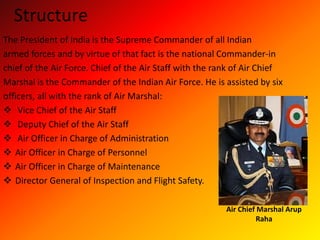
Air Chief Marshal Arup
Raha
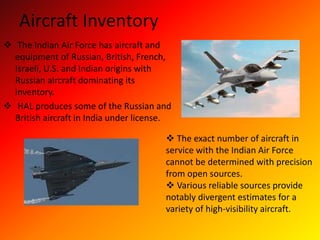
Aircraft Inventory
 The Indian Air Force has aircraft and
equipment of Russian, British, French,
Israeli, U.S. and Indian origins with
Russian aircraft dominating its
inventory.
 HAL produces some of the Russian and
British aircraft in India under license.
 The exact number of aircraft in
service with the Indian Air Force
cannot be determined with precision
from open sources.
 Various reliable sources provide
notably divergent estimates for a
variety of high-visibility aircraft.
Indian Air Force

Indian Air Force

  • 1.
    Indian Air Force PresentedBy Manpreet Sethi Class 9
  • 2.
    About It:-  Itsthe World's 4th largest Air force.  It was officially established on 8 October 1932 as an auxiliary air force of the British Empire and the prefix Royal was added in 1945 in recognition of its services during World War II.  Since independence, the IAF has been involved in four wars with neighbouring Pakistan and one with the People's Republic of China.
  • 3.
    History [World WarII]  During World War II, the IAF played an instrumental role in blocking the advance of the Japanese army in Burma, where its first air strike was on the Japanese military base in Arakan.  It also carried out strike missions against the Japanese airbases at Mae Hong Son, Chiang Mai and Chiang Rai in northern Thailand.  During the war, the IAF went through a phase of steady expansion. New aircraft, including the U.S. built Vultee Vengeance, Douglas DC-3 and the British Hawker Hurricane, Supermarine Spitfire and Westland Lysander, were added to its fleet.
  • 4.
    Mission  The IAF'smission is defined by the Armed Forces Act of 1947, Constitution of India and the Air Force Act of 1950.  the IAF has the primary objective of safeguarding Indian territory and national interests from all threats in conjunction with the other branches of the armed forces by defending Indian airspace.  The IAF also operates the Integrated Space Cell together with the other two branches of the Indian Armed Forces, the civilian Department of Space and the Indian Space Research Organisation (ISRO).
  • 5.
    Structure The President ofIndia is the Supreme Commander of all Indian armed forces and by virtue of that fact is the national Commander-in chief of the Air Force. Chief of the Air Staff with the rank of Air Chief Marshal is the Commander of the Indian Air Force. He is assisted by six officers, all with the rank of Air Marshal:  Vice Chief of the Air Staff  Deputy Chief of the Air Staff  Air Officer in Charge of Administration  Air Officer in Charge of Personnel  Air Officer in Charge of Maintenance  Director General of Inspection and Flight Safety. Air Chief Marshal Arup Raha
  • 6.
    Aircraft Inventory  TheIndian Air Force has aircraft and equipment of Russian, British, French, Israeli, U.S. and Indian origins with Russian aircraft dominating its inventory.  HAL produces some of the Russian and British aircraft in India under license.  The exact number of aircraft in service with the Indian Air Force cannot be determined with precision from open sources.  Various reliable sources provide notably divergent estimates for a variety of high-visibility aircraft.