INDIAN ARMY
CURRENT CHIEF
GENERAL
DALBIR SINGH
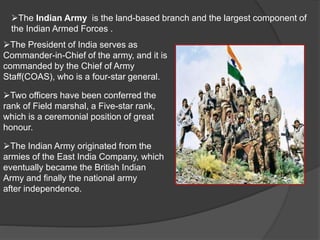
The Indian Army is the land-based branch and the largest component of
the Indian Armed Forces .
The President of India serves as
Commander-in-Chief of the army, and it is
commanded by the Chief of Army
Staff(COAS), who is a four-star general.
The Indian Army originated from the
armies of the East India Company, which
eventually became the British Indian
Army and finally the national army
after independence.
Two officers have been conferred the
rank of Field marshal, a Five-star rank,
which is a ceremonial position of great
honour.
 The primary mission of the Indian Army is to ensure national
security and unity, defending the nation from external
aggression and threats, and maintaining peace and security
within its borders.
It conducts humanitarian rescue operations during natural
calamities and other disturbances
It is a major component of national power alongside
the Indian Navy and the Indian Air Force.
 It is an all-volunteer force and comprises more than 80%
of the country's active defence personnel. It is one of the
largest standing armies in the world, with 1,129,900 active
troops and 960,000 reserve troops.
The units and regiments of the Indian Army have diverse
histories and have participated in a number of battles and
campaigns across the world, earning a large number of battle
and theatre honours before and after Independence.
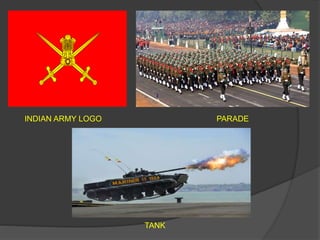
INDIAN ARMY LOGO PARADE
TANK
NAVY
INDIAN NAVY CURRENT
CHIEF
ADMIRAL
ROBIN.K.DHOWAN
The Indian Navy is the naval branch of
the armed forces of India.
The President of India serves as the
Commander-in-Chief of the Navy.
The Chief of Naval Staff (CNS),
usually a four-star officer in the rank
of Admiral, commands the navy.
In 1858, East India Company rule
gave way to the British Raj which
lasted until India became
independent in 1947. However it was
only when India became a republic in
1950, that the Royal Indian Navy as it
had been named since 1934- was
renamed to its modern title, the Indian
Navy.
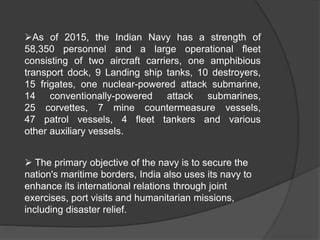
As of 2015, the Indian Navy has a strength of
58,350 personnel and a large operational fleet
consisting of two aircraft carriers, one amphibious
transport dock, 9 Landing ship tanks, 10 destroyers,
15 frigates, one nuclear-powered attack submarine,
14 conventionally-powered attack submarines,
25 corvettes, 7 mine countermeasure vessels,
47 patrol vessels, 4 fleet tankers and various
other auxiliary vessels.
 The primary objective of the navy is to secure the
nation's maritime borders, India also uses its navy to
enhance its international relations through joint
exercises, port visits and humanitarian missions,
including disaster relief.
INDIAN NAVY LOGO PARADE
INDIAN SHIP
AIR
FORCE
INDIAN AIR CURRENT
CHIEF
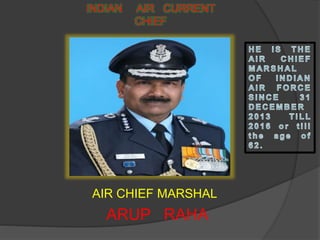
AIR CHIEF MARSHAL
ARUP RAHA
The Indian Air Force is the air
arm of the Indian armed forces.
Its the World's 4th largest Air
force.
Its primary responsibility is to
secure Indian airspace and to
conduct aerial warfare during a
conflict.
The Chief of Air Staff, an Air
Chief Marshal (ACM), is a four-
star commander and commands
the Air Force.
The International Institute for Strategic Studies
(IISS) estimates that the Indian Air Force has a
strength of 127,000 active personnel.
Flight global(Flight International) estimates
there to be around 1,820 aircraft in service with
the IAF. 862 Combat Planes ( 595 Fighters &
267 Attackers).
It was officially established on 8 October 1932 as
an auxiliary air force of the British Empire and the
prefix Royal was added in 1945 in recognition of its
services during World War II.
INDIAN AIR FORCE LOGO PARADE
INDIAN AIR FORCE FIGHTER
PLANE
MADE BY :-
PATHAMESH BANDEKAR
SUMEDH PATIL &

India's Defence System

  • 3.
  • 4.
    The Indian Armyis the land-based branch and the largest component of the Indian Armed Forces . The President of India serves as Commander-in-Chief of the army, and it is commanded by the Chief of Army Staff(COAS), who is a four-star general. The Indian Army originated from the armies of the East India Company, which eventually became the British Indian Army and finally the national army after independence. Two officers have been conferred the rank of Field marshal, a Five-star rank, which is a ceremonial position of great honour.
  • 5.
     The primarymission of the Indian Army is to ensure national security and unity, defending the nation from external aggression and threats, and maintaining peace and security within its borders. It conducts humanitarian rescue operations during natural calamities and other disturbances It is a major component of national power alongside the Indian Navy and the Indian Air Force.  It is an all-volunteer force and comprises more than 80% of the country's active defence personnel. It is one of the largest standing armies in the world, with 1,129,900 active troops and 960,000 reserve troops. The units and regiments of the Indian Army have diverse histories and have participated in a number of battles and campaigns across the world, earning a large number of battle and theatre honours before and after Independence.
  • 6.
    INDIAN ARMY LOGOPARADE TANK
  • 7.
  • 8.
  • 9.
    The Indian Navyis the naval branch of the armed forces of India. The President of India serves as the Commander-in-Chief of the Navy. The Chief of Naval Staff (CNS), usually a four-star officer in the rank of Admiral, commands the navy. In 1858, East India Company rule gave way to the British Raj which lasted until India became independent in 1947. However it was only when India became a republic in 1950, that the Royal Indian Navy as it had been named since 1934- was renamed to its modern title, the Indian Navy.
  • 10.
    As of 2015,the Indian Navy has a strength of 58,350 personnel and a large operational fleet consisting of two aircraft carriers, one amphibious transport dock, 9 Landing ship tanks, 10 destroyers, 15 frigates, one nuclear-powered attack submarine, 14 conventionally-powered attack submarines, 25 corvettes, 7 mine countermeasure vessels, 47 patrol vessels, 4 fleet tankers and various other auxiliary vessels.  The primary objective of the navy is to secure the nation's maritime borders, India also uses its navy to enhance its international relations through joint exercises, port visits and humanitarian missions, including disaster relief.
  • 11.
    INDIAN NAVY LOGOPARADE INDIAN SHIP
  • 12.
  • 13.
    INDIAN AIR CURRENT CHIEF AIRCHIEF MARSHAL ARUP RAHA
  • 14.
    The Indian AirForce is the air arm of the Indian armed forces. Its the World's 4th largest Air force. Its primary responsibility is to secure Indian airspace and to conduct aerial warfare during a conflict. The Chief of Air Staff, an Air Chief Marshal (ACM), is a four- star commander and commands the Air Force.
  • 15.
    The International Institutefor Strategic Studies (IISS) estimates that the Indian Air Force has a strength of 127,000 active personnel. Flight global(Flight International) estimates there to be around 1,820 aircraft in service with the IAF. 862 Combat Planes ( 595 Fighters & 267 Attackers). It was officially established on 8 October 1932 as an auxiliary air force of the British Empire and the prefix Royal was added in 1945 in recognition of its services during World War II.
  • 16.
    INDIAN AIR FORCELOGO PARADE INDIAN AIR FORCE FIGHTER PLANE
  • 17.
    MADE BY :- PATHAMESHBANDEKAR SUMEDH PATIL &