Feedback and Assessment:
   Embracing Diversity
Project Team
•   Heather Davidson
•   Leslie Robinson
•   Sue Braid
•   Gill Molyneaux
•   Helen Stafford

supported by
• Chrissi Nerantzi
• Donna Berwick
What is inclusive Teaching?
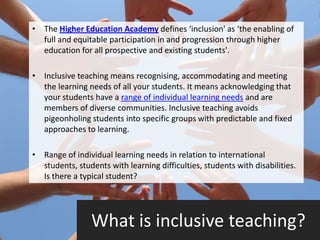
• The Higher Education Academy defines ‘inclusion' as ‘the enabling of
  full and equitable participation in and progression through higher
  education for all prospective and existing students'.

• Inclusive teaching means recognising, accommodating and meeting
  the learning needs of all your students. It means acknowledging that
  your students have a range of individual learning needs and are
  members of diverse communities. Inclusive teaching avoids
  pigeonholing students into specific groups with predictable and fixed
  approaches to learning.

• Range of individual learning needs in relation to international
  students, students with learning difficulties, students with disabilities.
  Is there a typical student?


                 What is inclusive teaching?
Higher Education Academy Project
• Overall aim – to develop an inclusive culture in
  Higher Education
• 16 Universities
• Initially a year long project
• 9 strands – feedback and assessment has been
  selected as UoS focus
• Task : to develop inclusive feedback and assessment
  across the University
Structure of the Project
•   Vision statement and Abstract
•   Staff and Student Engagement
•   Staff
•   Representative from each school to assist with identifying
    existing good practice
•    Discuss with project team assessment options appropriate
    to each school to form content of an inclusive assessment
    and feedback toolkit
•   Assist with disseminating toolkit
•   Audit of impact
•   Student Involvement
Inclusive practice
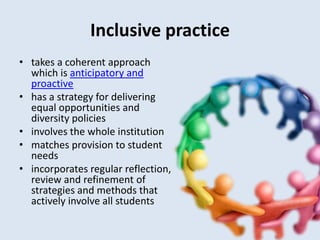
• takes a coherent approach
  which is anticipatory and
  proactive
• has a strategy for delivering
  equal opportunities and
  diversity policies
• involves the whole institution
• matches provision to student
  needs
• incorporates regular reflection,
  review and refinement of
  strategies and methods that
  actively involve all students
What is inclusive...
• Assessment?
• Feedback?

• Why Salford?
• Why now?
• ASPIRE
Inclusive practice
• http://www.youtube.com/watch?v=S5HZRXPb
  ow0
• http://www.youtube.com/watch?v=lz8heJbyo
  ZM                        I see what you mean... from
                                      my point... we should...
 This is interesting.... I could
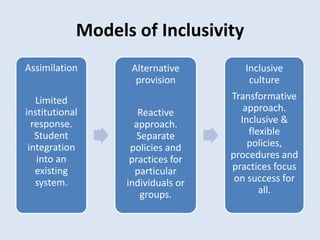
Models of Inclusivity
Assimilation       Alternative        Inclusive
                    provision          culture
   Limited                         Transformative
institutional        Reactive         approach.
  response.         approach.        Inclusive &
   Student           Separate          flexible
 integration       policies and        policies,
   into an         practices for   procedures and
   existing         particular     practices focus
   system.        individuals or    on success for
                      groups.             all.
Concepts to consider
• Medical model of
  disability/difference
• Social model of
  disability/difference
• Power difference
  between
  Staff/Student
Practice Examples
Teaching
• All students receive lecture notes 1 week
   prior to lecture
• Lecture information provided in range of
   formats – audio, PowerPoint, Podcast

Assessment
• Choice of assessment format for all
   students

Feedback
• Personalised feedback in a format that is
   meaningful for the student
• Audio, podcast
• Traditional? Innovative?
Case studies
Case Study 1: Is anybody out there?

A student who uses a wheelchair, and who has slow keyboarding skills, uses assistive technology (eg a one-handed
keyboard) and is required to participate in on-line discussions via a Virtual Learning Environment as a part of the
assessment, at a designated time during the week.
However, the slow keyboarding skills of the student means that by the time he has typed a response to a thread, the
conversation has moved on, and he is unable to engage in any dialogue. The highly dynamic nature of this assessment
process means that the student is being placed at an unfair disadvantage, and this becomes clear to the tutor when he
looks at the results of the discussion
The tutor identifies several options:
1. Offer a scribe who can type out the student’s
responses;
2. Ask for the student to write a reflection on the
discussion, rather than contribute to it;
3. Remove the on-line discussion from the assessment
process, returning instead to a conventional seminar
format
4. Alter the ‘chat’ function to something more akin to a
notice-board, whereby thoughts and responses can be
posted on a limited number of topics throughout the                                                              ?
assessment process.

Questions
1. Which option is most suited to the
   principles of inclusive assessment and
   why?
2. Do you see any barriers with this option?
Case Study 2: Death by Exam                                   Questions
                                                              1. Did the tutor take the best course of
A student with dyslexia is on an English course that is          action?
assessed at its conclusion on the basis on a series of
examined essays. The student’s writing skills are slow.
                                                              2. Was the approach taken an example of
Legibility and spelling/grammar are improved when the            assimilating, alternative or inclusive
student uses a word processor, and this is the student’s         assessment practice?
preferred method of written communication, as it also         3. Were there any alternative solutions
makes for clearer and more easily reviewed text. This            which would demonstrate inclusive
method, however, is even slower than hand-writing for this       practice?
student. The assessment is intended to consist of two 4
hour exams, with the students completing one long essay
question and two short essay questions in each.

Tutor’s action: It is believed that the student would not,
even with extended time, be able to fully demonstrate his
ability and understanding, and as such the possibility of
replacing the 4 hour examination with either a 7 day open
paper, or with assessed coursework, is considered. These
options, however, are rejected as the tutor is aware that
many students without disabilities may have learning styles
that are not best suited to assessment under examination
conditions, and it is felt that the dyslexic student may
therefore be gaining an unfair advantage, in these
particular circumstances.

In the end, the student is assessed via a 2 day open paper
and one 3 hour examination, in which he attempts the
same 2 short essay questions as other students. The
student is allowed to use a computer for this exam.
Case Study 3: Portfolio

“Study in Higher Education” is a first term, year ‘0’ module designed to assist students in
developing the necessary study skills and learning strategies required for a successful
undergraduate career.
Previously, the module was assessed by means of an extended essay but concerns about the
increasingly diverse student population, and the fact that the essay form of assessment is rarely
used in Science led to a change to a portfolio assessment.
The module is now assessed using a portfolio designed around criteria, based on the learning
outcomes of the module, but the means by which these criteria are satisfied are entirely flexible.
This provided students with some independence in selecting ways of delivery best suited to
demonstrate their strengths and abilities through articles, lab reports and coursework. Students
are strongly encouraged to use pieces of coursework completed as part of their programme of
study, which has been enhanced after marking as a result of feedback.

Questions
1. In what way does the new method of assessment address the tutors concerns
   about the original approach?
2. Does the change in assessment method demonstrate inclusive practice?
3. What do you perceive to be the barriers of introducing a portfolio as a method of
   assessment?
4. How might you engage staff members to try this method?
Case Study 4 : Decisions, decisions!

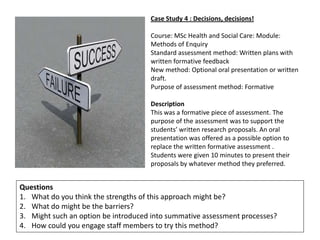
                                     Course: MSc Health and Social Care: Module:
                                     Methods of Enquiry
                                     Standard assessment method: Written plans with
                                     written formative feedback
                                     New method: Optional oral presentation or written
                                     draft.
                                     Purpose of assessment method: Formative

                                     Description
                                     This was a formative piece of assessment. The
                                     purpose of the assessment was to support the
                                     students’ written research proposals. An oral
                                     presentation was offered as a possible option to
                                     replace the written formative assessment .
                                     Students were given 10 minutes to present their
                                     proposals by whatever method they preferred.


Questions
1. What do you think the strengths of this approach might be?
2. What do might be the barriers?
3. Might such an option be introduced into summative assessment processes?
4. How could you engage staff members to try this method?
Questions
                                                          1. Is this an example of assimilating,
                                                          alternative or inclusive assessment?
Case Study 5: Video Star
                                                          2. How might written assessments be
A student has a significant hearing impairment. As a      adapted within your school to take into
consequence of this he was having great difficulty in     consideration where English is not the
writing the contextual studies assignment to the          students first language?
required standard as he did not have an
understanding of the English needed. The student’s        3. What would be the barriers to this?
language of communication was BSL. This meant that
he would fail his HND because of his lack of English      4. How might you engage staff members to
at the required level.                                    design alternative assessments?

Action: Rather than try to improve his English, in co-
operation with the validating body it was felt better
if he presented his assignment in BSL. This would be
videoed, with an interpreter present and voiceover.
It would have to be of the same standard and the
marking would be looking for the same criteria as if it
was written. Therefore there would have to be the
same level of academic debate as with a written
assignment; the only difference would be in the
method of it being recorded.
Case Study 6: Say it out loud

As part of a pilot study, fifteen student volunteers submitted
samples of their work for formative feedback. The work
included essays, parts of dissertations and written reflections.
After reading students’ work, feedback was recorded on a
desktop PC and converted to mp3 format . The mp3 files were
then sent to the students as email attachments. Semi
structured interviews with the students took place within 3
weeks of them receiving this feedback.

Overall, the students responded very positively to this type of
feedback. Reasons cited included: it was easier to understand
because handwriting is often illegible; it had more depth
because possible strategies for solving problems were
included rather than just stating what the problems were; and
it seemed ‘more genuine’, indicating that speech is received in
a more personal way than writing.
http://www.bioscience.heacademy.ac.uk/ftp/newsletters/bulletin22p5.pdf


Questions
1. In what ways might this be considered inclusive practice in providing feedback?
2. What do you perceive to be the barriers?
3. How might you engage staff members to try this method?
Case studies have been synthesised
      from the following sources
• http://www.bioscience.heacademy.ac.uk/ftp/
  Resources/disability/assessingdisabledstudent
  s.pdf
• http://www.plymouth.ac.uk/pages/view.asp?
  page=10494
• http://www.psychology.heacademy.ac.uk/net
  works/sig/ia.asp
• http://www.bioscience.heacademy.ac.uk/ftp/
  newsletters/bulletin22p5.pdf
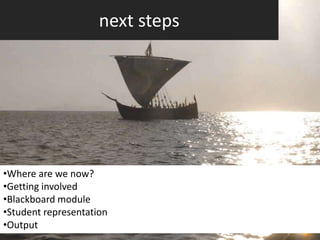
next steps


•Where are we now?
•Getting involved
•Blackboard module
•Student representation
•Output
Where are we now?
•   Senior Management Support
•   University wide developments
•   Research project
•   2 phases
•   Student volunteers
•   Staff champions
•   Evaluation of practice
•   Report
Focus
• Inclusive feedback and assessment as defined
  by students
• Student engagement
• Authentic/Meaningful
• Impact
How can you help?
•   Blackboard module
•   Student focus groups
•   Examples of good practice
•   Engagement with project developments

TLC - Creating an Inclusive Curriculum

  • 1.
    Feedback and Assessment: Embracing Diversity
  • 2.
    Project Team • Heather Davidson • Leslie Robinson • Sue Braid • Gill Molyneaux • Helen Stafford supported by • Chrissi Nerantzi • Donna Berwick
  • 3.
  • 4.
    • The HigherEducation Academy defines ‘inclusion' as ‘the enabling of full and equitable participation in and progression through higher education for all prospective and existing students'. • Inclusive teaching means recognising, accommodating and meeting the learning needs of all your students. It means acknowledging that your students have a range of individual learning needs and are members of diverse communities. Inclusive teaching avoids pigeonholing students into specific groups with predictable and fixed approaches to learning. • Range of individual learning needs in relation to international students, students with learning difficulties, students with disabilities. Is there a typical student? What is inclusive teaching?
  • 5.
    Higher Education AcademyProject • Overall aim – to develop an inclusive culture in Higher Education • 16 Universities • Initially a year long project • 9 strands – feedback and assessment has been selected as UoS focus • Task : to develop inclusive feedback and assessment across the University
  • 6.
    Structure of theProject • Vision statement and Abstract • Staff and Student Engagement • Staff • Representative from each school to assist with identifying existing good practice • Discuss with project team assessment options appropriate to each school to form content of an inclusive assessment and feedback toolkit • Assist with disseminating toolkit • Audit of impact • Student Involvement
  • 7.
    Inclusive practice • takesa coherent approach which is anticipatory and proactive • has a strategy for delivering equal opportunities and diversity policies • involves the whole institution • matches provision to student needs • incorporates regular reflection, review and refinement of strategies and methods that actively involve all students
  • 8.
    What is inclusive... •Assessment? • Feedback? • Why Salford? • Why now? • ASPIRE
  • 9.
    Inclusive practice • http://www.youtube.com/watch?v=S5HZRXPb ow0 • http://www.youtube.com/watch?v=lz8heJbyo ZM I see what you mean... from my point... we should... This is interesting.... I could
  • 10.
    Models of Inclusivity Assimilation Alternative Inclusive provision culture Limited Transformative institutional Reactive approach. response. approach. Inclusive & Student Separate flexible integration policies and policies, into an practices for procedures and existing particular practices focus system. individuals or on success for groups. all.
  • 11.
    Concepts to consider •Medical model of disability/difference • Social model of disability/difference • Power difference between Staff/Student
  • 12.
    Practice Examples Teaching • Allstudents receive lecture notes 1 week prior to lecture • Lecture information provided in range of formats – audio, PowerPoint, Podcast Assessment • Choice of assessment format for all students Feedback • Personalised feedback in a format that is meaningful for the student • Audio, podcast • Traditional? Innovative?
  • 13.
  • 14.
    Case Study 1:Is anybody out there? A student who uses a wheelchair, and who has slow keyboarding skills, uses assistive technology (eg a one-handed keyboard) and is required to participate in on-line discussions via a Virtual Learning Environment as a part of the assessment, at a designated time during the week. However, the slow keyboarding skills of the student means that by the time he has typed a response to a thread, the conversation has moved on, and he is unable to engage in any dialogue. The highly dynamic nature of this assessment process means that the student is being placed at an unfair disadvantage, and this becomes clear to the tutor when he looks at the results of the discussion The tutor identifies several options: 1. Offer a scribe who can type out the student’s responses; 2. Ask for the student to write a reflection on the discussion, rather than contribute to it; 3. Remove the on-line discussion from the assessment process, returning instead to a conventional seminar format 4. Alter the ‘chat’ function to something more akin to a notice-board, whereby thoughts and responses can be posted on a limited number of topics throughout the ? assessment process. Questions 1. Which option is most suited to the principles of inclusive assessment and why? 2. Do you see any barriers with this option?
  • 15.
    Case Study 2:Death by Exam Questions 1. Did the tutor take the best course of A student with dyslexia is on an English course that is action? assessed at its conclusion on the basis on a series of examined essays. The student’s writing skills are slow. 2. Was the approach taken an example of Legibility and spelling/grammar are improved when the assimilating, alternative or inclusive student uses a word processor, and this is the student’s assessment practice? preferred method of written communication, as it also 3. Were there any alternative solutions makes for clearer and more easily reviewed text. This which would demonstrate inclusive method, however, is even slower than hand-writing for this practice? student. The assessment is intended to consist of two 4 hour exams, with the students completing one long essay question and two short essay questions in each. Tutor’s action: It is believed that the student would not, even with extended time, be able to fully demonstrate his ability and understanding, and as such the possibility of replacing the 4 hour examination with either a 7 day open paper, or with assessed coursework, is considered. These options, however, are rejected as the tutor is aware that many students without disabilities may have learning styles that are not best suited to assessment under examination conditions, and it is felt that the dyslexic student may therefore be gaining an unfair advantage, in these particular circumstances. In the end, the student is assessed via a 2 day open paper and one 3 hour examination, in which he attempts the same 2 short essay questions as other students. The student is allowed to use a computer for this exam.
  • 16.
    Case Study 3:Portfolio “Study in Higher Education” is a first term, year ‘0’ module designed to assist students in developing the necessary study skills and learning strategies required for a successful undergraduate career. Previously, the module was assessed by means of an extended essay but concerns about the increasingly diverse student population, and the fact that the essay form of assessment is rarely used in Science led to a change to a portfolio assessment. The module is now assessed using a portfolio designed around criteria, based on the learning outcomes of the module, but the means by which these criteria are satisfied are entirely flexible. This provided students with some independence in selecting ways of delivery best suited to demonstrate their strengths and abilities through articles, lab reports and coursework. Students are strongly encouraged to use pieces of coursework completed as part of their programme of study, which has been enhanced after marking as a result of feedback. Questions 1. In what way does the new method of assessment address the tutors concerns about the original approach? 2. Does the change in assessment method demonstrate inclusive practice? 3. What do you perceive to be the barriers of introducing a portfolio as a method of assessment? 4. How might you engage staff members to try this method?
  • 17.
    Case Study 4: Decisions, decisions! Course: MSc Health and Social Care: Module: Methods of Enquiry Standard assessment method: Written plans with written formative feedback New method: Optional oral presentation or written draft. Purpose of assessment method: Formative Description This was a formative piece of assessment. The purpose of the assessment was to support the students’ written research proposals. An oral presentation was offered as a possible option to replace the written formative assessment . Students were given 10 minutes to present their proposals by whatever method they preferred. Questions 1. What do you think the strengths of this approach might be? 2. What do might be the barriers? 3. Might such an option be introduced into summative assessment processes? 4. How could you engage staff members to try this method?
  • 18.
    Questions 1. Is this an example of assimilating, alternative or inclusive assessment? Case Study 5: Video Star 2. How might written assessments be A student has a significant hearing impairment. As a adapted within your school to take into consequence of this he was having great difficulty in consideration where English is not the writing the contextual studies assignment to the students first language? required standard as he did not have an understanding of the English needed. The student’s 3. What would be the barriers to this? language of communication was BSL. This meant that he would fail his HND because of his lack of English 4. How might you engage staff members to at the required level. design alternative assessments? Action: Rather than try to improve his English, in co- operation with the validating body it was felt better if he presented his assignment in BSL. This would be videoed, with an interpreter present and voiceover. It would have to be of the same standard and the marking would be looking for the same criteria as if it was written. Therefore there would have to be the same level of academic debate as with a written assignment; the only difference would be in the method of it being recorded.
  • 19.
    Case Study 6:Say it out loud As part of a pilot study, fifteen student volunteers submitted samples of their work for formative feedback. The work included essays, parts of dissertations and written reflections. After reading students’ work, feedback was recorded on a desktop PC and converted to mp3 format . The mp3 files were then sent to the students as email attachments. Semi structured interviews with the students took place within 3 weeks of them receiving this feedback. Overall, the students responded very positively to this type of feedback. Reasons cited included: it was easier to understand because handwriting is often illegible; it had more depth because possible strategies for solving problems were included rather than just stating what the problems were; and it seemed ‘more genuine’, indicating that speech is received in a more personal way than writing. http://www.bioscience.heacademy.ac.uk/ftp/newsletters/bulletin22p5.pdf Questions 1. In what ways might this be considered inclusive practice in providing feedback? 2. What do you perceive to be the barriers? 3. How might you engage staff members to try this method?
  • 20.
    Case studies havebeen synthesised from the following sources • http://www.bioscience.heacademy.ac.uk/ftp/ Resources/disability/assessingdisabledstudent s.pdf • http://www.plymouth.ac.uk/pages/view.asp? page=10494 • http://www.psychology.heacademy.ac.uk/net works/sig/ia.asp • http://www.bioscience.heacademy.ac.uk/ftp/ newsletters/bulletin22p5.pdf
  • 21.
    next steps •Where arewe now? •Getting involved •Blackboard module •Student representation •Output
  • 22.
    Where are wenow? • Senior Management Support • University wide developments • Research project • 2 phases • Student volunteers • Staff champions • Evaluation of practice • Report
  • 23.
    Focus • Inclusive feedbackand assessment as defined by students • Student engagement • Authentic/Meaningful • Impact
  • 24.
    How can youhelp? • Blackboard module • Student focus groups • Examples of good practice • Engagement with project developments