Adverbs: Form and Function
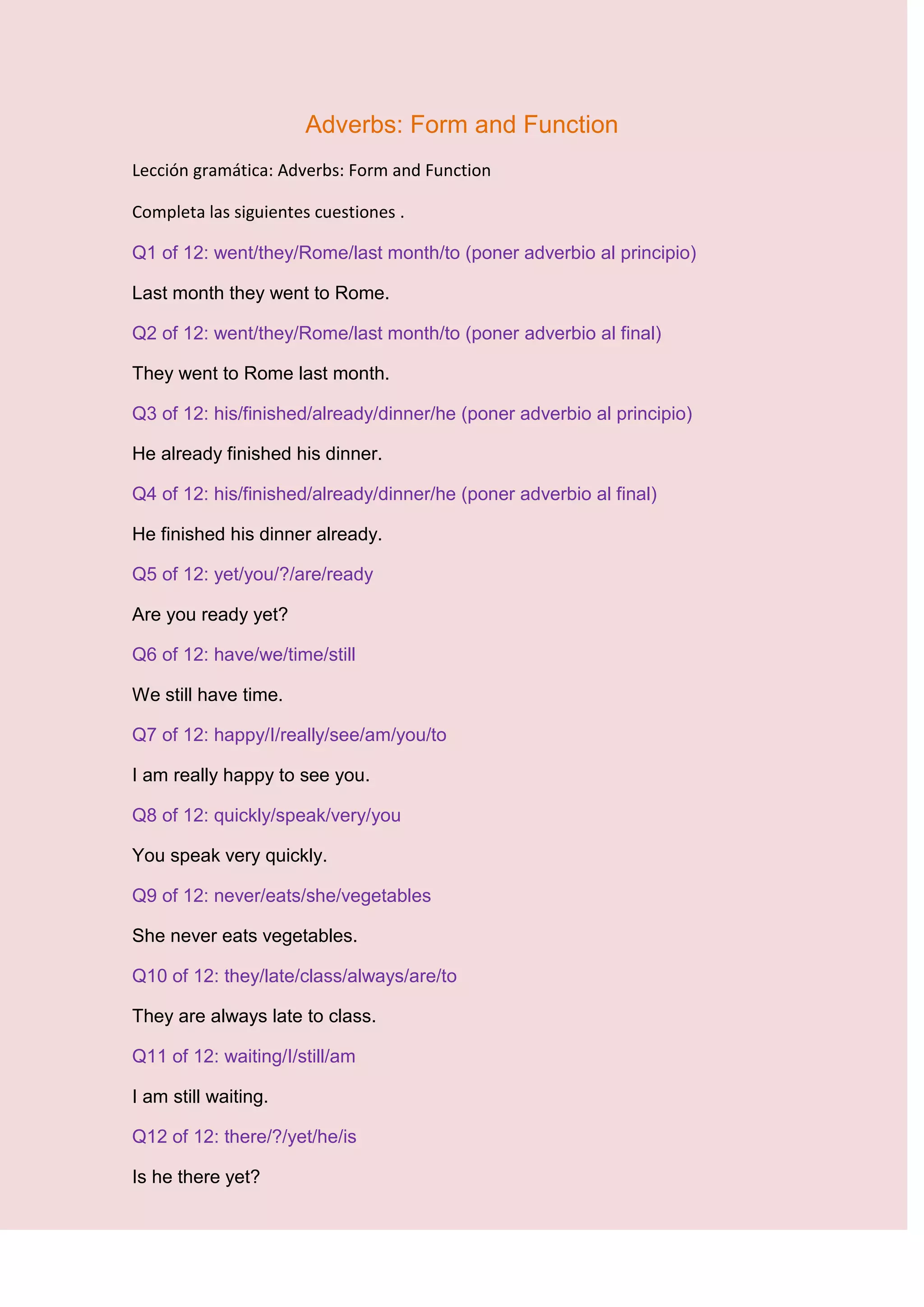
Lección gramática: Adverbs: Form and Function

Completa las siguientes cuestiones .

Q1 of 12: went/they/Rome/last month/to (poner adverbio al principio)

Last month they went to Rome.

Q2 of 12: went/they/Rome/last month/to (poner adverbio al final)

They went to Rome last month.

Q3 of 12: his/finished/already/dinner/he (poner adverbio al principio)

He already finished his dinner.

Q4 of 12: his/finished/already/dinner/he (poner adverbio al final)

He finished his dinner already.

Q5 of 12: yet/you/?/are/ready

Are you ready yet?

Q6 of 12: have/we/time/still

We still have time.

Q7 of 12: happy/I/really/see/am/you/to

I am really happy to see you.

Q8 of 12: quickly/speak/very/you

You speak very quickly.

Q9 of 12: never/eats/she/vegetables

She never eats vegetables.

Q10 of 12: they/late/class/always/are/to

They are always late to class.

Q11 of 12: waiting/I/still/am

I am still waiting.

Q12 of 12: there/?/yet/he/is

Is he there yet?
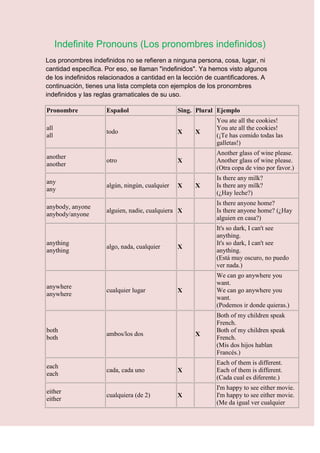
Indefinite Pronouns (Los pronombres indefinidos)
Los pronombres indefinidos no se refieren a ninguna persona, cosa, lugar, ni
cantidad específica. Por eso, se llaman "indefinidos". Ya hemos visto algunos
de los indefinidos relacionados a cantidad en la lección de cuantificadores. A
continuación, tienes una lista completa con ejemplos de los pronombres
indefinidos y las reglas gramaticales de su uso.

Pronombre            Español                    Sing. Plural Ejemplo
                                                            You ate all the cookies!
all                                                         You ate all the cookies!
                     todo                       X    X
all                                                         (¡Te has comido todas las
                                                            galletas!)
                                                            Another glass of wine please.
another
                     otro                       X           Another glass of wine please.
another
                                                            (Otra copa de vino por favor.)
                                                            Is there any milk?
any
                     algún, ningún, cualquier   X    X      Is there any milk?
any
                                                            (¿Hay leche?)
                                                            Is there anyone home?
anybody, anyone
                     alguien, nadie, cualquiera X           Is there anyone home? (¿Hay
anybody/anyone
                                                            alguien en casa?)
                                                            It's so dark, I can't see
                                                            anything.
anything                                                    It's so dark, I can't see
                     algo, nada, cualquier      X
anything                                                    anything.
                                                            (Está muy oscuro, no puedo
                                                            ver nada.)
                                                            We can go anywhere you
                                                            want.
anywhere
                     cualquier lugar            X           We can go anywhere you
anywhere
                                                            want.
                                                            (Podemos ir donde quieras.)
                                                            Both of my children speak
                                                            French.
both                                                        Both of my children speak
                     ambos/los dos                   X
both                                                        French.
                                                            (Mis dos hijos hablan
                                                            Francés.)
                                                            Each of them is different.
each
                     cada, cada uno             X           Each of them is different.
each
                                                            (Cada cual es diferente.)
                                                            I'm happy to see either movie.
either
                     cualquiera (de 2)          X           I'm happy to see either movie.
either
                                                            (Me da igual ver cualquier
pelicula.)
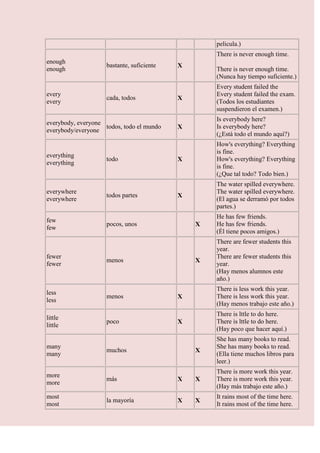
                                                   There is never enough time.
enough
                    bastante, suficiente   X
enough                                             There is never enough time.
                                                   (Nunca hay tiempo suficiente.)
                                                   Every student failed the
every                                              Every student failed the exam.
                    cada, todos            X
every                                              (Todos los estudiantes
                                                   suspendieron el examen.)
                                                   Is everybody here?
everybody, everyone
                    todos, todo el mundo   X       Is everybody here?
everybody/everyone
                                                   (¿Está todo el mundo aquí?)
                                                   How's everything? Everything
                                                   is fine.
everything
                    todo                   X       How's everything? Everything
everything
                                                   is fine.
                                                   (¿Que tal todo? Todo bien.)
                                                   The water spilled everywhere.
everywhere                                         The water spilled everywhere.
                    todos partes           X
everywhere                                         (El agua se derramó por todos
                                                   partes.)
                                                   He has few friends.
few
                    pocos, unos                X   He has few friends.
few
                                                   (Él tiene pocos amigos.)
                                                   There are fewer students this
                                                   year.
fewer                                              There are fewer students this
                    menos                      X
fewer                                              year.
                                                   (Hay menos alumnos este
                                                   año.)
                                                   There is less work this year.
less
                    menos                  X       There is less work this year.
less
                                                   (Hay menos trabajo este año.)
                                                   There is lttle to do here.
little
                    poco                   X       There is lttle to do here.
little
                                                   (Hay poco que hacer aquí.)
                                                   She has many books to read.
many                                               She has many books to read.
                    muchos                     X
many                                               (Ella tiene muchos libros para
                                                   leer.)
                                                   There is more work this year.
more
                    más                    X   X   There is more work this year.
more
                                                   (Hay más trabajo este año.)
most                                               It rains most of the time here.
                    la mayoría             X   X
most                                               It rains most of the time here.
(Llueve la mayoría del tiempo
                                          aquí.)
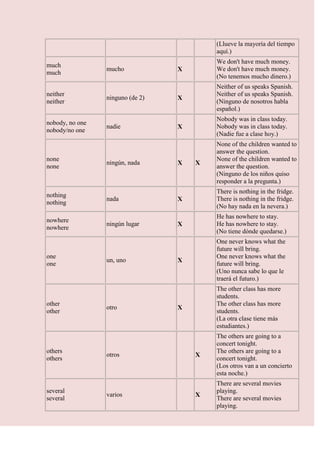
                                          We don't have much money.
much
                 mucho            X       We don't have much money.
much
                                          (No tenemos mucho dinero.)
                                          Neither of us speaks Spanish.
neither                                   Neither of us speaks Spanish.
                 ninguno (de 2)   X
neither                                   (Ninguno de nosotros habla
                                          español.)
                                          Nobody was in class today.
nobody, no one
                 nadie            X       Nobody was in class today.
nobody/no one
                                          (Nadie fue a clase hoy.)
                                          None of the children wanted to
                                          answer the question.
none                                      None of the children wanted to
                 ningún, nada     X   X
none                                      answer the question.
                                          (Ninguno de los niños quiso
                                          responder a la pregunta.)
                                          There is nothing in the fridge.
nothing
                 nada             X       There is nothing in the fridge.
nothing
                                          (No hay nada en la nevera.)
                                          He has nowhere to stay.
nowhere
                 ningún lugar     X       He has nowhere to stay.
nowhere
                                          (No tiene dónde quedarse.)
                                          One never knows what the
                                          future will bring.
one                                       One never knows what the
                 un, uno          X
one                                       future will bring.
                                          (Uno nunca sabe lo que le
                                          traerá el futuro.)
                                          The other class has more
                                          students.
other                                     The other class has more
                 otro             X
other                                     students.
                                          (La otra clase tiene más
                                          estudiantes.)
                                          The others are going to a
                                          concert tonight.
others                                    The others are going to a
                 otros                X
others                                    concert tonight.
                                          (Los otros van a un concierto
                                          esta noche.)
                                          There are several movies
several                                   playing.
                 varios               X
several                                   There are several movies
                                          playing.
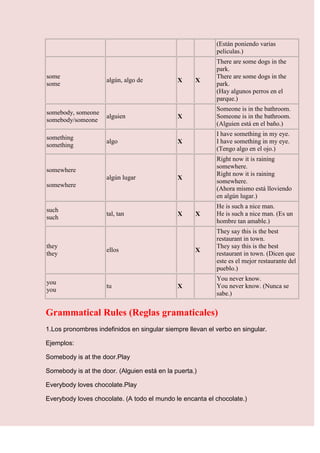
(Están poniendo varias
                                                           peliculas.)
                                                           There are some dogs in the
                                                           park.
some                                                       There are some dogs in the
                     algún, algo de           X     X
some                                                       park.
                                                           (Hay algunos perros en el
                                                           parque.)
                                                           Someone is in the bathroom.
somebody, someone
                     alguien                  X            Someone is in the bathroom.
somebody/someone
                                                           (Alguien está en el baño.)
                                                           I have something in my eye.
something
                     algo                     X            I have something in my eye.
something
                                                           (Tengo algo en el ojo.)
                                                           Right now it is raining
                                                           somewhere.
somewhere
                                                           Right now it is raining
                     algún lugar              X
                                                           somewhere.
somewhere
                                                           (Ahora mismo está lloviendo
                                                           en algún lugar.)
                                                           He is such a nice man.
such
                     tal, tan                 X     X      He is such a nice man. (Es un
such
                                                           hombre tan amable.)
                                                           They say this is the best
                                                           restaurant in town.
they                                                       They say this is the best
                     ellos                          X
they                                                       restaurant in town. (Dicen que
                                                           este es el mejor restaurante del
                                                           pueblo.)
                                                           You never know.
you
                     tu                       X            You never know. (Nunca se
you
                                                           sabe.)


Grammatical Rules (Reglas gramaticales)
1.Los pronombres indefinidos en singular siempre llevan el verbo en singular.

Ejemplos:

Somebody is at the door.Play

Somebody is at the door. (Alguien está en la puerta.)

Everybody loves chocolate.Play

Everybody loves chocolate. (A todo el mundo le encanta el chocolate.)
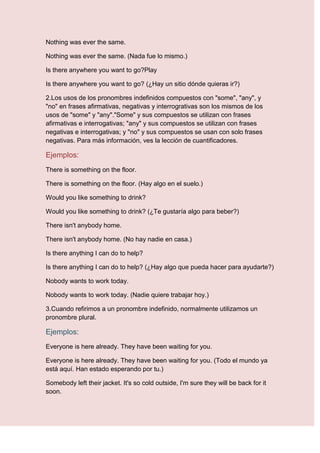
Nothing was ever the same.

Nothing was ever the same. (Nada fue lo mismo.)

Is there anywhere you want to go?Play

Is there anywhere you want to go? (¿Hay un sitio dónde quieras ir?)

2.Los usos de los pronombres indefinidos compuestos con "some", "any", y
"no" en frases afirmativas, negativas y interrogrativas son los mismos de los
usos de "some" y "any"."Some" y sus compuestos se utilizan con frases
afirmativas e interrogativas; "any" y sus compuestos se utilizan con frases
negativas e interrogativas; y "no" y sus compuestos se usan con solo frases
negativas. Para más información, ves la lección de cuantificadores.

Ejemplos:
There is something on the floor.

There is something on the floor. (Hay algo en el suelo.)

Would you like something to drink?

Would you like something to drink? (¿Te gustaría algo para beber?)

There isn't anybody home.

There isn't anybody home. (No hay nadie en casa.)

Is there anything I can do to help?

Is there anything I can do to help? (¿Hay algo que pueda hacer para ayudarte?)

Nobody wants to work today.

Nobody wants to work today. (Nadie quiere trabajar hoy.)

3.Cuando refirimos a un pronombre indefinido, normalmente utilizamos un
pronombre plural.

Ejemplos:
Everyone is here already. They have been waiting for you.

Everyone is here already. They have been waiting for you. (Todo el mundo ya
está aquí. Han estado esperando por tu.)

Somebody left their jacket. It's so cold outside, I'm sure they will be back for it
soon.
Somebody left their jacket. It's so cold outside, I'm sure they will be back for it
soon. (Alguien ha dejado su chaqueta. Hace tanto frío, estoy seguro que
regresará pronto.)

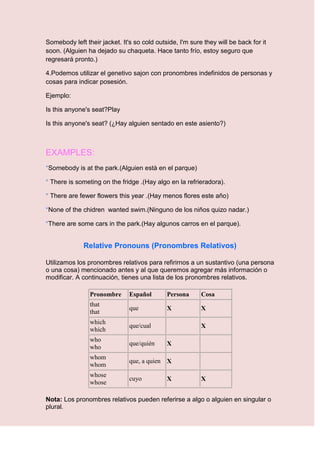
4.Podemos utilizar el genetivo sajon con pronombres indefinidos de personas y
cosas para indicar posesión.

Ejemplo:

Is this anyone's seat?Play

Is this anyone's seat? (¿Hay alguien sentado en este asiento?)


EXAMPLES:
*Somebody is at the park.(Alguien està en el parque)

* There is someting on the fridge .(Hay algo en la refrieradora).

* There are fewer flowers this year .(Hay menos flores este año)

*None of the chidren wanted swim.(Ninguno de los niños quizo nadar.)

*There are some cars in the park.(Hay algunos carros en el parque).


              Relative Pronouns (Pronombres Relativos)

Utilizamos los pronombres relativos para refirirnos a un sustantivo (una persona
o una cosa) mencionado antes y al que queremos agregar más información o
modificar. A continuación, tienes una lista de los pronombres relativos.

                Pronombre      Español       Persona      Cosa
                that
                               que           X            X
                that
                which
                               que/cual                   X
                which
                who
                               que/quién     X
                who
                whom
                               que, a quien X
                whom
                whose
                               cuyo          X            X
                whose

Nota: Los pronombres relativos pueden referirse a algo o alguien en singular o
plural.
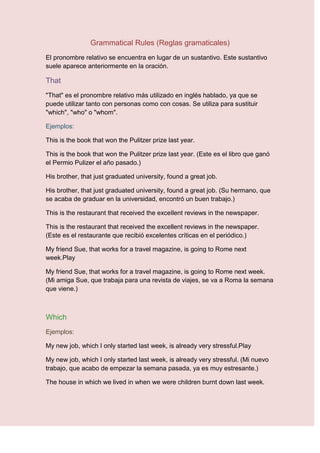
Grammatical Rules (Reglas gramaticales)
El pronombre relativo se encuentra en lugar de un sustantivo. Este sustantivo
suele aparece anteriormente en la oración.

That
"That" es el pronombre relativo más utilizado en inglés hablado, ya que se
puede utilizar tanto con personas como con cosas. Se utiliza para sustituir
"which", "who" o "whom".

Ejemplos:

This is the book that won the Pulitzer prize last year.

This is the book that won the Pulitzer prize last year. (Este es el libro que ganó
el Permio Pulizer el año pasado.)

His brother, that just graduated university, found a great job.

His brother, that just graduated university, found a great job. (Su hermano, que
se acaba de graduar en la universidad, encontró un buen trabajo.)

This is the restaurant that received the excellent reviews in the newspaper.

This is the restaurant that received the excellent reviews in the newspaper.
(Este es el restaurante que recibió excelentes críticas en el periódico.)

My friend Sue, that works for a travel magazine, is going to Rome next
week.Play

My friend Sue, that works for a travel magazine, is going to Rome next week.
(Mi amiga Sue, que trabaja para una revista de viajes, se va a Roma la semana
que viene.)


Which
Ejemplos:

My new job, which I only started last week, is already very stressful.Play

My new job, which I only started last week, is already very stressful. (Mi nuevo
trabajo, que acabo de empezar la semana pasada, ya es muy estresante.)

The house in which we lived in when we were children burnt down last week.
(La casa en la que vivíamos cuando éramos niños se quemó la semana
pasada.)

Who

Solo se puede utilizar "who" con personas.

Ejemplos:
My sister, who just moved in with me, is looking for a job.

My sister, who just moved in with me, is looking for a job. (Mi hermana, que se
acaba de mudar conmigo, está buscando un trabajo.)

I never met someone who didn't like music.

I never met someone who didn't like music. (Nunca he conocido a alguien que
no le guste la música.)


Whom
"Whom" se utiliza para hacer referencia al objeto indirecto del verbo, pero no lo
utilizamos mucho en Inglés coloquial. Más a menudo utilizamos "who" en vez
de "whom".

Ejemplos:
The woman with whom I was talking to was my cousin.Play

The woman with whom I was talking to was my cousin. (La mujer con quién
estaba hablando era mi prima.)

This is Peter, whom I met at the party last week.Play

This is Peter, whom I met at the party last week. (Este es Peter, a quien conocí
en la fiesta la semana pasada.)


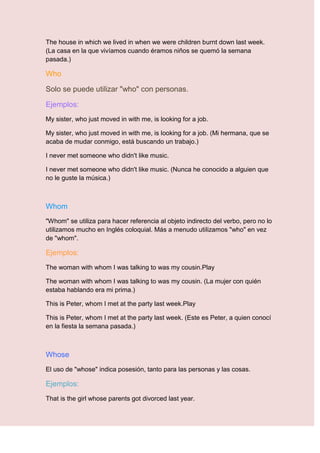
Whose
El uso de "whose" indica posesión, tanto para las personas y las cosas.

Ejemplos:
That is the girl whose parents got divorced last year.
That is the girl whose parents got divorced last year. (Esa es la chica cuyos
padres se divorciaron el año pasado.)

Paul, whose wife just had a baby, will not be at work for a few weeks.

Paul, whose wife just had a baby, will not be at work for a few weeks. (Paul,
cuyo esposa acaba de tener un bebé, no irá a trabajar durante unas semanas.)

Nota: Puede omitirse el pronombre relativo cuando es el objeto de
la frase.

Ejemplos:
The exam I took this morning won't be corrected and returned until next week.

The exam [that] I took this morning won't be corrected and returned until next
week. (El examen que hice esta mañana no se corregirá ni se devolverá hasta
la semana que viene.)

The woman I'm dating is a teacher.

The woman [who] I'm dating is a teacher. (La mujer con quien estoy saliendo es
profesora.)


When and where

Ejemplos:
The university where I teach is an excellent school.

The university where I teach is an excellent school. (La universidad donde
enseño es una escuela excelente.)

Can you tell me when is the best time to call?

Can you tell me when is the best time to call? (¿Puedes decirme cuando es la
mejor hora para llamar?)


                  Relative Clauses (Cláusula relativas)
Se utilizan los pronombres relativos para unir dos o más cláusulas y formando
así lo que llamamos "cláusulas relativas". Hay dos tipos de cláusulas relativas:
las que añaden información adicional y aquellos que modificar (o definir) el
sujeto de la oración.
Non-defining Relative Clauses
Estas cláusulas agregan información adicional. Se utiliza comas para separar la
cláusula relativa del resto de la oración.

Ejemplos:
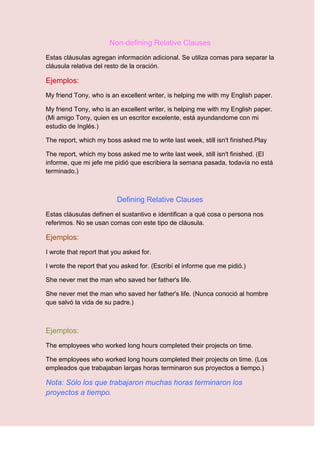
My friend Tony, who is an excellent writer, is helping me with my English paper.

My friend Tony, who is an excellent writer, is helping me with my English paper.
(Mi amigo Tony, quien es un escritor excelente, está ayundandome con mi
estudio de Inglés.)

The report, which my boss asked me to write last week, still isn't finished.Play

The report, which my boss asked me to write last week, still isn't finished. (El
informe, que mi jefe me pidió que escribiera la semana pasada, todavía no está
terminado.)


                          Defining Relative Clauses
Estas cláusulas definen el sustantivo e identifican a qué cosa o persona nos
referimos. No se usan comas con este tipo de cláusula.

Ejemplos:
I wrote that report that you asked for.

I wrote the report that you asked for. (Escribí el informe que me pidió.)

She never met the man who saved her father's life.

She never met the man who saved her father's life. (Nunca conoció al hombre
que salvó la vida de su padre.)


Ejemplos:
The employees who worked long hours completed their projects on time.

The employees who worked long hours completed their projects on time. (Los
empleados que trabajaban largas horas terminaron sus proyectos a tiempo.)

Nota: Sólo los que trabajaron muchas horas terminaron los
proyectos a tiempo.
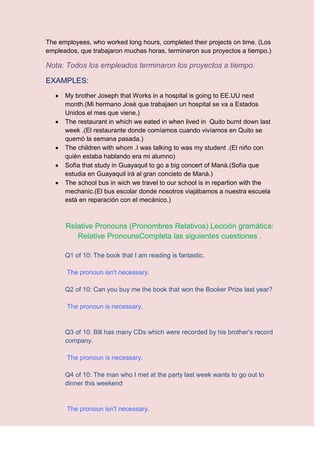
The employees, who worked long hours, completed their projects on time. (Los
empleados, que trabajaron muchas horas, terminaron sus proyectos a tiempo.)

Nota: Todos los empleados terminaron los proyectos a tiempo.

EXAMPLES:
      My brother Joseph that Works in a hospital is going to EE.UU next
      month.(Mi hermano Josè que trabajaen un hospital se va a Estados
      Unidos el mes que viene.)
      The restaurant in which we eated in when lived in Quito burnt down last
      week .(El restaurante donde comìamos cuando vivìamos en Quito se
      quemò la semana pasada.)
      The children with whom .I was talking to was my student .(El niño con
      quièn estaba hablando era mi alumno)
      Sofìa that study in Guayaquil to go a big concert of Manà.(Sofìa que
      estudia en Guayaquil irà al gran concieto de Manà.)
      The school bus in wich we travel to our school is in repartion with the
      mechanic.(El bus escolar donde nosotros viajábamos a nuestra escuela
      està en reparación con el mecànico.)


      Relative Pronouns (Pronombres Relativos) Lección gramática:
         Relative PronounsCompleta las siguientes cuestiones .

      Q1 of 10: The book that I am reading is fantastic.

       The pronoun isn't necessary.

      Q2 of 10: Can you buy me the book that won the Booker Prize last year?

       The pronoun is necessary.


      Q3 of 10: Bill has many CDs which were recorded by his brother's record
      company.

       The pronoun is necessary.

      Q4 of 10: The man who I met at the party last week wants to go out to
      dinner this weekend


       The pronoun isn't necessary.
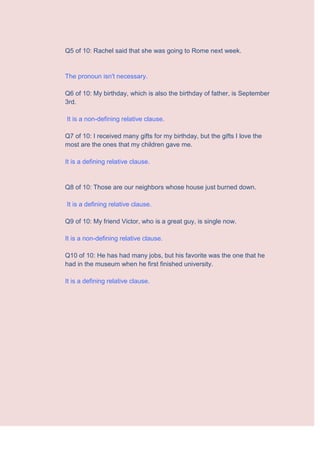
Q5 of 10: Rachel said that she was going to Rome next week.


The pronoun isn't necessary.

Q6 of 10: My birthday, which is also the birthday of father, is September
3rd.

It is a non-defining relative clause.

Q7 of 10: I received many gifts for my birthday, but the gifts I love the
most are the ones that my children gave me.

It is a defining relative clause.


Q8 of 10: Those are our neighbors whose house just burned down.

It is a defining relative clause.

Q9 of 10: My friend Victor, who is a great guy, is single now.

It is a non-defining relative clause.

Q10 of 10: He has had many jobs, but his favorite was the one that he
had in the museum when he first finished university.

It is a defining relative clause.

Indefinite y relative pronouns

  • 1.
    Adverbs: Form andFunction Lección gramática: Adverbs: Form and Function Completa las siguientes cuestiones . Q1 of 12: went/they/Rome/last month/to (poner adverbio al principio) Last month they went to Rome. Q2 of 12: went/they/Rome/last month/to (poner adverbio al final) They went to Rome last month. Q3 of 12: his/finished/already/dinner/he (poner adverbio al principio) He already finished his dinner. Q4 of 12: his/finished/already/dinner/he (poner adverbio al final) He finished his dinner already. Q5 of 12: yet/you/?/are/ready Are you ready yet? Q6 of 12: have/we/time/still We still have time. Q7 of 12: happy/I/really/see/am/you/to I am really happy to see you. Q8 of 12: quickly/speak/very/you You speak very quickly. Q9 of 12: never/eats/she/vegetables She never eats vegetables. Q10 of 12: they/late/class/always/are/to They are always late to class. Q11 of 12: waiting/I/still/am I am still waiting. Q12 of 12: there/?/yet/he/is Is he there yet?
  • 2.
    Indefinite Pronouns (Lospronombres indefinidos) Los pronombres indefinidos no se refieren a ninguna persona, cosa, lugar, ni cantidad específica. Por eso, se llaman "indefinidos". Ya hemos visto algunos de los indefinidos relacionados a cantidad en la lección de cuantificadores. A continuación, tienes una lista completa con ejemplos de los pronombres indefinidos y las reglas gramaticales de su uso. Pronombre Español Sing. Plural Ejemplo You ate all the cookies! all You ate all the cookies! todo X X all (¡Te has comido todas las galletas!) Another glass of wine please. another otro X Another glass of wine please. another (Otra copa de vino por favor.) Is there any milk? any algún, ningún, cualquier X X Is there any milk? any (¿Hay leche?) Is there anyone home? anybody, anyone alguien, nadie, cualquiera X Is there anyone home? (¿Hay anybody/anyone alguien en casa?) It's so dark, I can't see anything. anything It's so dark, I can't see algo, nada, cualquier X anything anything. (Está muy oscuro, no puedo ver nada.) We can go anywhere you want. anywhere cualquier lugar X We can go anywhere you anywhere want. (Podemos ir donde quieras.) Both of my children speak French. both Both of my children speak ambos/los dos X both French. (Mis dos hijos hablan Francés.) Each of them is different. each cada, cada uno X Each of them is different. each (Cada cual es diferente.) I'm happy to see either movie. either cualquiera (de 2) X I'm happy to see either movie. either (Me da igual ver cualquier
  • 3.
    pelicula.) There is never enough time. enough bastante, suficiente X enough There is never enough time. (Nunca hay tiempo suficiente.) Every student failed the every Every student failed the exam. cada, todos X every (Todos los estudiantes suspendieron el examen.) Is everybody here? everybody, everyone todos, todo el mundo X Is everybody here? everybody/everyone (¿Está todo el mundo aquí?) How's everything? Everything is fine. everything todo X How's everything? Everything everything is fine. (¿Que tal todo? Todo bien.) The water spilled everywhere. everywhere The water spilled everywhere. todos partes X everywhere (El agua se derramó por todos partes.) He has few friends. few pocos, unos X He has few friends. few (Él tiene pocos amigos.) There are fewer students this year. fewer There are fewer students this menos X fewer year. (Hay menos alumnos este año.) There is less work this year. less menos X There is less work this year. less (Hay menos trabajo este año.) There is lttle to do here. little poco X There is lttle to do here. little (Hay poco que hacer aquí.) She has many books to read. many She has many books to read. muchos X many (Ella tiene muchos libros para leer.) There is more work this year. more más X X There is more work this year. more (Hay más trabajo este año.) most It rains most of the time here. la mayoría X X most It rains most of the time here.
  • 4.
    (Llueve la mayoríadel tiempo aquí.) We don't have much money. much mucho X We don't have much money. much (No tenemos mucho dinero.) Neither of us speaks Spanish. neither Neither of us speaks Spanish. ninguno (de 2) X neither (Ninguno de nosotros habla español.) Nobody was in class today. nobody, no one nadie X Nobody was in class today. nobody/no one (Nadie fue a clase hoy.) None of the children wanted to answer the question. none None of the children wanted to ningún, nada X X none answer the question. (Ninguno de los niños quiso responder a la pregunta.) There is nothing in the fridge. nothing nada X There is nothing in the fridge. nothing (No hay nada en la nevera.) He has nowhere to stay. nowhere ningún lugar X He has nowhere to stay. nowhere (No tiene dónde quedarse.) One never knows what the future will bring. one One never knows what the un, uno X one future will bring. (Uno nunca sabe lo que le traerá el futuro.) The other class has more students. other The other class has more otro X other students. (La otra clase tiene más estudiantes.) The others are going to a concert tonight. others The others are going to a otros X others concert tonight. (Los otros van a un concierto esta noche.) There are several movies several playing. varios X several There are several movies playing.
  • 5.
    (Están poniendo varias peliculas.) There are some dogs in the park. some There are some dogs in the algún, algo de X X some park. (Hay algunos perros en el parque.) Someone is in the bathroom. somebody, someone alguien X Someone is in the bathroom. somebody/someone (Alguien está en el baño.) I have something in my eye. something algo X I have something in my eye. something (Tengo algo en el ojo.) Right now it is raining somewhere. somewhere Right now it is raining algún lugar X somewhere. somewhere (Ahora mismo está lloviendo en algún lugar.) He is such a nice man. such tal, tan X X He is such a nice man. (Es un such hombre tan amable.) They say this is the best restaurant in town. they They say this is the best ellos X they restaurant in town. (Dicen que este es el mejor restaurante del pueblo.) You never know. you tu X You never know. (Nunca se you sabe.) Grammatical Rules (Reglas gramaticales) 1.Los pronombres indefinidos en singular siempre llevan el verbo en singular. Ejemplos: Somebody is at the door.Play Somebody is at the door. (Alguien está en la puerta.) Everybody loves chocolate.Play Everybody loves chocolate. (A todo el mundo le encanta el chocolate.)
  • 6.
    Nothing was everthe same. Nothing was ever the same. (Nada fue lo mismo.) Is there anywhere you want to go?Play Is there anywhere you want to go? (¿Hay un sitio dónde quieras ir?) 2.Los usos de los pronombres indefinidos compuestos con "some", "any", y "no" en frases afirmativas, negativas y interrogrativas son los mismos de los usos de "some" y "any"."Some" y sus compuestos se utilizan con frases afirmativas e interrogativas; "any" y sus compuestos se utilizan con frases negativas e interrogativas; y "no" y sus compuestos se usan con solo frases negativas. Para más información, ves la lección de cuantificadores. Ejemplos: There is something on the floor. There is something on the floor. (Hay algo en el suelo.) Would you like something to drink? Would you like something to drink? (¿Te gustaría algo para beber?) There isn't anybody home. There isn't anybody home. (No hay nadie en casa.) Is there anything I can do to help? Is there anything I can do to help? (¿Hay algo que pueda hacer para ayudarte?) Nobody wants to work today. Nobody wants to work today. (Nadie quiere trabajar hoy.) 3.Cuando refirimos a un pronombre indefinido, normalmente utilizamos un pronombre plural. Ejemplos: Everyone is here already. They have been waiting for you. Everyone is here already. They have been waiting for you. (Todo el mundo ya está aquí. Han estado esperando por tu.) Somebody left their jacket. It's so cold outside, I'm sure they will be back for it soon.
  • 7.
    Somebody left theirjacket. It's so cold outside, I'm sure they will be back for it soon. (Alguien ha dejado su chaqueta. Hace tanto frío, estoy seguro que regresará pronto.) 4.Podemos utilizar el genetivo sajon con pronombres indefinidos de personas y cosas para indicar posesión. Ejemplo: Is this anyone's seat?Play Is this anyone's seat? (¿Hay alguien sentado en este asiento?) EXAMPLES: *Somebody is at the park.(Alguien està en el parque) * There is someting on the fridge .(Hay algo en la refrieradora). * There are fewer flowers this year .(Hay menos flores este año) *None of the chidren wanted swim.(Ninguno de los niños quizo nadar.) *There are some cars in the park.(Hay algunos carros en el parque). Relative Pronouns (Pronombres Relativos) Utilizamos los pronombres relativos para refirirnos a un sustantivo (una persona o una cosa) mencionado antes y al que queremos agregar más información o modificar. A continuación, tienes una lista de los pronombres relativos. Pronombre Español Persona Cosa that que X X that which que/cual X which who que/quién X who whom que, a quien X whom whose cuyo X X whose Nota: Los pronombres relativos pueden referirse a algo o alguien en singular o plural.
  • 8.
    Grammatical Rules (Reglasgramaticales) El pronombre relativo se encuentra en lugar de un sustantivo. Este sustantivo suele aparece anteriormente en la oración. That "That" es el pronombre relativo más utilizado en inglés hablado, ya que se puede utilizar tanto con personas como con cosas. Se utiliza para sustituir "which", "who" o "whom". Ejemplos: This is the book that won the Pulitzer prize last year. This is the book that won the Pulitzer prize last year. (Este es el libro que ganó el Permio Pulizer el año pasado.) His brother, that just graduated university, found a great job. His brother, that just graduated university, found a great job. (Su hermano, que se acaba de graduar en la universidad, encontró un buen trabajo.) This is the restaurant that received the excellent reviews in the newspaper. This is the restaurant that received the excellent reviews in the newspaper. (Este es el restaurante que recibió excelentes críticas en el periódico.) My friend Sue, that works for a travel magazine, is going to Rome next week.Play My friend Sue, that works for a travel magazine, is going to Rome next week. (Mi amiga Sue, que trabaja para una revista de viajes, se va a Roma la semana que viene.) Which Ejemplos: My new job, which I only started last week, is already very stressful.Play My new job, which I only started last week, is already very stressful. (Mi nuevo trabajo, que acabo de empezar la semana pasada, ya es muy estresante.) The house in which we lived in when we were children burnt down last week.
  • 9.
    The house inwhich we lived in when we were children burnt down last week. (La casa en la que vivíamos cuando éramos niños se quemó la semana pasada.) Who Solo se puede utilizar "who" con personas. Ejemplos: My sister, who just moved in with me, is looking for a job. My sister, who just moved in with me, is looking for a job. (Mi hermana, que se acaba de mudar conmigo, está buscando un trabajo.) I never met someone who didn't like music. I never met someone who didn't like music. (Nunca he conocido a alguien que no le guste la música.) Whom "Whom" se utiliza para hacer referencia al objeto indirecto del verbo, pero no lo utilizamos mucho en Inglés coloquial. Más a menudo utilizamos "who" en vez de "whom". Ejemplos: The woman with whom I was talking to was my cousin.Play The woman with whom I was talking to was my cousin. (La mujer con quién estaba hablando era mi prima.) This is Peter, whom I met at the party last week.Play This is Peter, whom I met at the party last week. (Este es Peter, a quien conocí en la fiesta la semana pasada.) Whose El uso de "whose" indica posesión, tanto para las personas y las cosas. Ejemplos: That is the girl whose parents got divorced last year.
  • 10.
    That is thegirl whose parents got divorced last year. (Esa es la chica cuyos padres se divorciaron el año pasado.) Paul, whose wife just had a baby, will not be at work for a few weeks. Paul, whose wife just had a baby, will not be at work for a few weeks. (Paul, cuyo esposa acaba de tener un bebé, no irá a trabajar durante unas semanas.) Nota: Puede omitirse el pronombre relativo cuando es el objeto de la frase. Ejemplos: The exam I took this morning won't be corrected and returned until next week. The exam [that] I took this morning won't be corrected and returned until next week. (El examen que hice esta mañana no se corregirá ni se devolverá hasta la semana que viene.) The woman I'm dating is a teacher. The woman [who] I'm dating is a teacher. (La mujer con quien estoy saliendo es profesora.) When and where Ejemplos: The university where I teach is an excellent school. The university where I teach is an excellent school. (La universidad donde enseño es una escuela excelente.) Can you tell me when is the best time to call? Can you tell me when is the best time to call? (¿Puedes decirme cuando es la mejor hora para llamar?) Relative Clauses (Cláusula relativas) Se utilizan los pronombres relativos para unir dos o más cláusulas y formando así lo que llamamos "cláusulas relativas". Hay dos tipos de cláusulas relativas: las que añaden información adicional y aquellos que modificar (o definir) el sujeto de la oración.
  • 11.
    Non-defining Relative Clauses Estascláusulas agregan información adicional. Se utiliza comas para separar la cláusula relativa del resto de la oración. Ejemplos: My friend Tony, who is an excellent writer, is helping me with my English paper. My friend Tony, who is an excellent writer, is helping me with my English paper. (Mi amigo Tony, quien es un escritor excelente, está ayundandome con mi estudio de Inglés.) The report, which my boss asked me to write last week, still isn't finished.Play The report, which my boss asked me to write last week, still isn't finished. (El informe, que mi jefe me pidió que escribiera la semana pasada, todavía no está terminado.) Defining Relative Clauses Estas cláusulas definen el sustantivo e identifican a qué cosa o persona nos referimos. No se usan comas con este tipo de cláusula. Ejemplos: I wrote that report that you asked for. I wrote the report that you asked for. (Escribí el informe que me pidió.) She never met the man who saved her father's life. She never met the man who saved her father's life. (Nunca conoció al hombre que salvó la vida de su padre.) Ejemplos: The employees who worked long hours completed their projects on time. The employees who worked long hours completed their projects on time. (Los empleados que trabajaban largas horas terminaron sus proyectos a tiempo.) Nota: Sólo los que trabajaron muchas horas terminaron los proyectos a tiempo.
  • 12.
    The employees, whoworked long hours, completed their projects on time. (Los empleados, que trabajaron muchas horas, terminaron sus proyectos a tiempo.) Nota: Todos los empleados terminaron los proyectos a tiempo. EXAMPLES: My brother Joseph that Works in a hospital is going to EE.UU next month.(Mi hermano Josè que trabajaen un hospital se va a Estados Unidos el mes que viene.) The restaurant in which we eated in when lived in Quito burnt down last week .(El restaurante donde comìamos cuando vivìamos en Quito se quemò la semana pasada.) The children with whom .I was talking to was my student .(El niño con quièn estaba hablando era mi alumno) Sofìa that study in Guayaquil to go a big concert of Manà.(Sofìa que estudia en Guayaquil irà al gran concieto de Manà.) The school bus in wich we travel to our school is in repartion with the mechanic.(El bus escolar donde nosotros viajábamos a nuestra escuela està en reparación con el mecànico.) Relative Pronouns (Pronombres Relativos) Lección gramática: Relative PronounsCompleta las siguientes cuestiones . Q1 of 10: The book that I am reading is fantastic. The pronoun isn't necessary. Q2 of 10: Can you buy me the book that won the Booker Prize last year? The pronoun is necessary. Q3 of 10: Bill has many CDs which were recorded by his brother's record company. The pronoun is necessary. Q4 of 10: The man who I met at the party last week wants to go out to dinner this weekend The pronoun isn't necessary.
  • 13.
    Q5 of 10:Rachel said that she was going to Rome next week. The pronoun isn't necessary. Q6 of 10: My birthday, which is also the birthday of father, is September 3rd. It is a non-defining relative clause. Q7 of 10: I received many gifts for my birthday, but the gifts I love the most are the ones that my children gave me. It is a defining relative clause. Q8 of 10: Those are our neighbors whose house just burned down. It is a defining relative clause. Q9 of 10: My friend Victor, who is a great guy, is single now. It is a non-defining relative clause. Q10 of 10: He has had many jobs, but his favorite was the one that he had in the museum when he first finished university. It is a defining relative clause.