
Conjunctions (Conjunciones)
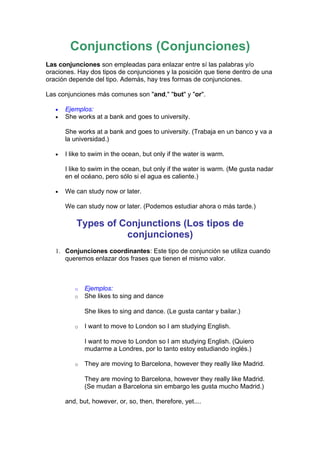
Las conjunciones son empleadas para enlazar entre sí las palabras y/o
oraciones. Hay dos tipos de conjunciones y la posición que tiene dentro de una
oración depende del tipo. Además, hay tres formas de conjunciones.

Las conjunciones más comunes son "and," "but" y "or".

   •   Ejemplos:
   •   She works at a bank and goes to university.

       She works at a bank and goes to university. (Trabaja en un banco y va a
       la universidad.)

   •   I like to swim in the ocean, but only if the water is warm.

       I like to swim in the ocean, but only if the water is warm. (Me gusta nadar
       en el océano, pero sólo si el agua es caliente.)

   •   We can study now or later.

       We can study now or later. (Podemos estudiar ahora o más tarde.)

           Types of Conjunctions (Los tipos de
                     conjunciones)
   1. Conjunciones coordinantes: Este tipo de conjunción se utiliza cuando
      queremos enlazar dos frases que tienen el mismo valor.


          o   Ejemplos:
          o   She likes to sing and dance

              She likes to sing and dance. (Le gusta cantar y bailar.)

          o   I want to move to London so I am studying English.

              I want to move to London so I am studying English. (Quiero
              mudarme a Londres, por lo tanto estoy estudiando inglés.)

          o   They are moving to Barcelona, however they really like Madrid.

              They are moving to Barcelona, however they really like Madrid.
              (Se mudan a Barcelona sin embargo les gusta mucho Madrid.)

       and, but, however, or, so, then, therefore, yet....
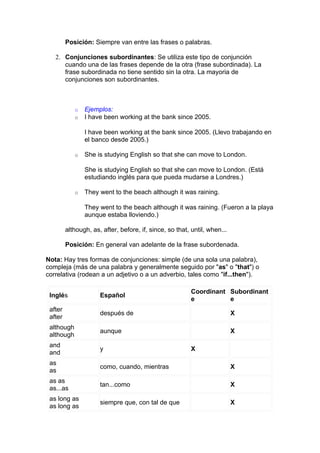
Posición: Siempre van entre las frases o palabras.

   2. Conjunciones subordinantes: Se utiliza este tipo de conjunción
      cuando una de las frases depende de la otra (frase subordinada). La
      frase subordinada no tiene sentido sin la otra. La mayoria de
      conjunciones son subordinantes.


            o   Ejemplos:
            o   I have been working at the bank since 2005.

                I have been working at the bank since 2005. (Llevo trabajando en
                el banco desde 2005.)

            o   She is studying English so that she can move to London.

                She is studying English so that she can move to London. (Está
                estudiando inglés para que pueda mudarse a Londres.)

            o   They went to the beach although it was raining.

                They went to the beach although it was raining. (Fueron a la playa
                aunque estaba lloviendo.)

         although, as, after, before, if, since, so that, until, when...

         Posición: En general van adelante de la frase subordenada.

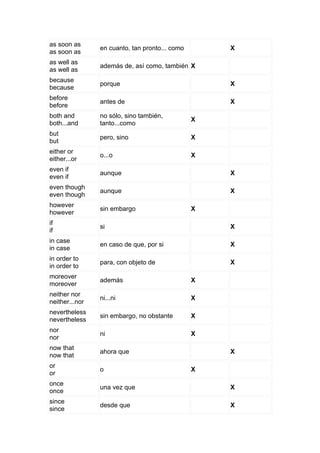
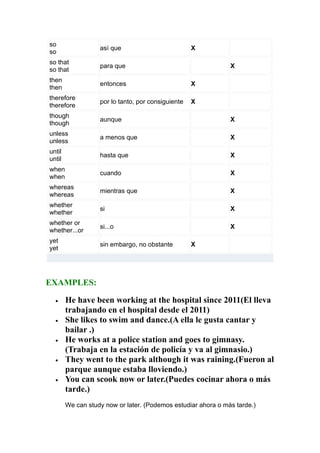
Nota: Hay tres formas de conjunciones: simple (de una sola una palabra),
compleja (más de una palabra y generalmente seguido por "as" o "that") o
correlativa (rodean a un adjetivo o a un adverbio, tales como "if...then").

                                                          Coordinant Subordinant
 Inglés               Español
                                                          e          e
 after
                      después de                                           X
 after
 although
                      aunque                                               X
 although
 and
                      y                                   X
 and
 as
                      como, cuando, mientras                               X
 as
 as as
                      tan...como                                           X
 as...as
 as long as
                      siempre que, con tal de que                          X
 as long as
as soon as
                en cuanto, tan pronto... como       X
as soon as
as well as
                además de, así como, también X
as well as
because
                porque                              X
because
before
                antes de                            X
before
both and        no sólo, sino también,
                                                X
both...and      tanto...como
but
                pero, sino                      X
but
either or
                o...o                           X
either...or
even if
                aunque                              X
even if
even though
                aunque                              X
even though
however
                sin embargo                     X
however
if
                si                                  X
if
in case
                en caso de que, por si              X
in case
in order to
                para, con objeto de                 X
in order to
moreover
                además                          X
moreover
neither nor
                ni...ni                         X
neither...nor
nevertheless
                sin embargo, no obstante        X
nevertheless
nor
                ni                              X
nor
now that
                ahora que                           X
now that
or
                o                               X
or
once
                una vez que                         X
once
since
                desde que                           X
since
so
                   así que                          X
so
so that
                   para que                                    X
so that
then
                   entonces                         X
then
therefore
                   por lo tanto, por consiguiente   X
therefore
though
                   aunque                                      X
though
unless
                   a menos que                                 X
unless
until
                   hasta que                                   X
until
when
                   cuando                                      X
when
whereas
                   mientras que                                X
whereas
whether
                   si                                          X
whether
whether or
                   si...o                                      X
whether...or
yet
                   sin embargo, no obstante         X
yet


EXAMPLES:

  •     He have been working at the hospital since 2011(El lleva
        trabajando en el hospital desde el 2011)
  •     She likes to swim and dance.(A ella le gusta cantar y
        bailar .)
  •     He works at a police station and goes to gimnasy.
        (Trabaja en la estación de policía y va al gimnasio.)
  •     They went to the park although it was raining.(Fueron al
        parque aunque estaba lloviendo.)
  •     You can scook now or later.(Puedes cocinar ahora o más
        tarde.)
        We can study now or later. (Podemos estudiar ahora o más tarde.)
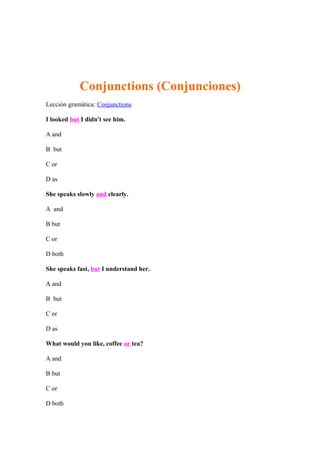
Conjunctions (Conjunciones)
Lección gramática: Conjunctions

I looked but I didn't see him.

A and

B but

C or

D as

She speaks slowly and clearly.

A and

B but

C or

D both

She speaks fast, but I understand her.

A and

B but

C or

D as

What would you like, coffee or tea?

A and

B but

C or

D both
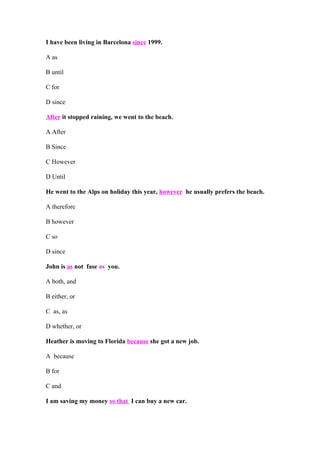
I have been living in Barcelona since 1999.

A as

B until

C for

D since

After it stopped raining, we went to the beach.

A After

B Since

C However

D Until

He went to the Alps on holiday this year, however he usually prefers the beach.

A therefore

B however

C so

D since

John is as not fase as you.

A both, and

B either, or

C as, as

D whether, or

Heather is moving to Florida because she got a new job.

A because

B for

C and

I am saving my money so that I can buy a new car.
A because

B although

C so that

Conjunctions

  • 1.
    Conjunctions (Conjunciones) Las conjuncionesson empleadas para enlazar entre sí las palabras y/o oraciones. Hay dos tipos de conjunciones y la posición que tiene dentro de una oración depende del tipo. Además, hay tres formas de conjunciones. Las conjunciones más comunes son "and," "but" y "or". • Ejemplos: • She works at a bank and goes to university. She works at a bank and goes to university. (Trabaja en un banco y va a la universidad.) • I like to swim in the ocean, but only if the water is warm. I like to swim in the ocean, but only if the water is warm. (Me gusta nadar en el océano, pero sólo si el agua es caliente.) • We can study now or later. We can study now or later. (Podemos estudiar ahora o más tarde.) Types of Conjunctions (Los tipos de conjunciones) 1. Conjunciones coordinantes: Este tipo de conjunción se utiliza cuando queremos enlazar dos frases que tienen el mismo valor. o Ejemplos: o She likes to sing and dance She likes to sing and dance. (Le gusta cantar y bailar.) o I want to move to London so I am studying English. I want to move to London so I am studying English. (Quiero mudarme a Londres, por lo tanto estoy estudiando inglés.) o They are moving to Barcelona, however they really like Madrid. They are moving to Barcelona, however they really like Madrid. (Se mudan a Barcelona sin embargo les gusta mucho Madrid.) and, but, however, or, so, then, therefore, yet....
  • 2.
    Posición: Siempre vanentre las frases o palabras. 2. Conjunciones subordinantes: Se utiliza este tipo de conjunción cuando una de las frases depende de la otra (frase subordinada). La frase subordinada no tiene sentido sin la otra. La mayoria de conjunciones son subordinantes. o Ejemplos: o I have been working at the bank since 2005. I have been working at the bank since 2005. (Llevo trabajando en el banco desde 2005.) o She is studying English so that she can move to London. She is studying English so that she can move to London. (Está estudiando inglés para que pueda mudarse a Londres.) o They went to the beach although it was raining. They went to the beach although it was raining. (Fueron a la playa aunque estaba lloviendo.) although, as, after, before, if, since, so that, until, when... Posición: En general van adelante de la frase subordenada. Nota: Hay tres formas de conjunciones: simple (de una sola una palabra), compleja (más de una palabra y generalmente seguido por "as" o "that") o correlativa (rodean a un adjetivo o a un adverbio, tales como "if...then"). Coordinant Subordinant Inglés Español e e after después de X after although aunque X although and y X and as como, cuando, mientras X as as as tan...como X as...as as long as siempre que, con tal de que X as long as
  • 3.
    as soon as en cuanto, tan pronto... como X as soon as as well as además de, así como, también X as well as because porque X because before antes de X before both and no sólo, sino también, X both...and tanto...como but pero, sino X but either or o...o X either...or even if aunque X even if even though aunque X even though however sin embargo X however if si X if in case en caso de que, por si X in case in order to para, con objeto de X in order to moreover además X moreover neither nor ni...ni X neither...nor nevertheless sin embargo, no obstante X nevertheless nor ni X nor now that ahora que X now that or o X or once una vez que X once since desde que X since
  • 4.
    so así que X so so that para que X so that then entonces X then therefore por lo tanto, por consiguiente X therefore though aunque X though unless a menos que X unless until hasta que X until when cuando X when whereas mientras que X whereas whether si X whether whether or si...o X whether...or yet sin embargo, no obstante X yet EXAMPLES: • He have been working at the hospital since 2011(El lleva trabajando en el hospital desde el 2011) • She likes to swim and dance.(A ella le gusta cantar y bailar .) • He works at a police station and goes to gimnasy. (Trabaja en la estación de policía y va al gimnasio.) • They went to the park although it was raining.(Fueron al parque aunque estaba lloviendo.) • You can scook now or later.(Puedes cocinar ahora o más tarde.) We can study now or later. (Podemos estudiar ahora o más tarde.)
  • 5.
    Conjunctions (Conjunciones) Lección gramática:Conjunctions I looked but I didn't see him. A and B but C or D as She speaks slowly and clearly. A and B but C or D both She speaks fast, but I understand her. A and B but C or D as What would you like, coffee or tea? A and B but C or D both
  • 6.
    I have beenliving in Barcelona since 1999. A as B until C for D since After it stopped raining, we went to the beach. A After B Since C However D Until He went to the Alps on holiday this year, however he usually prefers the beach. A therefore B however C so D since John is as not fase as you. A both, and B either, or C as, as D whether, or Heather is moving to Florida because she got a new job. A because B for C and I am saving my money so that I can buy a new car.
  • 7.