Inclusive Language:
A Writing Guide on Respecting Diversity,
Race, Gender, LGBTQ, Race, Age &
Disability
lingovalley@gmail.com
Inclusive Language:
A Writing Guide on Respecting Diversity,
Race, Gender, LGBTQ, Race, Age &
Disability
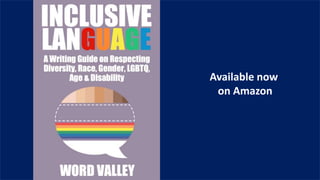
This guide is based on the
book. Available on
Amazon.
(Link in the description
below)
Every word has a history and comes from the past.
The word ‘landlord’, for example, dates back to Middle English
(spoken from 1066 until the late 15th Century) asa combination of
land + lord—reflecting common land ownership norms during that
period.
Today, land ownership is no longer restricted to the elite echelon of
society or male aristocrats in Britain.
What is Inclusive Language?
Inclusive language refers to neutral and unbiased language, free from
words and phrases that reflect prejudice, stereotyping, or
discriminatory views.
The goals of inclusive language is to embrace people of diverse
backgrounds and make them feel “apart of the group”. (Inclusive
language is the opposite of deliberate or unintentional exclusion of
people based on parts of their identity).
Inclusive language is different from ‘political correctness’.
Political correctness is using language that minimizes disputes or
conflict but may conceal the true values of the writer or organization,
such as opinions on global warming or territorial disputes.
Political correctness extends to a range of political topics including the
environment, human rights, historical problems, and territorial
disputes, whereas inclusive language focuses on people’s identity.
In sum, inclusive language comes from a place of genuine acceptance,
whereas political correctness is more about minimizing disputes.
Why Inclusive Language is Important
A person’s gender, sexual orientation, age, and race are important
characteristics of who they are but don't define who they are.
Attempting to reduce a person to a single characteristic of their identity
has the potential to cause offense. Inclusive language helps to respect
people’s unique identities without contributing to existing stereotypes.
About this Guide
It’s vital to treat this guide as a summary of recommended practices
rather than a prescriptive instruction manual. There is no universal or
fixed rule book when it comes to inclusive language.
As with all types of language, 'inclusive language' is constantly evolving
as people find new words that best describe who they are as well as
their outward identity.
Visual content
Providing an inclusive user experience includes images, promotional
banners, signs, flyers, and visual-based social media posts.
This includes avoiding cultural stereotyping in visual materials, promoting
diversity (in images of people for example), and using inclusive language for
accompanying text.
Also, approximately 1 in 12 men (8%) and 1 in 200 (0.5%) women are
classed as colorblind. Use tools like Hue and ColorBrewer
(http://colorbrewer2.org/) that provide a filter to select from palettes pre-
tested for color blindness.
Respecting Race
In 2020, Twitter, JPMorgan and other companies have dropped technical terms
such as ‘master’, ‘slave’, ‘whitelist’ and ‘blacklist’ in favor of inclusive language.
If it’s necessary to speak about a person’s cultural or ethnic background, try to
be specific. E.g. “Sickle cell disease is most common in those of sub-Saharan
ancestry”, rather than “Sickle cell disease mostly occurs in blacks”.
Where possible, ask the person how they wish to be described based on
where they or their family rather than making assumptions.
Likewise, be descriptive when describing a person’s citizenship status, such as
their nationality, country of origin, category of citizenship (permanent
resident/temporary resident/citizen), and undocumented/unauthorized.
Quick Tips:
· Avoid terms that reinforce racial stereotypes such as 'slave' and 'master’.
· Avoid terms that treat black and white as a negative-positive category, i.e.
'whitelist' and 'blacklist’.
· When necessary to speak about a person’s cultural or ethnic background, try
to be specific, and if possible, ask that person how they wish to be described.
· Avoid hyphenating nationalities, e.g. ‘Asian American’, not ‘Asian-American’.
·Do not use geographic descriptions interchangeably with religious or other
descriptions. For example, not all Muslims are Arab.
· Capitalize names of nationalities, races and tribes, e.g. Aboriginal Peoples,
Asian, Arab, · Consider the need to mention race. “Would I mention ‘white
student’ or ‘white faculty member’ in the same situation?
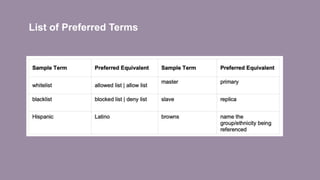
List of Preferred Terms
Respecting Gender
Gender is an important topic today. Keep content gender-neutral
(where possible) and avoid stereotypes based on genders, such as
women in the role of the housewife and office receptionist.
When discussing professions, try to remove gender terms from the
job title such as fireman, policeman, and businessman. Instead, use
firefighter, police officer and business executive, which are gender-
inclusive variants and more accepting of female professionals.
Pronouns
Pronouns such as ‘he’, ‘him’, and ‘his’ are common examples of
positioning the masculine as the general norm for referring to a person of
unspecified sex, such as: “a football player should lead his team from the
front".
Solutions
Use the plural forms ‘their’, ‘they’, and ‘them’.
Take a singular noun and use the plural version. E.g. "Developers should
keep their code clean and standard".
Remove the use of a pronoun using passive tense. E.g. “In the developer
world, it’s best practice to keep code clean and standard”.
Alternate pronouns to avoid the generic masculine. E.g. "When a writer
puts his audience first, the reader is more likely to recommend his work to
her friends.”
Pair gender-based pronouns such as "When a writer puts his or her
audience first mind, the reader is more likely to recommend the book to
others".
Bypass the use of pronouns by repeating a noun. E.g. "If a writer does
meet his deadline, the writer won’t get paid”. This style of writing is less
acceptable for formal writing and can come across as sneering or
negative.
Alternative gender pronouns such as ‘ze’ and 'zir' as alternatives for
‘he/her’ and ‘he/him’, and ‘zie/hir’ for ‘they/them’.
Gender-marked Roles
Gender-marked roles such as ‘waitress’, ‘chairman’, and
‘fireman’ omit reference to the feminine even though these
roles can be performed by persons of both genders.
While such roles may have traditionally been exclusive to a
given gender, gender-marked roles are mostly redundant today
and have the effect of trivializing or ignoring the reality of both
sexes performing the role.
These terms can be simply substituted with neutral
replacements such as ‘waiter’, ‘chairperson’, and ‘firefighter’.
Gender Titles
While ‘Miss’ and ‘Mrs.’ are not discriminatory in their literal
meaning, the absence of a male equivalent produces an uneven
balance. While the female titles of ‘Miss’ and ‘Mrs.’ effectively
recognize a woman's marital status, ‘Mr.’ applies to both married
and unmarried men.
As a counter solution to this discrepancy, ‘Ms.’ –the closest
equivalent to ‘Mr’—is commonly used to reference both unmarried
and married women..
Formality
Gender-biased language is sometimes found in references to
females in a demeaning or trivializing way such as a ‘girl’ or
‘sweetie’ in reference to an adult woman.
Linguist Deborah Cameron explains that when used by people who
aren’t closely acquainted with the subject, these terms "are
inherently disrespectful. They are a unilateral declaration by the
man that he need not trouble about the formalities expected
between non-intimates".
Quick Tips:
·In examples where you refer to two people as an example, use both a
female name (Stephanie) and a male name (Steve).
·Use 'different sex' instead of 'opposite sex' (as this recognizes 'gender'
as a spectrum rather than as binary).
·Avoid 'guys' to refer to mixed-gender groups.
·For gender-neutral scenarios, use 'they' and 'their' as singular or
collective pronouns.
·Avoid the use of pronouns for generic situations if appropriate.
·Avoid guessing marital status. When in doubt, reconsider the need to
include this information.
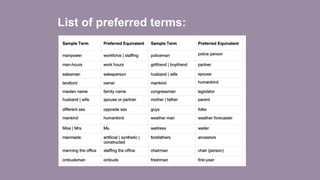
·Avoid male-centric words such as manpower, man-hours, salesman,
etc. See an extended list below.
List of preferred terms:
Respecting Sexual Orientation
Similar to gender-inclusive language, sexual orientation language benefits
from avoiding stereotypes and assumptions. As an example, we shouldn’t
assume that a person assigned a gender at birth identifies with that gender.
Try to use broad terms to discuss relationship status such as ‘partner’ or
‘spouse’ in place of ‘boyfriend’, ‘girlfriend,’ etc. Partner and spouse are
broader terms as they can be applied to different forms of relationships
and are less assumptive of the subject.
When people are legally recognized as married, ‘husband’ or ‘wife’ can be
used unless specified by the couple.
Collecting Personal Information
When collecting personal information about people, including
gender, it’s common practice to provide additional options for
the respondent to choose.
Example:
What is your gender?
[ ] Woman
[ ] Man
[ ] Self-described (please specify):
___________________________
Quick Tips:
·Use 'different sex' instead of 'opposite sex' (spectrum rather than binary).
·Avoid guessing gender identity, marital status, or sexual orientation. When
in doubt, reconsider the need to include this information.
·Avoid using words such as ‘wife’ or ‘husband’ that assumes heterosexual
relationships as the norm.
·When using pronouns, it’s best practice to use the pronoun preferred by
the subject rather than their gender assigned at birth. If unsure, use
collective pronouns such as ‘they,’ ‘their’, and ‘them’.
·When addressing letters, written invitations, or emails, try to use the title
that person uses. If you don’t know what title they use, it’s also acceptable
to address someone by their first and last names.
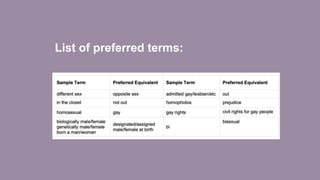
List of preferred terms:
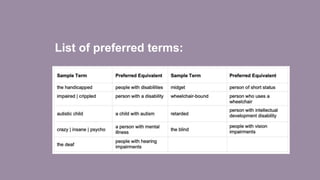
Respecting People with a Disability
According to the Society of Professional Journalists, 20% of the U.S.
population has a physical and/or mental disability, making this
subgroup of users one of the largest minorities to consider.
In most cases, you want to avoid language that frames disability as a
personal limitation. This also means a person should not be defined by
their disability or described as a 'victim' or 'suffering’.
Person-first language is the widely accepted format when referring to
people with a disability. This means writing ‘people with a disability’
rather than ‘disabled people’ or ‘the handicapped’.
Quick Tips:
· Avoid language that implies people with disabilities are victims or are
inspirations for living with a disability.
· Consider whether referring to a person’s disability is relevant.
· Avoid expressions that refer to mental illness such as 'crazy’, ‘that was
mental’, etc.
· Use ‘person with disability’ or 'people with disability' as the collective
term rather than 'the disabled’.
· Avoid terms that reinforce a limitation such as 'the handicapped',
'midget', and 'cripple'. See an extended list below.
List of preferred terms:
Respecting Age
Ageism, also called age discrimination, is described by the World Health
Organization (WHO) as “stereotyping, prejudice, and discrimination against
people based on their age”.
Ageism has wide implications and is known to have a negative effect on
finding employment, applying for a new credit card or car insurance,
gaining membership to a club or association, and can also have a significant
impact on one’s confidence and quality of life.
Aside from avoiding negative stereotypes, it’s important to avoid
expressions that refer to a person’s age (except for referring to specific age
groups including retirees and children) and to avoid negative terms.
Quick Tips:
·Don’t use women or an older relative as a substitute for 'novice' or
'beginner'. For example, don’t say "something is so simple to use your
mother (or grandpa) could do it".
·'Older persons' or 'seniors' are usually preferred terms over saying
'the elderly'.
·For describing technology and computer operations, it’s important to
provide clear instructions and explanations of technical terms and
consider the needs of the elderly when writing.
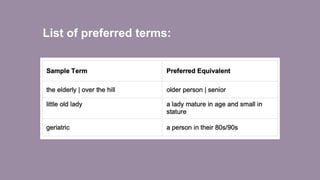
·Avoid negative terms such as 'over the hill', 'little old lady',
'grandfathering', or 'geriatric'.
List of preferred terms:
Creating an Inclusive Language Guide
One of the best ways to implement inclusive language at work or in your
organization is to create an inclusive language guide.
Try to keep the document live and encourage others to add their input
and feedback which will also help to give them ownership and buy-in
over implementing and maintaining the guidelines.
This guide can take the form of a shareable PowerPoint presentation,
PDF, or another format. You may even like to share the basic principles
of your guide publicly on your website as a reference for others.
Virtually no one can get language right 100 percent of the time for
100 percent of people.
The important thing is to continue learning, update your inclusive
language guide when necessary, and if you make a mistake, quickly
apologize and improve your writing and communication skills for
next time.
Available now
on Amazon

Inclusive language

  • 1.
    Inclusive Language: A WritingGuide on Respecting Diversity, Race, Gender, LGBTQ, Race, Age & Disability lingovalley@gmail.com
  • 2.
    Inclusive Language: A WritingGuide on Respecting Diversity, Race, Gender, LGBTQ, Race, Age & Disability This guide is based on the book. Available on Amazon. (Link in the description below)
  • 3.
    Every word hasa history and comes from the past. The word ‘landlord’, for example, dates back to Middle English (spoken from 1066 until the late 15th Century) asa combination of land + lord—reflecting common land ownership norms during that period. Today, land ownership is no longer restricted to the elite echelon of society or male aristocrats in Britain.
  • 4.
    What is InclusiveLanguage? Inclusive language refers to neutral and unbiased language, free from words and phrases that reflect prejudice, stereotyping, or discriminatory views. The goals of inclusive language is to embrace people of diverse backgrounds and make them feel “apart of the group”. (Inclusive language is the opposite of deliberate or unintentional exclusion of people based on parts of their identity).
  • 5.
    Inclusive language isdifferent from ‘political correctness’. Political correctness is using language that minimizes disputes or conflict but may conceal the true values of the writer or organization, such as opinions on global warming or territorial disputes. Political correctness extends to a range of political topics including the environment, human rights, historical problems, and territorial disputes, whereas inclusive language focuses on people’s identity. In sum, inclusive language comes from a place of genuine acceptance, whereas political correctness is more about minimizing disputes.
  • 6.
    Why Inclusive Languageis Important A person’s gender, sexual orientation, age, and race are important characteristics of who they are but don't define who they are. Attempting to reduce a person to a single characteristic of their identity has the potential to cause offense. Inclusive language helps to respect people’s unique identities without contributing to existing stereotypes.
  • 7.
    About this Guide It’svital to treat this guide as a summary of recommended practices rather than a prescriptive instruction manual. There is no universal or fixed rule book when it comes to inclusive language. As with all types of language, 'inclusive language' is constantly evolving as people find new words that best describe who they are as well as their outward identity.
  • 8.
    Visual content Providing aninclusive user experience includes images, promotional banners, signs, flyers, and visual-based social media posts. This includes avoiding cultural stereotyping in visual materials, promoting diversity (in images of people for example), and using inclusive language for accompanying text. Also, approximately 1 in 12 men (8%) and 1 in 200 (0.5%) women are classed as colorblind. Use tools like Hue and ColorBrewer (http://colorbrewer2.org/) that provide a filter to select from palettes pre- tested for color blindness.
  • 9.
    Respecting Race In 2020,Twitter, JPMorgan and other companies have dropped technical terms such as ‘master’, ‘slave’, ‘whitelist’ and ‘blacklist’ in favor of inclusive language. If it’s necessary to speak about a person’s cultural or ethnic background, try to be specific. E.g. “Sickle cell disease is most common in those of sub-Saharan ancestry”, rather than “Sickle cell disease mostly occurs in blacks”. Where possible, ask the person how they wish to be described based on where they or their family rather than making assumptions. Likewise, be descriptive when describing a person’s citizenship status, such as their nationality, country of origin, category of citizenship (permanent resident/temporary resident/citizen), and undocumented/unauthorized.
  • 10.
    Quick Tips: · Avoidterms that reinforce racial stereotypes such as 'slave' and 'master’. · Avoid terms that treat black and white as a negative-positive category, i.e. 'whitelist' and 'blacklist’. · When necessary to speak about a person’s cultural or ethnic background, try to be specific, and if possible, ask that person how they wish to be described. · Avoid hyphenating nationalities, e.g. ‘Asian American’, not ‘Asian-American’. ·Do not use geographic descriptions interchangeably with religious or other descriptions. For example, not all Muslims are Arab. · Capitalize names of nationalities, races and tribes, e.g. Aboriginal Peoples, Asian, Arab, · Consider the need to mention race. “Would I mention ‘white student’ or ‘white faculty member’ in the same situation?
  • 11.
  • 12.
    Respecting Gender Gender isan important topic today. Keep content gender-neutral (where possible) and avoid stereotypes based on genders, such as women in the role of the housewife and office receptionist. When discussing professions, try to remove gender terms from the job title such as fireman, policeman, and businessman. Instead, use firefighter, police officer and business executive, which are gender- inclusive variants and more accepting of female professionals.
  • 13.
    Pronouns Pronouns such as‘he’, ‘him’, and ‘his’ are common examples of positioning the masculine as the general norm for referring to a person of unspecified sex, such as: “a football player should lead his team from the front". Solutions Use the plural forms ‘their’, ‘they’, and ‘them’. Take a singular noun and use the plural version. E.g. "Developers should keep their code clean and standard". Remove the use of a pronoun using passive tense. E.g. “In the developer world, it’s best practice to keep code clean and standard”.
  • 14.
    Alternate pronouns toavoid the generic masculine. E.g. "When a writer puts his audience first, the reader is more likely to recommend his work to her friends.” Pair gender-based pronouns such as "When a writer puts his or her audience first mind, the reader is more likely to recommend the book to others". Bypass the use of pronouns by repeating a noun. E.g. "If a writer does meet his deadline, the writer won’t get paid”. This style of writing is less acceptable for formal writing and can come across as sneering or negative. Alternative gender pronouns such as ‘ze’ and 'zir' as alternatives for ‘he/her’ and ‘he/him’, and ‘zie/hir’ for ‘they/them’.
  • 15.
    Gender-marked Roles Gender-marked rolessuch as ‘waitress’, ‘chairman’, and ‘fireman’ omit reference to the feminine even though these roles can be performed by persons of both genders. While such roles may have traditionally been exclusive to a given gender, gender-marked roles are mostly redundant today and have the effect of trivializing or ignoring the reality of both sexes performing the role. These terms can be simply substituted with neutral replacements such as ‘waiter’, ‘chairperson’, and ‘firefighter’.
  • 16.
    Gender Titles While ‘Miss’and ‘Mrs.’ are not discriminatory in their literal meaning, the absence of a male equivalent produces an uneven balance. While the female titles of ‘Miss’ and ‘Mrs.’ effectively recognize a woman's marital status, ‘Mr.’ applies to both married and unmarried men. As a counter solution to this discrepancy, ‘Ms.’ –the closest equivalent to ‘Mr’—is commonly used to reference both unmarried and married women..
  • 17.
    Formality Gender-biased language issometimes found in references to females in a demeaning or trivializing way such as a ‘girl’ or ‘sweetie’ in reference to an adult woman. Linguist Deborah Cameron explains that when used by people who aren’t closely acquainted with the subject, these terms "are inherently disrespectful. They are a unilateral declaration by the man that he need not trouble about the formalities expected between non-intimates".
  • 18.
    Quick Tips: ·In exampleswhere you refer to two people as an example, use both a female name (Stephanie) and a male name (Steve). ·Use 'different sex' instead of 'opposite sex' (as this recognizes 'gender' as a spectrum rather than as binary). ·Avoid 'guys' to refer to mixed-gender groups. ·For gender-neutral scenarios, use 'they' and 'their' as singular or collective pronouns. ·Avoid the use of pronouns for generic situations if appropriate. ·Avoid guessing marital status. When in doubt, reconsider the need to include this information. ·Avoid male-centric words such as manpower, man-hours, salesman, etc. See an extended list below.
  • 19.
  • 20.
    Respecting Sexual Orientation Similarto gender-inclusive language, sexual orientation language benefits from avoiding stereotypes and assumptions. As an example, we shouldn’t assume that a person assigned a gender at birth identifies with that gender. Try to use broad terms to discuss relationship status such as ‘partner’ or ‘spouse’ in place of ‘boyfriend’, ‘girlfriend,’ etc. Partner and spouse are broader terms as they can be applied to different forms of relationships and are less assumptive of the subject. When people are legally recognized as married, ‘husband’ or ‘wife’ can be used unless specified by the couple.
  • 21.
    Collecting Personal Information Whencollecting personal information about people, including gender, it’s common practice to provide additional options for the respondent to choose. Example: What is your gender? [ ] Woman [ ] Man [ ] Self-described (please specify): ___________________________
  • 22.
    Quick Tips: ·Use 'differentsex' instead of 'opposite sex' (spectrum rather than binary). ·Avoid guessing gender identity, marital status, or sexual orientation. When in doubt, reconsider the need to include this information. ·Avoid using words such as ‘wife’ or ‘husband’ that assumes heterosexual relationships as the norm. ·When using pronouns, it’s best practice to use the pronoun preferred by the subject rather than their gender assigned at birth. If unsure, use collective pronouns such as ‘they,’ ‘their’, and ‘them’. ·When addressing letters, written invitations, or emails, try to use the title that person uses. If you don’t know what title they use, it’s also acceptable to address someone by their first and last names.
  • 23.
  • 24.
    Respecting People witha Disability According to the Society of Professional Journalists, 20% of the U.S. population has a physical and/or mental disability, making this subgroup of users one of the largest minorities to consider. In most cases, you want to avoid language that frames disability as a personal limitation. This also means a person should not be defined by their disability or described as a 'victim' or 'suffering’. Person-first language is the widely accepted format when referring to people with a disability. This means writing ‘people with a disability’ rather than ‘disabled people’ or ‘the handicapped’.
  • 25.
    Quick Tips: · Avoidlanguage that implies people with disabilities are victims or are inspirations for living with a disability. · Consider whether referring to a person’s disability is relevant. · Avoid expressions that refer to mental illness such as 'crazy’, ‘that was mental’, etc. · Use ‘person with disability’ or 'people with disability' as the collective term rather than 'the disabled’. · Avoid terms that reinforce a limitation such as 'the handicapped', 'midget', and 'cripple'. See an extended list below.
  • 26.
  • 27.
    Respecting Age Ageism, alsocalled age discrimination, is described by the World Health Organization (WHO) as “stereotyping, prejudice, and discrimination against people based on their age”. Ageism has wide implications and is known to have a negative effect on finding employment, applying for a new credit card or car insurance, gaining membership to a club or association, and can also have a significant impact on one’s confidence and quality of life. Aside from avoiding negative stereotypes, it’s important to avoid expressions that refer to a person’s age (except for referring to specific age groups including retirees and children) and to avoid negative terms.
  • 28.
    Quick Tips: ·Don’t usewomen or an older relative as a substitute for 'novice' or 'beginner'. For example, don’t say "something is so simple to use your mother (or grandpa) could do it". ·'Older persons' or 'seniors' are usually preferred terms over saying 'the elderly'. ·For describing technology and computer operations, it’s important to provide clear instructions and explanations of technical terms and consider the needs of the elderly when writing. ·Avoid negative terms such as 'over the hill', 'little old lady', 'grandfathering', or 'geriatric'.
  • 29.
  • 30.
    Creating an InclusiveLanguage Guide One of the best ways to implement inclusive language at work or in your organization is to create an inclusive language guide. Try to keep the document live and encourage others to add their input and feedback which will also help to give them ownership and buy-in over implementing and maintaining the guidelines. This guide can take the form of a shareable PowerPoint presentation, PDF, or another format. You may even like to share the basic principles of your guide publicly on your website as a reference for others.
  • 31.
    Virtually no onecan get language right 100 percent of the time for 100 percent of people. The important thing is to continue learning, update your inclusive language guide when necessary, and if you make a mistake, quickly apologize and improve your writing and communication skills for next time.
  • 32.