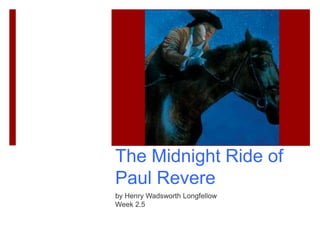
The Midnight Ride of
Paul Revere
by Henry Wadsworth Longfellow
Week 2.5
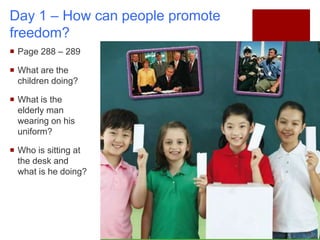
Day 1 – How can people promote
freedom?
 Page 288 – 289
 What are the
children doing?
 What is the
elderly man
wearing on his
uniform?
 Who is sitting at
the desk and
what is he doing?
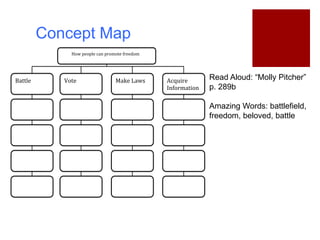
Concept Map
Read Aloud: “Molly Pitcher”
p. 289b
Amazing Words: battlefield,
freedom, beloved, battle
How people can promote freedom
Battle Vote Make Laws Acquire
Information
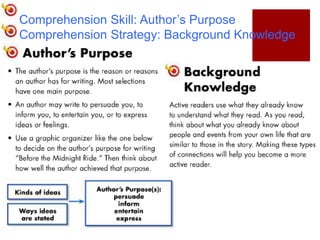
Comprehension Skill: Author’s Purpose
Comprehension Strategy: Background Knowledge
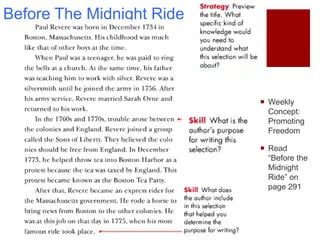
Before The Midnight Ride
 Weekly
Concept:
Promoting
Freedom
 Read
“Before the
Midnight
Ride” on
page 291
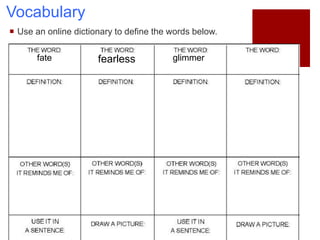
Vocabulary
 Use an online dictionary to define the words below.
fate fearless glimmer
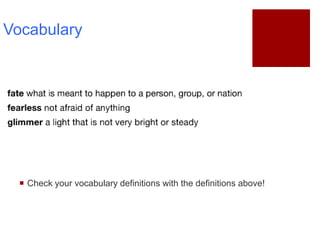
Vocabulary
 Check your vocabulary definitions with the definitions above!
Spelling – Take your pretest on SpellingCity
Conventions – finish WS 10 after reading groups
Handwriting – Work on the next two pages in
your cursive packet
Day 2 – Content Knowledge
Oral Vocabulary
 How can people promote freedom?
 “In between the sounds of the battle, Molly could hear cries. “Water!
Water!” Men were falling, falling from the heat.” - “Molly Pitcher”
 What sounds do you think would be heard in a battle?
 What do the sentences tell you about Molly’s surroundings?
 Why do you think the author told us about what was going on around
Molly?
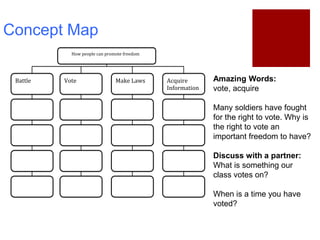
Concept Map
Amazing Words:
vote, acquire
Many soldiers have fought
for the right to vote. Why is
the right to vote an
important freedom to have?
Discuss with a partner:
What is something our
class votes on?
When is a time you have
voted?
How people can promote freedom
Battle Vote Make Laws Acquire
Information
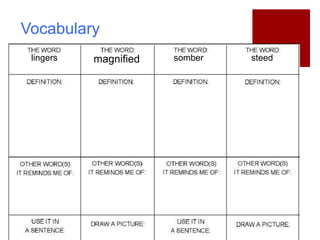
Vocabulary
lingers magnified somber steed
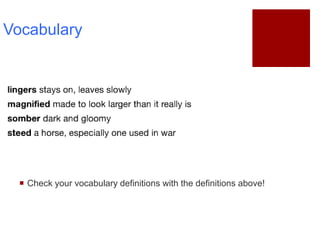
Vocabulary
 Check your vocabulary definitions with the definitions above!
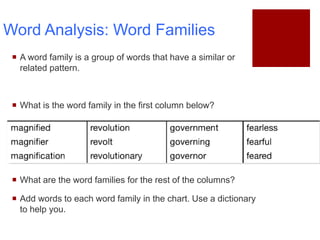
Word Analysis: Word Families
 A word family is a group of words that have a similar or
related pattern.
 What is the word family in the first column below?
 What are the word families for the rest of the columns?
 Add words to each word family in the chart. Use a dictionary
to help you.
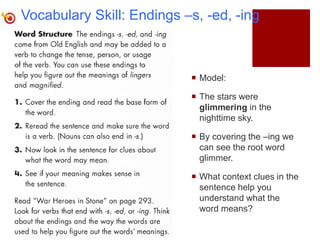
Vocabulary Skill: Endings –s, -ed, -ing
 Model:
 The stars were
glimmering in the
nighttime sky.
 By covering the –ing we
can see the root word
glimmer.
 What context clues in the
sentence help you
understand what the
word means?
Vocabulary Skill: Endings –s, -ed, -ing
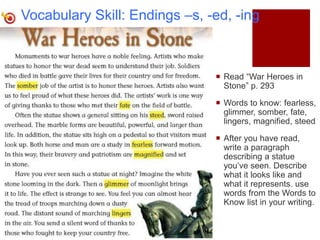
 Read “War Heroes in
Stone” p. 293
 Words to know: fearless,
glimmer, somber, fate,
lingers, magnified, steed
 After you have read,
write a paragraph
describing a statue
you’ve seen. Describe
what it looks like and
what it represents. use
words from the Words to
Know list in your writing.
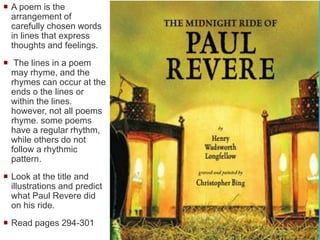
 A poem is the
arrangement of
carefully chosen words
in lines that express
thoughts and feelings.
 The lines in a poem
may rhyme, and the
rhymes can occur at the
ends o the lines or
within the lines.
however, not all poems
rhyme. some poems
have a regular rhythm,
while others do not
follow a rhythmic
pattern.
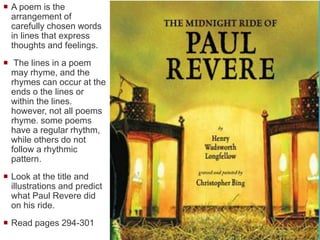
 Look at the title and
illustrations and predict
what Paul Revere did
on his ride.
 Read pages 294-301
Spelling – Get on SpellingCity and practice
your spelling words
Conventions – WS 156
Vocabulary – WS 159
Day 3 – Content Knowledge
Oral Vocabulary
 How can people promote freedom?
 “Soldiers who died in battle gave their lives for their country and for
freedom.” – “War Heroes in Stone” p. 293
 What is freedom?
 What does the context tell you about the phrase in battle?
 Why is it necessary sometimes for people to have to be in a battle for
freedom?
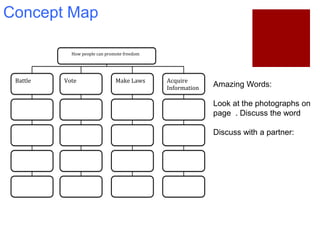
Concept Map
Amazing Words:
Look at the photographs on
page . Discuss the word
Discuss with a partner:
How people can promote freedom
Battle Vote Make Laws Acquire
Information
Literary Terms: Rhyme, Rhythm,
and Cadence
 Rhythm is the pattern of sounds.
 Rhyme is the repetition of the final vowel or consonant sounds in
words.
 Cadence is created by rhythm. It is the flow of language.
 A poem is the
arrangement of
carefully chosen words
in lines that express
thoughts and feelings.
 The lines in a poem
may rhyme, and the
rhymes can occur at the
ends o the lines or
within the lines.
however, not all poems
rhyme. some poems
have a regular rhythm,
while others do not
follow a rhythmic
pattern.
 Look at the title and
illustrations and predict
what Paul Revere did
on his ride.
 Read pages 294-301
Think Critically – Answer the think critically
questions on page 308
Conventions – WS 103
Type to learn – Practice your typing for 15
minutes
Day 4 – Content Knowledge
Oral Vocabulary
 How can people promote freedom?
“He heard the bleating of the flock,
And the twitter of the birds among the trees
And felt the breath of the morning breeze
Blowing over the meadows brown.”
-The Midnight Ride of Paul Revere p. 305
 What does the “bleating of the flock” mean?
 What does “twitter of birds” mean?
 The words bleating and twitter are examples of the same
sound device. What is this device?
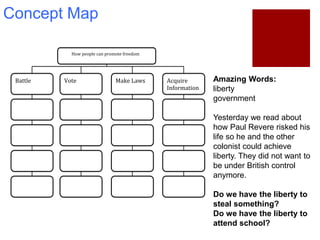
Concept Map
Amazing Words:
liberty
government
Yesterday we read about
how Paul Revere risked his
life so he and the other
colonist could achieve
liberty. They did not want to
be under British control
anymore.
Do we have the liberty to
steal something?
Do we have the liberty to
attend school?
How people can promote freedom
Battle Vote Make Laws Acquire
Information
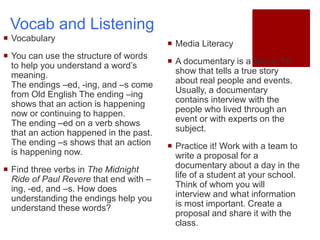
Vocab and Listening
 Vocabulary
 You can use the structure of words
to help you understand a word’s
meaning.
The endings –ed, -ing, and –s come
from Old English The ending –ing
shows that an action is happening
now or continuing to happen.
The ending –ed on a verb shows
that an action happened in the past.
The ending –s shows that an action
is happening now.
 Find three verbs in The Midnight
Ride of Paul Revere that end with –
ing, -ed, and –s. How does
understanding the endings help you
understand these words?
 Media Literacy
 A documentary is a film or TV
show that tells a true story
about real people and events.
Usually, a documentary
contains interview with the
people who lived through an
event or with experts on the
subject.
 Practice it! Work with a team to
write a proposal for a
documentary about a day in the
life of a student at your school.
Think of whom you will
interview and what information
is most important. Create a
proposal and share it with the
class.
Spelling – Practice your spelling words quietly
with a partner and a dry erase board.
Conventions – WS 163
Vocabulary - WS
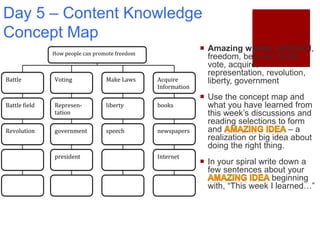
Day 5 – Content Knowledge
Concept Map
 Amazing words: battlefield,
freedom, beloved, battle,
vote, acquire,
representation, revolution,
liberty, government
 Use the concept map and
what you have learned from
this week’s discussions and
reading selections to form
and – a
realization or big idea about
doing the right thing.
 In your spiral write down a
few sentences about your
beginning
with, “This week I learned…”
Ba
How people can promote freedom
Battle Voting Make Laws Acquire
Information
Battle field Represen-
tation
liberty books
Revolution government speech newspapers
president Internet
REVIEW – Comprehension Skill
Author’s Purpose
 Author’s purpose is the reason or reasons an author has for writing.
Most selections have one main purpose.
 Authors can write to entertain, inform, persuade, or express feelings.
 Find an example in The Midnight Ride of Paul Revere of the author’s
purpose.
 Extra Practice WS 105
 The word endings –s, -ed, and –ing may be added to verbs to
change the tense, person, or usage of the verbs.
 How does the ending –ed change the word magnified?
 Work with a partner to determine the meanings of the words below.
Write each word in a sentence.
 gazing, gleamed, lingers
REVIEW – Vocabulary Skill
Endings –s, -ed, -ing
 A word family is a group of words that have a similar or related
pattern.
 With a partner, look up the word pay. Write down words that
belong in the word family pay.
 Use 3 of the words you find in a sentence.
REVIEW – Word Analysis
Word Families
 Reread The Midnight Ride of Paul Revere on page 296.
 What words rhyme in the selection?
 How does the rhythm of the poem create a mood or feeling?
REVIEW – Literary Terms
Rhyme, Rhythm, and Cadence

Reading Street

  • 1.
    The Midnight Rideof Paul Revere by Henry Wadsworth Longfellow Week 2.5
  • 2.
    Day 1 –How can people promote freedom?  Page 288 – 289  What are the children doing?  What is the elderly man wearing on his uniform?  Who is sitting at the desk and what is he doing?
  • 3.
    Concept Map Read Aloud:“Molly Pitcher” p. 289b Amazing Words: battlefield, freedom, beloved, battle How people can promote freedom Battle Vote Make Laws Acquire Information
  • 4.
    Comprehension Skill: Author’sPurpose Comprehension Strategy: Background Knowledge
  • 5.
    Before The MidnightRide  Weekly Concept: Promoting Freedom  Read “Before the Midnight Ride” on page 291
  • 6.
    Vocabulary  Use anonline dictionary to define the words below. fate fearless glimmer
  • 7.
    Vocabulary  Check yourvocabulary definitions with the definitions above!
  • 8.
    Spelling – Takeyour pretest on SpellingCity Conventions – finish WS 10 after reading groups Handwriting – Work on the next two pages in your cursive packet
  • 9.
    Day 2 –Content Knowledge Oral Vocabulary  How can people promote freedom?  “In between the sounds of the battle, Molly could hear cries. “Water! Water!” Men were falling, falling from the heat.” - “Molly Pitcher”  What sounds do you think would be heard in a battle?  What do the sentences tell you about Molly’s surroundings?  Why do you think the author told us about what was going on around Molly?
  • 10.
    Concept Map Amazing Words: vote,acquire Many soldiers have fought for the right to vote. Why is the right to vote an important freedom to have? Discuss with a partner: What is something our class votes on? When is a time you have voted? How people can promote freedom Battle Vote Make Laws Acquire Information
  • 11.
  • 12.
    Vocabulary  Check yourvocabulary definitions with the definitions above!
  • 13.
    Word Analysis: WordFamilies  A word family is a group of words that have a similar or related pattern.  What is the word family in the first column below?  What are the word families for the rest of the columns?  Add words to each word family in the chart. Use a dictionary to help you.
  • 14.
    Vocabulary Skill: Endings–s, -ed, -ing  Model:  The stars were glimmering in the nighttime sky.  By covering the –ing we can see the root word glimmer.  What context clues in the sentence help you understand what the word means?
  • 15.
    Vocabulary Skill: Endings–s, -ed, -ing  Read “War Heroes in Stone” p. 293  Words to know: fearless, glimmer, somber, fate, lingers, magnified, steed  After you have read, write a paragraph describing a statue you’ve seen. Describe what it looks like and what it represents. use words from the Words to Know list in your writing.
  • 16.
     A poemis the arrangement of carefully chosen words in lines that express thoughts and feelings.  The lines in a poem may rhyme, and the rhymes can occur at the ends o the lines or within the lines. however, not all poems rhyme. some poems have a regular rhythm, while others do not follow a rhythmic pattern.  Look at the title and illustrations and predict what Paul Revere did on his ride.  Read pages 294-301
  • 17.
    Spelling – Geton SpellingCity and practice your spelling words Conventions – WS 156 Vocabulary – WS 159
  • 18.
    Day 3 –Content Knowledge Oral Vocabulary  How can people promote freedom?  “Soldiers who died in battle gave their lives for their country and for freedom.” – “War Heroes in Stone” p. 293  What is freedom?  What does the context tell you about the phrase in battle?  Why is it necessary sometimes for people to have to be in a battle for freedom?
  • 19.
    Concept Map Amazing Words: Lookat the photographs on page . Discuss the word Discuss with a partner: How people can promote freedom Battle Vote Make Laws Acquire Information
  • 20.
    Literary Terms: Rhyme,Rhythm, and Cadence  Rhythm is the pattern of sounds.  Rhyme is the repetition of the final vowel or consonant sounds in words.  Cadence is created by rhythm. It is the flow of language.
  • 21.
     A poemis the arrangement of carefully chosen words in lines that express thoughts and feelings.  The lines in a poem may rhyme, and the rhymes can occur at the ends o the lines or within the lines. however, not all poems rhyme. some poems have a regular rhythm, while others do not follow a rhythmic pattern.  Look at the title and illustrations and predict what Paul Revere did on his ride.  Read pages 294-301
  • 22.
    Think Critically –Answer the think critically questions on page 308 Conventions – WS 103 Type to learn – Practice your typing for 15 minutes
  • 23.
    Day 4 –Content Knowledge Oral Vocabulary  How can people promote freedom? “He heard the bleating of the flock, And the twitter of the birds among the trees And felt the breath of the morning breeze Blowing over the meadows brown.” -The Midnight Ride of Paul Revere p. 305  What does the “bleating of the flock” mean?  What does “twitter of birds” mean?  The words bleating and twitter are examples of the same sound device. What is this device?
  • 24.
    Concept Map Amazing Words: liberty government Yesterdaywe read about how Paul Revere risked his life so he and the other colonist could achieve liberty. They did not want to be under British control anymore. Do we have the liberty to steal something? Do we have the liberty to attend school? How people can promote freedom Battle Vote Make Laws Acquire Information
  • 25.
    Vocab and Listening Vocabulary  You can use the structure of words to help you understand a word’s meaning. The endings –ed, -ing, and –s come from Old English The ending –ing shows that an action is happening now or continuing to happen. The ending –ed on a verb shows that an action happened in the past. The ending –s shows that an action is happening now.  Find three verbs in The Midnight Ride of Paul Revere that end with – ing, -ed, and –s. How does understanding the endings help you understand these words?  Media Literacy  A documentary is a film or TV show that tells a true story about real people and events. Usually, a documentary contains interview with the people who lived through an event or with experts on the subject.  Practice it! Work with a team to write a proposal for a documentary about a day in the life of a student at your school. Think of whom you will interview and what information is most important. Create a proposal and share it with the class.
  • 26.
    Spelling – Practiceyour spelling words quietly with a partner and a dry erase board. Conventions – WS 163 Vocabulary - WS
  • 27.
    Day 5 –Content Knowledge Concept Map  Amazing words: battlefield, freedom, beloved, battle, vote, acquire, representation, revolution, liberty, government  Use the concept map and what you have learned from this week’s discussions and reading selections to form and – a realization or big idea about doing the right thing.  In your spiral write down a few sentences about your beginning with, “This week I learned…” Ba How people can promote freedom Battle Voting Make Laws Acquire Information Battle field Represen- tation liberty books Revolution government speech newspapers president Internet
  • 28.
    REVIEW – ComprehensionSkill Author’s Purpose  Author’s purpose is the reason or reasons an author has for writing. Most selections have one main purpose.  Authors can write to entertain, inform, persuade, or express feelings.  Find an example in The Midnight Ride of Paul Revere of the author’s purpose.  Extra Practice WS 105
  • 29.
     The wordendings –s, -ed, and –ing may be added to verbs to change the tense, person, or usage of the verbs.  How does the ending –ed change the word magnified?  Work with a partner to determine the meanings of the words below. Write each word in a sentence.  gazing, gleamed, lingers REVIEW – Vocabulary Skill Endings –s, -ed, -ing
  • 30.
     A wordfamily is a group of words that have a similar or related pattern.  With a partner, look up the word pay. Write down words that belong in the word family pay.  Use 3 of the words you find in a sentence. REVIEW – Word Analysis Word Families
  • 31.
     Reread TheMidnight Ride of Paul Revere on page 296.  What words rhyme in the selection?  How does the rhythm of the poem create a mood or feeling? REVIEW – Literary Terms Rhyme, Rhythm, and Cadence

Editor's Notes

  • #4 Double Click on the concept map to open in word. Edit in word.
  • #5 p. 289c
  • #6 Worksheet 153
  • #15 WS 155
  • #16 WS 155
  • #17 WS Literary Elements 102 WS Vocabulary 159
  • #19 p. 302a
  • #21 Look at page 292 d for more information we could also begin incorporating our figurative language materials this week!
  • #22 WS Literary Elements 102 WS Vocabulary 159
  • #26 Day 4 Group - Read The Heroic Paul Revere p. 312 vocab and listening p. 316
  • #28 Amazing ideas might include these key concepts: The right to vote for our government leaders is one of the most important freedoms. Sometimes people go to battle to promote freedom. Our government leaders must protect our basic freedoms
  • #31 p. 317i