Including the Productive Poor in Agricultural Development
Escaping Poverty Traps:
Connecting the Chronically Poor to Economic Growth
Cheryl Morden
Director, IFAD North American Liaison Office
February 26, 2009
Presentation Outline
1. About IFAD, its target group, and results
2. Current context for increasing rural incomes
and improving food security
3. Understanding the impact on poor rural
women and men of rapidly changing
environment
4. Areas of strategic focus, key challenges, and
lessons learned
International Fund for Agricultural Development
A specialized U.N. agency
An international financial institution
A global alliance of developed and
developing countries to enable
poor rural people to overcome
poverty
IFAD’S target group
Rural people living in poverty and food insecurity in developing
countries:
- extremely poor people who have the potential to take
advantage of improved access to assets and opportunities for
agricultural production and rural income generating activities
- those who have fewer assets and opportunities -- in
particular, marginalized groups such as minorities and
indigenous peoples
- a special focus on women within all identified groups
Context
• The world is rapidly changing
• Change brings both threats and opportunities for the
livelihoods of poor rural people
Context - continued
• Rapid changes require new
approaches in rural development
programmes and policies
• Poor rural people are
constantly seeking ways
to adapt to a changing
environment
• Poor rural people are diverse
and have complex and
diversified livelihood strategies
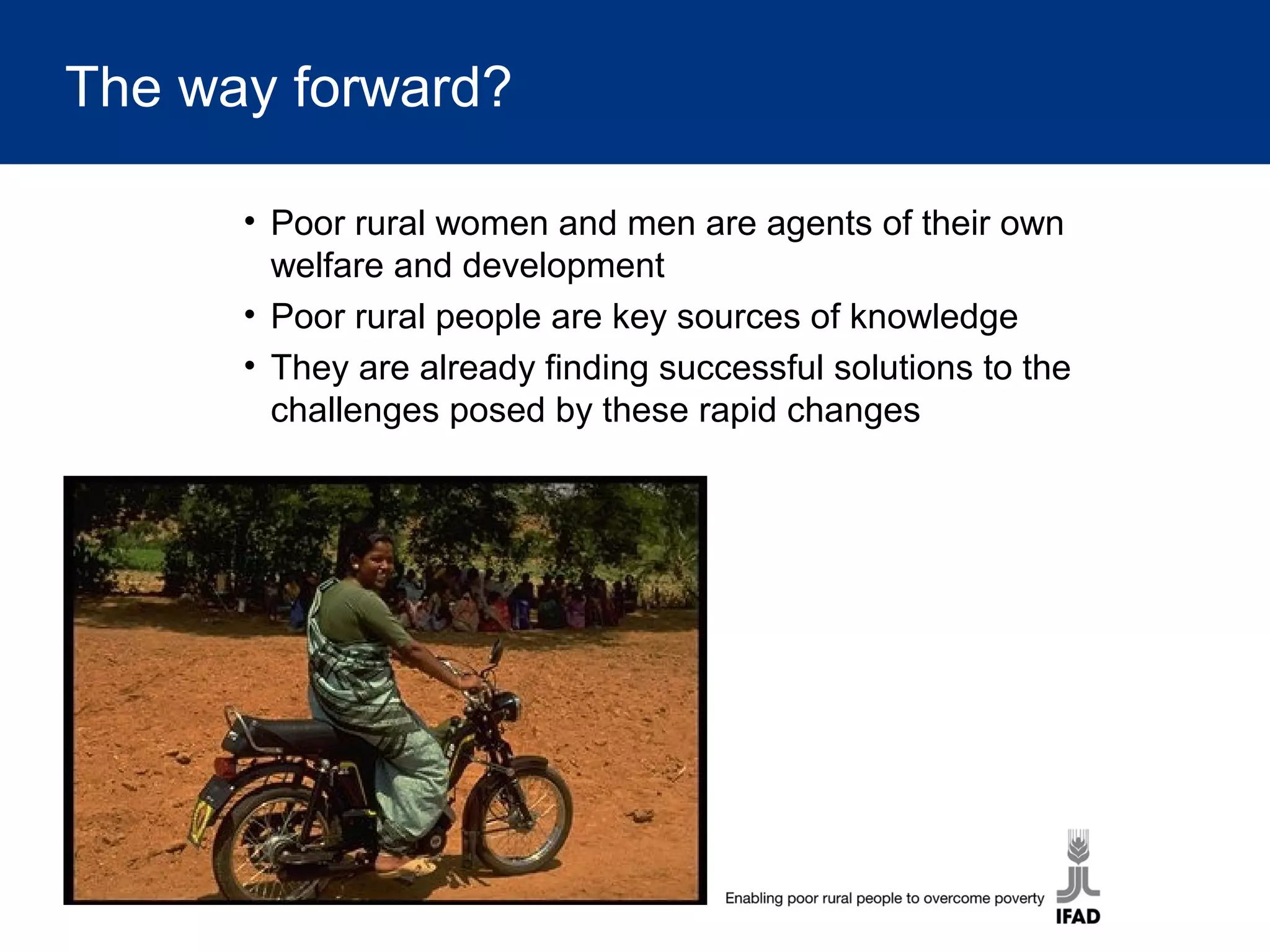
The way forward?
• Poor rural women and men are agents of their own
welfare and development
• Poor rural people are key sources of knowledge
• They are already finding successful solutions to the
challenges posed by these rapid changes
Key challenges
How can and do poor rural people gain access to and
capacity to benefit from:
- Sustainable management of productive natural
resources
- Agricultural services
- Remunerative and equitable markets
- Non-farm opportunities for employment and
enterprise development
- Participation in governance processes
Sustainable management of productive natural
resources
How to:
• Gain or maintain sufficient access and improve security
of access to productive resources
• Build capacity for management of natural resources
• Take advantage of evolving markets
“Land for labor” agreements for landless women
• Permanent land access and
use rights for women
beneficiaries
• Increased maintenance and
crop intensity
• Increased community
cohesion
Agricultural services
How to:
• Access to affordable and sustainable agricultural
services tailored to particular needs
• Flexible services supportive of innovation and adapted
to emerging issues
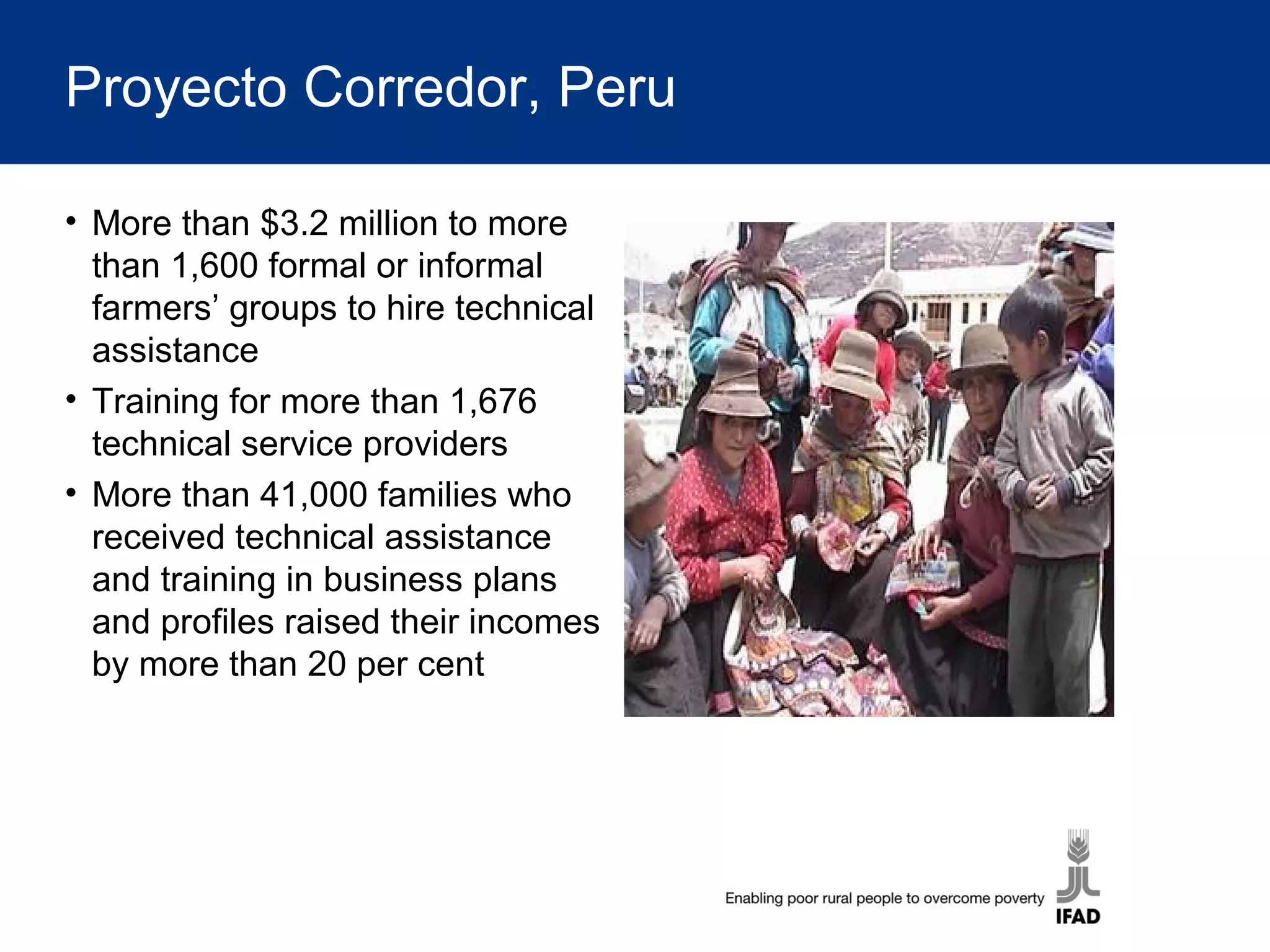
Proyecto Corredor, Peru
• More than $3.2 million to more
than 1,600 formal or informal
farmers’ groups to hire technical
assistance
• Training for more than 1,676
technical service providers
• More than 41,000 families who
received technical assistance
and training in business plans
and profiles raised their incomes
by more than 20 per cent
Remunerative and equitable markets
How to:
• Access adequate and affordable input markets
• Participate on better terms in agricultural market chains
• Enter new and high-value chains,
• Increase or protect their purchasing power on
agricultural or food markets
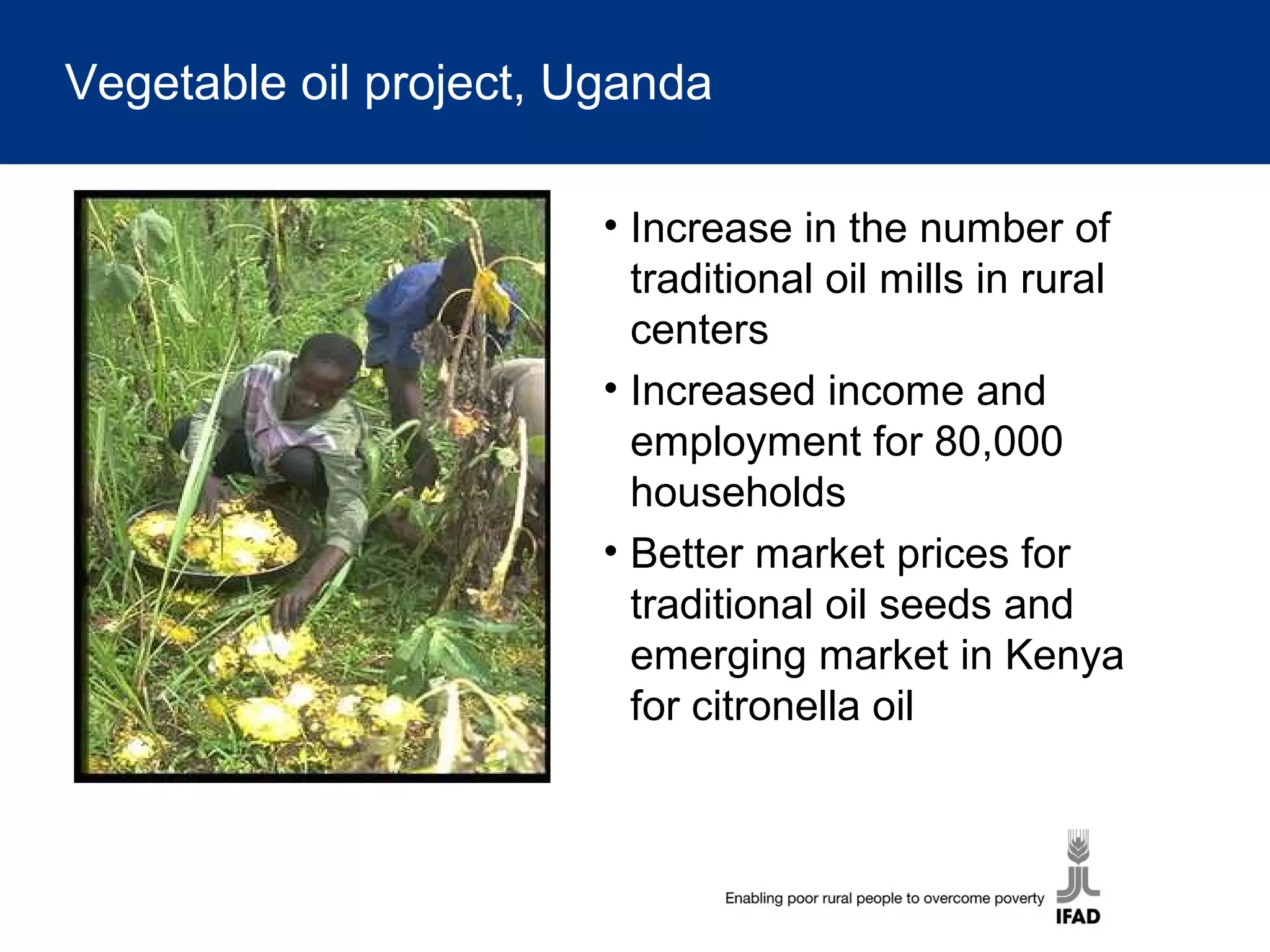
Vegetable oil project, Uganda
• Increase in the number of
traditional oil mills in rural
centers
• Increased income and
employment for 80,000
households
• Better market prices for
traditional oil seeds and
emerging market in Kenya
for citronella oil
Non-farm opportunities for employment and
enterprise development
How to:
• Find opportunities for profitable non-farm activities in
local markets
• develop viable non-farm activities and small enterprises
• better exploit employment opportunities linked to
urbanization and migration
• take advantage of non-farm income opportunities linked
to climate change.
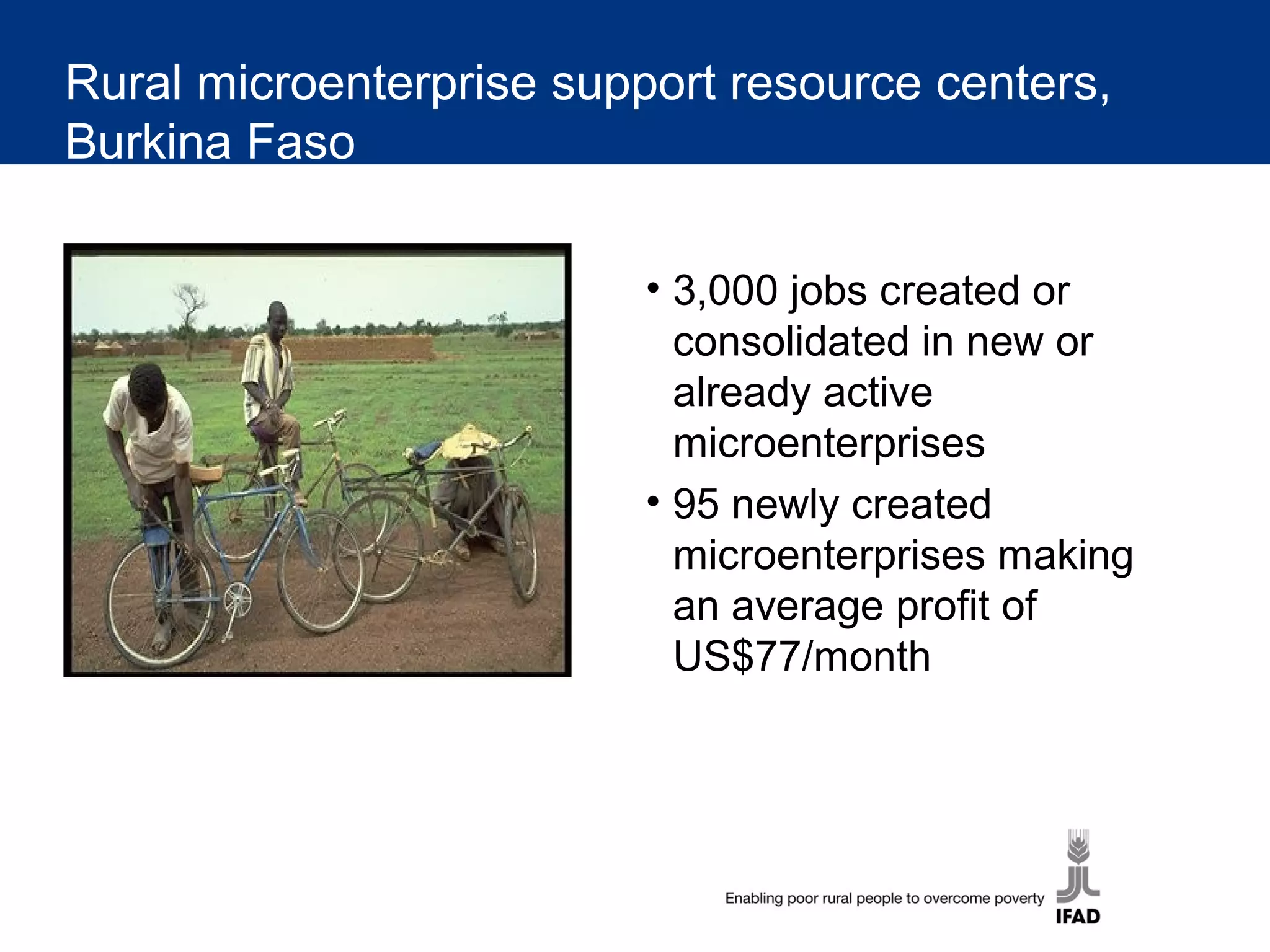
Rural microenterprise support resource centers,
Burkina Faso
• 3,000 jobs created or
consolidated in new or
already active
microenterprises
• 95 newly created
microenterprises making
an average profit of
US$77/month
Participation in governance processes
How to:
• Formulate a coherent and convincing pro-poor policy
agenda
• Access relevant formal and informal policy processes
• Ensure that pro-poor policy decisions are implemented
and have a positive impact
Village Networks, Cambodia
• Public services respond to
community needs and
demands
• Resource mobilization to
support commune projects
• Improved awareness of the
role of local governance
and the possibility of
addressing community
concerns
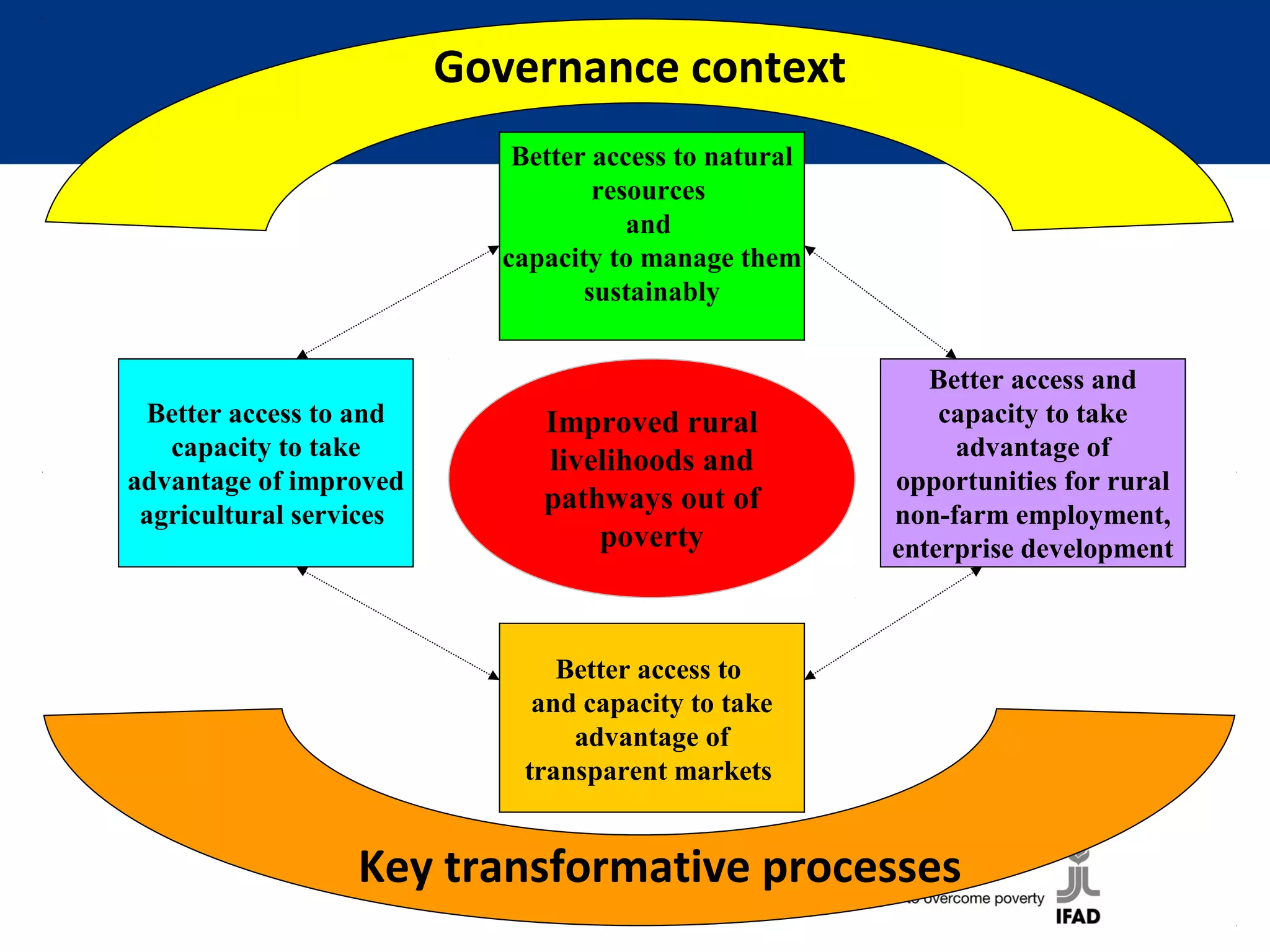
Better access to and
capacity to take
advantage of improved
agricultural services
Better access and
capacity to take
advantage of
opportunities for rural
non-farm employment,
enterprise development
Better access to
and capacity to take
advantage of
transparent markets
Better access to natural
resources
and
capacity to manage them
sustainably
Improved rural
livelihoods and
pathways out of
poverty
Key transformative processes
Governance context
Including the Productive Poor in Agricultural Development

Including the Productive Poor in Agricultural Development

  • 1.
    Including the ProductivePoor in Agricultural Development Escaping Poverty Traps: Connecting the Chronically Poor to Economic Growth Cheryl Morden Director, IFAD North American Liaison Office February 26, 2009
  • 2.
    Presentation Outline 1. AboutIFAD, its target group, and results 2. Current context for increasing rural incomes and improving food security 3. Understanding the impact on poor rural women and men of rapidly changing environment 4. Areas of strategic focus, key challenges, and lessons learned
  • 3.
    International Fund forAgricultural Development A specialized U.N. agency An international financial institution A global alliance of developed and developing countries to enable poor rural people to overcome poverty
  • 4.
    IFAD’S target group Ruralpeople living in poverty and food insecurity in developing countries: - extremely poor people who have the potential to take advantage of improved access to assets and opportunities for agricultural production and rural income generating activities - those who have fewer assets and opportunities -- in particular, marginalized groups such as minorities and indigenous peoples - a special focus on women within all identified groups
  • 5.
    Context • The worldis rapidly changing • Change brings both threats and opportunities for the livelihoods of poor rural people
  • 6.
    Context - continued •Rapid changes require new approaches in rural development programmes and policies • Poor rural people are constantly seeking ways to adapt to a changing environment • Poor rural people are diverse and have complex and diversified livelihood strategies
  • 7.
    The way forward? •Poor rural women and men are agents of their own welfare and development • Poor rural people are key sources of knowledge • They are already finding successful solutions to the challenges posed by these rapid changes
  • 8.
    Key challenges How canand do poor rural people gain access to and capacity to benefit from: - Sustainable management of productive natural resources - Agricultural services - Remunerative and equitable markets - Non-farm opportunities for employment and enterprise development - Participation in governance processes
  • 9.
    Sustainable management ofproductive natural resources How to: • Gain or maintain sufficient access and improve security of access to productive resources • Build capacity for management of natural resources • Take advantage of evolving markets
  • 10.
    “Land for labor”agreements for landless women • Permanent land access and use rights for women beneficiaries • Increased maintenance and crop intensity • Increased community cohesion
  • 11.
    Agricultural services How to: •Access to affordable and sustainable agricultural services tailored to particular needs • Flexible services supportive of innovation and adapted to emerging issues
  • 12.
    Proyecto Corredor, Peru •More than $3.2 million to more than 1,600 formal or informal farmers’ groups to hire technical assistance • Training for more than 1,676 technical service providers • More than 41,000 families who received technical assistance and training in business plans and profiles raised their incomes by more than 20 per cent
  • 13.
    Remunerative and equitablemarkets How to: • Access adequate and affordable input markets • Participate on better terms in agricultural market chains • Enter new and high-value chains, • Increase or protect their purchasing power on agricultural or food markets
  • 14.
    Vegetable oil project,Uganda • Increase in the number of traditional oil mills in rural centers • Increased income and employment for 80,000 households • Better market prices for traditional oil seeds and emerging market in Kenya for citronella oil
  • 15.
    Non-farm opportunities foremployment and enterprise development How to: • Find opportunities for profitable non-farm activities in local markets • develop viable non-farm activities and small enterprises • better exploit employment opportunities linked to urbanization and migration • take advantage of non-farm income opportunities linked to climate change.
  • 16.
    Rural microenterprise supportresource centers, Burkina Faso • 3,000 jobs created or consolidated in new or already active microenterprises • 95 newly created microenterprises making an average profit of US$77/month
  • 17.
    Participation in governanceprocesses How to: • Formulate a coherent and convincing pro-poor policy agenda • Access relevant formal and informal policy processes • Ensure that pro-poor policy decisions are implemented and have a positive impact
  • 18.
    Village Networks, Cambodia •Public services respond to community needs and demands • Resource mobilization to support commune projects • Improved awareness of the role of local governance and the possibility of addressing community concerns
  • 19.
    Better access toand capacity to take advantage of improved agricultural services Better access and capacity to take advantage of opportunities for rural non-farm employment, enterprise development Better access to and capacity to take advantage of transparent markets Better access to natural resources and capacity to manage them sustainably Improved rural livelihoods and pathways out of poverty Key transformative processes Governance context

Editor's Notes

  • #2 Gender equality is a development effectiveness issue, as well as an equity concern.   IFAD has recognized this from its beginning.    It has tried to ensure that the benefits of the programmes and projects it supports accrue equitably to women and men.   The current food crisis has served as a loud wake up call to reengage in agriculture and refocus on global food security.   As a result, there is now much greater recognition that agriculture is key to achieving the first MDG.    A sharp focus on gender –based constraints in agriculture can be a critical ingredient in successfully growing and marketing more food for a hungry world.      Economic empowerment can accelerate and reinforce gender equality and women’s empowerment by boosting a woman’s status.  Thus, IFAD ’s focus on the economic empowerment of poor rural women can also be an especially effective means of achieving the third MDG, which is gender equality and women’s  empowerment.  
  • #3 Gender equality and women’s empowerment are interconnected and affect men and women.
  • #11 In the Gambia, for example, negotiations at the community level led to an agreement that allows landless women rice growers seasonal use of lands whose owners lack the labour to farm them. In exchange, the women contribute labour to the reclamation of degraded land. As a result, with the availability of reclaimed communal land, women have become permanent landowners, rice production and incomes have increased, and household food security has improved.
  • #20 Here you can see that the five kinds of challenges are actually linked to each other. Poor rural people need improve access and capabilities in all five areas in order to improve their livelihoods. Participation in governance processes in particular affects what happens in relation to all other types of challenges. Also very important is what you see at the bottom of the page: transformative processes also affect all kinds of challenges, as well as, of course, the kind of solutions that can be found to them, and also the chances that solutions that exist today can continue to hold valid in the future. Let us now briefly see some of the transformative processes to which we give special attention in this publication.