AUTISM SPECTRUM
DISORDERS: Implications,
Resources, and Supports for
General Education
Staff Presentation
http://www.cdc.gov/ncbddd/autism
/facts.html
What are Autism Spectrum
Disorders?
Autism Spectrum Disorders (ASDs) are a
group of developmental disabilities that can
cause significant social, communication
and behavioral challenges.
People with ASD handle information in
their brain differently than other people.
taken from Centers for Disease Control Website
What are Autism Spectrum
Disorders? (cont.)
●ASD is a spectrum of disorders. That means
ASD affects each person in different ways, and
can range from very mild to severe.
●People with ASD share some similar
symptoms, such as problems with social
interaction, but there are differences in when the
symptoms start, how severe they are, and the
exact nature of the symptoms.
Who is affected by ASD?
●As many as 1 in 99 children today are being
diagnosed with ASDs
●Boys are 4 times more likely to be affected than girls
●Children can be diagnosed as young as 18 months
and typically are diagnosed by age 3
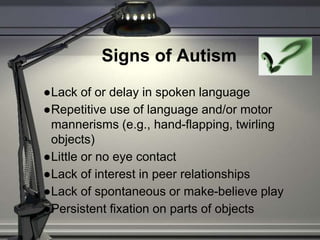
Signs of Autism
●Lack of or delay in spoken language
●Repetitive use of language and/or motor
mannerisms (e.g., hand-flapping, twirling
objects)
●Little or no eye contact
●Lack of interest in peer relationships
●Lack of spontaneous or make-believe play
●Persistent fixation on parts of objects
Causes of Autism
●There is no known single cause for
autism
●Researchers are investigating a
number of theories
othe possibility that under certain
conditions, a cluster of unstable genes
may interfere with brain development,
resulting in autism.
oproblems during pregnancy or delivery
as well as environmental factors
The Law
●Ed. Code Article 3 Sec 56040.1
In accordance with Section 1412(a)(5) of Title 20 of the
United States Code and Section 300.114 of Title 34 of the
Code of Federal Regulations, each public agency shall
ensure the following to address the least restrictive
environment for individuals with exceptional needs:
(a) To the maximum extent appropriate, individuals with
exceptional needs, including children in public or private
institutions or other care facilities, are educated with
children who are non disabled.
(b) Special classes, separate schooling, or other removal of
individuals with exceptional needs from the regular
environment occurs only if the nature or severity of the
disability is such that education in regular classes with the
use of supplementary aids and services cannot be achieved
Key Points
●What the law implies is that we will very likely
have more students with disabilities in the
general education classrooms
●We need to understand these disabilities and
the implications it can have
●More knowledge = More skills to work with
students effectively = reduced frustration
●Teamwork is key. Special ed and general ed
staff need to work hand in hand to ensure
success of all students in the school.
Please pay attention to the
use of “may”, “might” or “often”
when defining these
characteristics
All children with Autism are different and
may not be affected in the same way.
How does ASD affect
a student in school?
●Communication/Language Development
●Social Interactions
●Repetitive or Stereotypical behaviors
Areas of Difficulty:
Language/Communication
●Students who are non-vocal or have
limited vocal skills
omay require alternative communication
technologies
ooften engage in inappropriate behaviors to get
their wants and needs met
●The first priority in teaching language to
these students is to teach them how to get
their wants and needs met
Areas of Difficulty:
Language/Communication Cont’d
●Students who are non-vocal or have
limited vocal skills
omay also have impaired cognitive skills
omay not follow directions not due to willful non-
compliance but because they do not understand
the words
omay be mainstreamed usually with adult support
Areas of Difficulty:
Language/Communication2
●Students with mild speech delays/difficulties
otypically be mainstreamed in the general ed
classroom partially or fully
oneed to learn to speak just like ELD students
who are learning English
omay be able to speak clearly but use
echolalia. Some students may speak a lot but
may not use all the language functionally
ooften view the world very literally, they don’t
always understand sarcasm, jokes, idioms.
Areas of Difficulty:
Language/Communication
Cont’d
●Students with mild speech
delays/difficulties
omay use ‘scripted’ language. Sometimes students use
scripting functionally within context
omay have difficulty understanding abstract language.
For e.g., statements like, “You need to behave.” This is far
too abstract and the student needs specific examples of
what he/she is required to do. For e.g., you could instead
say, “You need to sit in your seat and complete page 3.”
Areas of Difficulty:
Social Interactions
Students with ASD:
●have a desire to interact with others but may not
know all the social rules so may have difficulty
understanding them and tend to misinterpret social
cues
●tend to watch others instead of interacting with them
●may respond more than initiate
●often have difficulty understanding the feelings/
perspectives of others
Areas of Difficulty:
Social Interaction Cont’d
●may interact with adults appropriately but not with
students.
●are often left out of social activities or are bullied
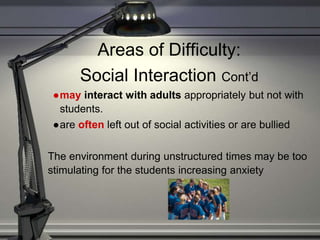
The environment during unstructured times may be too
stimulating for the students increasing anxiety
Areas of Difficulty: Behavior
●Students with Autism often have stereotypical or
repetitive behaviors
omay make the children appear odd (i.e. hand
flapping, toe walking, rocking, spinning in circles)
omay keep or maintain their attention more
intensely than other activities (i.e. talking about
bathrooms, looking at the wheels of a train, etc).
omay be very difficult for them to transition away
from these activities whether their stereotypical
behaviors are verbal or physical
Areas of Difficulty: Behavior Cont’d
Remember ASD students have:
●difficulties in communication, sensory processing or
lack of understanding of the rules
●difficulty making eye contact
●difficulty understanding the consequences of
punishments
●difficulty with abstract language
Areas of Difficulty:
Sensory Integration
Sensory Integration - involves taking in this info,
organizing our behavior, & interacting successfully in the
world.
●may have difficulty – can be mild or severe and varies
from student to student
●may increase when sensory systems are not
functioning appropriately.
Areas of Difficulty: Sensory
Integration Cont’d (Sensory Systems)
●Tactile (Touch) – info about the environment and object
qualities (touch, pressure, texture, hard, soft, sharp, dull, heat,
cold, pain)
●Vestibular (Balance) – where our body is in space and whether
or not we or our surroundings are moving. Involves speed and
direction of movement.
●Proprioception (body awareness) – where a certain body part
is and how it is moving
●Visual (sight) – info about objects and persons, helps define
boundaries as we move through time & space
●Auditory (hearing) – sounds in the environment
●Gustatory (taste) – different types of taste
●Olfactory (smell) – different types of smell
But what do I do in my classroom for
ASD students?
●Maintain a routine when possible and notify if there is
a change
●Use visuals and graphic organizers as supports
●Enforce consistent class rules
●Allow alternative activities for unstructured times to
avoid sensory overload
●Simplify communication, pausing between multi-step
directions
●Modify homework if needed
●Explain consequences of ASD student’s behaviors to
Where do I get help for my
classroom for ASD students?
●Work with school special education staff and
administration regarding supports and resources
●Know what is in the student’s IEP regarding
goals/objectives as well as
accommodations/modifications
●Implement UDL (Universal Design for Learning)
http://cast.org/ and Teaching Every Student
http://cast.org/teachingeverystudent/
But what do I do in my
classroom for other students?
●Maintain a routine when possible
●Use visuals for supports
●Enforce consistent class rules
●Explain the need for alternative activities
●Explain ASD student’s behaviors for students’
understanding, to get support, and to reduce
bullying
Resources (just some)
●For additional information on ASDs, here are some
websites:
oAutism Society of America http://www.autism-
society.org/site/PageServer
oAutism Speaks http://www.autismspeaks.org/
oAutism Collaboration http://www.autism.org/
ohttp://www.marthalakecov.org/~building/spneeds/autis
m/daily.htm
ohttp://www.cec.sped.org/AM/Template.cfm?Section=A
utism_Asperger_s_Syndrome&Template=/TaggedPag
e/TaggedPageDisplay.cfm&TPLID=37&ContentID=55
98

Asd presentation -seilts

  • 1.
    AUTISM SPECTRUM DISORDERS: Implications, Resources,and Supports for General Education Staff Presentation
  • 2.
    http://www.cdc.gov/ncbddd/autism /facts.html What are AutismSpectrum Disorders? Autism Spectrum Disorders (ASDs) are a group of developmental disabilities that can cause significant social, communication and behavioral challenges. People with ASD handle information in their brain differently than other people. taken from Centers for Disease Control Website
  • 3.
    What are AutismSpectrum Disorders? (cont.) ●ASD is a spectrum of disorders. That means ASD affects each person in different ways, and can range from very mild to severe. ●People with ASD share some similar symptoms, such as problems with social interaction, but there are differences in when the symptoms start, how severe they are, and the exact nature of the symptoms.
  • 4.
    Who is affectedby ASD? ●As many as 1 in 99 children today are being diagnosed with ASDs ●Boys are 4 times more likely to be affected than girls ●Children can be diagnosed as young as 18 months and typically are diagnosed by age 3
  • 5.
    Signs of Autism ●Lackof or delay in spoken language ●Repetitive use of language and/or motor mannerisms (e.g., hand-flapping, twirling objects) ●Little or no eye contact ●Lack of interest in peer relationships ●Lack of spontaneous or make-believe play ●Persistent fixation on parts of objects
  • 6.
    Causes of Autism ●Thereis no known single cause for autism ●Researchers are investigating a number of theories othe possibility that under certain conditions, a cluster of unstable genes may interfere with brain development, resulting in autism. oproblems during pregnancy or delivery as well as environmental factors
  • 7.
    The Law ●Ed. CodeArticle 3 Sec 56040.1 In accordance with Section 1412(a)(5) of Title 20 of the United States Code and Section 300.114 of Title 34 of the Code of Federal Regulations, each public agency shall ensure the following to address the least restrictive environment for individuals with exceptional needs: (a) To the maximum extent appropriate, individuals with exceptional needs, including children in public or private institutions or other care facilities, are educated with children who are non disabled. (b) Special classes, separate schooling, or other removal of individuals with exceptional needs from the regular environment occurs only if the nature or severity of the disability is such that education in regular classes with the use of supplementary aids and services cannot be achieved
  • 8.
    Key Points ●What thelaw implies is that we will very likely have more students with disabilities in the general education classrooms ●We need to understand these disabilities and the implications it can have ●More knowledge = More skills to work with students effectively = reduced frustration ●Teamwork is key. Special ed and general ed staff need to work hand in hand to ensure success of all students in the school.
  • 9.
    Please pay attentionto the use of “may”, “might” or “often” when defining these characteristics All children with Autism are different and may not be affected in the same way.
  • 10.
    How does ASDaffect a student in school? ●Communication/Language Development ●Social Interactions ●Repetitive or Stereotypical behaviors
  • 11.
    Areas of Difficulty: Language/Communication ●Studentswho are non-vocal or have limited vocal skills omay require alternative communication technologies ooften engage in inappropriate behaviors to get their wants and needs met ●The first priority in teaching language to these students is to teach them how to get their wants and needs met
  • 12.
    Areas of Difficulty: Language/CommunicationCont’d ●Students who are non-vocal or have limited vocal skills omay also have impaired cognitive skills omay not follow directions not due to willful non- compliance but because they do not understand the words omay be mainstreamed usually with adult support
  • 13.
    Areas of Difficulty: Language/Communication2 ●Studentswith mild speech delays/difficulties otypically be mainstreamed in the general ed classroom partially or fully oneed to learn to speak just like ELD students who are learning English omay be able to speak clearly but use echolalia. Some students may speak a lot but may not use all the language functionally ooften view the world very literally, they don’t always understand sarcasm, jokes, idioms.
  • 14.
    Areas of Difficulty: Language/Communication Cont’d ●Studentswith mild speech delays/difficulties omay use ‘scripted’ language. Sometimes students use scripting functionally within context omay have difficulty understanding abstract language. For e.g., statements like, “You need to behave.” This is far too abstract and the student needs specific examples of what he/she is required to do. For e.g., you could instead say, “You need to sit in your seat and complete page 3.”
  • 15.
    Areas of Difficulty: SocialInteractions Students with ASD: ●have a desire to interact with others but may not know all the social rules so may have difficulty understanding them and tend to misinterpret social cues ●tend to watch others instead of interacting with them ●may respond more than initiate ●often have difficulty understanding the feelings/ perspectives of others
  • 16.
    Areas of Difficulty: SocialInteraction Cont’d ●may interact with adults appropriately but not with students. ●are often left out of social activities or are bullied The environment during unstructured times may be too stimulating for the students increasing anxiety
  • 17.
    Areas of Difficulty:Behavior ●Students with Autism often have stereotypical or repetitive behaviors omay make the children appear odd (i.e. hand flapping, toe walking, rocking, spinning in circles) omay keep or maintain their attention more intensely than other activities (i.e. talking about bathrooms, looking at the wheels of a train, etc). omay be very difficult for them to transition away from these activities whether their stereotypical behaviors are verbal or physical
  • 18.
    Areas of Difficulty:Behavior Cont’d Remember ASD students have: ●difficulties in communication, sensory processing or lack of understanding of the rules ●difficulty making eye contact ●difficulty understanding the consequences of punishments ●difficulty with abstract language
  • 19.
    Areas of Difficulty: SensoryIntegration Sensory Integration - involves taking in this info, organizing our behavior, & interacting successfully in the world. ●may have difficulty – can be mild or severe and varies from student to student ●may increase when sensory systems are not functioning appropriately.
  • 20.
    Areas of Difficulty:Sensory Integration Cont’d (Sensory Systems) ●Tactile (Touch) – info about the environment and object qualities (touch, pressure, texture, hard, soft, sharp, dull, heat, cold, pain) ●Vestibular (Balance) – where our body is in space and whether or not we or our surroundings are moving. Involves speed and direction of movement. ●Proprioception (body awareness) – where a certain body part is and how it is moving ●Visual (sight) – info about objects and persons, helps define boundaries as we move through time & space ●Auditory (hearing) – sounds in the environment ●Gustatory (taste) – different types of taste ●Olfactory (smell) – different types of smell
  • 21.
    But what doI do in my classroom for ASD students? ●Maintain a routine when possible and notify if there is a change ●Use visuals and graphic organizers as supports ●Enforce consistent class rules ●Allow alternative activities for unstructured times to avoid sensory overload ●Simplify communication, pausing between multi-step directions ●Modify homework if needed ●Explain consequences of ASD student’s behaviors to
  • 22.
    Where do Iget help for my classroom for ASD students? ●Work with school special education staff and administration regarding supports and resources ●Know what is in the student’s IEP regarding goals/objectives as well as accommodations/modifications ●Implement UDL (Universal Design for Learning) http://cast.org/ and Teaching Every Student http://cast.org/teachingeverystudent/
  • 23.
    But what doI do in my classroom for other students? ●Maintain a routine when possible ●Use visuals for supports ●Enforce consistent class rules ●Explain the need for alternative activities ●Explain ASD student’s behaviors for students’ understanding, to get support, and to reduce bullying
  • 24.
    Resources (just some) ●Foradditional information on ASDs, here are some websites: oAutism Society of America http://www.autism- society.org/site/PageServer oAutism Speaks http://www.autismspeaks.org/ oAutism Collaboration http://www.autism.org/ ohttp://www.marthalakecov.org/~building/spneeds/autis m/daily.htm ohttp://www.cec.sped.org/AM/Template.cfm?Section=A utism_Asperger_s_Syndrome&Template=/TaggedPag e/TaggedPageDisplay.cfm&TPLID=37&ContentID=55 98

Editor's Notes

  • #7 There is no known single cause for autism, but it is generally accepted that it is caused by abnormalities in brain structure or function. Researchers are investigating a number of theories, including the link between heredity, genetics and medical problems. In many families, there appears to be a pattern of autism or related disabilities, further supporting a genetic basis to the disorder. Other researchers are investigating the possibility that under certain conditions, a cluster of unstable genes may interfere with brain development, resulting in autism. Still other researchers are investigating problems during pregnancy or delivery as well as environmental factors, such as viral infections, metabolic imbalances, and exposure to environmental chemicals (such as heavy metals like mercury)
  • #12 Students who are non-vocal or have limited vocal skills These students may require alternative communication technologies – anything from sign language, PEC (Picture Exchange Communication System) to hand held computer communication systems The first priority in teaching language to these students is to teach them how to get their wants and needs met Students with limited communication skills often engage in inappropriate behaviors to get their wants and needs met
  • #13 Students who are non-vocal or have limited vocal skills Students at this level may also have impaired cognitive skills (more than 50% of students with Autism also have mental retardation) Students may not follow directions not due to willful non-compliance but because they do not understand the words Students may be mainstreamed usually with adult support for short periods of time
  • #14 Students with mild speech delays/difficulties These are the students who would typically be mainstreamed in the general ed classroom partially or fully Students with Autism often need to learn to speak just like ELD students who are learning English – things need to be broken down, simplified, repeated multiple times and presented with multi-modalities Some students may be able to speak clearly but use echolalic (echolalia - involuntary repetition/echoing of a word or phrase) speech. Some students may speak a lot but may not use all the language functionally Students often view the world very literally, they don’t always understand sarcasm, jokes, idioms
  • #15 Students with mild speech delays/difficulties Students use ‘scripted’ language (Reciting lines from movies, commercials, books, etc.). Sometimes students use scripting functionally within context Students have difficulty understanding abstract language. For e.g., statements like, “You need to behave.” This is far too abstract and the student needs specific examples of what he/she is required to do. For e.g., you could instead say, “You need to sit in your seat and complete page 3.”
  • #19 Difficulties in communication, sensory processing or lack of understanding of the rules, many children with ASD may display inappropriate behaviors such as tantrums, physical aggression, crying, and engaging in activities at the wrong time (non-compliance) These inappropriate behaviors are often due to skill deficits. Thinking about behavior problems in this way helps to make difficult situations less frustrating and helps makes staff better able to problem solve.
  • #21 Tactile (Touch) – info about the environment and object qualities (touch, pressure, texture, hard, soft, sharp, dull, heat, cold, pain) Vestibular (Balance) – where our body is in space and whether or not we or our surroundings are moving. Involves speed and direction of movement. Proprioception (body awareness) – where a certain body part is and how it is moving Visual (sight) – info about objects and persons, helps define boundaries as we move through time & space Auditory (hearing) – sounds in the environment (loud, soft, high, low, near, far) Gustatory (taste) – different types of taste (sweet, sour, bitter, salty, spicy) Olfactory (smell) – different types of smell (musty, acrid, putrid, flowery, pungent)