Support to Decentralisation
in Ukraine – 2014-2017
Децентралізація	освіти in	
Poland
Ян	Герчиньскі
SKL	International
„Підтримка	децентралізації	в	Україні”
м.	Київ,	March	2,	2016 року
Support to Decentralisation
in Ukraine – 2014-2017
Origin of	decentralization in	Poland
• In	1989,	first non-Communist government of	
PM	Tadeusz	Mazowiecki	begun reforms of	all
sectors of	Polish state
• The	main goal was	to	create market	economy
and	a	democratic state
– Market	economy:	reforms of	Leszek	Balcerowicz
– Democratic state:	decentralization of	the	country
J.	Herczyński: Decentralizationof Education 2
Support to Decentralisation
in Ukraine – 2014-2017
Decentralization as	state-building
• Need to	destroy inherited national
bureaucracy managing all levels of	powers
• The	instrument:	radical decentralization of	the	
basic element	of	the	structure – gminas
• Immediate	local elections change 99.9%	of	
local councils and	heads of	administrations
J.	Herczyński: Decentralizationof Education 3
Support to Decentralisation
in Ukraine – 2014-2017
Reforms in	education sector
• Minister	Samsonowicz	started significant
reforms in	all areas of	education
– Professional	autonomy of	teachers:	Teaching
according to	what one	believes
– Content:	overhaul of	all curricula	and	textbooks
– School	directors:	new rules to	select
• Decentralization was	not	the	priority
J.	Herczyński: Decentralizationof Education 4
Support to Decentralisation
in Ukraine – 2014-2017
Structure of	education system
Polish education system	in	1990:	
• Preschools (3	grades,	starting at 4	years)
• Primary schools (8	grades,	starting at 7	years)
• Secondary schools (starting at 15	years):	
– General	academic lyceum (4	grades)	
– Technical	schools (5	grades)
– Basic	vocational schools (3	grades)
J.	Herczyński: Decentralizationof Education 5
Support to Decentralisation
in Ukraine – 2014-2017
Decentralization of	education
• Decentralization was	key policy	priority of	the	
government and	education had to	adapt
• The	first subsector of	education to	be	
decentralized was	preschooleducation
– Transferred to	gminas as	own function in	1990
– Financed from	own revenuesof	gminas
– Many	preschools were closed by	gminas
J.	Herczyński: Decentralizationof Education 6
Support to Decentralisation
in Ukraine – 2014-2017
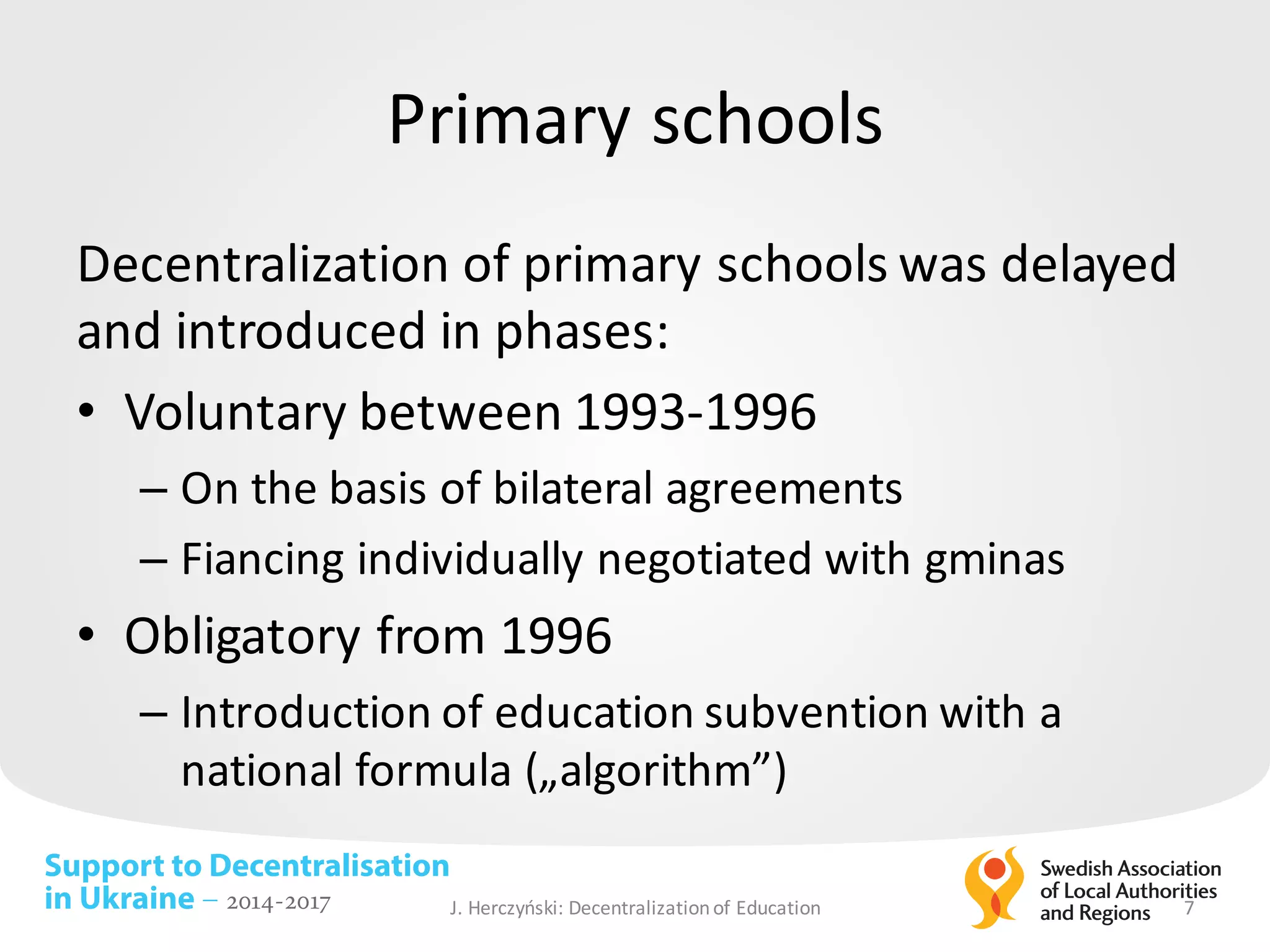
Primary schools
Decentralization of	primary schools was	delayed
and	introduced in	phases:	
• Voluntary between 1993-1996
– On	the	basis of	bilateral agreements
– Fiancing individually negotiated with	gminas
• Obligatory from	1996
– Introduction of	education subvention with	a	
national formula („algorithm”)
J.	Herczyński: Decentralizationof Education 7
Support to Decentralisation
in Ukraine – 2014-2017
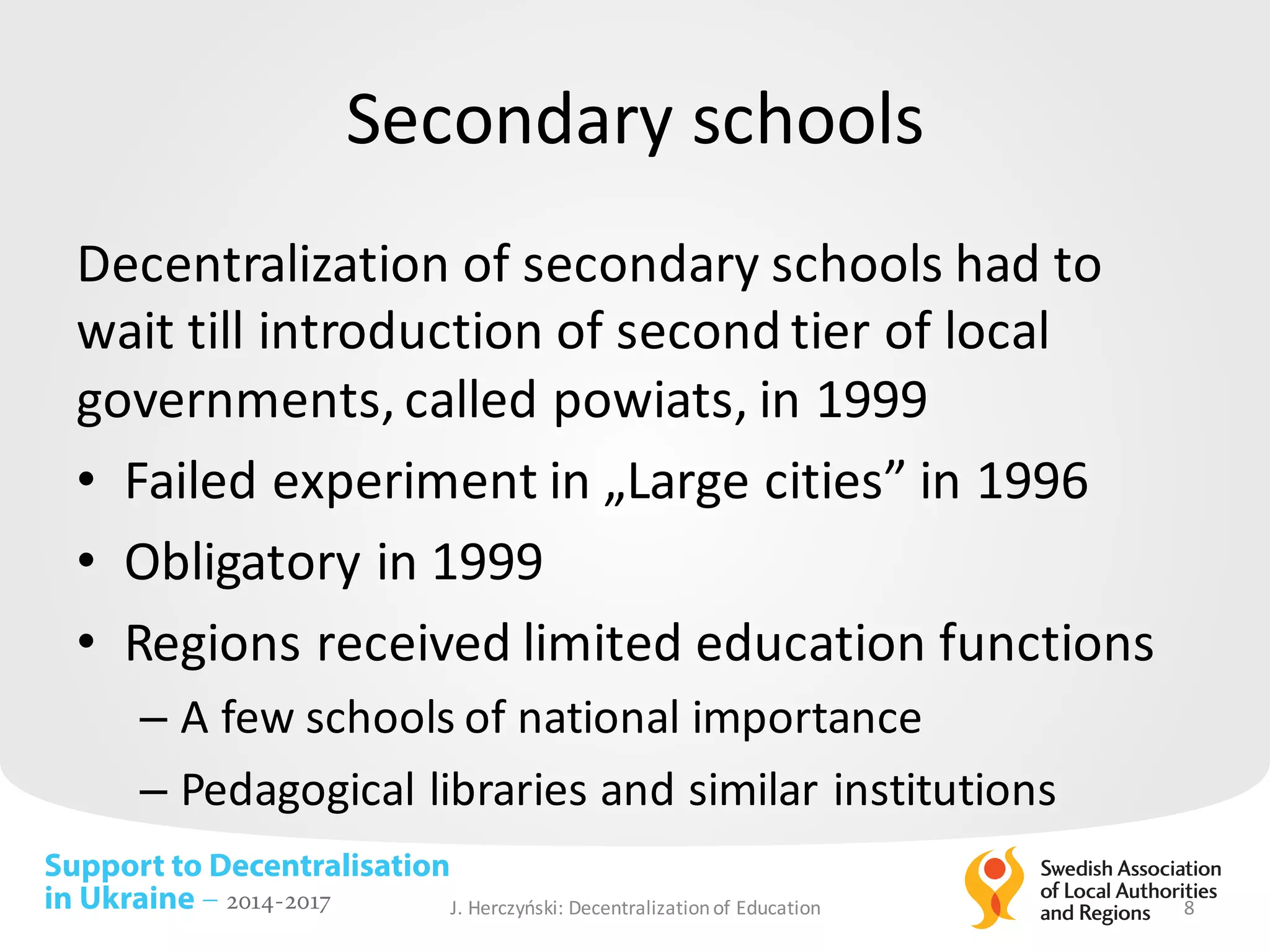
Secondary schools
Decentralization of	secondary schools had to	
wait till introduction of	second tier of	local
governments,	called powiats,	in	1999
• Failed experiment in	„Large cities”	in	1996
• Obligatory in	1999
• Regions	received limited education functions
– A	few schools of	national importance
– Pedagogical libraries and	similar institutions
J.	Herczyński: Decentralizationof Education 8
Support to Decentralisation
in Ukraine – 2014-2017
The	founder of	school
Education law	of	1990	introduced a	key concept
for	education decentralization school founder
• Law	clearly defines who is the	founder of	
different types of	education institutions
• Law	clearly defines the	functions and	
responsibilities of	school founder
J.	Herczyński: Decentralizationof Education 9
Support to Decentralisation
in Ukraine – 2014-2017
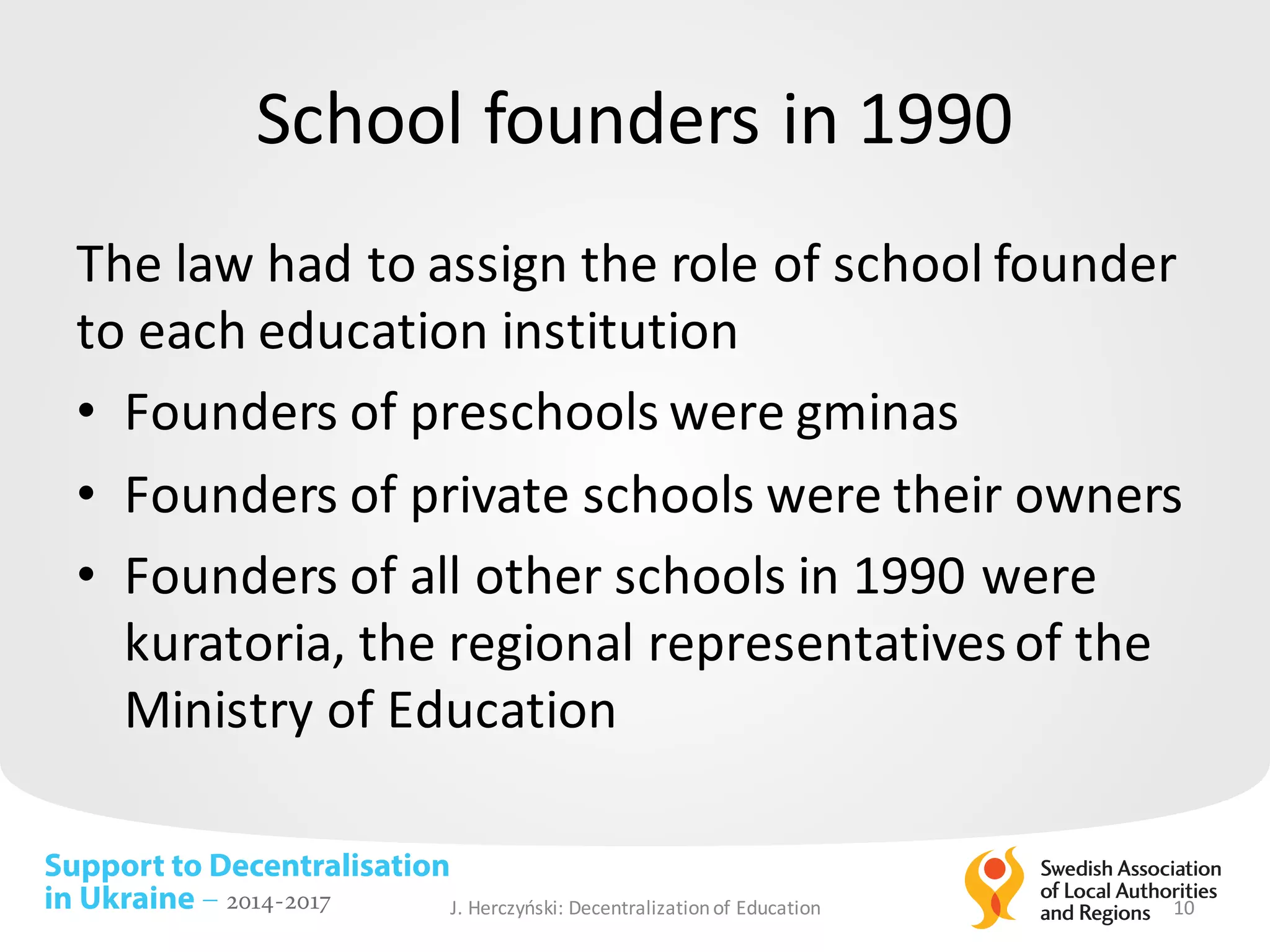
School	founders in	1990
The	law	had to	assign the	role	of	school founder
to	each education institution
• Founders of	preschools were gminas
• Founders of	private schools were their owners
• Founders of	all other schools in	1990	were
kuratoria,	the	regional representativesof	the	
Ministry of	Education
J.	Herczyński: Decentralizationof Education 10
Support to Decentralisation
in Ukraine – 2014-2017
Process of	decentralization
Accordingly,	two paralel	processes of	
decentralization of	education:	
• Successive transfer	of	schools and	other
institutions from	kuratoria	to	local
governments
• Successive strengthening of	the	role	of	school
founder
J.	Herczyński: Decentralizationof Education 11
Support to Decentralisation
in Ukraine – 2014-2017
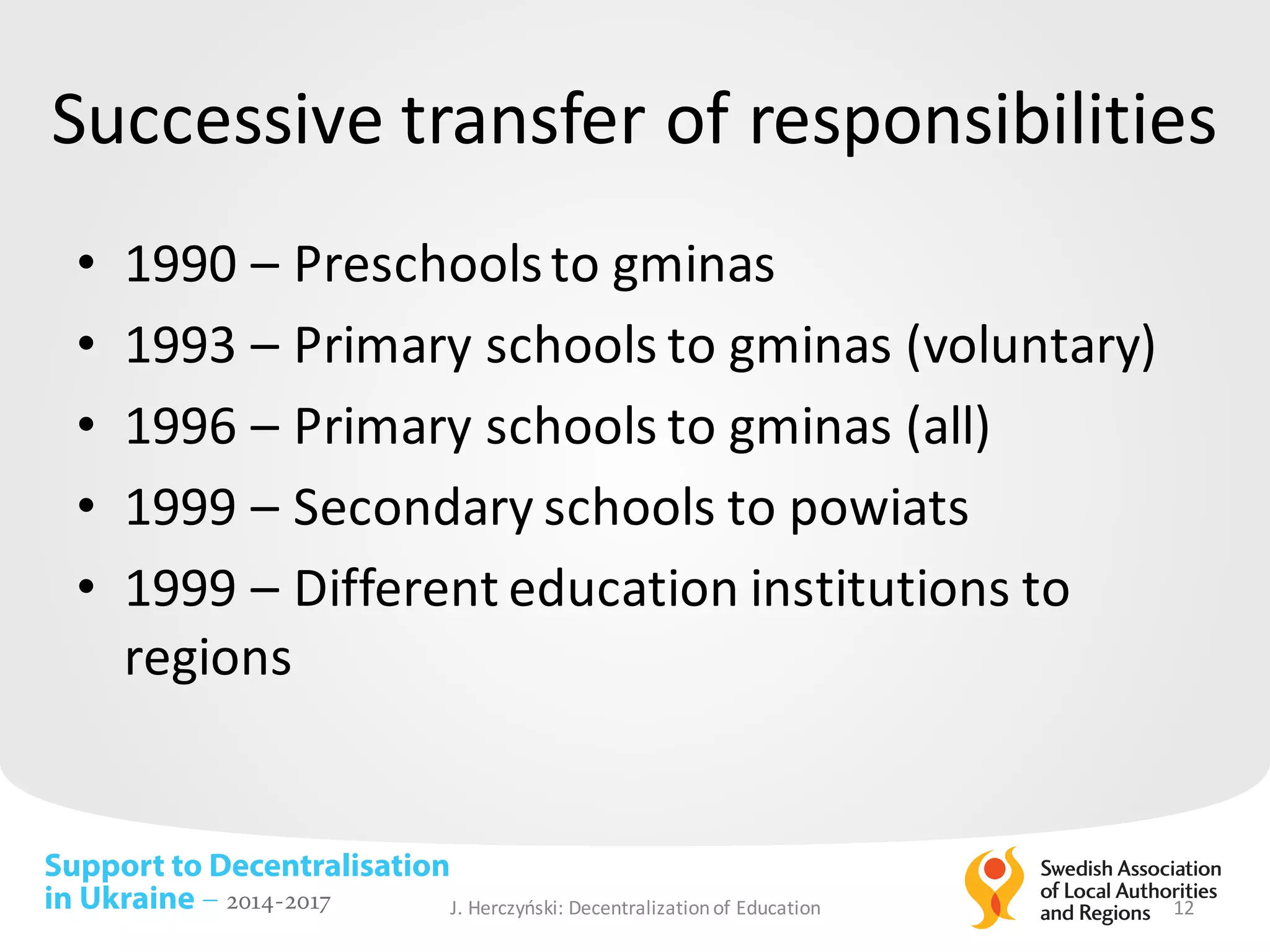
Successive transfer	of	responsibilities
• 1990	– Preschoolsto	gminas
• 1993	– Primary schools to	gminas (voluntary)
• 1996	– Primary schools to	gminas (all)
• 1999	– Secondary schools to	powiats
• 1999	– Different education institutions to	
regions
J.	Herczyński: Decentralizationof Education 12
Support to Decentralisation
in Ukraine – 2014-2017
Strengthening the	role	of	school founder
• Role	of	school founder was	slowly
strengthenedin	many important areas
• We	will discuss three key examples:
– Closing and	opening of	schools
– Selection of	school directors
– Setting of	school budgets
J.	Herczyński: Decentralizationof Education 13
Support to Decentralisation
in Ukraine – 2014-2017
Closing and	opening of	schools
• Initially,	school could be	closed only with	the	
written approval of	kurator
– Kurator	defended many schools from	closure
• In	1999,	only an opinion of	kurator	was	
required to	close a	school
– Negative opinion was	important for	stakeholders
• Since 2002,	not	even an opinion was	needed
• Since 2016,	again an approval is needed
J.	Herczyński: Decentralizationof Education 14
Support to Decentralisation
in Ukraine – 2014-2017
Selection of	school directors
• Since 1989,	school directors were selected by	
ad	hoc	commissions with	representativesof	
trade	unions,	parents and	kurator
• Since 1990,	school founder was	included
• Composition of	the	commission is clearly
specified in	the	laws
– Is one	of	the	most	often changed article of	the	law	
on	education
J.	Herczyński: Decentralizationof Education 15
Support to Decentralisation
in Ukraine – 2014-2017
Setting school budgets
• Iinitially,	required written approval by	school
founder and	kurator
– Kurator	assessed the	teaching plan	of	the	school
– Founder assessed its financial implications
• Over time,	opinion of	kurator	became less	
important
– Since 2002,	no	need for	opinion of	kurator
J.	Herczyński: Decentralizationof Education 16
Support to Decentralisation
in Ukraine – 2014-2017
Lessons for	Ukraine
• Decentralization of	education is a	slow proces	
during which all actors have to	learn
• Clear definitions in	the	laws are important for	
orderly proces
• Laws need to	be	regularly changed to	move
the	proces	along
J.	Herczyński: Decentralizationof Education 17
Support to Decentralisation
in Ukraine – 2014-2017
Дякую!
J.	Herczyński	Challenges	of	Education	
Decentralization
18

Децентралізація освіти in Poland

  • 1.
    Support to Decentralisation inUkraine – 2014-2017 Децентралізація освіти in Poland Ян Герчиньскі SKL International „Підтримка децентралізації в Україні” м. Київ, March 2, 2016 року
  • 2.
    Support to Decentralisation inUkraine – 2014-2017 Origin of decentralization in Poland • In 1989, first non-Communist government of PM Tadeusz Mazowiecki begun reforms of all sectors of Polish state • The main goal was to create market economy and a democratic state – Market economy: reforms of Leszek Balcerowicz – Democratic state: decentralization of the country J. Herczyński: Decentralizationof Education 2
  • 3.
    Support to Decentralisation inUkraine – 2014-2017 Decentralization as state-building • Need to destroy inherited national bureaucracy managing all levels of powers • The instrument: radical decentralization of the basic element of the structure – gminas • Immediate local elections change 99.9% of local councils and heads of administrations J. Herczyński: Decentralizationof Education 3
  • 4.
    Support to Decentralisation inUkraine – 2014-2017 Reforms in education sector • Minister Samsonowicz started significant reforms in all areas of education – Professional autonomy of teachers: Teaching according to what one believes – Content: overhaul of all curricula and textbooks – School directors: new rules to select • Decentralization was not the priority J. Herczyński: Decentralizationof Education 4
  • 5.
    Support to Decentralisation inUkraine – 2014-2017 Structure of education system Polish education system in 1990: • Preschools (3 grades, starting at 4 years) • Primary schools (8 grades, starting at 7 years) • Secondary schools (starting at 15 years): – General academic lyceum (4 grades) – Technical schools (5 grades) – Basic vocational schools (3 grades) J. Herczyński: Decentralizationof Education 5
  • 6.
    Support to Decentralisation inUkraine – 2014-2017 Decentralization of education • Decentralization was key policy priority of the government and education had to adapt • The first subsector of education to be decentralized was preschooleducation – Transferred to gminas as own function in 1990 – Financed from own revenuesof gminas – Many preschools were closed by gminas J. Herczyński: Decentralizationof Education 6
  • 7.
    Support to Decentralisation inUkraine – 2014-2017 Primary schools Decentralization of primary schools was delayed and introduced in phases: • Voluntary between 1993-1996 – On the basis of bilateral agreements – Fiancing individually negotiated with gminas • Obligatory from 1996 – Introduction of education subvention with a national formula („algorithm”) J. Herczyński: Decentralizationof Education 7
  • 8.
    Support to Decentralisation inUkraine – 2014-2017 Secondary schools Decentralization of secondary schools had to wait till introduction of second tier of local governments, called powiats, in 1999 • Failed experiment in „Large cities” in 1996 • Obligatory in 1999 • Regions received limited education functions – A few schools of national importance – Pedagogical libraries and similar institutions J. Herczyński: Decentralizationof Education 8
  • 9.
    Support to Decentralisation inUkraine – 2014-2017 The founder of school Education law of 1990 introduced a key concept for education decentralization school founder • Law clearly defines who is the founder of different types of education institutions • Law clearly defines the functions and responsibilities of school founder J. Herczyński: Decentralizationof Education 9
  • 10.
    Support to Decentralisation inUkraine – 2014-2017 School founders in 1990 The law had to assign the role of school founder to each education institution • Founders of preschools were gminas • Founders of private schools were their owners • Founders of all other schools in 1990 were kuratoria, the regional representativesof the Ministry of Education J. Herczyński: Decentralizationof Education 10
  • 11.
    Support to Decentralisation inUkraine – 2014-2017 Process of decentralization Accordingly, two paralel processes of decentralization of education: • Successive transfer of schools and other institutions from kuratoria to local governments • Successive strengthening of the role of school founder J. Herczyński: Decentralizationof Education 11
  • 12.
    Support to Decentralisation inUkraine – 2014-2017 Successive transfer of responsibilities • 1990 – Preschoolsto gminas • 1993 – Primary schools to gminas (voluntary) • 1996 – Primary schools to gminas (all) • 1999 – Secondary schools to powiats • 1999 – Different education institutions to regions J. Herczyński: Decentralizationof Education 12
  • 13.
    Support to Decentralisation inUkraine – 2014-2017 Strengthening the role of school founder • Role of school founder was slowly strengthenedin many important areas • We will discuss three key examples: – Closing and opening of schools – Selection of school directors – Setting of school budgets J. Herczyński: Decentralizationof Education 13
  • 14.
    Support to Decentralisation inUkraine – 2014-2017 Closing and opening of schools • Initially, school could be closed only with the written approval of kurator – Kurator defended many schools from closure • In 1999, only an opinion of kurator was required to close a school – Negative opinion was important for stakeholders • Since 2002, not even an opinion was needed • Since 2016, again an approval is needed J. Herczyński: Decentralizationof Education 14
  • 15.
    Support to Decentralisation inUkraine – 2014-2017 Selection of school directors • Since 1989, school directors were selected by ad hoc commissions with representativesof trade unions, parents and kurator • Since 1990, school founder was included • Composition of the commission is clearly specified in the laws – Is one of the most often changed article of the law on education J. Herczyński: Decentralizationof Education 15
  • 16.
    Support to Decentralisation inUkraine – 2014-2017 Setting school budgets • Iinitially, required written approval by school founder and kurator – Kurator assessed the teaching plan of the school – Founder assessed its financial implications • Over time, opinion of kurator became less important – Since 2002, no need for opinion of kurator J. Herczyński: Decentralizationof Education 16
  • 17.
    Support to Decentralisation inUkraine – 2014-2017 Lessons for Ukraine • Decentralization of education is a slow proces during which all actors have to learn • Clear definitions in the laws are important for orderly proces • Laws need to be regularly changed to move the proces along J. Herczyński: Decentralizationof Education 17
  • 18.
    Support to Decentralisation inUkraine – 2014-2017 Дякую! J. Herczyński Challenges of Education Decentralization 18