EDUCATIONALEDUCATIONAL
SYSTEMSYSTEM
in POLANDin POLAND
EDUCATIONEDUCATION
The present educational system inThe present educational system in
Poland was introduced inPoland was introduced in
1998/1999.1998/1999.
Many changes have beenMany changes have been
implemented over several yearsimplemented over several years
concerning administration,concerning administration,
financing, inspection, supervision,financing, inspection, supervision,
guidance, teachers rights andguidance, teachers rights and
duties.duties.
Educational system in PolandEducational system in Poland
Education is now compulsory fromEducation is now compulsory from
7 till 18 but there are some non school7 till 18 but there are some non school
alternatives from 16, includingalternatives from 16, including
apprenticeships.apprenticeships.
Pre-school educationPre-school education
According to the new Educational Act of 2002,According to the new Educational Act of 2002,
pre-school education is treated as the firstpre-school education is treated as the first
level of the education system and islevel of the education system and is
compulsory for children of six years old.compulsory for children of six years old.
This education stimulates the generalThis education stimulates the general
development and gives the primary readingdevelopment and gives the primary reading
skill and basic mathematics.skill and basic mathematics.
Elementary school educationElementary school education
Pupils of 7-12 go to elementary school,Pupils of 7-12 go to elementary school,
which is compulsory.which is compulsory.
Primary education is divided into twoPrimary education is divided into two
cycles:cycles:
- the first cycle (grades 1-3) at whichthe first cycle (grades 1-3) at which
beginning learning is offered,beginning learning is offered,
- the second cycle (grades 4-6) atthe second cycle (grades 4-6) at
which systematic learning iswhich systematic learning is
provided.provided.
Elementary school educationElementary school education
Primary schools operate on the basic ofPrimary schools operate on the basic of
general educational plan which determiniesgeneral educational plan which determinies
the minimum weekly number of lessonthe minimum weekly number of lesson
periods of particular subjects.periods of particular subjects.
The main components taught at the lowerThe main components taught at the lower
level of the primary school are:level of the primary school are:
- Polish language,Polish language,
- social and natural environment,social and natural environment,
- mathematics,mathematics,
- crafts and technology,crafts and technology,
- art and music,art and music,
- physical education.physical education.
Elementary school educationElementary school education
In the lower grades one teacherIn the lower grades one teacher
teaches all subjects, while in theteaches all subjects, while in the
higher grades each subject hashigher grades each subject has
a different teacher and usuallya different teacher and usually
pupils change classroom forpupils change classroom for
each subject.each subject.
Secondary educationSecondary education
After completing elementary school pupils canAfter completing elementary school pupils can
choose different secondary education, which ischoose different secondary education, which is
free of charge.free of charge.
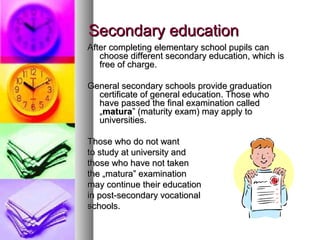
General secondary schools provide graduationGeneral secondary schools provide graduation
certificate of general education. Those whocertificate of general education. Those who
have passed the final examination calledhave passed the final examination called
„„maturamatura” (maturity exam) may apply to” (maturity exam) may apply to
universities.universities.
Those who do not wantThose who do not want
to study at university andto study at university and
those who have not takenthose who have not taken
the „matura” examinationthe „matura” examination
may continue their educationmay continue their education
in post-secondary vocationalin post-secondary vocational
schools.schools.
Higher educationHigher education
After secondary school students can takeAfter secondary school students can take
higher education.higher education.
There are various types of higher educationThere are various types of higher education
institutions in Poland:institutions in Poland:
- universities,universities,
- polytechnics,polytechnics,
- economic academies,economic academies,
- agricultural academies,agricultural academies,
- others.others.
Day studies in state higher schools are free ofDay studies in state higher schools are free of
charge.charge.
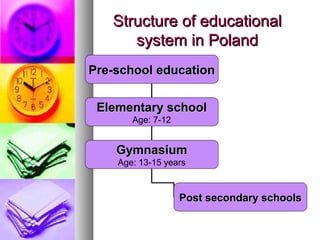
Structure of educationalStructure of educational
system in Polandsystem in Poland
Pre-school educationPre-school education
Elementary schoolElementary school
Age: 7-12
GymnasiumGymnasium
Age: 13-15 years
Post secondary schoolsPost secondary schools
 Holidays in Poland start in theHolidays in Poland start in the
end of the June and finish onend of the June and finish on
the 31st of August. On holidaysthe 31st of August. On holidays
we go on trips and meets withwe go on trips and meets with
friends.friends.
Students from
school in
Pisarzowice.

Education in poland

  • 1.
  • 2.
    EDUCATIONEDUCATION The present educationalsystem inThe present educational system in Poland was introduced inPoland was introduced in 1998/1999.1998/1999. Many changes have beenMany changes have been implemented over several yearsimplemented over several years concerning administration,concerning administration, financing, inspection, supervision,financing, inspection, supervision, guidance, teachers rights andguidance, teachers rights and duties.duties.
  • 3.
    Educational system inPolandEducational system in Poland Education is now compulsory fromEducation is now compulsory from 7 till 18 but there are some non school7 till 18 but there are some non school alternatives from 16, includingalternatives from 16, including apprenticeships.apprenticeships.
  • 4.
    Pre-school educationPre-school education Accordingto the new Educational Act of 2002,According to the new Educational Act of 2002, pre-school education is treated as the firstpre-school education is treated as the first level of the education system and islevel of the education system and is compulsory for children of six years old.compulsory for children of six years old. This education stimulates the generalThis education stimulates the general development and gives the primary readingdevelopment and gives the primary reading skill and basic mathematics.skill and basic mathematics.
  • 5.
    Elementary school educationElementaryschool education Pupils of 7-12 go to elementary school,Pupils of 7-12 go to elementary school, which is compulsory.which is compulsory. Primary education is divided into twoPrimary education is divided into two cycles:cycles: - the first cycle (grades 1-3) at whichthe first cycle (grades 1-3) at which beginning learning is offered,beginning learning is offered, - the second cycle (grades 4-6) atthe second cycle (grades 4-6) at which systematic learning iswhich systematic learning is provided.provided.
  • 6.
    Elementary school educationElementaryschool education Primary schools operate on the basic ofPrimary schools operate on the basic of general educational plan which determiniesgeneral educational plan which determinies the minimum weekly number of lessonthe minimum weekly number of lesson periods of particular subjects.periods of particular subjects. The main components taught at the lowerThe main components taught at the lower level of the primary school are:level of the primary school are: - Polish language,Polish language, - social and natural environment,social and natural environment, - mathematics,mathematics, - crafts and technology,crafts and technology, - art and music,art and music, - physical education.physical education.
  • 7.
    Elementary school educationElementaryschool education In the lower grades one teacherIn the lower grades one teacher teaches all subjects, while in theteaches all subjects, while in the higher grades each subject hashigher grades each subject has a different teacher and usuallya different teacher and usually pupils change classroom forpupils change classroom for each subject.each subject.
  • 8.
    Secondary educationSecondary education Aftercompleting elementary school pupils canAfter completing elementary school pupils can choose different secondary education, which ischoose different secondary education, which is free of charge.free of charge. General secondary schools provide graduationGeneral secondary schools provide graduation certificate of general education. Those whocertificate of general education. Those who have passed the final examination calledhave passed the final examination called „„maturamatura” (maturity exam) may apply to” (maturity exam) may apply to universities.universities. Those who do not wantThose who do not want to study at university andto study at university and those who have not takenthose who have not taken the „matura” examinationthe „matura” examination may continue their educationmay continue their education in post-secondary vocationalin post-secondary vocational schools.schools.
  • 9.
    Higher educationHigher education Aftersecondary school students can takeAfter secondary school students can take higher education.higher education. There are various types of higher educationThere are various types of higher education institutions in Poland:institutions in Poland: - universities,universities, - polytechnics,polytechnics, - economic academies,economic academies, - agricultural academies,agricultural academies, - others.others. Day studies in state higher schools are free ofDay studies in state higher schools are free of charge.charge.
  • 10.
    Structure of educationalStructureof educational system in Polandsystem in Poland Pre-school educationPre-school education Elementary schoolElementary school Age: 7-12 GymnasiumGymnasium Age: 13-15 years Post secondary schoolsPost secondary schools
  • 11.
     Holidays inPoland start in theHolidays in Poland start in the end of the June and finish onend of the June and finish on the 31st of August. On holidaysthe 31st of August. On holidays we go on trips and meets withwe go on trips and meets with friends.friends.
  • 12.