
Agro-processing in Ghana
Kwaw Andam
Ghana Strategy Support Program
International Food Policy Research Institute
Presentation to GSSP Side Event, ReSAKSS Annual Conference | Accra
October 18, 2016
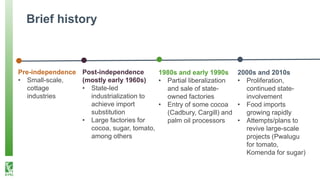
Brief history
Pre-independence
• Small-scale,
cottage
industries
Post-independence
(mostly early 1960s)
• State-led
industrialization to
achieve import
substitution
• Large factories for
cocoa, sugar, tomato,
among others
1980s and early 1990s
• Partial liberalization
and sale of state-
owned factories
• Entry of some cocoa
(Cadbury, Cargill) and
palm oil processors
2000s and 2010s
• Proliferation,
continued state-
involvement
• Food imports
growing rapidly
• Attempts/plans to
revive large-scale
projects (Pwalugu
for tomato,
Komenda for sugar)
What is holding back the processing sector?
 Low productivity and high cost of production
 Scarcity of preferred varieties and poor quality
 Transaction costs, transport, and infrastructure
 Failure of contract farming and vertical integration as an
alternative to imports
Emerging opportunities due to…
1. Urbanizing Ghana
2. Income growth
• 2004 per capita GDP: $426
• 2014 per capita GDP: $1400
3. Diet changes
• Especially shift to processed foods,
especially for urban consumers
4. Expanding export markets (?)
8
10121416
NumberofPeople(million)
2000 2005 2010 2015
Year
Rural Population Urban population
Growth of urban and rural
populations in Ghana, 2000-2015
What’s for sale? Inventory of processed foods
 Cities: Accra, Cape Coast, Ho, Koforidua,
Kumasi, Sekondi-Takoradi, Sunyani, Tamale
 Stores: open-air stalls, street vendors,
traditional self-service shops, small shops with
registers, chain and non-chain supermarkets
 Categories of processed foods
• Accra: cereals, tubers, meats and fish, fruits and
vegetables, oils and fats, spices
• Other cities: cereals, tubers, tomatoes, poultry
 Inventory process
• Focused on products rather than shops
• Information on products, manufacturers, ingredients,
packaging quality
• Aimed to cover all products
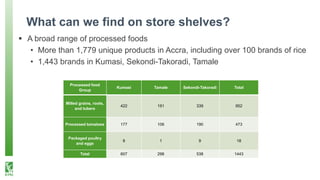
What can we find on store shelves?
 A broad range of processed foods
• More than 1,779 unique products in Accra, including over 100 brands of rice
• 1,443 brands in Kumasi, Sekondi-Takoradi, Tamale
Processed food
Group
Kumasi Tamale Sekondi-Takoradi Total
Milled grains, roots,
and tubers
422 191 339 952
Processed tomatoes 177 106 190 473
Packaged poultry
and eggs
8 1 9 18
Total 607 298 538 1443
Imports vs. Domestic Products
24
18
23
27
76
82
77
73
0 10 20 30 40 50 60 70 80 90
Kumasi
Tamale
Sekondi-Takoradi
Accra
Shares of processed food products
Imported (%) Domestic (%)
Country
Number of
products
Share of
imports
Rice
Vietnam 306 53
Thailand 168 29
India 30 5
Tomato Paste
China 252 70
Italy 37 10
United States 18 5
Main sources of imports
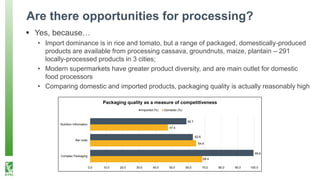
68.4
64.6
47.4
99.6
62.6
58.7
0.0 10.0 20.0 30.0 40.0 50.0 60.0 70.0 80.0 90.0 100.0
Complex Packaging
Bar code
Nutrition Information
Packaging quality as a measure of competitiveness
Imported (%) Domestic (%)
Are there opportunities for processing?
 Yes, because…
• Import dominance is in rice and tomato, but a range of packaged, domestically-produced
products are available from processing cassava, groundnuts, maize, plantain – 291
locally-processed products in 3 cities;
• Modern supermarkets have greater product diversity, and are main outlet for domestic
food processors
• Comparing domestic and imported products, packaging quality is actually reasonably high
Thank you!
 Acknowledgements
• Co-authors: Ramatu Al-Hassan, Seth Asante, Xinshen Diao, Jed Silver, David Tschirley
• Reviewers: Todd Benson, Shashi Kolavalli
 References
• Ackah, C., C. Adjasi, and F. Turkson. 2014. “Scoping Study on the Evolution of Industry in Ghana.”
UNU-WIDER: Learning to Complete Working Paper 2014/075. Washington.
• Andam, K., R.M. Al-Hassan, S.B. Asante, and X. Diao. 2015. “Is Ghana Making Progress in Agro-
Processing? Evidence from an Inventory of Processed Food Products in Retail Shops in Accra.”
Ghana Strategy Support Program (GSSP) Working Paper No. 41. International Food Policy Research
Institute. Accra.
• Hollinger, F., and J. M. Staatz. 2015. Agricultural Growth in West Africa Market and Policy Drivers.
African Development Bank and Food and Agriculture Organisation. Rome.
• Robinson, E.J.Z., and S. Kolavalli. 2010. “The Case of Tomato in Ghana : Processing.” Ghana
Strategy Support Program (GSSP) Working Paper No. 21. International Food Policy Research
Institute. Accra.

Agro-processing in Ghana

  • 1.
    Agro-processing in Ghana KwawAndam Ghana Strategy Support Program International Food Policy Research Institute Presentation to GSSP Side Event, ReSAKSS Annual Conference | Accra October 18, 2016
  • 2.
    Brief history Pre-independence • Small-scale, cottage industries Post-independence (mostlyearly 1960s) • State-led industrialization to achieve import substitution • Large factories for cocoa, sugar, tomato, among others 1980s and early 1990s • Partial liberalization and sale of state- owned factories • Entry of some cocoa (Cadbury, Cargill) and palm oil processors 2000s and 2010s • Proliferation, continued state- involvement • Food imports growing rapidly • Attempts/plans to revive large-scale projects (Pwalugu for tomato, Komenda for sugar)
  • 3.
    What is holdingback the processing sector?  Low productivity and high cost of production  Scarcity of preferred varieties and poor quality  Transaction costs, transport, and infrastructure  Failure of contract farming and vertical integration as an alternative to imports
  • 4.
    Emerging opportunities dueto… 1. Urbanizing Ghana 2. Income growth • 2004 per capita GDP: $426 • 2014 per capita GDP: $1400 3. Diet changes • Especially shift to processed foods, especially for urban consumers 4. Expanding export markets (?) 8 10121416 NumberofPeople(million) 2000 2005 2010 2015 Year Rural Population Urban population Growth of urban and rural populations in Ghana, 2000-2015
  • 5.
    What’s for sale?Inventory of processed foods  Cities: Accra, Cape Coast, Ho, Koforidua, Kumasi, Sekondi-Takoradi, Sunyani, Tamale  Stores: open-air stalls, street vendors, traditional self-service shops, small shops with registers, chain and non-chain supermarkets  Categories of processed foods • Accra: cereals, tubers, meats and fish, fruits and vegetables, oils and fats, spices • Other cities: cereals, tubers, tomatoes, poultry  Inventory process • Focused on products rather than shops • Information on products, manufacturers, ingredients, packaging quality • Aimed to cover all products
  • 6.
    What can wefind on store shelves?  A broad range of processed foods • More than 1,779 unique products in Accra, including over 100 brands of rice • 1,443 brands in Kumasi, Sekondi-Takoradi, Tamale Processed food Group Kumasi Tamale Sekondi-Takoradi Total Milled grains, roots, and tubers 422 191 339 952 Processed tomatoes 177 106 190 473 Packaged poultry and eggs 8 1 9 18 Total 607 298 538 1443
  • 7.
    Imports vs. DomesticProducts 24 18 23 27 76 82 77 73 0 10 20 30 40 50 60 70 80 90 Kumasi Tamale Sekondi-Takoradi Accra Shares of processed food products Imported (%) Domestic (%) Country Number of products Share of imports Rice Vietnam 306 53 Thailand 168 29 India 30 5 Tomato Paste China 252 70 Italy 37 10 United States 18 5 Main sources of imports
  • 8.
    68.4 64.6 47.4 99.6 62.6 58.7 0.0 10.0 20.030.0 40.0 50.0 60.0 70.0 80.0 90.0 100.0 Complex Packaging Bar code Nutrition Information Packaging quality as a measure of competitiveness Imported (%) Domestic (%) Are there opportunities for processing?  Yes, because… • Import dominance is in rice and tomato, but a range of packaged, domestically-produced products are available from processing cassava, groundnuts, maize, plantain – 291 locally-processed products in 3 cities; • Modern supermarkets have greater product diversity, and are main outlet for domestic food processors • Comparing domestic and imported products, packaging quality is actually reasonably high
  • 9.
    Thank you!  Acknowledgements •Co-authors: Ramatu Al-Hassan, Seth Asante, Xinshen Diao, Jed Silver, David Tschirley • Reviewers: Todd Benson, Shashi Kolavalli  References • Ackah, C., C. Adjasi, and F. Turkson. 2014. “Scoping Study on the Evolution of Industry in Ghana.” UNU-WIDER: Learning to Complete Working Paper 2014/075. Washington. • Andam, K., R.M. Al-Hassan, S.B. Asante, and X. Diao. 2015. “Is Ghana Making Progress in Agro- Processing? Evidence from an Inventory of Processed Food Products in Retail Shops in Accra.” Ghana Strategy Support Program (GSSP) Working Paper No. 41. International Food Policy Research Institute. Accra. • Hollinger, F., and J. M. Staatz. 2015. Agricultural Growth in West Africa Market and Policy Drivers. African Development Bank and Food and Agriculture Organisation. Rome. • Robinson, E.J.Z., and S. Kolavalli. 2010. “The Case of Tomato in Ghana : Processing.” Ghana Strategy Support Program (GSSP) Working Paper No. 21. International Food Policy Research Institute. Accra.