Improve the Offloading decision by Adaptive
partitioning of task for Mobile Cloud
Computing
Neha Goswami Sugandha Sharma
Computer Science and Engineering Department,
Chandigarh University
National Highway95, Mohali,140413, Punjab, India;
nggoswamineha@gmail.com
Computer Science and Engineering Department,
Chandigarh University
National Highway95, Mohali,140413, Punjab, India;
Sugandha.ss1@gmail.com
Abstract- Adaptive Offloading in Mobile Cloud
Computing by automatic partitioning approach of tasks
is the idea to augment execution through migrating
heavy computation from mobile devices to resourceful
cloud servers and then receive the results from them via
wireless networks. Offloading is an effective way to
overcome the resources and functionalities constraints
of the mobile devices since it can release them from
intensive processing and increase performance of the
mobile applications, in terms of response time.
Offloading brings many potential benefits, such as
energy saving, performance improvement, reliability
improvement, ease for the software developers and
better exploitation of contextual information.
Parameters about method transitions, response times,
cost and energy consumptions are dynamically re-
estimated at runtime during application executions.
Keywords- Cloud Computing, Mobile Cloud
Computing(MCC), Offloading, System model (cost model,
energy model, weighted model)
I. INTRODUCTION
With the computing technology advancements, the
desktop computer usage expands and main frame is
also expanded to a wider range of embedded
applications and mobile applications which includes
environmental sensing, surveillance, mobile phones
and GPS navigation, etc. These several applications
on systems run with resources that are limited.
Fore.g, battery powered is the mobile phones. The
environmental sensors comprises of smallersize
physically, small storage amounts and slow
processors. Wireless applications are used by most of
these applications and low are their magnitude orders
in comparison with wired networks. Meanwhile,
programs that run on these systems have increasing
complexity—for example, video processing on
mobile phones and object recognition on mobile
robots. An increasing gap is there among the complex
programs demand and the limited resources
availability.
A solution is offloading for augmentingthe
capabilities of this mobile system with computational
migration for more computers that are resourceful
(i.e., servers). The client-server architecture
traditionally utilized is different from this, in which
always a thin client migrates to a server computation.
There is a difference between the computation
offloading and the migration model which utilizes in
grid computing and multiprocessor system, where for
load balancing migrating the process [1-6]. The key
difference is that computation offloading differs
mainly when it migrates programs to servers outside
the computing environment of the immediate users;
typically migrating the process to grid computing
which occurs within computer in asimilar computing
environment, that is, the grid. In similar principle for
efforts is offloading like SETI@home [8], where for
computation performance sending request to
surrogates. The terms like “surrogate computing” and
“cyber foraging” are also utilized for describing
computation offloading.
Computation offloading[2-3, 6, 9] is growing topic
on which a significant amount of research has been
done which makes it feasible, making decisions of
International Journal of Computer Science and Information Security (IJCSIS),
Vol. 15, No. 8, August 2017
109 https://sites.google.com/site/ijcsis/
ISSN 1947-5500
offloading, and developing infrastructures of
offloading. Most of the researches done over
offloading prior to 2000are on making it feasible.
Primarily, this is because of its limitations in wireless
networks, such as lesser bandwidths. The focus
shifted to developing algorithms utilized for making
offloading decisions in early 2000s that is,
decidingwhether mobile users are benefited by
offloading. The offloading direction is shifted with
the improvements in network bandwidths, cloud
computing infrastructures, and virtualization
technology. More practical has become computation
offloading with these developments.
On mobile systems, saving the energy and
performance improvement may be done by utilizing
computation offloading depending usuallyon various
parameters like as the data exchanged amounts
through various networks and network bandwidth.
Various algorithms have been proposed for making
the offloading decisions to save energy or improve
performance [10, 13, 15-16, 18]. Usually decisions
are made with the parameter analyzation including
server speeds, bandwidths, server loads, available
memory, and the data exchanged amount among
mobile systems and servers. In the execution
environment [11], application behavior variation of
predicted parametric and partitioning programs [15]
is included in the solutions.
Resourceful computers access is required in
offloading through networkswireless or wired for
short durations. Virtualization may be used by these
servers for providing offloading services so as
various programs and their data can be protected and
isolated. Protections and isolations have motivated
the researchers to developoffloading infrastructures at
different granularities [16]. Performing offloading
may be at the levels of tasks [9],methods [3], virtual
machines [5], or applications [11]. .NET remoting,
RPC (remote procedure call), and Java RMI are the
various mechanisms which enables offloading at the
object level and class level. At the virtual-machine
level, techniques have been proposed for offloading
enabling [8, 17]. The offloading and elastic resources
allowed by cloud computing for multiple servers;
which enables the computation offloading. Several
solutions and infrastructures and solutions have been
proposed to improve offloading: they deal with
various issues forprivacy, users, security, mobility,
etc.The goal is paper to improve the utilization of
computing resources and reduce energy consumption.
II. LITERATURE REVIEW
For the mobile codes execution on the remote server
suchas the wall-powered PCs or cloud, a technique
has been employed in previous work, called
offloading execution, which is the execution
transferring act between two machines run time. By
computational loads relieving, the labors technique
for bring benefits of smartphones in terms of
execution time and batteryin their proximityfrom the
servers. In offloadingexecution, two maintasks are
there which involves before the remote execution:
state migration and code partitioning. In recent years,
greater deal of research has been conducted there for
finding or supportingof distributed systems optimal
partitioning with mobile devices.The static
partitioning schemes are proposed [10] by several
researchers where the assigned jobin the system to
each machine at compile timeis fixed. More doable
ought to be the static partitioning if the resource
configurations computationallysuch as memory
capacity, processor speed, network characteristics,
and energy consumption, remain fairly constant as
process is launched. In mobile computing, however,
the change in configurations is possible due to user
mobility even in the process execution mid.
Therefore, in other works mostly [4], [5], [8], [11]
have been on the semi-dynamic or dynamic
partitioning schemes development to execute
offloading. In a partitioning schemedynamically,
annotated is the code commonly
withdirectivesdelimiting the code regions which can
be delegated for remote executionto the server, if
profitable? Which regions run on the server actuallyis
decided during the execution of code when for
execution the resource configurations areknown.
Finally, once certain region at run time is selected,
execution needs for current state tobe captured and
server migration with the control command in which
execution resumption is directed.In other approach
[5], the entire state including the existing stack is
included in entire state and migrated all
heapreachableobjects for offloading the full process.
In anotherapproach [4], the stack is not to be
migrated as the functions set to run remotely will be
newly invoked in the server. Clearly, these two
International Journal of Computer Science and Information Security (IJCSIS),
Vol. 15, No. 8, Augus 2017
110 https://sites.google.com/site/ijcsis/
ISSN 1947-5500
approaches are having trade-offs. Above all, the
usuallythe state transferred amount, that is a major
decisive factor for themobile networks over
execution offloading efficacy and have latter of
smaller size.
III. CLOUD COMPUTING
Cloud computing is an important model in the world
of information technology. It is a type of computing
which provides a shared pool of virtualized and
managed computing resources to the customers on
their demand over the internet and other available
networks rather than having local servers or their
own personal devices to handle the applications. The
word cloud is used as an analogy for “the internet”,
so the term cloud computing means “ a type of
internet based computing” where different
applications and services are provided to the
organizations over the internet. Cloud computing is a
network of large group of servers interconnected to
each other i.e basically it a shared infrastructure
which contains large pools of systems that are linked
together. Due to the various features like elasticity,
scalability and availability, cloud computing becomes
more popular these days.
There are three types of cloud computing (i) public
cloud (ii) private cloud and (iii) hybrid cloud.
Public cloud provides an infrastructure where the
information is shared among different organizations.
In this model, services providers provides resources
like storage and applications to the general public.
It’s a pay per usage model i.e the users only have to
pay for what they used.
Private cloud provides an infrastructure that is
dedicated to a particular organization i.e the
resources and applications are not shared with the
other organizations. Private cloud provides more
security to the users than that of public cloud but also
more expensive.
Hybrid cloud is the composition of public cloud and
private cloud. In hybrid cloud, the important and
critical files or applications are hosted in private
cloud. While the applications with less security
concerns are hosted on public cloud. Only the
authorized organizations can access the applications
from private cloud while the applications and
resources from the public cloud are easily accessible
by the users.
Three service models of cloud computing are (i) Saas
(ii) PaaS (iii) IaaS.
Software as a service (SaaS) is a model that allows
users to access the internet based software’s. Users
don’t have to install, manage and upgrade the
applications on their devices as SaaS providers will
manage all this. Users need not to worry about their
data as equipment failure will not results in data loss
because data is secure in cloud.
Platform as a service (PaaS) is a cloud computing
model that provides users a platform with tools where
they can develop, manage and deliver their
applications. Providers are responsible for managing
security, backups and also for handling operating
systems and server software’s.
Infrastructure as a service (IaaS) is a cloud
computing model that allows users to access the
resources, storage and servers. Instead of purchasing
and maintaining own hardware devices the users can
pay per usage for IaaS on demand.
Charactristics of cloud computing are(i)On-demand
self-service: A consumer can unilaterally provision
computing capabilities, such as server time and
network storage, as needed automatically without
requiring human interaction with each service
provider. (ii)Broad network access: Capabilities are
available over the network and accessed through
standard mechanisms that promote use by
heterogeneous thin or thick client platforms
(e.g., mobile phones, tablets, laptops and
workstations). (iii)Resource pooling: The provider's
computing resources are pooled to serve multiple
consumers using a multi-tenant model, with different
physical and virtual resources dynamically assigned
and reassigned according to consumer demand. There
is a sense of location independence in that the
customer generally has no control or knowledge over
the exact location of the provided resources but may
be able to specify location at a higher level of
abstraction (e.g., country, state or datacenter).
Examples of resources include storage, processing,
memory and network bandwidth. (iv)Rapid
International Journal of Computer Science and Information Security (IJCSIS),
Vol. 15, No. 8, Augus 2017
111 https://sites.google.com/site/ijcsis/
ISSN 1947-5500
elasticity: Capabilities can be elastically provisioned
and released, in some cases automatically, to scale
rapidly outward and inward commensurate with
demand. To the consumer, the capabilities available
for provisioning often appear to be unlimited and can
be appropriated in any quantity at any time.
(v)Measured service: Cloud systems automatically
control and optimize resource use by leveraging a
metering capability at some level of abstraction
appropriate to the type of service (e.g., storage,
processing, bandwidth and active user accounts).
Resource usage can be monitored, controlled and
reported, providing transparency for the provider and
consumer.
IV. MOBILE CLOUD COMPUTING
Mobile cloud computing (MCC) is termed as the
combination of mobile computing, cloud computing
and networks in order to provide various services to
the mobile users like providing various
computational resources, network operators etc.
Mobile cloud computing is a model in which the
mobile applications are built and hosted using cloud
technology. It is different than that of mobile
computing as the devices can run cloud based
applications rather than that of remote applications.
MCC provides a lot of opportunities for mobile
industry and also allows the mobile users to utilize
the various resources offered by cloud. Three
approaches of MCC are : (i) providing access to
cloud services (ii) allows mobile devices to work
together as cloud service providers work. (iii)
augmenting the execution of various mobile
applications on the portable devices using cloud
resources.
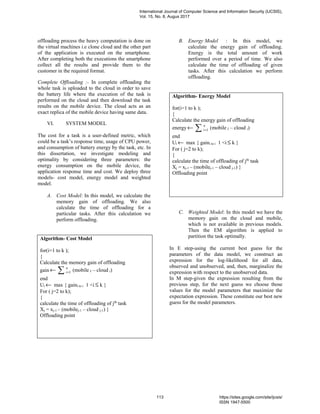
Characteristics of Mobile Cloud Computing are
(i)Convenience of data sharing:- A huge amount of
data is stored in the backend servers which allows the
users to access the data at any time without
depending on the mobile device.
(ii)Effective task Processing :- As there is an
interface in the cloud and mobile devices the users
are able to see the output directly on the mobile
device.
(iii)Elimination of the regionality:- Mobile cloud
computing eliminates the regionality for accessing
the data. The user can access the data at any time and
at any place.
Figure 1:- Mobile Cloud Computing (MCC)
V. OFFLOADING IN SMARTPHONES
Smartphones has some constraints like limited
energy, small processors and memory capacity. As
smartphones becomes more popular in our life and
with the advancement in the technology they uses
more powerful processors, different operating
systems like android, apple iOS , windows phone and
larger memory provide sharper screens , multiple
sensors but these together put a burden on battery’s
energy consumption. One approach for saving mobile
energy is task offloading.
Mobile cloud computing enhance the computing
capabilities of the smartphones by offloading the
computation to the cloud infrastructure. In the cloud
each mobile device has a clone cloud, which runs on
virtual machine and executes the mobile applications.
Offloading a task to the cloud is a critical technique
as in some cases the energy consumption of the
smartphones increases. To make offloading
beneficial, the energy cost of a particular task should
be estimated by comparing it with the task that is
executed locally on the mobile device. The energy
consumed during the task offloading process is
mainly due to the networking activities.
There are two types of offloading (i)Partial
Offloading (ii)Complete Offloading.
Partial offloading:- The compute intensive
applications are partially offloaded to the cloud in
order to reduce the load of the smartphones. In this
International Journal of Computer Science and Information Security (IJCSIS),
Vol. 15, No. 8, Augus 2017
112 https://sites.google.com/site/ijcsis/
ISSN 1947-5500
offloading process the heavy computation is done on
the virtual machines i.e clone cloud and the other part
of the application is executed on the smartphone.
After completing both the executions the smartphone
collect all the results and provide them to the
customer in the required format.
Complete Offloading :- In complete offloading the
whole task is uploaded to the cloud in order to save
the battery life where the execution of the task is
performed on the cloud and then download the task
results on the mobile device. The cloud acts as an
exact replica of the mobile device having same data.
VI. SYSTEM MODEL
The cost for a task is a user-defined metric, which
could be a task’s response time, usage of CPU power,
and consumption of battery energy by the task, etc. In
this dissertation, we investigate modeling and
optimality by considering three parameters: the
energy consumption on the mobile device, the
application response time and cost. We deploy three
models- cost model, energy model and weighted
model.
A. Cost Model: In this model, we calculate the
memory gain of offloading. We also
calculate the time of offloading for a
particular tasks. After this calculation we
perform offloading.
B. Energy Model : In this model, we
calculate the energy gain of offloading.
Energy is the total amount of work
performed over a period of time. We also
calculate the time of offloading of given
tasks. After this calculation we perform
offloading.
C. Weighted Model: In this model we have the
memory gain on the cloud and mobile,
which is not available in previous models.
Then the EM algorithm is applied to
partition the task optimally.
In E step-using the current best guess for the
parameters of the data model, we construct an
expression for the log-likelihood for all data,
observed and unobserved, and, then, marginalize the
expression with respect to the unobserved data.
In M step-given the expression resulting from the
previous step, for the next guess we choose those
values for the model parameters that maximize the
expectation expression. These constitute our best new
guess for the model parameters.
Algorithm- Cost Model
for(i=1 to k );
{
Calculate the memory gain of offloading
gain ← ∑ =
n
i 1 (mobile I – cloud i)
end
Ui ← max { gaini to i 1 <i ≤ k }
For ( j=2 to k);
{
calculate the time of offloading of jth
task
Xj = xj-1 – (mobilej-1 – cloud j-1) }
Offloading point
Algorithm- Energy Model
for(i=1 to k );
{
Calculate the energy gain of offloading
energy← ∑ =
n
i 1 (mobile I – cloud i)
end
Ui ← max { gaini to i 1 <i ≤ k }
For ( j=2 to k);
{
calculate the time of offloading of jth
task
Xj = xj-1 – (mobilej-1 – cloud j-1) }
Offloading point
International Journal of Computer Science and Information Security (IJCSIS),
Vol. 15, No. 8, Augus 2017
113 https://sites.google.com/site/ijcsis/
ISSN 1947-5500
Algorithm – weighted model
for ( i=1; i< k; i++)
{
Calculate the memory gain of offloading
gain ← ∑ =
n
i 1 (mobile i – cloud i) – input i – return i
end
Ui ← max { gaini to i 1 <i ≤ k }
Integrating Point ← EM (max (gain i to i 1<i ≤ k))
for ( j=2; j< k; j++);
{
calculate the time of offloading of jth
task
Xj = xj-1 – (mobilej-1 – cloud j-1) + input j-1 – input j
}
Offloading point
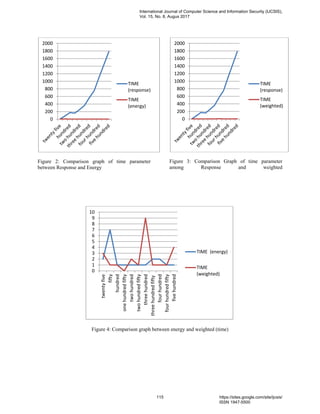
VII. EXPERIMENTAL RESULTS
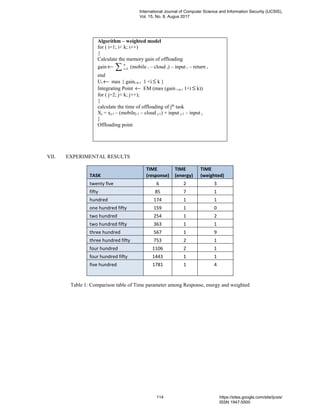
TASK
TIME
(response)
TIME
(energy)
TIME
(weighted)
twenty five 6 2 3
fifty 85 7 1
hundred 174 1 1
one hundred fifty 159 1 0
two hundred 254 1 2
two hundred fifty 363 1 1
three hundred 567 1 9
three hundred fifty 753 2 1
four hundred 1106 2 1
four hundred fifty 1443 1 1
five hundred 1781 1 4
Table 1: Comparison table of Time parameter among Response, energy and weighted
International Journal of Computer Science and Information Security (IJCSIS),
Vol. 15, No. 8, Augus 2017
114 https://sites.google.com/site/ijcsis/
ISSN 1947-5500
Figure 2: Comparison graph of time parameter
between Response and Energy
Figure 3: Comparison Graph of time parameter
among Response and weighted
Figure 4: Comparison graph between energy and weighted (time)
0
200
400
600
800
1000
1200
1400
1600
1800
2000
TIME
(response)
TIME
(energy)
0
200
400
600
800
1000
1200
1400
1600
1800
2000
TIME
(response)
TIME
(weighted)
0
1
2
3
4
5
6
7
8
9
10
twentyfive
fifty
hundred
onehundredfifty
twohundred
twohundredfifty
threehundred
threehundredfifty
fourhundred
fourhundredfifty
fivehundred
TIME (energy)
TIME
(weighted)
International Journal of Computer Science and Information Security (IJCSIS),
Vol. 15, No. 8, Augus 2017
115 https://sites.google.com/site/ijcsis/
ISSN 1947-5500
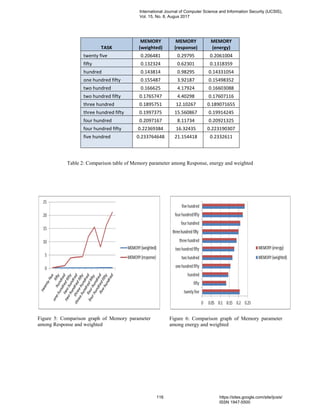
TASK
MEMORY
(weighted)
MEMORY
(response)
MEMORY
(energy)
twenty five 0.206481 0.29795 0.2061004
fifty 0.132324 0.62301 0.1318359
hundred 0.143814 0.98295 0.14331054
one hundred fifty 0.155487 3.92187 0.15498352
two hundred 0.166625 4.17924 0.16603088
two hundred fifty 0.1765747 4.40298 0.17607116
three hundred 0.1895751 12.10267 0.189071655
three hundred fifty 0.1997375 15.560867 0.19914245
four hundred 0.2097167 8.11734 0.20921325
four hundred fifty 0.22369384 16.32435 0.223190307
five hundred 0.233764648 21.154418 0.2332611
Table 2: Comparison table of Memory parameter among Response, energy and weighted
Figure 5: Comparison graph of Memory parameter
among Response and weighted
Figure 6: Comparison graph of Memory parameter
among energy and weighted
International Journal of Computer Science and Information Security (IJCSIS),
Vol. 15, No. 8, Augus 2017
116 https://sites.google.com/site/ijcsis/
ISSN 1947-5500
Figure 7: Comparison graph of Memory parameter among Response and energy
VIII. CONCLUSION
Several solutions have been proposed to enhance the
CPU performance and to manage the disk and screen
in an intelligent manner to reduce power
consumption. However, these solutions require
changes in the structure of mobile devices, or they
require a new hardware that results in an increase of
cost and may not be feasible for all mobile devices.
By offloading the computational intensive part of the
application which requires less communication to the
rest of the application, to the cloud, a mobile device
can save significant amount of battery energy and
provide more responsive user experience. In this
thesis, we have presented a computation offloading
scheme on virtual devices. Our partition algorithm
finds optimal program partitioning for given program
input data. Experimental results show that our
computation offloading scheme can be significantly
improve the performance and energy consumption on
handheld devices.
IX. FUTURE SCOPE
Computation offloading technique is proposed with
the objective to offload the large computations and
complex processing from resource-limited devices
(i.e., mobile devices) to resourceful machines (i.e.,
servers in clouds). This helps in reducing the
application execution time and also power
consumption.
More work is needed to be done for offloading field.
Future work can be extended in the following fields:
Here, we use EM algorithm for optimal partition the
application running on Smartphone, in future we will
use metaheuristic algorithm, since metaheuristics are
one of the most practical approaches for solving hard
optimization problems. This approach is interesting
for very large problem instances. We will also take
our operations to hardware for better understanding
the calculate delay and memory usage.
REFERENCES
[1] Li Z,WangC,XuR,”Computation offloading to save energy on
handheld devices: a partition scheme”,InProceedings of the 2001
international conference onCompilers, architecture, and synthesis
for embeddedsystems (CASES),238–246,2001
[2] ChengWang and ZhiyuanLi,”A computation offloading scheme
on handheld devices”, Journal of Parallel and Distributed
Computing, 2003
[3] Karthik Kumar and Yung-Hsiang Lu,“Cloud computing for
mobile users: Can offloading computation save
energy?”,Computer, vol. 43, no. 4, pp. 51–56,IEEE 2010
[4] S. Kosta, A. Aucinas, P. Hui, R. Mortier, and X. Zhang,
“Thinkair: Dynamic resource allocation and parallel execution in
the cloud for mobile code offloading.” in Proc. IEEE INFOCOM
2012
International Journal of Computer Science and Information Security (IJCSIS),
Vol. 15, No. 8, Augus 2017
117 https://sites.google.com/site/ijcsis/
ISSN 1947-5500
[5] J.Lei, F.Roy, FU.Xiaoming, S.Stefano, S. Zbigniew and T.
Hannes,”Cloud-based Computation Offloading forMobile Devices:
State of the Art, Challenges and Opportunities”,Future Network
and Mobile Summit Conference Proceedings, IIMC,2013
[6] SokolKosta. Alessandro Mei, JulindaStefa,”To offload or not to
offload? The bandwidth and energy costs of mobile cloud
computing”, INFOCOM, Proceedings IEEE 2013
[7] Huber Flores, SatishNarayanaSrirama,
RajkumarBuyya,”Computational Offloading or Data Binding?
Bridging the Cloud Infrastructure to the Proximity of the Mobile
User”IEEE,2014
[8] Roopali, Rajkumari,”Overview of Offloading in Smart Mobile
Devices for Mobile Cloud Computing”,Vol 5, Number 6, 2014
[9] Jaya Ashok Suradkar and R. D. Bharati, “Computation
Offloading: Overview, Frameworks and Challenges” International
Journal of Computer Applications Volume 134 – No.6, January
2016
[10] KarthikKumar·JibangLiu·Yung-Hsiang Lu· Bharat
Bhargava,”A Survey of Computation Offloading for Mobile
Systems”, Springer Issue on Mobile Network Application,10 April,
2012.
[11] Monika Dudeja and KritikaSoni,” Offloading Schemes in
Mobile Cloud” International Journal of Computer Applications
Volume 96– No.8, June 2014
[12] Xu Chen,” Decentralized Computation Offloading Game For
Mobile Cloud Computing”, IEEE 2015
[13] Chung.J, Park.Y, Park.J, and Cho.H,”Adaptive Cloud
Offloading of Augmented Reality Applications on Smart Devices
for Minimum Energy Consumption”,Ksii Transactions On Internet
And Information Systems VOL. 9, NO. 8, 31 August 2015
[14] D. Murali, J. Vamsinath,”Cloud Computing For Mobile
Users: Be Capable of Offloading Computation save Energy?”,
International Journal of Advanced Research in Computer Science
and Software Engineering, Volume 4, Issue 9, September 2014
[15] Ying-Dar Lin, Chu, E.T.-H., Yuan-Cheng Lai and Ting-Jun
Huang, "Time-and-Energy-Aware Computation Offloading in
Handheld Devices to Coprocessors and Clouds," in Systems
Journal, IEEE , vol.9, no.2, pp.393-405, June 2015.
[16] R. Kemp, N. Palmer, and T. Kielmann, “Cuckoo: A
computation offloading framework for smartphones,” presented at
the Proc. 2nd Int. Conf. Mobile Comput., Appl., Serv., Santa Clara,
CA, USA, 2010.
[17] Kaushik. N, Kumar. J,”A Computation Offloading
Framework to Optimize Energy Utilisation in Mobile Cloud
Computing Environment”, International Journal of Computer
Applications & Information Technology Vol. 5, Issue II April May
2014
[18] S.Rathnapriya, S. Sumithra,” Techniques to Minimize State
Transfer Cost for Dynamic Execution Offloading In Mobile Cloud
Computing”, Int. Journal of Engineering Research and
Applications, Vol. 5, Issue 5, ( Part -5), pp.32-35, May 2015
AUTHORS PROFILE
Neha Goswami, Student of ME(maters of engineering in CSE) at
Chandigarh University.
Er. Sugandha Sharma, Assistant Professor at Chandigarh
university.
International Journal of Computer Science and Information Security (IJCSIS),
Vol. 15, No. 8, Augus 2017
118 https://sites.google.com/site/ijcsis/
ISSN 1947-5500

Improve the Offloading Decision by Adaptive Partitioning of Task for Mobile Cloud Computing

  • 1.
    Improve the Offloadingdecision by Adaptive partitioning of task for Mobile Cloud Computing Neha Goswami Sugandha Sharma Computer Science and Engineering Department, Chandigarh University National Highway95, Mohali,140413, Punjab, India; nggoswamineha@gmail.com Computer Science and Engineering Department, Chandigarh University National Highway95, Mohali,140413, Punjab, India; Sugandha.ss1@gmail.com Abstract- Adaptive Offloading in Mobile Cloud Computing by automatic partitioning approach of tasks is the idea to augment execution through migrating heavy computation from mobile devices to resourceful cloud servers and then receive the results from them via wireless networks. Offloading is an effective way to overcome the resources and functionalities constraints of the mobile devices since it can release them from intensive processing and increase performance of the mobile applications, in terms of response time. Offloading brings many potential benefits, such as energy saving, performance improvement, reliability improvement, ease for the software developers and better exploitation of contextual information. Parameters about method transitions, response times, cost and energy consumptions are dynamically re- estimated at runtime during application executions. Keywords- Cloud Computing, Mobile Cloud Computing(MCC), Offloading, System model (cost model, energy model, weighted model) I. INTRODUCTION With the computing technology advancements, the desktop computer usage expands and main frame is also expanded to a wider range of embedded applications and mobile applications which includes environmental sensing, surveillance, mobile phones and GPS navigation, etc. These several applications on systems run with resources that are limited. Fore.g, battery powered is the mobile phones. The environmental sensors comprises of smallersize physically, small storage amounts and slow processors. Wireless applications are used by most of these applications and low are their magnitude orders in comparison with wired networks. Meanwhile, programs that run on these systems have increasing complexity—for example, video processing on mobile phones and object recognition on mobile robots. An increasing gap is there among the complex programs demand and the limited resources availability. A solution is offloading for augmentingthe capabilities of this mobile system with computational migration for more computers that are resourceful (i.e., servers). The client-server architecture traditionally utilized is different from this, in which always a thin client migrates to a server computation. There is a difference between the computation offloading and the migration model which utilizes in grid computing and multiprocessor system, where for load balancing migrating the process [1-6]. The key difference is that computation offloading differs mainly when it migrates programs to servers outside the computing environment of the immediate users; typically migrating the process to grid computing which occurs within computer in asimilar computing environment, that is, the grid. In similar principle for efforts is offloading like SETI@home [8], where for computation performance sending request to surrogates. The terms like “surrogate computing” and “cyber foraging” are also utilized for describing computation offloading. Computation offloading[2-3, 6, 9] is growing topic on which a significant amount of research has been done which makes it feasible, making decisions of International Journal of Computer Science and Information Security (IJCSIS), Vol. 15, No. 8, August 2017 109 https://sites.google.com/site/ijcsis/ ISSN 1947-5500
  • 2.
    offloading, and developinginfrastructures of offloading. Most of the researches done over offloading prior to 2000are on making it feasible. Primarily, this is because of its limitations in wireless networks, such as lesser bandwidths. The focus shifted to developing algorithms utilized for making offloading decisions in early 2000s that is, decidingwhether mobile users are benefited by offloading. The offloading direction is shifted with the improvements in network bandwidths, cloud computing infrastructures, and virtualization technology. More practical has become computation offloading with these developments. On mobile systems, saving the energy and performance improvement may be done by utilizing computation offloading depending usuallyon various parameters like as the data exchanged amounts through various networks and network bandwidth. Various algorithms have been proposed for making the offloading decisions to save energy or improve performance [10, 13, 15-16, 18]. Usually decisions are made with the parameter analyzation including server speeds, bandwidths, server loads, available memory, and the data exchanged amount among mobile systems and servers. In the execution environment [11], application behavior variation of predicted parametric and partitioning programs [15] is included in the solutions. Resourceful computers access is required in offloading through networkswireless or wired for short durations. Virtualization may be used by these servers for providing offloading services so as various programs and their data can be protected and isolated. Protections and isolations have motivated the researchers to developoffloading infrastructures at different granularities [16]. Performing offloading may be at the levels of tasks [9],methods [3], virtual machines [5], or applications [11]. .NET remoting, RPC (remote procedure call), and Java RMI are the various mechanisms which enables offloading at the object level and class level. At the virtual-machine level, techniques have been proposed for offloading enabling [8, 17]. The offloading and elastic resources allowed by cloud computing for multiple servers; which enables the computation offloading. Several solutions and infrastructures and solutions have been proposed to improve offloading: they deal with various issues forprivacy, users, security, mobility, etc.The goal is paper to improve the utilization of computing resources and reduce energy consumption. II. LITERATURE REVIEW For the mobile codes execution on the remote server suchas the wall-powered PCs or cloud, a technique has been employed in previous work, called offloading execution, which is the execution transferring act between two machines run time. By computational loads relieving, the labors technique for bring benefits of smartphones in terms of execution time and batteryin their proximityfrom the servers. In offloadingexecution, two maintasks are there which involves before the remote execution: state migration and code partitioning. In recent years, greater deal of research has been conducted there for finding or supportingof distributed systems optimal partitioning with mobile devices.The static partitioning schemes are proposed [10] by several researchers where the assigned jobin the system to each machine at compile timeis fixed. More doable ought to be the static partitioning if the resource configurations computationallysuch as memory capacity, processor speed, network characteristics, and energy consumption, remain fairly constant as process is launched. In mobile computing, however, the change in configurations is possible due to user mobility even in the process execution mid. Therefore, in other works mostly [4], [5], [8], [11] have been on the semi-dynamic or dynamic partitioning schemes development to execute offloading. In a partitioning schemedynamically, annotated is the code commonly withdirectivesdelimiting the code regions which can be delegated for remote executionto the server, if profitable? Which regions run on the server actuallyis decided during the execution of code when for execution the resource configurations areknown. Finally, once certain region at run time is selected, execution needs for current state tobe captured and server migration with the control command in which execution resumption is directed.In other approach [5], the entire state including the existing stack is included in entire state and migrated all heapreachableobjects for offloading the full process. In anotherapproach [4], the stack is not to be migrated as the functions set to run remotely will be newly invoked in the server. Clearly, these two International Journal of Computer Science and Information Security (IJCSIS), Vol. 15, No. 8, Augus 2017 110 https://sites.google.com/site/ijcsis/ ISSN 1947-5500
  • 3.
    approaches are havingtrade-offs. Above all, the usuallythe state transferred amount, that is a major decisive factor for themobile networks over execution offloading efficacy and have latter of smaller size. III. CLOUD COMPUTING Cloud computing is an important model in the world of information technology. It is a type of computing which provides a shared pool of virtualized and managed computing resources to the customers on their demand over the internet and other available networks rather than having local servers or their own personal devices to handle the applications. The word cloud is used as an analogy for “the internet”, so the term cloud computing means “ a type of internet based computing” where different applications and services are provided to the organizations over the internet. Cloud computing is a network of large group of servers interconnected to each other i.e basically it a shared infrastructure which contains large pools of systems that are linked together. Due to the various features like elasticity, scalability and availability, cloud computing becomes more popular these days. There are three types of cloud computing (i) public cloud (ii) private cloud and (iii) hybrid cloud. Public cloud provides an infrastructure where the information is shared among different organizations. In this model, services providers provides resources like storage and applications to the general public. It’s a pay per usage model i.e the users only have to pay for what they used. Private cloud provides an infrastructure that is dedicated to a particular organization i.e the resources and applications are not shared with the other organizations. Private cloud provides more security to the users than that of public cloud but also more expensive. Hybrid cloud is the composition of public cloud and private cloud. In hybrid cloud, the important and critical files or applications are hosted in private cloud. While the applications with less security concerns are hosted on public cloud. Only the authorized organizations can access the applications from private cloud while the applications and resources from the public cloud are easily accessible by the users. Three service models of cloud computing are (i) Saas (ii) PaaS (iii) IaaS. Software as a service (SaaS) is a model that allows users to access the internet based software’s. Users don’t have to install, manage and upgrade the applications on their devices as SaaS providers will manage all this. Users need not to worry about their data as equipment failure will not results in data loss because data is secure in cloud. Platform as a service (PaaS) is a cloud computing model that provides users a platform with tools where they can develop, manage and deliver their applications. Providers are responsible for managing security, backups and also for handling operating systems and server software’s. Infrastructure as a service (IaaS) is a cloud computing model that allows users to access the resources, storage and servers. Instead of purchasing and maintaining own hardware devices the users can pay per usage for IaaS on demand. Charactristics of cloud computing are(i)On-demand self-service: A consumer can unilaterally provision computing capabilities, such as server time and network storage, as needed automatically without requiring human interaction with each service provider. (ii)Broad network access: Capabilities are available over the network and accessed through standard mechanisms that promote use by heterogeneous thin or thick client platforms (e.g., mobile phones, tablets, laptops and workstations). (iii)Resource pooling: The provider's computing resources are pooled to serve multiple consumers using a multi-tenant model, with different physical and virtual resources dynamically assigned and reassigned according to consumer demand. There is a sense of location independence in that the customer generally has no control or knowledge over the exact location of the provided resources but may be able to specify location at a higher level of abstraction (e.g., country, state or datacenter). Examples of resources include storage, processing, memory and network bandwidth. (iv)Rapid International Journal of Computer Science and Information Security (IJCSIS), Vol. 15, No. 8, Augus 2017 111 https://sites.google.com/site/ijcsis/ ISSN 1947-5500
  • 4.
    elasticity: Capabilities canbe elastically provisioned and released, in some cases automatically, to scale rapidly outward and inward commensurate with demand. To the consumer, the capabilities available for provisioning often appear to be unlimited and can be appropriated in any quantity at any time. (v)Measured service: Cloud systems automatically control and optimize resource use by leveraging a metering capability at some level of abstraction appropriate to the type of service (e.g., storage, processing, bandwidth and active user accounts). Resource usage can be monitored, controlled and reported, providing transparency for the provider and consumer. IV. MOBILE CLOUD COMPUTING Mobile cloud computing (MCC) is termed as the combination of mobile computing, cloud computing and networks in order to provide various services to the mobile users like providing various computational resources, network operators etc. Mobile cloud computing is a model in which the mobile applications are built and hosted using cloud technology. It is different than that of mobile computing as the devices can run cloud based applications rather than that of remote applications. MCC provides a lot of opportunities for mobile industry and also allows the mobile users to utilize the various resources offered by cloud. Three approaches of MCC are : (i) providing access to cloud services (ii) allows mobile devices to work together as cloud service providers work. (iii) augmenting the execution of various mobile applications on the portable devices using cloud resources. Characteristics of Mobile Cloud Computing are (i)Convenience of data sharing:- A huge amount of data is stored in the backend servers which allows the users to access the data at any time without depending on the mobile device. (ii)Effective task Processing :- As there is an interface in the cloud and mobile devices the users are able to see the output directly on the mobile device. (iii)Elimination of the regionality:- Mobile cloud computing eliminates the regionality for accessing the data. The user can access the data at any time and at any place. Figure 1:- Mobile Cloud Computing (MCC) V. OFFLOADING IN SMARTPHONES Smartphones has some constraints like limited energy, small processors and memory capacity. As smartphones becomes more popular in our life and with the advancement in the technology they uses more powerful processors, different operating systems like android, apple iOS , windows phone and larger memory provide sharper screens , multiple sensors but these together put a burden on battery’s energy consumption. One approach for saving mobile energy is task offloading. Mobile cloud computing enhance the computing capabilities of the smartphones by offloading the computation to the cloud infrastructure. In the cloud each mobile device has a clone cloud, which runs on virtual machine and executes the mobile applications. Offloading a task to the cloud is a critical technique as in some cases the energy consumption of the smartphones increases. To make offloading beneficial, the energy cost of a particular task should be estimated by comparing it with the task that is executed locally on the mobile device. The energy consumed during the task offloading process is mainly due to the networking activities. There are two types of offloading (i)Partial Offloading (ii)Complete Offloading. Partial offloading:- The compute intensive applications are partially offloaded to the cloud in order to reduce the load of the smartphones. In this International Journal of Computer Science and Information Security (IJCSIS), Vol. 15, No. 8, Augus 2017 112 https://sites.google.com/site/ijcsis/ ISSN 1947-5500
  • 5.
    offloading process theheavy computation is done on the virtual machines i.e clone cloud and the other part of the application is executed on the smartphone. After completing both the executions the smartphone collect all the results and provide them to the customer in the required format. Complete Offloading :- In complete offloading the whole task is uploaded to the cloud in order to save the battery life where the execution of the task is performed on the cloud and then download the task results on the mobile device. The cloud acts as an exact replica of the mobile device having same data. VI. SYSTEM MODEL The cost for a task is a user-defined metric, which could be a task’s response time, usage of CPU power, and consumption of battery energy by the task, etc. In this dissertation, we investigate modeling and optimality by considering three parameters: the energy consumption on the mobile device, the application response time and cost. We deploy three models- cost model, energy model and weighted model. A. Cost Model: In this model, we calculate the memory gain of offloading. We also calculate the time of offloading for a particular tasks. After this calculation we perform offloading. B. Energy Model : In this model, we calculate the energy gain of offloading. Energy is the total amount of work performed over a period of time. We also calculate the time of offloading of given tasks. After this calculation we perform offloading. C. Weighted Model: In this model we have the memory gain on the cloud and mobile, which is not available in previous models. Then the EM algorithm is applied to partition the task optimally. In E step-using the current best guess for the parameters of the data model, we construct an expression for the log-likelihood for all data, observed and unobserved, and, then, marginalize the expression with respect to the unobserved data. In M step-given the expression resulting from the previous step, for the next guess we choose those values for the model parameters that maximize the expectation expression. These constitute our best new guess for the model parameters. Algorithm- Cost Model for(i=1 to k ); { Calculate the memory gain of offloading gain ← ∑ = n i 1 (mobile I – cloud i) end Ui ← max { gaini to i 1 <i ≤ k } For ( j=2 to k); { calculate the time of offloading of jth task Xj = xj-1 – (mobilej-1 – cloud j-1) } Offloading point Algorithm- Energy Model for(i=1 to k ); { Calculate the energy gain of offloading energy← ∑ = n i 1 (mobile I – cloud i) end Ui ← max { gaini to i 1 <i ≤ k } For ( j=2 to k); { calculate the time of offloading of jth task Xj = xj-1 – (mobilej-1 – cloud j-1) } Offloading point International Journal of Computer Science and Information Security (IJCSIS), Vol. 15, No. 8, Augus 2017 113 https://sites.google.com/site/ijcsis/ ISSN 1947-5500
  • 6.
    Algorithm – weightedmodel for ( i=1; i< k; i++) { Calculate the memory gain of offloading gain ← ∑ = n i 1 (mobile i – cloud i) – input i – return i end Ui ← max { gaini to i 1 <i ≤ k } Integrating Point ← EM (max (gain i to i 1<i ≤ k)) for ( j=2; j< k; j++); { calculate the time of offloading of jth task Xj = xj-1 – (mobilej-1 – cloud j-1) + input j-1 – input j } Offloading point VII. EXPERIMENTAL RESULTS TASK TIME (response) TIME (energy) TIME (weighted) twenty five 6 2 3 fifty 85 7 1 hundred 174 1 1 one hundred fifty 159 1 0 two hundred 254 1 2 two hundred fifty 363 1 1 three hundred 567 1 9 three hundred fifty 753 2 1 four hundred 1106 2 1 four hundred fifty 1443 1 1 five hundred 1781 1 4 Table 1: Comparison table of Time parameter among Response, energy and weighted International Journal of Computer Science and Information Security (IJCSIS), Vol. 15, No. 8, Augus 2017 114 https://sites.google.com/site/ijcsis/ ISSN 1947-5500
  • 7.
    Figure 2: Comparisongraph of time parameter between Response and Energy Figure 3: Comparison Graph of time parameter among Response and weighted Figure 4: Comparison graph between energy and weighted (time) 0 200 400 600 800 1000 1200 1400 1600 1800 2000 TIME (response) TIME (energy) 0 200 400 600 800 1000 1200 1400 1600 1800 2000 TIME (response) TIME (weighted) 0 1 2 3 4 5 6 7 8 9 10 twentyfive fifty hundred onehundredfifty twohundred twohundredfifty threehundred threehundredfifty fourhundred fourhundredfifty fivehundred TIME (energy) TIME (weighted) International Journal of Computer Science and Information Security (IJCSIS), Vol. 15, No. 8, Augus 2017 115 https://sites.google.com/site/ijcsis/ ISSN 1947-5500
  • 8.
    TASK MEMORY (weighted) MEMORY (response) MEMORY (energy) twenty five 0.2064810.29795 0.2061004 fifty 0.132324 0.62301 0.1318359 hundred 0.143814 0.98295 0.14331054 one hundred fifty 0.155487 3.92187 0.15498352 two hundred 0.166625 4.17924 0.16603088 two hundred fifty 0.1765747 4.40298 0.17607116 three hundred 0.1895751 12.10267 0.189071655 three hundred fifty 0.1997375 15.560867 0.19914245 four hundred 0.2097167 8.11734 0.20921325 four hundred fifty 0.22369384 16.32435 0.223190307 five hundred 0.233764648 21.154418 0.2332611 Table 2: Comparison table of Memory parameter among Response, energy and weighted Figure 5: Comparison graph of Memory parameter among Response and weighted Figure 6: Comparison graph of Memory parameter among energy and weighted International Journal of Computer Science and Information Security (IJCSIS), Vol. 15, No. 8, Augus 2017 116 https://sites.google.com/site/ijcsis/ ISSN 1947-5500
  • 9.
    Figure 7: Comparisongraph of Memory parameter among Response and energy VIII. CONCLUSION Several solutions have been proposed to enhance the CPU performance and to manage the disk and screen in an intelligent manner to reduce power consumption. However, these solutions require changes in the structure of mobile devices, or they require a new hardware that results in an increase of cost and may not be feasible for all mobile devices. By offloading the computational intensive part of the application which requires less communication to the rest of the application, to the cloud, a mobile device can save significant amount of battery energy and provide more responsive user experience. In this thesis, we have presented a computation offloading scheme on virtual devices. Our partition algorithm finds optimal program partitioning for given program input data. Experimental results show that our computation offloading scheme can be significantly improve the performance and energy consumption on handheld devices. IX. FUTURE SCOPE Computation offloading technique is proposed with the objective to offload the large computations and complex processing from resource-limited devices (i.e., mobile devices) to resourceful machines (i.e., servers in clouds). This helps in reducing the application execution time and also power consumption. More work is needed to be done for offloading field. Future work can be extended in the following fields: Here, we use EM algorithm for optimal partition the application running on Smartphone, in future we will use metaheuristic algorithm, since metaheuristics are one of the most practical approaches for solving hard optimization problems. This approach is interesting for very large problem instances. We will also take our operations to hardware for better understanding the calculate delay and memory usage. REFERENCES [1] Li Z,WangC,XuR,”Computation offloading to save energy on handheld devices: a partition scheme”,InProceedings of the 2001 international conference onCompilers, architecture, and synthesis for embeddedsystems (CASES),238–246,2001 [2] ChengWang and ZhiyuanLi,”A computation offloading scheme on handheld devices”, Journal of Parallel and Distributed Computing, 2003 [3] Karthik Kumar and Yung-Hsiang Lu,“Cloud computing for mobile users: Can offloading computation save energy?”,Computer, vol. 43, no. 4, pp. 51–56,IEEE 2010 [4] S. Kosta, A. Aucinas, P. Hui, R. Mortier, and X. Zhang, “Thinkair: Dynamic resource allocation and parallel execution in the cloud for mobile code offloading.” in Proc. IEEE INFOCOM 2012 International Journal of Computer Science and Information Security (IJCSIS), Vol. 15, No. 8, Augus 2017 117 https://sites.google.com/site/ijcsis/ ISSN 1947-5500
  • 10.
    [5] J.Lei, F.Roy,FU.Xiaoming, S.Stefano, S. Zbigniew and T. Hannes,”Cloud-based Computation Offloading forMobile Devices: State of the Art, Challenges and Opportunities”,Future Network and Mobile Summit Conference Proceedings, IIMC,2013 [6] SokolKosta. Alessandro Mei, JulindaStefa,”To offload or not to offload? The bandwidth and energy costs of mobile cloud computing”, INFOCOM, Proceedings IEEE 2013 [7] Huber Flores, SatishNarayanaSrirama, RajkumarBuyya,”Computational Offloading or Data Binding? Bridging the Cloud Infrastructure to the Proximity of the Mobile User”IEEE,2014 [8] Roopali, Rajkumari,”Overview of Offloading in Smart Mobile Devices for Mobile Cloud Computing”,Vol 5, Number 6, 2014 [9] Jaya Ashok Suradkar and R. D. Bharati, “Computation Offloading: Overview, Frameworks and Challenges” International Journal of Computer Applications Volume 134 – No.6, January 2016 [10] KarthikKumar·JibangLiu·Yung-Hsiang Lu· Bharat Bhargava,”A Survey of Computation Offloading for Mobile Systems”, Springer Issue on Mobile Network Application,10 April, 2012. [11] Monika Dudeja and KritikaSoni,” Offloading Schemes in Mobile Cloud” International Journal of Computer Applications Volume 96– No.8, June 2014 [12] Xu Chen,” Decentralized Computation Offloading Game For Mobile Cloud Computing”, IEEE 2015 [13] Chung.J, Park.Y, Park.J, and Cho.H,”Adaptive Cloud Offloading of Augmented Reality Applications on Smart Devices for Minimum Energy Consumption”,Ksii Transactions On Internet And Information Systems VOL. 9, NO. 8, 31 August 2015 [14] D. Murali, J. Vamsinath,”Cloud Computing For Mobile Users: Be Capable of Offloading Computation save Energy?”, International Journal of Advanced Research in Computer Science and Software Engineering, Volume 4, Issue 9, September 2014 [15] Ying-Dar Lin, Chu, E.T.-H., Yuan-Cheng Lai and Ting-Jun Huang, "Time-and-Energy-Aware Computation Offloading in Handheld Devices to Coprocessors and Clouds," in Systems Journal, IEEE , vol.9, no.2, pp.393-405, June 2015. [16] R. Kemp, N. Palmer, and T. Kielmann, “Cuckoo: A computation offloading framework for smartphones,” presented at the Proc. 2nd Int. Conf. Mobile Comput., Appl., Serv., Santa Clara, CA, USA, 2010. [17] Kaushik. N, Kumar. J,”A Computation Offloading Framework to Optimize Energy Utilisation in Mobile Cloud Computing Environment”, International Journal of Computer Applications & Information Technology Vol. 5, Issue II April May 2014 [18] S.Rathnapriya, S. Sumithra,” Techniques to Minimize State Transfer Cost for Dynamic Execution Offloading In Mobile Cloud Computing”, Int. Journal of Engineering Research and Applications, Vol. 5, Issue 5, ( Part -5), pp.32-35, May 2015 AUTHORS PROFILE Neha Goswami, Student of ME(maters of engineering in CSE) at Chandigarh University. Er. Sugandha Sharma, Assistant Professor at Chandigarh university. International Journal of Computer Science and Information Security (IJCSIS), Vol. 15, No. 8, Augus 2017 118 https://sites.google.com/site/ijcsis/ ISSN 1947-5500