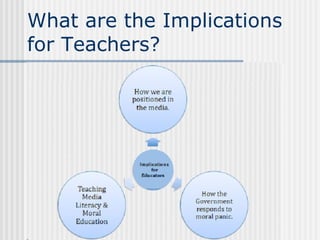
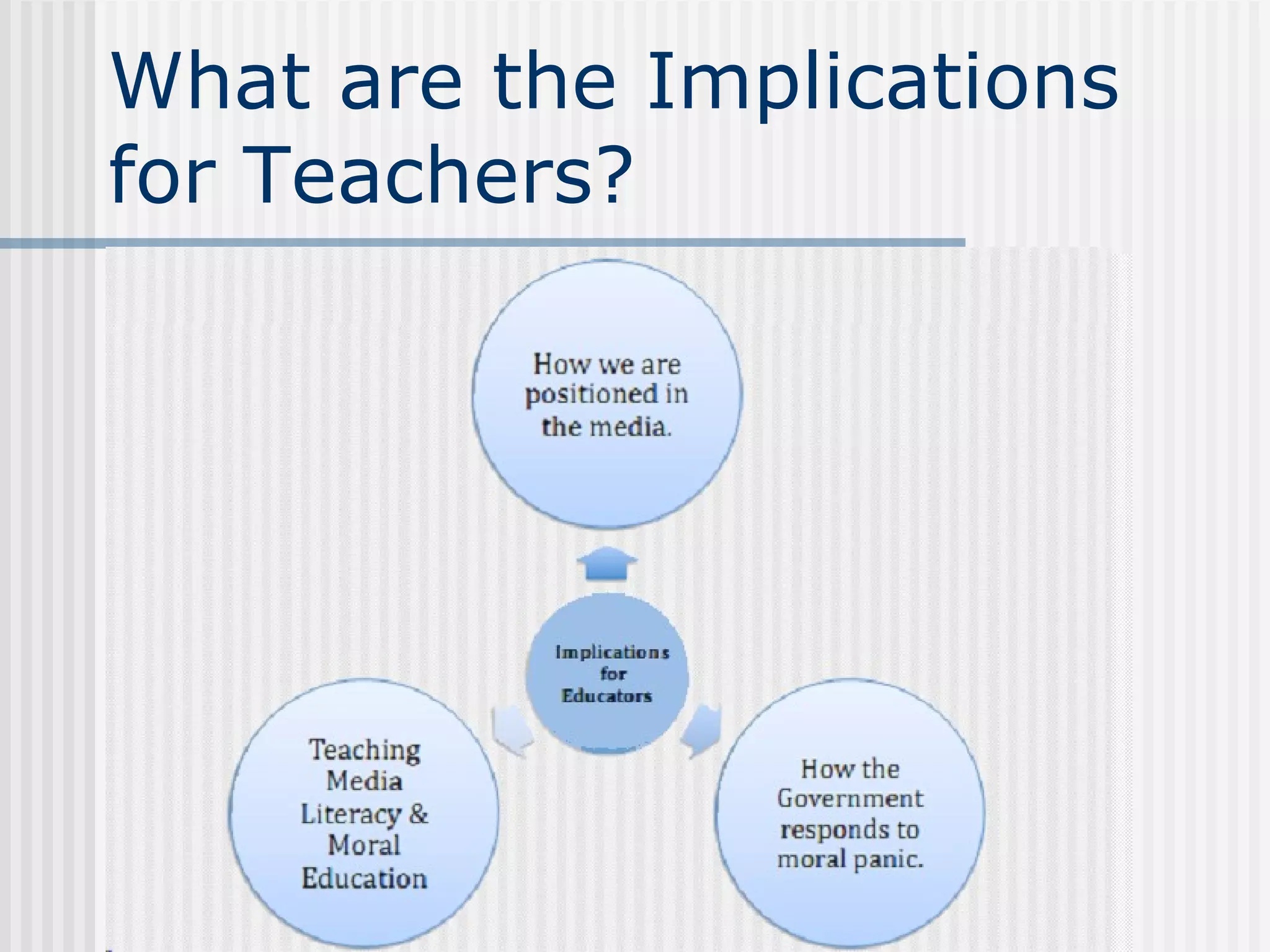
What are the Implications for Teachers? How we are positioned in the media. How the Government responds to moral panic.  Teaching Media Literacy & Moral Education
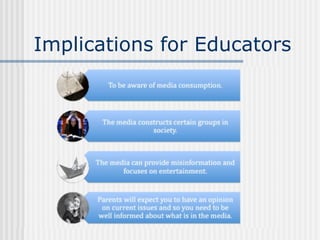
Implications for Educators To be aware of media consumption. The media constructs certain groups in society. The media can provide misinformation and focuses on entertainment. Parents will expect you to have an opinion on current issues and so you need to be well informed about what is in the media.
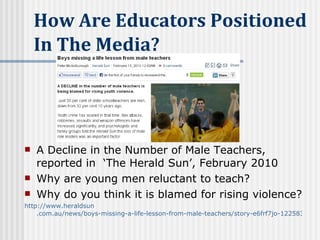
A Decline in the Number of Male Teachers, reported in  ‘The Herald Sun’, February 2010 Why are young men reluctant to teach? Why do you think it is blamed for rising violence?   http://www. heraldsun .com.au/news/boys-missing-a-life-lesson-from-male-teachers/story-e6frf7jo-1225830246785   How Are Educators Positioned in the Media?
The Newspaper article said…….   Low Pay:   “ Opposition education spokesman said that Victoria had the lowest education funding per person of any state, making it harder to recruit male teachers” Perception that it is “women’s work”: “ 1900 more secondary teachers than 10 years ago, but there are 350 fewer men among them.  Male teacher numbers in primary schools have remained steady, but they account for less than 25 per cent of the total.” Fear of being labeled a pedophile
Facts that the article are presenting………… “ Assaults by 10-14 year olds almost doubled in the past decade, to 1162 in 2008-09.  Assaults by 15-19 year olds jumped by more than 70% to 6500.”  “The loss of male role models was an important factor”   The Newspaper article said…….
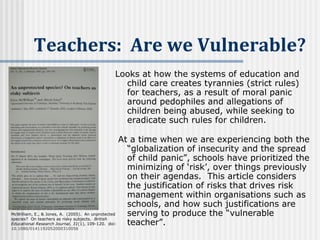
Looks at how the systems of education and child care creates tyrannies (strict rules) for teachers, as a result of moral panic around pedophiles and allegations of children being abused, while seeking to eradicate such rules for children.   At a time when we are experiencing both the “globalization of insecurity and the spread of child panic”, schools have prioritized the minimizing of ‘risk’, over things previously on their agendas.  This article considers the justification of risks that drives risk management within organisations such as schools, and how such justifications are serving to produce the “vulnerable teacher”.   Teachers:  Are we Vulnerable?     McWilliam, E., & Jones, A.  (2005).  An unprotected species?  On teachers as risky subjects.  British Educational Research Journal, 31 (1), 109-120.  doi:  10.1080/0141192052000310056
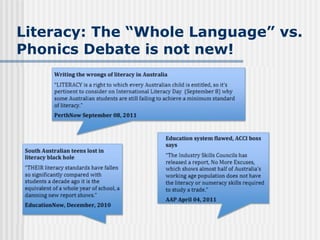
Literacy: The “Whole Language” vs. Phonics Debate is not new! Writing the wrongs of literacy in Australia “ LITERACY is a right to which every Australian child is entitled, so it’s pertinent to consider on International Literacy Day  (September 8) why some Australian students are still failing to achieve a minimum standard of literacy.” PerthNow September 08, 2011   South Australian teens lost in literacy black hole “ THEIR literacy standards have fallen so significantly compared with students a decade ago it is the equivalent of a whole year of school, a damning new report shows.” EducationNow, December, 2010   Education system flawed, ACCI boss says “ The Industry Skills Councils has released a report, No More Excuses, which shows almost half of Australia's working age population does not have the literacy or numeracy skills required to study a trade.” AAP April 04, 2011
Literacy:  Government Responds with an Inquiry. Gannon, S., & Sawyer, W. (2007). “Whole language” and moral panic in Australia.  International Journal of Progressive Education ,  3  (2), 33-51.  Retrieved from August, 30, 2011 from  http://www. inased .org/v3n2/ gannonsawyer . pdf Literacy Standards in Australia:   In 2000 & 2003 PISA (Programme for International Student Assessment) studies suggested, “that Australia was a world leader in teaching literacy and that Australian teachers were achieving among the best results in the OECD.”   In 2004-6 a public campaign with the focus on teachers & educators of English & literacy took place: In January 2004 Education Minister Brendan Nelson announced that Australian’s schools were providing students with the necessary tools to succeed in the workplace, …………but 10 months later in November 2004 he announced that a “national inquiry into literacy in primary schools” would be taking place as “employers were sick and tired of university graduates unable to spell or write” and saying that “one in five year 5 students could not pass a basic reading test”. This was due to  ‘The Australian’  publishing a letter from “26 psychologists and education academics, which attacked “whole language” methods as failing Australian students.”
From the Lecture In some low SES schools the curriculum gets narrowed down to the ‘basics’ due to the pressure of NAPLAN and teaching the ‘important’ aspects of the curriculum. The teachers are under pressure to improve NAPLAN scores and therefore they don’t have time for the ‘interesting and creative’ teaching and learning, which would cater for the children’s interests.    Think carefully about how politicians aim to position us as educators.  They often ‘react’ to the media and moral panic, as they don’t want society to think that things are out of control.  The opposition will do everything they can to fuel issues so they look the more ‘appealing’ party to vote in next time (demonising groups for political gain), for example, ‘Young people are out of control and the education system is not working.’    We need to be careful to not demonise the children that we will be teaching.  Our students might be victims of moral panic in the media, e.g. the part of Queensland that gangs supposedly exist.    Literacy and numeracy falling standards:  NAPLAN and My School are ways in which the government has tried to solve ‘the problem’ and demand getting ‘back to basics’.
Teaching media Literacy and Moral Education Teaching children to examine media for evidence of bias in reporting social unrest has value in determining whether an event is evidence of a general decline in moral values or an incident involving a small group of people for other reasons.  Remember: Moral panic sells newspapers!   Luke & Freebody’s (1999, p.7) four resources model incorporates the ‘Text Analyst’ role, where children need to be explicitly taught strategies to “critically analyse and transform texts”. It is important that children understand that texts are biased, portray particular views, silence other points of view and affect people’s ideas.   Schuitema, Ten Dam and Veugelers (2008, p.70) states “moral education refers to the deliberate teaching of particular values, attitudes, and dispositions to stimulate the prosocial and moral development of students”.  Therefore teaching children to critically think about how knowledge is constructed and promoted in our society, will prepare future generations to reflectively think and review media literacy and how it impacts on their individual morals and values (Feuerstein, 1999).     Schuitema, J., Ten Dam, G., & Veugelers, W.  (2008).  Teaching strategies for moral education:  a review.  Journal of Curriculum Studies, 40 (1), 69-89.  Retrieved August 30, 2011, from  Education Resources Information Center (ERIC) database.  (ERIC Document No  EJ784204 ). Luke, A., & Freebody, P.  (1999).  A map of possible practices:  Further notes on the four resources model.  Practically Primary 4 (2), 5-8.  Retrieved from July 27, 2011, from Queensland University of Technology Course Materials Database.   Feuerstein, M.  (1999).  Media literacy in support of critical thinking.   Journal of Educational Media, 24 (1), 43-54.  Retrieved September 15, 2011 from  ProQuest Education Journals.
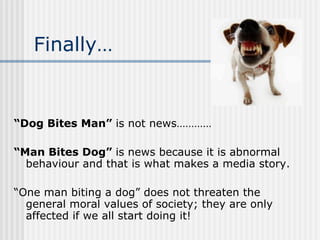
Finally… “ Dog Bites Man”  is not news…………   “ Man Bites Dog”  is news because it is abnormal   behaviour and that is what makes a media story.   “ One man biting a dog” does not threaten the general moral values of society; they are only affected if we all start doing it!
References AAP.  (2011).  Education system flawed, ACCI boss says.  Retrieved September 9, 2011 from  http://www. couriermail .com.au/news/breaking-news/education-system-flawed- acci -boss-says/story-e6freonf-1226033494918   EducationNow.  (2007).  South Australian teens lost in literacy black hole.  Retrieved September 9, 2011 from  http://www. adelaidenow .com.au/ ipad /south- australian -teens-lost-in-literacy-black-hole/story-fn6br97j-1225967259617   Gannon, S., & Sawyer, W. (2007). “Whole language” and moral panic in Australia.  International Journal of Progressive Education ,  3  (2), 33-51.  Retrieved from August 30, 2011 from  http://www. inased .org/v3n2/ gannonsawyer . pdf   Herald Sun.  (2011).  Boys missing a life lesson from male teachers.  Retrieved September 9, 2011 from  http://www. heraldsun .com.au/news/boys-missing-a-life-lesson-from- maleteachers /story-e6frf7jo-1225830246785   Luke, A., & Freebody, P.  (1999).  A map of possible practices:  Further notes on the four resources model.  Practically Primary 4 (2), 5-8.  Retrieved from  July 27, 2011, from Queensland University of Technology Course Materials Database.   McWilliam, E., & Jones, A.  (2005).  An unprotected species?  On teachers as risky subjects.  British Educational Research Journal, 31 (1), 109-120.  doi:  10.1080/0141192052000310056   PerthNow.  (2011).  Writing the wrongs of literacy in Australia.  Retrieved September 9, 2011 from  http://www. perthnow .com.au/writing-the-wrongs-of-literacy-in- australia /story-fn6mhct1-1226132441759   Schuitema, J., Ten Dam, G., & Veugelers, W.  (2008).  Teaching strategies for moral education:  a review.  Journal of Curriculum Studies, 40 (1), 69-89.  Retrieved August 30, 2011, from Education Resources Information Center (ERIC) database.  (ERIC Document No EJ784204).

Implications for educators

  • 1.
    What are theImplications for Teachers? How we are positioned in the media. How the Government responds to moral panic. Teaching Media Literacy & Moral Education
  • 2.
    Implications for EducatorsTo be aware of media consumption. The media constructs certain groups in society. The media can provide misinformation and focuses on entertainment. Parents will expect you to have an opinion on current issues and so you need to be well informed about what is in the media.
  • 3.
    A Decline inthe Number of Male Teachers, reported in ‘The Herald Sun’, February 2010 Why are young men reluctant to teach? Why do you think it is blamed for rising violence? http://www. heraldsun .com.au/news/boys-missing-a-life-lesson-from-male-teachers/story-e6frf7jo-1225830246785 How Are Educators Positioned in the Media?
  • 4.
    The Newspaper articlesaid……. Low Pay: “ Opposition education spokesman said that Victoria had the lowest education funding per person of any state, making it harder to recruit male teachers” Perception that it is “women’s work”: “ 1900 more secondary teachers than 10 years ago, but there are 350 fewer men among them. Male teacher numbers in primary schools have remained steady, but they account for less than 25 per cent of the total.” Fear of being labeled a pedophile
  • 5.
    Facts that thearticle are presenting………… “ Assaults by 10-14 year olds almost doubled in the past decade, to 1162 in 2008-09. Assaults by 15-19 year olds jumped by more than 70% to 6500.” “The loss of male role models was an important factor” The Newspaper article said…….
  • 6.
    Looks at howthe systems of education and child care creates tyrannies (strict rules) for teachers, as a result of moral panic around pedophiles and allegations of children being abused, while seeking to eradicate such rules for children.   At a time when we are experiencing both the “globalization of insecurity and the spread of child panic”, schools have prioritized the minimizing of ‘risk’, over things previously on their agendas. This article considers the justification of risks that drives risk management within organisations such as schools, and how such justifications are serving to produce the “vulnerable teacher”. Teachers: Are we Vulnerable?   McWilliam, E., & Jones, A. (2005). An unprotected species? On teachers as risky subjects. British Educational Research Journal, 31 (1), 109-120. doi: 10.1080/0141192052000310056
  • 7.
    Literacy: The “WholeLanguage” vs. Phonics Debate is not new! Writing the wrongs of literacy in Australia “ LITERACY is a right to which every Australian child is entitled, so it’s pertinent to consider on International Literacy Day  (September 8) why some Australian students are still failing to achieve a minimum standard of literacy.” PerthNow September 08, 2011   South Australian teens lost in literacy black hole “ THEIR literacy standards have fallen so significantly compared with students a decade ago it is the equivalent of a whole year of school, a damning new report shows.” EducationNow, December, 2010   Education system flawed, ACCI boss says “ The Industry Skills Councils has released a report, No More Excuses, which shows almost half of Australia's working age population does not have the literacy or numeracy skills required to study a trade.” AAP April 04, 2011
  • 8.
    Literacy: GovernmentResponds with an Inquiry. Gannon, S., & Sawyer, W. (2007). “Whole language” and moral panic in Australia. International Journal of Progressive Education , 3 (2), 33-51. Retrieved from August, 30, 2011 from http://www. inased .org/v3n2/ gannonsawyer . pdf Literacy Standards in Australia: In 2000 & 2003 PISA (Programme for International Student Assessment) studies suggested, “that Australia was a world leader in teaching literacy and that Australian teachers were achieving among the best results in the OECD.”   In 2004-6 a public campaign with the focus on teachers & educators of English & literacy took place: In January 2004 Education Minister Brendan Nelson announced that Australian’s schools were providing students with the necessary tools to succeed in the workplace, …………but 10 months later in November 2004 he announced that a “national inquiry into literacy in primary schools” would be taking place as “employers were sick and tired of university graduates unable to spell or write” and saying that “one in five year 5 students could not pass a basic reading test”. This was due to ‘The Australian’ publishing a letter from “26 psychologists and education academics, which attacked “whole language” methods as failing Australian students.”
  • 9.
    From the LectureIn some low SES schools the curriculum gets narrowed down to the ‘basics’ due to the pressure of NAPLAN and teaching the ‘important’ aspects of the curriculum. The teachers are under pressure to improve NAPLAN scores and therefore they don’t have time for the ‘interesting and creative’ teaching and learning, which would cater for the children’s interests.   Think carefully about how politicians aim to position us as educators. They often ‘react’ to the media and moral panic, as they don’t want society to think that things are out of control. The opposition will do everything they can to fuel issues so they look the more ‘appealing’ party to vote in next time (demonising groups for political gain), for example, ‘Young people are out of control and the education system is not working.’   We need to be careful to not demonise the children that we will be teaching. Our students might be victims of moral panic in the media, e.g. the part of Queensland that gangs supposedly exist.   Literacy and numeracy falling standards: NAPLAN and My School are ways in which the government has tried to solve ‘the problem’ and demand getting ‘back to basics’.
  • 10.
    Teaching media Literacyand Moral Education Teaching children to examine media for evidence of bias in reporting social unrest has value in determining whether an event is evidence of a general decline in moral values or an incident involving a small group of people for other reasons.  Remember: Moral panic sells newspapers!   Luke & Freebody’s (1999, p.7) four resources model incorporates the ‘Text Analyst’ role, where children need to be explicitly taught strategies to “critically analyse and transform texts”. It is important that children understand that texts are biased, portray particular views, silence other points of view and affect people’s ideas.   Schuitema, Ten Dam and Veugelers (2008, p.70) states “moral education refers to the deliberate teaching of particular values, attitudes, and dispositions to stimulate the prosocial and moral development of students”.  Therefore teaching children to critically think about how knowledge is constructed and promoted in our society, will prepare future generations to reflectively think and review media literacy and how it impacts on their individual morals and values (Feuerstein, 1999).   Schuitema, J., Ten Dam, G., & Veugelers, W. (2008). Teaching strategies for moral education: a review. Journal of Curriculum Studies, 40 (1), 69-89. Retrieved August 30, 2011, from Education Resources Information Center (ERIC) database. (ERIC Document No EJ784204 ). Luke, A., & Freebody, P. (1999). A map of possible practices: Further notes on the four resources model. Practically Primary 4 (2), 5-8. Retrieved from July 27, 2011, from Queensland University of Technology Course Materials Database. Feuerstein, M.  (1999).  Media literacy in support of critical thinking.  Journal of Educational Media, 24 (1), 43-54.  Retrieved September 15, 2011 from ProQuest Education Journals.
  • 11.
    Finally… “ DogBites Man” is not news…………   “ Man Bites Dog” is news because it is abnormal behaviour and that is what makes a media story.   “ One man biting a dog” does not threaten the general moral values of society; they are only affected if we all start doing it!
  • 12.
    References AAP. (2011). Education system flawed, ACCI boss says. Retrieved September 9, 2011 from http://www. couriermail .com.au/news/breaking-news/education-system-flawed- acci -boss-says/story-e6freonf-1226033494918   EducationNow. (2007). South Australian teens lost in literacy black hole. Retrieved September 9, 2011 from http://www. adelaidenow .com.au/ ipad /south- australian -teens-lost-in-literacy-black-hole/story-fn6br97j-1225967259617   Gannon, S., & Sawyer, W. (2007). “Whole language” and moral panic in Australia. International Journal of Progressive Education , 3 (2), 33-51. Retrieved from August 30, 2011 from http://www. inased .org/v3n2/ gannonsawyer . pdf   Herald Sun. (2011). Boys missing a life lesson from male teachers. Retrieved September 9, 2011 from http://www. heraldsun .com.au/news/boys-missing-a-life-lesson-from- maleteachers /story-e6frf7jo-1225830246785   Luke, A., & Freebody, P. (1999). A map of possible practices: Further notes on the four resources model. Practically Primary 4 (2), 5-8. Retrieved from July 27, 2011, from Queensland University of Technology Course Materials Database.   McWilliam, E., & Jones, A. (2005). An unprotected species? On teachers as risky subjects. British Educational Research Journal, 31 (1), 109-120. doi: 10.1080/0141192052000310056   PerthNow. (2011). Writing the wrongs of literacy in Australia. Retrieved September 9, 2011 from http://www. perthnow .com.au/writing-the-wrongs-of-literacy-in- australia /story-fn6mhct1-1226132441759   Schuitema, J., Ten Dam, G., & Veugelers, W. (2008). Teaching strategies for moral education: a review. Journal of Curriculum Studies, 40 (1), 69-89. Retrieved August 30, 2011, from Education Resources Information Center (ERIC) database. (ERIC Document No EJ784204).