―..the illiterate of the 21st century will not be those who cannot read
and write - but those who cannot learn, unlearn and re-learn..‖
                                                             Alvin Toffler
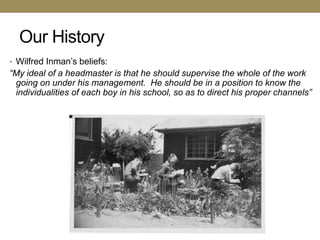
Our History
• Wilfred Inman‘s beliefs:
“My ideal of a headmaster is that he should supervise the whole of the work
 going on under his management. He should be in a position to know the
 individualities of each boy in his school, so as to direct his proper channels”
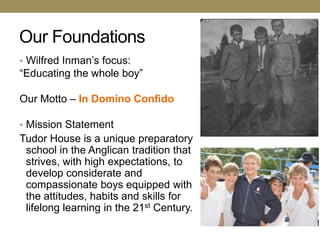
Our Foundations
• Wilfred Inman‘s focus:
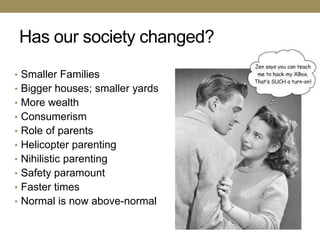
―Educating the whole boy‖

Our Motto – In Domino Confido

• Mission Statement
Tudor House is a unique preparatory
 school in the Anglican tradition that
 strives, with high expectations, to
 develop considerate and
 compassionate boys equipped with
 the attitudes, habits and skills for
 lifelong learning in the 21st Century.
History of Education – why?
• Each generation, since the beginning of human existence, has
 sought to pass on cultural and social
 values, traditions, morality, religion and skills to the next
 generation.

• Institution   – trust in people not your friends or family. And
 with boarding schools you have to trust much more than just
 academic learning.

• What questions your trust of Tudor House?
  •   Boarding
  •   Boys only
  •   Expensive
  •   Distant
  •   Sport on Saturdays
  •   Too caught up in the past
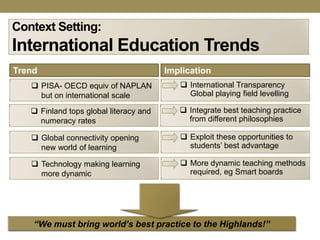
Context Setting:
International Education Trends
Trend                                   Implication
    PISA- OECD equiv of NAPLAN             International Transparency
     but on international scale              Global playing field levelling

    Finland tops global literacy and       Integrate best teaching practice
     numeracy rates                          from different philosophies

    Global connectivity opening            Exploit these opportunities to
     new world of learning                   students‘ best advantage

    Technology making learning             More dynamic teaching methods
     more dynamic                            required, eg Smart boards


    “We must bring world’s best practice to the Highlands!”
Context Setting:
Australian Education Trends
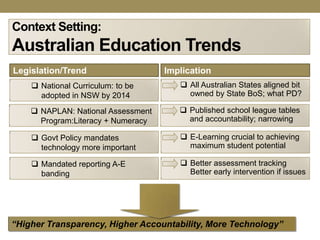
Legislation/Trend                   Implication
     National Curriculum: to be        All Australian States aligned bit
      adopted in NSW by 2014             owned by State BoS; what PD?

     NAPLAN: National Assessment       Published school league tables
      Program:Literacy + Numeracy        and accountability; narrowing

     Govt Policy mandates              E-Learning crucial to achieving
      technology more important          maximum student potential

     Mandated reporting A-E            Better assessment tracking
      banding                            Better early intervention if issues


“Higher Transparency, Higher Accountability, More Technology”
Context Setting:
Global Social Trends
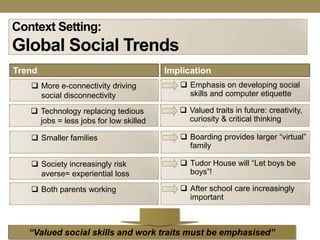
Trend                                   Implication
    More e-connectivity driving            Emphasis on developing social
     social disconnectivity                  skills and computer etiquette

    Technology replacing tedious           Valued traits in future: creativity,
     jobs = less jobs for low skilled        curiosity & critical thinking

    Smaller families                       Boarding provides larger ―virtual‖
                                             family

    Society increasingly risk              Tudor House will ―Let boys be
     averse= experiential loss               boys‖!

    Both parents working                   After school care increasingly
                                             important


   “Valued social skills and work traits must be emphasised”
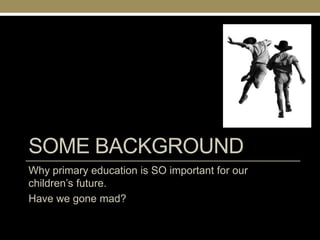
SOME BACKGROUND
Why primary education is SO important for our
children‘s future.
Have we gone mad?
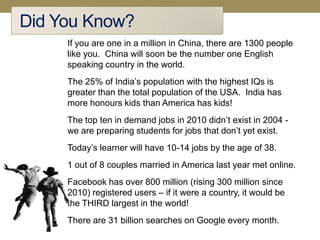
Did You Know?
     If you are one in a million in China, there are 1300 people
     like you. China will soon be the number one English
     speaking country in the world.
     The 25% of India‘s population with the highest IQs is
     greater than the total population of the USA. India has
     more honours kids than America has kids!
     The top ten in demand jobs in 2010 didn‘t exist in 2004 -
     we are preparing students for jobs that don‘t yet exist.
     Today‘s learner will have 10-14 jobs by the age of 38.
     1 out of 8 couples married in America last year met online.
     Facebook has over 800 million (rising 300 million since
     2010) registered users – if it were a country, it would be
     the THIRD largest in the world!
     There are 31 billion searches on Google every month.
Has our society changed?
• Smaller Families
• Bigger houses; smaller yards
• More wealth
• Consumerism
• Role of parents
• Helicopter parenting
• Nihilistic parenting
• Safety paramount
• Faster times
• Normal is now above-normal
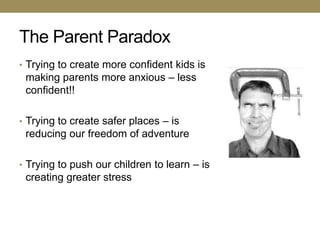
The Parent Paradox
• Trying to create more confident kids is
 making parents more anxious – less
 confident!!

• Trying to create safer places – is
 reducing our freedom of adventure

• Trying to push our children to learn – is
 creating greater stress
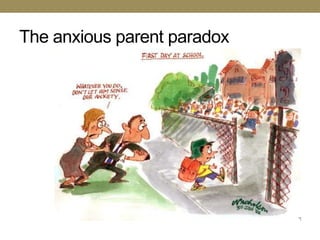
The anxious parent paradox
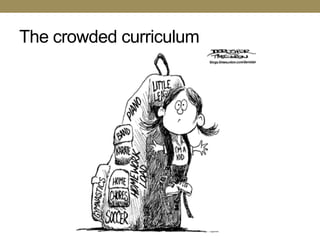
The crowded curriculum
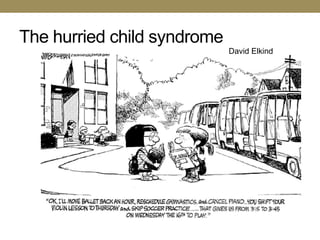
The hurried child syndrome
                             David Elkind
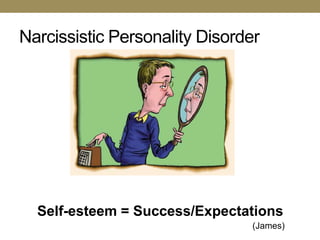
Narcissistic Personality Disorder


  Self-esteem = Success/Expectations
                               (James)
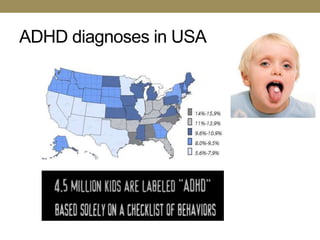
ADHD diagnoses in USA
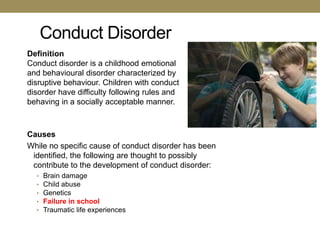
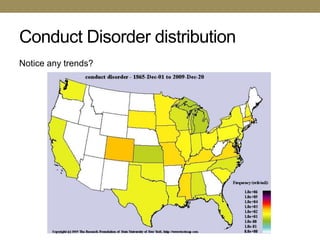
Conduct Disorder
Definition
Conduct disorder is a childhood emotional
and behavioural disorder characterized by
disruptive behaviour. Children with conduct
disorder have difficulty following rules and
behaving in a socially acceptable manner.


Causes
While no specific cause of conduct disorder has been
 identified, the following are thought to possibly
 contribute to the development of conduct disorder:
  •   Brain damage
  •   Child abuse
  •   Genetics
  •   Failure in school
  •   Traumatic life experiences
Conduct Disorder distribution
Notice any trends?
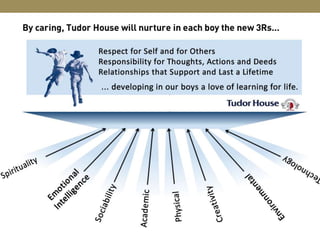
SPIRITUALITY
A protective shield against mental illness
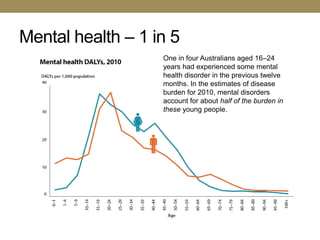
Mental health – 1 in 5
                   One in four Australians aged 16–24
                   years had experienced some mental
                   health disorder in the previous twelve
                   months. In the estimates of disease
                   burden for 2010, mental disorders
                   account for about half of the burden in
                   these young people.
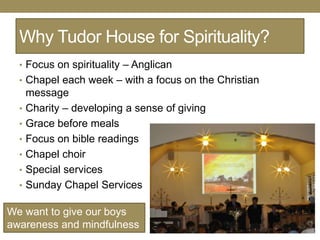
Why Tudor House for Spirituality?
  • Focus on spirituality – Anglican
  • Chapel each week – with a focus on the Christian
      message
  •   Charity – developing a sense of giving
  •   Grace before meals
  •   Focus on bible readings
  •   Chapel choir
  •   Special services
  •   Sunday Chapel Services

We want to give our boys
awareness and mindfulness
EMOTIONAL
INTELLIGENCE
Being aware of self and others is a key indicator of
success
The marshmallow test
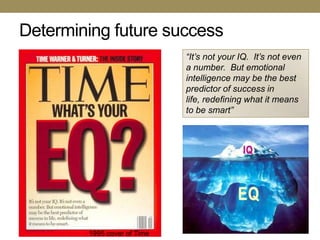
Determining future success
                             “It’s not your IQ. It’s not even
                             a number. But emotional
                             intelligence may be the best
                             predictor of success in
                             life, redefining what it means
                             to be smart”


        1995 cover of Time
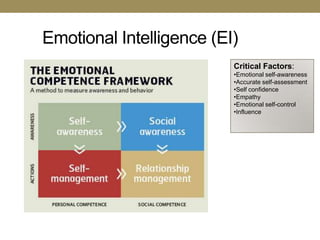
Emotional Intelligence (EI)
                          Critical Factors:
                          •Emotional self-awareness
                          •Accurate self-assessment
                          •Self confidence
                          •Empathy
                          •Emotional self-control
                          •Influence
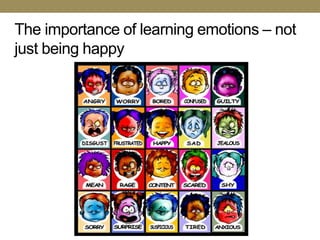
The importance of learning emotions – not
just being happy
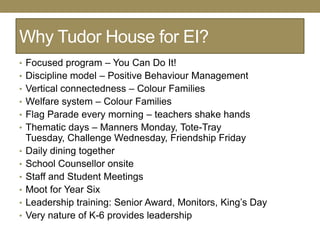
Why Tudor House for EI?
• Focused program – You Can Do It!
• Discipline model – Positive Behaviour Management
• Vertical connectedness – Colour Families
• Welfare system – Colour Families
• Flag Parade every morning – teachers shake hands
• Thematic days – Manners Monday, Tote-Tray
    Tuesday, Challenge Wednesday, Friendship Friday
•   Daily dining together
•   School Counsellor onsite
•   Staff and Student Meetings
•   Moot for Year Six
•   Leadership training: Senior Award, Monitors, King‘s Day
•   Very nature of K-6 provides leadership
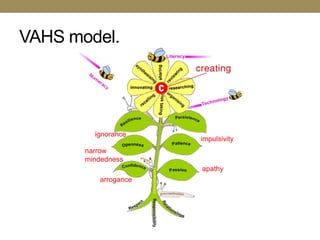
VAHS model.


         ignorance
                      impulsivity
       narrow
       mindedness
                      apathy
          arrogance
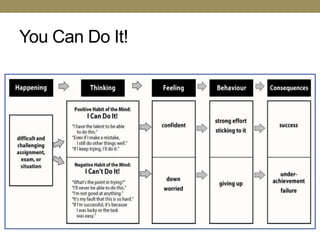
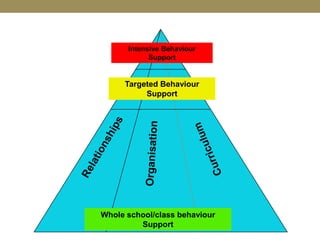
You Can Do It!
Intensive Behaviour
            Support


     Targeted Behaviour
          Support


Whole school/class behaviour
         Support
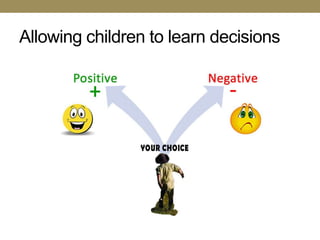
Allowing children to learn decisions
SOCIABILITY
Getting along allows us to develop our networks of
influence. We should strive to have our children develop
into ―hubs‖.
The new focus on competition
Goleman says, "Children are unintended victims of
 ratcheting up of competition. Their parents have to work
 longer and harder to maintain their parents' standard of
 living. Kids are over-scheduled after school, you don't have
 the down time. And there's a technological experiment with
 the world's youth. They spend more time alone, staring at a
 monitor than has been true ever in human history. There is
 relational poverty. They have less time with the people in
 their family. Fewer parents have the luxury of someone in
 the family to hang out with their kids. You don't have time
 as a child with the adults who care the most about you and
 who can help you learn these lessons, and nor is there
 time for free play, where you work problems out yourself.
 Childhood has been impoverished in that regard,
 particularly in affluent families. It's imperative that we put
 this in schools, so that at some point every day, you're
 getting it. In the interest of society, we need to institute
 social emotional learning programs."
Vidiot interface – not face to face

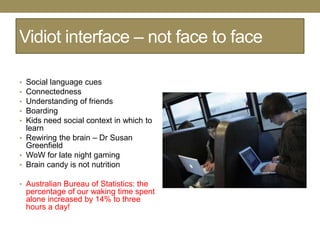
• Social language cues
• Connectedness
• Understanding of friends
• Boarding
• Kids need social context in which to
  learn
• Rewiring the brain – Dr Susan
  Greenfield
• WoW for late night gaming
• Brain candy is not nutrition

• Australian Bureau of Statistics: the
    percentage of our waking time spent
    alone increased by 14% to three
    hours a day!
Why Tudor House for Social Skills?
• Focus on freedom based on the chain of respect:
                 Act responsibly – earn our respect – granted greater freedom
•   Playground licence system
•   More play-based focus with opportunities to take responsible risks
•   Computers for learning NOT for leisure
•   Daily dining at table in groups
•   Crazes encouraged – marbles, yo-yos, diablos
•   Camping out at night with mates in Year Six
•   Skype and web-conferencing
•   Link to the past – tradition shapes our environment
•   Flag parade every morning
•   Colour House ball games
•   Sense of community – Meyer House for parents
•   Special events – Kite Day, GP Day, Anzac Day, Billy Cart Day
•   Charity focus: Dream Cricket Day
•   The Year Six Dance – mixing socially with girls
•   K-6 gives transition. Kids in K-12 don‘t get that.
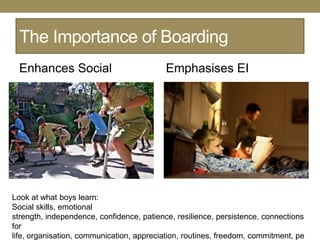
The Importance of Boarding
  Enhances Social                          Emphasises EI


Look at what boys learn:
Social skills, emotional
strength, independence, confidence, patience, resilience, persistence, connections
for
life, organisation, communication, appreciation, routines, freedom, commitment, pe
ACADEMIC
Learning boosts confidence, knowledge and control
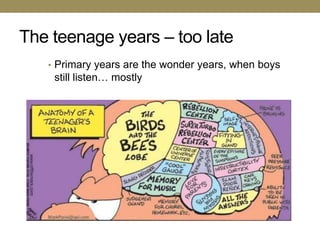
The teenage years – too late
   • Primary years are the wonder years, when boys
    still listen… mostly
Learning Styles
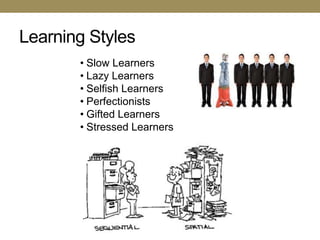
       • Slow Learners
       • Lazy Learners
       • Selfish Learners
       • Perfectionists
       • Gifted Learners
       • Stressed Learners
High Stake Tests
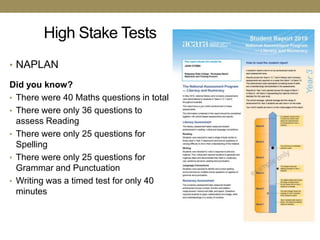
• NAPLAN

Did you know?
• There were 40 Maths questions in total
• There were only 36 questions to
  assess Reading
• There were only 25 questions for
  Spelling
• There were only 25 questions for
  Grammar and Punctuation
• Writing was a timed test for only 40
  minutes
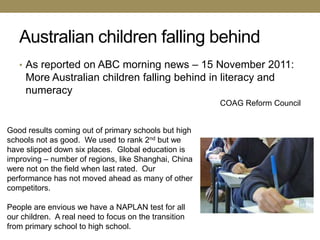
Australian children falling behind
   • As reported on ABC morning news – 15 November 2011:
     More Australian children falling behind in literacy and
     numeracy
                                                       COAG Reform Council


Good results coming out of primary schools but high
schools not as good. We used to rank 2nd but we
have slipped down six places. Global education is
improving – number of regions, like Shanghai, China
were not on the field when last rated. Our
performance has not moved ahead as many of other
competitors.

People are envious we have a NAPLAN test for all
our children. A real need to focus on the transition
from primary school to high school.
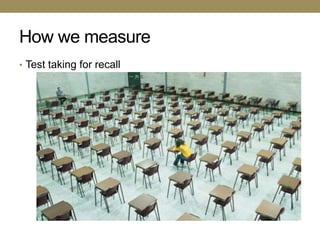
How we measure
• Test taking for recall
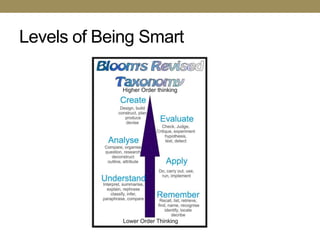
Levels of Being Smart
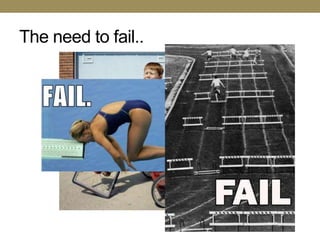
The need to fail..
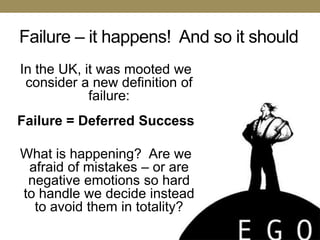
Failure – it happens! And so it should
In the UK, it was mooted we
 consider a new definition of
            failure:
Failure = Deferred Success

What is happening? Are we
 afraid of mistakes – or are
 negative emotions so hard
to handle we decide instead
  to avoid them in totality?
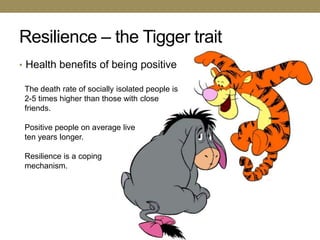
Resilience – the Tigger trait
• Health benefits of being positive

 The death rate of socially isolated people is
 2-5 times higher than those with close
 friends.

 Positive people on average live
 ten years longer.

 Resilience is a coping
 mechanism.
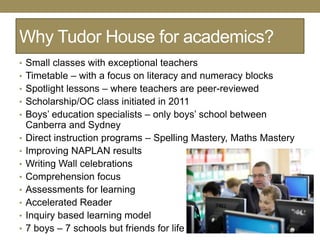
Why Tudor House for academics?
• Small classes with exceptional teachers
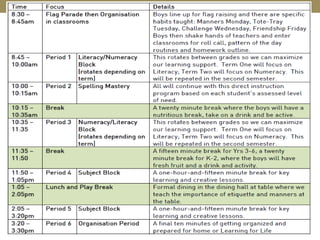
• Timetable – with a focus on literacy and numeracy blocks
• Spotlight lessons – where teachers are peer-reviewed
• Scholarship/OC class initiated in 2011
• Boys‘ education specialists – only boys‘ school between
    Canberra and Sydney
•   Direct instruction programs – Spelling Mastery, Maths Mastery
•   Improving NAPLAN results
•   Writing Wall celebrations
•   Comprehension focus
•   Assessments for learning
•   Accelerated Reader
•   Inquiry based learning model
•   7 boys – 7 schools but friends for life
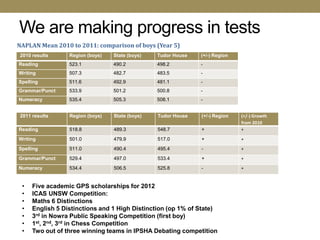
We are making progress in tests
NAPLAN Mean 2010 to 2011: comparison of boys (Year 5)
2010 results     Region (boys)   State (boys)   Tudor House   (+/-) Region
Reading          523.1           490.2          498.2         -
Writing          507.3           482.7          483.5         -
Spelling         511.6           492.9          481.1         -
Grammar/Punct    533.9           501.2          500.8         -
Numeracy         535.4           505.3          508.1         -


2011 results     Region (boys)   State (boys)   Tudor House   (+/-) Region   (+/-) Growth
                                                                             from 2010
Reading          518.8           489.3          548.7         +              +
Writing          501.0           479.9          517.0         +              +
Spelling         511.0           490.4          495.4         -              +
Grammar/Punct    529.4           497.0          533.4         +              +
Numeracy         534.4           506.5          525.8         -              +


 •   Five academic GPS scholarships for 2012
 •   ICAS UNSW Competition:
 •   Maths 6 Distinctions
 •   English 5 Distinctions and 1 High Distinction (op 1% of State)
 •   3rd in Nowra Public Speaking Competition (first boy)
 •   1st, 2nd, 3rd in Chess Competition
 •   Two out of three winning teams in IPSHA Debating competition
Observation – the monkey in the room
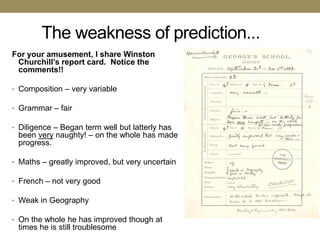
The weakness of prediction...
For your amusement, I share Winston
 Churchill’s report card. Notice the
 comments!!

• Composition – very variable

• Grammar – fair

• Diligence – Began term well but latterly has
 been very naughty! – on the whole has made
 progress.

• Maths – greatly improved, but very uncertain

• French – not very good

• Weak in Geography

• On the whole he has improved though at
 times he is still troublesome
Tudor House Report Card
PHYSICAL
Healthy habits need training and role-modelling. We
want our kids to survive and thrive.
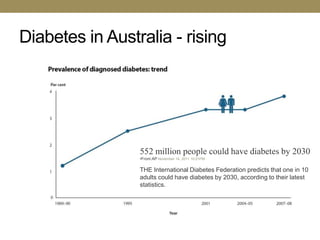
Diabetes in Australia - rising


                 552 million people could have diabetes by 2030
                 •From:AP November 14, 2011 10:01PM

                 THE International Diabetes Federation predicts that one in 10
                 adults could have diabetes by 2030, according to their latest
                 statistics.
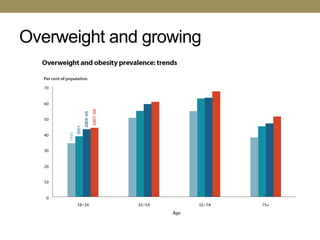
Overweight and growing
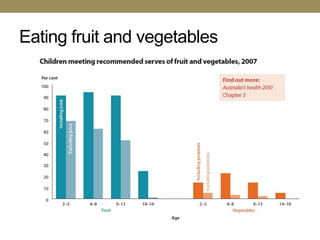
Eating fruit and vegetables
Why Tudor House?
•   Blue Bar challenge
•   Sports carnivals – IPSHA – CIS pathways
•   Triathlon
•   Bike riding, skateboarding, skating
•   No tuck shop or canteen – so controlled meals
•   Water – no soft-drinks
•   We provide all meals – our focus is on wholesome, home-
    cooked food
•   Fresh fruit whenever the boys want it
•   Playtime is emphasised
•   Sport is important – as a small school we punch above our
    weight: 2nd in National Interschools competition, undefeated 1st
    XV rugby, Sports tour to Kinross, QLD cricket tour
•   Sport played: water polo, cricket, softball, AFL, football, rugby
New timetable and focus
CREATIVITY
Our children need to be innovative and lateral – we
need to create change agents who can adopt and
adapt, seeing problems as opportunities.
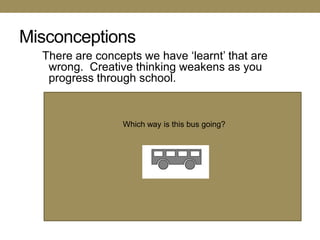
Misconceptions
  There are concepts we have ‗learnt‘ that are
   wrong. Creative thinking weakens as you
   progress through school.


                 Which way is this bus going?
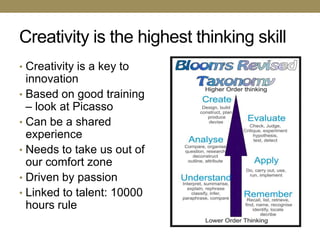
Creativity is the highest thinking skill
• Creativity is a key to
  innovation
• Based on good training
  – look at Picasso
• Can be a shared
  experience
• Needs to take us out of
  our comfort zone
• Driven by passion
• Linked to talent: 10000
  hours rule
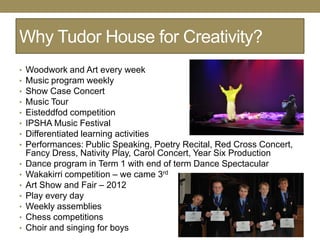
Why Tudor House for Creativity?
•   Woodwork and Art every week
•   Music program weekly
•   Show Case Concert
•   Music Tour
•   Eisteddfod competition
•   IPSHA Music Festival
•   Differentiated learning activities
•   Performances: Public Speaking, Poetry Recital, Red Cross Concert,
    Fancy Dress, Nativity Play, Carol Concert, Year Six Production
•   Dance program in Term 1 with end of term Dance Spectacular
•   Wakakirri competition – we came 3rd
•   Art Show and Fair – 2012
•   Play every day
•   Weekly assemblies
•   Chess competitions
•   Choir and singing for boys
ENVIRONMENTAL
Our children will need to appreciate, respect and protect
their environment. We cannot continue to use – we
have to return to reuse for our resources are finite.
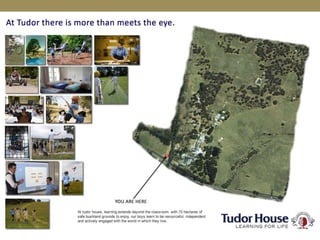
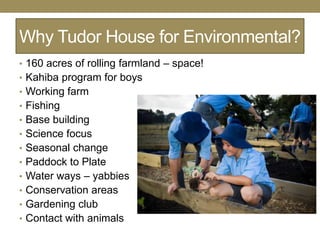
Why Tudor House for Environmental?
• 160 acres of rolling farmland – space!
• Kahiba program for boys
• Working farm
• Fishing
• Base building
• Science focus
• Seasonal change
• Paddock to Plate
• Water ways – yabbies
• Conservation areas
• Gardening club
• Contact with animals
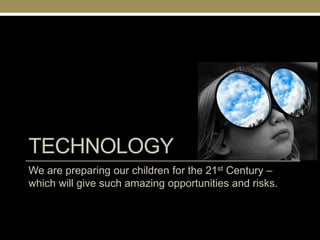
TECHNOLOGY
We are preparing our children for the 21st Century –
which will give such amazing opportunities and risks.
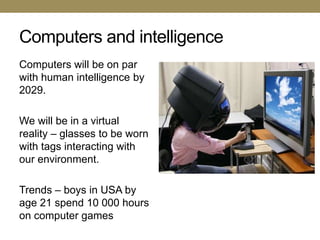
Computers and intelligence
Computers will be on par
with human intelligence by
2029.

We will be in a virtual
reality – glasses to be worn
with tags interacting with
our environment.

Trends – boys in USA by
age 21 spend 10 000 hours
on computer games
Why Tudor House for Technology?
• Arguably the best ICT infrastructure in Southern Highlands
• Video conferencing suite
• Interactive whiteboards in every classroom
• Full audio-visual hardware in every classroom
• Clickers for testing and surveys
• Wireless technology
• Skype for boarders
• Two full class laptop trolleys for upper primary
• Use of Web2.0 for communication
• Every boy has email address
• Database tracking for progress and reports
• Headmaster is a geek!
• ICT is supported by the full power of The King‘s School
THE RISK OF RISK
Tudor House retains the connections to common sense
because we trust in our own upbringing.
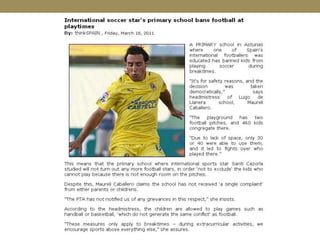
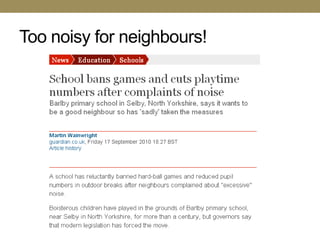
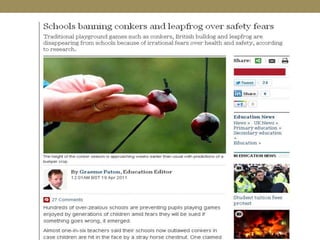
Too noisy for neighbours!
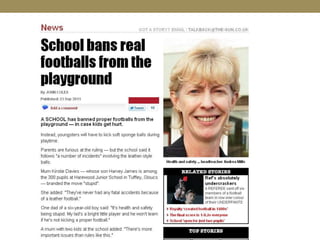
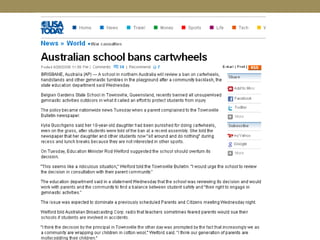
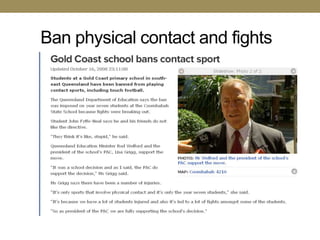
Ban physical contact and fights
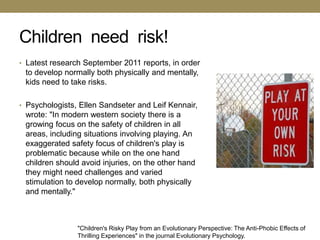
Children need risk!
• Latest research September 2011 reports, in order
 to develop normally both physically and mentally,
 kids need to take risks.

• Psychologists, Ellen Sandseter and Leif Kennair,
 wrote: "In modern western society there is a
 growing focus on the safety of children in all
 areas, including situations involving playing. An
 exaggerated safety focus of children's play is
 problematic because while on the one hand
 children should avoid injuries, on the other hand
 they might need challenges and varied
 stimulation to develop normally, both physically
 and mentally."


                "Children's Risky Play from an Evolutionary Perspective: The Anti-Phobic Effects of
                Thrilling Experiences" in the journal Evolutionary Psychology.
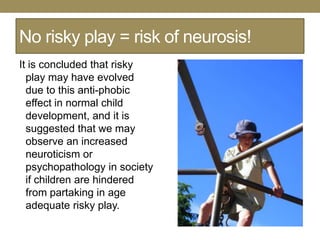
No risky play = risk of neurosis!
It is concluded that risky
  play may have evolved
  due to this anti-phobic
  effect in normal child
  development, and it is
  suggested that we may
  observe an increased
  neuroticism or
  psychopathology in society
  if children are hindered
  from partaking in age
  adequate risky play.
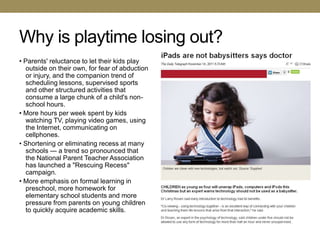
Why is playtime losing out?
• Parents' reluctance to let their kids play
   outside on their own, for fear of abduction
   or injury, and the companion trend of
   scheduling lessons, supervised sports
   and other structured activities that
   consume a large chunk of a child's non-
   school hours.
• More hours per week spent by kids
   watching TV, playing video games, using
   the Internet, communicating on
   cellphones.
• Shortening or eliminating recess at many
   schools — a trend so pronounced that
   the National Parent Teacher Association
   has launched a "Rescuing Recess"
   campaign.
• More emphasis on formal learning in
   preschool, more homework for
   elementary school students and more
   pressure from parents on young children
   to quickly acquire academic skills.
NEW DIRECTIONS
Tudor House innovates and creates. Starting next year
new programs are on offer
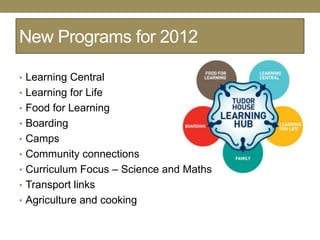
New Programs for 2012

• Learning Central
• Learning for Life
• Food for Learning
• Boarding
• Camps
• Community connections
• Curriculum Focus – Science and Maths
• Transport links
• Agriculture and cooking
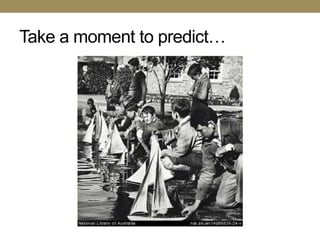
Take a moment to predict…
Questions & Answers
Learning at Tudor House School

Learning at Tudor House School

  • 1.
    ―..the illiterate ofthe 21st century will not be those who cannot read and write - but those who cannot learn, unlearn and re-learn..‖ Alvin Toffler
  • 2.
    Our History • WilfredInman‘s beliefs: “My ideal of a headmaster is that he should supervise the whole of the work going on under his management. He should be in a position to know the individualities of each boy in his school, so as to direct his proper channels”
  • 3.
    Our Foundations • WilfredInman‘s focus: ―Educating the whole boy‖ Our Motto – In Domino Confido • Mission Statement Tudor House is a unique preparatory school in the Anglican tradition that strives, with high expectations, to develop considerate and compassionate boys equipped with the attitudes, habits and skills for lifelong learning in the 21st Century.
  • 4.
    History of Education– why? • Each generation, since the beginning of human existence, has sought to pass on cultural and social values, traditions, morality, religion and skills to the next generation. • Institution – trust in people not your friends or family. And with boarding schools you have to trust much more than just academic learning. • What questions your trust of Tudor House? • Boarding • Boys only • Expensive • Distant • Sport on Saturdays • Too caught up in the past
  • 5.
    Context Setting: International EducationTrends Trend Implication  PISA- OECD equiv of NAPLAN  International Transparency but on international scale Global playing field levelling  Finland tops global literacy and  Integrate best teaching practice numeracy rates from different philosophies  Global connectivity opening  Exploit these opportunities to new world of learning students‘ best advantage  Technology making learning  More dynamic teaching methods more dynamic required, eg Smart boards “We must bring world’s best practice to the Highlands!”
  • 6.
    Context Setting: Australian EducationTrends Legislation/Trend Implication  National Curriculum: to be  All Australian States aligned bit adopted in NSW by 2014 owned by State BoS; what PD?  NAPLAN: National Assessment  Published school league tables Program:Literacy + Numeracy and accountability; narrowing  Govt Policy mandates  E-Learning crucial to achieving technology more important maximum student potential  Mandated reporting A-E  Better assessment tracking banding Better early intervention if issues “Higher Transparency, Higher Accountability, More Technology”
  • 7.
    Context Setting: Global SocialTrends Trend Implication  More e-connectivity driving  Emphasis on developing social social disconnectivity skills and computer etiquette  Technology replacing tedious  Valued traits in future: creativity, jobs = less jobs for low skilled curiosity & critical thinking  Smaller families  Boarding provides larger ―virtual‖ family  Society increasingly risk  Tudor House will ―Let boys be averse= experiential loss boys‖!  Both parents working  After school care increasingly important “Valued social skills and work traits must be emphasised”
  • 8.
    SOME BACKGROUND Why primaryeducation is SO important for our children‘s future. Have we gone mad?
  • 9.
    Did You Know? If you are one in a million in China, there are 1300 people like you. China will soon be the number one English speaking country in the world. The 25% of India‘s population with the highest IQs is greater than the total population of the USA. India has more honours kids than America has kids! The top ten in demand jobs in 2010 didn‘t exist in 2004 - we are preparing students for jobs that don‘t yet exist. Today‘s learner will have 10-14 jobs by the age of 38. 1 out of 8 couples married in America last year met online. Facebook has over 800 million (rising 300 million since 2010) registered users – if it were a country, it would be the THIRD largest in the world! There are 31 billion searches on Google every month.
  • 10.
    Has our societychanged? • Smaller Families • Bigger houses; smaller yards • More wealth • Consumerism • Role of parents • Helicopter parenting • Nihilistic parenting • Safety paramount • Faster times • Normal is now above-normal
  • 11.
    The Parent Paradox •Trying to create more confident kids is making parents more anxious – less confident!! • Trying to create safer places – is reducing our freedom of adventure • Trying to push our children to learn – is creating greater stress
  • 12.
  • 13.
  • 14.
    The hurried childsyndrome David Elkind
  • 15.
    Narcissistic Personality Disorder Self-esteem = Success/Expectations (James)
  • 16.
  • 17.
    Conduct Disorder Definition Conduct disorderis a childhood emotional and behavioural disorder characterized by disruptive behaviour. Children with conduct disorder have difficulty following rules and behaving in a socially acceptable manner. Causes While no specific cause of conduct disorder has been identified, the following are thought to possibly contribute to the development of conduct disorder: • Brain damage • Child abuse • Genetics • Failure in school • Traumatic life experiences
  • 18.
  • 20.
    SPIRITUALITY A protective shieldagainst mental illness
  • 21.
    Mental health –1 in 5 One in four Australians aged 16–24 years had experienced some mental health disorder in the previous twelve months. In the estimates of disease burden for 2010, mental disorders account for about half of the burden in these young people.
  • 22.
    Why Tudor Housefor Spirituality? • Focus on spirituality – Anglican • Chapel each week – with a focus on the Christian message • Charity – developing a sense of giving • Grace before meals • Focus on bible readings • Chapel choir • Special services • Sunday Chapel Services We want to give our boys awareness and mindfulness
  • 23.
    EMOTIONAL INTELLIGENCE Being aware ofself and others is a key indicator of success
  • 24.
  • 25.
    Determining future success “It’s not your IQ. It’s not even a number. But emotional intelligence may be the best predictor of success in life, redefining what it means to be smart” 1995 cover of Time
  • 26.
    Emotional Intelligence (EI) Critical Factors: •Emotional self-awareness •Accurate self-assessment •Self confidence •Empathy •Emotional self-control •Influence
  • 27.
    The importance oflearning emotions – not just being happy
  • 28.
    Why Tudor Housefor EI? • Focused program – You Can Do It! • Discipline model – Positive Behaviour Management • Vertical connectedness – Colour Families • Welfare system – Colour Families • Flag Parade every morning – teachers shake hands • Thematic days – Manners Monday, Tote-Tray Tuesday, Challenge Wednesday, Friendship Friday • Daily dining together • School Counsellor onsite • Staff and Student Meetings • Moot for Year Six • Leadership training: Senior Award, Monitors, King‘s Day • Very nature of K-6 provides leadership
  • 29.
    VAHS model. ignorance impulsivity narrow mindedness apathy arrogance
  • 30.
  • 31.
    Intensive Behaviour Support Targeted Behaviour Support Whole school/class behaviour Support
  • 32.
    Allowing children tolearn decisions
  • 33.
    SOCIABILITY Getting along allowsus to develop our networks of influence. We should strive to have our children develop into ―hubs‖.
  • 34.
    The new focuson competition Goleman says, "Children are unintended victims of ratcheting up of competition. Their parents have to work longer and harder to maintain their parents' standard of living. Kids are over-scheduled after school, you don't have the down time. And there's a technological experiment with the world's youth. They spend more time alone, staring at a monitor than has been true ever in human history. There is relational poverty. They have less time with the people in their family. Fewer parents have the luxury of someone in the family to hang out with their kids. You don't have time as a child with the adults who care the most about you and who can help you learn these lessons, and nor is there time for free play, where you work problems out yourself. Childhood has been impoverished in that regard, particularly in affluent families. It's imperative that we put this in schools, so that at some point every day, you're getting it. In the interest of society, we need to institute social emotional learning programs."
  • 35.
    Vidiot interface –not face to face • Social language cues • Connectedness • Understanding of friends • Boarding • Kids need social context in which to learn • Rewiring the brain – Dr Susan Greenfield • WoW for late night gaming • Brain candy is not nutrition • Australian Bureau of Statistics: the percentage of our waking time spent alone increased by 14% to three hours a day!
  • 36.
    Why Tudor Housefor Social Skills? • Focus on freedom based on the chain of respect: Act responsibly – earn our respect – granted greater freedom • Playground licence system • More play-based focus with opportunities to take responsible risks • Computers for learning NOT for leisure • Daily dining at table in groups • Crazes encouraged – marbles, yo-yos, diablos • Camping out at night with mates in Year Six • Skype and web-conferencing • Link to the past – tradition shapes our environment • Flag parade every morning • Colour House ball games • Sense of community – Meyer House for parents • Special events – Kite Day, GP Day, Anzac Day, Billy Cart Day • Charity focus: Dream Cricket Day • The Year Six Dance – mixing socially with girls • K-6 gives transition. Kids in K-12 don‘t get that.
  • 37.
    The Importance ofBoarding Enhances Social Emphasises EI Look at what boys learn: Social skills, emotional strength, independence, confidence, patience, resilience, persistence, connections for life, organisation, communication, appreciation, routines, freedom, commitment, pe
  • 38.
  • 39.
    The teenage years– too late • Primary years are the wonder years, when boys still listen… mostly
  • 40.
    Learning Styles • Slow Learners • Lazy Learners • Selfish Learners • Perfectionists • Gifted Learners • Stressed Learners
  • 41.
    High Stake Tests •NAPLAN Did you know? • There were 40 Maths questions in total • There were only 36 questions to assess Reading • There were only 25 questions for Spelling • There were only 25 questions for Grammar and Punctuation • Writing was a timed test for only 40 minutes
  • 42.
    Australian children fallingbehind • As reported on ABC morning news – 15 November 2011: More Australian children falling behind in literacy and numeracy COAG Reform Council Good results coming out of primary schools but high schools not as good. We used to rank 2nd but we have slipped down six places. Global education is improving – number of regions, like Shanghai, China were not on the field when last rated. Our performance has not moved ahead as many of other competitors. People are envious we have a NAPLAN test for all our children. A real need to focus on the transition from primary school to high school.
  • 43.
    How we measure •Test taking for recall
  • 44.
  • 45.
  • 46.
    Failure – ithappens! And so it should In the UK, it was mooted we consider a new definition of failure: Failure = Deferred Success What is happening? Are we afraid of mistakes – or are negative emotions so hard to handle we decide instead to avoid them in totality?
  • 47.
    Resilience – theTigger trait • Health benefits of being positive The death rate of socially isolated people is 2-5 times higher than those with close friends. Positive people on average live ten years longer. Resilience is a coping mechanism.
  • 48.
    Why Tudor Housefor academics? • Small classes with exceptional teachers • Timetable – with a focus on literacy and numeracy blocks • Spotlight lessons – where teachers are peer-reviewed • Scholarship/OC class initiated in 2011 • Boys‘ education specialists – only boys‘ school between Canberra and Sydney • Direct instruction programs – Spelling Mastery, Maths Mastery • Improving NAPLAN results • Writing Wall celebrations • Comprehension focus • Assessments for learning • Accelerated Reader • Inquiry based learning model • 7 boys – 7 schools but friends for life
  • 49.
    We are makingprogress in tests NAPLAN Mean 2010 to 2011: comparison of boys (Year 5) 2010 results Region (boys) State (boys) Tudor House (+/-) Region Reading 523.1 490.2 498.2 - Writing 507.3 482.7 483.5 - Spelling 511.6 492.9 481.1 - Grammar/Punct 533.9 501.2 500.8 - Numeracy 535.4 505.3 508.1 - 2011 results Region (boys) State (boys) Tudor House (+/-) Region (+/-) Growth from 2010 Reading 518.8 489.3 548.7 + + Writing 501.0 479.9 517.0 + + Spelling 511.0 490.4 495.4 - + Grammar/Punct 529.4 497.0 533.4 + + Numeracy 534.4 506.5 525.8 - + • Five academic GPS scholarships for 2012 • ICAS UNSW Competition: • Maths 6 Distinctions • English 5 Distinctions and 1 High Distinction (op 1% of State) • 3rd in Nowra Public Speaking Competition (first boy) • 1st, 2nd, 3rd in Chess Competition • Two out of three winning teams in IPSHA Debating competition
  • 50.
    Observation – themonkey in the room
  • 51.
    The weakness ofprediction... For your amusement, I share Winston Churchill’s report card. Notice the comments!! • Composition – very variable • Grammar – fair • Diligence – Began term well but latterly has been very naughty! – on the whole has made progress. • Maths – greatly improved, but very uncertain • French – not very good • Weak in Geography • On the whole he has improved though at times he is still troublesome
  • 52.
  • 53.
    PHYSICAL Healthy habits needtraining and role-modelling. We want our kids to survive and thrive.
  • 54.
    Diabetes in Australia- rising 552 million people could have diabetes by 2030 •From:AP November 14, 2011 10:01PM THE International Diabetes Federation predicts that one in 10 adults could have diabetes by 2030, according to their latest statistics.
  • 55.
  • 56.
    Eating fruit andvegetables
  • 57.
    Why Tudor House? • Blue Bar challenge • Sports carnivals – IPSHA – CIS pathways • Triathlon • Bike riding, skateboarding, skating • No tuck shop or canteen – so controlled meals • Water – no soft-drinks • We provide all meals – our focus is on wholesome, home- cooked food • Fresh fruit whenever the boys want it • Playtime is emphasised • Sport is important – as a small school we punch above our weight: 2nd in National Interschools competition, undefeated 1st XV rugby, Sports tour to Kinross, QLD cricket tour • Sport played: water polo, cricket, softball, AFL, football, rugby
  • 58.
  • 59.
    CREATIVITY Our children needto be innovative and lateral – we need to create change agents who can adopt and adapt, seeing problems as opportunities.
  • 60.
    Misconceptions Thereare concepts we have ‗learnt‘ that are wrong. Creative thinking weakens as you progress through school. Which way is this bus going?
  • 61.
    Creativity is thehighest thinking skill • Creativity is a key to innovation • Based on good training – look at Picasso • Can be a shared experience • Needs to take us out of our comfort zone • Driven by passion • Linked to talent: 10000 hours rule
  • 62.
    Why Tudor Housefor Creativity? • Woodwork and Art every week • Music program weekly • Show Case Concert • Music Tour • Eisteddfod competition • IPSHA Music Festival • Differentiated learning activities • Performances: Public Speaking, Poetry Recital, Red Cross Concert, Fancy Dress, Nativity Play, Carol Concert, Year Six Production • Dance program in Term 1 with end of term Dance Spectacular • Wakakirri competition – we came 3rd • Art Show and Fair – 2012 • Play every day • Weekly assemblies • Chess competitions • Choir and singing for boys
  • 63.
    ENVIRONMENTAL Our children willneed to appreciate, respect and protect their environment. We cannot continue to use – we have to return to reuse for our resources are finite.
  • 65.
    Why Tudor Housefor Environmental? • 160 acres of rolling farmland – space! • Kahiba program for boys • Working farm • Fishing • Base building • Science focus • Seasonal change • Paddock to Plate • Water ways – yabbies • Conservation areas • Gardening club • Contact with animals
  • 66.
    TECHNOLOGY We are preparingour children for the 21st Century – which will give such amazing opportunities and risks.
  • 67.
    Computers and intelligence Computerswill be on par with human intelligence by 2029. We will be in a virtual reality – glasses to be worn with tags interacting with our environment. Trends – boys in USA by age 21 spend 10 000 hours on computer games
  • 68.
    Why Tudor Housefor Technology? • Arguably the best ICT infrastructure in Southern Highlands • Video conferencing suite • Interactive whiteboards in every classroom • Full audio-visual hardware in every classroom • Clickers for testing and surveys • Wireless technology • Skype for boarders • Two full class laptop trolleys for upper primary • Use of Web2.0 for communication • Every boy has email address • Database tracking for progress and reports • Headmaster is a geek! • ICT is supported by the full power of The King‘s School
  • 69.
    THE RISK OFRISK Tudor House retains the connections to common sense because we trust in our own upbringing.
  • 71.
    Too noisy forneighbours!
  • 75.
  • 76.
    Children need risk! •Latest research September 2011 reports, in order to develop normally both physically and mentally, kids need to take risks. • Psychologists, Ellen Sandseter and Leif Kennair, wrote: "In modern western society there is a growing focus on the safety of children in all areas, including situations involving playing. An exaggerated safety focus of children's play is problematic because while on the one hand children should avoid injuries, on the other hand they might need challenges and varied stimulation to develop normally, both physically and mentally." "Children's Risky Play from an Evolutionary Perspective: The Anti-Phobic Effects of Thrilling Experiences" in the journal Evolutionary Psychology.
  • 77.
    No risky play= risk of neurosis! It is concluded that risky play may have evolved due to this anti-phobic effect in normal child development, and it is suggested that we may observe an increased neuroticism or psychopathology in society if children are hindered from partaking in age adequate risky play.
  • 78.
    Why is playtimelosing out? • Parents' reluctance to let their kids play outside on their own, for fear of abduction or injury, and the companion trend of scheduling lessons, supervised sports and other structured activities that consume a large chunk of a child's non- school hours. • More hours per week spent by kids watching TV, playing video games, using the Internet, communicating on cellphones. • Shortening or eliminating recess at many schools — a trend so pronounced that the National Parent Teacher Association has launched a "Rescuing Recess" campaign. • More emphasis on formal learning in preschool, more homework for elementary school students and more pressure from parents on young children to quickly acquire academic skills.
  • 79.
    NEW DIRECTIONS Tudor Houseinnovates and creates. Starting next year new programs are on offer
  • 80.
    New Programs for2012 • Learning Central • Learning for Life • Food for Learning • Boarding • Camps • Community connections • Curriculum Focus – Science and Maths • Transport links • Agriculture and cooking
  • 81.
    Take a momentto predict…
  • 82.

Editor's Notes

  • #10 Years it took to reach a market audience of 50 million: Radio – 38 years Television – 13 years Internet – 4 years
  • #27 Companies are now hiring on emotional intelligence