Implementing the Researcher Development Framework A joint Vitae NW & YNE Hub good practice workshop
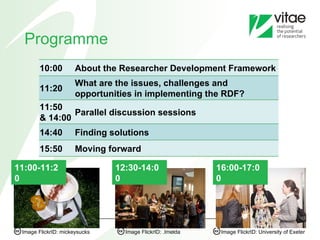
Programme 11:00-11:20 12:30-14:00 16:00-17:00 Image FlickrID: University of Exeter Image FlickrID: mickeysucks Image FlickrID: .Imelda 10:00 About the Researcher Development Framework 11:20 What are the issues, challenges and opportunities in implementing the RDF? 11:50  & 14:00 Parallel discussion sessions 14:40 Finding solutions 15:50 Moving forward
An introduction to the Researcher Development Framework   Dr Vivien Hodges Vitae®, © 2011 The Careers Research and Advisory Centre (CRAC) Limited
Vitae vision and aims For the UK to be world-class in supporting the personal, professional and career development of researchers Build human capital  by influencing the development and implementation of effective policy relating to researcher development Enhance higher education provision  to train and develop researchers Empower researchers  to make an impact in their careers Evidence the impact  of professional and career development support for researchers
Researcher development in context  The UK is committed to the development of world-class researchers.  Researchers are critical to economic success Researchers’ careers span a wider variety of employment sectors Strong UK commitment to researcher development
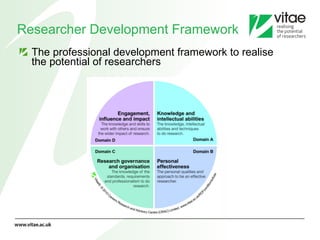
Researcher Development Framework The professional development framework to realise the potential of researchers
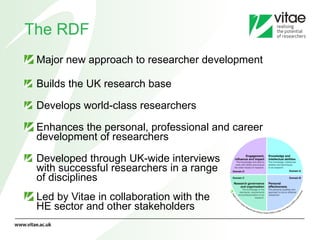
The RDF Major new approach to researcher development Builds the UK research base Develops world-class researchers   Enhances  the personal, professional and career development of researchers Developed through UK-wide interviews  with successful researchers in a range  of disciplines Led by Vitae in collaboration with the  HE sector and other stakeholders
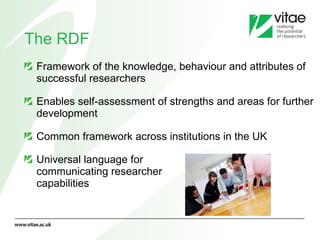
The RDF Framework of the knowledge, behaviour and attributes of successful researchers  Enables self-assessment of strengths and areas for further development  Common framework across institutions in the UK Universal language for  communicating researcher  capabilities
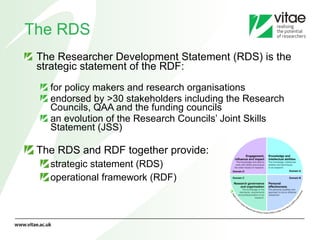
The RDS The  Researcher Development Statement  (RDS) is the strategic statement of the RDF: for policy makers and research organisations endorsed by >30 stakeholders including the Research Councils, QAA and the funding councils an evolution of the Research Councils’ Joint Skills Statement (JSS)  The RDS and RDF together provide:  strategic statement (RDS)  operational framework (RDF)
Using the RDF and RDS Researchers: identify strengths and priorities for  professional and career development  Managers and supervisors of researchers  fundamental to planning researcher development Staff supporting researchers in HEIs underpins strategies for researcher development Policy makers, employers and other stakeholders realising researchers’ potential for all sectors of the economy and society
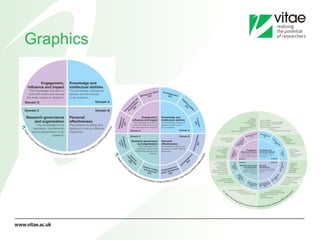
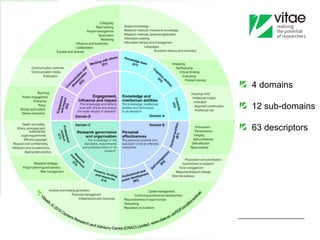
4 domains 12 sub-domains 63 descriptors
Researcher feedback ‘ It put career development  back into the forefront of my mind as it can often slip back when you’re engaged in what you’re doing day to day.’  ‘ The RDF will encourage me to be more proactive about my career development as it provides me with a framework (list of milestones).’ ‘ It was very good for me to reflect.  I realised that nothing is stopping me  but myself.  The sky is the limit.’  ‘ I’ve always thought of myself as being quite ambitious, driven and focussed on what I want, but the framework made me realise I can have a much larger vision.’
Links and resources RDF:  www.vitae.ac.uk/rdf   RDS:  www.vitae.ac.uk/rds   RDF profiles:  www.vitae.ac.uk/rdfprofiles   RDF professional development planner:  www.vitae.ac.uk/rdfplanner   Contact:  [email_address]
Development and validation Dr Julie Reeves
Development  The  Core  of RDF determined by profession  Semi-structured interviews with > 100 researchers Representative sample: range of experiences, institution types, geographical context, disciplines and demographics Phenomenographic method  Results: > 1000 characteristics and variants,  clustered   into common groups
Refinement & validation Core - refined and informed by Literature survey  Specialist groups Consultations  Feedback Validation End result = Sector Wide view
Interesting findings Personal effectiveness  not  disciplinary differences Passion and curiosity Not what you know, but what you do with it that counts -   ‘at some point everyone is an expert in the subject’ (Professor - Arts)  Opposite of a PGR? - broad focus, ‘thick skinned’, able to transcend discipline Underperformers (not in RDF):  overly-narrow focus, lack of confidence, career plan, ‘terror of rejection’, unable to balance demands of role, lack of deliverables
Unique features - USPs Lot of choice!  Core of RDF is what the profession identified as important  Richness, depth, flexibility ‘ Development framework’ - designed by researchers for researchers Shift from ‘training & skills’ to ‘development’ Reflects whole sector’s view - stands as  whole  piece
Information and resources www.vitae.ac.uk/rdf   Dr Emma Gillaspy
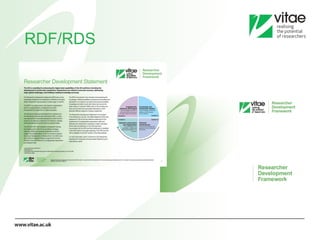
RDF/RDS
Project background Background to the project Consultation process  Project team members Advisory group members Research projects, literature reviews, methodology, presentation slides
Stakeholder groups Specific information for organisations and individuals about how the framework will be used. Policy makers and other stakeholders Staff in HEIs with a remit for researcher development Supervisors, principal investigators Researchers Employers
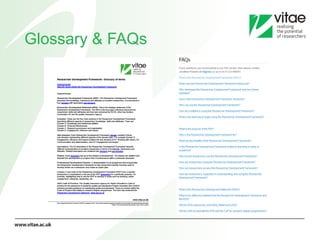
Glossary & FAQs
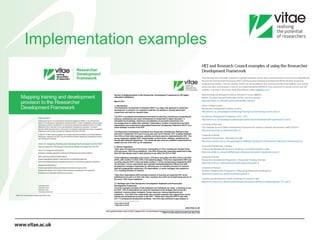
Implementation examples
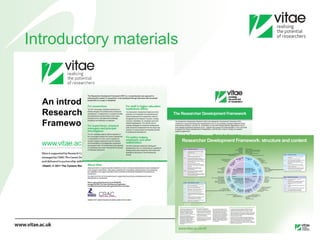
Introductory materials
Graphics
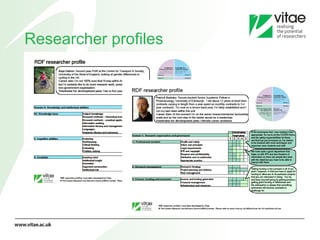
Researcher profiles
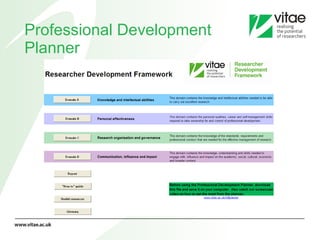
Professional Development Planner
Future developments Highlighting RDS release to HEI PVC and HR Vitae training resources updated to include mapping to the RDF Key messages leaflets for stakeholders More examples of RDF use by HEIs RDF background paper RDF lenses and associated methodology
Resources for researchers Examples of professional development planner including action plans Dedicated RDF webpages for researchers Professional development planning support Researcher employability guide highlighting how the skills that employers want can be mapped to the RDF
Image FlickrID:  姒儿喵喵

Implementing the Researcher Development Framework

  • 1.
    Implementing the ResearcherDevelopment Framework A joint Vitae NW & YNE Hub good practice workshop
  • 2.
    Programme 11:00-11:20 12:30-14:0016:00-17:00 Image FlickrID: University of Exeter Image FlickrID: mickeysucks Image FlickrID: .Imelda 10:00 About the Researcher Development Framework 11:20 What are the issues, challenges and opportunities in implementing the RDF? 11:50 & 14:00 Parallel discussion sessions 14:40 Finding solutions 15:50 Moving forward
  • 3.
    An introduction tothe Researcher Development Framework Dr Vivien Hodges Vitae®, © 2011 The Careers Research and Advisory Centre (CRAC) Limited
  • 4.
    Vitae vision andaims For the UK to be world-class in supporting the personal, professional and career development of researchers Build human capital by influencing the development and implementation of effective policy relating to researcher development Enhance higher education provision to train and develop researchers Empower researchers to make an impact in their careers Evidence the impact of professional and career development support for researchers
  • 5.
    Researcher development incontext The UK is committed to the development of world-class researchers. Researchers are critical to economic success Researchers’ careers span a wider variety of employment sectors Strong UK commitment to researcher development
  • 6.
    Researcher Development FrameworkThe professional development framework to realise the potential of researchers
  • 7.
    The RDF Majornew approach to researcher development Builds the UK research base Develops world-class researchers Enhances the personal, professional and career development of researchers Developed through UK-wide interviews with successful researchers in a range of disciplines Led by Vitae in collaboration with the HE sector and other stakeholders
  • 8.
    The RDF Frameworkof the knowledge, behaviour and attributes of successful researchers Enables self-assessment of strengths and areas for further development Common framework across institutions in the UK Universal language for communicating researcher capabilities
  • 9.
    The RDS The Researcher Development Statement (RDS) is the strategic statement of the RDF: for policy makers and research organisations endorsed by >30 stakeholders including the Research Councils, QAA and the funding councils an evolution of the Research Councils’ Joint Skills Statement (JSS) The RDS and RDF together provide: strategic statement (RDS) operational framework (RDF)
  • 10.
    Using the RDFand RDS Researchers: identify strengths and priorities for professional and career development Managers and supervisors of researchers fundamental to planning researcher development Staff supporting researchers in HEIs underpins strategies for researcher development Policy makers, employers and other stakeholders realising researchers’ potential for all sectors of the economy and society
  • 11.
    4 domains 12sub-domains 63 descriptors
  • 12.
    Researcher feedback ‘It put career development back into the forefront of my mind as it can often slip back when you’re engaged in what you’re doing day to day.’ ‘ The RDF will encourage me to be more proactive about my career development as it provides me with a framework (list of milestones).’ ‘ It was very good for me to reflect. I realised that nothing is stopping me but myself. The sky is the limit.’ ‘ I’ve always thought of myself as being quite ambitious, driven and focussed on what I want, but the framework made me realise I can have a much larger vision.’
  • 13.
    Links and resourcesRDF: www.vitae.ac.uk/rdf RDS: www.vitae.ac.uk/rds RDF profiles: www.vitae.ac.uk/rdfprofiles RDF professional development planner: www.vitae.ac.uk/rdfplanner Contact: [email_address]
  • 14.
  • 15.
    Development The Core of RDF determined by profession Semi-structured interviews with > 100 researchers Representative sample: range of experiences, institution types, geographical context, disciplines and demographics Phenomenographic method Results: > 1000 characteristics and variants, clustered into common groups
  • 16.
    Refinement & validationCore - refined and informed by Literature survey Specialist groups Consultations Feedback Validation End result = Sector Wide view
  • 17.
    Interesting findings Personaleffectiveness not disciplinary differences Passion and curiosity Not what you know, but what you do with it that counts - ‘at some point everyone is an expert in the subject’ (Professor - Arts) Opposite of a PGR? - broad focus, ‘thick skinned’, able to transcend discipline Underperformers (not in RDF): overly-narrow focus, lack of confidence, career plan, ‘terror of rejection’, unable to balance demands of role, lack of deliverables
  • 18.
    Unique features -USPs Lot of choice! Core of RDF is what the profession identified as important Richness, depth, flexibility ‘ Development framework’ - designed by researchers for researchers Shift from ‘training & skills’ to ‘development’ Reflects whole sector’s view - stands as whole piece
  • 19.
    Information and resourceswww.vitae.ac.uk/rdf Dr Emma Gillaspy
  • 20.
  • 21.
    Project background Backgroundto the project Consultation process Project team members Advisory group members Research projects, literature reviews, methodology, presentation slides
  • 22.
    Stakeholder groups Specificinformation for organisations and individuals about how the framework will be used. Policy makers and other stakeholders Staff in HEIs with a remit for researcher development Supervisors, principal investigators Researchers Employers
  • 23.
  • 24.
  • 25.
  • 26.
  • 27.
  • 28.
  • 29.
    Future developments HighlightingRDS release to HEI PVC and HR Vitae training resources updated to include mapping to the RDF Key messages leaflets for stakeholders More examples of RDF use by HEIs RDF background paper RDF lenses and associated methodology
  • 30.
    Resources for researchersExamples of professional development planner including action plans Dedicated RDF webpages for researchers Professional development planning support Researcher employability guide highlighting how the skills that employers want can be mapped to the RDF
  • 31.
    Image FlickrID: 姒儿喵喵

Editor's Notes

  • #16 Comes out of JSS and initiative of Policy Forum 2008 Precursor projects at Glasgow Caledonia and Manchester Universities Empirical data from analysis of semi-structured interviews with > 100 experienced researchers Phenomenographic method – Gerlese Akerlind – Individuals experience the same phenonemena differently – we only have a partial perspective – such as being a researcher. But if we obtain sufficient perspectives we may get an idea about the whole. Not pre-defined, but by contrasting the data looking for the similarities and differences in what people have to say about a phenonemena. For us, this approach resulted in over 1,000 characteristics and variants being identified: – For example: a number of people said it was important to be able to analyse data as a researcher we noted that as a characteristic, but a few also said it was important to be able to analyse other peoples data not just your own, so we noted that as a variant. The resulting information was organised and re-organised (or clustered) into areas that seemed most appropriate. Much debate over this and the order of things. The project started with 9 main areas and, after much discussion and deliberation, finished with 4. Much debate over ‘clusters’ and ‘order’
  • #17 What wasn’t mentioned – specialist groups came into their own. What wasn’t mentioned – equally noticeable Enterprise, Collaboration & teamwork, Public engagement, Income generation as opposed to grant applications Global perspective, New technologies and research areas, Ethics, health & safety Enterprise – not even mentioned as a characteristic: be interesting to run survey in 10 years time. Collaboration and teamwork - Teamwork - no mention of this although managing individual relationships was viewed as significant by the interviewees. The use of new technology to promote research presence. Internationalism = absent. We drew on the sector and a range of stakeholders to help plug the gaps and give us their perspective. RCUK, Beacons for PE, RIN, careers – employers at the end. Consultation – Sept 2010 Feedback from individuals and project group and advisory group. Expert panel – who validated the RDF. Some given the whole RDF others a Domain - interviewed closely about. Minor tweaks – but all could identify themselves in it. Sector wide view = extremely powerful. Not just what an individual supervisor or PI says is important for a research career – but what the sector says is – based on the professions’ view. May not all be relevant at any one time – but it probably will be relevant in one way or another over time
  • #18 Key characteristics include: Having a passion for and curiosity for research area – Use knowledge innovatively and imaginatively Disciplinary differences were neither marked nor significant IN the Research – RDF drawing them out. Outstanding people keep on trying - they don’t give up, they deal with rejection and keep applying, submitting etc. Able to make links within and beyond academia to non-academic, PERSEVRE The characteristics of an outstanding performer appear to be the opposite of those associated with a PGR - i.e. broad range of intellectual focus, interdisciplinary NOT IN RDF - Underperformers – unable to apply knowledge in innovative way, possess an overly narrow focus, ‘terror of rejection’, lack confidence, lack a coherent career plan – never complete things, always talking about them but not actually bringing them to fruition, unable to balance teaching, research and admin etc. Two kinds of researchers linked – but it is not about knowledge per se rather how it is used.
  • #19 JSS was one dimensional – this is 3D. Richness, depth, flexibility. Assist individuals, at all stages, with their professional development – i.e. from new researchers to those with Global renown Development framework: knowledge, behaviours and attitudes appropriate for the profession Ethics, integrity, academic writing & publications, enthusiasm, self–confidence and perseverance. Passion and drive not so critical if you are a dentist Shift from ‘training and skills’ to ‘development’ and implies a shift from ‘measuring’ to ‘evidencing’ (personal view) Challenges: Large and scary! Prone to the pitfalls of ‘Perception’ ‘ data’, ‘ethics’, ‘experiment’ Resist the temptation of ‘Phasing’ Can’t measure enthusiasm or creativity Only useful if you want to stay in academia… Audience – who is it for? different perspectives emerge from stakeholders with different purposes for RDF