Using the RDF to Develop
Postgraduate Information Literacy

 Sheila Corrall, Stéphane Goldstein
   Members of the RIN Working
   Group on Information Handling
  www.rin.ac.uk/info-handling-training
Intended Outcomes


By the end of the workshop participants will have:
  gained an understanding of the purpose and content of
   the Researcher Development Framework (RDF)
   and the Researcher Development Statement (RDS)
  reflected on how the RDF can be used to support and
   contextualise information literacy training and
   development for research students and staff
  discussed specific methods and tools that could be
   used to develop key information literacy competencies
  considered ways of promoting good practice in
   information training and development for researchers
Workshop Overview


                    The RIN working group and
                     its partnership approach
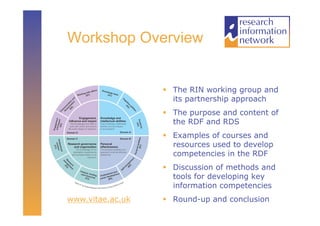
                    The purpose and content of
                     the RDF and RDS
                    Examples of courses and
                     resources used to develop
                     competencies in the RDF
                    Discussion of methods and
                     tools for developing key
                     information competencies
www.vitae.ac.uk     Round-up and conclusion
About the Working Group


  A new advocacy group formed in 2009 as a
   result of the RIN Mind the Skills Gap report
  A coalition of partners representing academic,
   research and library/information domains
       e.g. BAILER, BL, CILIP, DCC, HEA, Info Lit Website,
        JISC, JORUM, SCONUL, RLUK, UKCGE, UUK, Vitae
  A collective interlocutor and change agent
       raising awareness, responding to strategic issues,
        investigating concerns, promoting good practice
  A champion for information and data literacy
A Partnership Approach
with Vitae and SCONUL

  Providing expert advice to Vitae on the information
   handling and data management content of the RDF
  Mapping the RDF competency descriptors against the
   headline skills of the SCONUL Seven Pillars Model to
   develop an information literacy lens for the RDF
  Collating examples of good practice in information-
   related training for the Vitae Database of Practice
  Sponsoring work on a practical guidance booklet for
   Vitae to raise awareness and understanding of the
   information elements of the RDF among researchers
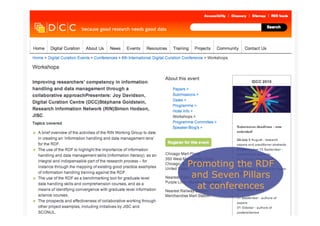
  Promoting the RDF and Seven Pillars at conferences
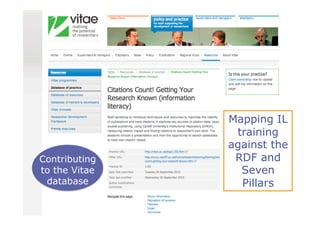
Mapping IL
                training
               against the
Contributing    RDF and
to the Vitae     Seven
 database        Pillars
Promoting the RDF
 and Seven Pillars
  at conferences
Introducing the Researcher
  Development Framework and
Researcher Development Statement

  Domains, Sub-domains, Key Descriptors
    Knowledge, Behaviours, Attitudes
  Phased descriptions/Strategic summary
Background to the RDF


  Launched in 2010 by Vitae (formerly UKGrad)
      agency supporting the personal, professional and
       career development of research students and staff
  A comprehensive competency framework
      covers knowledge, skills, behaviours and attitudes
       needed by researchers over their whole career
  Replaces RCUK (2001) Joint Skills Statement
      former benchmark for doctoral students with limited
       poorly-presented coverage of information literacy
      a two-way mapping of the RDF and JSS is available
       on the Vitae website (see www.vitae.ac.uk/rdf)
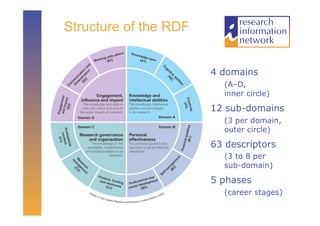
Structure of the RDF


                       4 domains
                         (A–D,
                         inner circle)

                       12 sub-domains
                         (3 per domain,
                         outer circle)

                       63 descriptors
                         (3 to 8 per
                         sub-domain)

                       5 phases
                         (career stages)
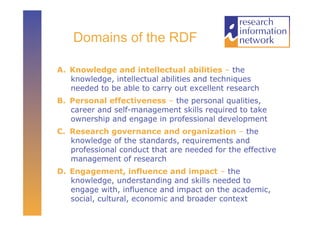
Domains of the RDF

A.  Knowledge and intellectual abilities – the
    knowledge, intellectual abilities and techniques
    needed to be able to carry out excellent research
B.  Personal effectiveness – the personal qualities,
    career and self-management skills required to take
    ownership and engage in professional development
C.  Research governance and organization – the
    knowledge of the standards, requirements and
    professional conduct that are needed for the effective
    management of research
D.  Engagement, influence and impact – the
    knowledge, understanding and skills needed to
    engage with, influence and impact on the academic,
    social, cultural, economic and broader context
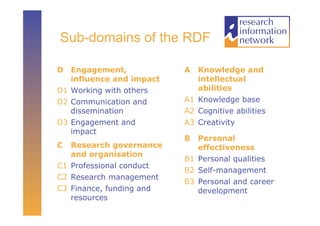
Sub-domains of the RDF

D Engagement,             A  Knowledge and
   influence and impact      intellectual
D1 Working with others       abilities
D2 Communication and      A1 Knowledge base
   dissemination          A2 Cognitive abilities
D3 Engagement and         A3 Creativity
   impact
                          B  Personal
C  Research governance       effectiveness
   and organisation
                          B1 Personal qualities
C1 Professional conduct
                          B2 Self-management
C2 Research management
                          B3 Personal and career
C3 Finance, funding and      development
   resources
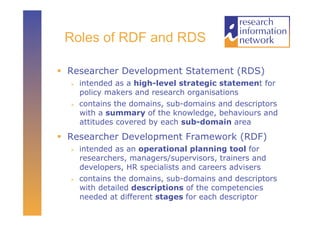
Roles of RDF and RDS

  Researcher Development Statement (RDS)
      intended as a high-level strategic statement for
       policy makers and research organisations
      contains the domains, sub-domains and descriptors
       with a summary of the knowledge, behaviours and
       attitudes covered by each sub-domain area

  Researcher Development Framework (RDF)
      intended as an operational planning tool for
       researchers, managers/supervisors, trainers and
       developers, HR specialists and careers advisers
      contains the domains, sub-domains and descriptors
       with detailed descriptions of the competencies
       needed at different stages for each descriptor
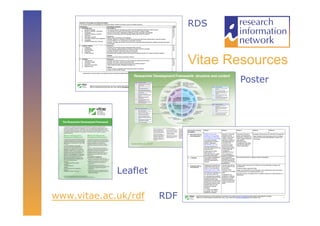
RDS


                             Vitae Resources
                                    Poster


             Leaflet

www.vitae.ac.uk/rdf    RDF
Locating Information Literacy in the
  the Researcher Development
            Framework

    Mapping the RDF to the Seven Pillars
   Key Descriptors, Related Competencies
     Relevant Courses and Resources
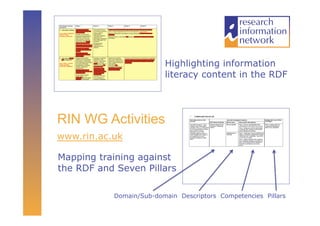
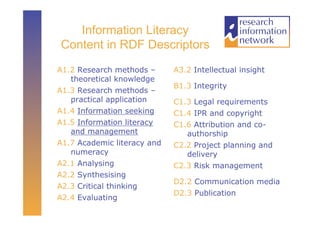
Highlighting information
                         literacy content in the RDF


RIN WG Activities
www.rin.ac.uk

Mapping training against
the RDF and Seven Pillars

           Domain/Sub-domain Descriptors Competencies Pillars
Information Literacy
Content in RDF Descriptors
A1.2 Research methods –      A3.2 Intellectual insight
   theoretical knowledge
                             B1.3 Integrity
A1.3 Research methods –
   practical application     C1.3 Legal requirements
A1.4 Information seeking     C1.4 IPR and copyright
A1.5 Information literacy    C1.6 Attribution and co-
   and management               authorship
A1.7 Academic literacy and   C2.2 Project planning and
   numeracy                     delivery
A2.1 Analysing               C2.3 Risk management
A2.2 Synthesising
                             D2.2 Communication media
A2.3 Critical thinking
                             D2.3 Publication
A2.4 Evaluating
Information Literacy Content
    in RDF Competencies
D Engagement, influence and impact
D2 Communication and dissemination
D2.3 Publication
Phase 1
     Is developing awareness of the range and diversity of

      outlets for publications.
Phase 2
     Disseminates in a range of research, professional and

      public outlets.
Phase 3
     Aims for the most prestigious publication in academic and

      non-academic outlets.
Phase 4
     Targets right journals/outlets to gain an ‘extensive track

      record of high quality published research’.
Courses and Resources
 for RDF Competencies
  Citations count! Getting your research known
  Workshop, Cardiff University – Pillars 4, 5 and 6;
   Descriptors A1.4, A2.4, C1.4, C1.6, D2.3
  Copy right, not copycat! Good academic
   practice when writing your thesis
  Course, Loughborough University – Pillar 6;
    Descriptors B1.3, C1.4, C1.6
  E-thesis: Advice and resources about the
   submission of electronic theses
  Training unit, University of Southampton – Pillar 6;
    Descriptors B1.3, C1.4, C1.6, D2.3
  Pathway 2 information [OPAC features]
  Interactive online tutorial, University of Nottingham –
    Pillars, 2, 3 and 4; Descriptor A1.4
Methods and Tools for
 Developing Competencies


Bite-sized training to develop RDF competencies
  Review the competencies presented in the handout
  Select one or more where you think IL practitioners
   could contribute to researcher development
  Drawing on experience within your workshop group,
   discuss strategies for developing the competencies
      do you have any existing courses or resources that

       could be used or adapted to meet these needs?
      are you willing to offer your material to RIN for

       deposit with JORUM or in the Vitae database?
  Record your proposals and offers on flipchart paper

Corrall & Goldstein - Using the Researcher Development Framework to Develop Postgraduate Information Literacy

  • 1.
    Using the RDFto Develop Postgraduate Information Literacy Sheila Corrall, Stéphane Goldstein Members of the RIN Working Group on Information Handling www.rin.ac.uk/info-handling-training
  • 2.
    Intended Outcomes By theend of the workshop participants will have:   gained an understanding of the purpose and content of the Researcher Development Framework (RDF) and the Researcher Development Statement (RDS)   reflected on how the RDF can be used to support and contextualise information literacy training and development for research students and staff   discussed specific methods and tools that could be used to develop key information literacy competencies   considered ways of promoting good practice in information training and development for researchers
  • 3.
    Workshop Overview   The RIN working group and its partnership approach   The purpose and content of the RDF and RDS   Examples of courses and resources used to develop competencies in the RDF   Discussion of methods and tools for developing key information competencies www.vitae.ac.uk   Round-up and conclusion
  • 4.
    About the WorkingGroup   A new advocacy group formed in 2009 as a result of the RIN Mind the Skills Gap report   A coalition of partners representing academic, research and library/information domains   e.g. BAILER, BL, CILIP, DCC, HEA, Info Lit Website, JISC, JORUM, SCONUL, RLUK, UKCGE, UUK, Vitae   A collective interlocutor and change agent   raising awareness, responding to strategic issues, investigating concerns, promoting good practice   A champion for information and data literacy
  • 5.
    A Partnership Approach withVitae and SCONUL   Providing expert advice to Vitae on the information handling and data management content of the RDF   Mapping the RDF competency descriptors against the headline skills of the SCONUL Seven Pillars Model to develop an information literacy lens for the RDF   Collating examples of good practice in information- related training for the Vitae Database of Practice   Sponsoring work on a practical guidance booklet for Vitae to raise awareness and understanding of the information elements of the RDF among researchers   Promoting the RDF and Seven Pillars at conferences
  • 6.
    Mapping IL training against the Contributing RDF and to the Vitae Seven database Pillars
  • 7.
    Promoting the RDF and Seven Pillars at conferences
  • 8.
    Introducing the Researcher Development Framework and Researcher Development Statement Domains, Sub-domains, Key Descriptors Knowledge, Behaviours, Attitudes Phased descriptions/Strategic summary
  • 9.
    Background to theRDF   Launched in 2010 by Vitae (formerly UKGrad)   agency supporting the personal, professional and career development of research students and staff   A comprehensive competency framework   covers knowledge, skills, behaviours and attitudes needed by researchers over their whole career   Replaces RCUK (2001) Joint Skills Statement   former benchmark for doctoral students with limited poorly-presented coverage of information literacy   a two-way mapping of the RDF and JSS is available on the Vitae website (see www.vitae.ac.uk/rdf)
  • 10.
    Structure of theRDF 4 domains (A–D, inner circle) 12 sub-domains (3 per domain, outer circle) 63 descriptors (3 to 8 per sub-domain) 5 phases (career stages)
  • 11.
    Domains of theRDF A.  Knowledge and intellectual abilities – the knowledge, intellectual abilities and techniques needed to be able to carry out excellent research B.  Personal effectiveness – the personal qualities, career and self-management skills required to take ownership and engage in professional development C.  Research governance and organization – the knowledge of the standards, requirements and professional conduct that are needed for the effective management of research D.  Engagement, influence and impact – the knowledge, understanding and skills needed to engage with, influence and impact on the academic, social, cultural, economic and broader context
  • 12.
    Sub-domains of theRDF D Engagement, A Knowledge and influence and impact intellectual D1 Working with others abilities D2 Communication and A1 Knowledge base dissemination A2 Cognitive abilities D3 Engagement and A3 Creativity impact B Personal C Research governance effectiveness and organisation B1 Personal qualities C1 Professional conduct B2 Self-management C2 Research management B3 Personal and career C3 Finance, funding and development resources
  • 13.
    Roles of RDFand RDS   Researcher Development Statement (RDS)   intended as a high-level strategic statement for policy makers and research organisations   contains the domains, sub-domains and descriptors with a summary of the knowledge, behaviours and attitudes covered by each sub-domain area   Researcher Development Framework (RDF)   intended as an operational planning tool for researchers, managers/supervisors, trainers and developers, HR specialists and careers advisers   contains the domains, sub-domains and descriptors with detailed descriptions of the competencies needed at different stages for each descriptor
  • 14.
    RDS Vitae Resources Poster Leaflet www.vitae.ac.uk/rdf RDF
  • 15.
    Locating Information Literacyin the the Researcher Development Framework Mapping the RDF to the Seven Pillars Key Descriptors, Related Competencies Relevant Courses and Resources
  • 16.
    Highlighting information literacy content in the RDF RIN WG Activities www.rin.ac.uk Mapping training against the RDF and Seven Pillars Domain/Sub-domain Descriptors Competencies Pillars
  • 17.
    Information Literacy Content inRDF Descriptors A1.2 Research methods – A3.2 Intellectual insight theoretical knowledge B1.3 Integrity A1.3 Research methods – practical application C1.3 Legal requirements A1.4 Information seeking C1.4 IPR and copyright A1.5 Information literacy C1.6 Attribution and co- and management authorship A1.7 Academic literacy and C2.2 Project planning and numeracy delivery A2.1 Analysing C2.3 Risk management A2.2 Synthesising D2.2 Communication media A2.3 Critical thinking D2.3 Publication A2.4 Evaluating
  • 18.
    Information Literacy Content in RDF Competencies D Engagement, influence and impact D2 Communication and dissemination D2.3 Publication Phase 1   Is developing awareness of the range and diversity of outlets for publications. Phase 2   Disseminates in a range of research, professional and public outlets. Phase 3   Aims for the most prestigious publication in academic and non-academic outlets. Phase 4   Targets right journals/outlets to gain an ‘extensive track record of high quality published research’.
  • 19.
    Courses and Resources for RDF Competencies   Citations count! Getting your research known Workshop, Cardiff University – Pillars 4, 5 and 6; Descriptors A1.4, A2.4, C1.4, C1.6, D2.3   Copy right, not copycat! Good academic practice when writing your thesis Course, Loughborough University – Pillar 6; Descriptors B1.3, C1.4, C1.6   E-thesis: Advice and resources about the submission of electronic theses Training unit, University of Southampton – Pillar 6; Descriptors B1.3, C1.4, C1.6, D2.3   Pathway 2 information [OPAC features] Interactive online tutorial, University of Nottingham – Pillars, 2, 3 and 4; Descriptor A1.4
  • 20.
    Methods and Toolsfor Developing Competencies Bite-sized training to develop RDF competencies   Review the competencies presented in the handout   Select one or more where you think IL practitioners could contribute to researcher development   Drawing on experience within your workshop group, discuss strategies for developing the competencies   do you have any existing courses or resources that could be used or adapted to meet these needs?   are you willing to offer your material to RIN for deposit with JORUM or in the Vitae database?   Record your proposals and offers on flipchart paper