
SIR G


          Research
        Rationalization
RESEARCH - DERIVED FROM THE French word “cerchier”
  meaning to seek or search
 Con - trolled

 Crit - ical

 Em - pirical

 Sy - stematic

investigation of a hypothetical proposition related to natural
  phenomenon.
 Must be conducted to affirm or deny a hypothesis

 PHENOMENON – anything that affects human lifeEx.
  disease, signs & symptoms, procedures,
 HYPOTHESIS – educated guess, scientific guess, tentative
  statement of a supposed answer.
Ex. Not known yet if true of false, right or wrong
Nagel, 1961. - Basic research (or pure research)

                  “knowledge for knowledge’s sake”
Wysocki, 1983 - basic research is to generate and
                   refine theory.
Abdellah & Levine, 1979 - Applied research (or
  practical research) generate knowledge that will
  directly influence or improve clinical practice .
Purpose
Ma - ke decisions
So - lve problems
Pre - dict or control outcomes in real-life practice
  situations.
Purpose of Nursing Research
GENERAL – to develop new knowledge and technology to improve the practice of
  nursing and the provision of services for the attainment of health for the people
   ULTIMATE GOAL – to improve quality of life 
   Specific Purposes of Nursing Research
   EXPLORE
    to obtain richer familiarity with the phenomenon
   DESCRIBE
          to obtain complete and accurate information about a phenomenon
   EXPLAIN
         to provide conceptual analysis grounded in observation or human
    behavior
   EXPERIMENT
          to test hypothesis about relationships
   TEST
          to determine responses to a proposed method, procedure, product
   PREDICT
          to estimate the probability of a specific outcome
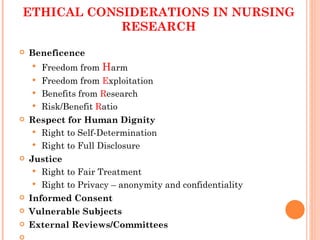
ETHICAL CONSIDERATIONS IN NURSING
            RESEARCH
   Beneficence
      Freedom from Harm
      Freedom from Exploitation
      Benefits from Research
      Risk/Benefit Ratio
   Respect for Human Dignity
      Right to Self-Determination
      Right to Full Disclosure
   Justice
      Right to Fair Treatment
      Right to Privacy – anonymity and confidentiality
   Informed Consent
   Vulnerable Subjects
   External Reviews/Committees

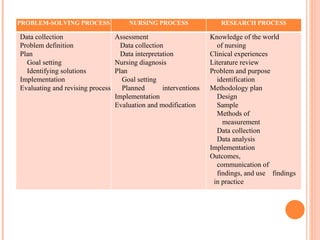
PROBLEM-SOLVING PROCESS              NURSING PROCESS                RESEARCH PROCESS

Data collection                 Assessment                       Knowledge of the world
Problem definition                Data collection                  of nursing
Plan                              Data interpretation            Clinical experiences
  Goal setting                  Nursing diagnosis                Literature review
  Identifying solutions         Plan                             Problem and purpose
Implementation                    Goal setting                     identification
Evaluating and revising process   Planned        interventions   Methodology plan
                                Implementation                     Design
                                Evaluation and modification        Sample
                                                                   Methods of
                                                                     measurement
                                                                   Data collection
                                                                   Data analysis
                                                                 Implementation
                                                                 Outcomes,
                                                                   communication of
                                                                   findings, and use findings
                                                                  in practice
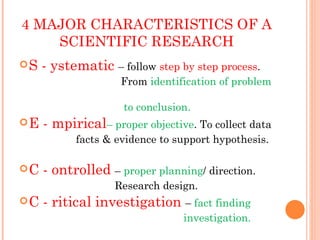
4 MAJOR CHARACTERISTICS OF A
    SCIENTIFIC RESEARCH
S   - ystematic – follow step by step process.
                    From identification of problem

                    to conclusion.
E   - mpirical– proper objective. To collect data
           facts & evidence to support hypothesis.

C   - ontrolled – proper planning/ direction.
                   Research design.
C   - ritical investigation – fact finding
                                investigation.
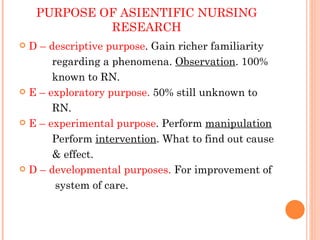
PURPOSE OF ASIENTIFIC NURSING
             RESEARCH
 D – descriptive purpose. Gain richer familiarity
       regarding a phenomena. Observation. 100%
       known to RN.
 E – exploratory purpose. 50% still unknown to

       RN.
 E – experimental purpose. Perform manipulation

       Perform intervention. What to find out cause
       & effect.
 D – developmental purposes. For improvement of

        system of care.
F NIGHTINGALE

    Birthplace.   Italy

    Training ground:   Germany
   Greatest contribution: environmental
    theory & training of RNs in Crimean
    War

    School: St.   Thomas School of
                   Nursing
 
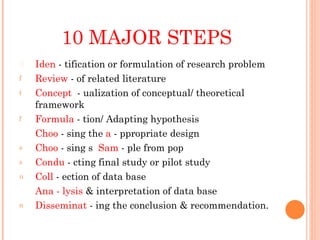
10 MAJOR STEPS
    Iden - tification or formulation of research problem
f   Review - of related literature
t   Concept - ualization of conceptual/ theoretical
    framework
f   Formula - tion/ Adapting hypothesis
    Choo - sing the a - ppropriate design
s   Choo - sing s Sam - ple from pop
s   Condu - cting final study or pilot study
u   Coll - ection of data base
    Ana - lysis & interpretation of data base
n   Disseminat - ing the conclusion & recommendation.
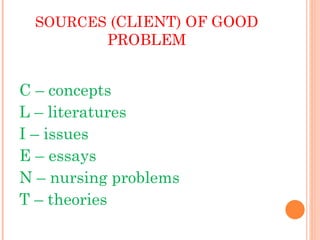
SOURCES (CLIENT) OF GOOD
          PROBLEM


C – concepts
L – literatures
I – issues
E – essays
N – nursing problems
T – theories
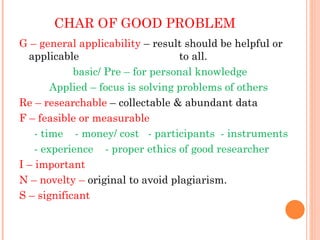
CHAR OF GOOD PROBLEM
G – general applicability – result should be helpful or
  applicable                       to all.
            basic/ Pre – for personal knowledge
        Applied – focus is solving problems of others
Re – researchable – collectable & abundant data
F – feasible or measurable
    - time - money/ cost - participants - instruments
    - experience - proper ethics of good researcher
I – important
N – novelty – original to avoid plagiarism.
S – significant
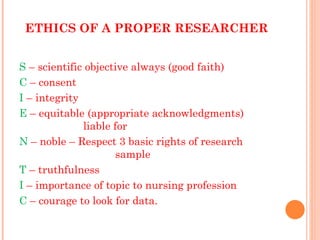
ETHICS OF A PROPER RESEARCHER


S – scientific objective always (good faith)
C – consent
I – integrity
E – equitable (appropriate acknowledgments)
              liable for
N – noble – Respect 3 basic rights of research
                     sample
T – truthfulness
I – importance of topic to nursing profession
C – courage to look for data.
 Legal owner of chart: Hospital
 Legal owner of data in the chart: Patient

 Plagiarism – illegal replication: no consent &
  acknowledge
3 rights of sample/ pt
 Right not to be harmed
 Right to self determination – get consent & right to
  withdraw consent
 Right to privacy

   anonymity – privacy of identity of informant
   confidentiality – name given but privacy of info/ data
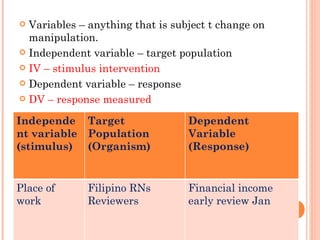
  Variables – anything that is subject t change on
   manipulation.
  Independent variable – target population

  IV – stimulus intervention

  Dependent variable – response

  DV – response measured

  
Independe Target                   Dependent
nt variable Population             Variable
(stimulus) (Organism)              (Response)
                                    

Place of      Filipino RNs         Financial income
work          Reviewers            early review Jan
Review of related literature
 Purpose: for proper formulation of conceptual &
  theoretical framework. 
 Theory – relationship bet concepts

 Conceptual framework. Illustration showing
  relationship between variables
 Paradigm- diagrammatic presentation / illustration of
  conceptual framework.
 Source of review literature

    Conceptual Sources – authors & conceptualists
     ( DOH book, Lippincott, Mosbys)for general use, can
    be sold. 2.   Research sources – researchers cant be sold.

Rationalize research

  • 1.
    SIR G Research Rationalization
  • 2.
    RESEARCH - DERIVEDFROM THE French word “cerchier” meaning to seek or search  Con - trolled  Crit - ical  Em - pirical  Sy - stematic investigation of a hypothetical proposition related to natural phenomenon.  Must be conducted to affirm or deny a hypothesis  PHENOMENON – anything that affects human lifeEx. disease, signs & symptoms, procedures,  HYPOTHESIS – educated guess, scientific guess, tentative statement of a supposed answer. Ex. Not known yet if true of false, right or wrong
  • 3.
    Nagel, 1961. -Basic research (or pure research) “knowledge for knowledge’s sake” Wysocki, 1983 - basic research is to generate and refine theory. Abdellah & Levine, 1979 - Applied research (or practical research) generate knowledge that will directly influence or improve clinical practice . Purpose Ma - ke decisions So - lve problems Pre - dict or control outcomes in real-life practice situations.
  • 4.
    Purpose of NursingResearch GENERAL – to develop new knowledge and technology to improve the practice of nursing and the provision of services for the attainment of health for the people  ULTIMATE GOAL – to improve quality of life   Specific Purposes of Nursing Research  EXPLORE to obtain richer familiarity with the phenomenon  DESCRIBE  to obtain complete and accurate information about a phenomenon  EXPLAIN  to provide conceptual analysis grounded in observation or human behavior  EXPERIMENT  to test hypothesis about relationships  TEST  to determine responses to a proposed method, procedure, product  PREDICT  to estimate the probability of a specific outcome
  • 5.
    ETHICAL CONSIDERATIONS INNURSING RESEARCH  Beneficence  Freedom from Harm  Freedom from Exploitation  Benefits from Research  Risk/Benefit Ratio  Respect for Human Dignity  Right to Self-Determination  Right to Full Disclosure  Justice  Right to Fair Treatment  Right to Privacy – anonymity and confidentiality  Informed Consent  Vulnerable Subjects  External Reviews/Committees 
  • 6.
    PROBLEM-SOLVING PROCESS NURSING PROCESS RESEARCH PROCESS Data collection Assessment Knowledge of the world Problem definition Data collection of nursing Plan Data interpretation Clinical experiences Goal setting Nursing diagnosis Literature review Identifying solutions Plan Problem and purpose Implementation Goal setting identification Evaluating and revising process Planned interventions Methodology plan Implementation Design Evaluation and modification Sample Methods of measurement Data collection Data analysis Implementation Outcomes, communication of findings, and use findings in practice
  • 7.
    4 MAJOR CHARACTERISTICSOF A SCIENTIFIC RESEARCH S - ystematic – follow step by step process. From identification of problem to conclusion. E - mpirical– proper objective. To collect data facts & evidence to support hypothesis. C - ontrolled – proper planning/ direction. Research design. C - ritical investigation – fact finding investigation.
  • 8.
    PURPOSE OF ASIENTIFICNURSING RESEARCH  D – descriptive purpose. Gain richer familiarity regarding a phenomena. Observation. 100% known to RN.  E – exploratory purpose. 50% still unknown to RN.  E – experimental purpose. Perform manipulation Perform intervention. What to find out cause & effect.  D – developmental purposes. For improvement of system of care.
  • 9.
    F NIGHTINGALE  Birthplace. Italy  Training ground: Germany  Greatest contribution: environmental theory & training of RNs in Crimean War  School: St. Thomas School of Nursing  
  • 10.
    10 MAJOR STEPS Iden - tification or formulation of research problem f Review - of related literature t Concept - ualization of conceptual/ theoretical framework f Formula - tion/ Adapting hypothesis Choo - sing the a - ppropriate design s Choo - sing s Sam - ple from pop s Condu - cting final study or pilot study u Coll - ection of data base Ana - lysis & interpretation of data base n Disseminat - ing the conclusion & recommendation.
  • 11.
    SOURCES (CLIENT) OFGOOD PROBLEM C – concepts L – literatures I – issues E – essays N – nursing problems T – theories
  • 12.
    CHAR OF GOODPROBLEM G – general applicability – result should be helpful or applicable to all. basic/ Pre – for personal knowledge Applied – focus is solving problems of others Re – researchable – collectable & abundant data F – feasible or measurable - time - money/ cost - participants - instruments - experience - proper ethics of good researcher I – important N – novelty – original to avoid plagiarism. S – significant
  • 13.
    ETHICS OF APROPER RESEARCHER S – scientific objective always (good faith) C – consent I – integrity E – equitable (appropriate acknowledgments) liable for N – noble – Respect 3 basic rights of research sample T – truthfulness I – importance of topic to nursing profession C – courage to look for data.
  • 14.
     Legal ownerof chart: Hospital  Legal owner of data in the chart: Patient  Plagiarism – illegal replication: no consent & acknowledge 3 rights of sample/ pt  Right not to be harmed  Right to self determination – get consent & right to withdraw consent  Right to privacy  anonymity – privacy of identity of informant  confidentiality – name given but privacy of info/ data
  • 15.
     Variables– anything that is subject t change on manipulation.  Independent variable – target population  IV – stimulus intervention  Dependent variable – response  DV – response measured   Independe Target Dependent nt variable Population Variable (stimulus) (Organism) (Response)   Place of Filipino RNs Financial income work Reviewers early review Jan
  • 16.
    Review of relatedliterature  Purpose: for proper formulation of conceptual & theoretical framework.   Theory – relationship bet concepts  Conceptual framework. Illustration showing relationship between variables  Paradigm- diagrammatic presentation / illustration of conceptual framework.  Source of review literature  Conceptual Sources – authors & conceptualists ( DOH book, Lippincott, Mosbys)for general use, can be sold. 2. Research sources – researchers cant be sold.