IMPACTION OF MANDIBULAR THIRD
MOLAR & IT’S MANAGEMENT
SUBMITTED BY;
LEKSHMI S AJIT
ROLL NO:11
FINAL
YEAR PART I
CONTENTS
• INTRODUCTION
• THEORIES OF IMPACTION
• AETIOLOGY OF IMPACTION
• INDICATIONS FOR REMOVAL
• CONTRAINDICATIONS FOR REMOVAL
• CLASSIFICATION
• CLINICAL EVALUATION
• RADIOLOGICAL ASSESSMENT
• SURGICAL REMOVAL
• OTHER TECHNIQUES IN MANDIBULAR 3RD
MOLAR REMOVAL
• CONCLUSION
• REFERENCE
INTRODUCTION
• Impacted tooth is a tooth which is completely or partially unerupted ,
is positioned against another tooth , bone or soft tissues so that its
further eruption is unlikely & described according to its anatomic
position.
• Teeth become impacted mainly due to inadequate dental arch
length & space in which to erupt.
• Third molars are most frequently impacted as they are the last teeth
to erupt
THEORIES OF IMPACTION
• ORTHODONTIC THEORY
growth of the jaw & the movement of teeth occurs in forward direction , anything
that interferes with such movement will cause an impaction.
• NODINE’S PHYLOGENIC THEORY
Elimination of unused tooth which causes congenital absence of third molars.
• MENDELIAN THEORY
Inherits small jaws from one parent & a complement of large teeth from other i.e,
small mandible with impaction of 2nd
& 3rd
molars.
• PATHOLOGICAL THEORY
Osteosclerosis of third molar area bring condensation of osseous
tissue further preventing growth and development of jaws.
• ENDOCRINAL THEORY
An imbalance of endocrine activity leads to lack of growth of jaws.
• NATURE AND NURTURE THEORY
A.J Mac Gregor explains that impaction can occur due to a
mismatch in size and shape of teeth and jaws.
AETIOLOGY OF IMPACTION
LOCAL CAUSES
1. Irregularity in position and pressure of adjacent tooth.
2. Density of overlying or surrounding bone.
3. Arch length and tooth size discrepancy
4. Dilaceration
5. Over retained deciduous teeth
6. Ectopic position of tooth bud
7. Localised chronic inflammation
SYSTEMIC CAUSES
1. Prenatal causes : heredity
2. Postnatal causes : rickets, anemia, tuberculosis,
malnutrition, congenital syphilis , endocrine dysfunctions.
3. Rare conditions: progeria, cleft palate ,osteopetrosis ,
oxycephaly
INDICATIONS FOR REMOVAL
 Infections
 Periodontal diseases
 Dentigerous cyst formation
 External resorption of 2nd
molar
 Buccoverted impacted molars
 Prophylactic removal
 Atypical pain
 Fracture of mandible in 3rd
molar region
CONTRAINDIACTIONS FOR REMOVAL
• Medical history
• Deeply impacted third molars in patients with no history of
any bony pathology to avoid damage to vital structures
• Partially erupted tooth which can be used as an abutment in
FPD
• Impacted teeth which are likely to erupt successfully.
CLASSIFICATION
A) BASED ON NATURE OF OVERLYING BONE
• Soft tissue impaction: presence of dense fibrous tissues
overlying the teeth prevents normal eruption.
• Hard tissue impaction: teeth fail to erupt due to obstruction
caused by overlying bone.
WINTER’S CLASSIFICATION
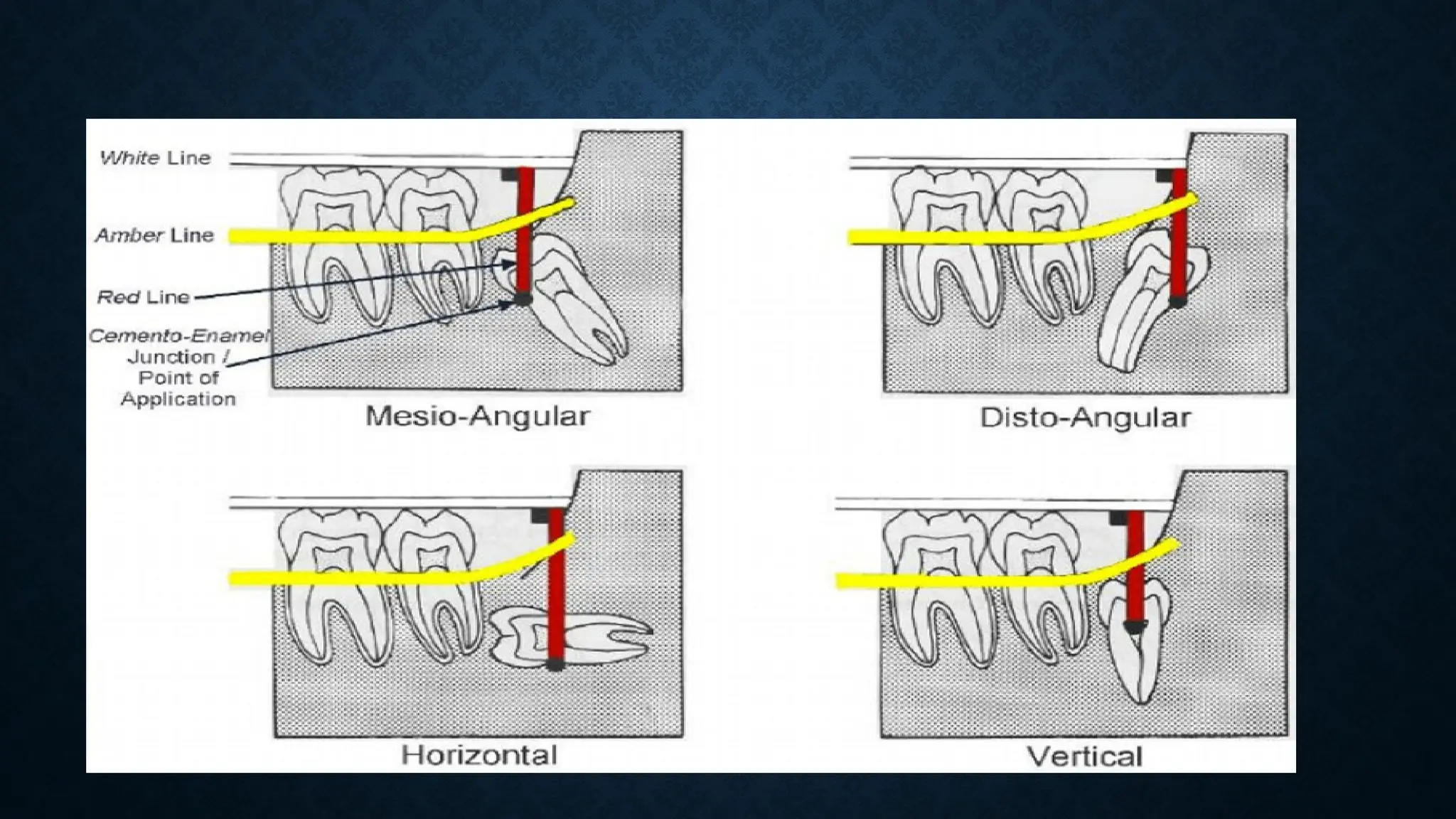
• Mesioangular :
• long axis of 3rd
molar bisects long axis of 2nd
molar
• Distoangular :
• long axis of 3rd
molar away from long axis of 2nd
molar
• Horizontal :
• long axis of 3rd
molar bisect long axis of 2nd
molar at right
angle
• Vertical :
• long axis of 3rd
molar runs parallel to long axis of 2nd
molar
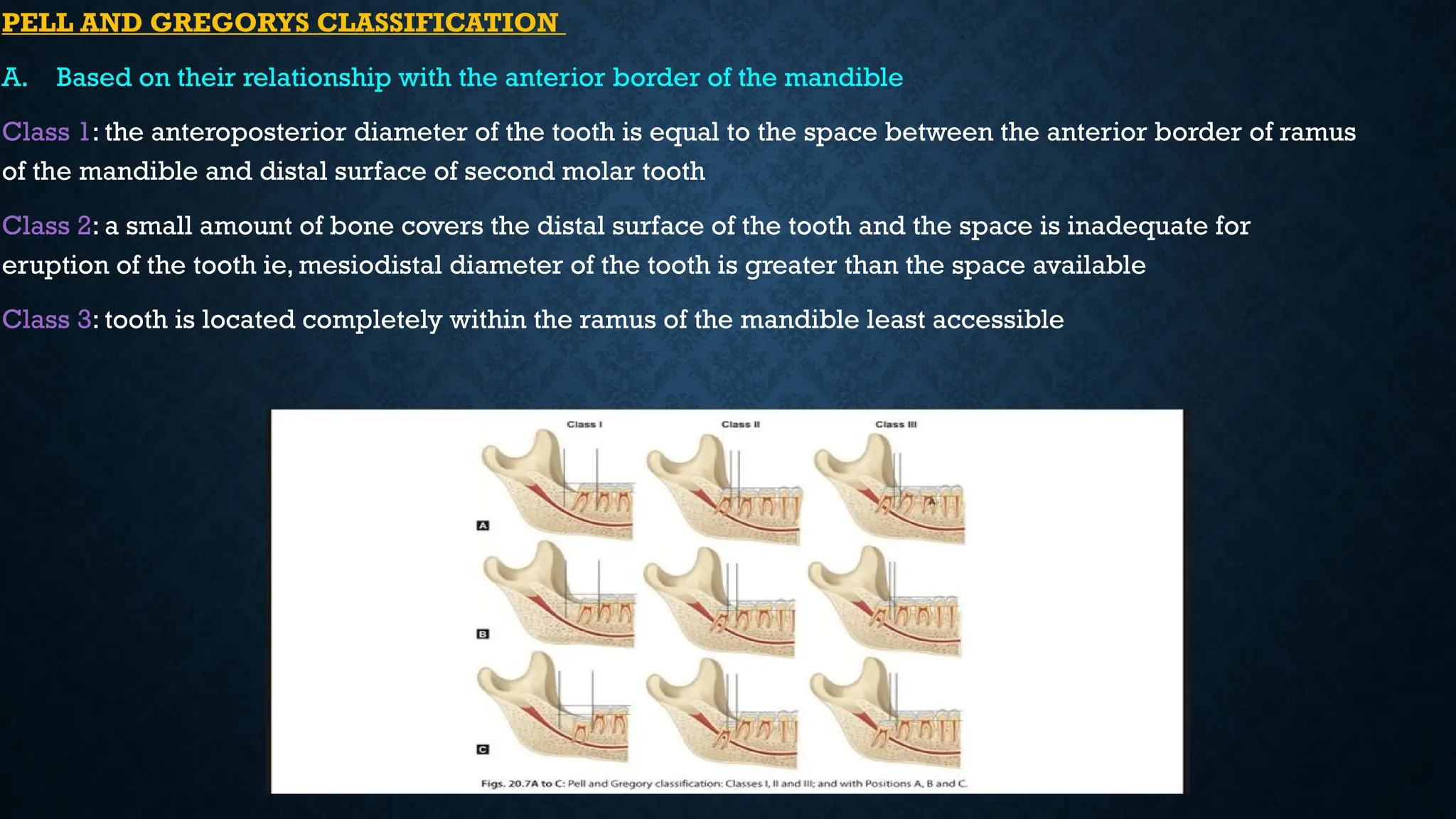
PELL AND GREGORYS CLASSIFICATION
A. Based on their relationship with the anterior border of the mandible
Class 1: the anteroposterior diameter of the tooth is equal to the space between the anterior border of ramus
of the mandible and distal surface of second molar tooth
Class 2: a small amount of bone covers the distal surface of the tooth and the space is inadequate for
eruption of the tooth ie, mesiodistal diameter of the tooth is greater than the space available
Class 3: tooth is located completely within the ramus of the mandible least accessible
• B. Based on the amount of bone covering the impacted tooth and
relation to occlusal plane
• Position A:occlusal plane of the impacted tooth is nearly in the same
level as the occlusal level of the adjacent second molar tooth
• Position B : occlusal plane of the impacted tooth is in the midway
between the cervical line and the occlusal plane of the adjacent
second molar tooth
• Position C : occlusal plane of the impacted tooth below the level of
cervical line of the second molar tooth
• C. Based on long axis of impacted tooth
• Same as winters classification
• B. Based on the amount of bone covering the impacted tooth and
relation to occlusal plane
• Position A:occlusal plane of the impacted tooth is nearly in the same
level as the occlusal level of the adjacent second molar tooth
• Position B : occlusal plane of the impacted tooth is in the midway
between the cervical line and the occlusal plane of the adjacent
second molar tooth
• Position C : occlusal plane of the impacted tooth below the level of
cervical line of the second molar tooth
• C. Based on long axis of impacted tooth
• Same as winters classification
CLINICAL EVALUATION
GENERAL EXAMINATION
• Presence of any systemic disorders/diseases
• Age & general fitness
• Presence of facial swellings & enlarged tender lymph nodes
indicates active infection & treatment should be deferred
LOCAL EXAMINATION
• Eruption status of impacted tooth
• Occlusal relationship
• Presence of local infection like pericoronitis
• Periodontal status
• Resorption of 2nd
molars
• Caries in or resorption of 3rd
molars and adjacent tooth
• Soft tissue assessment
• TMJ function-mouth opening
• External and internal oblique ridge
FACTORS COMPLICATING THE REMOVAL OF MANDIBULAR 3RD
MOLAR
• Pre existing joint problem-risk of dislocation or derangement
• Position of impacted 3rd
molar
• Thickness of oblique ridge
• Surrounding bone-dense bony socket resists easy removal
RADIOLOGICAL ASSESSMENT
• TYPES OF RADIOGRAPHS USED
1.Intraoral periapical radiograph
2.Bitewing
3.Occlusal radiograph
4.Lateral oblique
5.OPG
6.CBCT
FRANK’S TECHNIQUE OF LOCALISING MANDIBULAR CANAL
• 1st
IOPA taken with x-rays directed perpendicular to the tooth with no vertical
or horizontal angulations
• 2nd
IOPA taken with x-rays directed 25 degree below plane of occlusion
• If canal on buccal side of roots will appear to move upward on the roots
• If mandibular canal lies on lingual to impaction,it will move downward in
relation to roots of 3rd
molar
INTERPRETATION OF RADIOGRAPH
ASSESSMENT OF ACCESS
• Determined by inclination of radiopaque
line caused by external oblique ridge
• When the radiopaque line is horizontal access
is easy,when it is more vertical,access is poor.
• If radiopaque line is behind the impacted tooth
access is good ,if it is situated in front of the
tooth access is poor.
ASSESSMENT OF POSITION AND DEPTH
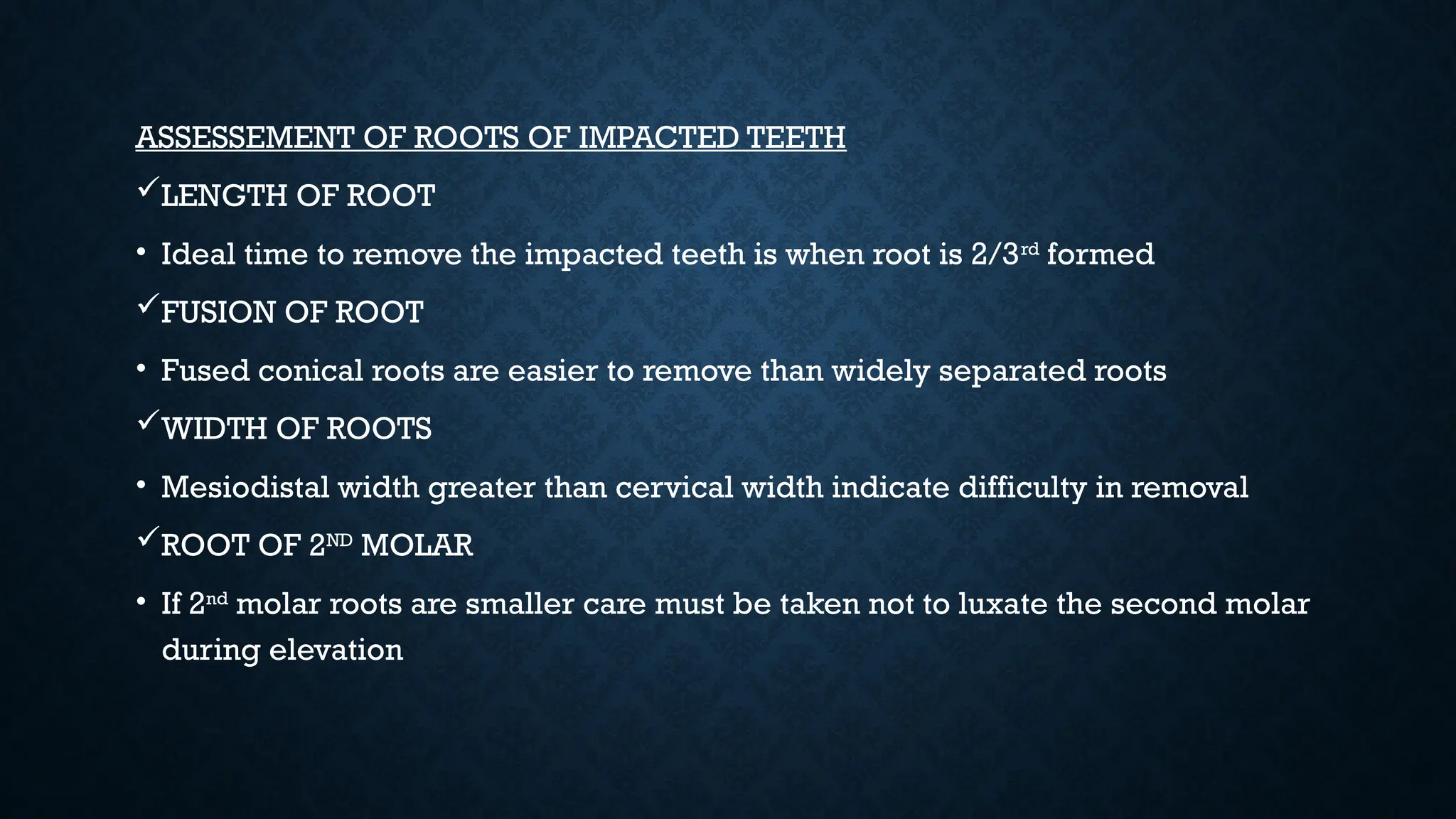
• WAR LINES: 3 imaginary lines drawn on standard radiograph
with different colors like white,amber,red.
• White line-drawn along occlusal surface of erupted mandibular
molars and extended over third molar region posteriorly.
• It indicates depth of tooth within mandible & relationship of
occlusal surface of impacted tooth with the erupted molars
• Amber line- drawn from the surface of bone on the distal aspevt
of 3rd
molar to the crest of the interdental septum between the 1st
& 2nd
molar.
• This line represents margin of alveolar bone covering 3rd
molar
• Red line- drawn perpendicular from amber line to an
imaginary point of application of elevator,usually on CEJ on
the mesial surface of impacted tooth
• <5mm-less difficult;for every 1mm increase difficulty
increses by 3 times
• >5mm –advised under GA;>9mm –very difficult
ASSESSEMENT OF ROOTS OF IMPACTED TEETH
LENGTH OF ROOT
• Ideal time to remove the impacted teeth is when root is 2/3rd
formed
FUSION OF ROOT
• Fused conical roots are easier to remove than widely separated roots
WIDTH OF ROOTS
• Mesiodistal width greater than cervical width indicate difficulty in removal
ROOT OF 2ND
MOLAR
• If 2nd
molar roots are smaller care must be taken not to luxate the second molar
during elevation
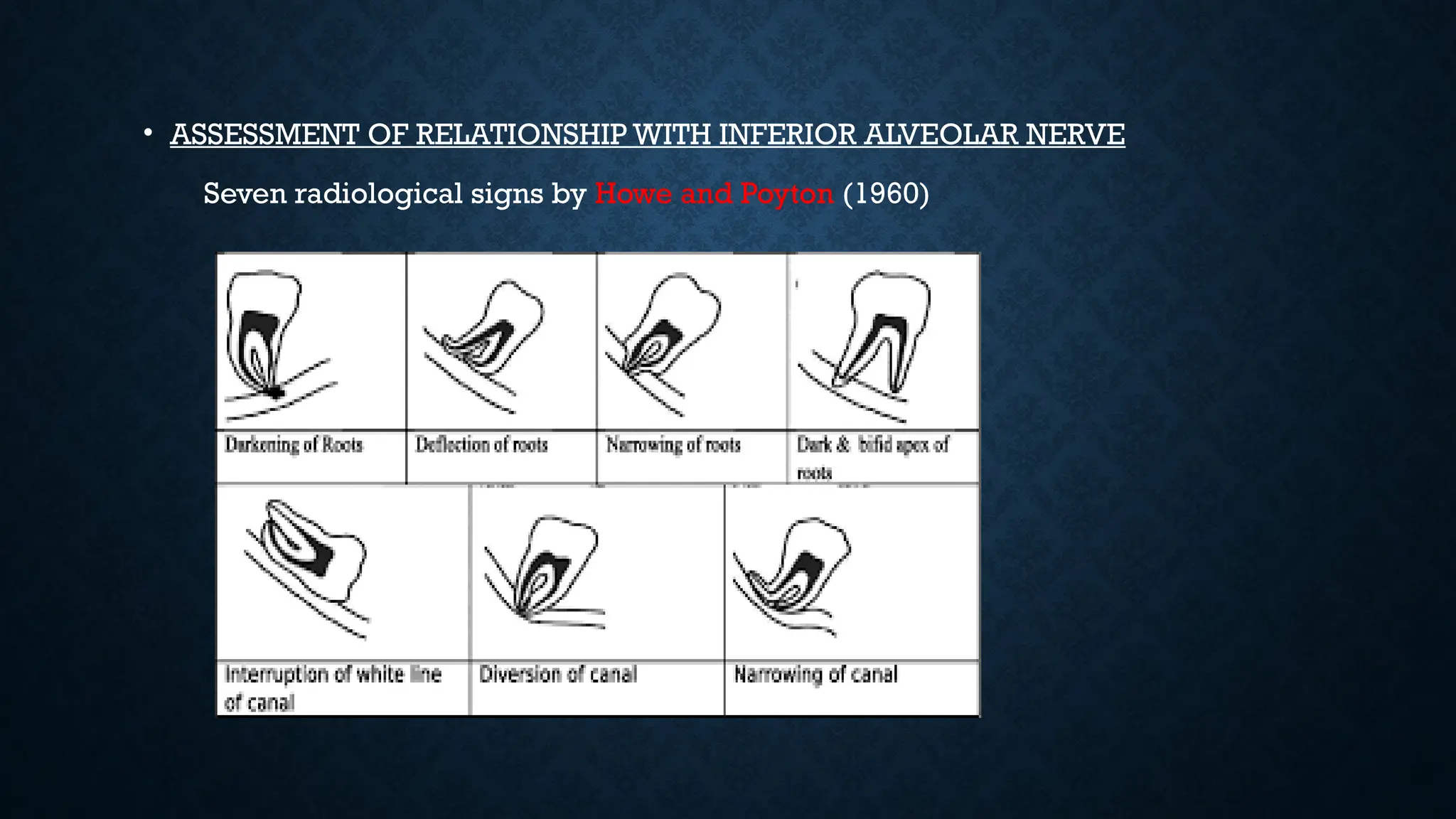
• ASSESSMENT OF RELATIONSHIP WITH INFERIOR ALVEOLAR NERVE
Seven radiological signs by Howe and Poyton (1960)
SURGICAL REMOVAL OF IMPACTED 3RD
MOLAR
• Depends on:
• Type and degree of impaction
• Amount of soft tissue exposure to aid removal of bone
• Amount and technique of bone removal
• Odentectomy
• ANAESTHESIA
• Local anaesthesia by nerve block of IAN,lingual nerve
• GA in deeply situated tooth
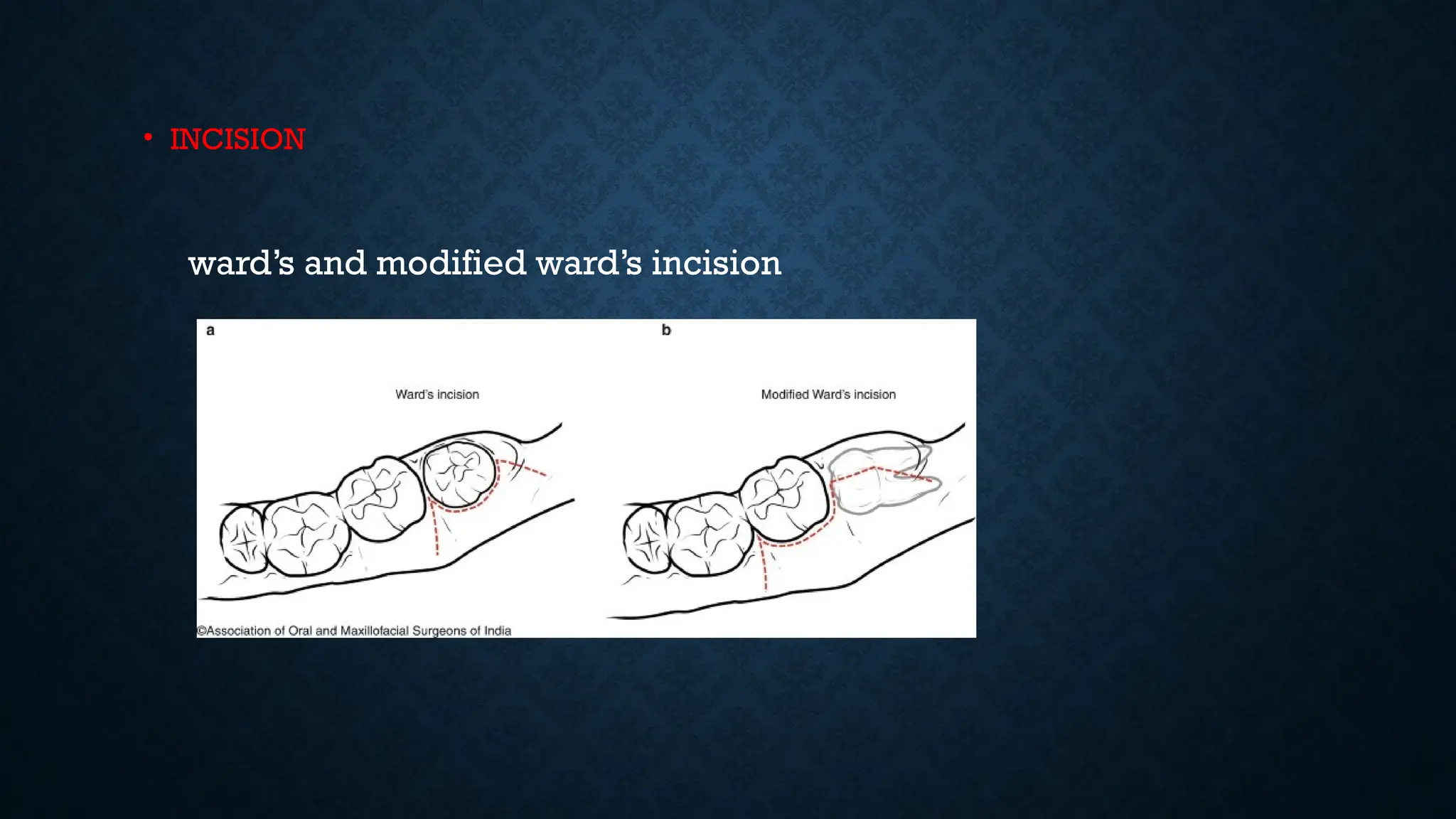
• INCISION
ward’s and modified ward’s incision
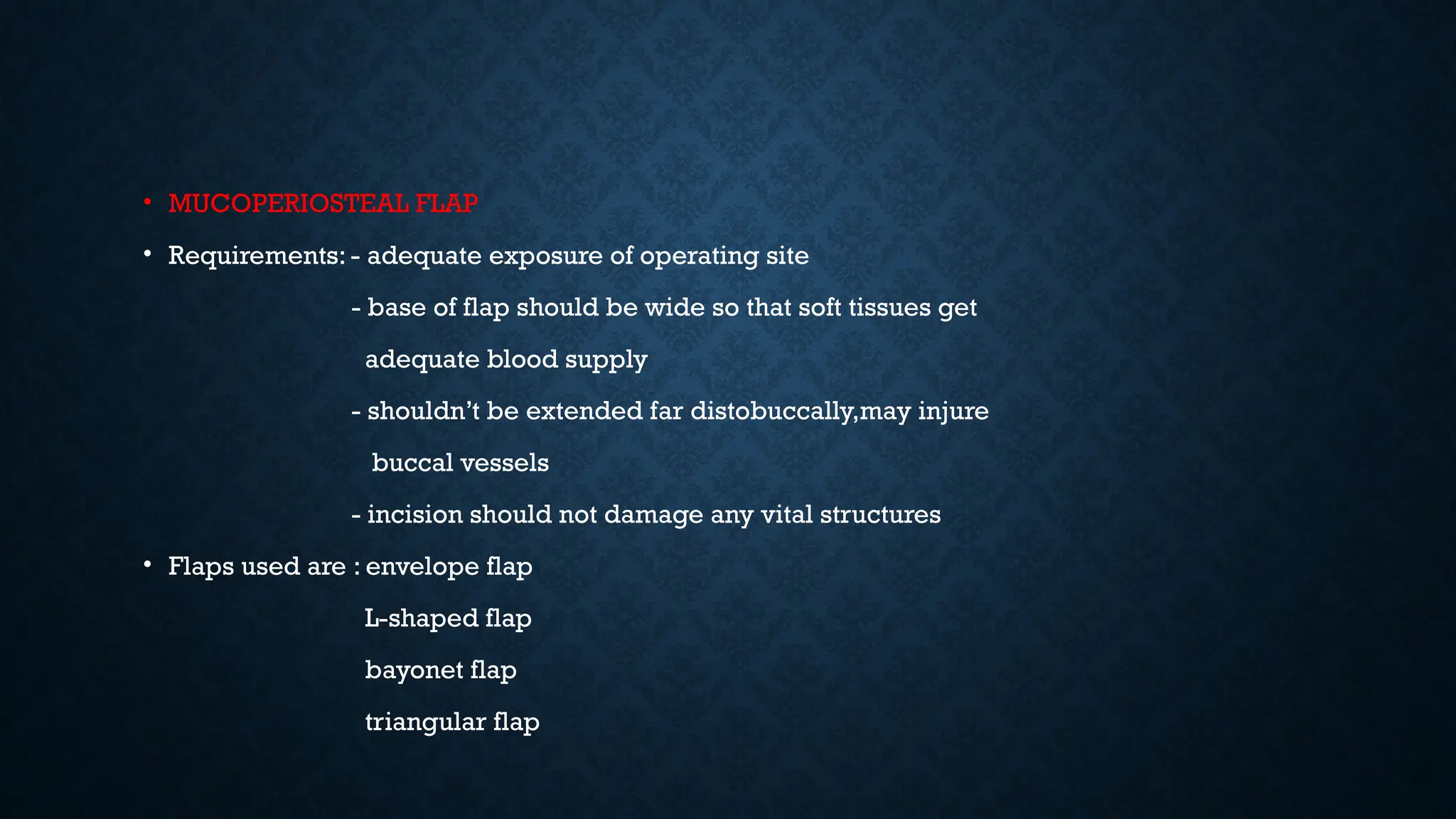
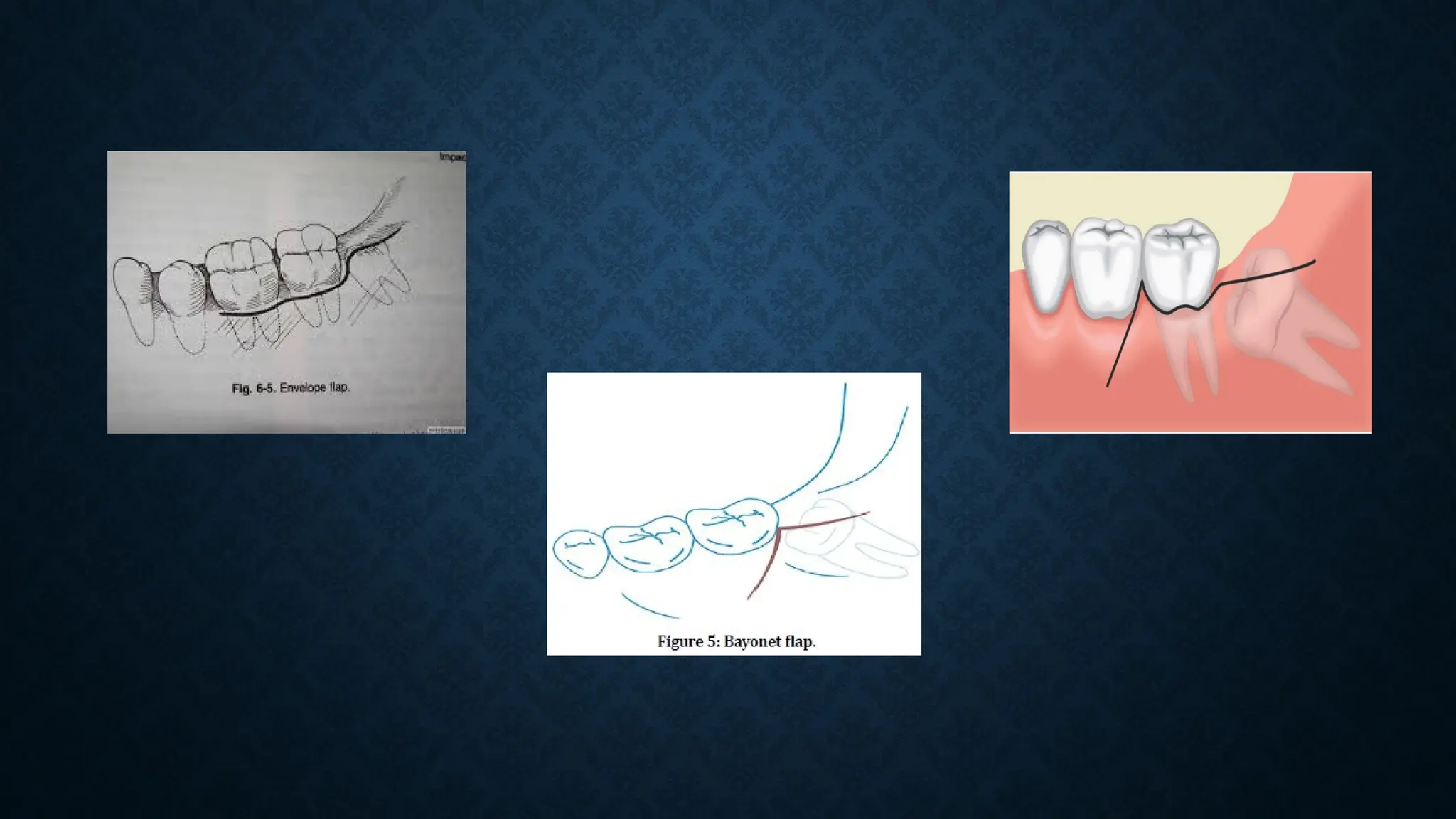
• MUCOPERIOSTEAL FLAP
• Requirements: - adequate exposure of operating site
- base of flap should be wide so that soft tissues get
adequate blood supply
- shouldn’t be extended far distobuccally,may injure
buccal vessels
- incision should not damage any vital structures
• Flaps used are : envelope flap
L-shaped flap
bayonet flap
triangular flap
ELEVATION OF FLAP
• Flap elevated using periosteal elevator
• Once the flap has been raised appropriate retractors are used to retract the
flap.
REMOVAL OF BONE
• Removal of bone with bur: MOORE GILLBE COLLAR TECHNIQUE
• Bur is used to create a gutter around the neck of the tooth.On the buccal and
distal aspect bone must be removed to expose the entire crown till CEJ.
• Removal of bone with chisel:
• Buccal bone carved away by chiseling.
• When removing bone using chisel, mandible should be adequately
supported
REMOVAL OF TOOTH
• Using straight elevator force is applied on the mesial CEJ of the impacted
tooth so that tooth rotates in an arc.
• Sectioning of tooth in multiple segments helps in easy removal.
DEBRIDEMENT OF WOUND AND WOUND CLOSURE
• Wound is debrided to remove particulate bone chips and debris using
periapical curette.
• Sharp margins of bone smoothened using bone file
• Wound is then closed with sutures
• Initial suture is placed on the distal aspect of 2nd
molar.
• Additional sutures placed in anterior and posterior limbs of incision.
OTHER TECHNIQUES IN THIRD MOLAR
REMOVAL
• LATERAL TREPHINATION TECHNIQUE
 Described by Bowdler-Henry
 Local anesthesia is secured , external oblique ridge is palpated and s-shaped
incision is made
 Incision from retromolar fossa-external oblique ridge-mucous membrane above
vestibule-anterior to first permanent molar
 Full thickness is elevated
 Buccal cortical plate over 3rd
molar is trephined
 At posterior end, 2nd
cut is made through the outer plate at 45degree
 Buccal plate is fractured and impcted tooth is delivered out
• LINGUAL SPLIT TECHNIQUE
 Introduced by Sir William Kelsey Fry
 Incision made on 3rd
molar region-mucoperiosteal flap is elevated on buccal
side
 Chisel is placed horizontally with the bevel facing downwards
 Point of application of elevator is made with chisel by excising triangular piece
of bone
 Distolingual bone fractured using chisel held at a 45 degree
 Peninsula of bone which remains distal to the tooth & between buccal and
lingual cuts is excised
 Lingual plate is fractured and lifted from the wound
 Bony edges are smoothened with file,wound is irrigated with salina and closed
with sutures
CONCLUSION
All impacted tooth must be removed unless removal is
contraindicated. Extraction should be performed as soon as
the dentist determines that the tooth is impacted . Removal
of impacted tooth becomes more difficult with advancing
age .If removal of impacted teeth is deferred ,surgery is
more likely to be complicated and hazardous for the
patient.
REFERENCE
• TEXTBOOK OF ORAL AND MAXILLOFACIAL SURGERY – THIRD EDITION-
S M BALAJI

IMPACTION OF MANDIBULAR 3RD MOLAR & IT’S MANAGEMENT ls.pptx

  • 1.
    IMPACTION OF MANDIBULARTHIRD MOLAR & IT’S MANAGEMENT SUBMITTED BY; LEKSHMI S AJIT ROLL NO:11 FINAL YEAR PART I
  • 2.
    CONTENTS • INTRODUCTION • THEORIESOF IMPACTION • AETIOLOGY OF IMPACTION • INDICATIONS FOR REMOVAL • CONTRAINDICATIONS FOR REMOVAL • CLASSIFICATION • CLINICAL EVALUATION • RADIOLOGICAL ASSESSMENT • SURGICAL REMOVAL • OTHER TECHNIQUES IN MANDIBULAR 3RD MOLAR REMOVAL • CONCLUSION • REFERENCE
  • 3.
    INTRODUCTION • Impacted toothis a tooth which is completely or partially unerupted , is positioned against another tooth , bone or soft tissues so that its further eruption is unlikely & described according to its anatomic position. • Teeth become impacted mainly due to inadequate dental arch length & space in which to erupt. • Third molars are most frequently impacted as they are the last teeth to erupt
  • 4.
    THEORIES OF IMPACTION •ORTHODONTIC THEORY growth of the jaw & the movement of teeth occurs in forward direction , anything that interferes with such movement will cause an impaction. • NODINE’S PHYLOGENIC THEORY Elimination of unused tooth which causes congenital absence of third molars. • MENDELIAN THEORY Inherits small jaws from one parent & a complement of large teeth from other i.e, small mandible with impaction of 2nd & 3rd molars.
  • 5.
    • PATHOLOGICAL THEORY Osteosclerosisof third molar area bring condensation of osseous tissue further preventing growth and development of jaws. • ENDOCRINAL THEORY An imbalance of endocrine activity leads to lack of growth of jaws. • NATURE AND NURTURE THEORY A.J Mac Gregor explains that impaction can occur due to a mismatch in size and shape of teeth and jaws.
  • 6.
    AETIOLOGY OF IMPACTION LOCALCAUSES 1. Irregularity in position and pressure of adjacent tooth. 2. Density of overlying or surrounding bone. 3. Arch length and tooth size discrepancy 4. Dilaceration 5. Over retained deciduous teeth 6. Ectopic position of tooth bud 7. Localised chronic inflammation
  • 7.
    SYSTEMIC CAUSES 1. Prenatalcauses : heredity 2. Postnatal causes : rickets, anemia, tuberculosis, malnutrition, congenital syphilis , endocrine dysfunctions. 3. Rare conditions: progeria, cleft palate ,osteopetrosis , oxycephaly
  • 8.
    INDICATIONS FOR REMOVAL Infections  Periodontal diseases  Dentigerous cyst formation  External resorption of 2nd molar  Buccoverted impacted molars  Prophylactic removal  Atypical pain  Fracture of mandible in 3rd molar region
  • 9.
    CONTRAINDIACTIONS FOR REMOVAL •Medical history • Deeply impacted third molars in patients with no history of any bony pathology to avoid damage to vital structures • Partially erupted tooth which can be used as an abutment in FPD • Impacted teeth which are likely to erupt successfully.
  • 10.
    CLASSIFICATION A) BASED ONNATURE OF OVERLYING BONE • Soft tissue impaction: presence of dense fibrous tissues overlying the teeth prevents normal eruption. • Hard tissue impaction: teeth fail to erupt due to obstruction caused by overlying bone.
  • 11.
    WINTER’S CLASSIFICATION • Mesioangular: • long axis of 3rd molar bisects long axis of 2nd molar • Distoangular : • long axis of 3rd molar away from long axis of 2nd molar • Horizontal : • long axis of 3rd molar bisect long axis of 2nd molar at right angle • Vertical : • long axis of 3rd molar runs parallel to long axis of 2nd molar
  • 13.
    PELL AND GREGORYSCLASSIFICATION A. Based on their relationship with the anterior border of the mandible Class 1: the anteroposterior diameter of the tooth is equal to the space between the anterior border of ramus of the mandible and distal surface of second molar tooth Class 2: a small amount of bone covers the distal surface of the tooth and the space is inadequate for eruption of the tooth ie, mesiodistal diameter of the tooth is greater than the space available Class 3: tooth is located completely within the ramus of the mandible least accessible
  • 14.
    • B. Basedon the amount of bone covering the impacted tooth and relation to occlusal plane • Position A:occlusal plane of the impacted tooth is nearly in the same level as the occlusal level of the adjacent second molar tooth • Position B : occlusal plane of the impacted tooth is in the midway between the cervical line and the occlusal plane of the adjacent second molar tooth • Position C : occlusal plane of the impacted tooth below the level of cervical line of the second molar tooth • C. Based on long axis of impacted tooth • Same as winters classification • B. Based on the amount of bone covering the impacted tooth and relation to occlusal plane • Position A:occlusal plane of the impacted tooth is nearly in the same level as the occlusal level of the adjacent second molar tooth • Position B : occlusal plane of the impacted tooth is in the midway between the cervical line and the occlusal plane of the adjacent second molar tooth • Position C : occlusal plane of the impacted tooth below the level of cervical line of the second molar tooth • C. Based on long axis of impacted tooth • Same as winters classification
  • 15.
    CLINICAL EVALUATION GENERAL EXAMINATION •Presence of any systemic disorders/diseases • Age & general fitness • Presence of facial swellings & enlarged tender lymph nodes indicates active infection & treatment should be deferred
  • 16.
    LOCAL EXAMINATION • Eruptionstatus of impacted tooth • Occlusal relationship • Presence of local infection like pericoronitis • Periodontal status • Resorption of 2nd molars • Caries in or resorption of 3rd molars and adjacent tooth • Soft tissue assessment • TMJ function-mouth opening • External and internal oblique ridge
  • 17.
    FACTORS COMPLICATING THEREMOVAL OF MANDIBULAR 3RD MOLAR • Pre existing joint problem-risk of dislocation or derangement • Position of impacted 3rd molar • Thickness of oblique ridge • Surrounding bone-dense bony socket resists easy removal
  • 18.
    RADIOLOGICAL ASSESSMENT • TYPESOF RADIOGRAPHS USED 1.Intraoral periapical radiograph 2.Bitewing 3.Occlusal radiograph 4.Lateral oblique 5.OPG 6.CBCT
  • 19.
    FRANK’S TECHNIQUE OFLOCALISING MANDIBULAR CANAL • 1st IOPA taken with x-rays directed perpendicular to the tooth with no vertical or horizontal angulations • 2nd IOPA taken with x-rays directed 25 degree below plane of occlusion • If canal on buccal side of roots will appear to move upward on the roots • If mandibular canal lies on lingual to impaction,it will move downward in relation to roots of 3rd molar
  • 20.
    INTERPRETATION OF RADIOGRAPH ASSESSMENTOF ACCESS • Determined by inclination of radiopaque line caused by external oblique ridge • When the radiopaque line is horizontal access is easy,when it is more vertical,access is poor. • If radiopaque line is behind the impacted tooth access is good ,if it is situated in front of the tooth access is poor.
  • 21.
    ASSESSMENT OF POSITIONAND DEPTH • WAR LINES: 3 imaginary lines drawn on standard radiograph with different colors like white,amber,red. • White line-drawn along occlusal surface of erupted mandibular molars and extended over third molar region posteriorly. • It indicates depth of tooth within mandible & relationship of occlusal surface of impacted tooth with the erupted molars • Amber line- drawn from the surface of bone on the distal aspevt of 3rd molar to the crest of the interdental septum between the 1st & 2nd molar. • This line represents margin of alveolar bone covering 3rd molar
  • 22.
    • Red line-drawn perpendicular from amber line to an imaginary point of application of elevator,usually on CEJ on the mesial surface of impacted tooth • <5mm-less difficult;for every 1mm increase difficulty increses by 3 times • >5mm –advised under GA;>9mm –very difficult
  • 23.
    ASSESSEMENT OF ROOTSOF IMPACTED TEETH LENGTH OF ROOT • Ideal time to remove the impacted teeth is when root is 2/3rd formed FUSION OF ROOT • Fused conical roots are easier to remove than widely separated roots WIDTH OF ROOTS • Mesiodistal width greater than cervical width indicate difficulty in removal ROOT OF 2ND MOLAR • If 2nd molar roots are smaller care must be taken not to luxate the second molar during elevation
  • 24.
    • ASSESSMENT OFRELATIONSHIP WITH INFERIOR ALVEOLAR NERVE Seven radiological signs by Howe and Poyton (1960)
  • 25.
    SURGICAL REMOVAL OFIMPACTED 3RD MOLAR • Depends on: • Type and degree of impaction • Amount of soft tissue exposure to aid removal of bone • Amount and technique of bone removal • Odentectomy • ANAESTHESIA • Local anaesthesia by nerve block of IAN,lingual nerve • GA in deeply situated tooth
  • 26.
    • INCISION ward’s andmodified ward’s incision
  • 27.
    • MUCOPERIOSTEAL FLAP •Requirements: - adequate exposure of operating site - base of flap should be wide so that soft tissues get adequate blood supply - shouldn’t be extended far distobuccally,may injure buccal vessels - incision should not damage any vital structures • Flaps used are : envelope flap L-shaped flap bayonet flap triangular flap
  • 29.
    ELEVATION OF FLAP •Flap elevated using periosteal elevator • Once the flap has been raised appropriate retractors are used to retract the flap. REMOVAL OF BONE • Removal of bone with bur: MOORE GILLBE COLLAR TECHNIQUE • Bur is used to create a gutter around the neck of the tooth.On the buccal and distal aspect bone must be removed to expose the entire crown till CEJ. • Removal of bone with chisel: • Buccal bone carved away by chiseling. • When removing bone using chisel, mandible should be adequately supported
  • 30.
    REMOVAL OF TOOTH •Using straight elevator force is applied on the mesial CEJ of the impacted tooth so that tooth rotates in an arc. • Sectioning of tooth in multiple segments helps in easy removal. DEBRIDEMENT OF WOUND AND WOUND CLOSURE • Wound is debrided to remove particulate bone chips and debris using periapical curette. • Sharp margins of bone smoothened using bone file • Wound is then closed with sutures • Initial suture is placed on the distal aspect of 2nd molar. • Additional sutures placed in anterior and posterior limbs of incision.
  • 31.
    OTHER TECHNIQUES INTHIRD MOLAR REMOVAL • LATERAL TREPHINATION TECHNIQUE  Described by Bowdler-Henry  Local anesthesia is secured , external oblique ridge is palpated and s-shaped incision is made  Incision from retromolar fossa-external oblique ridge-mucous membrane above vestibule-anterior to first permanent molar  Full thickness is elevated  Buccal cortical plate over 3rd molar is trephined  At posterior end, 2nd cut is made through the outer plate at 45degree  Buccal plate is fractured and impcted tooth is delivered out
  • 32.
    • LINGUAL SPLITTECHNIQUE  Introduced by Sir William Kelsey Fry  Incision made on 3rd molar region-mucoperiosteal flap is elevated on buccal side  Chisel is placed horizontally with the bevel facing downwards  Point of application of elevator is made with chisel by excising triangular piece of bone  Distolingual bone fractured using chisel held at a 45 degree  Peninsula of bone which remains distal to the tooth & between buccal and lingual cuts is excised  Lingual plate is fractured and lifted from the wound  Bony edges are smoothened with file,wound is irrigated with salina and closed with sutures
  • 33.
    CONCLUSION All impacted toothmust be removed unless removal is contraindicated. Extraction should be performed as soon as the dentist determines that the tooth is impacted . Removal of impacted tooth becomes more difficult with advancing age .If removal of impacted teeth is deferred ,surgery is more likely to be complicated and hazardous for the patient.
  • 34.
    REFERENCE • TEXTBOOK OFORAL AND MAXILLOFACIAL SURGERY – THIRD EDITION- S M BALAJI