Digital Business
Six Data Architecture and
IT Infrastructure Governance
Mandates for Multinational Banks
Banking and financial services institutions operating in multiple countries
and executing digital transformation programs can leverage the principles
of BCBS 239 to standardize and stabilize their IT infrastructure and related
data architecture processes to realize digital business value across their
geographic footprint.
Executive Summary
Banks are investing in technology and architecture to
enhance the digital platforms and reporting processes to:
❙ Respond to frequent regulatory changes, such as
General Data Protection Regulation (GDPR), BASEL,
Markets in Financial Instruments Directive (MiFID),
and the Dodd-Frank Act.
❙❙ Offer enhanced customer satisfaction by
introducing new services and products such as
automated voice recognition systems, automated
product recommendations, chatbots to continue
24x7 customer support, and many more.
Harmonize IT systems and automate processes for
use of common tools and technologies.
❙❙
Cognizant 20-20 Insights
August 2019
Despite having a clear business case for
digital, banks and financial services typically
fail to execute IT and organizational change
management due to lack of visibility into budget
allocation and resource utilization in the planning
phase of evaluating the technology landscape.
The most common cause of failures occurs when
the technology decision-makers lose control of
the target architecture model and make random
changes in choosing products. This situation
leads to an internal disruption and the program
goes out of control. Inappropriate budgeting
can cause substantial operational losses. A
change in products for data architecture and IT
infrastructure causes the need to edit builds and
can hamper deployments. Overall, there is a high
likelihood of having a negative impact on the
financial and regulatory reports, which will result in
a reputational loss to the firm.
Banks are mandated to comply with BCBS
239 Principles of “Data architecture and IT
infrastructure” and “Governance.” Aligning the
right set of governance at the right time will
mitigate the risk of a program manager losing
control of the program due to changing tools and
architecture during the digital transformation
journey. The white paper outlines a proven set
of governances as a control mechanism based
on our experience with various financial services
customers in the U.S. and EMEA.
Cognizant 20-20 Insights
2  /  Six Data Architecture and IT Infrastructure Governance Mandates for Multinational Banks
Cognizant 20-20 Insights
3  /  Six Data Architecture and IT Infrastructure Governance Mandates for Multinational Banks
A typical digital program scenario
Let’s take an example of a bank that has multiple
operational units spread across multiple countries.
The bank is running a digital transformation
program with aggressive timelines to comply with
regulatory mandates and meet market demands.
The program management establishes a strategic
unit and an implementation unit, which will follow
Agile methodology. The strategic unit will be
responsible for defining the architectural decisions,
identifying tools and technologies, defining
policies and procedures for the technology
ecosystem, describing business processes and
making all strategic decisions. The implementation
unit will be responsible for development, testing
and delivery of codes, which will align with the
target operating model of the strategic unit. The
bank has given entities power to generate their
local reports while the group reports are managed
from bank headquarters. In such a scenario, a major
step is assessing a unified “tools and technologies”
and “IT infrastructure” on which the projects of
the program would run irrespective of any country
or business unit they belong to. This will ensure
that they have access to the same technology and
speak the same language as described in the data
management framework.
In our experience, local entities want to retain their
legacy systems and operating models and build
reports in their own way. When the strategic unit
chooses the components of the IT infrastructure,
the entities are pushed to migrate their builds
in the new infrastructure. It becomes very
challenging to adapt to a changing infrastructure
during the decision phase and eventually
migrating to the target operating model. The
major challenge is to assess the impacts of
changing tools and technologies on project
performance and prepare for a more accurate
budget and resource allocation.
How tools and architecture change impacts
program performance
Data transformation in regulatory application(s) are
heavily dependent on tools and architecture.
In our experiences, we have observed the following
approaches, and resulting project impact.
Tools change, architecture remains
the same
The strategic unit has participants from local
and group entities (each entity is defined as
each country that is participating in the program)
that influence the decision of the board.
In our experience, the program manager overseeing this approach
will completely lose control over the environment, and program
performance will degrade as time and budget expenditure
increases. Overall, the vision of having a unified technology
ecosystem is also undermined, leading the program to failure.
Cognizant 20-20 Insights
4  /  Six Data Architecture and IT Infrastructure Governance Mandates for Multinational Banks
These entity representatives are often inclined to
a solution that seems comfortable based on their
experience. Because of multiple local and group
representatives, with multiple views, the decision
on identification of tools is typically delayed or
changes regularly.
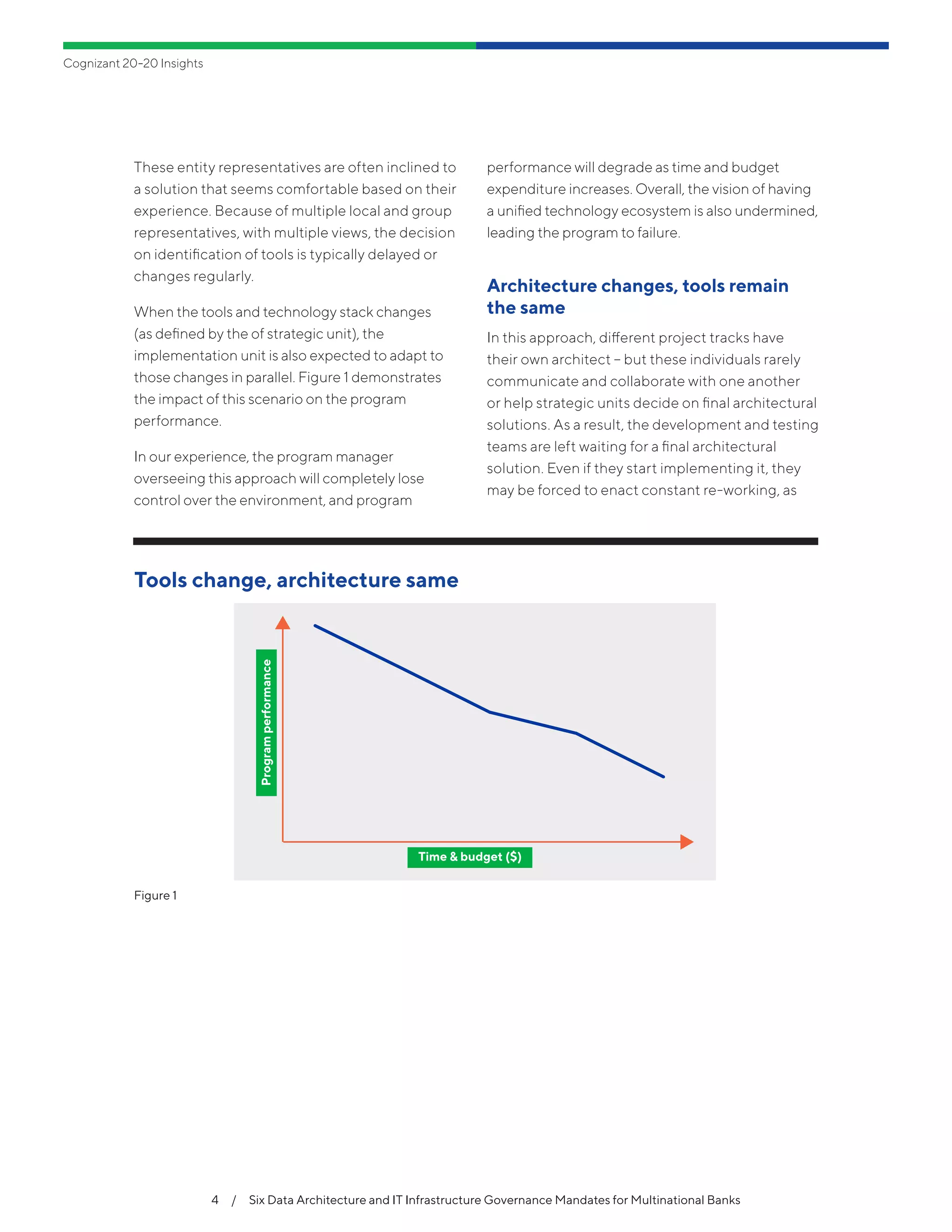
When the tools and technology stack changes
(as defined by the of strategic unit), the
implementation unit is also expected to adapt to
those changes in parallel. Figure 1 demonstrates
the impact of this scenario on the program
performance.
In our experience, the program manager
overseeing this approach will completely lose
control over the environment, and program
performance will degrade as time and budget
expenditure increases. Overall, the vision of having
a unified technology ecosystem is also undermined,
leading the program to failure.
Architecture changes, tools remain
the same
In this approach, different project tracks have
their own architect -- but these individuals rarely
communicate and collaborate with one another
or help strategic units decide on final architectural
solutions. As a result, the development and testing
teams are left waiting for a final architectural
solution. Even if they start implementing it, they
may be forced to enact constant re-working, as
Figure 1
Tools change, architecture same
Programperformance
Time & budget ($)
Cognizant 20-20 Insights
5  /  Six Data Architecture and IT Infrastructure Governance Mandates for Multinational Banks
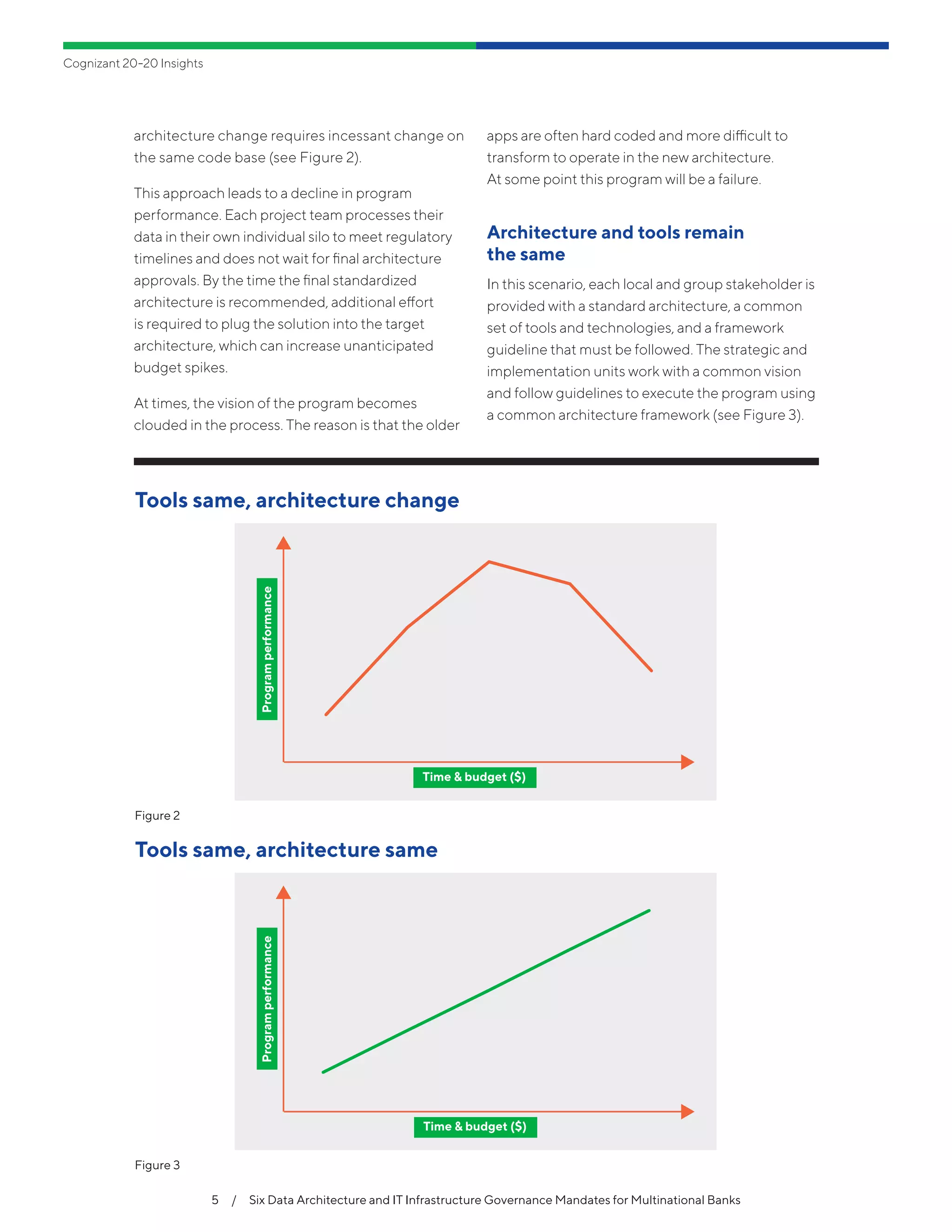
architecture change requires incessant change on
the same code base (see Figure 2).
This approach leads to a decline in program
performance. Each project team processes their
data in their own individual silo to meet regulatory
timelines and does not wait for final architecture
approvals. By the time the final standardized
architecture is recommended, additional effort
is required to plug the solution into the target
architecture, which can increase unanticipated
budget spikes.
At times, the vision of the program becomes
clouded in the process. The reason is that the older
apps are often hard coded and more difficult to
transform to operate in the new architecture.
At some point this program will be a failure.
Architecture and tools remain
the same
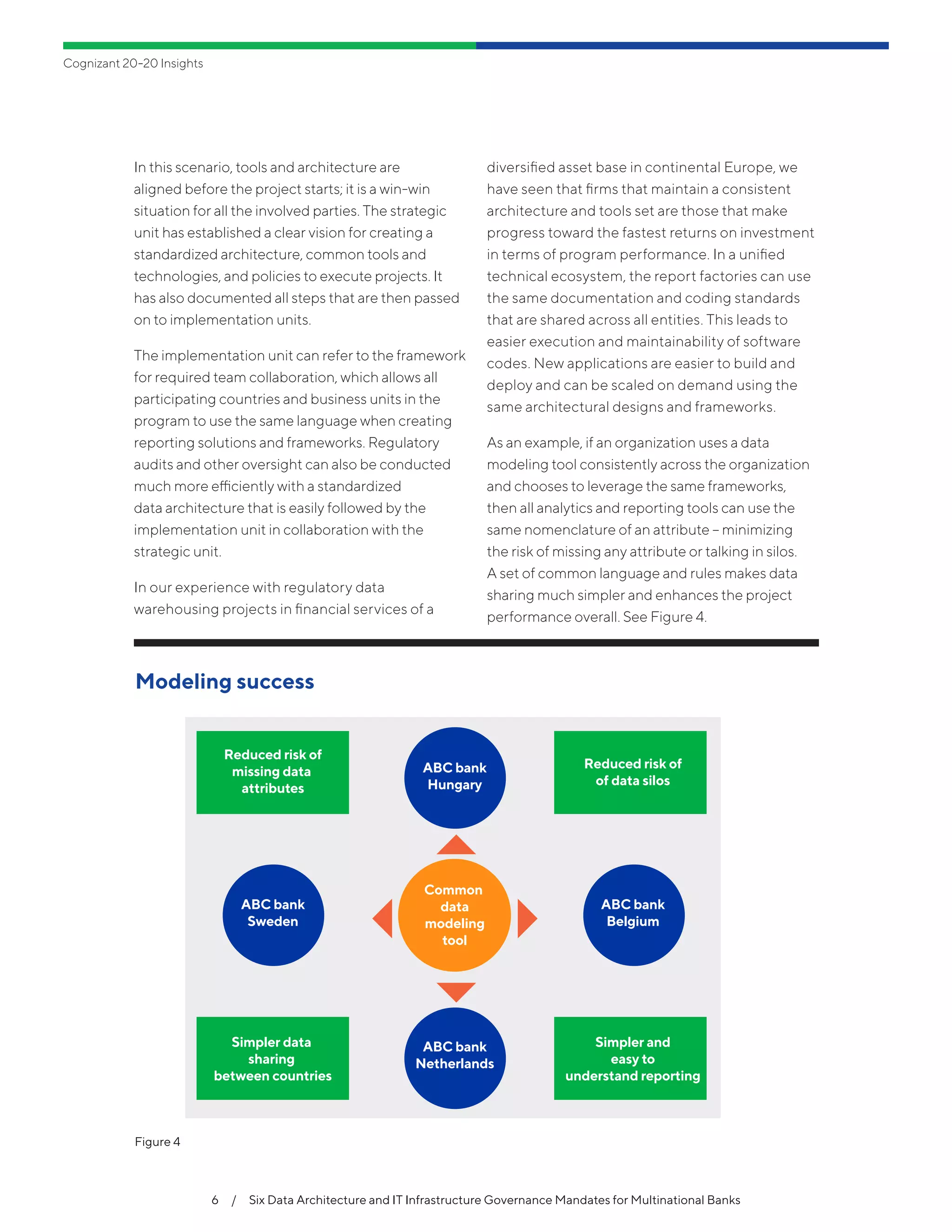
In this scenario, each local and group stakeholder is
provided with a standard architecture, a common
set of tools and technologies, and a framework
guideline that must be followed. The strategic and
implementation units work with a common vision
and follow guidelines to execute the program using
a common architecture framework (see Figure 3).
Figure 2
Tools same, architecture change
Programperformance
Time & budget ($)
Figure 3
Tools same, architecture same
Programperformance
Time & budget ($)
Cognizant 20-20 Insights
6  /  Six Data Architecture and IT Infrastructure Governance Mandates for Multinational Banks
In this scenario, tools and architecture are
aligned before the project starts; it is a win-win
situation for all the involved parties. The strategic
unit has established a clear vision for creating a
standardized architecture, common tools and
technologies, and policies to execute projects. It
has also documented all steps that are then passed
on to implementation units.
The implementation unit can refer to the framework
for required team collaboration, which allows all
participating countries and business units in the
program to use the same language when creating
reporting solutions and frameworks. Regulatory
audits and other oversight can also be conducted
much more efficiently with a standardized
data architecture that is easily followed by the
implementation unit in collaboration with the
strategic unit.
In our experience with regulatory data
warehousing projects in financial services of a
diversified asset base in continental Europe, we
have seen that firms that maintain a consistent
architecture and tools set are those that make
progress toward the fastest returns on investment
in terms of program performance. In a unified
technical ecosystem, the report factories can use
the same documentation and coding standards
that are shared across all entities. This leads to
easier execution and maintainability of software
codes. New applications are easier to build and
deploy and can be scaled on demand using the
same architectural designs and frameworks.
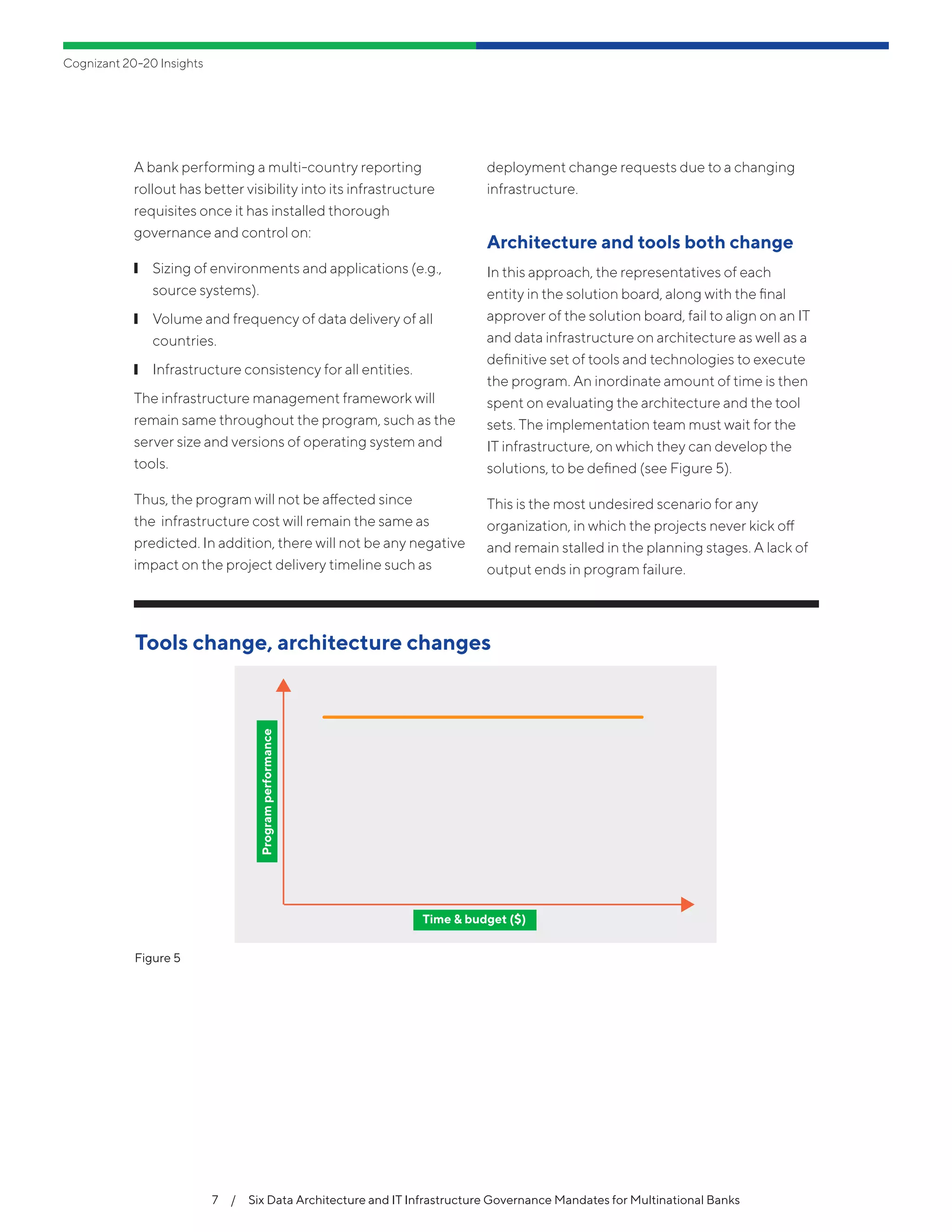
As an example, if an organization uses a data
modeling tool consistently across the organization
and chooses to leverage the same frameworks,
then all analytics and reporting tools can use the
same nomenclature of an attribute – minimizing
the risk of missing any attribute or talking in silos.
A set of common language and rules makes data
sharing much simpler and enhances the project
performance overall. See Figure 4.
Figure 4
Modeling success
Reduced risk of
missing data
attributes
ABC bank
Sweden
ABC bank
Hungary
ABC bank
Netherlands
ABC bank
Belgium
Common
data
modeling
tool
Reduced risk of
of data silos
Simpler data
sharing
between countries
Simpler and
easy to
understand reporting
7  /  Six Data Architecture and IT Infrastructure Governance Mandates for Multinational Banks
A bank performing a multi-country reporting
rollout has better visibility into its infrastructure
requisites once it has installed thorough
governance and control on:
❙❙ Sizing of environments and applications (e.g.,
source systems).
❙❙ Volume and frequency of data delivery of all
countries.
❙❙ Infrastructure consistency for all entities.
The infrastructure management framework will
remain same throughout the program, such as the
server size and versions of operating system and
tools.
Thus, the program will not be affected since
the infrastructure cost will remain the same as
predicted. In addition, there will not be any negative
impact on the project delivery timeline such as
deployment change requests due to a changing
infrastructure.
Architecture and tools both change
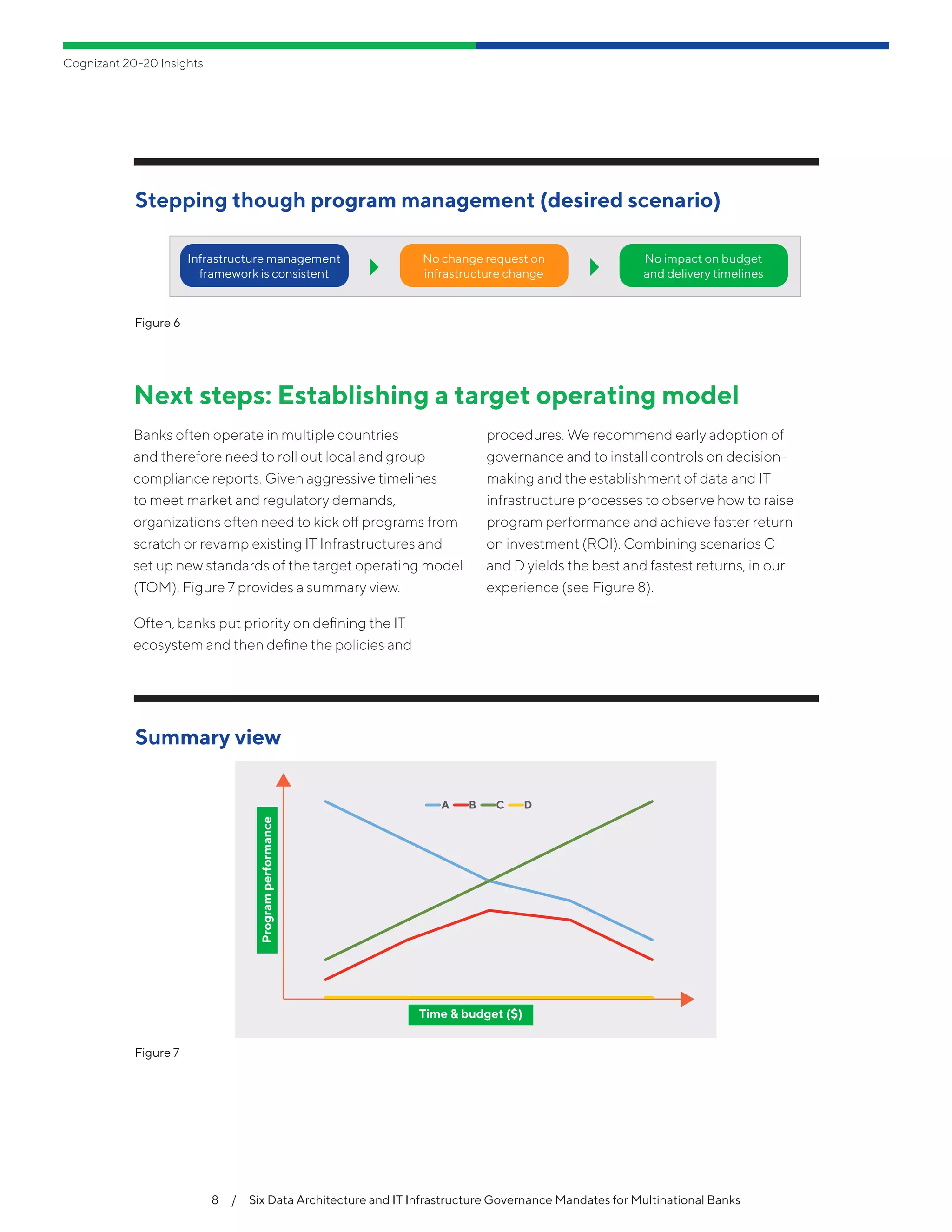
In this approach, the representatives of each
entity in the solution board, along with the final
approver of the solution board, fail to align on an IT
and data infrastructure on architecture as well as a
definitive set of tools and technologies to execute
the program. An inordinate amount of time is then
spent on evaluating the architecture and the tool
sets. The implementation team must wait for the
IT infrastructure, on which they can develop the
solutions, to be defined (see Figure 5).
This is the most undesired scenario for any
organization, in which the projects never kick off
and remain stalled in the planning stages. A lack of
output ends in program failure.
Cognizant 20-20 Insights
Figure 5
Tools change, architecture changes
Programperformance
Time & budget ($)
8  /  Six Data Architecture and IT Infrastructure Governance Mandates for Multinational Banks
Next steps: Establishing a target operating model
Banks often operate in multiple countries
and therefore need to roll out local and group
compliance reports. Given aggressive timelines
to meet market and regulatory demands,
organizations often need to kick off programs from
scratch or revamp existing IT Infrastructures and
set up new standards of the target operating model
(TOM). Figure 7 provides a summary view.
Often, banks put priority on defining the IT
ecosystem and then define the policies and
procedures. We recommend early adoption of
governance and to install controls on decision-
making and the establishment of data and IT
infrastructure processes to observe how to raise
program performance and achieve faster return
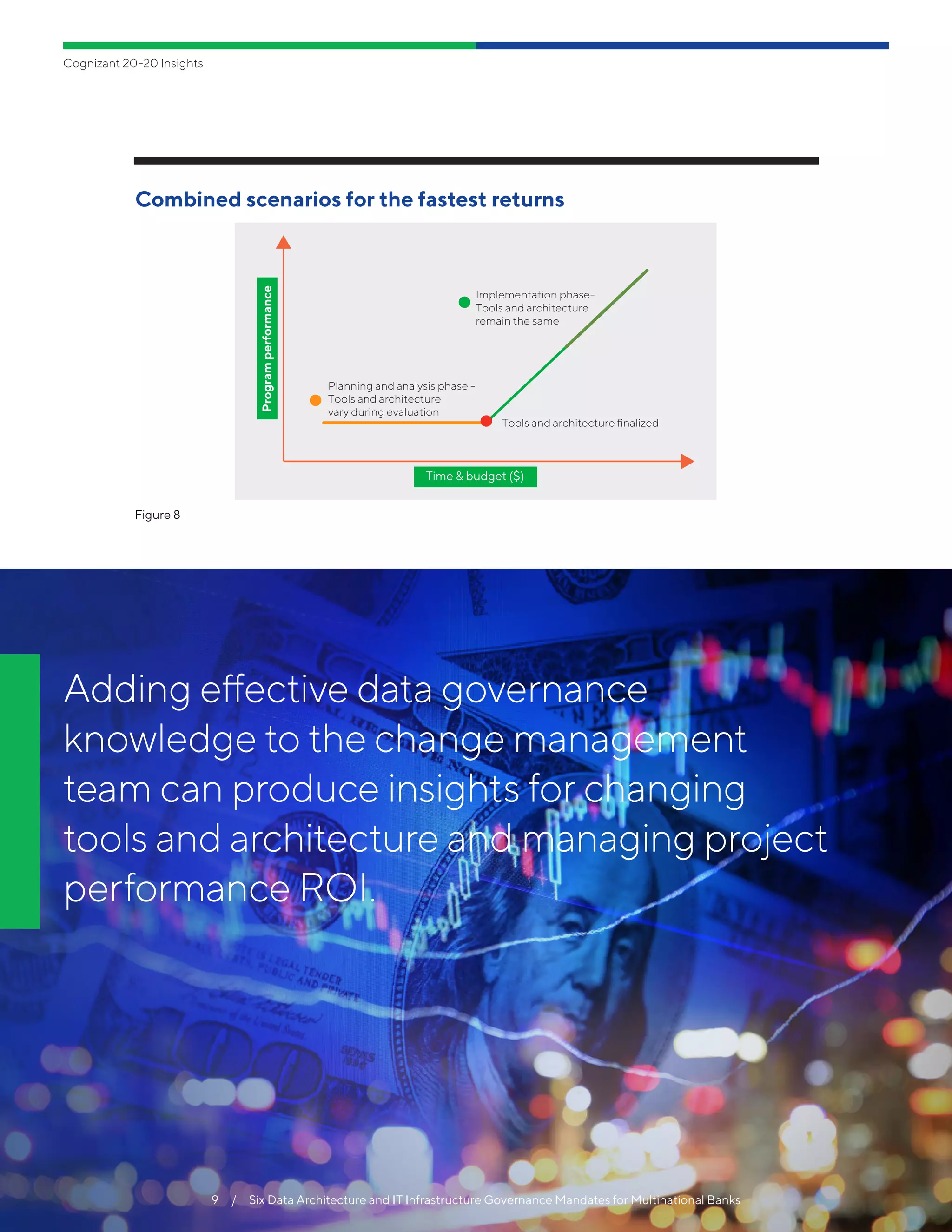
on investment (ROI). Combining scenarios C
and D yields the best and fastest returns, in our
experience (see Figure 8).
Figure 7
Summary view
Programperformance
Time & budget ($)
A B C D
Figure 6
Stepping though program management (desired scenario)
Infrastructure management
framework is consistent
No change request on
infrastructure change
No impact on budget
and delivery timelines
Cognizant 20-20 Insights
9  /  Six Data Architecture and IT Infrastructure Governance Mandates for Multinational Banks
Figure 8
Combined scenarios for the fastest returns
Programperformance
Time & budget ($)
Tools and architecture finalized
Implementation phase-
Tools and architecture
remain the same
Planning and analysis phase -
Tools and architecture
vary during evaluation
Adding effective data governance
knowledge to the change management
team can produce insights for changing
tools and architecture and managing project
performance ROI.
10  /  Six Data Architecture and IT Infrastructure Governance Mandates for Multinational Banks
Cognizant 20-20 Insights
Looking forward
Leveraging governance on data architecture and IT infrastructure using BCBS 239 can help financial firms
make less myopic decisions during a multi-country application rollout, and ensure successful coordination
between strategic and implementation units. Six governance mandates include the following:
1.	 Engage a strong data governance team, early on, that can create and define clear roles and
responsibilities as well as policies and procedures for the target operating model. The team should
be involved before the inception of the data architecture solution so that it can create a strategy around
tools and architecture within acceptable timelines and create guidelines for clear data management
frameworks. In addition, the team can create collaterals to be passed on to each country for local and
group reporting standard processes.
2.	 Finalize the data architecture and IT infrastructure to include the entire technology ecosystem
before implementing reporting solutions. This can help achieve the highest program and project
performances both from solution as well as a budget point of view.
3.	 Create a strategy to deploy and manage an extremely experienced team in the strategic unit of
the solution board to expedite the decision of finalizing the architecture, tools and technologies.
Having experienced members on the team can speed the processes and help to make timely and
efficient decisions while the implementation unit is awaiting the decision on TOM from the strategic
unit.
4.	 Assign a representative of each country manager to update the strategic unit on the situation of
their reporting urgencies and the steps taken by their local team to meet those urgencies.
5.	 In the case of a heavily urgent report rollout, try to create a process for report generation by re-
utilizing existing tools and architecture and get a team ready for manual corrections. This team
can be identified by utilizing the human resources that are not impacted by the urgency reports and is
awaiting the TOM. It is also recommended to have versions documented clearly for any audits.
6.	 Data governance units and business architects are recommended to work closely with program
managers and allocate an overhead budget for the initial period when the data architecture and
IT infrastructure TOM is in the planning phase. The ROI may not meet goals but will pick up once
the TOM and framework is decided. The budget can be spread during the forecast using the approach
detailed above in scenarios two and three and summarized in Figure 8.
Cognizant 20-20 Insights
11  /  Six Data Architecture and IT Infrastructure Governance Mandates for Multinational Banks
References
•• Steven ZoBell, “Why Digital Transformations
Fail: Closing The $900 Billion Hole In
Enterprise Strategy,” Forbes, March 13,
2018, https://www.forbes.com/sites/
forbestechcouncil/2018/03/13/why-digital-
transformations-fail-closing-the-900-billion-
hole-in-enterprise-strategy/#12fc499f7b8b.
•• Pedro Serrador, “Planning is an important
phase for a successful execution of a program.
Without which any program is bound to fail,”
Project Management Institute (PMI) (featured
in 2012 Paper presented at PMI®
Global
Congress 2012—North America, Vancouver,
British Columbia, Canada, https://www.pmi.org/
learning/library/importance-planning-phase-
project-success-6021.
•• Weisman, “A good governance body right
from the start till the end of a program ensures
smooth execution and best ROI,” The Open
Group, 2009, http://archive.opengroup.org/
public/member/proceedings/q209/q209a/
Presentations/weisman_1.pdf.
•• “Principles for effective risk data aggregation
and risk reporting,” Bank for International
Sentiments, January 2013, https://www.bis.org/
publ/bcbs239.pdf.
Endnote
7	 https://en.wikipedia.org/wiki/BCBS_239.
Cognizant 20-20 Insights
12  /  Six Data Architecture and IT Infrastructure Governance Mandates for Multinational Banks
About the authors
Anand Ghosh
Senior Manager, Cognizant Banking & Financial Services Practice
Anand Ghosh is a Senior Manager within Cognizant’s Banking & Financial Services Practice in Benelux.
He provides consulting solutions to financial services in governance, risk and control. He has over 10
years of work experience across the U.S., EMEA and APAC. He is currently focused on helping clients to
build target operating models, set up Centers of Excellence, and align data governance and data quality
frameworks with regulatory and compliance requirements, using modern tools and technology including
big data and robotic process automation. Anand holds an engineering degree from WBUT India, an MBA
degree from Lindenwold University in the U.S. and a big data certification from the Massachusetts Institute
of Technology, Sloan School of Business. He can be reached at Anandamoy.Ghosh@cognizant.com |
www.linkedin.com/in/anand-ghosh-33ab6619/.
Kapil Arora
Architect, Cognizant Artificial Intelligence and Analytics Practice
Kapil Arora is an Architect within Cognizant’s Artificial Intelligence and Analytics Practice in India. He has
more than 12 years of experience in data warehousing and business Intelligence, machine learning and
cloud services. His current interests span artificial Intelligence, machine learning, deep Learning, text
mining and robotics. Kapil earned a bachelor’s of technology in electrical and electronics engineering from
Uttar Pradesh Technical University, Lucknow, India. He can be reached at Kapil.Arora@cognizant.com |
https://linkedin.com/in/Kapil-arora-52939819.
© Copyright 2019, Cognizant. All rights reserved. No part of this document may be reproduced, stored in a retrieval system, transmitted in any form or by any means,electronic, mechanical,
photocopying, recording, or otherwise, without the express written permission from Cognizant. The information contained herein is subject to change without notice. All other trademarks
mentioned herein are the property of their respective owners.
Codex 4626
World Headquarters
500 Frank W. Burr Blvd.
Teaneck, NJ 07666 USA
Phone: +1 201 801 0233
Fax: +1 201 801 0243
Toll Free: +1 888 937 3277
European Headquarters
1 Kingdom Street
Paddington Central
London W2 6BD England
Phone: +44 (0) 20 7297 7600
Fax: +44 (0) 20 7121 0102
India Operations Headquarters
#5/535 Old Mahabalipuram Road
Okkiyam Pettai, Thoraipakkam
Chennai, 600 096 India
Phone: +91 (0) 44 4209 6000
Fax: +91 (0) 44 4209 6060
About Cognizant Banking and Financial Services
Cognizant’s Banking and Financial Services business unit, which includes consumer lending, commercial finance, leasing insurance, cards, payments,
banking, investment banking, wealth management and transaction processing, is the company’s largest industry segment, serving leading financial insti-
tutions in North America, Europe, and Asia-Pacific. These include six out of the top 10 North American financial institutions and nine out of the top
10 European banks. The practice leverages its deep domain and consulting expertise to provide solutions across the entire financial services spectrum,
and enables our clients to manage business transformation challenges, drive revenue and cost optimization, create new capabilities, mitigate risks, com-
ply with regulations, capitalize on new business opportunities, and drive efficiency, effectiveness, innovation and virtualization. For more, please visit
www.cognizant.com/banking-financial-services.
About Cognizant
Cognizant (Nasdaq-100: CTSH) is one of the world’s leading professional services companies, transforming clients’ business, operating and technology
models for the digital era. Our unique industry-based, consultative approach helps clients envision, build and run more innovative and efficient business-
es. Headquartered in the U.S., Cognizant is ranked 193 on the Fortune 500 and is consistently listed among the most admired companies in the world.
Learn how Cognizant helps clients lead with digital at www.cognizant.com or follow us @Cognizant.

Six Data Architecture and IT Infrastructure Governance Mandates for Multinational Banks

  • 1.
    Digital Business Six DataArchitecture and IT Infrastructure Governance Mandates for Multinational Banks Banking and financial services institutions operating in multiple countries and executing digital transformation programs can leverage the principles of BCBS 239 to standardize and stabilize their IT infrastructure and related data architecture processes to realize digital business value across their geographic footprint. Executive Summary Banks are investing in technology and architecture to enhance the digital platforms and reporting processes to: ❙ Respond to frequent regulatory changes, such as General Data Protection Regulation (GDPR), BASEL, Markets in Financial Instruments Directive (MiFID), and the Dodd-Frank Act. ❙❙ Offer enhanced customer satisfaction by introducing new services and products such as automated voice recognition systems, automated product recommendations, chatbots to continue 24x7 customer support, and many more. Harmonize IT systems and automate processes for use of common tools and technologies. ❙❙ Cognizant 20-20 Insights August 2019
  • 2.
    Despite having aclear business case for digital, banks and financial services typically fail to execute IT and organizational change management due to lack of visibility into budget allocation and resource utilization in the planning phase of evaluating the technology landscape. The most common cause of failures occurs when the technology decision-makers lose control of the target architecture model and make random changes in choosing products. This situation leads to an internal disruption and the program goes out of control. Inappropriate budgeting can cause substantial operational losses. A change in products for data architecture and IT infrastructure causes the need to edit builds and can hamper deployments. Overall, there is a high likelihood of having a negative impact on the financial and regulatory reports, which will result in a reputational loss to the firm. Banks are mandated to comply with BCBS 239 Principles of “Data architecture and IT infrastructure” and “Governance.” Aligning the right set of governance at the right time will mitigate the risk of a program manager losing control of the program due to changing tools and architecture during the digital transformation journey. The white paper outlines a proven set of governances as a control mechanism based on our experience with various financial services customers in the U.S. and EMEA. Cognizant 20-20 Insights 2  /  Six Data Architecture and IT Infrastructure Governance Mandates for Multinational Banks
  • 3.
    Cognizant 20-20 Insights 3 /  Six Data Architecture and IT Infrastructure Governance Mandates for Multinational Banks A typical digital program scenario Let’s take an example of a bank that has multiple operational units spread across multiple countries. The bank is running a digital transformation program with aggressive timelines to comply with regulatory mandates and meet market demands. The program management establishes a strategic unit and an implementation unit, which will follow Agile methodology. The strategic unit will be responsible for defining the architectural decisions, identifying tools and technologies, defining policies and procedures for the technology ecosystem, describing business processes and making all strategic decisions. The implementation unit will be responsible for development, testing and delivery of codes, which will align with the target operating model of the strategic unit. The bank has given entities power to generate their local reports while the group reports are managed from bank headquarters. In such a scenario, a major step is assessing a unified “tools and technologies” and “IT infrastructure” on which the projects of the program would run irrespective of any country or business unit they belong to. This will ensure that they have access to the same technology and speak the same language as described in the data management framework. In our experience, local entities want to retain their legacy systems and operating models and build reports in their own way. When the strategic unit chooses the components of the IT infrastructure, the entities are pushed to migrate their builds in the new infrastructure. It becomes very challenging to adapt to a changing infrastructure during the decision phase and eventually migrating to the target operating model. The major challenge is to assess the impacts of changing tools and technologies on project performance and prepare for a more accurate budget and resource allocation. How tools and architecture change impacts program performance Data transformation in regulatory application(s) are heavily dependent on tools and architecture. In our experiences, we have observed the following approaches, and resulting project impact. Tools change, architecture remains the same The strategic unit has participants from local and group entities (each entity is defined as each country that is participating in the program) that influence the decision of the board. In our experience, the program manager overseeing this approach will completely lose control over the environment, and program performance will degrade as time and budget expenditure increases. Overall, the vision of having a unified technology ecosystem is also undermined, leading the program to failure.
  • 4.
    Cognizant 20-20 Insights 4 /  Six Data Architecture and IT Infrastructure Governance Mandates for Multinational Banks These entity representatives are often inclined to a solution that seems comfortable based on their experience. Because of multiple local and group representatives, with multiple views, the decision on identification of tools is typically delayed or changes regularly. When the tools and technology stack changes (as defined by the of strategic unit), the implementation unit is also expected to adapt to those changes in parallel. Figure 1 demonstrates the impact of this scenario on the program performance. In our experience, the program manager overseeing this approach will completely lose control over the environment, and program performance will degrade as time and budget expenditure increases. Overall, the vision of having a unified technology ecosystem is also undermined, leading the program to failure. Architecture changes, tools remain the same In this approach, different project tracks have their own architect -- but these individuals rarely communicate and collaborate with one another or help strategic units decide on final architectural solutions. As a result, the development and testing teams are left waiting for a final architectural solution. Even if they start implementing it, they may be forced to enact constant re-working, as Figure 1 Tools change, architecture same Programperformance Time & budget ($)
  • 5.
    Cognizant 20-20 Insights 5 /  Six Data Architecture and IT Infrastructure Governance Mandates for Multinational Banks architecture change requires incessant change on the same code base (see Figure 2). This approach leads to a decline in program performance. Each project team processes their data in their own individual silo to meet regulatory timelines and does not wait for final architecture approvals. By the time the final standardized architecture is recommended, additional effort is required to plug the solution into the target architecture, which can increase unanticipated budget spikes. At times, the vision of the program becomes clouded in the process. The reason is that the older apps are often hard coded and more difficult to transform to operate in the new architecture. At some point this program will be a failure. Architecture and tools remain the same In this scenario, each local and group stakeholder is provided with a standard architecture, a common set of tools and technologies, and a framework guideline that must be followed. The strategic and implementation units work with a common vision and follow guidelines to execute the program using a common architecture framework (see Figure 3). Figure 2 Tools same, architecture change Programperformance Time & budget ($) Figure 3 Tools same, architecture same Programperformance Time & budget ($)
  • 6.
    Cognizant 20-20 Insights 6 /  Six Data Architecture and IT Infrastructure Governance Mandates for Multinational Banks In this scenario, tools and architecture are aligned before the project starts; it is a win-win situation for all the involved parties. The strategic unit has established a clear vision for creating a standardized architecture, common tools and technologies, and policies to execute projects. It has also documented all steps that are then passed on to implementation units. The implementation unit can refer to the framework for required team collaboration, which allows all participating countries and business units in the program to use the same language when creating reporting solutions and frameworks. Regulatory audits and other oversight can also be conducted much more efficiently with a standardized data architecture that is easily followed by the implementation unit in collaboration with the strategic unit. In our experience with regulatory data warehousing projects in financial services of a diversified asset base in continental Europe, we have seen that firms that maintain a consistent architecture and tools set are those that make progress toward the fastest returns on investment in terms of program performance. In a unified technical ecosystem, the report factories can use the same documentation and coding standards that are shared across all entities. This leads to easier execution and maintainability of software codes. New applications are easier to build and deploy and can be scaled on demand using the same architectural designs and frameworks. As an example, if an organization uses a data modeling tool consistently across the organization and chooses to leverage the same frameworks, then all analytics and reporting tools can use the same nomenclature of an attribute – minimizing the risk of missing any attribute or talking in silos. A set of common language and rules makes data sharing much simpler and enhances the project performance overall. See Figure 4. Figure 4 Modeling success Reduced risk of missing data attributes ABC bank Sweden ABC bank Hungary ABC bank Netherlands ABC bank Belgium Common data modeling tool Reduced risk of of data silos Simpler data sharing between countries Simpler and easy to understand reporting
  • 7.
    7  /  SixData Architecture and IT Infrastructure Governance Mandates for Multinational Banks A bank performing a multi-country reporting rollout has better visibility into its infrastructure requisites once it has installed thorough governance and control on: ❙❙ Sizing of environments and applications (e.g., source systems). ❙❙ Volume and frequency of data delivery of all countries. ❙❙ Infrastructure consistency for all entities. The infrastructure management framework will remain same throughout the program, such as the server size and versions of operating system and tools. Thus, the program will not be affected since the infrastructure cost will remain the same as predicted. In addition, there will not be any negative impact on the project delivery timeline such as deployment change requests due to a changing infrastructure. Architecture and tools both change In this approach, the representatives of each entity in the solution board, along with the final approver of the solution board, fail to align on an IT and data infrastructure on architecture as well as a definitive set of tools and technologies to execute the program. An inordinate amount of time is then spent on evaluating the architecture and the tool sets. The implementation team must wait for the IT infrastructure, on which they can develop the solutions, to be defined (see Figure 5). This is the most undesired scenario for any organization, in which the projects never kick off and remain stalled in the planning stages. A lack of output ends in program failure. Cognizant 20-20 Insights Figure 5 Tools change, architecture changes Programperformance Time & budget ($)
  • 8.
    8  /  SixData Architecture and IT Infrastructure Governance Mandates for Multinational Banks Next steps: Establishing a target operating model Banks often operate in multiple countries and therefore need to roll out local and group compliance reports. Given aggressive timelines to meet market and regulatory demands, organizations often need to kick off programs from scratch or revamp existing IT Infrastructures and set up new standards of the target operating model (TOM). Figure 7 provides a summary view. Often, banks put priority on defining the IT ecosystem and then define the policies and procedures. We recommend early adoption of governance and to install controls on decision- making and the establishment of data and IT infrastructure processes to observe how to raise program performance and achieve faster return on investment (ROI). Combining scenarios C and D yields the best and fastest returns, in our experience (see Figure 8). Figure 7 Summary view Programperformance Time & budget ($) A B C D Figure 6 Stepping though program management (desired scenario) Infrastructure management framework is consistent No change request on infrastructure change No impact on budget and delivery timelines Cognizant 20-20 Insights
  • 9.
    Cognizant 20-20 Insights 9 /  Six Data Architecture and IT Infrastructure Governance Mandates for Multinational Banks Figure 8 Combined scenarios for the fastest returns Programperformance Time & budget ($) Tools and architecture finalized Implementation phase- Tools and architecture remain the same Planning and analysis phase - Tools and architecture vary during evaluation Adding effective data governance knowledge to the change management team can produce insights for changing tools and architecture and managing project performance ROI.
  • 10.
    10  /  SixData Architecture and IT Infrastructure Governance Mandates for Multinational Banks Cognizant 20-20 Insights Looking forward Leveraging governance on data architecture and IT infrastructure using BCBS 239 can help financial firms make less myopic decisions during a multi-country application rollout, and ensure successful coordination between strategic and implementation units. Six governance mandates include the following: 1. Engage a strong data governance team, early on, that can create and define clear roles and responsibilities as well as policies and procedures for the target operating model. The team should be involved before the inception of the data architecture solution so that it can create a strategy around tools and architecture within acceptable timelines and create guidelines for clear data management frameworks. In addition, the team can create collaterals to be passed on to each country for local and group reporting standard processes. 2. Finalize the data architecture and IT infrastructure to include the entire technology ecosystem before implementing reporting solutions. This can help achieve the highest program and project performances both from solution as well as a budget point of view. 3. Create a strategy to deploy and manage an extremely experienced team in the strategic unit of the solution board to expedite the decision of finalizing the architecture, tools and technologies. Having experienced members on the team can speed the processes and help to make timely and efficient decisions while the implementation unit is awaiting the decision on TOM from the strategic unit. 4. Assign a representative of each country manager to update the strategic unit on the situation of their reporting urgencies and the steps taken by their local team to meet those urgencies. 5. In the case of a heavily urgent report rollout, try to create a process for report generation by re- utilizing existing tools and architecture and get a team ready for manual corrections. This team can be identified by utilizing the human resources that are not impacted by the urgency reports and is awaiting the TOM. It is also recommended to have versions documented clearly for any audits. 6. Data governance units and business architects are recommended to work closely with program managers and allocate an overhead budget for the initial period when the data architecture and IT infrastructure TOM is in the planning phase. The ROI may not meet goals but will pick up once the TOM and framework is decided. The budget can be spread during the forecast using the approach detailed above in scenarios two and three and summarized in Figure 8.
  • 11.
    Cognizant 20-20 Insights 11 /  Six Data Architecture and IT Infrastructure Governance Mandates for Multinational Banks References •• Steven ZoBell, “Why Digital Transformations Fail: Closing The $900 Billion Hole In Enterprise Strategy,” Forbes, March 13, 2018, https://www.forbes.com/sites/ forbestechcouncil/2018/03/13/why-digital- transformations-fail-closing-the-900-billion- hole-in-enterprise-strategy/#12fc499f7b8b. •• Pedro Serrador, “Planning is an important phase for a successful execution of a program. Without which any program is bound to fail,” Project Management Institute (PMI) (featured in 2012 Paper presented at PMI® Global Congress 2012—North America, Vancouver, British Columbia, Canada, https://www.pmi.org/ learning/library/importance-planning-phase- project-success-6021. •• Weisman, “A good governance body right from the start till the end of a program ensures smooth execution and best ROI,” The Open Group, 2009, http://archive.opengroup.org/ public/member/proceedings/q209/q209a/ Presentations/weisman_1.pdf. •• “Principles for effective risk data aggregation and risk reporting,” Bank for International Sentiments, January 2013, https://www.bis.org/ publ/bcbs239.pdf. Endnote 7 https://en.wikipedia.org/wiki/BCBS_239.
  • 12.
    Cognizant 20-20 Insights 12 /  Six Data Architecture and IT Infrastructure Governance Mandates for Multinational Banks About the authors Anand Ghosh Senior Manager, Cognizant Banking & Financial Services Practice Anand Ghosh is a Senior Manager within Cognizant’s Banking & Financial Services Practice in Benelux. He provides consulting solutions to financial services in governance, risk and control. He has over 10 years of work experience across the U.S., EMEA and APAC. He is currently focused on helping clients to build target operating models, set up Centers of Excellence, and align data governance and data quality frameworks with regulatory and compliance requirements, using modern tools and technology including big data and robotic process automation. Anand holds an engineering degree from WBUT India, an MBA degree from Lindenwold University in the U.S. and a big data certification from the Massachusetts Institute of Technology, Sloan School of Business. He can be reached at Anandamoy.Ghosh@cognizant.com | www.linkedin.com/in/anand-ghosh-33ab6619/. Kapil Arora Architect, Cognizant Artificial Intelligence and Analytics Practice Kapil Arora is an Architect within Cognizant’s Artificial Intelligence and Analytics Practice in India. He has more than 12 years of experience in data warehousing and business Intelligence, machine learning and cloud services. His current interests span artificial Intelligence, machine learning, deep Learning, text mining and robotics. Kapil earned a bachelor’s of technology in electrical and electronics engineering from Uttar Pradesh Technical University, Lucknow, India. He can be reached at Kapil.Arora@cognizant.com | https://linkedin.com/in/Kapil-arora-52939819.
  • 13.
    © Copyright 2019,Cognizant. All rights reserved. No part of this document may be reproduced, stored in a retrieval system, transmitted in any form or by any means,electronic, mechanical, photocopying, recording, or otherwise, without the express written permission from Cognizant. The information contained herein is subject to change without notice. All other trademarks mentioned herein are the property of their respective owners. Codex 4626 World Headquarters 500 Frank W. Burr Blvd. Teaneck, NJ 07666 USA Phone: +1 201 801 0233 Fax: +1 201 801 0243 Toll Free: +1 888 937 3277 European Headquarters 1 Kingdom Street Paddington Central London W2 6BD England Phone: +44 (0) 20 7297 7600 Fax: +44 (0) 20 7121 0102 India Operations Headquarters #5/535 Old Mahabalipuram Road Okkiyam Pettai, Thoraipakkam Chennai, 600 096 India Phone: +91 (0) 44 4209 6000 Fax: +91 (0) 44 4209 6060 About Cognizant Banking and Financial Services Cognizant’s Banking and Financial Services business unit, which includes consumer lending, commercial finance, leasing insurance, cards, payments, banking, investment banking, wealth management and transaction processing, is the company’s largest industry segment, serving leading financial insti- tutions in North America, Europe, and Asia-Pacific. These include six out of the top 10 North American financial institutions and nine out of the top 10 European banks. The practice leverages its deep domain and consulting expertise to provide solutions across the entire financial services spectrum, and enables our clients to manage business transformation challenges, drive revenue and cost optimization, create new capabilities, mitigate risks, com- ply with regulations, capitalize on new business opportunities, and drive efficiency, effectiveness, innovation and virtualization. For more, please visit www.cognizant.com/banking-financial-services. About Cognizant Cognizant (Nasdaq-100: CTSH) is one of the world’s leading professional services companies, transforming clients’ business, operating and technology models for the digital era. Our unique industry-based, consultative approach helps clients envision, build and run more innovative and efficient business- es. Headquartered in the U.S., Cognizant is ranked 193 on the Fortune 500 and is consistently listed among the most admired companies in the world. Learn how Cognizant helps clients lead with digital at www.cognizant.com or follow us @Cognizant.