Radioimagistic
Diagnosis used in
Ophthalmology
USMF “Nicolae
Testemițanu”
⯈Any anatomical structure of the human
body is not comparable to face, which is
important for an external evaluation and
self-esteem as aesthetically as personally.
⯈The role of imaging in ophthalmology for
an early and correct diagnosis is difficult
to sub estimate - this medical discipline
has the central role in ophthalmic
pathology.
RADIOIMAGISTIC METHODS
USED IN OPHTHALMOLOGY
1. Radiography conventional (standard) and
digital
2. CT scan
3. MRI
4. USG
⯈ Conventional and digital Radiography allows to
determine the complications of orbital trauma :
orbital wall fracture with or without the
involvement of orbital fissure, foreign intraorbital
body, hemophthalmus (bleeding) and orbital
emphysema.
⯈ CT scan specify the severity of orbital fractures
and injuries of juxtaposed soft tissues.
⯈ MRI is useful for determining of the pathologies
of soft tissues and detection of radiotransparent
foreign bodies.
Basic Principles
⯈ The radiological investigation represent one of the most
important investigation in whole medical imaging,
especially in cranio-cerebral and face trauma, also in
the trauma of orbits. The final succes depend on right
investigation, especially in simetric position of patient.
⯈ In case of non-collaborative patient, or in severe cranio-
cerebral trauma, the effectiveness of radiological exam
will be less.
The radiological investigation
Basic projections: anterior, posterior, lateral, axial.
The investigation usually start with frontal projection
(anterio- posterior) and lateral pojection (from trauma side).
During the investigation the radiologist can make other types
of projections (it’s depend on the character of craniocerebral
trauma).
The anterior projection: visualisation of orbits, nose
walls, maxillary sinus, maxilla and mandible.
The possibility to exclude the extraorbitar lesions.
⯈ The radiography of orbits shows a metallic foreign body 1x2mm
into the left orbit.
⯈ The radiography of orbits shows a metallic foreign body
3x10 mm into posttraumatic pseudochist in the left
orbit.
CLINICAL CASE : INTRAORBITAR
FOREIGN BODIES
Orbital trauma by firearm. Bullet localized by metallic sonda .
Simultaneously reveal an orbital floor fracture in left orbit .
The bullet was extracted, eyeball was preserved that organ.
Focht method
It is an ascheletical X-rays exam that uses 2 films. During the
investigation the patient is those who hold the cassette.
Before the investigation the affected eye will be anesthetized
with solution of 0.5% lidocaine. The x-rays pass trough
temporal region perpendicular to the films.
1. eyeball 2. cornea 3. superior eyelid 4. inferior eyelid
⯈ Focht method- allows to see the foreign body into the
anterior part of eyeball
⯈ Focht method shows the localization of foreign body into
the iris
Komberg- Baltin method
⯈the localization is done by an ophthalmological
aluminum or plastic prosthesis with metal parts
situated at 3, 6, 9, 12 hours.
⯈The prosthesis is installed at the external surface
of the affected eye.
⯈An antero-posterior radiographic exam.
⯈ In projection of left orbit is found a metallic foreign
body, placed between 2 and 5 h, into th eyeball.
The method of locating foreign
bodies with sonde.
Fixing perpendicular the sonde in the center of the
eye cornea ( that will be anesthetized with dicaine).
An antero-posterior and lateral radiographic exam is
maked.
Metallic foreign body 5x7 mm, localized outside of eyeball,
into the nervus opticus.
Large penetrating trauma
suffered, that did not
allow the application of
prosthesis to perform
radiography by Komberg
method. Try to locating
with sonda.
1x2 mm metallic foreign
body placed into the
eyeball.
CLINICAL
CASE
⯈ Multiple foreign bodies. Corn shrapnel in left orbit, but
eyeball was not involved in the process.
Lateral
projection.
Nasal bone
fracture with
fragments
displacement
following a
sports injury.
Lateral
projection.
Comminuti
ng nasal
bones
fracture
after a fall
as a result
of syncope.
Fracture of nasal bones
CT - NASAL SEPTUM FRACTURE
Bilateral nasal bone fracture (arrows). The fragments are
moved to the right, indicating trauma from the left. *
Indicates orbital emphysema (fracture of maxillary sinus
wall).
Posttraumatic nasal deformity. The angulation of cartilaginous
portion of the nasal septum. Red arrows - blood in the nasal
cavity. * - emphysema in preseptalis region, anterior of
eyeball.
ORBITAL FRACTURE
Blow-out fracture
Fractured bone is moved outside the
orbit, most commonly affects the lower
wall, but can affect any wall. Up to 30%
of patients had ocular lesions associated.
Clinical: enophtalmia, diplopia,
hypoesthesia. Imaging: m. Rectus
inferior has a round shape. CT: coronary
sections in bone and soft tissue window
demonstrates fracture of inferior orbital
wall. Inferior rectus muscle is "trapped
in hole”. The red stars correspond at
posttraumatic edema
Fracture blow-in. Fractured bone is displaced toward the orbit, may involve
any wall. Clinical: exophtalm, reduced visual acuity (trauma to the eyeball,
optic neuropathy, optic nerve canal fracture).
In orbital trauma by dropping: the fracture of inferior orbital wall with
fragment displacement (red arrow) and medial rectus muscle dislocation
(blue arrows), retrobulbar hematoma (blue stars). H – hemosinusitis ( blood
in sinus). O - optic nerve.
GRAVE’S OPHTHALMOPATHY
ORBITAL LYMPHOMA
Inflammation/Infection
Orbital pseudotumor
Thyroid ophthalmopathy
Orbital cellulitis
Abscess
Neoplastic
Lymphoma
Dermoid
Metastases
Vascular
Hemangioma
Vascular
malformatio
ns
MR
I
RETROBULBAR HEMANGIOMA
(MRI)
Inflammation/Infection
Orbital pseudotumor
Thyroid ophthalmopathy
Orbital cellulitis
Abscess
Neoplastic
Lymphoma
Dermoid
Metastases
Vascular
Hemangioma
Vascular
malformatio
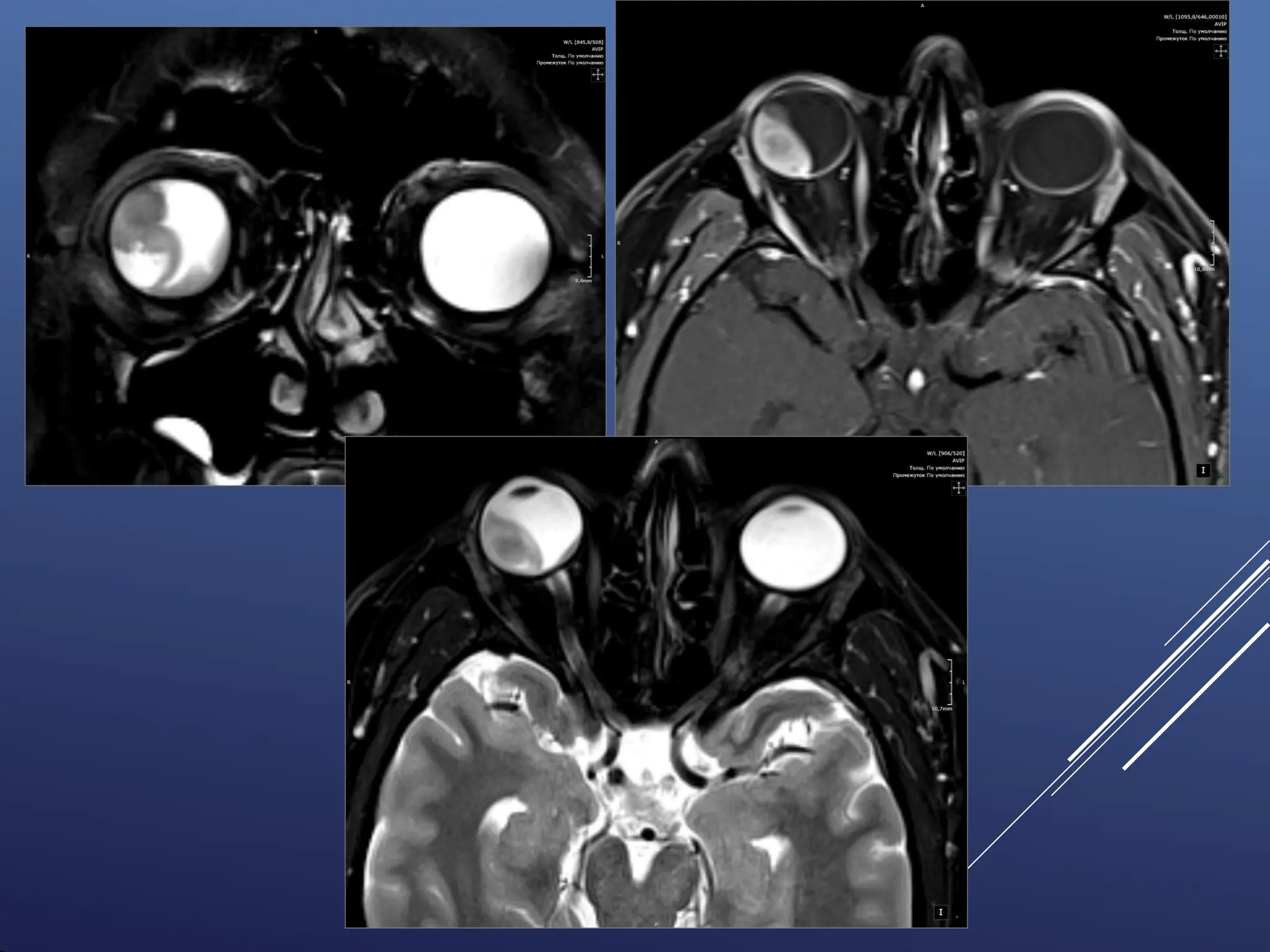
Trauma of left eyeball
Retrobulbar tumor
Intraorbita
r tumor
with retinal
detachme
Tumor of
orbit
THANK YOU FOR
ATENTION

Imaging-in-oftalmology radiology mbbs.pptx

  • 1.
  • 2.
    ⯈Any anatomical structureof the human body is not comparable to face, which is important for an external evaluation and self-esteem as aesthetically as personally. ⯈The role of imaging in ophthalmology for an early and correct diagnosis is difficult to sub estimate - this medical discipline has the central role in ophthalmic pathology.
  • 3.
    RADIOIMAGISTIC METHODS USED INOPHTHALMOLOGY 1. Radiography conventional (standard) and digital 2. CT scan 3. MRI 4. USG
  • 4.
    ⯈ Conventional anddigital Radiography allows to determine the complications of orbital trauma : orbital wall fracture with or without the involvement of orbital fissure, foreign intraorbital body, hemophthalmus (bleeding) and orbital emphysema. ⯈ CT scan specify the severity of orbital fractures and injuries of juxtaposed soft tissues. ⯈ MRI is useful for determining of the pathologies of soft tissues and detection of radiotransparent foreign bodies.
  • 5.
    Basic Principles ⯈ Theradiological investigation represent one of the most important investigation in whole medical imaging, especially in cranio-cerebral and face trauma, also in the trauma of orbits. The final succes depend on right investigation, especially in simetric position of patient. ⯈ In case of non-collaborative patient, or in severe cranio- cerebral trauma, the effectiveness of radiological exam will be less.
  • 6.
    The radiological investigation Basicprojections: anterior, posterior, lateral, axial. The investigation usually start with frontal projection (anterio- posterior) and lateral pojection (from trauma side). During the investigation the radiologist can make other types of projections (it’s depend on the character of craniocerebral trauma).
  • 7.
    The anterior projection:visualisation of orbits, nose walls, maxillary sinus, maxilla and mandible. The possibility to exclude the extraorbitar lesions.
  • 8.
    ⯈ The radiographyof orbits shows a metallic foreign body 1x2mm into the left orbit.
  • 9.
    ⯈ The radiographyof orbits shows a metallic foreign body 3x10 mm into posttraumatic pseudochist in the left orbit.
  • 10.
    CLINICAL CASE :INTRAORBITAR FOREIGN BODIES Orbital trauma by firearm. Bullet localized by metallic sonda . Simultaneously reveal an orbital floor fracture in left orbit . The bullet was extracted, eyeball was preserved that organ.
  • 11.
    Focht method It isan ascheletical X-rays exam that uses 2 films. During the investigation the patient is those who hold the cassette. Before the investigation the affected eye will be anesthetized with solution of 0.5% lidocaine. The x-rays pass trough temporal region perpendicular to the films.
  • 12.
    1. eyeball 2.cornea 3. superior eyelid 4. inferior eyelid ⯈ Focht method- allows to see the foreign body into the anterior part of eyeball
  • 13.
    ⯈ Focht methodshows the localization of foreign body into the iris
  • 14.
    Komberg- Baltin method ⯈thelocalization is done by an ophthalmological aluminum or plastic prosthesis with metal parts situated at 3, 6, 9, 12 hours. ⯈The prosthesis is installed at the external surface of the affected eye. ⯈An antero-posterior radiographic exam.
  • 15.
    ⯈ In projectionof left orbit is found a metallic foreign body, placed between 2 and 5 h, into th eyeball.
  • 16.
    The method oflocating foreign bodies with sonde. Fixing perpendicular the sonde in the center of the eye cornea ( that will be anesthetized with dicaine). An antero-posterior and lateral radiographic exam is maked.
  • 17.
    Metallic foreign body5x7 mm, localized outside of eyeball, into the nervus opticus.
  • 18.
    Large penetrating trauma suffered,that did not allow the application of prosthesis to perform radiography by Komberg method. Try to locating with sonda. 1x2 mm metallic foreign body placed into the eyeball.
  • 19.
    CLINICAL CASE ⯈ Multiple foreignbodies. Corn shrapnel in left orbit, but eyeball was not involved in the process.
  • 21.
    Lateral projection. Nasal bone fracture with fragments displacement followinga sports injury. Lateral projection. Comminuti ng nasal bones fracture after a fall as a result of syncope. Fracture of nasal bones
  • 22.
    CT - NASALSEPTUM FRACTURE Bilateral nasal bone fracture (arrows). The fragments are moved to the right, indicating trauma from the left. * Indicates orbital emphysema (fracture of maxillary sinus wall).
  • 23.
    Posttraumatic nasal deformity.The angulation of cartilaginous portion of the nasal septum. Red arrows - blood in the nasal cavity. * - emphysema in preseptalis region, anterior of eyeball.
  • 24.
    ORBITAL FRACTURE Blow-out fracture Fracturedbone is moved outside the orbit, most commonly affects the lower wall, but can affect any wall. Up to 30% of patients had ocular lesions associated. Clinical: enophtalmia, diplopia, hypoesthesia. Imaging: m. Rectus inferior has a round shape. CT: coronary sections in bone and soft tissue window demonstrates fracture of inferior orbital wall. Inferior rectus muscle is "trapped in hole”. The red stars correspond at posttraumatic edema
  • 25.
    Fracture blow-in. Fracturedbone is displaced toward the orbit, may involve any wall. Clinical: exophtalm, reduced visual acuity (trauma to the eyeball, optic neuropathy, optic nerve canal fracture). In orbital trauma by dropping: the fracture of inferior orbital wall with fragment displacement (red arrow) and medial rectus muscle dislocation (blue arrows), retrobulbar hematoma (blue stars). H – hemosinusitis ( blood in sinus). O - optic nerve.
  • 26.
  • 28.
    ORBITAL LYMPHOMA Inflammation/Infection Orbital pseudotumor Thyroidophthalmopathy Orbital cellulitis Abscess Neoplastic Lymphoma Dermoid Metastases Vascular Hemangioma Vascular malformatio ns
  • 29.
  • 30.
    RETROBULBAR HEMANGIOMA (MRI) Inflammation/Infection Orbital pseudotumor Thyroidophthalmopathy Orbital cellulitis Abscess Neoplastic Lymphoma Dermoid Metastases Vascular Hemangioma Vascular malformatio
  • 31.
  • 32.
  • 34.
  • 35.
  • 36.