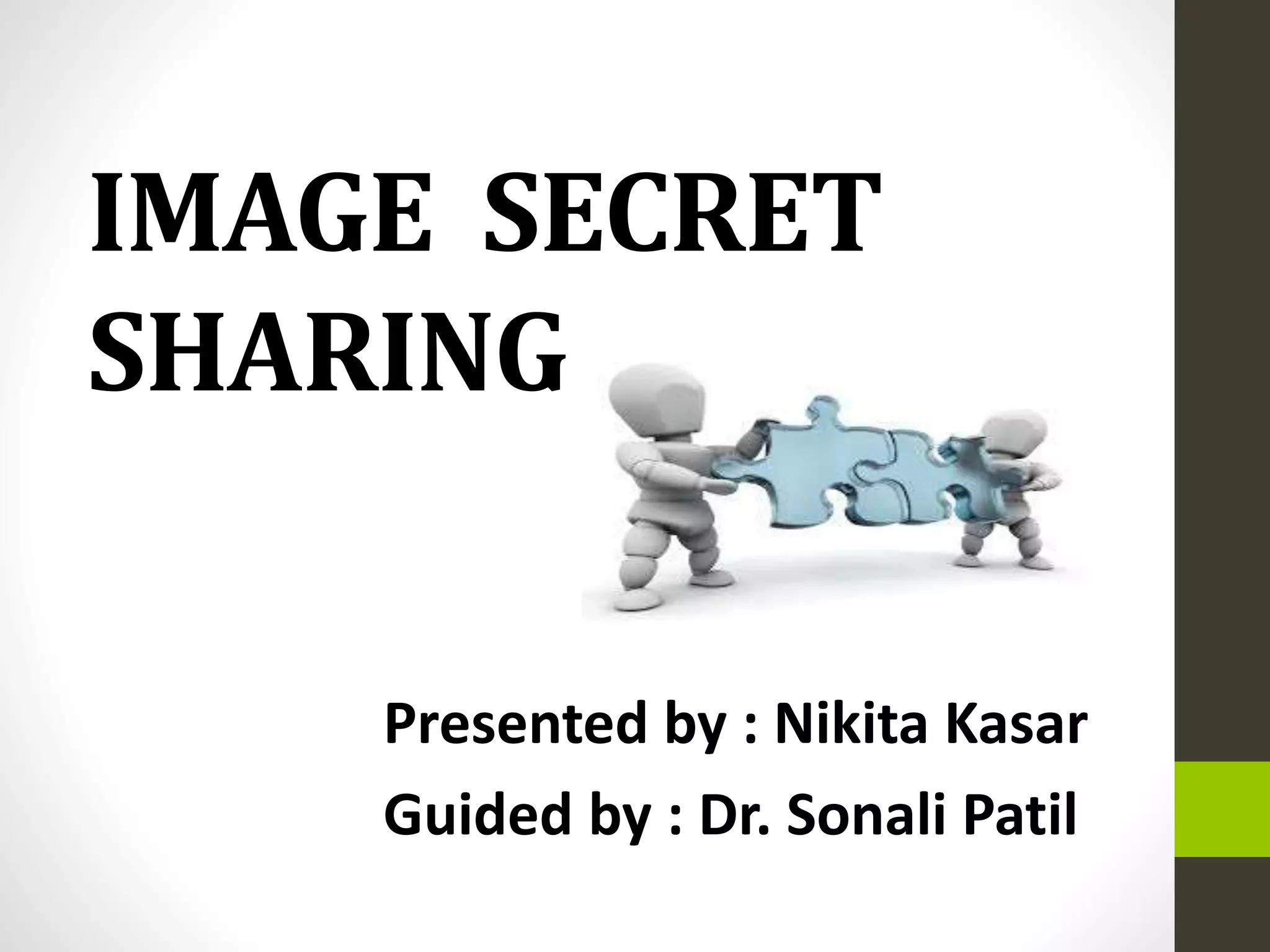
IMAGE SECRET
SHARING
Presented by : Nikita Kasar
Guided by : Dr. Sonali Patil
INTRODUCTION
• Secret sharing is a technique for protecting
sensitive data, such as cryptographic keys.
• Secret sharing is used in modern
cryptography to lower the risks associated
with compromised data.
• The first secret sharing schemes were
proposed by Shamir and Blakley in 1979.
PROBLEM STATEMENT
To provide security to images
using secret sharing algorithm.
OBJECTIVE
•To study different image secret
sharing algorithms.
• To secure data transmission in
networks which are used for
exchange of private images.
MOTIVATION
• If we do not process or hide
our secret information, the information
might be stolen by the hackers easily.
• The information is kept in a single
information-carrier. If the information-
carrier is lost or destroyed by an attacker,
the secret information might disappear.
WHY SECRET SHARING?
• Encryption – Single point failure.
• Decryption key may be lost.
• Encrypted content is corrupted during
transmission.
To address these reliability problems , an
image secret sharing scheme is good
alternative to remedy such vulnerabilities.
LITERATURE SURVEY
-------SHAMIR’S ALGORITHM------
• ● Based on polynomial interpolation
• ● It's (k, n) threshold scheme
• ● Dealer D distribute a secret s to n
players
• ● At least k participant's are required to
construct a secret s
THRESHOLD SCHEME
• Divide some data D into pieces/shadow
images D1,D2,……Dn in such a way that :
• i) Knowledge of any k or more Di pieces
makes D easily computable.
• Ii)Knowledge of any k-1 or fewer Di pieces
leaves D completely undetermined(in the
sense that all its possible values are
equally likely.)
Secret sharing in images
• Each pixel value of a secret image is a secret
message.
• We use the secret image to generate shadow
images and only require part of these shadow
images to reconstruct the secret image.
• The shadow images should not reveal any
information about the image.
• Ideally, each shadow image should look like
random noise so that anyone without the
permission won’t be able to get any information
about a secret image
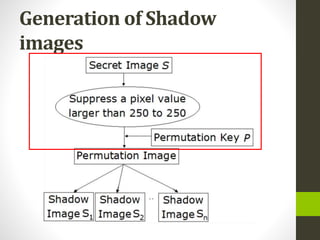
Generation of Shadow
images
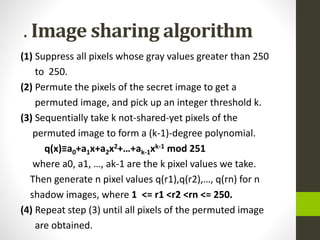
. Image sharing algorithm
(1) Suppress all pixels whose gray values greater than 250
to 250.
(2) Permute the pixels of the secret image to get a
permuted image, and pick up an integer threshold k.
(3) Sequentially take k not-shared-yet pixels of the
permuted image to form a (k-1)-degree polynomial.
q(x)≡a0+a1x+a2x2+…+ak-1xk-1 mod 251
where a0, a1, …, ak-1 are the k pixel values we take.
Then generate n pixel values q(r1),q(r2),…, q(rn) for n
shadow images, where 1 <= r1 <r2 <rn <= 250.
(4) Repeat step (3) until all pixels of the permuted image
are obtained.
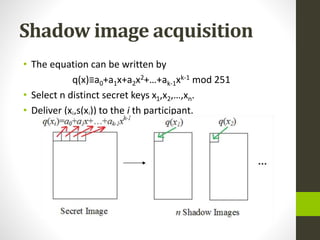
Shadow image acquisition
• The equation can be written by
q(x)≡a0+a1x+a2x2+…+ak-1xk-1 mod 251
• Select n distinct secret keys x1,x2,…,xn.
• Deliver (xi,s(xi)) to the i th participant.
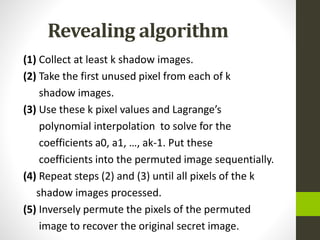
Revealing algorithm
(1) Collect at least k shadow images.
(2) Take the first unused pixel from each of k
shadow images.
(3) Use these k pixel values and Lagrange’s
polynomial interpolation to solve for the
coefficients a0, a1, …, ak-1. Put these
coefficients into the permuted image sequentially.
(4) Repeat steps (2) and (3) until all pixels of the k
shadow images processed.
(5) Inversely permute the pixels of the permuted
image to recover the original secret image.
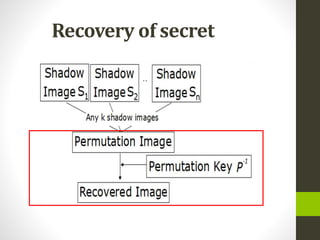
Recovery of secret
ADVANTAGES
• The Shamir’s secret sharing scheme has a good
abstract foundation which provides an excellent
framework for proofs and applications.
• Shares can be easily added or removed without
affecting other shares.
• It is easy to change shares , keeping the same
secret.
• It is possible to provide more than 1 share per
individual.
DISADVANTAGE
• The Shamir-based method utilizes a scheme of
Lagrange polynomial interpolation to recover
the secret image from k out of n shadow image
generated from an original secret image.
• This method might expose some image features
in the shadow images without preprocessing the
secret image.
APPLICATIONS
• Medical applications such as tele diagnosis
require information exchange over insecure
networks.
• Password generation using shares.
• Generating shares by director of bank for the
bank’s vault unlocking code
APPLICATIONS
• ● Key Escrow/ Key Backup
• ● Used to build other cryptographic
primitives
• ● Secure multi party computation
• ● Electronic voting system
CONCLUSION& FUTURE SCOPE
- Share highly sensitive information
- Secret cannot be revealed with (k-1)
shares
- Secure storage
-Use of Watermarking
&Steganography
REFERENCES
• A. Shamir, “How to share a secret,” Communications of the
ACM, Vol. 22, No.11, 612613, 1979.
• C.C. Thien and J.C. Lin, “Secret image sharing,” Computer &
Graphics, Vol.26, No.1, 765-7710, 2002.
• “An Image Secret Sharing Method”,Li Bai Saroj Biswas ECE
Department Temple University Philadelphia, PA, U.S.A.
lbai@temple.edu
• A STUDY ON SECRET IMAGE SHARING
Ming-Hong Tsai1 and Chaur-Chin Chen2 1,2Department of
Computer Science, National Tsing Hua University, Hsinchu
30013, Taiwan 2Institute of Information Systems & Applications,
National Tsing Hua University, Hsinchu, Taiwan
Image secret sharing using Shamir's Algorithm

Image secret sharing using Shamir's Algorithm

  • 1.
    IMAGE SECRET SHARING Presented by: Nikita Kasar Guided by : Dr. Sonali Patil
  • 2.
    INTRODUCTION • Secret sharingis a technique for protecting sensitive data, such as cryptographic keys. • Secret sharing is used in modern cryptography to lower the risks associated with compromised data. • The first secret sharing schemes were proposed by Shamir and Blakley in 1979.
  • 3.
    PROBLEM STATEMENT To providesecurity to images using secret sharing algorithm.
  • 4.
    OBJECTIVE •To study differentimage secret sharing algorithms. • To secure data transmission in networks which are used for exchange of private images.
  • 5.
    MOTIVATION • If wedo not process or hide our secret information, the information might be stolen by the hackers easily. • The information is kept in a single information-carrier. If the information- carrier is lost or destroyed by an attacker, the secret information might disappear.
  • 6.
  • 7.
    • Encryption –Single point failure. • Decryption key may be lost. • Encrypted content is corrupted during transmission. To address these reliability problems , an image secret sharing scheme is good alternative to remedy such vulnerabilities.
  • 8.
    LITERATURE SURVEY -------SHAMIR’S ALGORITHM------ •● Based on polynomial interpolation • ● It's (k, n) threshold scheme • ● Dealer D distribute a secret s to n players • ● At least k participant's are required to construct a secret s
  • 9.
    THRESHOLD SCHEME • Dividesome data D into pieces/shadow images D1,D2,……Dn in such a way that : • i) Knowledge of any k or more Di pieces makes D easily computable. • Ii)Knowledge of any k-1 or fewer Di pieces leaves D completely undetermined(in the sense that all its possible values are equally likely.)
  • 10.
    Secret sharing inimages • Each pixel value of a secret image is a secret message. • We use the secret image to generate shadow images and only require part of these shadow images to reconstruct the secret image. • The shadow images should not reveal any information about the image. • Ideally, each shadow image should look like random noise so that anyone without the permission won’t be able to get any information about a secret image
  • 11.
  • 12.
    . Image sharingalgorithm (1) Suppress all pixels whose gray values greater than 250 to 250. (2) Permute the pixels of the secret image to get a permuted image, and pick up an integer threshold k. (3) Sequentially take k not-shared-yet pixels of the permuted image to form a (k-1)-degree polynomial. q(x)≡a0+a1x+a2x2+…+ak-1xk-1 mod 251 where a0, a1, …, ak-1 are the k pixel values we take. Then generate n pixel values q(r1),q(r2),…, q(rn) for n shadow images, where 1 <= r1 <r2 <rn <= 250. (4) Repeat step (3) until all pixels of the permuted image are obtained.
  • 13.
    Shadow image acquisition •The equation can be written by q(x)≡a0+a1x+a2x2+…+ak-1xk-1 mod 251 • Select n distinct secret keys x1,x2,…,xn. • Deliver (xi,s(xi)) to the i th participant.
  • 14.
    Revealing algorithm (1) Collectat least k shadow images. (2) Take the first unused pixel from each of k shadow images. (3) Use these k pixel values and Lagrange’s polynomial interpolation to solve for the coefficients a0, a1, …, ak-1. Put these coefficients into the permuted image sequentially. (4) Repeat steps (2) and (3) until all pixels of the k shadow images processed. (5) Inversely permute the pixels of the permuted image to recover the original secret image.
  • 15.
  • 16.
    ADVANTAGES • The Shamir’ssecret sharing scheme has a good abstract foundation which provides an excellent framework for proofs and applications. • Shares can be easily added or removed without affecting other shares. • It is easy to change shares , keeping the same secret. • It is possible to provide more than 1 share per individual.
  • 17.
    DISADVANTAGE • The Shamir-basedmethod utilizes a scheme of Lagrange polynomial interpolation to recover the secret image from k out of n shadow image generated from an original secret image. • This method might expose some image features in the shadow images without preprocessing the secret image.
  • 18.
    APPLICATIONS • Medical applicationssuch as tele diagnosis require information exchange over insecure networks. • Password generation using shares. • Generating shares by director of bank for the bank’s vault unlocking code
  • 19.
    APPLICATIONS • ● KeyEscrow/ Key Backup • ● Used to build other cryptographic primitives • ● Secure multi party computation • ● Electronic voting system
  • 20.
    CONCLUSION& FUTURE SCOPE -Share highly sensitive information - Secret cannot be revealed with (k-1) shares - Secure storage -Use of Watermarking &Steganography
  • 21.
    REFERENCES • A. Shamir,“How to share a secret,” Communications of the ACM, Vol. 22, No.11, 612613, 1979. • C.C. Thien and J.C. Lin, “Secret image sharing,” Computer & Graphics, Vol.26, No.1, 765-7710, 2002. • “An Image Secret Sharing Method”,Li Bai Saroj Biswas ECE Department Temple University Philadelphia, PA, U.S.A. lbai@temple.edu • A STUDY ON SECRET IMAGE SHARING Ming-Hong Tsai1 and Chaur-Chin Chen2 1,2Department of Computer Science, National Tsing Hua University, Hsinchu 30013, Taiwan 2Institute of Information Systems & Applications, National Tsing Hua University, Hsinchu, Taiwan