COPY-ROTATE-MOVE FORGERY
DETECTION BASED ON SPATIAL
DOMAIN
Sondos M. Fadl, Noura A. Semary, and Mohiy M. Hadhoud
Faculty of Computers and Information, Menofia University, Egypt
{sondos.magdy,noura.samri,mmhadhoud}@ci.menofia.edu.eg
Introduction
Related works
Objectives
Proposed method
Experiment results
Conclusions and future work
AGENDA
INTRODUCTION
As image is better than thousands of words, World Wide Web
nowadays contains a large amount of digital images used for
effective communication process.
It becomes very trivial for professionals or non-professionals to
edit any pre-existing photographs by using freely available
image editing tools, such as Photoshop.
INTRODUCTION
INTRODUCTION
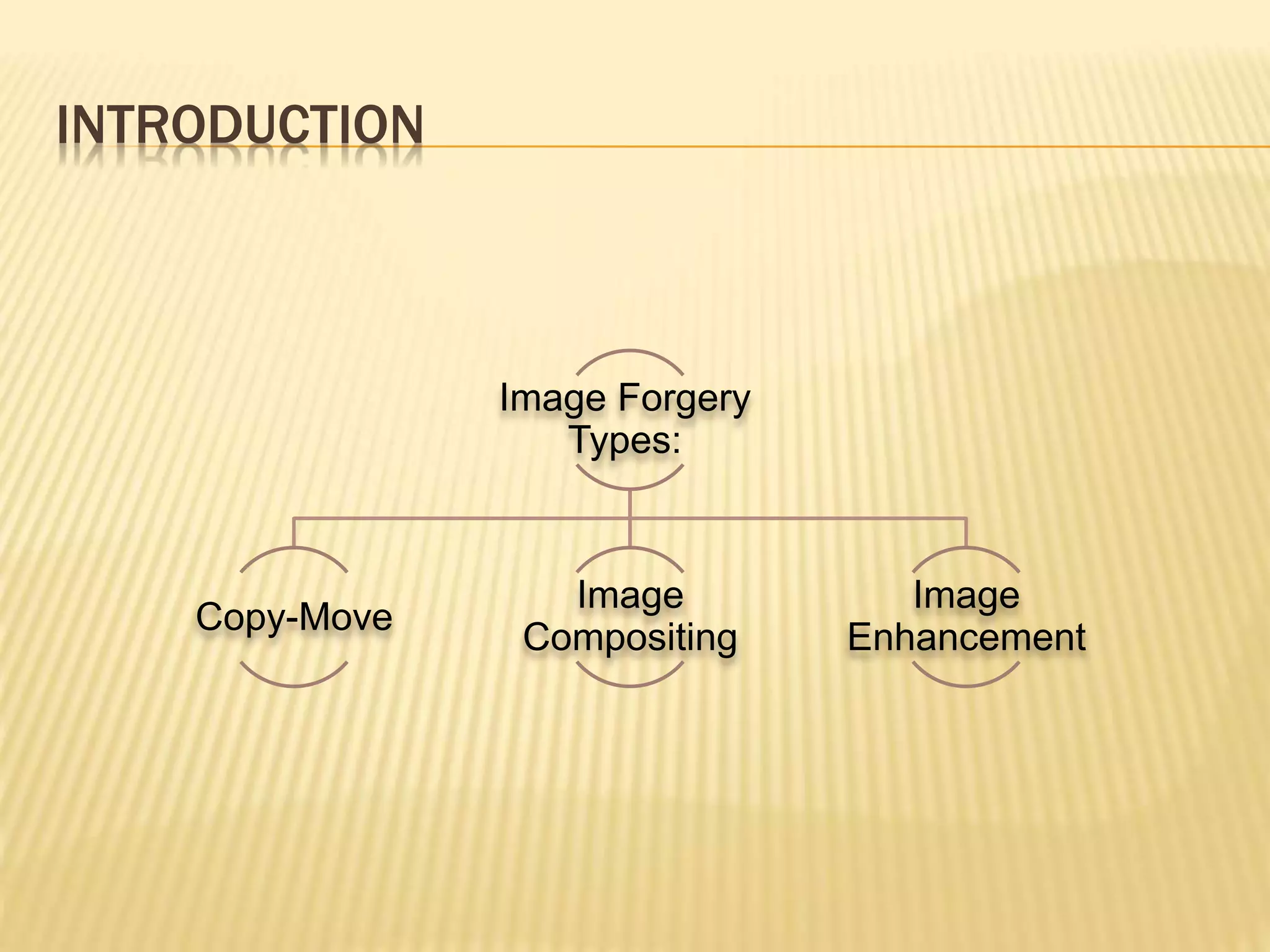
Image Forgery
Types:
Copy-Move
Image
Compositing
Image
Enhancement
INTRODUCTION
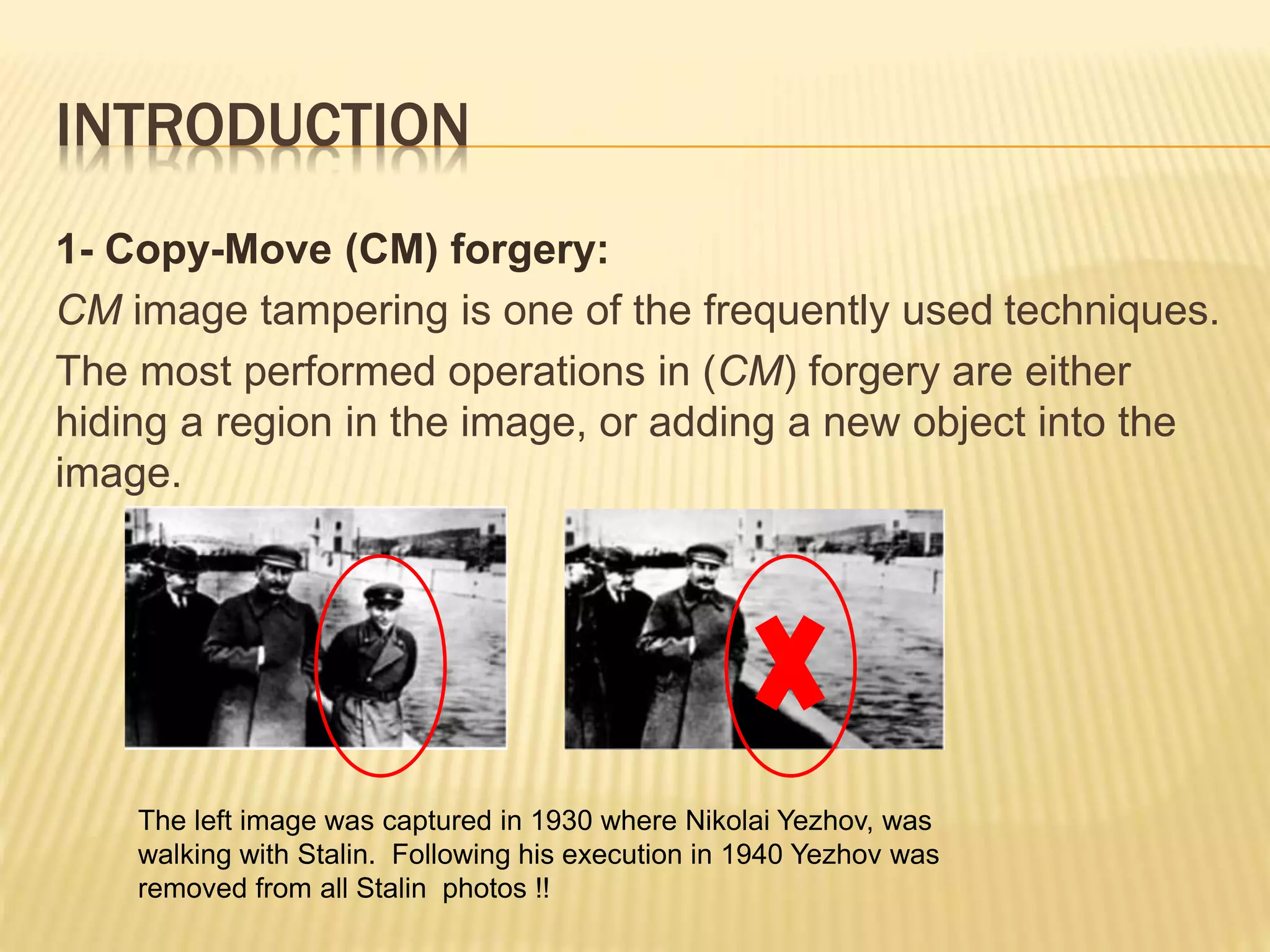
1- Copy-Move (CM) forgery:
CM image tampering is one of the frequently used techniques.
The most performed operations in (CM) forgery are either
hiding a region in the image, or adding a new object into the
image.
The left image was captured in 1930 where Nikolai Yezhov, was
walking with Stalin. Following his execution in 1940 Yezhov was
removed from all Stalin photos !!
INTRODUCTION
2- Image compositing :
that mixes between two or more different images.
3- Image enhancement:
such as blurring, contrast or brightness alteration etc.
Example of image compositing.
Example of image enhancement.
INTRODUCTION
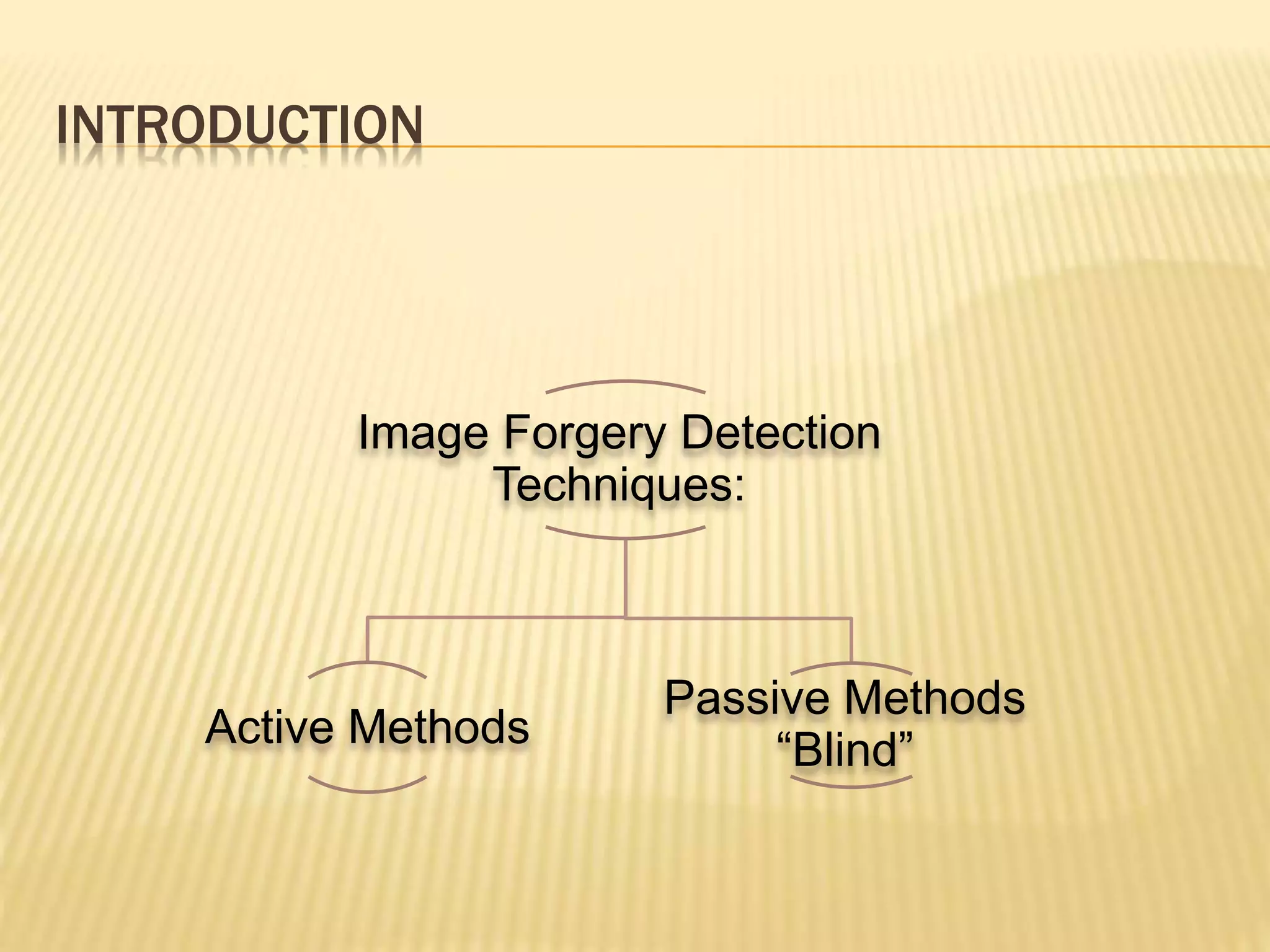
Image Forgery Detection
Techniques:
Active Methods
Passive Methods
“Blind”
1- Active methods such as watermarking depend on prior
information about the original image that in many cases is
not available.
2- Passive or blind methods not depend on prior information
about the original image, it needs only forgery image.
INTRODUCTION
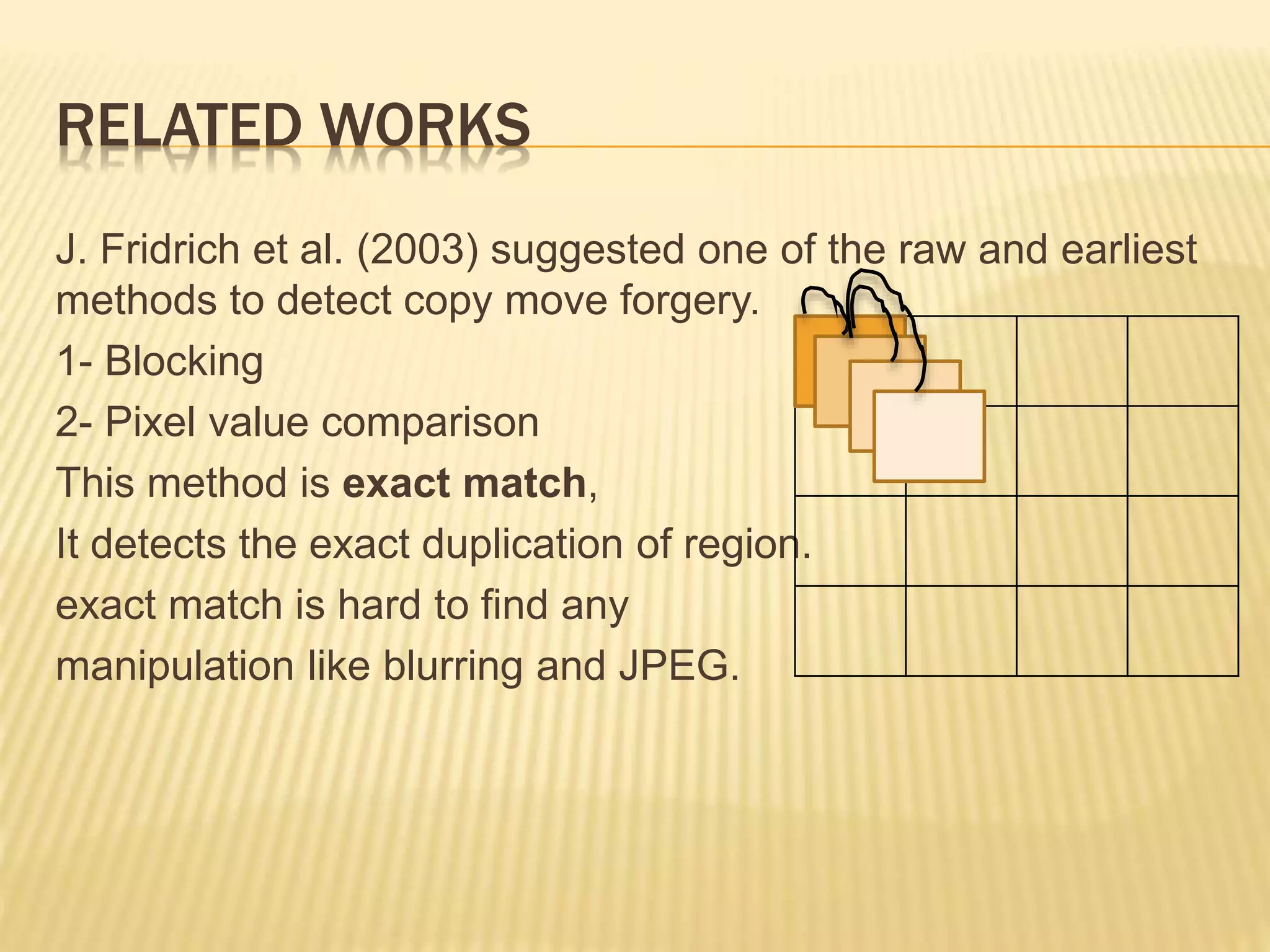
J. Fridrich et al. (2003) suggested one of the raw and earliest
methods to detect copy move forgery.
1- Blocking
2- Pixel value comparison
This method is exact match,
It detects the exact duplication of region.
exact match is hard to find any
manipulation like blurring and JPEG.
RELATED WORKS
Y. Huang et al. (2011) : Another method called robust match
is suggested in which instead of pixel value comparison “exact
match” quantized DCT coefficients are matched.
This method can detect type of manipulations such as JPEG
compression and Gaussian blurring. However the above
method fails for any type of geometric transformations of the
block such as rotation, scaling etc.
RELATED WORKS
RELATED WORKS
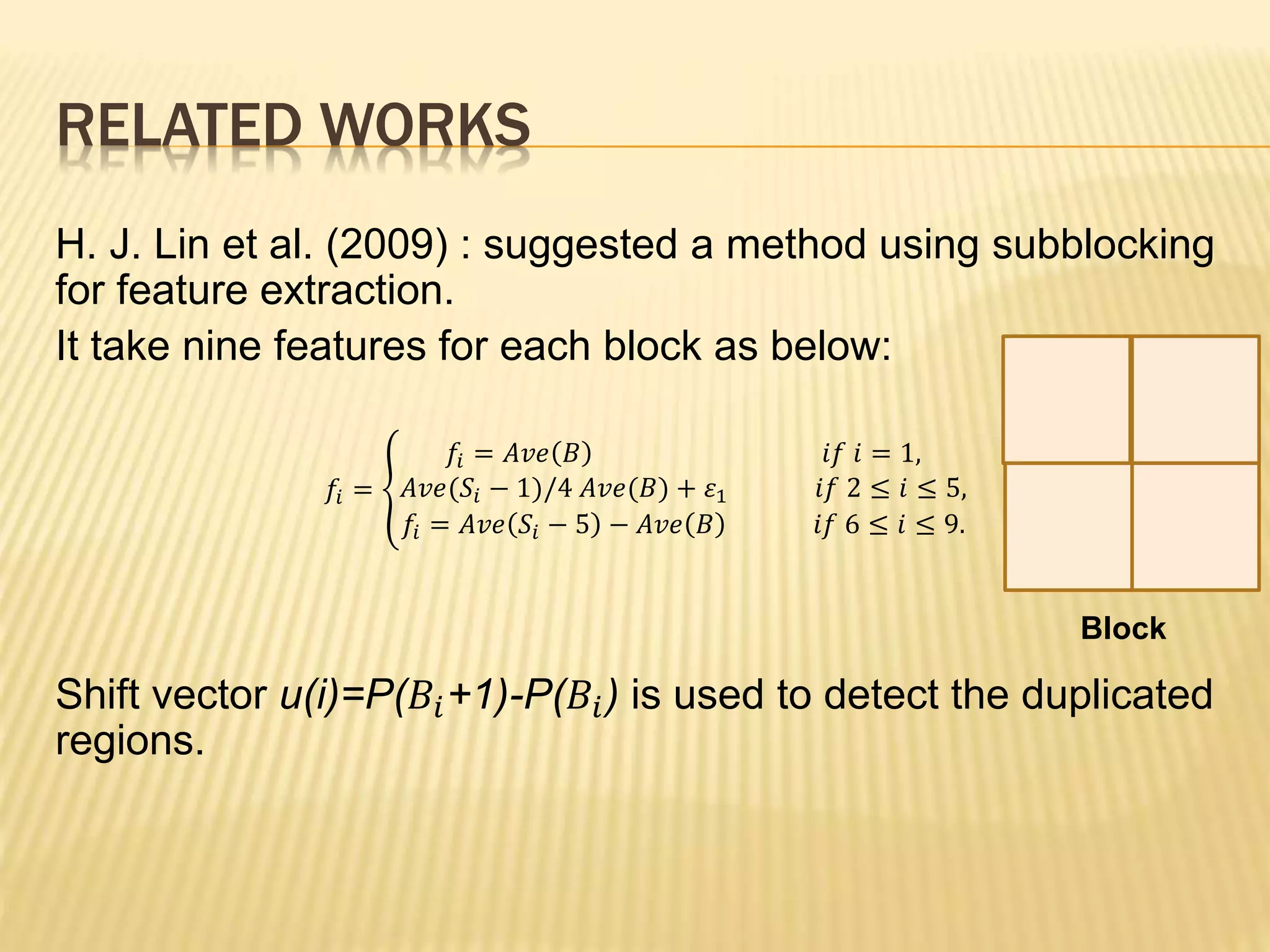
H. J. Lin et al. (2009) : suggested a method using subblocking
for feature extraction.
It take nine features for each block as below:
𝑓𝑖 =
𝑓𝑖 = 𝐴𝑣𝑒 𝐵 𝑖𝑓 𝑖 = 1,
𝐴𝑣𝑒(𝑆𝑖 − 1)/4 𝐴𝑣𝑒(𝐵) + 𝜀1 𝑖𝑓 2 ≤ 𝑖 ≤ 5,
𝑓𝑖 = 𝐴𝑣𝑒 𝑆𝑖 − 5 − 𝐴𝑣𝑒 𝐵 𝑖𝑓 6 ≤ 𝑖 ≤ 9.
Shift vector u(i)=P(𝐵𝑖+1)-P(𝐵𝑖) is used to detect the duplicated
regions.
Block
RELATED WORKS
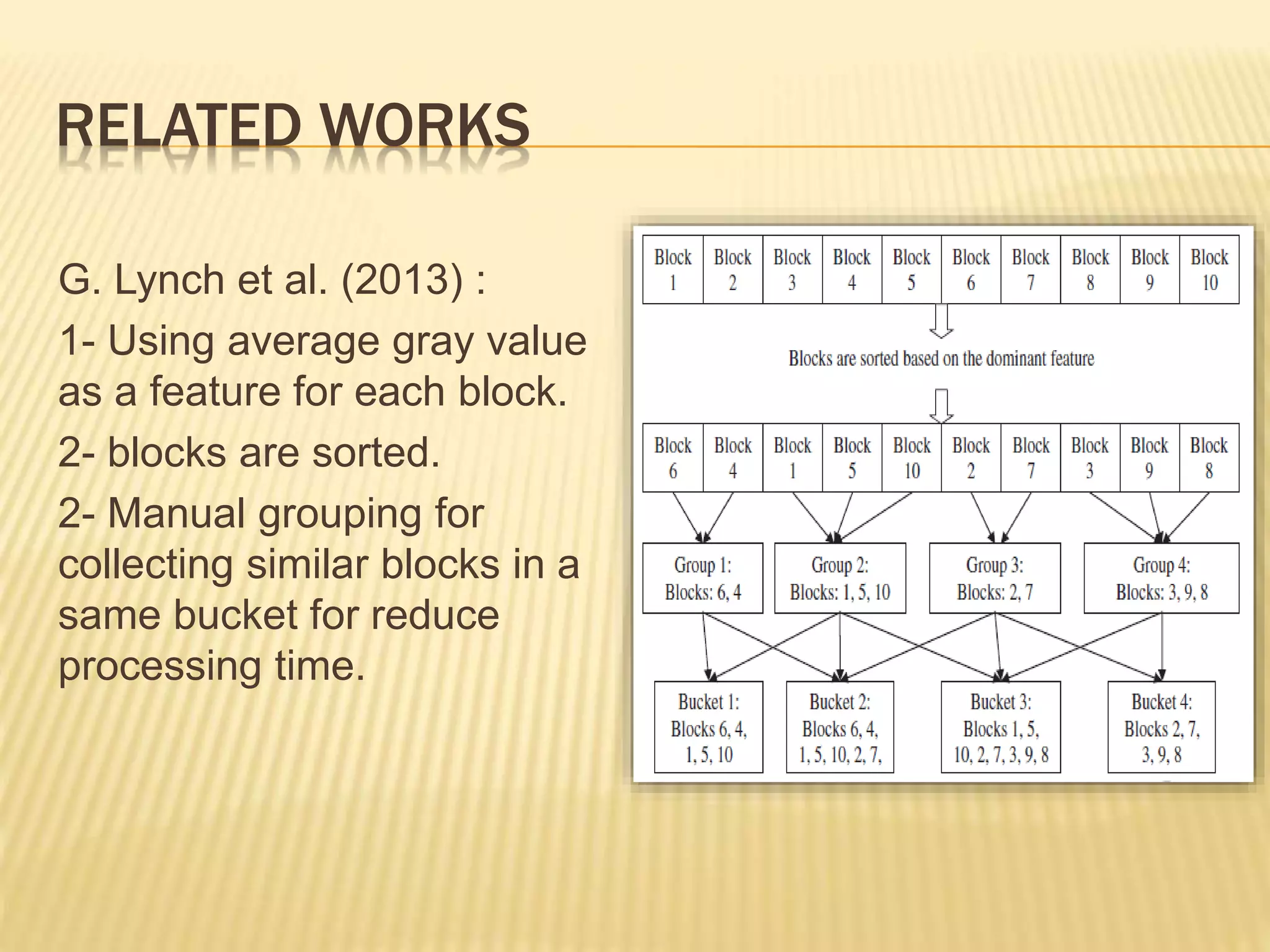
G. Lynch et al. (2013) :
1- Using average gray value
as a feature for each block.
2- blocks are sorted.
2- Manual grouping for
collecting similar blocks in a
same bucket for reduce
processing time.
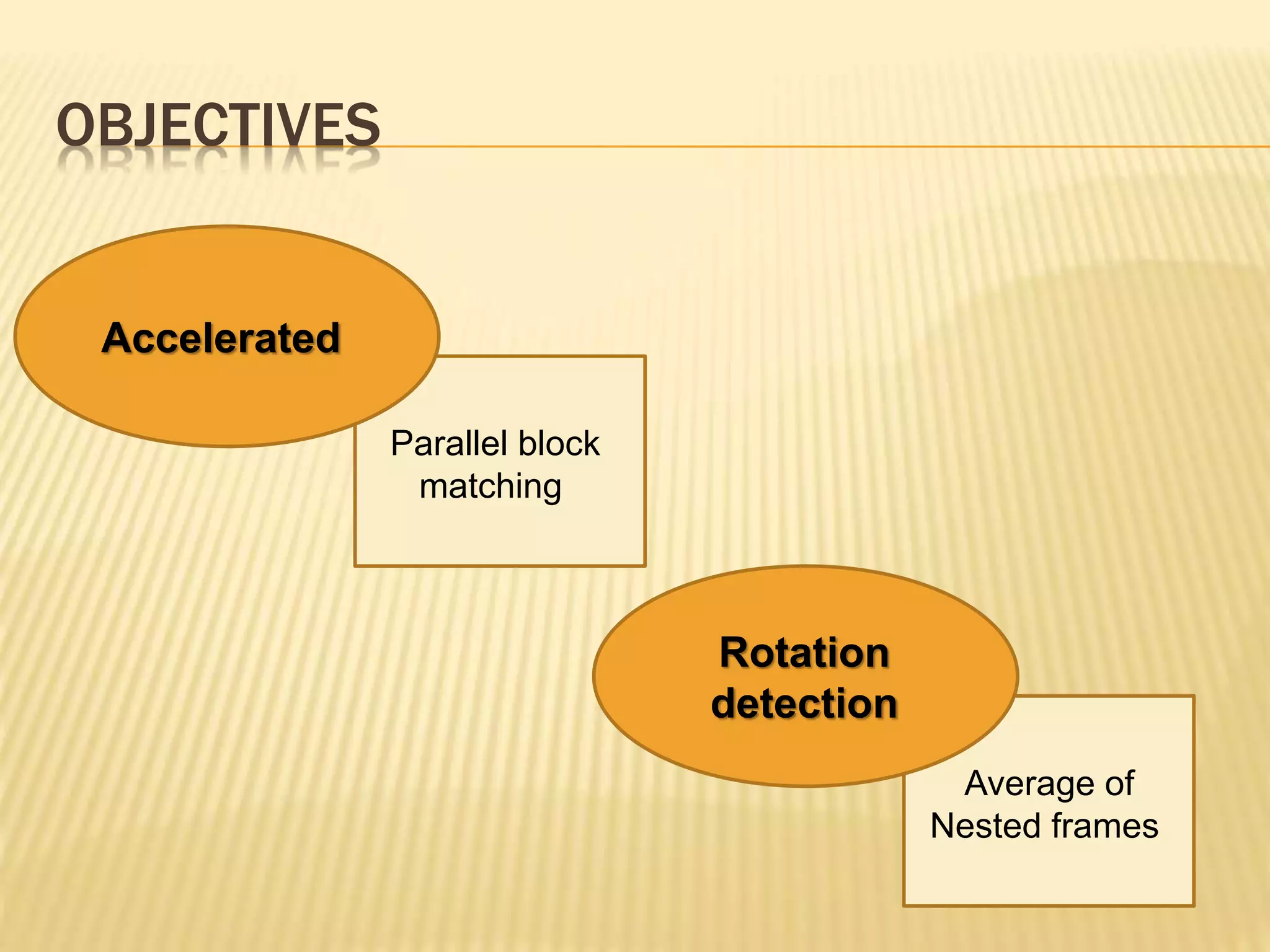
OBJECTIVES
Parallel block
matching
Average of
Nested frames
Rotation
detection
Accelerated
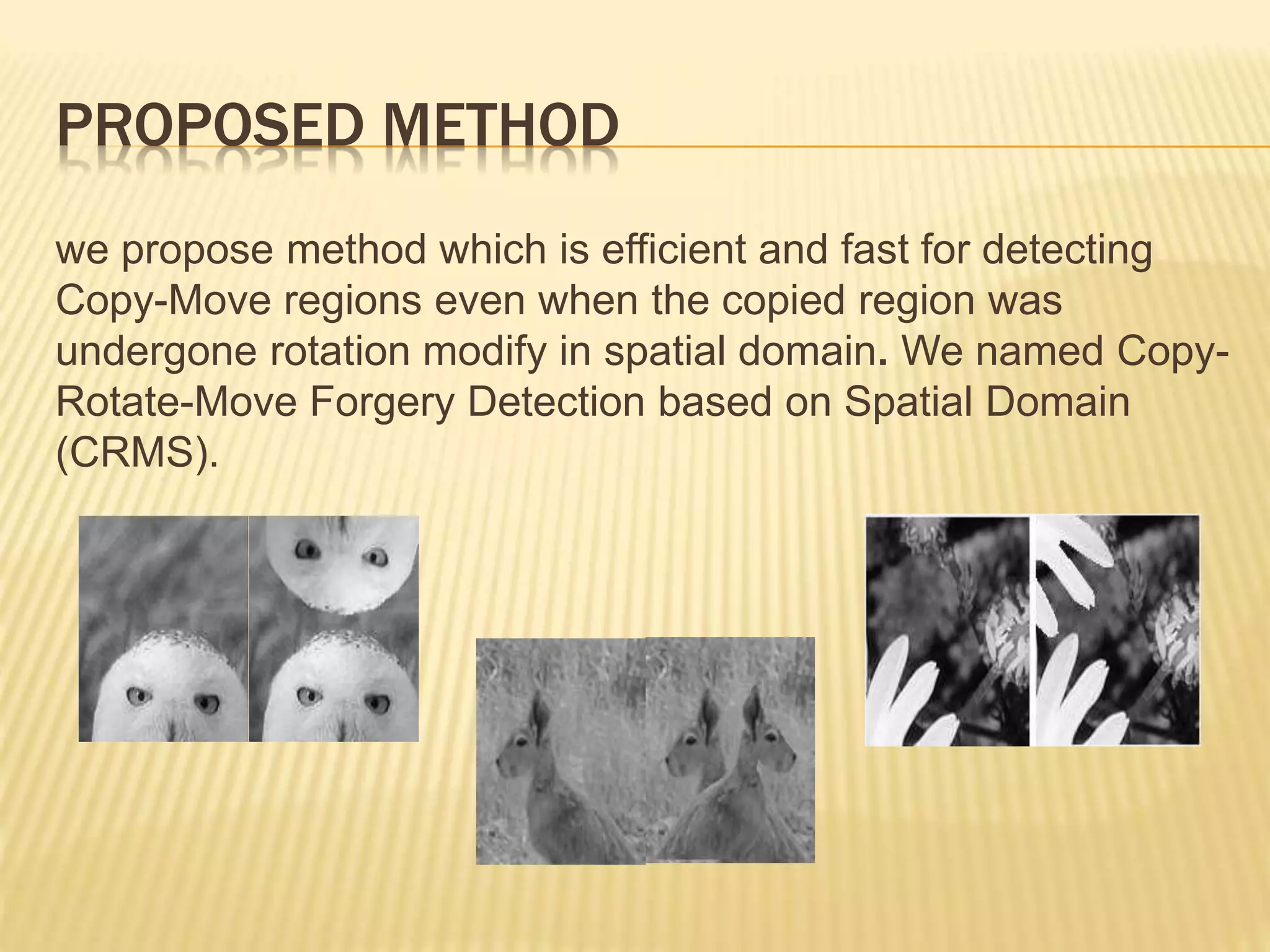
we propose method which is efficient and fast for detecting
Copy-Move regions even when the copied region was
undergone rotation modify in spatial domain. We named Copy-
Rotate-Move Forgery Detection based on Spatial Domain
(CRMS).
PROPOSED METHOD
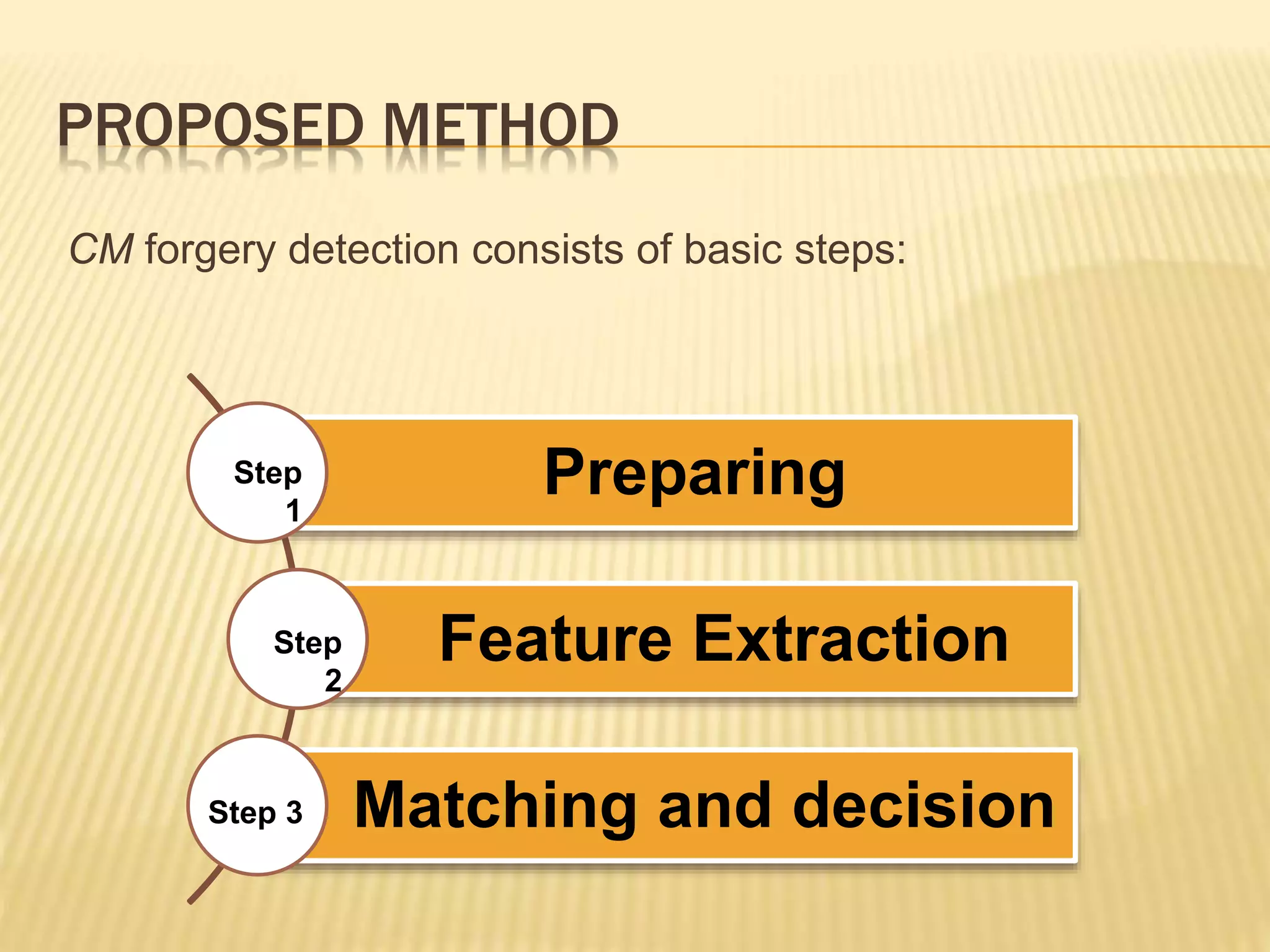
CM forgery detection consists of basic steps:
PROPOSED METHOD
Preparing
Feature Extraction
Matching and decision
Step
1
Step
2
Step 3
PROPOSED METHOD
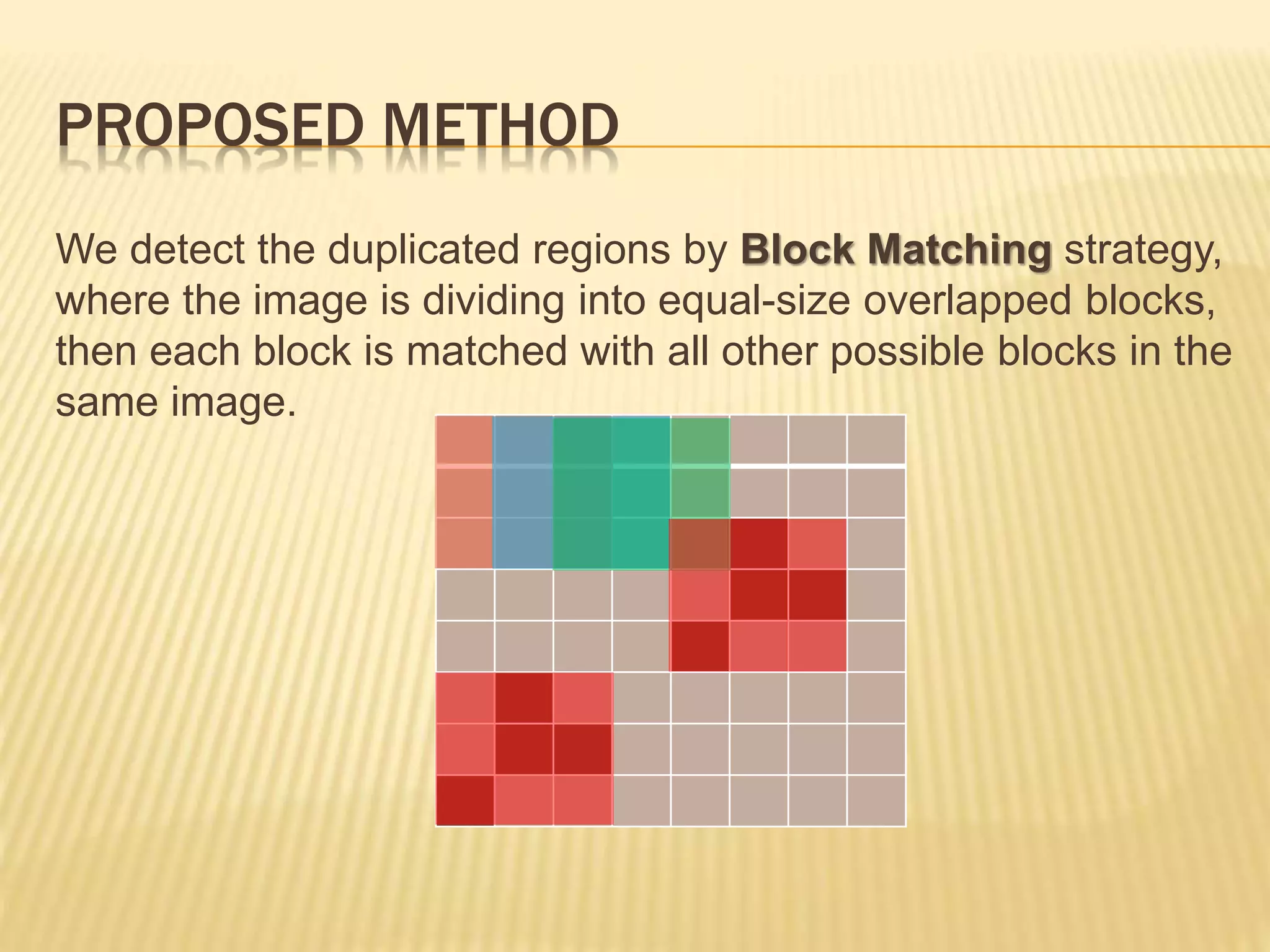
We detect the duplicated regions by Block Matching strategy,
where the image is dividing into equal-size overlapped blocks,
then each block is matched with all other possible blocks in the
same image.
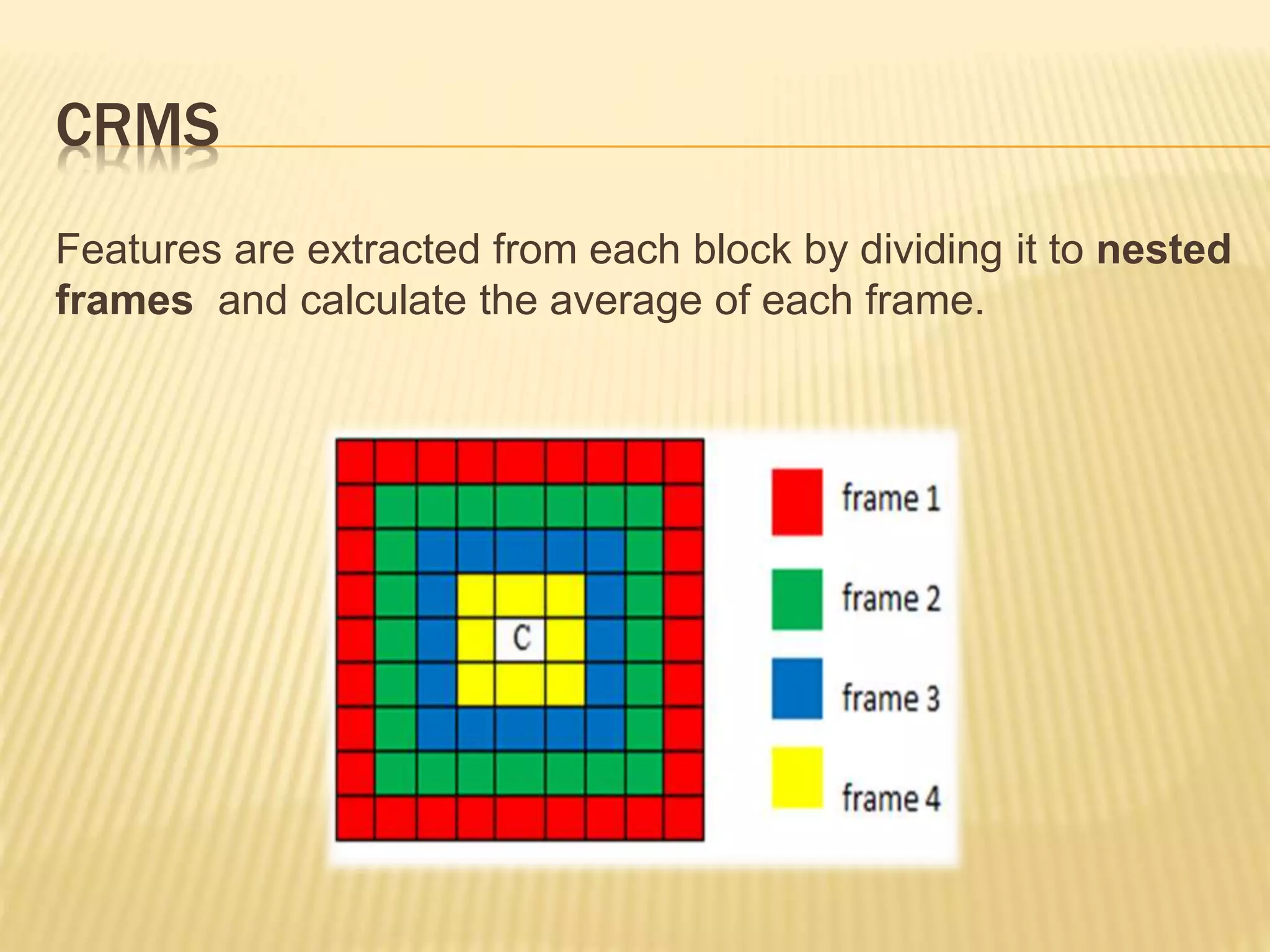
Features are extracted from each block by dividing it to nested
frames and calculate the average of each frame.
CRMS
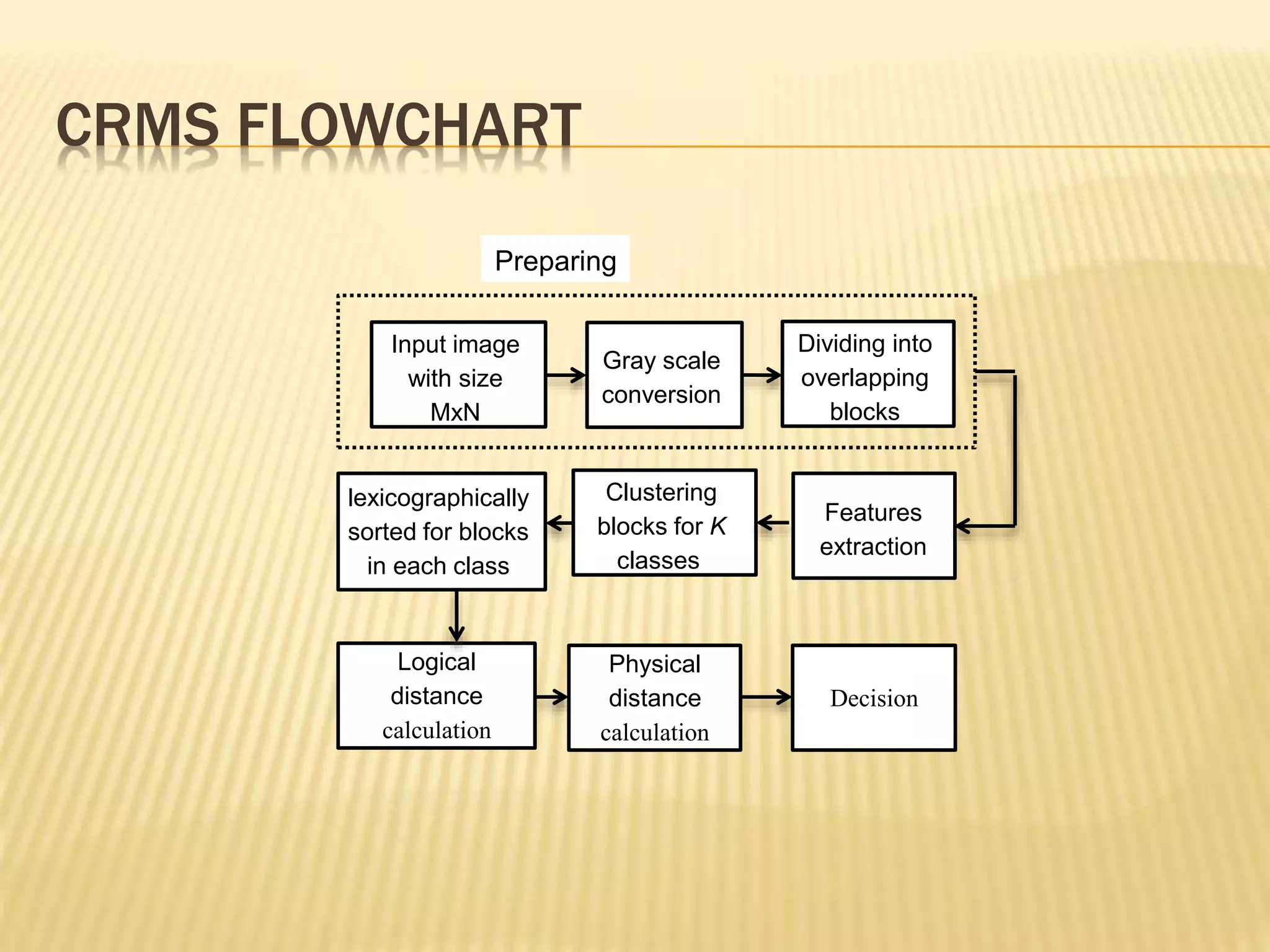
Input image
with size
MxN
Gray scale
conversion
Dividing into
overlapping
blocks
Features
extraction
Clustering
blocks for K
classes
lexicographically
sorted for blocks
in each class
Logical
distance
calculation
Physical
distance
calculation
Decision
Preparing
CRMS FLOWCHART
1. Preparing Stage:
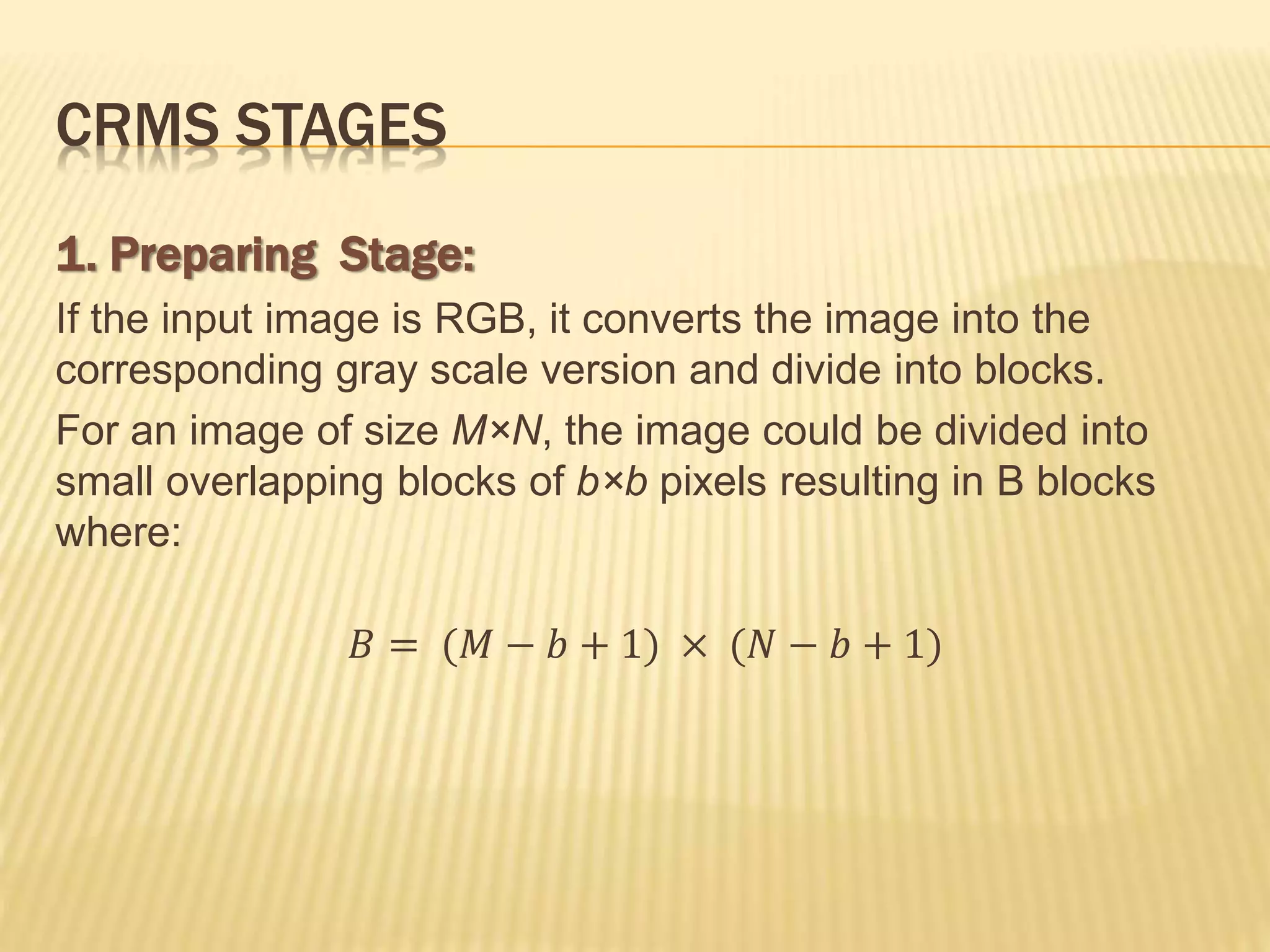
If the input image is RGB, it converts the image into the
corresponding gray scale version and divide into blocks.
For an image of size M×N, the image could be divided into
small overlapping blocks of b×b pixels resulting in B blocks
where:
𝐵 = (𝑀 − 𝑏 + 1) × (𝑁 − 𝑏 + 1)
CRMS STAGES
CRMS STAGES
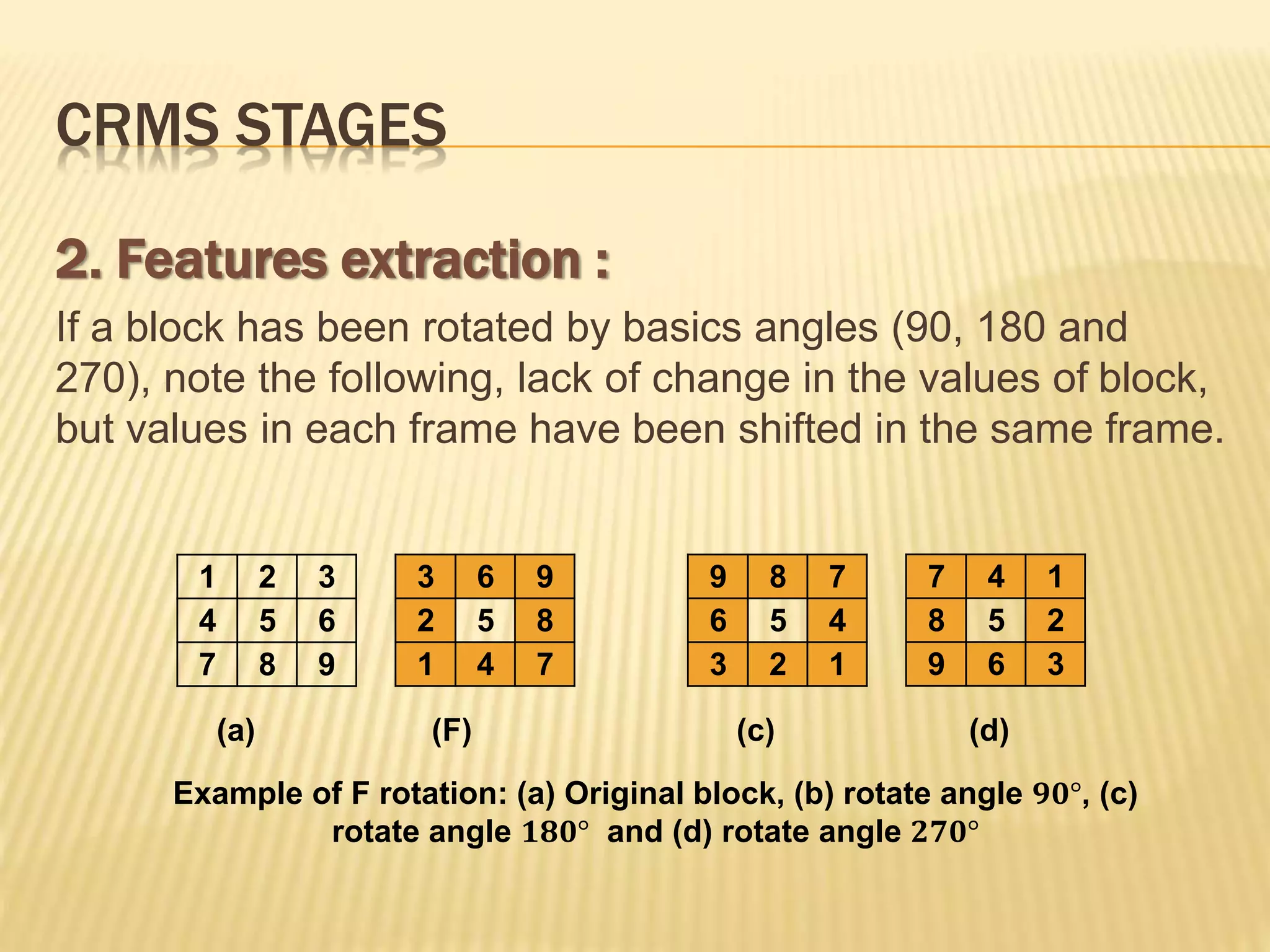
2. Features extraction :
If a block has been rotated by basics angles (90, 180 and
270), note the following, lack of change in the values of block,
but values in each frame have been shifted in the same frame.
(a) (F) (c) (d)
Example of F rotation: (a) Original block, (b) rotate angle 𝟗𝟎°, (c)
rotate angle 𝟏𝟖𝟎° and (d) rotate angle 𝟐𝟕𝟎°
321
654
987
963
852
741
789
456
123
147
258
369
CRMS STAGES
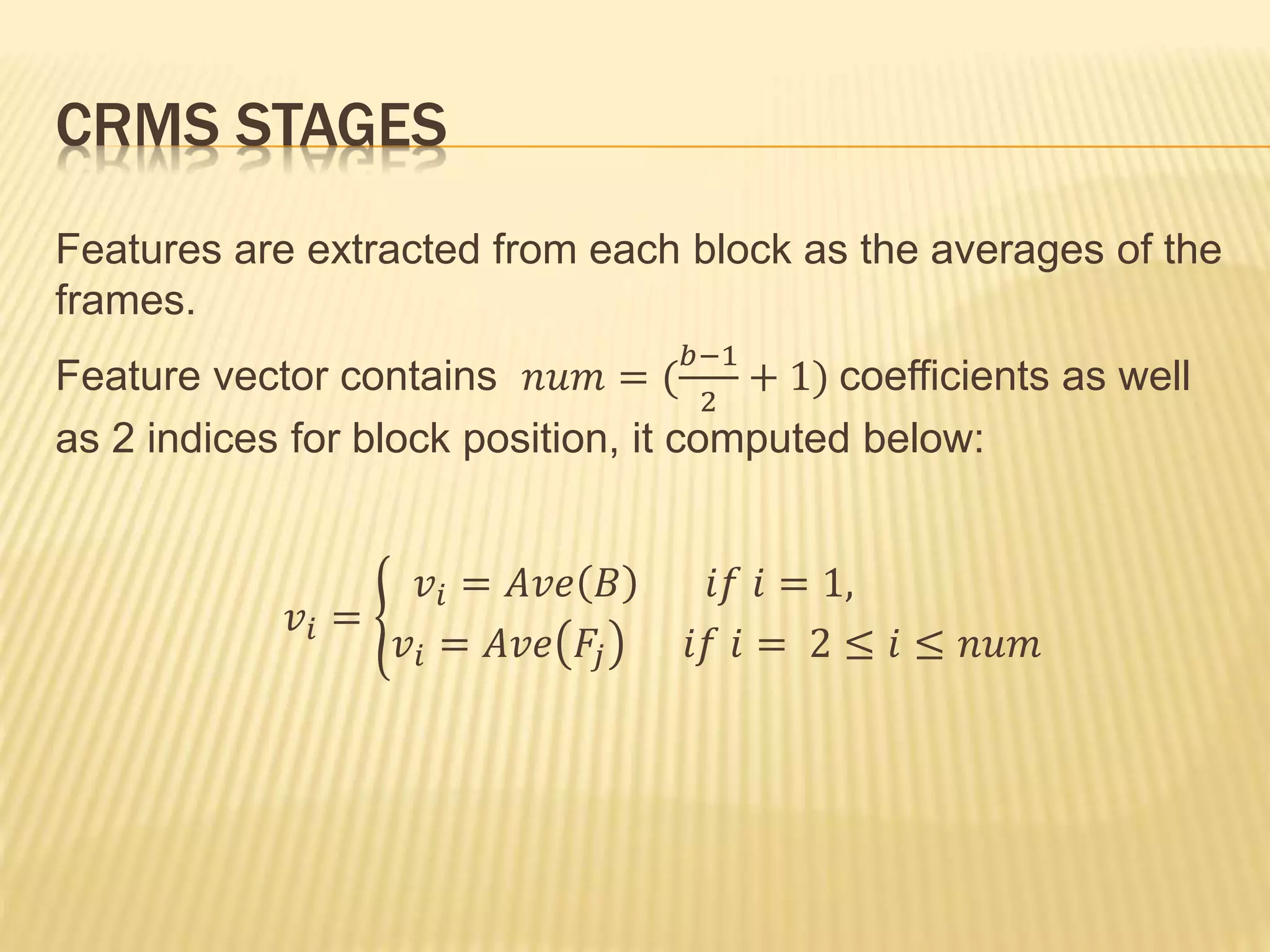
Features are extracted from each block as the averages of the
frames.
Feature vector contains 𝑛𝑢𝑚 = (
𝑏−1
2
+ 1) coefficients as well
as 2 indices for block position, it computed below:
𝑣𝑖 =
𝑣𝑖 = 𝐴𝑣𝑒 𝐵 𝑖𝑓 𝑖 = 1,
𝑣𝑖 = 𝐴𝑣𝑒 𝐹𝑗 𝑖𝑓 𝑖 = 2 ≤ 𝑖 ≤ 𝑛𝑢𝑚
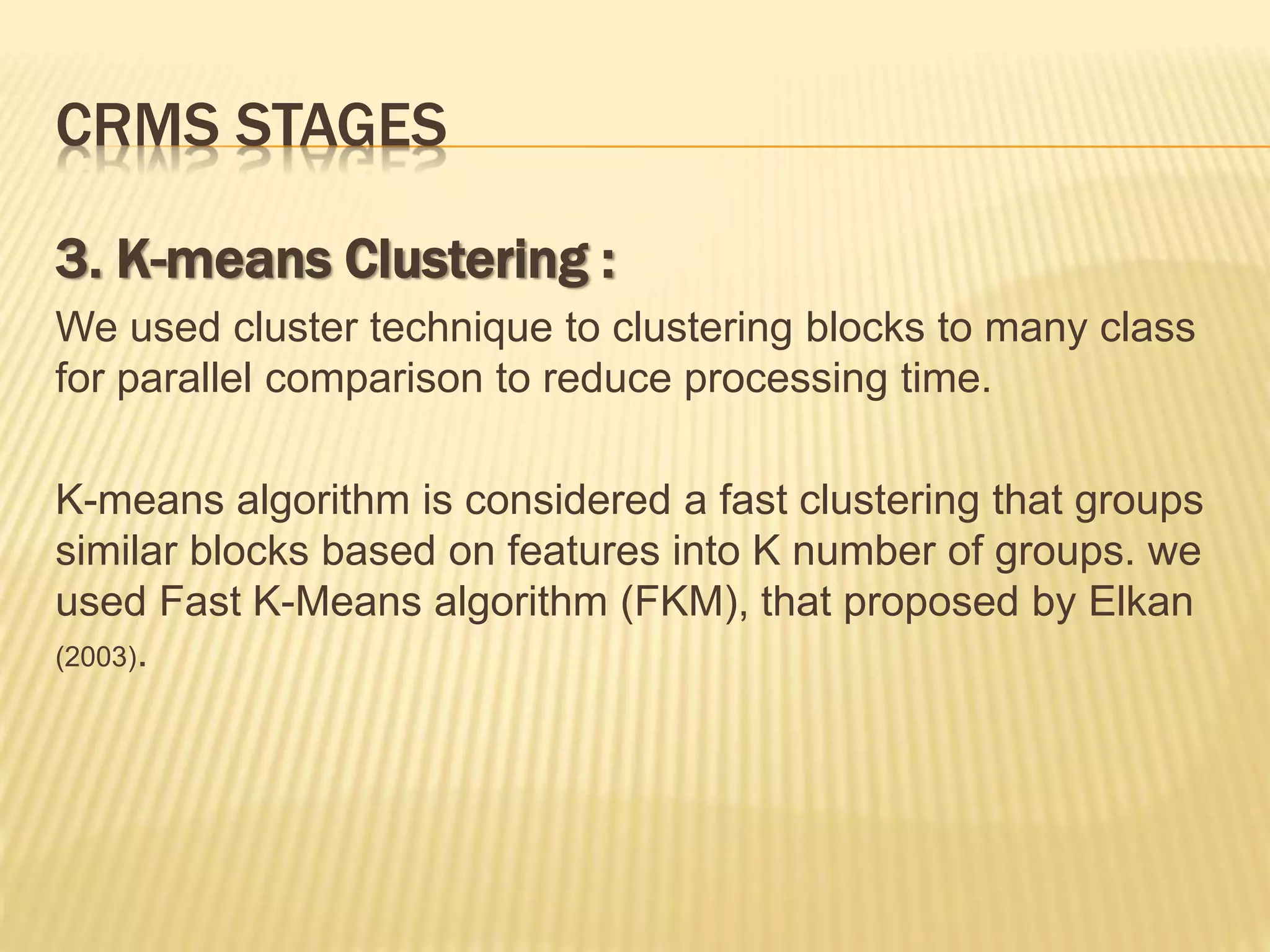
3. K-means Clustering :
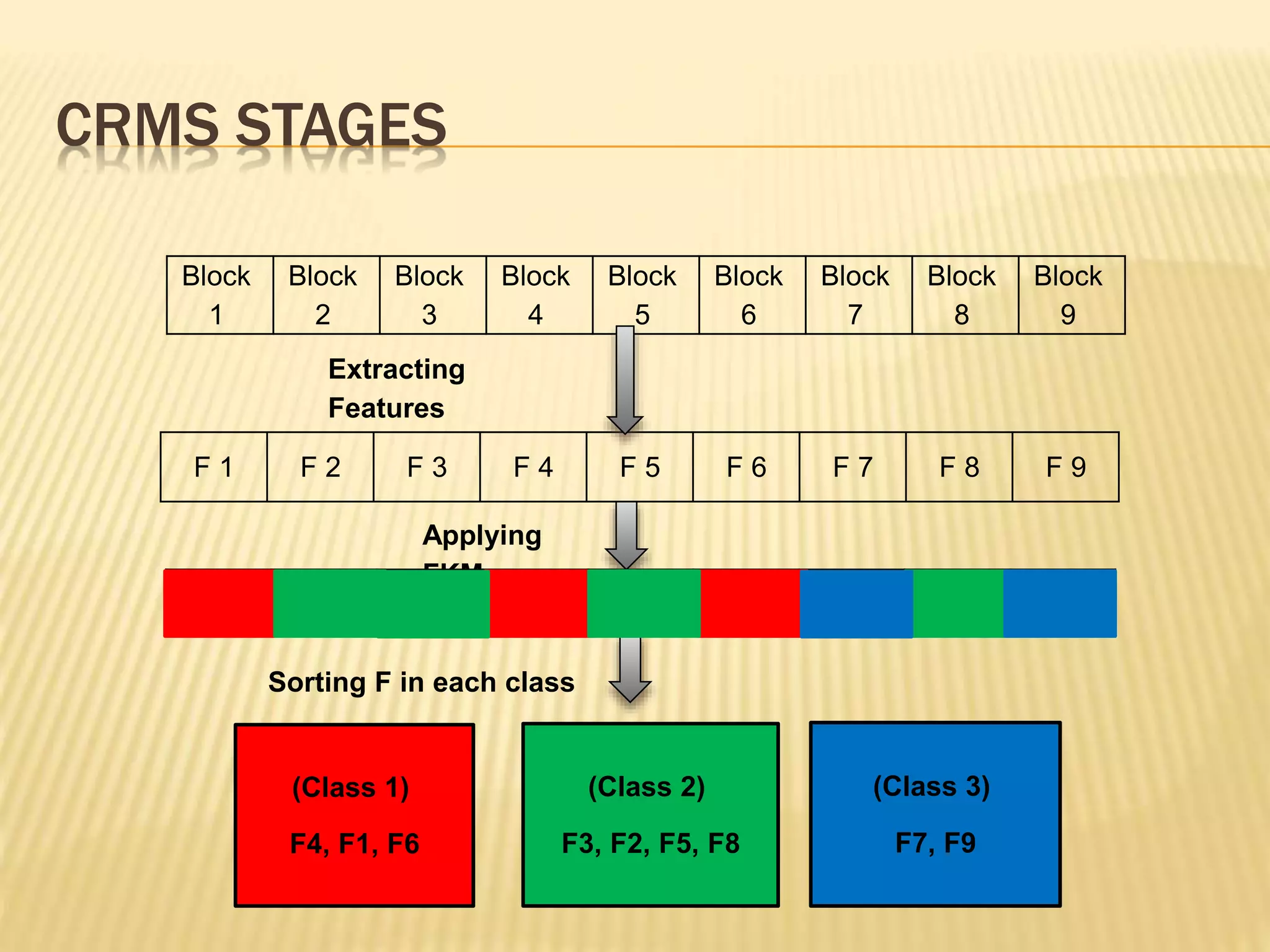
We used cluster technique to clustering blocks to many class
for parallel comparison to reduce processing time.
K-means algorithm is considered a fast clustering that groups
similar blocks based on features into K number of groups. we
used Fast K-Means algorithm (FKM), that proposed by Elkan
(2003).
CRMS STAGES
F 9F 8F 7F 6F 5F 4F 3F 2F 1
CRMS STAGES
F 9F 8F 7F 6F 5F 4F 3F 2F 1
(Class 1)
F4, F1, F6
(Class 2)
F3, F2, F5, F8
(Class 3)
F7, F9
Sorting F in each class
Applying
FKM
Block
9
Block
8
Block
7
Block
6
Block
5
Block
4
Block
3
Block
2
Block
1
Extracting
Features
CRMS STAGES
4. Matching:
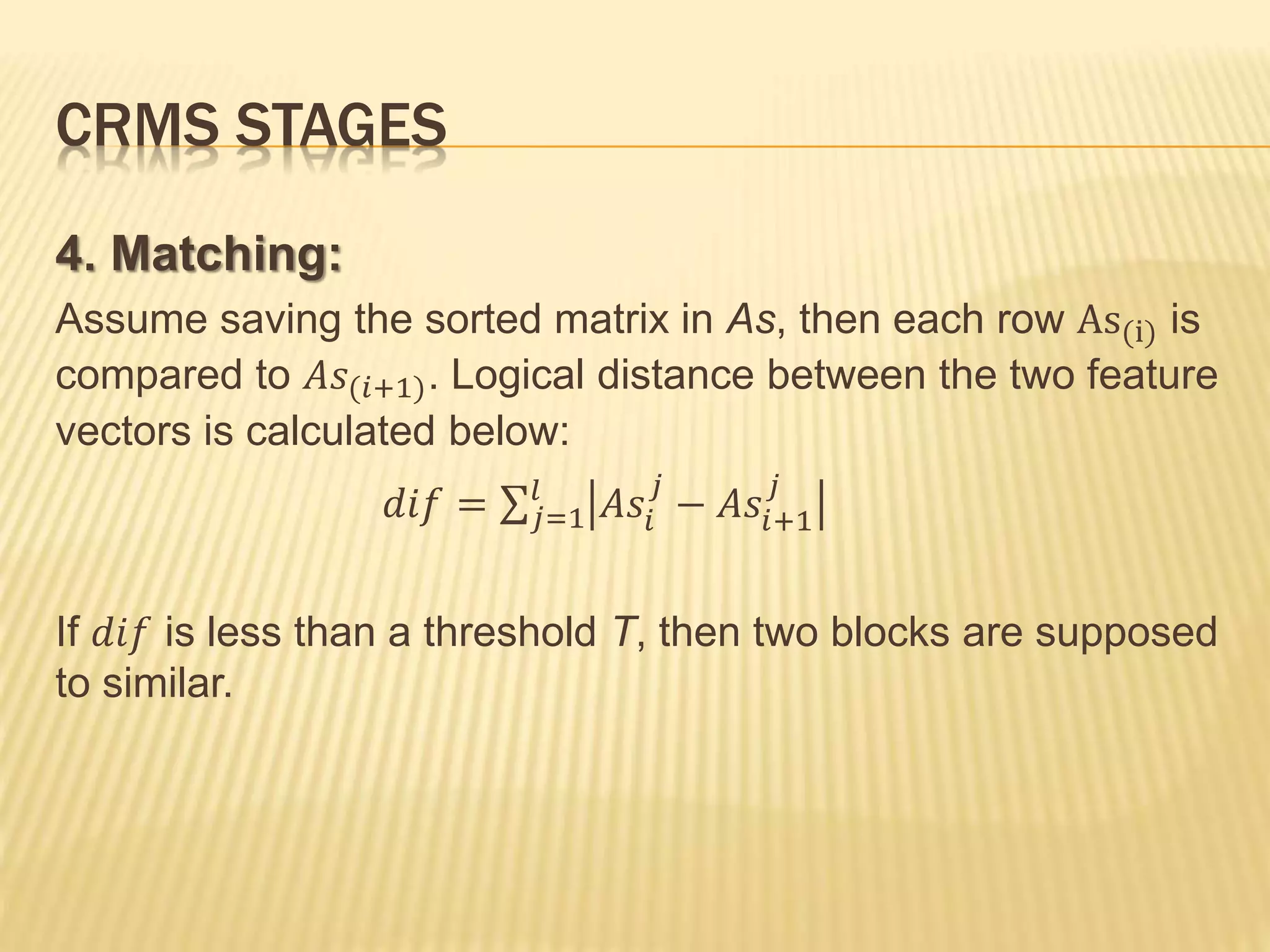
Assume saving the sorted matrix in As, then each row As(i) is
compared to 𝐴𝑠(𝑖+1). Logical distance between the two feature
vectors is calculated below:
𝑑𝑖𝑓 = 𝑗=1
𝑙
𝐴𝑠𝑖
𝑗
− 𝐴𝑠𝑖+1
𝑗
If 𝑑𝑖𝑓 is less than a threshold T, then two blocks are supposed
to similar.
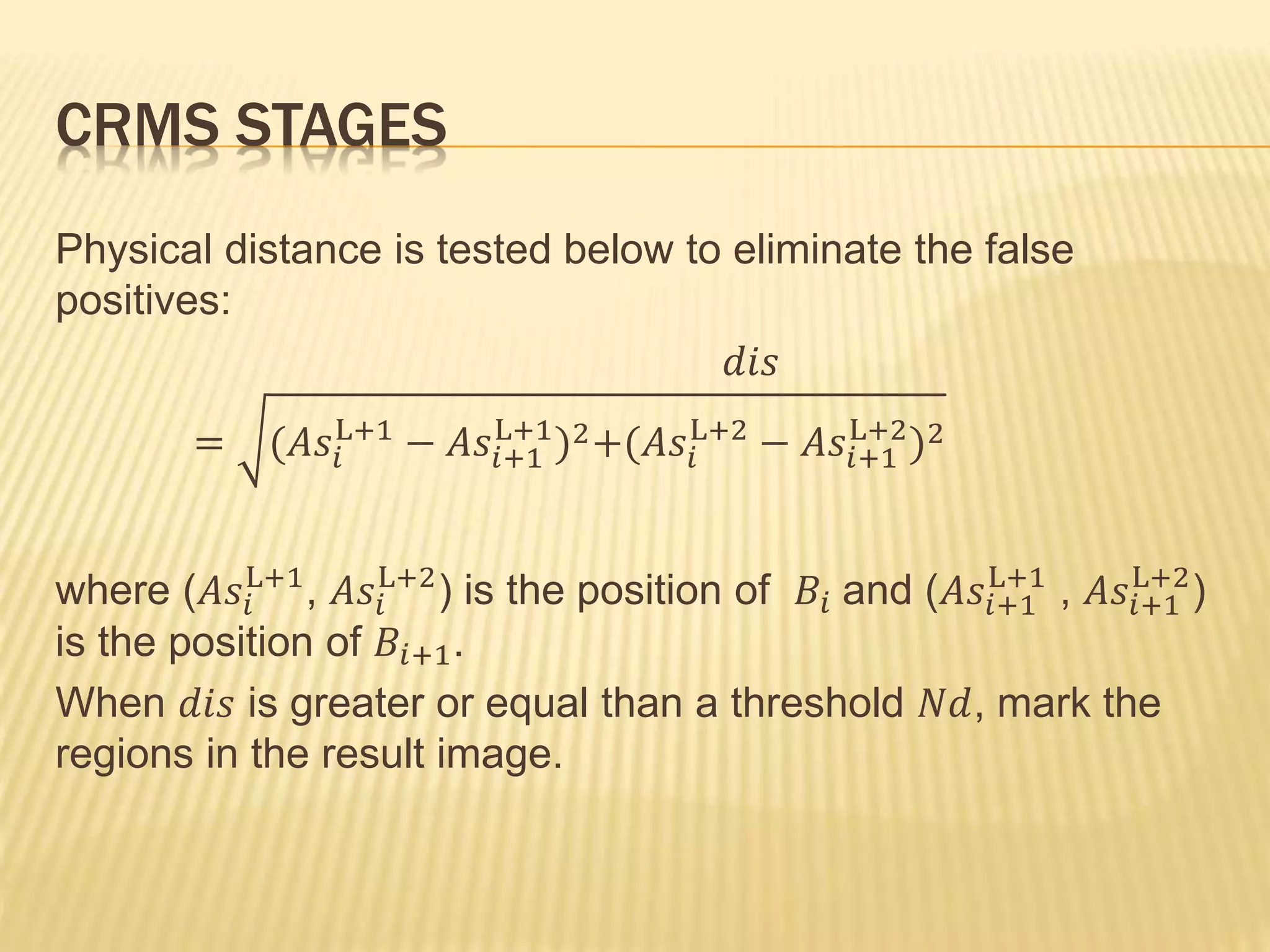
Physical distance is tested below to eliminate the false
positives:
𝑑𝑖𝑠
= (𝐴𝑠𝑖
L+1
− 𝐴𝑠𝑖+1
L+1
)2+(𝐴𝑠𝑖
L+2
− 𝐴𝑠𝑖+1
L+2
)2
where (𝐴𝑠𝑖
L+1
, 𝐴𝑠𝑖
L+2
) is the position of 𝐵𝑖 and (𝐴𝑠𝑖+1
L+1
, 𝐴𝑠𝑖+1
L+2
)
is the position of 𝐵𝑖+1.
When 𝑑𝑖𝑠 is greater or equal than a threshold 𝑁𝑑, mark the
regions in the result image.
CRMS STAGES
Experiment method and procedure:
The experiments were carried out on the Matlab R2012a, RAM
4 GB and processor 2.30 GHZ.
All the images were 128×128 pixels gray image saved in BMP
format.
All the parameter in the experiment were set as: b=9 ,T=0.2 ,
Nd=16 , L=9 and K={4,10,20}.
EXPERIMENT RESULTS
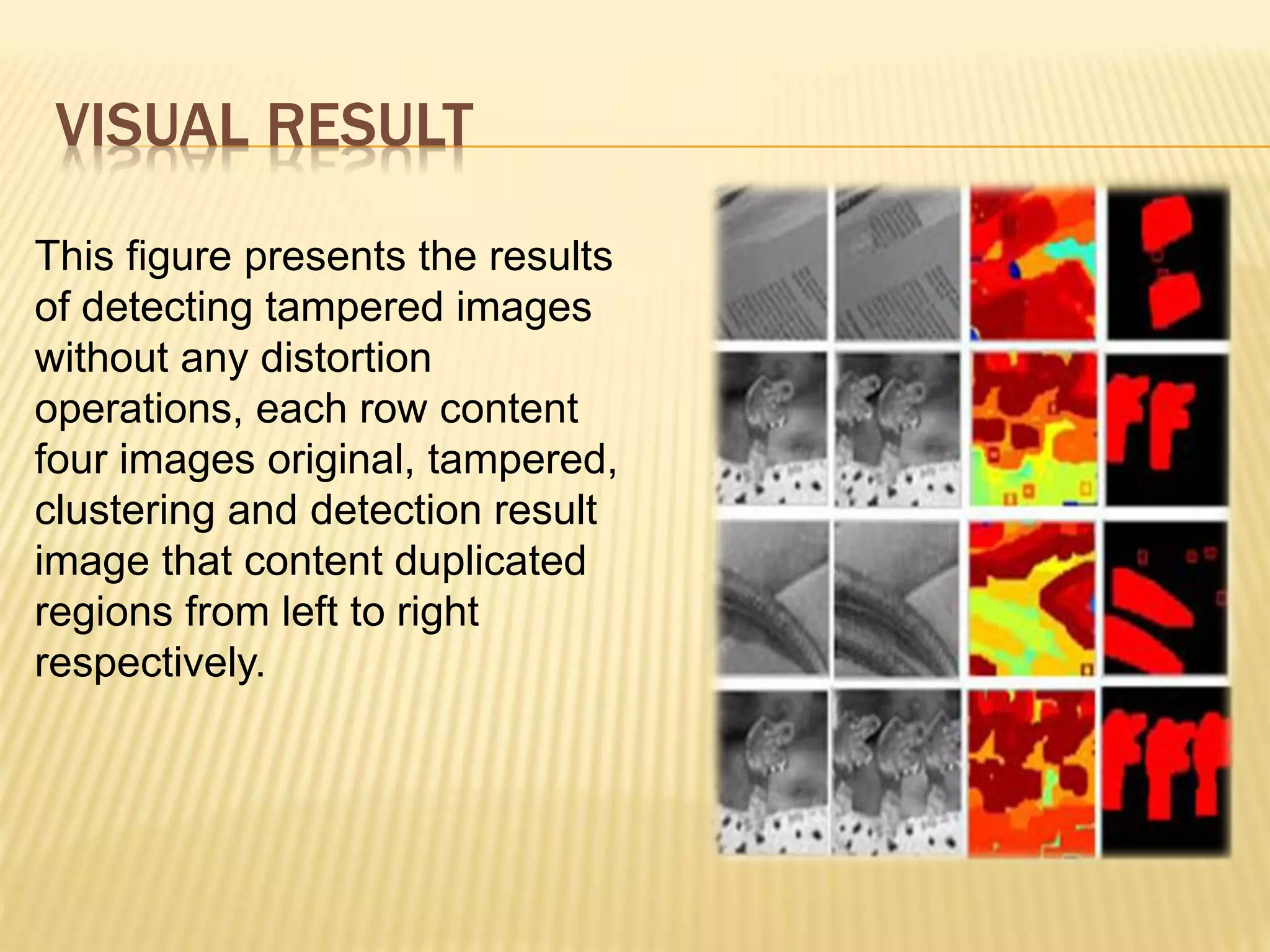
This figure presents the results
of detecting tampered images
without any distortion
operations, each row content
four images original, tampered,
clustering and detection result
image that content duplicated
regions from left to right
respectively.
VISUAL RESULT
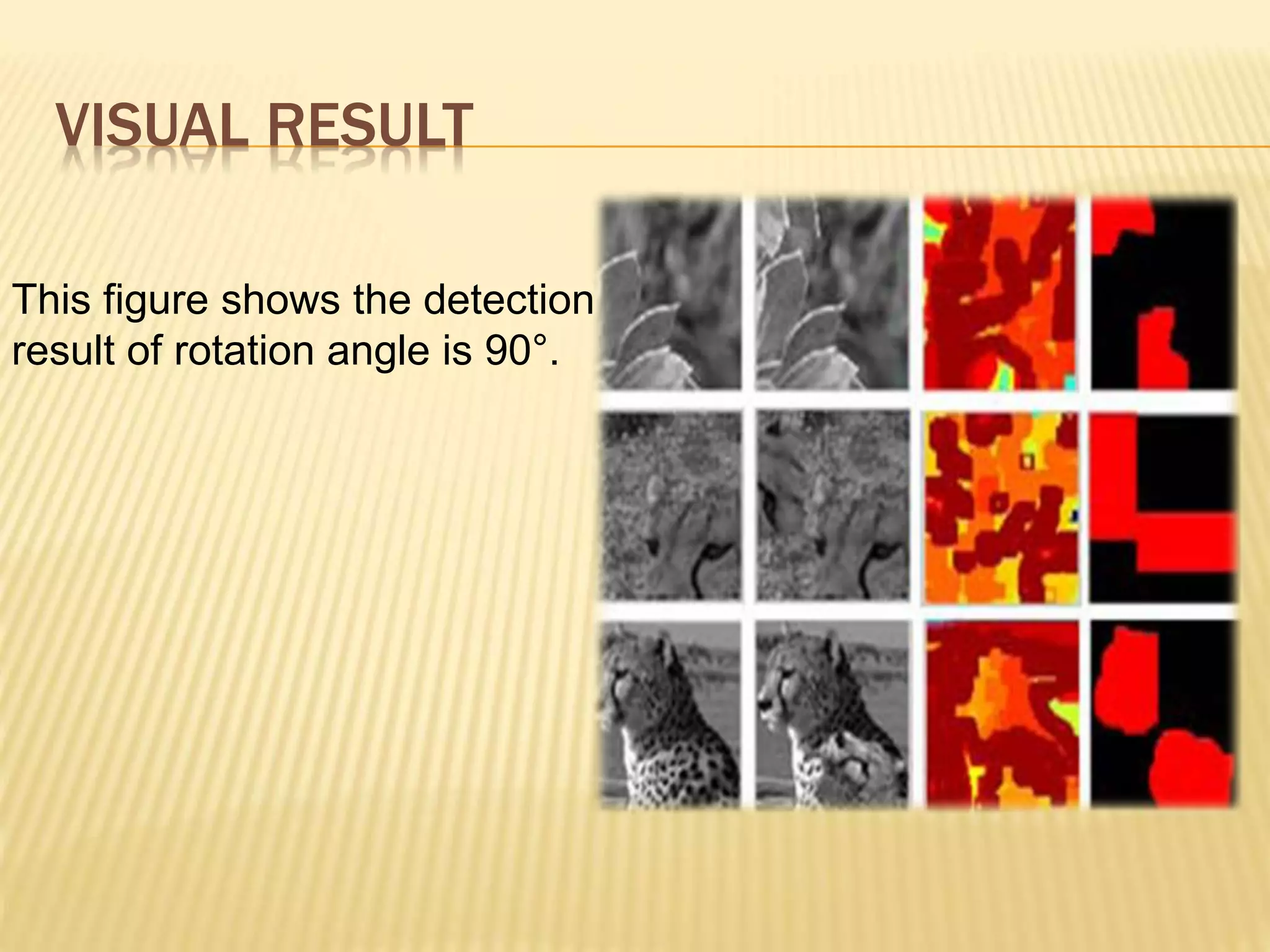
This figure shows the detection
result of rotation angle is 90°.
VISUAL RESULT
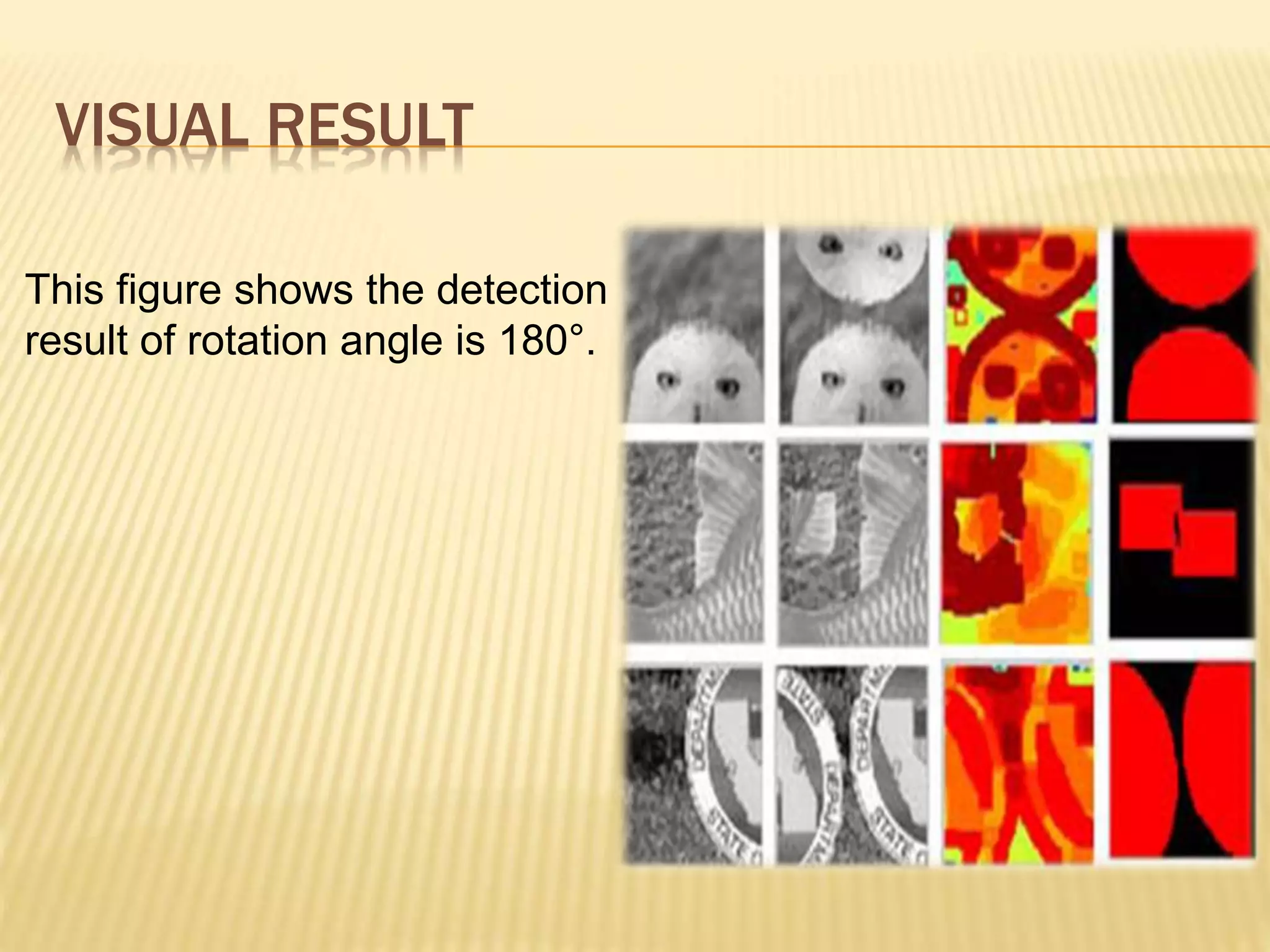
This figure shows the detection
result of rotation angle is 180°.
VISUAL RESULT
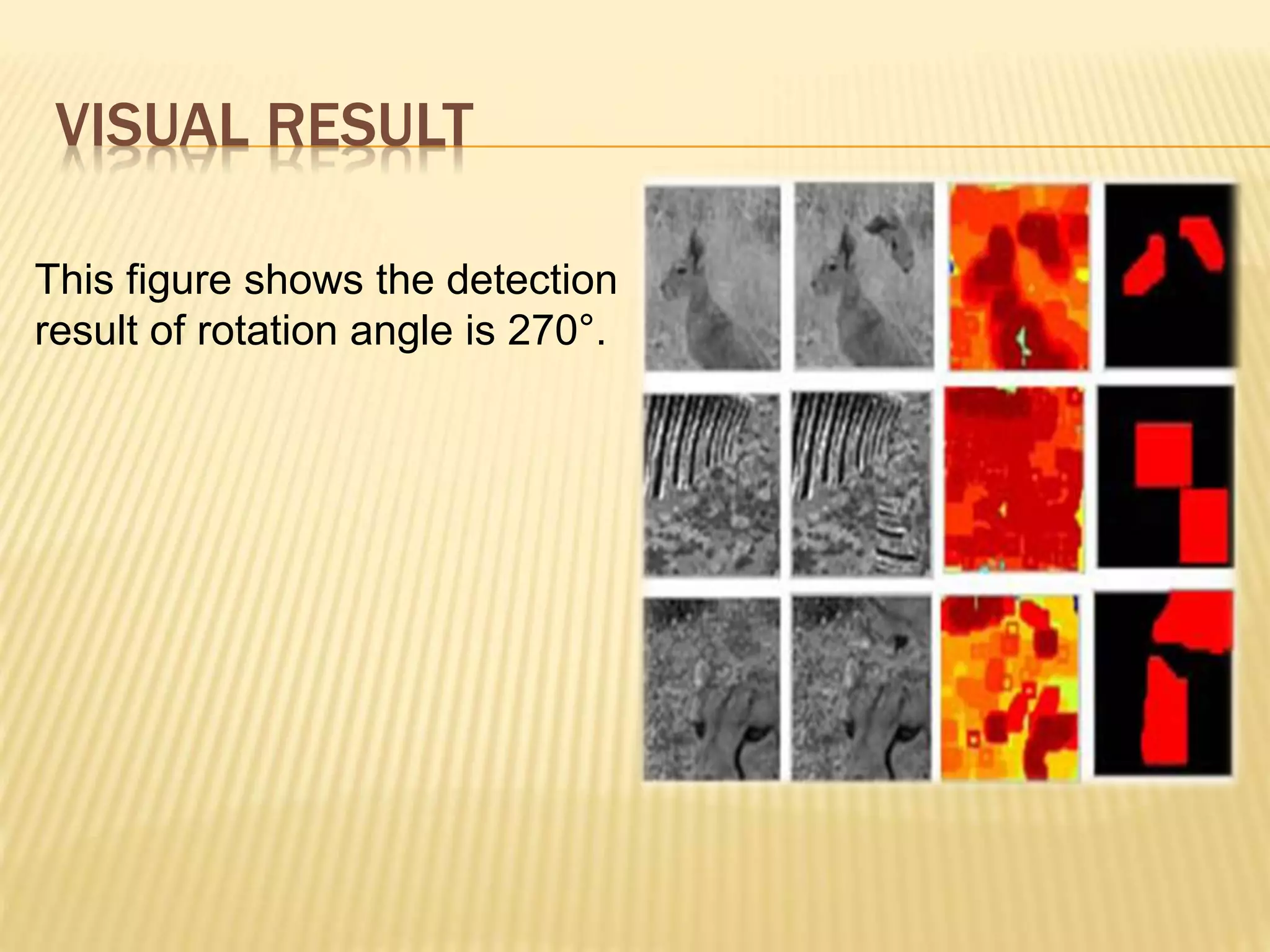
This figure shows the detection
result of rotation angle is 270°.
VISUAL RESULT
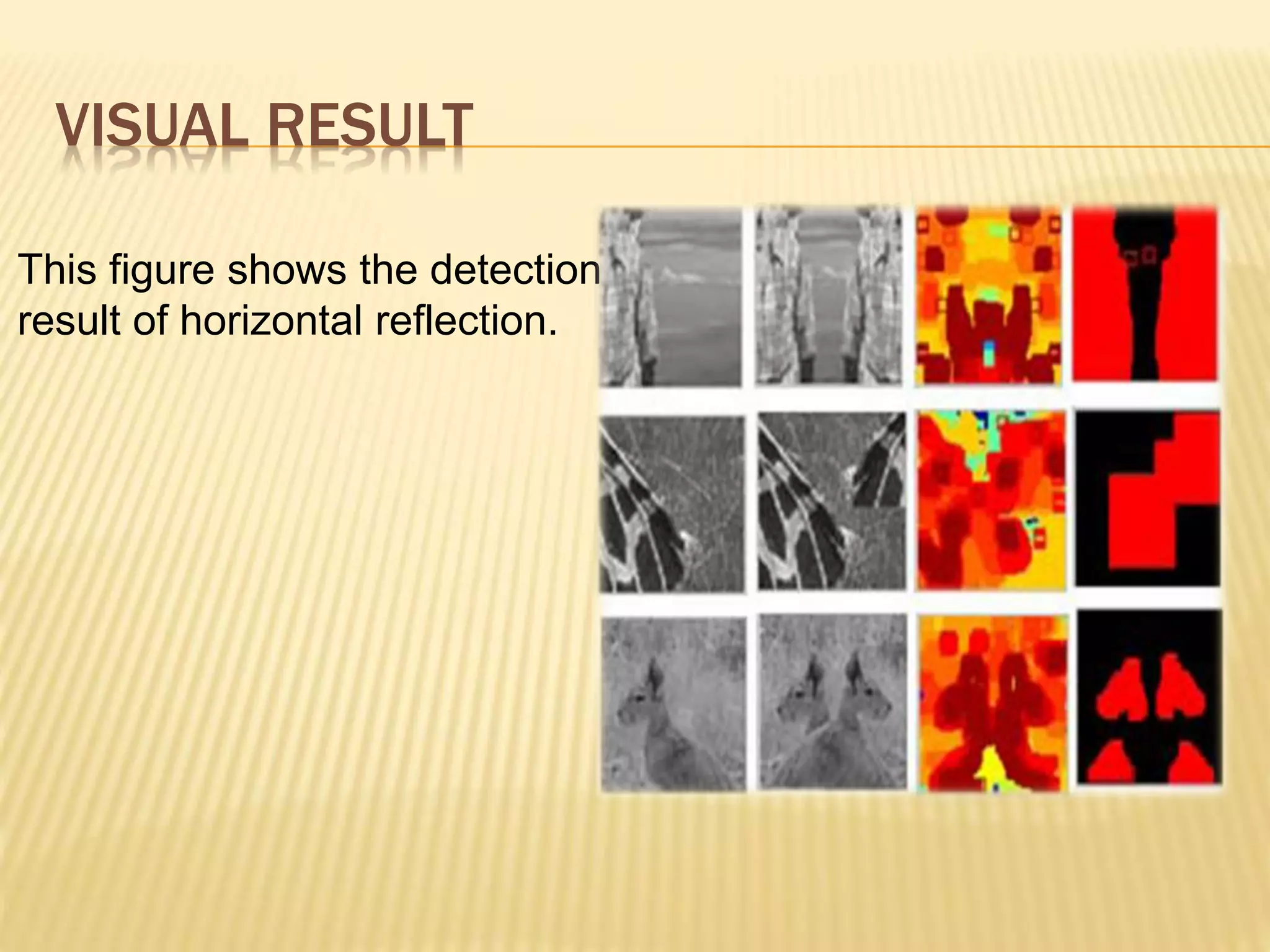
This figure shows the detection
result of horizontal reflection.
VISUAL RESULT
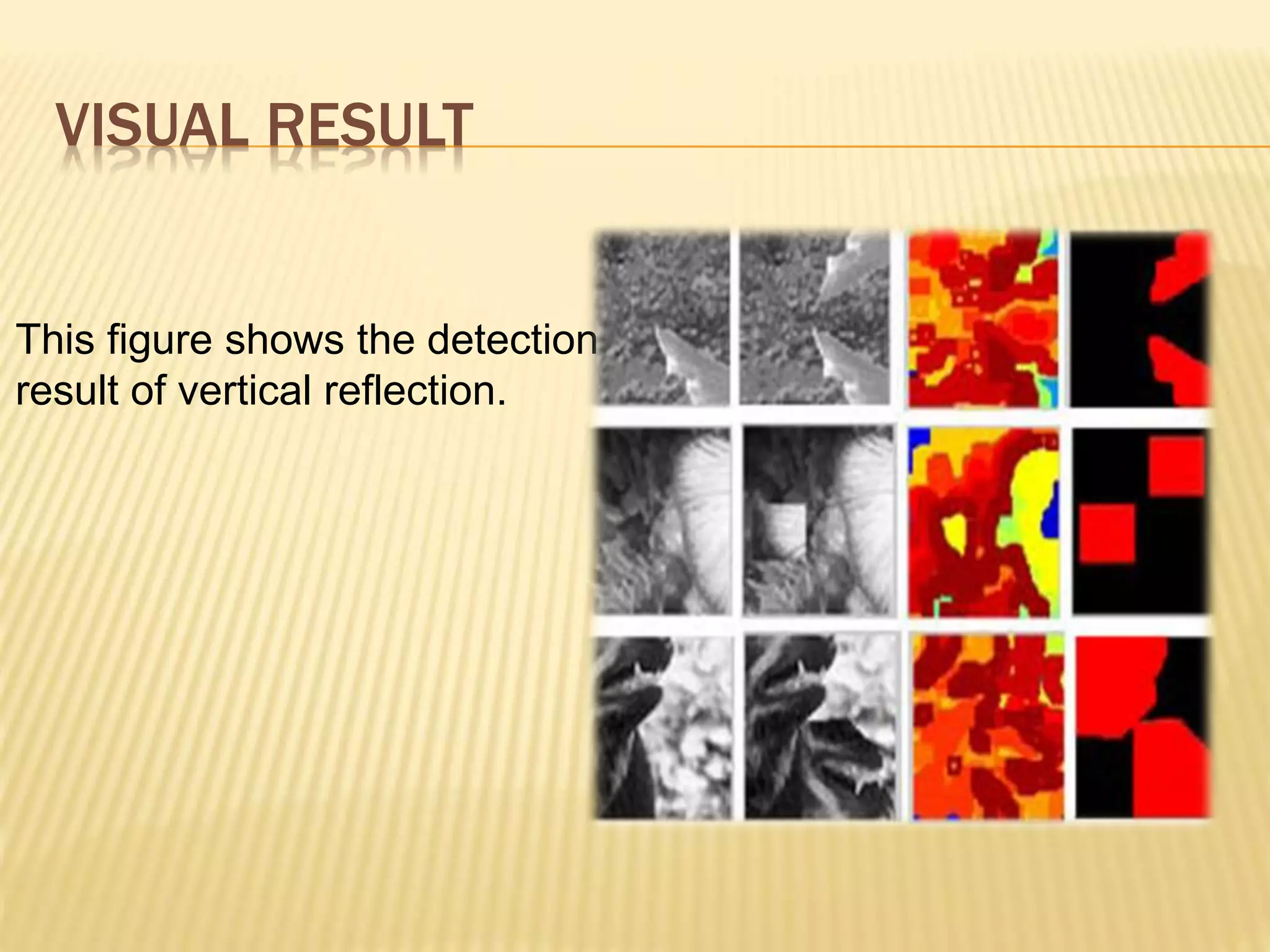
This figure shows the detection
result of vertical reflection.
VISUAL RESULT
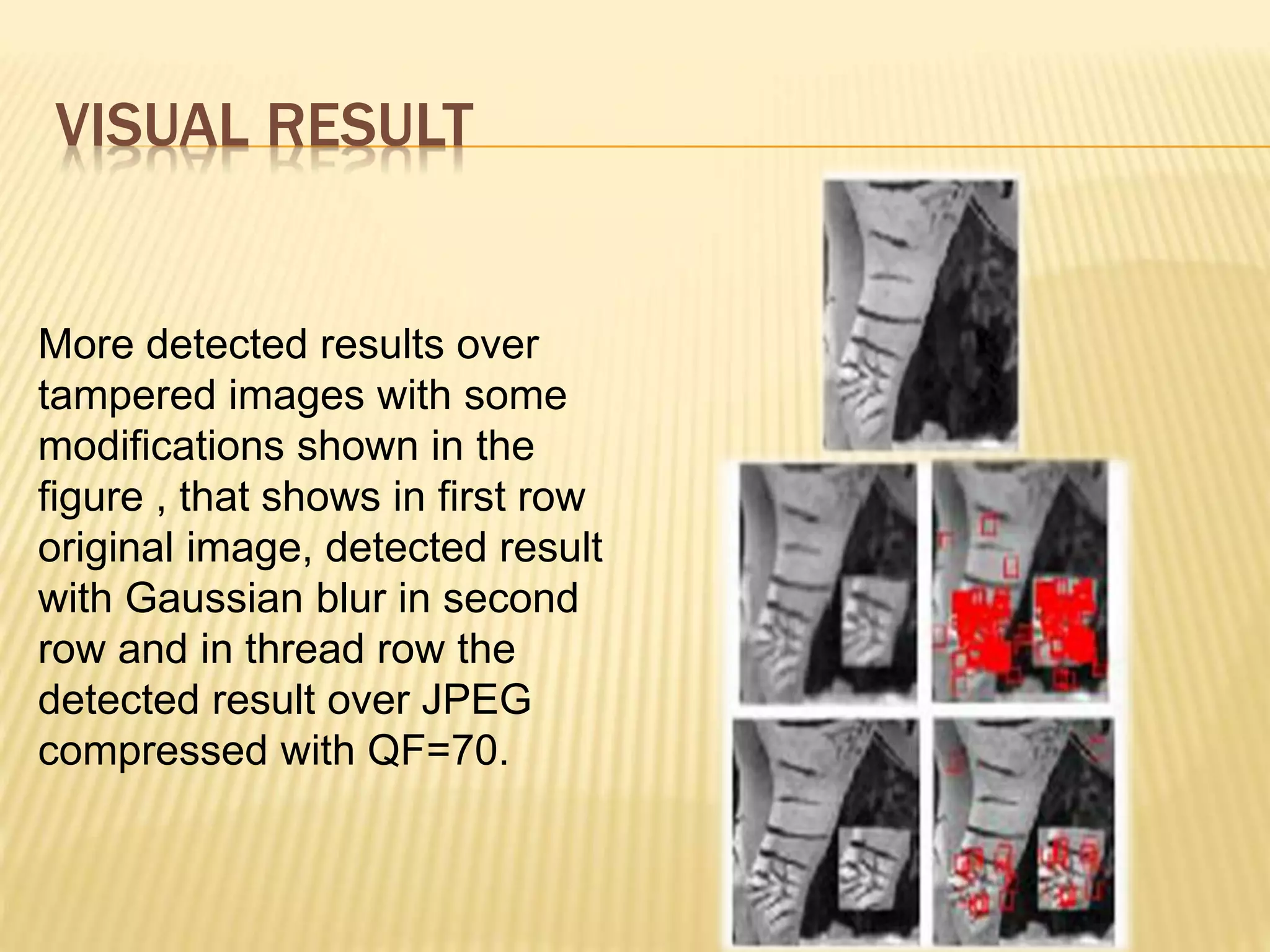
More detected results over
tampered images with some
modifications shown in the
figure , that shows in first row
original image, detected result
with Gaussian blur in second
row and in thread row the
detected result over JPEG
compressed with QF=70.
VISUAL RESULT
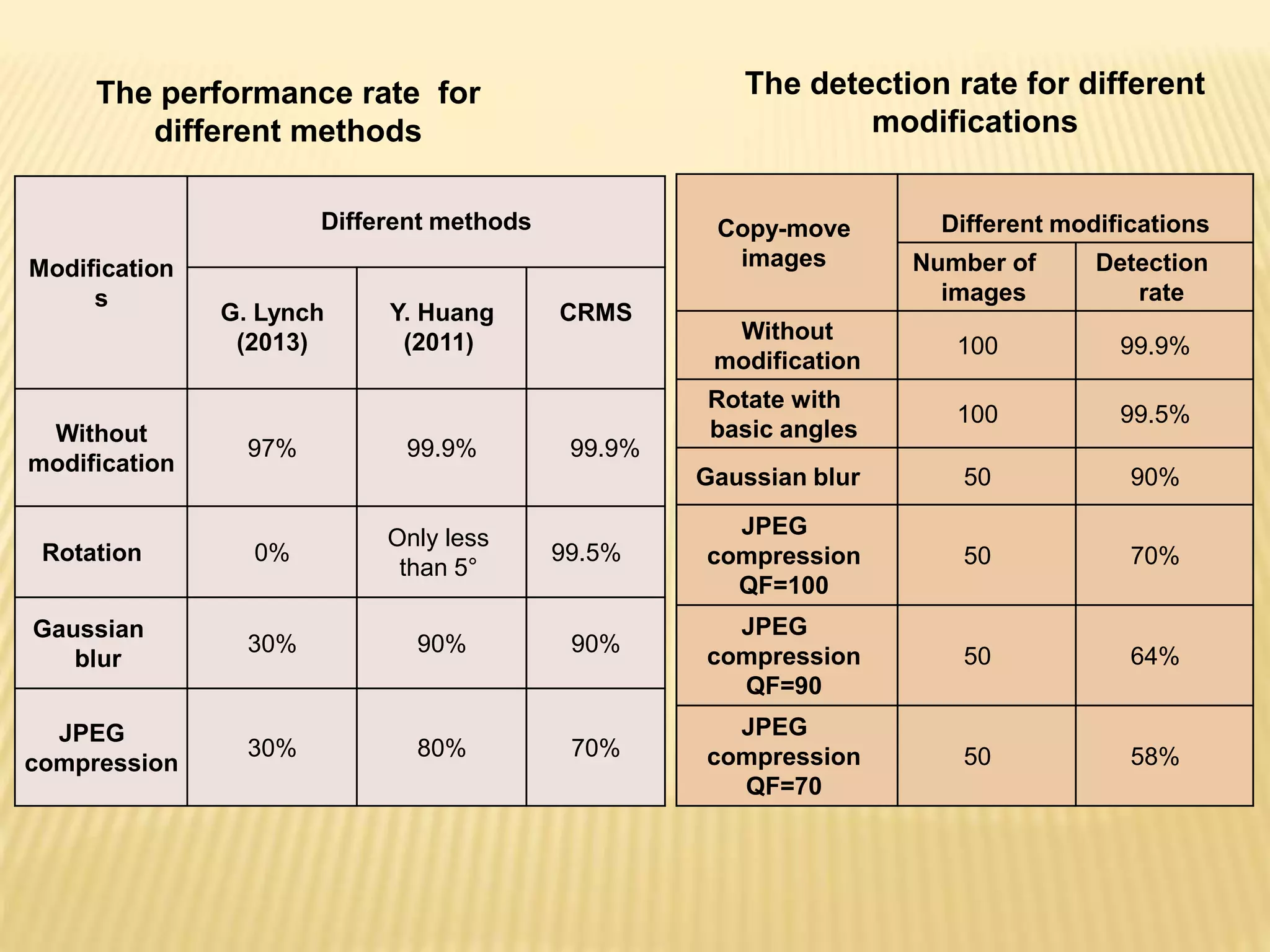
EXPERIMENT RESULTS
Time(s)
Lynch (2013) Huang (2011) Tripathi (2011) CRMS
7.68 4.7005 6.4018 1.5237
The performance time of different methods
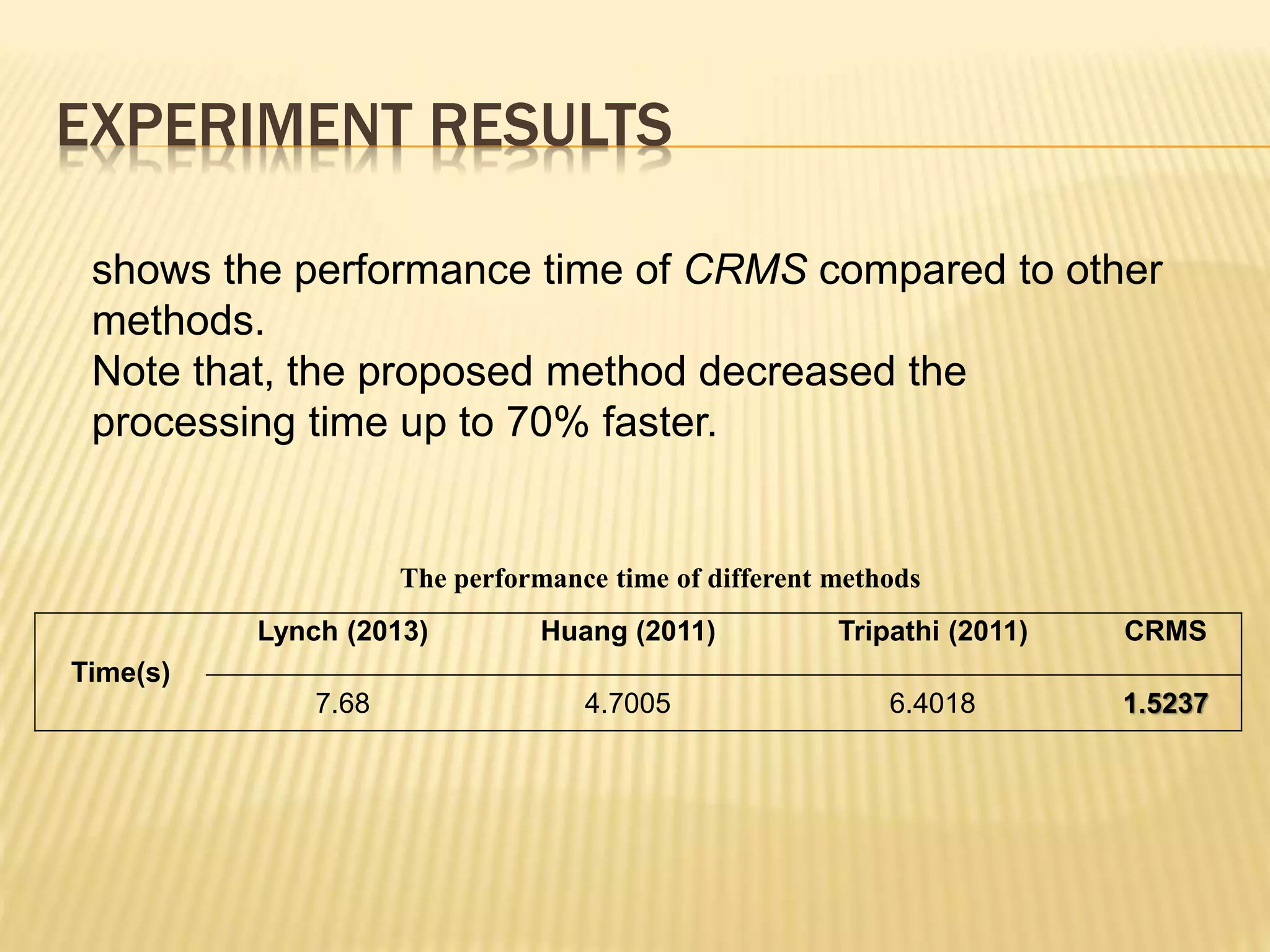
shows the performance time of CRMS compared to other
methods.
Note that, the proposed method decreased the
processing time up to 70% faster.
Copy-move
images
Different modifications
Number of
images
Detection
rate
Without
modification
100 99.9%
Rotate with
basic angles
100 99.5%
Gaussian blur 50 90%
JPEG
compression
QF=100
50 70%
JPEG
compression
QF=90
50 64%
JPEG
compression
QF=70
50 58%
The detection rate for different
modifications
Modification
s
Different methods
G. Lynch
(2013)
Y. Huang
(2011)
CRMS
Without
modification
97% 99.9% 99.9%
Rotation 0%
Only less
than 5°
99.5%
Gaussian
blur
30% 90% 90%
JPEG
compression
30% 80% 70%
The performance rate for
different methods
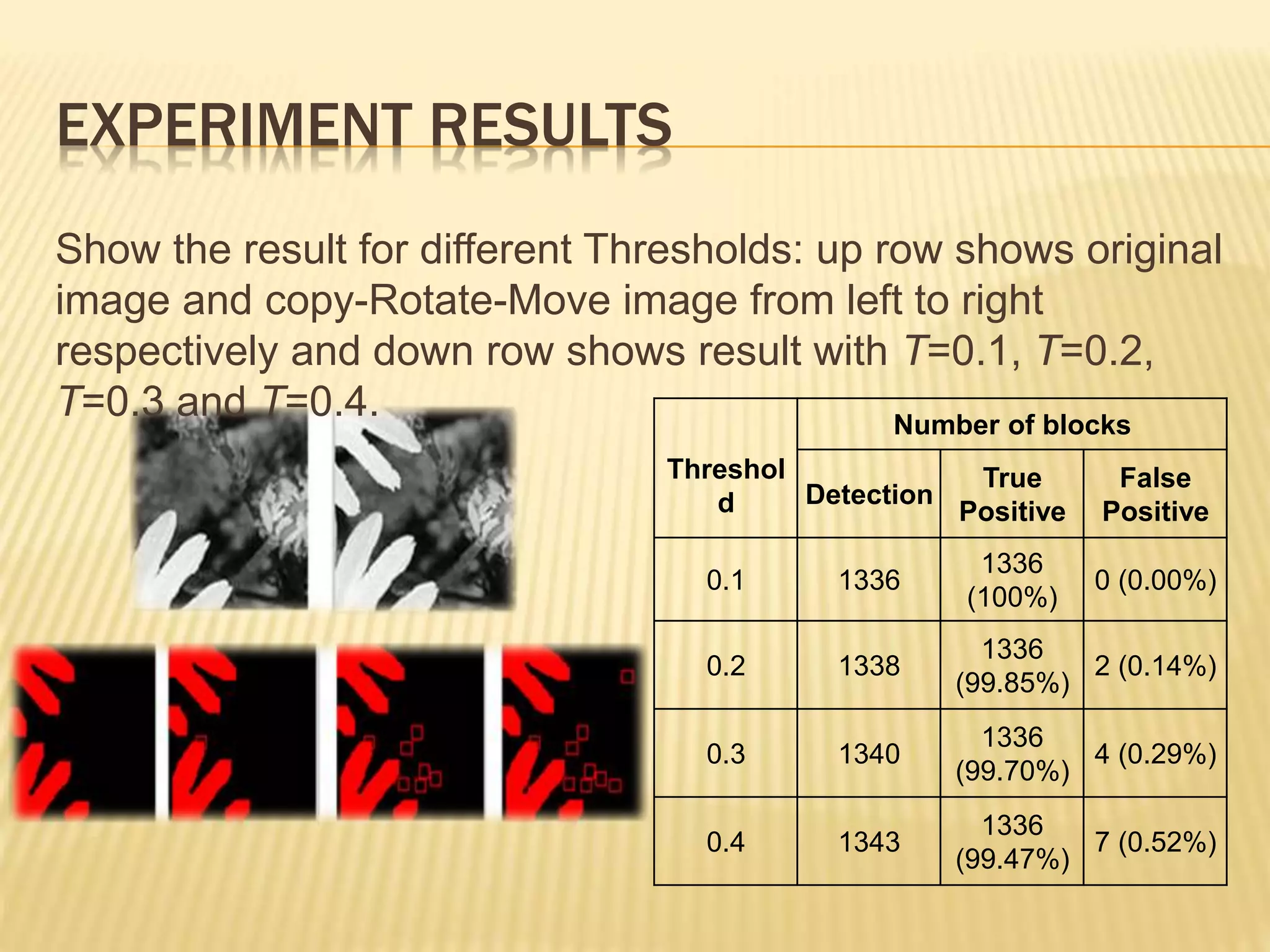
Threshol
d
Number of blocks
Detection
True
Positive
False
Positive
0.1 1336
1336
(100%)
0 (0.00%)
0.2 1338
1336
(99.85%)
2 (0.14%)
0.3 1340
1336
(99.70%)
4 (0.29%)
0.4 1343
1336
(99.47%)
7 (0.52%)
EXPERIMENT RESULTS
Show the result for different Thresholds: up row shows original
image and copy-Rotate-Move image from left to right
respectively and down row shows result with T=0.1, T=0.2,
T=0.3 and T=0.4.
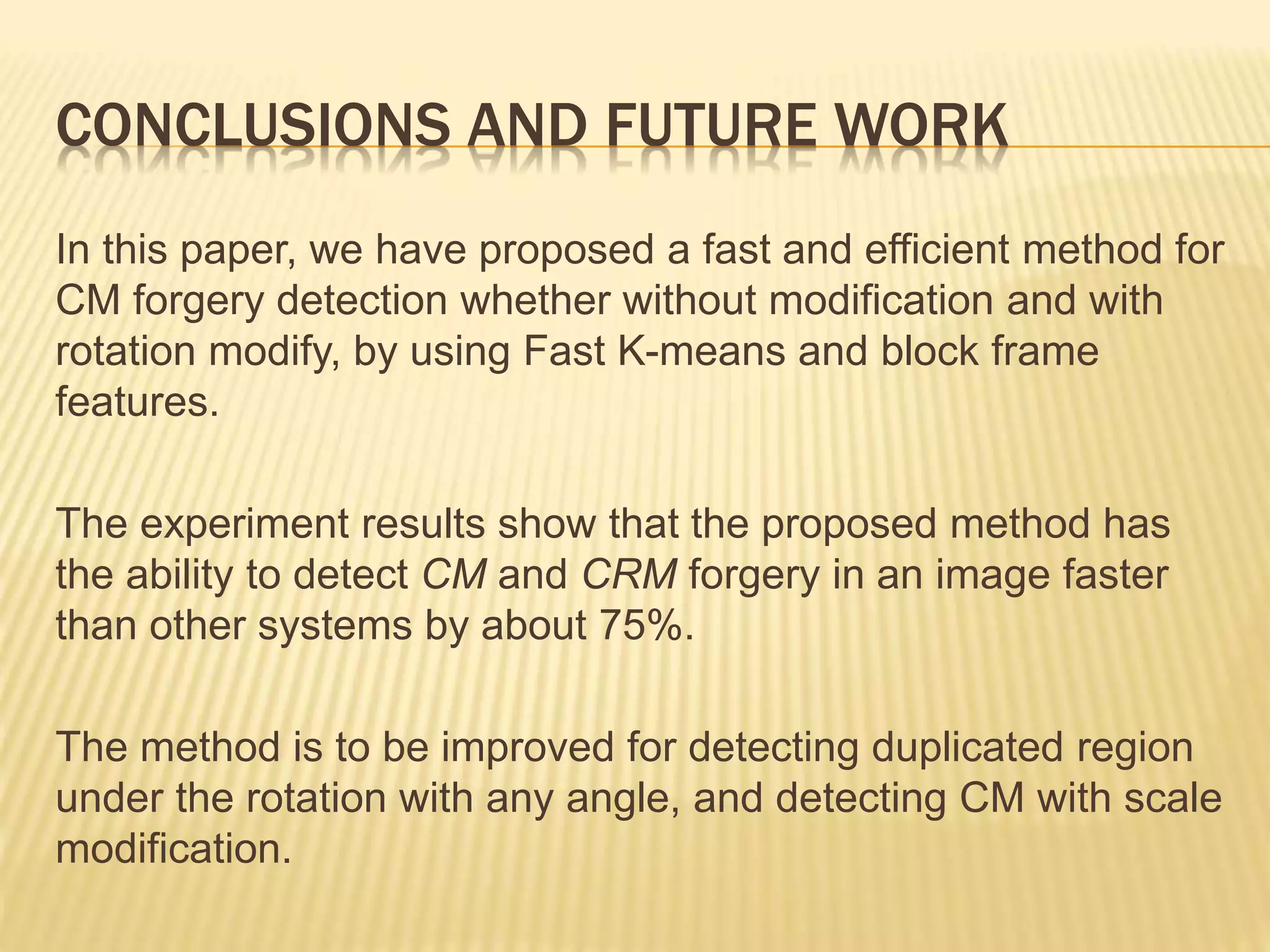
In this paper, we have proposed a fast and efficient method for
CM forgery detection whether without modification and with
rotation modify, by using Fast K-means and block frame
features.
The experiment results show that the proposed method has
the ability to detect CM and CRM forgery in an image faster
than other systems by about 75%.
The method is to be improved for detecting duplicated region
under the rotation with any angle, and detecting CM with scale
modification.
CONCLUSIONS AND FUTURE WORK
A. Khan, S. A. Malik, A. Ali, R. Chamlawi, M. Hussain, M. T. Mahmood, et al, "Intelligent reversible
watermarking and authentication: hiding depth map information for 3D cameras" , Elsevier
Information Sciences, vol. 216, pp. 155-175, 2012.
J. H. Hsiao, C. S. Chen, L. F. Chien, and M. S. Chen, "A new approach to image copy detection
based on extended feature sets." IEEE Image Processing, vol. 16, pp. 2069-2079, no. 8, 2007.
H. Ling, F. Zou, W. Q. Yan, Q. Ma, and H. Cheng, "Efficient image copy detection using multiscale
fingerprints", IEEE Multimedia, 2012.
S. Nikolopoulos, S. Zafeiriou, N. Nikolaidis and I. Pitas, "Image replica detection system utilizing R-
trees and linear discriminant analysis." Elsevier Pattern Recognition, vol. 43, pp. 636-649, no. 3,
2010.
V. Christlein, C. Riess, J. Jordan, C. Riess and E. Angelopoulou, "An evaluation of popular copy-
move forgery detection approaches." IEEE Information Forensics and Security, vol. 7, pp. 1841-
1854, no. 6, 2012.
A. J. Fridrich, F. D. Soukal, and A. J. Lukas, "Detection of copy-move forgery in digital images." in
Proceedings of Digital Forensic Research Workshop, 2003.
G. Lynch, F. Y. Shih and H. Y. M. Liao, "An efficient expanding F algorithm for image copy-move
forgery detection." Elsevier Information Sciences, vol. 239, pp. 253-265, 2013.
REFERENCES
Y. Huang, W. Lu, W. Sun and D. Long, "Improved DCT-based detection of copy-move forgery in images."
Elsevier Forensic science international, vol. 206, pp. 178-184, no. 1, 2011.
H. J. Lin, C. W. Wang and Y. T. Kao, "Fast copy-move forgery detection." WSEAS Transactions on Signal
Processing (World Scientific and Engineering Academy and Society), vol. 5, pp. 188-197, no. 5, 2009.
V. K. Singh and R. C. Tripathi, "Fast and efficient region duplication detection in digital images using sub-
blocking method." International Journal of Advanced Science and Technology, vol. 35, pp. 93-102, 2011.
A. C. Popescu and H. Farid, "Exposing digital forgeries by detecting duplicated image regions." Dept.
Comput.er Sci., Dartmouth College, Tech. Rep. TR2004-515, 2004.
C. Elkan, "Using the triangle inequality to accelerate k-means." ICML. Pp. 147-153, 2003.
M. Zagha and G. E. blelloch, "Radix sort for vector multiprocessors." Proceedings of the 1991 ACM/IEEE
conference on Supercomputing.. pp. 712-721, 1991.
T. T. Ng, J. Hsu, S. F. Chang, Columbia Image Splicing Detection Evaluation Dataset.:
http://www.ee.columFia.edu/ln/dvmm/downloads/AuthSplicedDataSet/AuthSplicedDataSet/
REFERENCES

Copy-Rotate-Move Forgery Detection Based on Spatial Domain

  • 1.
    COPY-ROTATE-MOVE FORGERY DETECTION BASEDON SPATIAL DOMAIN Sondos M. Fadl, Noura A. Semary, and Mohiy M. Hadhoud Faculty of Computers and Information, Menofia University, Egypt {sondos.magdy,noura.samri,mmhadhoud}@ci.menofia.edu.eg
  • 2.
    Introduction Related works Objectives Proposed method Experimentresults Conclusions and future work AGENDA
  • 3.
    INTRODUCTION As image isbetter than thousands of words, World Wide Web nowadays contains a large amount of digital images used for effective communication process.
  • 4.
    It becomes verytrivial for professionals or non-professionals to edit any pre-existing photographs by using freely available image editing tools, such as Photoshop. INTRODUCTION
  • 5.
  • 6.
    INTRODUCTION 1- Copy-Move (CM)forgery: CM image tampering is one of the frequently used techniques. The most performed operations in (CM) forgery are either hiding a region in the image, or adding a new object into the image. The left image was captured in 1930 where Nikolai Yezhov, was walking with Stalin. Following his execution in 1940 Yezhov was removed from all Stalin photos !!
  • 7.
    INTRODUCTION 2- Image compositing: that mixes between two or more different images. 3- Image enhancement: such as blurring, contrast or brightness alteration etc. Example of image compositing. Example of image enhancement.
  • 8.
  • 9.
    1- Active methodssuch as watermarking depend on prior information about the original image that in many cases is not available. 2- Passive or blind methods not depend on prior information about the original image, it needs only forgery image. INTRODUCTION
  • 10.
    J. Fridrich etal. (2003) suggested one of the raw and earliest methods to detect copy move forgery. 1- Blocking 2- Pixel value comparison This method is exact match, It detects the exact duplication of region. exact match is hard to find any manipulation like blurring and JPEG. RELATED WORKS
  • 11.
    Y. Huang etal. (2011) : Another method called robust match is suggested in which instead of pixel value comparison “exact match” quantized DCT coefficients are matched. This method can detect type of manipulations such as JPEG compression and Gaussian blurring. However the above method fails for any type of geometric transformations of the block such as rotation, scaling etc. RELATED WORKS
  • 12.
    RELATED WORKS H. J.Lin et al. (2009) : suggested a method using subblocking for feature extraction. It take nine features for each block as below: 𝑓𝑖 = 𝑓𝑖 = 𝐴𝑣𝑒 𝐵 𝑖𝑓 𝑖 = 1, 𝐴𝑣𝑒(𝑆𝑖 − 1)/4 𝐴𝑣𝑒(𝐵) + 𝜀1 𝑖𝑓 2 ≤ 𝑖 ≤ 5, 𝑓𝑖 = 𝐴𝑣𝑒 𝑆𝑖 − 5 − 𝐴𝑣𝑒 𝐵 𝑖𝑓 6 ≤ 𝑖 ≤ 9. Shift vector u(i)=P(𝐵𝑖+1)-P(𝐵𝑖) is used to detect the duplicated regions. Block
  • 13.
    RELATED WORKS G. Lynchet al. (2013) : 1- Using average gray value as a feature for each block. 2- blocks are sorted. 2- Manual grouping for collecting similar blocks in a same bucket for reduce processing time.
  • 14.
    OBJECTIVES Parallel block matching Average of Nestedframes Rotation detection Accelerated
  • 15.
    we propose methodwhich is efficient and fast for detecting Copy-Move regions even when the copied region was undergone rotation modify in spatial domain. We named Copy- Rotate-Move Forgery Detection based on Spatial Domain (CRMS). PROPOSED METHOD
  • 16.
    CM forgery detectionconsists of basic steps: PROPOSED METHOD Preparing Feature Extraction Matching and decision Step 1 Step 2 Step 3
  • 17.
    PROPOSED METHOD We detectthe duplicated regions by Block Matching strategy, where the image is dividing into equal-size overlapped blocks, then each block is matched with all other possible blocks in the same image.
  • 18.
    Features are extractedfrom each block by dividing it to nested frames and calculate the average of each frame. CRMS
  • 19.
    Input image with size MxN Grayscale conversion Dividing into overlapping blocks Features extraction Clustering blocks for K classes lexicographically sorted for blocks in each class Logical distance calculation Physical distance calculation Decision Preparing CRMS FLOWCHART
  • 20.
    1. Preparing Stage: Ifthe input image is RGB, it converts the image into the corresponding gray scale version and divide into blocks. For an image of size M×N, the image could be divided into small overlapping blocks of b×b pixels resulting in B blocks where: 𝐵 = (𝑀 − 𝑏 + 1) × (𝑁 − 𝑏 + 1) CRMS STAGES
  • 21.
    CRMS STAGES 2. Featuresextraction : If a block has been rotated by basics angles (90, 180 and 270), note the following, lack of change in the values of block, but values in each frame have been shifted in the same frame. (a) (F) (c) (d) Example of F rotation: (a) Original block, (b) rotate angle 𝟗𝟎°, (c) rotate angle 𝟏𝟖𝟎° and (d) rotate angle 𝟐𝟕𝟎° 321 654 987 963 852 741 789 456 123 147 258 369
  • 22.
    CRMS STAGES Features areextracted from each block as the averages of the frames. Feature vector contains 𝑛𝑢𝑚 = ( 𝑏−1 2 + 1) coefficients as well as 2 indices for block position, it computed below: 𝑣𝑖 = 𝑣𝑖 = 𝐴𝑣𝑒 𝐵 𝑖𝑓 𝑖 = 1, 𝑣𝑖 = 𝐴𝑣𝑒 𝐹𝑗 𝑖𝑓 𝑖 = 2 ≤ 𝑖 ≤ 𝑛𝑢𝑚
  • 23.
    3. K-means Clustering: We used cluster technique to clustering blocks to many class for parallel comparison to reduce processing time. K-means algorithm is considered a fast clustering that groups similar blocks based on features into K number of groups. we used Fast K-Means algorithm (FKM), that proposed by Elkan (2003). CRMS STAGES
  • 24.
    F 9F 8F7F 6F 5F 4F 3F 2F 1 CRMS STAGES F 9F 8F 7F 6F 5F 4F 3F 2F 1 (Class 1) F4, F1, F6 (Class 2) F3, F2, F5, F8 (Class 3) F7, F9 Sorting F in each class Applying FKM Block 9 Block 8 Block 7 Block 6 Block 5 Block 4 Block 3 Block 2 Block 1 Extracting Features
  • 25.
    CRMS STAGES 4. Matching: Assumesaving the sorted matrix in As, then each row As(i) is compared to 𝐴𝑠(𝑖+1). Logical distance between the two feature vectors is calculated below: 𝑑𝑖𝑓 = 𝑗=1 𝑙 𝐴𝑠𝑖 𝑗 − 𝐴𝑠𝑖+1 𝑗 If 𝑑𝑖𝑓 is less than a threshold T, then two blocks are supposed to similar.
  • 26.
    Physical distance istested below to eliminate the false positives: 𝑑𝑖𝑠 = (𝐴𝑠𝑖 L+1 − 𝐴𝑠𝑖+1 L+1 )2+(𝐴𝑠𝑖 L+2 − 𝐴𝑠𝑖+1 L+2 )2 where (𝐴𝑠𝑖 L+1 , 𝐴𝑠𝑖 L+2 ) is the position of 𝐵𝑖 and (𝐴𝑠𝑖+1 L+1 , 𝐴𝑠𝑖+1 L+2 ) is the position of 𝐵𝑖+1. When 𝑑𝑖𝑠 is greater or equal than a threshold 𝑁𝑑, mark the regions in the result image. CRMS STAGES
  • 27.
    Experiment method andprocedure: The experiments were carried out on the Matlab R2012a, RAM 4 GB and processor 2.30 GHZ. All the images were 128×128 pixels gray image saved in BMP format. All the parameter in the experiment were set as: b=9 ,T=0.2 , Nd=16 , L=9 and K={4,10,20}. EXPERIMENT RESULTS
  • 28.
    This figure presentsthe results of detecting tampered images without any distortion operations, each row content four images original, tampered, clustering and detection result image that content duplicated regions from left to right respectively. VISUAL RESULT
  • 29.
    This figure showsthe detection result of rotation angle is 90°. VISUAL RESULT
  • 30.
    This figure showsthe detection result of rotation angle is 180°. VISUAL RESULT
  • 31.
    This figure showsthe detection result of rotation angle is 270°. VISUAL RESULT
  • 32.
    This figure showsthe detection result of horizontal reflection. VISUAL RESULT
  • 33.
    This figure showsthe detection result of vertical reflection. VISUAL RESULT
  • 34.
    More detected resultsover tampered images with some modifications shown in the figure , that shows in first row original image, detected result with Gaussian blur in second row and in thread row the detected result over JPEG compressed with QF=70. VISUAL RESULT
  • 35.
    EXPERIMENT RESULTS Time(s) Lynch (2013)Huang (2011) Tripathi (2011) CRMS 7.68 4.7005 6.4018 1.5237 The performance time of different methods shows the performance time of CRMS compared to other methods. Note that, the proposed method decreased the processing time up to 70% faster.
  • 36.
    Copy-move images Different modifications Number of images Detection rate Without modification 10099.9% Rotate with basic angles 100 99.5% Gaussian blur 50 90% JPEG compression QF=100 50 70% JPEG compression QF=90 50 64% JPEG compression QF=70 50 58% The detection rate for different modifications Modification s Different methods G. Lynch (2013) Y. Huang (2011) CRMS Without modification 97% 99.9% 99.9% Rotation 0% Only less than 5° 99.5% Gaussian blur 30% 90% 90% JPEG compression 30% 80% 70% The performance rate for different methods
  • 37.
    Threshol d Number of blocks Detection True Positive False Positive 0.11336 1336 (100%) 0 (0.00%) 0.2 1338 1336 (99.85%) 2 (0.14%) 0.3 1340 1336 (99.70%) 4 (0.29%) 0.4 1343 1336 (99.47%) 7 (0.52%) EXPERIMENT RESULTS Show the result for different Thresholds: up row shows original image and copy-Rotate-Move image from left to right respectively and down row shows result with T=0.1, T=0.2, T=0.3 and T=0.4.
  • 38.
    In this paper,we have proposed a fast and efficient method for CM forgery detection whether without modification and with rotation modify, by using Fast K-means and block frame features. The experiment results show that the proposed method has the ability to detect CM and CRM forgery in an image faster than other systems by about 75%. The method is to be improved for detecting duplicated region under the rotation with any angle, and detecting CM with scale modification. CONCLUSIONS AND FUTURE WORK
  • 39.
    A. Khan, S.A. Malik, A. Ali, R. Chamlawi, M. Hussain, M. T. Mahmood, et al, "Intelligent reversible watermarking and authentication: hiding depth map information for 3D cameras" , Elsevier Information Sciences, vol. 216, pp. 155-175, 2012. J. H. Hsiao, C. S. Chen, L. F. Chien, and M. S. Chen, "A new approach to image copy detection based on extended feature sets." IEEE Image Processing, vol. 16, pp. 2069-2079, no. 8, 2007. H. Ling, F. Zou, W. Q. Yan, Q. Ma, and H. Cheng, "Efficient image copy detection using multiscale fingerprints", IEEE Multimedia, 2012. S. Nikolopoulos, S. Zafeiriou, N. Nikolaidis and I. Pitas, "Image replica detection system utilizing R- trees and linear discriminant analysis." Elsevier Pattern Recognition, vol. 43, pp. 636-649, no. 3, 2010. V. Christlein, C. Riess, J. Jordan, C. Riess and E. Angelopoulou, "An evaluation of popular copy- move forgery detection approaches." IEEE Information Forensics and Security, vol. 7, pp. 1841- 1854, no. 6, 2012. A. J. Fridrich, F. D. Soukal, and A. J. Lukas, "Detection of copy-move forgery in digital images." in Proceedings of Digital Forensic Research Workshop, 2003. G. Lynch, F. Y. Shih and H. Y. M. Liao, "An efficient expanding F algorithm for image copy-move forgery detection." Elsevier Information Sciences, vol. 239, pp. 253-265, 2013. REFERENCES
  • 40.
    Y. Huang, W.Lu, W. Sun and D. Long, "Improved DCT-based detection of copy-move forgery in images." Elsevier Forensic science international, vol. 206, pp. 178-184, no. 1, 2011. H. J. Lin, C. W. Wang and Y. T. Kao, "Fast copy-move forgery detection." WSEAS Transactions on Signal Processing (World Scientific and Engineering Academy and Society), vol. 5, pp. 188-197, no. 5, 2009. V. K. Singh and R. C. Tripathi, "Fast and efficient region duplication detection in digital images using sub- blocking method." International Journal of Advanced Science and Technology, vol. 35, pp. 93-102, 2011. A. C. Popescu and H. Farid, "Exposing digital forgeries by detecting duplicated image regions." Dept. Comput.er Sci., Dartmouth College, Tech. Rep. TR2004-515, 2004. C. Elkan, "Using the triangle inequality to accelerate k-means." ICML. Pp. 147-153, 2003. M. Zagha and G. E. blelloch, "Radix sort for vector multiprocessors." Proceedings of the 1991 ACM/IEEE conference on Supercomputing.. pp. 712-721, 1991. T. T. Ng, J. Hsu, S. F. Chang, Columbia Image Splicing Detection Evaluation Dataset.: http://www.ee.columFia.edu/ln/dvmm/downloads/AuthSplicedDataSet/AuthSplicedDataSet/ REFERENCES

Editor's Notes

  • #5 Detection of digital image forgery is an important task in many fields such as journalism that form public opinion to the community , defaming business and political opinions.