CHAPTER ONE


INTRODUCTION


1.0 Introduction
This chapter contains information on the background of the study, the study problem, research
objectives, scope of the study research questions and the conceptual frame work. These will help
the reader understand what is to be researched about.

1.1 Background

The problem of youth unemployment and underemployment in Africa poses complex economic,
social and moral policy issues. It is also well known that this problem is part and parcel of the
overall problem of unemployment and underemployment that afflicts almost all African
countries. Unemployment is not a hard bone to chew for just a few unfortunate poor countries,
but it is a problem that is not discriminative and biased, because of this, unemployment bites and
indeed it bites down on the whole world including the developed countries. It does not take one
to have eyes to see that unemployment is rising around the world. According to the United
Nations report of 2009, the world recorded the highest unprecedented increase in youth
unemployment and in this regard, the number of youth who were unemployed reached 75.8
million and in 2010, the global rate of youth unemployment was 12.6%. Unemployment rates in
the 30 wealthy countries that belong to the Organization for Economic Cooperation and
Development range from a low of 3.2% in the Netherlands to 17.6% in Spain, according to July
2009 figures. The US unemployment rate was 9.4% in July 2009, above the European Union rate
of 8.8%. By August, the US unemployment rate had ticked up to 9.7%, a 26-year high. It was
announced earlier this year 2010 by the International Labor Office that global unemployment last
year reached the highest level on record. More than 7% of the global work force was
unemployed in 2009.

In Africa, many people depend on low productivity subsistence agriculture and the informal
sector for their livelihood where returns on labor and capital are low. Despite all the numerous
declarations and commitments, the overall employment situation in Africa has not changed over
the last decade. In 1998 and 2008, the total unemployment rate was 7.4% and 7.6% in sub-
Saharan Africa and 12.8% and 10% in North Africa respectively. In most African countries,
including the East African countries, unemployment and under-employment levels have
continued to increase and have remained at extremely high levels despite considerable efforts to
promote sustainable development by national governments and international development
agencies, (Economic Commission for Africa-ECA, 2002).


In the region of East Africa, most of the population is involved in growing crops and herding
livestock either for sale or consumption on the farm. The majority therefore earn their livelihood
on the country side where there are very few wage earners. In Uganda, the problem mostly
affects the youth and yet, these form the biggest percentage of Uganda’s population.


1.2 Statement of the problem

Unemployment, is mostly affecting the youth. According to the Uganda National Bureau of
statistics, the rate of unemployment in Uganda is 32% and 22.3% for the youth. According to the
African Development Indicators’ report 2008/2009, 83% of Ugandan youth are unemployed and
the statistics in the Uganda Youth Convention conference held at Makerere University in August
2010 show that out of the 400,000 graduates every year only 80,000 get employed. The
government of Uganda has set up The School Leaver’s Industrial Fund according to the 2010/11
National Budget which is to provide funds for the youth to start up small scale businesses.
However, despite all these efforts to try and improve the situation, the problem of unemployment
still persists in Uganda. Many Ugandans are still living below the poverty line, there are still
many people applying for jobs that may require only one person. This research therefore, intends
to attempt to find out the possible causes of the persistent unemployment problem and to find out
the possible solutions to this problem that has for so long undermined the stable growth and
development of Uganda.

1.3 General objective:

To determine the factors responsible for the high level of youth unemployment in Uganda
1.4 Specific objectives

        To examine the trend and the level of youth unemployment in Kampala central (Uganda).
        To identify and analyze the major causes of youth unemployment in Kampala central.
        To explore policy options for unemployment in Uganda.
        To identify the various types of unemployment in Uganda.

1.5 Research Questions

   i.   What is the trend and the level of youth unemployment in Kampala central?
 ii.    What are the major causes of youth unemployment in Kampala central?
 iii.   What is the trend in growth of Uganda’s population?
 iv.    What are the major types of unemployment in Uganda?
  v.    What are the policy options for unemployment in Uganda?

1.6 Scope of the study

The scope of the sturdy is shows the limitations of the sturdy in terms of the time, content, and
content to be covered. This was included to describe to

Geographical scope

Kampala central is one of the five divisions that make up Kampala district and it being the
smallest of them makes it more ideal for my research.

Time scope


Content scope


1.7 Justification of the study
If the problem of unemployment is not addressed now, the country is likely to fail to achieve its
Millennium Development Goals. In 2007, in Paris, the Inter Agency and Experts meeting on the
Millennium Development Goals indicators came up with new target and indicators that focused
on unemployment, alongside other issues.

Many of the youths in Uganda are unemployed and over the years, the problem has worsened.
This therefore creates the need to carry out research and if no research is carried out, the future
of Uganda’s development is uncertain. Poverty will increase and so will the crime rate as youth
look for illegal ways of making a living. Kampala has a high number of graduates and in addition
to that, many of the youth move to Kampala from villages creating more pressure for the
available jobs and increasing unemployment. People in Kampala are expected to be employed
but the reality is different hence the need to do research in this area.

This research is indeed crucial and a necessity in order to free the youth of Uganda from
exploitation by over ambitious politicians. The World Bank in its 2008 report said Uganda had
the highest youth unemployment rate and the youngest population in the world. It warned that
unless Uganda scales up her efforts to create jobs, the youth would be more involved in crime
and armed conflicts.

The other reason as to why this sturdy had to be done when it was done was that according to
me, many of the youth in Uganda are afraid of getting into marriage. This indeed justifies the
need for this sturdy because the main reason is that without any stable and well paying job, they
are unable to support the families that would result from marriage. This sturdy therefore set out
to try and solve the unemployment problem among the youth and provide suggestions to avert
this “monstrosity” which is slowly killing the dreams and hopes of us the youth.

This study will benefit all the people of Uganda who are in one way or another connected to the
subject of the study. This is in as far as providing the possible solutions and a better
understanding of the youth unemployment problem that is affecting Uganda.


1.8 Definition of concepts
Unemployment
Unemployment according to Colander (2004) is a situation which occurs when people are
looking for a job and cannot find one.

Unemployment rate

Unemployment rate is the percentage of people in the economy who are willing and able to wprk
but who are not working. Colander (2004)

Cyclical unemployment

According to Colander (2004), cyclical unemployment is the type of unemployment that results
from fluctuations in economic activities.

Structural unemployment

Structural unemployment is unemployment caused by the institutional structure of an economy
or by economic restructuring making some skills obsolete. Colander (2004)

Capital is any resource that put aside for investment and developmental purposes

Youth: According to the International Labour Organization discussion paper No.4 (2000), it is
clear that the definition of who is included in youth very much depends on which dimension of
“youth” takes precedence: demographic (e.g. age); cultural (notions of adulthood); biological
(attainment of puberty); social (attainment of maturity or marriage ability); or economic (e.g.
ability to sustain oneself). The spectrum of youth has been variously defined to range from the
ages of 10 or 11 years (as in some cultural traditions), to as high as 34 years (as in South Africa
for instance). More generally the age range between 12 and 25 years is presupposed, which may
even be narrowed to 15-24 years. In the case of Uganda, the National Youth Council Statute
1993 defines the youth to be those persons of either sex between the ages of 18-30.


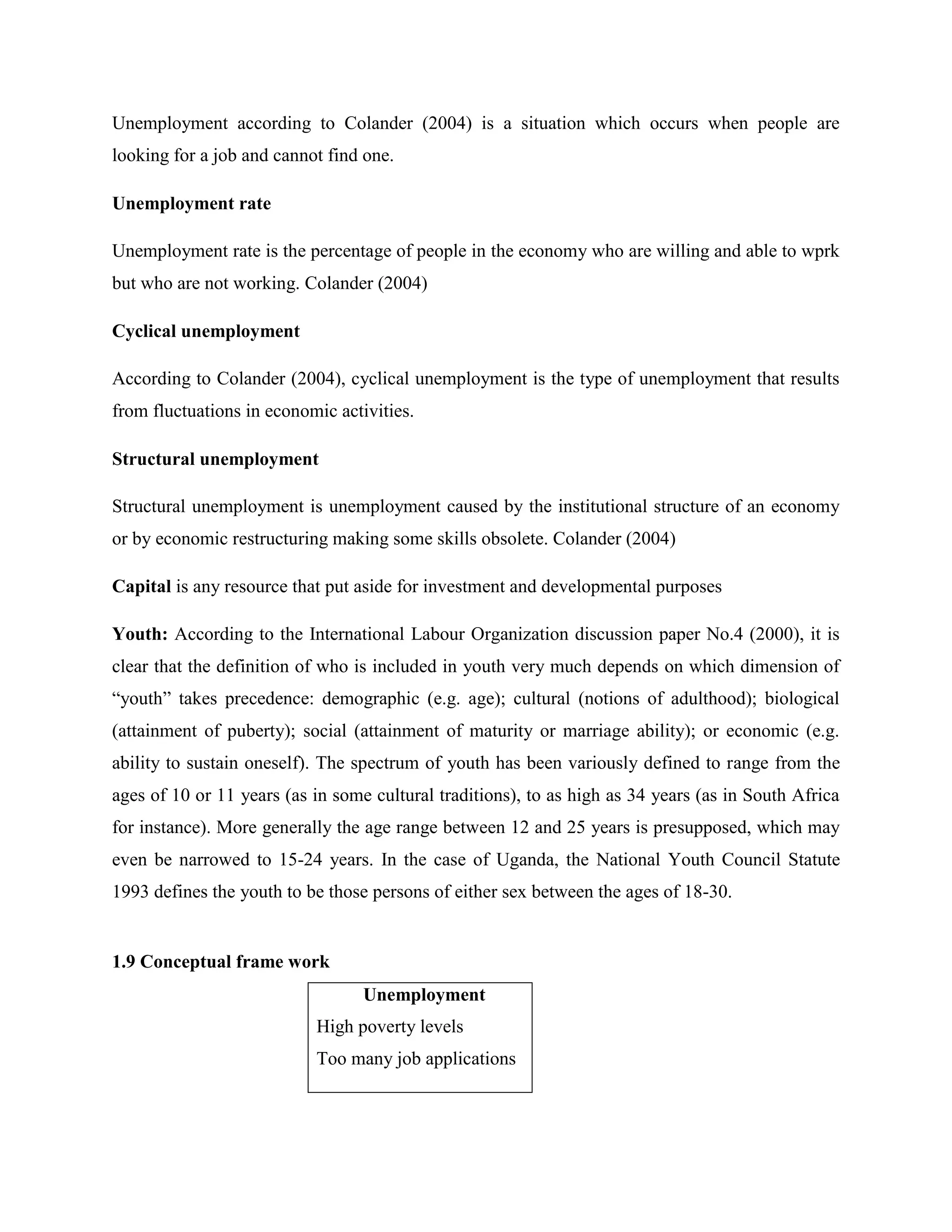
1.9 Conceptual frame work
                                  Unemployment
                           High poverty levels
                           Too many job applications
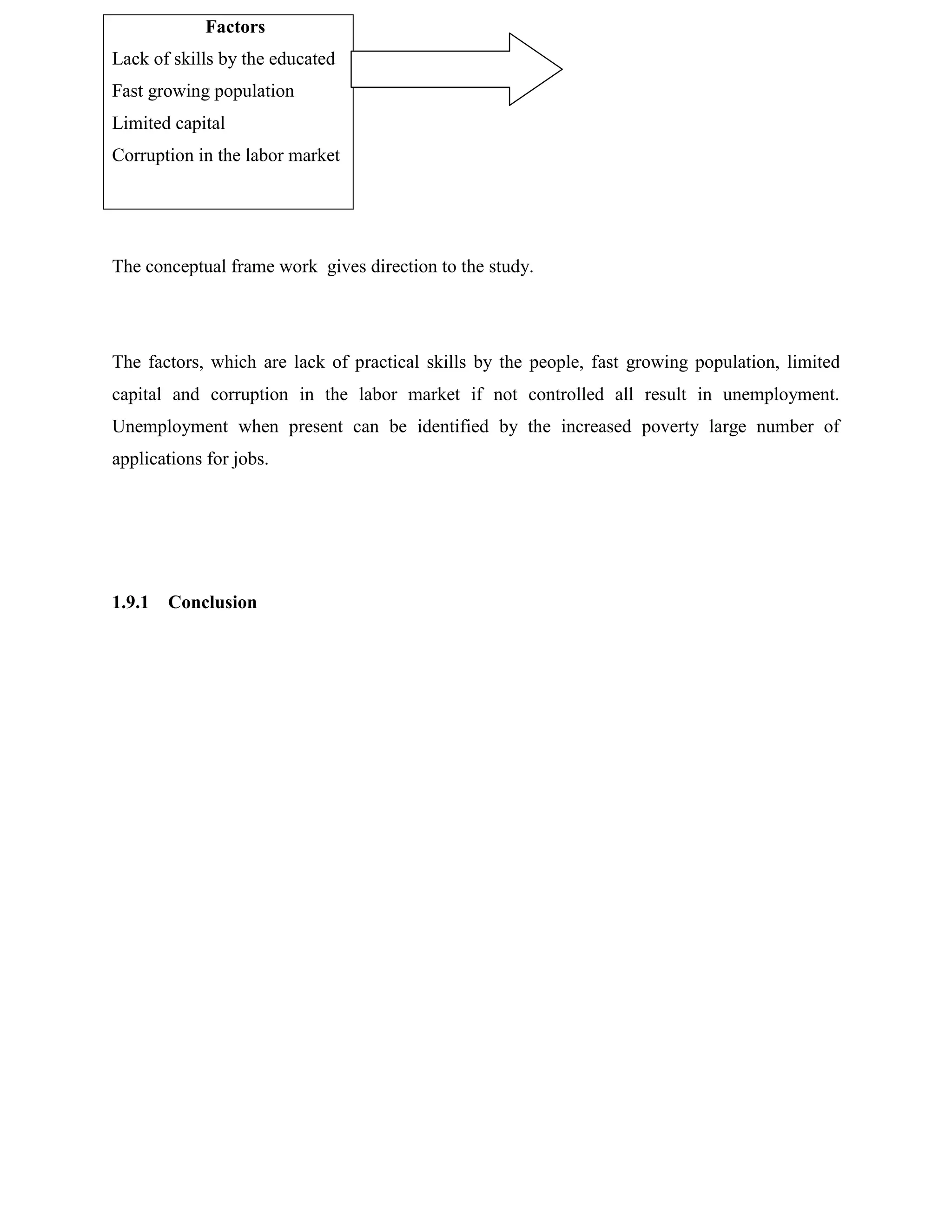
Factors
Lack of skills by the educated
Fast growing population
Limited capital
Corruption in the labor market


The conceptual frame work gives direction to the study.


The factors, which are lack of practical skills by the people, fast growing population, limited
capital and corruption in the labor market if not controlled all result in unemployment.
Unemployment when present can be identified by the increased poverty large number of
applications for jobs.


1.9.1 Conclusion

Chapter one (dissertation)

  • 1.
    CHAPTER ONE INTRODUCTION 1.0 Introduction Thischapter contains information on the background of the study, the study problem, research objectives, scope of the study research questions and the conceptual frame work. These will help the reader understand what is to be researched about. 1.1 Background The problem of youth unemployment and underemployment in Africa poses complex economic, social and moral policy issues. It is also well known that this problem is part and parcel of the overall problem of unemployment and underemployment that afflicts almost all African countries. Unemployment is not a hard bone to chew for just a few unfortunate poor countries, but it is a problem that is not discriminative and biased, because of this, unemployment bites and indeed it bites down on the whole world including the developed countries. It does not take one to have eyes to see that unemployment is rising around the world. According to the United Nations report of 2009, the world recorded the highest unprecedented increase in youth unemployment and in this regard, the number of youth who were unemployed reached 75.8 million and in 2010, the global rate of youth unemployment was 12.6%. Unemployment rates in the 30 wealthy countries that belong to the Organization for Economic Cooperation and Development range from a low of 3.2% in the Netherlands to 17.6% in Spain, according to July 2009 figures. The US unemployment rate was 9.4% in July 2009, above the European Union rate of 8.8%. By August, the US unemployment rate had ticked up to 9.7%, a 26-year high. It was announced earlier this year 2010 by the International Labor Office that global unemployment last year reached the highest level on record. More than 7% of the global work force was unemployed in 2009. In Africa, many people depend on low productivity subsistence agriculture and the informal sector for their livelihood where returns on labor and capital are low. Despite all the numerous
  • 2.
    declarations and commitments,the overall employment situation in Africa has not changed over the last decade. In 1998 and 2008, the total unemployment rate was 7.4% and 7.6% in sub- Saharan Africa and 12.8% and 10% in North Africa respectively. In most African countries, including the East African countries, unemployment and under-employment levels have continued to increase and have remained at extremely high levels despite considerable efforts to promote sustainable development by national governments and international development agencies, (Economic Commission for Africa-ECA, 2002). In the region of East Africa, most of the population is involved in growing crops and herding livestock either for sale or consumption on the farm. The majority therefore earn their livelihood on the country side where there are very few wage earners. In Uganda, the problem mostly affects the youth and yet, these form the biggest percentage of Uganda’s population. 1.2 Statement of the problem Unemployment, is mostly affecting the youth. According to the Uganda National Bureau of statistics, the rate of unemployment in Uganda is 32% and 22.3% for the youth. According to the African Development Indicators’ report 2008/2009, 83% of Ugandan youth are unemployed and the statistics in the Uganda Youth Convention conference held at Makerere University in August 2010 show that out of the 400,000 graduates every year only 80,000 get employed. The government of Uganda has set up The School Leaver’s Industrial Fund according to the 2010/11 National Budget which is to provide funds for the youth to start up small scale businesses. However, despite all these efforts to try and improve the situation, the problem of unemployment still persists in Uganda. Many Ugandans are still living below the poverty line, there are still many people applying for jobs that may require only one person. This research therefore, intends to attempt to find out the possible causes of the persistent unemployment problem and to find out the possible solutions to this problem that has for so long undermined the stable growth and development of Uganda. 1.3 General objective: To determine the factors responsible for the high level of youth unemployment in Uganda
  • 3.
    1.4 Specific objectives To examine the trend and the level of youth unemployment in Kampala central (Uganda). To identify and analyze the major causes of youth unemployment in Kampala central. To explore policy options for unemployment in Uganda. To identify the various types of unemployment in Uganda. 1.5 Research Questions i. What is the trend and the level of youth unemployment in Kampala central? ii. What are the major causes of youth unemployment in Kampala central? iii. What is the trend in growth of Uganda’s population? iv. What are the major types of unemployment in Uganda? v. What are the policy options for unemployment in Uganda? 1.6 Scope of the study The scope of the sturdy is shows the limitations of the sturdy in terms of the time, content, and content to be covered. This was included to describe to Geographical scope Kampala central is one of the five divisions that make up Kampala district and it being the smallest of them makes it more ideal for my research. Time scope Content scope 1.7 Justification of the study
  • 4.
    If the problemof unemployment is not addressed now, the country is likely to fail to achieve its Millennium Development Goals. In 2007, in Paris, the Inter Agency and Experts meeting on the Millennium Development Goals indicators came up with new target and indicators that focused on unemployment, alongside other issues. Many of the youths in Uganda are unemployed and over the years, the problem has worsened. This therefore creates the need to carry out research and if no research is carried out, the future of Uganda’s development is uncertain. Poverty will increase and so will the crime rate as youth look for illegal ways of making a living. Kampala has a high number of graduates and in addition to that, many of the youth move to Kampala from villages creating more pressure for the available jobs and increasing unemployment. People in Kampala are expected to be employed but the reality is different hence the need to do research in this area. This research is indeed crucial and a necessity in order to free the youth of Uganda from exploitation by over ambitious politicians. The World Bank in its 2008 report said Uganda had the highest youth unemployment rate and the youngest population in the world. It warned that unless Uganda scales up her efforts to create jobs, the youth would be more involved in crime and armed conflicts. The other reason as to why this sturdy had to be done when it was done was that according to me, many of the youth in Uganda are afraid of getting into marriage. This indeed justifies the need for this sturdy because the main reason is that without any stable and well paying job, they are unable to support the families that would result from marriage. This sturdy therefore set out to try and solve the unemployment problem among the youth and provide suggestions to avert this “monstrosity” which is slowly killing the dreams and hopes of us the youth. This study will benefit all the people of Uganda who are in one way or another connected to the subject of the study. This is in as far as providing the possible solutions and a better understanding of the youth unemployment problem that is affecting Uganda. 1.8 Definition of concepts Unemployment
  • 5.
    Unemployment according toColander (2004) is a situation which occurs when people are looking for a job and cannot find one. Unemployment rate Unemployment rate is the percentage of people in the economy who are willing and able to wprk but who are not working. Colander (2004) Cyclical unemployment According to Colander (2004), cyclical unemployment is the type of unemployment that results from fluctuations in economic activities. Structural unemployment Structural unemployment is unemployment caused by the institutional structure of an economy or by economic restructuring making some skills obsolete. Colander (2004) Capital is any resource that put aside for investment and developmental purposes Youth: According to the International Labour Organization discussion paper No.4 (2000), it is clear that the definition of who is included in youth very much depends on which dimension of “youth” takes precedence: demographic (e.g. age); cultural (notions of adulthood); biological (attainment of puberty); social (attainment of maturity or marriage ability); or economic (e.g. ability to sustain oneself). The spectrum of youth has been variously defined to range from the ages of 10 or 11 years (as in some cultural traditions), to as high as 34 years (as in South Africa for instance). More generally the age range between 12 and 25 years is presupposed, which may even be narrowed to 15-24 years. In the case of Uganda, the National Youth Council Statute 1993 defines the youth to be those persons of either sex between the ages of 18-30. 1.9 Conceptual frame work Unemployment High poverty levels Too many job applications
  • 6.
    Factors Lack of skillsby the educated Fast growing population Limited capital Corruption in the labor market The conceptual frame work gives direction to the study. The factors, which are lack of practical skills by the people, fast growing population, limited capital and corruption in the labor market if not controlled all result in unemployment. Unemployment when present can be identified by the increased poverty large number of applications for jobs. 1.9.1 Conclusion