Beyond GDP: Innovative ideas for a regional dashboard 
The GCRO BAROMETER 2014 
Darlington Mushongera 
Researcher, GCRO 
28/10/2014 
01/01/
GCRO – the institution 
• What is the GCRO? 
• Gauteng City Region Observatory 
• A research centre based at Wits University in Johannesburg 
• Established in 2008 
• By the provincial government as a partnership with Wits University, University of 
Johannesburg (UJ) and GPG 
• More recently, organised local government has come on board as a partner (SALGA) 
• What is its purpose/aim? 
• Assist in building a knowledge base for government, business, labour, civil society and 
citizens, 
• That knowledge based is required for shaping appropriate strategies that will advance 
the Gauteng as a competitive, integrated, sustainable and inclusive city-region 
• How? 
• Through cutting edge research in a wide range of areas, economic, social, political, 
and environment but with relevance to Gauteng 
• Modelling patterns and GIS mapping 
• A range of visual data intensive outputs (Vignettes, Data Briefs, Map of the months etc.) 
• To view our work please go to www.gcro.ac.za 
• A major element of our work – the biannual Quality of Life Survey 
2
Gauteng City-Region (GCR) – the space 
3
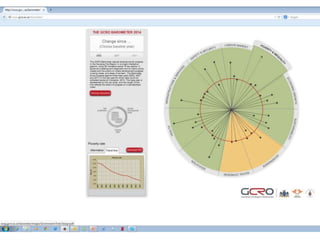
The Barometer – tool 
• Purpose 
– Part of GCRO mandate 
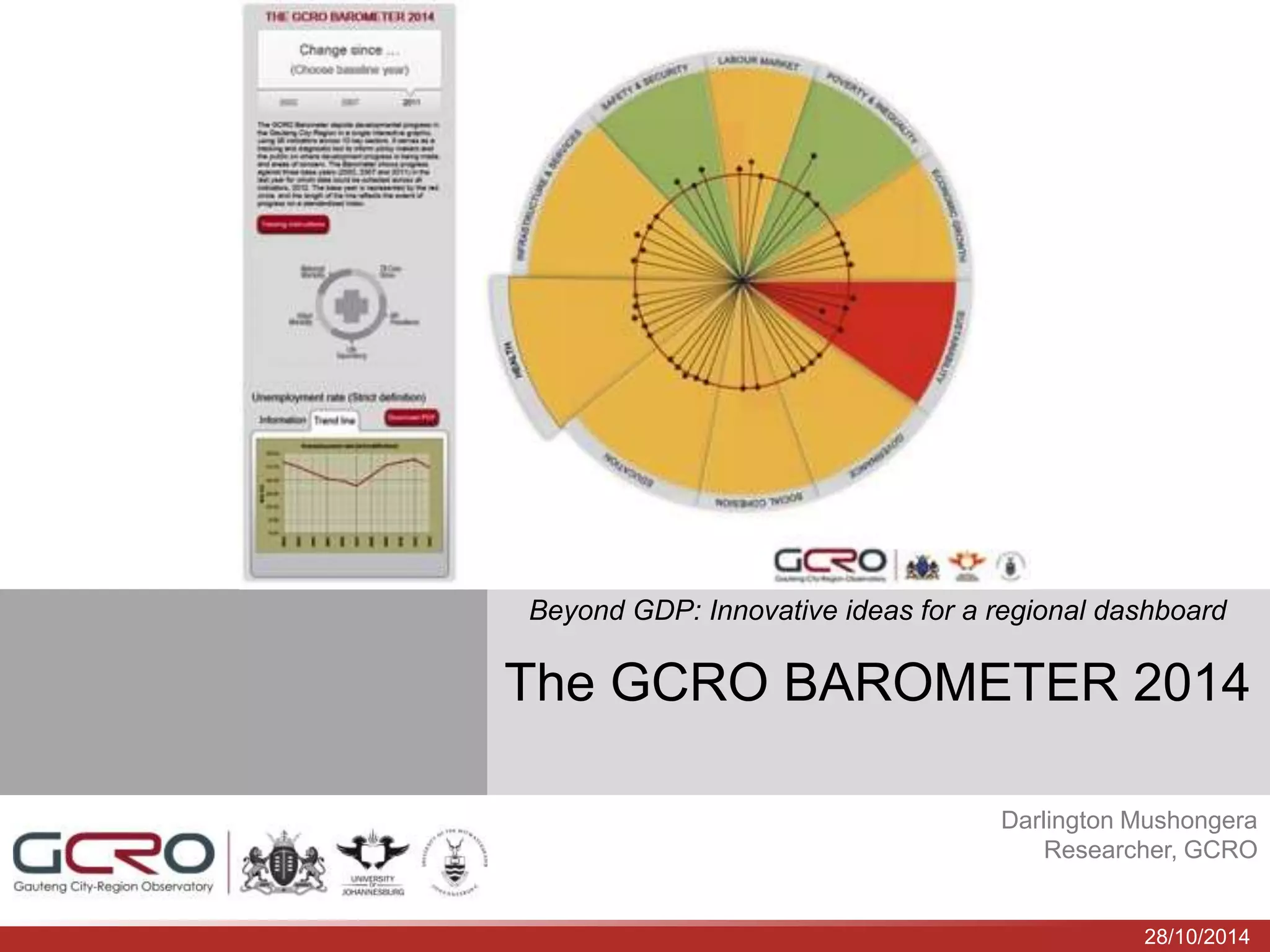
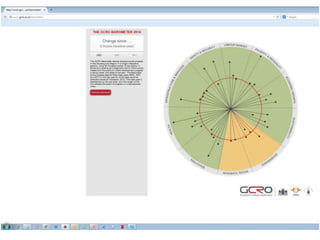
– To depict, in a single visual, developmental progress in the Gauteng City-Region (GCR) 
– Reducing complex data into into quick and easily digestible format but not lossing sight of the detail 
• Web based, interactive, circular visual 
• Displays 38 Indicators 
• Spread across 10 Sectors 
• Indicator definitions and data sources 
• Trend charts for each indicator – 2002-2012 
• Downloadable report with brief analysis of the trends 
• Accessible on line via PC (Mac/Win), Laptop, iPad, smart phone, etc 
• The link is www.gcro.ac.za/barometer
10 Sectors 38 indicators 
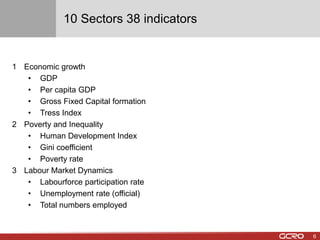
1 Economic growth 
• GDP 
• Per capita GDP 
• Gross Fixed Capital formation 
• Tress Index 
2 Poverty and Inequality 
• Human Development Index 
• Gini coefficient 
• Poverty rate 
3 Labour Market Dynamics 
• Labourforce participation rate 
• Unemployment rate (official) 
• Total numbers employed 
6
10 Sectors 38 indicators 
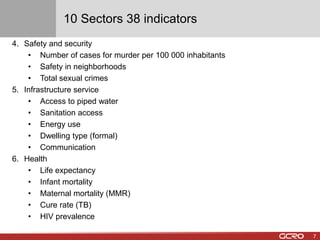
4. Safety and security 
• Number of cases for murder per 100 000 inhabitants 
• Safety in neighborhoods 
• Total sexual crimes 
5. Infrastructure service 
• Access to piped water 
• Sanitation access 
• Energy use 
• Dwelling type (formal) 
• Communication 
6. Health 
• Life expectancy 
• Infant mortality 
• Maternal mortality (MMR) 
• Cure rate (TB) 
• HIV prevalence 
7
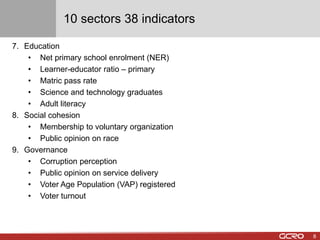
7. Education 
10 sectors 38 indicators 
• Net primary school enrolment (NER) 
• Learner-educator ratio – primary 
• Matric pass rate 
• Science and technology graduates 
• Adult literacy 
8. Social cohesion 
• Membership to voluntary organization 
• Public opinion on race 
9. Governance 
• Corruption perception 
• Public opinion on service delivery 
• Voter Age Population (VAP) registered 
• Voter turnout 
8
10 Sectors 38 indicators 
10.Sustainability 
• Drinking water quality – Blue Drop Index 
• Sanitation Risk – Green drop Index 
• Air quality – Air quality index 
• Electricity consumption – per capita 
9
Method 
• 38 key indicators were selected and categorized into 10 broad sectors 
• The period covered in the analysis is 2002 to 2012. 
• Ideally, the intention was to cover the period from 1995 to 2013 but there were 
no datasets that consistently covered this period for all 38 indicators. 
• Various data sources were used such as StatsSA3, Quantec, Global Insight, 
SAAQIS, SAPS and GCRO’s Quality of Life (QoL) surveys. 
• A simple index was used to benchmark progress in 2012 against 3 base years 
i.e. 2002, 2007 and 2011. 
• The average sector indices were used to determine progress relative to the 
base years using a colour scale, 
• Red=significant negative change [<100]; 
• Amber=only minor positive change [=>100 but <105]; 
• Green=significant positive change =>105). 
10
Data sources 
• Government 
• Statistics South Africa - official source of data in SA 
• DEA (SAAQIS) 
• DWA (now W&S) 
• GDE 
• DoH (Health Systems Trust) 
• SAPS 
• Private Sector 
• Quantec 
• Global Insight 
• GCRO Quality of Life 
• Major part of GCRO 
• Mostly opinion survey, 
• Perceptions about life, government, race, service delivery, etc. 
11
Key issues arising the project 
• Data scarcity! 
• For as much as there is to be abundance of data in SA, its in fact scarce when 
you come to do in depth and time series analysis as this. 
• Comparability of data 
• Time series data sometimes fails to tell a logical story e.g. access to water 
• Data experts the private sector 
• Quantec, Global Insight – can we take these as given 
• Their methodologies? Motive? Can we really trust their data? 
• Technical 
• Functionality 
• Choosing variables to represent sector 
• Defining variables – local vs. international standards 
12
Summary results from GCRO Barometer 
2014 
• Significant progress across all sectors 
• However people perceptions about government are waning 
• Relative apathy in terms of citizen participation in governance matters 
• This should be a cause for concern for policy makers at all levels regarding the pace 
and nature of development and its impact on people. 
• Note: 
• Significant changes over longer periods – which is logical 
• But not much change in shorter periods <=5 years 
• With local politics getting more competitive it my be difficult to see the impact of government policies 
• The Barometer was launched in August 2014 
• Metros found it useful 
• City of Johannesburg – want 3 separate ones for benchmarking with Ekurhuleni and 
Tshwane
Thank you

The GCRO BAROMETER 2014

  • 1.
    Beyond GDP: Innovativeideas for a regional dashboard The GCRO BAROMETER 2014 Darlington Mushongera Researcher, GCRO 28/10/2014 01/01/
  • 2.
    GCRO – theinstitution • What is the GCRO? • Gauteng City Region Observatory • A research centre based at Wits University in Johannesburg • Established in 2008 • By the provincial government as a partnership with Wits University, University of Johannesburg (UJ) and GPG • More recently, organised local government has come on board as a partner (SALGA) • What is its purpose/aim? • Assist in building a knowledge base for government, business, labour, civil society and citizens, • That knowledge based is required for shaping appropriate strategies that will advance the Gauteng as a competitive, integrated, sustainable and inclusive city-region • How? • Through cutting edge research in a wide range of areas, economic, social, political, and environment but with relevance to Gauteng • Modelling patterns and GIS mapping • A range of visual data intensive outputs (Vignettes, Data Briefs, Map of the months etc.) • To view our work please go to www.gcro.ac.za • A major element of our work – the biannual Quality of Life Survey 2
  • 3.
  • 4.
    The Barometer –tool • Purpose – Part of GCRO mandate – To depict, in a single visual, developmental progress in the Gauteng City-Region (GCR) – Reducing complex data into into quick and easily digestible format but not lossing sight of the detail • Web based, interactive, circular visual • Displays 38 Indicators • Spread across 10 Sectors • Indicator definitions and data sources • Trend charts for each indicator – 2002-2012 • Downloadable report with brief analysis of the trends • Accessible on line via PC (Mac/Win), Laptop, iPad, smart phone, etc • The link is www.gcro.ac.za/barometer
  • 6.
    10 Sectors 38indicators 1 Economic growth • GDP • Per capita GDP • Gross Fixed Capital formation • Tress Index 2 Poverty and Inequality • Human Development Index • Gini coefficient • Poverty rate 3 Labour Market Dynamics • Labourforce participation rate • Unemployment rate (official) • Total numbers employed 6
  • 7.
    10 Sectors 38indicators 4. Safety and security • Number of cases for murder per 100 000 inhabitants • Safety in neighborhoods • Total sexual crimes 5. Infrastructure service • Access to piped water • Sanitation access • Energy use • Dwelling type (formal) • Communication 6. Health • Life expectancy • Infant mortality • Maternal mortality (MMR) • Cure rate (TB) • HIV prevalence 7
  • 8.
    7. Education 10sectors 38 indicators • Net primary school enrolment (NER) • Learner-educator ratio – primary • Matric pass rate • Science and technology graduates • Adult literacy 8. Social cohesion • Membership to voluntary organization • Public opinion on race 9. Governance • Corruption perception • Public opinion on service delivery • Voter Age Population (VAP) registered • Voter turnout 8
  • 9.
    10 Sectors 38indicators 10.Sustainability • Drinking water quality – Blue Drop Index • Sanitation Risk – Green drop Index • Air quality – Air quality index • Electricity consumption – per capita 9
  • 10.
    Method • 38key indicators were selected and categorized into 10 broad sectors • The period covered in the analysis is 2002 to 2012. • Ideally, the intention was to cover the period from 1995 to 2013 but there were no datasets that consistently covered this period for all 38 indicators. • Various data sources were used such as StatsSA3, Quantec, Global Insight, SAAQIS, SAPS and GCRO’s Quality of Life (QoL) surveys. • A simple index was used to benchmark progress in 2012 against 3 base years i.e. 2002, 2007 and 2011. • The average sector indices were used to determine progress relative to the base years using a colour scale, • Red=significant negative change [<100]; • Amber=only minor positive change [=>100 but <105]; • Green=significant positive change =>105). 10
  • 11.
    Data sources •Government • Statistics South Africa - official source of data in SA • DEA (SAAQIS) • DWA (now W&S) • GDE • DoH (Health Systems Trust) • SAPS • Private Sector • Quantec • Global Insight • GCRO Quality of Life • Major part of GCRO • Mostly opinion survey, • Perceptions about life, government, race, service delivery, etc. 11
  • 12.
    Key issues arisingthe project • Data scarcity! • For as much as there is to be abundance of data in SA, its in fact scarce when you come to do in depth and time series analysis as this. • Comparability of data • Time series data sometimes fails to tell a logical story e.g. access to water • Data experts the private sector • Quantec, Global Insight – can we take these as given • Their methodologies? Motive? Can we really trust their data? • Technical • Functionality • Choosing variables to represent sector • Defining variables – local vs. international standards 12
  • 23.
    Summary results fromGCRO Barometer 2014 • Significant progress across all sectors • However people perceptions about government are waning • Relative apathy in terms of citizen participation in governance matters • This should be a cause for concern for policy makers at all levels regarding the pace and nature of development and its impact on people. • Note: • Significant changes over longer periods – which is logical • But not much change in shorter periods <=5 years • With local politics getting more competitive it my be difficult to see the impact of government policies • The Barometer was launched in August 2014 • Metros found it useful • City of Johannesburg – want 3 separate ones for benchmarking with Ekurhuleni and Tshwane
  • 24.

Editor's Notes

  • #2 The Barometer is the latest of GCRO research products under the Government, Governance and Intergovernmental Relations pillar of the GCRO 2011-2014 Strategic Plan It has been in the making during the last 2 years Its audience are the general public, policy makers, researcher/academics who have particular interest on Gauteng development More important is will serve as a handy reference tool for the Gauteng Planning Commission The plan is to update it annually and as new data becomes available. Its serves not just as information tool but also a tracking and diagnostic tool on where development is being made and areas of concern It will also service as a tool for benchmarking Gauteng/GCR against other similar city-regions elsewhere in the world. We also expect it reveal where further research may be needed. The was consultation with GPG Planning re: consensus on indicators to be used in populating the Barometer Care was taken to make sure that key indicators for each sector are included (some sectors have more that other but its not an indication of importance). Care was also taken to make sure that the selected indicators are comparable nationally and internationally – so we use standard measure for most indicators. The barometer shows progress in 2012 against three base years 2002, 2007, 2011. A standardised index has been used to make sure that all the indicators are plot-table on the same chart.
  • #3 - QoL - some of the data use in the Barometer was drawn from the survey, rare data that is not found in other publicly available surveys - QoL is open to the public free of charge – only need to go through the formalities of getting it.
  • #4 - The GCR has no unique boundaries but is the imaginary space where the influence of Gauteng extends, We refer to these as footprints where certain nodes exist e.g. Witbank, Secunda and Middleburg This concept can be high sensitive politically – so we sometime use very cautiously.
  • #5 Mandate as show in slide 2. Challenges Not easy to classification – internal disagreement between staff e.g. I will come back to these later BUT inspite of the challenge we did not give up We worked hard to make sure that the we get as close as possible to
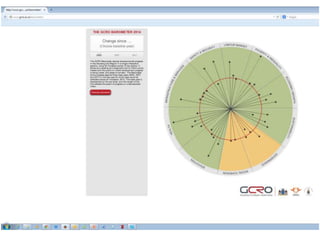
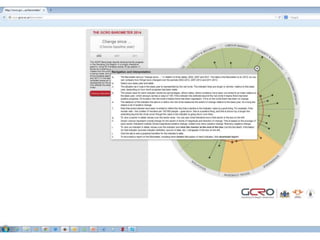
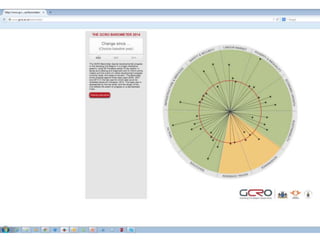
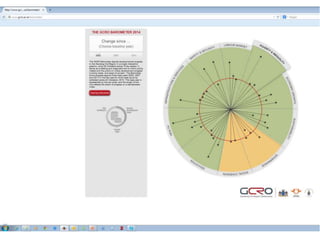
  • #6 When you open the Barometer for the first time this is what you see. All sectors in place. The title is on top THE GCRO BAROMETER 2014 Below the title is a facility for choosing a base year to compare progress against 2012. Below that is small paragraph introducing the Barometer in terms of its purpose and the basic principle behind the tool. Below that is button “Viewing instructions”
  • #14 When you open the Barometer for the first time this is what you see. All sectors in place. The title is on top THE GCRO BAROMETER 2014 Below the title is a facility for choosing a base year to compare progress against 2012. Below that is small paragraph introducing the Barometer in terms of its purpose and the basic principle behind the tool. Below that is button “Viewing instructions”
  • #15 Below the introduction is a tab which says “Viewing instructions”. Clicking the “Viewing instructions button – a small window opens with detailed instructions on how to view the Barometer and how to interpret the indicators. Now we do understand that people have become relatively computer literate and are quite at ease in finding their way through interactive visuals as these. However, we do encourage viewers of the Barometer to spend some time reading through the instructions which you can view by clicking the viewing instructions button. The reason is that these instructions contain a lot of background detail that will help the viewer to understand not just the navigation (which may be easy) but also the meaning of what one is viewing on the Barometer. It takes only a couple minutes so please take time to go through the instructions.. Otherwise you might spend all you viewing time say “why? What?” and eventually you may reject it as unfriendly. Click the top right corner to remove the instructions and start navigating.
  • #16 Ok navigation. You need to be connected to the internet The first thing one can do is to view the Barometer across the three different base year before exploring the different sectors and the individual indicators. As I said, when it opens what you see is a picture that compares 2012 against 2002 (i.e. 10 years ago).
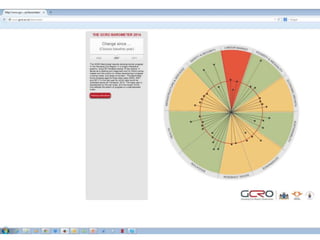
  • #17 Click 2007 to see the picture against 2007 – i.e. 5 years ago
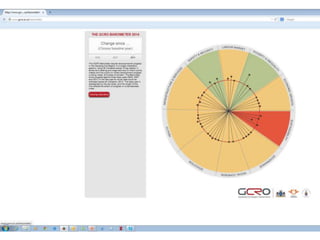
  • #18 Click 2011 to see the picture against 2011 – a year ago
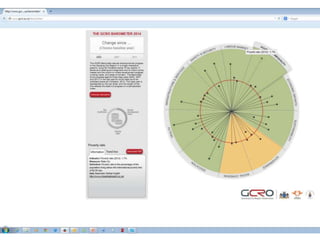
  • #19 Viewing specific sectors Mouse the sector and it pops out Sector icon appears on the left bar here together with the names of the indicators for that sector.
  • #20 Moussing over the top ends of the indicator lines reveals the name of the indicator and its value for 2012. If you click information about the indicators also appears at the bottom of the left bar. Inform includes definition, unit of measurement and the data sources that we used.
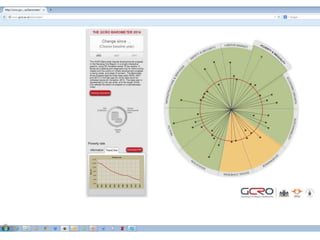
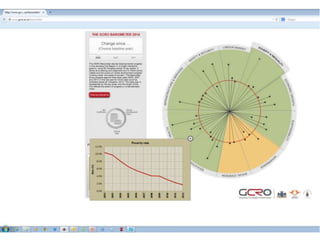
  • #21 If you click the “Trend line” tab you get a trend chart for the indicator from 2002-2012.
  • #22 Double click the chart to enlarge This applies to all other indicators
  • #23 Click download to access the full analysis of the all the 38 indicators. The document opens as a PDF, so make you have Adobe PDF viewer installed on your device.