What is a conclusion made
from observing data?
It is a repeated
arrangement of
numbers, shapes
and colors.
What is a sequence
in which term after
the first is formed by
adding a fixed
number.
How do you
find the nth
term of an
arithmetic
sequence?
Find the next
2 terms of the
following sequence. 33
3,
7,11,15,__,__
ILLUSTRATES
A
GEOMETRIC
SEQUENCE
(M10AL-Id-1)
Activity
Activity
Bring out the scissors and piece of paper.
Cut the paper in 3, count the pieces then
pile the pieces, then cut again into 3,
count it again, then pile it again cut into
3, count it again, then pile it again cut
into 3 , count again the number of pieces.
Write the number of times you cut in 3 (x)
and the number of pieces of paper(y) on
the table.
x 0 1 2 3 4 5
y
Answer the following questions:
1.What can you observe in
this tally? Is there a
sequence? Is it an
arithmetic sequence?
2.Does it have a common
difference? What can you
say about this sequence?
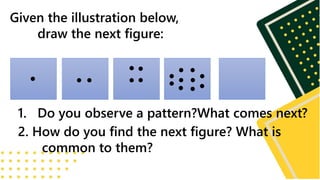
Given the illustration below,
draw the next figure:
1. Do you observe a pattern?What comes next?
2. How do you find the next figure? What is
common to them?
3. Can you write the next term in the
table below?
n 1 2 3 4 5 6 7
𝒂𝒏
A Geometric sequence is a
sequence where each term
after the first is obtained by
multiplying the preceding
term by a nonzero constant
number called common
ratio.
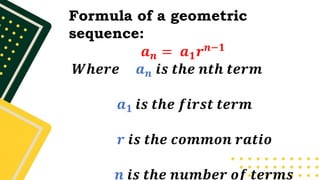
Formula of a geometric
sequence:
𝒂𝒏 = 𝒂𝟏𝒓𝒏−𝟏
𝑾𝒉𝒆𝒓𝒆 𝒂𝒏 𝒊𝒔 𝒕𝒉𝒆 𝒏𝒕𝒉 𝒕𝒆𝒓𝒎
𝒂𝟏 𝒊𝒔 𝒕𝒉𝒆 𝒇𝒊𝒓𝒔𝒕 𝒕𝒆𝒓𝒎
𝒓 𝒊𝒔 𝒕𝒉𝒆 𝒄𝒐𝒎𝒎𝒐𝒏 𝒓𝒂𝒕𝒊𝒐
𝒏 𝒊𝒔 𝒕𝒉𝒆 𝒏𝒖𝒎𝒃𝒆𝒓 𝒐𝒇 𝒕𝒆𝒓𝒎𝒔
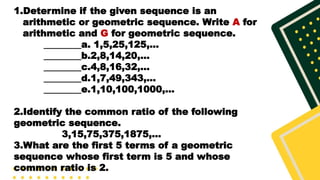
1.Determine if the given sequence is an
arithmetic or geometric sequence. Write A for
arithmetic and G for geometric sequence.
________a. 1,5,25,125,…
________b.2,8,14,20,…
________c.4,8,16,32,…
________d.1,7,49,343,…
________e.1,10,100,1000,…
2.Identify the common ratio of the following
geometric sequence.
3,15,75,375,1875,…
3.What are the first 5 terms of a geometric
sequence whose first term is 5 and whose
common ratio is 2.

Illustrating the Geometric Sequence.pptx

  • 2.
    What is aconclusion made from observing data?
  • 3.
    It is arepeated arrangement of numbers, shapes and colors.
  • 4.
    What is asequence in which term after the first is formed by adding a fixed number.
  • 5.
    How do you findthe nth term of an arithmetic sequence?
  • 6.
    Find the next 2terms of the following sequence. 33 3, 7,11,15,__,__
  • 7.
  • 8.
  • 9.
    Activity Bring out thescissors and piece of paper. Cut the paper in 3, count the pieces then pile the pieces, then cut again into 3, count it again, then pile it again cut into 3, count it again, then pile it again cut into 3 , count again the number of pieces. Write the number of times you cut in 3 (x) and the number of pieces of paper(y) on the table.
  • 10.
    x 0 12 3 4 5 y
  • 11.
    Answer the followingquestions: 1.What can you observe in this tally? Is there a sequence? Is it an arithmetic sequence? 2.Does it have a common difference? What can you say about this sequence?
  • 12.
    Given the illustrationbelow, draw the next figure: 1. Do you observe a pattern?What comes next? 2. How do you find the next figure? What is common to them?
  • 13.
    3. Can youwrite the next term in the table below? n 1 2 3 4 5 6 7 𝒂𝒏
  • 14.
    A Geometric sequenceis a sequence where each term after the first is obtained by multiplying the preceding term by a nonzero constant number called common ratio.
  • 15.
    Formula of ageometric sequence: 𝒂𝒏 = 𝒂𝟏𝒓𝒏−𝟏 𝑾𝒉𝒆𝒓𝒆 𝒂𝒏 𝒊𝒔 𝒕𝒉𝒆 𝒏𝒕𝒉 𝒕𝒆𝒓𝒎 𝒂𝟏 𝒊𝒔 𝒕𝒉𝒆 𝒇𝒊𝒓𝒔𝒕 𝒕𝒆𝒓𝒎 𝒓 𝒊𝒔 𝒕𝒉𝒆 𝒄𝒐𝒎𝒎𝒐𝒏 𝒓𝒂𝒕𝒊𝒐 𝒏 𝒊𝒔 𝒕𝒉𝒆 𝒏𝒖𝒎𝒃𝒆𝒓 𝒐𝒇 𝒕𝒆𝒓𝒎𝒔
  • 16.
    1.Determine if thegiven sequence is an arithmetic or geometric sequence. Write A for arithmetic and G for geometric sequence. ________a. 1,5,25,125,… ________b.2,8,14,20,… ________c.4,8,16,32,… ________d.1,7,49,343,… ________e.1,10,100,1000,… 2.Identify the common ratio of the following geometric sequence. 3,15,75,375,1875,… 3.What are the first 5 terms of a geometric sequence whose first term is 5 and whose common ratio is 2.