IKEA
GROUP-A5
KAPIL MAKHIJA
BHAVIK THAKKAR
SAGAR SAWANT
MEHBOOB BHATTI
ANIKET KATDARE
ITM SION
BATCH-91
Summary of the case study
• Established in the 1940s in Sweden by Ingvar
Kamprad, and is one of the world's largest
retailers of home furnishings.
• IKEA’s vision is to: “To create a better life for the
majority of people which is the basis of its strategic
orientation”
• USP is to sell “value for money products.”
• Production oriented, Swedish roots in its
international advertising, "Swedish" blue and
gold color scheme for its stores; that is spreading
Swedish culture and lifestyle all over the world.
• A group with 138 stores in 28 countries and
sales of close to $6 billion till 1997
• Have a very strong bonding with vendors (as
business partners)
• There are about 2500 vendors in 65 country
• They enjoy : long term contracts , technical
advise & leased equipments
• 11% sales in Sweden, 29.6% from Germany,
42.5% from the rest of Western Europe, 14.4%
from North America.
Background
Idea of “A better life,
for many people”
 Searched for
furniture manufactures
Began to build long term business
partnerships with manufactures
and distributers
“We do not buy products from
our suppliers, we buy unused
production capacity.” -- IKEA
Sold small items
out of families
kitchen.
IKEA in today's world
Today’s marketing strategy
• Catalogue distributed world-wide as 191 million
copies (in 56 different editions and 27 different
languages).
• IKEA has 31 trading service offices in 26 countries
so production can be monitored, new ideas
tested, prices negotiated and quality checked.
• All of the company’s home furnishing products
are comprised of 71% renewable material and
include as much recyclable material as possible.
• They were the first company to feature a GAY
relationships in a commercial.
The
Environmental
Issue
The Social Issue
1980:
Formaldehyde
scandal in Denmark
Complication – The Environmental Issue
1st
Action
Alternative
action
Action
1992:
Formaldehyde
scandal in Germany
1st Action
• Immediately stopped the production and sales of Billy
bookcases worldwide
• Estimated lost: $6-7 million
Alternative Action
• Forestry: Forestry policy working with Greenpeace and
World Wide Fund for Nature
• Environmental Criteria: working with suppliers, adapting
the product range,transport and distribution, ensuring
environmentally conscious stores
Complication – The Environmental Issue
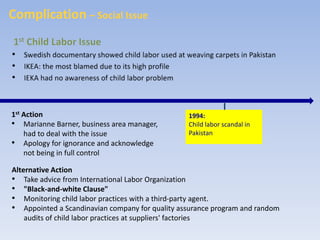
Complication – Social Issue
1994:
Child labor scandal in
Pakistan
1st Action
• Marianne Barner, business area manager,
had to deal with the issue
• Apology for ignorance and acknowledge
not being in full control
Alternative Action
• Take advice from International Labor Organization
• "Black-and-white Clause"
• Monitoring child labor practices with a third-party agent.
• Appointed a Scandinavian company for quality assurance program and random
audits of child labor practices at suppliers' factories
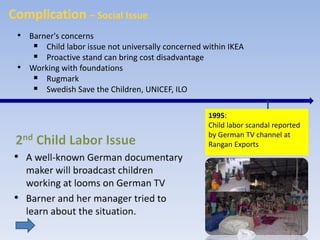
Complication – Social Issue
1995:
Child labor scandal reported
by German TV channel at
Rangan Exports
• Barner's concerns
 Child labor issue not universally concerned within IKEA
 Proactive stand can bring cost disadvantage
• Working with foundations
 Rugmark
 Swedish Save the Children, UNICEF, ILO
After 1997
• By 2009 they had 267 store out which in USA
they came up 37 & in Germany 44 stores
• By 2013 they started capturing new emerging
markets like Latin & middle east
• If one is in UK it is better to head to IKEA outlets
rather a real estate agent
• One can grab a flat-pack house for a fraction of
the cost.
• The BoKlok houses were originally released in
Sweden in 1996, and have since expanded to
IKEA stores across Northern Europe.
• In 2008 IKEA UK launched family mobile a
virtual mobile phone network , that runs on T
mobile
• IKEA family loyalty card
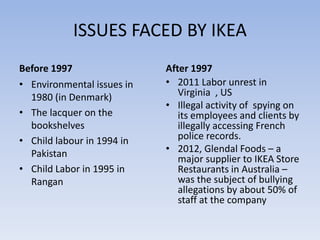
ISSUES FACED BY IKEA
Before 1997
• Environmental issues in
1980 (in Denmark)
• The lacquer on the
bookshelves
• Child labour in 1994 in
Pakistan
• Child Labor in 1995 in
Rangan
After 1997
• 2011 Labor unrest in
Virginia , US
• Illegal activity of spying on
its employees and clients by
illegally accessing French
police records.
• 2012, Glendal Foods – a
major supplier to IKEA Store
Restaurants in Australia –
was the subject of bullying
allegations by about 50% of
staff at the company
Culture adaptation of IKEA
• Culture and lifestyle clash with America(1991)
• Failure in Japan (1974) > re-entry (1984)
• Pre adaptation of culture in China
• Created Guidelines for Thialand
FACTS & FILES
• The founder is dyslexic person :-
IKEA have a very specific way of naming products.
E.g. : tables and chairs generally are named after places
in Finland. Carpets are named after places in
Denmark
• Founder was also directly involved with fund raising
& recruitment for the New Swedish Movement (still
has out lets in Israel as well as Islamic countries)
• In 1994 he apologized to all his Jewish employees in
writing
• For tax benefits it claims as a charity body
IKEA & INDIA
IKEA and UNICEF
• IKEA has worked for UNICEF for more than 10
years.
• IKEA has been funding UNICEF projects that
help:
– Improve children education
– Keep children out of work
– Provide health start of life for children
• IKEA has donated $ 2 billion
• IKEA has impacted more than 84 million children
in INDIA alone.
• Soft toys for Education- So far IKEA has donated
$90 million through UNICEF
?
• 1)How can it work with international
stakeholder’s to prevent any future likelihood
of child labor or labor issue?
• 2)What cultural differences that IKEA needs to
adapt in order to increase organizational
effectiveness?
3)What are action plan taken by “IKEA”
to prevent Environmental issues?
1. Replace polyvinylchloride (PVC) in wallpapers, home textiles, shower
curtains, lampshades, and furniture
2. Minimize the use of formaldehyde in its products, including textiles
3. Eliminate acid-curing lacquers
4. Produce a model of chair (OGLA) made from 100% pre-consumer plastic
waste
5. Introduce a series of air-inflatable furniture products into the product line to
reduce the use of raw materials and transportation weight and volume
6. Reduce the use of chromium for metal surface treatment
7. Limit the use of substances such as cadmium, lead, PCB, PCP, and AZO
pigments
8. Use wood from responsibly managed forests that replant and maintain
biological diversity
9. Use only recyclable materials for flat packaging and "pure" (non-mixed)
materials for packaging to assist in recycling
10. Introduce rental bicycles with trailers for customers in Denmark

Ikea Case study

  • 1.
    IKEA GROUP-A5 KAPIL MAKHIJA BHAVIK THAKKAR SAGARSAWANT MEHBOOB BHATTI ANIKET KATDARE ITM SION BATCH-91
  • 2.
    Summary of thecase study • Established in the 1940s in Sweden by Ingvar Kamprad, and is one of the world's largest retailers of home furnishings. • IKEA’s vision is to: “To create a better life for the majority of people which is the basis of its strategic orientation” • USP is to sell “value for money products.” • Production oriented, Swedish roots in its international advertising, "Swedish" blue and gold color scheme for its stores; that is spreading Swedish culture and lifestyle all over the world.
  • 3.
    • A groupwith 138 stores in 28 countries and sales of close to $6 billion till 1997 • Have a very strong bonding with vendors (as business partners) • There are about 2500 vendors in 65 country • They enjoy : long term contracts , technical advise & leased equipments • 11% sales in Sweden, 29.6% from Germany, 42.5% from the rest of Western Europe, 14.4% from North America.
  • 4.
    Background Idea of “Abetter life, for many people”  Searched for furniture manufactures Began to build long term business partnerships with manufactures and distributers “We do not buy products from our suppliers, we buy unused production capacity.” -- IKEA Sold small items out of families kitchen.
  • 6.
  • 7.
    Today’s marketing strategy •Catalogue distributed world-wide as 191 million copies (in 56 different editions and 27 different languages). • IKEA has 31 trading service offices in 26 countries so production can be monitored, new ideas tested, prices negotiated and quality checked. • All of the company’s home furnishing products are comprised of 71% renewable material and include as much recyclable material as possible. • They were the first company to feature a GAY relationships in a commercial.
  • 8.
  • 9.
    1980: Formaldehyde scandal in Denmark Complication– The Environmental Issue 1st Action Alternative action Action
  • 10.
    1992: Formaldehyde scandal in Germany 1stAction • Immediately stopped the production and sales of Billy bookcases worldwide • Estimated lost: $6-7 million Alternative Action • Forestry: Forestry policy working with Greenpeace and World Wide Fund for Nature • Environmental Criteria: working with suppliers, adapting the product range,transport and distribution, ensuring environmentally conscious stores Complication – The Environmental Issue
  • 11.
    Complication – SocialIssue 1994: Child labor scandal in Pakistan 1st Action • Marianne Barner, business area manager, had to deal with the issue • Apology for ignorance and acknowledge not being in full control Alternative Action • Take advice from International Labor Organization • "Black-and-white Clause" • Monitoring child labor practices with a third-party agent. • Appointed a Scandinavian company for quality assurance program and random audits of child labor practices at suppliers' factories
  • 12.
    Complication – SocialIssue 1995: Child labor scandal reported by German TV channel at Rangan Exports • Barner's concerns  Child labor issue not universally concerned within IKEA  Proactive stand can bring cost disadvantage • Working with foundations  Rugmark  Swedish Save the Children, UNICEF, ILO
  • 13.
    After 1997 • By2009 they had 267 store out which in USA they came up 37 & in Germany 44 stores • By 2013 they started capturing new emerging markets like Latin & middle east • If one is in UK it is better to head to IKEA outlets rather a real estate agent • One can grab a flat-pack house for a fraction of the cost. • The BoKlok houses were originally released in Sweden in 1996, and have since expanded to IKEA stores across Northern Europe.
  • 14.
    • In 2008IKEA UK launched family mobile a virtual mobile phone network , that runs on T mobile • IKEA family loyalty card
  • 15.
    ISSUES FACED BYIKEA Before 1997 • Environmental issues in 1980 (in Denmark) • The lacquer on the bookshelves • Child labour in 1994 in Pakistan • Child Labor in 1995 in Rangan After 1997 • 2011 Labor unrest in Virginia , US • Illegal activity of spying on its employees and clients by illegally accessing French police records. • 2012, Glendal Foods – a major supplier to IKEA Store Restaurants in Australia – was the subject of bullying allegations by about 50% of staff at the company
  • 16.
    Culture adaptation ofIKEA • Culture and lifestyle clash with America(1991) • Failure in Japan (1974) > re-entry (1984) • Pre adaptation of culture in China • Created Guidelines for Thialand
  • 17.
    FACTS & FILES •The founder is dyslexic person :- IKEA have a very specific way of naming products. E.g. : tables and chairs generally are named after places in Finland. Carpets are named after places in Denmark • Founder was also directly involved with fund raising & recruitment for the New Swedish Movement (still has out lets in Israel as well as Islamic countries) • In 1994 he apologized to all his Jewish employees in writing • For tax benefits it claims as a charity body
  • 18.
  • 19.
    IKEA and UNICEF •IKEA has worked for UNICEF for more than 10 years. • IKEA has been funding UNICEF projects that help: – Improve children education – Keep children out of work – Provide health start of life for children • IKEA has donated $ 2 billion • IKEA has impacted more than 84 million children in INDIA alone. • Soft toys for Education- So far IKEA has donated $90 million through UNICEF
  • 20.
    ? • 1)How canit work with international stakeholder’s to prevent any future likelihood of child labor or labor issue? • 2)What cultural differences that IKEA needs to adapt in order to increase organizational effectiveness?
  • 21.
    3)What are actionplan taken by “IKEA” to prevent Environmental issues? 1. Replace polyvinylchloride (PVC) in wallpapers, home textiles, shower curtains, lampshades, and furniture 2. Minimize the use of formaldehyde in its products, including textiles 3. Eliminate acid-curing lacquers 4. Produce a model of chair (OGLA) made from 100% pre-consumer plastic waste 5. Introduce a series of air-inflatable furniture products into the product line to reduce the use of raw materials and transportation weight and volume 6. Reduce the use of chromium for metal surface treatment 7. Limit the use of substances such as cadmium, lead, PCB, PCP, and AZO pigments 8. Use wood from responsibly managed forests that replant and maintain biological diversity 9. Use only recyclable materials for flat packaging and "pure" (non-mixed) materials for packaging to assist in recycling 10. Introduce rental bicycles with trailers for customers in Denmark