http://www.iaeme.com/IJCIET/index.asp 1933 editor@iaeme.com
International Journal of Civil Engineering and Technology (IJCIET)
Volume 10, Issue 01, January 2019, pp. 1933-1940, Article ID: IJCIET_10_01_177
Available online at http://www.iaeme.com/ijciet/issues.asp?JType=IJCIET&VType=10&IType=01
ISSN Print: 0976-6308 and ISSN Online: 0976-6316
© IAEME Publication Scopus Indexed
TENSILE PROPERTIES OF FIBERGLASS AS
REINFORCEMENT OF LOW-COST RUBBER
BASE ISOLATOR FOR SMALL HOUSES
Budwi Harsono
Master Candidate, Civil Engineering Department,
Institut Teknologi Sepuluh Nopember (ITS), Surabaya, Indonesia
Tavio*
Professor, Civil Engineering Department,
Institut Teknologi Sepuluh Nopember (ITS), Surabaya, Indonesia
*Corresponding Author
ABSTRACT
Indonesia is one of the countries that has a very high seismic intensity. To meet
the standardization of the building design, several studies were conducted, including
the use of base isolation in residential buildings. The base isolator consists of several
layers of rubber and steel or lamination fibers which function to increase the vertical
stiffness of the isolator. Some has managed to use lamination fiber to make isolator
costs cheaper. This research uses fiberglass type net and woven roving types WR4
and WR6. Fiberglass is modeled according to the ASTM standard dogbone.
Fiberglass is tested as a standard matrix and is a composite. As a composite, the first
type is combined with 2504H Eternal resins and mepoxe catalyst, and second with
adhesive lord chemlok. The effect of curing on a temperature of 150 °C was observed
according to the conditions of making Low-Cost Rubber Base Isolation (LCRBI) on
the printing machine.
The result, fiberglass type Net matrix has a higher tensile strength compared to
other materials. For fiberglass net matrix composite has increased tensile strength in
the oven for 1 hour and returns to the oven for 2 hours at 150 °C. While the
composites of the WR4 and WR6 matrix materials have tensile strengths below 500
MPa and have a relatively small increase and decrease in value. Net type fiberglass is
suitable to be used as reinforcement on low-cost rubber base isolation for residential
areas, where with a small service load from the house it is needed a base isolator that
is not too stiff (optimal elastic). In addition, the fiberglass type net has a hollow
shape, allowing the layer between the rubbers to be more perfect for perfect
attachment
Budwi Harsono and Tavio
http://www.iaeme.com/IJCIET/index.asp 1934 editor@iaeme.com
Keywords: Fiberglass, Low-Cost Rubber Base Isolation, Small Houses,
Reinforcement
Cite this Article: Budwi Harsono and Tavio, Tensile Properties of Fiberglass as
Reinforcement of Low-Cost Rubber Base Isolator for Small Houses, International
Journal of Civil Engineering and Technology, 10(1), 2019, pp. 1933-1940.
http://www.iaeme.com/IJCIET/issues.asp?JType=IJCIET&VType=10&IType=01
1. INTRODUCTION
Indonesia is one of the countries that has a very high seismic intensity [1,2]. To meet the
standardization of the building design, several studies were conducted, including the use of
base isolation in residential buildings [3,4]. The base isolator consists of several layers of
rubber and steel or lamination fibers which function to increase the vertical stiffness of the
isolator [5,6]. Some has managed to use lamination fiber to make isolator costs cheaper [6].
In this study, we used several types of fiberglass as an effort to obtain an optimal base of
residential isolation in terms of both cost efficiency and construction functions (Figure 1).
(a) (b)
Figure 1 Base isolators for residential, (a) Side view, (b) Isometric view
As reinforcing material, fiberglass is not directly used. However, fiberglass requires
lamination in the form of resins and other adhesives to form a composite material that is
different in nature from the original material [8]. The composite material itself is composed
of a matrix (first phase) and reinforcement or reinforcing (second phase).
Damage arising from composites can be: (a) fiber damage, curved fiber
(buckling/kinking), fiber splitting, fiber/matrix debonding, crack matrix, and radial crack [9-
11]. The tensile strength of the test specimens (matrix, fiber, and composite) can be obtained
from Eq. (1).
A
F
t 
(1)
Where
σt = tensile strength (N/mm2
= MPa)
F = maximum load (N)
A = initial cross-sectional area of the test specimen (mm2
)
Specimen strain is calculated by Eq. (2).
Tensile Properties of Fiberglass as Reinforcement of Low-Cost Rubber Base Isolator for
Small Houses
http://www.iaeme.com/IJCIET/index.asp 1935 editor@iaeme.com
f
of
o L
LL
L
L 



(2)
Where
ε = strain (%)
∆L = length of specimen length (mm)
Lo = the initial length of the test section (mm)
Lf = length of the end of the test section (mm)
The fibers used in composites can be continuous or not continuous. If the fiber used is
not continuous, the ratio of fiber length (L) to its diameter (D) must meet L/D ≥ 100, and
according to ASTM D638 [12], the fiber length is at least 5 mm [11].
2. MATERIALS RESEARCH
2.1. Resins
The type of resins used is EBP-2504H eternal resins with mepoxe type catalyst. EBP-2504H
is a type of non-saturated polyester with medium viscosity and is intended for FRP molding
products. The shape and dimension of the sample is shown in Figures 2 and 3.
Figure 2 Figure of Dogbone Resins Material [12] (Unit length in mm)
(a) (b) (c)
Figure 3 (a), (b), (c) Resins samples after testing
Budwi Harsono and Tavio
http://www.iaeme.com/IJCIET/index.asp 1936 editor@iaeme.com
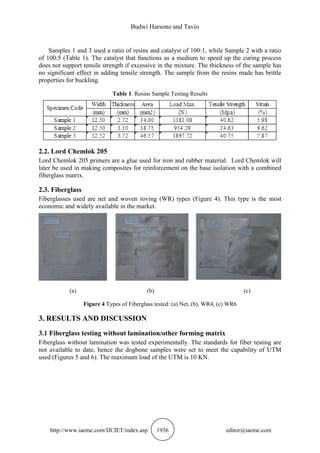
Samples 1 and 3 used a ratio of resins and catalyst of 100:1, while Sample 2 with a ratio
of 100:5 (Table 1). The catalyst that functions as a medium to speed up the curing process
does not support tensile strength if excessive in the mixture. The thickness of the sample has
no significant effect in adding tensile strength. The sample from the resins made has brittle
properties for buckling.
Table 1. Resins Sample Testing Results
2.2. Lord Chemlok 205
Lord Chemlok 205 primers are a glue used for iron and rubber material. Lord Chemlok will
later be used in making composites for reinforcement on the base isolation with a combined
fiberglass matrix.
2.3. Fiberglass
Fiberglasses used are net and woven roving (WR) types (Figure 4). This type is the most
economic and widely available in the market.
(a) (b) (c)
Figure 4 Types of Fiberglass tested: (a) Net, (b), WR4, (c) WR6
3. RESULTS AND DISCUSSION
3.1 Fiberglass testing without lamination/other forming matrix
Fiberglass without lamination was tested experimentally. The standards for fiber testing are
not available to date, hence the dogbone samples were set to meet the capability of UTM
used (Figures 5 and 6). The maximum load of the UTM is 10 KN.
Tensile Properties of Fiberglass as Reinforcement of Low-Cost Rubber Base Isolator for
Small Houses
http://www.iaeme.com/IJCIET/index.asp 1937 editor@iaeme.com
Figure 5 Dogbone fiberglass sample (Unit length in mm)
Figure 6 Fiberglass samples after being tested without lamination (Strand and normal shape).
According to the test results in Table 2, in strand conditions, net fiberglass types have
maximum tensile strength. While on the strand group, Fiberglass also has a large tensile
strength approaching the maximum tensile strength. The strain that occurs in the fiberglass
net is 5.8% (the maximum strain achieved among the samples tested).
Table 2 Fiberglass Testing Results without lamination
3.2. Fiberglass testing with other forming laminates/matrix
Testing of composites of fiberglass matrix and other forming matrix used ASTM D3039
testing standard [10] (Figures 7 and 8). In the test, the influence of oven temperature of 150
°C on the tensile strength of the composite material was investigated. This was based on the
use of the composite material for making LCRBI which was carried out at a temperature of
150 °C until the rubber compression process was completed. The test result is summarized in
Table 3.
Budwi Harsono and Tavio
http://www.iaeme.com/IJCIET/index.asp 1938 editor@iaeme.com
Figure 7 Composite dogbone material sample (ASTM D3039) [10]
Figure 8 Composite dogbone material sample (ASTM D3039) [10]
Table 3. Test results of fiberglass composite samples with lamination
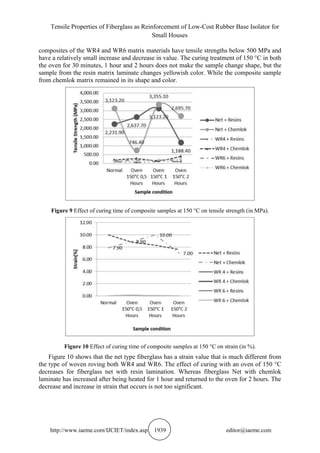
From Figure 9, it can be seen that the influence of oven time at 150 °C on the tensile
strength of composite samples. Where fiberglass Net matrix composite has increased tensile
strength in the oven for 1 hour and returns to the oven for 2 hours at 150 °C. While the
Tensile Properties of Fiberglass as Reinforcement of Low-Cost Rubber Base Isolator for
Small Houses
http://www.iaeme.com/IJCIET/index.asp 1939 editor@iaeme.com
composites of the WR4 and WR6 matrix materials have tensile strengths below 500 MPa and
have a relatively small increase and decrease in value. The curing treatment of 150 °C in both
the oven for 30 minutes, 1 hour and 2 hours does not make the sample change shape, but the
sample from the resin matrix laminate changes yellowish color. While the composite sample
from chemlok matrix remained in its shape and color.
Figure 9 Effect of curing time of composite samples at 150 °C on tensile strength (in MPa).
Figure 10 Effect of curing time of composite samples at 150 °C on strain (in %).
Figure 10 shows that the net type fiberglass has a strain value that is much different from
the type of woven roving both WR4 and WR6. The effect of curing with an oven of 150 °C
decreases for fiberglass net with resin lamination. Whereas fiberglass Net with chemlok
laminate has increased after being heated for 1 hour and returned to the oven for 2 hours. The
decrease and increase in strain that occurs is not too significant.
Budwi Harsono and Tavio
http://www.iaeme.com/IJCIET/index.asp 1940 editor@iaeme.com
4. CONCLUSION
The net type fiberglass is suitable to be used as reinforcement of LCRBI for residential
houses, in which the low gravity load of the houses requires a softer (not too stiff) base
isolation but still has to remain elastic during severe earthquake. In addition, the net type
fiberglass with perforated area allows the layer between the rubbers to provide better (more
effective) bonding.
ACKNOWLEDGEMENTS
The authors would like to gratefully acknowledge for all the facilities and the supports
received to make this research possible.
REFERENCES
[1] Habieb, A. B., Milani, G., Tavio and Milani, F. Seismic Performance of a Masonry
Building Isolated with Low-Cost Rubber Isolators. WIT Transactions on the Built
Environment, 172, 2017, pp. 71-82.
[2] Habieb, A. B.; Milani, G.; Tavio; and Milani, F., “Low Cost Rubber Seismic Isolators for
Masonry Housing in Developing Countries,” AIP Conference Proceedings, American
Institute of Physics, USA, 1906, 2017, pp. 1–4.
[3] Kelly, J. M.; and Konstantinidis, D. A,, “Seismic Isolation for Housing in the Urban
Environment,” Second International Conference on Earthquake Engineering and Disaster
Mitigation (ICEEDM-2) Surabaya, Indonesia, 19-20 July 2011.
[4] Habieb, A. B.; Milani, G.; Tavio; and Milani, F., “Low Cost Frictional Seismic Base-
Isolation of Residential New Masonry Buildings in Developing Countries: A Small
Masonry House Case Study, Open Civil Engineering Journal, 11, M2, Jan. 2017, pp.
1026–1035.
[5] Habieb, A. B.; Milani, G.; Tavio; and Milani, F., “FE Modelling of Fiber Reinforced
Elastomeric Isolators (FREI): Mesh Verification and Validation,” AIP Conference
Proceedings, American Institute of Physics, USA, 1978, 2018, pp. 1–4.
[6] Kelly, J. M., “Earthquake-Resistant Design with Rubber,” Earthquake Engineering
Research Center National Information Service for Earthquake Engineering 1301 South
46th Street, Richmond, California 94804, USA, 1997.
[7] Habieb, A. B., Milani, G., Tavio and Milani, F. Two-Step Advanced Numerical Approach
for the Design of Low-Cost Unbounded Fiber Reinforced Elastomeric Seismic Isolation
Systems in New Masonry Buildings. Engineering Failure Analysis, 90, 2018, pp. 38-396.
[8] Herakovitch, C. T., “Mechanics of Composites,” John Wiley & Sons, Inc., USA, 1998.
[9] Aboudi, J., “Mechanics of Composites Materials: A Unified Micromechanical
Approach”, Elsevier, Amsterdam, 1991.
[10] ASTM D3039/D3039M-17, “Standard Test Method for Tensile Properties of Polymer
Matrix Composite Materials,” ASTM International, West Conshohocken, PA, 2017.
[11] Malau, V., “Characterization of Mechanical and Physical Properties of E-Glass
Composites and 2504 Eternal Resin with Variations in Fiber Content, Temperature and
Curing Time,” Mechanics, 8 (2), Mar. 2010.
[12] ASTM D638-14, “Standard Test Method for Tensile Properties of Plastics,” ASTM
International, West Conshohocken, PA, 2014.
[13] Rakesh Hota , Kshitij Kumar , Ganni Gowtham , Avinash Kumar Kotni, Experimental
Investigation of Fiberglass Reinforced Mono-Composite Leaf Spring, International
Journal of Design and Manufacturing Technology (IJDMT), pp. 30-42.

Ijciet 10 01_177

  • 1.
    http://www.iaeme.com/IJCIET/index.asp 1933 editor@iaeme.com InternationalJournal of Civil Engineering and Technology (IJCIET) Volume 10, Issue 01, January 2019, pp. 1933-1940, Article ID: IJCIET_10_01_177 Available online at http://www.iaeme.com/ijciet/issues.asp?JType=IJCIET&VType=10&IType=01 ISSN Print: 0976-6308 and ISSN Online: 0976-6316 © IAEME Publication Scopus Indexed TENSILE PROPERTIES OF FIBERGLASS AS REINFORCEMENT OF LOW-COST RUBBER BASE ISOLATOR FOR SMALL HOUSES Budwi Harsono Master Candidate, Civil Engineering Department, Institut Teknologi Sepuluh Nopember (ITS), Surabaya, Indonesia Tavio* Professor, Civil Engineering Department, Institut Teknologi Sepuluh Nopember (ITS), Surabaya, Indonesia *Corresponding Author ABSTRACT Indonesia is one of the countries that has a very high seismic intensity. To meet the standardization of the building design, several studies were conducted, including the use of base isolation in residential buildings. The base isolator consists of several layers of rubber and steel or lamination fibers which function to increase the vertical stiffness of the isolator. Some has managed to use lamination fiber to make isolator costs cheaper. This research uses fiberglass type net and woven roving types WR4 and WR6. Fiberglass is modeled according to the ASTM standard dogbone. Fiberglass is tested as a standard matrix and is a composite. As a composite, the first type is combined with 2504H Eternal resins and mepoxe catalyst, and second with adhesive lord chemlok. The effect of curing on a temperature of 150 °C was observed according to the conditions of making Low-Cost Rubber Base Isolation (LCRBI) on the printing machine. The result, fiberglass type Net matrix has a higher tensile strength compared to other materials. For fiberglass net matrix composite has increased tensile strength in the oven for 1 hour and returns to the oven for 2 hours at 150 °C. While the composites of the WR4 and WR6 matrix materials have tensile strengths below 500 MPa and have a relatively small increase and decrease in value. Net type fiberglass is suitable to be used as reinforcement on low-cost rubber base isolation for residential areas, where with a small service load from the house it is needed a base isolator that is not too stiff (optimal elastic). In addition, the fiberglass type net has a hollow shape, allowing the layer between the rubbers to be more perfect for perfect attachment
  • 2.
    Budwi Harsono andTavio http://www.iaeme.com/IJCIET/index.asp 1934 editor@iaeme.com Keywords: Fiberglass, Low-Cost Rubber Base Isolation, Small Houses, Reinforcement Cite this Article: Budwi Harsono and Tavio, Tensile Properties of Fiberglass as Reinforcement of Low-Cost Rubber Base Isolator for Small Houses, International Journal of Civil Engineering and Technology, 10(1), 2019, pp. 1933-1940. http://www.iaeme.com/IJCIET/issues.asp?JType=IJCIET&VType=10&IType=01 1. INTRODUCTION Indonesia is one of the countries that has a very high seismic intensity [1,2]. To meet the standardization of the building design, several studies were conducted, including the use of base isolation in residential buildings [3,4]. The base isolator consists of several layers of rubber and steel or lamination fibers which function to increase the vertical stiffness of the isolator [5,6]. Some has managed to use lamination fiber to make isolator costs cheaper [6]. In this study, we used several types of fiberglass as an effort to obtain an optimal base of residential isolation in terms of both cost efficiency and construction functions (Figure 1). (a) (b) Figure 1 Base isolators for residential, (a) Side view, (b) Isometric view As reinforcing material, fiberglass is not directly used. However, fiberglass requires lamination in the form of resins and other adhesives to form a composite material that is different in nature from the original material [8]. The composite material itself is composed of a matrix (first phase) and reinforcement or reinforcing (second phase). Damage arising from composites can be: (a) fiber damage, curved fiber (buckling/kinking), fiber splitting, fiber/matrix debonding, crack matrix, and radial crack [9- 11]. The tensile strength of the test specimens (matrix, fiber, and composite) can be obtained from Eq. (1). A F t  (1) Where σt = tensile strength (N/mm2 = MPa) F = maximum load (N) A = initial cross-sectional area of the test specimen (mm2 ) Specimen strain is calculated by Eq. (2).
  • 3.
    Tensile Properties ofFiberglass as Reinforcement of Low-Cost Rubber Base Isolator for Small Houses http://www.iaeme.com/IJCIET/index.asp 1935 editor@iaeme.com f of o L LL L L     (2) Where ε = strain (%) ∆L = length of specimen length (mm) Lo = the initial length of the test section (mm) Lf = length of the end of the test section (mm) The fibers used in composites can be continuous or not continuous. If the fiber used is not continuous, the ratio of fiber length (L) to its diameter (D) must meet L/D ≥ 100, and according to ASTM D638 [12], the fiber length is at least 5 mm [11]. 2. MATERIALS RESEARCH 2.1. Resins The type of resins used is EBP-2504H eternal resins with mepoxe type catalyst. EBP-2504H is a type of non-saturated polyester with medium viscosity and is intended for FRP molding products. The shape and dimension of the sample is shown in Figures 2 and 3. Figure 2 Figure of Dogbone Resins Material [12] (Unit length in mm) (a) (b) (c) Figure 3 (a), (b), (c) Resins samples after testing
  • 4.
    Budwi Harsono andTavio http://www.iaeme.com/IJCIET/index.asp 1936 editor@iaeme.com Samples 1 and 3 used a ratio of resins and catalyst of 100:1, while Sample 2 with a ratio of 100:5 (Table 1). The catalyst that functions as a medium to speed up the curing process does not support tensile strength if excessive in the mixture. The thickness of the sample has no significant effect in adding tensile strength. The sample from the resins made has brittle properties for buckling. Table 1. Resins Sample Testing Results 2.2. Lord Chemlok 205 Lord Chemlok 205 primers are a glue used for iron and rubber material. Lord Chemlok will later be used in making composites for reinforcement on the base isolation with a combined fiberglass matrix. 2.3. Fiberglass Fiberglasses used are net and woven roving (WR) types (Figure 4). This type is the most economic and widely available in the market. (a) (b) (c) Figure 4 Types of Fiberglass tested: (a) Net, (b), WR4, (c) WR6 3. RESULTS AND DISCUSSION 3.1 Fiberglass testing without lamination/other forming matrix Fiberglass without lamination was tested experimentally. The standards for fiber testing are not available to date, hence the dogbone samples were set to meet the capability of UTM used (Figures 5 and 6). The maximum load of the UTM is 10 KN.
  • 5.
    Tensile Properties ofFiberglass as Reinforcement of Low-Cost Rubber Base Isolator for Small Houses http://www.iaeme.com/IJCIET/index.asp 1937 editor@iaeme.com Figure 5 Dogbone fiberglass sample (Unit length in mm) Figure 6 Fiberglass samples after being tested without lamination (Strand and normal shape). According to the test results in Table 2, in strand conditions, net fiberglass types have maximum tensile strength. While on the strand group, Fiberglass also has a large tensile strength approaching the maximum tensile strength. The strain that occurs in the fiberglass net is 5.8% (the maximum strain achieved among the samples tested). Table 2 Fiberglass Testing Results without lamination 3.2. Fiberglass testing with other forming laminates/matrix Testing of composites of fiberglass matrix and other forming matrix used ASTM D3039 testing standard [10] (Figures 7 and 8). In the test, the influence of oven temperature of 150 °C on the tensile strength of the composite material was investigated. This was based on the use of the composite material for making LCRBI which was carried out at a temperature of 150 °C until the rubber compression process was completed. The test result is summarized in Table 3.
  • 6.
    Budwi Harsono andTavio http://www.iaeme.com/IJCIET/index.asp 1938 editor@iaeme.com Figure 7 Composite dogbone material sample (ASTM D3039) [10] Figure 8 Composite dogbone material sample (ASTM D3039) [10] Table 3. Test results of fiberglass composite samples with lamination From Figure 9, it can be seen that the influence of oven time at 150 °C on the tensile strength of composite samples. Where fiberglass Net matrix composite has increased tensile strength in the oven for 1 hour and returns to the oven for 2 hours at 150 °C. While the
  • 7.
    Tensile Properties ofFiberglass as Reinforcement of Low-Cost Rubber Base Isolator for Small Houses http://www.iaeme.com/IJCIET/index.asp 1939 editor@iaeme.com composites of the WR4 and WR6 matrix materials have tensile strengths below 500 MPa and have a relatively small increase and decrease in value. The curing treatment of 150 °C in both the oven for 30 minutes, 1 hour and 2 hours does not make the sample change shape, but the sample from the resin matrix laminate changes yellowish color. While the composite sample from chemlok matrix remained in its shape and color. Figure 9 Effect of curing time of composite samples at 150 °C on tensile strength (in MPa). Figure 10 Effect of curing time of composite samples at 150 °C on strain (in %). Figure 10 shows that the net type fiberglass has a strain value that is much different from the type of woven roving both WR4 and WR6. The effect of curing with an oven of 150 °C decreases for fiberglass net with resin lamination. Whereas fiberglass Net with chemlok laminate has increased after being heated for 1 hour and returned to the oven for 2 hours. The decrease and increase in strain that occurs is not too significant.
  • 8.
    Budwi Harsono andTavio http://www.iaeme.com/IJCIET/index.asp 1940 editor@iaeme.com 4. CONCLUSION The net type fiberglass is suitable to be used as reinforcement of LCRBI for residential houses, in which the low gravity load of the houses requires a softer (not too stiff) base isolation but still has to remain elastic during severe earthquake. In addition, the net type fiberglass with perforated area allows the layer between the rubbers to provide better (more effective) bonding. ACKNOWLEDGEMENTS The authors would like to gratefully acknowledge for all the facilities and the supports received to make this research possible. REFERENCES [1] Habieb, A. B., Milani, G., Tavio and Milani, F. Seismic Performance of a Masonry Building Isolated with Low-Cost Rubber Isolators. WIT Transactions on the Built Environment, 172, 2017, pp. 71-82. [2] Habieb, A. B.; Milani, G.; Tavio; and Milani, F., “Low Cost Rubber Seismic Isolators for Masonry Housing in Developing Countries,” AIP Conference Proceedings, American Institute of Physics, USA, 1906, 2017, pp. 1–4. [3] Kelly, J. M.; and Konstantinidis, D. A,, “Seismic Isolation for Housing in the Urban Environment,” Second International Conference on Earthquake Engineering and Disaster Mitigation (ICEEDM-2) Surabaya, Indonesia, 19-20 July 2011. [4] Habieb, A. B.; Milani, G.; Tavio; and Milani, F., “Low Cost Frictional Seismic Base- Isolation of Residential New Masonry Buildings in Developing Countries: A Small Masonry House Case Study, Open Civil Engineering Journal, 11, M2, Jan. 2017, pp. 1026–1035. [5] Habieb, A. B.; Milani, G.; Tavio; and Milani, F., “FE Modelling of Fiber Reinforced Elastomeric Isolators (FREI): Mesh Verification and Validation,” AIP Conference Proceedings, American Institute of Physics, USA, 1978, 2018, pp. 1–4. [6] Kelly, J. M., “Earthquake-Resistant Design with Rubber,” Earthquake Engineering Research Center National Information Service for Earthquake Engineering 1301 South 46th Street, Richmond, California 94804, USA, 1997. [7] Habieb, A. B., Milani, G., Tavio and Milani, F. Two-Step Advanced Numerical Approach for the Design of Low-Cost Unbounded Fiber Reinforced Elastomeric Seismic Isolation Systems in New Masonry Buildings. Engineering Failure Analysis, 90, 2018, pp. 38-396. [8] Herakovitch, C. T., “Mechanics of Composites,” John Wiley & Sons, Inc., USA, 1998. [9] Aboudi, J., “Mechanics of Composites Materials: A Unified Micromechanical Approach”, Elsevier, Amsterdam, 1991. [10] ASTM D3039/D3039M-17, “Standard Test Method for Tensile Properties of Polymer Matrix Composite Materials,” ASTM International, West Conshohocken, PA, 2017. [11] Malau, V., “Characterization of Mechanical and Physical Properties of E-Glass Composites and 2504 Eternal Resin with Variations in Fiber Content, Temperature and Curing Time,” Mechanics, 8 (2), Mar. 2010. [12] ASTM D638-14, “Standard Test Method for Tensile Properties of Plastics,” ASTM International, West Conshohocken, PA, 2014. [13] Rakesh Hota , Kshitij Kumar , Ganni Gowtham , Avinash Kumar Kotni, Experimental Investigation of Fiberglass Reinforced Mono-Composite Leaf Spring, International Journal of Design and Manufacturing Technology (IJDMT), pp. 30-42.