International Journal of Computer Applications Technology and Research
Volume 2– Issue 3, 297 - 301, 2013
www.ijcat.com 297
Enhancing Web-Security with Stronger Captchas
Dilip Kumar Kushwaha
Department of MCA
BBDIT, Ghaziabad, India
Harleen Kaur
FMIT, JAMIA HAMDARD
New Delhi, India
KM Priyanka
Department of MCA
BBDIT, Ghaziabad, India
Abstract:. Captcha are used widely over the World Wide Web to prevent automated programs in order to scrape a data from
websites. Captcha is a challenge response test used to ensure that the response is generated by a person not by a computer. Users
are asked to read and type a string of distorted characters in order to ensure that the user is human or not. Automation is real
problem for web application. Automated attacks can exploit many services:
1. Blogs 2. Forums 3. Phishing 4. Theft of data
Registration Websites use CAPTCHA (completely automated public turing test to tell computers and human apart) systems to
prevent the bot programs from wasting their resources. Today is the Era of where technologies are changes very rapidly. So
spammers are hackers are also trying something new to cracking captcha. That’s why it is necessary to developing an advanced
technology to generating a captcha. Just like simply generating a Captcha Images from text, or rotating an object within images.
Keywords: CAPTCHA, Spammers, Hackers, Bot, Images generation, Rotation of Object
1. INTRODUCTION:
Completely Automated Public Turing Test To Tell
Computers and Humans Apart.
Captcha (Completely automated public turing test to tell
computers and human aparts) are used widely over the World
Wide Web to prevent automated programs to in order to a
data from websites.
A CAPTCHA (Completely Automated Public Turing test to
tell Computers and Humans Apart) is a Challenge-response
system test designed to differentiate humans from automated
programs.
A CAPTCHA differentiates between human and bot by
setting some task that is easy for most humans to perform but
is more difficult and time-consuming for current bots to
complete.
CAPTCHAs are often used to stop bots and other automated
programs from using blogs to affect search engine rankings,
signing up for e-mail accounts to send out spam or take part
in on-line polls.
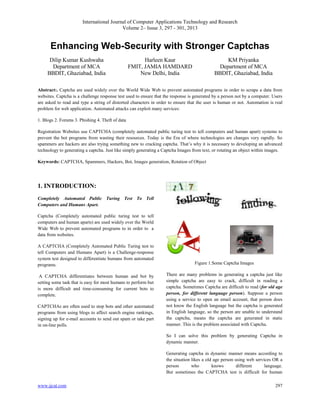
Figure 1.Some Captcha Images
There are many problems in generating a captcha just like
simple captcha are easy to crack, difficult in reading a
captcha. Sometimes Captcha are difficult to read (for old age
person, for different language person). Suppose a person
using a service to open an email account, that person does
not know the English language but the captcha is generated
in English language, so the person are unable to understand
the captcha, means the captcha are generated in static
manner. This is the problem associated with Captcha.
So I can solve this problem by generating Captcha in
dynamic manner.
Generating captcha in dynamic manner means according to
the situation likes a old age person using web services OR a
person who knows different language.
But sometimes the CAPTCHA test is difficult for human
International Journal of Computer Applications Technology and Research
Volume 2– Issue 3, 297 - 301, 2013
www.ijcat.com 298
users to read because the users have different ages,
languages, etc. In this paper we propose a solution for this
problem. The registration system can select a kind of
CAPTCHA system among different available CAPTCHA
systems regarding to the user's needs such as user language
and disabilities.
For example if a user is illiterate, then he/she easily detect
images, so for this purpose I generate a images of text, or
increasing the complexity of captcha by rotating objects
within images.
2.Brief History:
Turing [1] in 1950 proposed a test for AI in which a
computer must fool a panel of humans into believing the
machine is human. Blum, Ahn, Langford(2000)[2] proposed
a class of ATT( called human interactive proof HID), which
Hopper(2001)[3] describes as a protocol “ that allows a
human to prove something to a computer.
Hopper and Blum (2001)[4] propose a HIP called secure
Human Identification Protocol or Humanoid, in which
computer must verify a human membership in a group
without requiring a password , biometric data, electronic key
or any other physical evidence.
Blum,Ahn,Langford (2000)[5] propose a “Completely
Automated Public Turing Test To Tell Humans and
Computer Apart” in which the computer must be able to
generate and grade “ A test that most hum can pass.”
Example: EzGimpy-deter to spam attacks. First used by
yahoo(2001)[6].
3.TYPES OF CAPTCHA:
3.1 Text based-a CAPTCHA features an image file of
slightly distorted alphanumeric characters.(GIMPY)
3.2 Graphics based- Pix," presents the user with six images
of a single subject, such as babies or horses, and asks them to
define the subject of the pictures.
3.3 Audio based-To accomodate the visually-impaired, some
CAPTCHAs use audio files.
3.4 Logic based-Which of ten, 8, 29, sixty four, 83 or fifty
four is the smallest?
3.5 Math based- 4+5=?
4. APPLICATION OF CAPTCHA:
Automated attacks can exploit many services:
• Blogs
• Forums
• Phishing
• Theft of data
Registration Websites use CAPTCHA systems to
prevent the bot programs from wasting their resources.
5. REALTED WORK
CAPTCHA was first introduced in 1997 when Andrei Broder
devised the CAPTCHA method. In the same year, Altavista
web site used this method to distinguish between computer
programs and human user. In this method, a distorted English
word was shown to the user and the user was asked to type it
Figure. 2
5.1 OCR-Based CAPTCHA Methods
In OCR-based methods [7], the image of a word with
distortion and various pictorial effects is shown to the user
and he/she asked
to type that word. Due to presence of various pictorial
effects, the computer will encounter problems in the
recognition of these words and only a human user can
recognize the word. But these methods usually result in
dissatisfaction of users. On the other hand, efforts have been
made for attacking these methods . Examples of these
methods include Gimpy, Handwritten CAPTCHA, and
Persian/Arabic CAPTCHA.
5.2. Non-OCR-Based CAPTCHA Methods
In contrast, we can point to Non-OCR-based methods which
are easier to work with than OCR-based ones. Examples of
these methods include PIX, Text-to-Speech method, and
Drawing CAPTCHA. Various methods have been proposed
for breaking up the CAPTCHA. It can be done with the help
of the segmentation and character recognition techniques.
This can be done with the help of the Neural Network using
divide and conquer approach. To provide defense against
such techniques resistance method for CAPTCHA have also
been proposed that includes Font tricks, Noise, Color model
and Overlap.
6. PROBLEM STATEMENT:
The aim of this paper is to propose a method for generating
image based on Text or rotating object within images to
make difficult for automatic program to detect the captcha.
6.1 Proposed Solution for Generating Image Captcha:
International Journal of Computer Applications Technology and Research
Volume 2– Issue 3, 297 - 301, 2013
www.ijcat.com 299
6.2 Generating image based on Text:
For this purpose I will use image processing operations to
convert simple text into image. The steps involved in the
proposed method are as follows:
Step 1: Set Image type (JPEG).
Step 2: Create new image in buffer.
Step 3: Set background image white.
Step 4: Set Gradient font of text to be converted to graphics
image.
Step 5: Write text in a image
Step 6: Release resources and write the output to output
stream.
These steps are shown in figure 5.
6.3 Algorithm for Captcha Image Generation from
simple text:gure
imagecaptcha(inputstring)
{
BufferedImage image;
image=texttoimage(inputstring);
return image;
}
6.4 Algorithm for Image generation:
Image texttoimage (inputstring)
{
response.setContentType ("image/jpeg");
ServletOutputStream output=response.getOutputStream();
BufferedImage image1 = new BufferedImage (300, 50,
BufferedImage.TYPE_BYTE_INDEXED);
Graphics2D graphics1 = image1.createGraphics ();
// Set back ground of the generated image to white
graphics1.setColor (Color.WHITE);
graphics1.fillRect (0, 0, 300, 50);
// set gradient font of text to be converted to image
GradientPaint gradientPaint1 = new GradientPaint (10, 5,
Color.BLUE, 20, 10, Color.LIGHT_GRAY, true);
graphics1.setPaint (gradientPaint1);
Font font = new Font("Times New Roman", Font.ITALIC,
35);
graphics1.setFont (font);
// write input string in the image
graphics1.drawString (inputstring, 5, 30);
// release resources used by graphics context
graphics1.dispose ();
// encode the image as a JPEG data stream
JPEGCodec.createJPEGEncoder (output).encode (image1);
// close the stream
output.close ();
}
7.Results:
Above algorithm generates images by text as shown below:
Figure3: Final output
This algorithm makes difficult for automatic program to
Bypass the captcha.
Following graphs illustrate more time taken by automatic
program to bypass the captcha for form filling. In the chart
shown below, I show the time taken by automatic programs
to bypass the captcha with using and without using this
software and also shows the relative study for the same as
follows (for approx 10 cases):
International Journal of Computer Applications Technology and Research
Volume 2– Issue 3, 297 - 301, 2013
www.ijcat.com 300
Figure 4:comparative study
8. FUTURE SCOPE:
The security analysis shows that this new design can prevent
attacks efficiently from existing algorithms as well as
possible ones using multiple frames. In short, this project
will be a good guide for the design of next generation
CAPTCHA. Our future research will be on how to design a
more practical and safer dynamic CAPTCHA and the
improvement in performance of the websites when these
CAPTCHAs are used (Generally when these type of
CAPTCHAs are used the performance decreases as the
generation requires time for execution) .
9.CONCLUSION:
In this project we implemented a practical and safe image
CAPTCHA from text, ensuring it not only extremely hard to
recognize, but easy to identify for humans as well. It also
makes full use of disadvantages of computers in recognizing
images from a complicated background, making it still very
difficult for computer programs to break.
CAPTCHAs are an effective way to counter bots and reduce
spam. This proposed problem gives us the solution for
dynamic Captcha. Applications are varied– from stopping
bots to character recognition & pattern matching. Some
issues with current implementations represent challenges for
future improvements
Acknowledgement:
This research paper is made possible through the help and
support from everyone,
Including: faculty members who give his/her valuable
suggestions to me , family, friends, and in essence, all
sentient beings.
Especially, please allow me to dedicate my acknowledgment
of gratitude toward the following significant advisors and
contributors:
First and foremost, I would like to thank Dr. Harleen Kaur
for his most support and encouragement. He kindly read my
paper and offered invaluable detailed advices on grammar,
organization, and the theme of the paper.
Second, I would like to thank as well as all the other faculty
members who have taught me about image processing and
captcha over the past three years of my pursuit of the master
degree.
Finally, I sincerely thank to my friends, who provide the
advice. The product of this research paper would not be
possible without all of them.
10 REFERENCES:
[1] L. V. Ahn, M. Blum, N. J. Hopper, and J. Langford.
CAPTCHA: using hard AI problems for security. In
Eurocrypt, 2003.Luis von Ahn, Manuel Blum, Nicholas
J. Hopper and John Langford. TheCAPTCHA Web
Page: http://www.captcha.net. 2000.
[2]. Luis von Ahn, Manuel Blum and John Langford. Telling
Humans and Computers Apart (Automatically) or How
Lazy Cryptographers do AI. To appear in Commu-
nications of the ACM.
[3]. Mihir Bellare, Russell Impagliazzo and Moni Naor. Does
Parallel Repetition Lower the Error in Computationally
Sound Protocols? In 38th IEEE Symposium on
Foundations of Computer Science (FOCS' 97),
[4] A. L. Coates, H. S. Baird, and R. J. Fateman. Pessimal
Print: A Reverse Turing Test. In Proceedings of the
International Conference on Document Analysis and
Recognition (ICDAR' 01), pages 1154-1159. Seattle
WA, 2001.
[5] http://www.lafdc.com/captcha /
[6] K. Chellapilla, P. Simard. Using Machine Learning to
Break Visual Human Interaction Proofs (HIPs)
[7] Y. Lecun, L. Bottou, Y, Benshio, P. Haffber. Gradient-
Based Learning Applied to Document Recognition.
Proc. of the IEEE, November 1999.
[8] Mike O'Neill. Neural network for Recognition of
Handwritten Digits.
[9] L. Bottou, Y, Benshio, Y. Lecun. Global Training of
Document Processing Systems using Graph
Transformer Networks.
[10] Y. Lecun, L. Bottou, Y, Benshio. Reading checks with
multilayer graph transformer network.
[11] P. Simard, D. Steinkraus, J. Platt. Best Practices for
Convolutional Neural Networks Applied to Visual
Document Analysis.
[12] C Burges, O. Matan, Y. LeCun, J. Denker, L. Jackel,
C.Stenard, C. Nohl, J. Ben. Shortest Path Segmentation:
a method for training a Neural Network to Recognize
Character Strings.
[13] D. You, G. Kim. An approach for locating segmentation
points of handwritten digit strings using a neural
network.
[14] G. Mori, J. Malik. Recognizing Objects in Adversial
Clutter: Breaking a Visual Captcha.
International Journal of Computer Applications Technology and Research
Volume 2– Issue 3, 297 - 301, 2013
www.ijcat.com 301
figure:2
Figure 5: DFD for image generation
from captcha
Graphics string
EXT STRING
Generating Image
Captcha
Image Captcha
LEVEL 0
Generation of
Image new Image
Write text to
image
New Captcha
Image
LEVEL 1
Set image type to
jpeg
Create image in
buffer
image
Set background
image white
New image
Convert text into
graphics
New image
Release the
resource and write
output
Write graphics string
in the image

Enhancing Web-Security with Stronger Captchas

  • 1.
    International Journal ofComputer Applications Technology and Research Volume 2– Issue 3, 297 - 301, 2013 www.ijcat.com 297 Enhancing Web-Security with Stronger Captchas Dilip Kumar Kushwaha Department of MCA BBDIT, Ghaziabad, India Harleen Kaur FMIT, JAMIA HAMDARD New Delhi, India KM Priyanka Department of MCA BBDIT, Ghaziabad, India Abstract:. Captcha are used widely over the World Wide Web to prevent automated programs in order to scrape a data from websites. Captcha is a challenge response test used to ensure that the response is generated by a person not by a computer. Users are asked to read and type a string of distorted characters in order to ensure that the user is human or not. Automation is real problem for web application. Automated attacks can exploit many services: 1. Blogs 2. Forums 3. Phishing 4. Theft of data Registration Websites use CAPTCHA (completely automated public turing test to tell computers and human apart) systems to prevent the bot programs from wasting their resources. Today is the Era of where technologies are changes very rapidly. So spammers are hackers are also trying something new to cracking captcha. That’s why it is necessary to developing an advanced technology to generating a captcha. Just like simply generating a Captcha Images from text, or rotating an object within images. Keywords: CAPTCHA, Spammers, Hackers, Bot, Images generation, Rotation of Object 1. INTRODUCTION: Completely Automated Public Turing Test To Tell Computers and Humans Apart. Captcha (Completely automated public turing test to tell computers and human aparts) are used widely over the World Wide Web to prevent automated programs to in order to a data from websites. A CAPTCHA (Completely Automated Public Turing test to tell Computers and Humans Apart) is a Challenge-response system test designed to differentiate humans from automated programs. A CAPTCHA differentiates between human and bot by setting some task that is easy for most humans to perform but is more difficult and time-consuming for current bots to complete. CAPTCHAs are often used to stop bots and other automated programs from using blogs to affect search engine rankings, signing up for e-mail accounts to send out spam or take part in on-line polls. Figure 1.Some Captcha Images There are many problems in generating a captcha just like simple captcha are easy to crack, difficult in reading a captcha. Sometimes Captcha are difficult to read (for old age person, for different language person). Suppose a person using a service to open an email account, that person does not know the English language but the captcha is generated in English language, so the person are unable to understand the captcha, means the captcha are generated in static manner. This is the problem associated with Captcha. So I can solve this problem by generating Captcha in dynamic manner. Generating captcha in dynamic manner means according to the situation likes a old age person using web services OR a person who knows different language. But sometimes the CAPTCHA test is difficult for human
  • 2.
    International Journal ofComputer Applications Technology and Research Volume 2– Issue 3, 297 - 301, 2013 www.ijcat.com 298 users to read because the users have different ages, languages, etc. In this paper we propose a solution for this problem. The registration system can select a kind of CAPTCHA system among different available CAPTCHA systems regarding to the user's needs such as user language and disabilities. For example if a user is illiterate, then he/she easily detect images, so for this purpose I generate a images of text, or increasing the complexity of captcha by rotating objects within images. 2.Brief History: Turing [1] in 1950 proposed a test for AI in which a computer must fool a panel of humans into believing the machine is human. Blum, Ahn, Langford(2000)[2] proposed a class of ATT( called human interactive proof HID), which Hopper(2001)[3] describes as a protocol “ that allows a human to prove something to a computer. Hopper and Blum (2001)[4] propose a HIP called secure Human Identification Protocol or Humanoid, in which computer must verify a human membership in a group without requiring a password , biometric data, electronic key or any other physical evidence. Blum,Ahn,Langford (2000)[5] propose a “Completely Automated Public Turing Test To Tell Humans and Computer Apart” in which the computer must be able to generate and grade “ A test that most hum can pass.” Example: EzGimpy-deter to spam attacks. First used by yahoo(2001)[6]. 3.TYPES OF CAPTCHA: 3.1 Text based-a CAPTCHA features an image file of slightly distorted alphanumeric characters.(GIMPY) 3.2 Graphics based- Pix," presents the user with six images of a single subject, such as babies or horses, and asks them to define the subject of the pictures. 3.3 Audio based-To accomodate the visually-impaired, some CAPTCHAs use audio files. 3.4 Logic based-Which of ten, 8, 29, sixty four, 83 or fifty four is the smallest? 3.5 Math based- 4+5=? 4. APPLICATION OF CAPTCHA: Automated attacks can exploit many services: • Blogs • Forums • Phishing • Theft of data Registration Websites use CAPTCHA systems to prevent the bot programs from wasting their resources. 5. REALTED WORK CAPTCHA was first introduced in 1997 when Andrei Broder devised the CAPTCHA method. In the same year, Altavista web site used this method to distinguish between computer programs and human user. In this method, a distorted English word was shown to the user and the user was asked to type it Figure. 2 5.1 OCR-Based CAPTCHA Methods In OCR-based methods [7], the image of a word with distortion and various pictorial effects is shown to the user and he/she asked to type that word. Due to presence of various pictorial effects, the computer will encounter problems in the recognition of these words and only a human user can recognize the word. But these methods usually result in dissatisfaction of users. On the other hand, efforts have been made for attacking these methods . Examples of these methods include Gimpy, Handwritten CAPTCHA, and Persian/Arabic CAPTCHA. 5.2. Non-OCR-Based CAPTCHA Methods In contrast, we can point to Non-OCR-based methods which are easier to work with than OCR-based ones. Examples of these methods include PIX, Text-to-Speech method, and Drawing CAPTCHA. Various methods have been proposed for breaking up the CAPTCHA. It can be done with the help of the segmentation and character recognition techniques. This can be done with the help of the Neural Network using divide and conquer approach. To provide defense against such techniques resistance method for CAPTCHA have also been proposed that includes Font tricks, Noise, Color model and Overlap. 6. PROBLEM STATEMENT: The aim of this paper is to propose a method for generating image based on Text or rotating object within images to make difficult for automatic program to detect the captcha. 6.1 Proposed Solution for Generating Image Captcha:
  • 3.
    International Journal ofComputer Applications Technology and Research Volume 2– Issue 3, 297 - 301, 2013 www.ijcat.com 299 6.2 Generating image based on Text: For this purpose I will use image processing operations to convert simple text into image. The steps involved in the proposed method are as follows: Step 1: Set Image type (JPEG). Step 2: Create new image in buffer. Step 3: Set background image white. Step 4: Set Gradient font of text to be converted to graphics image. Step 5: Write text in a image Step 6: Release resources and write the output to output stream. These steps are shown in figure 5. 6.3 Algorithm for Captcha Image Generation from simple text:gure imagecaptcha(inputstring) { BufferedImage image; image=texttoimage(inputstring); return image; } 6.4 Algorithm for Image generation: Image texttoimage (inputstring) { response.setContentType ("image/jpeg"); ServletOutputStream output=response.getOutputStream(); BufferedImage image1 = new BufferedImage (300, 50, BufferedImage.TYPE_BYTE_INDEXED); Graphics2D graphics1 = image1.createGraphics (); // Set back ground of the generated image to white graphics1.setColor (Color.WHITE); graphics1.fillRect (0, 0, 300, 50); // set gradient font of text to be converted to image GradientPaint gradientPaint1 = new GradientPaint (10, 5, Color.BLUE, 20, 10, Color.LIGHT_GRAY, true); graphics1.setPaint (gradientPaint1); Font font = new Font("Times New Roman", Font.ITALIC, 35); graphics1.setFont (font); // write input string in the image graphics1.drawString (inputstring, 5, 30); // release resources used by graphics context graphics1.dispose (); // encode the image as a JPEG data stream JPEGCodec.createJPEGEncoder (output).encode (image1); // close the stream output.close (); } 7.Results: Above algorithm generates images by text as shown below: Figure3: Final output This algorithm makes difficult for automatic program to Bypass the captcha. Following graphs illustrate more time taken by automatic program to bypass the captcha for form filling. In the chart shown below, I show the time taken by automatic programs to bypass the captcha with using and without using this software and also shows the relative study for the same as follows (for approx 10 cases):
  • 4.
    International Journal ofComputer Applications Technology and Research Volume 2– Issue 3, 297 - 301, 2013 www.ijcat.com 300 Figure 4:comparative study 8. FUTURE SCOPE: The security analysis shows that this new design can prevent attacks efficiently from existing algorithms as well as possible ones using multiple frames. In short, this project will be a good guide for the design of next generation CAPTCHA. Our future research will be on how to design a more practical and safer dynamic CAPTCHA and the improvement in performance of the websites when these CAPTCHAs are used (Generally when these type of CAPTCHAs are used the performance decreases as the generation requires time for execution) . 9.CONCLUSION: In this project we implemented a practical and safe image CAPTCHA from text, ensuring it not only extremely hard to recognize, but easy to identify for humans as well. It also makes full use of disadvantages of computers in recognizing images from a complicated background, making it still very difficult for computer programs to break. CAPTCHAs are an effective way to counter bots and reduce spam. This proposed problem gives us the solution for dynamic Captcha. Applications are varied– from stopping bots to character recognition & pattern matching. Some issues with current implementations represent challenges for future improvements Acknowledgement: This research paper is made possible through the help and support from everyone, Including: faculty members who give his/her valuable suggestions to me , family, friends, and in essence, all sentient beings. Especially, please allow me to dedicate my acknowledgment of gratitude toward the following significant advisors and contributors: First and foremost, I would like to thank Dr. Harleen Kaur for his most support and encouragement. He kindly read my paper and offered invaluable detailed advices on grammar, organization, and the theme of the paper. Second, I would like to thank as well as all the other faculty members who have taught me about image processing and captcha over the past three years of my pursuit of the master degree. Finally, I sincerely thank to my friends, who provide the advice. The product of this research paper would not be possible without all of them. 10 REFERENCES: [1] L. V. Ahn, M. Blum, N. J. Hopper, and J. Langford. CAPTCHA: using hard AI problems for security. In Eurocrypt, 2003.Luis von Ahn, Manuel Blum, Nicholas J. Hopper and John Langford. TheCAPTCHA Web Page: http://www.captcha.net. 2000. [2]. Luis von Ahn, Manuel Blum and John Langford. Telling Humans and Computers Apart (Automatically) or How Lazy Cryptographers do AI. To appear in Commu- nications of the ACM. [3]. Mihir Bellare, Russell Impagliazzo and Moni Naor. Does Parallel Repetition Lower the Error in Computationally Sound Protocols? In 38th IEEE Symposium on Foundations of Computer Science (FOCS' 97), [4] A. L. Coates, H. S. Baird, and R. J. Fateman. Pessimal Print: A Reverse Turing Test. In Proceedings of the International Conference on Document Analysis and Recognition (ICDAR' 01), pages 1154-1159. Seattle WA, 2001. [5] http://www.lafdc.com/captcha / [6] K. Chellapilla, P. Simard. Using Machine Learning to Break Visual Human Interaction Proofs (HIPs) [7] Y. Lecun, L. Bottou, Y, Benshio, P. Haffber. Gradient- Based Learning Applied to Document Recognition. Proc. of the IEEE, November 1999. [8] Mike O'Neill. Neural network for Recognition of Handwritten Digits. [9] L. Bottou, Y, Benshio, Y. Lecun. Global Training of Document Processing Systems using Graph Transformer Networks. [10] Y. Lecun, L. Bottou, Y, Benshio. Reading checks with multilayer graph transformer network. [11] P. Simard, D. Steinkraus, J. Platt. Best Practices for Convolutional Neural Networks Applied to Visual Document Analysis. [12] C Burges, O. Matan, Y. LeCun, J. Denker, L. Jackel, C.Stenard, C. Nohl, J. Ben. Shortest Path Segmentation: a method for training a Neural Network to Recognize Character Strings. [13] D. You, G. Kim. An approach for locating segmentation points of handwritten digit strings using a neural network. [14] G. Mori, J. Malik. Recognizing Objects in Adversial Clutter: Breaking a Visual Captcha.
  • 5.
    International Journal ofComputer Applications Technology and Research Volume 2– Issue 3, 297 - 301, 2013 www.ijcat.com 301 figure:2 Figure 5: DFD for image generation from captcha Graphics string EXT STRING Generating Image Captcha Image Captcha LEVEL 0 Generation of Image new Image Write text to image New Captcha Image LEVEL 1 Set image type to jpeg Create image in buffer image Set background image white New image Convert text into graphics New image Release the resource and write output Write graphics string in the image