Faculty of Biological Sciences
Enhancing flexible learning through integrating
tablet devices
Prof Neil Morris
Director of Digital Learning
Professor of Educational Technology,
Innovation and Change
University of Leeds
National Teaching Fellow
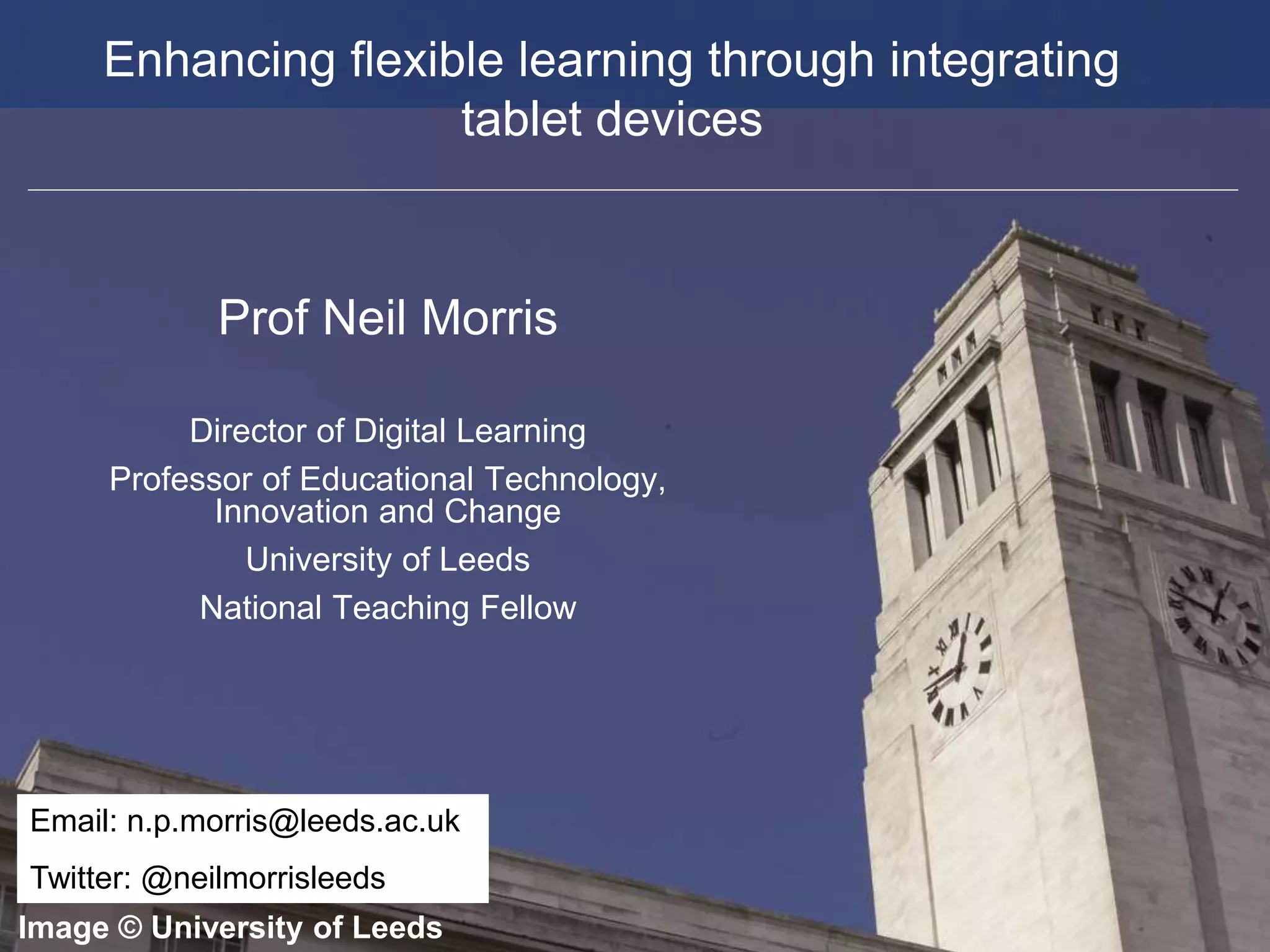
Image © University of Leeds
Email: n.p.morris@leeds.ac.uk
Twitter: @neilmorrisleeds
Overview
A changing landscape
Mobile learning
Case studies using tablet devices
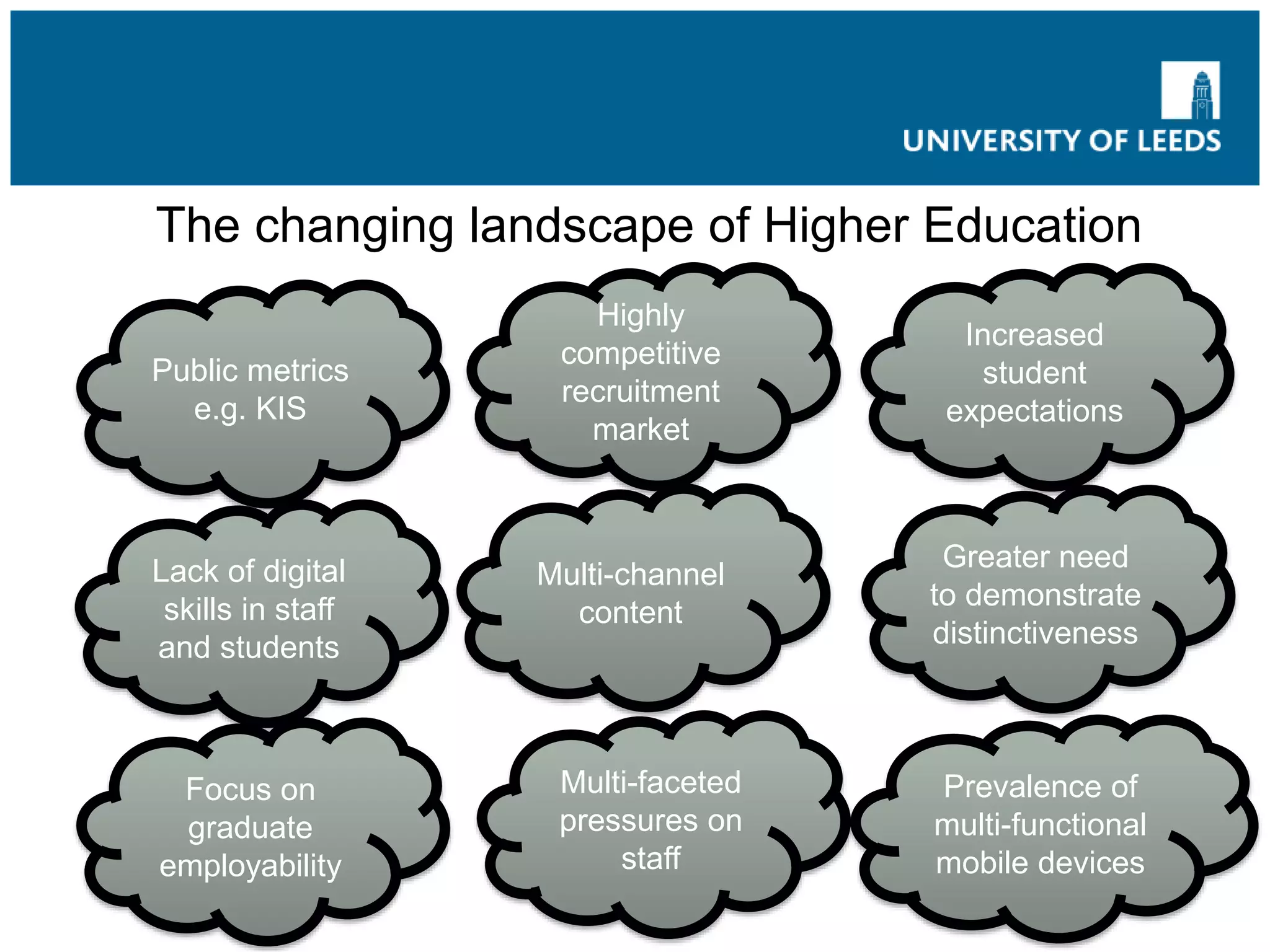
Increased
student
expectations
Highly
competitive
recruitment
market
Greater need
to demonstrate
distinctiveness
Multi-channel
content
Lack of digital
skills in staff
and students
Prevalence of
multi-functional
mobile devices
Multi-faceted
pressures on
staff
Focus on
graduate
employability
Public metrics
e.g. KIS
The changing landscape of Higher Education
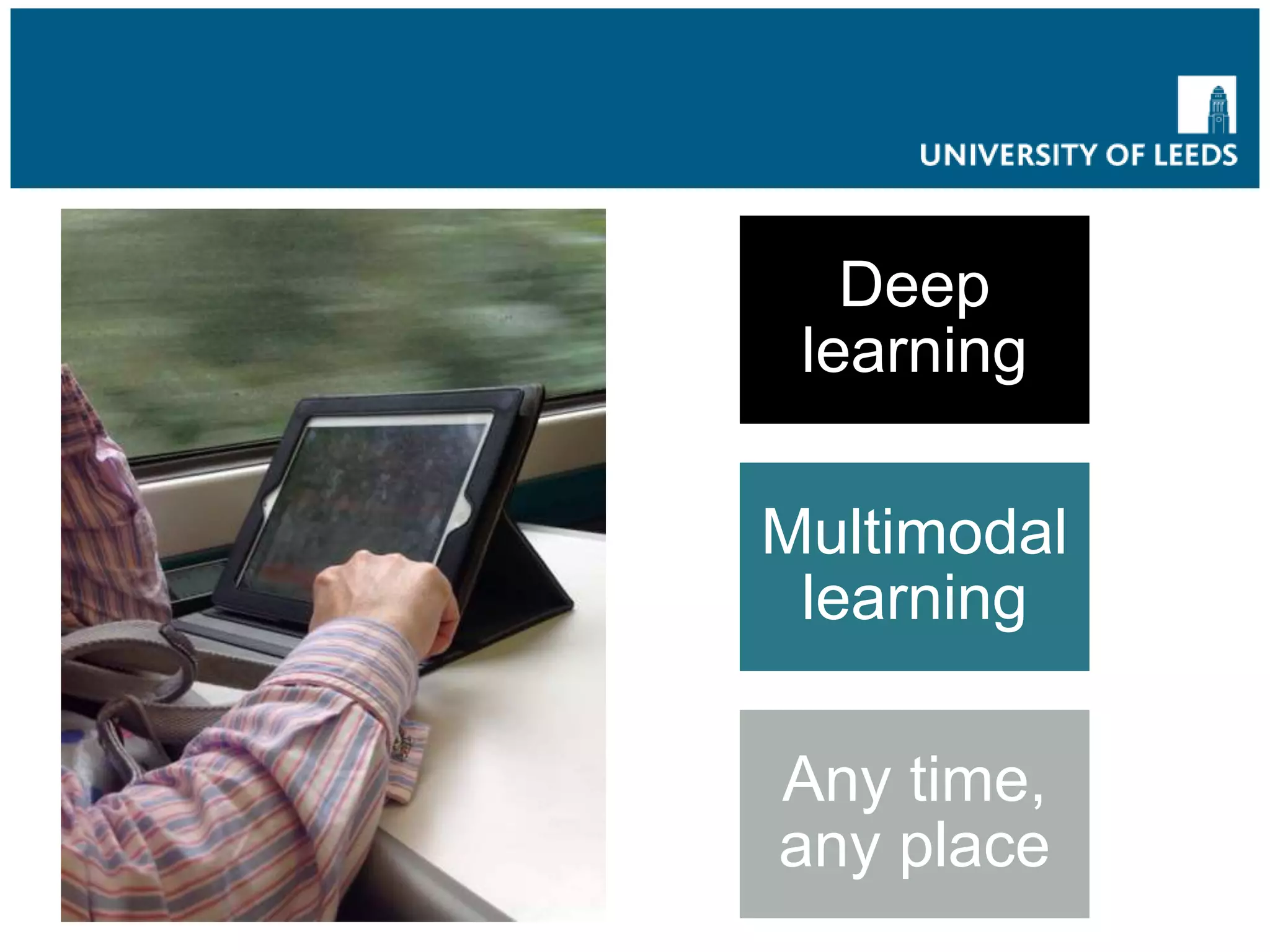
Mobile learning in action
Deep
learning
Multimodal
learning
Any time,
any place
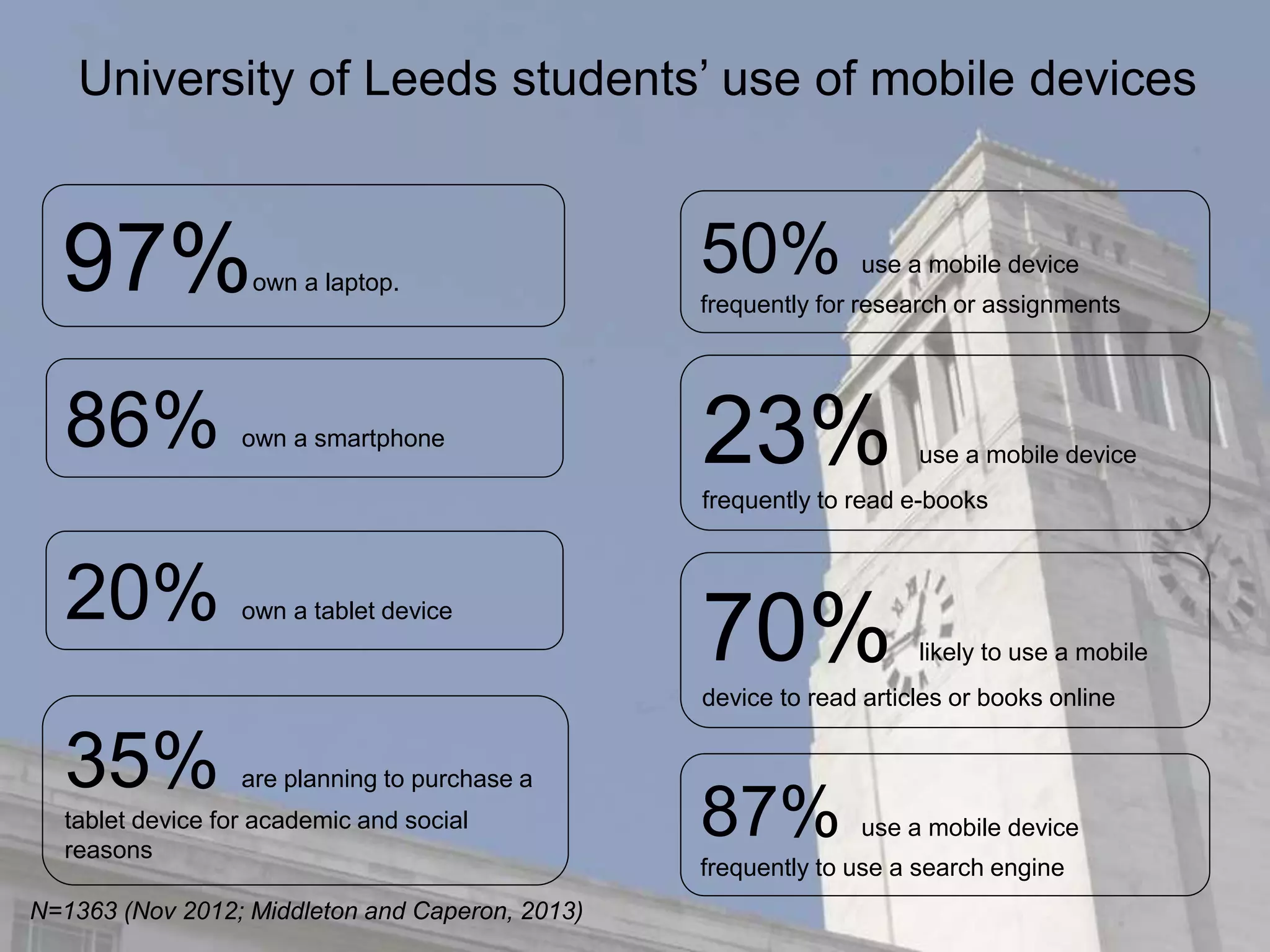
N=1363 (Nov 2012; Middleton and Caperon, 2013)
50% use a mobile device
frequently for research or assignments
23% use a mobile device
frequently to read e-books
86% own a smartphone
97%own a laptop.
20% own a tablet device
35% are planning to purchase a
tablet device for academic and social
reasons
70% likely to use a mobile
device to read articles or books online
87% use a mobile device
frequently to use a search engine
University of Leeds students’ use of mobile devices
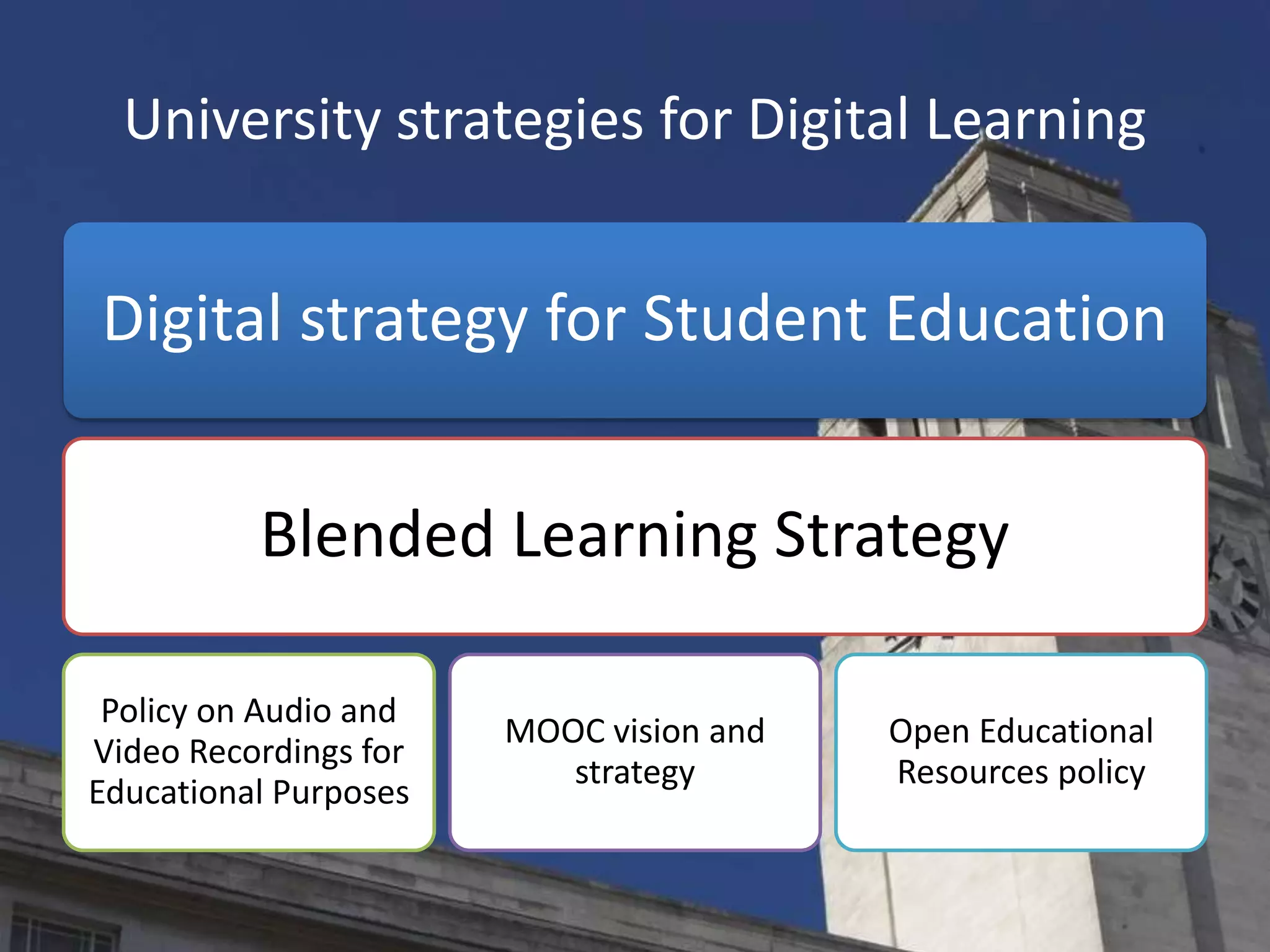
Digital strategy for Student Education
Blended Learning Strategy
Policy on Audio and
Video Recordings for
Educational Purposes
MOOC vision and
strategy
Open Educational
Resources policy
University strategies for Digital Learning
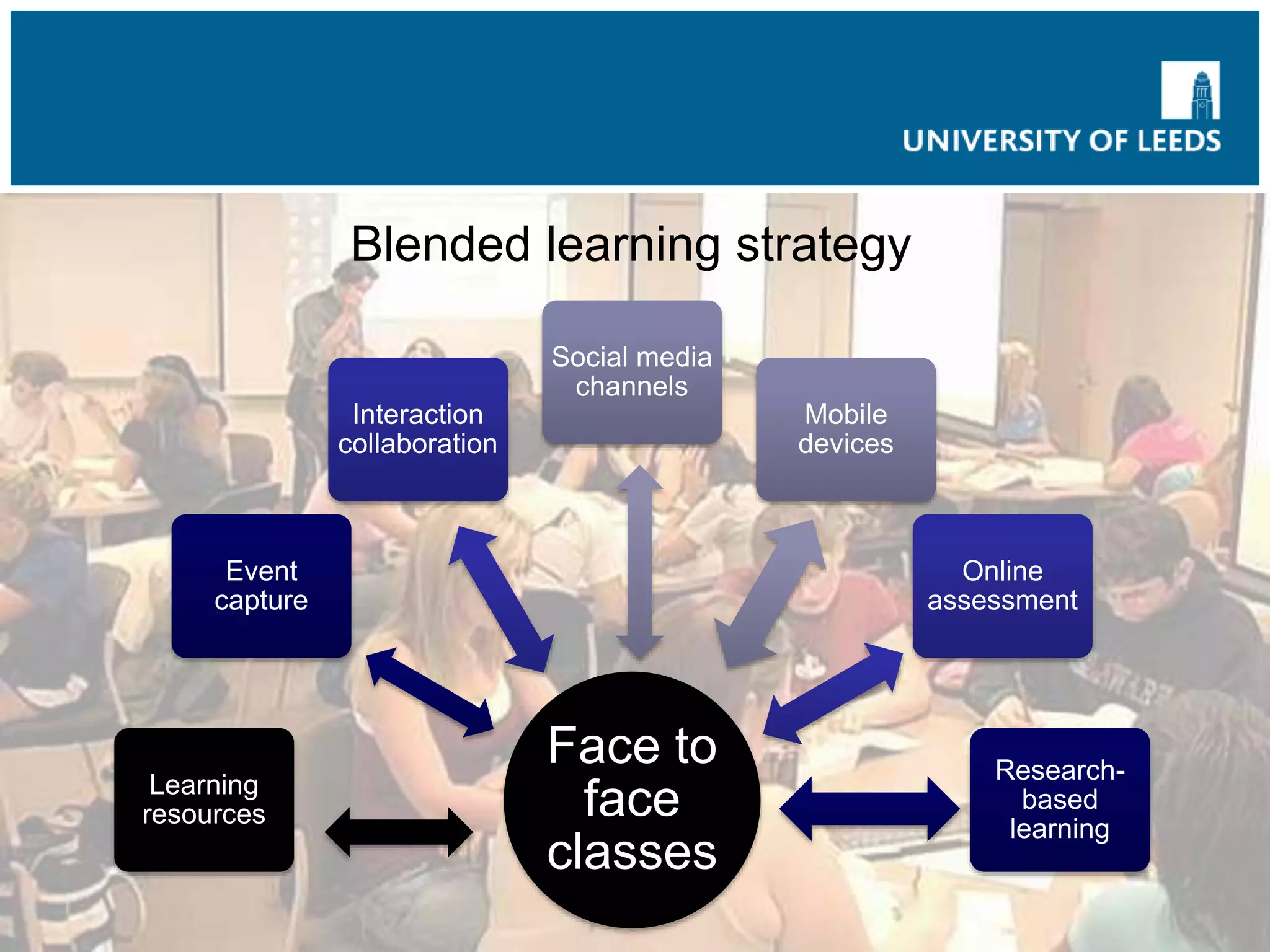
Blended learning strategy
Face to
face
classes
Learning
resources
Event
capture
Interaction
collaboration
Social media
channels
Mobile
devices
Online
assessment
Research-
based
learning
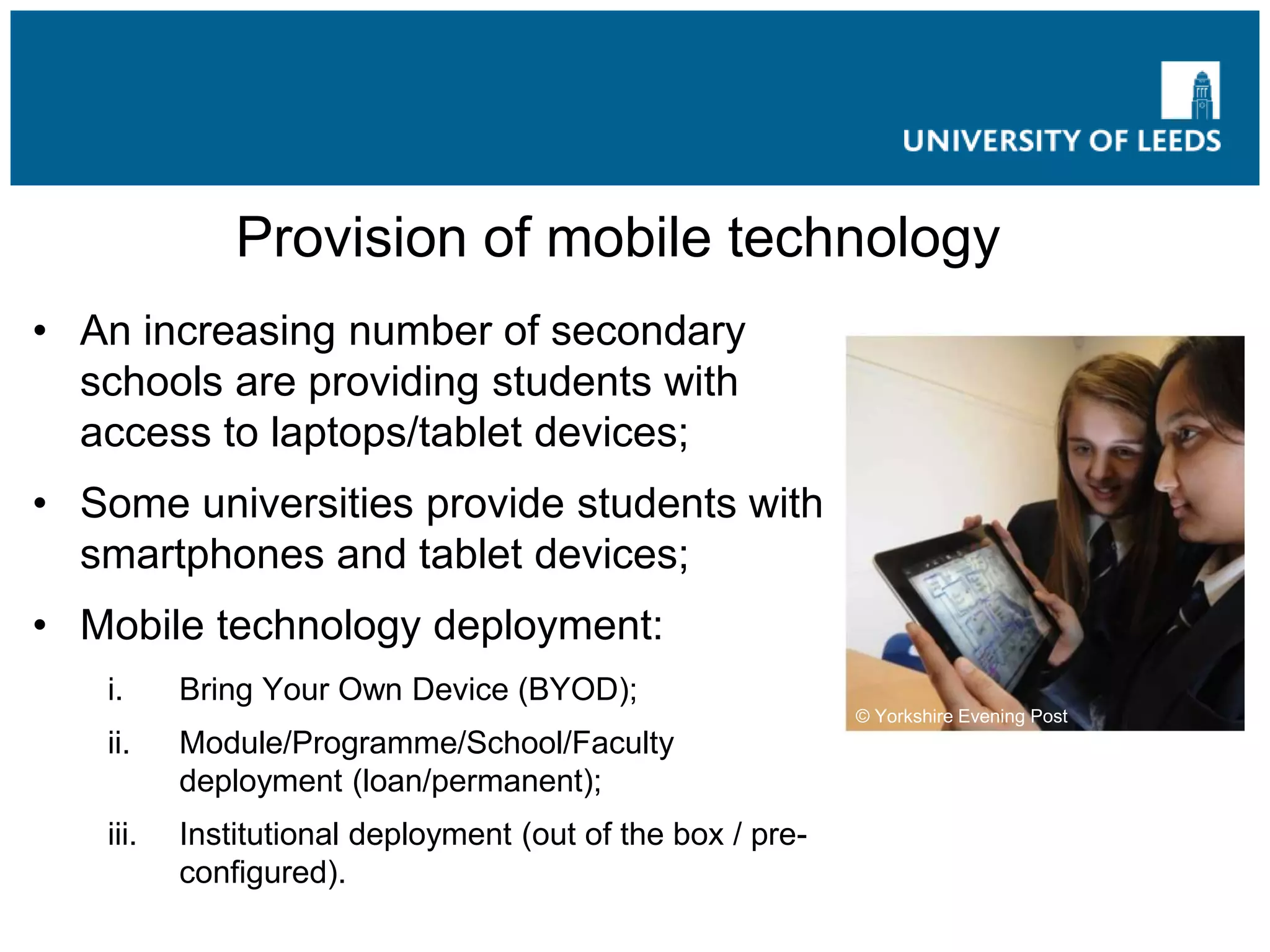
Provision of mobile technology
• An increasing number of secondary
schools are providing students with
access to laptops/tablet devices;
• Some universities provide students with
smartphones and tablet devices;
• Mobile technology deployment:
i. Bring Your Own Device (BYOD);
ii. Module/Programme/School/Faculty
deployment (loan/permanent);
iii. Institutional deployment (out of the box / pre-
configured).
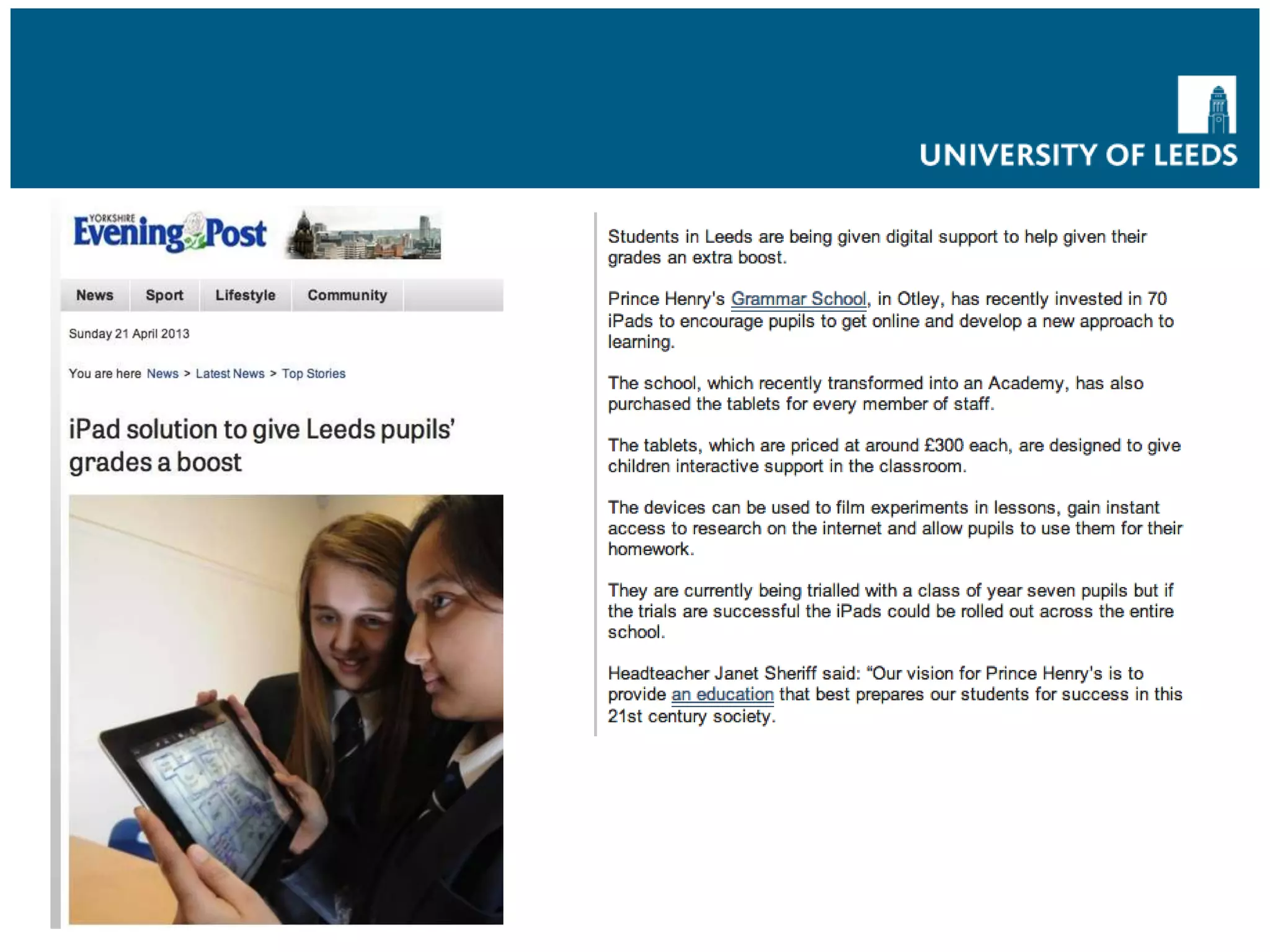
© Yorkshire Evening Post
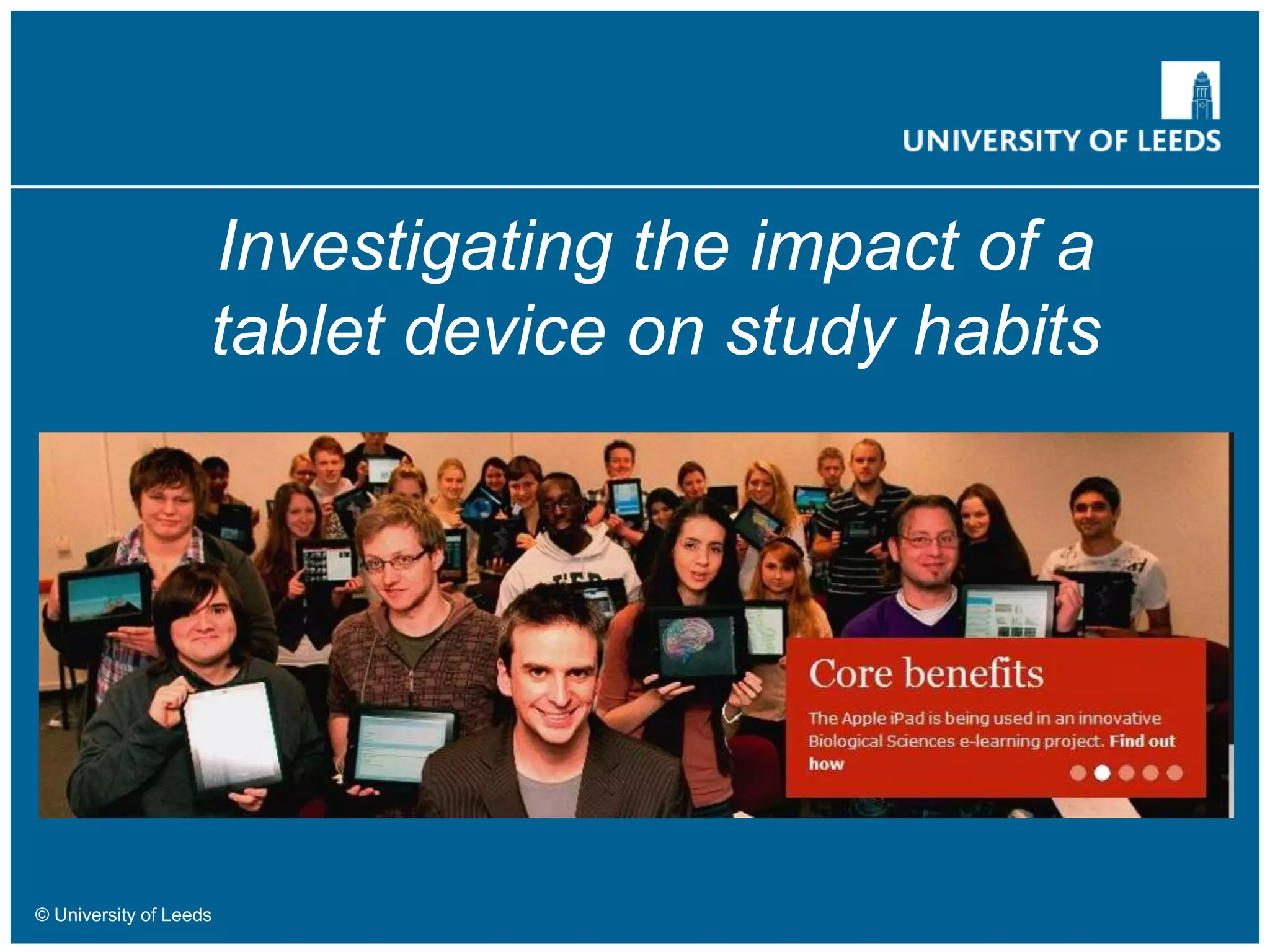
Investigating the impact of a
tablet device on study habits
© University of Leeds
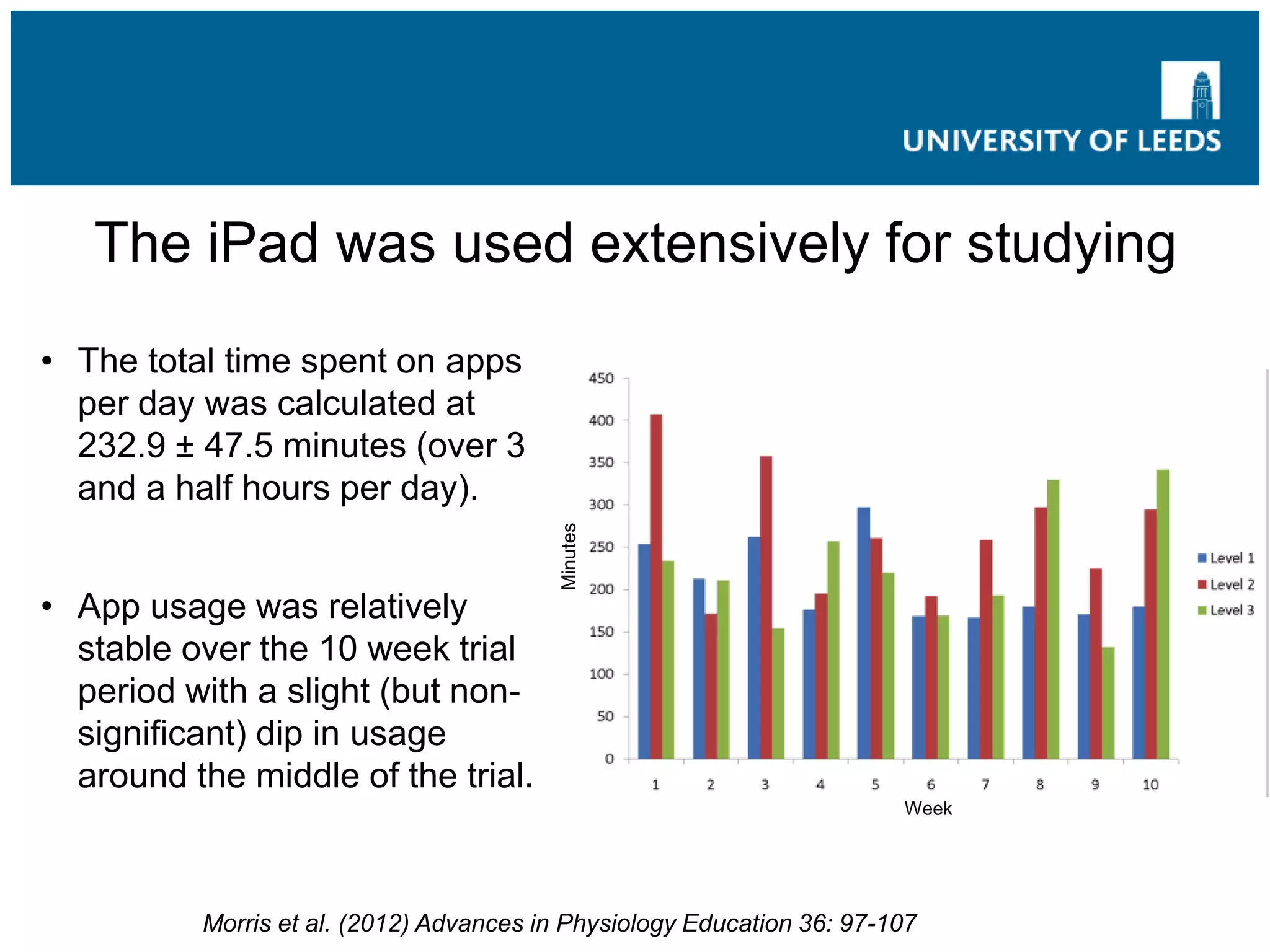
The iPad was used extensively for studying
• The total time spent on apps
per day was calculated at
232.9 ± 47.5 minutes (over 3
and a half hours per day).
• App usage was relatively
stable over the 10 week trial
period with a slight (but non-
significant) dip in usage
around the middle of the trial.
Minutes
Week
Morris et al. (2012) Advances in Physiology Education 36: 97-107
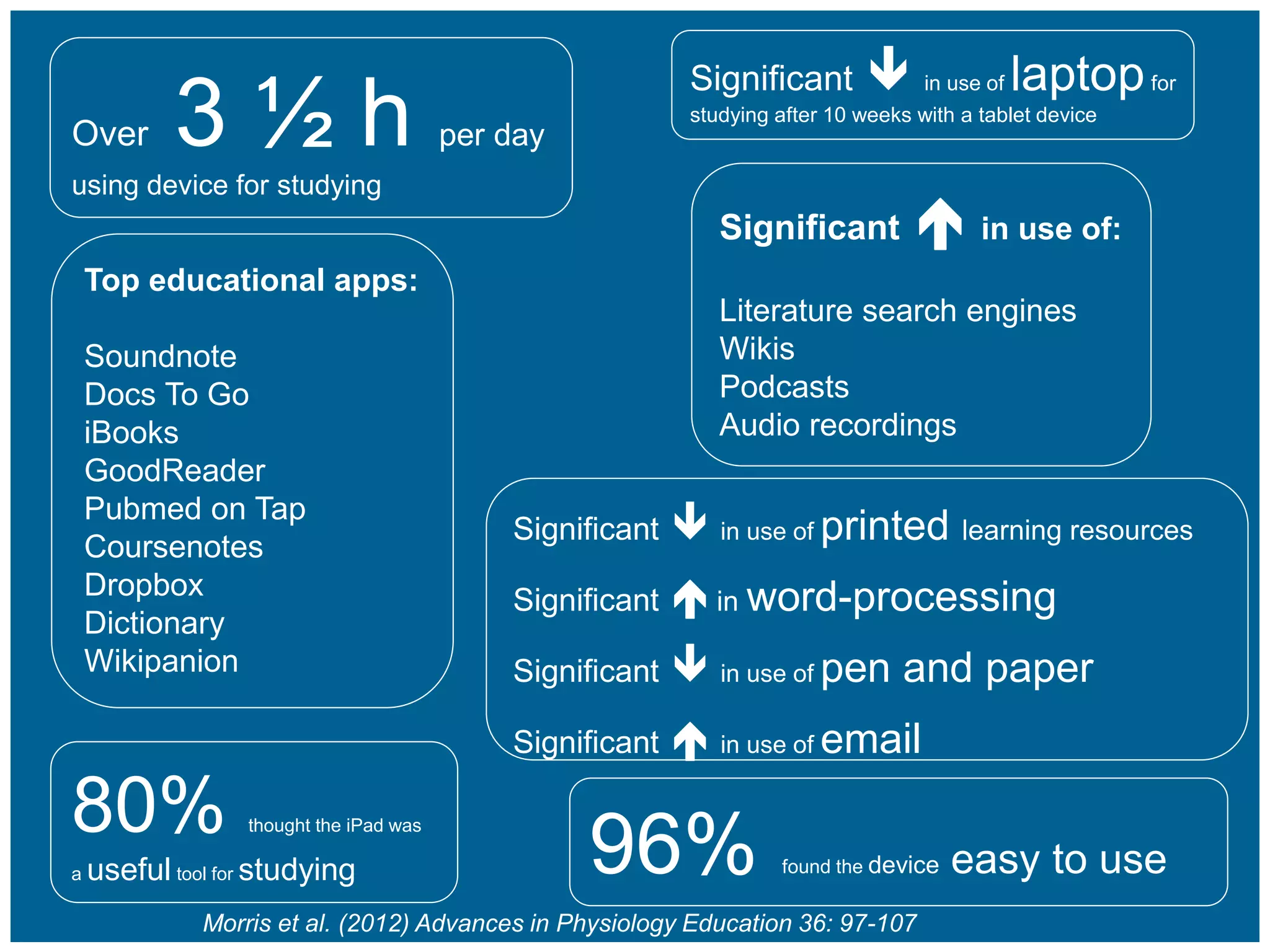
Over 3 ½ h per day
using device for studying
Significant  in use of laptopfor
studying after 10 weeks with a tablet device
96% found the device easy to use
80% thought the iPad was
a useful tool for studying
Top educational apps:
Soundnote
Docs To Go
iBooks
GoodReader
Pubmed on Tap
Coursenotes
Dropbox
Dictionary
Wikipanion
Significant  in use of:
Literature search engines
Wikis
Podcasts
Audio recordings
Significant  in use of printed learning resources
Significant  in word-processing
Significant  in use of pen and paper
Significant  in use of email
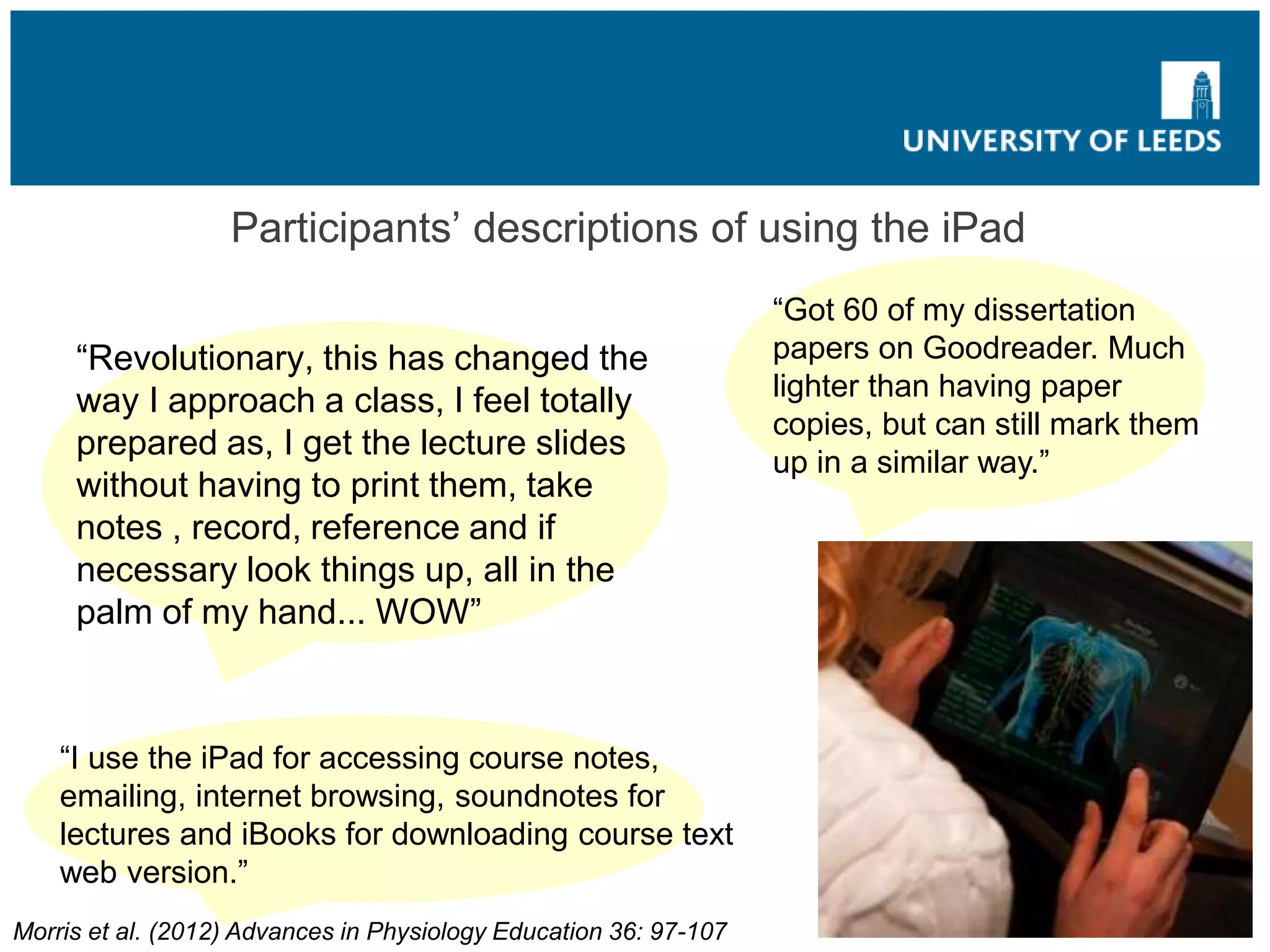
Participants’ descriptions of using the iPad
“Revolutionary, this has changed the
way I approach a class, I feel totally
prepared as, I get the lecture slides
without having to print them, take
notes , record, reference and if
necessary look things up, all in the
palm of my hand... WOW”
“Got 60 of my dissertation
papers on Goodreader. Much
lighter than having paper
copies, but can still mark them
up in a similar way.”
“I use the iPad for accessing course notes,
emailing, internet browsing, soundnotes for
lectures and iBooks for downloading course text
web version.”
Morris et al. (2012) Advances in Physiology Education 36: 97-107
Neil Morris, University of Leeds; CC-BY-NC-
SA
Neil Morris, University of Leeds; CC-BY-NC-
SA
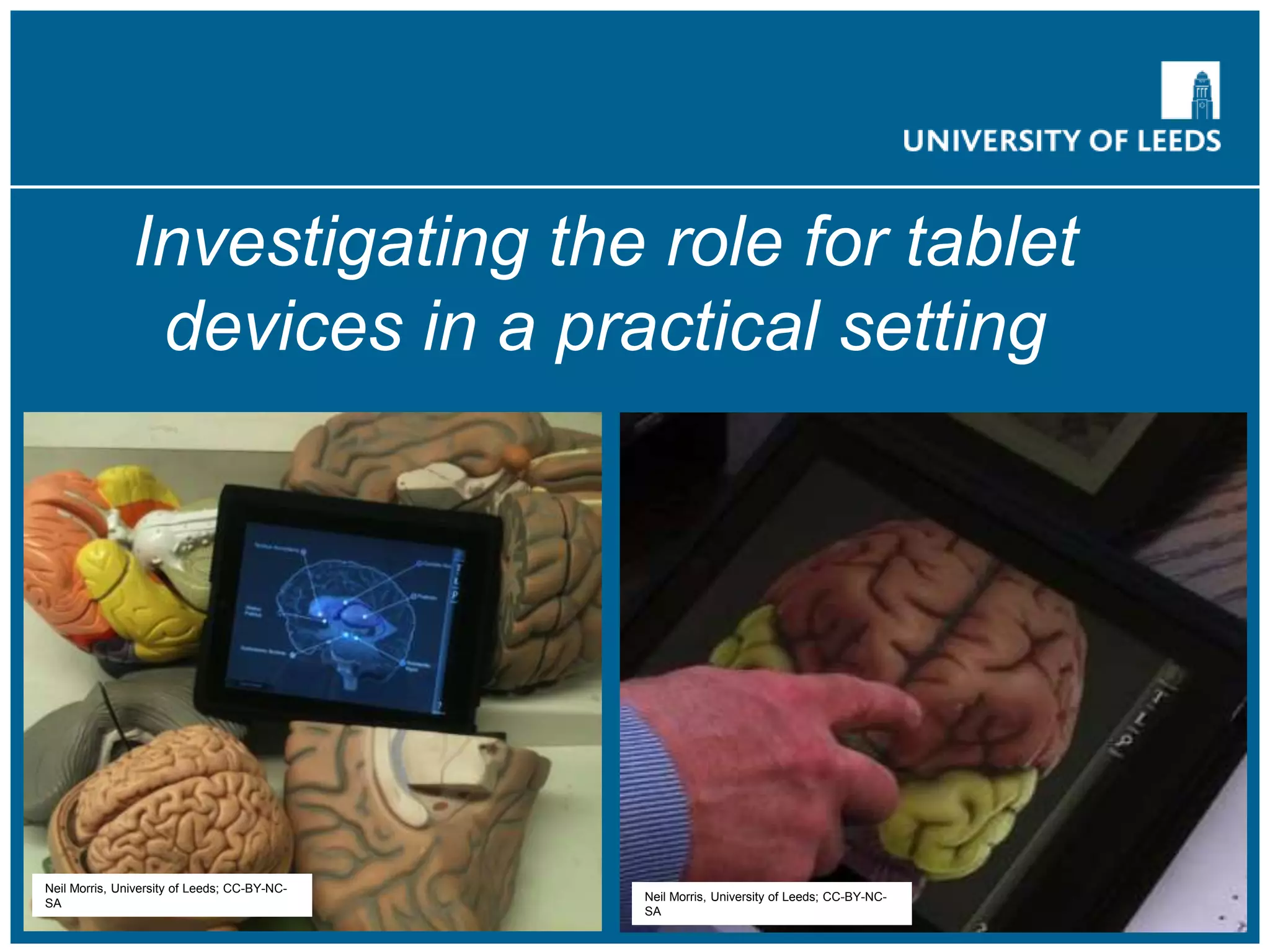
Investigating the role for tablet
devices in a practical setting
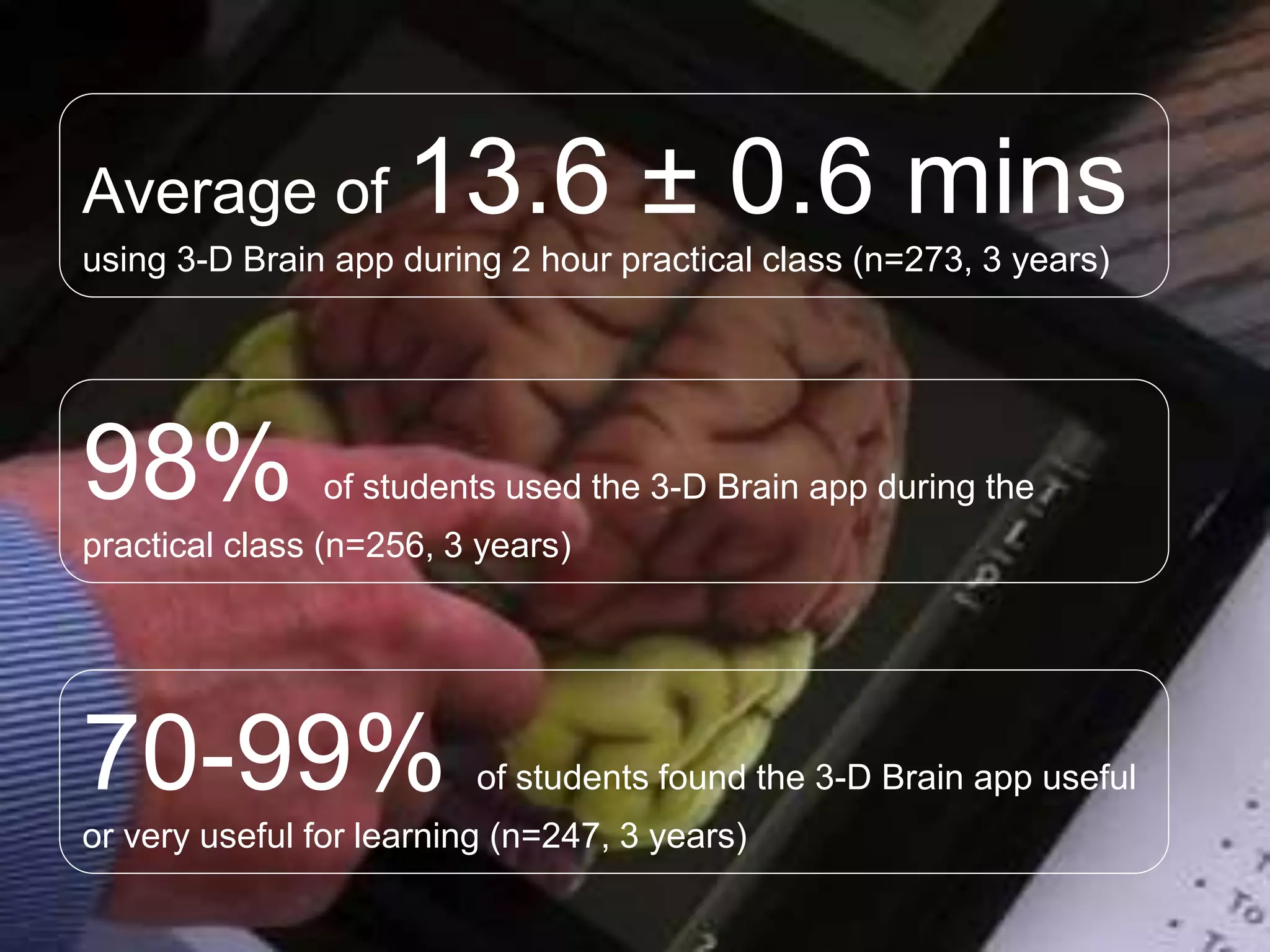
Average of 13.6 ± 0.6 mins
using 3-D Brain app during 2 hour practical class (n=273, 3 years)
98% of students used the 3-D Brain app during the
practical class (n=256, 3 years)
70-99% of students found the 3-D Brain app useful
or very useful for learning (n=247, 3 years)
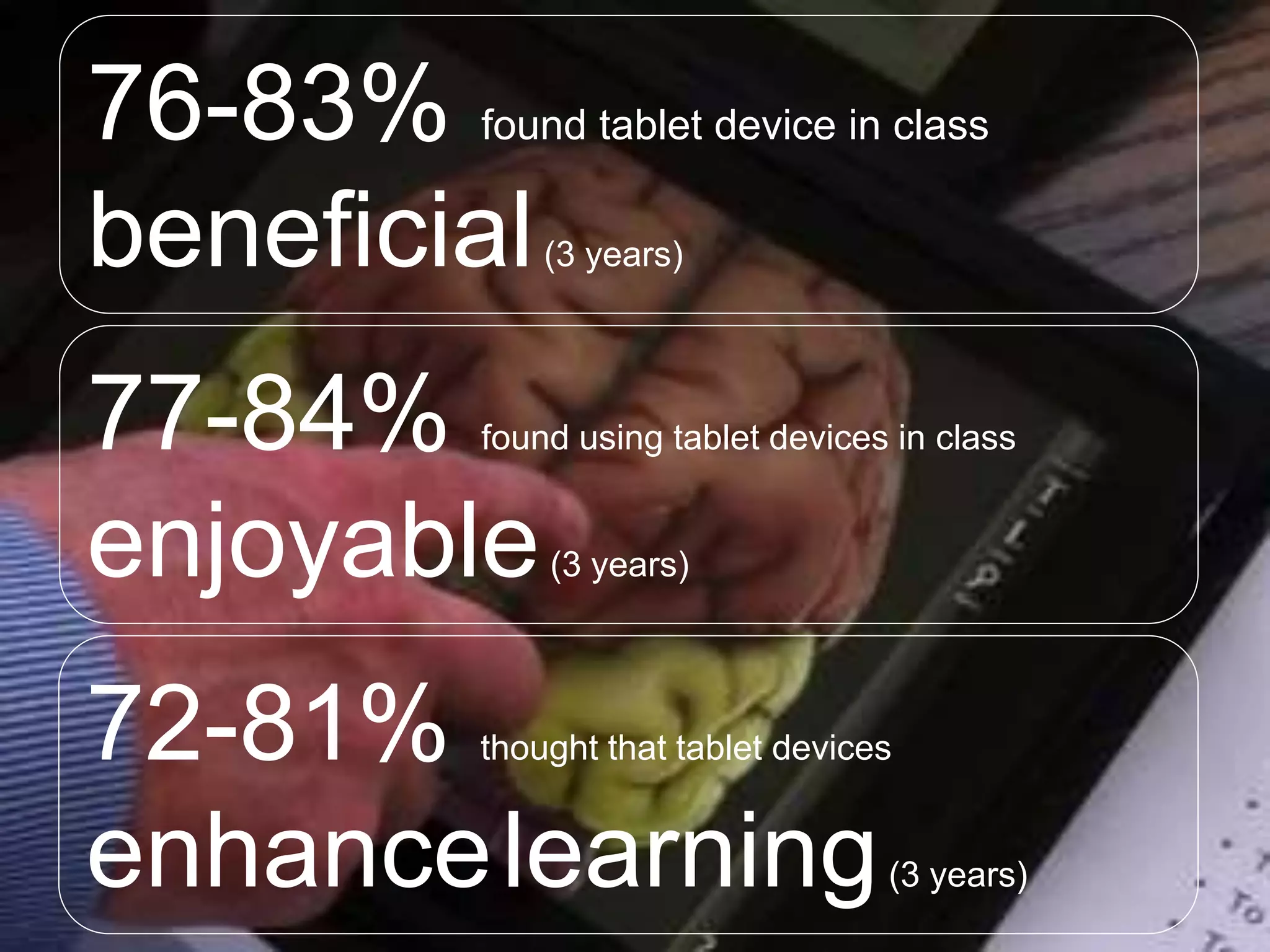
76-83% found tablet device in class
beneficial(3 years)
77-84% found using tablet devices in class
enjoyable(3 years)
72-81% thought that tablet devices
enhancelearning(3 years)
Morris et al, in preparation (data collected in two academic sessions)
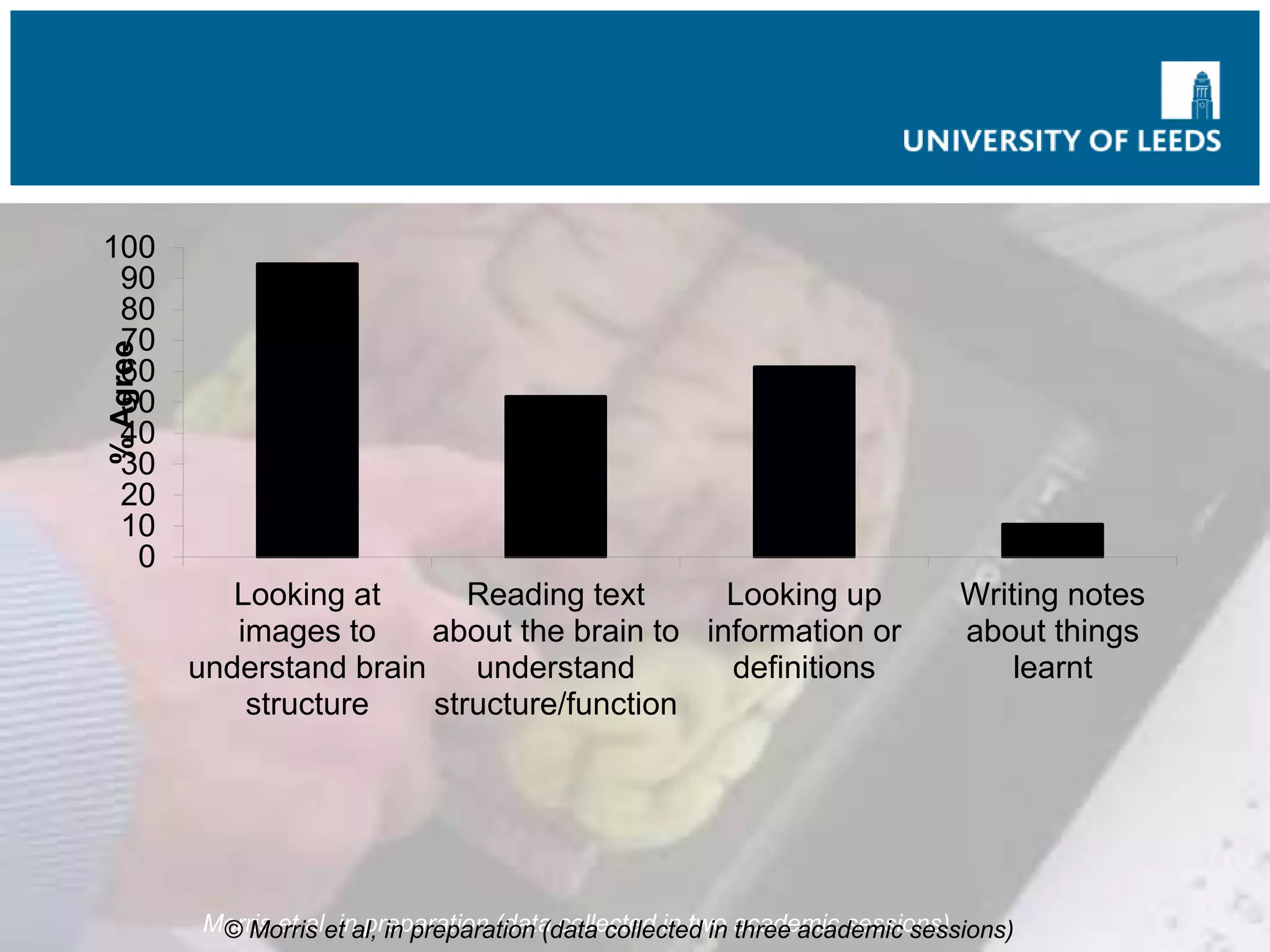
0
10
20
30
40
50
60
70
80
90
100
Looking at
images to
understand brain
structure
Reading text
about the brain to
understand
structure/function
Looking up
information or
definitions
Writing notes
about things
learnt
%Agree
© Morris et al, in preparation (data collected in three academic sessions)
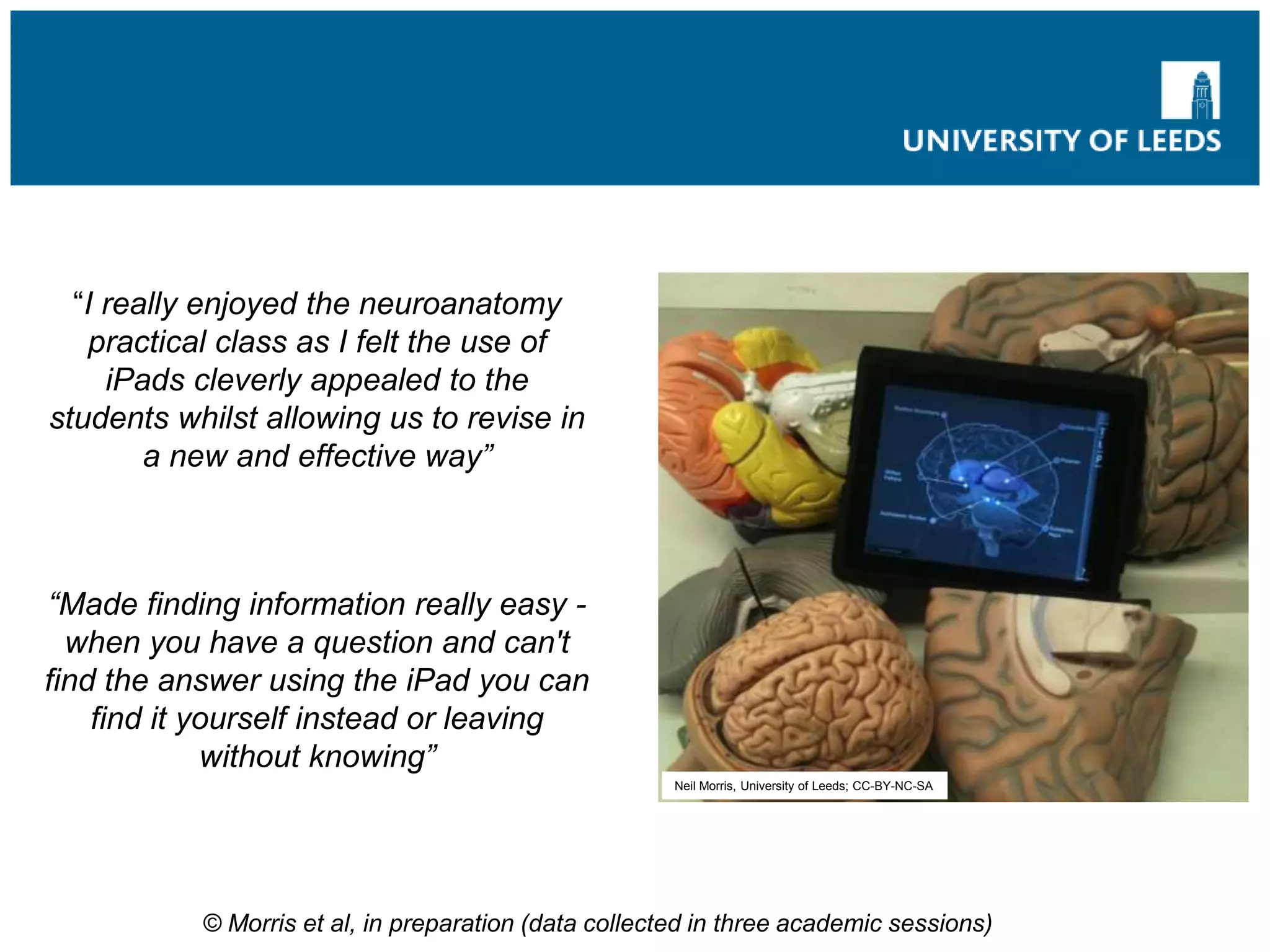
“I really enjoyed the neuroanatomy
practical class as I felt the use of
iPads cleverly appealed to the
students whilst allowing us to revise in
a new and effective way”
“Made finding information really easy -
when you have a question and can't
find the answer using the iPad you can
find it yourself instead or leaving
without knowing”
Neil Morris, University of Leeds; CC-BY-NC-SA
© Morris et al, in preparation (data collected in three academic sessions)
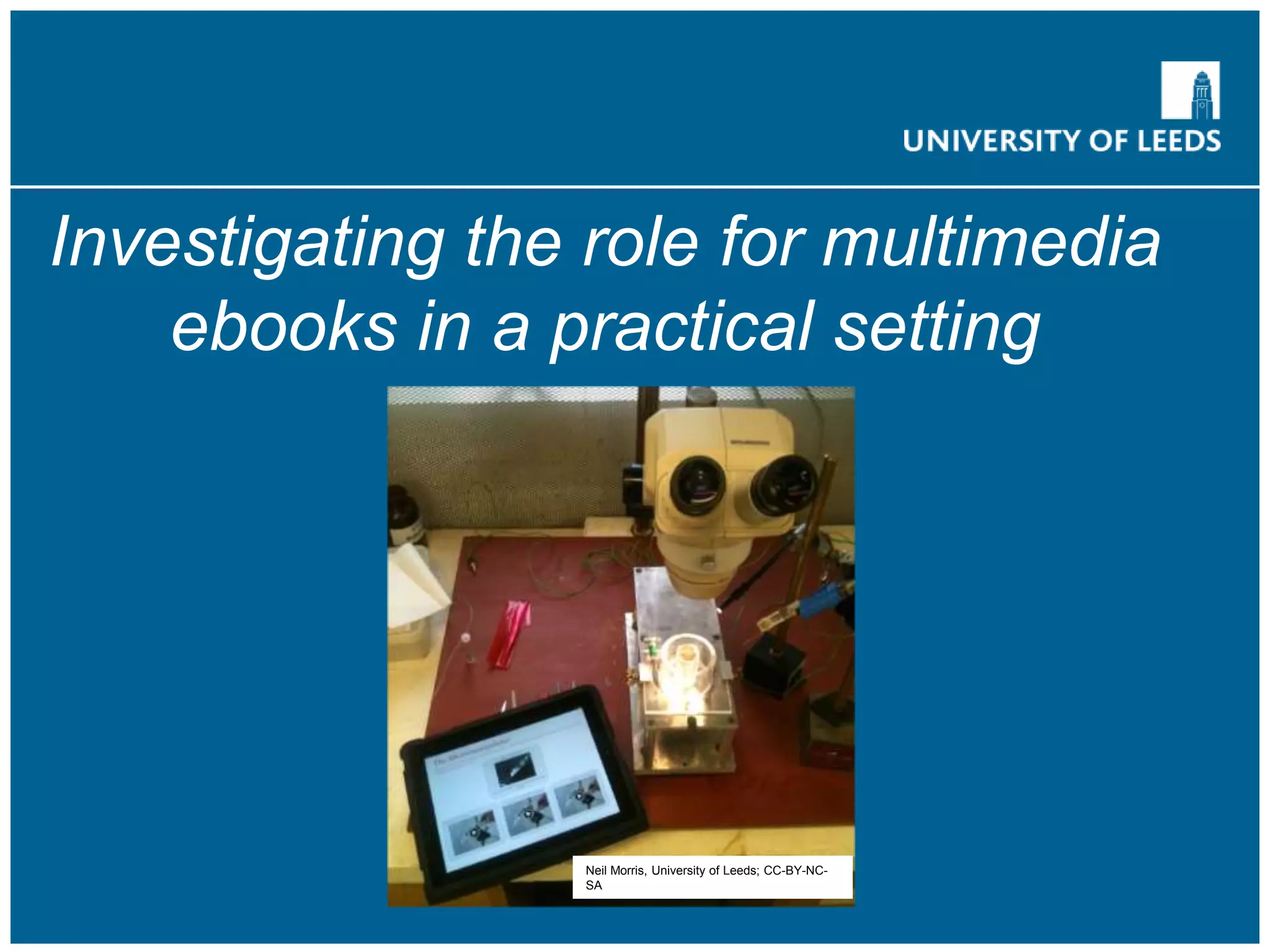
Investigating the role for multimedia
ebooks in a practical setting
Neil Morris, University of Leeds; CC-BY-NC-
SA
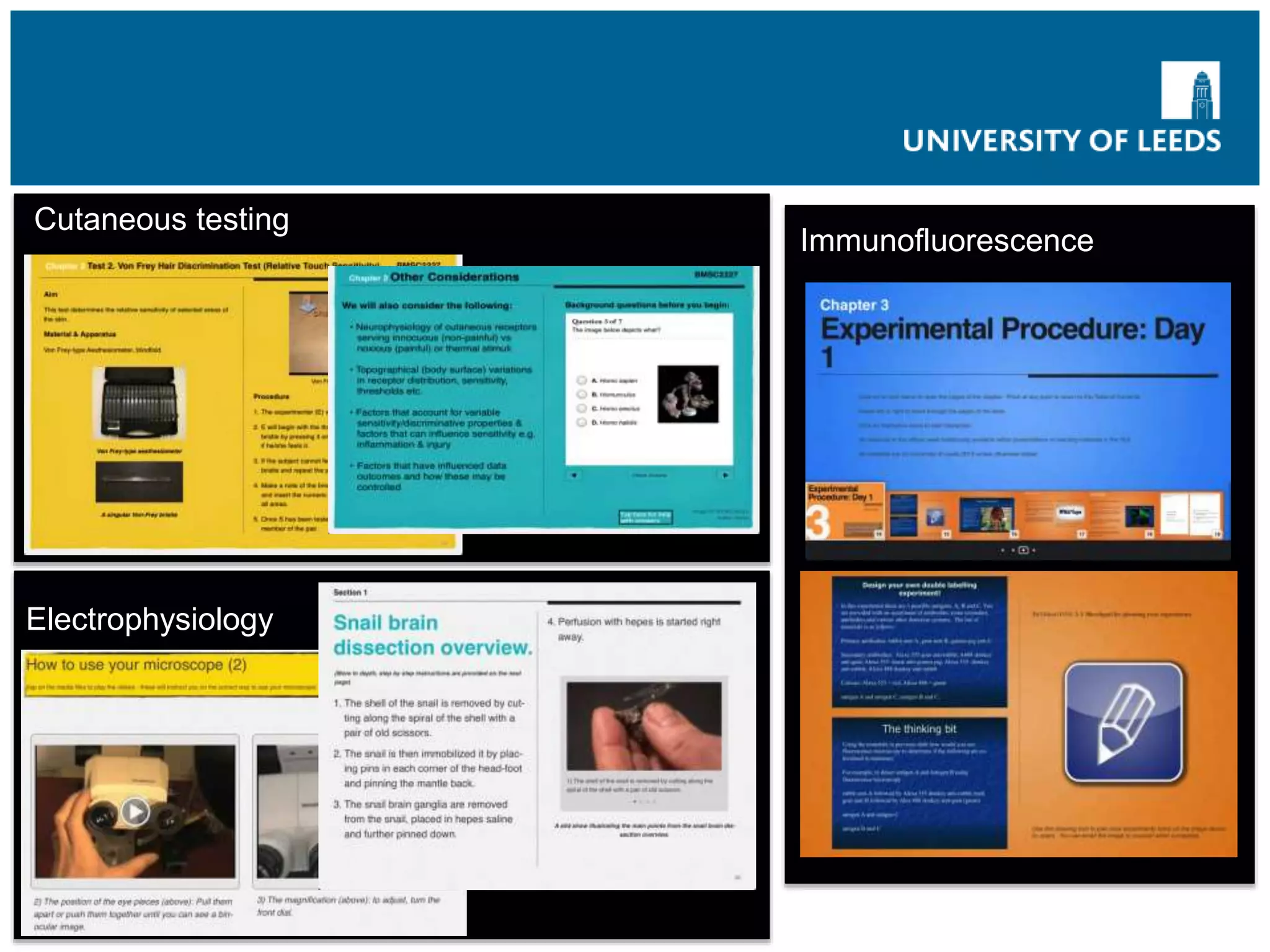
Cutaneous testing
Immunofluorescence
Electrophysiology
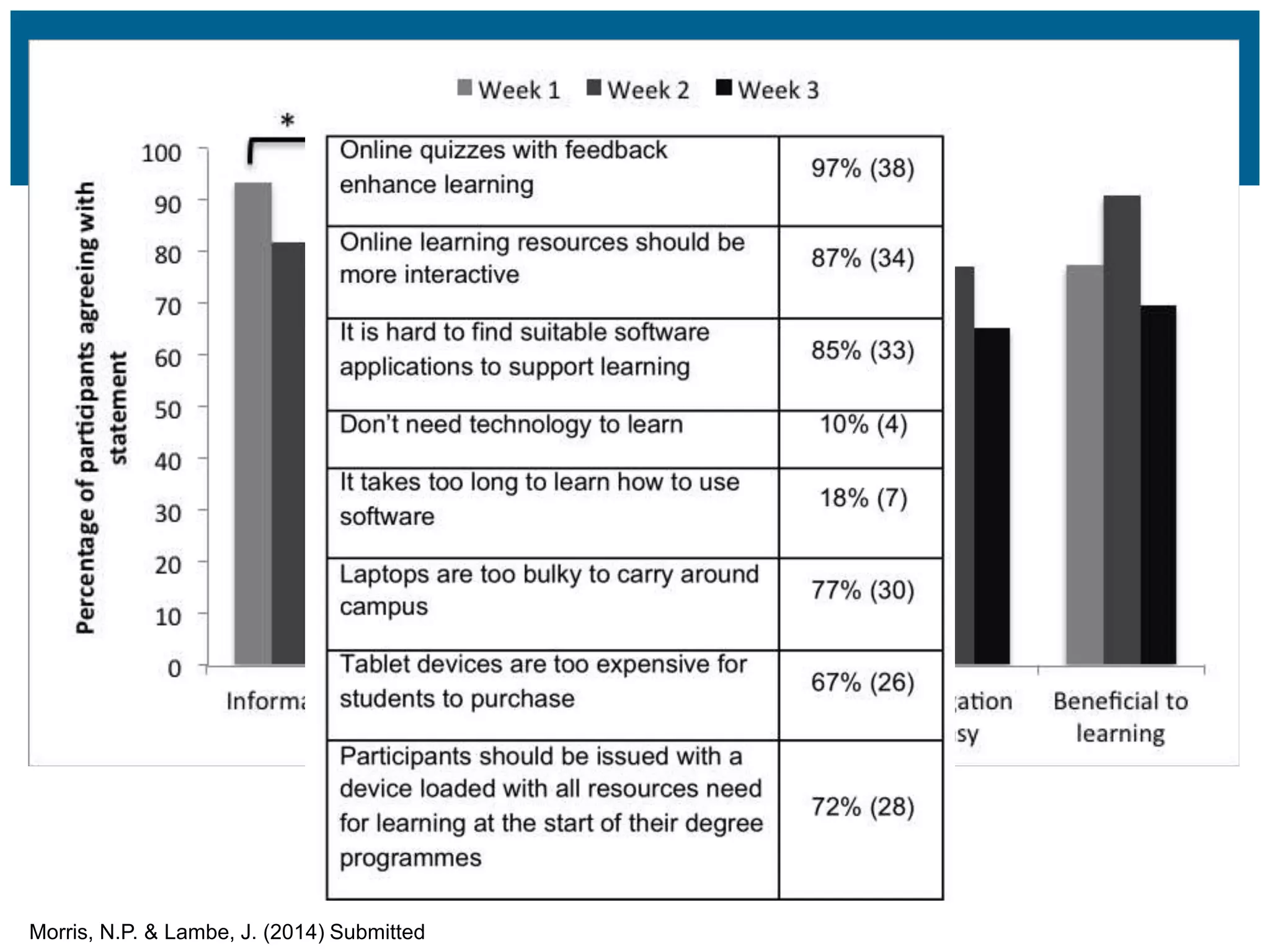
Morris, N.P. & Lambe, J. (2014) Submitted
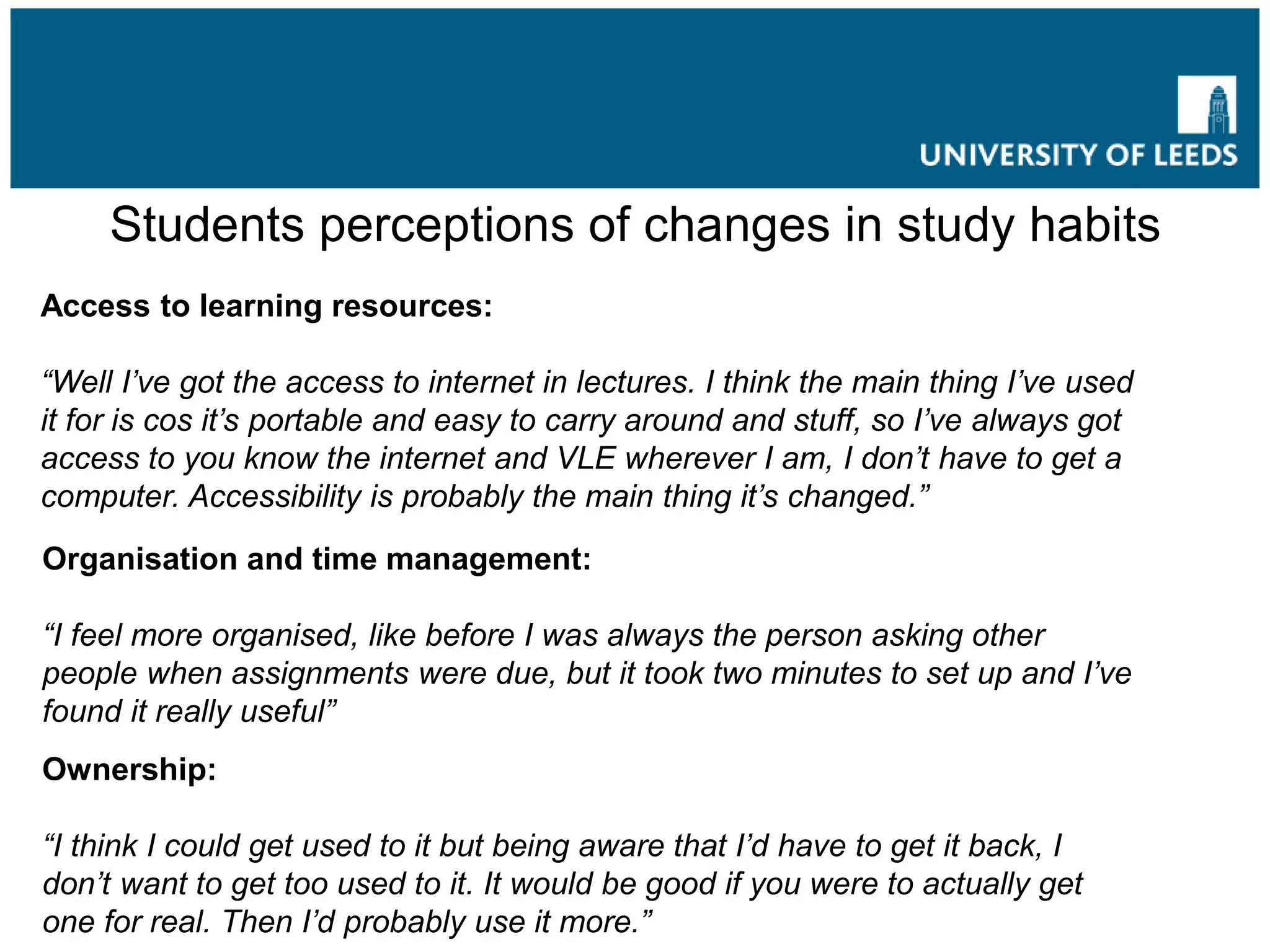
Students perceptions of changes in study habits
Access to learning resources:
“Well I’ve got the access to internet in lectures. I think the main thing I’ve used
it for is cos it’s portable and easy to carry around and stuff, so I’ve always got
access to you know the internet and VLE wherever I am, I don’t have to get a
computer. Accessibility is probably the main thing it’s changed.”
Organisation and time management:
“I feel more organised, like before I was always the person asking other
people when assignments were due, but it took two minutes to set up and I’ve
found it really useful”
Ownership:
“I think I could get used to it but being aware that I’d have to get it back, I
don’t want to get too used to it. It would be good if you were to actually get
one for real. Then I’d probably use it more.”
Students perceptions of eBooks
Aesthetic appeal:
“I think the eBook is more inviting to use than the hand-outs, like before the lab
I wanted to go over some of the material and I went straight to the iPad
because the eBook looks nicer and it explains it well”
Skills training:
“I've used the eBooks just in practical [classes] with the videos, sometimes its
better to have a pictorial display instead of just a written protocol to
understand how to do things particularly in dissections.”
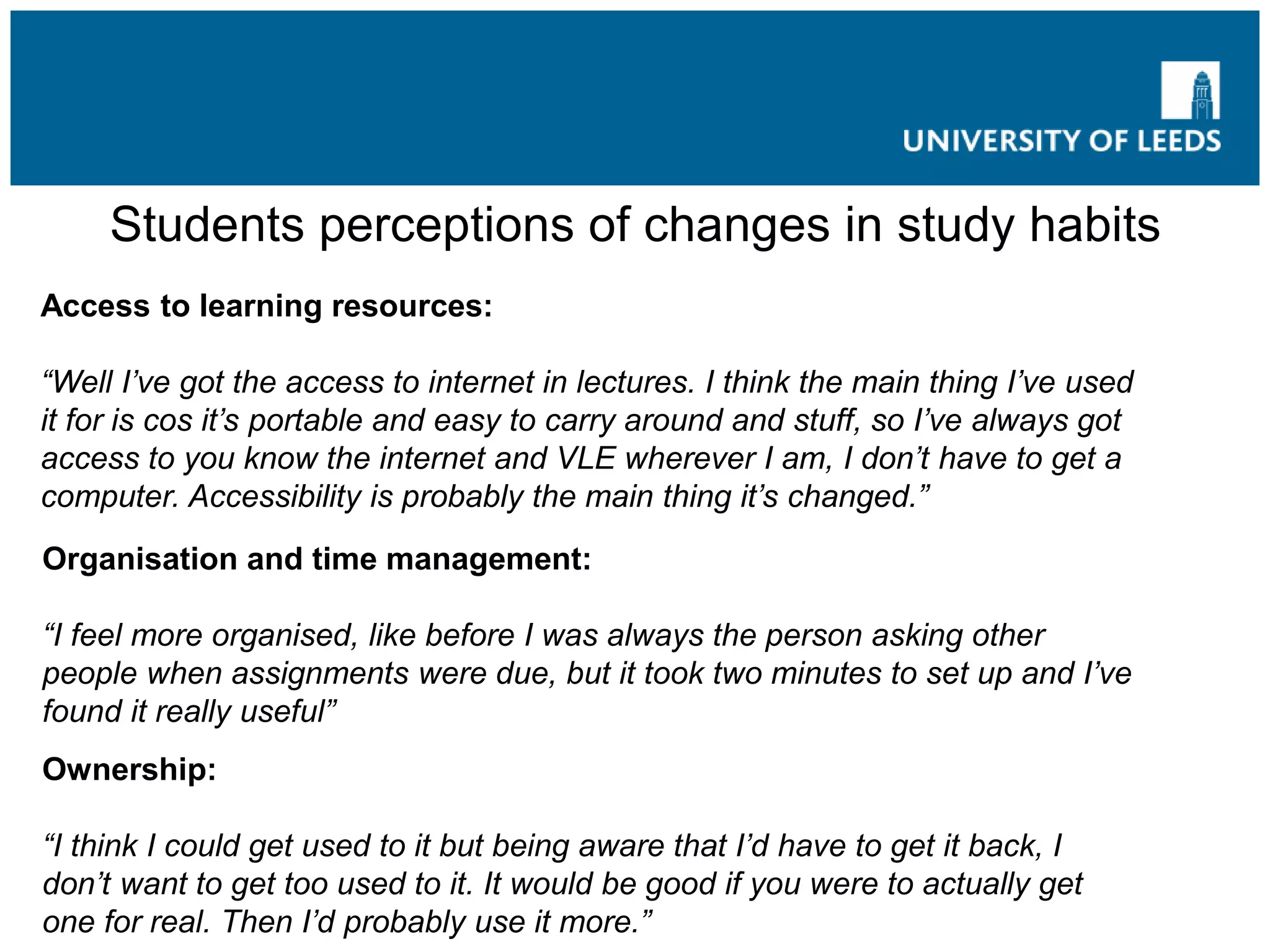
Students perceptions of changes in study habits
Access to learning resources:
“Well I’ve got the access to internet in lectures. I think the main thing I’ve used
it for is cos it’s portable and easy to carry around and stuff, so I’ve always got
access to you know the internet and VLE wherever I am, I don’t have to get a
computer. Accessibility is probably the main thing it’s changed.”
Organisation and time management:
“I feel more organised, like before I was always the person asking other
people when assignments were due, but it took two minutes to set up and I’ve
found it really useful”
Ownership:
“I think I could get used to it but being aware that I’d have to get it back, I
don’t want to get too used to it. It would be good if you were to actually get
one for real. Then I’d probably use it more.”
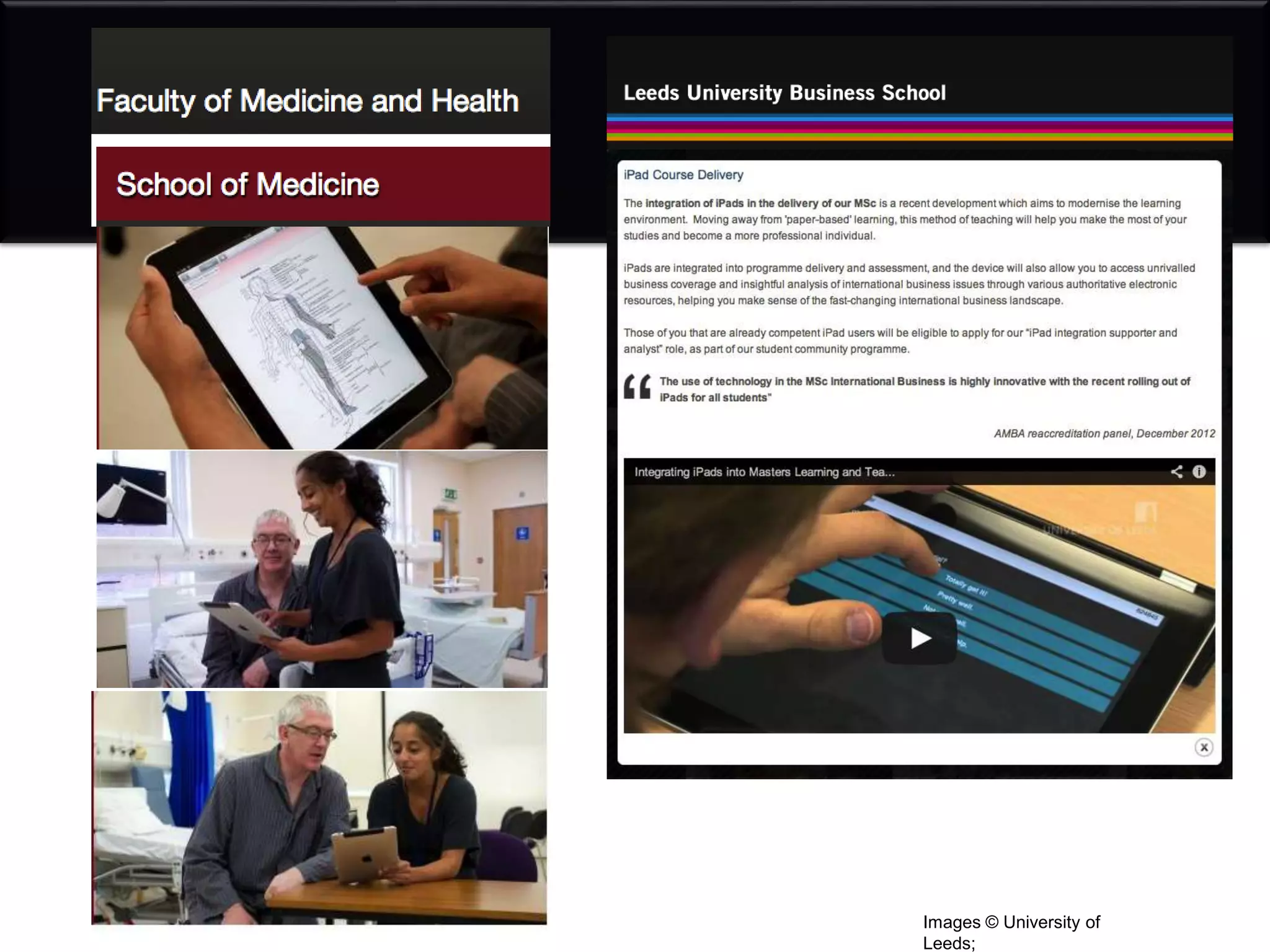
Images © University of
Leeds;
References and acknowledgements
Morris, N.P. (2007) HEA Centre for Bioscience E-learning Case Study. Blended learning resources for a first year
neuroscience/pharmacology module – an e-learning practice case study: ftp://www.bioscience.heacademy.ac.uk/Resources/morris.pdf
Morris, N.P. (2008) VLE implementation project. Learning and Teaching Bulletin, University of Leeds, Issue 18.
Morris, N.P. (2010) Podcasts and mobile assessment enhance student learning experience and academic performance. Bioscience
Education. 16:1.
Morris, N.P. (2010) Using eVoting handsets in Biological Sciences. Learning and Teaching Bulletin, University of Leeds. Issue 24.
Morris, N.P. (2010) Blended learning approaches enhance student academic performance. Enhancing Learning Experiences in Higher
Education, Hong Kong University. Conference Proceedings: http://www.cetl.hku.hk/conference2010/pdf/Morris.pdf
Morris, N. P. (2011) Using Blackboard for Blended Learning Enhances Student Engagement and Learning. Blackboard World
Conference, Las Vegas, July 2011. http://blackboard.echo360.com/ess/echo/presentation/1a246e1f-faba-4bc6-8fe1-8e4234a4c790
Morris N.P., Ramsay, L., Chauhan, V. (2012) Can a tablet device enhance undergraduate science students study behaviours?
Advances in Physiology Education 36: 97-107
Cottrell S; Morris N.P. (2012) Study Skills Connected. Palgrave MacMillan.
Morris NP (2014) First time MOOC provider: reflections from a research-intensive university in the UK. European MOOC summit : 259-
263.
Smith, K. & Morris, N.P. (2014) Evaluation of Biomedical Science students use and perceptions of Podcasting. Bioscience Education.
24.
Acknowledgements to all final year project students, student interns,
project officers and the Digital Learning Team who contributed to the
work presented.
Work funded by Higher Education Academy and University of Leeds
All data © Neil Morris, University of Leeds
Future online learning strategy

Ig mob tech talk nm (recov)

  • 1.
    Faculty of BiologicalSciences Enhancing flexible learning through integrating tablet devices Prof Neil Morris Director of Digital Learning Professor of Educational Technology, Innovation and Change University of Leeds National Teaching Fellow Image © University of Leeds Email: n.p.morris@leeds.ac.uk Twitter: @neilmorrisleeds
  • 2.
    Overview A changing landscape Mobilelearning Case studies using tablet devices
  • 3.
    Increased student expectations Highly competitive recruitment market Greater need to demonstrate distinctiveness Multi-channel content Lackof digital skills in staff and students Prevalence of multi-functional mobile devices Multi-faceted pressures on staff Focus on graduate employability Public metrics e.g. KIS The changing landscape of Higher Education
  • 5.
    Mobile learning inaction Deep learning Multimodal learning Any time, any place
  • 6.
    N=1363 (Nov 2012;Middleton and Caperon, 2013) 50% use a mobile device frequently for research or assignments 23% use a mobile device frequently to read e-books 86% own a smartphone 97%own a laptop. 20% own a tablet device 35% are planning to purchase a tablet device for academic and social reasons 70% likely to use a mobile device to read articles or books online 87% use a mobile device frequently to use a search engine University of Leeds students’ use of mobile devices
  • 7.
    Digital strategy forStudent Education Blended Learning Strategy Policy on Audio and Video Recordings for Educational Purposes MOOC vision and strategy Open Educational Resources policy University strategies for Digital Learning
  • 8.
    Blended learning strategy Faceto face classes Learning resources Event capture Interaction collaboration Social media channels Mobile devices Online assessment Research- based learning
  • 9.
    Provision of mobiletechnology • An increasing number of secondary schools are providing students with access to laptops/tablet devices; • Some universities provide students with smartphones and tablet devices; • Mobile technology deployment: i. Bring Your Own Device (BYOD); ii. Module/Programme/School/Faculty deployment (loan/permanent); iii. Institutional deployment (out of the box / pre- configured). © Yorkshire Evening Post
  • 10.
    Investigating the impactof a tablet device on study habits © University of Leeds
  • 11.
    The iPad wasused extensively for studying • The total time spent on apps per day was calculated at 232.9 ± 47.5 minutes (over 3 and a half hours per day). • App usage was relatively stable over the 10 week trial period with a slight (but non- significant) dip in usage around the middle of the trial. Minutes Week Morris et al. (2012) Advances in Physiology Education 36: 97-107
  • 12.
    Morris et al.(2012) Advances in Physiology Education 36: 97-107 Over 3 ½ h per day using device for studying Significant  in use of laptopfor studying after 10 weeks with a tablet device 96% found the device easy to use 80% thought the iPad was a useful tool for studying Top educational apps: Soundnote Docs To Go iBooks GoodReader Pubmed on Tap Coursenotes Dropbox Dictionary Wikipanion Significant  in use of: Literature search engines Wikis Podcasts Audio recordings Significant  in use of printed learning resources Significant  in word-processing Significant  in use of pen and paper Significant  in use of email
  • 13.
    Participants’ descriptions ofusing the iPad “Revolutionary, this has changed the way I approach a class, I feel totally prepared as, I get the lecture slides without having to print them, take notes , record, reference and if necessary look things up, all in the palm of my hand... WOW” “Got 60 of my dissertation papers on Goodreader. Much lighter than having paper copies, but can still mark them up in a similar way.” “I use the iPad for accessing course notes, emailing, internet browsing, soundnotes for lectures and iBooks for downloading course text web version.” Morris et al. (2012) Advances in Physiology Education 36: 97-107
  • 14.
    Neil Morris, Universityof Leeds; CC-BY-NC- SA Neil Morris, University of Leeds; CC-BY-NC- SA Investigating the role for tablet devices in a practical setting
  • 15.
    Average of 13.6± 0.6 mins using 3-D Brain app during 2 hour practical class (n=273, 3 years) 98% of students used the 3-D Brain app during the practical class (n=256, 3 years) 70-99% of students found the 3-D Brain app useful or very useful for learning (n=247, 3 years)
  • 16.
    76-83% found tabletdevice in class beneficial(3 years) 77-84% found using tablet devices in class enjoyable(3 years) 72-81% thought that tablet devices enhancelearning(3 years)
  • 17.
    Morris et al,in preparation (data collected in two academic sessions) 0 10 20 30 40 50 60 70 80 90 100 Looking at images to understand brain structure Reading text about the brain to understand structure/function Looking up information or definitions Writing notes about things learnt %Agree © Morris et al, in preparation (data collected in three academic sessions)
  • 18.
    “I really enjoyedthe neuroanatomy practical class as I felt the use of iPads cleverly appealed to the students whilst allowing us to revise in a new and effective way” “Made finding information really easy - when you have a question and can't find the answer using the iPad you can find it yourself instead or leaving without knowing” Neil Morris, University of Leeds; CC-BY-NC-SA © Morris et al, in preparation (data collected in three academic sessions)
  • 19.
    Investigating the rolefor multimedia ebooks in a practical setting Neil Morris, University of Leeds; CC-BY-NC- SA
  • 20.
  • 21.
    Morris, N.P. &Lambe, J. (2014) Submitted
  • 22.
    Students perceptions ofchanges in study habits Access to learning resources: “Well I’ve got the access to internet in lectures. I think the main thing I’ve used it for is cos it’s portable and easy to carry around and stuff, so I’ve always got access to you know the internet and VLE wherever I am, I don’t have to get a computer. Accessibility is probably the main thing it’s changed.” Organisation and time management: “I feel more organised, like before I was always the person asking other people when assignments were due, but it took two minutes to set up and I’ve found it really useful” Ownership: “I think I could get used to it but being aware that I’d have to get it back, I don’t want to get too used to it. It would be good if you were to actually get one for real. Then I’d probably use it more.”
  • 23.
    Students perceptions ofeBooks Aesthetic appeal: “I think the eBook is more inviting to use than the hand-outs, like before the lab I wanted to go over some of the material and I went straight to the iPad because the eBook looks nicer and it explains it well” Skills training: “I've used the eBooks just in practical [classes] with the videos, sometimes its better to have a pictorial display instead of just a written protocol to understand how to do things particularly in dissections.”
  • 24.
    Students perceptions ofchanges in study habits Access to learning resources: “Well I’ve got the access to internet in lectures. I think the main thing I’ve used it for is cos it’s portable and easy to carry around and stuff, so I’ve always got access to you know the internet and VLE wherever I am, I don’t have to get a computer. Accessibility is probably the main thing it’s changed.” Organisation and time management: “I feel more organised, like before I was always the person asking other people when assignments were due, but it took two minutes to set up and I’ve found it really useful” Ownership: “I think I could get used to it but being aware that I’d have to get it back, I don’t want to get too used to it. It would be good if you were to actually get one for real. Then I’d probably use it more.”
  • 25.
  • 26.
    References and acknowledgements Morris,N.P. (2007) HEA Centre for Bioscience E-learning Case Study. Blended learning resources for a first year neuroscience/pharmacology module – an e-learning practice case study: ftp://www.bioscience.heacademy.ac.uk/Resources/morris.pdf Morris, N.P. (2008) VLE implementation project. Learning and Teaching Bulletin, University of Leeds, Issue 18. Morris, N.P. (2010) Podcasts and mobile assessment enhance student learning experience and academic performance. Bioscience Education. 16:1. Morris, N.P. (2010) Using eVoting handsets in Biological Sciences. Learning and Teaching Bulletin, University of Leeds. Issue 24. Morris, N.P. (2010) Blended learning approaches enhance student academic performance. Enhancing Learning Experiences in Higher Education, Hong Kong University. Conference Proceedings: http://www.cetl.hku.hk/conference2010/pdf/Morris.pdf Morris, N. P. (2011) Using Blackboard for Blended Learning Enhances Student Engagement and Learning. Blackboard World Conference, Las Vegas, July 2011. http://blackboard.echo360.com/ess/echo/presentation/1a246e1f-faba-4bc6-8fe1-8e4234a4c790 Morris N.P., Ramsay, L., Chauhan, V. (2012) Can a tablet device enhance undergraduate science students study behaviours? Advances in Physiology Education 36: 97-107 Cottrell S; Morris N.P. (2012) Study Skills Connected. Palgrave MacMillan. Morris NP (2014) First time MOOC provider: reflections from a research-intensive university in the UK. European MOOC summit : 259- 263. Smith, K. & Morris, N.P. (2014) Evaluation of Biomedical Science students use and perceptions of Podcasting. Bioscience Education. 24. Acknowledgements to all final year project students, student interns, project officers and the Digital Learning Team who contributed to the work presented. Work funded by Higher Education Academy and University of Leeds All data © Neil Morris, University of Leeds Future online learning strategy