



Neil Morris
Director of Digital Learning
Professor of Educational Technology,
Innovation and Change, School of
Education
University of Leeds
© University of Leeds
Email: n.p.morris@leeds.ac.uk
Twitter: @neilmorrisleeds, @unileedsonline
Digital technology and Higher Education:
delivering benefits for student education
Interaction in this session
Twitter – use the hashtag #BBtlc16 to post
comments or ask questions
Padlet – post your ideas on our collaborative
online wall: (http://padlet.com/wall/esp6r1g70osz)
Recording available afterwards (via BBTLC)
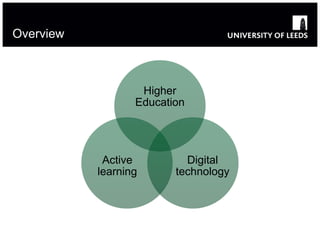
Overview
Higher
Education
Digital
technology
Active
learning
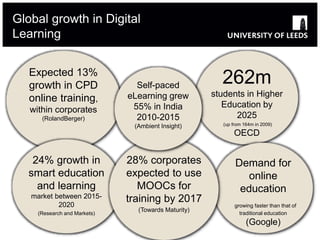
Global growth in Digital
Learning
262m
students in Higher
Education by
2025
(up from 164m in 2009)
OECD
Demand for
online
education
growing faster than that of
traditional education
(Google)
Expected 13%
growth in CPD
online training,
within corporates
(RolandBerger)
24% growth in
smart education
and learning
market between 2015-
2020
(Research and Markets)
28% corporates
expected to use
MOOCs for
training by 2017
(Towards Maturity)
Self-paced
eLearning grew
55% in India
2010-2015
(Ambient Insight)
A mutually beneficial partnership to
address the rapidly changing
demands of students, within a
technology perspective, by
collaborating on jointly agreed
projects from planning through to
execution
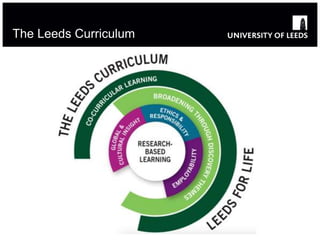
The Leeds Curriculum
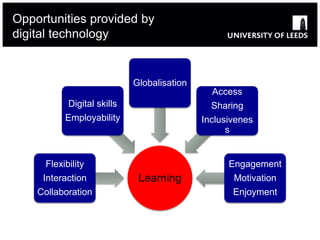
Opportunities provided by
digital technology
Learning
Flexibility
Interaction
Collaboration
Digital skills
Employability
Globalisation
Access
Sharing
Inclusivenes
s
Engagement
Motivation
Enjoyment
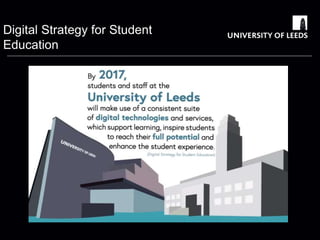
Digital Strategy for Student
Education
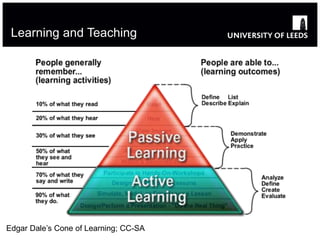
Edgar Dale’s Cone of Learning; CC-SA
Learning and Teaching
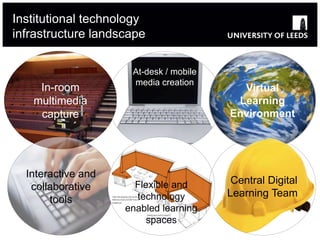
Institutional technology
infrastructure landscape
In-room
multimedia
capture
At-desk / mobile
media creation
Virtual
Learning
Environment
Interactive and
collaborative
tools
Flexible and
technology
enabled learning
spaces
Central Digital
Learning Team
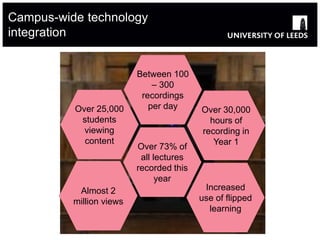
Campus-wide technology
integration
Over 25,000
students
viewing
content
Over 73% of
all lectures
recorded this
year
Between 100
– 300
recordings
per day Over 30,000
hours of
recording in
Year 1
Almost 2
million views
Increased
use of flipped
learning
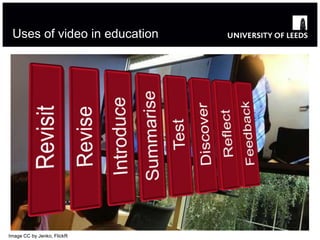
Uses of video in education
Image CC by Jenko, FlickR
A need for change
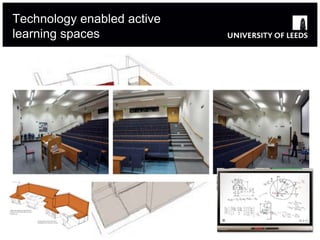
Technology enabled active
learning spaces
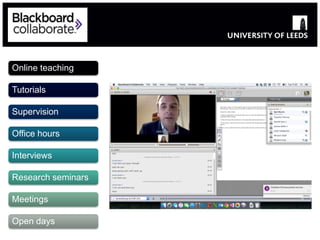
Online teaching
Tutorials
Supervision
Office hours
Interviews
Research seminars
Meetings
Open days
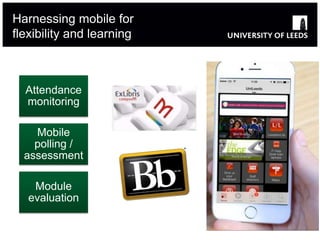
Harnessing mobile for
flexibility and learning
Attendance
monitoring
Mobile
polling /
assessment
Module
evaluation
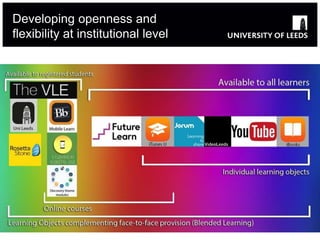
Developing openness and
flexibility at institutional level
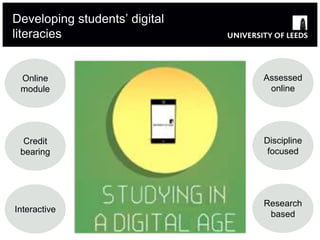
Developing students’ digital
literacies
Digital skills
Digital
scholarship
Digital
practice
Digital
presence
Online
module
Credit
bearing
Interactive
Assessed
online
Discipline
focused
Research
based
Overview of the Studying in a
Digital Age module
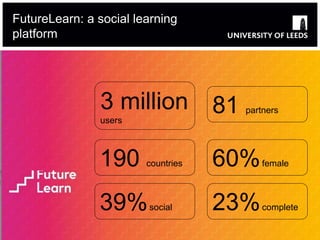
FutureLearn: a social learning
platform
Overall stats
190 countries 60%female
39%social 23%complete
3 million
users
81 partners
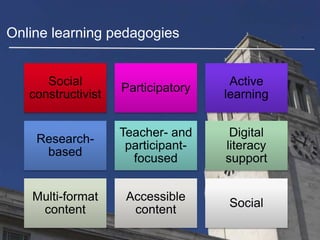
Social
constructivist
Participatory
Active
learning
Research-
based
Teacher- and
participant-
focused
Digital
literacy
support
Multi-format
content
Accessible
content
Social
Online learning pedagogies
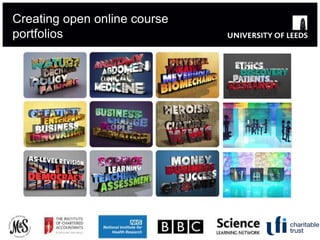
Creating open online course
portfolios
Collaborative and social online
learning activities
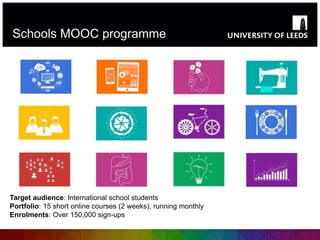
Schools MOOC programme
Target audience: International school students
Portfolio: 15 short online courses (2 weeks), running monthly
Enrolments: Over 150,000 sign-ups
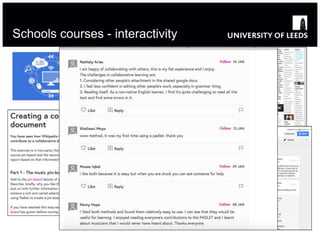
Schools courses - interactivity
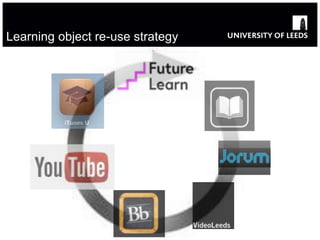
Learning object re-use strategy
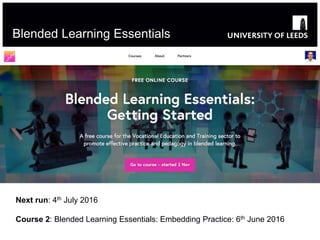
Blended Learning Essentials
Next run: 4th July 2016
Course 2: Blended Learning Essentials: Embedding Practice: 6th June 2016
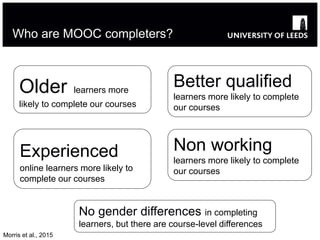
Who are MOOC completers?
Older learners more
likely to complete our courses
No gender differences in completing
learners, but there are course-level differences
Experienced
online learners more likely to
complete our courses
Better qualified
learners more likely to complete
our courses
Non working
learners more likely to complete
our courses
Morris et al., 2015
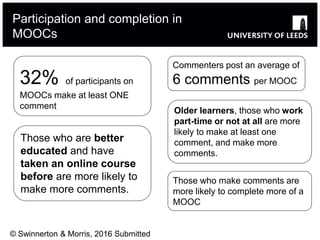
Participation and completion in
MOOCs
32% of participants on
MOOCs make at least ONE
comment
Those who are better
educated and have
taken an online course
before are more likely to
make more comments.
Older learners, those who work
part-time or not at all are more
likely to make at least one
comment, and make more
comments.
Those who make comments are
more likely to complete more of a
MOOC
© Swinnerton & Morris, 2016 Submitted
Commenters post an average of
6 comments per MOOC
And finally….
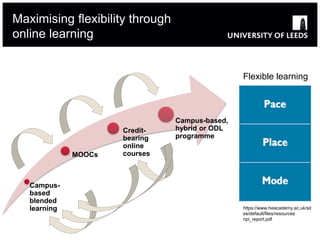
Maximising flexibility through
online learning
Campus-
based
blended
learning
MOOCs
Credit-
bearing
online
courses
Campus-based,
hybrid or ODL
programme
https://www.heacademy.ac.uk/sit
es/default/files/resources
npi_report.pdf
Flexible learning
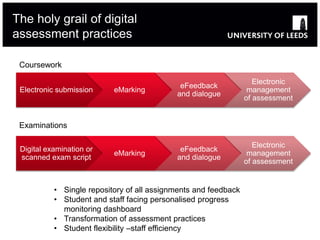
The holy grail of digital
assessment practices
Electronic submission eMarking
eFeedback
and dialogue
Electronic
management
of assessment
Coursework
Digital examination or
scanned exam script
eMarking
eFeedback
and dialogue
Electronic
management
of assessment
Examinations
• Single repository of all assignments and feedback
• Student and staff facing personalised progress
monitoring dashboard
• Transformation of assessment practices
• Student flexibility –staff efficiency
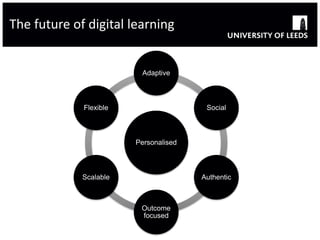
The future of digital learning
Personalised
Adaptive
Social
Authentic
Outcome
focused
Scalable
Flexible
© University of Leeds
Email: n.p.morris@leeds.ac.uk
Twitter: @neilmorrisleeds

BlackBoard Learning and Teaching Conference Keynote