If and When
If and When
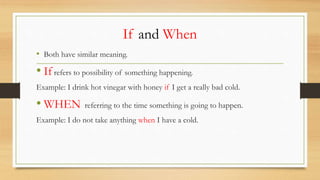
• Both have similar meaning.
• If refers to possibility of something happening.
Example: I drink hot vinegar with honey if I get a really bad cold.
• WHEN referring to the time something is going to happen.
Example: I do not take anything when I have a cold.
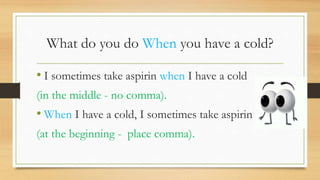
What do you do When you have a cold?
• I sometimes take aspirin when I have a cold
(in the middle - no comma).
• When I have a cold, I sometimes take aspirin
(at the beginning - place comma).
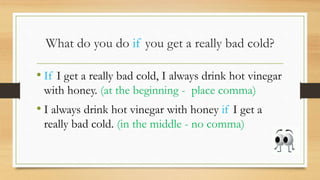
What do you do if you get a really bad cold?
• If I get a really bad cold, I always drink hot vinegar
with honey. (at the beginning - place comma)
• I always drink hot vinegar with honey if I get a
really bad cold. (in the middle - no comma)
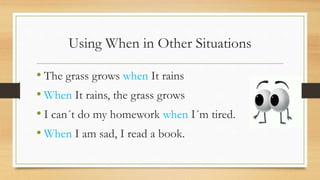
Using When in Other Situations
• The grass grows when It rains
• When It rains, the grass grows
• I can´t do my homework when I´m tired.
• When I am sad, I read a book.
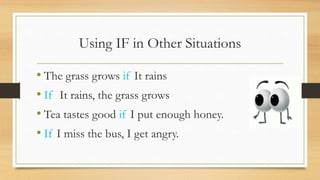
Using IF in Other Situations
• The grass grows if It rains
• If It rains, the grass grows
• Tea tastes good if I put enough honey.
• If I miss the bus, I get angry.
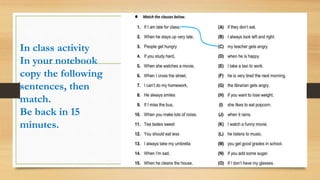
In class activity
In your notebook
copy the following
sentences, then
match.
Be back in 15
minutes.
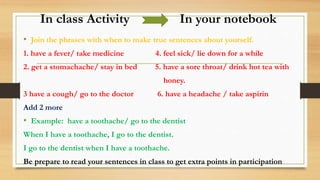
In class Activity In your notebook
• Join the phrases with when to make true sentences about yourself.
1. have a fever/ take medicine 4. feel sick/ lie down for a while
2. get a stomachache/ stay in bed 5. have a sore throat/ drink hot tea with
honey.
3 have a cough/ go to the doctor 6. have a headache / take aspirin
Add 2 more
• Example: have a toothache/ go to the dentist
When I have a toothache, I go to the dentist.
I go to the dentist when I have a toothache.
Be prepare to read your sentences in class to get extra points in participation
In class Activity
• write questions for specific people (more than one person), ask what do they do in
these specific situations
( use if in your questions)
• Look for the questions your classmates asked you and answer them (use if)
• Example: have a bad cold and have to go to class?
• What do you do if you have a bad cold and have to go to class?
• If I have a bad cold, I usually stay home.
1. Feel sore after exercising? 4. have an upset stomach after you eat?
2. Have a high fever? 5. Feel tired and run down ?
3. Have to cough at a concert? 6. have to sneeze at a movie?

If and when

  • 1.
  • 2.
    If and When •Both have similar meaning. • If refers to possibility of something happening. Example: I drink hot vinegar with honey if I get a really bad cold. • WHEN referring to the time something is going to happen. Example: I do not take anything when I have a cold.
  • 3.
    What do youdo When you have a cold? • I sometimes take aspirin when I have a cold (in the middle - no comma). • When I have a cold, I sometimes take aspirin (at the beginning - place comma).
  • 4.
    What do youdo if you get a really bad cold? • If I get a really bad cold, I always drink hot vinegar with honey. (at the beginning - place comma) • I always drink hot vinegar with honey if I get a really bad cold. (in the middle - no comma)
  • 5.
    Using When inOther Situations • The grass grows when It rains • When It rains, the grass grows • I can´t do my homework when I´m tired. • When I am sad, I read a book.
  • 6.
    Using IF inOther Situations • The grass grows if It rains • If It rains, the grass grows • Tea tastes good if I put enough honey. • If I miss the bus, I get angry.
  • 7.
    In class activity Inyour notebook copy the following sentences, then match. Be back in 15 minutes.
  • 8.
    In class ActivityIn your notebook • Join the phrases with when to make true sentences about yourself. 1. have a fever/ take medicine 4. feel sick/ lie down for a while 2. get a stomachache/ stay in bed 5. have a sore throat/ drink hot tea with honey. 3 have a cough/ go to the doctor 6. have a headache / take aspirin Add 2 more • Example: have a toothache/ go to the dentist When I have a toothache, I go to the dentist. I go to the dentist when I have a toothache. Be prepare to read your sentences in class to get extra points in participation
  • 9.
    In class Activity •write questions for specific people (more than one person), ask what do they do in these specific situations ( use if in your questions) • Look for the questions your classmates asked you and answer them (use if) • Example: have a bad cold and have to go to class? • What do you do if you have a bad cold and have to go to class? • If I have a bad cold, I usually stay home. 1. Feel sore after exercising? 4. have an upset stomach after you eat? 2. Have a high fever? 5. Feel tired and run down ? 3. Have to cough at a concert? 6. have to sneeze at a movie?