w
w
w
.exam
race.com
I.E.S-{ORJ) 1997 I ol J6
ELECTRICAL ENGINEERING J
3.
5.
PAPER·II
When n thyristor is negatively biased
a All the three junctions are negatwcly
based
b. Outer junctions are positively biased
and the inner jiDJction is negatiNiy
biased.
c. Outer j unctions are negatn·ely biased
:llld tlw inner junClion is positivc.l''
biased
d. The jlmction near the anode is
negative!)' biased and the one near the
cathode is positivelv biased
Consider the following semiconductor
derices;
I Tnac
2. Thyristor
J. AJnplifving gale thyristor
Tbe correct se<.)uence or th~e de1 oces in
increasing order of their diidl capabJitties
is
a. I. 3. 2
b. I, 2, 3
c. 3, I. 2
d 3. 2. I
In de choppers feeding hlghl) inductive
loads, the waveforl'llS lbr input and output
currents are
a. Di.scontmoous and contmuous
respectively
b. Both continuous
c., Both discontinuous
d Continuous rutd discoutiuuoll~
respectively
A single-phase voltage source square-
wa>'e inverter feeds pure inductne load.
The waveform ofthe load current will be
a, Sinusoidal
b. Rectangular
c. Trapezoidal
d Triangular
In macbine tool dri1e applicatiOR the
spaed of a S"-pflrately excHecl de motOr rs
required to be controlled both below and
6.
7
above the rated speed of the motor. Whfch
one of the followin~: metbods is best suited
for dus purpose1 (V, = nmmluro voltage,
lr= field current and IJ"'"' = field currout
at rated speed}
a. It = I'""'" ·v, variable
b. V, fixed· lrvariable
c. V, and 11 variable, with Ir s lr,....J
d V, and lr variable. wrth 1, ?: lr....d
A sepatatel)' e.-.cfled de motor is rNJUired
to be conLtolled from a 3-phase source for
operation in the lirst quadrant onJ,.. TI1e
110St preferred converter would be;
<t Fully colllrolled converter
b. Fully controlled corll'erter 11i~1
freewheeling diode
c. Half-controlled converter
d. Sequence comrol or tO series
connected fully controlled co111erters
If ~1e commutation angle of a diode
rectifier (due to source inductance eiTect)
is IJ. then the il1ductive voltage regulation
will be
a.
l+ws,u
2
b. I cos II
+--
2
c. 1
_ cOSJJ
z
d.
I COSJI
2
Consider the folloWing statements~
ll1e diodes tn a voltage source onvener
(Mci1urruy invener) should be able to
I Withstand a large voltage m the
re1•erse direcuon.
2 Cany the commutating current excess
ofload currenL
3 Pro"1de the reqmred reverse bias to the
outgoing thyristor
-1. Feedbacl.. Lhe reacd1 e current to the
source.
w
w
w
.exam
race.com
Ofthe;,e s!aemenl:$
a. I, 2 and 3 arecorrect
b. J, 3 and 4 (Ire CQITI'cl
"- ~ 3 and 4 are <.-mret't
d. I, 2 and 4 are correct
9. The ao-[o-dc voltage ratio ofa convert<>r itt
tile state ofdi.scontitmous conduction is
a Dependent upon the fil'ing angle but
independentofload tin1e constant
b. Dependent uponload time cotu.1ant but
independent of firitlf!, atlgle
~. Dependent upon botlt titillfl angle and
load time cotlStant
d. Independent of both firing rutgJe~ and
load time cotlStattt
I0. In a 3-pha.se bridge rectifier fed from Ute
star corurected secoJtdary wittditlg of a
lnulStbtmet; l~t lhe Voltnge to tlte neub·al
oftl~e A - p.ha~e (phase ~eqli<Jnce A, B, C)
be V., •;n oiL AI the instmtl when the
voll.ltae of A-pha<>e is maxitn1nn, llte
output Vollage Rt tlte rectifier tenninals
will be
a. v,, i../2
b. VM
c. l..SV.
<1. .J3v.
11. Cons.ider the ioUowing statements
segarding speed control of iudoction
mol'€'rs by means of external rotor
resistors:
1. Reduction in speed .is accompanied by
J'educed efficiency
2. Wi61 a huge rosistanc<l in 1he rotor
cirouit, 6te. speed woJld vary
con.sidembly with volriation in torque.
3. The method is Vf!I'Y complicated.
The Disa<lvMtages of soch a method of
speed control wouldiuclude
a. 1 and 2
h. 2 and 3
c. I and3
d. 1, 2 and 3
1:2. Cow;itler tlte tollo"in,g stntesnents;
S~tched ntodc JlOWcr supplies are
preferred over the continuous types,
because theyare
l. Suitable for use in l>othac and de.
2. More efficient
3. Sui~tble for low-pqwer circuit•.
4. Suitable for high.-pow.ercircuils.
Ofthese sl~temenJl;
a. 1 :U(d 2 m·e correct
b. 1and 3 arc cosrect
c. 2 and 3 arecorrect
d. 2 and <1are co.rrect
:of16
13. In (lcchopperl!, per W1il rim~e '" m•L'Uill•m•
whenthe duty cycle ct is
a. 0.2
h. 0 5
c_ 0.7
II. 0.9
14. Match the 3 curves labeUed A. B. C and D
wiOt UJe churacteri..~·tics givet1 under list-11
and sele-ct Ole correct arJSwer using Ute
codes giveubelow the figures:
t:::E!E@I·~·~ - Q 180'1
Jt10EEQ
!::~~
it;::~ ~ I
ljO.O ~80'
u~tiJ: Control characteristic ofa
1. .3-pulse cot~verler feetliJig pure
resistance.
2. l"'~ly controlled convet1er fee.Ilng R-L
load withperfec~ smoolhing
3. Single-phase ac voltage ~'ltlll·oller
feeding pure inductiveJoad
'1. 6-pnlse llnlf-cootrolled converted
A B C D
a. I 2 3 4
b. I 2 4 3
c 2 I 3 4
d. 2 J •I '3
1.5 A 3-pHise C<)Overler feeds a rtu-e ""'istive
Joad at a firing angle of a = 60". TI1e
average value of current flowing in the
load 1~ I0. If n~ very large inductHnce is
comtected in tl1e load circuit, U1en the
n. Awrage value of cuuettt will nmtnil•
liS IQ A
w
w
w
.exam
race.com
b. Average value of ~11rre.nt will become
greater tlllll1 lOA
c. Avemge value of current will become
less tlum 10 A
d. Trend ofvariation of currentcannot be
prroieted unless t11e exact value, oftile
inductance connected is known
16. It1 a 3-phase recti.tier circuit, tl1yristor
lllltllber I,2 !IIIII ) are <'OlUii'."ted
respectively to ·!, Y and B phase9 of tlte
stlll'- connecl.ed lnmsformer second!l1y.
When the current i• being oommutated
fron1tJI)'ristor No. t to No. 2 the effect of
the trausfomter leakage and the ac system
inductance will besuchtlutt it will
a. Prolong the conduction in No. l and
<!clay tlte· tum- an of No. 2
t•orrespondingly
b. Stop the ronduction in No. I at tltc.
scheduled time, but delay Ute !uot-<nt
ofNo.2
c. Produce cot.tdncti.orl iu bo1h No. 1 and
No.2 in pumllel for Hn ovedawinv;
pt:ri<Xl througha tranSient
d. Double Ote voltnse OllljiUt throngh a
commntltliQJl !;ransient
17. lfau iubi.n!;i~ senticondnctur U; doped with
a very small umount of b!ml11, then in Ote
e;>.."trinsic semiconductor so fom1ed, the
number ofelectrons and holes will
a. Decrease
b. lncre','!Se andde..'t'ease re<pectively
c. Increase.
d. OecrlolllSe and increase respectively
18. !f<t= 0.98., lu = 61JAnnd I ~ = 100,..A fora
trnwistor, tl1011 the vlilue ofl. will be
a 2.3 rnA
b. ::l.lmA
C. 4.6llL~
d. 5.2 mA
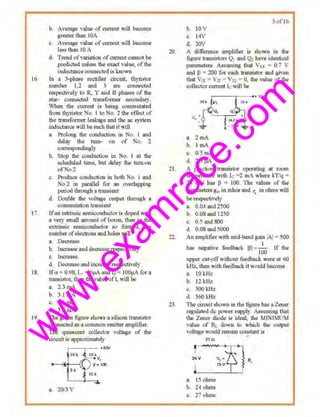
J9. Th<> given figure shows a silicon transistor
connected as acomnton emitter amplifier.
The quiescent collector voltage of the
cir<.t1Jit is approximately
+!!<lV
IO~():Ok'v,
o---i p = 100
.. j. 10 k
-a. 20/3 V
21
22.
l:). 10 v
c 14V
d. 20V
3 Df l6
II. difference antplifier i~ showtt i:tt 0Je
figure transistors Q1 and Ql have iden1icul
pmumeter.s. Assuming Lhal V&£ = 0.7 V
and J3 = 200 for each tnmsistor ·and given
that Vsr = Vsr = Vs2 = Q, Ute value of Ute
<:ollel"iorcurrenl. lc will be
r----,-----• 15 v
II) II J~~c 10 11
rlf.'lo, <~.:>lv , (_ ~ ~ • v~,
UJ l~~~~~
a. 2 mA
b. 1mA
c O.SmA
d. 2.5 J.L"-.
A Jlmction ltllllSish.>r opernting at room
temperature widt Ic ='2 mA where k-T/q =
25 ·mV has [i = 100. The valt1es of the
parameters g.., ut mhos and r, in ohms will
be rel.'{lectively
a. 0.04 and 2500
b. ooa·and 12so
o. 0.5 and 800
d. 0.08 and 5000
An ~mpli lier with mid-band gain IAI- )00
'has n.gallve reedback IPI=-
1
- . Ir the
LOO
upper <:~Jt-ofT withoul feedback were'ar 60
kHz, tlte.n wilh feedback it would become
a. I() kifI.
b. 12 kllz
c. 300 kliz
d. 360kHz
The clrcult •hown i.n the fig.ure has a Zener
regulated de power supply. Assuming that
the Zener .dio.de is ideal tltc MJN1MijM
vlilue or Rr. dow11 tu wlticla Oaa output
vollllge wouldren"w1conytant is
27 0
2~*l ts~r
a. l5~bms
b. 24 ollms
o 27 ohms
w
w
w
.exam
race.com
24.
d. 45 ohms
A 11on-inverting OP-AMP swnmer is
P.hown in the figure. 11u! ocltput Voltage Vo
is
II ZR
a. sin tOOt
3 •
1.>. 2SU1100/
c. 2sinl00 t
d. 3sirt100t
25. The expression for tlce output voltage Yoin
terms of tl1e input voltages V; rucd ~ in
lhe circnit. shown in the 6g11te, assnrrring
fue operational ampl.tfier to beldeal is:
26.
V, =A,V. -A2111
The valltes of A1 ru1ct A2 would be
tespeclively
.100 '11
v, ... I1: v,
v, llli
Q?l<
~
•• 9 arid -10
b. 9.9 arcd -10
c. -9 and 10
d. -9.9 and 10
Tlce transfer guin lor Ute cir<.'Uit sh!lwn in
the figt~re is given by
R, R,
0 "'"" '3£>-1~·,v. ~ + v•
'~
.-['··~:¥]
b. -[ :.~, , ,l
~ of16
,-[.~:~-··I
d. -[R,; ,E;J
27. Consider the following statemenu:
regardi.ug anRC phase-slti.ft oscillator:
I. Theamplifier gui.ttis positive.
2. Tite ampliJier gaiJtis negative.
3. The plwe shift introduced by tlto
feedback network is 180"'.
4. The pltase shiJt introduced b.y th:e
feedback networkis 360°.
Ofthese statements
a. 1 and 3 m·e correct
b. 2 and 3 are correct
c. 2 and 4 are correct
d. 1 and 4 are correct
28. If rut input signal wjtJt non-zero de
component is applied to a low pass RC
IU!twork, the d.<> component in Uce ouqJUt
wUlbe
a. The same as tlmt in Ute input
b. Less llmn in lhe inpm
c. More than that in lhe 1nplll
d. Zero
29. For tlce giveu input. dca output wavefonu
across the diode shown in tlce fi~ure will
be
ru inpu! "; ~ oucpuc
a.
b.
C
c
w
w
w
.exam
race.com
d.
v ~06Vrl6V
1
i '--' Jt~
30. The wavefonn oftlte oulput ofa low pass
tllter to astep inputwill bw as in
a.
b.
c.
v
vt~ '-t
31. Tlle voltage lo.>vels for a neglltive logi<'
system.
a Mnst neoossarilybe negative
b. Could boo negative or po!ritive
c. Mustnecessarily be·J)06iHve
d. Must necessarily becitlterzero or- SV
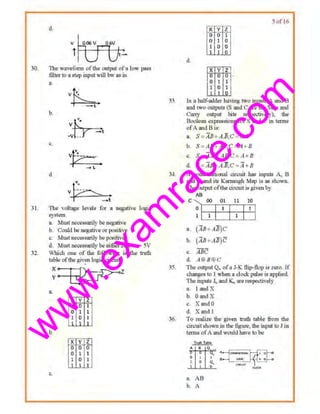
32. Vbich one of tlte following is the ll1ltll
t>tble oftl1e giv~o logic circuit'/
~~L
a.
c.
X V Z
0 0 I
0 1 1
1 0 l
1 ~ 1 1
X V Z
0 0 0
0 1 I
1 0 1
1 I l
33.
d.
X y l
0 0 1
0 1 0
I 0 0
I 1 0
X. y z
0 u 0
0 I 1
I 0 l
I I 0
5 of 6
In a half-adder having two inputs A and B
and two outputs (S and C are the Sum and
Carry output bits respectively), tile
Boolean expressions for S and C in lerrn.s
ofA andBis;
a. S =AB Alf:C =A.B
b . S=ABT AB;C=A+B
!~ S-= A.ii+AB;C= A+B
d. S=AB..-.4.B;C=.4+B
3d. A combinational circuit bas inputs A, B
and C and its Kamaugh Map is as shown.
The onlpnt oftl1e Cire~dt_. given by
AB
c--.._ oo 01 11 10
~11 1
1
111
1
1
a. {JlB+iiB)C
'b. (J:B 1 A.B)c
c. iiifC
d. Aal llli>C.:
35. The outpttt Q. ofu J-K fli11·llop iHero. If
changes to I when a clock pUlse is applied.
The inputs J. and K, are respectively
a JandX
b. 0 and X
c. X audO
d, X and 1
36. To realize the given truth table ITem the
circuit shown in the figure, fue.input to J In
tcrnts ofA and wouldllllve tobe
a AB
b. A
w
w
w
.exam
race.com
37
38.
39
c. ()
d. AB
Ihe circtlit schematic shown In the
follo"~ng llgun:
~' ~ ~ ,~
wnj:f. ....t ~d~."••nJl ~"'I
.•.1
!!._, :e::_j 'fk---J 1!-l
Represents -1-bits
11- Static shill register
b Oynumic shifl 1'1:gastcr
c Asynchn.,nous counter
d Synchnlllt'US wunter
Mutch Ust-1 (f'uof.ltionlc.itcuJt) with list-ll
c•rcuit rc~li7.ation) and select the correct
ans-wer
l.ist l
A. D-Oir> flo))
H. 1'-fl ip Rtlp
L. E.'clustW UR
0 Halfodder
UstU
I
2
3.
n.
h
c.
d
A
2
1
J
3
0
3
3
2
2
c
I
~
~
I
D
•I
I
I
~
Ihe lurg~ IJ1c I<AM ,,r a computer o.hc
faster is its speed. since il climinmes
a. Need for ROM
b Need fe>r c.~tcmal m<mory
~0.
41
-12.
43.
44
I> of II•
c. f requent disk 1/0ss
d Need for 11 data-wind nnth
1)13. PW und DD dfrcc.tii'<-S are used to
pine¢ dnta in paniculnr loc:ltions nr In
simpl) allocate space .-itbout reassigrung
aHytlung to spare The OW and DO
directions are used {J) gcncrmc
u. OITscts
I> Full address of vnrinbles
c. Full uddrcss of labels
d Ollscts or full addr<ss or labels and
vnnnblcs
Match L•st-1 (I ype nl' instru~llnn) '"'"
list-[! (Instruction) and select !he COffrCt
3JJ!oiwe-r
List I
1, On~ byte instruction
B. l'wo b) tcs mslruction
C Thruc bytes instnactinn
1~. l~cgistcr indir~cl oddrcssmg
l.i.<t II
I MOV A, dmu
2 MOV A, 8
3 MOV /1. M
q JM'P uddr.
J B
0.
h
c.
d.
I
2
2
I
2
I
I
2
4
-1
3
3
l)
3
3
Cous1der tbc t'hllnwUJg sci of' uJstructions:
STC
CMC
MOV /,B
Rill
MOV ll,/
Jill~ S<:l of instniCtion.'
tL l)oubl<s IJ1c number m llcg1sle.r be B
b. Divades U1< number m Rcgi.,;ter by 2
c. Multiplies B by A
d. /del' A Wid 8
rhc number hits needed tO addr..>ss -IK
memory is
a. 6
b. s
c, 12
d I(
l'hc IJS(. instruction of MU80 mny have
two forrnnl~. In on<' of th~ tbrrnuts. rm
w
w
w
.exam
race.com
memory operand is used. Under lllis
format, the number of external op-oode.
(for the ccrprocessor) wllfch Ctn be
specified ts
a. 611
IJ, 128
c. 256
d. 512
45. The Tll.AP ts one of Ote itltemtpl~
available in TNTEL 8085. V.1uclt one o.f
the following statemettU< IS true of1'RAP7
a. Itislevel triggered
b. Itis negativeedge triggered
c. IUspositiveedge lriggered
d. it is both positive edge triggered and
level triggered
46. Consider the following figures sh0w:ing
clock periods of!Jtstruction Fetch 1ttaohilte
,;;ycle for INTEL ~85_
It 'T.js,t; I M~
IOJQ ,., ;..-
•$, ~ ....._
$,
An lzll.ROR, in U1e above dia~ relates
to lite signal -
a. IOIM
b. so
c. Sl
d. R,D
4'7. In a L6-bil microprocessot; words ru-e
stored in iwo crat.se..'Olive 111emruy
loontions. Tite enfue 1vord can be read in
one operation provided tlte 1irs1
a. Word is even
b. Word is odd
o, MemO!)' locationisodd
d. Memory addross is even
48. A 3;.8 decl)derwitlt two tmable inputs i~ to
be used lo address 8 blocks of memQry.
What will be tlte size of each memruy
block when addressed frotn a sixteen bit
bus witl1 twu MSBs used lo enable ll1e
decodet'l
a. 2 K
b. 4 K
c. 16 K
d. 64 f(
7 of16
49. A carrier signal of frequency f, is
modulated by a ~ignal
2Acos 2n/,1-A •in1:Jr/,1
The spectrum ofthe mo.dulated signal will
include which of llte following frequency
componenls~
I. .~ -/,""J.
2. f. -/,- .t:
3. J; •2/, f l
4. J;-'J./,+J;
Selece· the correct answer using the oodes
giv~nbelow:
a. I and 2
b. 3 and •I
c, 3 almtc
d. 1,2, 3aJKI4
:50 Wlucl1 one of U1e following ts the
advantage of base modulation over
collector modulation of a t:nmsistor Class
C.amplifier'/
a. Req'uires lower mod11lntion power
b. Higherpower output per lmmdstor
C·. Better efficiency
d. Better linearity
5L ht a tllllllW band FM systeJJI. Ute highest
modulating frequency is fw. The
bflndwidlh ofthe system "'~II be
a. 6fm
b. F.,
~. 2fm
d. l()fm
52. A telephone cltrumcl will PCM gives good.
perfonnan~e al: ~ transmissi on rat" t)f Mk
bin;ls. Wi1h companding and complex
version pf delta modulation (DM), to
aclueve the same pe(torntartoe, tlte-
transmis~-i"n mteJIIUSl be tlu~e h.>
a. 64 k bi1s/s
b. 100kbits/s
c. 64 M bits/s
d. I(}() Mbits/s
53. Equalizing pulses in IV are placed during
Ultl
a. Vertical bhmking period
b. FlorizOiltal blankingperiod
c. Serrations
d. Horizontal retraoo
w
w
w
.exam
race.com
S4. The most useful :rppro~ch to rudnr system
l'or mcmlloring_ tho speed of m11ving
''ehidts is:
o. Pulsod rudar·
b. Monopulse
c. Dopier· ra<lar
d. AuUHrllokiog rlldar
55. CoflJlid~..- Ute follmving stotoi11tnts.
Tbu. inilXWlUm range of rndar can ba
incre-ased hy
I lncre3Hinslhe re•k lr;m•mit1<:<1 pOW~T
2. lncreosing thegoin <Jfthe receiver
3, lnc1'easing th.,dramet.er oflhe •nlenna
4 Reducing the wavelenglb used
Oflhe.~c ~t:Jtemenl~
it. 1...~ and 4-arc correct
b. l.2.3 •nd 4 arecon-ect
c. 2 and 4.are con·ect
d. l ood 3 are C(>M."Ct
56. C()ftlidt:r the following . totemenLs obout
broadband communicotious u5ing
submarine c.'hie<:
1, A submarine cable repealer contains
tillers li>r th.e two direcliuns of
tnu1s.uWus.ion.
2. Armoured •ubmariuc Cllblc is Ulled for
the •hollow- sl10re ends ofthe cable. V
3 f'ibre-opl{c gubmarinc c:~blc is used to
prtvmt lnodvcrlent plugging- In of lh"
cablo.
Of thesestolemonl.'l
o. 1 aud 2 ore cou·cct
b. 2lllld 3 nre eon·ect
c. llllld 3 arc c..,n·cul
d. I. 2. and 3 n!c com:cl
57. To couplu a coaxial llnc to • parolld wil'c
Iine, i1 is tlest to use: a
n. S loned line
I> Bt1lun
c. Directiorml coupler
d. (Juarter-wave lr>ru;former
51!. ss~rtlon A: A dirlerentloll~ cqmpounded
" " 11101lf IHIS t!Jc possf~ility ur •lMlillg in
the tcvc.~ctl direction.
Ron,<uu R; Owing to higher induct.mcc in
tht: t<efit:!l ticld, the r~uhunl m11in nux
rcwroes during slllr1ing.
n. Both A nnd JUre uue and R is Uie
con'IJcl <ll<pl!Ul3tion nfA.
8 ol II>
b. Bolh A ~nd R ~re true but R is NOT ii
correct explnnatlon ofA
¢ . A is true hut R is f.~l•c
d. A is false but R is lme
59. A.....sert.lon A.: In a snli.,Jt-pole
synchronous motor. Ute augu!ar
displa~ent of rotor per unit change of
power 1• less than that for ~ similr.r
cyl indrio~ J mlor machme.
J~casclu R: A relutUncu luo'quc is
de"clhpt:d iu the •alieni- pole mach.in~ due
In the ..tfect of direct a.~is tlmc on the
damper winding.
a. BoUt A and Rare 011e and R is lire
correct .:xplnMLlon of A.
b. BoU1 A anJ R "'"'truo but R is NOT a
cnrrcc:l esplnrwtion of A
c. ~ i!i h'ue but R is fi1ba:
d. A is false bul R is true
60. A""ertinn A: During tlre lood flow Jtudy.
a voltage conlrolled bus ts treated as ~ toad
bus when the ~~~~~itude (I[ Ut!: voltage is
very much higher or very much lower tlt.1o
J·he sc.heduled voltage.
Reas1m .R: A l'O]l ch~ngin.g tronsfc1rmer is
repr"S"lllod o.~ :on net W<Jr'k ito t11e lt>ad (tow
1nodcl.
a. Both A Md Rnrc IJ'U~ 1mtl R i.> the
c~>rrcct e.xplon3tion ofA.
b. Both A and R.,..., true but R is NOT a
correct explanation of A
c, A is IJ'Uc hut R i• f;rlsc
d. .' is fal~e hul R i• ~·uc
61. AsSI'rtion A: Jn lite re.~idual type ..arth
compensation USQd in tlic di!tancc
protection ocllcmes with solidi)' earthed
neutr:~l sy~tems. 1he residuAl compensation
circuit uses auxiliary c:.un'<;utl t.J'i:tusfotmers.
Reasuu R: A (r':lclion of lh~ r.:sidual
CUO'UUI i• 3dd<ld to th~ r~ull ourrcut I. for
an earth t:1ul1on phase ·a·, This froction is
so ~hoscn thnt Lh<> r~Jay measures the
po.illvc~t:tjuonte lmpcduncc Zt.
:o. Bulh A aud R;lrc true .md R is lhc
c-OJTeCl explrutntionof A.
b. Bolh A and R are true but R is NOT •
c-orrect e,>;planation ofA
c. A is lrne but R is f.1lse
4. A rs Jalse but R is true
62. Asserlion A: In HVDC' syslems. lh" d~
w ltuge shauld be os hij!l>..,, pc.ssible uud
w
w
w
.exam
race.com
63.
64.
65.
66.
tlie rectifier control ongle alpha ,;houhl bo
••• to" as possible.
R~a,..)n R: Cunli>1 of <k voltnge ls
cxerdsctl hy tJao. r.:xlifit.T tultl in't.1 tcr
cuulrul :.n,glc:!l alpha ;and y:munJa
respectively,
a. 13oth A and fulre blle and R is the
con·ect explanation ofA.
1•. Both A and R are true but R is NOT •
COtrcct e~l>lonntion ofA
c. A is h uc but R is false
d. A lS f• be but R is true
Asst<rtion A: A~3 ph3Sc induction motor
operation on a 3·phase voltage controller
for sp~d control eannot be used for
constant tor<jUU lond..
Rt!asuu R: l11c uutpul voltiJg.c wnvct(>tltl
orthe cuntmllcr is rli.turted,
n, Both 1 and Rore blle and R i.s the
correct explaNtion ofA.
b Both A and R are 1J11e but R is NO l' D
.:orrect <:otplonation ofA
c. A i., true but R i• fal•c
cl A '' fn.be but R is true
Asst.'rtluu !; TTL 41ld C!VIOS c.>nuot be
nonually used together,
Reason R; Til. operates on a (- 5 ~ 0 25)
regulated supply voltage and some mA.
whih• tb!> CMOS op,'fllt.:. on wtregubtcd
supply vollllge of "t3V to • JSV and
•omc~t.A.
n. BQih A and !tire bllc and R i~ the
correct CX]>Illnaticm ufA.
b Both A ancl R are t111e hut R is Nfl"l' J
conoe~l expl>untiuu ofA
c. A i, tn"' but Ris faiJ;e
d. A is f>l!<>hut R is true
As~t~rtiun A~ f,fach.itt~: Jangungc program
•• wntten in hexodecimal.
R•a.<nn R: Microprocesoor con onder
stand 1e~adecitnal numllersystem.
"' Both A Md Rare blle ;tnd R is th"
C<!O'CO <.'~planation OfA.
b. Dotlt 1 •od R arc true but R i& NOT a
C(lCI'(:CL CXjllaJt3tion i!f A
c. .' is tn1a but R L• till$e
d A is fn l•e but R is true
Ass~rtinu , : '!'he ileogree uf modul.•tion of
a·ijcUc.- f;equency volrnge present ut the
Input temtin•l5 oi.tbe diode is less li••••tho
67.
68.
69.
? " ' 16
degree of moduLnion of tho origillJII r.adio
frequency signal m AIIcletel!tor.
Renson R It der>Cnds primarily im theratio
of tho. SUUICIJ ittl(itli3n<C of tJoe r>dill
frecrueucy vi>ltngc ~~ 1hc clioclc lu.ld
impedance.
a, Both A and lt-rre 1J11e and K is the
correct explan:ulool ofA.
b. BoOt A and R "'" true bol R is NOT 4
correct <lNplnnati<)u ofA
c. J is ~·uc but R i!l fubc
d. A is false but R is true
Ass•rtion A: Tho different compon<:nls of
a composll:c: video sig.n-.11 are needed
consecutively and not simullllneously ~~
U1e TV feceiwrs.
Rcusun R; T)ro dillcrcnt curnponcnk' uf
the r;nrnt~<•site vid~m sign:rl nrc •ent tn lire
receiver nn 11 fTe~tu~ncy cl-ivlsitm I:Htsili.
a. aoth A ·and R~re h1oe 'IDd R is the
corn:ct expl~n~tion ofA.
b. I3oUr A •nd R arc lnoc but R is NOT n
corn:ct explanation ofA
c. A i• b1re but R i• ful,e
d. i i• false but R i!! true
lf tho applied voll1ge of • cerl:tin
transfonner is increased bv 51)% and the
frequen~y Is reduced to 5.0"o (assuming)
that Ulo Dlllgnct.ic drcuil n:rnuins
unsaturated), the mn.<imum core •nux
densitywill
a. Chang~ tn thn:c, titncs the <1rigio:rl
V3.}Uc
b. Change to l.5 tim~ Ute 01~innl l<tlue
e. Change to 0.5 limes Ute original vtLiu"
d. Rarnnin the snmo a> the original val'"'
TI•e low-oltngo wimliug of " core-typo
trun..dQnn«..T is $lfbdivided into twn t;X(lt:ll
halVes. endr nl' hall' the nriginnl width err
the single winding with lito high-voltage
winding in between th.esc two bolves of
low-voltage windin.g (instead of having
u•ual -=~nslructi•ln (If low-vultngc windini!
adj:lccnt to tire cu1<: 11nd •urroondt:d b the
lriglo·vOit3g<: Vinrling.) Such an inter·lncing
ofcoils wnulrl make t]le t'Ombined primnry
and •ocoodnry leakl•gc I'<:.'ICillll~• (in ter111s
oftho prinmy) ttearl~·
a. Twice
b. Eqwal
c. H•lf
d. One-founh
w
w
w
.exam
race.com
70.
71.
72
73.
74.
Tw.;. 3-limb. 3"Pii•sc delta-slru' connected
tr:msfol'niers are otqJplie<l from· the s:tm"
Sj>urce. One ul' the transfomten; •~ uf Oy 1
#nd tltc other is uf Oy IJ connc'Ction. TIJc
ph:~se ditlerence l!erween he
corresponding rhn.~e Wthages 111' the two
second Aries would be
01. 0°
b. 300
c. r,o-~
tl. ]2()9
lo a lruusfoaner fed fmm o fw1dameolal
frequency voltage snuroe. the source of
hannonics rs the
a. Overload
h. PoM insulntiun
c. Iron lOS$
d. Saturation ofcore
A -!Ilk VA lransfonner h.. a .:o•·e lo$~ of
400V nod. o fuU-Ioocl copper loss of 800
 . The proportion of ·fUIt-load al
maximum e.tfieicnC}r i~
"· Sll'lo
b. 62.3~.,
c. 70. 7~..
d. 110~.
A singlc-pbll!e Lransfonntr h3S a. rnting of
IS k VA. 6001120V. ft i1 r<>:onnectcd 4!
an autl)- tmnsfonner lo supply at 720 V
lm m a 600 V primary $O>rtce. The
OIIUXIIUUtiJ lo•d it Cllll *'PI>f.V IS
a. 9() kVA
b. 18 kVA
e. 13 k'i
d. 12Wi
11u: guncrol expression for tho
instanL1neous value of the torque of
tlyn.;uuo-el~trlc 1unchiues is given by
T -~li )" dL, +l (t )' dl., + 1 tM
- 2 I c/i;l 2 J ./(1 4I dfl
Where ;, ~nd '' :U'e rotor and sl.ator
curr~nts n:>pcelivoly. La and L2 11r0 rotor
windings- selfinduchmccs.
~vf is the: mu1usl indu.owm:e bot.,.een J~.tzrtor
:rnd rotor winding• and(l is aloe angular
displ~cement of the rotor.
For a S)~tcha'tlnotas machine (cylindric.~!
rotor). tb~ torguo is given by only tho third
tem1 oflhe equation. hoc.1use
n, Tho nwr:>ge value nf ('it)0
•nd (i:):
e:1ch is 1~ew
7),
76.
77.
10 " ' ~ ~
b. 'Ille nr<ot ~nd tllc $e.xtnd terms cancel
eoch othcrr
elL, d ell., I , . d
c. dll ~ ~~ elf/ l~V~ oppostte stgns an
~
dB
<!b.
c/0
tl. Lt ond L: do not vt:ry with respect to
0
Match l.i~t -1 (Parts of electrical machinos)
willt List - 11 (Tile approximate natw-e of
lh" air-gnp molfpattorn produtcd by tb~-rn)
and 5ielec.t the correct answer
List J
A. DC mnc.hine, Jbtor
B. DC ma10hine. rotor
C. Solient·pole •ynchronous machine,
~t~l<'r
0. SotUirrd-cagc roltlr nl' incluc1i<>n motor
List 11
L Sinusoidal
2 Tr~pt:z.Oldal
3. Tri•11gul>.r
A 13 c D
•• 1 2 3
b. 3 J 3 1
C,, 2 :l I 3
d. 2 3 I 1
A de shu.nt generator,. when driven at il$
rated •peed. is found to be not generating
any vollllge. Wblch ofUoe following would
~ccount for Ibis?
L There t$no ""'idu•l mat~ncti&rtt.
2. The eonnectiqn ot lhc licld >Ulrling ;,
not proper with respecl to the :.nn:•ture-
lc1lflit10ls.
3. Tlte resist~nce of the field circuit Js
grente1· tban tl1e critlcalli~ld r.:sistancc.
-1. Th<> loo(J t'<'Sil;tancc is '"" Utnn the
critic.;sl armansre r~istnnce.
Select the correr;l •n.,wer u•ing the cooleo
giveo helt)w;
a. 3 and 4
b. I. 2 and~
c. I, 2 an() 3
d. I. 2, 3 anrl 4
To hove spork less comrnutation. U!e
am:J:ture rcl~tion eiTcct in .1 de madtinc is
neutrolized hy
w
w
w
.exam
race.com
71;.
7'J.
a. Using compensating winding <Utd
U<lmmutating poles
b, Sbltlins dte bnosh nxis from th<>
g~'Olll~tricnl tteutrnl axis to U1o
maguttic ncutrnl :.~xili
c. Fi>cing Ute bnosh axis in line with th~
pole a.xis
d Increasing tho Jicld excitation
I11 " de shun! geiiCI'atnr wml.:illg '''' lnad,
the bmshcs urc 11111'ucl fmward m tho
direction of rotation. As p result of dtis.
rommutution will
o. Improve but tcmtinnl vohll.!!c will Iiiii
b. Wmsen und te11111113l voltage WI II Iilii
•~ lruprove und tenniual ''ultagl! will rise
d Worsen and terminal voltngo will rise
Match I ist-1 (Ways ofcumpounding. series
unJ shumlicld winding~ ofa de eo;,mp.1und
generator) with lisHI ( Volt- ampere
cbumcteristics ot constant speed) nnd
seloct the correct answer using the codes
gtven belo•1 ~te List.<:
IJst I
A. Overcompounded
H. Level~o'<lmpnunded
C. DiOerellliully compoilllded
l), Undcr-«>mpoundcd
ll.st II
I.
1001. t1Tcrmir'W t
Vollogo '
tocn Lod<
tOO'I. t eu...n,
3.
4.
80.
81.
I I ol Ill
I~ tshT-.!nol - - ~
Voltogo
IOO'J. Loclo
Cumnt
A n c [1
3 3 I ~ 2
>. 3 I 2 4
c. I 3 2 ~
d. I 3 ~ 2
Whtch one ur tho folluwio1 lisures best
represents the 'anation iu arm:~lure <.<urrtul
and S!""'d with time during Ibe stntlllg ofo
de shunt motor7
a.
h.
N
t
d.
I 1-
I
.....
N
-.....
,.,......-
I
A de ov"r oompOLmded genurutor was
upemting lU!ti~fuctvrily Ulld ~upplyiog
powur lu ·110 inl:i:uite bus 11bon the prim~:
mover f:riJcd to supply any mcchanit'UI
PI"""' The muchino mould then run us a
•· Cumulntively compound.:d motor w1th
speed reve-rsed
1). Cumulntivcly compllunded m<IIM w1lh
<iire~tiun of rotlltiun as before
e flif:lerontiuiJy comJx•undud nwlur "tth
speed reversed
d. DiO'orentiall} compounded mulur with
llirec.tiun tlfspeed ns before
w
w
w
.exam
race.com
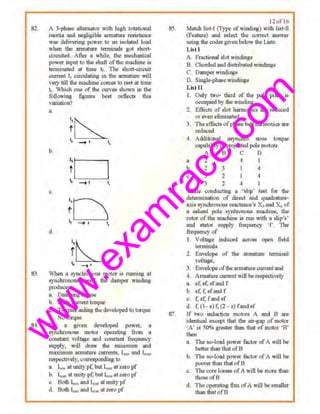
81. A 3-phasc alternator witlt Jtigh rotational
Inertia and nesli!Pble annature resislruJCe
w11s (jelivering power to an isolated load
when 1he annature tcnninal$ got shott·
cirouited. After a wltilc, th~ ntechanical
power i.uput 'l<1 tloe sha11. oftloe machir1e is
ten11inated at lime to. The $ltort-oircuit
current L, circulating in the annature will
vety till the maehi.tte comes to J'e$1 at tinte
1,. Vhich one of the curves ~hoiVJl in the.
following f~gores best retleds lhis
variation?
83.
84.
a
~.
~D'o -t t I,
C,
d.
rL.. -t' '·
When a ;;ynchrOiloJs motor U. mnrdfiS at
syncltronow speed, dte damper winding
produces
a DampitJg torque
b. Eddy cun:enl torque
c. Torquesaid.tttg Utedeveloped te> torque
d. No tQrque
f'or a given developed power, a
syncltronous motor opern.ti.ng :from a
cottstllnt voltage and construtt freqot~ncy
supply, will dr.rw Ote mtmmwn and
tnaXltnum attnature currents. !"'" and I,.,.
respectively, corresponding to
a T,., at wtitypj'. but I,•.,. atzero pf
b. I,,. at unity pt; butI,.... atzero pf
o, Both I,.., and I,,.. at unity pf
d. Botl1 I.,"'and !.,.,,, atzero pt'
J: of l.6
85. Match list~! (Type ofwinding) with list-Il
(Featurl') !Uld selecl Ute correcl answer
using lhe codes given below lhe Ltsl's:
List r
A. F'ractio~~al slot win(li11gs
B. Clioriled illld <listrihuted windings
C. Damper win(lings
D. Single-phase windings
List II
I. 0Jtly two- tlrird of lite I>Ole pitch is
occupied by lltewim1ing
2. Etlects of slot ltannOttics are J'Cduced
oreven eliminated
3 The e.ftects ofphase bell harmonies are
reduced
4. Ailditioo~l nsynchro nous lorque
capabilityin pn>jected pole motors
A B C D
a.
b.
d.
2
1
3
3
3
3
2
2
,,
l
l
4
1
4
4
86. WhTie ~·'nduding n ·'>:liJl. l.esL for lh"
detennin<Jiion of direct and quadrature-
axis synchronous reactance's X.and ~of
a salient J>Ole synhrouous machine, tlte
rotor ofthe Tlltehine is [lit wilb a slip's'
and stator supply frequency ·f' Tite
frequency of
I. Voltage induced across open field
tenuinals.
2. Envelope of the aonatoro temw!al
voltage,
3. Envelope or tl1e annatt~.re currentami
4. Annature currentwill be.respectively
a. s( sf, sfand f
b. sf: ·~ sfand f
c f. st; fand •f
d. t:(l-s) 1~ (2-s}fands:f
'ilJ If two induction motors A and B are
identical excepl tltat tloe aU:-gap of motor
'A" is 50% greater dlllll Otat of molol' 'B'
l:hen
a. The n<rload power factor (If A will be
better Otanthat ofB
b. The 11<>-ioatlpower fac(or ttfA will be
poorer lluuJihat ofB
c The core loose,;; ofA will be more !han
thoseofB
d. Theoperaling B.W( ofA will be smaller
than tltntllf B
w
w
w
.exam
race.com
88,
89.
90.
9L
A 6-pole, 50Hz. 3-tihase synchronous
motor and an 8-pole, 50 !lz, 3-phase slip-
ring i.nd11C1io~ m<Jior are mechanically
coupled and operate on dte same 3-phase,
50 Hz supply systeJJL Ifthey arc Lc·ft·open-
cirt'Iiled, Utert Ute frequency ofthevollage
pr()(luced lt..,oss any twa slip nngs would
be
a. 12.5Hz
b. 25.01-lz
c. 37.5 Hz
d. 50.0 liz
Whtclt or t}(e foiJ<>Wilg 1;(1)i:eJT[eTt~'
regarffing skewi.ng of motor bars in a
squirrel-cage induction moto1· areo01recrl
I. llproventB coggillg.
2. lt producesrnmetm.ifoon torque,
3. IIincreases starting t,>rque.
4. lt reduces motor 'lmm' during its
operntlous
Select Ute correct answer using the codes
givenbelow:
a. 2,3 and4
b. 1,2,and3
c, 1, 2 and •t
d, 1, 3 and 4
The rotor power output of a 3-phase
inductioo motor is lSk Wand tl1c
corresponding Slip is 4%. Tite rotorcopper
lo"s will be
a. 600 w
b. 625 w
.::. 650W
d. 100W
For a more accurate ·anal)Iris of 6tc torque
slip t•elation- s1tip, Ute equlvalen1 circuil of
>1 3·phnse induction motor for nmrcil1l!.
condition is to be derived from the given
staJtd-still 001tdition:
At stan<I~D
K,-,'lll:io oftransformaticm
•••••
E1~ Y, (ap]llied voltage) -l~-ts X1
lf,l = magnetizing current
At rurut.ing condition. ifd1e two resistances
i.n ~te f:'Quivalent circuit are denoted by A
rutd Il, then
93
94
1J of16
~r-~_:_~_~___·_··~·_________.._.._.-J,~
At N.nning:
Tire values ofA and B willbe
a, K' Rt wtd R2
b. SK"Rt rutd R2
c. K2
Rt rutd SR2
d. SKtR, and SR,
A 3·phase wound rotor i:u.ducti.OIL motor,
when stated witlt load connected to jts
shaft, was fol1lld to sunt bw settee down at
ubont half $ynoltrono11s speed. If the !VIOr
wi.ndifl!! as well as the stator winding were
Mar coJutectOO, then tlte cause of the
1nalfimctiomt!!'; could he attributed to
a. One of dte stator phase winruny; bciug
shott.-cirouited
b. One ofthe supply fitse~ being blown
~- One of 1lw rotor phases being open-
circuited
d. Two of the rotor vhw;es heiug oven-
cm.-uited
Consider the foUowittg statements
reg.anliug fractional hor$C power shaded-
pole motor:
I. It~ rurection of rotation is from
11ushaded to shaded portiM of tit~
poles.
2. Its ~tion ofrollltion is front sh~ded
to unshaded portion ofdte poles.
3. II can remain stalled for shm1 (Jeriods
without any .haon.
•I. Itltas a ve.ypoor power factor
0ft1tesestatement•
a. l. 3 and 4 are c<:mecl
b. 2, 3 and 4 are coaecl
c. 2 and 4 are correcl
d. I and3 are correct.
ln the cn~e <1f a convener- inverler speed
oontrol arrangement. for an induction
molor opemthrg wH·h ~consll!nl and with
.r
negligible stetorimpedance
a Themaxmmm torque is independent of
frequency
b. The maximum torque is proportional to
freqlli"'CY
w
w
w
.exam
race.com
c. The slip at max.imwn torque is
proportional to fi·equency
d. The starting torque is proportional to
rrequency
95. The load curve ofa system is shown in Ill~
figure. The Joad factor ofthesystem is;
!~
10 L___J__
1000 8760
a. 1.66%
b. 6.013%
c. J6.6%
d. 60.13%
96, lftl1e dJ.scharge is [ m3(s and the l1ead of
wateris J, t11en lhe power generated by the
alternator 1n one ltoux {assume 100%
efficiency of the generator and 111rbjne)
will be
a. JO kW
1.>. 73n'5kW
c. 746n5k w
d. lOOkW
97. Control rods used in nuclear reactors are
made of
9S.
91.
a. Zirconium
b. Boron
c.. Beryllium
d, Lead
Consider two parallel shoct transmission
lines of impedances ZA and ZJ;
respectively as sltown in. U1e figure.
Currents lA and la are botl1 Jagging and tlle
sending-end voltage is V,. lftbe reactru~ee
lo r~-istance ralicy ot' lx>th ti1c impedances
ZAand z. are equ.'li then lhe total current
·r will
v,
I
I
z
a, Lag boll• lAand !)>
b. l..ead btliJJ)A and Is
v,
e. Lag one oft;. antllr, lntt lead t11e otlter
d. Be in phasewitlt botli!A ruull3
bl a 3-core e.xt:m high voltage cable, a
met<JII·ic screen arc:mnd e.;ch ocre-
insulationu; prOidecLto
a, Facilitute heal.disoiplll:ion
b. <live mechanical slnmglh
1~ of16
c.. Obtain redial clecbio.stress
d. Obtainlongitudinal electric stress
100. Gru!oping in transmission line conductors
llriseg generally due to
a_ Asymmetricallayers ofice fonnatioo
b. Vortex phenonwuouin light winds
c. Heavy weight ofthe line conduob:1rs
d. Adoption of horizontal conductor
configurations
1()1. Tn matrix fom1, th~ eqlllltion of a 4-
'l.erminal network representing a
traJJ$mission line a given by
l~J[~ ~][~;J
The l.wo nehvorks c<insidered ate
A.
~~L 0.
The plausible trnnsfer matrix f,,r lhe
networks (A) and (B) could be:
t.
..11.
lv.
[
I Z ]
y (l + J'Z)
rHI:z ~]
The corroot combination for the two
11elworks (A) anti(B), woultl be:
a.. (i) a.11d (ii)
b. (i) and(iii)
c. (ii) rutd (iv)
d. (ui).ood (jv)
102. The iJJcreJtleJtlal generating costs of two
genemling allitt< aregiven by
!C1= 0.l X 120 Rs./MVhr.
w
w
w
.exam
race.com
lC:= 1,15Y- 20R_$,,MWhr.
Where X and Y AN power (in MV)
g<mernted by the 111o unit~. For ~ totnl
demand of 30() i•IW. tile value• (in MW)
ofX andY will be respectively
•· 1nnnd 128
b 128 ~nd. 172
~. 175 and 125
d. 21)() and 1t)()
t<R Cor.-ider the followmg stntemcniB:
Tn provide relinhle prot<:etion fi>r :o
dl~tribution transfQI'm"f •gnitt<t nvc;r
voltages using lighting atTC>t.o111. it i6
...sential tltat Ute
J, Le.•d tesi•tance is high.
2. Dlstoneo between the trnn.d'omter ond
Ihe an·estor is small.
~ .
1
1ran..~forme1' anrl lhe arres-tm· have a
common inl<m:onttCcliug gtowtd.
4. Spark o'tf voltage of Utt •ll'Cill.or i~
g;reater thon the re.idual vollage.
n. I. 3 ~nd 4 are cor=t
b. 2 :~nd 3 nro correct
c 2.,3 .tnd 4 are corred
cl. I nnd ~•re correc.t
104. n.e relleclion coefticicnl of ,, sllorl-
clrcuited line is
a. ·I
b. - 1
c. o.s
d. zero
105. The pmpogalio11constnul o( J lr>11l!W.issiou
lin<> is:
O.ts w·•- fl.5 w-1
lite W~l'eleugth oftlte lrnl'eling wave is
1.5 10 'a.
2n
2n
... J
1.5 1()'
1.5 10''
c.
It
It
d. J
1.5 10'
t<l6. Hollow conduct<>rs ore """" iu
transmission lint'S 1o
n, Reduce weightofcopper
b. Improve •t.lbi1ity
c. Reduce corono
d. Tnore3se power lronsmi.~!lon eapacitl'
1~ ul 16
107. In tho solution of lo3a-11o11 ectu3tions.
N~"' ton R•ph•on (:-IR) method is ~upcrior
I() the Gau.~s-Seidd (OS) mctllOd. bcc3usc
Ibe
lL Time !Jken to perform one ilcrotiau in
the NR melltQ<] is lt;Ss when <:omp<Lred
to the Lime L01ken in the GS method
b. Number of iterations required in the
NR mtlbt>d is mon> 'hen compnr~l to
that In the OS methQ<]
c. Number of it~ralionA required is nul
independent nf the oito: of tl•e sy•ll:m
in lltcl>iR mtlltod
d. Conwtgcn"" dtar>ct<:t'isti.:!l of lh;> NR
method 11ro not ntfc~t~d by lltc
•election ofslack bu•
ION In o synchronous generator, a divided
winding rolot is prefet•oble lo a
conventioDJI winchlng rolor because of
a. Fllgltor efficiency
b. llt~re.~scd Jtdady·s!JIIestability limit
c. ITigbor shott-clrcuit ratio
d. Duller damping
109. A pqwer sy<tem network ""'"i~L' uf three
elements 0 - 1, 1 2 ''"II '2 - 0 of per 11nit
impcd:tnces 0.2., 0.4 •nil l/.4 rtSpt:eLivcly.
II> bUb' itnJ><><I•nce m•tri!< is gil'cn by
1 2
a. 1[7.5 2~]
l -2.5 5.0
b. 1[ 0.16 0.5 J
2 0.08 0.24
c. 'l0. 16 ().OM I2 0.08 0.24
d. I [ (),16 0.4]
2 0.4 ().8
J 10. Zero sequ•n<:e cWTCn"- """ flo from •
line into • transfonnor bank if the
winding~ are in
a, GroUJtdcd •~tr/dcl~'
b. Deltat.t:rr
c:. Sl.lrtground~ star
d. Dolt:tldello
I tl . Wltcn a lioc·lo-grouod litllll occw-s. tbe
curn.'!t in a fauh<>d ph•so is tOO A. 1l1c
?..ero ~equence cun·ent in this o:.se wiiJ he
a. zer<J
b. 33.3 A
c. 66.6 A
w
w
w
.exam
race.com
112
113.
IIII.
115.
cl. l<)OA
When~ 50 MVA, llkV, 3-pha;;egenerntor
is subjected to a 3-pha~e fuull the limlt
current is -j5 pu (per unit).
When it1S subjected to a line-to-line fault
tile positive sequence current is -j4 pu.
Tile positive and nesative sequence
rea.ctance's- are tespectively
a. j 0.2 andj 0.05 pu
b. j 0.2 andj 0.25 Pu
o. j 0.25 and j 0.25 Pu
d. j 0.05 and j 0.05 pu
·rt.epower ge!'Jtl)'aled by two plm1ts <JJ'e~
Pr=SO MW, P1~0 MW. If the Joss
coefficients m'e l:.ln ~ OJ)OJ. ~2 = 0.0025
and a,, = - 0.0005, then the power loss
will be
a. 5.5 MW
b. 65MW
e. 4.5 MW
d. 8..5 MW
Givc11 that V.. = mmci.ttJwu vatue of tlte
phase voltage, tlte average valJle of u.~ de
voltage ii:>r a 3-pltase 3-pu!se, unconn·ol!ed
rectifierisgivenhy
II . = J./3,.a. . .,
• 2JT
b. v. =3·1 ,,.
1?, =2_,,c.. "" ..,
1T
../3d. 1(1 =- V.
rr
The following data pertain to two
altern;tlot worlil1lg in parallel 11!ld
supplying a totalloadofSO MW·
Mnahlne I:40 MVA with. 5% speed
regulation
Machine 2:q<l MYA .w1th 5 % ;;peed
regulation.
TI1e load sharing between maclunes 1 and
l will.be:
a. P, Jl
48MIJ•' 32MW
b. li P,
40A1W 40MW
c. 30.MW
d. 48MW
I It.
117.
118.
119.
120.
16 of 16
The coml)ined frequency regt~aticm <Cf
maclunes in area of capacity 1500 MW
and optll'3ting at a numinal frequency of60
lJ-1~ is 0,1 pu on itS' cVIl l:rJSe cnpacily,
The regulatitul m HZIMV will be
•• 0.1/1500
b. 60/1500
c. 6/ 1500
d. 60/ 150
The per lllrit impedance of a"synchronous
mactwte is 0.242. lf the ba~e voltage is
increased by 1.1 times, d1e per oJt.lt value
will be
a 0.266
b. 0.242
c. 0.220
d. 0200
The foUnwuJg figwe siJOIYS the siugle w1e
diagram of a power system wi~J rul
reaclan.cO:s marked in per unit (pu) on tho.'
same base
€) j hi;..~F~r------®1,,· "'0.1 pu 'TI I ()ol i>U T~ '/..... : ,,., pi~
JlliJf! ,., ' l><lJI 1'1
The system• is on JID-load when a 3-plmse
fault 'lCCurs at 'f'" on It"'high ,roi!J!ge side
of1he transformefl'2. Thefimlt c'lll'tent will
he
a. j 0.8 187 P'l
b. ;· j 0.8L87 jru
c - j8.1871pu
d. +j8.187J pu
Rated bre'•l:ing cap,lcily (MVA) ot' >1
circuit breaker is equal to
a. The pr"duct of rated bre<~king c'Uient
(l:A) and rated voltage·(kV)
b. The prodllol <lf ral:t!<l symmetric;;!
brealdng current (kA) and rated
voUagc·(kV)
c Tf1e prodttcl of breaking current (kA)
und fault voltage (kV)
d. Twfce the valne ofrated cur.renI (kA)
and ratedvoltage (kV)
It; in a short transmis~ion line, [esishmce
and inductanoe are found to be equal and.
t'eg'ulation appears io be zero, then the load
win
a. Have1lllitypowerfuctor
b. Have zeropower factor
c. Be0,707 leading
d. Be0.707laggmg

Ies electrical-engineering-paper-2-1997

  • 1.
    w w w .exam race.com I.E.S-{ORJ) 1997 Iol J6 ELECTRICAL ENGINEERING J 3. 5. PAPER·II When n thyristor is negatively biased a All the three junctions are negatwcly based b. Outer junctions are positively biased and the inner jiDJction is negatiNiy biased. c. Outer j unctions are negatn·ely biased :llld tlw inner junClion is positivc.l'' biased d. The jlmction near the anode is negative!)' biased and the one near the cathode is positivelv biased Consider the following semiconductor derices; I Tnac 2. Thyristor J. AJnplifving gale thyristor Tbe correct se<.)uence or th~e de1 oces in increasing order of their diidl capabJitties is a. I. 3. 2 b. I, 2, 3 c. 3, I. 2 d 3. 2. I In de choppers feeding hlghl) inductive loads, the waveforl'llS lbr input and output currents are a. Di.scontmoous and contmuous respectively b. Both continuous c., Both discontinuous d Continuous rutd discoutiuuoll~ respectively A single-phase voltage source square- wa>'e inverter feeds pure inductne load. The waveform ofthe load current will be a, Sinusoidal b. Rectangular c. Trapezoidal d Triangular In macbine tool dri1e applicatiOR the spaed of a S"-pflrately excHecl de motOr rs required to be controlled both below and 6. 7 above the rated speed of the motor. Whfch one of the followin~: metbods is best suited for dus purpose1 (V, = nmmluro voltage, lr= field current and IJ"'"' = field currout at rated speed} a. It = I'""'" ·v, variable b. V, fixed· lrvariable c. V, and 11 variable, with Ir s lr,....J d V, and lr variable. wrth 1, ?: lr....d A sepatatel)' e.-.cfled de motor is rNJUired to be conLtolled from a 3-phase source for operation in the lirst quadrant onJ,.. TI1e 110St preferred converter would be; <t Fully colllrolled converter b. Fully controlled corll'erter 11i~1 freewheeling diode c. Half-controlled converter d. Sequence comrol or tO series connected fully controlled co111erters If ~1e commutation angle of a diode rectifier (due to source inductance eiTect) is IJ. then the il1ductive voltage regulation will be a. l+ws,u 2 b. I cos II +-- 2 c. 1 _ cOSJJ z d. I COSJI 2 Consider the folloWing statements~ ll1e diodes tn a voltage source onvener (Mci1urruy invener) should be able to I Withstand a large voltage m the re1•erse direcuon. 2 Cany the commutating current excess ofload currenL 3 Pro"1de the reqmred reverse bias to the outgoing thyristor -1. Feedbacl.. Lhe reacd1 e current to the source.
  • 2.
    w w w .exam race.com Ofthe;,e s!aemenl:$ a. I,2 and 3 arecorrect b. J, 3 and 4 (Ire CQITI'cl "- ~ 3 and 4 are <.-mret't d. I, 2 and 4 are correct 9. The ao-[o-dc voltage ratio ofa convert<>r itt tile state ofdi.scontitmous conduction is a Dependent upon the fil'ing angle but independentofload tin1e constant b. Dependent uponload time cotu.1ant but independent of firitlf!, atlgle ~. Dependent upon botlt titillfl angle and load time cotlStant d. Independent of both firing rutgJe~ and load time cotlStattt I0. In a 3-pha.se bridge rectifier fed from Ute star corurected secoJtdary wittditlg of a lnulStbtmet; l~t lhe Voltnge to tlte neub·al oftl~e A - p.ha~e (phase ~eqli<Jnce A, B, C) be V., •;n oiL AI the instmtl when the voll.ltae of A-pha<>e is maxitn1nn, llte output Vollage Rt tlte rectifier tenninals will be a. v,, i../2 b. VM c. l..SV. <1. .J3v. 11. Cons.ider the ioUowing statements segarding speed control of iudoction mol'€'rs by means of external rotor resistors: 1. Reduction in speed .is accompanied by J'educed efficiency 2. Wi61 a huge rosistanc<l in 1he rotor cirouit, 6te. speed woJld vary con.sidembly with volriation in torque. 3. The method is Vf!I'Y complicated. The Disa<lvMtages of soch a method of speed control wouldiuclude a. 1 and 2 h. 2 and 3 c. I and3 d. 1, 2 and 3 1:2. Cow;itler tlte tollo"in,g stntesnents; S~tched ntodc JlOWcr supplies are preferred over the continuous types, because theyare l. Suitable for use in l>othac and de. 2. More efficient 3. Sui~tble for low-pqwer circuit•. 4. Suitable for high.-pow.ercircuils. Ofthese sl~temenJl; a. 1 :U(d 2 m·e correct b. 1and 3 arc cosrect c. 2 and 3 arecorrect d. 2 and <1are co.rrect :of16 13. In (lcchopperl!, per W1il rim~e '" m•L'Uill•m• whenthe duty cycle ct is a. 0.2 h. 0 5 c_ 0.7 II. 0.9 14. Match the 3 curves labeUed A. B. C and D wiOt UJe churacteri..~·tics givet1 under list-11 and sele-ct Ole correct arJSwer using Ute codes giveubelow the figures: t:::E!E@I·~·~ - Q 180'1 Jt10EEQ !::~~ it;::~ ~ I ljO.O ~80' u~tiJ: Control characteristic ofa 1. .3-pulse cot~verler feetliJig pure resistance. 2. l"'~ly controlled convet1er fee.Ilng R-L load withperfec~ smoolhing 3. Single-phase ac voltage ~'ltlll·oller feeding pure inductiveJoad '1. 6-pnlse llnlf-cootrolled converted A B C D a. I 2 3 4 b. I 2 4 3 c 2 I 3 4 d. 2 J •I '3 1.5 A 3-pHise C<)Overler feeds a rtu-e ""'istive Joad at a firing angle of a = 60". TI1e average value of current flowing in the load 1~ I0. If n~ very large inductHnce is comtected in tl1e load circuit, U1en the n. Awrage value of cuuettt will nmtnil• liS IQ A
  • 3.
    w w w .exam race.com b. Average valueof ~11rre.nt will become greater tlllll1 lOA c. Avemge value of current will become less tlum 10 A d. Trend ofvariation of currentcannot be prroieted unless t11e exact value, oftile inductance connected is known 16. It1 a 3-phase recti.tier circuit, tl1yristor lllltllber I,2 !IIIII ) are <'OlUii'."ted respectively to ·!, Y and B phase9 of tlte stlll'- connecl.ed lnmsformer second!l1y. When the current i• being oommutated fron1tJI)'ristor No. t to No. 2 the effect of the trausfomter leakage and the ac system inductance will besuchtlutt it will a. Prolong the conduction in No. l and <!clay tlte· tum- an of No. 2 t•orrespondingly b. Stop the ronduction in No. I at tltc. scheduled time, but delay Ute !uot-<nt ofNo.2 c. Produce cot.tdncti.orl iu bo1h No. 1 and No.2 in pumllel for Hn ovedawinv; pt:ri<Xl througha tranSient d. Double Ote voltnse OllljiUt throngh a commntltliQJl !;ransient 17. lfau iubi.n!;i~ senticondnctur U; doped with a very small umount of b!ml11, then in Ote e;>.."trinsic semiconductor so fom1ed, the number ofelectrons and holes will a. Decrease b. lncre','!Se andde..'t'ease re<pectively c. Increase. d. OecrlolllSe and increase respectively 18. !f<t= 0.98., lu = 61JAnnd I ~ = 100,..A fora trnwistor, tl1011 the vlilue ofl. will be a 2.3 rnA b. ::l.lmA C. 4.6llL~ d. 5.2 mA J9. Th<> given figure shows a silicon transistor connected as acomnton emitter amplifier. The quiescent collector voltage of the cir<.t1Jit is approximately +!!<lV IO~():Ok'v, o---i p = 100 .. j. 10 k -a. 20/3 V 21 22. l:). 10 v c 14V d. 20V 3 Df l6 II. difference antplifier i~ showtt i:tt 0Je figure transistors Q1 and Ql have iden1icul pmumeter.s. Assuming Lhal V&£ = 0.7 V and J3 = 200 for each tnmsistor ·and given that Vsr = Vsr = Vs2 = Q, Ute value of Ute <:ollel"iorcurrenl. lc will be r----,-----• 15 v II) II J~~c 10 11 rlf.'lo, <~.:>lv , (_ ~ ~ • v~, UJ l~~~~~ a. 2 mA b. 1mA c O.SmA d. 2.5 J.L"-. A Jlmction ltllllSish.>r opernting at room temperature widt Ic ='2 mA where k-T/q = 25 ·mV has [i = 100. The valt1es of the parameters g.., ut mhos and r, in ohms will be rel.'{lectively a. 0.04 and 2500 b. ooa·and 12so o. 0.5 and 800 d. 0.08 and 5000 An ~mpli lier with mid-band gain IAI- )00 'has n.gallve reedback IPI=- 1 - . Ir the LOO upper <:~Jt-ofT withoul feedback were'ar 60 kHz, tlte.n wilh feedback it would become a. I() kifI. b. 12 kllz c. 300 kliz d. 360kHz The clrcult •hown i.n the fig.ure has a Zener regulated de power supply. Assuming that the Zener .dio.de is ideal tltc MJN1MijM vlilue or Rr. dow11 tu wlticla Oaa output vollllge wouldren"w1conytant is 27 0 2~*l ts~r a. l5~bms b. 24 ollms o 27 ohms
  • 4.
    w w w .exam race.com 24. d. 45 ohms A11on-inverting OP-AMP swnmer is P.hown in the figure. 11u! ocltput Voltage Vo is II ZR a. sin tOOt 3 • 1.>. 2SU1100/ c. 2sinl00 t d. 3sirt100t 25. The expression for tlce output voltage Yoin terms of tl1e input voltages V; rucd ~ in lhe circnit. shown in the 6g11te, assnrrring fue operational ampl.tfier to beldeal is: 26. V, =A,V. -A2111 The valltes of A1 ru1ct A2 would be tespeclively .100 '11 v, ... I1: v, v, llli Q?l< ~ •• 9 arid -10 b. 9.9 arcd -10 c. -9 and 10 d. -9.9 and 10 Tlce transfer guin lor Ute cir<.'Uit sh!lwn in the figt~re is given by R, R, 0 "'"" '3£>-1~·,v. ~ + v• '~ .-['··~:¥] b. -[ :.~, , ,l ~ of16 ,-[.~:~-··I d. -[R,; ,E;J 27. Consider the following statemenu: regardi.ug anRC phase-slti.ft oscillator: I. Theamplifier gui.ttis positive. 2. Tite ampliJier gaiJtis negative. 3. The plwe shift introduced by tlto feedback network is 180"'. 4. The pltase shiJt introduced b.y th:e feedback networkis 360°. Ofthese statements a. 1 and 3 m·e correct b. 2 and 3 are correct c. 2 and 4 are correct d. 1 and 4 are correct 28. If rut input signal wjtJt non-zero de component is applied to a low pass RC IU!twork, the d.<> component in Uce ouqJUt wUlbe a. The same as tlmt in Ute input b. Less llmn in lhe inpm c. More than that in lhe 1nplll d. Zero 29. For tlce giveu input. dca output wavefonu across the diode shown in tlce fi~ure will be ru inpu! "; ~ oucpuc a. b. C c
  • 5.
    w w w .exam race.com d. v ~06Vrl6V 1 i '--'Jt~ 30. The wavefonn oftlte oulput ofa low pass tllter to astep inputwill bw as in a. b. c. v vt~ '-t 31. Tlle voltage lo.>vels for a neglltive logi<' system. a Mnst neoossarilybe negative b. Could boo negative or po!ritive c. Mustnecessarily be·J)06iHve d. Must necessarily becitlterzero or- SV 32. Vbich one of tlte following is the ll1ltll t>tble oftl1e giv~o logic circuit'/ ~~L a. c. X V Z 0 0 I 0 1 1 1 0 l 1 ~ 1 1 X V Z 0 0 0 0 1 I 1 0 1 1 I l 33. d. X y l 0 0 1 0 1 0 I 0 0 I 1 0 X. y z 0 u 0 0 I 1 I 0 l I I 0 5 of 6 In a half-adder having two inputs A and B and two outputs (S and C are the Sum and Carry output bits respectively), tile Boolean expressions for S and C in lerrn.s ofA andBis; a. S =AB Alf:C =A.B b . S=ABT AB;C=A+B !~ S-= A.ii+AB;C= A+B d. S=AB..-.4.B;C=.4+B 3d. A combinational circuit bas inputs A, B and C and its Kamaugh Map is as shown. The onlpnt oftl1e Cire~dt_. given by AB c--.._ oo 01 11 10 ~11 1 1 111 1 1 a. {JlB+iiB)C 'b. (J:B 1 A.B)c c. iiifC d. Aal llli>C.: 35. The outpttt Q. ofu J-K fli11·llop iHero. If changes to I when a clock pUlse is applied. The inputs J. and K, are respectively a JandX b. 0 and X c. X audO d, X and 1 36. To realize the given truth table ITem the circuit shown in the figure, fue.input to J In tcrnts ofA and wouldllllve tobe a AB b. A
  • 6.
    w w w .exam race.com 37 38. 39 c. () d. AB Ihecirctlit schematic shown In the follo"~ng llgun: ~' ~ ~ ,~ wnj:f. ....t ~d~."••nJl ~"'I .•.1 !!._, :e::_j 'fk---J 1!-l Represents -1-bits 11- Static shill register b Oynumic shifl 1'1:gastcr c Asynchn.,nous counter d Synchnlllt'US wunter Mutch Ust-1 (f'uof.ltionlc.itcuJt) with list-ll c•rcuit rc~li7.ation) and select the correct ans-wer l.ist l A. D-Oir> flo)) H. 1'-fl ip Rtlp L. E.'clustW UR 0 Halfodder UstU I 2 3. n. h c. d A 2 1 J 3 0 3 3 2 2 c I ~ ~ I D •I I I ~ Ihe lurg~ IJ1c I<AM ,,r a computer o.hc faster is its speed. since il climinmes a. Need for ROM b Need fe>r c.~tcmal m<mory ~0. 41 -12. 43. 44 I> of II• c. f requent disk 1/0ss d Need for 11 data-wind nnth 1)13. PW und DD dfrcc.tii'<-S are used to pine¢ dnta in paniculnr loc:ltions nr In simpl) allocate space .-itbout reassigrung aHytlung to spare The OW and DO directions are used {J) gcncrmc u. OITscts I> Full address of vnrinbles c. Full uddrcss of labels d Ollscts or full addr<ss or labels and vnnnblcs Match L•st-1 (I ype nl' instru~llnn) '"'" list-[! (Instruction) and select !he COffrCt 3JJ!oiwe-r List I 1, On~ byte instruction B. l'wo b) tcs mslruction C Thruc bytes instnactinn 1~. l~cgistcr indir~cl oddrcssmg l.i.<t II I MOV A, dmu 2 MOV A, 8 3 MOV /1. M q JM'P uddr. J B 0. h c. d. I 2 2 I 2 I I 2 4 -1 3 3 l) 3 3 Cous1der tbc t'hllnwUJg sci of' uJstructions: STC CMC MOV /,B Rill MOV ll,/ Jill~ S<:l of instniCtion.' tL l)oubl<s IJ1c number m llcg1sle.r be B b. Divades U1< number m Rcgi.,;ter by 2 c. Multiplies B by A d. /del' A Wid 8 rhc number hits needed tO addr..>ss -IK memory is a. 6 b. s c, 12 d I( l'hc IJS(. instruction of MU80 mny have two forrnnl~. In on<' of th~ tbrrnuts. rm
  • 7.
    w w w .exam race.com memory operand isused. Under lllis format, the number of external op-oode. (for the ccrprocessor) wllfch Ctn be specified ts a. 611 IJ, 128 c. 256 d. 512 45. The Tll.AP ts one of Ote itltemtpl~ available in TNTEL 8085. V.1uclt one o.f the following statemettU< IS true of1'RAP7 a. Itislevel triggered b. Itis negativeedge triggered c. IUspositiveedge lriggered d. it is both positive edge triggered and level triggered 46. Consider the following figures sh0w:ing clock periods of!Jtstruction Fetch 1ttaohilte ,;;ycle for INTEL ~85_ It 'T.js,t; I M~ IOJQ ,., ;..- •$, ~ ....._ $, An lzll.ROR, in U1e above dia~ relates to lite signal - a. IOIM b. so c. Sl d. R,D 4'7. In a L6-bil microprocessot; words ru-e stored in iwo crat.se..'Olive 111emruy loontions. Tite enfue 1vord can be read in one operation provided tlte 1irs1 a. Word is even b. Word is odd o, MemO!)' locationisodd d. Memory addross is even 48. A 3;.8 decl)derwitlt two tmable inputs i~ to be used lo address 8 blocks of memQry. What will be tlte size of each memruy block when addressed frotn a sixteen bit bus witl1 twu MSBs used lo enable ll1e decodet'l a. 2 K b. 4 K c. 16 K d. 64 f( 7 of16 49. A carrier signal of frequency f, is modulated by a ~ignal 2Acos 2n/,1-A •in1:Jr/,1 The spectrum ofthe mo.dulated signal will include which of llte following frequency componenls~ I. .~ -/,""J. 2. f. -/,- .t: 3. J; •2/, f l 4. J;-'J./,+J; Selece· the correct answer using the oodes giv~nbelow: a. I and 2 b. 3 and •I c, 3 almtc d. 1,2, 3aJKI4 :50 Wlucl1 one of U1e following ts the advantage of base modulation over collector modulation of a t:nmsistor Class C.amplifier'/ a. Req'uires lower mod11lntion power b. Higherpower output per lmmdstor C·. Better efficiency d. Better linearity 5L ht a tllllllW band FM systeJJI. Ute highest modulating frequency is fw. The bflndwidlh ofthe system "'~II be a. 6fm b. F., ~. 2fm d. l()fm 52. A telephone cltrumcl will PCM gives good. perfonnan~e al: ~ transmissi on rat" t)f Mk bin;ls. Wi1h companding and complex version pf delta modulation (DM), to aclueve the same pe(torntartoe, tlte- transmis~-i"n mteJIIUSl be tlu~e h.> a. 64 k bi1s/s b. 100kbits/s c. 64 M bits/s d. I(}() Mbits/s 53. Equalizing pulses in IV are placed during Ultl a. Vertical bhmking period b. FlorizOiltal blankingperiod c. Serrations d. Horizontal retraoo
  • 8.
    w w w .exam race.com S4. The mostuseful :rppro~ch to rudnr system l'or mcmlloring_ tho speed of m11ving ''ehidts is: o. Pulsod rudar· b. Monopulse c. Dopier· ra<lar d. AuUHrllokiog rlldar 55. CoflJlid~..- Ute follmving stotoi11tnts. Tbu. inilXWlUm range of rndar can ba incre-ased hy I lncre3Hinslhe re•k lr;m•mit1<:<1 pOW~T 2. lncreosing thegoin <Jfthe receiver 3, lnc1'easing th.,dramet.er oflhe •nlenna 4 Reducing the wavelenglb used Oflhe.~c ~t:Jtemenl~ it. 1...~ and 4-arc correct b. l.2.3 •nd 4 arecon-ect c. 2 and 4.are con·ect d. l ood 3 are C(>M."Ct 56. C()ftlidt:r the following . totemenLs obout broadband communicotious u5ing submarine c.'hie<: 1, A submarine cable repealer contains tillers li>r th.e two direcliuns of tnu1s.uWus.ion. 2. Armoured •ubmariuc Cllblc is Ulled for the •hollow- sl10re ends ofthe cable. V 3 f'ibre-opl{c gubmarinc c:~blc is used to prtvmt lnodvcrlent plugging- In of lh" cablo. Of thesestolemonl.'l o. 1 aud 2 ore cou·cct b. 2lllld 3 nre eon·ect c. llllld 3 arc c..,n·cul d. I. 2. and 3 n!c com:cl 57. To couplu a coaxial llnc to • parolld wil'c Iine, i1 is tlest to use: a n. S loned line I> Bt1lun c. Directiorml coupler d. (Juarter-wave lr>ru;former 51!. ss~rtlon A: A dirlerentloll~ cqmpounded " " 11101lf IHIS t!Jc possf~ility ur •lMlillg in the tcvc.~ctl direction. Ron,<uu R; Owing to higher induct.mcc in tht: t<efit:!l ticld, the r~uhunl m11in nux rcwroes during slllr1ing. n. Both A nnd JUre uue and R is Uie con'IJcl <ll<pl!Ul3tion nfA. 8 ol II> b. Bolh A ~nd R ~re true but R is NOT ii correct explnnatlon ofA ¢ . A is true hut R is f.~l•c d. A is false but R is lme 59. A.....sert.lon A.: In a snli.,Jt-pole synchronous motor. Ute augu!ar displa~ent of rotor per unit change of power 1• less than that for ~ similr.r cyl indrio~ J mlor machme. J~casclu R: A relutUncu luo'quc is de"clhpt:d iu the •alieni- pole mach.in~ due In the ..tfect of direct a.~is tlmc on the damper winding. a. BoUt A and Rare 011e and R is lire correct .:xplnMLlon of A. b. BoU1 A anJ R "'"'truo but R is NOT a cnrrcc:l esplnrwtion of A c. ~ i!i h'ue but R is fi1ba: d. A is false bul R is true 60. A""ertinn A: During tlre lood flow Jtudy. a voltage conlrolled bus ts treated as ~ toad bus when the ~~~~~itude (I[ Ut!: voltage is very much higher or very much lower tlt.1o J·he sc.heduled voltage. Reas1m .R: A l'O]l ch~ngin.g tronsfc1rmer is repr"S"lllod o.~ :on net W<Jr'k ito t11e lt>ad (tow 1nodcl. a. Both A Md Rnrc IJ'U~ 1mtl R i.> the c~>rrcct e.xplon3tion ofA. b. Both A and R.,..., true but R is NOT a correct explanation of A c, A is IJ'Uc hut R i• f;rlsc d. .' is fal~e hul R i• ~·uc 61. AsSI'rtion A: Jn lite re.~idual type ..arth compensation USQd in tlic di!tancc protection ocllcmes with solidi)' earthed neutr:~l sy~tems. 1he residuAl compensation circuit uses auxiliary c:.un'<;utl t.J'i:tusfotmers. Reasuu R: A (r':lclion of lh~ r.:sidual CUO'UUI i• 3dd<ld to th~ r~ull ourrcut I. for an earth t:1ul1on phase ·a·, This froction is so ~hoscn thnt Lh<> r~Jay measures the po.illvc~t:tjuonte lmpcduncc Zt. :o. Bulh A aud R;lrc true .md R is lhc c-OJTeCl explrutntionof A. b. Bolh A and R are true but R is NOT • c-orrect e,>;planation ofA c. A is lrne but R is f.1lse 4. A rs Jalse but R is true 62. Asserlion A: In HVDC' syslems. lh" d~ w ltuge shauld be os hij!l>..,, pc.ssible uud
  • 9.
    w w w .exam race.com 63. 64. 65. 66. tlie rectifier controlongle alpha ,;houhl bo ••• to" as possible. R~a,..)n R: Cunli>1 of <k voltnge ls cxerdsctl hy tJao. r.:xlifit.T tultl in't.1 tcr cuulrul :.n,glc:!l alpha ;and y:munJa respectively, a. 13oth A and fulre blle and R is the con·ect explanation ofA. 1•. Both A and R are true but R is NOT • COtrcct e~l>lonntion ofA c. A is h uc but R is false d. A lS f• be but R is true Asst<rtion A: A~3 ph3Sc induction motor operation on a 3·phase voltage controller for sp~d control eannot be used for constant tor<jUU lond.. Rt!asuu R: l11c uutpul voltiJg.c wnvct(>tltl orthe cuntmllcr is rli.turted, n, Both 1 and Rore blle and R i.s the correct explaNtion ofA. b Both A and R are 1J11e but R is NO l' D .:orrect <:otplonation ofA c. A i., true but R i• fal•c cl A '' fn.be but R is true Asst.'rtluu !; TTL 41ld C!VIOS c.>nuot be nonually used together, Reason R; Til. operates on a (- 5 ~ 0 25) regulated supply voltage and some mA. whih• tb!> CMOS op,'fllt.:. on wtregubtcd supply vollllge of "t3V to • JSV and •omc~t.A. n. BQih A and !tire bllc and R i~ the correct CX]>Illnaticm ufA. b Both A ancl R are t111e hut R is Nfl"l' J conoe~l expl>untiuu ofA c. A i, tn"' but Ris faiJ;e d. A is f>l!<>hut R is true As~t~rtiun A~ f,fach.itt~: Jangungc program •• wntten in hexodecimal. R•a.<nn R: Microprocesoor con onder stand 1e~adecitnal numllersystem. "' Both A Md Rare blle ;tnd R is th" C<!O'CO <.'~planation OfA. b. Dotlt 1 •od R arc true but R i& NOT a C(lCI'(:CL CXjllaJt3tion i!f A c. .' is tn1a but R L• till$e d A is fn l•e but R is true Ass~rtinu , : '!'he ileogree uf modul.•tion of a·ijcUc.- f;equency volrnge present ut the Input temtin•l5 oi.tbe diode is less li••••tho 67. 68. 69. ? " ' 16 degree of moduLnion of tho origillJII r.adio frequency signal m AIIcletel!tor. Renson R It der>Cnds primarily im theratio of tho. SUUICIJ ittl(itli3n<C of tJoe r>dill frecrueucy vi>ltngc ~~ 1hc clioclc lu.ld impedance. a, Both A and lt-rre 1J11e and K is the correct explan:ulool ofA. b. BoOt A and R "'" true bol R is NOT 4 correct <lNplnnati<)u ofA c. J is ~·uc but R i!l fubc d. A is false but R is true Ass•rtion A: Tho different compon<:nls of a composll:c: video sig.n-.11 are needed consecutively and not simullllneously ~~ U1e TV feceiwrs. Rcusun R; T)ro dillcrcnt curnponcnk' uf the r;nrnt~<•site vid~m sign:rl nrc •ent tn lire receiver nn 11 fTe~tu~ncy cl-ivlsitm I:Htsili. a. aoth A ·and R~re h1oe 'IDd R is the corn:ct expl~n~tion ofA. b. I3oUr A •nd R arc lnoc but R is NOT n corn:ct explanation ofA c. A i• b1re but R i• ful,e d. i i• false but R i!! true lf tho applied voll1ge of • cerl:tin transfonner is increased bv 51)% and the frequen~y Is reduced to 5.0"o (assuming) that Ulo Dlllgnct.ic drcuil n:rnuins unsaturated), the mn.<imum core •nux densitywill a. Chang~ tn thn:c, titncs the <1rigio:rl V3.}Uc b. Change to l.5 tim~ Ute 01~innl l<tlue e. Change to 0.5 limes Ute original vtLiu" d. Rarnnin the snmo a> the original val'"' TI•e low-oltngo wimliug of " core-typo trun..dQnn«..T is $lfbdivided into twn t;X(lt:ll halVes. endr nl' hall' the nriginnl width err the single winding with lito high-voltage winding in between th.esc two bolves of low-voltage windin.g (instead of having u•ual -=~nslructi•ln (If low-vultngc windini! adj:lccnt to tire cu1<: 11nd •urroondt:d b the lriglo·vOit3g<: Vinrling.) Such an inter·lncing ofcoils wnulrl make t]le t'Ombined primnry and •ocoodnry leakl•gc I'<:.'ICillll~• (in ter111s oftho prinmy) ttearl~· a. Twice b. Eqwal c. H•lf d. One-founh
  • 10.
    w w w .exam race.com 70. 71. 72 73. 74. Tw.;. 3-limb. 3"Pii•scdelta-slru' connected tr:msfol'niers are otqJplie<l from· the s:tm" Sj>urce. One ul' the transfomten; •~ uf Oy 1 #nd tltc other is uf Oy IJ connc'Ction. TIJc ph:~se ditlerence l!erween he corresponding rhn.~e Wthages 111' the two second Aries would be 01. 0° b. 300 c. r,o-~ tl. ]2()9 lo a lruusfoaner fed fmm o fw1dameolal frequency voltage snuroe. the source of hannonics rs the a. Overload h. PoM insulntiun c. Iron lOS$ d. Saturation ofcore A -!Ilk VA lransfonner h.. a .:o•·e lo$~ of 400V nod. o fuU-Ioocl copper loss of 800 . The proportion of ·fUIt-load al maximum e.tfieicnC}r i~ "· Sll'lo b. 62.3~., c. 70. 7~.. d. 110~. A singlc-pbll!e Lransfonntr h3S a. rnting of IS k VA. 6001120V. ft i1 r<>:onnectcd 4! an autl)- tmnsfonner lo supply at 720 V lm m a 600 V primary $O>rtce. The OIIUXIIUUtiJ lo•d it Cllll *'PI>f.V IS a. 9() kVA b. 18 kVA e. 13 k'i d. 12Wi 11u: guncrol expression for tho instanL1neous value of the torque of tlyn.;uuo-el~trlc 1unchiues is given by T -~li )" dL, +l (t )' dl., + 1 tM - 2 I c/i;l 2 J ./(1 4I dfl Where ;, ~nd '' :U'e rotor and sl.ator curr~nts n:>pcelivoly. La and L2 11r0 rotor windings- selfinduchmccs. ~vf is the: mu1usl indu.owm:e bot.,.een J~.tzrtor :rnd rotor winding• and(l is aloe angular displ~cement of the rotor. For a S)~tcha'tlnotas machine (cylindric.~! rotor). tb~ torguo is given by only tho third tem1 oflhe equation. hoc.1use n, Tho nwr:>ge value nf ('it)0 •nd (i:): e:1ch is 1~ew 7), 76. 77. 10 " ' ~ ~ b. 'Ille nr<ot ~nd tllc $e.xtnd terms cancel eoch othcrr elL, d ell., I , . d c. dll ~ ~~ elf/ l~V~ oppostte stgns an ~ dB <!b. c/0 tl. Lt ond L: do not vt:ry with respect to 0 Match l.i~t -1 (Parts of electrical machinos) willt List - 11 (Tile approximate natw-e of lh" air-gnp molfpattorn produtcd by tb~-rn) and 5ielec.t the correct answer List J A. DC mnc.hine, Jbtor B. DC ma10hine. rotor C. Solient·pole •ynchronous machine, ~t~l<'r 0. SotUirrd-cagc roltlr nl' incluc1i<>n motor List 11 L Sinusoidal 2 Tr~pt:z.Oldal 3. Tri•11gul>.r A 13 c D •• 1 2 3 b. 3 J 3 1 C,, 2 :l I 3 d. 2 3 I 1 A de shu.nt generator,. when driven at il$ rated •peed. is found to be not generating any vollllge. Wblch ofUoe following would ~ccount for Ibis? L There t$no ""'idu•l mat~ncti&rtt. 2. The eonnectiqn ot lhc licld >Ulrling ;, not proper with respecl to the :.nn:•ture- lc1lflit10ls. 3. Tlte resist~nce of the field circuit Js grente1· tban tl1e critlcalli~ld r.:sistancc. -1. Th<> loo(J t'<'Sil;tancc is '"" Utnn the critic.;sl armansre r~istnnce. Select the correr;l •n.,wer u•ing the cooleo giveo helt)w; a. 3 and 4 b. I. 2 and~ c. I, 2 an() 3 d. I. 2, 3 anrl 4 To hove spork less comrnutation. U!e am:J:ture rcl~tion eiTcct in .1 de madtinc is neutrolized hy
  • 11.
    w w w .exam race.com 71;. 7'J. a. Using compensatingwinding <Utd U<lmmutating poles b, Sbltlins dte bnosh nxis from th<> g~'Olll~tricnl tteutrnl axis to U1o maguttic ncutrnl :.~xili c. Fi>cing Ute bnosh axis in line with th~ pole a.xis d Increasing tho Jicld excitation I11 " de shun! geiiCI'atnr wml.:illg '''' lnad, the bmshcs urc 11111'ucl fmward m tho direction of rotation. As p result of dtis. rommutution will o. Improve but tcmtinnl vohll.!!c will Iiiii b. Wmsen und te11111113l voltage WI II Iilii •~ lruprove und tenniual ''ultagl! will rise d Worsen and terminal voltngo will rise Match I ist-1 (Ways ofcumpounding. series unJ shumlicld winding~ ofa de eo;,mp.1und generator) with lisHI ( Volt- ampere cbumcteristics ot constant speed) nnd seloct the correct answer using the codes gtven belo•1 ~te List.<: IJst I A. Overcompounded H. Level~o'<lmpnunded C. DiOerellliully compoilllded l), Undcr-«>mpoundcd ll.st II I. 1001. t1Tcrmir'W t Vollogo ' tocn Lod< tOO'I. t eu...n, 3. 4. 80. 81. I I ol Ill I~ tshT-.!nol - - ~ Voltogo IOO'J. Loclo Cumnt A n c [1 3 3 I ~ 2 >. 3 I 2 4 c. I 3 2 ~ d. I 3 ~ 2 Whtch one ur tho folluwio1 lisures best represents the 'anation iu arm:~lure <.<urrtul and S!""'d with time during Ibe stntlllg ofo de shunt motor7 a. h. N t d. I 1- I ..... N -..... ,.,......- I A de ov"r oompOLmded genurutor was upemting lU!ti~fuctvrily Ulld ~upplyiog powur lu ·110 inl:i:uite bus 11bon the prim~: mover f:riJcd to supply any mcchanit'UI PI"""' The muchino mould then run us a •· Cumulntively compound.:d motor w1th speed reve-rsed 1). Cumulntivcly compllunded m<IIM w1lh <iire~tiun of rotlltiun as before e flif:lerontiuiJy comJx•undud nwlur "tth speed reversed d. DiO'orentiall} compounded mulur with llirec.tiun tlfspeed ns before
  • 12.
    w w w .exam race.com 81. A 3-phascalternator witlt Jtigh rotational Inertia and nesli!Pble annature resislruJCe w11s (jelivering power to an isolated load when 1he annature tcnninal$ got shott· cirouited. After a wltilc, th~ ntechanical power i.uput 'l<1 tloe sha11. oftloe machir1e is ten11inated at lime to. The $ltort-oircuit current L, circulating in the annature will vety till the maehi.tte comes to J'e$1 at tinte 1,. Vhich one of the curves ~hoiVJl in the. following f~gores best retleds lhis variation? 83. 84. a ~. ~D'o -t t I, C, d. rL.. -t' '· When a ;;ynchrOiloJs motor U. mnrdfiS at syncltronow speed, dte damper winding produces a DampitJg torque b. Eddy cun:enl torque c. Torquesaid.tttg Utedeveloped te> torque d. No tQrque f'or a given developed power, a syncltronous motor opern.ti.ng :from a cottstllnt voltage and construtt freqot~ncy supply, will dr.rw Ote mtmmwn and tnaXltnum attnature currents. !"'" and I,.,. respectively, corresponding to a T,., at wtitypj'. but I,•.,. atzero pf b. I,,. at unity pt; butI,.... atzero pf o, Both I,.., and I,,.. at unity pf d. Botl1 I.,"'and !.,.,,, atzero pt' J: of l.6 85. Match list~! (Type ofwinding) with list-Il (Featurl') !Uld selecl Ute correcl answer using lhe codes given below lhe Ltsl's: List r A. F'ractio~~al slot win(li11gs B. Clioriled illld <listrihuted windings C. Damper win(lings D. Single-phase windings List II I. 0Jtly two- tlrird of lite I>Ole pitch is occupied by lltewim1ing 2. Etlects of slot ltannOttics are J'Cduced oreven eliminated 3 The e.ftects ofphase bell harmonies are reduced 4. Ailditioo~l nsynchro nous lorque capabilityin pn>jected pole motors A B C D a. b. d. 2 1 3 3 3 3 2 2 ,, l l 4 1 4 4 86. WhTie ~·'nduding n ·'>:liJl. l.esL for lh" detennin<Jiion of direct and quadrature- axis synchronous reactance's X.and ~of a salient J>Ole synhrouous machine, tlte rotor ofthe Tlltehine is [lit wilb a slip's' and stator supply frequency ·f' Tite frequency of I. Voltage induced across open field tenuinals. 2. Envelope of the aonatoro temw!al voltage, 3. Envelope or tl1e annatt~.re currentami 4. Annature currentwill be.respectively a. s( sf, sfand f b. sf: ·~ sfand f c f. st; fand •f d. t:(l-s) 1~ (2-s}fands:f 'ilJ If two induction motors A and B are identical excepl tltat tloe aU:-gap of motor 'A" is 50% greater dlllll Otat of molol' 'B' l:hen a. The n<rload power factor (If A will be better Otanthat ofB b. The 11<>-ioatlpower fac(or ttfA will be poorer lluuJihat ofB c The core loose,;; ofA will be more !han thoseofB d. Theoperaling B.W( ofA will be smaller than tltntllf B
  • 13.
    w w w .exam race.com 88, 89. 90. 9L A 6-pole, 50Hz.3-tihase synchronous motor and an 8-pole, 50 !lz, 3-phase slip- ring i.nd11C1io~ m<Jior are mechanically coupled and operate on dte same 3-phase, 50 Hz supply systeJJL Ifthey arc Lc·ft·open- cirt'Iiled, Utert Ute frequency ofthevollage pr()(luced lt..,oss any twa slip nngs would be a. 12.5Hz b. 25.01-lz c. 37.5 Hz d. 50.0 liz Whtclt or t}(e foiJ<>Wilg 1;(1)i:eJT[eTt~' regarffing skewi.ng of motor bars in a squirrel-cage induction moto1· areo01recrl I. llproventB coggillg. 2. lt producesrnmetm.ifoon torque, 3. IIincreases starting t,>rque. 4. lt reduces motor 'lmm' during its operntlous Select Ute correct answer using the codes givenbelow: a. 2,3 and4 b. 1,2,and3 c, 1, 2 and •t d, 1, 3 and 4 The rotor power output of a 3-phase inductioo motor is lSk Wand tl1c corresponding Slip is 4%. Tite rotorcopper lo"s will be a. 600 w b. 625 w .::. 650W d. 100W For a more accurate ·anal)Iris of 6tc torque slip t•elation- s1tip, Ute equlvalen1 circuil of >1 3·phnse induction motor for nmrcil1l!. condition is to be derived from the given staJtd-still 001tdition: At stan<I~D K,-,'lll:io oftransformaticm ••••• E1~ Y, (ap]llied voltage) -l~-ts X1 lf,l = magnetizing current At rurut.ing condition. ifd1e two resistances i.n ~te f:'Quivalent circuit are denoted by A rutd Il, then 93 94 1J of16 ~r-~_:_~_~___·_··~·_________.._.._.-J,~ At N.nning: Tire values ofA and B willbe a, K' Rt wtd R2 b. SK"Rt rutd R2 c. K2 Rt rutd SR2 d. SKtR, and SR, A 3·phase wound rotor i:u.ducti.OIL motor, when stated witlt load connected to jts shaft, was fol1lld to sunt bw settee down at ubont half $ynoltrono11s speed. If the !VIOr wi.ndifl!! as well as the stator winding were Mar coJutectOO, then tlte cause of the 1nalfimctiomt!!'; could he attributed to a. One of dte stator phase winruny; bciug shott.-cirouited b. One ofthe supply fitse~ being blown ~- One of 1lw rotor phases being open- circuited d. Two of the rotor vhw;es heiug oven- cm.-uited Consider the foUowittg statements reg.anliug fractional hor$C power shaded- pole motor: I. It~ rurection of rotation is from 11ushaded to shaded portiM of tit~ poles. 2. Its ~tion ofrollltion is front sh~ded to unshaded portion ofdte poles. 3. II can remain stalled for shm1 (Jeriods without any .haon. •I. Itltas a ve.ypoor power factor 0ft1tesestatement• a. l. 3 and 4 are c<:mecl b. 2, 3 and 4 are coaecl c. 2 and 4 are correcl d. I and3 are correct. ln the cn~e <1f a convener- inverler speed oontrol arrangement. for an induction molor opemthrg wH·h ~consll!nl and with .r negligible stetorimpedance a Themaxmmm torque is independent of frequency b. The maximum torque is proportional to freqlli"'CY
  • 14.
    w w w .exam race.com c. The slipat max.imwn torque is proportional to fi·equency d. The starting torque is proportional to rrequency 95. The load curve ofa system is shown in Ill~ figure. The Joad factor ofthesystem is; !~ 10 L___J__ 1000 8760 a. 1.66% b. 6.013% c. J6.6% d. 60.13% 96, lftl1e dJ.scharge is [ m3(s and the l1ead of wateris J, t11en lhe power generated by the alternator 1n one ltoux {assume 100% efficiency of the generator and 111rbjne) will be a. JO kW 1.>. 73n'5kW c. 746n5k w d. lOOkW 97. Control rods used in nuclear reactors are made of 9S. 91. a. Zirconium b. Boron c.. Beryllium d, Lead Consider two parallel shoct transmission lines of impedances ZA and ZJ; respectively as sltown in. U1e figure. Currents lA and la are botl1 Jagging and tlle sending-end voltage is V,. lftbe reactru~ee lo r~-istance ralicy ot' lx>th ti1c impedances ZAand z. are equ.'li then lhe total current ·r will v, I I z a, Lag boll• lAand !)> b. l..ead btliJJ)A and Is v, e. Lag one oft;. antllr, lntt lead t11e otlter d. Be in phasewitlt botli!A ruull3 bl a 3-core e.xt:m high voltage cable, a met<JII·ic screen arc:mnd e.;ch ocre- insulationu; prOidecLto a, Facilitute heal.disoiplll:ion b. <live mechanical slnmglh 1~ of16 c.. Obtain redial clecbio.stress d. Obtainlongitudinal electric stress 100. Gru!oping in transmission line conductors llriseg generally due to a_ Asymmetricallayers ofice fonnatioo b. Vortex phenonwuouin light winds c. Heavy weight ofthe line conduob:1rs d. Adoption of horizontal conductor configurations 1()1. Tn matrix fom1, th~ eqlllltion of a 4- 'l.erminal network representing a traJJ$mission line a given by l~J[~ ~][~;J The l.wo nehvorks c<insidered ate A. ~~L 0. The plausible trnnsfer matrix f,,r lhe networks (A) and (B) could be: t. ..11. lv. [ I Z ] y (l + J'Z) rHI:z ~] The corroot combination for the two 11elworks (A) anti(B), woultl be: a.. (i) a.11d (ii) b. (i) and(iii) c. (ii) rutd (iv) d. (ui).ood (jv) 102. The iJJcreJtleJtlal generating costs of two genemling allitt< aregiven by !C1= 0.l X 120 Rs./MVhr.
  • 15.
    w w w .exam race.com lC:= 1,15Y- 20R_$,,MWhr. WhereX and Y AN power (in MV) g<mernted by the 111o unit~. For ~ totnl demand of 30() i•IW. tile value• (in MW) ofX andY will be respectively •· 1nnnd 128 b 128 ~nd. 172 ~. 175 and 125 d. 21)() and 1t)() t<R Cor.-ider the followmg stntemcniB: Tn provide relinhle prot<:etion fi>r :o dl~tribution transfQI'm"f •gnitt<t nvc;r voltages using lighting atTC>t.o111. it i6 ...sential tltat Ute J, Le.•d tesi•tance is high. 2. Dlstoneo between the trnn.d'omter ond Ihe an·estor is small. ~ . 1 1ran..~forme1' anrl lhe arres-tm· have a common inl<m:onttCcliug gtowtd. 4. Spark o'tf voltage of Utt •ll'Cill.or i~ g;reater thon the re.idual vollage. n. I. 3 ~nd 4 are cor=t b. 2 :~nd 3 nro correct c 2.,3 .tnd 4 are corred cl. I nnd ~•re correc.t 104. n.e relleclion coefticicnl of ,, sllorl- clrcuited line is a. ·I b. - 1 c. o.s d. zero 105. The pmpogalio11constnul o( J lr>11l!W.issiou lin<> is: O.ts w·•- fl.5 w-1 lite W~l'eleugth oftlte lrnl'eling wave is 1.5 10 'a. 2n 2n ... J 1.5 1()' 1.5 10'' c. It It d. J 1.5 10' t<l6. Hollow conduct<>rs ore """" iu transmission lint'S 1o n, Reduce weightofcopper b. Improve •t.lbi1ity c. Reduce corono d. Tnore3se power lronsmi.~!lon eapacitl' 1~ ul 16 107. In tho solution of lo3a-11o11 ectu3tions. N~"' ton R•ph•on (:-IR) method is ~upcrior I() the Gau.~s-Seidd (OS) mctllOd. bcc3usc Ibe lL Time !Jken to perform one ilcrotiau in the NR melltQ<] is lt;Ss when <:omp<Lred to the Lime L01ken in the GS method b. Number of iterations required in the NR mtlbt>d is mon> 'hen compnr~l to that In the OS methQ<] c. Number of it~ralionA required is nul independent nf the oito: of tl•e sy•ll:m in lltcl>iR mtlltod d. Conwtgcn"" dtar>ct<:t'isti.:!l of lh;> NR method 11ro not ntfc~t~d by lltc •election ofslack bu• ION In o synchronous generator, a divided winding rolot is prefet•oble lo a conventioDJI winchlng rolor because of a. Fllgltor efficiency b. llt~re.~scd Jtdady·s!JIIestability limit c. ITigbor shott-clrcuit ratio d. Duller damping 109. A pqwer sy<tem network ""'"i~L' uf three elements 0 - 1, 1 2 ''"II '2 - 0 of per 11nit impcd:tnces 0.2., 0.4 •nil l/.4 rtSpt:eLivcly. II> bUb' itnJ><><I•nce m•tri!< is gil'cn by 1 2 a. 1[7.5 2~] l -2.5 5.0 b. 1[ 0.16 0.5 J 2 0.08 0.24 c. 'l0. 16 ().OM I2 0.08 0.24 d. I [ (),16 0.4] 2 0.4 ().8 J 10. Zero sequ•n<:e cWTCn"- """ flo from • line into • transfonnor bank if the winding~ are in a, GroUJtdcd •~tr/dcl~' b. Deltat.t:rr c:. Sl.lrtground~ star d. Dolt:tldello I tl . Wltcn a lioc·lo-grouod litllll occw-s. tbe curn.'!t in a fauh<>d ph•so is tOO A. 1l1c ?..ero ~equence cun·ent in this o:.se wiiJ he a. zer<J b. 33.3 A c. 66.6 A
  • 16.
    w w w .exam race.com 112 113. IIII. 115. cl. l<)OA When~ 50MVA, llkV, 3-pha;;egenerntor is subjected to a 3-pha~e fuull the limlt current is -j5 pu (per unit). When it1S subjected to a line-to-line fault tile positive sequence current is -j4 pu. Tile positive and nesative sequence rea.ctance's- are tespectively a. j 0.2 andj 0.05 pu b. j 0.2 andj 0.25 Pu o. j 0.25 and j 0.25 Pu d. j 0.05 and j 0.05 pu ·rt.epower ge!'Jtl)'aled by two plm1ts <JJ'e~ Pr=SO MW, P1~0 MW. If the Joss coefficients m'e l:.ln ~ OJ)OJ. ~2 = 0.0025 and a,, = - 0.0005, then the power loss will be a. 5.5 MW b. 65MW e. 4.5 MW d. 8..5 MW Givc11 that V.. = mmci.ttJwu vatue of tlte phase voltage, tlte average valJle of u.~ de voltage ii:>r a 3-pltase 3-pu!se, unconn·ol!ed rectifierisgivenhy II . = J./3,.a. . ., • 2JT b. v. =3·1 ,,. 1?, =2_,,c.. "" .., 1T ../3d. 1(1 =- V. rr The following data pertain to two altern;tlot worlil1lg in parallel 11!ld supplying a totalloadofSO MW· Mnahlne I:40 MVA with. 5% speed regulation Machine 2:q<l MYA .w1th 5 % ;;peed regulation. TI1e load sharing between maclunes 1 and l will.be: a. P, Jl 48MIJ•' 32MW b. li P, 40A1W 40MW c. 30.MW d. 48MW I It. 117. 118. 119. 120. 16 of 16 The coml)ined frequency regt~aticm <Cf maclunes in area of capacity 1500 MW and optll'3ting at a numinal frequency of60 lJ-1~ is 0,1 pu on itS' cVIl l:rJSe cnpacily, The regulatitul m HZIMV will be •• 0.1/1500 b. 60/1500 c. 6/ 1500 d. 60/ 150 The per lllrit impedance of a"synchronous mactwte is 0.242. lf the ba~e voltage is increased by 1.1 times, d1e per oJt.lt value will be a 0.266 b. 0.242 c. 0.220 d. 0200 The foUnwuJg figwe siJOIYS the siugle w1e diagram of a power system wi~J rul reaclan.cO:s marked in per unit (pu) on tho.' same base €) j hi;..~F~r------®1,,· "'0.1 pu 'TI I ()ol i>U T~ '/..... : ,,., pi~ JlliJf! ,., ' l><lJI 1'1 The system• is on JID-load when a 3-plmse fault 'lCCurs at 'f'" on It"'high ,roi!J!ge side of1he transformefl'2. Thefimlt c'lll'tent will he a. j 0.8 187 P'l b. ;· j 0.8L87 jru c - j8.1871pu d. +j8.187J pu Rated bre'•l:ing cap,lcily (MVA) ot' >1 circuit breaker is equal to a. The pr"duct of rated bre<~king c'Uient (l:A) and rated voltage·(kV) b. The prodllol <lf ral:t!<l symmetric;;! brealdng current (kA) and rated voUagc·(kV) c Tf1e prodttcl of breaking current (kA) und fault voltage (kV) d. Twfce the valne ofrated cur.renI (kA) and ratedvoltage (kV) It; in a short transmis~ion line, [esishmce and inductanoe are found to be equal and. t'eg'ulation appears io be zero, then the load win a. Have1lllitypowerfuctor b. Have zeropower factor c. Be0,707 leading d. Be0.707laggmg