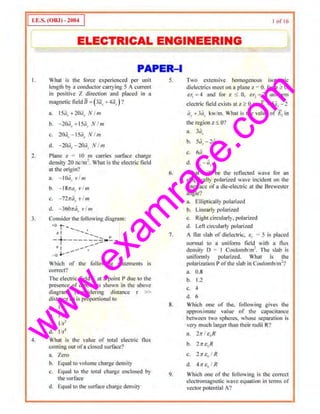
w
w
w
.exam
race.com
I I.F;.S. (On.J) - 2004 I oflt>
I ELECTRICAL ENGINEERING J
I.
2.
3.
+.
PAPER-I
What is the Ioree experienced per unit
length by a conductor carrying 5 A curren1
in positive 7 direction and pla""d in a
magnetic field7i~{31i, + 41i,.)'!
a. 15U, +20ii, N / m
b. - !Oii, -+ 15ii, N / m
c. 20ii, - 15li, N f m
d. - 20ii,-20ii, N / m
Plane 7. = I0 m carries surface c.hurge
density 10 ncfm
2
• What is the tllectric field
at the origin?
a. - lOti.: '''m
b. - 18JTa, vi m
c. -12;ui: ,,/m
d. - J60,Tii, II f m
Consider lhe following diagrnm:
·o I -
d I ----~_ ..J._____ :-::-:::-..,!:._
I --
ul ---·I __ _. r
·0 .,..
Which or the following suuemcnts is
corret.L'?
The elec-tric lield E at a point P due to the
presence of dipole as shown in the above
diagram (considering di!i(ance r >>
distance d) is proportional to
a. 1/r
b. 1/,-l
c. 1/,J
d. llr1
Whm is the value of total electric nux
coming out of a closed surface?
a. Zero
b. Equal to volume charge density
c. Equal to the ioral charge enclos~d by
thesurH•ce
d. loqual to the surfarocharge density
s.
6.
7.
8.
~-
Two extensive homogenous isotropic
dielectrics meet on a plane 2. ~ 0. for z 2: 0.
cr, = 4 and for z S 0. tr, = 2 unilorm
electric field exists at z 2: 0 as E1= 5a, - 2
~. +3a, kwlm. What is the value of E,in
theregion z:S 0?
a. JQ!
b. -- ~ .
:w, - _al
C, 6a,
d. a~ -a)
What will be the reflected wave for an
elliptically polarized wave incident on tl1e
interface of a die-electric at the Brewester
angle'/
:h ElUptkally polarized
b. Li11early polarized
c. Right circularly, polarized
d. Left circularly polarized
A nat slab of dielec.tric, e, • 5 is placed
nonnal to a unifonn field with a OLL
density D = I Coulomblm'. The slab is
unifom1ly polarized. What is the
polariwtion P of the slab in Coulomblm1
·?
a. 0.8
b. 1.2
c. 4
d. 6
Which one of the. following gives tl1e
approximate value of the capacitance
between two spheres. whose separation is
very much larger than their radii R1
a. 1~r I c.,R
b. 2tre6 R
c. 2nc., 1
R
d. ~ ;r c, I R
Which one. of the lbllowing is the corrcd
electromagnetic wave equ.nion in terms of
vector potentialA?
w
w
w
.exam
race.com
10.
b. ~'A-1' 0'~ =-fu
r:er
' &'!I"- ~ ..1 - - = - !t.l
(1/1
., ilA
cl. v-,,_"sar' =-1'1
Vluch one of lha following stotwncnl• i•
cnrreot'/
~Nte W3velcngth of:t wa·e lli:O)l~gating in a
''ave guide is
a, Sm·oller than me free space wavelength
I> Greater tll:on the freesp•ce wnvelength
c, Directly proportional to the group
vehldty.
(I_ Inversely proportionnl tO the ph:oso
veloeity
II. Which one of the following statements is
con·t."Ct'?
For • lossless diel.x:tric rnedium, u,. phase
constant for • traveling "ave. p is
proportional to
"- ti,
b. ..r;
c. IIs.
d. lt.j&.
12. lvlntch Li.•t I ,.;u, List U and scloci tho
correct ansll'er using the cod"" given
below;
Lis1 t
A. Continuity eqnolion
B. Ampere's lnw
C. Oillplacemenl curr•"lll
D. Faradoy's law
Li.>tll
l. 
- - (!0lf =J ,. _
ill
2 - w.I=-
fJt
~
~ -  jj ,. aii
ot
~ -
- (}/
I.J =-
ot
13.
1of 16
. 13 (' 0
a, -1 3 2
b. 4 1 2 J
"- 2 3 4 I
d. 2 1 4 3
In a lossle<s medium the (nlrim~ic
lmpedonco: 17= GOn ond .u.= I. Wh•t is
the value ofthe diolootric constant e,?
ll. 2
b. 1
c. *
d. 8
14. lvlatch Li<l l (Type of field denoted by ::i ).
witll List U (l3ehav!or} and select tl1e
corruc.t answer uslng the codes given
below:
15.
l.ist 1
A A sialic electric fiold in a charge freu
region
D. t sbltic electric field in " charged
region
C. A sre"dY magnetic l'iel(! in a eum.>nl
earryinQ eonductor
D. - time-v3ryillfl electric field in •
C-harged moditnn With time--varying
ma11nctic field
List U
1. v.4=o
v .4 ~ o
2. v"4" o
'il-::i: tl
3. 1_1~ 0
1 - ;J=o
4. 'il.ii = 0
v .1=0
A
•• 4
b. 4
c 2
B c D
2 3
2 l 3
4 3
d, 2 4 3
Whic.h one of the following srolement• i•
con·ect?
A wave guode can l>e considered I<• be
un•logOU.II<I"
•. Low p•ss filio:r
w
w
w
.exam
race.com
16.
17.
18.
19.
b. High pas> filter
.:. Bond pus fitter
d. B>nd slop filter
Cou.idct lb.: following ~l.•l•'IDCIIIJ; Jbuul
the d'feclive length of o half wave dipole
(Elevation angle (I is menJured from the
dipole altt•)
I. r.neetive lengch is n funccion orB.
2. F.neetive length is mas imum for
n= trl 2.
3. ~taximum en~ti'~ length is larger
til•n I'llysicaI IengU1.
~ . Eireclive length is lhe same for lh"
autd:una in lr:t.osruiu.ing 4nd receiv.iug
mode!,
Which of fl'c .stntcments given ;~bov! are
correcr'l
n. l, 2 and~
b. 'l. 3 and 4
c. l. lnnd3
d. I. 3 and 4
A losslc» tronsmission ~ne of ldngtb 50
em with L ~ IOJtH m C 40 pf''m ;,
operated at 30 ~,f]-lz_ ~1al is its olccbic
lcngU1 (fl/)?
n. 2U2
h. 0.2}.
c.. ws•
<l 40 tr
Which oue of tbc following st.nletucnts i•
corrccl'2
lf the F~nni lo"•cl Li~• midway bolw<>t!n the
conduction and -valence- bauds, then the
semiconductors
:1 lnhi nsie
b. E:<lnn.•ic
0 • p-IYP"
d. n-typc
Wbidt on~ of the following slnt~m<lll! ls
COITect't
Superconductors arc popularly u•ed for
~. Genorolins very $lrong magnoti.: field
b. Reducing i1
R lossc:s
~ Gt-~toJnting cltcb·ostAtic lield
u. G""~•-•Ling Ngious free fi"Om uugn.:tic
field
20.
21.
22.
l~.
~of II>
Wl•ich one of the lollowing i• u.e C<:Jrrccl
e~pressiOTi lor che propagmion conslanc In
a truosmissiun line?
a. ( II - .fli11. )(ri ; mC)
b. (!< I j<VL)
 (G ;me)
(R+ tNL)
<:. ' (G-; mC')
d. J(R jroL)(ti, ; roC)
On which ofthe following factors does the
value of critical cu""''tll density in a
superconductor depend?
a, Tompernture
b. Applied masnelie fidld
c.. TcnlJl<:r~turc and apJ>Iied magnetic
field
d. Sibbec'srule
Match List I (M1lterials) wiU1 Li.>t ll
(Equationit·ule) >nd solcct lh<l corrcot
-answer U.liing the Clades _given below;
List!
A. Didcetriu 111:1tcrial
13. Fcnomoguctic motorial
C. Comlucto"'
D. Sup•;rconduccor
U stfl
l. Debye equation
2. Curie Weiss low
3. Mobhi<'ti.'il:tl·· rule
4. Meissner "O<:ct
u.
b.
(!.
d.
A
.'
3
1
3
I
B
B
4
4
2
2
c
c
l
3
I
3
D
D
2
2
4
4
A clielech·ic material has the renl part of
the dielectric C<lnslartl (•:,) '" 4 and it.s
lo•s ton&onl is 0.004. Wh"t is tl1e complex
dieleclri< c<•n•tnnt (e. •1r<'J>re<lc:nted by?
a. 4 T J 0.016
"· ~ -0.01 1)
c.. 4+j 0.001
d. ~ j 0.00 1
w
w
w
.exam
race.com
24.
2.5.
26.
27.
M~tch List I wl!h Li~t II and selec! the
(:orrect answer using the codes given
below:
List !
A. Lannon frequency
B. Bohr magnetron
C. Magncric induction
D. Curie-Weiss law
Li~t n
I. X=C I(T-R)
,
3. dt l 4:cm
~ . eB/2m
A
a. 2
B
I
c
4
b. 1 3 4
D
3
c. 4 I 2 3
d. 4 3 1 I
Which one·of Ute following statements is
not correct?
a. Vacuum can act as a dicl~-<:trk 111alcrial
b. Piezoelectric. materials qm act as
transducers
c. Quartr c.rystal is a lcrroclcdric
material
d. The d i~l~ctric constant l)f dkctric.s
depends on the frequency of the
•PI>Iied lield
Which one or the following is the
temperature below which certain material
are ant ten·oma~netic and above which
they are paramagnetic?
a. Curie temperah1re
b. Ned temperature
c. Trnnsition tempe.rature
d. Woiss temperatufl:
Mutch List I (Type of ute mnteriuh with
List II (Name uf the matcriul) and s<:lect
th!.! correct nnswcr:
Lis t I
A. Ferromagnetic
B. Sofl magnetic
C. [lard magnetic
D. Semiconductor
List II
I. Rochelle salt
28.
29.
30.
31.
32.
2. AlniC(l
3. Penn alluy
4. Ga As
a.
b.
c.
d.
A
3
I
3
B
I
3
3
c
2
2
cj.
4 2
Which one or the ll1llowing statement< is
con'ec.t'?
A f~rrite. core has lower specific ~lldy
current loss compared to an iron core
bec..1use the iron core hns
a. lligher elll<ltrical rcsistnncc
b. Lower electrical resistance
c., Higher penneability
d. Lower permeability
In which one of the following way> can
Ote lloll volmge across so impUt·ity
scmii.)OJu.fucLor crystal be incre-ased'?
a. By increasing the thickness or the
crystal
b. By increasing the concentration of
impttrity atoms in the crystal
c. By increasing the width orthe crystal
d. By increasing the current llowiug
through the crystal
Which one of the following statements is
correct?
11te liaU coefficient of an intrinsic
semiconductor is
a. l'ositive
b. Negative
c. Zem
d. Infinite
Consider the following circuit:
~:EOn' ::s-v.. 20
••- .
Which one of' the lolluwing statements i$
correct'?
The circuit shown above is
a. Passive and linear
b. Active nnd linCllr
c. Passiveand non-linear
d. Active and non- line~r
Consider the lollowin~ circuit:
w
w
w
.exam
race.com
33.
34.
35.
~ u ..._,
30 c:::;:
'· •) c
In the above oireuit, when
V, = 3V, I = 4A, wllat is the value of I
when V,- 12V?
a. 5A
b. 10 A
c. 15A
d. 20 A
Three parallel re$1SI1Ve branches are
connected across a. d.c. supply. What will
be the ratio of the branch currents 1,:11:!3
if the branch resistances are in the ratio
R, : R1:R_,::1:4:6?
a. 1 ;,l: 6
b. 2:4:6
c. 6:3:2
d. 6:2:4
Consider the loil(lving circuit:
I
What is the value of current I in the sn
resistor in the above circuit7
~ OA
b. 2A
c. 3A
d. 41
A voltage source having an mtcmal
impedance of 8 + j6 ohms supplies p<.>wer
to a resistive load. Whatshould be the load
r~sistance- for maximum powe1· transJC.rrcd
to it'?
a. 8 ohms
b. 6 ohms
c. 10 ohms
d. Mohms
Cousider tile circluts A at1d B given below:
Q: [[(oteU• A) tCirwt Bl
F11r whal values respectiVely of' I and R.
the circuit B is equivalent to circtrit A'I
38,
39.
40.
5 of tb
o. 3A,400
b. 4A, .240
c. IA.60fl
d. 2A,IOOO
Cmlsider tbe tollowiu.g circuit:
~.. '
What is the value ofcurrent f ln the above
C'ircuit1
!
a. I A
b. 2A
c. 3 A
d. 4 A
Cousider tbe lbllowing circuit:
...L L· f·What should be the value of resistance R.
in the above circnit if it hilS to absorb the
maximum power from IJ1e source?
a. R/3 ohms
b. 3/8 ohms
c. 4 ohms
d. 8 ohms
The transfer function ofa system
V(<) s
Z(s)=-·-) =--, . The system is at rest
/(,< S •I• J
for the 1< 0.
What will be the value orv(l) for 1 ~ 0, ;r
i(t) - J u(t). where u(t) is a unit step?
a. e''
b. 2e Jl
e. Je 1r
d. 4e-•
Consider tbe lbllowing circuit:
Por the circuit sbown above, by how noucb
the voltage across the ulductor leads th~
voltage across thecapaoitor'l
w
w
w
.exam
race.com
41.
-12.
-13.
a. 45"
b. <JO•
c. 135°
d. ISO·
Consider 1.11~ follow[ug eitcuil:
,.
...
[he circuit shown above is in steady >tale
betore closing the switch. What is the
current i(o 'J ihi'Ou!!)l the switch if ihe
circuit is dose"(! aJ t 0?
a. -lA
b. OA
c. ~ A
d. I:! A
Consider ihc following cirt-uit:
30U Mltl
"'•
•••Q
Ihe circuit $hown :tbove uttuins a ste-ddy
swte ~~ illt the switch S ~lo>L~. What is the
value of 1(1) for 1 ~ 0, if 111e swilch S is
opened at t = 0'1
u. 0.5-0.5 e ~11
b. 0.6-0.Ie '"
c. 0.5-0.5e·"'•
d. 0.6- 0.6e'101
Cousider Lh~ folluwiug diugrnm:
• . ' '
Which one ofthe Jbllowinggives Lap latt-
trnns(bnn ofthe wavelength v(t) shown in
the above diagram'/
o, [ ~· +e'' • 2c' ]!.t
b [t'' +c''-2e'']ls
c. [e + 1.'
1
' -2" J'] f.•
d. [e • +e "'+2<' ]!s
44.
-15.
-II)•
II"' Ill
Consider the toll.lwing pok·7~.ro diagram
ofnsystem funcli•~n l.(s) ~ V(s)ll(s),
. rWhat will be the magnitude orthe vullngc
pha.~or till' i(l) : sin 1?
a. 312
b. I
c. 2/3
d. 113
A balanced della conneeted load ha' an
1mpc:danoe of 9L JO" ohtns per pbasc,
Wlmt is the impcdanc~ per phase of its
equivalent smr'l
a. 27 L3o•n
h. 11 L90"n
c.. 3 L30°!l
d. .. /.20"!1
ror a pnmllet RL.<. t·esonant cirt'uit the
dumped frequcn~y is Jiirls und oondwidllt
Is2 rls. Wltal i; its resonant frequency?
a. 2
b. ,[7
c.JiO
d. 3
47. Consider the following ci...:uit:
••
In Uw above cirtu.ilZ(s) = 2 :IS .f-i..r..
and Z (s) J as s-+ 0 . What aro.
respectively the vatu~ ofR1 and R~?
o. 6n. m
1:>. 4ftln
c. 30.60
d. Ml. >0
Consider lite foll(lwing cir<uit;
f ··f ··I ··t
w
w
w
.exam
race.com
For the above.circuit. ~1e current sourc.e is
sinusoidal with frequoocy e<tU31 to the
resonant frequency of the circuit. What is
Ute value orcurrent through the resistor~
3. 0
b. 0.11
c, I
d. 10 I
49. In an a.c. series Rl.l circuit. th~ vnhage
across R and L is 20 V. voltage across L
and C is 9V and voltage across RL.C ls
15V, Vh:tl is the volwgc across C?
a. 7V
b. t2V
c:. 11V
d. 21V
50. Consider the following circuit:
•:
1
F 1
1
~1~2nt 1'':'
What is the short·Circuit natural frequency
at port I of Ute ubovc circuit'?
"' S+l = l
b. S+ I = 0
c. ls+ I= 0
d. 2s • 3 ~ 0
51. Two resisto•·s ofequal value are connected
in series across Ule lines 13 uncl C of a
symmetrical 3-pha.w 400 - V system.
What is t1Le magnirude of the voltage
bmwcen ihc line A and the jun~tion of the
resistors'?
3. 400/ ...{J
b. 200.(3
c. 40013
d. 100.(3
52. Two iclontlcal T-<ection<. such as one
sh011 below are connected inseries.
What isthe y11 ofthe combination'?
a. 11/240 u
b. 221240 u
(:, 11/360 u
1 ,,r II•
d. 22Jt2(J u
53. The rcaliwtion of tlte driving points
impedance. func.tion
Z(.v) = (a.•' +7s+J)1(.~' +3.v+ p) is
shown in the circuit given below:
What arc, reSpt"Ctively d!C values or" uud
fl?
a. 5.2
b. 2.5
c. 2.3
d. 2. 1
54. Impedimcc
Z(.>')=[(>'+3)(H S)]l((> +4)(.•+6)) Is
realized i·n the Foster's second lilnn. Whnt
will be Ute values. respc<:tively of R aud l
in oneor the series R-l. hranches?
a. 2n. 1/3 H
b. 2n .1/3 H
c. 2fl.. 5/JH
d. 2.n.2/3H
55. Match List I (Accuracy) with Li$t II (Type
of the ~~~ndartl) and sdcct tho corrocl
.tlll.SVC.r;
56.
List I
t. Least accurate
0. More accur.lte
C. Much mor~ accurate
D. IIJghest possible accuJ·ate
Usf II
I• PrimaI)
2. Sccondnry
3. Vorking
4. International
A 13 c
a. 3 4
b. 4 3
c. 3 2 I
d. 2 ~
f)
2
2
4
4
Which one urthe following stutcmcnLS is
correct?
w
w
w
.exam
race.com
57.
58.
59.
GO.
61.
The aJ!pliCDtion ofthe in!trument in wrong
mnnner in the procedure r1f meil$urcmenl
rcsuiL• in 11/nn
''· Syslcm~lit!crmr
b Random etTor
c. Gross error
d. IJlstrument error
1 0 to 200 V voltmeter b•• " J!.Unranteed
~ccurncy ol' lqo of full sc;ole reading. Th~
vo)tug~ measured by litis in.sll'tlmcnt is 50
V. What i> the limiting lli'I'Or1
a.. 4~v
b. 2°u
c. 1°•1
d. (),:z50,u
Which one of the following slai<OcmenL•
coorcctly represoot.s tltesystemdie Crt'tlrs?
n. 'J'hcse=tlrs c3n he t<~lcutated l'rbm th"
dotnils of lite initrumctlts
h. 1ltcsc. ore the residual cmn'l!
~. 'fllC!~C CITOI'l'l m:ty UCCUt Undi;.r
<!<rutrollctl o;unditiom
d. These •~ thll errors oom.mlucd by the
cx·pcrimenl~
A r1>!<istor R is mcosiU'Cd using th~ '-1
method, with V read as 1(), 14 V and I as
5.07 mA Which one uf the liollowins
u.xpl'css~ the v:alm: ofre:si.stancc'?
a. 2k0
h. 2.()(1 ~-o
c. 2U0tt0
d. 2.0 k(l
Which on~ of the following stotd:IJ..nls is
con'ect!
11oc ddloction of bot Wire in.•lrwn~IDI
depends on
a. r.m.•.v~luc ofthe ~.o. c~nt
b. •·.on.s. voluc ofthe ~.c. voltAge
.:... uvornge v:o!ue ofthe a.c.. current
d. avcmge v:Liue ofthe-u.c. voltage
Vhidt <Jill< of tlte folloing moterials is
usc<l in tltc fabo·ication of swamping
I'C'<illtanoeofo PMMC instrument'/
n, Copper
b. Aluminium
c. 1buguniu
d. Tuugshal
62.
63.
G4.
05.
66.
67.
8 "' j (>
Wltich one or the lollowing i• b~siCDIIy a
cunenl sens-itive.ffiKlrument'!
a. Pennanenl magnet moving coil
inslntmcnl
b. CaUtode ray oseiJioseope
c. Eleclr~totic instJIment
d. f:f!.'l' inpul. eloolronic voltmeter
A d'ArsonIll mu,·ement 'ilh internal
oli•istance R = 10() nand full •c•le current
of 11 rnA is to be cunverted ir1to (0- 10) V
o:angc. What is tho rctjUir<ltl resi.stunce?
a. HI il
b. 10100 ()
c. 9<)111) 0
d. 120oo n
Which ono of the foUowiug lYI"'~ of
ln>trumenl.! """ be used to determine the
r.m.s. volue of n.c, voltage of high
magnitude 110 IN) ami nf .In) aVe
shape?
n. Moving iro.n instruntcuL~
b. Dynamometer type ioistrumeniS
c. Intluclion iMtrumenl~
d. Electrosttllc instrument,;
'fhe batte~y •"lis m an electronrc
millim~:ter ~~e re<1uircd lo m~ure which
onuofthe following'!
•• Ro£tslM.I;<;
b. Volwge
c. Cwrent
d. Power
Vhkh, one of Ute following method.<
decreasw:s thl.! t:rror due to conn~tiuus in u
dynamomclet' LYJ>C Wallmctcr'1
a. Using bir.Jnr compensatiug Winding in
place ofcurrentcoil
b. O&ing non·induotive pressure !Oil
c..irc.uil
c. U•ing • cap.1citor •cross a part ofhigh
ro;idance ofprt::i!$Ure cull circuil
(1. I Ising 11 S" amping resistance
·n,e power of a thr~phnse, lhreo-wir-e
h:1tance system w:ts measured hy lw(l-
W~Umder method. The I'Cading of on~ of
lho Wattmeters w•s found to be double
thai ofhe other. What i~ the pol'er factor
ofthe ~ystcm'l
•· I
w
w
w
.exam
race.com
6.8.
69.
70.
71.
b. 0.866
.:- 0.707
d. 0.5
Mntcb List I with Li!lt ll and ~elect tbu
COITCCt answer using. the codes given
below·
Li•tl (Instruments)
A. Dyn:unum~(er instrument -
13. TI•ennocc>uple·based in•tnuntlul
C. Ramp gcMrnlt/1
D. Weston Stnndard C.:ll
List U(Applicotlon)
I. True r.m.s. value mtte
2. Tran,~fl:r n~ttum.:nt between a,c. •n~
d.c.
3. Time base •>rCRo
4. Stan~ard ofElectrumotive force (Emf)
Codes:
,. s c D
It, 4 3 2
b. 4 ' I 2
·'
0. 2 3 4
d. 2 3 I <I
Luw n:."iJ(a.JlCAJ from few ohttt~ down lo
one micro ohm i" mea.sured using whlc.h
one ofthe following instructs 1lle1'il&'1
a; Ohmmeter
b. A •erie• type ohmmeter
c. isluu11type ohmmeter
cl. A voltmeter !lnd :&ll tunmctc1·
Wbieh on~ of lh~ follo'tng stnhml~ls l•
coiToct'! An electronic voltmeter is more-
relinble as comt>ared to nmll.imeler for
me.asuriu~ voltage :across low imped::t11c~
bCte.ause
:L, its sousilivity is higlt
b. it utTers high input imp<:<loncc
c- it d~>es noll ~It~ th" measured VQIIJigo
<I its sensitivity. and input lmpc~bncc are
Jtigh nnd tltl OUt :&(lcr the IIIC8SU1Cil
v•lue
Which une uf U1c lillltming dccid<>< lbc
preci5ion ofintegrating digital voltmeter1
a, Refcr<:nce vuhngc of :ucnlog
comparator
b. Slope ofthegenemted rnmp
c. Width ofthe generated pulse•
72.
73.
74.
75.
76.
77.
? ul II>
d. Ele<:ltonic cnunter
Which one of the following >tatements 1$
correct'!
Spirnl$pMngs arc used in instrumenls to
a. provide controlling torque
b. provide damping IDrquo
c. luod U1c current to nwvin¥- coil "' wdl
a~ In provide 01c cont~UIIing tm'l""
d. provide linc..r ddlectinn
Vhieh nne of tho following dueide~ tho
lime of response or an indkmling
instrument1
a. Deflecting systilm
b. Controlling •ystem
c. Damping system
d. Pivottmd Jewel be.1ring
Whichon~ oftbe following is rneMuredby
the loss ofch.;rge method'/
•• LowR
b. High R
"· LowL
d, 1:4ltL
Which one t>f the follcltli0!1 gives Gnu~c
(ne(Or ufa ~lr•in gaugc7
•• J).L/5.R
L R
b. ~ R/5.L
R I.
"- 6R/'oH lJ
~R~~Pd.
R p
Which one oJ' the follow mg defmition
.:onlctly. repr<'!lents • dulll acquisitiort
system (I)AS)?
<L DAS is a group of dcch·onic devices
that an: connected lo perfonn th«
m~:JSun:ment "lind quantlz:ttion of
ekcU'i<:lll Signols For digital pfotessing
b. DAS is ~ group of devices Uta! are
connected Lstorc, cfiffercnt .signals
c, D.<S is a sy;lcm to conlfola pre>C<>ss
d. DAS is • ~ign• l conditjoner
J.Jal~b List I with Li,t U 011d sol<:<:t tltc
cun..,ct all!lwcr 11.<ing the aod~ given
below
List I (T111nsduccr)
w
w
w
.exam
race.com
78.
79.
RQ.
A. Pie~o-clcclric crystal
B. Manometer
C. Resistance bridge
D. Resisultlce stmiLI gage
List H(Purameter)
I. Static pressure mt:asurcment
2. Dynamic l'or~e measure.lllem
3. S1udy or vibrmion ofa canlilever
4. Vibration in position of slider by an
external force changes the resistance
Codes:
A B C D
.. 4 I 2 3
b. 4 '~ 2 I
c. 2 I 4 3
d. 2 ·' 4 I
Wllid 1one ofthe Jbllowing thermocouples
hWj Ulc highest lempcrature moa~uring
runge'!
a. Copper-Cunsuutl;ln
b. Iron-Constantan
c. Alumci-Chromcl
d. Platinum Rhooium-Piminurn
Consider the 11111uwlng elerncnls:
L Low p!L'lS 111er
2. Signal mmsmission medium
3. Amplitler
4. Digital to analog convertor
5. Analog 10 digilal convertor
Wbich one of the following scqueuues is
ll"' correct sequence Jbr ciTcctive signal
r~-<:onstruclion in a data acquisilion and
p.rocessing scheme?
a. 1·3·5·2--4
b. 3-1-:-2-4
c. 1-5-3-2-4
d. 3-5-1-4-2
Consider tbe Jbllowmg diagn~m:
81.
82.
10 nfl(>
r~or the mulliplc gearsyskm shown above.
which one of !he following gives abe
equiv:dean inertia referred 10 shafl l?
3 . .!,T.!,(ZJ+.J,(Z:~: )'
b I N~ N1 N..
( J
. ( )'. • I ~J, - +./, - -
/1/1 N,N,
c. J, ,_J (~)' >J,lii~N, J'N, N,N1
.• I I ( N, ) ' J ( N,N,1:u . . ,+. ! - , + J - -
,, N,N,
C'on~idcr !be followfng mechanical system
shnm1 in lhe cli@gmm:
•• K,
.... .., ~
Which Cln~ ofthe lbllowing circuits shows
lhc correct forrt · c.urrcnl analogous
electrical circuit for lhc mechanical
diagram shown ahove?
a.
b.
c.
d.
v, , ~.. ~
c"' R,.
1., • •
The signal flow graph for a certain
feodback Ct)nlrol sysicm is givcn below:
w
w
w
.exam
race.com
85.
84.
••
Now consider ~.. fOllowing S"l or
equ~tions for the nod<>$:
I. x1 ~ al.rl +"~·"'
3. XJ :: ~."1 ...(I~Xl
~ . x~ = n.x,,+a"x;.
Which ofthe nbove equations are correct'!
a. 1.2and3
b. 1. 3and 4
" ' 2. 3 &lld 4
d. I. 2 aud 4
Consider the lbllowins. system shown in
the diagram:
.,., IC>O---ooj -n+;; f--- ,,..
In the system shown in the above diagram
~(t) - sin 1. What will be the response y(t)
in the steac1y state?
<~. sin(t - 45")Ji
b. sin (1 -t45•)Ji
c. .Jie'sint
d. siol- cosl
Consider tbe foUowlug O~ree block
diagrum A, Band C shown below:
-.,c,a • •
• "•I:,J•I
85.
86.
R7.
II of lo
Which one or the lbllowing statements 1s
correct in respeet of the above block
diagrams?
a Only A ~nd llare.cquivnlcnt
b. Only A and Care equivalent
c. Only Band Care eq1•ivulent
d. A. B aud t :1rc equivalent
Consider U1e rollowiug t!U'ee cases of
block diagram algcbm A, B and C
·~3. -T ~ • ~- -T.....!.
v v
BJool< dil>gnlm A
·~-v
Blooll d'"""'" B
"~ •~Z
" 4£:!.-vBlocl<d~C
WI•ich ofthe nbovc relations are correct?
~ Aand R
b. Band C
c. A "ncl C
d. A, ll anti C
The damping ratio and namraL ITequcncy
of a second ordet system are 0.6 and ?.
rudls respectively. Which one ot' !he
lbllowing combinat·ions gives the correct
values or J>L>ak and settlng tilne,
respective!~ for the unit step response of
1hesystem?
a. 3.33 S and 1.95 S
b. I ,95 s and 3,33 S
c. 1.95 s und 1.5 s
d. t .5 sand 1.95 S
Mntch List I (Type of plots) with List VII
(Pw1<;ti<Jns) ami selecr the correct· ;111swer
using tllc cl)l)esg iven below:
List I
1. Rode plots
B. Polar plots
C. Nyquist plots
D. Nichols chnn
List It
I. Opon loop rc~ponsc due to damped
sinusoidal inputs as n timction or
complex frequency
w
w
w
.exam
race.com
88.
39.
<.)().
1. Op¢n loop response due to undamped
sinu.~oi~n I as • function of real
frequency
3. Closed lo11p rospoMc due to sinusoidal
in1>ul~ "-' " function o£real ft.,quoncy
~ . Opt!n IOQp magnlludc :tnd phase UOJ;'l•
responses Jbr undamped sinusoid.1l
inputs plotted separolely as n iimction
ofrenl fr<!quen~.y
Codes:
A B (" 0
•. 2 ~ 3
b. 2 4 I ~
2 '·'
d. 4 2 3
A un.ily feedback ooutrul system hilS a
forward loop trans-10.. function as
1!1:-
[ )
Ill< pluse valuo wlll be zero at
.v(4il J
frequency ro,. Which one of the following
equatiU!Ili should be sali•fied by w17
" • <!'> .,. cot(r~)
b. (< = hm (7'")
c. T19, = COl ( "-1 )
tl T"-1 = "'n(l' )
C'on•iderthefollowing to'nM!i.-rfunctions:
l. 11tS1
• S - l )
2. 4/(S2
I 2S + ~)
3. 21(~! T 2.S f 2)
~ - ll(s• - 2s -t IJ
s. :vcs'- 6:'! .... 3>
Which of lhe ~bove transfer 1mclion.•
rt()feo!t:lll und.,.- damped •ccond <1rder
systcms1
"· 4 and 5
b. t.4~nd 5
c. 1.2and3
d. 1.3 and 5
Which one ol' the following "'tu•tion•
gives the sleAdy·St<tte error for a unity
r<x:db>ck systan e.~citcd h,
tt, (t)• I u, (t)< t1
rt1(I )12J
I I I
"- ,.........;.......,. I - t -
(2 ~ ,1;.", ) K., K
91.
92
93.
11 of 16
I I 2
"· )+- -t -(11 K , K, K
1 1 1c. _, _,._
K K K' , .
I I l
d. t- •-
(1+K,) K, K
A control s-ystem is c1e.fined in S·dnmain.
F<JIIowiog poin"' regarding Ote poiC<S ofthe
transfer fut1ctiou obtaineu from tbe
ch;u-Jcteristie <lqllllliort ~~·e noted
L Poles with positive a•e-al part denote
•table sy~tem.
2. Comple:< paleo alwnys oc<Jur in pairs. ·
3. . polu S - o (a 0) mcnru that the
lransienl response cont-r.ins t"Xponential
decay.
Which ofthe above are correct'/
3. I aud 2
b. I and 3
... 2an~ 3
d. 1.. 2 and 3
Consider the !oUowiug slatemeul<
1-egarding :Jd•anuge:s or using tile
generalized error coeffieoents
I. The generalized error <:oefticient.s
j}rovide ~ snnple w~y of determining
tho nolu"' of U1o o-c.•punst of •
feedback control system lo -almost any
orhitrnry input.
2. The gencrolizod error ~oetl'icoents lead
to the colculntion ol' the stendy-~t•te
rcspon•<:- without acluoUy solving tit<>
>-ystem diO'creutial equot.ion.
3. The gcnernlizcd eoTor ooc!Iicienl<
esMblish relatioo• hips among the
various t)'pes ofinputs.
Which of the obove stat~tnents ;~re CQrrect1
a, L, 2 and -'
b. I and 2
c. 2 and 3
d. J and 3
11u' Nyquist plot for Uoo closed-loop
control system with the loop trnnster
funlltion G(Sl J-I(S) = ( (()() ) is
S ~- Ill
ploUed. Titen. the critical po.int(· I. jO) i~
u. neve1'eoclosed
w
w
w
.exam
race.com
94.
95.
b. enclosed under cenaln conditions
c. just touched
d. enclosed
A minimum phase uniry feedback system
hu.~ a Bode plot with n C(111Sillllt slope of -
10 dbldccmlo for ull frc.qucncius. Wbnl is
th~ ~tl ue or tltc lllll<inuun phu:.<: margin
Ji:lr the system'!
a. o·
b. 9{)'
c. - 9u•
d. 180°
Consider th~ lolluwin~ NJquist plot M n
feedback sysre111 haviug,open loop transfer
function Gl·llsl = (S ~ I )I ls1(s - 2)] u.<
Sh(lwn in the diagram given b..:low~
I.GH
What is the number ofclosed loop roles in
the right hull'ofthe s-plune?
a. 0
b. I
~. 2
d. 3
% . Consider the lhll<m1ng stat~ments tur a
counterclockwise Nyquist poth:
I. i'or n stahlc loop S) >tent. the Nyquist
plot nfG(s)l l(s) should endrcle (· I,jO)
point as tnwly tiwes liS thete are poles
of Gts)H(s) in rhc ri,ght half of the S·
plune. lhi! encirdements. if tlt~re are
nny must be made in the
counterclockwise direction.
2. If the loop gain function G(s111(s) is n
swblc function. the closed loop system
i~ always stubIc.
3. 11' tho loop gain function G(s)l1(sl is a
smblc function. tor u stable closed-loop
system. the Nyq.uist plut uf Gts)H(s)
must uul ~uclos~ t.IJ~ cri!Jcal poiut (· l.
.iOl.
Whicilof the stntrm<uts given nbove is/arc
c~lrreco~
a. Uuly I
h. I ~nd 2
~7.
i)R.
U nt II•
c. I and 3
d. Only 3
11te characteristic ctlu~tiuu for u tl1ird-
ord4)r :>yStcm is:
q(s) =o.1.,. ' + a1s!~ a1~· +n1 = 1•
.For the third-order system to be stahle.
bcsid<s llml o.ll the CO<llidcniS huw lu I'C
positive. which one of' tl1e tollowiog has to
be satislicd us u necessary ami suilicicnt
condirion?
c. tt!o1 2 n1a(l
d. Ouly 3
A oontrul system has G(s)JIts) = K/(S(s 1
4)(s2
• •IS >- 20)] tO < K < » 1. What is tit()
nounbcr nr brcaknwlly points in the mol
l(lqos rliugrum'l
a. One
b. 1lu
c. Three
d. Zcm
Which oo" oftho tbllowing is the correct
expression lbr the rransli:r funcnon l)f on
dectrlcal RC phn;;c-lug compensating
nctworkr!
RCS
ll,
(I+ R('S)
b.
RC'
(I+ IICS)
I
c.
(I t RCS)
stl.
(I+ IICS)
I00. Which oue of' Ute following is not a correct
I'~~~~~~ IO sc)~'lll ri'C<iback C<IJilpensutiUll
over cascaded one?
11. No umplifit'Uiion i~ required us the
energy transter is from higher to ),,wer
level
b. Suitable del'ices are not availuble for
oomp~nsntion (series)
c. lt is economical
d. Provides greater stillness uguiost load
dlstutbnnces
w
w
w
.exam
race.com
I0 I. F'or a unity feedback system, the origin of
the. ,..plane is mapped in the z·planc by
transfonnntion z = e~>"t to which one of th~
following?
IOJ.
a. Origin
b. I jO
c. - I +jO
d. 0 j l
Con~ider the following uetwork:
,~{·E·t+--:-1
What is th~ winimwro number ofstates of
01c ne-twork given ubove in order to
determine the complete output or Ute
nNwork over all futur~ time for a given
input?
a. 0
b. I
c. 2
d. J
103. Match List I (Singular point) with List II
(Phase portrait) and sele<:t tlte correct
an~wer using the codes given below:
List I
A. Unstable focus
B. Stable focus
C. Srablu node
D. Saddle
List II
I. A logarithmic spiral extending into tho
singular point
2. Trajec.tories approach sinsular point
adjacent to straight liolc curve out and
l<.>av0 in vicinity ofsingular points
3. A logarithmic spiral extending out of
the singular point
4·. Traj~ctories are asymptolic: to strui.ghl
line
Codes;
A B c 0
a 3 2 4
h. I 2 3 4
c. J 4 2
II. 4 3 2
104. About which one of the following Is the
phase-plane portrait lor the non-linear
105.
t4oftu
system given by .~-f(x.x) and
satisfyingf(,u ·): .f(-x..~)
sytnmctrical?
a. ~·nxis
b. .i· -axis
e. Both Utex and ~axes
d. Neither x nor x axes
A unity feedback non-linear control
system's plot for - liN and O(jl,)) is
sh<lwn in the diagram given below:
'·
•-o /' ......
/c;U"I
R,
N is describing function of ~oe ut>n·liuear
device and G(s) is UIC tr:wsfer function of
the linear plant. Which one of the
following statements is correct'/ The limit
cycle is
a. srable
b. UllS!ablc
c. ctitlcally stable
d. None ofthe above
I0~. Mutch L.ist I (Namt> of th0 Component)
with t,ist II (Type of cbe Component) and
select the correcc answer using the codes
giv~n bc:low:
Ust l
A. Amplidync
B. Potentiometer
C. Stepper motor
D, AC Tucho-gcneratoo·
Lise 1.1
I. Rate feedback ele111ent
l. Actuator
J. Serllo amplilier
4. Error dektlor
Codes:
A B c
a 3 2 I
b. I 2 3
c.. 3 4 2
d. I 4 3
D
4
4
2
I07. Consider tl'oe following statements!
w
w
w
.exam
race.com
s..-vomowrs hnve lighter rotor a'
comp•red to 1rdinary motors and
hcn~'C lowor iuc,.tin.
2. 11nd c.m.l'. in lid d conlttJIIed d.e.
motors net• :t~ minor loop lee~lback
Md result• in incre:os~d 1lampir1g and
improved 1.rrmsien' re,.;ponse.
3. Permanent magnet d.c. servomotors
'"'" be uRcd in d ther ann>Lure-
controlled or Cicld-controlll!!"modos.
VIicb of tht: abow stntcmeniS •re uot
corrccf1
a. 1 and 2
b. 2 ru1d 3
C-. I tlnd J
d. I. 2and 3
108. ll•btch l.11<t I (Plot/Model) with List Jl
CRelated paramctot·) •nd s•leet the ~orr.:et
"'"~"cr usinj! the cC)<Ic.~ given bclc)w;
Li>t I
A Root locus plot
B. Bodoplot
C Nyqui.<t plot
D. ~ignal 0~11 ~h1111
Li.<~ n
Comer frequency
2. l!ruabwoy point
3. ,- ritical llQint
~ . Tro.nsmitlanae
C'odes:
A B
•• 4 3
h. 4 I
2 3
d. 2 I
c D
2
'•' 2
4
3 4
lll9. II 3-ph•se ' br·connected bolanccxl lo•d
consumes P wans of p~,w~,. from a ~00 V
(line t(J lillc voltage) supfll~. if the S>n•c
l<utd i~ c.oru1c..:.tocl in dchtt ae~·U,!f tbe M!lmc
~nppJy, Wh•t i• the piiW<:T <on•nmptiun '/
n. P/13V
b. p V
c. .jjp V
cl. ~ I' w
110. Assertion (A): An mtrin•ic scmi-conduotor
h"s low ~leotrica l conductivity. l-Ienee, it
is um·waUy not used in tlw dc:vico
fnbtic•tiun wiUtout d:unping.
ISntlli
Rc:1.~on (R): Its electric.~ Iresistlvity can be
incre.'ISed h)' raising its tempernture.
a. Both 1 ·ami R ure indh~dunlly tnoe
11ncl R is the ciJrreCt •=--plonntiun of A
b. BoU1 A and R ~re ludividually true but
R is not Ult . .:orrc:et oxpLlnation of A
c. A is lrm: but R Is fals<:
d. A is false but R i<true
II J A<sertion (AI: In a tossloss transmission
line lbe voltnge ~ud CUIT<mt distributinns
nlong the tine ore "'"~YI Co•••t.;nl
Rl!:nSon (R): TI1a voltAge •nd cun'<'ttt
di~tnlJutions in un open line are ~ucb that
"I n disL1nce >.4 fmw the lo~d end, Ihe
Uno looks like a serie$ resonant circuit.
a. Bolll A ·ond R are individiUIIIy tnoc
oml R i> Ute corrC<..1 oxp!WlJJtion of A
b. Both A •nd Rare individuallv 1rue but
R is n()t the, correct oxplnnotit>~l of 1
c. .' is true but R l1 false
d. A is false but R is true
112. Assertion (A): An <lectric or mechnnkal
input ru:tka the flux jwnp from oue
superconductor to a.notlJor. geottating:
large direcl currenl$.
113.
Reason (R): The el•ctric resi~tivity of
$Uperconductors dq>ends upon ~~e
maguotic field.
a. BoUl A ·•nd R "'" ind.ividu:•Jiy true
and R is tho oom>ct e"plnnolioo of A
b. Both A •od Rare individuall} (J'uo but
R is not the. c.orrcct expl•ll4tion of A
c. : is true but R isfabe
d. A i• fal;le but R is IJ'ue
Ass•rtinn (AI: C'rvotron is a switch
c.on.Uucted out ·of supcrconduct..in.g
materials.
R,coson (}~): Switching action Is
ch~1';1Ctenstic of superc.onducto•~ only.
"· Both A ·and R are indi,·idually tnoe
and R is U1e corr-ect explanolioo of A
b. Both A ~nd Rare inclividuall~ tru~ but
R ill <l(lt U1e. oorre<:t o.~plnnntion ofA
c. .• i> truc but R l'i f•lsc
d. A i• f:ol<t but R is true
I14, Assertion (A): Soil m•gnetic material is
usod in making d O<lromngueto.
Reason (R): Son mJJgnetic male•iols h•w
a higlt cocroivo ficltL
w
w
w
.exam
race.com
"· 13o1h /1. 'and R = individuntly '""'
and R is the correct c.'(Jllan~lion ol A
1!, 13oth A ond Rare in<Lividuolly tnte bill
R IS not the, correct explanation orA
~ A is 1rue but R is false
d. A i5 f.llse but R i5true
115 ,'u!sertion (A); ff Thon·enin'a equivolent of
a circuit is kn011. ils Norton equivalent i~
:tlso known.
Reason (R): Notmt'~ oquivolonl i>
re<>ipro~J ofTiuov1011in·s "'Iuivalent
'~ Uolb A •and R nJ-e iudividuaUy true
and R is the com:ct <:Xpl~n~tion ~fA
1.>, Bolh A oud Rare individtl41ly lftl~ but
R i;> not !he, rorrect e.'tplan"lion of A
o. A is true but R is false
d. A is false but R islrne
116. '"'•cttiou (A): An ui<X.-tronic voltmctc:r
measures the voltage across a high
resisl.,nce more accur~tely as compared to
nn ordimu·y nwltimt:h:r.
Re•sQn (R): The d)e-.1ronic vulbttcll:r
~>nsist~ of• vollllgo omplitior whi~b is not
pres.,t in an ordin3Ty multirneter.
'~ Both /1. ·and R arc individunOy ll'llo
and R is tllc correct cXplan~tion ofA
h. 13oth 1 nnd Rare mdividuolly tnl~ bttl
R is not the, e<•rrc<:t c.'<planotion uf A
c. A is true but R is fol$e
d. A is fulse but R is true
117 A-.ertion (A): Cathode r>)' e»cilloscope•
using CRT employing ~leclrustatk
deflection nre used in lllbot:Jto•'ies for
scientific m~ason:ments. -
Rt:ason (R): CRT u.sing cltettostntic
de-flection systems has more deflection
sensitivity as compored In C'RT employing
111aguetic deOecti.ugsystem.
a. Bull• A ·aud R al'e individually tn•e
ant! R is lllc Ct)n:ce.l C..XJ'I3nati•ln ~fA
h. Both A ant! R arc individWlll)' 1Jue hut
R •~ n<>llhe, co•-rccl c.xplauation of A
l6ntll>
c. i is true but R;, mise
d. • j$ false but Rio tr11e
J11!. Assertion (A): A dual trac~ CRo c:m
display two input signaleo Jimu1t:meowdy.
Reason (R): A dunl troce CRO use• a CRT
having two electron guns to generate two
elto.:.tron beam> !in1ull.1neously.
a. Bolb A ·and R are individually true
and R Oi.lllc comoct eXplanation of A
b. BoUt A and R arc lndividuull} true hu(
R is not !he, oom.-et explanation ofi
c. : is true but R is false
tl 1 is f~Js~ bul R is o·ue
119. Asse1tiou (A): Dal.a a~uisitiou systotns
arc used in. 01 large and cvtr Utcrcl.Sing
number, of applications in :t veriety of
induslfloland scientific areas.
Reason (kj; Transducer convert. thft
analog signal to • form ac.:epl3bl.: by Ute
All' convt>rlor.
a. DoUt A ·and R ate individually tn•e
and R ill tl1~ con"Cct "'"1'lonotion of A
b. Doth A ami Rate lt"fividunUy truo but
R is not the, correct "-"Plnnntion of .
c. 1 is true but R is frusc
d. : isfilse but R;. true
120. A.ss...-tion tA); tn addition ofrenl lt:l'o at s
= · z~ in the lrilnsfet· function G(t) Jl(s) of
a <:ontrol ~')'s tern reslllt$ in lht increase of
stsbility mltrj~in.
Re:tson (R); An addition of real zero nt $ ~
- zo in ll>c transfer function G(s)flj~) will
make the resultant root loci bond towards
Ihe left.
a. Both A -nnd R are individu.1lly lme
and R is Ute correct esplon•tiou of A
b. Both A and Rare individually true hut
R is not the, cot't'eel explanatiou ofA
~. A is Ime hut R tS (itlse
d. ,- i, lalloe hut R is tnte

Ies electrical-engineering-paper-1-2004

  • 1.
    w w w .exam race.com I I.F;.S. (On.J)- 2004 I oflt> I ELECTRICAL ENGINEERING J I. 2. 3. +. PAPER-I What is the Ioree experienced per unit length by a conductor carrying 5 A curren1 in positive 7 direction and pla""d in a magnetic field7i~{31i, + 41i,.)'! a. 15U, +20ii, N / m b. - !Oii, -+ 15ii, N / m c. 20ii, - 15li, N f m d. - 20ii,-20ii, N / m Plane 7. = I0 m carries surface c.hurge density 10 ncfm 2 • What is the tllectric field at the origin? a. - lOti.: '''m b. - 18JTa, vi m c. -12;ui: ,,/m d. - J60,Tii, II f m Consider lhe following diagrnm: ·o I - d I ----~_ ..J._____ :-::-:::-..,!:._ I -- ul ---·I __ _. r ·0 .,.. Which or the following suuemcnts is corret.L'? The elec-tric lield E at a point P due to the presence of dipole as shown in the above diagram (considering di!i(ance r >> distance d) is proportional to a. 1/r b. 1/,-l c. 1/,J d. llr1 Whm is the value of total electric nux coming out of a closed surface? a. Zero b. Equal to volume charge density c. Equal to the ioral charge enclos~d by thesurH•ce d. loqual to the surfarocharge density s. 6. 7. 8. ~- Two extensive homogenous isotropic dielectrics meet on a plane 2. ~ 0. for z 2: 0. cr, = 4 and for z S 0. tr, = 2 unilorm electric field exists at z 2: 0 as E1= 5a, - 2 ~. +3a, kwlm. What is the value of E,in theregion z:S 0? a. JQ! b. -- ~ . :w, - _al C, 6a, d. a~ -a) What will be the reflected wave for an elliptically polarized wave incident on tl1e interface of a die-electric at the Brewester angle'/ :h ElUptkally polarized b. Li11early polarized c. Right circularly, polarized d. Left circularly polarized A nat slab of dielec.tric, e, • 5 is placed nonnal to a unifonn field with a OLL density D = I Coulomblm'. The slab is unifom1ly polarized. What is the polariwtion P of the slab in Coulomblm1 ·? a. 0.8 b. 1.2 c. 4 d. 6 Which one of the. following gives tl1e approximate value of the capacitance between two spheres. whose separation is very much larger than their radii R1 a. 1~r I c.,R b. 2tre6 R c. 2nc., 1 R d. ~ ;r c, I R Which one. of the lbllowing is the corrcd electromagnetic wave equ.nion in terms of vector potentialA?
  • 2.
    w w w .exam race.com 10. b. ~'A-1' 0'~=-fu r:er ' &'!I"- ~ ..1 - - = - !t.l (1/1 ., ilA cl. v-,,_"sar' =-1'1 Vluch one of lha following stotwncnl• i• cnrreot'/ ~Nte W3velcngth of:t wa·e lli:O)l~gating in a ''ave guide is a, Sm·oller than me free space wavelength I> Greater tll:on the freesp•ce wnvelength c, Directly proportional to the group vehldty. (I_ Inversely proportionnl tO the ph:oso veloeity II. Which one of the following statements is con·t."Ct'? For • lossless diel.x:tric rnedium, u,. phase constant for • traveling "ave. p is proportional to "- ti, b. ..r; c. IIs. d. lt.j&. 12. lvlntch Li.•t I ,.;u, List U and scloci tho correct ansll'er using the cod"" given below; Lis1 t A. Continuity eqnolion B. Ampere's lnw C. Oillplacemenl curr•"lll D. Faradoy's law Li.>tll l. - - (!0lf =J ,. _ ill 2 - w.I=- fJt ~ ~ - jj ,. aii ot ~ - - (}/ I.J =- ot 13. 1of 16 . 13 (' 0 a, -1 3 2 b. 4 1 2 J "- 2 3 4 I d. 2 1 4 3 In a lossle<s medium the (nlrim~ic lmpedonco: 17= GOn ond .u.= I. Wh•t is the value ofthe diolootric constant e,? ll. 2 b. 1 c. * d. 8 14. lvlatch Li<l l (Type of field denoted by ::i ). witll List U (l3ehav!or} and select tl1e corruc.t answer uslng the codes given below: 15. l.ist 1 A A sialic electric fiold in a charge freu region D. t sbltic electric field in " charged region C. A sre"dY magnetic l'iel(! in a eum.>nl earryinQ eonductor D. - time-v3ryillfl electric field in • C-harged moditnn With time--varying ma11nctic field List U 1. v.4=o v .4 ~ o 2. v"4" o 'il-::i: tl 3. 1_1~ 0 1 - ;J=o 4. 'il.ii = 0 v .1=0 A •• 4 b. 4 c 2 B c D 2 3 2 l 3 4 3 d, 2 4 3 Whic.h one of the following srolement• i• con·ect? A wave guode can l>e considered I<• be un•logOU.II<I" •. Low p•ss filio:r
  • 3.
    w w w .exam race.com 16. 17. 18. 19. b. High pas>filter .:. Bond pus fitter d. B>nd slop filter Cou.idct lb.: following ~l.•l•'IDCIIIJ; Jbuul the d'feclive length of o half wave dipole (Elevation angle (I is menJured from the dipole altt•) I. r.neetive lengch is n funccion orB. 2. F.neetive length is mas imum for n= trl 2. 3. ~taximum en~ti'~ length is larger til•n I'llysicaI IengU1. ~ . Eireclive length is lhe same for lh" autd:una in lr:t.osruiu.ing 4nd receiv.iug mode!, Which of fl'c .stntcments given ;~bov! are correcr'l n. l, 2 and~ b. 'l. 3 and 4 c. l. lnnd3 d. I. 3 and 4 A losslc» tronsmission ~ne of ldngtb 50 em with L ~ IOJtH m C 40 pf''m ;, operated at 30 ~,f]-lz_ ~1al is its olccbic lcngU1 (fl/)? n. 2U2 h. 0.2}. c.. ws• <l 40 tr Which oue of tbc following st.nletucnts i• corrccl'2 lf the F~nni lo"•cl Li~• midway bolw<>t!n the conduction and -valence- bauds, then the semiconductors :1 lnhi nsie b. E:<lnn.•ic 0 • p-IYP" d. n-typc Wbidt on~ of the following slnt~m<lll! ls COITect't Superconductors arc popularly u•ed for ~. Genorolins very $lrong magnoti.: field b. Reducing i1 R lossc:s ~ Gt-~toJnting cltcb·ostAtic lield u. G""~•-•Ling Ngious free fi"Om uugn.:tic field 20. 21. 22. l~. ~of II> Wl•ich one of the lollowing i• u.e C<:Jrrccl e~pressiOTi lor che propagmion conslanc In a truosmissiun line? a. ( II - .fli11. )(ri ; mC) b. (!< I j<VL) (G ;me) (R+ tNL) <:. ' (G-; mC') d. J(R jroL)(ti, ; roC) On which ofthe following factors does the value of critical cu""''tll density in a superconductor depend? a, Tompernture b. Applied masnelie fidld c.. TcnlJl<:r~turc and apJ>Iied magnetic field d. Sibbec'srule Match List I (M1lterials) wiU1 Li.>t ll (Equationit·ule) >nd solcct lh<l corrcot -answer U.liing the Clades _given below; List! A. Didcetriu 111:1tcrial 13. Fcnomoguctic motorial C. Comlucto"' D. Sup•;rconduccor U stfl l. Debye equation 2. Curie Weiss low 3. Mobhi<'ti.'il:tl·· rule 4. Meissner "O<:ct u. b. (!. d. A .' 3 1 3 I B B 4 4 2 2 c c l 3 I 3 D D 2 2 4 4 A clielech·ic material has the renl part of the dielectric C<lnslartl (•:,) '" 4 and it.s lo•s ton&onl is 0.004. Wh"t is tl1e complex dieleclri< c<•n•tnnt (e. •1r<'J>re<lc:nted by? a. 4 T J 0.016 "· ~ -0.01 1) c.. 4+j 0.001 d. ~ j 0.00 1
  • 4.
    w w w .exam race.com 24. 2.5. 26. 27. M~tch List Iwl!h Li~t II and selec! the (:orrect answer using the codes given below: List ! A. Lannon frequency B. Bohr magnetron C. Magncric induction D. Curie-Weiss law Li~t n I. X=C I(T-R) , 3. dt l 4:cm ~ . eB/2m A a. 2 B I c 4 b. 1 3 4 D 3 c. 4 I 2 3 d. 4 3 1 I Which one·of Ute following statements is not correct? a. Vacuum can act as a dicl~-<:trk 111alcrial b. Piezoelectric. materials qm act as transducers c. Quartr c.rystal is a lcrroclcdric material d. The d i~l~ctric constant l)f dkctric.s depends on the frequency of the •PI>Iied lield Which one or the following is the temperature below which certain material are ant ten·oma~netic and above which they are paramagnetic? a. Curie temperah1re b. Ned temperature c. Trnnsition tempe.rature d. Woiss temperatufl: Mutch List I (Type of ute mnteriuh with List II (Name uf the matcriul) and s<:lect th!.! correct nnswcr: Lis t I A. Ferromagnetic B. Sofl magnetic C. [lard magnetic D. Semiconductor List II I. Rochelle salt 28. 29. 30. 31. 32. 2. AlniC(l 3. Penn alluy 4. Ga As a. b. c. d. A 3 I 3 B I 3 3 c 2 2 cj. 4 2 Which one or the ll1llowing statement< is con'ec.t'? A f~rrite. core has lower specific ~lldy current loss compared to an iron core bec..1use the iron core hns a. lligher elll<ltrical rcsistnncc b. Lower electrical resistance c., Higher penneability d. Lower permeability In which one of the following way> can Ote lloll volmge across so impUt·ity scmii.)OJu.fucLor crystal be incre-ased'? a. By increasing the thickness or the crystal b. By increasing the concentration of impttrity atoms in the crystal c. By increasing the width orthe crystal d. By increasing the current llowiug through the crystal Which one of the following statements is correct? 11te liaU coefficient of an intrinsic semiconductor is a. l'ositive b. Negative c. Zem d. Infinite Consider the following circuit: ~:EOn' ::s-v.. 20 ••- . Which one of' the lolluwing statements i$ correct'? The circuit shown above is a. Passive and linear b. Active nnd linCllr c. Passiveand non-linear d. Active and non- line~r Consider the lollowin~ circuit:
  • 5.
    w w w .exam race.com 33. 34. 35. ~ u ..._, 30c:::;: '· •) c In the above oireuit, when V, = 3V, I = 4A, wllat is the value of I when V,- 12V? a. 5A b. 10 A c. 15A d. 20 A Three parallel re$1SI1Ve branches are connected across a. d.c. supply. What will be the ratio of the branch currents 1,:11:!3 if the branch resistances are in the ratio R, : R1:R_,::1:4:6? a. 1 ;,l: 6 b. 2:4:6 c. 6:3:2 d. 6:2:4 Consider the loil(lving circuit: I What is the value of current I in the sn resistor in the above circuit7 ~ OA b. 2A c. 3A d. 41 A voltage source having an mtcmal impedance of 8 + j6 ohms supplies p<.>wer to a resistive load. Whatshould be the load r~sistance- for maximum powe1· transJC.rrcd to it'? a. 8 ohms b. 6 ohms c. 10 ohms d. Mohms Cousider tile circluts A at1d B given below: Q: [[(oteU• A) tCirwt Bl F11r whal values respectiVely of' I and R. the circuit B is equivalent to circtrit A'I 38, 39. 40. 5 of tb o. 3A,400 b. 4A, .240 c. IA.60fl d. 2A,IOOO Cmlsider tbe tollowiu.g circuit: ~.. ' What is the value ofcurrent f ln the above C'ircuit1 ! a. I A b. 2A c. 3 A d. 4 A Cousider tbe lbllowing circuit: ...L L· f·What should be the value of resistance R. in the above circnit if it hilS to absorb the maximum power from IJ1e source? a. R/3 ohms b. 3/8 ohms c. 4 ohms d. 8 ohms The transfer function ofa system V(<) s Z(s)=-·-) =--, . The system is at rest /(,< S •I• J for the 1< 0. What will be the value orv(l) for 1 ~ 0, ;r i(t) - J u(t). where u(t) is a unit step? a. e'' b. 2e Jl e. Je 1r d. 4e-• Consider tbe lbllowing circuit: Por the circuit sbown above, by how noucb the voltage across the ulductor leads th~ voltage across thecapaoitor'l
  • 6.
    w w w .exam race.com 41. -12. -13. a. 45" b. <JO• c.135° d. ISO· Consider 1.11~ follow[ug eitcuil: ,. ... [he circuit shown above is in steady >tale betore closing the switch. What is the current i(o 'J ihi'Ou!!)l the switch if ihe circuit is dose"(! aJ t 0? a. -lA b. OA c. ~ A d. I:! A Consider ihc following cirt-uit: 30U Mltl "'• •••Q Ihe circuit $hown :tbove uttuins a ste-ddy swte ~~ illt the switch S ~lo>L~. What is the value of 1(1) for 1 ~ 0, if 111e swilch S is opened at t = 0'1 u. 0.5-0.5 e ~11 b. 0.6-0.Ie '" c. 0.5-0.5e·"'• d. 0.6- 0.6e'101 Cousider Lh~ folluwiug diugrnm: • . ' ' Which one ofthe Jbllowinggives Lap latt- trnns(bnn ofthe wavelength v(t) shown in the above diagram'/ o, [ ~· +e'' • 2c' ]!.t b [t'' +c''-2e'']ls c. [e + 1.' 1 ' -2" J'] f.• d. [e • +e "'+2<' ]!s 44. -15. -II)• II"' Ill Consider the toll.lwing pok·7~.ro diagram ofnsystem funcli•~n l.(s) ~ V(s)ll(s), . rWhat will be the magnitude orthe vullngc pha.~or till' i(l) : sin 1? a. 312 b. I c. 2/3 d. 113 A balanced della conneeted load ha' an 1mpc:danoe of 9L JO" ohtns per pbasc, Wlmt is the impcdanc~ per phase of its equivalent smr'l a. 27 L3o•n h. 11 L90"n c.. 3 L30°!l d. .. /.20"!1 ror a pnmllet RL.<. t·esonant cirt'uit the dumped frequcn~y is Jiirls und oondwidllt Is2 rls. Wltal i; its resonant frequency? a. 2 b. ,[7 c.JiO d. 3 47. Consider the following ci...:uit: •• In Uw above cirtu.ilZ(s) = 2 :IS .f-i..r.. and Z (s) J as s-+ 0 . What aro. respectively the vatu~ ofR1 and R~? o. 6n. m 1:>. 4ftln c. 30.60 d. Ml. >0 Consider lite foll(lwing cir<uit; f ··f ··I ··t
  • 7.
    w w w .exam race.com For the above.circuit.~1e current sourc.e is sinusoidal with frequoocy e<tU31 to the resonant frequency of the circuit. What is Ute value orcurrent through the resistor~ 3. 0 b. 0.11 c, I d. 10 I 49. In an a.c. series Rl.l circuit. th~ vnhage across R and L is 20 V. voltage across L and C is 9V and voltage across RL.C ls 15V, Vh:tl is the volwgc across C? a. 7V b. t2V c:. 11V d. 21V 50. Consider the following circuit: •: 1 F 1 1 ~1~2nt 1'':' What is the short·Circuit natural frequency at port I of Ute ubovc circuit'? "' S+l = l b. S+ I = 0 c. ls+ I= 0 d. 2s • 3 ~ 0 51. Two resisto•·s ofequal value are connected in series across Ule lines 13 uncl C of a symmetrical 3-pha.w 400 - V system. What is t1Le magnirude of the voltage bmwcen ihc line A and the jun~tion of the resistors'? 3. 400/ ...{J b. 200.(3 c. 40013 d. 100.(3 52. Two iclontlcal T-<ection<. such as one sh011 below are connected inseries. What isthe y11 ofthe combination'? a. 11/240 u b. 221240 u (:, 11/360 u 1 ,,r II• d. 22Jt2(J u 53. The rcaliwtion of tlte driving points impedance. func.tion Z(.v) = (a.•' +7s+J)1(.~' +3.v+ p) is shown in the circuit given below: What arc, reSpt"Ctively d!C values or" uud fl? a. 5.2 b. 2.5 c. 2.3 d. 2. 1 54. Impedimcc Z(.>')=[(>'+3)(H S)]l((> +4)(.•+6)) Is realized i·n the Foster's second lilnn. Whnt will be Ute values. respc<:tively of R aud l in oneor the series R-l. hranches? a. 2n. 1/3 H b. 2n .1/3 H c. 2fl.. 5/JH d. 2.n.2/3H 55. Match List I (Accuracy) with Li$t II (Type of the ~~~ndartl) and sdcct tho corrocl .tlll.SVC.r; 56. List I t. Least accurate 0. More accur.lte C. Much mor~ accurate D. IIJghest possible accuJ·ate Usf II I• PrimaI) 2. Sccondnry 3. Vorking 4. International A 13 c a. 3 4 b. 4 3 c. 3 2 I d. 2 ~ f) 2 2 4 4 Which one urthe following stutcmcnLS is correct?
  • 8.
    w w w .exam race.com 57. 58. 59. GO. 61. The aJ!pliCDtion ofthein!trument in wrong mnnner in the procedure r1f meil$urcmenl rcsuiL• in 11/nn ''· Syslcm~lit!crmr b Random etTor c. Gross error d. IJlstrument error 1 0 to 200 V voltmeter b•• " J!.Unranteed ~ccurncy ol' lqo of full sc;ole reading. Th~ vo)tug~ measured by litis in.sll'tlmcnt is 50 V. What i> the limiting lli'I'Or1 a.. 4~v b. 2°u c. 1°•1 d. (),:z50,u Which one of the following slai<OcmenL• coorcctly represoot.s tltesystemdie Crt'tlrs? n. 'J'hcse=tlrs c3n he t<~lcutated l'rbm th" dotnils of lite initrumctlts h. 1ltcsc. ore the residual cmn'l! ~. 'fllC!~C CITOI'l'l m:ty UCCUt Undi;.r <!<rutrollctl o;unditiom d. These •~ thll errors oom.mlucd by the cx·pcrimenl~ A r1>!<istor R is mcosiU'Cd using th~ '-1 method, with V read as 1(), 14 V and I as 5.07 mA Which one uf the liollowins u.xpl'css~ the v:alm: ofre:si.stancc'? a. 2k0 h. 2.()(1 ~-o c. 2U0tt0 d. 2.0 k(l Which on~ of the following stotd:IJ..nls is con'ect! 11oc ddloction of bot Wire in.•lrwn~IDI depends on a. r.m.•.v~luc ofthe ~.o. c~nt b. •·.on.s. voluc ofthe ~.c. voltAge .:... uvornge v:o!ue ofthe a.c.. current d. avcmge v:Liue ofthe-u.c. voltage Vhidt <Jill< of tlte folloing moterials is usc<l in tltc fabo·ication of swamping I'C'<illtanoeofo PMMC instrument'/ n, Copper b. Aluminium c. 1buguniu d. Tuugshal 62. 63. G4. 05. 66. 67. 8 "' j (> Wltich one or the lollowing i• b~siCDIIy a cunenl sens-itive.ffiKlrument'! a. Pennanenl magnet moving coil inslntmcnl b. CaUtode ray oseiJioseope c. Eleclr~totic instJIment d. f:f!.'l' inpul. eloolronic voltmeter A d'ArsonIll mu,·ement 'ilh internal oli•istance R = 10() nand full •c•le current of 11 rnA is to be cunverted ir1to (0- 10) V o:angc. What is tho rctjUir<ltl resi.stunce? a. HI il b. 10100 () c. 9<)111) 0 d. 120oo n Which ono of the foUowiug lYI"'~ of ln>trumenl.! """ be used to determine the r.m.s. volue of n.c, voltage of high magnitude 110 IN) ami nf .In) aVe shape? n. Moving iro.n instruntcuL~ b. Dynamometer type ioistrumeniS c. Intluclion iMtrumenl~ d. Electrosttllc instrument,; 'fhe batte~y •"lis m an electronrc millim~:ter ~~e re<1uircd lo m~ure which onuofthe following'! •• Ro£tslM.I;<; b. Volwge c. Cwrent d. Power Vhkh, one of Ute following method.< decreasw:s thl.! t:rror due to conn~tiuus in u dynamomclet' LYJ>C Wallmctcr'1 a. Using bir.Jnr compensatiug Winding in place ofcurrentcoil b. O&ing non·induotive pressure !Oil c..irc.uil c. U•ing • cap.1citor •cross a part ofhigh ro;idance ofprt::i!$Ure cull circuil (1. I Ising 11 S" amping resistance ·n,e power of a thr~phnse, lhreo-wir-e h:1tance system w:ts measured hy lw(l- W~Umder method. The I'Cading of on~ of lho Wattmeters w•s found to be double thai ofhe other. What i~ the pol'er factor ofthe ~ystcm'l •· I
  • 9.
    w w w .exam race.com 6.8. 69. 70. 71. b. 0.866 .:- 0.707 d.0.5 Mntcb List I with Li!lt ll and ~elect tbu COITCCt answer using. the codes given below· Li•tl (Instruments) A. Dyn:unum~(er instrument - 13. TI•ennocc>uple·based in•tnuntlul C. Ramp gcMrnlt/1 D. Weston Stnndard C.:ll List U(Applicotlon) I. True r.m.s. value mtte 2. Tran,~fl:r n~ttum.:nt between a,c. •n~ d.c. 3. Time base •>rCRo 4. Stan~ard ofElectrumotive force (Emf) Codes: ,. s c D It, 4 3 2 b. 4 ' I 2 ·' 0. 2 3 4 d. 2 3 I <I Luw n:."iJ(a.JlCAJ from few ohttt~ down lo one micro ohm i" mea.sured using whlc.h one ofthe following instructs 1lle1'il&'1 a; Ohmmeter b. A •erie• type ohmmeter c. isluu11type ohmmeter cl. A voltmeter !lnd :&ll tunmctc1· Wbieh on~ of lh~ follo'tng stnhml~ls l• coiToct'! An electronic voltmeter is more- relinble as comt>ared to nmll.imeler for me.asuriu~ voltage :across low imped::t11c~ bCte.ause :L, its sousilivity is higlt b. it utTers high input imp<:<loncc c- it d~>es noll ~It~ th" measured VQIIJigo <I its sensitivity. and input lmpc~bncc are Jtigh nnd tltl OUt :&(lcr the IIIC8SU1Cil v•lue Which une uf U1c lillltming dccid<>< lbc preci5ion ofintegrating digital voltmeter1 a, Refcr<:nce vuhngc of :ucnlog comparator b. Slope ofthegenemted rnmp c. Width ofthe generated pulse• 72. 73. 74. 75. 76. 77. ? ul II> d. Ele<:ltonic cnunter Which one of the following >tatements 1$ correct'! Spirnl$pMngs arc used in instrumenls to a. provide controlling torque b. provide damping IDrquo c. luod U1c current to nwvin¥- coil "' wdl a~ In provide 01c cont~UIIing tm'l"" d. provide linc..r ddlectinn Vhieh nne of tho following dueide~ tho lime of response or an indkmling instrument1 a. Deflecting systilm b. Controlling •ystem c. Damping system d. Pivottmd Jewel be.1ring Whichon~ oftbe following is rneMuredby the loss ofch.;rge method'/ •• LowR b. High R "· LowL d, 1:4ltL Which one t>f the follcltli0!1 gives Gnu~c (ne(Or ufa ~lr•in gaugc7 •• J).L/5.R L R b. ~ R/5.L R I. "- 6R/'oH lJ ~R~~Pd. R p Which one oJ' the follow mg defmition .:onlctly. repr<'!lents • dulll acquisitiort system (I)AS)? <L DAS is a group of dcch·onic devices that an: connected lo perfonn th« m~:JSun:ment "lind quantlz:ttion of ekcU'i<:lll Signols For digital pfotessing b. DAS is ~ group of devices Uta! are connected Lstorc, cfiffercnt .signals c, D.<S is a sy;lcm to conlfola pre>C<>ss d. DAS is • ~ign• l conditjoner J.Jal~b List I with Li,t U 011d sol<:<:t tltc cun..,ct all!lwcr 11.<ing the aod~ given below List I (T111nsduccr)
  • 10.
    w w w .exam race.com 78. 79. RQ. A. Pie~o-clcclric crystal B.Manometer C. Resistance bridge D. Resisultlce stmiLI gage List H(Purameter) I. Static pressure mt:asurcment 2. Dynamic l'or~e measure.lllem 3. S1udy or vibrmion ofa canlilever 4. Vibration in position of slider by an external force changes the resistance Codes: A B C D .. 4 I 2 3 b. 4 '~ 2 I c. 2 I 4 3 d. 2 ·' 4 I Wllid 1one ofthe Jbllowing thermocouples hWj Ulc highest lempcrature moa~uring runge'! a. Copper-Cunsuutl;ln b. Iron-Constantan c. Alumci-Chromcl d. Platinum Rhooium-Piminurn Consider the 11111uwlng elerncnls: L Low p!L'lS 111er 2. Signal mmsmission medium 3. Amplitler 4. Digital to analog convertor 5. Analog 10 digilal convertor Wbich one of the following scqueuues is ll"' correct sequence Jbr ciTcctive signal r~-<:onstruclion in a data acquisilion and p.rocessing scheme? a. 1·3·5·2--4 b. 3-1-:-2-4 c. 1-5-3-2-4 d. 3-5-1-4-2 Consider tbe Jbllowmg diagn~m: 81. 82. 10 nfl(> r~or the mulliplc gearsyskm shown above. which one of !he following gives abe equiv:dean inertia referred 10 shafl l? 3 . .!,T.!,(ZJ+.J,(Z:~: )' b I N~ N1 N.. ( J . ( )'. • I ~J, - +./, - - /1/1 N,N, c. J, ,_J (~)' >J,lii~N, J'N, N,N1 .• I I ( N, ) ' J ( N,N,1:u . . ,+. ! - , + J - - ,, N,N, C'on~idcr !be followfng mechanical system shnm1 in lhe cli@gmm: •• K, .... .., ~ Which Cln~ ofthe lbllowing circuits shows lhc correct forrt · c.urrcnl analogous electrical circuit for lhc mechanical diagram shown ahove? a. b. c. d. v, , ~.. ~ c"' R,. 1., • • The signal flow graph for a certain feodback Ct)nlrol sysicm is givcn below:
  • 11.
    w w w .exam race.com 85. 84. •• Now consider ~..fOllowing S"l or equ~tions for the nod<>$: I. x1 ~ al.rl +"~·"' 3. XJ :: ~."1 ...(I~Xl ~ . x~ = n.x,,+a"x;. Which ofthe nbove equations are correct'! a. 1.2and3 b. 1. 3and 4 " ' 2. 3 &lld 4 d. I. 2 aud 4 Consider the lbllowins. system shown in the diagram: .,., IC>O---ooj -n+;; f--- ,,.. In the system shown in the above diagram ~(t) - sin 1. What will be the response y(t) in the steac1y state? <~. sin(t - 45")Ji b. sin (1 -t45•)Ji c. .Jie'sint d. siol- cosl Consider tbe foUowlug O~ree block diagrum A, Band C shown below: -.,c,a • • • "•I:,J•I 85. 86. R7. II of lo Which one or the lbllowing statements 1s correct in respeet of the above block diagrams? a Only A ~nd llare.cquivnlcnt b. Only A and Care equivalent c. Only Band Care eq1•ivulent d. A. B aud t :1rc equivalent Consider U1e rollowiug t!U'ee cases of block diagram algcbm A, B and C ·~3. -T ~ • ~- -T.....!. v v BJool< dil>gnlm A ·~-v Blooll d'"""'" B "~ •~Z " 4£:!.-vBlocl<d~C WI•ich ofthe nbovc relations are correct? ~ Aand R b. Band C c. A "ncl C d. A, ll anti C The damping ratio and namraL ITequcncy of a second ordet system are 0.6 and ?. rudls respectively. Which one ot' !he lbllowing combinat·ions gives the correct values or J>L>ak and settlng tilne, respective!~ for the unit step response of 1hesystem? a. 3.33 S and 1.95 S b. I ,95 s and 3,33 S c. 1.95 s und 1.5 s d. t .5 sand 1.95 S Mntch List I (Type of plots) with List VII (Pw1<;ti<Jns) ami selecr the correct· ;111swer using tllc cl)l)esg iven below: List I 1. Rode plots B. Polar plots C. Nyquist plots D. Nichols chnn List It I. Opon loop rc~ponsc due to damped sinusoidal inputs as n timction or complex frequency
  • 12.
    w w w .exam race.com 88. 39. <.)(). 1. Op¢n loopresponse due to undamped sinu.~oi~n I as • function of real frequency 3. Closed lo11p rospoMc due to sinusoidal in1>ul~ "-' " function o£real ft.,quoncy ~ . Opt!n IOQp magnlludc :tnd phase UOJ;'l• responses Jbr undamped sinusoid.1l inputs plotted separolely as n iimction ofrenl fr<!quen~.y Codes: A B (" 0 •. 2 ~ 3 b. 2 4 I ~ 2 '·' d. 4 2 3 A un.ily feedback ooutrul system hilS a forward loop trans-10.. function as 1!1:- [ ) Ill< pluse valuo wlll be zero at .v(4il J frequency ro,. Which one of the following equatiU!Ili should be sali•fied by w17 " • <!'> .,. cot(r~) b. (< = hm (7'") c. T19, = COl ( "-1 ) tl T"-1 = "'n(l' ) C'on•iderthefollowing to'nM!i.-rfunctions: l. 11tS1 • S - l ) 2. 4/(S2 I 2S + ~) 3. 21(~! T 2.S f 2) ~ - ll(s• - 2s -t IJ s. :vcs'- 6:'! .... 3> Which of lhe ~bove transfer 1mclion.• rt()feo!t:lll und.,.- damped •ccond <1rder systcms1 "· 4 and 5 b. t.4~nd 5 c. 1.2and3 d. 1.3 and 5 Which one ol' the following "'tu•tion• gives the sleAdy·St<tte error for a unity r<x:db>ck systan e.~citcd h, tt, (t)• I u, (t)< t1 rt1(I )12J I I I "- ,.........;.......,. I - t - (2 ~ ,1;.", ) K., K 91. 92 93. 11 of 16 I I 2 "· )+- -t -(11 K , K, K 1 1 1c. _, _,._ K K K' , . I I l d. t- •- (1+K,) K, K A control s-ystem is c1e.fined in S·dnmain. F<JIIowiog poin"' regarding Ote poiC<S ofthe transfer fut1ctiou obtaineu from tbe ch;u-Jcteristie <lqllllliort ~~·e noted L Poles with positive a•e-al part denote •table sy~tem. 2. Comple:< paleo alwnys oc<Jur in pairs. · 3. . polu S - o (a 0) mcnru that the lransienl response cont-r.ins t"Xponential decay. Which ofthe above are correct'/ 3. I aud 2 b. I and 3 ... 2an~ 3 d. 1.. 2 and 3 Consider the !oUowiug slatemeul< 1-egarding :Jd•anuge:s or using tile generalized error coeffieoents I. The generalized error <:oefticient.s j}rovide ~ snnple w~y of determining tho nolu"' of U1o o-c.•punst of • feedback control system lo -almost any orhitrnry input. 2. The gencrolizod error ~oetl'icoents lead to the colculntion ol' the stendy-~t•te rcspon•<:- without acluoUy solving tit<> >-ystem diO'creutial equot.ion. 3. The gcnernlizcd eoTor ooc!Iicienl< esMblish relatioo• hips among the various t)'pes ofinputs. Which of the obove stat~tnents ;~re CQrrect1 a, L, 2 and -' b. I and 2 c. 2 and 3 d. J and 3 11u' Nyquist plot for Uoo closed-loop control system with the loop trnnster funlltion G(Sl J-I(S) = ( (()() ) is S ~- Ill ploUed. Titen. the critical po.int(· I. jO) i~ u. neve1'eoclosed
  • 13.
    w w w .exam race.com 94. 95. b. enclosed undercenaln conditions c. just touched d. enclosed A minimum phase uniry feedback system hu.~ a Bode plot with n C(111Sillllt slope of - 10 dbldccmlo for ull frc.qucncius. Wbnl is th~ ~tl ue or tltc lllll<inuun phu:.<: margin Ji:lr the system'! a. o· b. 9{)' c. - 9u• d. 180° Consider th~ lolluwin~ NJquist plot M n feedback sysre111 haviug,open loop transfer function Gl·llsl = (S ~ I )I ls1(s - 2)] u.< Sh(lwn in the diagram given b..:low~ I.GH What is the number ofclosed loop roles in the right hull'ofthe s-plune? a. 0 b. I ~. 2 d. 3 % . Consider the lhll<m1ng stat~ments tur a counterclockwise Nyquist poth: I. i'or n stahlc loop S) >tent. the Nyquist plot nfG(s)l l(s) should endrcle (· I,jO) point as tnwly tiwes liS thete are poles of Gts)H(s) in rhc ri,ght half of the S· plune. lhi! encirdements. if tlt~re are nny must be made in the counterclockwise direction. 2. If the loop gain function G(s111(s) is n swblc function. the closed loop system i~ always stubIc. 3. 11' tho loop gain function G(s)l1(sl is a smblc function. tor u stable closed-loop system. the Nyq.uist plut uf Gts)H(s) must uul ~uclos~ t.IJ~ cri!Jcal poiut (· l. .iOl. Whicilof the stntrm<uts given nbove is/arc c~lrreco~ a. Uuly I h. I ~nd 2 ~7. i)R. U nt II• c. I and 3 d. Only 3 11te characteristic ctlu~tiuu for u tl1ird- ord4)r :>yStcm is: q(s) =o.1.,. ' + a1s!~ a1~· +n1 = 1• .For the third-order system to be stahle. bcsid<s llml o.ll the CO<llidcniS huw lu I'C positive. which one of' tl1e tollowiog has to be satislicd us u necessary ami suilicicnt condirion? c. tt!o1 2 n1a(l d. Ouly 3 A oontrul system has G(s)JIts) = K/(S(s 1 4)(s2 • •IS >- 20)] tO < K < » 1. What is tit() nounbcr nr brcaknwlly points in the mol l(lqos rliugrum'l a. One b. 1lu c. Three d. Zcm Which oo" oftho tbllowing is the correct expression lbr the rransli:r funcnon l)f on dectrlcal RC phn;;c-lug compensating nctworkr! RCS ll, (I+ R('S) b. RC' (I+ IICS) I c. (I t RCS) stl. (I+ IICS) I00. Which oue of' Ute following is not a correct I'~~~~~~ IO sc)~'lll ri'C<iback C<IJilpensutiUll over cascaded one? 11. No umplifit'Uiion i~ required us the energy transter is from higher to ),,wer level b. Suitable del'ices are not availuble for oomp~nsntion (series) c. lt is economical d. Provides greater stillness uguiost load dlstutbnnces
  • 14.
    w w w .exam race.com I0 I. F'ora unity feedback system, the origin of the. ,..plane is mapped in the z·planc by transfonnntion z = e~>"t to which one of th~ following? IOJ. a. Origin b. I jO c. - I +jO d. 0 j l Con~ider the following uetwork: ,~{·E·t+--:-1 What is th~ winimwro number ofstates of 01c ne-twork given ubove in order to determine the complete output or Ute nNwork over all futur~ time for a given input? a. 0 b. I c. 2 d. J 103. Match List I (Singular point) with List II (Phase portrait) and sele<:t tlte correct an~wer using the codes given below: List I A. Unstable focus B. Stable focus C. Srablu node D. Saddle List II I. A logarithmic spiral extending into tho singular point 2. Trajec.tories approach sinsular point adjacent to straight liolc curve out and l<.>av0 in vicinity ofsingular points 3. A logarithmic spiral extending out of the singular point 4·. Traj~ctories are asymptolic: to strui.ghl line Codes; A B c 0 a 3 2 4 h. I 2 3 4 c. J 4 2 II. 4 3 2 104. About which one of the following Is the phase-plane portrait lor the non-linear 105. t4oftu system given by .~-f(x.x) and satisfyingf(,u ·): .f(-x..~) sytnmctrical? a. ~·nxis b. .i· -axis e. Both Utex and ~axes d. Neither x nor x axes A unity feedback non-linear control system's plot for - liN and O(jl,)) is sh<lwn in the diagram given below: '· •-o /' ...... /c;U"I R, N is describing function of ~oe ut>n·liuear device and G(s) is UIC tr:wsfer function of the linear plant. Which one of the following statements is correct'/ The limit cycle is a. srable b. UllS!ablc c. ctitlcally stable d. None ofthe above I0~. Mutch L.ist I (Namt> of th0 Component) with t,ist II (Type of cbe Component) and select the correcc answer using the codes giv~n bc:low: Ust l A. Amplidync B. Potentiometer C. Stepper motor D, AC Tucho-gcneratoo· Lise 1.1 I. Rate feedback ele111ent l. Actuator J. Serllo amplilier 4. Error dektlor Codes: A B c a 3 2 I b. I 2 3 c.. 3 4 2 d. I 4 3 D 4 4 2 I07. Consider tl'oe following statements!
  • 15.
    w w w .exam race.com s..-vomowrs hnve lighterrotor a' comp•red to 1rdinary motors and hcn~'C lowor iuc,.tin. 2. 11nd c.m.l'. in lid d conlttJIIed d.e. motors net• :t~ minor loop lee~lback Md result• in incre:os~d 1lampir1g and improved 1.rrmsien' re,.;ponse. 3. Permanent magnet d.c. servomotors '"'" be uRcd in d ther ann>Lure- controlled or Cicld-controlll!!"modos. VIicb of tht: abow stntcmeniS •re uot corrccf1 a. 1 and 2 b. 2 ru1d 3 C-. I tlnd J d. I. 2and 3 108. ll•btch l.11<t I (Plot/Model) with List Jl CRelated paramctot·) •nd s•leet the ~orr.:et "'"~"cr usinj! the cC)<Ic.~ given bclc)w; Li>t I A Root locus plot B. Bodoplot C Nyqui.<t plot D. ~ignal 0~11 ~h1111 Li.<~ n Comer frequency 2. l!ruabwoy point 3. ,- ritical llQint ~ . Tro.nsmitlanae C'odes: A B •• 4 3 h. 4 I 2 3 d. 2 I c D 2 '•' 2 4 3 4 lll9. II 3-ph•se ' br·connected bolanccxl lo•d consumes P wans of p~,w~,. from a ~00 V (line t(J lillc voltage) supfll~. if the S>n•c l<utd i~ c.oru1c..:.tocl in dchtt ae~·U,!f tbe M!lmc ~nppJy, Wh•t i• the piiW<:T <on•nmptiun '/ n. P/13V b. p V c. .jjp V cl. ~ I' w 110. Assertion (A): An mtrin•ic scmi-conduotor h"s low ~leotrica l conductivity. l-Ienee, it is um·waUy not used in tlw dc:vico fnbtic•tiun wiUtout d:unping. ISntlli Rc:1.~on (R): Its electric.~ Iresistlvity can be incre.'ISed h)' raising its tempernture. a. Both 1 ·ami R ure indh~dunlly tnoe 11ncl R is the ciJrreCt •=--plonntiun of A b. BoU1 A and R ~re ludividually true but R is not Ult . .:orrc:et oxpLlnation of A c. A is lrm: but R Is fals<: d. A is false but R i<true II J A<sertion (AI: In a tossloss transmission line lbe voltnge ~ud CUIT<mt distributinns nlong the tine ore "'"~YI Co•••t.;nl Rl!:nSon (R): TI1a voltAge •nd cun'<'ttt di~tnlJutions in un open line are ~ucb that "I n disL1nce >.4 fmw the lo~d end, Ihe Uno looks like a serie$ resonant circuit. a. Bolll A ·ond R are individiUIIIy tnoc oml R i> Ute corrC<..1 oxp!WlJJtion of A b. Both A •nd Rare individuallv 1rue but R is n()t the, correct oxplnnotit>~l of 1 c. .' is true but R l1 false d. A is false but R is true 112. Assertion (A): An <lectric or mechnnkal input ru:tka the flux jwnp from oue superconductor to a.notlJor. geottating: large direcl currenl$. 113. Reason (R): The el•ctric resi~tivity of $Uperconductors dq>ends upon ~~e maguotic field. a. BoUl A ·•nd R "'" ind.ividu:•Jiy true and R is tho oom>ct e"plnnolioo of A b. Both A •od Rare individuall} (J'uo but R is not the. c.orrcct expl•ll4tion of A c. : is true but R isfabe d. A i• fal;le but R is IJ'ue Ass•rtinn (AI: C'rvotron is a switch c.on.Uucted out ·of supcrconduct..in.g materials. R,coson (}~): Switching action Is ch~1';1Ctenstic of superc.onducto•~ only. "· Both A ·and R are indi,·idually tnoe and R is U1e corr-ect explanolioo of A b. Both A ~nd Rare inclividuall~ tru~ but R ill <l(lt U1e. oorre<:t o.~plnnntion ofA c. .• i> truc but R l'i f•lsc d. A i• f:ol<t but R is true I14, Assertion (A): Soil m•gnetic material is usod in making d O<lromngueto. Reason (R): Son mJJgnetic male•iols h•w a higlt cocroivo ficltL
  • 16.
    w w w .exam race.com "· 13o1h /1.'and R = individuntly '""' and R is the correct c.'(Jllan~lion ol A 1!, 13oth A ond Rare in<Lividuolly tnte bill R IS not the, correct explanation orA ~ A is 1rue but R is false d. A i5 f.llse but R i5true 115 ,'u!sertion (A); ff Thon·enin'a equivolent of a circuit is kn011. ils Norton equivalent i~ :tlso known. Reason (R): Notmt'~ oquivolonl i> re<>ipro~J ofTiuov1011in·s "'Iuivalent '~ Uolb A •and R nJ-e iudividuaUy true and R is the com:ct <:Xpl~n~tion ~fA 1.>, Bolh A oud Rare individtl41ly lftl~ but R i;> not !he, rorrect e.'tplan"lion of A o. A is true but R is false d. A is false but R islrne 116. '"'•cttiou (A): An ui<X.-tronic voltmctc:r measures the voltage across a high resisl.,nce more accur~tely as compared to nn ordimu·y nwltimt:h:r. Re•sQn (R): The d)e-.1ronic vulbttcll:r ~>nsist~ of• vollllgo omplitior whi~b is not pres.,t in an ordin3Ty multirneter. '~ Both /1. ·and R arc individunOy ll'llo and R is tllc correct cXplan~tion ofA h. 13oth 1 nnd Rare mdividuolly tnl~ bttl R is not the, e<•rrc<:t c.'<planotion uf A c. A is true but R is fol$e d. A is fulse but R is true 117 A-.ertion (A): Cathode r>)' e»cilloscope• using CRT employing ~leclrustatk deflection nre used in lllbot:Jto•'ies for scientific m~ason:ments. - Rt:ason (R): CRT u.sing cltettostntic de-flection systems has more deflection sensitivity as compored In C'RT employing 111aguetic deOecti.ugsystem. a. Bull• A ·aud R al'e individually tn•e ant! R is lllc Ct)n:ce.l C..XJ'I3nati•ln ~fA h. Both A ant! R arc individWlll)' 1Jue hut R •~ n<>llhe, co•-rccl c.xplauation of A l6ntll> c. i is true but R;, mise d. • j$ false but Rio tr11e J11!. Assertion (A): A dual trac~ CRo c:m display two input signaleo Jimu1t:meowdy. Reason (R): A dunl troce CRO use• a CRT having two electron guns to generate two elto.:.tron beam> !in1ull.1neously. a. Bolb A ·and R are individually true and R Oi.lllc comoct eXplanation of A b. BoUt A and R arc lndividuull} true hu( R is not !he, oom.-et explanation ofi c. : is true but R is false tl 1 is f~Js~ bul R is o·ue 119. Asse1tiou (A): Dal.a a~uisitiou systotns arc used in. 01 large and cvtr Utcrcl.Sing number, of applications in :t veriety of induslfloland scientific areas. Reason (kj; Transducer convert. thft analog signal to • form ac.:epl3bl.: by Ute All' convt>rlor. a. DoUt A ·and R ate individually tn•e and R ill tl1~ con"Cct "'"1'lonotion of A b. Doth A ami Rate lt"fividunUy truo but R is not the, correct "-"Plnnntion of . c. 1 is true but R is frusc d. : isfilse but R;. true 120. A.ss...-tion tA); tn addition ofrenl lt:l'o at s = · z~ in the lrilnsfet· function G(t) Jl(s) of a <:ontrol ~')'s tern reslllt$ in lht increase of stsbility mltrj~in. Re:tson (R); An addition of real zero nt $ ~ - zo in ll>c transfer function G(s)flj~) will make the resultant root loci bond towards Ihe left. a. Both A -nnd R are individu.1lly lme and R is Ute correct esplon•tiou of A b. Both A and Rare individually true hut R is not the, cot't'eel explanatiou ofA ~. A is Ime hut R tS (itlse d. ,- i, lalloe hut R is tnte