IELTS 9 BAND
SCORE TIPS
LISTENING, READING, WRITING, SPEAKING
ADYAR / VADAPALANI
CONTACT NO : 9841633116 / 044-24462116 / 9840403117 / 044-23652016
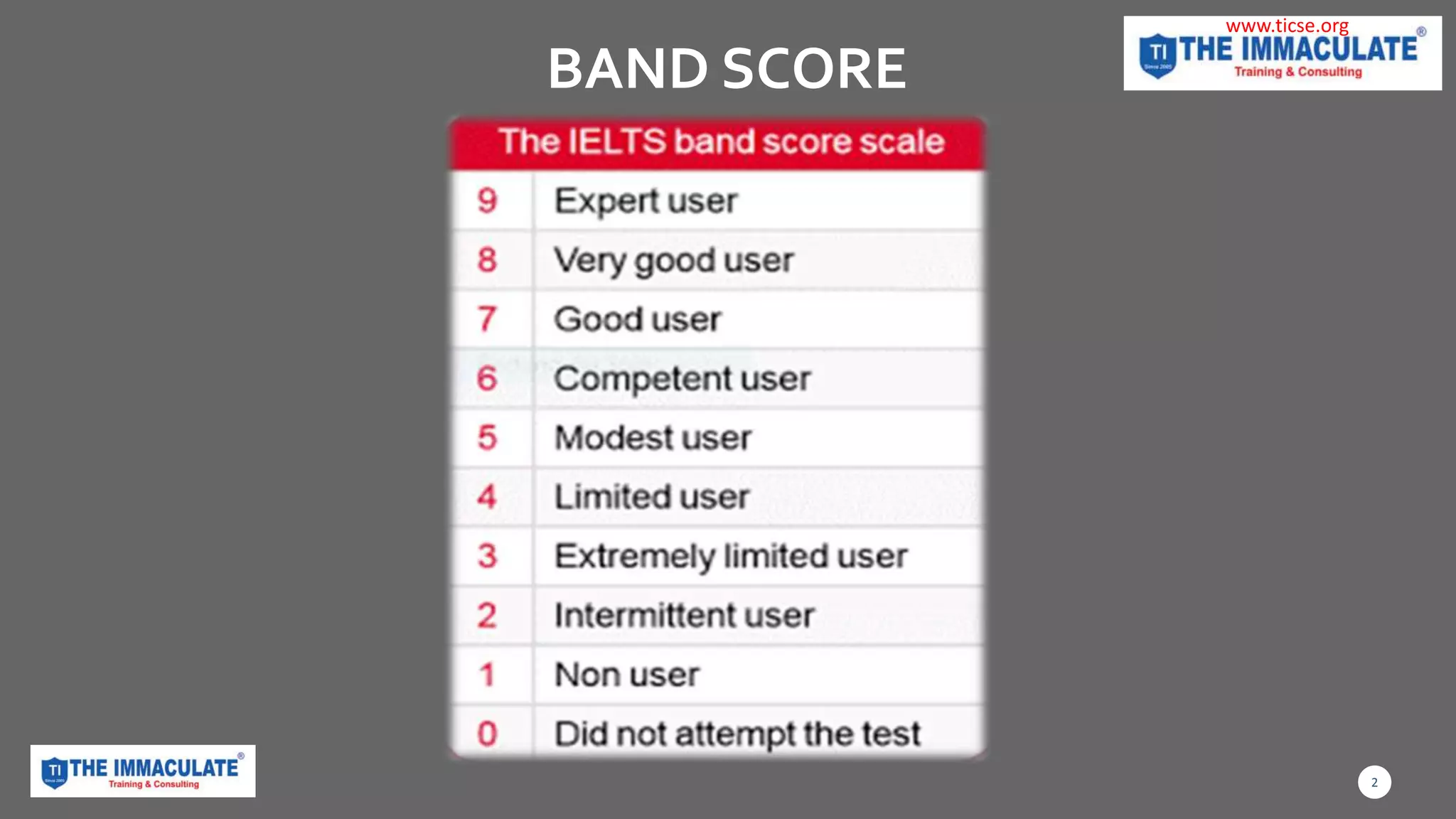
BAND SCORE
2
www.ticse.org
LISTENING
• Before you do each section, you will be given
30-45 seconds to look at the questions. Use
this time to study the questions and try to
predict what you might hear.
• Always check your spelling. If you make a
spelling mistake in the IELTS Listening paper,
your answer will be marked wrong.
• Listen carefully, as there are several ways of
helping people to spell a word without simply
spelling it out. If you need to write something
that is not a name (e.g. the registration number
of a car), you may hear a combination of
numbers and letters.
• You will hear native speaker accents from
several English-speaking countries in the test.
These may include British, American, Canadian,
Australian and New Zealand accents. Search
online for non-commercial national radio
stations in these countries, and try to listen to a
variety of them. National stations often have
talk or current affairs programs that can help
you practice for IELTS.
3
www.ticse.org
READING
• Make sure you read the whole passage so that
you can locate any key words and paraphrases
from the questions. Take highlighter pens into the
exam with you. Use a different colour for each
task, to highlight important parts of the text. This
will help save time when checking answers.
• If you are asked to choose “one word only” from
the passage, make sure you do not add extra
information such as adjectives or adverbs (e.g.
bone tools; abalone shells; gently stirred) or
articles (the ochre). If you write more than one
word, your answer will be marked as wrong.
• Read the headings so that you are familiar with
them, skim read the whole passage to get the
overall meaning.
• Read the first paragraph and decide which
headings might fit, repeat steps 3 and 4 for the
remaining paragraphs.
• Don’t try to match words in the headings to words
in the passage. You need to focus on the whole
idea of each paragraph.
4
www.ticse.org
WRITING
• Your answer must accurately describe the information
presented in the visual. Don’t draw conclusions that are
not supported by the information you are given.
• Each time you come across any form of graph, chart or
table, study it carefully and practice picking out the major
changes that the figure shows. Imagine that you are
explaining to someone else what you have noticed from
the graph.
• Leave at least three minutes at the end to check your
spelling, punctuation and grammar.
• You will lose marks if you copy words from the question.
Make sure to paraphrase the ideas.
• The examiner will assess the coherence and cohesion of
your answer. They will judge how your ideas are
organized and how you link information. Planning before
you write is the best way to make sure your ideas are
organized in a logical way.
• Both the tasks will be assessed based on lexical resources
or vocabulary you use. This means that you need to avoid
repeating words from the question and use as wide a
variety of words and phrases to discuss the topic as you
can.
5
www.ticse.org
SPEAKING
• Make good eye contact with the examiner from
the moment you enter the room, and answer in a
polite and friendly way. Your body language is an
important part of communicating.
• Speaking test should be a natural conversation. If
you try to give a prepared speech, the examiner
will interrupt you and ask you a different question.
• If you run out of ideas after one minute, give
yourself a fresh start by looking at your notes or
looking at the task in the booklet again.
• Listen carefully to the examiner’s questions to
make sure that you answer them fully and
appropriately.
• Part 3, it is important to have your own opinion.
Try to read newspaper and watch the news to
keep up with current issues.
6
www.ticse.org
theimmaculatecoaching@gmail.com
http://www.ticse.org/
FOLLOW US ON

Ielts 9 band score tips

  • 1.
    IELTS 9 BAND SCORETIPS LISTENING, READING, WRITING, SPEAKING ADYAR / VADAPALANI CONTACT NO : 9841633116 / 044-24462116 / 9840403117 / 044-23652016
  • 2.
  • 3.
    LISTENING • Before youdo each section, you will be given 30-45 seconds to look at the questions. Use this time to study the questions and try to predict what you might hear. • Always check your spelling. If you make a spelling mistake in the IELTS Listening paper, your answer will be marked wrong. • Listen carefully, as there are several ways of helping people to spell a word without simply spelling it out. If you need to write something that is not a name (e.g. the registration number of a car), you may hear a combination of numbers and letters. • You will hear native speaker accents from several English-speaking countries in the test. These may include British, American, Canadian, Australian and New Zealand accents. Search online for non-commercial national radio stations in these countries, and try to listen to a variety of them. National stations often have talk or current affairs programs that can help you practice for IELTS. 3 www.ticse.org
  • 4.
    READING • Make sureyou read the whole passage so that you can locate any key words and paraphrases from the questions. Take highlighter pens into the exam with you. Use a different colour for each task, to highlight important parts of the text. This will help save time when checking answers. • If you are asked to choose “one word only” from the passage, make sure you do not add extra information such as adjectives or adverbs (e.g. bone tools; abalone shells; gently stirred) or articles (the ochre). If you write more than one word, your answer will be marked as wrong. • Read the headings so that you are familiar with them, skim read the whole passage to get the overall meaning. • Read the first paragraph and decide which headings might fit, repeat steps 3 and 4 for the remaining paragraphs. • Don’t try to match words in the headings to words in the passage. You need to focus on the whole idea of each paragraph. 4 www.ticse.org
  • 5.
    WRITING • Your answermust accurately describe the information presented in the visual. Don’t draw conclusions that are not supported by the information you are given. • Each time you come across any form of graph, chart or table, study it carefully and practice picking out the major changes that the figure shows. Imagine that you are explaining to someone else what you have noticed from the graph. • Leave at least three minutes at the end to check your spelling, punctuation and grammar. • You will lose marks if you copy words from the question. Make sure to paraphrase the ideas. • The examiner will assess the coherence and cohesion of your answer. They will judge how your ideas are organized and how you link information. Planning before you write is the best way to make sure your ideas are organized in a logical way. • Both the tasks will be assessed based on lexical resources or vocabulary you use. This means that you need to avoid repeating words from the question and use as wide a variety of words and phrases to discuss the topic as you can. 5 www.ticse.org
  • 6.
    SPEAKING • Make goodeye contact with the examiner from the moment you enter the room, and answer in a polite and friendly way. Your body language is an important part of communicating. • Speaking test should be a natural conversation. If you try to give a prepared speech, the examiner will interrupt you and ask you a different question. • If you run out of ideas after one minute, give yourself a fresh start by looking at your notes or looking at the task in the booklet again. • Listen carefully to the examiner’s questions to make sure that you answer them fully and appropriately. • Part 3, it is important to have your own opinion. Try to read newspaper and watch the news to keep up with current issues. 6 www.ticse.org
  • 7.