1
Windows Networking and Device Technologies January 27, 2005
WELCOME
HAR
IKRIHNAN.
July 11, 2006
Presented by
Harikrishnan.P.V
S7 CSE
Reg no: VIAHECS016
2
Windows Networking and Device Technologies January 27, 2005
IEEE 802.11n
HAR
IKRIHNAN.
July 11, 2006
3
Windows Networking and Device Technologies January 27, 2005
HAR
IKRIHNAN.
July 11, 2006
1. In January 2004 IEEE announced that it had formed a new 802.11
TaskGroup (TGn) to develop a new amendment to the 802.11 standard for
local-area wireless networks. The real data throughput is estimated to
reach a theoretical 540 Mbit/s and should be up to 40 times faster than
802.11b, and near 10 times faster than 802.11a or 802.11g.
2. There were two competing proposals of the 802.11n standard: WWiSE
(World-Wide Spectrum Efficiency), backed by companies including
Broadcom, and TGn Sync backed by Intel and Philips.
History
HISTORY
4
Windows Networking and Device Technologies January 27, 2005
HARKRIHNAN.
July 11, 2006
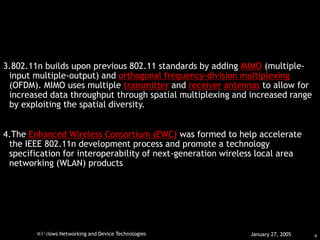
3.802.11n builds upon previous 802.11 standards by adding MIMO (multiple-
input multiple-output) and orthogonal frequency-division multiplexing
(OFDM). MIMO uses multiple transmitter and receiver antennas to allow for
increased data throughput through spatial multiplexing and increased range
by exploiting the spatial diversity.
4.The Enhanced Wireless Consortium (EWC) was formed to help accelerate
the IEEE 802.11n development process and promote a technology
specification for interoperability of next-generation wireless local area
networking (WLAN) products
5
Windows Networking and Device Technologies January 27, 2005
802.11 WLAN Standards
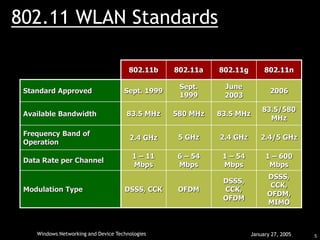
802.11b 802.11a 802.11g 802.11n
Standard Approved Sept. 1999
Sept.
1999
June
2003
2006
Available Bandwidth 83.5 MHz 580 MHz 83.5 MHz
83.5/580
MHz
Frequency Band of
Operation
2.4 GHz 5 GHz 2.4 GHz 2.4/5 GHz
Data Rate per Channel
1 – 11
Mbps
6 – 54
Mbps
1 – 54
Mbps
1 – 600
Mbps
Modulation Type DSSS, CCK OFDM
DSSS,
CCK,
OFDM
DSSS,
CCK,
OFDM,
MIMO
6
Windows Networking and Device Technologies January 27, 2005
802.11n
1.Frequency most likely the 5GHz range, meaning
possible compatibility with 802.11a
2.Throughput to match highest possible data
rates- (raise the effective throughput of WLANs
to at least 100M bps)
3.Defining standardized modifications to the
802.11 physical layers and MAC layers, which
will improve not just data rates but also actual
data throughput
7
Windows Networking and Device Technologies January 27, 2005
802.11n PHY Improvements
1. Improved coding and modulation
2. Backward compatibility
3. Number of antennas
4. MIMO and Spatial Multiplexing
8
Windows Networking and Device Technologies January 27, 2005
MIMO Wireless Systems
Multiple Input Multiple Output (MIMO) systems with
multiple parallel radios improve the following:
• Outages reduced by using information from multiple
antennas
• Transmit power can be increased via multiple power
amplifiers
• Higher throughputs possible
channel
Radio
D
S
P
Bits
TX
Radio
Radio
D
S
P
Bits
RX
Radio
9
Windows Networking and Device Technologies January 27, 2005
MIMO
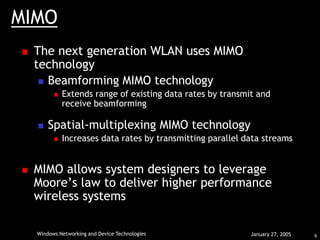
 The next generation WLAN uses MIMO
technology
 Beamforming MIMO technology
 Extends range of existing data rates by transmit and
receive beamforming
 Spatial-multiplexing MIMO technology
 Increases data rates by transmitting parallel data streams
 MIMO allows system designers to leverage
Moore’s law to deliver higher performance
wireless systems
10
Windows Networking and Device Technologies January 27, 2005
HAR
IKRIHNAN.
July 11, 2006
Operating Modes
The PHY will operate in one of 3 modes
Legacy Mode – in this mode packets are transmitted in the
legacy 802.11a/g format.
Mixed Mode – in this mode packets are transmitted with a
preamble compatible with the legacy 802.11a/g. The rest of the
packet has a new format. In this mode the receiver shall be
able to decode both the Mixed Mode packets and legacy packets.
11
Windows Networking and Device Technologies January 27, 2005
HAR
IKRIHNAN.
July 11, 2006
Operating Modes–(cont)
Green Field – in this mode high throughput packets are
transmitted without a legacy compatible part. This mode
is optional. In this mode the receiver shall be able to decode
both Green Field mode packets, Mixed Mode packets and
legacy format packets.
12
Windows Networking and Device Technologies January 27, 2005
HAR
IKRIHNAN.
July 11, 2006
Benefits of 802.11n:
1. Irresistible Performance and Range
2. Compelling Capacity
3. No Network Left Behind
13
Windows Networking and Device Technologies January 27, 2005
HAR
IKRIHNAN.
July 11, 2006
Challenges of 802.11n:
1. Enterprise Deployment Challenges
2. New Coverage Patterns
3. Variety of Client Devices
4. Consumer and Small Business Already Moving
14
Windows Networking and Device Technologies January 27, 2005
Conclusion
It’s All Good
802.11n will substantially increase the performance and
ubiquitous wireless access of laptops, desktops, smart phones
and entertainment devices over the next several years.
Without cost increase, just like the migration from 802.11 cousin
10 Mbps Ethernet to gigabit Ethernet, 802.11n will first appear in
client devices and begin to be pervasively deployed in enterprises,
homes and eventually metro networks.
While there will be teething problems with this new technology,
there is no doubt of its pervasive and inevitable deployment.
15
Windows Networking and Device Technologies January 27, 2005
THANK YOU…….

ieee 802.11n

  • 1.
    1 Windows Networking andDevice Technologies January 27, 2005 WELCOME HAR IKRIHNAN. July 11, 2006 Presented by Harikrishnan.P.V S7 CSE Reg no: VIAHECS016
  • 2.
    2 Windows Networking andDevice Technologies January 27, 2005 IEEE 802.11n HAR IKRIHNAN. July 11, 2006
  • 3.
    3 Windows Networking andDevice Technologies January 27, 2005 HAR IKRIHNAN. July 11, 2006 1. In January 2004 IEEE announced that it had formed a new 802.11 TaskGroup (TGn) to develop a new amendment to the 802.11 standard for local-area wireless networks. The real data throughput is estimated to reach a theoretical 540 Mbit/s and should be up to 40 times faster than 802.11b, and near 10 times faster than 802.11a or 802.11g. 2. There were two competing proposals of the 802.11n standard: WWiSE (World-Wide Spectrum Efficiency), backed by companies including Broadcom, and TGn Sync backed by Intel and Philips. History HISTORY
  • 4.
    4 Windows Networking andDevice Technologies January 27, 2005 HARKRIHNAN. July 11, 2006 3.802.11n builds upon previous 802.11 standards by adding MIMO (multiple- input multiple-output) and orthogonal frequency-division multiplexing (OFDM). MIMO uses multiple transmitter and receiver antennas to allow for increased data throughput through spatial multiplexing and increased range by exploiting the spatial diversity. 4.The Enhanced Wireless Consortium (EWC) was formed to help accelerate the IEEE 802.11n development process and promote a technology specification for interoperability of next-generation wireless local area networking (WLAN) products
  • 5.
    5 Windows Networking andDevice Technologies January 27, 2005 802.11 WLAN Standards 802.11b 802.11a 802.11g 802.11n Standard Approved Sept. 1999 Sept. 1999 June 2003 2006 Available Bandwidth 83.5 MHz 580 MHz 83.5 MHz 83.5/580 MHz Frequency Band of Operation 2.4 GHz 5 GHz 2.4 GHz 2.4/5 GHz Data Rate per Channel 1 – 11 Mbps 6 – 54 Mbps 1 – 54 Mbps 1 – 600 Mbps Modulation Type DSSS, CCK OFDM DSSS, CCK, OFDM DSSS, CCK, OFDM, MIMO
  • 6.
    6 Windows Networking andDevice Technologies January 27, 2005 802.11n 1.Frequency most likely the 5GHz range, meaning possible compatibility with 802.11a 2.Throughput to match highest possible data rates- (raise the effective throughput of WLANs to at least 100M bps) 3.Defining standardized modifications to the 802.11 physical layers and MAC layers, which will improve not just data rates but also actual data throughput
  • 7.
    7 Windows Networking andDevice Technologies January 27, 2005 802.11n PHY Improvements 1. Improved coding and modulation 2. Backward compatibility 3. Number of antennas 4. MIMO and Spatial Multiplexing
  • 8.
    8 Windows Networking andDevice Technologies January 27, 2005 MIMO Wireless Systems Multiple Input Multiple Output (MIMO) systems with multiple parallel radios improve the following: • Outages reduced by using information from multiple antennas • Transmit power can be increased via multiple power amplifiers • Higher throughputs possible channel Radio D S P Bits TX Radio Radio D S P Bits RX Radio
  • 9.
    9 Windows Networking andDevice Technologies January 27, 2005 MIMO  The next generation WLAN uses MIMO technology  Beamforming MIMO technology  Extends range of existing data rates by transmit and receive beamforming  Spatial-multiplexing MIMO technology  Increases data rates by transmitting parallel data streams  MIMO allows system designers to leverage Moore’s law to deliver higher performance wireless systems
  • 10.
    10 Windows Networking andDevice Technologies January 27, 2005 HAR IKRIHNAN. July 11, 2006 Operating Modes The PHY will operate in one of 3 modes Legacy Mode – in this mode packets are transmitted in the legacy 802.11a/g format. Mixed Mode – in this mode packets are transmitted with a preamble compatible with the legacy 802.11a/g. The rest of the packet has a new format. In this mode the receiver shall be able to decode both the Mixed Mode packets and legacy packets.
  • 11.
    11 Windows Networking andDevice Technologies January 27, 2005 HAR IKRIHNAN. July 11, 2006 Operating Modes–(cont) Green Field – in this mode high throughput packets are transmitted without a legacy compatible part. This mode is optional. In this mode the receiver shall be able to decode both Green Field mode packets, Mixed Mode packets and legacy format packets.
  • 12.
    12 Windows Networking andDevice Technologies January 27, 2005 HAR IKRIHNAN. July 11, 2006 Benefits of 802.11n: 1. Irresistible Performance and Range 2. Compelling Capacity 3. No Network Left Behind
  • 13.
    13 Windows Networking andDevice Technologies January 27, 2005 HAR IKRIHNAN. July 11, 2006 Challenges of 802.11n: 1. Enterprise Deployment Challenges 2. New Coverage Patterns 3. Variety of Client Devices 4. Consumer and Small Business Already Moving
  • 14.
    14 Windows Networking andDevice Technologies January 27, 2005 Conclusion It’s All Good 802.11n will substantially increase the performance and ubiquitous wireless access of laptops, desktops, smart phones and entertainment devices over the next several years. Without cost increase, just like the migration from 802.11 cousin 10 Mbps Ethernet to gigabit Ethernet, 802.11n will first appear in client devices and begin to be pervasively deployed in enterprises, homes and eventually metro networks. While there will be teething problems with this new technology, there is no doubt of its pervasive and inevitable deployment.
  • 15.
    15 Windows Networking andDevice Technologies January 27, 2005 THANK YOU…….

Editor's Notes