Emerging Technology
Roundtable – Substation
Automation/IEC 61850
November 15-16, 2016
RELIABILITY | ACCOUNTABILITY
2
Agenda - Emerging Technology Roundtable
RELIABILITY | ACCOUNTABILITY
3
TransitionProgram@nerc.net
Overview of IEC 61850 technology
NERC Emerging TechnologyWorkshop
Nov-15, 2016
Deepak Maragal, PhD, PE Herbert Falk
Senior Protection & Control Engineer-I Senior Solutions Architect
New York Power Authority Systems Integration Specialists Company
Agenda
What is IEC 61850?
What applications do IEC 61850 cover?
Pros-Cons of IEC 61850 based Substation Automation System
Architectures
Time synchronization
Cyber Security
2
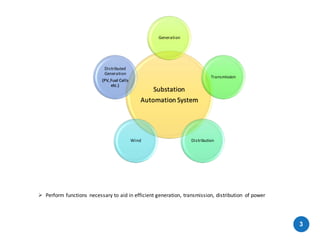
Substation
Automation System
Generation
Transmission
Distribution
Wind
Distributed
Generation
(PV,Fuel Cells
etc.)
 Perform functions necessary to aid in efficient generation, transmission, distribution of power
3
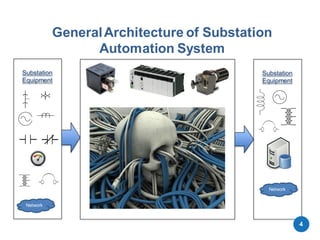
GeneralArchitecture of Substation
Automation System
Substation
Equipment
Substation
Equipment
Network
Network
4
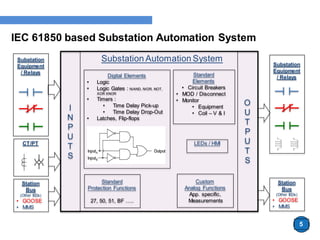
IEC 61850 based Substation Automation System
5
5
Substation
Equipment
/ Relays
Substation Automation System
Digital Elements
• Logic
• Logic Gates : N/AND, N/OR, NOT,
XOR XNOR
• Timers :
• Time Delay Pick-up
• Time Delay Drop-Out
• Latches, Flip-flops
Station
Bus
(Other IEDs)
• GOOSE
• MMS
Standard
Protection Functions
27, 50, 51, BF …..
Custom
Analog Functions
App. specific,
Measurements
Standard
Elements
• Circuit Breakers
• MOD / Disconnect
• Monitor
• Equipment
• Coil – V & I
LEDs / HMI
CT/PT
Substation
Equipment
/ Relays
Station
Bus
(Other IEDs)
• GOOSE
• MMS
I
N
P
U
T
S
O
U
T
P
U
T
S
3
2
1
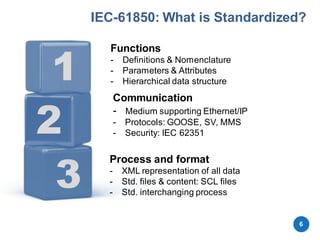
Functions
- Definitions & Nomenclature
- Parameters & Attributes
- Hierarchical data structure
Communication
- Medium supporting Ethernet/IP
- Protocols: GOOSE, SV, MMS
- Security: IEC 62351
Process and format
- XML representation of all data
- Std. files & content: SCL files
- Std. interchanging process
IEC-61850: What is Standardized?
6
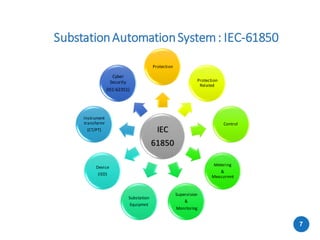
IEC
61850
Protection
Protection
Related
Control
Metering
&
Measurmnt
Supervision
&
Monitoring
Substation
Equipmnt
Device
(IED)
Instrument
transformr
(CT/PT)
Cyber
Security
(IEC-62351)
SubstationAutomationSystem: IEC-61850
7
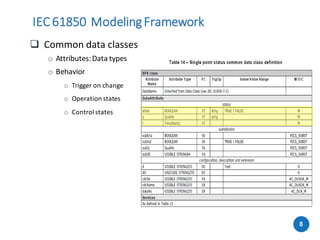
 Common data classes
o Attributes:Data types
o Behavior
o Trigger on change
o Operation states
o Control states
IEC61850 ModelingFramework
8
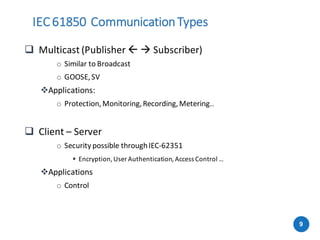
IEC61850 CommunicationTypes
 Multicast (Publisher   Subscriber)
o Similar to Broadcast
o GOOSE,SV
Applications:
o Protection,Monitoring,Recording,Metering..
 Client – Server
o Security possible throughIEC-62351
 Encryption,User Authentication,Access Control …
Applications
o Control
9
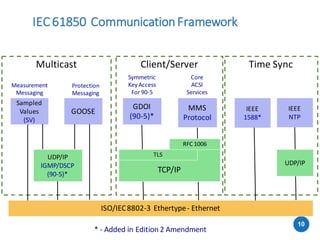
IEC61850 CommunicationFramework
10
Multicast Client/Server
ISO/IEC8802-3 Ethertype- Ethernet
Sampled
Values
(SV)
GOOSE MMS
Protocol
IEEE
1588*
GDOI
(90-5)*
UDP/IP
IGMP/DSCP
(90-5)*
TCP/IP
TLS
RFC 1006
Protection
Messaging
Measurement
Messaging
Symmetric
Key Access
For 90-5
Core
ACSI
Services
Time Sync
IEEE
NTP
UDP/IP
* - Added in Edition 2 Amendment
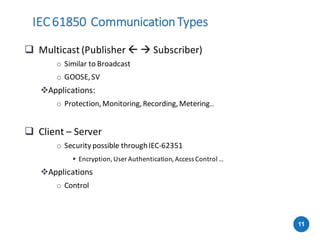
IEC61850 CommunicationTypes
 Multicast (Publisher   Subscriber)
o Similar to Broadcast
o GOOSE,SV
Applications:
o Protection,Monitoring,Recording,Metering..
 Client – Server
o Security possible throughIEC-62351
 Encryption,User Authentication,Access Control …
Applications
o Control
11
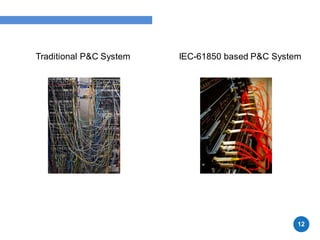
Traditional P&C System IEC-61850 based P&C System
12
Advantages of IEC 61850 based SAS
Cable reduction
Interoperability & standardization
Extensive troubleshooting & performance data
Self monitoring & improvement in reliability
Distributed and Centralized implementation
13
Disadvantages of IEC 61850 based SAS
New technology is Complex
o Requires change
o New skills & tools
Additional burden on Network management
Cyber security overheads: NERC CIP
Complexity & overheads out way Benefits in many applications
14
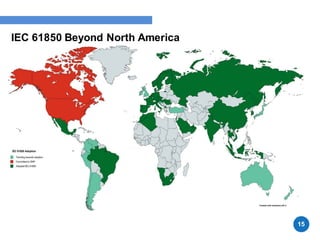
IEC 61850 Beyond North America
15
IEC 61850 Beyond the Substation (North America)
 Substation-to-Control Center (IEC/TR 61850-90-2) targeted for SCADA
communication
 AEP – in all substations
 SCE – Centralized Remedial Action Scheme and all future substations
 CONED and others have active deployments
 Substation-to-Substation (IEC/TR 61850-90-1) communication typically used for
protection control
 SCE’s, PG&E, SRP, Toronto Airport are examples
 Secure Synchrophasor for WAMPAC
 PG&E has an active deployment for Wide Area Monitoring and Situational
Awareness (no PAC)
 Windpower and DER (including aggregation) for SCADA
 E.on and EDF Canada (Windpower)
 Largest IEC 61850 deployment coming in a SW Refinery
16
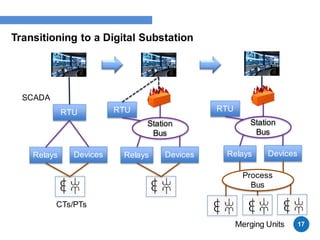
Transitioning to a Digital Substation
17
Relays Devices
CTs/PTs
RTU
SCADA
Relays Devices
RTU
Station
Bus
Relays Devices
RTU
Station
Bus
Merging Units
Process
Bus
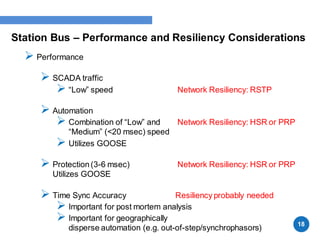
Station Bus – Performance and Resiliency Considerations
 Performance
 SCADA traffic
 “Low” speed Network Resiliency: RSTP
 Automation
 Combination of “Low” and Network Resiliency: HSR or PRP
“Medium” (<20 msec) speed
 Utilizes GOOSE
 Protection(3-6 msec) Network Resiliency: HSR or PRP
Utilizes GOOSE
 Time Sync Accuracy Resiliency probably needed
 Important for post mortem analysis
 Important for geographically
disperse automation (e.g. out-of-step/synchrophasors)
18
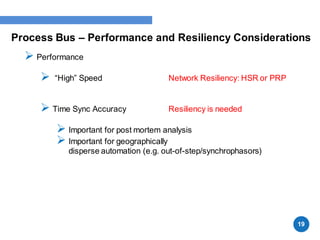
Process Bus – Performance and Resiliency Considerations
 Performance
 “High” Speed Network Resiliency: HSR or PRP
 Time Sync Accuracy Resiliency is needed
 Important for post mortem analysis
 Important for geographically
disperse automation (e.g. out-of-step/synchrophasors)
19
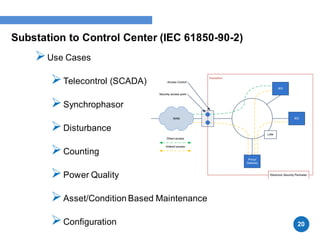
Substation to Control Center (IEC 61850-90-2)
Use Cases
Telecontrol (SCADA)
Synchrophasor
Disturbance
Counting
Power Quality
Asset/Condition Based Maintenance
Configuration 20
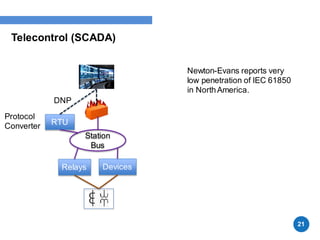
Telecontrol (SCADA)
21
Relays Devices
RTU
Station
Bus
DNP
Protocol
Converter
Newton-Evans reports very
low penetration of IEC 61850
in NorthAmerica.
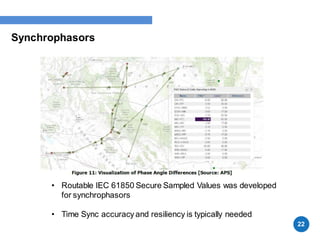
Synchrophasors
22
• Routable IEC 61850 Secure Sampled Values was developed
for synchrophasors
• Time Sync accuracy and resiliency is typically needed
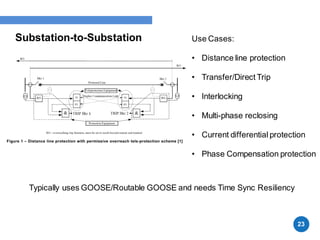
Substation-to-Substation
23
Use Cases:
• Distance line protection
• Transfer/Direct Trip
• Interlocking
• Multi-phase reclosing
• Current differential protection
• Phase Compensation protection
Typically uses GOOSE/Routable GOOSE and needs Time Sync Resiliency
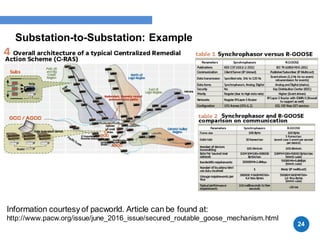
Substation-to-Substation: Example
24
Information courtesy of pacworld. Article can be found at:
http://www.pacw.org/issue/june_2016_issue/secured_routable_goose_mechanism.html
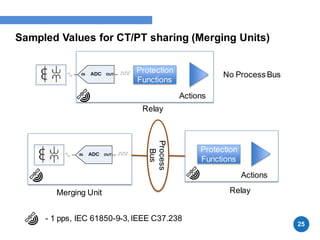
Sampled Values for CT/PT sharing (Merging Units)
25
Protection
Functions
Actions
Relay
Protection
Functions
Actions
Relay
Process
Bus
Merging Unit
No Process Bus
- 1 pps, IEC 61850-9-3, IEEE C37.238
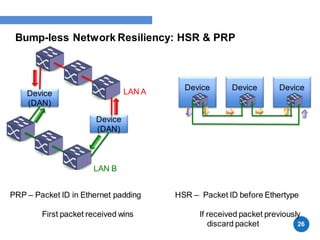
Bump-less Network Resiliency: HSR & PRP
26
LAN A
LAN B
Device
(DAN)
Device
(DAN)
Device Device Device
PRP – Packet ID in Ethernet padding
First packet received wins
HSR – Packet ID before Ethertype
If received packet previously
discard packet
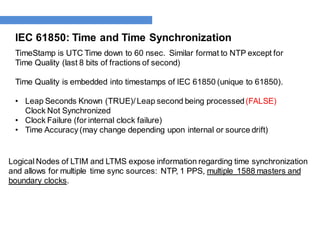
IEC 61850: Time and Time Synchronization
TimeStamp is UTC Time down to 60 nsec. Similar format to NTP except for
Time Quality (last 8 bits of fractions of second)
Time Quality is embedded into timestamps of IEC 61850 (unique to 61850).
• Leap Seconds Known (TRUE)/ Leap second being processed(FALSE)
Clock Not Synchronized
• Clock Failure (for internal clock failure)
• Time Accuracy (may change depending upon internal or source drift)
Logical Nodes of LTIM and LTMS expose information regarding time synchronization
and allows for multiple time sync sources: NTP, 1 PPS, multiple 1588 masters and
boundary clocks.
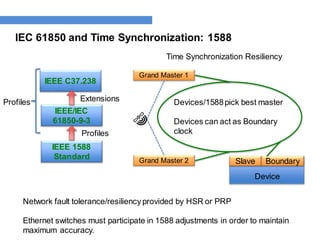
IEC 61850 and Time Synchronization: 1588
Profiles
IEEE 1588
Standard
IEEE/IEC
61850-9-3
IEEE C37.238
Extensions
Profiles
Grand Master 1
Grand Master 2 Slave Boundary
Device
Devices/1588pick best master
Devices can act as Boundary
clock
Time Synchronization Resiliency
Network fault tolerance/resiliency provided by HSR or PRP
Ethernet switches must participate in 1588 adjustments in order to maintain
maximum accuracy.
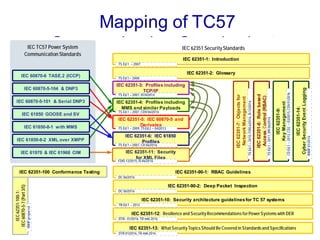
Mapping of TC57
Communication Standards to
IEC 62351 Security Standards
IEC TC57 Power System
Communication Standards
IEC 62351 SecurityStandards
IEC 62351-1: Introduction
IEC 62351-2: Glossary
IEC
62351-7:
Objects
for
Network
Management
IEC
62351-8:
Role
based
Access
Control
(RBAC)
IEC
62351-9:
Key
Management
IEC 62351-3: Profiles including
TCP/IP
IEC 62351-4: Profiles including
MMS and similar Payloads
IEC 62351-5: IEC 60870-5 and
Derivates
IEC 62351-6: IEC 61850
Profiles
TS Ed.1 – 2007
TS Ed.1 – 2008
TS Ed.1 – 2007, IS10/2014
TS Ed.1 – 2007, CDV 06/2016
TS Ed.1 – 2009, TS Ed.2 – 04/2013
TS Ed.1 – 2007, CD 06/2016
TS
Ed.1
–
2010,
FDIS
6/2016,
IS
12/2016
TS
Ed.1
–
2011,
RR
06/2016
CD
Ed.1
–
2013,
CD2
–
03/2015,
CDV
01/2016
IEC 62351-10: Security architecture guidelinesfor TC 57 systems
IEC 62351-12: Resilience and Security Recommendations forPowerSystems with DER
IEC 62351-13: What Security Topics Should Be Covered in Standards and Specifications
IEC
62351-14:
Cyber
Security
Event
Logging
NWIP
01/2016
IEC 62351-90-1: RBAC Guidelines
DC 06/2016
IEC 62351-90-2: Deep Packet Inspection
DC 06/2016
TR Ed.1 – 2012
DTR– 01/2016, TR mid-2016
DTR 01/2016, TR mid-2016
IEC
62351-100-1:
IEC
60870-5-7
(Part
3/5)
NWIP
prepared
IEC 62351-100 Conformance Testing
IEC 60870-6 TASE.2 (ICCP)
IEC 61850-8-1 with MMS
IEC 61850 GOOSE and SV
IEC 60870-5-104 & DNP3
IEC 60870-5-101 & Serial DNP3
IEC 61970 & IEC 61968 CIM
IEC 61850-8-2 XML over XMPP
IEC 62351-11: Security
for XML Files
FDIS 12/2015, IS 06/2016
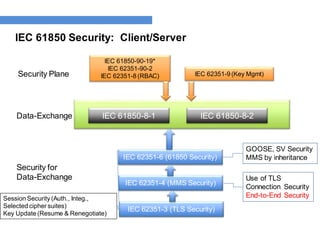
IEC 61850 Security: Client/Server
IEC 61850-90-19*
IEC 62351-90-2
IEC 62351-8 (RBAC) IEC 62351-9 (Key Mgmt)
Security Plane
IEC 61850-8-1 IEC 61850-8-2
Data-Exchange
Security for
Data-Exchange
IEC 62351-3 (TLS Security)
IEC 62351-4 (MMS Security)
IEC 62351-6 (61850 Security)
Use of TLS
Connection Security
End-to-End Security
GOOSE, SV Security
MMS by inheritance
Session Security (Auth., Integ.,
Selected cipher suites)
Key Update (Resume & Renegotiate)
IEC 61850 Security: Client/Server RBAC
RBAC infrastructure allows:
• New role definitions
• Area of responsibilities
• Changes based upon operational
• constraints
IEC 61850 Security: GOOSE and SV
GOOSE SV for CT/PT Synchrophasors
L2 UDP/IP L2 UDP/IP SV over UDP/IP
Authentication x x x x x
Tamper Detection x x x x x
Confidentiality x x Not
Suggested
Not Suggested x
Policy and symmetric keys managed through extensions of GDOI – Key Distribution
Center (KDC)
Layer 2 can also be non-secure and that is what is typically deployed for
intra-substation communication.
Opportunities
Provides:
• Members with access to draft standards
• Supports user feedback and answering questions
• Sponsoring of the 4th IEC 61850 IOP
• Other benefits
IEC 61850
Boot Camp
Co-locatedwith the 2017 IEC 61850 IOP. Scheduled
October 12-13, 2017 in New Orleans.
2017
IEC 61850
Interoperability
Testing
Set-up October 13, 2017 in New Orleans
Testing October 14-19, 2017
Coordination and test development starting 11/2016
IEEE PSRCC
H30
Provides a forum for users and vendors to discuss
issues in using IEC 61850 and forward issues that
may impact the IEC standards to the appropriate
standards body.
Next meeting
January 2017
New Orleans
Deepak.Maragal@nypa.gov
Office: 914-287-3874
Cell: 914-364-1241
Herb@sisconet.com
Office: 586-254-0020 x105
61850 Business Drivers
Digital Re-Invention at Southern California Edison
Jeff Gooding
IT Principal Manager
Enterprise Architecture & Strategy
November, 2016
1
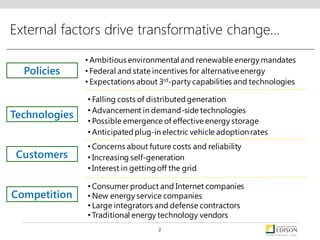
External factors drive transformative change…
• Falling costs of distributed generation
• Advancement in demand-side technologies
• Possible emergence of effective energy storage
• Anticipated plug-in electric vehicle adoptionrates
Technologies
• Ambitiousenvironmentaland renewable energy mandates
• Federal and state incentives for alternativeenergy
• Expectations about 3rd-party capabilities and technologies
Policies
• Concerns about future costs and reliability
• Increasing self-generation
• Interest in gettingoff the grid
Customers
• Consumer product and Internet companies
• New energy service companies
• Large integrators and defense contractors
• Traditional energy technology vendors
Competition
2
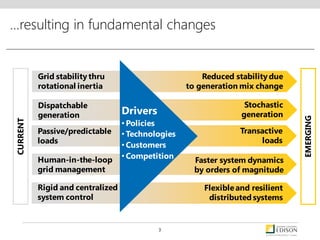
…resulting in fundamental changes
Grid stability thru
rotational inertia
Reduced stability due
to generation mix change
Dispatchable
generation
Stochastic
generation
Passive/predictable
loads
Transactive
loads
Human-in-the-loop
grid management
Faster system dynamics
by orders of magnitude
Rigid and centralized
system control
Flexible and resilient
distributed systems
CURRENT
EMERGING
Drivers
• Policies
• Technologies
• Customers
• Competition
3
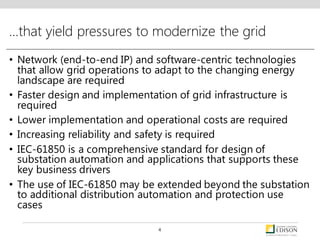
…that yield pressures to modernize the grid
• Network (end-to-end IP) and software-centric technologies
that allow grid operations to adapt to the changing energy
landscape are required
• Faster design and implementation of grid infrastructure is
required
• Lower implementation and operational costs are required
• Increasing reliability and safety is required
• IEC-61850 is a comprehensive standard for design of
substation automation and applications that supports these
key business drivers
• The use of IEC-61850 may be extended beyond the substation
to additional distribution automation and protection use
cases
4
61850 Key Business Benefits
• Capital Cost Reduction – Less space for mechanical switches,
copper wires, signaling devices and meters as well as decreased
complexity in CT & PT wiring if process bus is used
• Interoperability – Multi-vendor integration is faster and avoidance
of vendor lock-in drives costs down. Integration costs are pushed
to the vendors.
• Increased speed to delivery – Using the 61850 standard improves
engineering efficiency, procurement and commissioning through
standard configuration language, object-oriented software, XML
and automated testing tools
• Operational Reliability – Enhanced situational awareness allows
for better and faster operational decisions with more timely data.
Reduced equipment operations and maintenance costs by reducing
time to find and fix issues (some fixed automatically)
5
Technical Imperatives in a Digital Utility
• Common “core” communications protocols across the grid
with virtualized gateways and edge compute to translate non-
61850 protocols
• End-to-end standard Internet Protocol(IP) communications to
facilitate modern cybersecurity on the grid
• Common cybersecurity framework and a “defense-in-depth”
design to protect the grid against attack
• Real-time, distributed control and event-driven architectures
• Software-centric solutions with remote upgradability and
automated testing to accommodate requirements in the
future
6
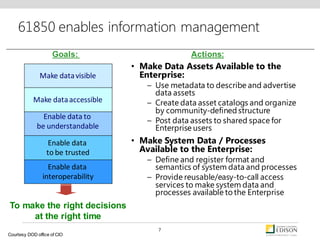
61850 enables information management
• Make Data Assets Available to the
Enterprise:
– Use metadata to describe and advertise
data assets
– Create data asset catalogs and organize
by community-defined structure
– Post data assets to shared space for
Enterprise users
• Make System Data / Processes
Available to the Enterprise:
– Define and register format and
semantics of system data and processes
– Provide reusable/easy-to-call access
services to make system data and
processes available to the Enterprise
Make datavisible
Make dataaccessible
Enable data to
be understandable
Enable data
to be trusted
Enable data
interoperability
To make the right decisions
at the right time
Goals: Actions:
Courtesy DOD office of CIO
7
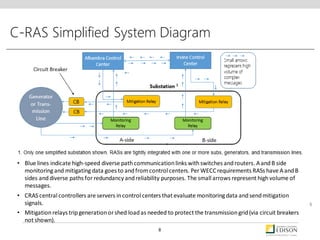
C-RAS Simplified System Diagram
8
• Blue lines indicate high-speed diverse pathcommunicationlinks withswitches androuters. AandB side
monitoringand mitigatingdata goes to andfromcontrol centers. Per WECCrequirements RASs have AandB
sides anddiverse paths for redundancy andreliability purposes. The small arrows represent highvolume of
messages.
• CRAS central controllers are servers incontrol centers that evaluate monitoringdata andsendmitigation
signals.
• Mitigationrelays tripgenerationor shed loadas needed to protect the transmissiongrid(via circuit breakers
not shown).
8
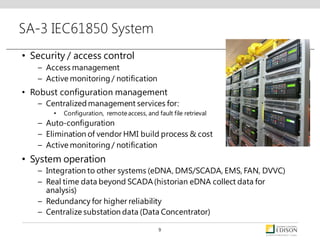
SA-3 IEC61850 System
• Security / access control
– Access management
– Active monitoring / notification
• Robust configuration management
– Centralized management services for:
• Configuration, remoteaccess, and fault file retrieval
– Auto-configuration
– Elimination of vendor HMI build process & cost
– Active monitoring / notification
• System operation
– Integration to other systems (eDNA, DMS/SCADA, EMS, FAN, DVVC)
– Real time data beyond SCADA(historian eDNA collect data for
analysis)
– Redundancy for higher reliability
– Centralize substation data (Data Concentrator)
9
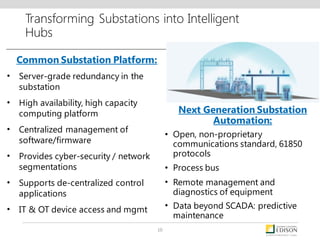
Transforming Substations into Intelligent
Hubs
Common Substation Platform:
• Server-grade redundancy in the
substation
• High availability, high capacity
computing platform
• Centralized management of
software/firmware
• Provides cyber-security / network
segmentations
• Supports de-centralized control
applications
• IT & OT device access and mgmt
Next Generation Substation
Automation:
• Open, non-proprietary
communications standard, 61850
protocols
• Process bus
• Remote management and
diagnostics of equipment
• Data beyond SCADA: predictive
maintenance
10
Questions?
11
Entergy
Transmission
Engineering
IEC 61850
Next Gen Substation Automation
Chan Wong
cwong@entergy.com
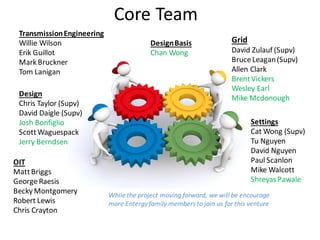
Core Team
TransmissionEngineering
Willie Wilson
Erik Guillot
Mark Bruckner
Tom Lanigan
Grid
David Zulauf (Supv)
Bruce Leagan(Supv)
Allen Clark
BrentVickers
Wesley Earl
Mike Mcdonough
Design
Chris Taylor (Supv)
David Daigle (Supv)
Josh Bonfiglio
ScottWaguespack
Jerry Berndsen
Settings
Cat Wong (Supv)
Tu Nguyen
David Nguyen
Paul Scanlon
Mike Walcott
ShreyasPawale
While the project moving forward, we will be encourage
more Entergy family members to join us for this venture
DesignBasis
Chan Wong
OIT
MattBriggs
George Raesis
Becky Montgomery
Robert Lewis
Chris Crayton
Core Team
2
Entergy TransmissionEngineering
Collaborators
3
Entergy
Transmission
Engineering
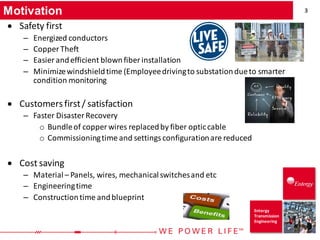
Motivation
• Safety first
– Energized conductors
– Copper Theft
– Easier andefficient blownfiber installation
– Minimizewindshieldtime (Employeedrivingto substationdueto smarter
condition monitoring
• Customersfirst/ satisfaction
– Faster Disaster Recovery
o Bundleof copper wires replacedby fiber opticcable
o Commissioningtime and settings configurationare reduced
• Cost saving
– Material– Panels, wires, mechanicalswitchesand etc
– Engineeringtime
– Constructiontime andblueprint
4
Entergy
Transmission
Engineering
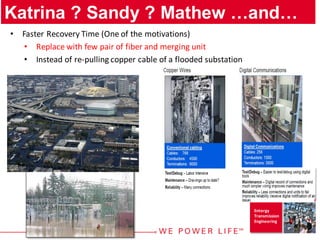
Katrina ? Sandy ? Mathew …and…
• Faster Recovery Time (One of the motivations)
• Replace with few pair of fiber and merging unit
• Instead of re-pulling copper cable of a flooded substation
5
Entergy
Transmission
Engineering
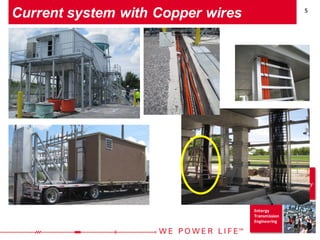
Current system with Copper wires
6
Entergy
Transmission
Engineering
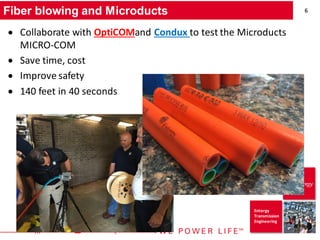
Fiber blowing and Microducts
• Collaborate with OptiCOMand Condux to test the Microducts
MICRO-COM
• Save time, cost
• Improve safety
• 140 feet in 40 seconds
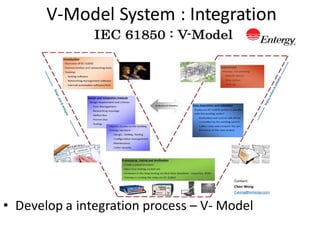
• Develop a integration process – V- Model
V-Model System : Integration
8
Entergy
Transmission
Engineering
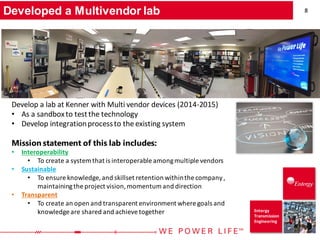
Developed a Multivendor lab
Develop a lab at Kenner with Multi vendor devices (2014-2015)
• As a sandboxto testthe technology
• Develop integrationprocessto the existing system
Mission statement of this lab includes:
• Interoperability
• To create a system that is interoperable amongmultiple vendors
• Sustainable
• To ensure knowledge,and skillset retention withinthe company,
maintainingthe project vision,momentum and direction
• Transparent
• To create an open and transparent environment where goals and
knowledge are shared and achieve together
9
Entergy
Transmission
Engineering
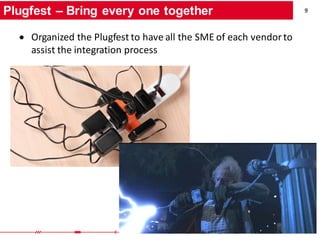
Plugfest – Bring every one together
• Organized the Plugfest to have all the SME of each vendor to
assist the integration process
10
Entergy
Transmission
Engineering
Plugfest 1.0
• Proof of concept of IEC 61850
• Show the benefit of running fiber versus copper wire
• Show the different testing process
• Design, Settings, and Communicationdifference compare to
existing process
• Vendors: Doble, Omicron, ABB, ALSTOM, SEL
Outcome
• Test station were suggested to test the IEDs in the real life
environment
• Pilot system will run in parallel with the existing protection
scheme
11
Entergy
Transmission
Engineering
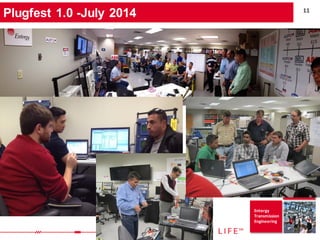
Plugfest 1.0 -July 2014
12
Entergy
Transmission
Engineering
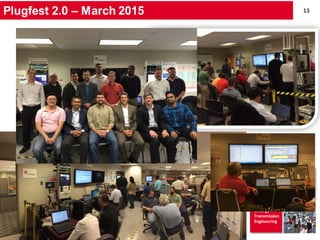
Plugfest 2.0 -- March 2015
• Added more collaborators
– SIEMENS
– Opti-COM
• Joliet Substation
– Overcurrent protection scheme based on existing Breaker Settings
• Requirements
– Edition 2 IEDs were requested
– PRP or HSR – redundancy features
– IEEE 1588
– Human Machine Interface (HMI)
– Grandmaster clock (Optional)
– DFR (Optional)
– Wireless (Optional)
13
Entergy
Transmission
Engineering
Plugfest 2.0 – March 2015
14
Entergy
Transmission
Engineering
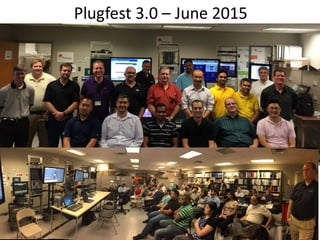
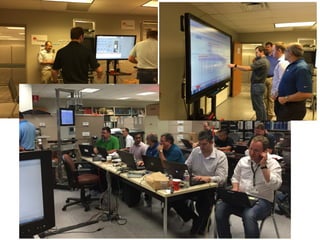
Plugfest 3.0 – June 2015
• New Collaborators
– SUBNET
– HIRSCHMANN
– Condux International
• Resolve challenges found in Plugfest 2.0
• Try to integrate all vendors into one network
• Redundancy protocol
– VLAN
– Multicast (To be tested later)
• Settings matches Joliet Substation Breakers’ Overcurrent
Settings
• WE ARE READY FOR JOLIET
Plugfest 3.0 – June 2015
17
Entergy
Transmission
Engineering
Joliet Pilot Substation
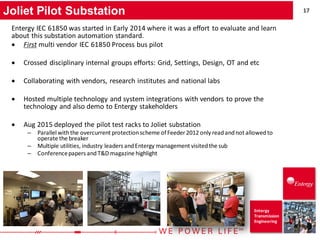
Entergy IEC 61850 was started in Early 2014 where it was a effort to evaluate and learn
about this substation automation standard.
• First multi vendor IEC 61850 Process bus pilot
• Crossed disciplinary internal groups efforts: Grid, Settings, Design, OT and etc
• Collaborating with vendors, research institutes and national labs
• Hosted multiple technology and system integrations with vendors to prove the
technology and also demo to Entergy stakeholders
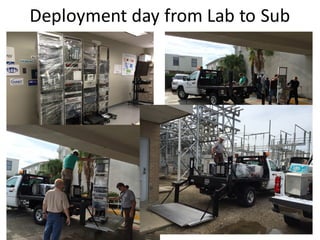
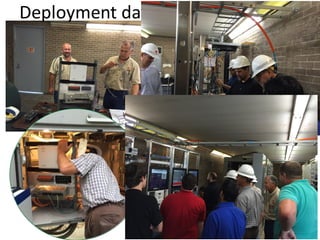
• Aug 2015 deployed the pilot test racks to Joliet substation
– Parallel withthe overcurrent protectionscheme ofFeeder 2012 only readandnot allowedto
operate the breaker
– Multiple utilities, industry leaders andEntergy management visitedthe sub
– Conferencepapers andT&D magazine highlight
Deployment day from Lab to Sub
Parallel Monitoring System
• The IEC 61850 system is configured
– Based on the settings from the protection scheme
settings in the substation
– Parallel system to monitor the system
– ONLY Read --- NOT ALLOWED to operate the breaker
– Used for data validation after pilot duration
(>3months)
Overcurrent scheme
• All relay settings are based on the existing
setting in Joliet Sub’s pilot breaker
• Process bus -- Pass!!!!
– Per testing via injecting current through the
merging unit
– Relay subscribe the data through the network
• PRP -- Pass !!!!
– Lost of communication alarm picks up
– Relay still picks up with one network
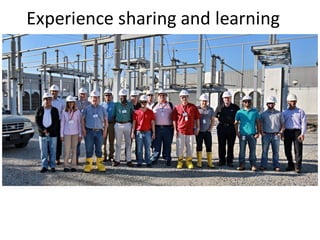
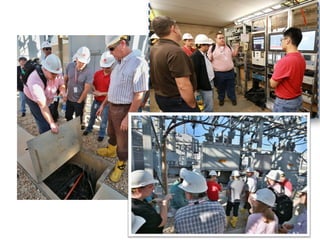
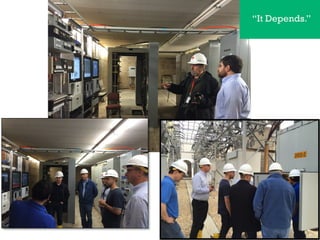
Experience sharing and learning
25
Entergy
Transmission
Engineering
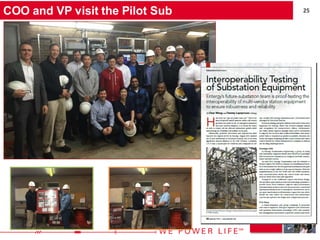
COO and VP visit the Pilot Sub
26
Entergy
Transmission
Engineering
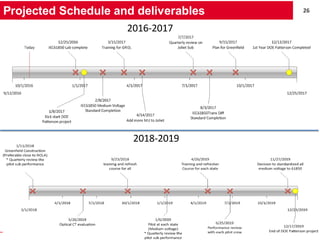
Projected Schedule and deliverables
2016-2017
2018-2019
27
Entergy TransmissionEngineering
ONE MORE THING !!!
28
Entergy
Transmission
Engineering
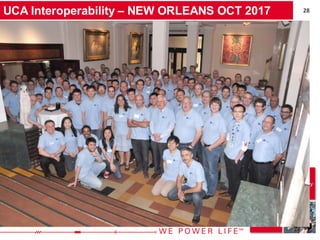
UCA Interoperability – NEW ORLEANS OCT 2017
29
Entergy
Transmission
Engineering
UCA IOP New Orleans
• The IOP test will take place in New Orleans in
October 2017. It will be hosted by Entergy.
• The Boot Camp training
– October 12 - 13.
• IOP testing
– October 14 - 19.
• IEC TC57 WG10
– Follow after IOP
• Marriott Arts District / Convention Center
Entergy
Transmission
Engineering
Thanks
Chan Wong
cwong@entergy.com
31
Entergy
Transmission
Engineering
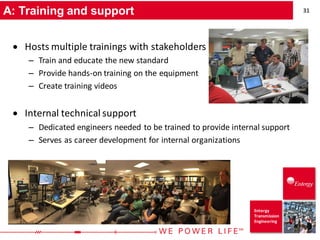
A: Training and support
• Hosts multiple trainings with stakeholders
– Train and educate the new standard
– Provide hands-on training on the equipment
– Create training videos
• Internal technical support
– Dedicated engineers needed to be trained to provide internal support
– Serves as career development for internal organizations
32
Entergy
Transmission
Engineering
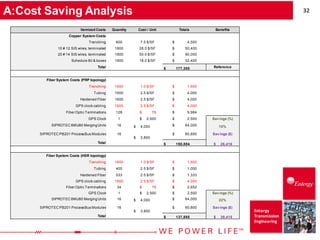
A:Cost Saving Analysis
Itemized Costs Quantity Cost / Unit Totals Benefits
Copper System Costs
Trenching 600 7.5 $/SF $ 4,500
10 # 12 SIS wires, terminated 1800 28.0 $/SF $ 50,400
20 # 14 SIS wires, terminated 1800 50.0 $/SF $ 90,000
Schedule 80 & boxes 1800 18.0 $/SF $ 32,400
Total $ 177,300 Reference
Fiber System Costs (PRP topology)
Trenching 1600 1.0 $/SF $ 1,600
Tubing 1600 2.5 $/SF $ 4,000
Hardened Fiber 1600 2.5 $/SF $ 4,000
GPS clock cabling 1600 2.5 $/SF $ 4,000
Fiber Optic Terminations 128 $ 78 $ 9,984
GPS Clock 1 $ 2,500 $ 2,500 Savings (%)
SIPROTEC 8MU80 MergingUnits 16 $ 4,000 $ 64,000 15%
SIPROTEC PB201 ProcessBus Modules 16
$ 3,800
$ 60,800 Savings ($)
Total $ 150,884 $ 26,416
Fiber System Costs (HSR topology)
Trenching 1600 1.0 $/SF $ 1,600
Tubing 400 2.5 $/SF $ 1,000
Hardened Fiber 533 2.5 $/SF $ 1,333
GPS clock cabling 1600 2.5 $/SF $ 4,000
Fiber Optic Terminations 34 $ 78 $ 2,652
GPS Clock 1 $ 2,500 $ 2,500 Savings (%)
SIPROTEC 8MU80 MergingUnits 16 $ 4,000 $ 64,000 22%
SIPROTEC PB201 ProcessBus Modules 16
$ 3,800
$ 60,800 Savings ($)
Total $ 137,885 $ 39,415
33
Entergy
Transmission
Engineering
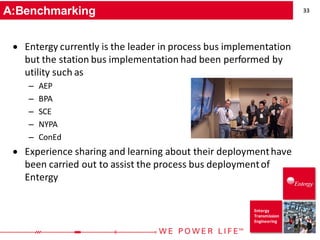
A:Benchmarking
• Entergy currently is the leader in process bus implementation
but the station bus implementation had been performed by
utility such as
– AEP
– BPA
– SCE
– NYPA
– ConEd
• Experience sharing and learning about their deploymenthave
been carried out to assist the process bus deploymentof
Entergy
ENGINEERINGMANAGER,
TELECOM – PRIVATENETWORKS
SECRETARYIEEE PESPOWER SYSTEM COMMUNICATIONSAND
CYBERSECURITYCOMMITTEE
CRAIG PREUSS
IEC 61850 ARCHITECTURE AND
GOOSE
3/28/2016
IEC 61850
ARCHITECTURE AND
GOOSE
Pieces, parts, and protocols
Architecture
2
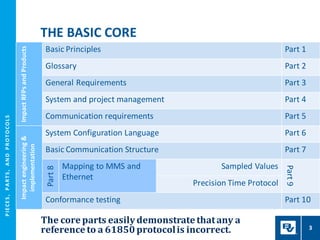
The coreparts easilydemonstratethatany a
referenceto a 61850 protocolis incorrect.
THE BASIC CORE
3
Part 1
Part 2
Part 3
Part 4
Part 5
Part 6
Part 7
Impact
RFPs
and
Products
Basic Principles Part 1
Glossary Part 2
General Requirements Part 3
System and project management Part 4
Communication requirements Part 5
Impact
engineering
&
implementation
System Configuration Language Part 6
Basic Communication Structure Part 7
Part
8
Mapping to MMS and
Ethernet
Sampled Values
Part
9
Precision Time Protocol
Conformance testing Part 10
P
I
E
CE
S
,
P
A
R
T
S
,
A
N
D
P
R
O
T
O
CO
L
S
P
I
E
CE
S
,
P
A
R
T
S
,
A
N
D
P
R
O
T
O
CO
L
S
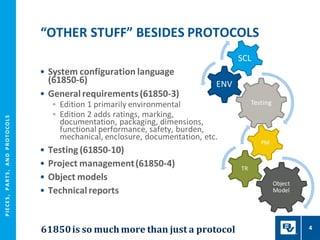
61850is so much more than just a protocol
• System configuration language
(61850-6)
• Generalrequirements(61850-3)
• Edition 1 primarily environmental
• Edition 2 adds ratings, marking,
documentation, packaging, dimensions,
functional performance, safety, burden,
mechanical, enclosure, documentation, etc.
• Testing (61850-10)
• Project management(61850-4)
• Object models
• Technicalreports
“OTHER STUFF” BESIDES PROTOCOLS
4
Testing
ENV
SCL
Object
Model
TR
PM
P
I
E
CE
S
,
P
A
R
T
S
,
A
N
D
P
R
O
T
O
CO
L
S
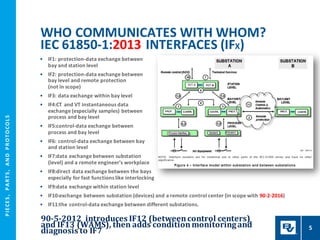
90-5-2012 introduces IF12 (betweencontrol centers)
and IF13 (WAMS), then adds conditionmonitoringand
diagnosis to IF7
• IF1: protection-data exchange between
bay and station level
• IF2: protection-data exchange between
bay level and remote protection
(not in scope)
• IF3: data exchange within bay level
• IF4:CT and VT instantaneous data
exchange (especially samples) between
process and bay level
• IF5:control-data exchange between
process and bay level
• IF6: control-data exchange between bay
and station level
• IF7:data exchange between substation
(level) and a remote engineer’s workplace
• IF8:direct data exchange between the bays
especially for fast functions like interlocking
• IF9:data exchange within station level
• IF10:exchange between substation (devices) and a remote control center (in scope with 90-2-2016)
• IF11:the control-data exchange between different substations.
WHO COMMUNICATES WITH WHOM?
IEC 61850-1:2013 INTERFACES (IFX)
5
P
I
E
CE
S
,
P
A
R
T
S
,
A
N
D
P
R
O
T
O
CO
L
S
6
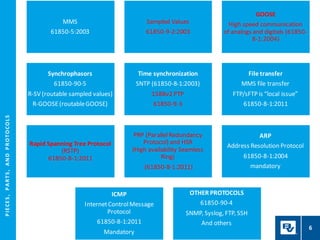
MMS
61850-5:2003
Sampled Values
61850-9-2:2003
GOOSE
High speed communication
of analogs and digitals (61850-
8-1:2004)
Synchrophasors
61850-90-5
R-SV (routable sampled values)
R-GOOSE(routableGOOSE)
Time synchronization
SNTP (61850-8-1:2003)
1588v2 PTP
61850-9-3
File transfer
MMS file transfer
FTP/sFTP is “local issue”
61850-8-1:2011
Rapid Spanning Tree Protocol
(RSTP)
61850-8-1:2011
PRP (ParallelRedundancy
Protocol) and HSR
(High availability Seamless
Ring)
(61850-8-1:2011)
ARP
Address Resolution Protocol
61850-8-1:2004
mandatory
ICMP
InternetControlMessage
Protocol
61850-8-1:2011
Mandatory
OTHER PROTOCOLS
61850-90-4
SNMP, Syslog, FTP, SSH
And others
P
I
E
CE
S
,
P
A
R
T
S
,
A
N
D
P
R
O
T
O
CO
L
S
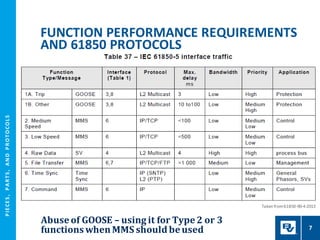
Abuseof GOOSE – using it for Type2 or 3
functionswhenMMS should beused
FUNCTION PERFORMANCE REQUIREMENTS
AND 61850 PROTOCOLS
7
Taken from61850-90-4-2013
P
I
E
CE
S
,
P
A
R
T
S
,
A
N
D
P
R
O
T
O
CO
L
S
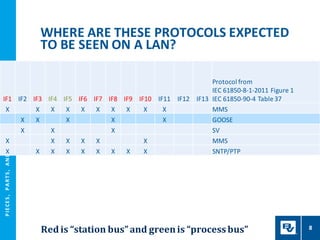
Red is “station bus”and greenis “processbus”
WHERE ARE THESE PROTOCOLS EXPECTED
TO BE SEEN ON A LAN?
8
IF1 IF2 IF3 IF4 IF5 IF6 IF7 IF8 IF9 IF10 IF11 IF12 IF13
Protocol from
IEC 61850-8-1-2011 Figure 1
IEC 61850-90-4 Table 37
X X X X X X X X X X MMS
X X X X X GOOSE
X X X SV
X X X X X X MMS
X X X X X X X X X SNTP/PTP
P
I
E
CE
S
,
P
A
R
T
S
,
A
N
D
P
R
O
T
O
CO
L
S
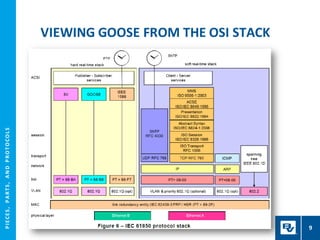
VIEWING GOOSE FROM THE OSI STACK
9
P
I
E
CE
S
,
P
A
R
T
S
,
A
N
D
P
R
O
T
O
CO
L
S
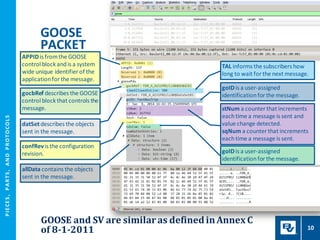
GOOSE and SV are similaras defined inAnnex C
of 8-1-2011
GOOSE
PACKET
10
APPIDis fromthe GOOSE
control block andis a system
wide unique identifier of the
applicationfor the message.
gocbRef describes the GOOSE
control block that controls the
message.
TAL informs the subscribers how
long to wait for the next message.
datSet describes the objects
sent in the message.
goIDis a user-assigned
identificationfor the message.
stNum a counter that increments
eachtime a message is sent and
value change detected.
sqNum a counter that increments
eachtime a message is sent.
confRevis the configuration
revision. goIDis a user-assigned
identificationfor the message.
allData contains the objects
sent in the message.
P
I
E
CE
S
,
P
A
R
T
S
,
A
N
D
P
R
O
T
O
CO
L
S
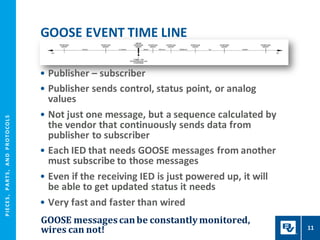
GOOSE messagescanbe constantlymonitored,
wires can not!
• Publisher – subscriber
• Publisher sends control, status point, or analog
values
• Not just one message, but a sequence calculated by
the vendor that continuously sends data from
publisher to subscriber
• Each IED that needs GOOSE messages from another
must subscribe to those messages
• Even if the receiving IED is just powered up, it will
be able to get updated status it needs
• Very fast and faster than wired
GOOSE EVENT TIME LINE
11
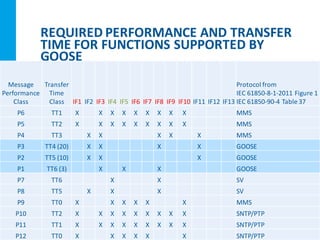
REQUIRED PERFORMANCE AND TRANSFER
TIME FOR FUNCTIONS SUPPORTED BY
GOOSE
12
Message
Performance
Class
Transfer
Time
Class IF1 IF2 IF3 IF4 IF5 IF6 IF7 IF8 IF9 IF10 IF11 IF12 IF13
Protocol from
IEC 61850-8-1-2011 Figure 1
IEC 61850-90-4 Table 37
P6 TT1 X X X X X X X X X MMS
P5 TT2 X X X X X X X X X MMS
P4 TT3 X X X X X MMS
P3 TT4 (20) X X X X GOOSE
P2 TT5 (10) X X X GOOSE
P1 TT6 (3) X X X GOOSE
P7 TT6 X X SV
P8 TT5 X X X SV
P9 TT0 X X X X X X MMS
P10 TT2 X X X X X X X X X SNTP/PTP
P11 TT1 X X X X X X X X X SNTP/PTP
P12 TT0 X X X X X X SNTP/PTP
P
I
E
CE
S
,
P
A
R
T
S
,
A
N
D
P
R
O
T
O
CO
L
S
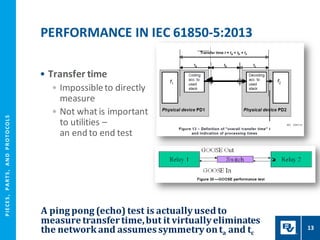
A ping pong (echo) test is actuallyused to
measuretransfertime,but it virtuallyeliminates
the network and assumessymmetryonta and tc
• Transfer time
• Impossibleto directly
measure
• Not what is important
to utilities –
an end to end test
PERFORMANCE IN IEC 61850-5:2013
13
P
I
E
CE
S
,
P
A
R
T
S
,
A
N
D
P
R
O
T
O
CO
L
S
• GOOSE message structure has an optional
framework to support cybersecurity
• Based on IEC 62351-6
• Uses Reserved1and Reserved2fieldsfrom the
message
• Uses an extension to the message that contains the
message authentication code
• Research indicates
• The authentication using 1024-bit keys takes 8.3 ms
• Using 2048-bit keys today will take longer
GOOSE CYBERSECURITY
14
P
I
E
CE
S
,
P
A
R
T
S
,
A
N
D
P
R
O
T
O
CO
L
S
• TypicalLayer 2 attacks
• ARP attacks, MAC flooding attacks, spanning-tree attacks,
multicast brute force attacks, VLAN trunking protocol
attacks, private VLAN attacks, identity theft, VLAN hopping
attacks, MAC spoofing and double-encapsulated
802.1Q/Nested VLAN attacks
• GOOSE attacks
• GOOSE spoof (and variants)
• GOOSE storm
• High Status Number Attack (or GOOSE poison) (send stNum
value of 232-1
• High rate flooding attack
• Semantic attack
GOOSE ATTACKS
15
P
I
E
CE
S
,
P
A
R
T
S
,
A
N
D
P
R
O
T
O
CO
L
S
• GOOSE Spoof attack (one variant)
• Publishingfalse layer 2 packetsand subscribingIEDs
mistakenly believe the messages are valid
GOOSE SPOOF ATTACK
16
Juan Hoyos,etal,"ExploitingtheGOOSEProtocol:APractical Attackon
Cyber-infrastructure”,GC'12 Workshop:SmartGridCommunications:
Design for Performance
P
I
E
CE
S
,
P
A
R
T
S
,
A
N
D
P
R
O
T
O
CO
L
S
• Existingmitigations (typicalto layer 2)
• A dedicated VLAN ID for all trunk ports
• Disable all unused ports and place in unused VLAN
• Do not use the default VLAN (1)
• Set all ports to non-trunking
• Physical security to detect and delay unauthorized Layer 2
access
• GOOSE Spoof specific mitigations
• GOOSE anomaly detection in switches and routers to reject
GOOSE messages not consistent with 61850 configuration
• Other GOOSE mitigations
• GOOSE anomaly detection in IEDs
GOOSE SPOOF MITIGATION
17
IEC 61850
ARCHITECTURE AND
GOOSE
Pieces, parts, and protocols
Example LAN Architectures
18
E
X
A
M
P
L
E
L
A
N
A
R
CH
I
T
E
C
T
U
R
E
S
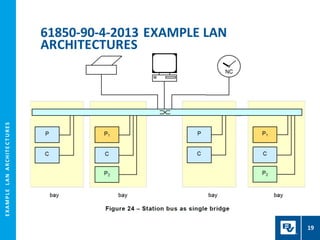
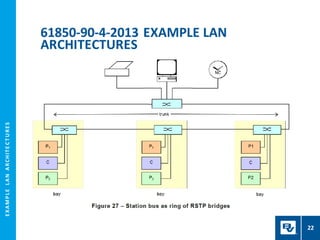
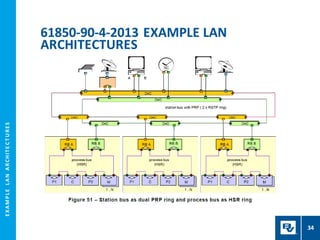
61850-90-4-2013 EXAMPLE LAN
ARCHITECTURES
19
E
X
A
M
P
L
E
L
A
N
A
R
CH
I
T
E
C
T
U
R
E
S
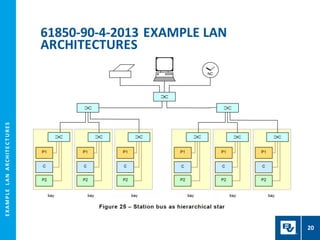
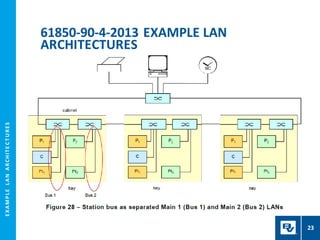
61850-90-4-2013 EXAMPLE LAN
ARCHITECTURES
20
E
X
A
M
P
L
E
L
A
N
A
R
CH
I
T
E
C
T
U
R
E
S
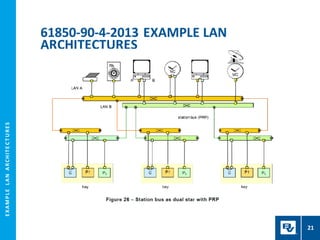
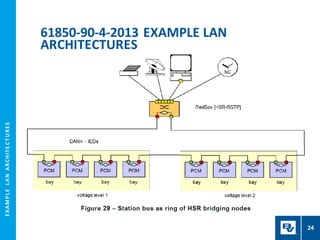
61850-90-4-2013 EXAMPLE LAN
ARCHITECTURES
21
E
X
A
M
P
L
E
L
A
N
A
R
CH
I
T
E
C
T
U
R
E
S
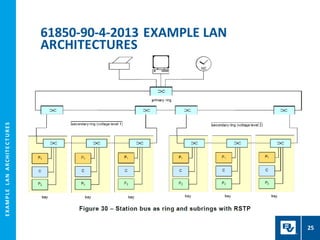
61850-90-4-2013 EXAMPLE LAN
ARCHITECTURES
22
E
X
A
M
P
L
E
L
A
N
A
R
CH
I
T
E
C
T
U
R
E
S
61850-90-4-2013 EXAMPLE LAN
ARCHITECTURES
23
E
X
A
M
P
L
E
L
A
N
A
R
CH
I
T
E
C
T
U
R
E
S
61850-90-4-2013 EXAMPLE LAN
ARCHITECTURES
24
E
X
A
M
P
L
E
L
A
N
A
R
CH
I
T
E
C
T
U
R
E
S
61850-90-4-2013 EXAMPLE LAN
ARCHITECTURES
25
E
X
A
M
P
L
E
L
A
N
A
R
CH
I
T
E
C
T
U
R
E
S
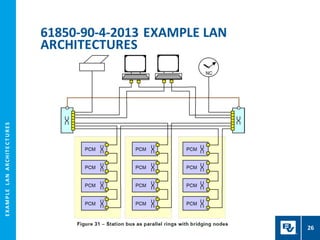
61850-90-4-2013 EXAMPLE LAN
ARCHITECTURES
26
E
X
A
M
P
L
E
L
A
N
A
R
CH
I
T
E
C
T
U
R
E
S
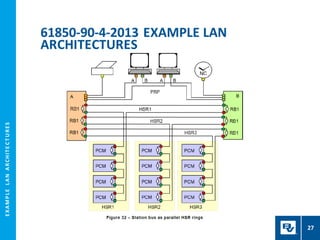
61850-90-4-2013 EXAMPLE LAN
ARCHITECTURES
27
E
X
A
M
P
L
E
L
A
N
A
R
CH
I
T
E
C
T
U
R
E
S
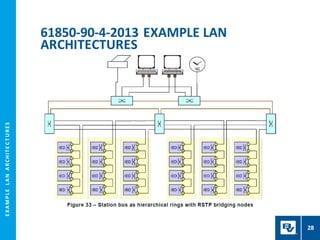
61850-90-4-2013 EXAMPLE LAN
ARCHITECTURES
28
E
X
A
M
P
L
E
L
A
N
A
R
CH
I
T
E
C
T
U
R
E
S
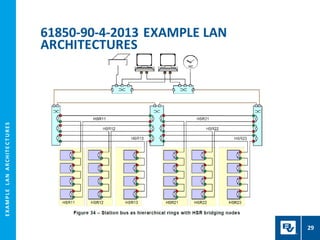
61850-90-4-2013 EXAMPLE LAN
ARCHITECTURES
29
E
X
A
M
P
L
E
L
A
N
A
R
CH
I
T
E
C
T
U
R
E
S
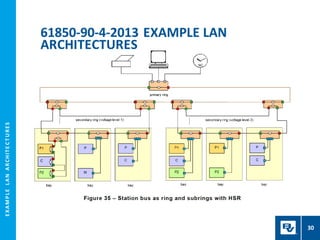
61850-90-4-2013 EXAMPLE LAN
ARCHITECTURES
30
E
X
A
M
P
L
E
L
A
N
A
R
CH
I
T
E
C
T
U
R
E
S
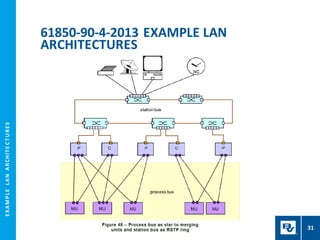
61850-90-4-2013 EXAMPLE LAN
ARCHITECTURES
31
E
X
A
M
P
L
E
L
A
N
A
R
CH
I
T
E
C
T
U
R
E
S
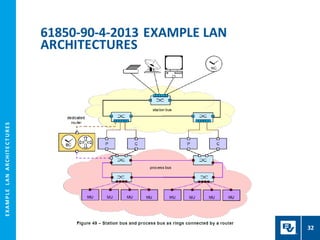
61850-90-4-2013 EXAMPLE LAN
ARCHITECTURES
32
E
X
A
M
P
L
E
L
A
N
A
R
CH
I
T
E
C
T
U
R
E
S
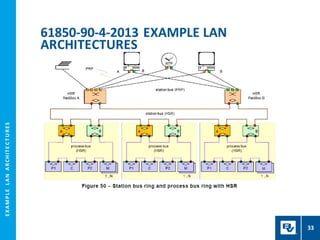
61850-90-4-2013 EXAMPLE LAN
ARCHITECTURES
33
E
X
A
M
P
L
E
L
A
N
A
R
CH
I
T
E
C
T
U
R
E
S
61850-90-4-2013 EXAMPLE LAN
ARCHITECTURES
34
CO
N
CL
US
I
O
N
S
• IEC 61850 specifies an architecturefor utilityautomation
systems
• IEC 61850 includesmany different protocols
• IEC 61850 supports applicationsthat have performance
requirementsthat can be met by some protocolsand not
others
• IEC 61850 has numerouspossible architecturesfeaturing
“stationbus” and “process bus”
• IEC 61850 GOOSE protocolis fast enough to support any
time criticalapplications,plusthose that are not
• IEC 61850 GOOSE protocolpresentssome cybersecurity
challenges
CONCLUSIONS
35
36
R e turn
t o Y e
O l den
W a ys
Now is the time for any questions and discussion
NERC Roundtable Forum
11/21/2016
Page 1 Energy Automation
Authors:
Eric Stranz, Business Development Manager, Siemens
NERC Roundtable Forum
Motivation
11/21/2016 Energy Automation
Page 2
NERC Roundtable Forum
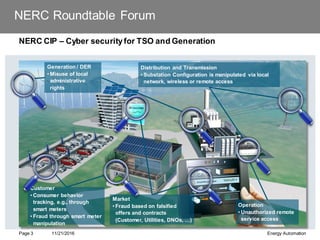
NERC CIP – Cyber securityfor TSO and Generation
11/21/2016 Energy Automation
Page 3
Generation / DER
• Misuse of local
administrative
rights
Distribution and Transmission
• Substation Configuration is manipulated via local
network, wireless or remote access
Operation
• Unauthorized remote
service access
Market
• Fraud based on falsified
offers and contracts
(Customer, Utilities, DNOs, …)
Customer
• Consumer behavior
tracking, e.g., through
smart meters
• Fraud through smart meter
manipulation
NERC Roundtable Forum
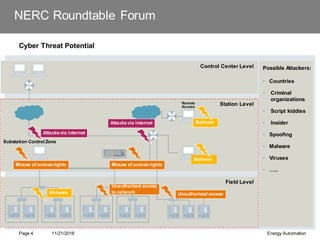
Cyber Threat Potential
11/21/2016 Energy Automation
Page 4
Station Level
Possible Attackers:
• Countries
• Criminal
organizations
• Script kiddies
• Insider
• Spoofing
• Malware
• Viruses
• …..
Control Center Level
Field Level
Substation Control Zone
Remote
Access
Malware
Misuse of accessrights
Unauthorized access
to network Unauthorized access
Attacksvia internet
Attacksvia internet
Misuse of accessrights
Malware
Malware
NERC Roundtable Forum
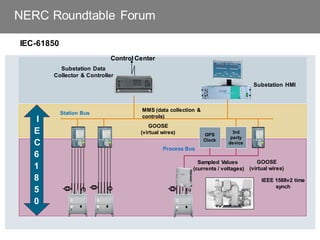
Control Center
GPS
Clock
Substation HMI
Process Bus
Station Bus
MMS (data collection &
controls)
Sampled Values
(currents / voltages)
GOOSE
(virtual wires)
I
E
C
6
1
8
5
0
GOOSE
(virtual wires)
Substation Data
Collector & Controller
IEC-61850
3rd
party
device
IEEE 1588v2 time
synch
NERC Roundtable Forum
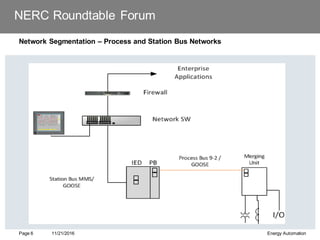
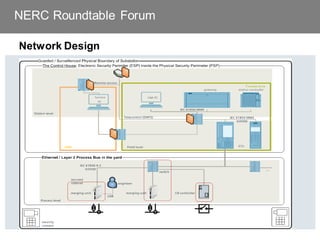
Network Segmentation – Process and Station Bus Networks
11/21/2016 Energy Automation
Page 6
NERC Roundtable Forum
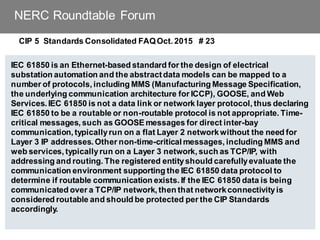
CIP 5 Standards Consolidated FAQOct. 2015 # 23
IEC 61850 is an Ethernet-based standard for the design of electrical
substation automation and the abstractdata models can be mapped to a
number of protocols, including MMS (Manufacturing Message Specification,
the underlying communication architecture for ICCP), GOOSE, and Web
Services. IEC 61850 is not a data link or network layer protocol, thus declaring
IEC 61850 to be a routable or non-routable protocol is not appropriate. Time-
critical messages, such as GOOSE messages for direct inter-bay
communication, typicallyrun on a flat Layer 2 networkwithout the need for
Layer 3 IP addresses. Other non-time-critical messages, including MMS and
web services, typicallyrun on a Layer 3 network, such as TCP/IP, with
addressing and routing. The registered entityshould carefullyevaluate the
communication environment supporting the IEC 61850 data protocol to
determine if routable communication exists. If the IEC 61850 data is being
communicated over a TCP/IP network, then that networkconnectivityis
considered routable and should be protected per the CIP Standards
accordingly.
NERC Roundtable Forum
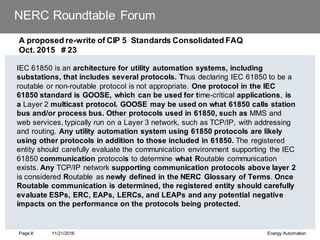
A proposed re-write of CIP 5 Standards Consolidated FAQ
Oct. 2015 # 23
IEC 61850 is an architecture for utility automation systems, including
substations, that includes several protocols. Thus declaring IEC 61850 to be a
routable or non-routable protocol is not appropriate. One protocol in the IEC
61850 standard is GOOSE, which can be used for time-critical applications, is
a Layer 2 multicast protocol. GOOSE may be used on what 61850 calls station
bus and/or process bus. Other protocols used in 61850, such as MMS and
web services, typically run on a Layer 3 network, such as TCP/IP, with addressing
and routing. Any utility automation system using 61850 protocols are likely
using other protocols in addition to those included in 61850. The registered
entity should carefully evaluate the communication environment supporting the IEC
61850 communication protocols to determine what Routable communication
exists. Any TCP/IP network supporting communication protocols above layer 2
is considered Routable as newly defined in the NERC Glossary of Terms. Once
Routable communication is determined, the registered entity should carefully
evaluate ESPs, ERC, EAPs, LERCs, and LEAPs and any potential negative
impacts on the performance on the protocols being protected.
11/21/2016 Energy Automation
Page 8
NERC Roundtable Forum
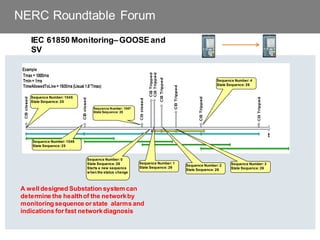
IEC 61850 Monitoring–GOOSE and
SV
Sequence Number: 1045
State Sequence: 25
Sequence Number: 1046
State Sequence: 25
Sequence Number: 1047
State Sequence: 25
Sequence Number: 0
State Sequence: 26
Starts a new sequence
when the status change
Sequence Number: 1
State Sequence: 26
Sequence Number: 2
State Sequence: 26
Sequence Number: 3
State Sequence: 26
Sequence Number: 4
State Sequence: 26
A well designed Substation system can
determine the healthof the networkby
monitoring sequence or state alarms and
indications for fast networkdiagnosis
NERC Roundtable Forum
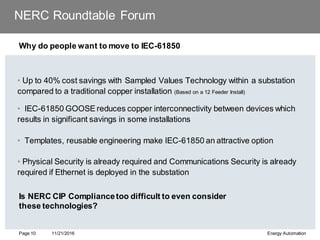
Why do people want to move to IEC-61850
• Up to 40% cost savings with Sampled Values Technology within a substation
compared to a traditional copper installation (Based on a 12 Feeder Install)
• IEC-61850 GOOSE reduces copper interconnectivity between devices which
results in significant savings in some installations
• Templates, reusable engineering make IEC-61850 an attractive option
• Physical Security is already required and Communications Security is already
required if Ethernet is deployed in the substation
11/21/2016 Energy Automation
Page 10
Is NERC CIP Compliancetoo difficult to even consider
these technologies?
NERC Roundtable Forum
11/21/2016
Page 11 Energy Automation
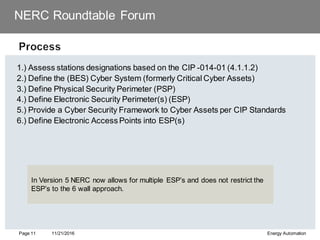
1.) Assess stations designations based on the CIP -014-01 (4.1.1.2)
2.) Define the (BES) Cyber System (formerly Critical Cyber Assets)
3.) Define Physical Security Perimeter (PSP)
4.) Define Electronic Security Perimeter(s) (ESP)
5.) Provide a Cyber Security Framework to Cyber Assets per CIP Standards
6.) Define Electronic Access Points into ESP(s)
In Version 5 NERC now allows for multiple ESP’s and does not restrict the
ESP’s to the 6 wall approach.
NERC Roundtable Forum
Physical & Cyber security
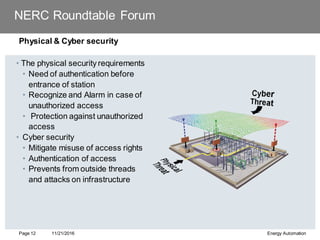
• The physical security requirements
• Need of authentication before
entrance of station
• Recognize and Alarm in case of
unauthorized access
• Protection against unauthorized
access
• Cyber security
• Mitigate misuse of access rights
• Authentication of access
• Prevents from outside threads
and attacks on infrastructure
11/21/2016 Energy Automation
Page 12
NERC Roundtable Forum
Normal NERC CIP ApplicableSubstationsShould Already
Include Physical SecurityMeasures
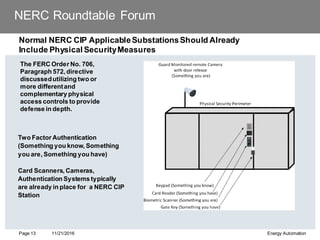
Two Factor Authentication
(Something you know, Something
you are, Something you have)
Card Scanners, Cameras,
Authentication Systems typically
are already in place for a NERC CIP
Station
11/21/2016 Energy Automation
Page 13
The FERC Order No. 706,
Paragraph 572, directive
discussedutilizing two or
more differentand
complementary physical
access controls to provide
defense in depth.
NERC Roundtable Forum
ESP at the Control House
11/21/2016 Energy Automation
Page 14
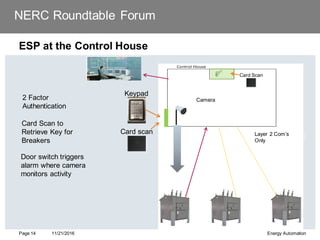
Camera
Keypad
Card scan
Card Scan
2 Factor
Authentication
Card Scan to
Retrieve Key for
Breakers
Door switch triggers
alarm where camera
monitors activity
Layer 2 Com’s
Only
NERC Roundtable Forum
Network Design
NERC Roundtable Forum
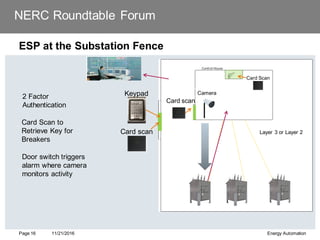
ESP at the Substation Fence
11/21/2016 Energy Automation
Page 16
Camera
Keypad
Card scan
Card Scan
2 Factor
Authentication
Card Scan to
Retrieve Key for
Breakers
Door switch triggers
alarm where camera
monitors activity
Card scan
Layer 3 or Layer 2
NERC Roundtable Forum
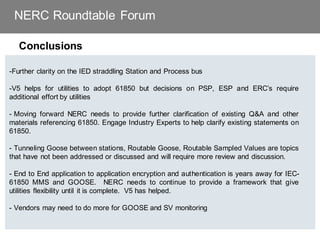
-Further clarity on the IED straddling Station and Process bus
-V5 helps for utilities to adopt 61850 but decisions on PSP, ESP and ERC’s require
additional effort by utilities
- Moving forward NERC needs to provide further clarification of existing Q&A and other
materials referencing 61850. Engage Industry Experts to help clarify existing statements on
61850.
- Tunneling Goose between stations, Routable Goose, Routable Sampled Values are topics
that have not been addressed or discussed and will require more review and discussion.
- End to End application to application encryption and authentication is years away for IEC-
61850 MMS and GOOSE. NERC needs to continue to provide a framework that give
utilities flexibility until it is complete. V5 has helped.
- Vendors may need to do more for GOOSE and SV monitoring
Conclusions
NERC Roundtable Forum
Thank you for your
attention!
11/21/2016
Page 18 Energy Automation
NERC CIP Implications of IEC
61850 in Transmission Stations
Scott R Mix, CISSP, CIP Technical Manager, NERC
RELIABILITY | ACCOUNTABILITY
2
Agenda
• Application of NERC Standards
• NERC Definitions
• What Does it Mean? (Compliance Implications)
• Effective Dates (Implementation Timeframes)
RELIABILITY | ACCOUNTABILITY
3
Application of NERC Standards
• NERC Standards apply to the Bulk Electric System (BES)
 Generally, 100kV and above, but with some exceptions,
primarily for radial lines
 20MVA and above generating units, 75MVA and above
generating plants, with some exceptions for wholly behind-
the-meter generation
• NERC Standards do not apply to distribution (i.e., non-
BES)
 With several exceptions, primarily UFLS, UVLS, Blackstart
Resources (generation), Cranking Paths
RELIABILITY | ACCOUNTABILITY
4
Application of NERC CIP Standards
• NERC CIP standards (CIP-002 through CIP-011) in their
current version require a high / medium / low
categorization, with corresponding requirement for
the levels
 High only applies to Control Centers
 Medium and low applies to field assets (and Control
Centers)
• For medium impact assets, external connectivity also
informs the requirements
 External Routable Connectivity includes more requirements
• This presentation is not about the requirements;
rather it is about scoping of assets subject to the
requirements
RELIABILITY | ACCOUNTABILITY
5
Definitions
• Cyber Asset: Programmable electronic devices,
including the hardware, software, and data in those
devices.
RELIABILITY | ACCOUNTABILITY
6
Definitions
• BES Cyber Asset (BCA): A Cyber Asset that if rendered
unavailable, degraded, or misused would, within 15
minutes of its required operation, misoperation, or
non-operation, adversely impact one or more
Facilities, systems, or equipment, which, if destroyed,
degraded, or otherwise rendered unavailable when
needed, would affect the reliable operation of the
Bulk Electric System. Redundancy of affected
Facilities, systems, and equipment shall not be
considered when determining adverse impact. Each
BES Cyber Asset is included in one or more BES Cyber
Systems.
RELIABILITY | ACCOUNTABILITY
7
Definitions
• BES Cyber System (BCS): One or more BES Cyber
Assets logically grouped by a responsible entity to
perform one or more reliability tasks for a functional
entity.
 (not part of the formal definition) Components of the BCS
also include “glue” infrastructure components (e.g.,
networking infrastructure) necessary for the system to
perform its reliability tasks, like merging units and network
switches
 Tremendous flexibility is built into the definition – BCS could
be the entire substation, all relays/equipment at a voltage
level, relays/equipment at feeder/bay level, etc
RELIABILITY | ACCOUNTABILITY
8
Definitions
• Electronic Security Perimeter (ESP): The logical
border surrounding a network to which BES Cyber
Systems are connected using a routable protocol.
RELIABILITY | ACCOUNTABILITY
9
Definitions
• Protected Cyber Asset (PCA): One or more Cyber
Assets connected using a routable protocol within or
on an Electronic Security Perimeter that is not part of
the highest impact BES Cyber System within the same
Electronic Security Perimeter. The impact rating of
Protected Cyber Assets is equal to the highest rated
BES Cyber System in the same ESP.
 A stand-alone substation HMI, if not needed for control
processing, would be a PCA; however, if it was needed for
control processing, it would be a BES Cyber Asset
RELIABILITY | ACCOUNTABILITY
10
Definitions
• Electronic Access Point (EAP): A Cyber Asset interface
on an Electronic Security Perimeter that allows
routable communication between Cyber Assets
outside an Electronic Security Perimeter and Cyber
Assets inside an Electronic Security Perimeter.
 Note that there are no requirements or restrictions on
communications between Cyber Assets located within an
ESP – the only requirements are for communicationsthat
pass through an EAP
RELIABILITY | ACCOUNTABILITY
11
Definitions
• Electronic Access Control or Monitoring Systems
(EACMS): Cyber Assets that perform electronic access
control or electronic access monitoring of the
Electronic Security Perimeter(s) or BES Cyber Systems.
This includes intermediate Systems.
 Typically this includes Cyber Assets that perform firewall /
filtering services, intrusion detection or monitoring services,
logging services, authentication services, proxy services, etc
RELIABILITY | ACCOUNTABILITY
12
Definitions
• Low Impact:
• Current proposed requirements for Low Impact BES
Cyber Systems (posted for comment and ballot
until December 5, 2016) have eliminated
definitions for both “LERC” and “LEAP”
• However, the concepts of external routable
connectivity and requirements for controlling
external routable access remain in the requirement
language
RELIABILITY | ACCOUNTABILITY
13
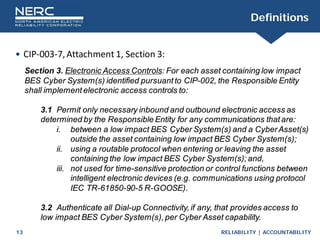
• CIP-003-7,Attachment 1, Section 3:
Definitions
Section 3. Electronic Access Controls: For each asset containing low impact
BES Cyber System(s) identified pursuant to CIP-002, the Responsible Entity
shall implement electronic access controls to:
3.1 Permit only necessary inbound and outbound electronic access as
determined by the Responsible Entity for any communications that are:
i. between a low impact BES Cyber System(s) and a CyberAsset(s)
outside the asset containing low impact BES Cyber System(s);
ii. using a routable protocol when entering or leaving the asset
containing the low impact BES Cyber System(s); and,
iii. not used for time-sensitive protection or control functions between
intelligent electronic devices (e.g. communications using protocol
IEC TR-61850-90-5 R-GOOSE).
3.2 Authenticate all Dial-up Connectivity, if any, that provides access to
low impact BES Cyber System(s), per Cyber Asset capability.
RELIABILITY | ACCOUNTABILITY
14
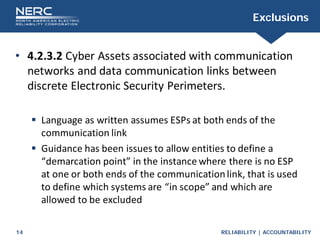
Exclusions
• 4.2.3.2 Cyber Assets associated with communication
networks and data communication links between
discrete Electronic Security Perimeters.
 Language as written assumes ESPs at both ends of the
communication link
 Guidance has been issues to allow entities to define a
“demarcation point” in the instance where there is no ESP
at one or both ends of the communicationlink, that is used
to define which systems are “in scope” and which are
allowed to be excluded
RELIABILITY | ACCOUNTABILITY
15
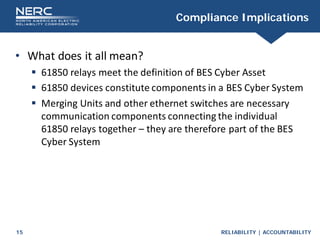
Compliance Implications
• What does it all mean?
 61850 relays meet the definition of BES Cyber Asset
 61850 devices constitute components in a BES Cyber System
 Merging Units and other ethernet switches are necessary
communication components connecting the individual
61850 relays together – they are therefore part of the BES
Cyber System
RELIABILITY | ACCOUNTABILITY
16
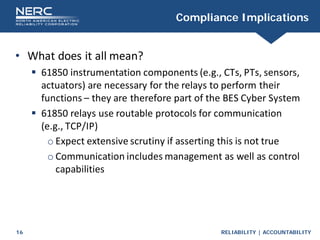
Compliance Implications
• What does it all mean?
 61850 instrumentation components (e.g., CTs, PTs, sensors,
actuators) are necessary for the relays to perform their
functions – they are therefore part of the BES Cyber System
 61850 relays use routable protocols for communication
(e.g., TCP/IP)
o Expect extensive scrutiny if asserting this is not true
o Communication includes management as well as control
capabilities
RELIABILITY | ACCOUNTABILITY
17
Compliance Implications
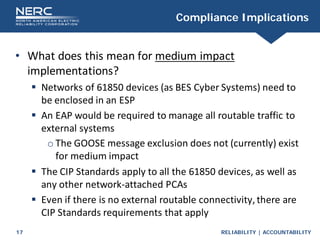
• What does this mean for medium impact
implementations?
 Networks of 61850 devices (as BES Cyber Systems) need to
be enclosed in an ESP
 An EAP would be required to manage all routable traffic to
external systems
o The GOOSE message exclusion does not (currently) exist
for medium impact
 The CIP Standards apply to all the 61850 devices, as well as
any other network-attached PCAs
 Even if there is no external routable connectivity,there are
CIP Standards requirements that apply
RELIABILITY | ACCOUNTABILITY
18
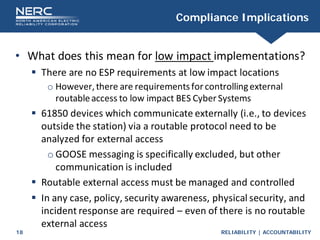
Compliance Implications
• What does this mean for low impact implementations?
 There are no ESP requirements at low impact locations
o However,there are requirementsfor controllingexternal
routableaccess to low impact BES Cyber Systems
 61850 devices which communicate externally (i.e., to devices
outside the station) via a routable protocol need to be
analyzed for external access
o GOOSE messaging is specifically excluded, but other
communication is included
 Routable external access must be managed and controlled
 In any case, policy, security awareness, physical security, and
incident response are required – even of there is no routable
external access
RELIABILITY | ACCOUNTABILITY
19
Compliance Implications
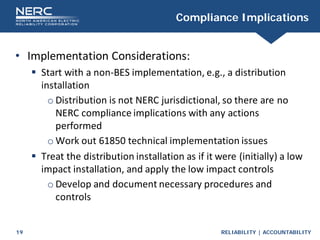
• Implementation Considerations:
 Start with a non-BES implementation, e.g., a distribution
installation
o Distribution is not NERC jurisdictional, so there are no
NERC compliance implications with any actions
performed
o Work out 61850 technical implementation issues
 Treat the distribution installation as if it were (initially) a low
impact installation, and apply the low impact controls
o Develop and document necessary procedures and
controls
RELIABILITY | ACCOUNTABILITY
20
Compliance Implications
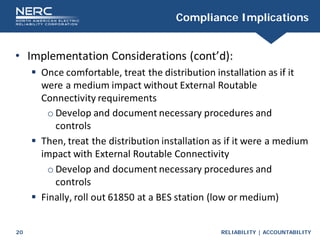
• Implementation Considerations (cont’d):
 Once comfortable, treat the distribution installation as if it
were a medium impact without External Routable
Connectivity requirements
o Develop and document necessary procedures and
controls
 Then, treat the distribution installation as if it were a medium
impact with External Routable Connectivity
o Develop and document necessary procedures and
controls
 Finally, roll out 61850 at a BES station (low or medium)
RELIABILITY | ACCOUNTABILITY
21
Scott Mix, CISSP
scott.mix@nerc.net
215-853-8204

roundtable - IEC 61850 slides (20161115).pdf

  • 1.
    Emerging Technology Roundtable –Substation Automation/IEC 61850 November 15-16, 2016
  • 2.
    RELIABILITY | ACCOUNTABILITY 2 Agenda- Emerging Technology Roundtable
  • 3.
  • 4.
    Overview of IEC61850 technology NERC Emerging TechnologyWorkshop Nov-15, 2016 Deepak Maragal, PhD, PE Herbert Falk Senior Protection & Control Engineer-I Senior Solutions Architect New York Power Authority Systems Integration Specialists Company
  • 5.
    Agenda What is IEC61850? What applications do IEC 61850 cover? Pros-Cons of IEC 61850 based Substation Automation System Architectures Time synchronization Cyber Security 2
  • 6.
    Substation Automation System Generation Transmission Distribution Wind Distributed Generation (PV,Fuel Cells etc.) Perform functions necessary to aid in efficient generation, transmission, distribution of power 3
  • 7.
    GeneralArchitecture of Substation AutomationSystem Substation Equipment Substation Equipment Network Network 4
  • 8.
    IEC 61850 basedSubstation Automation System 5 5 Substation Equipment / Relays Substation Automation System Digital Elements • Logic • Logic Gates : N/AND, N/OR, NOT, XOR XNOR • Timers : • Time Delay Pick-up • Time Delay Drop-Out • Latches, Flip-flops Station Bus (Other IEDs) • GOOSE • MMS Standard Protection Functions 27, 50, 51, BF ….. Custom Analog Functions App. specific, Measurements Standard Elements • Circuit Breakers • MOD / Disconnect • Monitor • Equipment • Coil – V & I LEDs / HMI CT/PT Substation Equipment / Relays Station Bus (Other IEDs) • GOOSE • MMS I N P U T S O U T P U T S
  • 9.
    3 2 1 Functions - Definitions &Nomenclature - Parameters & Attributes - Hierarchical data structure Communication - Medium supporting Ethernet/IP - Protocols: GOOSE, SV, MMS - Security: IEC 62351 Process and format - XML representation of all data - Std. files & content: SCL files - Std. interchanging process IEC-61850: What is Standardized? 6
  • 10.
  • 11.
     Common dataclasses o Attributes:Data types o Behavior o Trigger on change o Operation states o Control states IEC61850 ModelingFramework 8
  • 12.
    IEC61850 CommunicationTypes  Multicast(Publisher   Subscriber) o Similar to Broadcast o GOOSE,SV Applications: o Protection,Monitoring,Recording,Metering..  Client – Server o Security possible throughIEC-62351  Encryption,User Authentication,Access Control … Applications o Control 9
  • 13.
    IEC61850 CommunicationFramework 10 Multicast Client/Server ISO/IEC8802-3Ethertype- Ethernet Sampled Values (SV) GOOSE MMS Protocol IEEE 1588* GDOI (90-5)* UDP/IP IGMP/DSCP (90-5)* TCP/IP TLS RFC 1006 Protection Messaging Measurement Messaging Symmetric Key Access For 90-5 Core ACSI Services Time Sync IEEE NTP UDP/IP * - Added in Edition 2 Amendment
  • 14.
    IEC61850 CommunicationTypes  Multicast(Publisher   Subscriber) o Similar to Broadcast o GOOSE,SV Applications: o Protection,Monitoring,Recording,Metering..  Client – Server o Security possible throughIEC-62351  Encryption,User Authentication,Access Control … Applications o Control 11
  • 15.
    Traditional P&C SystemIEC-61850 based P&C System 12
  • 16.
    Advantages of IEC61850 based SAS Cable reduction Interoperability & standardization Extensive troubleshooting & performance data Self monitoring & improvement in reliability Distributed and Centralized implementation 13
  • 17.
    Disadvantages of IEC61850 based SAS New technology is Complex o Requires change o New skills & tools Additional burden on Network management Cyber security overheads: NERC CIP Complexity & overheads out way Benefits in many applications 14
  • 18.
    IEC 61850 BeyondNorth America 15
  • 19.
    IEC 61850 Beyondthe Substation (North America)  Substation-to-Control Center (IEC/TR 61850-90-2) targeted for SCADA communication  AEP – in all substations  SCE – Centralized Remedial Action Scheme and all future substations  CONED and others have active deployments  Substation-to-Substation (IEC/TR 61850-90-1) communication typically used for protection control  SCE’s, PG&E, SRP, Toronto Airport are examples  Secure Synchrophasor for WAMPAC  PG&E has an active deployment for Wide Area Monitoring and Situational Awareness (no PAC)  Windpower and DER (including aggregation) for SCADA  E.on and EDF Canada (Windpower)  Largest IEC 61850 deployment coming in a SW Refinery 16
  • 20.
    Transitioning to aDigital Substation 17 Relays Devices CTs/PTs RTU SCADA Relays Devices RTU Station Bus Relays Devices RTU Station Bus Merging Units Process Bus
  • 21.
    Station Bus –Performance and Resiliency Considerations  Performance  SCADA traffic  “Low” speed Network Resiliency: RSTP  Automation  Combination of “Low” and Network Resiliency: HSR or PRP “Medium” (<20 msec) speed  Utilizes GOOSE  Protection(3-6 msec) Network Resiliency: HSR or PRP Utilizes GOOSE  Time Sync Accuracy Resiliency probably needed  Important for post mortem analysis  Important for geographically disperse automation (e.g. out-of-step/synchrophasors) 18
  • 22.
    Process Bus –Performance and Resiliency Considerations  Performance  “High” Speed Network Resiliency: HSR or PRP  Time Sync Accuracy Resiliency is needed  Important for post mortem analysis  Important for geographically disperse automation (e.g. out-of-step/synchrophasors) 19
  • 23.
    Substation to ControlCenter (IEC 61850-90-2) Use Cases Telecontrol (SCADA) Synchrophasor Disturbance Counting Power Quality Asset/Condition Based Maintenance Configuration 20
  • 24.
  • 25.
    Synchrophasors 22 • Routable IEC61850 Secure Sampled Values was developed for synchrophasors • Time Sync accuracy and resiliency is typically needed
  • 26.
    Substation-to-Substation 23 Use Cases: • Distanceline protection • Transfer/Direct Trip • Interlocking • Multi-phase reclosing • Current differential protection • Phase Compensation protection Typically uses GOOSE/Routable GOOSE and needs Time Sync Resiliency
  • 27.
    Substation-to-Substation: Example 24 Information courtesyof pacworld. Article can be found at: http://www.pacw.org/issue/june_2016_issue/secured_routable_goose_mechanism.html
  • 28.
    Sampled Values forCT/PT sharing (Merging Units) 25 Protection Functions Actions Relay Protection Functions Actions Relay Process Bus Merging Unit No Process Bus - 1 pps, IEC 61850-9-3, IEEE C37.238
  • 29.
    Bump-less Network Resiliency:HSR & PRP 26 LAN A LAN B Device (DAN) Device (DAN) Device Device Device PRP – Packet ID in Ethernet padding First packet received wins HSR – Packet ID before Ethertype If received packet previously discard packet
  • 30.
    IEC 61850: Timeand Time Synchronization TimeStamp is UTC Time down to 60 nsec. Similar format to NTP except for Time Quality (last 8 bits of fractions of second) Time Quality is embedded into timestamps of IEC 61850 (unique to 61850). • Leap Seconds Known (TRUE)/ Leap second being processed(FALSE) Clock Not Synchronized • Clock Failure (for internal clock failure) • Time Accuracy (may change depending upon internal or source drift) Logical Nodes of LTIM and LTMS expose information regarding time synchronization and allows for multiple time sync sources: NTP, 1 PPS, multiple 1588 masters and boundary clocks.
  • 31.
    IEC 61850 andTime Synchronization: 1588 Profiles IEEE 1588 Standard IEEE/IEC 61850-9-3 IEEE C37.238 Extensions Profiles Grand Master 1 Grand Master 2 Slave Boundary Device Devices/1588pick best master Devices can act as Boundary clock Time Synchronization Resiliency Network fault tolerance/resiliency provided by HSR or PRP Ethernet switches must participate in 1588 adjustments in order to maintain maximum accuracy.
  • 32.
    Mapping of TC57 CommunicationStandards to IEC 62351 Security Standards IEC TC57 Power System Communication Standards IEC 62351 SecurityStandards IEC 62351-1: Introduction IEC 62351-2: Glossary IEC 62351-7: Objects for Network Management IEC 62351-8: Role based Access Control (RBAC) IEC 62351-9: Key Management IEC 62351-3: Profiles including TCP/IP IEC 62351-4: Profiles including MMS and similar Payloads IEC 62351-5: IEC 60870-5 and Derivates IEC 62351-6: IEC 61850 Profiles TS Ed.1 – 2007 TS Ed.1 – 2008 TS Ed.1 – 2007, IS10/2014 TS Ed.1 – 2007, CDV 06/2016 TS Ed.1 – 2009, TS Ed.2 – 04/2013 TS Ed.1 – 2007, CD 06/2016 TS Ed.1 – 2010, FDIS 6/2016, IS 12/2016 TS Ed.1 – 2011, RR 06/2016 CD Ed.1 – 2013, CD2 – 03/2015, CDV 01/2016 IEC 62351-10: Security architecture guidelinesfor TC 57 systems IEC 62351-12: Resilience and Security Recommendations forPowerSystems with DER IEC 62351-13: What Security Topics Should Be Covered in Standards and Specifications IEC 62351-14: Cyber Security Event Logging NWIP 01/2016 IEC 62351-90-1: RBAC Guidelines DC 06/2016 IEC 62351-90-2: Deep Packet Inspection DC 06/2016 TR Ed.1 – 2012 DTR– 01/2016, TR mid-2016 DTR 01/2016, TR mid-2016 IEC 62351-100-1: IEC 60870-5-7 (Part 3/5) NWIP prepared IEC 62351-100 Conformance Testing IEC 60870-6 TASE.2 (ICCP) IEC 61850-8-1 with MMS IEC 61850 GOOSE and SV IEC 60870-5-104 & DNP3 IEC 60870-5-101 & Serial DNP3 IEC 61970 & IEC 61968 CIM IEC 61850-8-2 XML over XMPP IEC 62351-11: Security for XML Files FDIS 12/2015, IS 06/2016
  • 33.
    IEC 61850 Security:Client/Server IEC 61850-90-19* IEC 62351-90-2 IEC 62351-8 (RBAC) IEC 62351-9 (Key Mgmt) Security Plane IEC 61850-8-1 IEC 61850-8-2 Data-Exchange Security for Data-Exchange IEC 62351-3 (TLS Security) IEC 62351-4 (MMS Security) IEC 62351-6 (61850 Security) Use of TLS Connection Security End-to-End Security GOOSE, SV Security MMS by inheritance Session Security (Auth., Integ., Selected cipher suites) Key Update (Resume & Renegotiate)
  • 34.
    IEC 61850 Security:Client/Server RBAC RBAC infrastructure allows: • New role definitions • Area of responsibilities • Changes based upon operational • constraints
  • 35.
    IEC 61850 Security:GOOSE and SV GOOSE SV for CT/PT Synchrophasors L2 UDP/IP L2 UDP/IP SV over UDP/IP Authentication x x x x x Tamper Detection x x x x x Confidentiality x x Not Suggested Not Suggested x Policy and symmetric keys managed through extensions of GDOI – Key Distribution Center (KDC) Layer 2 can also be non-secure and that is what is typically deployed for intra-substation communication.
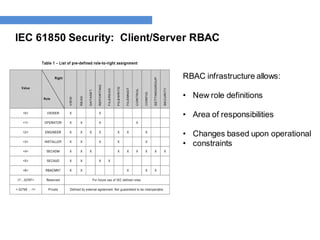
  • 36.
    Opportunities Provides: • Members withaccess to draft standards • Supports user feedback and answering questions • Sponsoring of the 4th IEC 61850 IOP • Other benefits IEC 61850 Boot Camp Co-locatedwith the 2017 IEC 61850 IOP. Scheduled October 12-13, 2017 in New Orleans. 2017 IEC 61850 Interoperability Testing Set-up October 13, 2017 in New Orleans Testing October 14-19, 2017 Coordination and test development starting 11/2016 IEEE PSRCC H30 Provides a forum for users and vendors to discuss issues in using IEC 61850 and forward issues that may impact the IEC standards to the appropriate standards body. Next meeting January 2017 New Orleans
  • 37.
  • 38.
    61850 Business Drivers DigitalRe-Invention at Southern California Edison Jeff Gooding IT Principal Manager Enterprise Architecture & Strategy November, 2016 1
  • 39.
    External factors drivetransformative change… • Falling costs of distributed generation • Advancement in demand-side technologies • Possible emergence of effective energy storage • Anticipated plug-in electric vehicle adoptionrates Technologies • Ambitiousenvironmentaland renewable energy mandates • Federal and state incentives for alternativeenergy • Expectations about 3rd-party capabilities and technologies Policies • Concerns about future costs and reliability • Increasing self-generation • Interest in gettingoff the grid Customers • Consumer product and Internet companies • New energy service companies • Large integrators and defense contractors • Traditional energy technology vendors Competition 2
  • 40.
    …resulting in fundamentalchanges Grid stability thru rotational inertia Reduced stability due to generation mix change Dispatchable generation Stochastic generation Passive/predictable loads Transactive loads Human-in-the-loop grid management Faster system dynamics by orders of magnitude Rigid and centralized system control Flexible and resilient distributed systems CURRENT EMERGING Drivers • Policies • Technologies • Customers • Competition 3
  • 41.
    …that yield pressuresto modernize the grid • Network (end-to-end IP) and software-centric technologies that allow grid operations to adapt to the changing energy landscape are required • Faster design and implementation of grid infrastructure is required • Lower implementation and operational costs are required • Increasing reliability and safety is required • IEC-61850 is a comprehensive standard for design of substation automation and applications that supports these key business drivers • The use of IEC-61850 may be extended beyond the substation to additional distribution automation and protection use cases 4
  • 42.
    61850 Key BusinessBenefits • Capital Cost Reduction – Less space for mechanical switches, copper wires, signaling devices and meters as well as decreased complexity in CT & PT wiring if process bus is used • Interoperability – Multi-vendor integration is faster and avoidance of vendor lock-in drives costs down. Integration costs are pushed to the vendors. • Increased speed to delivery – Using the 61850 standard improves engineering efficiency, procurement and commissioning through standard configuration language, object-oriented software, XML and automated testing tools • Operational Reliability – Enhanced situational awareness allows for better and faster operational decisions with more timely data. Reduced equipment operations and maintenance costs by reducing time to find and fix issues (some fixed automatically) 5
  • 43.
    Technical Imperatives ina Digital Utility • Common “core” communications protocols across the grid with virtualized gateways and edge compute to translate non- 61850 protocols • End-to-end standard Internet Protocol(IP) communications to facilitate modern cybersecurity on the grid • Common cybersecurity framework and a “defense-in-depth” design to protect the grid against attack • Real-time, distributed control and event-driven architectures • Software-centric solutions with remote upgradability and automated testing to accommodate requirements in the future 6
  • 44.
    61850 enables informationmanagement • Make Data Assets Available to the Enterprise: – Use metadata to describe and advertise data assets – Create data asset catalogs and organize by community-defined structure – Post data assets to shared space for Enterprise users • Make System Data / Processes Available to the Enterprise: – Define and register format and semantics of system data and processes – Provide reusable/easy-to-call access services to make system data and processes available to the Enterprise Make datavisible Make dataaccessible Enable data to be understandable Enable data to be trusted Enable data interoperability To make the right decisions at the right time Goals: Actions: Courtesy DOD office of CIO 7
  • 45.
    C-RAS Simplified SystemDiagram 8 • Blue lines indicate high-speed diverse pathcommunicationlinks withswitches androuters. AandB side monitoringand mitigatingdata goes to andfromcontrol centers. Per WECCrequirements RASs have AandB sides anddiverse paths for redundancy andreliability purposes. The small arrows represent highvolume of messages. • CRAS central controllers are servers incontrol centers that evaluate monitoringdata andsendmitigation signals. • Mitigationrelays tripgenerationor shed loadas needed to protect the transmissiongrid(via circuit breakers not shown). 8
  • 46.
    SA-3 IEC61850 System •Security / access control – Access management – Active monitoring / notification • Robust configuration management – Centralized management services for: • Configuration, remoteaccess, and fault file retrieval – Auto-configuration – Elimination of vendor HMI build process & cost – Active monitoring / notification • System operation – Integration to other systems (eDNA, DMS/SCADA, EMS, FAN, DVVC) – Real time data beyond SCADA(historian eDNA collect data for analysis) – Redundancy for higher reliability – Centralize substation data (Data Concentrator) 9
  • 47.
    Transforming Substations intoIntelligent Hubs Common Substation Platform: • Server-grade redundancy in the substation • High availability, high capacity computing platform • Centralized management of software/firmware • Provides cyber-security / network segmentations • Supports de-centralized control applications • IT & OT device access and mgmt Next Generation Substation Automation: • Open, non-proprietary communications standard, 61850 protocols • Process bus • Remote management and diagnostics of equipment • Data beyond SCADA: predictive maintenance 10
  • 48.
  • 49.
    Entergy Transmission Engineering IEC 61850 Next GenSubstation Automation Chan Wong cwong@entergy.com
  • 50.
    Core Team TransmissionEngineering Willie Wilson ErikGuillot Mark Bruckner Tom Lanigan Grid David Zulauf (Supv) Bruce Leagan(Supv) Allen Clark BrentVickers Wesley Earl Mike Mcdonough Design Chris Taylor (Supv) David Daigle (Supv) Josh Bonfiglio ScottWaguespack Jerry Berndsen Settings Cat Wong (Supv) Tu Nguyen David Nguyen Paul Scanlon Mike Walcott ShreyasPawale While the project moving forward, we will be encourage more Entergy family members to join us for this venture DesignBasis Chan Wong OIT MattBriggs George Raesis Becky Montgomery Robert Lewis Chris Crayton Core Team
  • 51.
  • 52.
    3 Entergy Transmission Engineering Motivation • Safety first –Energized conductors – Copper Theft – Easier andefficient blownfiber installation – Minimizewindshieldtime (Employeedrivingto substationdueto smarter condition monitoring • Customersfirst/ satisfaction – Faster Disaster Recovery o Bundleof copper wires replacedby fiber opticcable o Commissioningtime and settings configurationare reduced • Cost saving – Material– Panels, wires, mechanicalswitchesand etc – Engineeringtime – Constructiontime andblueprint
  • 53.
    4 Entergy Transmission Engineering Katrina ? Sandy? Mathew …and… • Faster Recovery Time (One of the motivations) • Replace with few pair of fiber and merging unit • Instead of re-pulling copper cable of a flooded substation
  • 54.
  • 55.
    6 Entergy Transmission Engineering Fiber blowing andMicroducts • Collaborate with OptiCOMand Condux to test the Microducts MICRO-COM • Save time, cost • Improve safety • 140 feet in 40 seconds
  • 56.
    • Develop aintegration process – V- Model V-Model System : Integration
  • 57.
    8 Entergy Transmission Engineering Developed a Multivendorlab Develop a lab at Kenner with Multi vendor devices (2014-2015) • As a sandboxto testthe technology • Develop integrationprocessto the existing system Mission statement of this lab includes: • Interoperability • To create a system that is interoperable amongmultiple vendors • Sustainable • To ensure knowledge,and skillset retention withinthe company, maintainingthe project vision,momentum and direction • Transparent • To create an open and transparent environment where goals and knowledge are shared and achieve together
  • 58.
    9 Entergy Transmission Engineering Plugfest – Bringevery one together • Organized the Plugfest to have all the SME of each vendor to assist the integration process
  • 59.
    10 Entergy Transmission Engineering Plugfest 1.0 • Proofof concept of IEC 61850 • Show the benefit of running fiber versus copper wire • Show the different testing process • Design, Settings, and Communicationdifference compare to existing process • Vendors: Doble, Omicron, ABB, ALSTOM, SEL Outcome • Test station were suggested to test the IEDs in the real life environment • Pilot system will run in parallel with the existing protection scheme
  • 60.
  • 61.
    12 Entergy Transmission Engineering Plugfest 2.0 --March 2015 • Added more collaborators – SIEMENS – Opti-COM • Joliet Substation – Overcurrent protection scheme based on existing Breaker Settings • Requirements – Edition 2 IEDs were requested – PRP or HSR – redundancy features – IEEE 1588 – Human Machine Interface (HMI) – Grandmaster clock (Optional) – DFR (Optional) – Wireless (Optional)
  • 62.
  • 63.
    14 Entergy Transmission Engineering Plugfest 3.0 –June 2015 • New Collaborators – SUBNET – HIRSCHMANN – Condux International • Resolve challenges found in Plugfest 2.0 • Try to integrate all vendors into one network • Redundancy protocol – VLAN – Multicast (To be tested later) • Settings matches Joliet Substation Breakers’ Overcurrent Settings • WE ARE READY FOR JOLIET
  • 64.
  • 66.
    17 Entergy Transmission Engineering Joliet Pilot Substation EntergyIEC 61850 was started in Early 2014 where it was a effort to evaluate and learn about this substation automation standard. • First multi vendor IEC 61850 Process bus pilot • Crossed disciplinary internal groups efforts: Grid, Settings, Design, OT and etc • Collaborating with vendors, research institutes and national labs • Hosted multiple technology and system integrations with vendors to prove the technology and also demo to Entergy stakeholders • Aug 2015 deployed the pilot test racks to Joliet substation – Parallel withthe overcurrent protectionscheme ofFeeder 2012 only readandnot allowedto operate the breaker – Multiple utilities, industry leaders andEntergy management visitedthe sub – Conferencepapers andT&D magazine highlight
  • 67.
  • 68.
  • 69.
    Parallel Monitoring System •The IEC 61850 system is configured – Based on the settings from the protection scheme settings in the substation – Parallel system to monitor the system – ONLY Read --- NOT ALLOWED to operate the breaker – Used for data validation after pilot duration (>3months)
  • 70.
    Overcurrent scheme • Allrelay settings are based on the existing setting in Joliet Sub’s pilot breaker • Process bus -- Pass!!!! – Per testing via injecting current through the merging unit – Relay subscribe the data through the network • PRP -- Pass !!!! – Lost of communication alarm picks up – Relay still picks up with one network
  • 71.
  • 74.
  • 75.
  • 76.
  • 77.
  • 78.
    29 Entergy Transmission Engineering UCA IOP NewOrleans • The IOP test will take place in New Orleans in October 2017. It will be hosted by Entergy. • The Boot Camp training – October 12 - 13. • IOP testing – October 14 - 19. • IEC TC57 WG10 – Follow after IOP • Marriott Arts District / Convention Center
  • 79.
  • 80.
    31 Entergy Transmission Engineering A: Training andsupport • Hosts multiple trainings with stakeholders – Train and educate the new standard – Provide hands-on training on the equipment – Create training videos • Internal technical support – Dedicated engineers needed to be trained to provide internal support – Serves as career development for internal organizations
  • 81.
    32 Entergy Transmission Engineering A:Cost Saving Analysis ItemizedCosts Quantity Cost / Unit Totals Benefits Copper System Costs Trenching 600 7.5 $/SF $ 4,500 10 # 12 SIS wires, terminated 1800 28.0 $/SF $ 50,400 20 # 14 SIS wires, terminated 1800 50.0 $/SF $ 90,000 Schedule 80 & boxes 1800 18.0 $/SF $ 32,400 Total $ 177,300 Reference Fiber System Costs (PRP topology) Trenching 1600 1.0 $/SF $ 1,600 Tubing 1600 2.5 $/SF $ 4,000 Hardened Fiber 1600 2.5 $/SF $ 4,000 GPS clock cabling 1600 2.5 $/SF $ 4,000 Fiber Optic Terminations 128 $ 78 $ 9,984 GPS Clock 1 $ 2,500 $ 2,500 Savings (%) SIPROTEC 8MU80 MergingUnits 16 $ 4,000 $ 64,000 15% SIPROTEC PB201 ProcessBus Modules 16 $ 3,800 $ 60,800 Savings ($) Total $ 150,884 $ 26,416 Fiber System Costs (HSR topology) Trenching 1600 1.0 $/SF $ 1,600 Tubing 400 2.5 $/SF $ 1,000 Hardened Fiber 533 2.5 $/SF $ 1,333 GPS clock cabling 1600 2.5 $/SF $ 4,000 Fiber Optic Terminations 34 $ 78 $ 2,652 GPS Clock 1 $ 2,500 $ 2,500 Savings (%) SIPROTEC 8MU80 MergingUnits 16 $ 4,000 $ 64,000 22% SIPROTEC PB201 ProcessBus Modules 16 $ 3,800 $ 60,800 Savings ($) Total $ 137,885 $ 39,415
  • 82.
    33 Entergy Transmission Engineering A:Benchmarking • Entergy currentlyis the leader in process bus implementation but the station bus implementation had been performed by utility such as – AEP – BPA – SCE – NYPA – ConEd • Experience sharing and learning about their deploymenthave been carried out to assist the process bus deploymentof Entergy
  • 83.
    ENGINEERINGMANAGER, TELECOM – PRIVATENETWORKS SECRETARYIEEEPESPOWER SYSTEM COMMUNICATIONSAND CYBERSECURITYCOMMITTEE CRAIG PREUSS IEC 61850 ARCHITECTURE AND GOOSE 3/28/2016
  • 84.
    IEC 61850 ARCHITECTURE AND GOOSE Pieces,parts, and protocols Architecture 2
  • 85.
    The coreparts easilydemonstratethatanya referenceto a 61850 protocolis incorrect. THE BASIC CORE 3 Part 1 Part 2 Part 3 Part 4 Part 5 Part 6 Part 7 Impact RFPs and Products Basic Principles Part 1 Glossary Part 2 General Requirements Part 3 System and project management Part 4 Communication requirements Part 5 Impact engineering & implementation System Configuration Language Part 6 Basic Communication Structure Part 7 Part 8 Mapping to MMS and Ethernet Sampled Values Part 9 Precision Time Protocol Conformance testing Part 10 P I E CE S , P A R T S , A N D P R O T O CO L S
  • 86.
    P I E CE S , P A R T S , A N D P R O T O CO L S 61850is so muchmore than just a protocol • System configuration language (61850-6) • Generalrequirements(61850-3) • Edition 1 primarily environmental • Edition 2 adds ratings, marking, documentation, packaging, dimensions, functional performance, safety, burden, mechanical, enclosure, documentation, etc. • Testing (61850-10) • Project management(61850-4) • Object models • Technicalreports “OTHER STUFF” BESIDES PROTOCOLS 4 Testing ENV SCL Object Model TR PM
  • 87.
    P I E CE S , P A R T S , A N D P R O T O CO L S 90-5-2012 introduces IF12(betweencontrol centers) and IF13 (WAMS), then adds conditionmonitoringand diagnosis to IF7 • IF1: protection-data exchange between bay and station level • IF2: protection-data exchange between bay level and remote protection (not in scope) • IF3: data exchange within bay level • IF4:CT and VT instantaneous data exchange (especially samples) between process and bay level • IF5:control-data exchange between process and bay level • IF6: control-data exchange between bay and station level • IF7:data exchange between substation (level) and a remote engineer’s workplace • IF8:direct data exchange between the bays especially for fast functions like interlocking • IF9:data exchange within station level • IF10:exchange between substation (devices) and a remote control center (in scope with 90-2-2016) • IF11:the control-data exchange between different substations. WHO COMMUNICATES WITH WHOM? IEC 61850-1:2013 INTERFACES (IFX) 5
  • 88.
    P I E CE S , P A R T S , A N D P R O T O CO L S 6 MMS 61850-5:2003 Sampled Values 61850-9-2:2003 GOOSE High speedcommunication of analogs and digitals (61850- 8-1:2004) Synchrophasors 61850-90-5 R-SV (routable sampled values) R-GOOSE(routableGOOSE) Time synchronization SNTP (61850-8-1:2003) 1588v2 PTP 61850-9-3 File transfer MMS file transfer FTP/sFTP is “local issue” 61850-8-1:2011 Rapid Spanning Tree Protocol (RSTP) 61850-8-1:2011 PRP (ParallelRedundancy Protocol) and HSR (High availability Seamless Ring) (61850-8-1:2011) ARP Address Resolution Protocol 61850-8-1:2004 mandatory ICMP InternetControlMessage Protocol 61850-8-1:2011 Mandatory OTHER PROTOCOLS 61850-90-4 SNMP, Syslog, FTP, SSH And others
  • 89.
    P I E CE S , P A R T S , A N D P R O T O CO L S Abuseof GOOSE –using it for Type2 or 3 functionswhenMMS should beused FUNCTION PERFORMANCE REQUIREMENTS AND 61850 PROTOCOLS 7 Taken from61850-90-4-2013
  • 90.
    P I E CE S , P A R T S , A N D P R O T O CO L S Red is “stationbus”and greenis “processbus” WHERE ARE THESE PROTOCOLS EXPECTED TO BE SEEN ON A LAN? 8 IF1 IF2 IF3 IF4 IF5 IF6 IF7 IF8 IF9 IF10 IF11 IF12 IF13 Protocol from IEC 61850-8-1-2011 Figure 1 IEC 61850-90-4 Table 37 X X X X X X X X X X MMS X X X X X GOOSE X X X SV X X X X X X MMS X X X X X X X X X SNTP/PTP
  • 91.
  • 92.
    P I E CE S , P A R T S , A N D P R O T O CO L S GOOSE and SVare similaras defined inAnnex C of 8-1-2011 GOOSE PACKET 10 APPIDis fromthe GOOSE control block andis a system wide unique identifier of the applicationfor the message. gocbRef describes the GOOSE control block that controls the message. TAL informs the subscribers how long to wait for the next message. datSet describes the objects sent in the message. goIDis a user-assigned identificationfor the message. stNum a counter that increments eachtime a message is sent and value change detected. sqNum a counter that increments eachtime a message is sent. confRevis the configuration revision. goIDis a user-assigned identificationfor the message. allData contains the objects sent in the message.
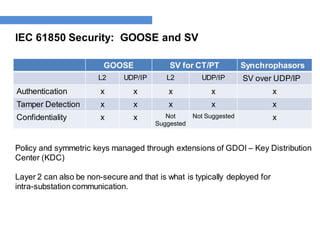
  • 93.
    P I E CE S , P A R T S , A N D P R O T O CO L S GOOSE messagescanbe constantlymonitored, wirescan not! • Publisher – subscriber • Publisher sends control, status point, or analog values • Not just one message, but a sequence calculated by the vendor that continuously sends data from publisher to subscriber • Each IED that needs GOOSE messages from another must subscribe to those messages • Even if the receiving IED is just powered up, it will be able to get updated status it needs • Very fast and faster than wired GOOSE EVENT TIME LINE 11
  • 94.
    REQUIRED PERFORMANCE ANDTRANSFER TIME FOR FUNCTIONS SUPPORTED BY GOOSE 12 Message Performance Class Transfer Time Class IF1 IF2 IF3 IF4 IF5 IF6 IF7 IF8 IF9 IF10 IF11 IF12 IF13 Protocol from IEC 61850-8-1-2011 Figure 1 IEC 61850-90-4 Table 37 P6 TT1 X X X X X X X X X MMS P5 TT2 X X X X X X X X X MMS P4 TT3 X X X X X MMS P3 TT4 (20) X X X X GOOSE P2 TT5 (10) X X X GOOSE P1 TT6 (3) X X X GOOSE P7 TT6 X X SV P8 TT5 X X X SV P9 TT0 X X X X X X MMS P10 TT2 X X X X X X X X X SNTP/PTP P11 TT1 X X X X X X X X X SNTP/PTP P12 TT0 X X X X X X SNTP/PTP
  • 95.
    P I E CE S , P A R T S , A N D P R O T O CO L S A ping pong(echo) test is actuallyused to measuretransfertime,but it virtuallyeliminates the network and assumessymmetryonta and tc • Transfer time • Impossibleto directly measure • Not what is important to utilities – an end to end test PERFORMANCE IN IEC 61850-5:2013 13
  • 96.
    P I E CE S , P A R T S , A N D P R O T O CO L S • GOOSE messagestructure has an optional framework to support cybersecurity • Based on IEC 62351-6 • Uses Reserved1and Reserved2fieldsfrom the message • Uses an extension to the message that contains the message authentication code • Research indicates • The authentication using 1024-bit keys takes 8.3 ms • Using 2048-bit keys today will take longer GOOSE CYBERSECURITY 14
  • 97.
    P I E CE S , P A R T S , A N D P R O T O CO L S • TypicalLayer 2attacks • ARP attacks, MAC flooding attacks, spanning-tree attacks, multicast brute force attacks, VLAN trunking protocol attacks, private VLAN attacks, identity theft, VLAN hopping attacks, MAC spoofing and double-encapsulated 802.1Q/Nested VLAN attacks • GOOSE attacks • GOOSE spoof (and variants) • GOOSE storm • High Status Number Attack (or GOOSE poison) (send stNum value of 232-1 • High rate flooding attack • Semantic attack GOOSE ATTACKS 15
  • 98.
    P I E CE S , P A R T S , A N D P R O T O CO L S • GOOSE Spoofattack (one variant) • Publishingfalse layer 2 packetsand subscribingIEDs mistakenly believe the messages are valid GOOSE SPOOF ATTACK 16 Juan Hoyos,etal,"ExploitingtheGOOSEProtocol:APractical Attackon Cyber-infrastructure”,GC'12 Workshop:SmartGridCommunications: Design for Performance
  • 99.
    P I E CE S , P A R T S , A N D P R O T O CO L S • Existingmitigations (typicaltolayer 2) • A dedicated VLAN ID for all trunk ports • Disable all unused ports and place in unused VLAN • Do not use the default VLAN (1) • Set all ports to non-trunking • Physical security to detect and delay unauthorized Layer 2 access • GOOSE Spoof specific mitigations • GOOSE anomaly detection in switches and routers to reject GOOSE messages not consistent with 61850 configuration • Other GOOSE mitigations • GOOSE anomaly detection in IEDs GOOSE SPOOF MITIGATION 17
  • 100.
    IEC 61850 ARCHITECTURE AND GOOSE Pieces,parts, and protocols Example LAN Architectures 18
  • 101.
  • 102.
  • 103.
  • 104.
  • 105.
  • 106.
  • 107.
  • 108.
  • 109.
  • 110.
  • 111.
  • 112.
  • 113.
  • 114.
  • 115.
  • 116.
  • 117.
    CO N CL US I O N S • IEC 61850specifies an architecturefor utilityautomation systems • IEC 61850 includesmany different protocols • IEC 61850 supports applicationsthat have performance requirementsthat can be met by some protocolsand not others • IEC 61850 has numerouspossible architecturesfeaturing “stationbus” and “process bus” • IEC 61850 GOOSE protocolis fast enough to support any time criticalapplications,plusthose that are not • IEC 61850 GOOSE protocolpresentssome cybersecurity challenges CONCLUSIONS 35
  • 118.
    36 R e turn to Y e O l den W a ys Now is the time for any questions and discussion
  • 119.
    NERC Roundtable Forum 11/21/2016 Page1 Energy Automation Authors: Eric Stranz, Business Development Manager, Siemens
  • 120.
  • 121.
    NERC Roundtable Forum NERCCIP – Cyber securityfor TSO and Generation 11/21/2016 Energy Automation Page 3 Generation / DER • Misuse of local administrative rights Distribution and Transmission • Substation Configuration is manipulated via local network, wireless or remote access Operation • Unauthorized remote service access Market • Fraud based on falsified offers and contracts (Customer, Utilities, DNOs, …) Customer • Consumer behavior tracking, e.g., through smart meters • Fraud through smart meter manipulation
  • 122.
    NERC Roundtable Forum CyberThreat Potential 11/21/2016 Energy Automation Page 4 Station Level Possible Attackers: • Countries • Criminal organizations • Script kiddies • Insider • Spoofing • Malware • Viruses • ….. Control Center Level Field Level Substation Control Zone Remote Access Malware Misuse of accessrights Unauthorized access to network Unauthorized access Attacksvia internet Attacksvia internet Misuse of accessrights Malware Malware
  • 123.
    NERC Roundtable Forum ControlCenter GPS Clock Substation HMI Process Bus Station Bus MMS (data collection & controls) Sampled Values (currents / voltages) GOOSE (virtual wires) I E C 6 1 8 5 0 GOOSE (virtual wires) Substation Data Collector & Controller IEC-61850 3rd party device IEEE 1588v2 time synch
  • 124.
    NERC Roundtable Forum NetworkSegmentation – Process and Station Bus Networks 11/21/2016 Energy Automation Page 6
  • 125.
    NERC Roundtable Forum CIP5 Standards Consolidated FAQOct. 2015 # 23 IEC 61850 is an Ethernet-based standard for the design of electrical substation automation and the abstractdata models can be mapped to a number of protocols, including MMS (Manufacturing Message Specification, the underlying communication architecture for ICCP), GOOSE, and Web Services. IEC 61850 is not a data link or network layer protocol, thus declaring IEC 61850 to be a routable or non-routable protocol is not appropriate. Time- critical messages, such as GOOSE messages for direct inter-bay communication, typicallyrun on a flat Layer 2 networkwithout the need for Layer 3 IP addresses. Other non-time-critical messages, including MMS and web services, typicallyrun on a Layer 3 network, such as TCP/IP, with addressing and routing. The registered entityshould carefullyevaluate the communication environment supporting the IEC 61850 data protocol to determine if routable communication exists. If the IEC 61850 data is being communicated over a TCP/IP network, then that networkconnectivityis considered routable and should be protected per the CIP Standards accordingly.
  • 126.
    NERC Roundtable Forum Aproposed re-write of CIP 5 Standards Consolidated FAQ Oct. 2015 # 23 IEC 61850 is an architecture for utility automation systems, including substations, that includes several protocols. Thus declaring IEC 61850 to be a routable or non-routable protocol is not appropriate. One protocol in the IEC 61850 standard is GOOSE, which can be used for time-critical applications, is a Layer 2 multicast protocol. GOOSE may be used on what 61850 calls station bus and/or process bus. Other protocols used in 61850, such as MMS and web services, typically run on a Layer 3 network, such as TCP/IP, with addressing and routing. Any utility automation system using 61850 protocols are likely using other protocols in addition to those included in 61850. The registered entity should carefully evaluate the communication environment supporting the IEC 61850 communication protocols to determine what Routable communication exists. Any TCP/IP network supporting communication protocols above layer 2 is considered Routable as newly defined in the NERC Glossary of Terms. Once Routable communication is determined, the registered entity should carefully evaluate ESPs, ERC, EAPs, LERCs, and LEAPs and any potential negative impacts on the performance on the protocols being protected. 11/21/2016 Energy Automation Page 8
  • 127.
    NERC Roundtable Forum IEC61850 Monitoring–GOOSE and SV Sequence Number: 1045 State Sequence: 25 Sequence Number: 1046 State Sequence: 25 Sequence Number: 1047 State Sequence: 25 Sequence Number: 0 State Sequence: 26 Starts a new sequence when the status change Sequence Number: 1 State Sequence: 26 Sequence Number: 2 State Sequence: 26 Sequence Number: 3 State Sequence: 26 Sequence Number: 4 State Sequence: 26 A well designed Substation system can determine the healthof the networkby monitoring sequence or state alarms and indications for fast networkdiagnosis
  • 128.
    NERC Roundtable Forum Whydo people want to move to IEC-61850 • Up to 40% cost savings with Sampled Values Technology within a substation compared to a traditional copper installation (Based on a 12 Feeder Install) • IEC-61850 GOOSE reduces copper interconnectivity between devices which results in significant savings in some installations • Templates, reusable engineering make IEC-61850 an attractive option • Physical Security is already required and Communications Security is already required if Ethernet is deployed in the substation 11/21/2016 Energy Automation Page 10 Is NERC CIP Compliancetoo difficult to even consider these technologies?
  • 129.
    NERC Roundtable Forum 11/21/2016 Page11 Energy Automation 1.) Assess stations designations based on the CIP -014-01 (4.1.1.2) 2.) Define the (BES) Cyber System (formerly Critical Cyber Assets) 3.) Define Physical Security Perimeter (PSP) 4.) Define Electronic Security Perimeter(s) (ESP) 5.) Provide a Cyber Security Framework to Cyber Assets per CIP Standards 6.) Define Electronic Access Points into ESP(s) In Version 5 NERC now allows for multiple ESP’s and does not restrict the ESP’s to the 6 wall approach.
  • 130.
    NERC Roundtable Forum Physical& Cyber security • The physical security requirements • Need of authentication before entrance of station • Recognize and Alarm in case of unauthorized access • Protection against unauthorized access • Cyber security • Mitigate misuse of access rights • Authentication of access • Prevents from outside threads and attacks on infrastructure 11/21/2016 Energy Automation Page 12
  • 131.
    NERC Roundtable Forum NormalNERC CIP ApplicableSubstationsShould Already Include Physical SecurityMeasures Two Factor Authentication (Something you know, Something you are, Something you have) Card Scanners, Cameras, Authentication Systems typically are already in place for a NERC CIP Station 11/21/2016 Energy Automation Page 13 The FERC Order No. 706, Paragraph 572, directive discussedutilizing two or more differentand complementary physical access controls to provide defense in depth.
  • 132.
    NERC Roundtable Forum ESPat the Control House 11/21/2016 Energy Automation Page 14 Camera Keypad Card scan Card Scan 2 Factor Authentication Card Scan to Retrieve Key for Breakers Door switch triggers alarm where camera monitors activity Layer 2 Com’s Only
  • 133.
  • 134.
    NERC Roundtable Forum ESPat the Substation Fence 11/21/2016 Energy Automation Page 16 Camera Keypad Card scan Card Scan 2 Factor Authentication Card Scan to Retrieve Key for Breakers Door switch triggers alarm where camera monitors activity Card scan Layer 3 or Layer 2
  • 135.
    NERC Roundtable Forum -Furtherclarity on the IED straddling Station and Process bus -V5 helps for utilities to adopt 61850 but decisions on PSP, ESP and ERC’s require additional effort by utilities - Moving forward NERC needs to provide further clarification of existing Q&A and other materials referencing 61850. Engage Industry Experts to help clarify existing statements on 61850. - Tunneling Goose between stations, Routable Goose, Routable Sampled Values are topics that have not been addressed or discussed and will require more review and discussion. - End to End application to application encryption and authentication is years away for IEC- 61850 MMS and GOOSE. NERC needs to continue to provide a framework that give utilities flexibility until it is complete. V5 has helped. - Vendors may need to do more for GOOSE and SV monitoring Conclusions
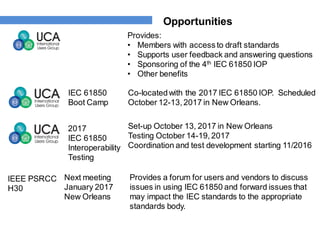
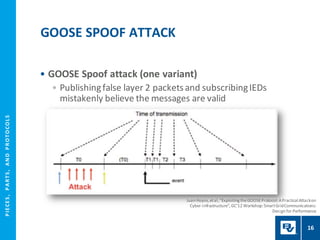
  • 136.
    NERC Roundtable Forum Thankyou for your attention! 11/21/2016 Page 18 Energy Automation
  • 137.
    NERC CIP Implicationsof IEC 61850 in Transmission Stations Scott R Mix, CISSP, CIP Technical Manager, NERC
  • 138.
    RELIABILITY | ACCOUNTABILITY 2 Agenda •Application of NERC Standards • NERC Definitions • What Does it Mean? (Compliance Implications) • Effective Dates (Implementation Timeframes)
  • 139.
    RELIABILITY | ACCOUNTABILITY 3 Applicationof NERC Standards • NERC Standards apply to the Bulk Electric System (BES)  Generally, 100kV and above, but with some exceptions, primarily for radial lines  20MVA and above generating units, 75MVA and above generating plants, with some exceptions for wholly behind- the-meter generation • NERC Standards do not apply to distribution (i.e., non- BES)  With several exceptions, primarily UFLS, UVLS, Blackstart Resources (generation), Cranking Paths
  • 140.
    RELIABILITY | ACCOUNTABILITY 4 Applicationof NERC CIP Standards • NERC CIP standards (CIP-002 through CIP-011) in their current version require a high / medium / low categorization, with corresponding requirement for the levels  High only applies to Control Centers  Medium and low applies to field assets (and Control Centers) • For medium impact assets, external connectivity also informs the requirements  External Routable Connectivity includes more requirements • This presentation is not about the requirements; rather it is about scoping of assets subject to the requirements
  • 141.
    RELIABILITY | ACCOUNTABILITY 5 Definitions •Cyber Asset: Programmable electronic devices, including the hardware, software, and data in those devices.
  • 142.
    RELIABILITY | ACCOUNTABILITY 6 Definitions •BES Cyber Asset (BCA): A Cyber Asset that if rendered unavailable, degraded, or misused would, within 15 minutes of its required operation, misoperation, or non-operation, adversely impact one or more Facilities, systems, or equipment, which, if destroyed, degraded, or otherwise rendered unavailable when needed, would affect the reliable operation of the Bulk Electric System. Redundancy of affected Facilities, systems, and equipment shall not be considered when determining adverse impact. Each BES Cyber Asset is included in one or more BES Cyber Systems.
  • 143.
    RELIABILITY | ACCOUNTABILITY 7 Definitions •BES Cyber System (BCS): One or more BES Cyber Assets logically grouped by a responsible entity to perform one or more reliability tasks for a functional entity.  (not part of the formal definition) Components of the BCS also include “glue” infrastructure components (e.g., networking infrastructure) necessary for the system to perform its reliability tasks, like merging units and network switches  Tremendous flexibility is built into the definition – BCS could be the entire substation, all relays/equipment at a voltage level, relays/equipment at feeder/bay level, etc
  • 144.
    RELIABILITY | ACCOUNTABILITY 8 Definitions •Electronic Security Perimeter (ESP): The logical border surrounding a network to which BES Cyber Systems are connected using a routable protocol.
  • 145.
    RELIABILITY | ACCOUNTABILITY 9 Definitions •Protected Cyber Asset (PCA): One or more Cyber Assets connected using a routable protocol within or on an Electronic Security Perimeter that is not part of the highest impact BES Cyber System within the same Electronic Security Perimeter. The impact rating of Protected Cyber Assets is equal to the highest rated BES Cyber System in the same ESP.  A stand-alone substation HMI, if not needed for control processing, would be a PCA; however, if it was needed for control processing, it would be a BES Cyber Asset
  • 146.
    RELIABILITY | ACCOUNTABILITY 10 Definitions •Electronic Access Point (EAP): A Cyber Asset interface on an Electronic Security Perimeter that allows routable communication between Cyber Assets outside an Electronic Security Perimeter and Cyber Assets inside an Electronic Security Perimeter.  Note that there are no requirements or restrictions on communications between Cyber Assets located within an ESP – the only requirements are for communicationsthat pass through an EAP
  • 147.
    RELIABILITY | ACCOUNTABILITY 11 Definitions •Electronic Access Control or Monitoring Systems (EACMS): Cyber Assets that perform electronic access control or electronic access monitoring of the Electronic Security Perimeter(s) or BES Cyber Systems. This includes intermediate Systems.  Typically this includes Cyber Assets that perform firewall / filtering services, intrusion detection or monitoring services, logging services, authentication services, proxy services, etc
  • 148.
    RELIABILITY | ACCOUNTABILITY 12 Definitions •Low Impact: • Current proposed requirements for Low Impact BES Cyber Systems (posted for comment and ballot until December 5, 2016) have eliminated definitions for both “LERC” and “LEAP” • However, the concepts of external routable connectivity and requirements for controlling external routable access remain in the requirement language
  • 149.
    RELIABILITY | ACCOUNTABILITY 13 •CIP-003-7,Attachment 1, Section 3: Definitions Section 3. Electronic Access Controls: For each asset containing low impact BES Cyber System(s) identified pursuant to CIP-002, the Responsible Entity shall implement electronic access controls to: 3.1 Permit only necessary inbound and outbound electronic access as determined by the Responsible Entity for any communications that are: i. between a low impact BES Cyber System(s) and a CyberAsset(s) outside the asset containing low impact BES Cyber System(s); ii. using a routable protocol when entering or leaving the asset containing the low impact BES Cyber System(s); and, iii. not used for time-sensitive protection or control functions between intelligent electronic devices (e.g. communications using protocol IEC TR-61850-90-5 R-GOOSE). 3.2 Authenticate all Dial-up Connectivity, if any, that provides access to low impact BES Cyber System(s), per Cyber Asset capability.
  • 150.
    RELIABILITY | ACCOUNTABILITY 14 Exclusions •4.2.3.2 Cyber Assets associated with communication networks and data communication links between discrete Electronic Security Perimeters.  Language as written assumes ESPs at both ends of the communication link  Guidance has been issues to allow entities to define a “demarcation point” in the instance where there is no ESP at one or both ends of the communicationlink, that is used to define which systems are “in scope” and which are allowed to be excluded
  • 151.
    RELIABILITY | ACCOUNTABILITY 15 ComplianceImplications • What does it all mean?  61850 relays meet the definition of BES Cyber Asset  61850 devices constitute components in a BES Cyber System  Merging Units and other ethernet switches are necessary communication components connecting the individual 61850 relays together – they are therefore part of the BES Cyber System
  • 152.
    RELIABILITY | ACCOUNTABILITY 16 ComplianceImplications • What does it all mean?  61850 instrumentation components (e.g., CTs, PTs, sensors, actuators) are necessary for the relays to perform their functions – they are therefore part of the BES Cyber System  61850 relays use routable protocols for communication (e.g., TCP/IP) o Expect extensive scrutiny if asserting this is not true o Communication includes management as well as control capabilities
  • 153.
    RELIABILITY | ACCOUNTABILITY 17 ComplianceImplications • What does this mean for medium impact implementations?  Networks of 61850 devices (as BES Cyber Systems) need to be enclosed in an ESP  An EAP would be required to manage all routable traffic to external systems o The GOOSE message exclusion does not (currently) exist for medium impact  The CIP Standards apply to all the 61850 devices, as well as any other network-attached PCAs  Even if there is no external routable connectivity,there are CIP Standards requirements that apply
  • 154.
    RELIABILITY | ACCOUNTABILITY 18 ComplianceImplications • What does this mean for low impact implementations?  There are no ESP requirements at low impact locations o However,there are requirementsfor controllingexternal routableaccess to low impact BES Cyber Systems  61850 devices which communicate externally (i.e., to devices outside the station) via a routable protocol need to be analyzed for external access o GOOSE messaging is specifically excluded, but other communication is included  Routable external access must be managed and controlled  In any case, policy, security awareness, physical security, and incident response are required – even of there is no routable external access
  • 155.
    RELIABILITY | ACCOUNTABILITY 19 ComplianceImplications • Implementation Considerations:  Start with a non-BES implementation, e.g., a distribution installation o Distribution is not NERC jurisdictional, so there are no NERC compliance implications with any actions performed o Work out 61850 technical implementation issues  Treat the distribution installation as if it were (initially) a low impact installation, and apply the low impact controls o Develop and document necessary procedures and controls
  • 156.
    RELIABILITY | ACCOUNTABILITY 20 ComplianceImplications • Implementation Considerations (cont’d):  Once comfortable, treat the distribution installation as if it were a medium impact without External Routable Connectivity requirements o Develop and document necessary procedures and controls  Then, treat the distribution installation as if it were a medium impact with External Routable Connectivity o Develop and document necessary procedures and controls  Finally, roll out 61850 at a BES station (low or medium)
  • 157.
    RELIABILITY | ACCOUNTABILITY 21 ScottMix, CISSP scott.mix@nerc.net 215-853-8204