
How to find a Thing? 
Discussion of an Object Name Service 
within the Identities of Things Discussion Group 
September, 2014 
Ingo Friese; T-Labs DTAG, 
Matteo Signorini; Excalibur
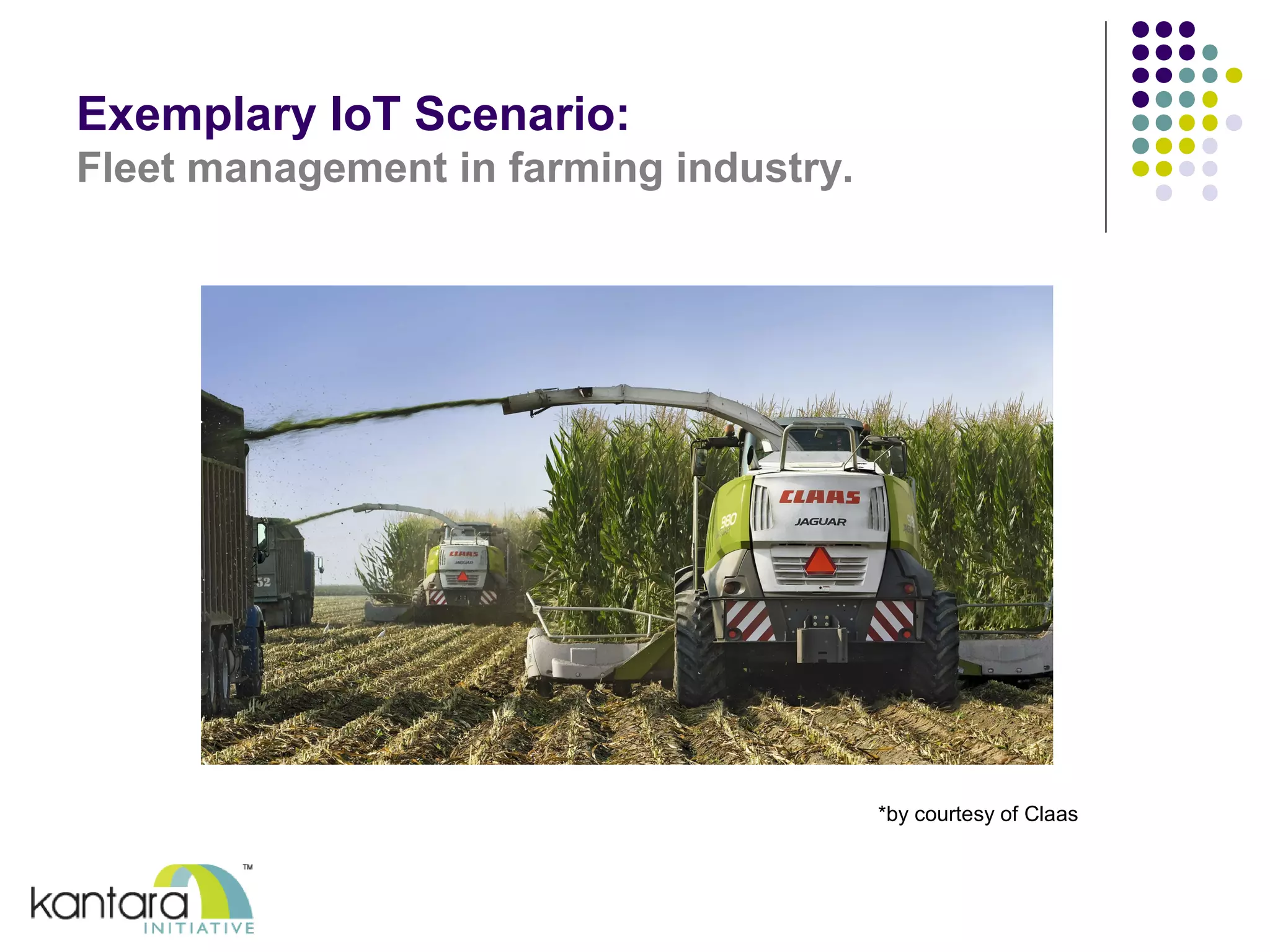
Exemplary IoT Scenario: 
Fleet management in farming industry. 
*by courtesy of Claas
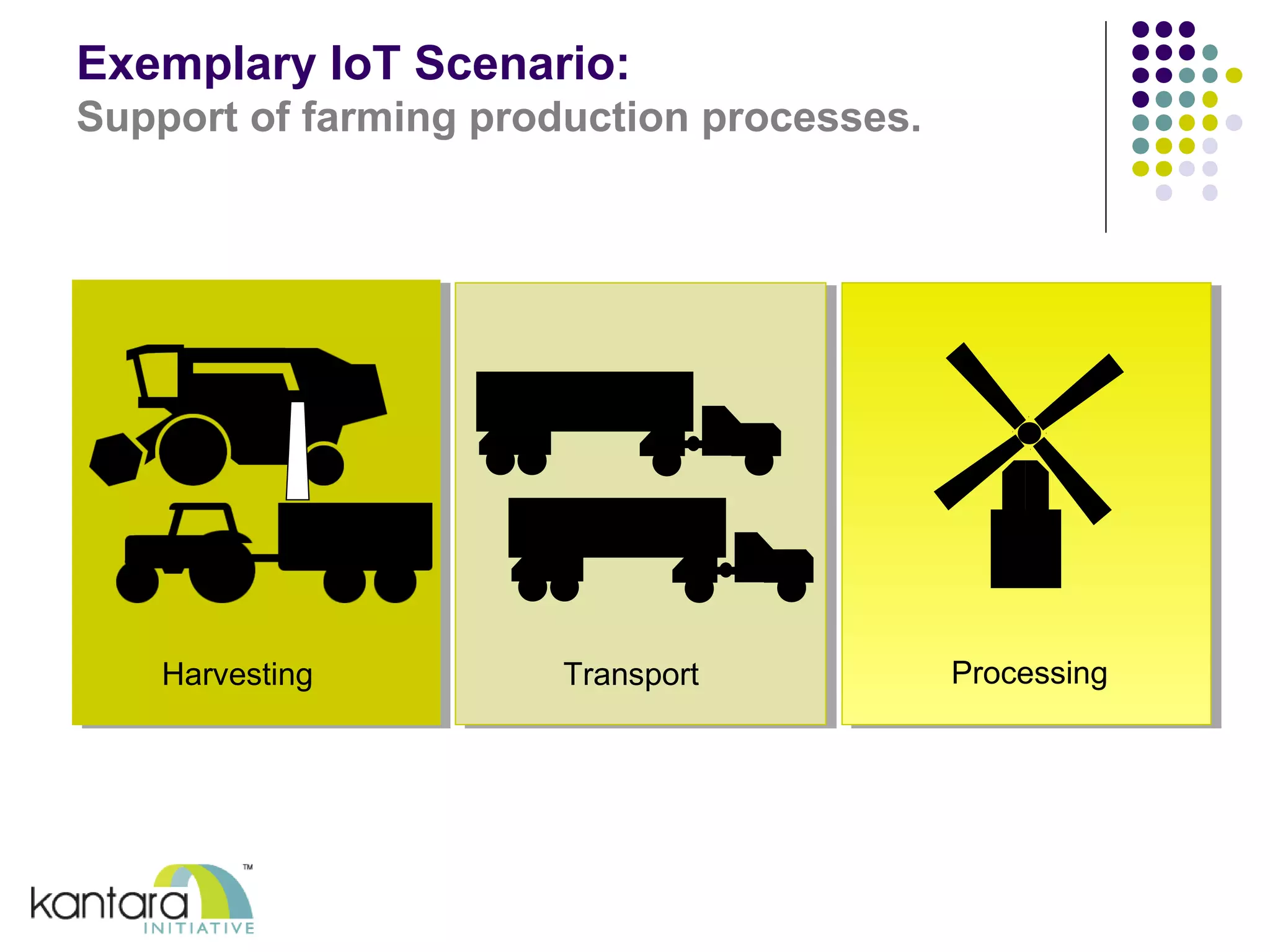
Exemplary IoT Scenario: 
Support of farming production processes. 
Harvesting Transport Processing
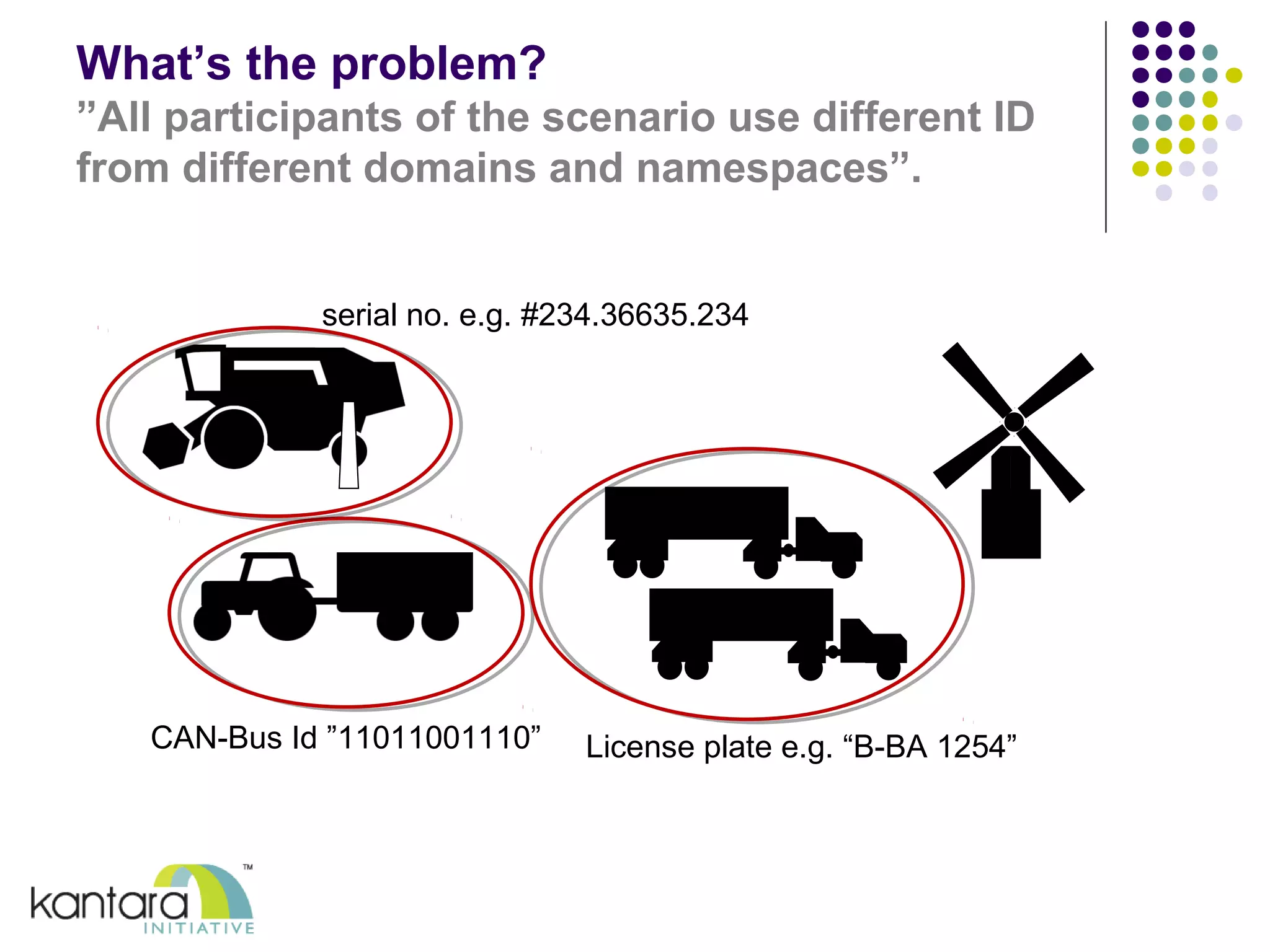
What’s the problem? 
”All participants of the scenario use different ID 
from different domains and namespaces”. 
serial no. e.g. #234.36635.234 
License plate e.g. “B-BA 1254” 
CAN-Bus Id ”11011001110”
What’s the problem? 
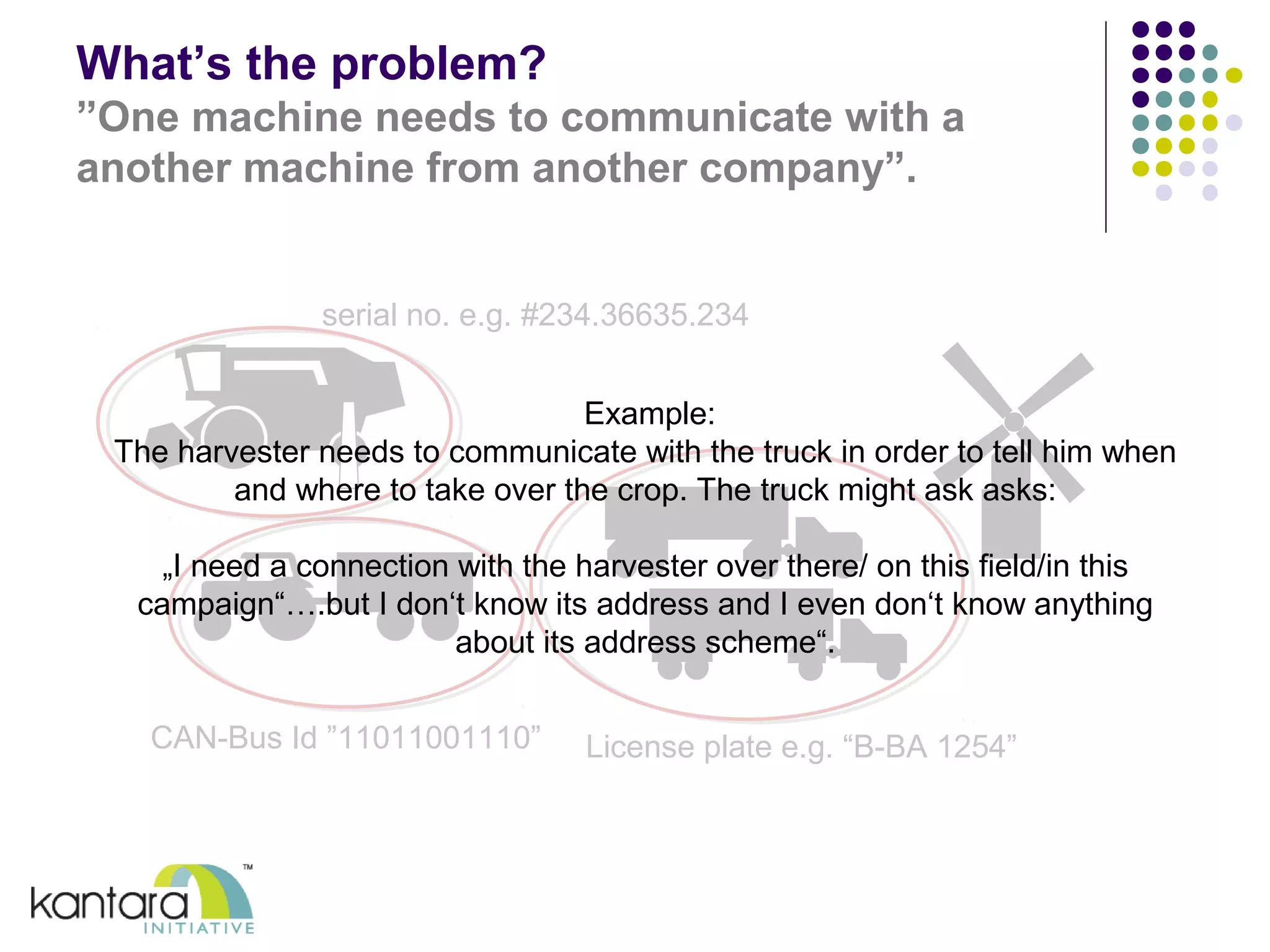
”One machine needs to communicate with a 
another machine from another company”. 
serial no. e.g. #234.36635.234 
License plate e.g. “B-BA 1254” 
CAN-Bus Id ”11011001110” 
Example: 
The harvester needs to communicate with the truck in order to tell him when 
and where to take over the crop. The truck might ask asks: 
„I need a connection with the harvester over there/ on this field/in this 
campaign“….but I don‘t know its address and I even don‘t know anything 
about its address scheme“.
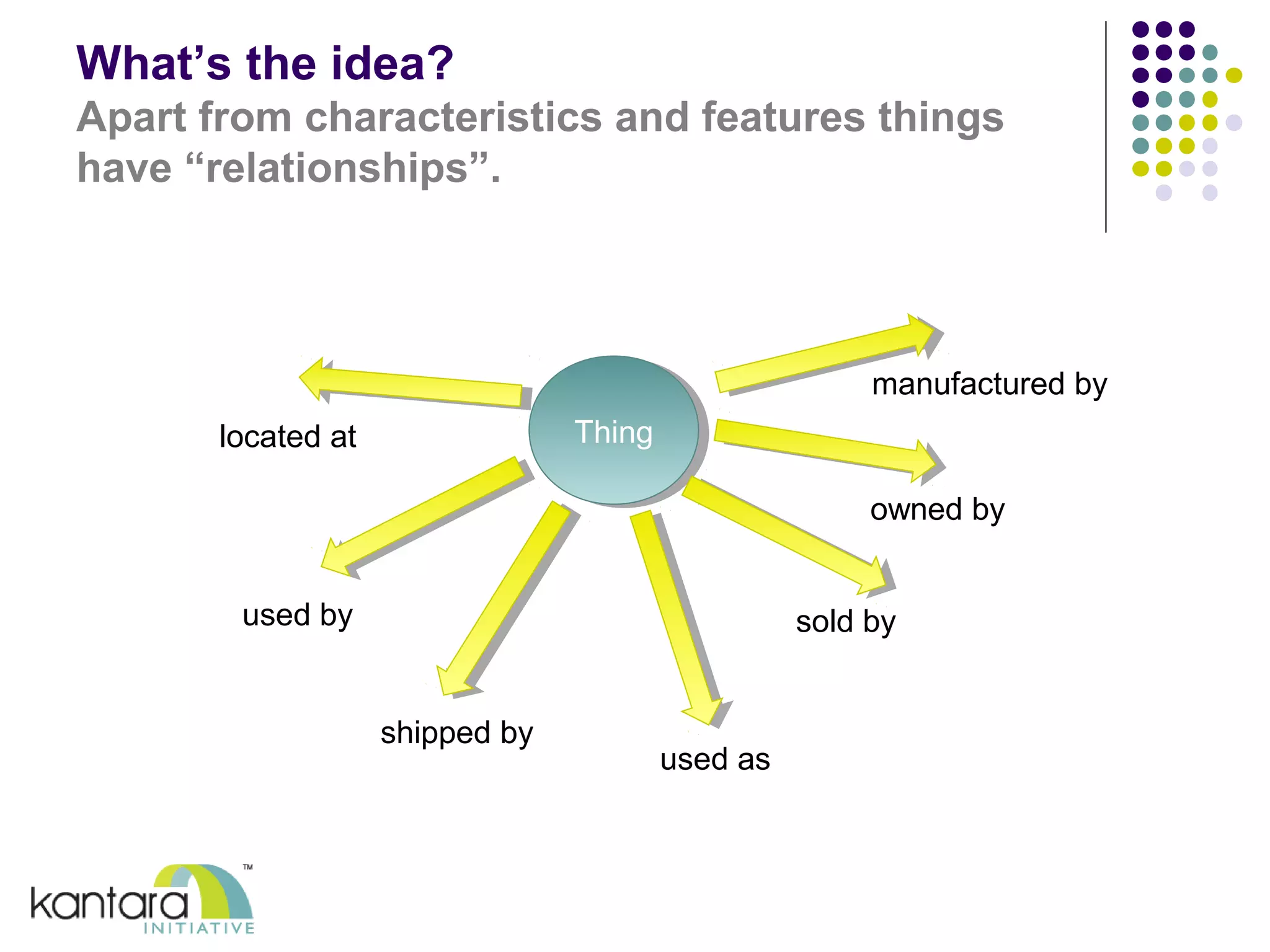
What’s the idea? 
Apart from characteristics and features things 
have “relationships”. 
TThhiningg 
manufactured by 
owned by 
sold by 
used as 
shipped by 
located at 
used by
How to find a Thing? 
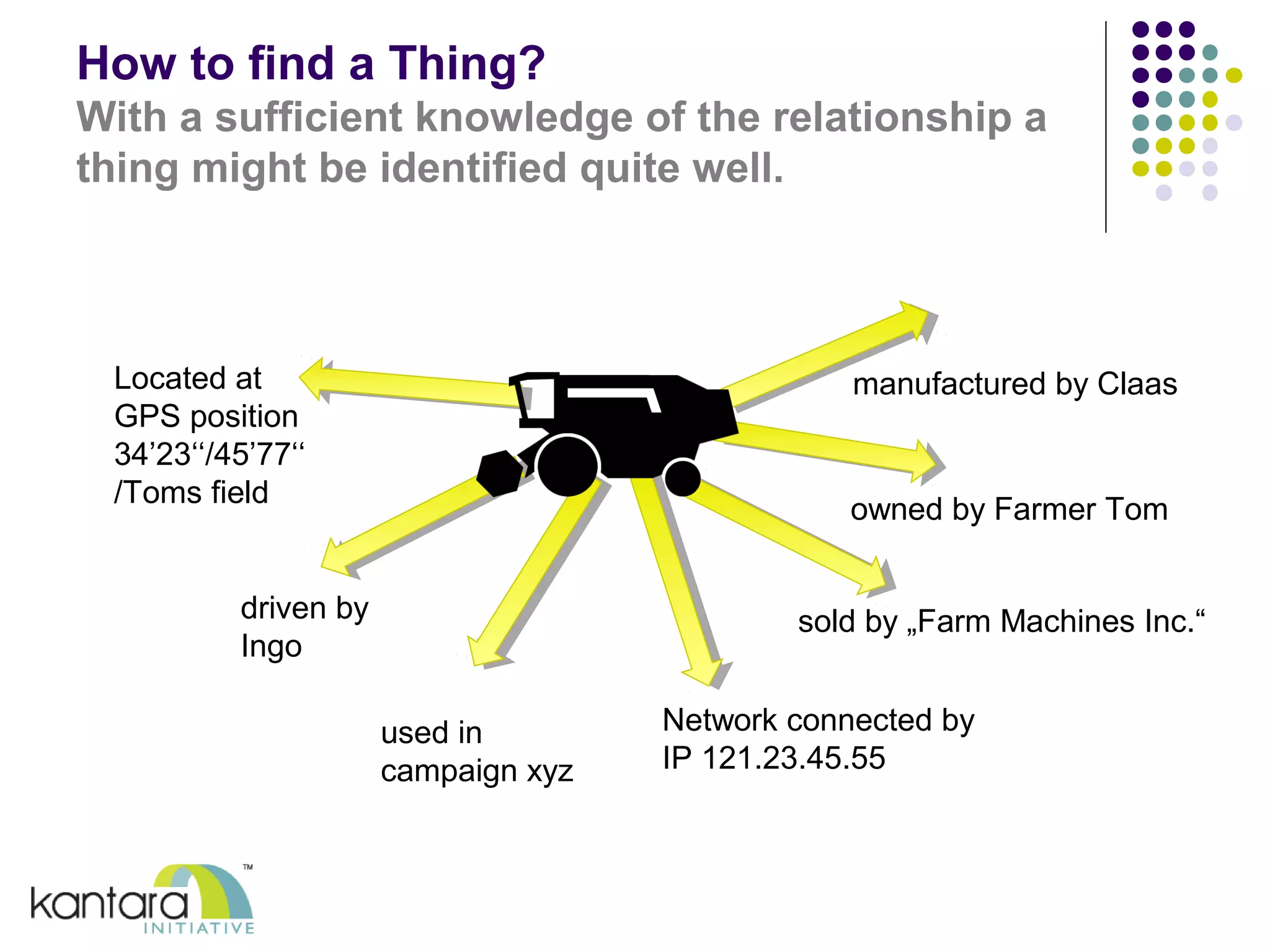
With a sufficient knowledge of the relationship a 
thing might be identified quite well. 
manufactured by Claas 
owned by Farmer Tom 
sold by „Farm Machines Inc.“ 
Network connected by 
IP 121.23.45.55 
used in 
campaign xyz 
Located at 
GPS position 
34’23‘‘/45’77‘‘ 
/Toms field 
driven by 
Ingo
How to find a Thing? 
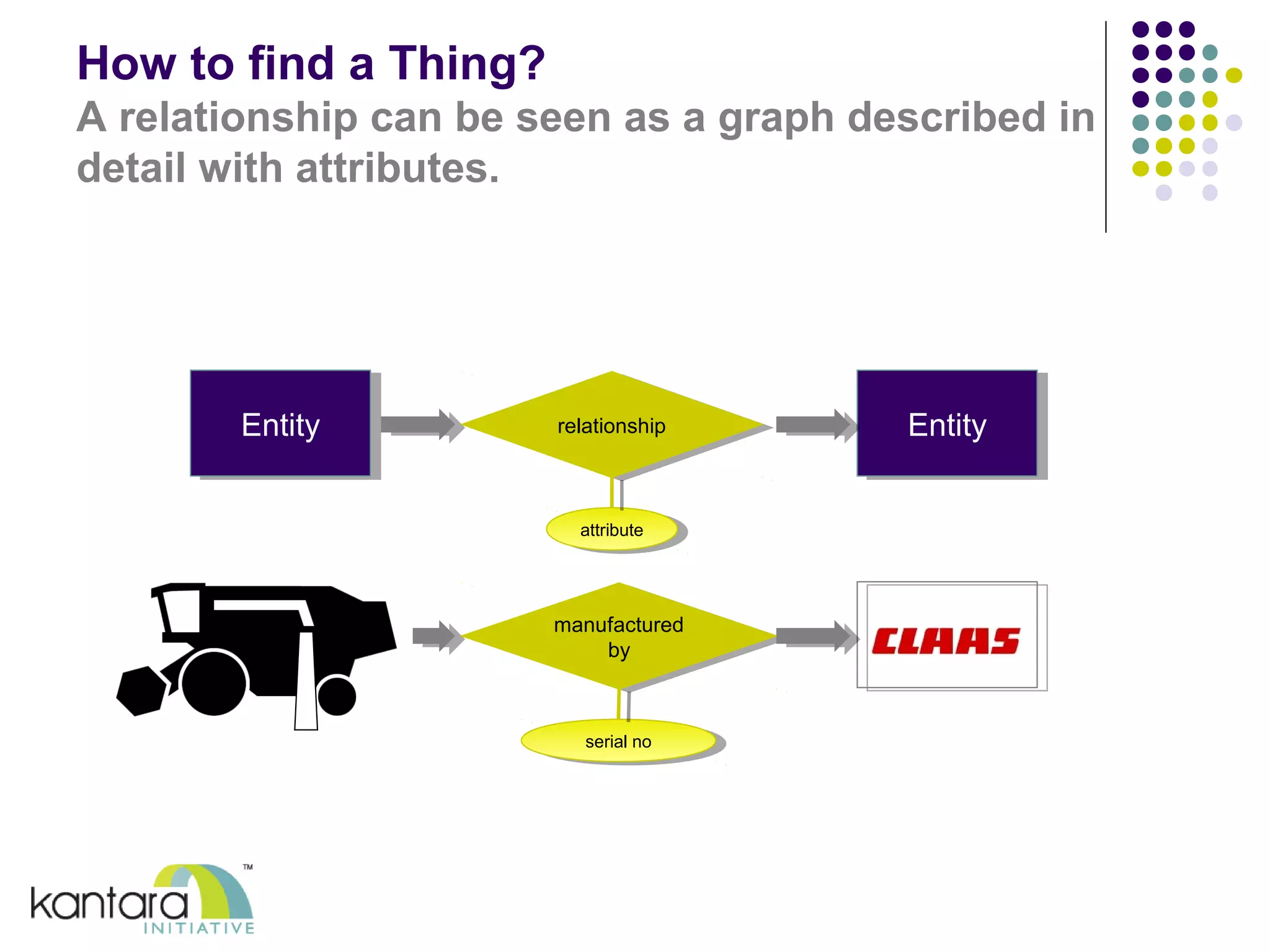
A relationship can be seen as a graph described in 
detail with attributes. 
EEnntittiyty rerelalatitoionnsshhipip EEnntittiyty 
atatrttibriubtuete 
manufactured 
manufactured CClalaaass 
by 
by 
sesreiarila nl ono
How to find a Thing? 
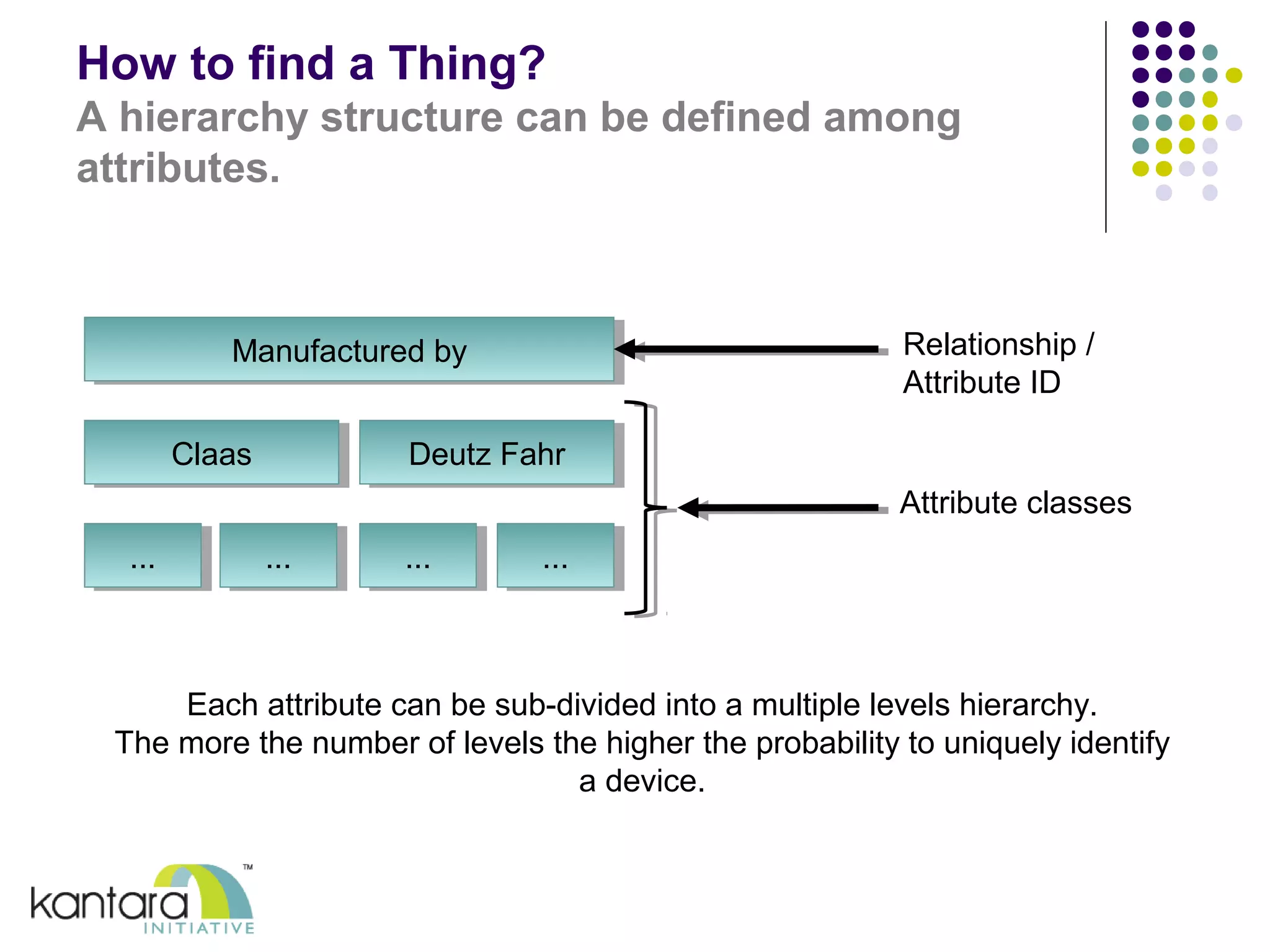
A hierarchy structure can be defined among 
attributes. 
MMaannuufafacctuturreedd b byy 
CClalaaass DDeeuutztz F Faahhrr 
...... ...... ...... ...... 
Relationship / 
Attribute ID 
Attribute classes 
Each attribute can be sub-divided into a multiple levels hierarchy. 
The more the number of levels the higher the probability to uniquely identify 
a device.
How to find a Thing? 
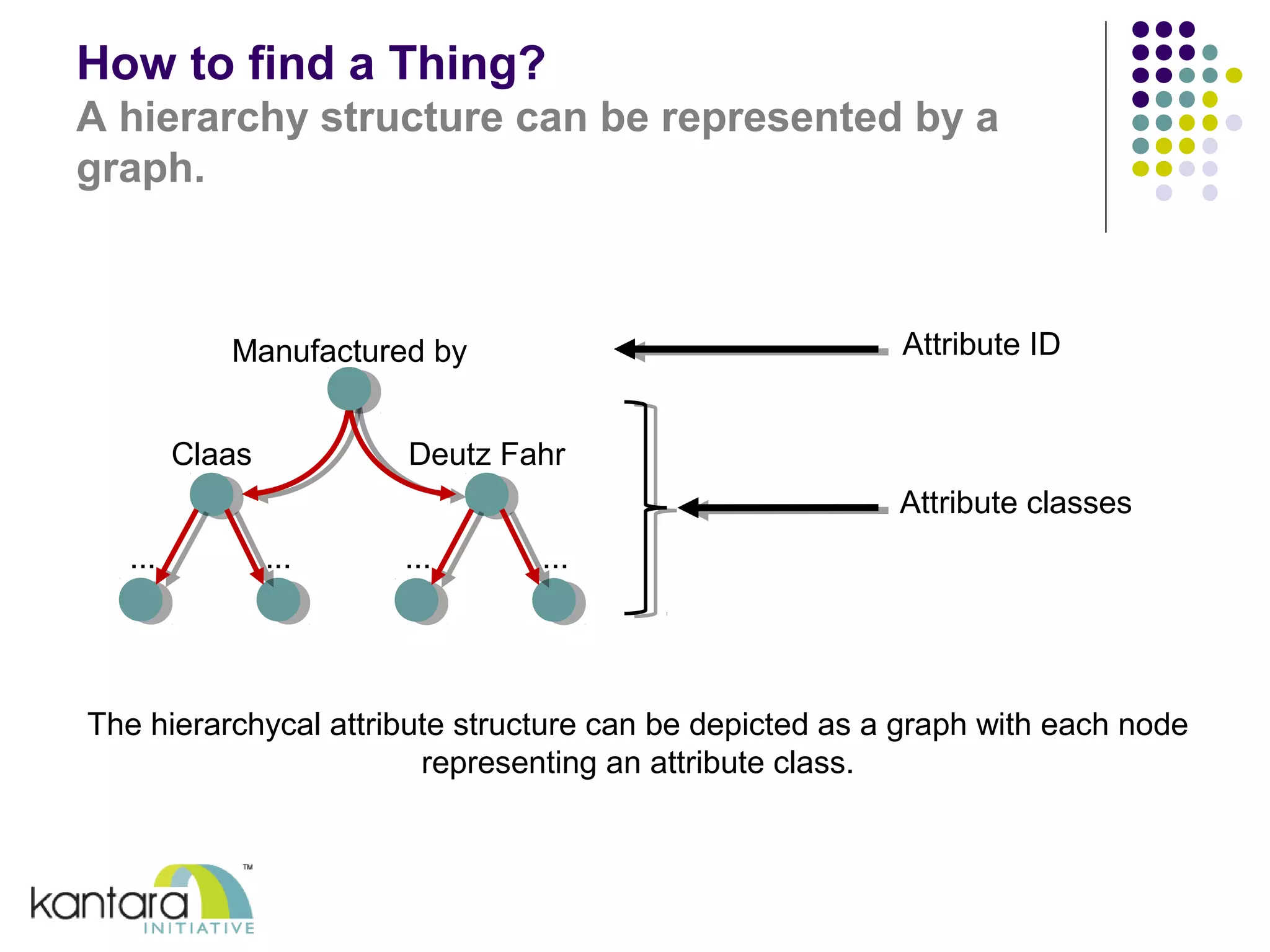
A hierarchy structure can be represented by a 
graph. 
Manufactured by 
Claas Deutz Fahr 
... ... ... ... 
Attribute ID 
Attribute classes 
The hierarchycal attribute structure can be depicted as a graph with each node 
representing an attribute class.
How to find a Thing? 
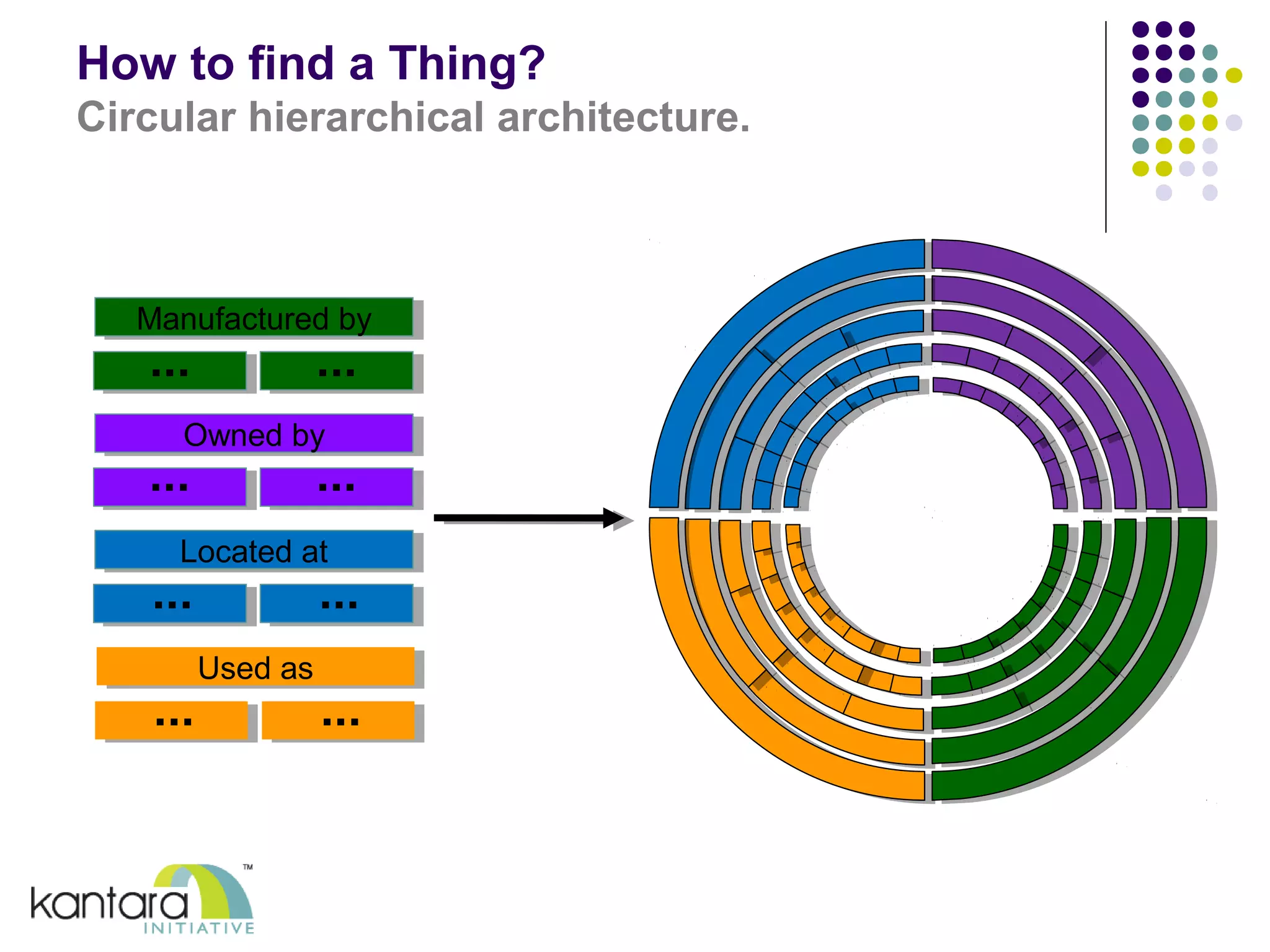
Circular hierarchical architecture. 
MMaannuufafacctuturreedd b byy 
... ... 
OOwwnneedd b byy 
... ... 
LLooccaatetedd a att 
... ... 
UUsseedd a ass 
... ...
How to find a Thing? 
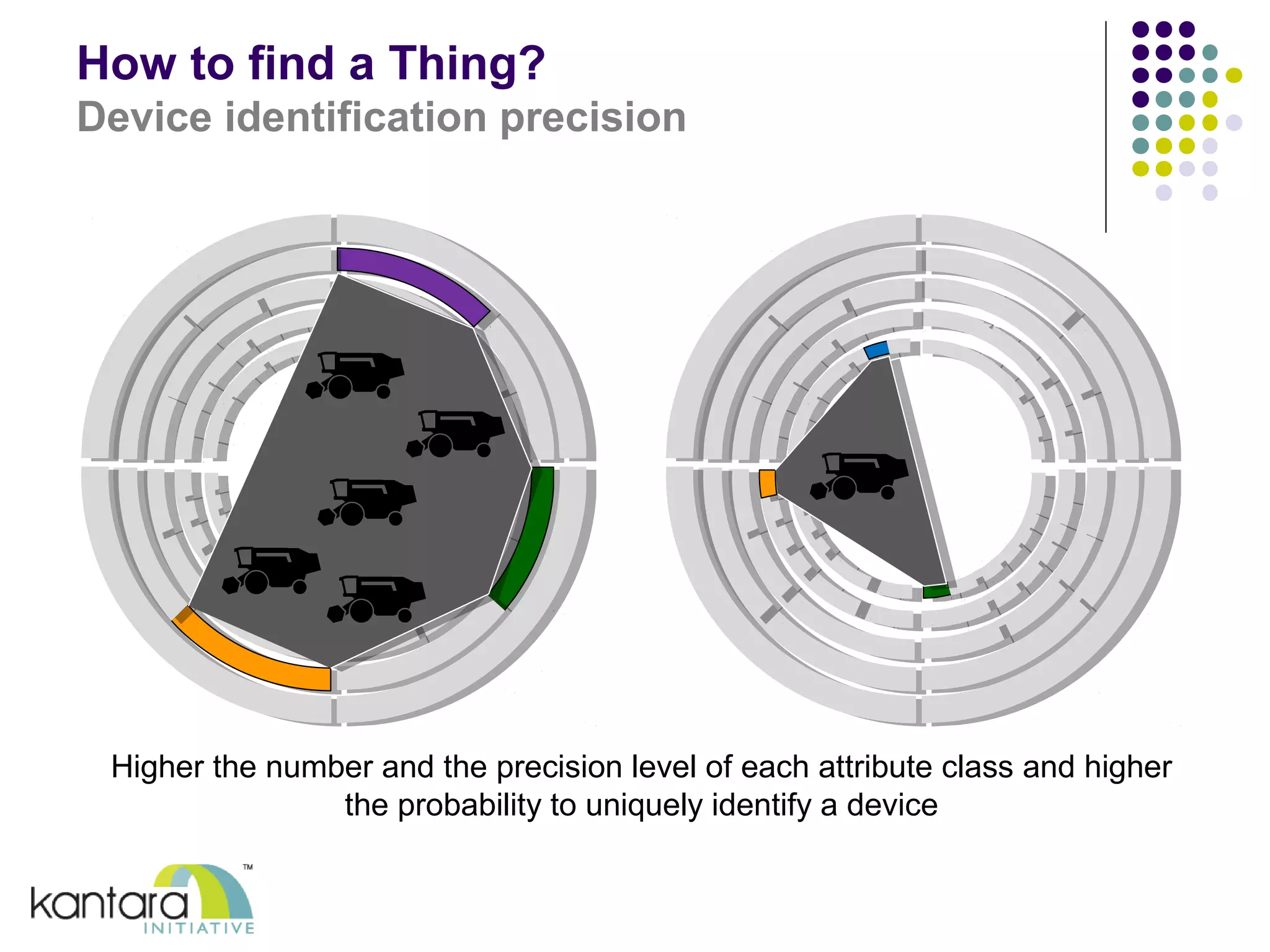
Device identification precision 
Higher the number and the precision level of each attribute class and higher 
the probability to uniquely identify a device
How to find a Thing? 
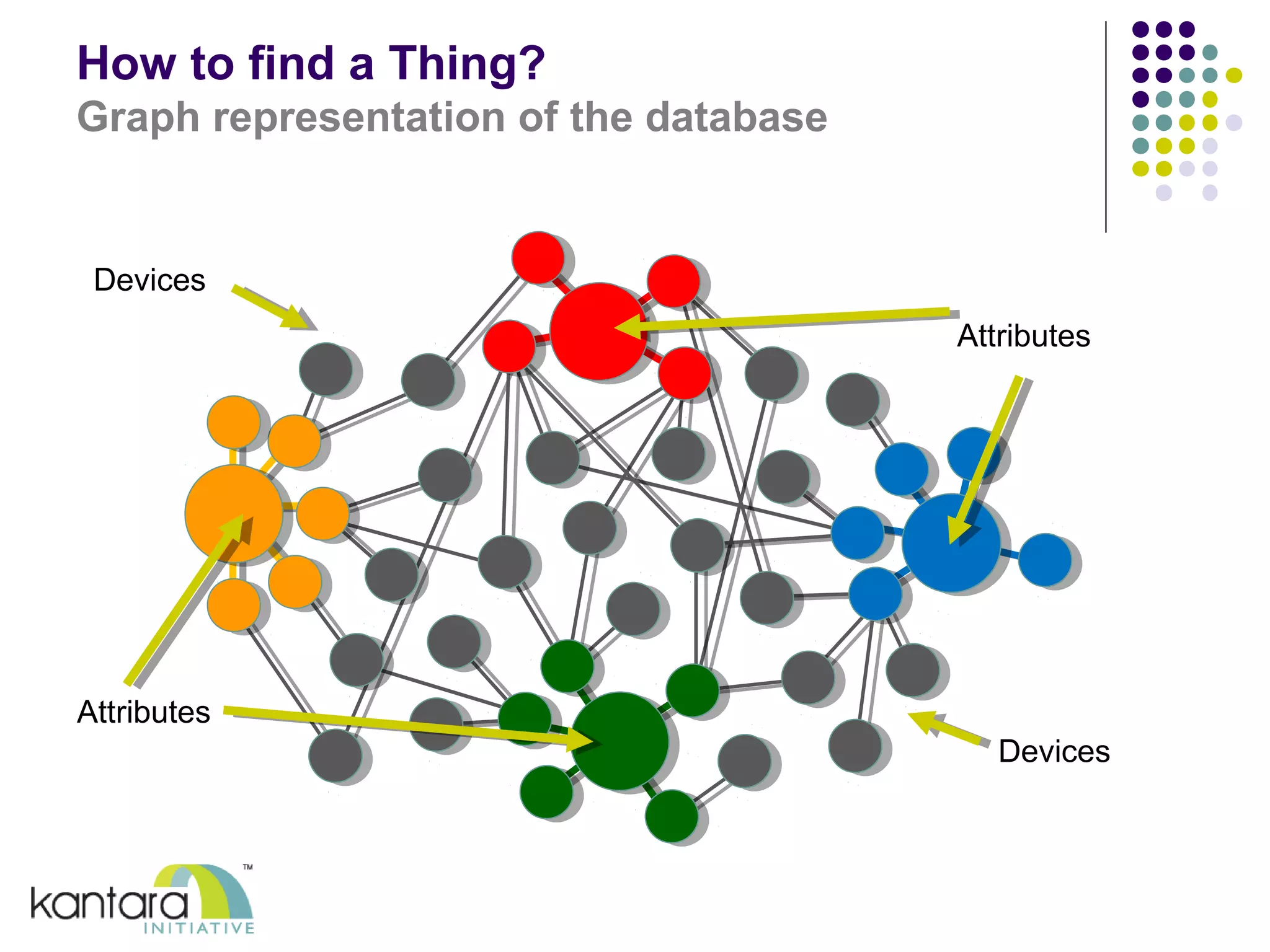
Graph representation of the database 
Attributes 
Attributes 
Devices 
Devices
How to find a Thing? 
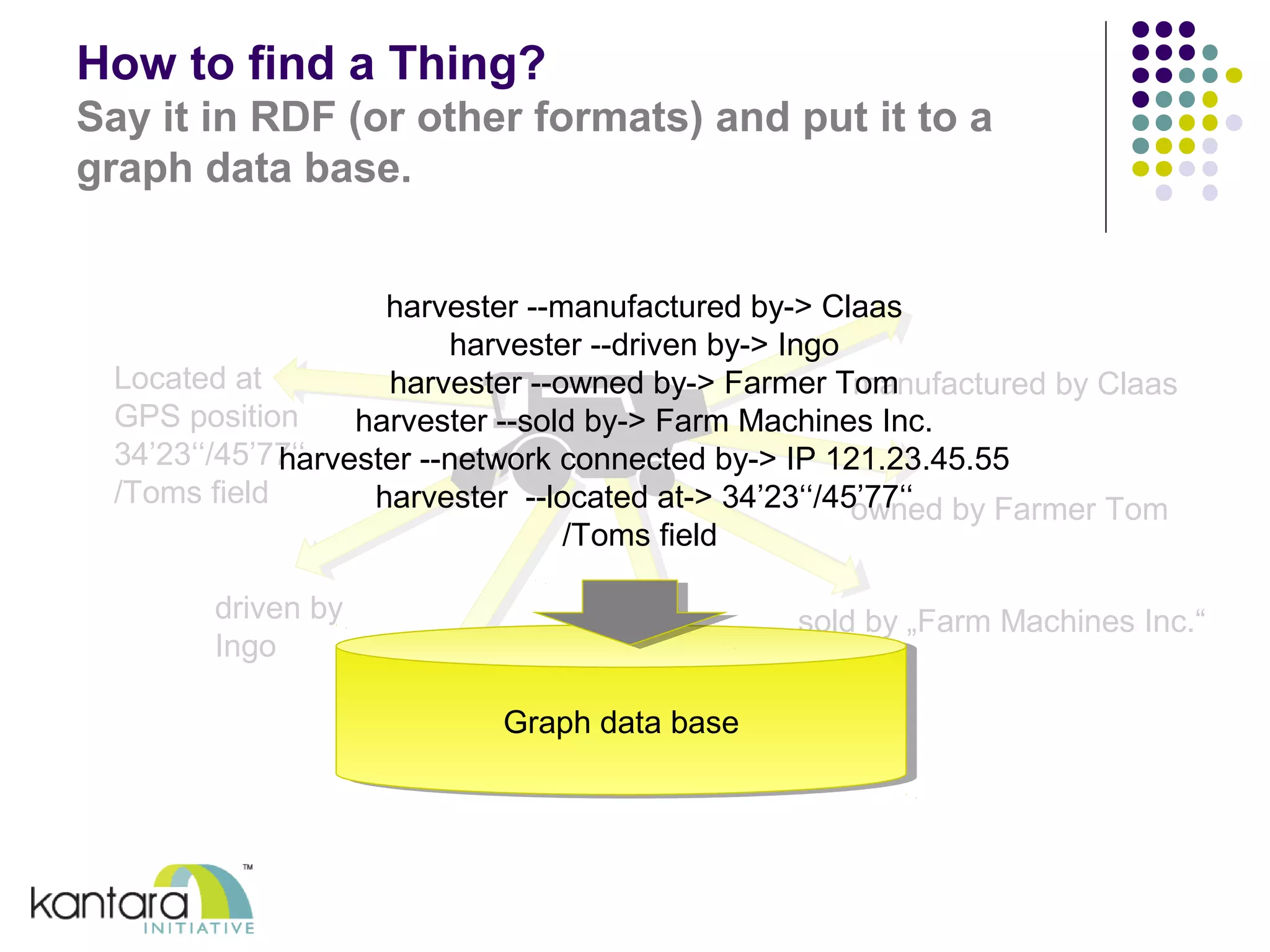
Say it in RDF (or other formats) and put it to a 
graph data base. 
manufactured by Claas 
owned by Farmer Tom 
sold by „Farm Machines Inc.“ 
used as 
corn harvester 
shipped by 
MAX-Transport 
Located at 
GPS position 
34’23‘‘/45’77‘‘ 
/Toms field 
driven by 
Ingo 
harvester --manufactured by-> Claas 
harvester --driven by-> Ingo 
harvester --owned by-> Farmer Tom 
harvester --sold by-> Farm Machines Inc. 
harvester --network connected by-> IP 121.23.45.55 
harvester --located at-> 34’23‘‘/45’77‘‘ 
/Toms field 
GGrraapphh d daatata b baassee
How to find a Thing? 
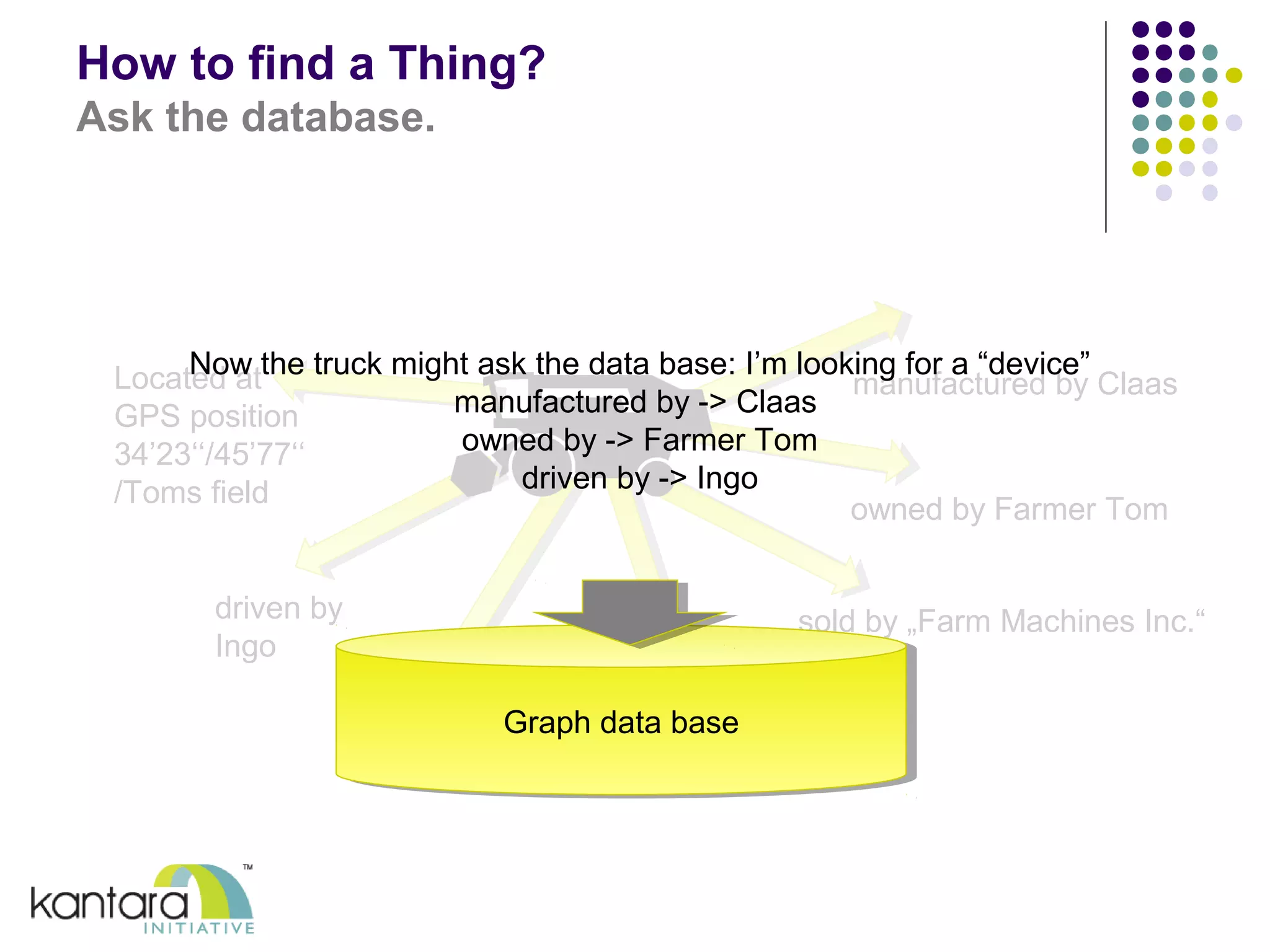
Ask the database. 
Now the truck might ask the data base: I’m looking for a “device” 
manufactured by Claas 
owned by Farmer Tom 
sold by „Farm Machines Inc.“ 
used as 
corn harvester 
shipped by 
MAX-Transport 
Located at 
GPS position 
34’23‘‘/45’77‘‘ 
/Toms field 
driven by 
Ingo 
manufactured by -> Claas 
owned by -> Farmer Tom 
driven by -> Ingo 
GGrraapphh d daatata b baassee
How to find a Thing? 
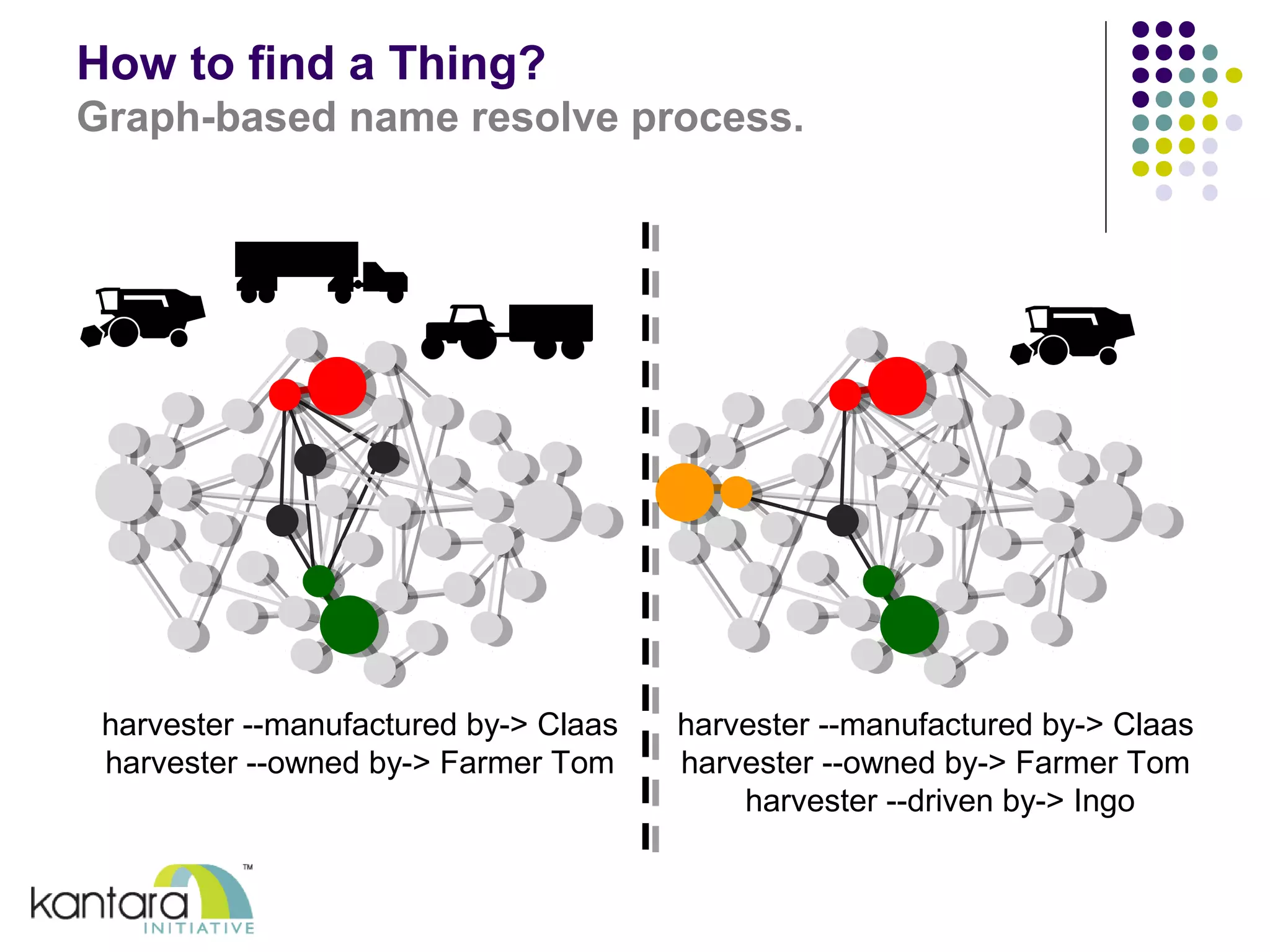
Graph-based name resolve process. 
harvester --manufactured by-> Claas 
harvester --owned by-> Farmer Tom 
harvester --manufactured by-> Claas 
harvester --owned by-> Farmer Tom 
harvester --driven by-> Ingo
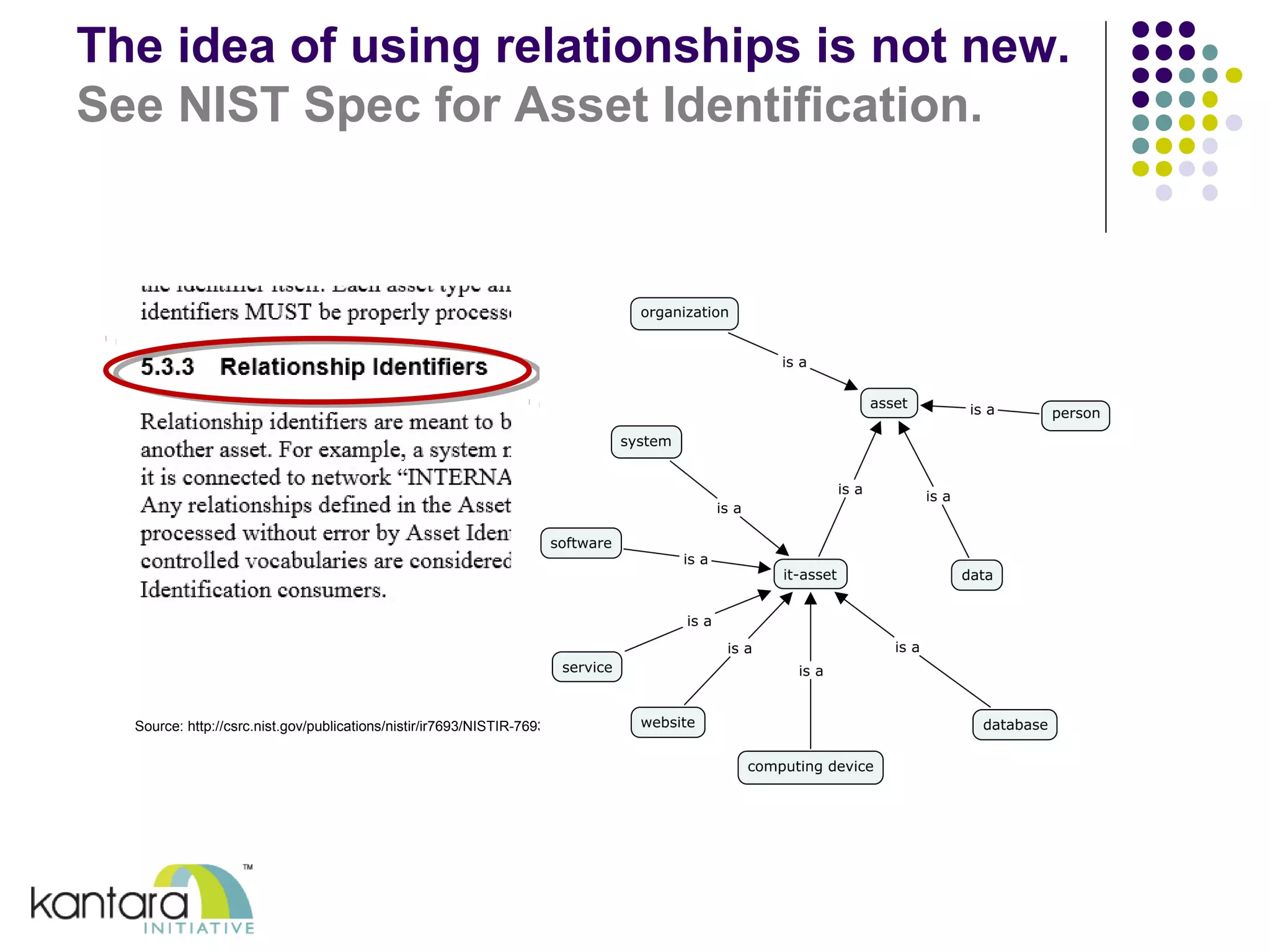
The idea of using relationships is not new. 
See NIST Spec for Asset Identification. 
Source: http://csrc.nist.gov/publications/nistir/ir7693/NISTIR-7693.pdf
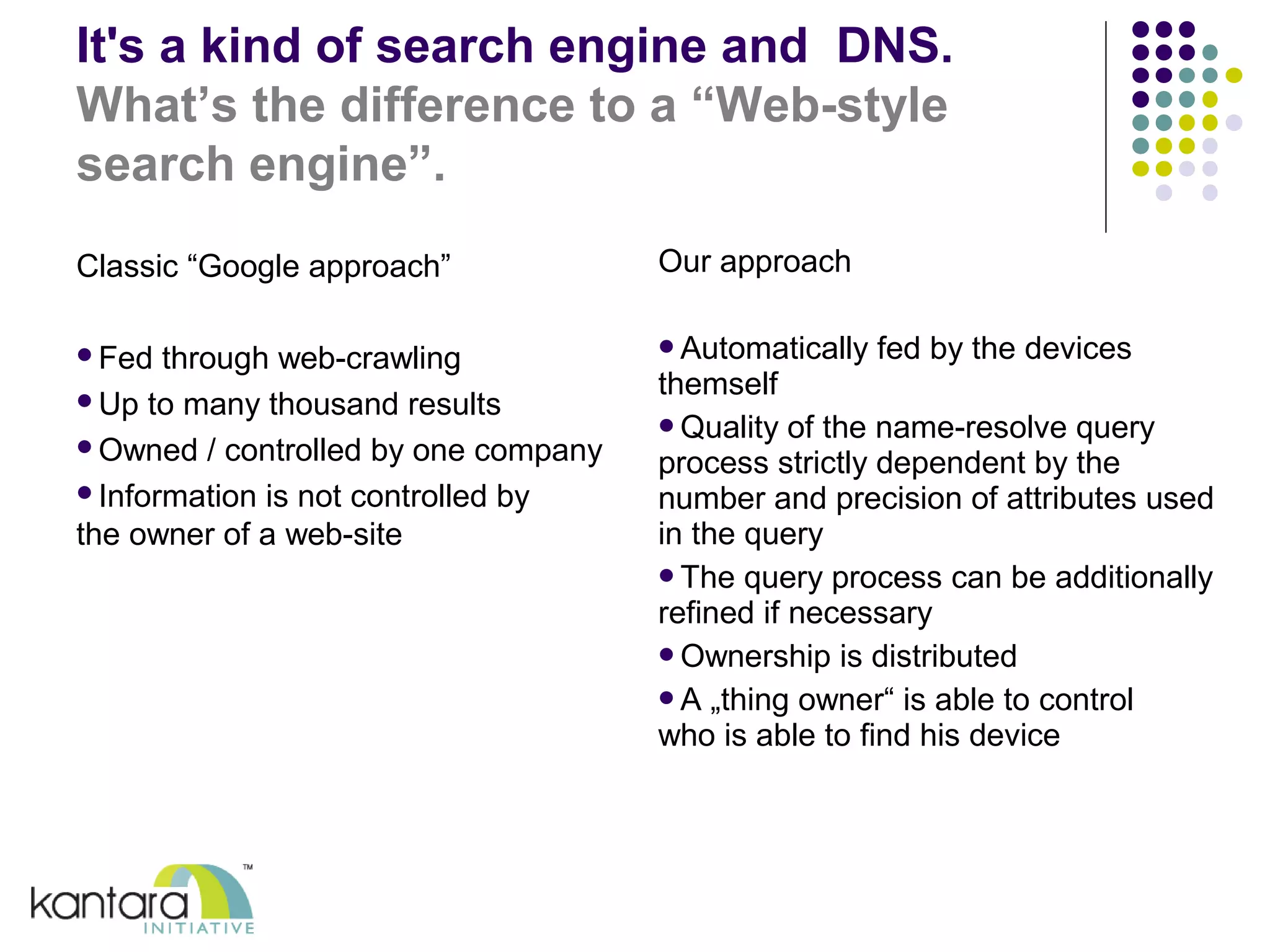
It's a kind of search engine and DNS. 
What’s the difference to a “Web-style 
search engine”. 
Classic “Google approach” 
Fed through web-crawling 
Up to many thousand results 
Owned / controlled by one company 
Information is not controlled by 
the owner of a web-site 
Our approach 
Automatically fed by the devices 
themself 
Quality of the name-resolve query 
process strictly dependent by the 
number and precision of attributes used 
in the query 
The query process can be additionally 
refined if necessary 
Ownership is distributed 
A „thing owner“ is able to control 
who is able to find his device
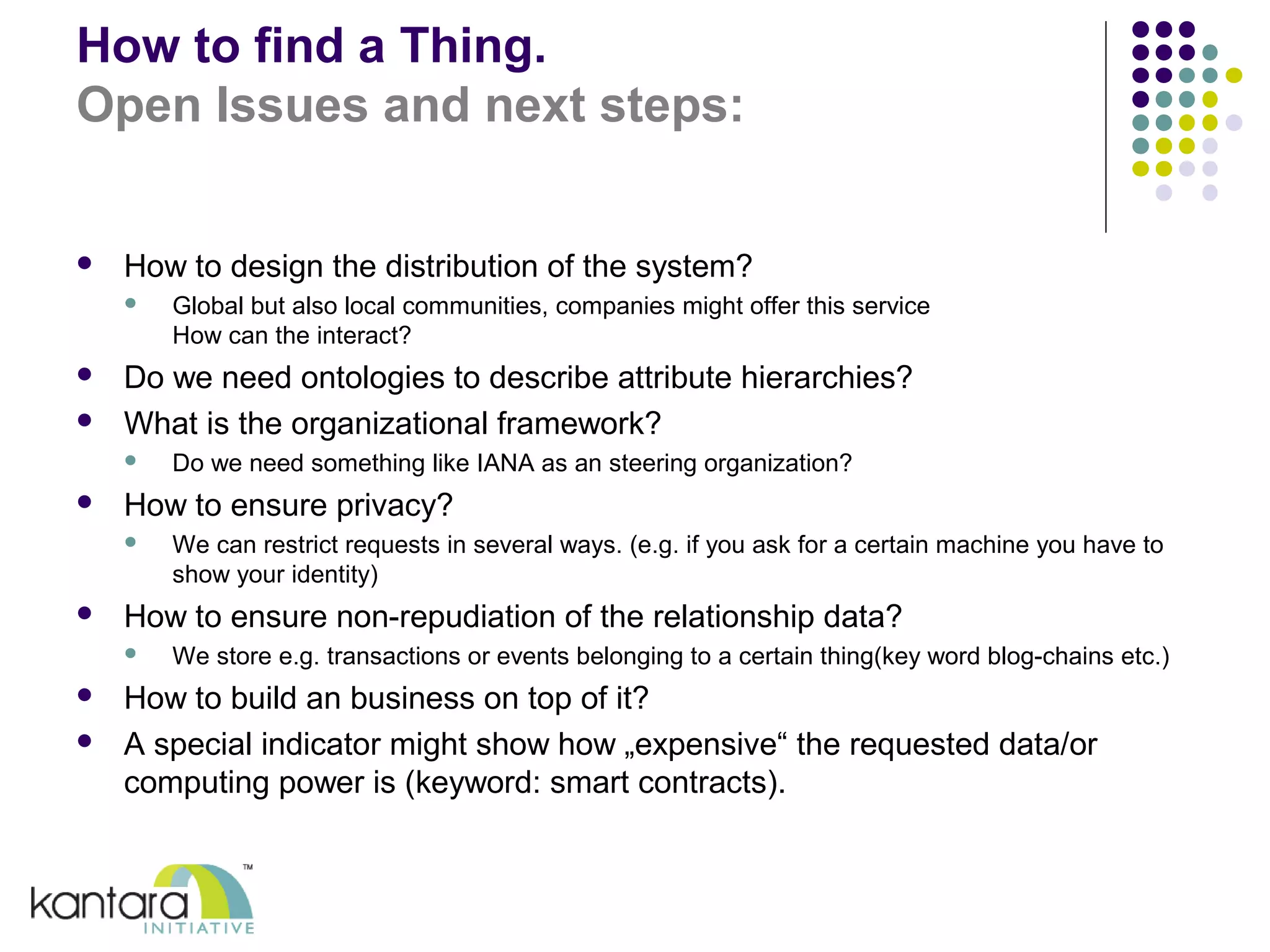
How to find a Thing. 
Open Issues and next steps: 
 How to design the distribution of the system? 
 Global but also local communities, companies might offer this service 
How can the interact? 
 Do we need ontologies to describe attribute hierarchies? 
 What is the organizational framework? 
 Do we need something like IANA as an steering organization? 
 How to ensure privacy? 
 We can restrict requests in several ways. (e.g. if you ask for a certain machine you have to 
show your identity) 
 How to ensure non-repudiation of the relationship data? 
 We store e.g. transactions or events belonging to a certain thing(key word blog-chains etc.) 
 How to build an business on top of it? 
 A special indicator might show how „expensive“ the requested data/or 
computing power is (keyword: smart contracts).
Identities of Things 
Discussion Group 
IDoT
Identities of Things Discussion Group 
Current Members.
Identities of Things Discussion Group 
Become a member. 
•No formal burdens in Kantara Initiative 
•Rather hands on work 
•No membership fees apply for working in a DG 
•Just sign GPA: http://signup.kantarainitiative.org/?selectedGroup=34 
•Agenda and more: http://kantarainitiative.org/groups/idot/ 
Let‘s work together on an interesting and most relevant topic. 
Join IDoT DG in Kantara Initiative!
Questions?

IDoT: How to find a thing - Discovery in IoT

  • 1.
    How to finda Thing? Discussion of an Object Name Service within the Identities of Things Discussion Group September, 2014 Ingo Friese; T-Labs DTAG, Matteo Signorini; Excalibur
  • 2.
    Exemplary IoT Scenario: Fleet management in farming industry. *by courtesy of Claas
  • 3.
    Exemplary IoT Scenario: Support of farming production processes. Harvesting Transport Processing
  • 4.
    What’s the problem? ”All participants of the scenario use different ID from different domains and namespaces”. serial no. e.g. #234.36635.234 License plate e.g. “B-BA 1254” CAN-Bus Id ”11011001110”
  • 5.
    What’s the problem? ”One machine needs to communicate with a another machine from another company”. serial no. e.g. #234.36635.234 License plate e.g. “B-BA 1254” CAN-Bus Id ”11011001110” Example: The harvester needs to communicate with the truck in order to tell him when and where to take over the crop. The truck might ask asks: „I need a connection with the harvester over there/ on this field/in this campaign“….but I don‘t know its address and I even don‘t know anything about its address scheme“.
  • 6.
    What’s the idea? Apart from characteristics and features things have “relationships”. TThhiningg manufactured by owned by sold by used as shipped by located at used by
  • 7.
    How to finda Thing? With a sufficient knowledge of the relationship a thing might be identified quite well. manufactured by Claas owned by Farmer Tom sold by „Farm Machines Inc.“ Network connected by IP 121.23.45.55 used in campaign xyz Located at GPS position 34’23‘‘/45’77‘‘ /Toms field driven by Ingo
  • 8.
    How to finda Thing? A relationship can be seen as a graph described in detail with attributes. EEnntittiyty rerelalatitoionnsshhipip EEnntittiyty atatrttibriubtuete manufactured manufactured CClalaaass by by sesreiarila nl ono
  • 9.
    How to finda Thing? A hierarchy structure can be defined among attributes. MMaannuufafacctuturreedd b byy CClalaaass DDeeuutztz F Faahhrr ...... ...... ...... ...... Relationship / Attribute ID Attribute classes Each attribute can be sub-divided into a multiple levels hierarchy. The more the number of levels the higher the probability to uniquely identify a device.
  • 10.
    How to finda Thing? A hierarchy structure can be represented by a graph. Manufactured by Claas Deutz Fahr ... ... ... ... Attribute ID Attribute classes The hierarchycal attribute structure can be depicted as a graph with each node representing an attribute class.
  • 11.
    How to finda Thing? Circular hierarchical architecture. MMaannuufafacctuturreedd b byy ... ... OOwwnneedd b byy ... ... LLooccaatetedd a att ... ... UUsseedd a ass ... ...
  • 12.
    How to finda Thing? Device identification precision Higher the number and the precision level of each attribute class and higher the probability to uniquely identify a device
  • 13.
    How to finda Thing? Graph representation of the database Attributes Attributes Devices Devices
  • 14.
    How to finda Thing? Say it in RDF (or other formats) and put it to a graph data base. manufactured by Claas owned by Farmer Tom sold by „Farm Machines Inc.“ used as corn harvester shipped by MAX-Transport Located at GPS position 34’23‘‘/45’77‘‘ /Toms field driven by Ingo harvester --manufactured by-> Claas harvester --driven by-> Ingo harvester --owned by-> Farmer Tom harvester --sold by-> Farm Machines Inc. harvester --network connected by-> IP 121.23.45.55 harvester --located at-> 34’23‘‘/45’77‘‘ /Toms field GGrraapphh d daatata b baassee
  • 15.
    How to finda Thing? Ask the database. Now the truck might ask the data base: I’m looking for a “device” manufactured by Claas owned by Farmer Tom sold by „Farm Machines Inc.“ used as corn harvester shipped by MAX-Transport Located at GPS position 34’23‘‘/45’77‘‘ /Toms field driven by Ingo manufactured by -> Claas owned by -> Farmer Tom driven by -> Ingo GGrraapphh d daatata b baassee
  • 16.
    How to finda Thing? Graph-based name resolve process. harvester --manufactured by-> Claas harvester --owned by-> Farmer Tom harvester --manufactured by-> Claas harvester --owned by-> Farmer Tom harvester --driven by-> Ingo
  • 17.
    The idea ofusing relationships is not new. See NIST Spec for Asset Identification. Source: http://csrc.nist.gov/publications/nistir/ir7693/NISTIR-7693.pdf
  • 18.
    It's a kindof search engine and DNS. What’s the difference to a “Web-style search engine”. Classic “Google approach” Fed through web-crawling Up to many thousand results Owned / controlled by one company Information is not controlled by the owner of a web-site Our approach Automatically fed by the devices themself Quality of the name-resolve query process strictly dependent by the number and precision of attributes used in the query The query process can be additionally refined if necessary Ownership is distributed A „thing owner“ is able to control who is able to find his device
  • 19.
    How to finda Thing. Open Issues and next steps:  How to design the distribution of the system?  Global but also local communities, companies might offer this service How can the interact?  Do we need ontologies to describe attribute hierarchies?  What is the organizational framework?  Do we need something like IANA as an steering organization?  How to ensure privacy?  We can restrict requests in several ways. (e.g. if you ask for a certain machine you have to show your identity)  How to ensure non-repudiation of the relationship data?  We store e.g. transactions or events belonging to a certain thing(key word blog-chains etc.)  How to build an business on top of it?  A special indicator might show how „expensive“ the requested data/or computing power is (keyword: smart contracts).
  • 20.
    Identities of Things Discussion Group IDoT
  • 21.
    Identities of ThingsDiscussion Group Current Members.
  • 22.
    Identities of ThingsDiscussion Group Become a member. •No formal burdens in Kantara Initiative •Rather hands on work •No membership fees apply for working in a DG •Just sign GPA: http://signup.kantarainitiative.org/?selectedGroup=34 •Agenda and more: http://kantarainitiative.org/groups/idot/ Let‘s work together on an interesting and most relevant topic. Join IDoT DG in Kantara Initiative!
  • 23.