Extending the Power of Consent
with User-Managed Access &
OpenUMA
FORGEROCK.COM
Eve Maler
VP Innovation & Emerging Technology
eve.maler@forgerock.com
@xmlgrrl
April 15, 2015
Warren Strange
Director, Sales Engineering
warren.strange@forgerock.com
2
■  Provides strategic vision and real-world innovation
for digital identity transformation
■  Connects business, governments, research, and
education
■  Non-profit founded 2009
■  Open and transparent
■  @KantaraNews to get involved
3
■  Offers the expertise and resources to help
physicians with application and meaningful use of
health information tech collection, secure
transmission and reporting of critical clinical
information
4
Personal data sharing
challenges
5
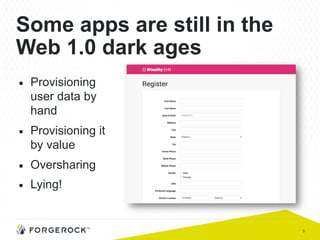
Some apps are still in the
Web 1.0 dark ages
■  Provisioning
user data by
hand
■  Provisioning it
by value
■  Oversharing
■  Lying!
6
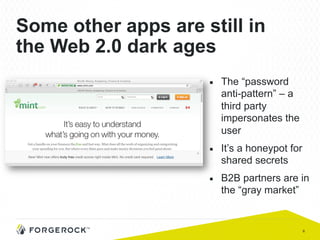
Some other apps are still in
the Web 2.0 dark ages
■  The “password
anti-pattern” – a
third party
impersonates the
user
■  It’s a honeypot for
shared secrets
■  B2B partners are in
the “gray market”
7
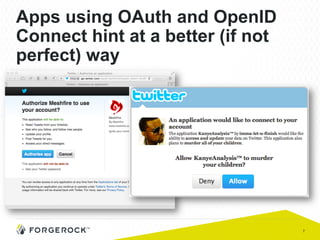
Apps using OAuth and OpenID
Connect hint at a better (if not
perfect) way
8
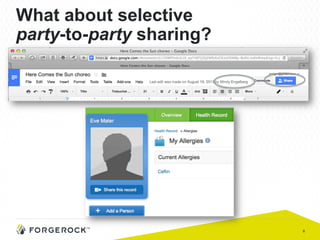
What about selective
party-to-party sharing?
9
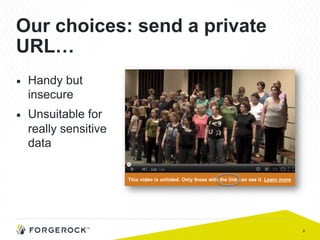
Our choices: send a private
URL…
■  Handy but
insecure
■  Unsuitable for
really sensitive
data
10
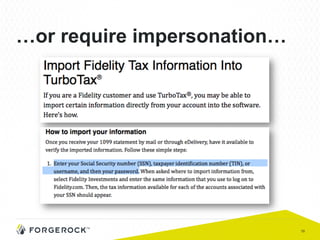
…or require impersonation…
11
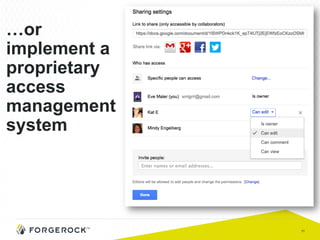
…or
implement a
proprietary
access
management
system
12
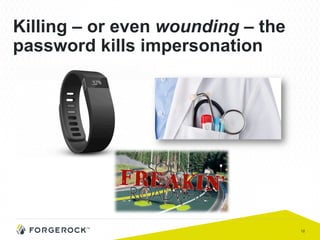
Killing – or even wounding – the
password kills impersonation
13
We have tough requirements
for delegated authorization
■  Lightweight for developers
■  Robustly secure
■  Privacy-enhancing
■  Internet-scalable
■  Multi-party
■  Enables end-user convenience
14
The solution space
15
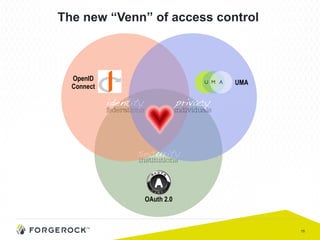
The new “Venn” of access control
16
UMA in a nutshell
■  It’s a protocol for lightweight access control
■  It’s a profile and application of OAuth2
■  It’s a set of authorization, privacy, and consent APIs
■  It’s a Kantara Initiative Work Group
■  It’s two V1.0 Recommendations (standards)
■  It’s not an “XACML killer”
■  Founder, chair, and “chief UMAnitarian”:
17
JWT	
  
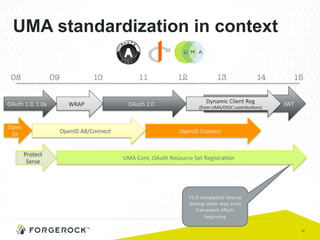
UMA standardization in context
Protect	
  
Serve	
  
UMA	
  Core,	
  OAuth	
  Resource	
  Set	
  Registra:on	
  
OAuth	
  1.0,	
  1.0a	
   WRAP	
  
OpenID	
  AB/Connect	
  
Open	
  
ID	
  
OAuth	
  2.0	
  
08
 09
 10
 11
 13
12
 14
 15
Dynamic	
  Client	
  Reg	
  
(from	
  UMA/OIDC	
  contribu5ons)	
  
OpenID	
  Connect	
  
V1.0	
  completed;	
  interop	
  
tes:ng	
  under	
  way;	
  trust	
  
framework	
  efforts	
  
beginning	
  
18
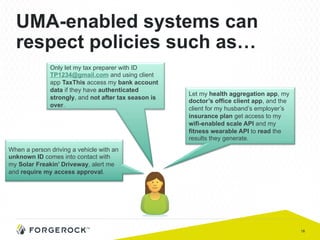
UMA-enabled systems can
respect policies such as…
Only let my tax preparer with ID
TP1234@gmail.com and using client
app TaxThis access my bank account
data if they have authenticated
strongly, and not after tax season is
over.
Let my health aggregation app, my
doctor’s office client app, and the
client for my husband’s employer’s
insurance plan get access to my
wifi-enabled scale API and my
fitness wearable API to read the
results they generate.
When a person driving a vehicle with an
unknown ID comes into contact with
my Solar Freakin’ Driveway, alert me
and require my access approval.
19
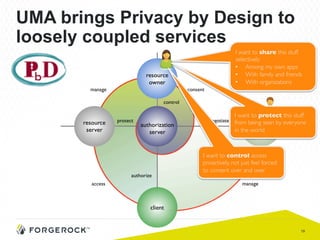
UMA brings Privacy by Design to
loosely coupled services
I want to share this stuff
selectively
•  Among my own apps
•  With family and friends
•  With organizations
I want to protect this stuff
from being seen by everyone
in the world
I want to control access
proactively, not just feel forced
to consent over and over
20
Subject
or
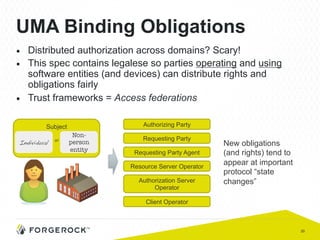
UMA Binding Obligations
■  Distributed authorization across domains? Scary!
■  This spec contains legalese so parties operating and using
software entities (and devices) can distribute rights and
obligations fairly
■  Trust frameworks = Access federations
Individual!
Non-
person
entity
Authorizing Party
Requesting Party
Resource Server Operator
Client Operator
Requesting Party Agent
Authorization Server
Operator
New obligations
(and rights) tend to
appear at important
protocol “state
changes”
21
HEART in a nutshell
■  It’s for patient-centric RESTful health data sharing
■  It’s international, but spurred by HHS ONC and VA
■  It’s primarily about “profiling the Venn”
■  It’s an OpenID Foundation Working Group
■  Its security profiles are interesting outside health
■  Its semantic profiles will be FHIR-specific
■  Co-chairs:
22
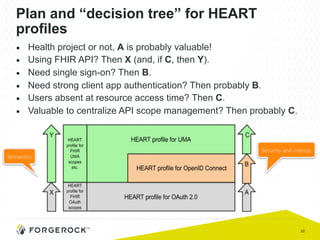
Plan and “decision tree” for HEART
profiles
■  Health project or not, A is probably valuable!
■  Using FHIR API? Then X (and, if C, then Y).
■  Need single sign-on? Then B.
■  Need strong client app authentication? Then probably B.
■  Users absent at resource access time? Then C.
■  Valuable to centralize API scope management? Then probably C.
Security and interop
Semantics
23
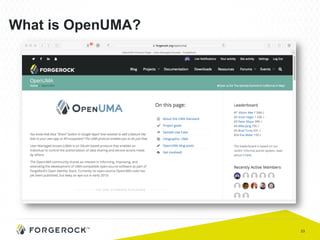
What is OpenUMA?
24
What about the user
experience?
Introducing the world-premiere demonstration of
ForgeRock’s OpenUMA for RESTful patient-centric
health data sharing use cases
25
Dramatis personae
■  Individual
■  Graduate of Unseen University
■  (Nurse in real life)
■  New patient of Dr. Bob’s BlueHealth
practice, with heart troubles
■  Doctor
Alice
Dr. Bob
26
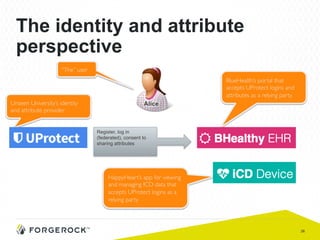
The identity and attribute
perspective
“The” user
Unseen University’s identity
and attribute provider
BlueHealth’s portal that
accepts UProtect logins and
attributes as a relying party
Alice
Register, log in
(federated), consent to
sharing attributes
HappyHeart’s app for viewing
and managing ICD data that
accepts UProtect logins as a
relying party
27
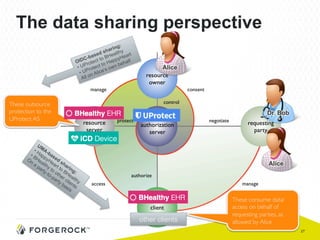
The data sharing perspective
Alice
Dr. Bob
Alice
These outsource
protection to the
UProtect AS
These consume data/
access on behalf of
requesting parties, as
allowed by Aliceother clients
28
About ForgeRock
29
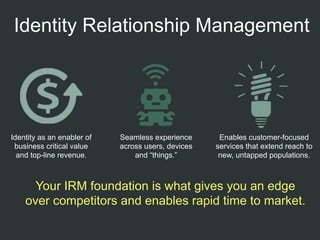
Identity as an enabler of
business critical value
and top-line revenue.
Seamless experience
across users, devices
and “things.”
Enables customer-focused
services that extend reach to
new, untapped populations.
Your IRM foundation is what gives you an edge
over competitors and enables rapid time to market.
Identity Relationship Management
30
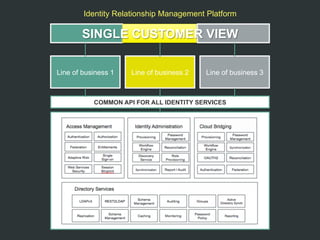
COMMON API FOR ALL IDENTITY SERVICES
Line of business 1 Line of business 2 Line of business 3
SINGLE CUSTOMER VIEW
Identity Relationship Management Platform
31
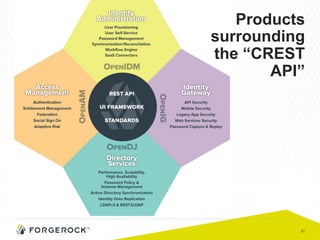
Products
surrounding
the “CREST
API”
32
ForgeRock IRM success…
Thank you!
FORGEROCK.COM
Eve Maler
VP Innovation & Emerging Technology
eve.maler@forgerock.com
@xmlgrrl
34
Appendix:
Gory UMA details
35
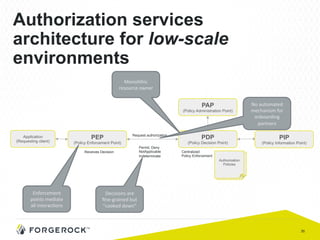
Authorization services
architecture for low-scale
environments
Application
(Requesting client)
PEP
(Policy Enforcement Point)
PDP
(Policy Decision Point)
PAP
(Policy Administration Point)
Authorization
Policies
Request authorization
Permit, Deny
NotApplicable
Indeterminate
Centralized
Policy Enforcement
Receives Decision
Monolithic	
  
resource	
  owner	
  
Enforcement	
  
points	
  mediate	
  
all	
  interac:ons	
  
Decisions	
  are	
  
fine-­‐grained	
  but	
  
“cooked	
  down”	
  
No	
  automated	
  
mechanism	
  for	
  
onboarding	
  
partners	
  
PIP
(Policy Information Point)
36
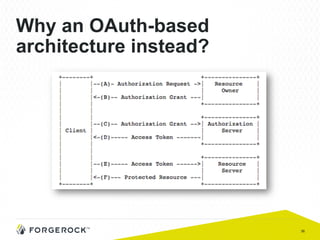
Why an OAuth-based
architecture instead?
37
“User-centric, constrained,
delegated, RESTful WS-
Security” J
It’s about more than “eliminating the password anti-pattern”
■  Gets client apps out of the business of storing passwords
■  “Teaches” clients to rotate secrets
■  Friendly to authentication methods and user devices
■  Allows per-client tracking and revocation
■  Allows for scoped access
■  Captures user consent
■  Lowers development cost
■  Generative for a wider variety of design patterns
38
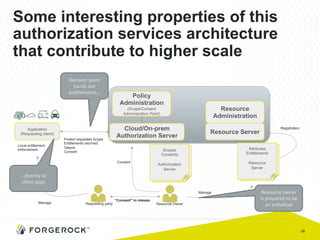
Some interesting properties of this
authorization services architecture
that contribute to higher scale
Application
(Requesting client)
Cloud/On-prem
Authorization Server
Policy
Administration
(Scope/Consent
Administration Point)
Resource Server
Scopes
Consents
Authorization
Server
“Consent” to release
Protect requested Scope
Entitlements returned
Tokens
Consent
Local entitlement
enforcement
Requesting party Resource Owner
Attributes
Entitlements
Resource
Server
Resource
Administration
Registration
Manage
Consent
Manage
Resource	
  owner	
  
is	
  prepared	
  to	
  be	
  
an	
  individual	
  
Decision	
  point	
  
hands	
  out	
  
en:tlements…	
  
…directly	
  to	
  
client	
  apps	
  
39
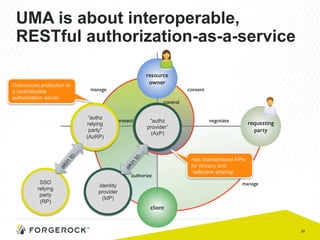
UMA is about interoperable,
RESTful authorization-as-a-service
Has standardized APIs
for privacy and
“selective sharing”
Outsources protection to
a centralizable
authorization server
“authz
provider”
(AzP)
“authz
relying
party”
(AzRP)
identity
provider
(IdP)
SSO
relying
party
(RP)
40
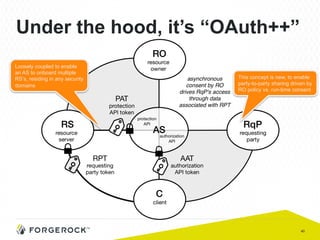
Under the hood, it’s “OAuth++”
Loosely coupled to enable
an AS to onboard multiple
RS’s, residing in any security
domains
This concept is new, to enable
party-to-party sharing driven by
RO policy vs. run-time consent
41
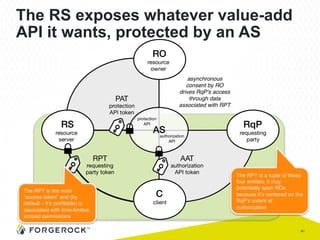
The RS exposes whatever value-add
API it wants, protected by an AS
The RPT is the main
“access token” and (by
default – it’s profilable) is
associated with time-limited,
scoped permissions
The RPT is a tuple of these
four entities; it may
potentially span ROs
because it’s centered on the
RqP’s extent of
authorization
42
Comparing plain OAuth
access tokens to UMA RPTs
■  OAuth access tokens:
–  Profilable; no standardized form on
the wire, though a signed JWT is
sometimes used
–  Token introspection at runtime is
getting standardized; a JWT gets
returned
■  UMA RPTs:
–  Profilable; default form on the wire
(“bearer”) is opaque and required
to be introspected at runtime using
the draft standard
–  What’s returned is an enhanced
JWT with a new “permissions”
claim that binds scopes to named
resource sets
–  These are machine-readable,
scope-grained, dynamic consent
directives – entitlements – that an
RS must act on
43
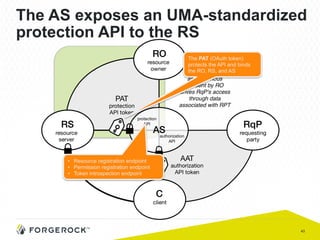
The AS exposes an UMA-standardized
protection API to the RS
•  Resource registration endpoint
•  Permission registration endpoint
•  Token introspection endpoint
The PAT (OAuth token)
protects the API and binds
the RO, RS, and AS
44
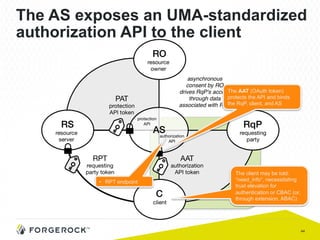
The AS exposes an UMA-standardized
authorization API to the client
•  RPT endpoint
The AAT (OAuth token)
protects the API and binds
the RqP, client, and AS
The client may be told:
“need_info”, necessitating
trust elevation for
authentication or CBAC (or,
through extension, ABAC)
45
These are embedded OAuth flows to
protect UMA-standard security APIs
■  The “PAT” and “AAT” are our names for plain old
OAuth tokens – representing important UMA
concepts!
–  Alice’s consent to federate authorization
–  Bob’s consent to share claims to win access
■  Many “binding obligations” will hinge on their
issuance
46
The significance of resource
set registration
■  The AS is authoritative for Alice’s policy
■  But the RS is authoritative for what its API can do –
its “verbs” and “objects”, and what Alice has created
there
■  Resource set registration allows the RS to remain
authoritative in this fashion, and allows RS:AS to be
an n:m relationship
47
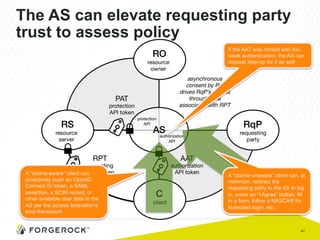
The AS can elevate requesting party
trust to assess policy
A “claims-aware” client can
proactively push an OpenID
Connect ID token, a SAML
assertion, a SCIM record, or
other available user data to the
AS per the access federation’s
trust framework
A “claims-unaware” client can, at
minimum, redirect the
requesting party to the AS to log
in, press an “I Agree” button, fill
in a form, follow a NASCAR for
federated login, etc.
If the AAT was minted with too-
weak authentication, the AS can
request step-up for it as well
48
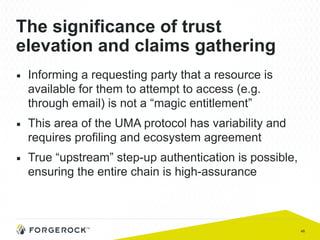
The significance of trust
elevation and claims gathering
■  Informing a requesting party that a resource is
available for them to attempt to access (e.g.
through email) is not a “magic entitlement”
■  This area of the UMA protocol has variability and
requires profiling and ecosystem agreement
■  True “upstream” step-up authentication is possible,
ensuring the entire chain is high-assurance
49
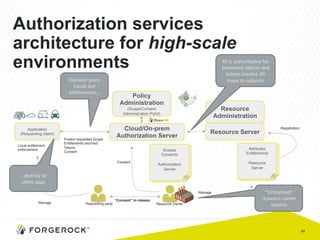
Authorization services
architecture for high-scale
environments
Application
(Requesting client)
Cloud/On-prem
Authorization Server
Policy
Administration
(Scope/Consent
Administration Point)
Resource Server
Scopes
Consents
Authorization
Server
“Consent” to release
Protect requested Scope
Entitlements returned
Tokens
Consent
Local entitlement
enforcement
Requesting party Resource Owner
Attributes
Entitlements
Resource
Server
Resource
Administration
Registration
Manage
Consent
Manage
“Virtualized”	
  
resource	
  owner	
  
op:ons	
  
Decision	
  point	
  
hands	
  out	
  
en:tlements…	
  
…directly	
  to	
  
client	
  apps	
  
RS	
  is	
  authorita:ve	
  for	
  
protected	
  objects	
  and	
  
scopes	
  (verbs);	
  AS	
  
maps	
  to	
  subjects	
  
51
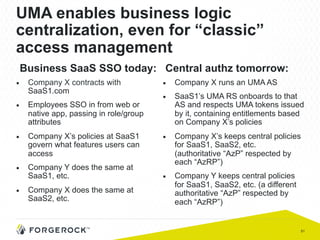
UMA enables business logic
centralization, even for “classic”
access management
■  Company X contracts with
SaaS1.com
■  Employees SSO in from web or
native app, passing in role/group
attributes
■  Company X’s policies at SaaS1
govern what features users can
access
■  Company Y does the same at
SaaS1, etc.
■  Company X does the same at
SaaS2, etc.
■  Company X runs an UMA AS
■  SaaS1’s UMA RS onboards to that
AS and respects UMA tokens issued
by it, containing entitlements based
on Company X’s policies
■  Company X’s keeps central policies
for SaaS1, SaaS2, etc.
(authoritative “AzP” respected by
each “AzRP”)
■  Company Y keeps central policies
for SaaS1, SaaS2, etc. (a different
authoritative “AzP” respected by
each “AzRP”)
Business SaaS SSO today: Central authz tomorrow:
52
Appendix:
IoT implications of UMA
53
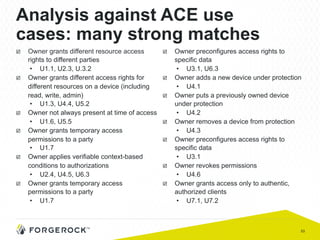
Analysis against ACE use
cases: many strong matches
þ  Owner grants different resource access
rights to different parties
•  U1.1, U2.3, U.3.2
þ  Owner grants different access rights for
different resources on a device (including
read, write, admin)
•  U1.3, U4.4, U5.2
þ  Owner not always present at time of access
•  U1.6, U5.5
þ  Owner grants temporary access
permissions to a party
•  U1.7
þ  Owner applies verifiable context-based
conditions to authorizations
•  U2.4, U4.5, U6.3
þ  Owner grants temporary access
permissions to a party
•  U1.7
þ  Owner preconfigures access rights to
specific data
•  U3.1, U6.3
þ  Owner adds a new device under protection
•  U4.1
þ  Owner puts a previously owned device
under protection
•  U4.2
þ  Owner removes a device from protection
•  U4.3
þ  Owner preconfigures access rights to
specific data
•  U3.1
þ  Owner revokes permissions
•  U4.6
þ  Owner grants access only to authentic,
authorized clients
•  U7.1, U7.2
54
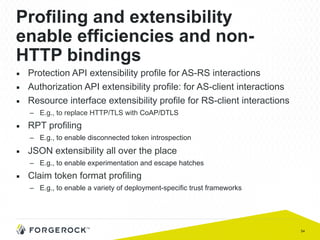
Profiling and extensibility
enable efficiencies and non-
HTTP bindings
■  Protection API extensibility profile for AS-RS interactions
■  Authorization API extensibility profile: for AS-client interactions
■  Resource interface extensibility profile for RS-client interactions
–  E.g., to replace HTTP/TLS with CoAP/DTLS
■  RPT profiling
–  E.g., to enable disconnected token introspection
■  JSON extensibility all over the place
–  E.g., to enable experimentation and escape hatches
■  Claim token format profiling
–  E.g., to enable a variety of deployment-specific trust frameworks

Extending the Power of Consent with User-Managed Access & OpenUMA

  • 1.
    Extending the Powerof Consent with User-Managed Access & OpenUMA FORGEROCK.COM Eve Maler VP Innovation & Emerging Technology eve.maler@forgerock.com @xmlgrrl April 15, 2015 Warren Strange Director, Sales Engineering warren.strange@forgerock.com
  • 2.
    2 ■  Provides strategicvision and real-world innovation for digital identity transformation ■  Connects business, governments, research, and education ■  Non-profit founded 2009 ■  Open and transparent ■  @KantaraNews to get involved
  • 3.
    3 ■  Offers theexpertise and resources to help physicians with application and meaningful use of health information tech collection, secure transmission and reporting of critical clinical information
  • 4.
  • 5.
    5 Some apps arestill in the Web 1.0 dark ages ■  Provisioning user data by hand ■  Provisioning it by value ■  Oversharing ■  Lying!
  • 6.
    6 Some other appsare still in the Web 2.0 dark ages ■  The “password anti-pattern” – a third party impersonates the user ■  It’s a honeypot for shared secrets ■  B2B partners are in the “gray market”
  • 7.
    7 Apps using OAuthand OpenID Connect hint at a better (if not perfect) way
  • 8.
  • 9.
    9 Our choices: senda private URL… ■  Handy but insecure ■  Unsuitable for really sensitive data
  • 10.
  • 11.
  • 12.
    12 Killing – oreven wounding – the password kills impersonation
  • 13.
    13 We have toughrequirements for delegated authorization ■  Lightweight for developers ■  Robustly secure ■  Privacy-enhancing ■  Internet-scalable ■  Multi-party ■  Enables end-user convenience
  • 14.
  • 15.
    15 The new “Venn”of access control
  • 16.
    16 UMA in anutshell ■  It’s a protocol for lightweight access control ■  It’s a profile and application of OAuth2 ■  It’s a set of authorization, privacy, and consent APIs ■  It’s a Kantara Initiative Work Group ■  It’s two V1.0 Recommendations (standards) ■  It’s not an “XACML killer” ■  Founder, chair, and “chief UMAnitarian”:
  • 17.
    17 JWT   UMA standardizationin context Protect   Serve   UMA  Core,  OAuth  Resource  Set  Registra:on   OAuth  1.0,  1.0a   WRAP   OpenID  AB/Connect   Open   ID   OAuth  2.0   08 09 10 11 13 12 14 15 Dynamic  Client  Reg   (from  UMA/OIDC  contribu5ons)   OpenID  Connect   V1.0  completed;  interop   tes:ng  under  way;  trust   framework  efforts   beginning  
  • 18.
    18 UMA-enabled systems can respectpolicies such as… Only let my tax preparer with ID TP1234@gmail.com and using client app TaxThis access my bank account data if they have authenticated strongly, and not after tax season is over. Let my health aggregation app, my doctor’s office client app, and the client for my husband’s employer’s insurance plan get access to my wifi-enabled scale API and my fitness wearable API to read the results they generate. When a person driving a vehicle with an unknown ID comes into contact with my Solar Freakin’ Driveway, alert me and require my access approval.
  • 19.
    19 UMA brings Privacyby Design to loosely coupled services I want to share this stuff selectively •  Among my own apps •  With family and friends •  With organizations I want to protect this stuff from being seen by everyone in the world I want to control access proactively, not just feel forced to consent over and over
  • 20.
    20 Subject or UMA Binding Obligations ■ Distributed authorization across domains? Scary! ■  This spec contains legalese so parties operating and using software entities (and devices) can distribute rights and obligations fairly ■  Trust frameworks = Access federations Individual! Non- person entity Authorizing Party Requesting Party Resource Server Operator Client Operator Requesting Party Agent Authorization Server Operator New obligations (and rights) tend to appear at important protocol “state changes”
  • 21.
    21 HEART in anutshell ■  It’s for patient-centric RESTful health data sharing ■  It’s international, but spurred by HHS ONC and VA ■  It’s primarily about “profiling the Venn” ■  It’s an OpenID Foundation Working Group ■  Its security profiles are interesting outside health ■  Its semantic profiles will be FHIR-specific ■  Co-chairs:
  • 22.
    22 Plan and “decisiontree” for HEART profiles ■  Health project or not, A is probably valuable! ■  Using FHIR API? Then X (and, if C, then Y). ■  Need single sign-on? Then B. ■  Need strong client app authentication? Then probably B. ■  Users absent at resource access time? Then C. ■  Valuable to centralize API scope management? Then probably C. Security and interop Semantics
  • 23.
  • 24.
    24 What about theuser experience? Introducing the world-premiere demonstration of ForgeRock’s OpenUMA for RESTful patient-centric health data sharing use cases
  • 25.
    25 Dramatis personae ■  Individual ■ Graduate of Unseen University ■  (Nurse in real life) ■  New patient of Dr. Bob’s BlueHealth practice, with heart troubles ■  Doctor Alice Dr. Bob
  • 26.
    26 The identity andattribute perspective “The” user Unseen University’s identity and attribute provider BlueHealth’s portal that accepts UProtect logins and attributes as a relying party Alice Register, log in (federated), consent to sharing attributes HappyHeart’s app for viewing and managing ICD data that accepts UProtect logins as a relying party
  • 27.
    27 The data sharingperspective Alice Dr. Bob Alice These outsource protection to the UProtect AS These consume data/ access on behalf of requesting parties, as allowed by Aliceother clients
  • 28.
  • 29.
    29 Identity as anenabler of business critical value and top-line revenue. Seamless experience across users, devices and “things.” Enables customer-focused services that extend reach to new, untapped populations. Your IRM foundation is what gives you an edge over competitors and enables rapid time to market. Identity Relationship Management
  • 30.
    30 COMMON API FORALL IDENTITY SERVICES Line of business 1 Line of business 2 Line of business 3 SINGLE CUSTOMER VIEW SINGLE CUSTOMER VIEW Identity Relationship Management Platform
  • 31.
  • 32.
  • 33.
    Thank you! FORGEROCK.COM Eve Maler VPInnovation & Emerging Technology eve.maler@forgerock.com @xmlgrrl
  • 34.
  • 35.
    35 Authorization services architecture forlow-scale environments Application (Requesting client) PEP (Policy Enforcement Point) PDP (Policy Decision Point) PAP (Policy Administration Point) Authorization Policies Request authorization Permit, Deny NotApplicable Indeterminate Centralized Policy Enforcement Receives Decision Monolithic   resource  owner   Enforcement   points  mediate   all  interac:ons   Decisions  are   fine-­‐grained  but   “cooked  down”   No  automated   mechanism  for   onboarding   partners   PIP (Policy Information Point)
  • 36.
  • 37.
    37 “User-centric, constrained, delegated, RESTfulWS- Security” J It’s about more than “eliminating the password anti-pattern” ■  Gets client apps out of the business of storing passwords ■  “Teaches” clients to rotate secrets ■  Friendly to authentication methods and user devices ■  Allows per-client tracking and revocation ■  Allows for scoped access ■  Captures user consent ■  Lowers development cost ■  Generative for a wider variety of design patterns
  • 38.
    38 Some interesting propertiesof this authorization services architecture that contribute to higher scale Application (Requesting client) Cloud/On-prem Authorization Server Policy Administration (Scope/Consent Administration Point) Resource Server Scopes Consents Authorization Server “Consent” to release Protect requested Scope Entitlements returned Tokens Consent Local entitlement enforcement Requesting party Resource Owner Attributes Entitlements Resource Server Resource Administration Registration Manage Consent Manage Resource  owner   is  prepared  to  be   an  individual   Decision  point   hands  out   en:tlements…   …directly  to   client  apps  
  • 39.
    39 UMA is aboutinteroperable, RESTful authorization-as-a-service Has standardized APIs for privacy and “selective sharing” Outsources protection to a centralizable authorization server “authz provider” (AzP) “authz relying party” (AzRP) identity provider (IdP) SSO relying party (RP)
  • 40.
    40 Under the hood,it’s “OAuth++” Loosely coupled to enable an AS to onboard multiple RS’s, residing in any security domains This concept is new, to enable party-to-party sharing driven by RO policy vs. run-time consent
  • 41.
    41 The RS exposeswhatever value-add API it wants, protected by an AS The RPT is the main “access token” and (by default – it’s profilable) is associated with time-limited, scoped permissions The RPT is a tuple of these four entities; it may potentially span ROs because it’s centered on the RqP’s extent of authorization
  • 42.
    42 Comparing plain OAuth accesstokens to UMA RPTs ■  OAuth access tokens: –  Profilable; no standardized form on the wire, though a signed JWT is sometimes used –  Token introspection at runtime is getting standardized; a JWT gets returned ■  UMA RPTs: –  Profilable; default form on the wire (“bearer”) is opaque and required to be introspected at runtime using the draft standard –  What’s returned is an enhanced JWT with a new “permissions” claim that binds scopes to named resource sets –  These are machine-readable, scope-grained, dynamic consent directives – entitlements – that an RS must act on
  • 43.
    43 The AS exposesan UMA-standardized protection API to the RS •  Resource registration endpoint •  Permission registration endpoint •  Token introspection endpoint The PAT (OAuth token) protects the API and binds the RO, RS, and AS
  • 44.
    44 The AS exposesan UMA-standardized authorization API to the client •  RPT endpoint The AAT (OAuth token) protects the API and binds the RqP, client, and AS The client may be told: “need_info”, necessitating trust elevation for authentication or CBAC (or, through extension, ABAC)
  • 45.
    45 These are embeddedOAuth flows to protect UMA-standard security APIs ■  The “PAT” and “AAT” are our names for plain old OAuth tokens – representing important UMA concepts! –  Alice’s consent to federate authorization –  Bob’s consent to share claims to win access ■  Many “binding obligations” will hinge on their issuance
  • 46.
    46 The significance ofresource set registration ■  The AS is authoritative for Alice’s policy ■  But the RS is authoritative for what its API can do – its “verbs” and “objects”, and what Alice has created there ■  Resource set registration allows the RS to remain authoritative in this fashion, and allows RS:AS to be an n:m relationship
  • 47.
    47 The AS canelevate requesting party trust to assess policy A “claims-aware” client can proactively push an OpenID Connect ID token, a SAML assertion, a SCIM record, or other available user data to the AS per the access federation’s trust framework A “claims-unaware” client can, at minimum, redirect the requesting party to the AS to log in, press an “I Agree” button, fill in a form, follow a NASCAR for federated login, etc. If the AAT was minted with too- weak authentication, the AS can request step-up for it as well
  • 48.
    48 The significance oftrust elevation and claims gathering ■  Informing a requesting party that a resource is available for them to attempt to access (e.g. through email) is not a “magic entitlement” ■  This area of the UMA protocol has variability and requires profiling and ecosystem agreement ■  True “upstream” step-up authentication is possible, ensuring the entire chain is high-assurance
  • 49.
    49 Authorization services architecture forhigh-scale environments Application (Requesting client) Cloud/On-prem Authorization Server Policy Administration (Scope/Consent Administration Point) Resource Server Scopes Consents Authorization Server “Consent” to release Protect requested Scope Entitlements returned Tokens Consent Local entitlement enforcement Requesting party Resource Owner Attributes Entitlements Resource Server Resource Administration Registration Manage Consent Manage “Virtualized”   resource  owner   op:ons   Decision  point   hands  out   en:tlements…   …directly  to   client  apps   RS  is  authorita:ve  for   protected  objects  and   scopes  (verbs);  AS   maps  to  subjects  
  • 51.
    51 UMA enables businesslogic centralization, even for “classic” access management ■  Company X contracts with SaaS1.com ■  Employees SSO in from web or native app, passing in role/group attributes ■  Company X’s policies at SaaS1 govern what features users can access ■  Company Y does the same at SaaS1, etc. ■  Company X does the same at SaaS2, etc. ■  Company X runs an UMA AS ■  SaaS1’s UMA RS onboards to that AS and respects UMA tokens issued by it, containing entitlements based on Company X’s policies ■  Company X’s keeps central policies for SaaS1, SaaS2, etc. (authoritative “AzP” respected by each “AzRP”) ■  Company Y keeps central policies for SaaS1, SaaS2, etc. (a different authoritative “AzP” respected by each “AzRP”) Business SaaS SSO today: Central authz tomorrow:
  • 52.
  • 53.
    53 Analysis against ACEuse cases: many strong matches þ  Owner grants different resource access rights to different parties •  U1.1, U2.3, U.3.2 þ  Owner grants different access rights for different resources on a device (including read, write, admin) •  U1.3, U4.4, U5.2 þ  Owner not always present at time of access •  U1.6, U5.5 þ  Owner grants temporary access permissions to a party •  U1.7 þ  Owner applies verifiable context-based conditions to authorizations •  U2.4, U4.5, U6.3 þ  Owner grants temporary access permissions to a party •  U1.7 þ  Owner preconfigures access rights to specific data •  U3.1, U6.3 þ  Owner adds a new device under protection •  U4.1 þ  Owner puts a previously owned device under protection •  U4.2 þ  Owner removes a device from protection •  U4.3 þ  Owner preconfigures access rights to specific data •  U3.1 þ  Owner revokes permissions •  U4.6 þ  Owner grants access only to authentic, authorized clients •  U7.1, U7.2
  • 54.
    54 Profiling and extensibility enableefficiencies and non- HTTP bindings ■  Protection API extensibility profile for AS-RS interactions ■  Authorization API extensibility profile: for AS-client interactions ■  Resource interface extensibility profile for RS-client interactions –  E.g., to replace HTTP/TLS with CoAP/DTLS ■  RPT profiling –  E.g., to enable disconnected token introspection ■  JSON extensibility all over the place –  E.g., to enable experimentation and escape hatches ■  Claim token format profiling –  E.g., to enable a variety of deployment-specific trust frameworks