https://dasycenter.org/wp-content/uploads/2020/10/IDIO2020_B3_DataViz_EdoraFNguyenJ_acc.pdf
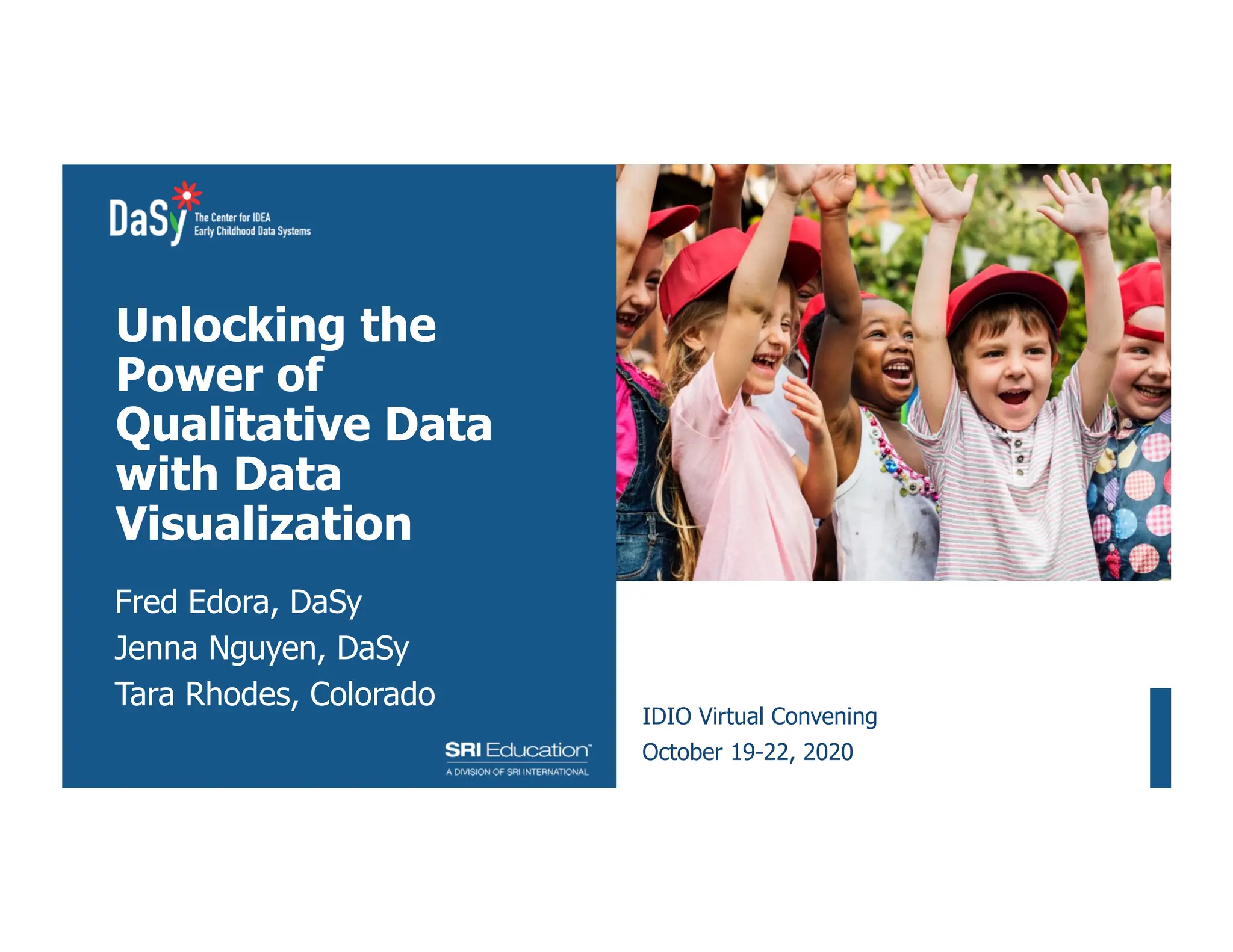
Unlocking the
Power of
Qualitative Data
with Data
Visualization
Fred Edora, DaSy
Jenna Nguyen, DaSy
Tara Rhodes, Colorado
IDIO Virtual Convening
October 19-22, 2020
3
Agenda
Welcome & Objectives – 15 min
Presentation – 25 min
Colorado – 20 min
Activity – 25 min
Conclusion – 5 min
4
Objectives
Define qualitative
data and qualitative
data visualization
1
Describe purpose
and benefits of
using qualitative
data viz
2
Identify
frameworks for
qualitative data viz
and examples
3
Explore methods
for sharing
qualitative data
meaningfully
4
5
Getting to Know
You
Poll: What is your role?
Nothing in life is to be feared, it is only to
be understood.
– Marie Curie
9
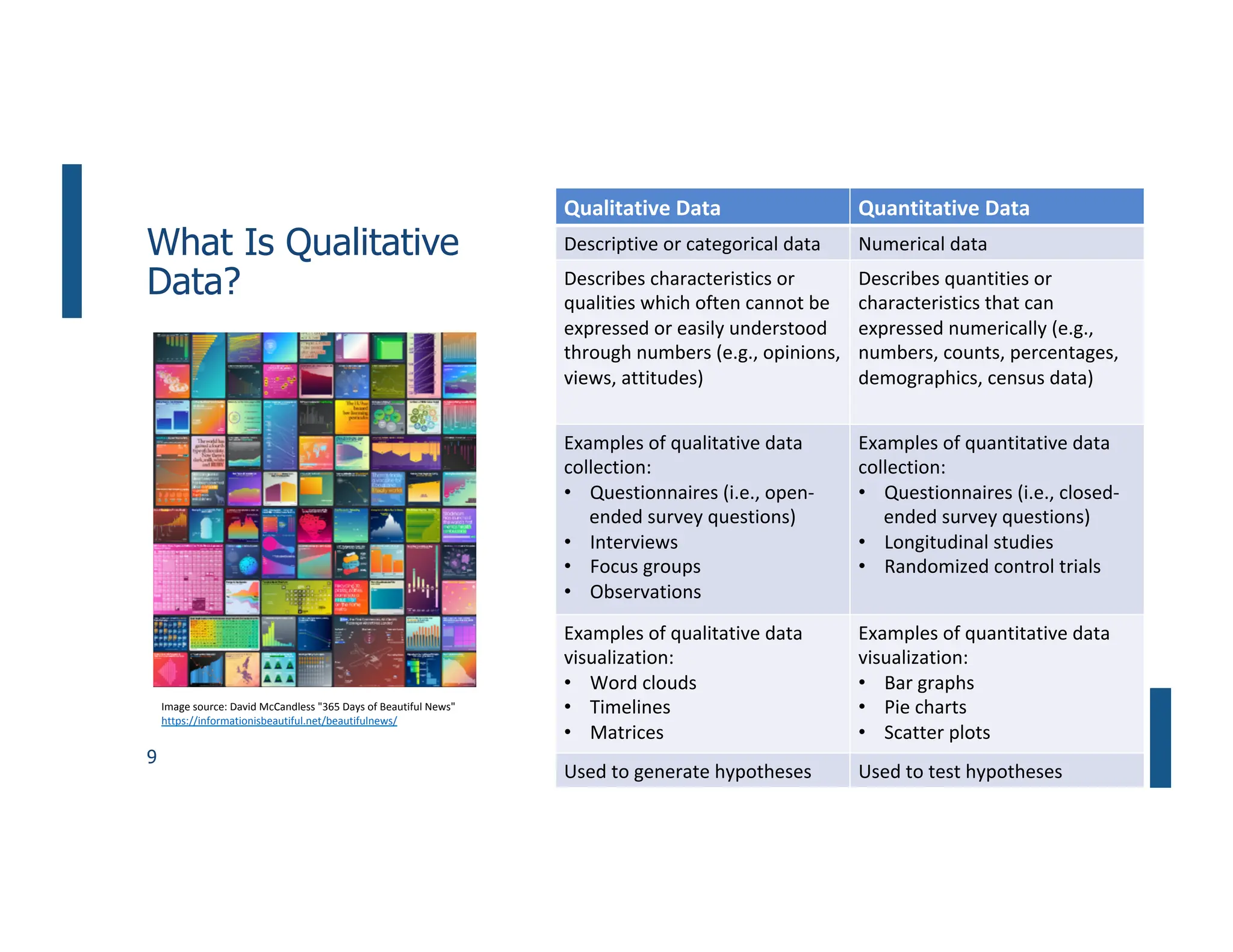
What Is Qualitative
Data?
Qualitative Data Quantitative Data
Descriptive or categorical data Numerical data
Describes characteristics or
qualities which often cannot be
expressed or easily understood
through numbers (e.g., opinions,
views, attitudes)
Describes quantities or
characteristics that can
expressed numerically (e.g.,
numbers, counts, percentages,
demographics, census data)
Examples of qualitative data
collection:
• Questionnaires (i.e., open-
ended survey questions)
• Interviews
• Focus groups
• Observations
Examples of quantitative data
collection:
• Questionnaires (i.e., closed-
ended survey questions)
• Longitudinal studies
• Randomized control trials
Examples of qualitative data
visualization:
• Word clouds
• Timelines
• Matrices
Examples of quantitative data
visualization:
• Bar graphs
• Pie charts
• Scatter plots
Used to generate hypotheses Used to test hypotheses
Image source: David McCandless "365 Days of Beautiful News"
https://informationisbeautiful.net/beautifulnews/
10
What Is Data Visualization?
“Data display in a graphic format is a way of
portraying information succinctly and
efficiently, illustrating details provided in
longer textual information.”
Source: Verdinelli, S., & Scagnoli, N. I. (2013)
12
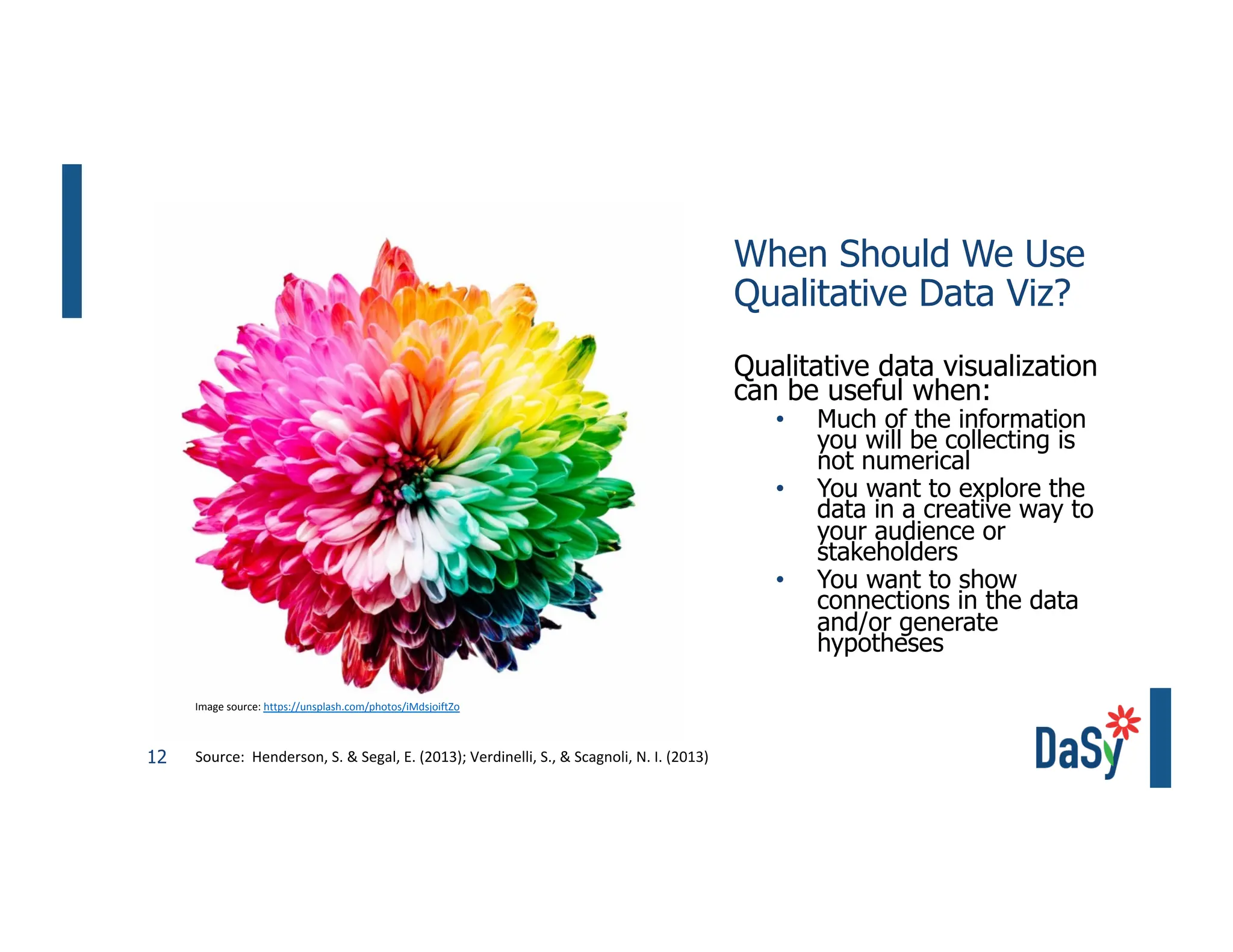
When Should We Use
Qualitative Data Viz?
Qualitative data visualization
can be useful when:
• Much of the information
you will be collecting is
not numerical
• You want to explore the
data in a creative way to
your audience or
stakeholders
• You want to show
connections in the data
and/or generate
hypotheses
Source: Henderson, S. & Segal, E. (2013); Verdinelli, S., & Scagnoli, N. I. (2013)
Image source: https://unsplash.com/photos/iMdsjoiftZo
13
What Can You Do with Qualitative Visual
Displays?
Can be used to:
• Reduce and focus text
• Highlight themes and patterns in the data
• Identify outliers
• Convey a message, discovery, or particular perspective
• Introduce new levels of understanding
• Purpose of “illuminating rather than obscuring the
message”
Source: Henderson, S. & Segal, E. (2013); Verdinelli, S., & Scagnoli, N. I. (2013)
14
How Does Qualitative Data Visualization
Benefit Our Audiences?
Audiences can:
• Acquire new insights
• Develop elaborate understanding
• Appreciate new knowledge
• Build theories
• Draw conclusions
• Take action
Source: Henderson, S. & Segal, E. (2013); Verdinelli, S., & Scagnoli, N. I. (2013)
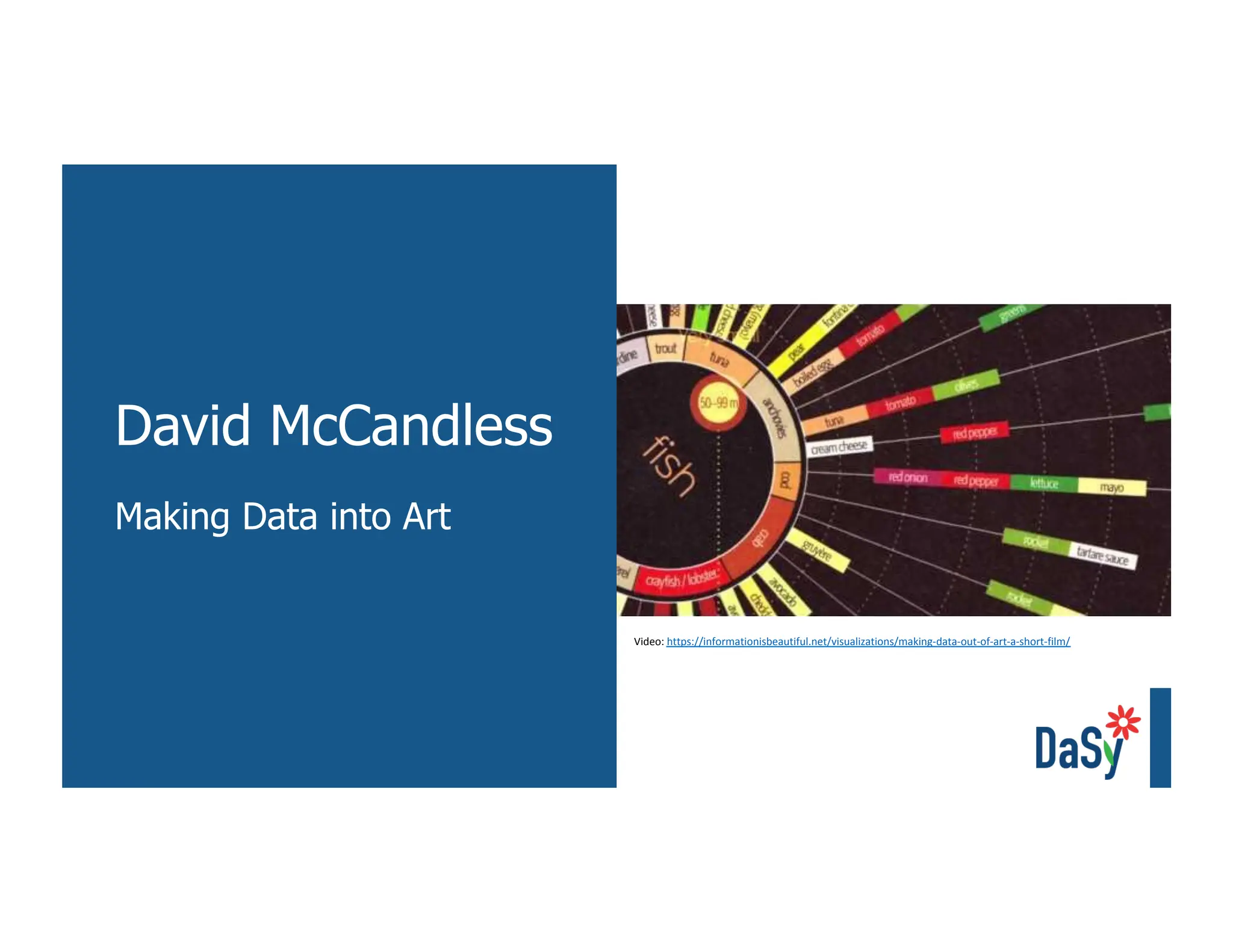
David McCandless
Making Data into Art
Video: https://informationisbeautiful.net/visualizations/making-data-out-of-art-a-short-film/
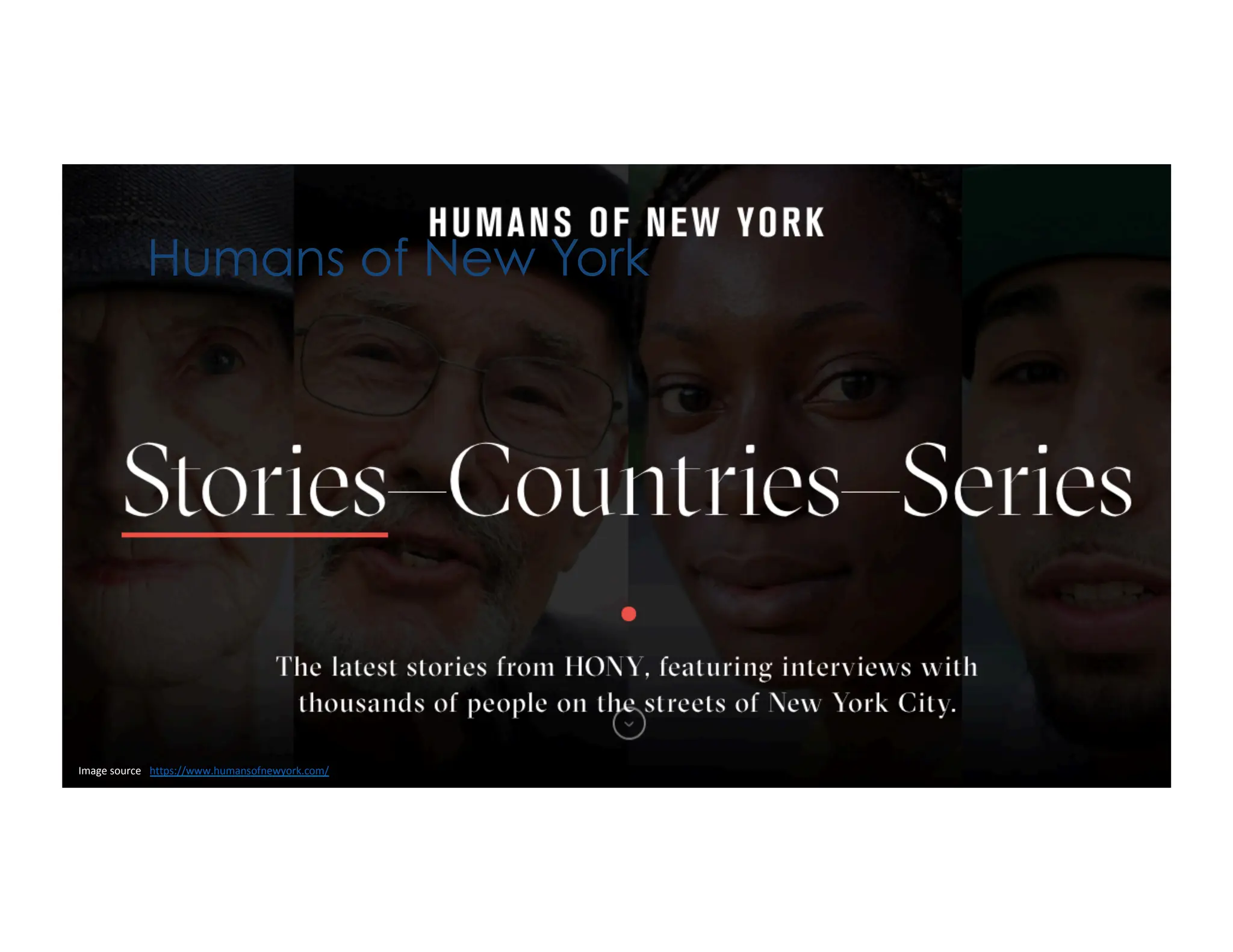
Humans of New York
Image source: https://www.humansofnewyork.com/
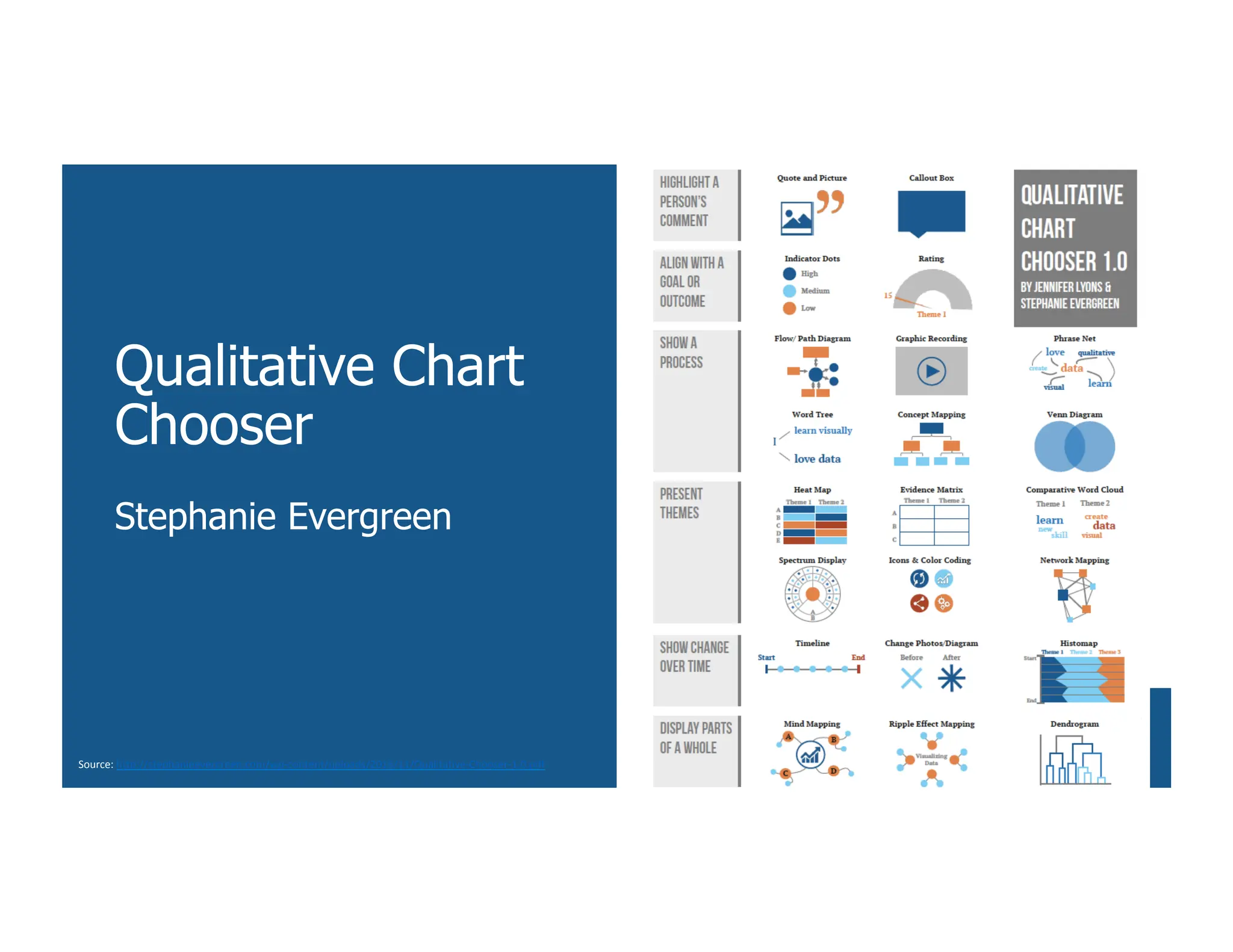
Qualitative Chart
Chooser
Stephanie Evergreen
Source: http://stephanieevergreen.com/wp-content/uploads/2016/11/Qualitative-Chooser-1.0.pdf
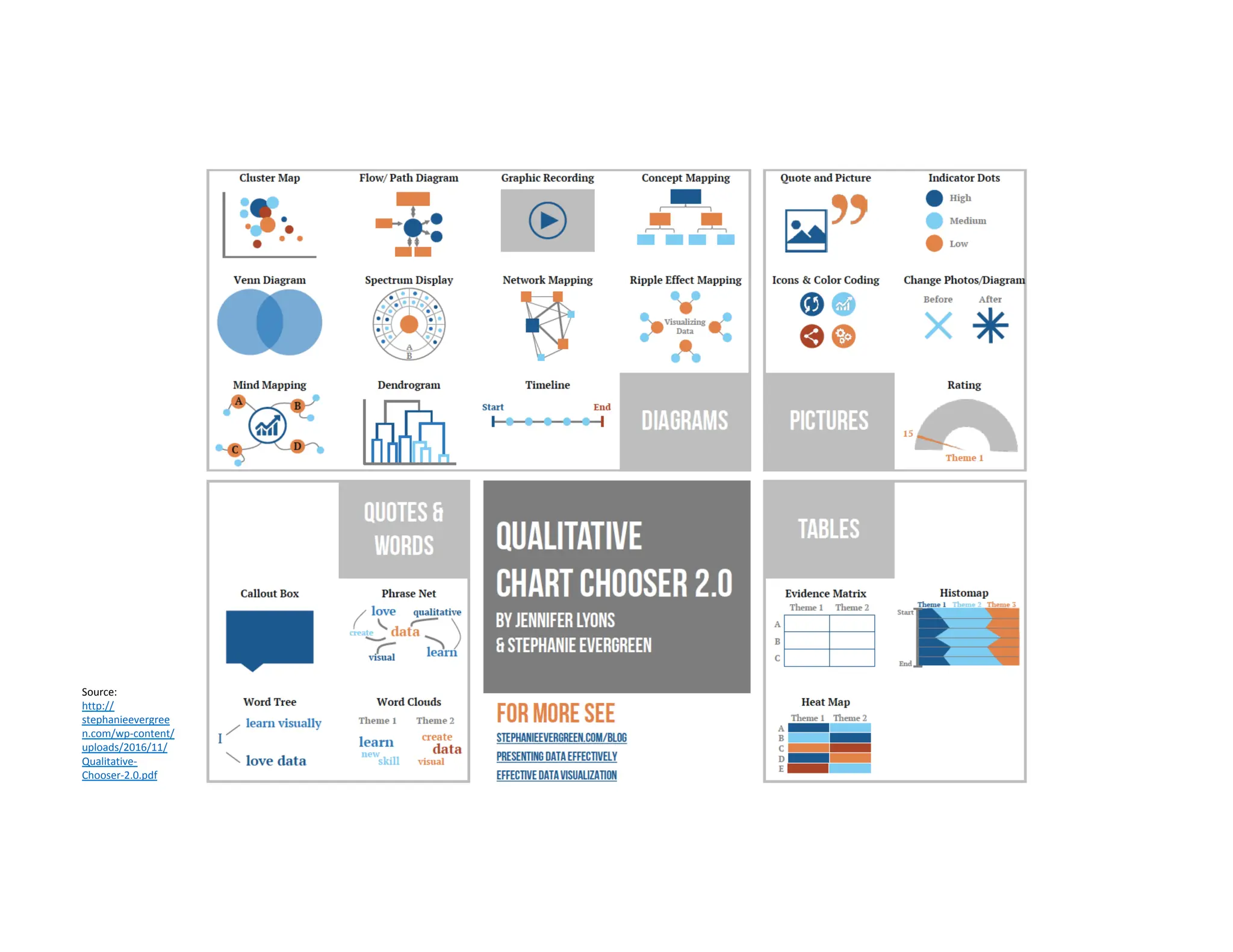
Qualitative Chart Chooser 2.0
Source:
http://
stephanieevergree
n.com/wp-content/
uploads/2016/11/
Qualitative-
Chooser-2.0.pdf
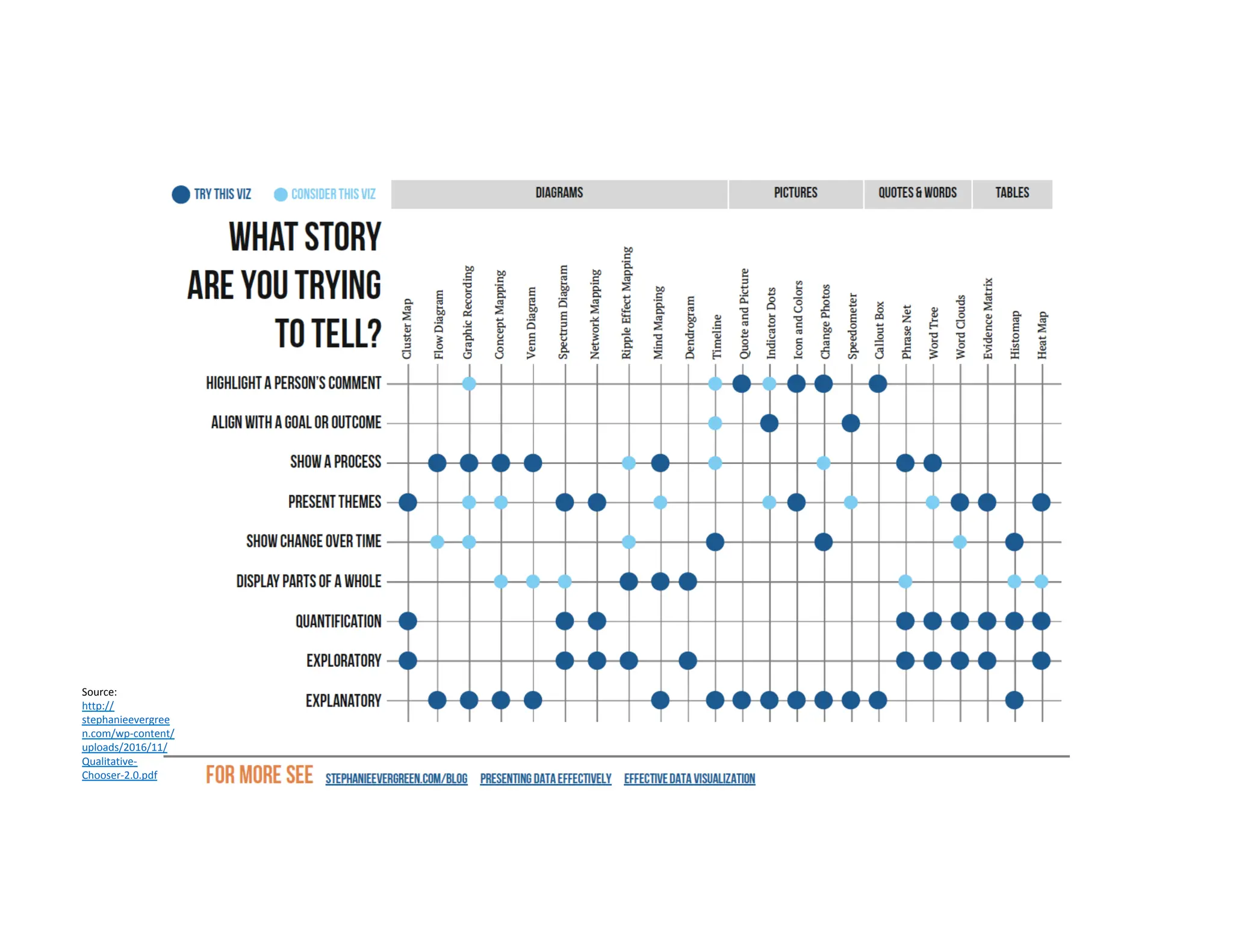
Qualitative Chart Chooser
2.0 (continued)
Source:
http://
stephanieevergree
n.com/wp-content/
uploads/2016/11/
Qualitative-
Chooser-2.0.pdf
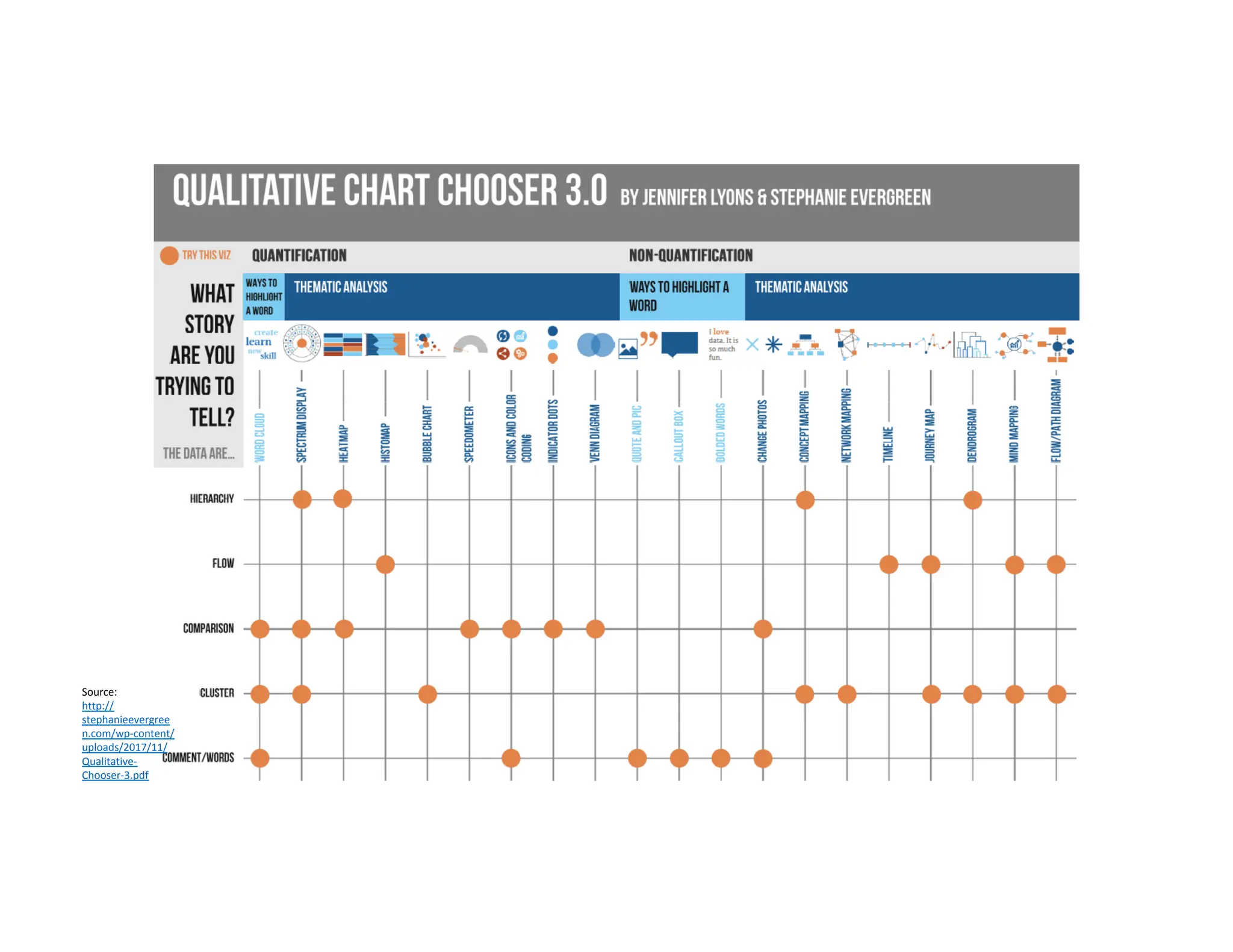
Source:
http://
stephanieevergree
n.com/wp-content/
uploads/2017/11/
Qualitative-
Chooser-3.pdf
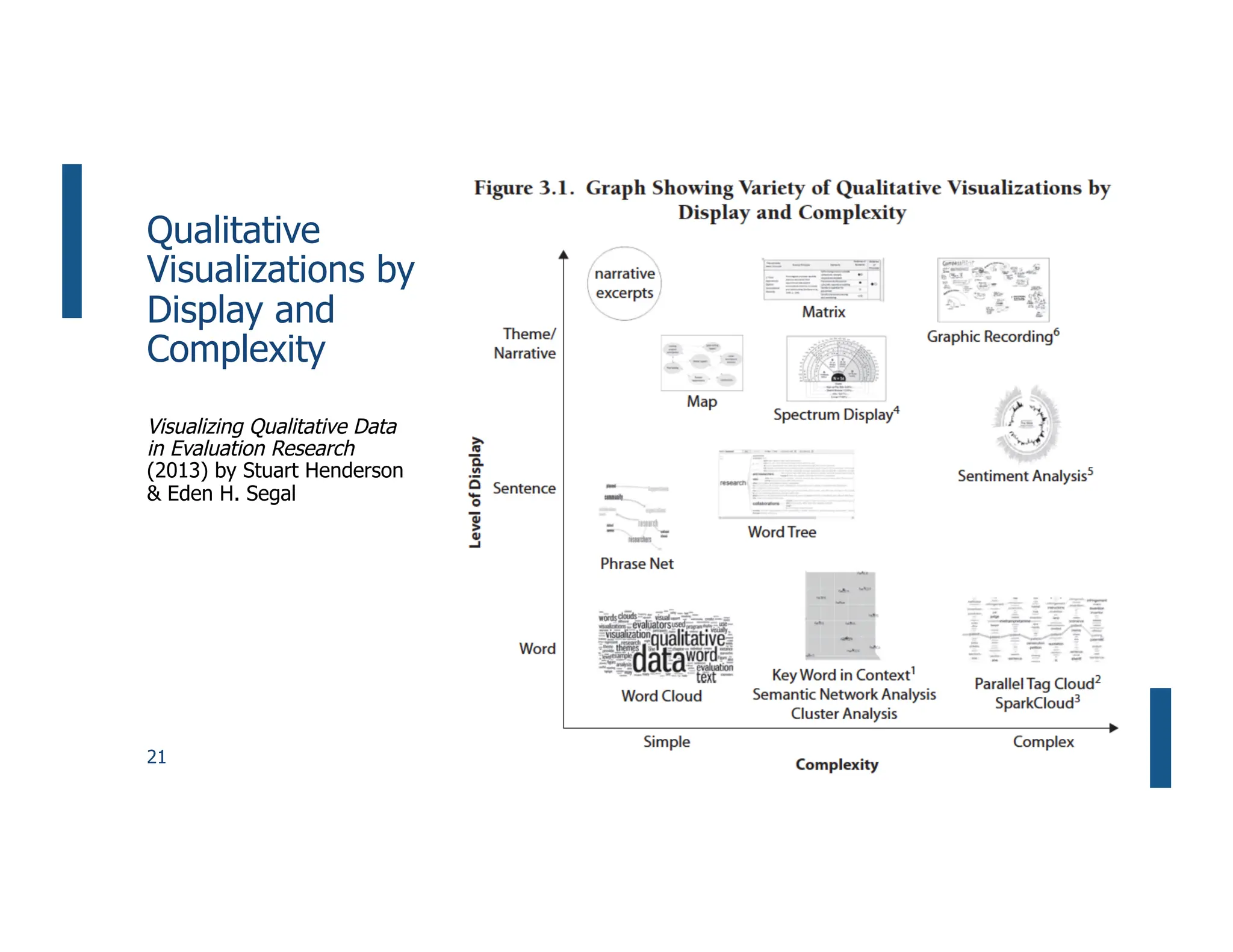
21
Qualitative
Visualizations by
Display and
Complexity
Visualizing Qualitative Data
in Evaluation Research
(2013) by Stuart Henderson
& Eden H. Segal
22
Types of
Qualitative
Visual Displays
and Purposes
Data Display in Qualitative
Research (2013) by
Susanna Verdinelli &
Norma I. Scagnoli
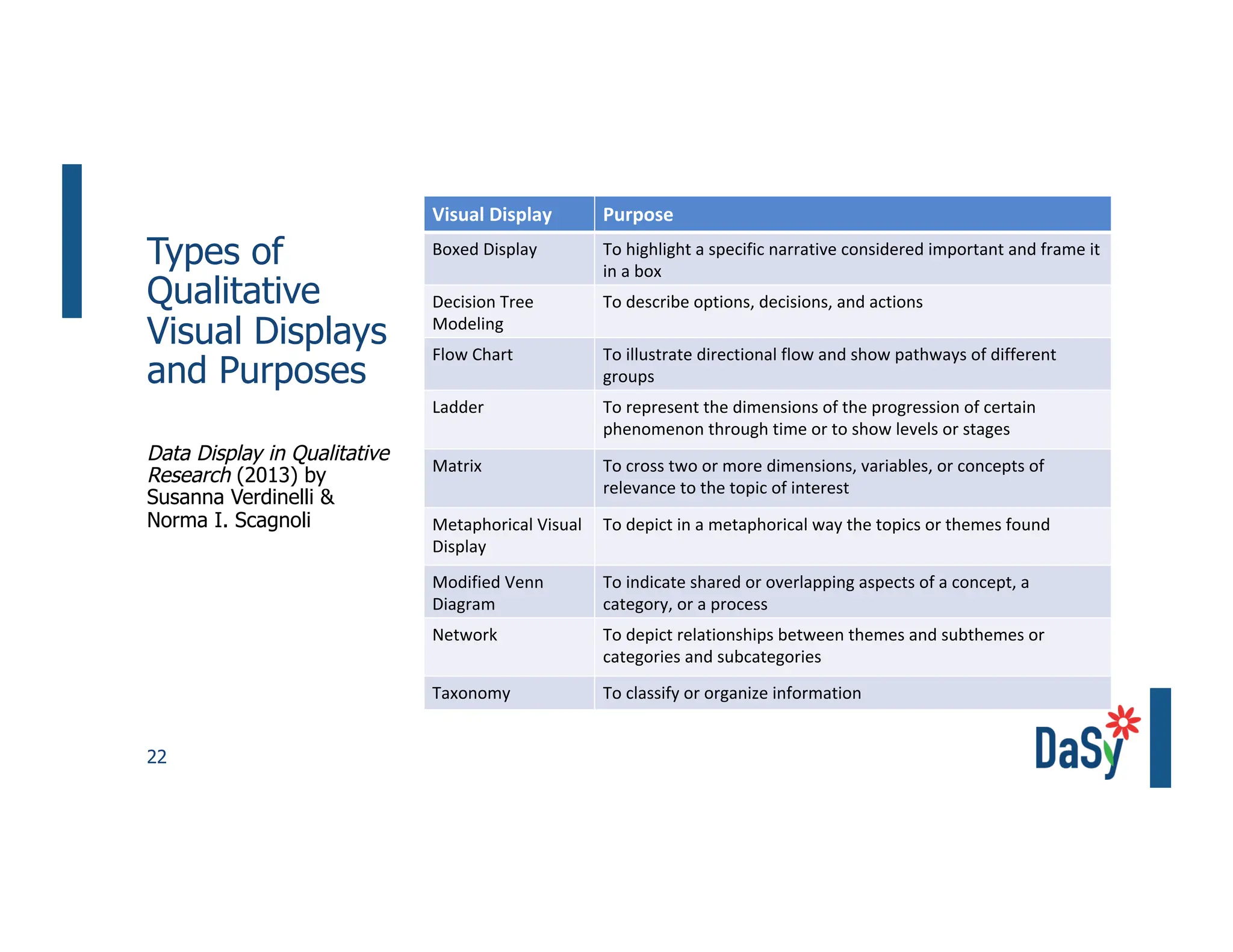
Visual Display Purpose
Boxed Display To highlight a specific narrative considered important and frame it
in a box
Decision Tree
Modeling
To describe options, decisions, and actions
Flow Chart To illustrate directional flow and show pathways of different
groups
Ladder To represent the dimensions of the progression of certain
phenomenon through time or to show levels or stages
Matrix To cross two or more dimensions, variables, or concepts of
relevance to the topic of interest
Metaphorical Visual
Display
To depict in a metaphorical way the topics or themes found
Modified Venn
Diagram
To indicate shared or overlapping aspects of a concept, a
category, or a process
Network To depict relationships between themes and subthemes or
categories and subcategories
Taxonomy To classify or organize information
23
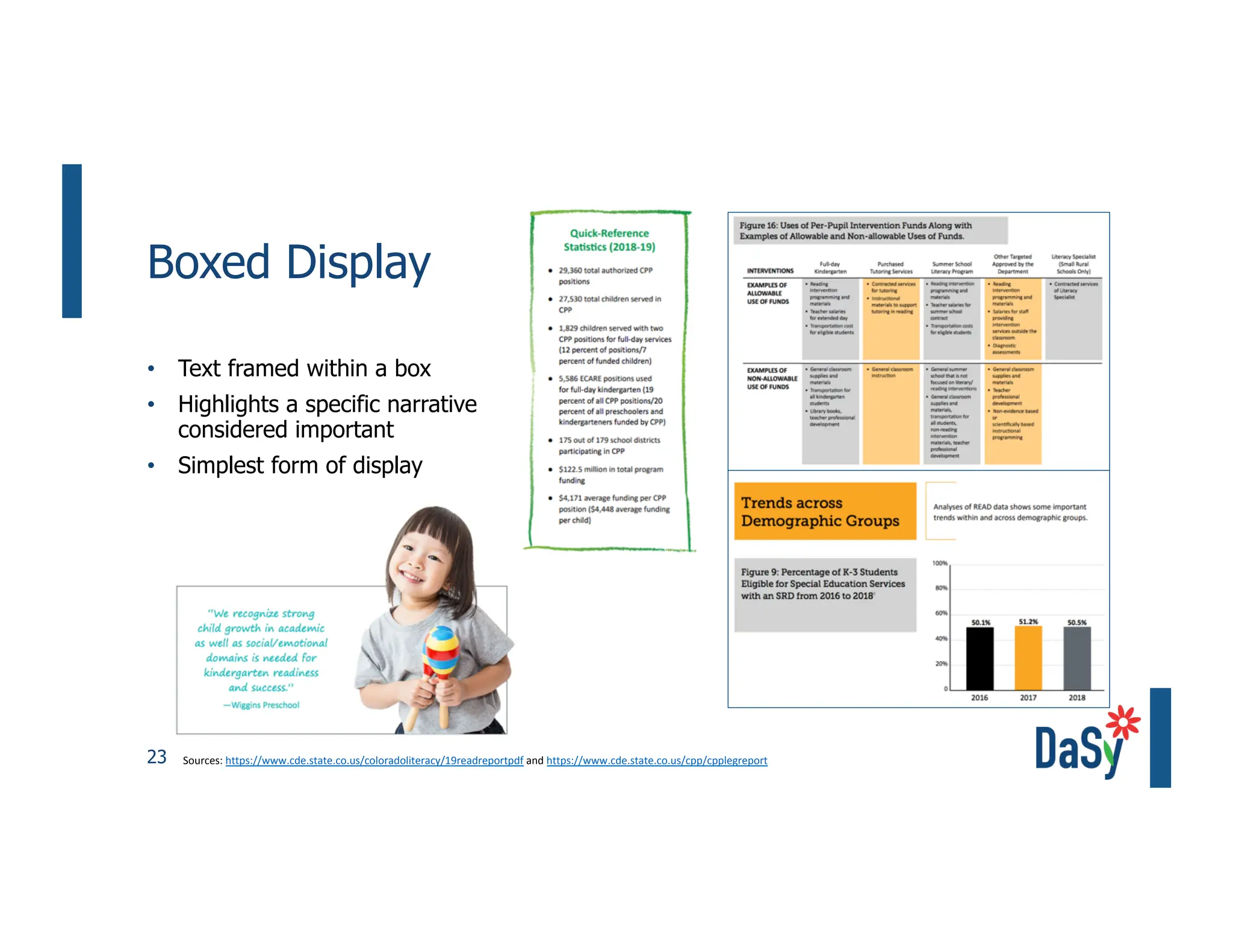
Boxed Display
• Text framed within a box
• Highlights a specific narrative
considered important
• Simplest form of display
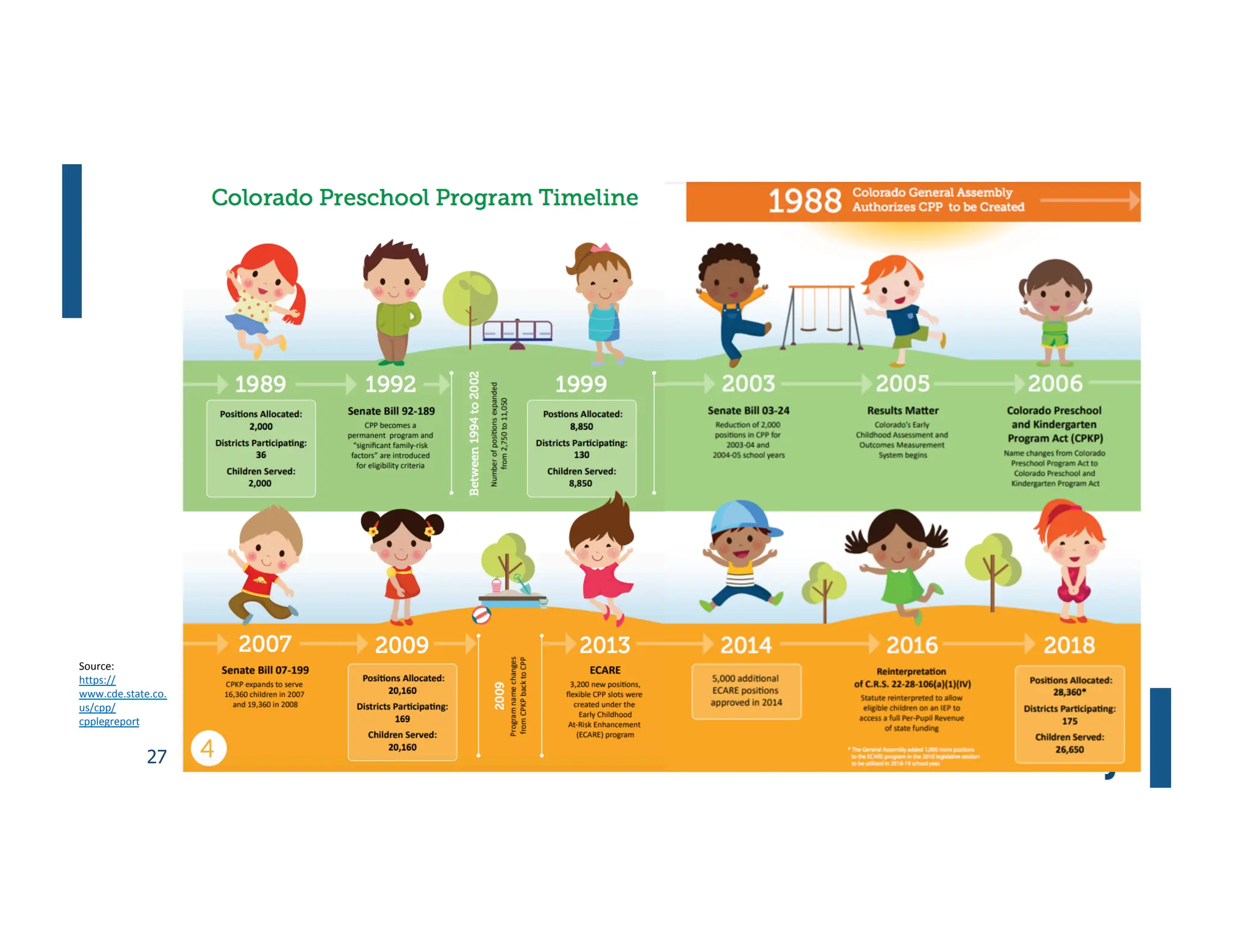
Sources: https://www.cde.state.co.us/coloradoliteracy/19readreportpdf and https://www.cde.state.co.us/cpp/cpplegreport
24
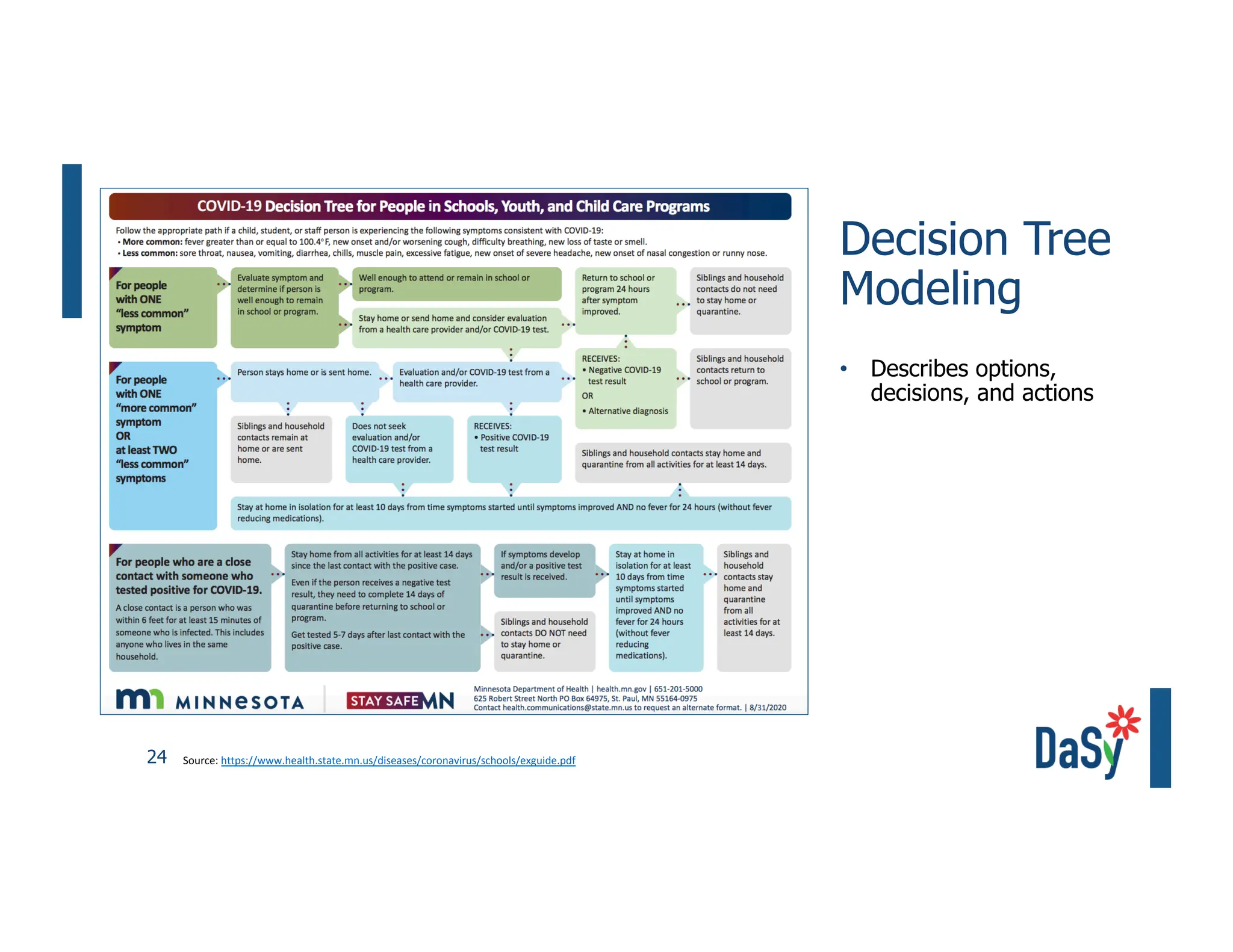
Decision Tree
Modeling
• Describes options,
decisions, and actions
Source: https://www.health.state.mn.us/diseases/coronavirus/schools/exguide.pdf
25
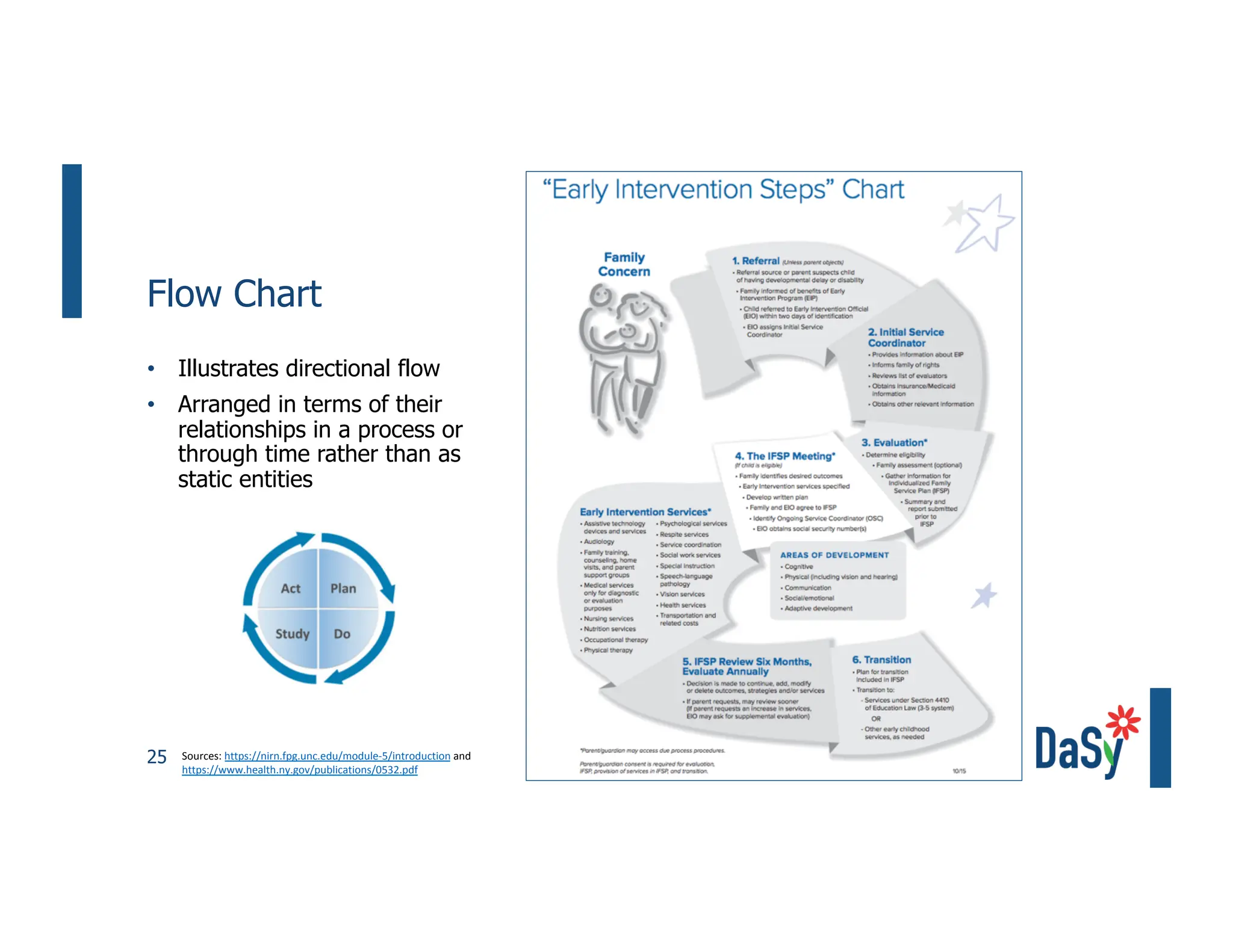
Flow Chart
• Illustrates directional flow
• Arranged in terms of their
relationships in a process or
through time rather than as
static entities
Sources: https://nirn.fpg.unc.edu/module-5/introduction and
https://www.health.ny.gov/publications/0532.pdf
26
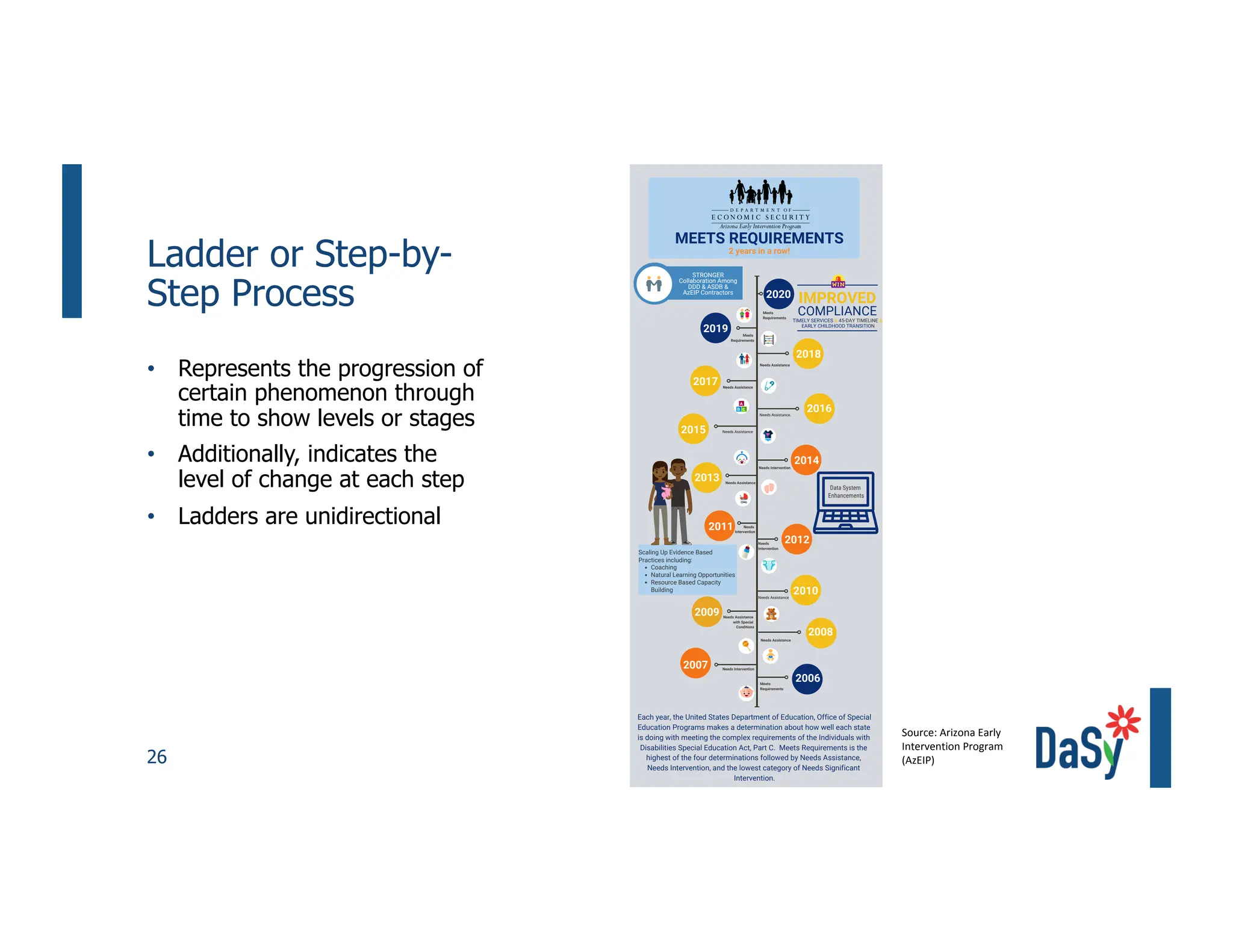
Ladder or Step-by-
Step Process
• Represents the progression of
certain phenomenon through
time to show levels or stages
• Additionally, indicates the
level of change at each step
• Ladders are unidirectional
MEETS REQUIREMENTS
Each year, the United States Department of Education, Office of Special
Education Programs makes a determination about how well each state
is doing with meeting the complex requirements of the Individuals with
Disabilities Special Education Act, Part C. Meets Requirements is the
highest of the four determinations followed by Needs Assistance,
Needs Intervention, and the lowest category of Needs Significant
Intervention.
2020
2019
2018
2017
2016
2015
Meets
Requirements
Meets
Requirements
Needs Assistance
Needs Assistance
Needs Assistance.
Needs Assistance
2014
Needs Intervention
2013 Needs Assistance
2012
Needs
Intervention
2011 Needs
Intervention
2010
Needs Assistance
2009 Needs Assistance
with Special
Conditions
Scaling Up Evidence Based
Practices including:
Coaching
Natural Learning Opportunities
Resource Based Capacity
Building
2008
Needs Assistance
2007 Needs Intervention
2006
Meets
Requirements
2 years in a row!
IMPROVED
COMPLIANCE
TIMELY SERVICES & 45-DAY TIMELINE &
EARLY CHILDHOOD TRANSITION
STRONGER
Collaboration Among
DDD & ASDB &
AzEIP Contractors
Data System
Enhancements
Source: Arizona Early
Intervention Program
(AzEIP)
27
Source:
https://
www.cde.state.co.
us/cpp/
cpplegreport
28
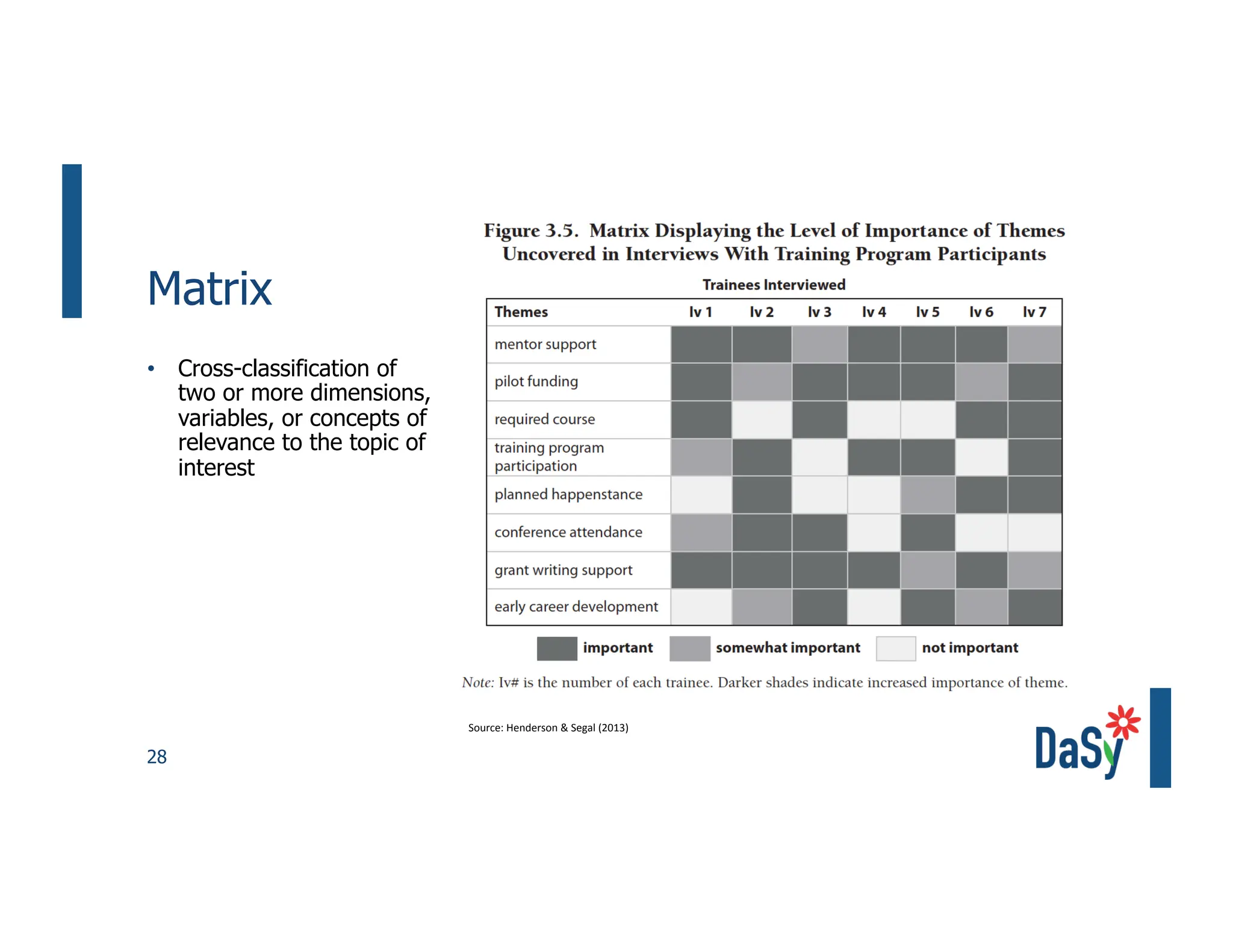
Matrix
• Cross-classification of
two or more dimensions,
variables, or concepts of
relevance to the topic of
interest
Source: Henderson & Segal (2013)
29
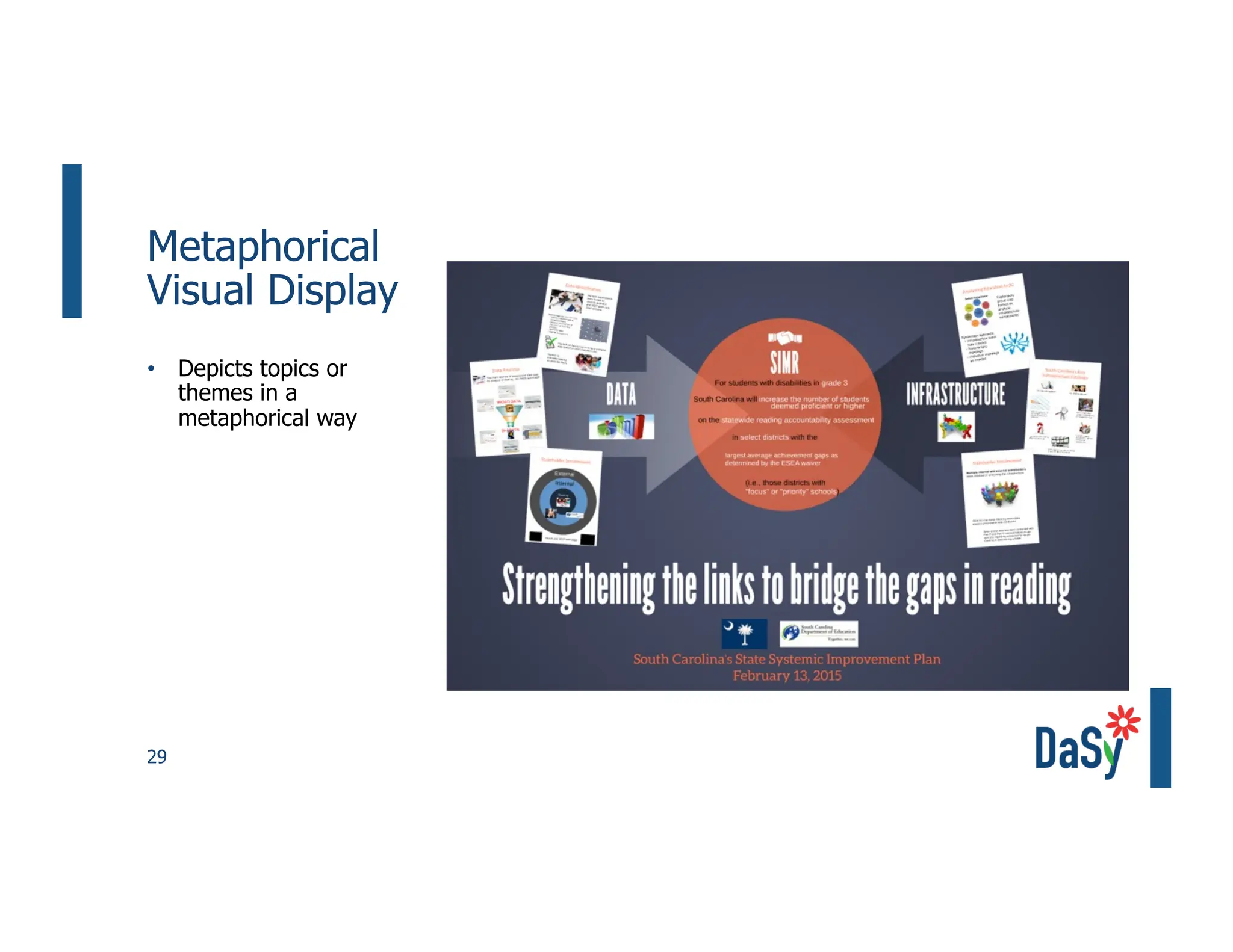
Metaphorical
Visual Display
• Depicts topics or
themes in a
metaphorical way
30
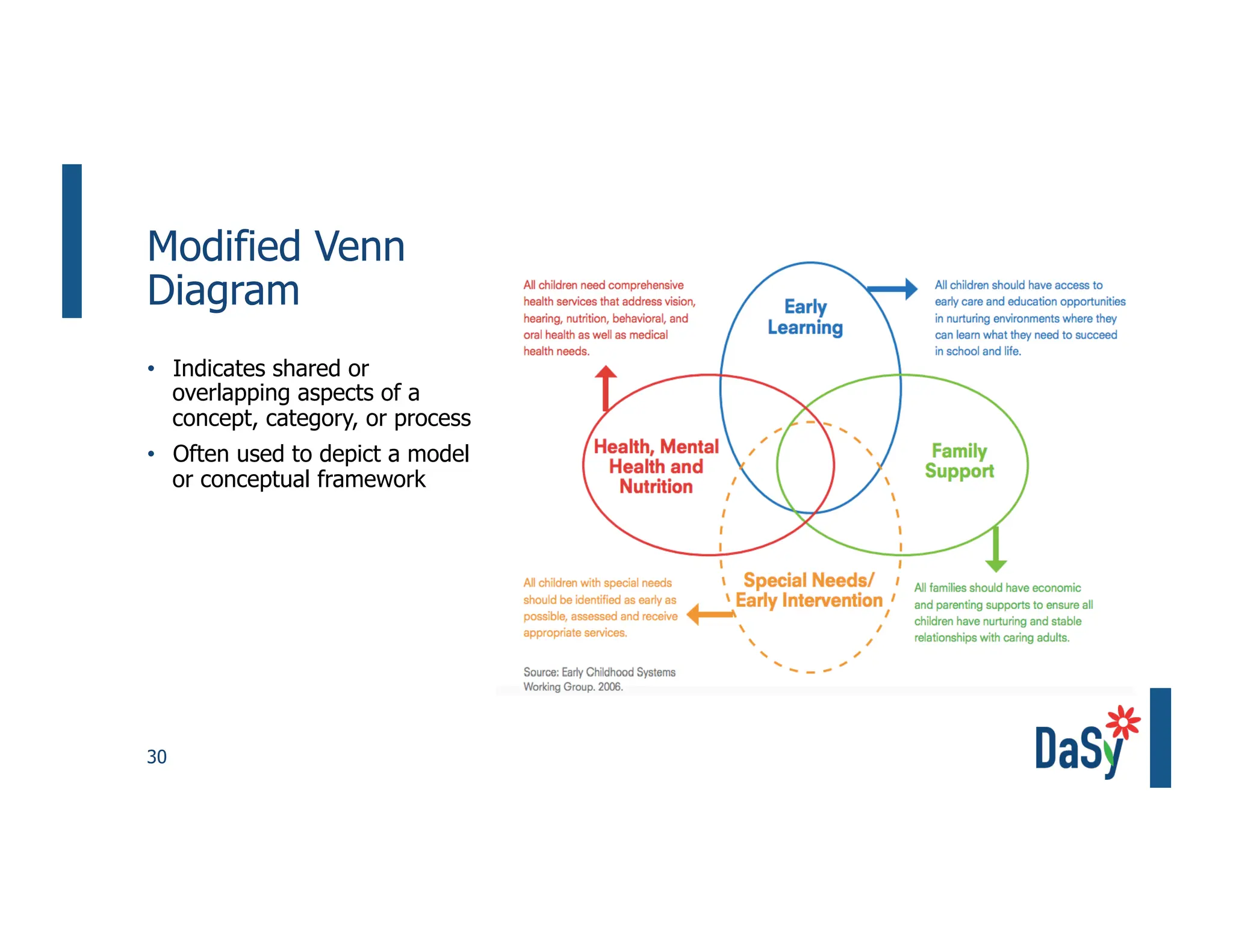
Modified Venn
Diagram
• Indicates shared or
overlapping aspects of a
concept, category, or process
• Often used to depict a model
or conceptual framework
31
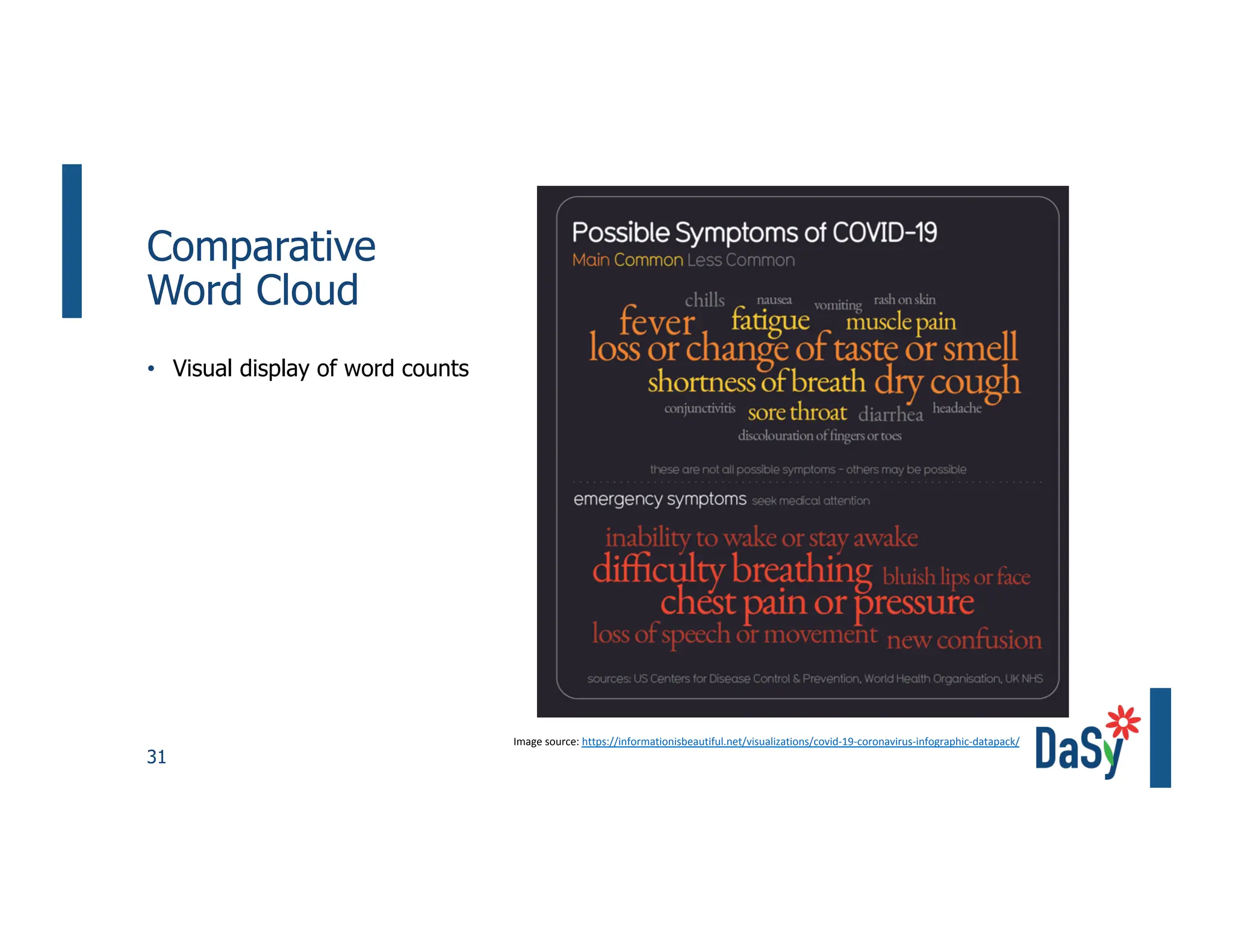
Comparative
Word Cloud
• Visual display of word counts
Image source: https://informationisbeautiful.net/visualizations/covid-19-coronavirus-infographic-datapack/
32
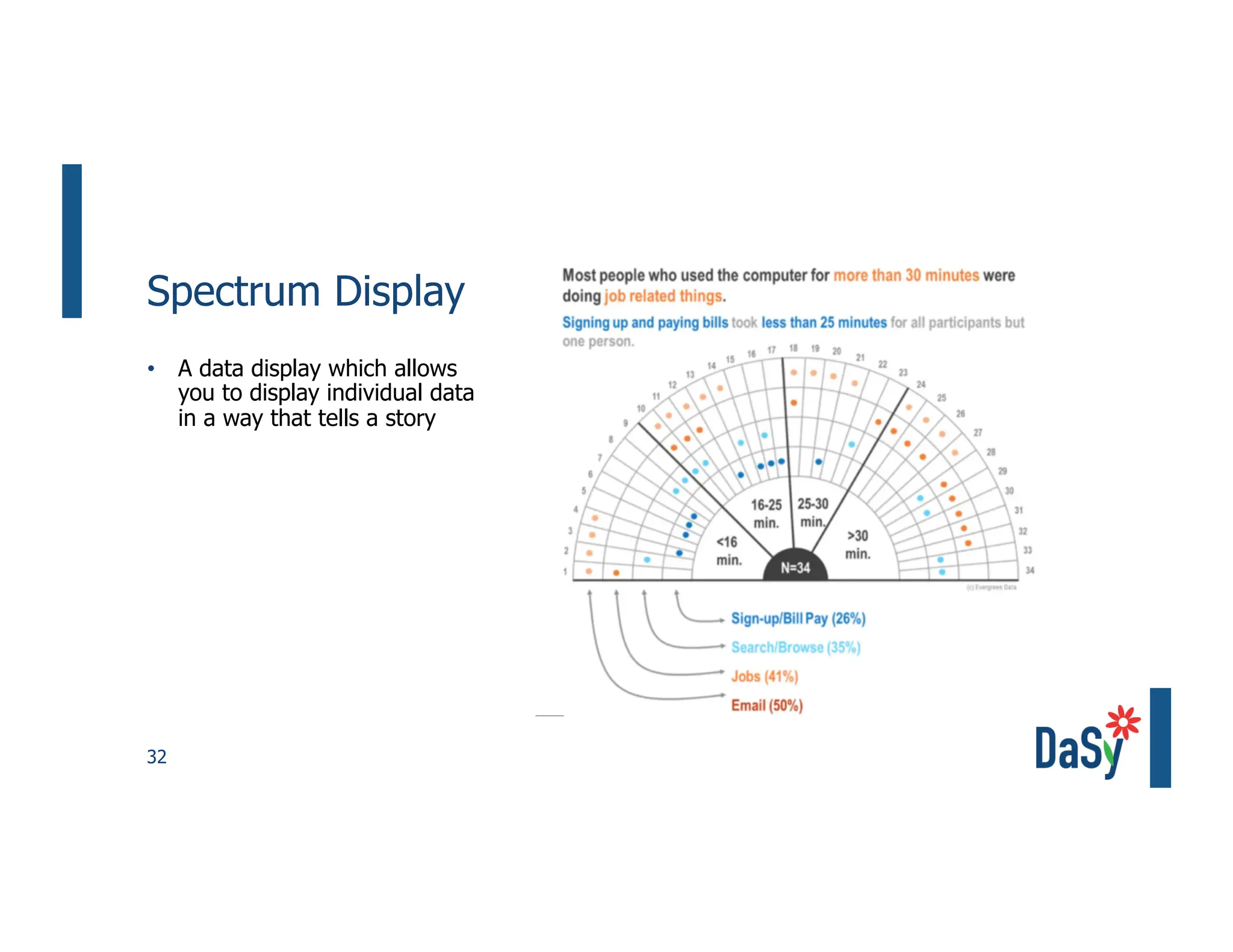
Spectrum Display
• A data display which allows
you to display individual data
in a way that tells a story
33
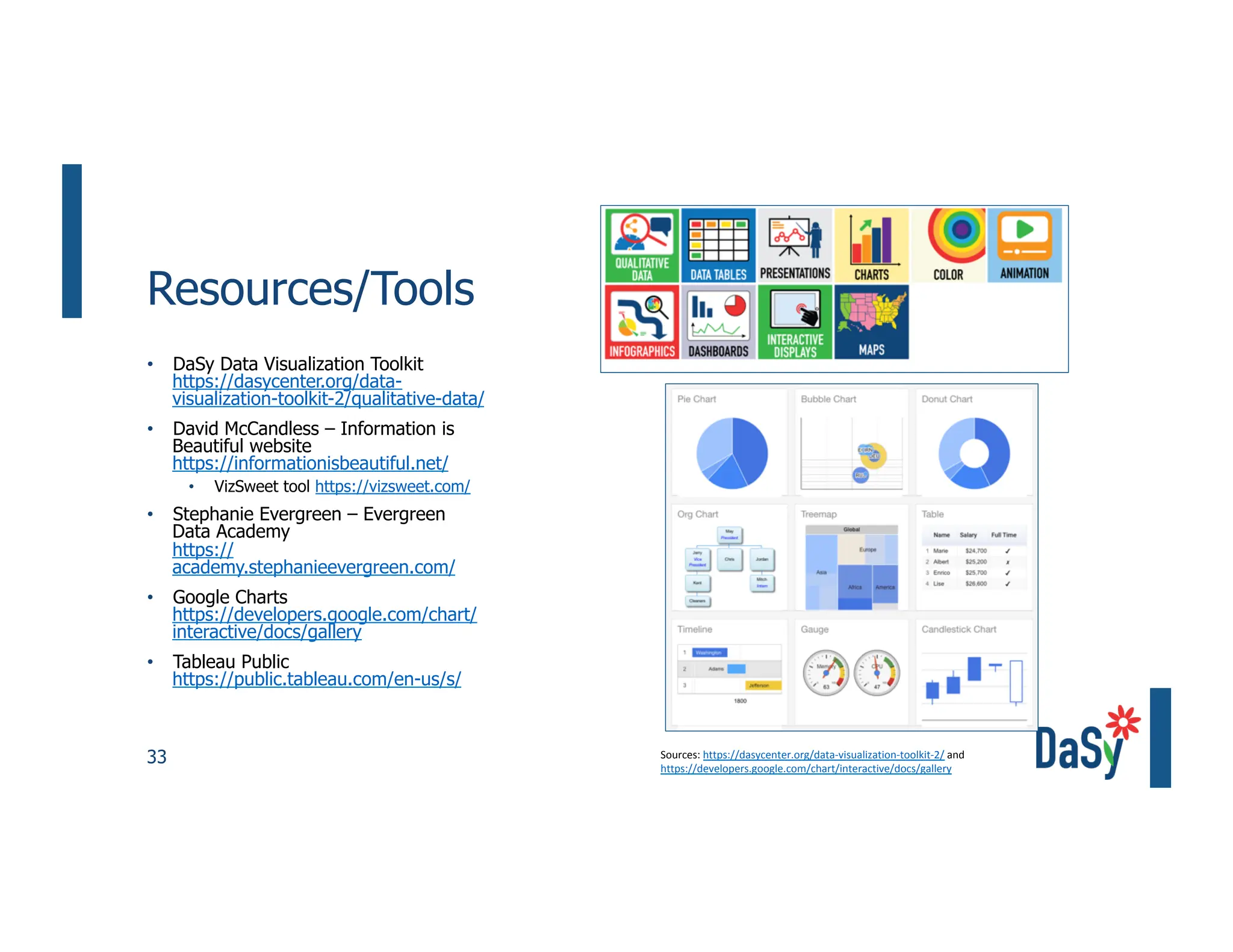
Resources/Tools
• DaSy Data Visualization Toolkit
https://dasycenter.org/data-
visualization-toolkit-2/qualitative-data/
• David McCandless – Information is
Beautiful website
https://informationisbeautiful.net/
• VizSweet tool https://vizsweet.com/
• Stephanie Evergreen – Evergreen
Data Academy
https://
academy.stephanieevergreen.com/
• Google Charts
https://developers.google.com/chart/
interactive/docs/gallery
• Tableau Public
https://public.tableau.com/en-us/s/
Sources: https://dasycenter.org/data-visualization-toolkit-2/ and
https://developers.google.com/chart/interactive/docs/gallery
34
Image source: https://unsplash.com/photos/xoYPV4oVQJI
Tara Rhodes
Colorado
35
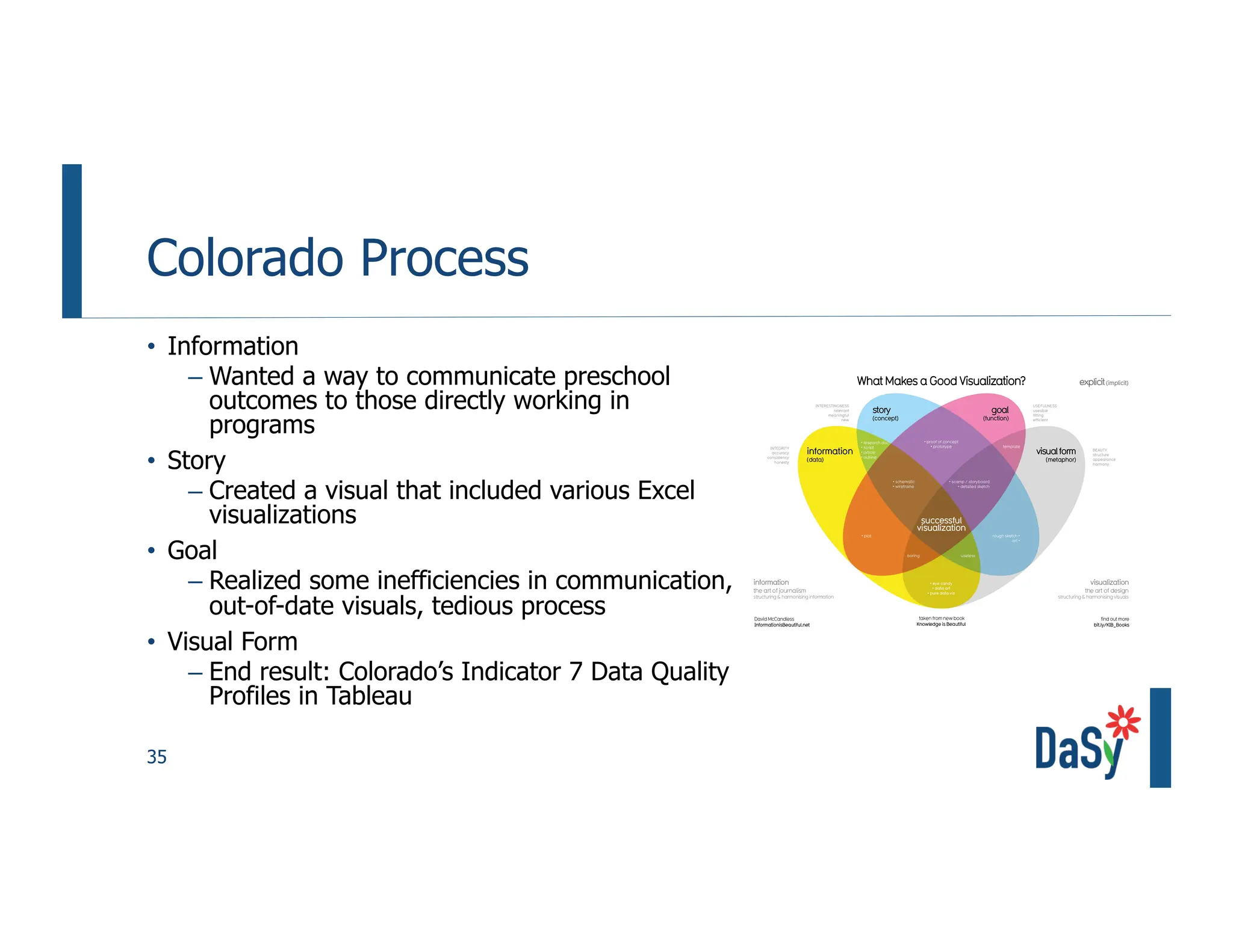
Colorado Process
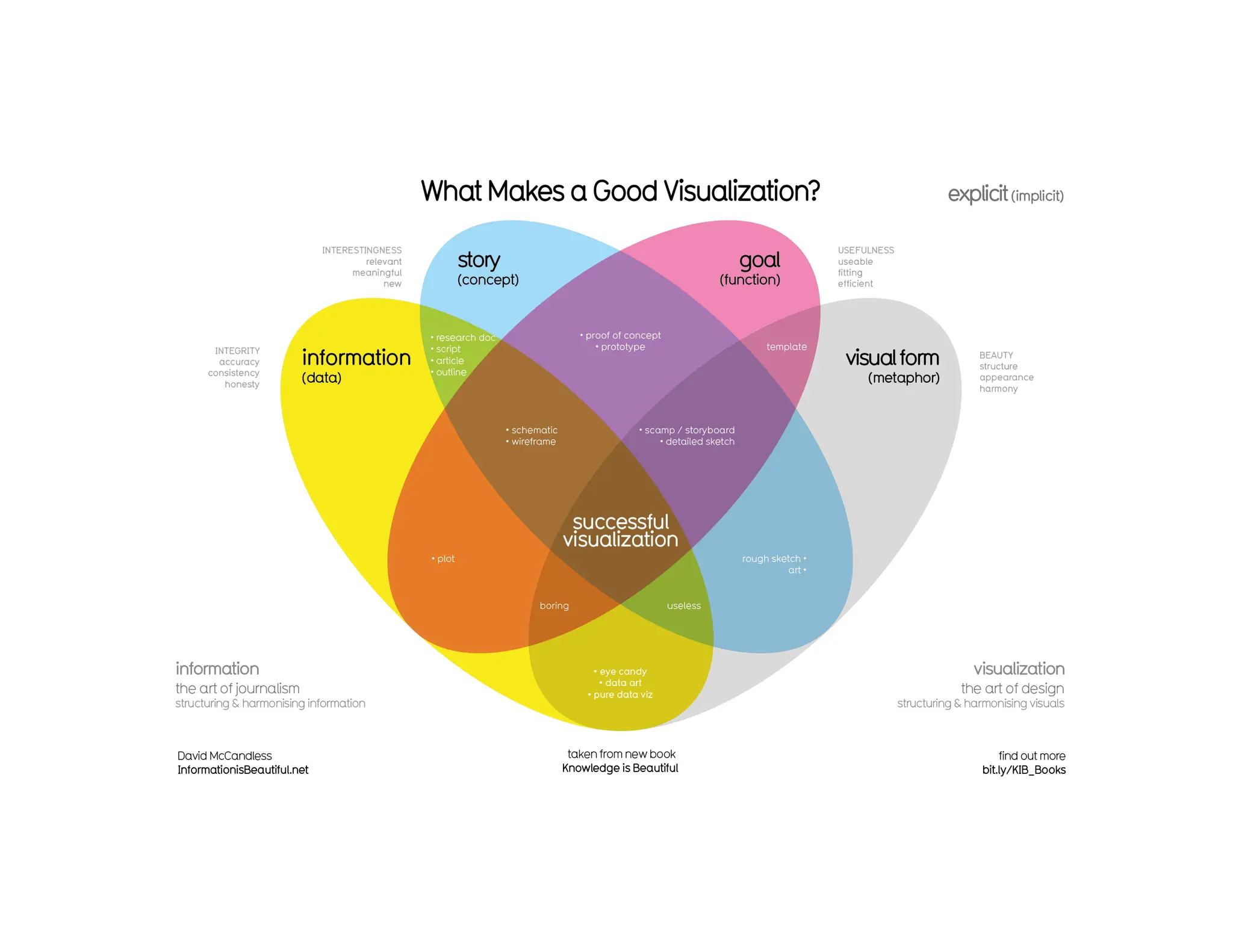
• Information
‒ Wanted a way to communicate preschool
outcomes to those directly working in
programs
• Story
‒ Created a visual that included various Excel
visualizations
• Goal
‒ Realized some inefficiencies in communication,
out-of-date visuals, tedious process
• Visual Form
‒ End result: Colorado’s Indicator 7 Data Quality
Profiles in Tableau
36
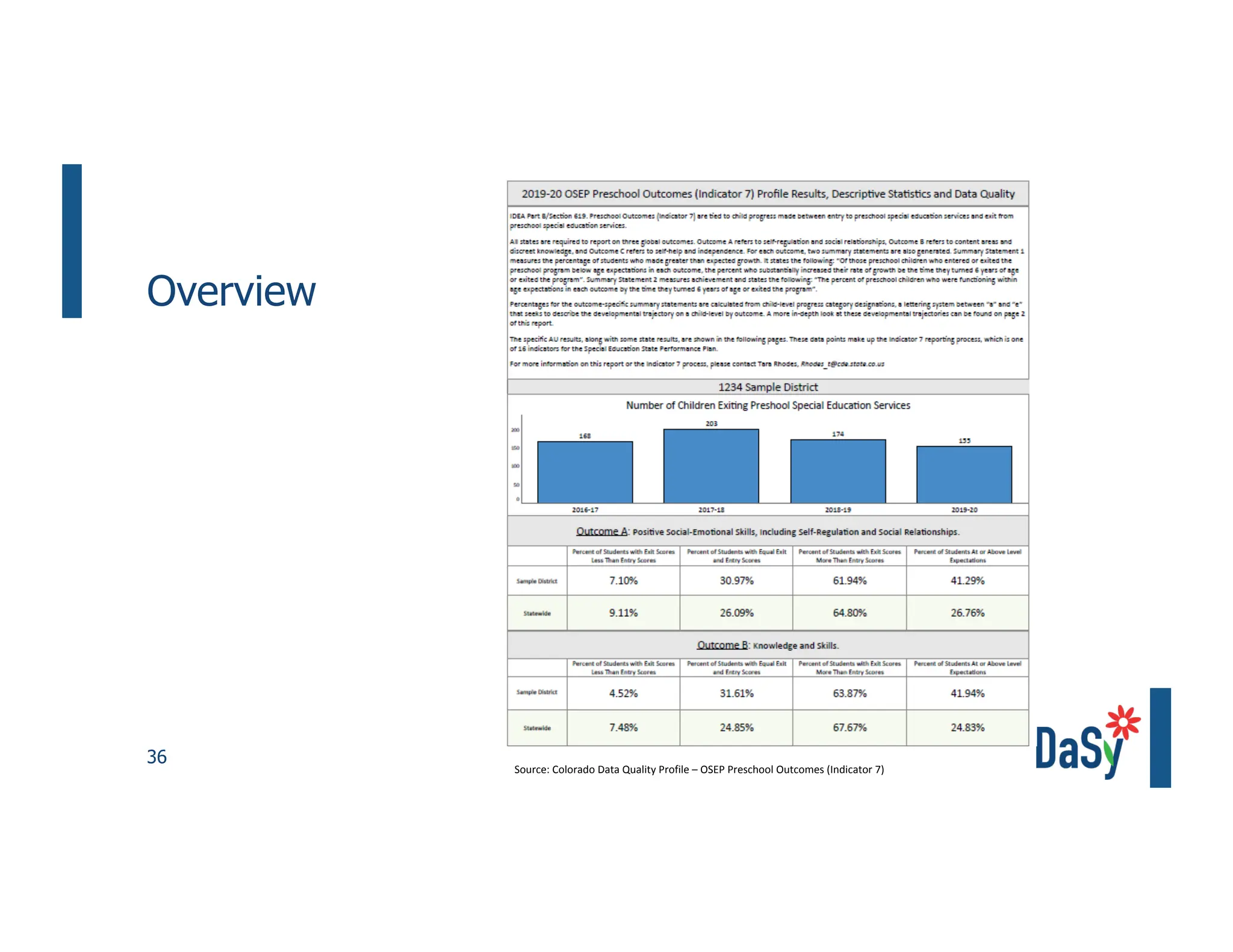
Overview
Source: Colorado Data Quality Profile – OSEP Preschool Outcomes (Indicator 7)
37
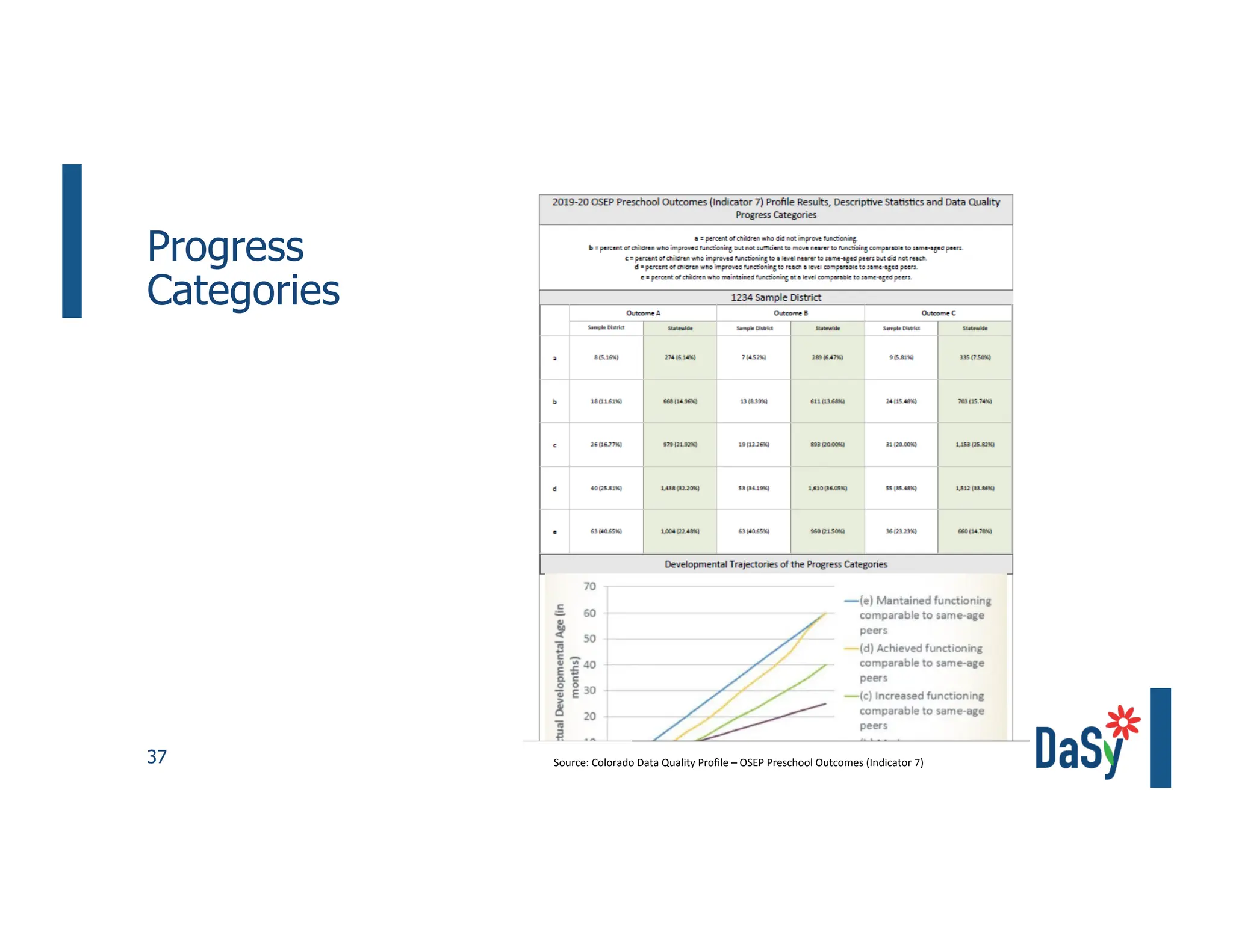
Progress
Categories
Source: Colorado Data Quality Profile – OSEP Preschool Outcomes (Indicator 7)
38
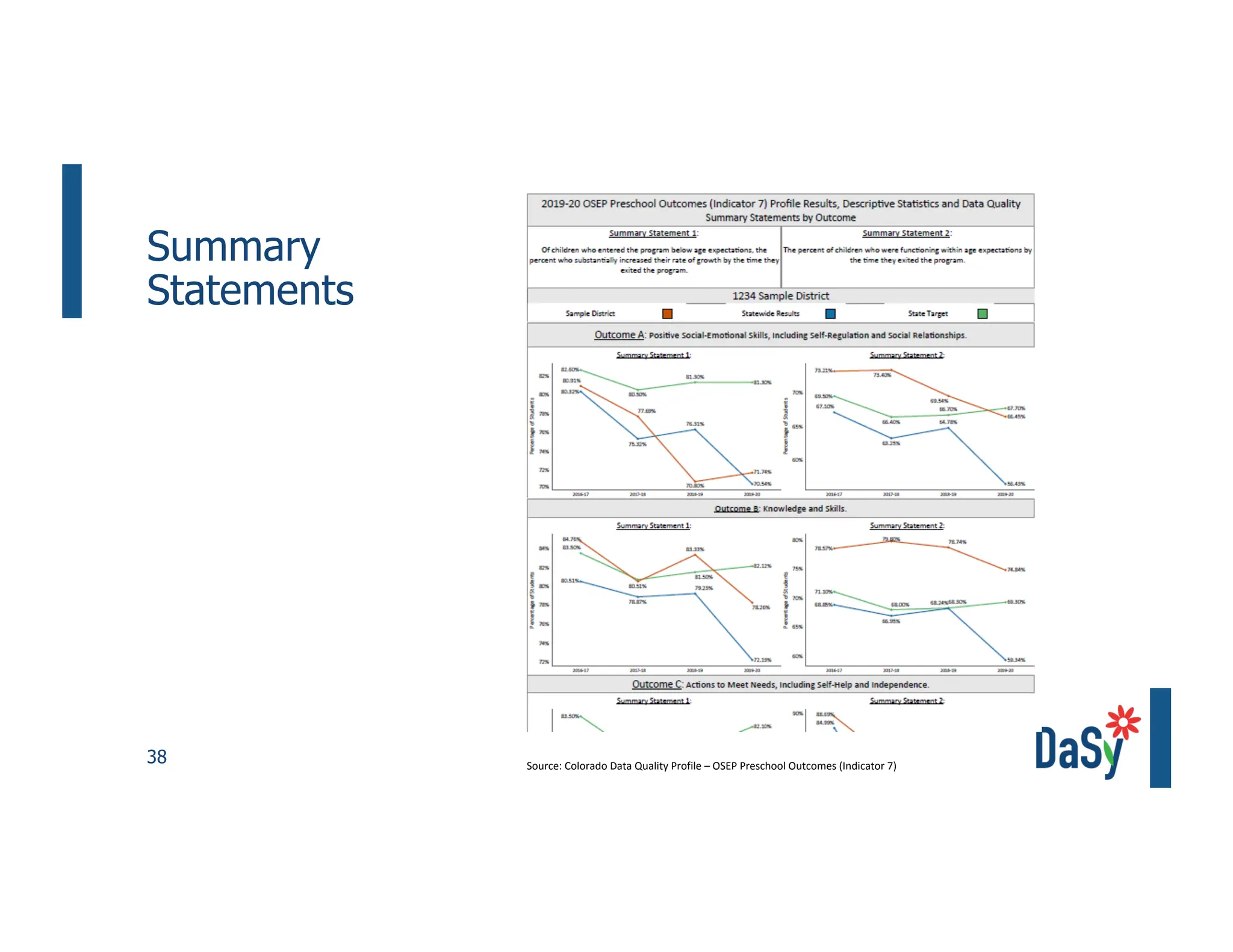
Summary
Statements
Source: Colorado Data Quality Profile – OSEP Preschool Outcomes (Indicator 7)
39
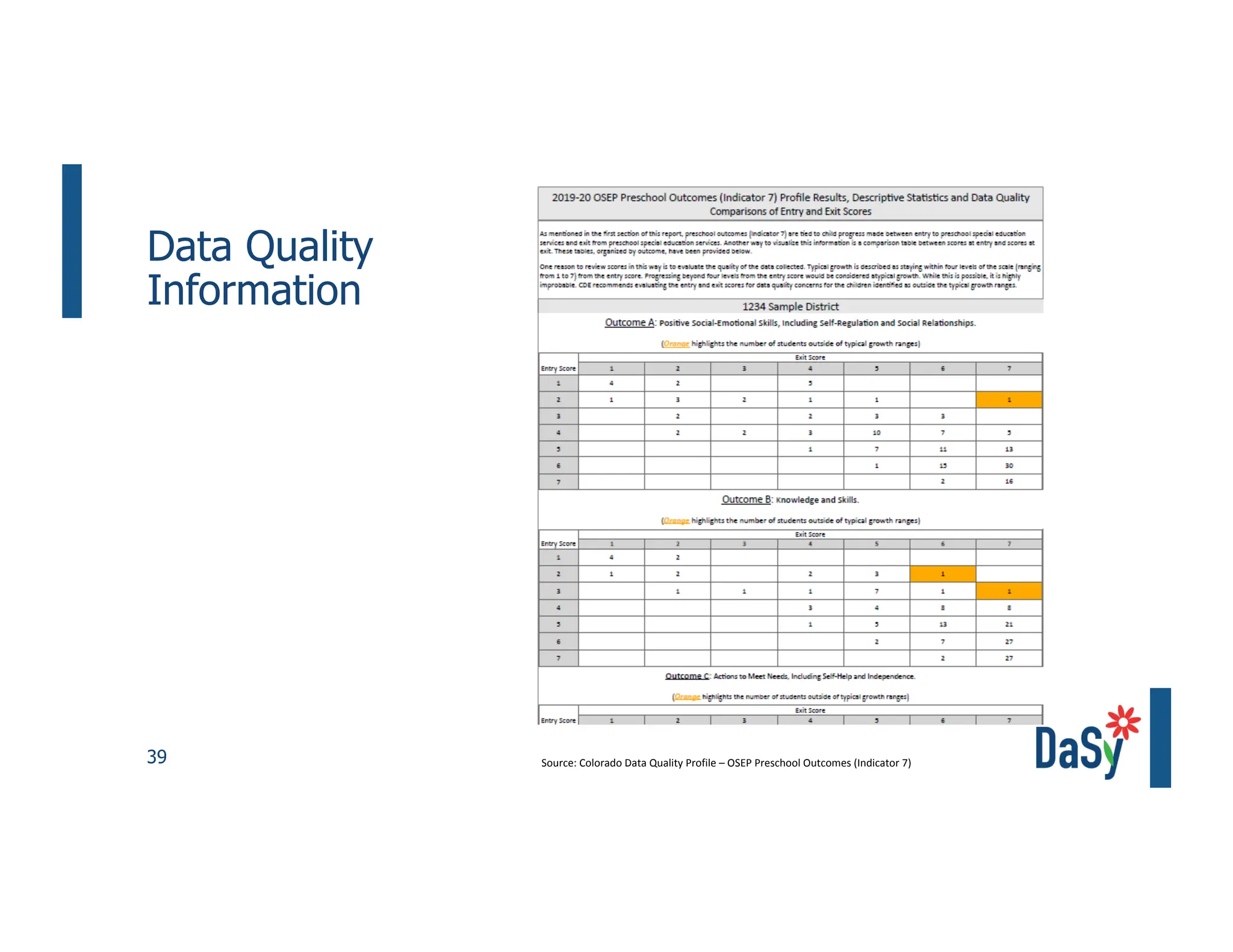
Data Quality
Information
Source: Colorado Data Quality Profile – OSEP Preschool Outcomes (Indicator 7)
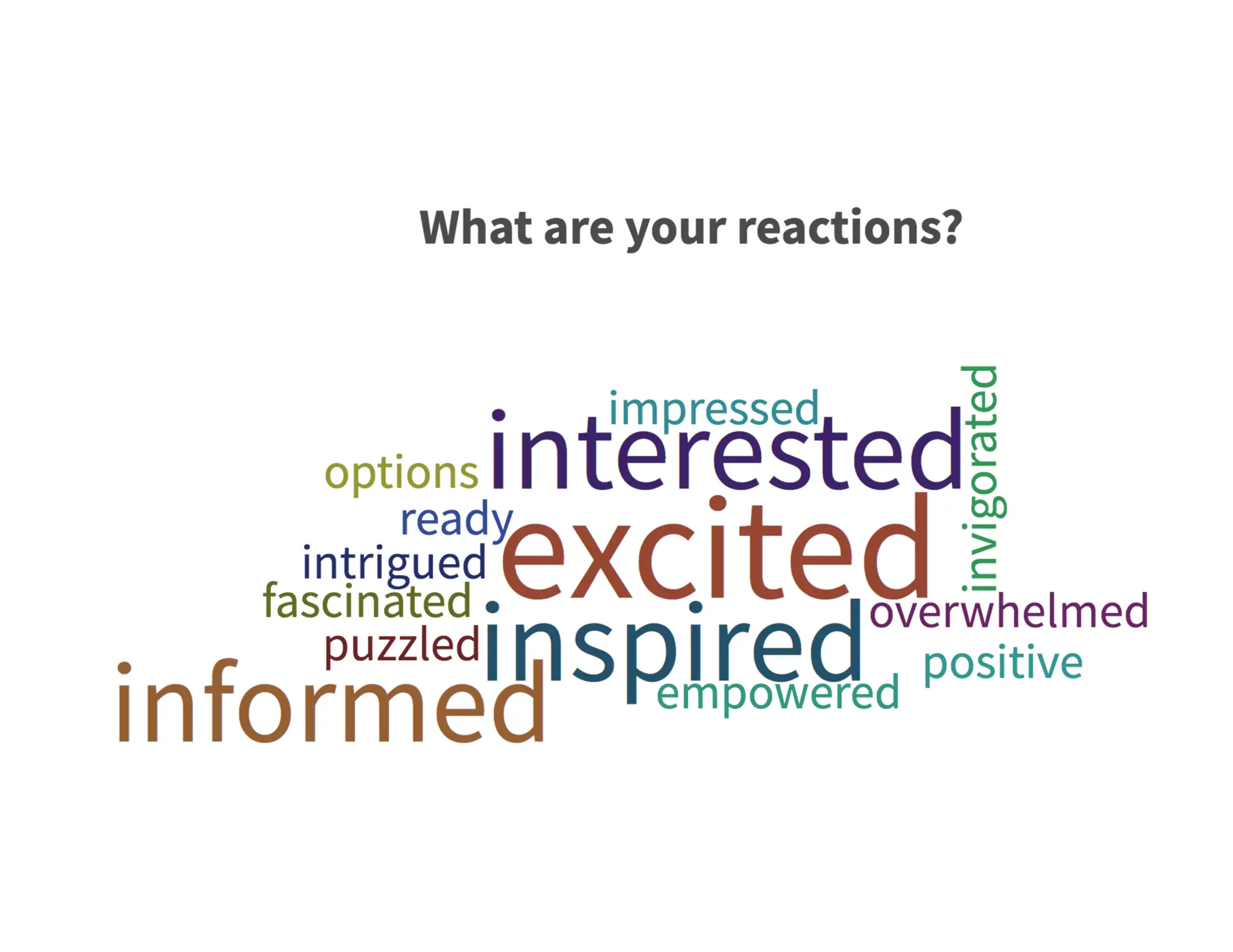
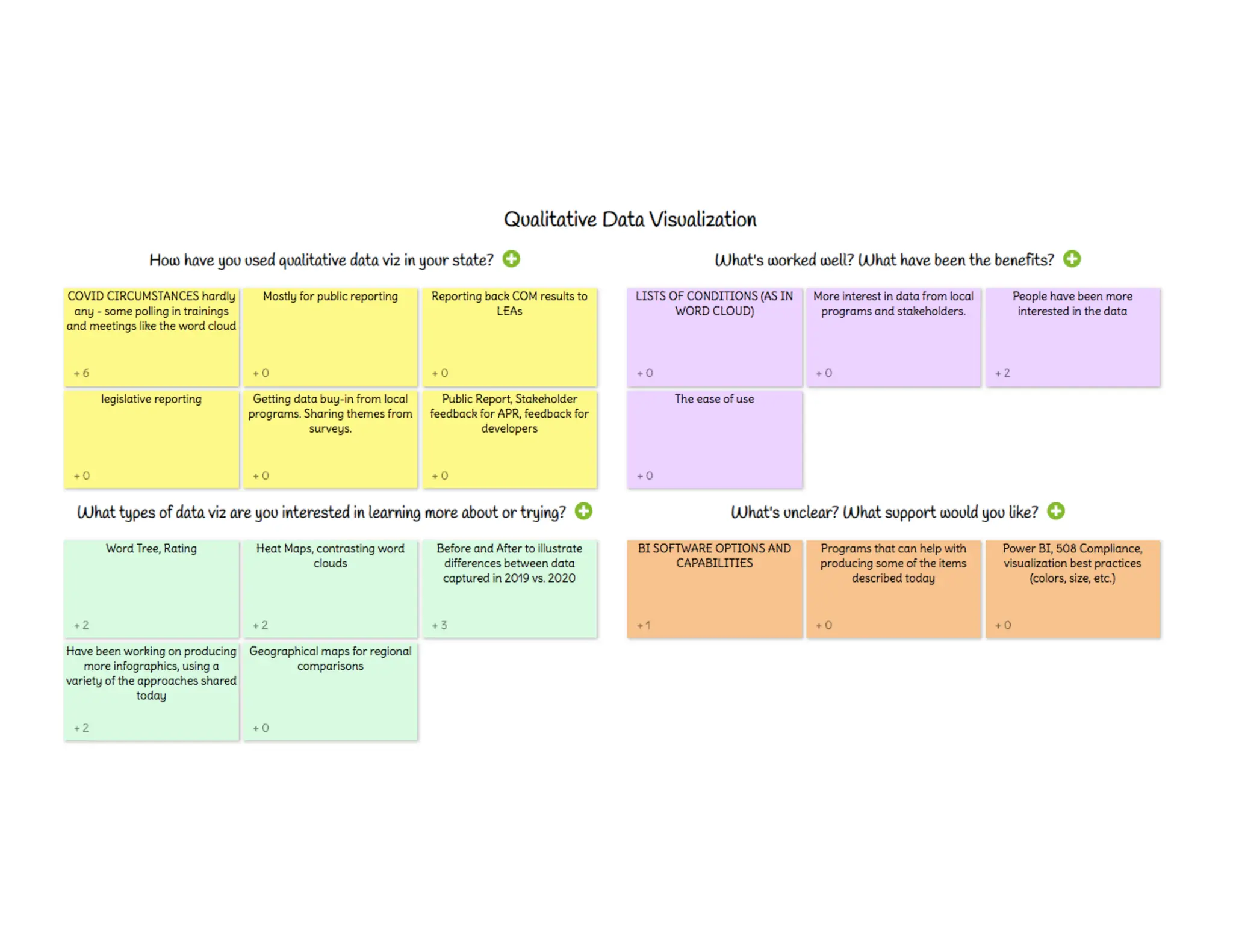
Activity
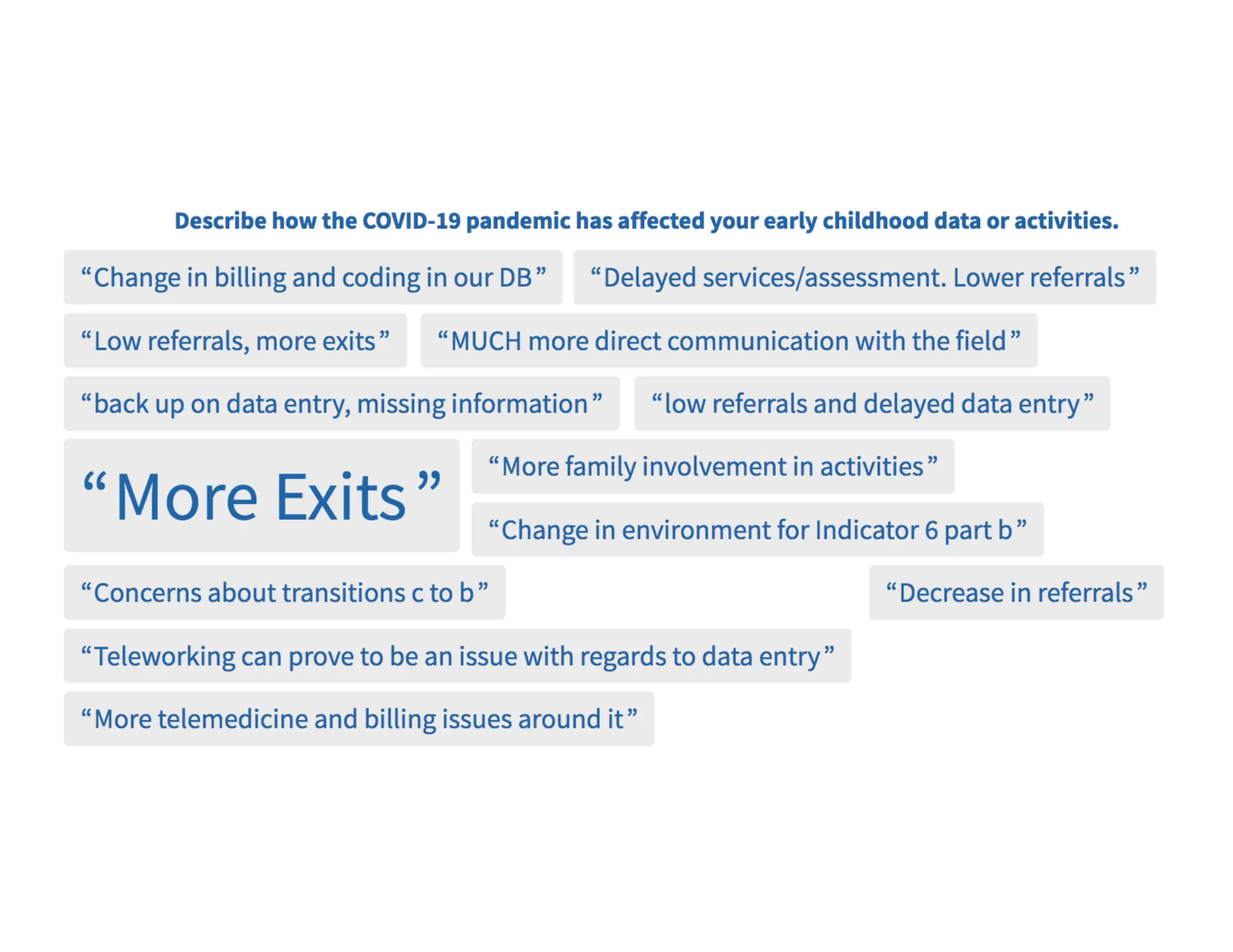
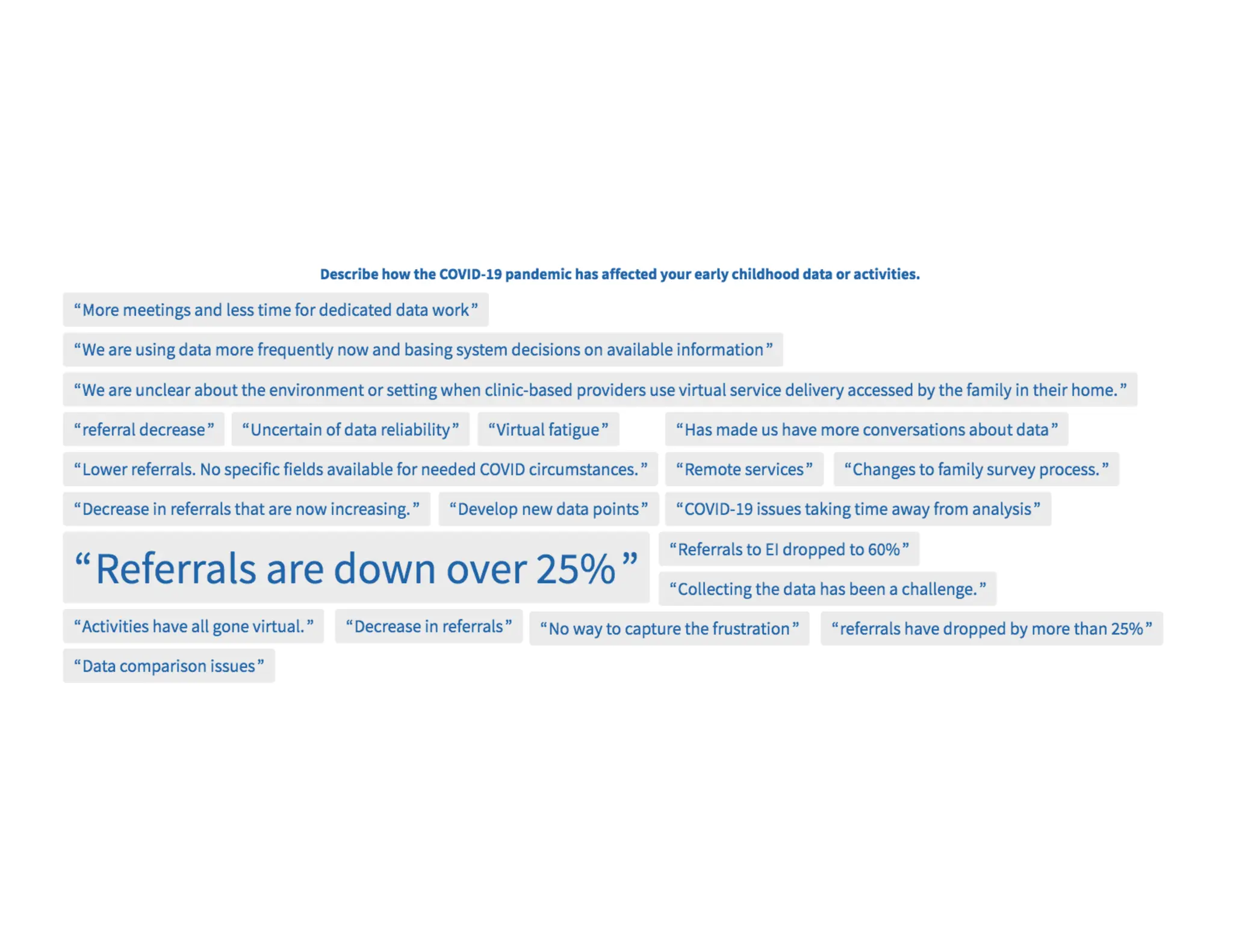
Word Cloud Responses
Activity – Sticky Wall
43
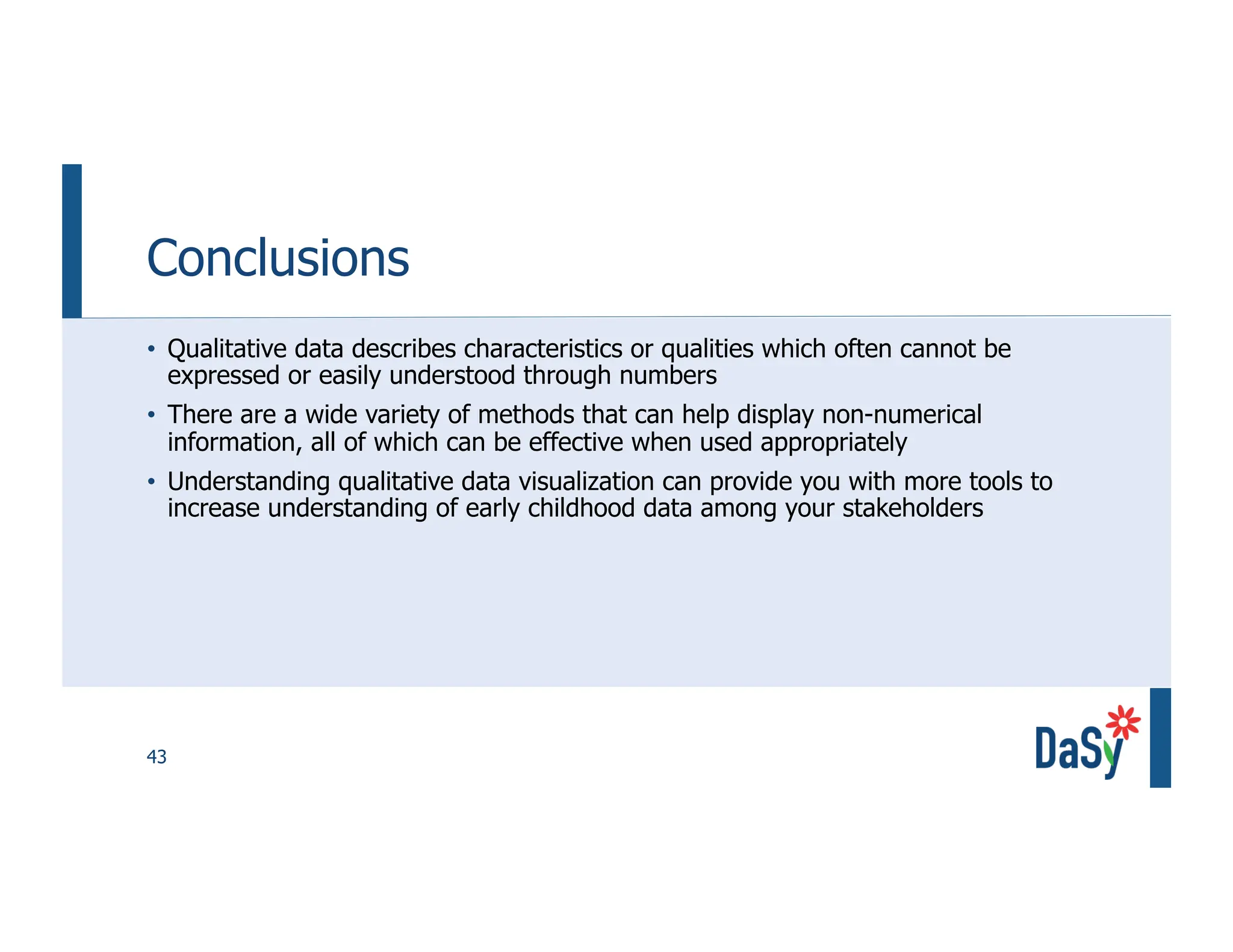
Conclusions
• Qualitative data describes characteristics or qualities which often cannot be
expressed or easily understood through numbers
• There are a wide variety of methods that can help display non-numerical
information, all of which can be effective when used appropriately
• Understanding qualitative data visualization can provide you with more tools to
increase understanding of early childhood data among your stakeholders
44
Making data mean more through storytelling |
Ben Wellington | TEDxBroadway
Video: https://www.youtube.com/watch?v=6xsvGYIxJok
45
508 Compliance & Accessibility Resources
• https://osepideasthatwork.org/resources-grantees/508-resources
• https://www.section508.gov/create/video-social
• https://accessibility.digital.gov/visual-design/getting-started/
• https://www.aucd.org/docs/lend/
distance_tech2017/3_accessibility_resources2017.pdf
• http://www.storytellingwithdata.com/blog/2018/6/26/accessible-data-viz-is-
better-data-viz
• https://www.thinkingondata.com/something-about-viridis-library/
46
References
• Henderson, S. & Segal, E. (2013). Visualizing qualitative data in evaluation
research. In T. Azzam & S. Evergreen (Eds.), Data visualization, part 1. New
Directions for Evaluation, 139, 53-71.
• Verdinelli, S., & Scagnoli, N. I. (2013). Data Display in Qualitative Research.
International Journal of Qualitative Methods, 12(1), 359–381.
47
Contact
Information
Fred Edora:
fred.edora@aemcorp.com
Jenna Nguyen:
jenna.nguyen@sri.com
Tara Rhodes:
Rhodes_T@cde.state.co.us
Evaluation
Reminder
Thank you
Visit us at http://dasycenter.org/
Follow us on Twitter: @DaSyCenter
The contents of this presentation were developed under a grant from the U.S. Department of Education,
#H373Z190002. The contents and resources do not necessarily represent the policy of the U.S. Department of
Education, and you should not assume endorsement by the Federal Government. Project Officers: Meredith Miceli
and Amy Bae.

IDIO2020_B3_DataViz_EdoraFNguyenJ_acc.pdf

  • 1.
  • 2.
    Unlocking the Power of QualitativeData with Data Visualization Fred Edora, DaSy Jenna Nguyen, DaSy Tara Rhodes, Colorado IDIO Virtual Convening October 19-22, 2020
  • 3.
    3 Agenda Welcome & Objectives– 15 min Presentation – 25 min Colorado – 20 min Activity – 25 min Conclusion – 5 min
  • 4.
    4 Objectives Define qualitative data andqualitative data visualization 1 Describe purpose and benefits of using qualitative data viz 2 Identify frameworks for qualitative data viz and examples 3 Explore methods for sharing qualitative data meaningfully 4
  • 5.
    5 Getting to Know You Poll:What is your role?
  • 8.
    Nothing in lifeis to be feared, it is only to be understood. – Marie Curie
  • 9.
    9 What Is Qualitative Data? QualitativeData Quantitative Data Descriptive or categorical data Numerical data Describes characteristics or qualities which often cannot be expressed or easily understood through numbers (e.g., opinions, views, attitudes) Describes quantities or characteristics that can expressed numerically (e.g., numbers, counts, percentages, demographics, census data) Examples of qualitative data collection: • Questionnaires (i.e., open- ended survey questions) • Interviews • Focus groups • Observations Examples of quantitative data collection: • Questionnaires (i.e., closed- ended survey questions) • Longitudinal studies • Randomized control trials Examples of qualitative data visualization: • Word clouds • Timelines • Matrices Examples of quantitative data visualization: • Bar graphs • Pie charts • Scatter plots Used to generate hypotheses Used to test hypotheses Image source: David McCandless "365 Days of Beautiful News" https://informationisbeautiful.net/beautifulnews/
  • 10.
    10 What Is DataVisualization? “Data display in a graphic format is a way of portraying information succinctly and efficiently, illustrating details provided in longer textual information.” Source: Verdinelli, S., & Scagnoli, N. I. (2013)
  • 12.
    12 When Should WeUse Qualitative Data Viz? Qualitative data visualization can be useful when: • Much of the information you will be collecting is not numerical • You want to explore the data in a creative way to your audience or stakeholders • You want to show connections in the data and/or generate hypotheses Source: Henderson, S. & Segal, E. (2013); Verdinelli, S., & Scagnoli, N. I. (2013) Image source: https://unsplash.com/photos/iMdsjoiftZo
  • 13.
    13 What Can YouDo with Qualitative Visual Displays? Can be used to: • Reduce and focus text • Highlight themes and patterns in the data • Identify outliers • Convey a message, discovery, or particular perspective • Introduce new levels of understanding • Purpose of “illuminating rather than obscuring the message” Source: Henderson, S. & Segal, E. (2013); Verdinelli, S., & Scagnoli, N. I. (2013)
  • 14.
    14 How Does QualitativeData Visualization Benefit Our Audiences? Audiences can: • Acquire new insights • Develop elaborate understanding • Appreciate new knowledge • Build theories • Draw conclusions • Take action Source: Henderson, S. & Segal, E. (2013); Verdinelli, S., & Scagnoli, N. I. (2013)
  • 15.
    David McCandless Making Datainto Art Video: https://informationisbeautiful.net/visualizations/making-data-out-of-art-a-short-film/
  • 16.
    Humans of NewYork Image source: https://www.humansofnewyork.com/
  • 17.
    Qualitative Chart Chooser Stephanie Evergreen Source:http://stephanieevergreen.com/wp-content/uploads/2016/11/Qualitative-Chooser-1.0.pdf
  • 18.
    Qualitative Chart Chooser2.0 Source: http:// stephanieevergree n.com/wp-content/ uploads/2016/11/ Qualitative- Chooser-2.0.pdf
  • 19.
    Qualitative Chart Chooser 2.0(continued) Source: http:// stephanieevergree n.com/wp-content/ uploads/2016/11/ Qualitative- Chooser-2.0.pdf
  • 20.
  • 21.
    21 Qualitative Visualizations by Display and Complexity VisualizingQualitative Data in Evaluation Research (2013) by Stuart Henderson & Eden H. Segal
  • 22.
    22 Types of Qualitative Visual Displays andPurposes Data Display in Qualitative Research (2013) by Susanna Verdinelli & Norma I. Scagnoli Visual Display Purpose Boxed Display To highlight a specific narrative considered important and frame it in a box Decision Tree Modeling To describe options, decisions, and actions Flow Chart To illustrate directional flow and show pathways of different groups Ladder To represent the dimensions of the progression of certain phenomenon through time or to show levels or stages Matrix To cross two or more dimensions, variables, or concepts of relevance to the topic of interest Metaphorical Visual Display To depict in a metaphorical way the topics or themes found Modified Venn Diagram To indicate shared or overlapping aspects of a concept, a category, or a process Network To depict relationships between themes and subthemes or categories and subcategories Taxonomy To classify or organize information
  • 23.
    23 Boxed Display • Textframed within a box • Highlights a specific narrative considered important • Simplest form of display Sources: https://www.cde.state.co.us/coloradoliteracy/19readreportpdf and https://www.cde.state.co.us/cpp/cpplegreport
  • 24.
    24 Decision Tree Modeling • Describesoptions, decisions, and actions Source: https://www.health.state.mn.us/diseases/coronavirus/schools/exguide.pdf
  • 25.
    25 Flow Chart • Illustratesdirectional flow • Arranged in terms of their relationships in a process or through time rather than as static entities Sources: https://nirn.fpg.unc.edu/module-5/introduction and https://www.health.ny.gov/publications/0532.pdf
  • 26.
    26 Ladder or Step-by- StepProcess • Represents the progression of certain phenomenon through time to show levels or stages • Additionally, indicates the level of change at each step • Ladders are unidirectional MEETS REQUIREMENTS Each year, the United States Department of Education, Office of Special Education Programs makes a determination about how well each state is doing with meeting the complex requirements of the Individuals with Disabilities Special Education Act, Part C. Meets Requirements is the highest of the four determinations followed by Needs Assistance, Needs Intervention, and the lowest category of Needs Significant Intervention. 2020 2019 2018 2017 2016 2015 Meets Requirements Meets Requirements Needs Assistance Needs Assistance Needs Assistance. Needs Assistance 2014 Needs Intervention 2013 Needs Assistance 2012 Needs Intervention 2011 Needs Intervention 2010 Needs Assistance 2009 Needs Assistance with Special Conditions Scaling Up Evidence Based Practices including: Coaching Natural Learning Opportunities Resource Based Capacity Building 2008 Needs Assistance 2007 Needs Intervention 2006 Meets Requirements 2 years in a row! IMPROVED COMPLIANCE TIMELY SERVICES & 45-DAY TIMELINE & EARLY CHILDHOOD TRANSITION STRONGER Collaboration Among DDD & ASDB & AzEIP Contractors Data System Enhancements Source: Arizona Early Intervention Program (AzEIP)
  • 27.
  • 28.
    28 Matrix • Cross-classification of twoor more dimensions, variables, or concepts of relevance to the topic of interest Source: Henderson & Segal (2013)
  • 29.
    29 Metaphorical Visual Display • Depictstopics or themes in a metaphorical way
  • 30.
    30 Modified Venn Diagram • Indicatesshared or overlapping aspects of a concept, category, or process • Often used to depict a model or conceptual framework
  • 31.
    31 Comparative Word Cloud • Visualdisplay of word counts Image source: https://informationisbeautiful.net/visualizations/covid-19-coronavirus-infographic-datapack/
  • 32.
    32 Spectrum Display • Adata display which allows you to display individual data in a way that tells a story
  • 33.
    33 Resources/Tools • DaSy DataVisualization Toolkit https://dasycenter.org/data- visualization-toolkit-2/qualitative-data/ • David McCandless – Information is Beautiful website https://informationisbeautiful.net/ • VizSweet tool https://vizsweet.com/ • Stephanie Evergreen – Evergreen Data Academy https:// academy.stephanieevergreen.com/ • Google Charts https://developers.google.com/chart/ interactive/docs/gallery • Tableau Public https://public.tableau.com/en-us/s/ Sources: https://dasycenter.org/data-visualization-toolkit-2/ and https://developers.google.com/chart/interactive/docs/gallery
  • 34.
  • 35.
    35 Colorado Process • Information ‒Wanted a way to communicate preschool outcomes to those directly working in programs • Story ‒ Created a visual that included various Excel visualizations • Goal ‒ Realized some inefficiencies in communication, out-of-date visuals, tedious process • Visual Form ‒ End result: Colorado’s Indicator 7 Data Quality Profiles in Tableau
  • 36.
    36 Overview Source: Colorado DataQuality Profile – OSEP Preschool Outcomes (Indicator 7)
  • 37.
    37 Progress Categories Source: Colorado DataQuality Profile – OSEP Preschool Outcomes (Indicator 7)
  • 38.
    38 Summary Statements Source: Colorado DataQuality Profile – OSEP Preschool Outcomes (Indicator 7)
  • 39.
    39 Data Quality Information Source: ColoradoData Quality Profile – OSEP Preschool Outcomes (Indicator 7)
  • 40.
  • 41.
  • 42.
  • 43.
    43 Conclusions • Qualitative datadescribes characteristics or qualities which often cannot be expressed or easily understood through numbers • There are a wide variety of methods that can help display non-numerical information, all of which can be effective when used appropriately • Understanding qualitative data visualization can provide you with more tools to increase understanding of early childhood data among your stakeholders
  • 44.
    44 Making data meanmore through storytelling | Ben Wellington | TEDxBroadway Video: https://www.youtube.com/watch?v=6xsvGYIxJok
  • 45.
    45 508 Compliance &Accessibility Resources • https://osepideasthatwork.org/resources-grantees/508-resources • https://www.section508.gov/create/video-social • https://accessibility.digital.gov/visual-design/getting-started/ • https://www.aucd.org/docs/lend/ distance_tech2017/3_accessibility_resources2017.pdf • http://www.storytellingwithdata.com/blog/2018/6/26/accessible-data-viz-is- better-data-viz • https://www.thinkingondata.com/something-about-viridis-library/
  • 46.
    46 References • Henderson, S.& Segal, E. (2013). Visualizing qualitative data in evaluation research. In T. Azzam & S. Evergreen (Eds.), Data visualization, part 1. New Directions for Evaluation, 139, 53-71. • Verdinelli, S., & Scagnoli, N. I. (2013). Data Display in Qualitative Research. International Journal of Qualitative Methods, 12(1), 359–381.
  • 47.
  • 48.
  • 49.
    Thank you Visit usat http://dasycenter.org/ Follow us on Twitter: @DaSyCenter The contents of this presentation were developed under a grant from the U.S. Department of Education, #H373Z190002. The contents and resources do not necessarily represent the policy of the U.S. Department of Education, and you should not assume endorsement by the Federal Government. Project Officers: Meredith Miceli and Amy Bae.