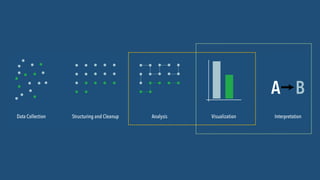
Rhetorics of data, narrative, and visualization
Steven Braun
Data Analytics and Visualization Specialist
Northeastern University Libraries
Digital Scholarship Group
November 16, 2018
NISO / Assessment Practices and Metrics for 21st Century Needs
Formulation, Interpretation, and Presentation of Data: Part II
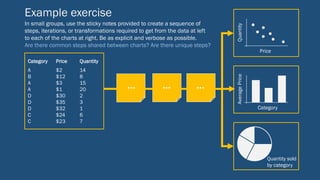
Example exercise
Quantity
Price
AveragePrice
Category
Quantity sold
by category
Category Price Quantity
A
B
A
A
D
D
D
C
C
$2
$12
$3
$1
$30
$35
$32
$24
$23
14
8
15
20
2
3
1
6
7
... ... ...
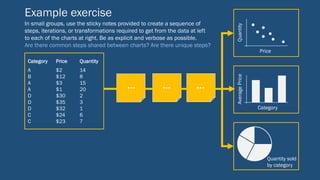
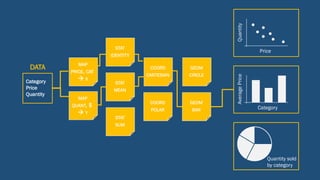
In small groups, use the sticky notes provided to create a sequence of
steps, iterations, or transformations required to get from the data at left
to each of the charts at right. Be as explicit and verbose as possible.
Are there common steps shared between charts? Are there unique steps?
Quantity
Price
AveragePrice
Category
Quantity sold
by category
Category
Price
Quantity
MAP
PRICE, CAT
à X
MAP
QUANT, $
à Y
STAT
IDENTITY
STAT
MEAN
STAT
SUM
GEOM
CIRCLE
GEOM
BAR
COORD
CARTESIAN
COORD
POLAR
DATA
Quantity
Price
AveragePrice
Category
Quantity sold
by category
Category
Price
Quantity
MAP
PRICE, CAT
à X
MAP
QUANT, $
à Y
STAT
IDENTITY
STAT
MEAN
STAT
SUM
GEOM
CIRCLE
GEOM
BAR
COORD
CARTESIAN
COORD
POLAR
DATA
Quantity
Price
AveragePrice
Category
Quantity sold
by category
Category
Price
Quantity
MAP
PRICE, CAT
à X
MAP
QUANT, $
à Y
STAT
IDENTITY
STAT
MEAN
STAT
SUM
GEOM
CIRCLE
GEOM
BAR
COORD
CARTESIAN
COORD
POLAR
DATA
Quantity
Price
AveragePrice
Category
Quantity sold
by category
Category
Price
Quantity
MAP
PRICE, CAT
à X
MAP
QUANT, $
à Y
STAT
IDENTITY
STAT
MEAN
STAT
SUM
GEOM
CIRCLE
GEOM
BAR
COORD
CARTESIAN
COORD
POLAR
DATA
Quantity
Price
AveragePrice
Category
Quantity sold
by category
Category
Price
Quantity
MAP
PRICE, CAT
à X
MAP
QUANT, $
à Y
STAT
IDENTITY
STAT
MEAN
STAT
SUM
GEOM
CIRCLE
GEOM
BAR
COORD
CARTESIAN
COORD
POLAR
DATA
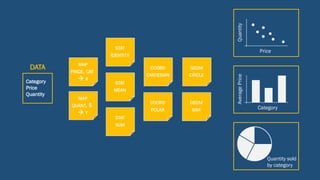
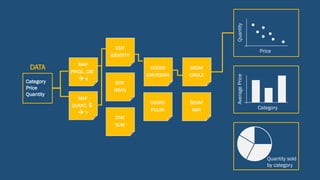
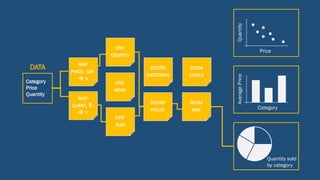
The way participants reasoned through these procedures was
dependent upon the tool (software) they were using
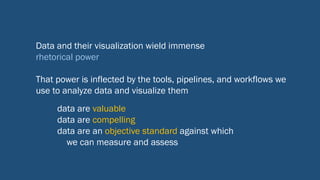
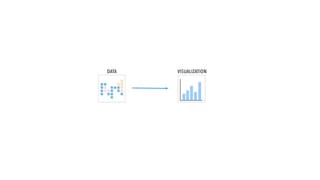
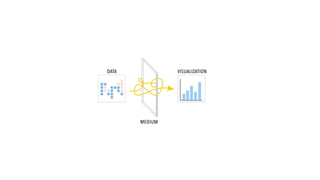
Data and their visualization wield immense
rhetorical power
That power is inflected by the tools, pipelines, and workflows we
use to analyze data and visualize them
data are valuable
data are compelling
data are an objective standard against which
we can measure and assess
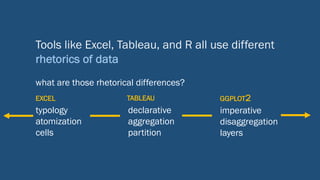
Tools like Excel, Tableau, and R all use different
rhetorics of data
what are those rhetorical differences?
declarative
aggregation
partition
imperative
disaggregation
layers
TABLEAU GGPLOT2
typology
atomization
cells
EXCEL
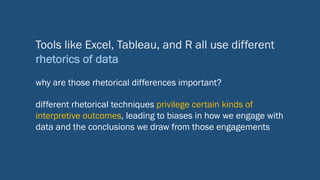
Tools like Excel, Tableau, and R all use different
rhetorics of data
why are those rhetorical differences important?
different rhetorical techniques privilege certain kinds of
interpretive outcomes, leading to biases in how we engage with
data and the conclusions we draw from those engagements
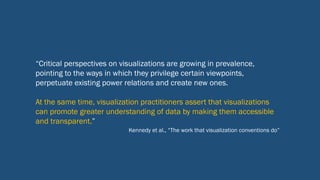
“Critical perspectives on visualizations are growing in prevalence,
pointing to the ways in which they privilege certain viewpoints,
perpetuate existing power relations and create new ones.
At the same time, visualization practitioners assert that visualizations
can promote greater understanding of data by making them accessible
and transparent.”
Kennedy et al., “The work that visualization conventions do”
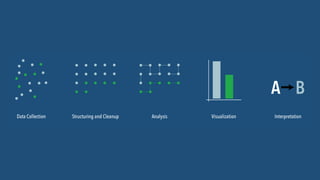
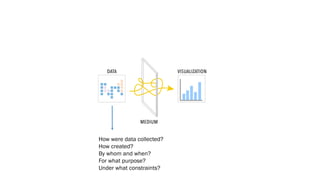
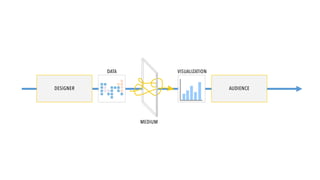
How were data collected?
How created?
By whom and when?
For what purpose?
Under what constraints?
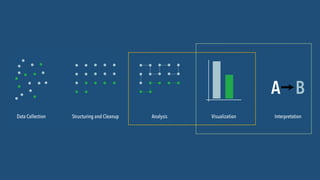
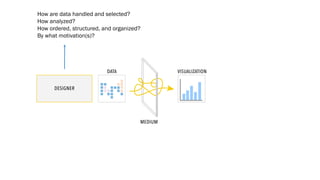
How are data handled and selected?
How analyzed?
How ordered, structured, and organized?
By what motivation(s)?
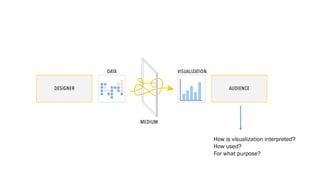
How is visualization interpreted?
How used?
For what purpose?
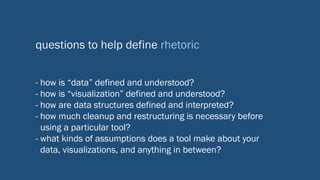
questions to help define rhetoric
- how is “data” defined and understood?
- how is “visualization” defined and understood?
- how are data structures defined and interpreted?
- how much cleanup and restructuring is necessary before
using a particular tool?
- what kinds of assumptions does a tool make about your
data, visualizations, and anything in between?
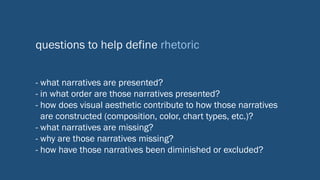
questions to help define rhetoric
- what narratives are presented?
- in what order are those narratives presented?
- how does visual aesthetic contribute to how those narratives
are constructed (composition, color, chart types, etc.)?
- what narratives are missing?
- why are those narratives missing?
- how have those narratives been diminished or excluded?
Exercises for interrogating rhetorics
and narratives
pipelines and workflows
Example exercise
Quantity
Price
AveragePrice
Category
Quantity sold
by category
Category Price Quantity
A
B
A
A
D
D
D
C
C
$2
$12
$3
$1
$30
$35
$32
$24
$23
14
8
15
20
2
3
1
6
7
... ... ...
In small groups, use the sticky notes provided to create a sequence of
steps, iterations, or transformations required to get from the data at left
to each of the charts at right. Be as explicit and verbose as possible.
Are there common steps shared between charts? Are there unique steps?
Exercises for interrogating rhetorics
and narratives
pipelines and workflows
visualizing two numbers
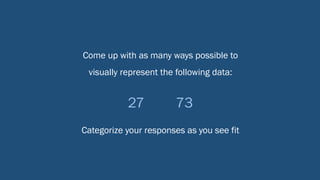
Come up with as many ways possible to
visually represent the following data:
27 73
Categorize your responses as you see fit
HOW TO VISUALIZE
TWO NUMBERS
Given the data set of 27, 73 or 13, 87 , how many different ways can you think of to
visualize those data using only markers and sticky notes?
The following are responses to this prompt given in data visualization workshops over the past year — ranging
from familiar bar and pie charts to some creative deviations — categorized by the channels and modes through
which they communicate these quantities.
P_00274
P_00088
P_00243
P_00095
P_00189
P_00312
P_00017
P_00030
P_00008
P_00007
P_00063
P_00216
P_00210
P_00236
P_00321
P_00161
P_00125
P_00100
P_00093
SIZE
PROPORTION
POSITION
QUANTITY
COLOR
ANGLE
SYMBOL
TEXTURE
FREQUENCY
VALUE
NUMERACY
TEXT
AGE
WEIGHT
SEMANTICS
SIZE
PROPORTION
POSITION
QUANTITY
COLOR
ANGLE
SYMBOL
TEXTURE
FREQUENCY
VALUE
NUMERACY
TEXT
AGE
WEIGHT
SEMANTICS
SIZE
PROPORTION
POSITION
QUANTITY
COLOR
ANGLE
SYMBOL
TEXTURE
FREQUENCY
VALUE
NUMERACY
TEXT
AGE
WEIGHT
SEMANTICS
SIZE
PROPORTION
POSITION
QUANTITY
COLOR
ANGLE
SYMBOL
TEXTURE
FREQUENCY
VALUE
NUMERACY
TEXT
AGE
WEIGHT
SEMANTICS
SIZE
PROPORTION
POSITION
QUANTITY
COLOR
ANGLE
SYMBOL
TEXTURE
FREQUENCY
VALUE
NUMERACY
TEXT
AGE
WEIGHT
SEMANTICS
SIZE
PROPORTION
POSITION
QUANTITY
COLOR
ANGLE
SYMBOL
TEXTURE
FREQUENCY
VALUE
NUMERACY
TEXT
AGE
WEIGHT
SEMANTICS
SIZE
PROPORTION
POSITION
QUANTITY
COLOR
ANGLE
SYMBOL
TEXTURE
FREQUENCY
VALUE
NUMERACY
TEXT
AGE
WEIGHT
SEMANTICS
SIZE
PROPORTION
POSITION
QUANTITY
COLOR
ANGLE
SYMBOL
TEXTURE
FREQUENCY
VALUE
NUMERACY
TEXT
AGE
WEIGHT
SEMANTICS
This visualization was created by Steven Braun using D3.js and Adobe Illustrator. Steven is
the Data Analytics and Visualization Specialist in Snell Library. For more information about
data visualization services offered in Snell, see subjectguides.lib.neu.edu/gis-datavis or
contact Steven at s.braun@northeastern.edu.
ABSTRACT
CHART TYPES
AREA CHART
BAR CHART
BELL CURVE OR BOX PLOT
HISTOGRAM
LINE CHART
NUMBER LINE
PICTORIAL
PIE CHART
SCATTER PLOT
STACKED COLUMNS
TALLY MARKS
TEXT
VENN DIAGRAM
HOW TO READ THIS VISUALIZATION
Each row represents a single visualization (created on a single sticky note) of the data set
[13, 87] or [27, 73]. Columns represent different modes or channels of communicating the
values of these data, e.g., size, proportion, or color. For each visualization, the channels or
modes used by it are marked with a colored square; gray squares indicate that a particular
channel is not used by the respective visualization. Each row is colored according to
visualization or chart type, as indicated to the left.
LEARN MORE
Most of these “abstract”
visualizations did not fall into
any other traditional categories
of charts and graphs but relied
heavily on the use of
proportion and color to
communicate the data set
All of these bar charts relied on
size (length) as the primary
channel of representation,but
some went a step further and
used additional channels like
color and texture to
communicate differences within
the data set
Line charts are effective because
they rely on position as the
primary channel of
communicating value,which
enables highly accurate reading
in one and two dimensions
Pie charts are among the most
popular charts people typically
think of when it comes to
visualization,especially for data
sets where the values add up to
a unified whole (e.g.,100)
Tally marks are among the
simplest ways to visually
communicate a data set,
directly encoding quantity in a
way that is countable in
one-to-one correspondence
Although far less abstract than
other forms of visualization,
simply writing out numbers is
another way of visually
communicating data; here,text
is combined with other
channels such as size to
illustrate numeric differences
Exercises for interrogating rhetorics
and narratives
pipelines and workflows
visualizing two numbers
visualization critiques
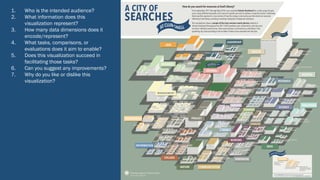
1. Who is the intended audience?
2. What information does this
visualization represent?
3. How many data dimensions does it
encode/represent?
4. What tasks, comparisons, or
evaluations does it aim to enable?
5. Does this visualization succeed in
facilitating those tasks?
6. Can you suggest any improvements?
7. Why do you like or dislike this
visualization?
Exercises for interrogating rhetorics
and narratives
pipelines and workflows
visualizing two numbers
visualization critiques
evaluate + redesign
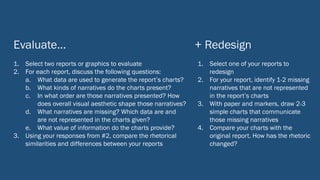
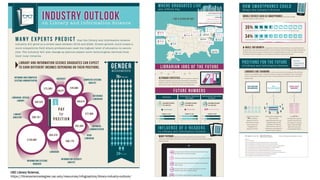
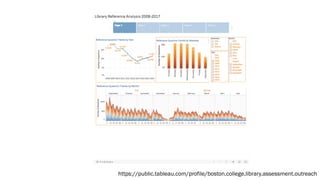
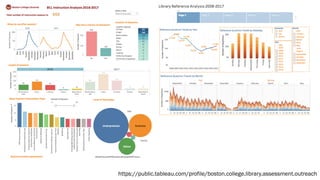
Evaluate...
1. Select two reports or graphics to evaluate
2. For each report, discuss the following questions:
a. What data are used to generate the report’s charts?
b. What kinds of narratives do the charts present?
c. In what order are those narratives presented? How
does overall visual aesthetic shape those narratives?
d. What narratives are missing? Which data are and
are not represented in the charts given?
e. What value of information do the charts provide?
3. Using your responses from #2, compare the rhetorical
similarities and differences between your reports
1. Select one of your reports to
redesign
2. For your report, identify 1-2 missing
narratives that are not represented
in the report’s charts
3. With paper and markers, draw 2-3
simple charts that communicate
those missing narratives
4. Compare your charts with the
original report. How has the rhetoric
changed?
+ Redesign
USC Library Science,
https://librarysciencedegree.usc.edu/resources/infographics/library-industry-outlook/
https://public.tableau.com/profile/boston.college.library.assessment.outreach
Exercises for interrogating rhetorics
and narratives
pipelines and workflows
visualizing two numbers
visualization critiques
evaluate + redesign
unconventional media
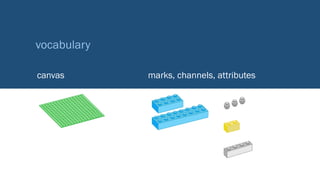
vocabulary
marks, channels, attributescanvas
in pairs
explore the blocks in the sets provided
in a LEGO-based visualization system, what are the marks?
what channels are available?
what constraints do these blocks place on what
you can and cannot express?
in pairs
explore the data set provided
what narratives are depicted in the
data set?
what emotional and practical value
do these data possess?
what kinds of visual narratives
might you compose with the data?
where did these data come from?
how were they created?
in what systems and cultures of
practice were these data created?
how are the data organized?
in pairs
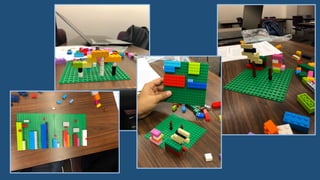
using the sets provided, create a visual representation of the data
in whatever way you see fit
what design constraints do you run into?
how do you decide which data to use and which to exclude?
are those choices a consequence of the data or the medium?
Data Therapy
https://datatherapy.org
“There is much talk right now about how we live in a time of data and visualization. There are
lots of pretty pictures generated everyday by amazing coders, statistics gurus, and so on. Then
there are normal people. Normal people aren’t statisticians, software developers, or graphic
design experts. Normal people don’t have a big budget to pay lots of data consultants. Normal
people in regular jobs have data that they know can help them, and they want to use
it. Normal people need Data Therapy.”
Semiology of Graphics Envisioning Information
The Visual Display of
Quantitative Information Beautiful Evidence
Jacques Bertin Edward Tufte Edward Tufte Edward Tufte
CONTACT
Steven Braun
s.braun@northeastern.edu
(617) 373-5885
http://www.stevengbraun.com
http://subjectguides.lib.neu.edu/gis-datavis

Rhetorics of Data, Narrative, and Visualization

  • 1.
    Rhetorics of data,narrative, and visualization Steven Braun Data Analytics and Visualization Specialist Northeastern University Libraries Digital Scholarship Group November 16, 2018 NISO / Assessment Practices and Metrics for 21st Century Needs Formulation, Interpretation, and Presentation of Data: Part II
  • 2.
    Example exercise Quantity Price AveragePrice Category Quantity sold bycategory Category Price Quantity A B A A D D D C C $2 $12 $3 $1 $30 $35 $32 $24 $23 14 8 15 20 2 3 1 6 7 ... ... ... In small groups, use the sticky notes provided to create a sequence of steps, iterations, or transformations required to get from the data at left to each of the charts at right. Be as explicit and verbose as possible. Are there common steps shared between charts? Are there unique steps?
  • 3.
    Quantity Price AveragePrice Category Quantity sold by category Category Price Quantity MAP PRICE,CAT à X MAP QUANT, $ à Y STAT IDENTITY STAT MEAN STAT SUM GEOM CIRCLE GEOM BAR COORD CARTESIAN COORD POLAR DATA
  • 4.
    Quantity Price AveragePrice Category Quantity sold by category Category Price Quantity MAP PRICE,CAT à X MAP QUANT, $ à Y STAT IDENTITY STAT MEAN STAT SUM GEOM CIRCLE GEOM BAR COORD CARTESIAN COORD POLAR DATA
  • 5.
    Quantity Price AveragePrice Category Quantity sold by category Category Price Quantity MAP PRICE,CAT à X MAP QUANT, $ à Y STAT IDENTITY STAT MEAN STAT SUM GEOM CIRCLE GEOM BAR COORD CARTESIAN COORD POLAR DATA
  • 6.
    Quantity Price AveragePrice Category Quantity sold by category Category Price Quantity MAP PRICE,CAT à X MAP QUANT, $ à Y STAT IDENTITY STAT MEAN STAT SUM GEOM CIRCLE GEOM BAR COORD CARTESIAN COORD POLAR DATA
  • 7.
    Quantity Price AveragePrice Category Quantity sold by category Category Price Quantity MAP PRICE,CAT à X MAP QUANT, $ à Y STAT IDENTITY STAT MEAN STAT SUM GEOM CIRCLE GEOM BAR COORD CARTESIAN COORD POLAR DATA The way participants reasoned through these procedures was dependent upon the tool (software) they were using
  • 8.
    Data and theirvisualization wield immense rhetorical power That power is inflected by the tools, pipelines, and workflows we use to analyze data and visualize them data are valuable data are compelling data are an objective standard against which we can measure and assess
  • 9.
    Tools like Excel,Tableau, and R all use different rhetorics of data what are those rhetorical differences? declarative aggregation partition imperative disaggregation layers TABLEAU GGPLOT2 typology atomization cells EXCEL
  • 10.
    Tools like Excel,Tableau, and R all use different rhetorics of data why are those rhetorical differences important? different rhetorical techniques privilege certain kinds of interpretive outcomes, leading to biases in how we engage with data and the conclusions we draw from those engagements
  • 11.
    “Critical perspectives onvisualizations are growing in prevalence, pointing to the ways in which they privilege certain viewpoints, perpetuate existing power relations and create new ones. At the same time, visualization practitioners assert that visualizations can promote greater understanding of data by making them accessible and transparent.” Kennedy et al., “The work that visualization conventions do”
  • 16.
    How were datacollected? How created? By whom and when? For what purpose? Under what constraints?
  • 17.
    How are datahandled and selected? How analyzed? How ordered, structured, and organized? By what motivation(s)?
  • 18.
    How is visualizationinterpreted? How used? For what purpose?
  • 20.
    questions to helpdefine rhetoric - how is “data” defined and understood? - how is “visualization” defined and understood? - how are data structures defined and interpreted? - how much cleanup and restructuring is necessary before using a particular tool? - what kinds of assumptions does a tool make about your data, visualizations, and anything in between?
  • 21.
    questions to helpdefine rhetoric - what narratives are presented? - in what order are those narratives presented? - how does visual aesthetic contribute to how those narratives are constructed (composition, color, chart types, etc.)? - what narratives are missing? - why are those narratives missing? - how have those narratives been diminished or excluded?
  • 22.
    Exercises for interrogatingrhetorics and narratives pipelines and workflows
  • 23.
    Example exercise Quantity Price AveragePrice Category Quantity sold bycategory Category Price Quantity A B A A D D D C C $2 $12 $3 $1 $30 $35 $32 $24 $23 14 8 15 20 2 3 1 6 7 ... ... ... In small groups, use the sticky notes provided to create a sequence of steps, iterations, or transformations required to get from the data at left to each of the charts at right. Be as explicit and verbose as possible. Are there common steps shared between charts? Are there unique steps?
  • 24.
    Exercises for interrogatingrhetorics and narratives pipelines and workflows visualizing two numbers
  • 25.
    Come up withas many ways possible to visually represent the following data: 27 73 Categorize your responses as you see fit
  • 26.
    HOW TO VISUALIZE TWONUMBERS Given the data set of 27, 73 or 13, 87 , how many different ways can you think of to visualize those data using only markers and sticky notes? The following are responses to this prompt given in data visualization workshops over the past year — ranging from familiar bar and pie charts to some creative deviations — categorized by the channels and modes through which they communicate these quantities. P_00274 P_00088 P_00243 P_00095 P_00189 P_00312 P_00017 P_00030 P_00008 P_00007 P_00063 P_00216 P_00210 P_00236 P_00321 P_00161 P_00125 P_00100 P_00093 SIZE PROPORTION POSITION QUANTITY COLOR ANGLE SYMBOL TEXTURE FREQUENCY VALUE NUMERACY TEXT AGE WEIGHT SEMANTICS SIZE PROPORTION POSITION QUANTITY COLOR ANGLE SYMBOL TEXTURE FREQUENCY VALUE NUMERACY TEXT AGE WEIGHT SEMANTICS SIZE PROPORTION POSITION QUANTITY COLOR ANGLE SYMBOL TEXTURE FREQUENCY VALUE NUMERACY TEXT AGE WEIGHT SEMANTICS SIZE PROPORTION POSITION QUANTITY COLOR ANGLE SYMBOL TEXTURE FREQUENCY VALUE NUMERACY TEXT AGE WEIGHT SEMANTICS SIZE PROPORTION POSITION QUANTITY COLOR ANGLE SYMBOL TEXTURE FREQUENCY VALUE NUMERACY TEXT AGE WEIGHT SEMANTICS SIZE PROPORTION POSITION QUANTITY COLOR ANGLE SYMBOL TEXTURE FREQUENCY VALUE NUMERACY TEXT AGE WEIGHT SEMANTICS SIZE PROPORTION POSITION QUANTITY COLOR ANGLE SYMBOL TEXTURE FREQUENCY VALUE NUMERACY TEXT AGE WEIGHT SEMANTICS SIZE PROPORTION POSITION QUANTITY COLOR ANGLE SYMBOL TEXTURE FREQUENCY VALUE NUMERACY TEXT AGE WEIGHT SEMANTICS This visualization was created by Steven Braun using D3.js and Adobe Illustrator. Steven is the Data Analytics and Visualization Specialist in Snell Library. For more information about data visualization services offered in Snell, see subjectguides.lib.neu.edu/gis-datavis or contact Steven at s.braun@northeastern.edu. ABSTRACT CHART TYPES AREA CHART BAR CHART BELL CURVE OR BOX PLOT HISTOGRAM LINE CHART NUMBER LINE PICTORIAL PIE CHART SCATTER PLOT STACKED COLUMNS TALLY MARKS TEXT VENN DIAGRAM HOW TO READ THIS VISUALIZATION Each row represents a single visualization (created on a single sticky note) of the data set [13, 87] or [27, 73]. Columns represent different modes or channels of communicating the values of these data, e.g., size, proportion, or color. For each visualization, the channels or modes used by it are marked with a colored square; gray squares indicate that a particular channel is not used by the respective visualization. Each row is colored according to visualization or chart type, as indicated to the left. LEARN MORE Most of these “abstract” visualizations did not fall into any other traditional categories of charts and graphs but relied heavily on the use of proportion and color to communicate the data set All of these bar charts relied on size (length) as the primary channel of representation,but some went a step further and used additional channels like color and texture to communicate differences within the data set Line charts are effective because they rely on position as the primary channel of communicating value,which enables highly accurate reading in one and two dimensions Pie charts are among the most popular charts people typically think of when it comes to visualization,especially for data sets where the values add up to a unified whole (e.g.,100) Tally marks are among the simplest ways to visually communicate a data set, directly encoding quantity in a way that is countable in one-to-one correspondence Although far less abstract than other forms of visualization, simply writing out numbers is another way of visually communicating data; here,text is combined with other channels such as size to illustrate numeric differences
  • 27.
    Exercises for interrogatingrhetorics and narratives pipelines and workflows visualizing two numbers visualization critiques
  • 28.
    1. Who isthe intended audience? 2. What information does this visualization represent? 3. How many data dimensions does it encode/represent? 4. What tasks, comparisons, or evaluations does it aim to enable? 5. Does this visualization succeed in facilitating those tasks? 6. Can you suggest any improvements? 7. Why do you like or dislike this visualization?
  • 29.
    Exercises for interrogatingrhetorics and narratives pipelines and workflows visualizing two numbers visualization critiques evaluate + redesign
  • 30.
    Evaluate... 1. Select tworeports or graphics to evaluate 2. For each report, discuss the following questions: a. What data are used to generate the report’s charts? b. What kinds of narratives do the charts present? c. In what order are those narratives presented? How does overall visual aesthetic shape those narratives? d. What narratives are missing? Which data are and are not represented in the charts given? e. What value of information do the charts provide? 3. Using your responses from #2, compare the rhetorical similarities and differences between your reports 1. Select one of your reports to redesign 2. For your report, identify 1-2 missing narratives that are not represented in the report’s charts 3. With paper and markers, draw 2-3 simple charts that communicate those missing narratives 4. Compare your charts with the original report. How has the rhetoric changed? + Redesign
  • 31.
  • 32.
  • 33.
  • 34.
    Exercises for interrogatingrhetorics and narratives pipelines and workflows visualizing two numbers visualization critiques evaluate + redesign unconventional media
  • 35.
  • 36.
    in pairs explore theblocks in the sets provided in a LEGO-based visualization system, what are the marks? what channels are available? what constraints do these blocks place on what you can and cannot express?
  • 37.
    in pairs explore thedata set provided what narratives are depicted in the data set? what emotional and practical value do these data possess? what kinds of visual narratives might you compose with the data? where did these data come from? how were they created? in what systems and cultures of practice were these data created? how are the data organized?
  • 38.
    in pairs using thesets provided, create a visual representation of the data in whatever way you see fit what design constraints do you run into? how do you decide which data to use and which to exclude? are those choices a consequence of the data or the medium?
  • 41.
    Data Therapy https://datatherapy.org “There ismuch talk right now about how we live in a time of data and visualization. There are lots of pretty pictures generated everyday by amazing coders, statistics gurus, and so on. Then there are normal people. Normal people aren’t statisticians, software developers, or graphic design experts. Normal people don’t have a big budget to pay lots of data consultants. Normal people in regular jobs have data that they know can help them, and they want to use it. Normal people need Data Therapy.”
  • 42.
    Semiology of GraphicsEnvisioning Information The Visual Display of Quantitative Information Beautiful Evidence Jacques Bertin Edward Tufte Edward Tufte Edward Tufte
  • 43.