MPM17 Introduction to New Media
Lecture 1:What is New Media? A technology, a practice or a framework?
Historically Late in the 20 th  century, the term multimedia changes meaning.  Pre 90’s: a convergence tool Multimedia : “The combined use of several media, such as movies, slides, music, and lighting, especially for the purpose of education or entertainment. The use of several mass media, such as television, radio, and print, especially for the purpose of advertising or publicity. Also called mixed media. The combined use of media such as text, graphics, video, and sound, as on a computer system” . Source: The American Heritage® Dictionary of the English Language, Third Edition. Copyright © 1996, 1992 by Houghton Mifflin Company.
Mid 90’s: the computer becomes central Multimedia : “Human-computer interaction involving text, graphics, voice and video. Often also includes concepts from hypertext”. source: Usenet newsgroup: news:comp.multimedia. (1994-12-02)   The term Multimedia starts inferring the idea of digital interactive environments and  becomes synonymous with CD-ROM in the personal computer world
Why such a shift in definition? Because changes in technologies nring change to media production contexts. Multimedia becomes redefined by the ideas of various industrial sectors whose notions are converging
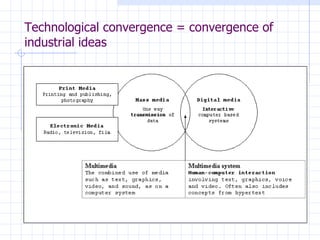
Technological convergence = convergence of industrial ideas
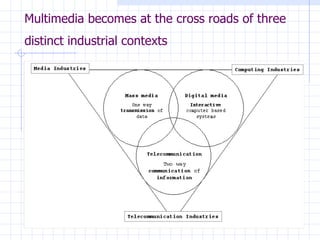
The need to use Communication systems comes to change the notion of Convergence By the end of the 90’s, the term starts referring to another idea, that of a  communication tool  multimedia :”transmission that combine media of communication (text and graphics and sound etc.) [syn: multimedia system]”.  Source: WordNet ® 1.6, © 1997 Princeton University  This shift in definition marks the influence of a third industry, telecommunications
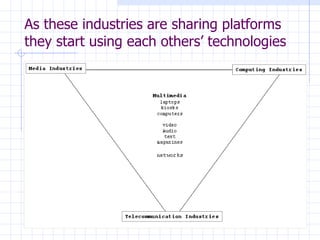
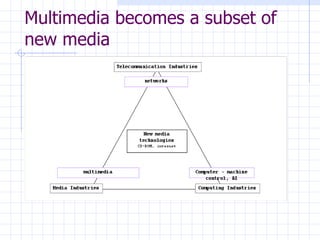
Multimedia becomes at the cross roads of three distinct industrial contexts
As these industries are sharing platforms they start using each others’ technologies
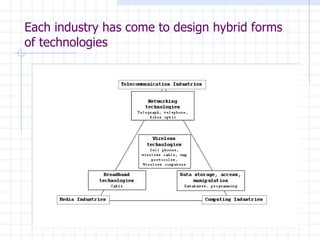
Each industry has come to design hybrid forms of technologies
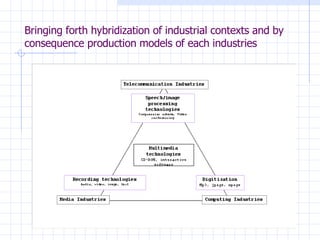
Bringing forth hybridization of industrial contexts and by consequence production models of each industries Today: hybridation demands shift the centre of innovation Multimedia is no longer at the centre of innovation New media :”The integration of computers, computer networking, and multimedia”
early 00s: hybridization has replaced convergence at the core of innovation models Multimedia is no longer a core innovation  new media  replaces multimedia:” the integration of computers, computer networking and multimedia”.
Multimedia becomes a subset of new media
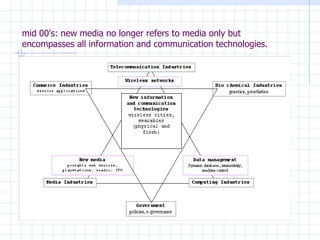
mid 00's: new media no longer refers to media only but encompasses all information and communication technologies.
What does this means new  media? definition moves away from ICT to encompass other technologies (robotics, biotech, etc)‏ mid 00s : new media art standard practice is “to take up the products of the technology industries (...) and apply them to its own diverse ends, in a cultural domain. “ (Whitelaw, 2004)‏
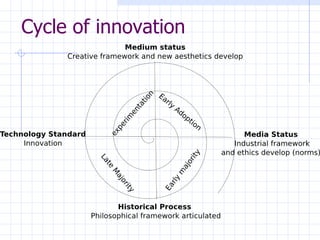
nm is not a technology platform but a framework nm is a framework that is technology independent. late 00s:  new media is an experimental framework where  artists become innovators  that use standard technologies to  develop their own aesthetics , where context becomes part of content
Cycle of innovation
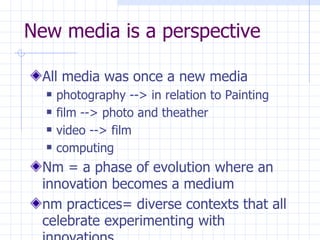
New media is a perspective All media was once a new media photography --> in relation to Painting film --> photo and theather video --> film computing Nm = a phase of evolution where an innovation becomes a medium  nm practices= diverse contexts that all celebrate experimenting with innovations.
Our faculty Diverse practice Different media Diverse point of view and positions What do they have in common?
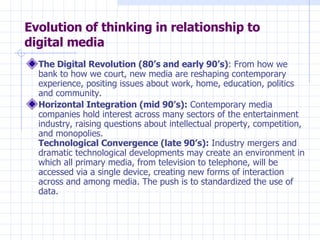
Evolution of thinking in relationship to digital media The Digital Revolution (80’s and early 90’s) : From how we bank to how we court, new media are reshaping contemporary experience, positing issues about work, home, education, politics and community. Horizontal Integration (mid 90’s):  Contemporary media companies hold interest across many sectors of the entertainment industry, raising questions about intellectual property, competition, and monopolies. Technological Convergence (late 90’s):  Industry mergers and dramatic technological developments may create an environment in which all primary media, from television to telephone, will be accessed via a single device, creating new forms of interaction across and among media. The push is to standardized the use of data.
continued Globalization (late 90’s):  Advanced telecommunications and the worldwide expansion of media markets create an urgent need to understand our emerging "global media culture," the cross-fertilization of national and international cultural traditions, and the new styles and genres developing in this context.  Socio-Technological hybridation (early 00s):  We are increasingly adept as consumers and citizens at using one medium in relation to another, choosing which technology is best to receive or transmit a particular form of information, and transforming media content to better express our own ideas. Industries try to adapt to this demand by building modular, adaptable technologies. Giving users the ability to build their own hybrid machines (I.e. the visor). Only the point of connection between content and form can be standardized.  media ecologies (mid 00s) : networks are connecting all type of information and communication systems. Ubiquitous computing, social computing and virtuality all blend within one system. Users no longer choose devices, intelligent device connect to each other for us. aggregation of content happens automatically. Machine and human networks coexist.

mpm17: New media Contexts

  • 1.
  • 2.
    Lecture 1:What isNew Media? A technology, a practice or a framework?
  • 3.
    Historically Late inthe 20 th century, the term multimedia changes meaning. Pre 90’s: a convergence tool Multimedia : “The combined use of several media, such as movies, slides, music, and lighting, especially for the purpose of education or entertainment. The use of several mass media, such as television, radio, and print, especially for the purpose of advertising or publicity. Also called mixed media. The combined use of media such as text, graphics, video, and sound, as on a computer system” . Source: The American Heritage® Dictionary of the English Language, Third Edition. Copyright © 1996, 1992 by Houghton Mifflin Company.
  • 4.
    Mid 90’s: thecomputer becomes central Multimedia : “Human-computer interaction involving text, graphics, voice and video. Often also includes concepts from hypertext”. source: Usenet newsgroup: news:comp.multimedia. (1994-12-02) The term Multimedia starts inferring the idea of digital interactive environments and becomes synonymous with CD-ROM in the personal computer world
  • 5.
    Why such ashift in definition? Because changes in technologies nring change to media production contexts. Multimedia becomes redefined by the ideas of various industrial sectors whose notions are converging
  • 6.
    Technological convergence =convergence of industrial ideas
  • 7.
    The need touse Communication systems comes to change the notion of Convergence By the end of the 90’s, the term starts referring to another idea, that of a communication tool multimedia :”transmission that combine media of communication (text and graphics and sound etc.) [syn: multimedia system]”. Source: WordNet ® 1.6, © 1997 Princeton University This shift in definition marks the influence of a third industry, telecommunications
  • 8.
    Multimedia becomes atthe cross roads of three distinct industrial contexts
  • 9.
    As these industriesare sharing platforms they start using each others’ technologies
  • 10.
    Each industry hascome to design hybrid forms of technologies
  • 11.
    Bringing forth hybridizationof industrial contexts and by consequence production models of each industries Today: hybridation demands shift the centre of innovation Multimedia is no longer at the centre of innovation New media :”The integration of computers, computer networking, and multimedia”
  • 12.
    early 00s: hybridizationhas replaced convergence at the core of innovation models Multimedia is no longer a core innovation new media replaces multimedia:” the integration of computers, computer networking and multimedia”.
  • 13.
    Multimedia becomes asubset of new media
  • 14.
    mid 00's: newmedia no longer refers to media only but encompasses all information and communication technologies.
  • 15.
    What does thismeans new media? definition moves away from ICT to encompass other technologies (robotics, biotech, etc)‏ mid 00s : new media art standard practice is “to take up the products of the technology industries (...) and apply them to its own diverse ends, in a cultural domain. “ (Whitelaw, 2004)‏
  • 16.
    nm is nota technology platform but a framework nm is a framework that is technology independent. late 00s: new media is an experimental framework where artists become innovators that use standard technologies to develop their own aesthetics , where context becomes part of content
  • 17.
  • 18.
    New media isa perspective All media was once a new media photography --> in relation to Painting film --> photo and theather video --> film computing Nm = a phase of evolution where an innovation becomes a medium nm practices= diverse contexts that all celebrate experimenting with innovations.
  • 19.
    Our faculty Diversepractice Different media Diverse point of view and positions What do they have in common?
  • 20.
    Evolution of thinkingin relationship to digital media The Digital Revolution (80’s and early 90’s) : From how we bank to how we court, new media are reshaping contemporary experience, positing issues about work, home, education, politics and community. Horizontal Integration (mid 90’s): Contemporary media companies hold interest across many sectors of the entertainment industry, raising questions about intellectual property, competition, and monopolies. Technological Convergence (late 90’s): Industry mergers and dramatic technological developments may create an environment in which all primary media, from television to telephone, will be accessed via a single device, creating new forms of interaction across and among media. The push is to standardized the use of data.
  • 21.
    continued Globalization (late90’s): Advanced telecommunications and the worldwide expansion of media markets create an urgent need to understand our emerging "global media culture," the cross-fertilization of national and international cultural traditions, and the new styles and genres developing in this context. Socio-Technological hybridation (early 00s): We are increasingly adept as consumers and citizens at using one medium in relation to another, choosing which technology is best to receive or transmit a particular form of information, and transforming media content to better express our own ideas. Industries try to adapt to this demand by building modular, adaptable technologies. Giving users the ability to build their own hybrid machines (I.e. the visor). Only the point of connection between content and form can be standardized. media ecologies (mid 00s) : networks are connecting all type of information and communication systems. Ubiquitous computing, social computing and virtuality all blend within one system. Users no longer choose devices, intelligent device connect to each other for us. aggregation of content happens automatically. Machine and human networks coexist.