Credit Card Frauds
Modern Day Pick pocketing…
Definition and Meaning
• Credit card fraud is a wide-
  ranging term for theft and
  fraud committed using a
  credit card or any similar
  payment mechanism as a
  fraudulent source of funds in
  a transaction.
• The purpose may be to
  obtain goods without
  paying, or to obtain
  unauthorized funds from an
  account.
• Credit card fraud is also an
  adjunct to identity theft.
Hard Facts
• "Lost or stolen wallets, checkbooks and credit and debit
  cards" made up 43 percent of all ID theft incidents in which
  the "method of access" was known. (Source: Javelin
  Strategy & Research, February 2009 study.)
• Credit and debit card fraud is the No. 1 fear of Americans in
  the midst of the global financial crisis. Concern about fraud
  supersedes that of terrorism, computer and health viruses
  and personal safety. (Source: Unisys Security Index: United
  States, March 2009)
• Arizona leads the nation in identity theft complaints per
  100,000 people. In 2008, the state had 149 complaints
  about ID theft per 100,000 people. California
  (139.1), Florida (133.3), Texas (130.3) and Nevada (126.0)
  rounded out the top five. (Source: Federal Trade
  Commission, February 2009 survey)
• South Dakota has the fewest identity theft complaints
  per 100,000 people in the nation. In 2008, the state
  had 33.8 complaints about ID theft per 100,000
  people. North Dakota (35.7), Iowa (44.9), Montana
  (46.5) and Wyoming (46.9) rounded out the bottom
  five. (Source: Federal Trade Commission, February
  2009 survey)
• Brownsville-Harlingen, Texas, is the metropolitan area
  with the largest number of ID theft complaints per
  100,000 people. In 2008, the area had 366.8
  complaints per 100,000 people. Napa, Calif., was
  second with 351.3. (Source: Federal Trade
  Commission, February 2009 survey)
Types of Frauds
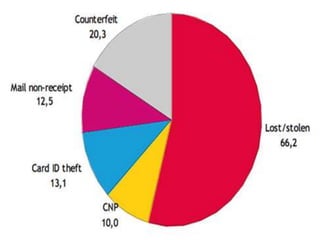
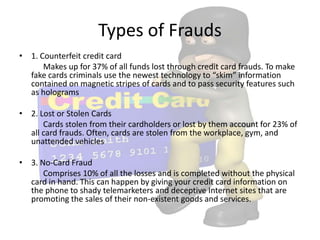
• 1. Counterfeit credit card
      Makes up for 37% of all funds lost through credit card frauds. To make
  fake cards criminals use the newest technology to “skim” information
  contained on magnetic stripes of cards and to pass security features such
  as holograms

• 2. Lost or Stolen Cards
      Cards stolen from their cardholders or lost by them account for 23% of
  all card frauds. Often, cards are stolen from the workplace, gym, and
  unattended vehicles

• 3. No-Card Fraud
      Comprises 10% of all the losses and is completed without the physical
  card in hand. This can happen by giving your credit card information on
  the phone to shady telemarketers and deceptive Internet sites that are
  promoting the sales of their non-existent goods and services.
• 4.Non-Receipt Fraud
      Is responsible for 7% of all losses. It occurs
  when new or replaced cards mailed by your card
  company are stolen during the process of being
  mailed.

• 5.Identity Theft Fraud
        Accounts for 4% of all losses, and occurs
  when criminals apply for a card using someone
  else’ identity and information
Case Study
• In what is seen as a problem that could
  affect the aam aadmi, estimates show
  that Rs 8.2 crore is lost annually in India
  due to credit card fraud. From Kumar
  Mangalam Birla to the aam
  aadmi, there have been all sorts of
  victims.
• Ram Shanker Shukla from Lucknow got
  the biggest surprise when he recieved
  SMS alerts saying Rs 20,000 were
  deducted from his bank account and
  that too, to pay utility bills in Delhi and
  Jaipur. By the time he realised it, Shukla
  had become the latest victim of online
  fraud.
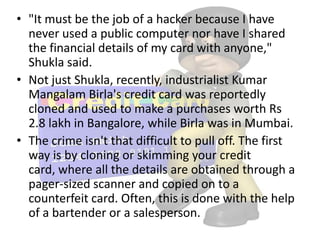
• "It must be the job of a hacker because I have
  never used a public computer nor have I shared
  the financial details of my card with anyone,"
  Shukla said.
• Not just Shukla, recently, industrialist Kumar
  Mangalam Birla's credit card was reportedly
  cloned and used to make a purchases worth Rs
  2.8 lakh in Bangalore, while Birla was in Mumbai.
• The crime isn't that difficult to pull off. The first
  way is by cloning or skimming your credit
  card, where all the details are obtained through a
  pager-sized scanner and copied on to a
  counterfeit card. Often, this is done with the help
  of a bartender or a salesperson.
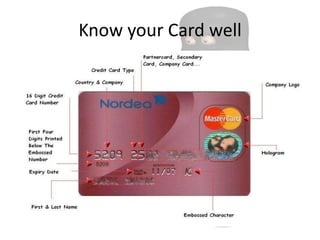
Know your Card well
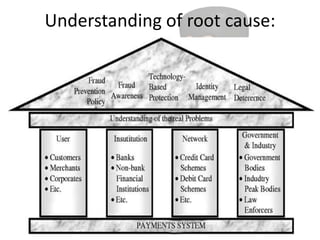
Understanding of root cause:
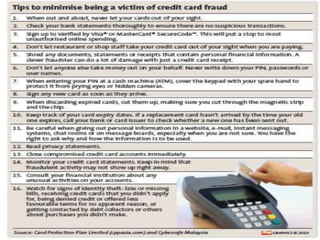
Save Yourself!!
DOs                                           DON’Ts
If you lose your credit card, please report   Please do not disclose your Credit Card
the loss immediately.                         Number/ATM PIN to anyone.
When you dispose of a card at the time of Please do not hand over the card to
renewal/upgradation, please make sure     anyone, even if he/she claims to
to cut it diagonally before disposal.     represent the Bank.
Please keep your card in a safe place.        Never get carried away by strangers who
Treat it as carefully as you would treat      try to help you use the ATM machine.
your cash.
Please ensure the card is swiped in your      Please do not write the ATM PIN on the
presence.                                     card or on a paper which you carry along
                                              with the card.
Please make sure you conduct any ATM          Hand over your phone with activated
transaction in complete privacy. If your      banking services to anybody.
card is held back by the ATM, please
inform the concerned Call Center/Branch
personnel immediately.
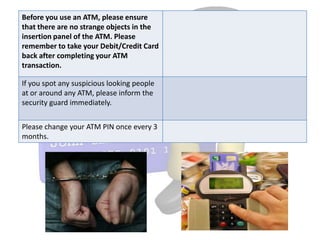
Before you use an ATM, please ensure
that there are no strange objects in the
insertion panel of the ATM. Please
remember to take your Debit/Credit Card
back after completing your ATM
transaction.

If you spot any suspicious looking people
at or around any ATM, please inform the
security guard immediately.


Please change your ATM PIN once every 3
months.

Credit card frauds

  • 1.
    Credit Card Frauds ModernDay Pick pocketing…
  • 2.
    Definition and Meaning •Credit card fraud is a wide- ranging term for theft and fraud committed using a credit card or any similar payment mechanism as a fraudulent source of funds in a transaction. • The purpose may be to obtain goods without paying, or to obtain unauthorized funds from an account. • Credit card fraud is also an adjunct to identity theft.
  • 3.
    Hard Facts • "Lostor stolen wallets, checkbooks and credit and debit cards" made up 43 percent of all ID theft incidents in which the "method of access" was known. (Source: Javelin Strategy & Research, February 2009 study.) • Credit and debit card fraud is the No. 1 fear of Americans in the midst of the global financial crisis. Concern about fraud supersedes that of terrorism, computer and health viruses and personal safety. (Source: Unisys Security Index: United States, March 2009) • Arizona leads the nation in identity theft complaints per 100,000 people. In 2008, the state had 149 complaints about ID theft per 100,000 people. California (139.1), Florida (133.3), Texas (130.3) and Nevada (126.0) rounded out the top five. (Source: Federal Trade Commission, February 2009 survey)
  • 4.
    • South Dakotahas the fewest identity theft complaints per 100,000 people in the nation. In 2008, the state had 33.8 complaints about ID theft per 100,000 people. North Dakota (35.7), Iowa (44.9), Montana (46.5) and Wyoming (46.9) rounded out the bottom five. (Source: Federal Trade Commission, February 2009 survey) • Brownsville-Harlingen, Texas, is the metropolitan area with the largest number of ID theft complaints per 100,000 people. In 2008, the area had 366.8 complaints per 100,000 people. Napa, Calif., was second with 351.3. (Source: Federal Trade Commission, February 2009 survey)
  • 6.
    Types of Frauds •1. Counterfeit credit card Makes up for 37% of all funds lost through credit card frauds. To make fake cards criminals use the newest technology to “skim” information contained on magnetic stripes of cards and to pass security features such as holograms • 2. Lost or Stolen Cards Cards stolen from their cardholders or lost by them account for 23% of all card frauds. Often, cards are stolen from the workplace, gym, and unattended vehicles • 3. No-Card Fraud Comprises 10% of all the losses and is completed without the physical card in hand. This can happen by giving your credit card information on the phone to shady telemarketers and deceptive Internet sites that are promoting the sales of their non-existent goods and services.
  • 7.
    • 4.Non-Receipt Fraud Is responsible for 7% of all losses. It occurs when new or replaced cards mailed by your card company are stolen during the process of being mailed. • 5.Identity Theft Fraud Accounts for 4% of all losses, and occurs when criminals apply for a card using someone else’ identity and information
  • 8.
    Case Study • Inwhat is seen as a problem that could affect the aam aadmi, estimates show that Rs 8.2 crore is lost annually in India due to credit card fraud. From Kumar Mangalam Birla to the aam aadmi, there have been all sorts of victims. • Ram Shanker Shukla from Lucknow got the biggest surprise when he recieved SMS alerts saying Rs 20,000 were deducted from his bank account and that too, to pay utility bills in Delhi and Jaipur. By the time he realised it, Shukla had become the latest victim of online fraud.
  • 9.
    • "It mustbe the job of a hacker because I have never used a public computer nor have I shared the financial details of my card with anyone," Shukla said. • Not just Shukla, recently, industrialist Kumar Mangalam Birla's credit card was reportedly cloned and used to make a purchases worth Rs 2.8 lakh in Bangalore, while Birla was in Mumbai. • The crime isn't that difficult to pull off. The first way is by cloning or skimming your credit card, where all the details are obtained through a pager-sized scanner and copied on to a counterfeit card. Often, this is done with the help of a bartender or a salesperson.
  • 10.
  • 11.
  • 13.
    Save Yourself!! DOs DON’Ts If you lose your credit card, please report Please do not disclose your Credit Card the loss immediately. Number/ATM PIN to anyone. When you dispose of a card at the time of Please do not hand over the card to renewal/upgradation, please make sure anyone, even if he/she claims to to cut it diagonally before disposal. represent the Bank. Please keep your card in a safe place. Never get carried away by strangers who Treat it as carefully as you would treat try to help you use the ATM machine. your cash. Please ensure the card is swiped in your Please do not write the ATM PIN on the presence. card or on a paper which you carry along with the card. Please make sure you conduct any ATM Hand over your phone with activated transaction in complete privacy. If your banking services to anybody. card is held back by the ATM, please inform the concerned Call Center/Branch personnel immediately.
  • 14.
    Before you usean ATM, please ensure that there are no strange objects in the insertion panel of the ATM. Please remember to take your Debit/Credit Card back after completing your ATM transaction. If you spot any suspicious looking people at or around any ATM, please inform the security guard immediately. Please change your ATM PIN once every 3 months.