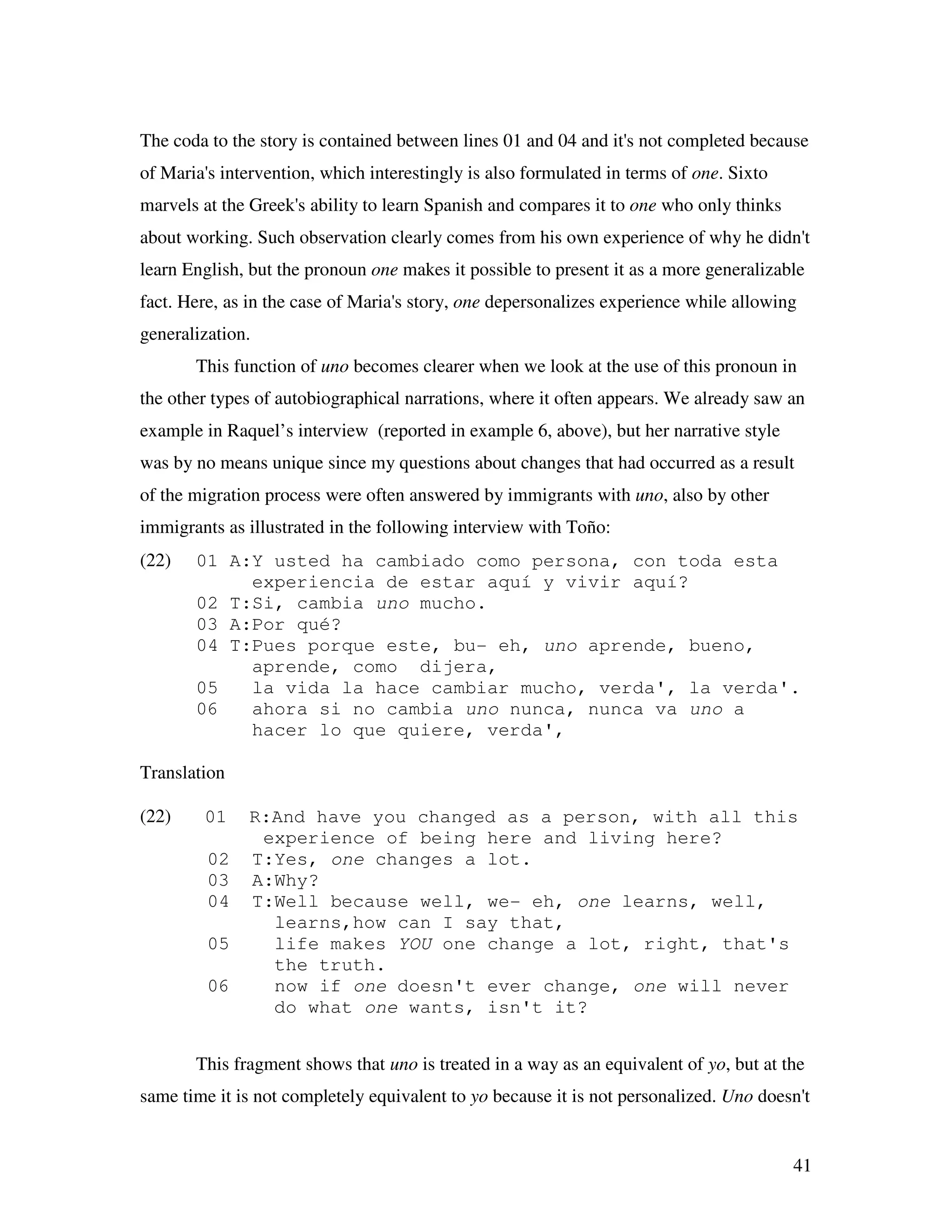
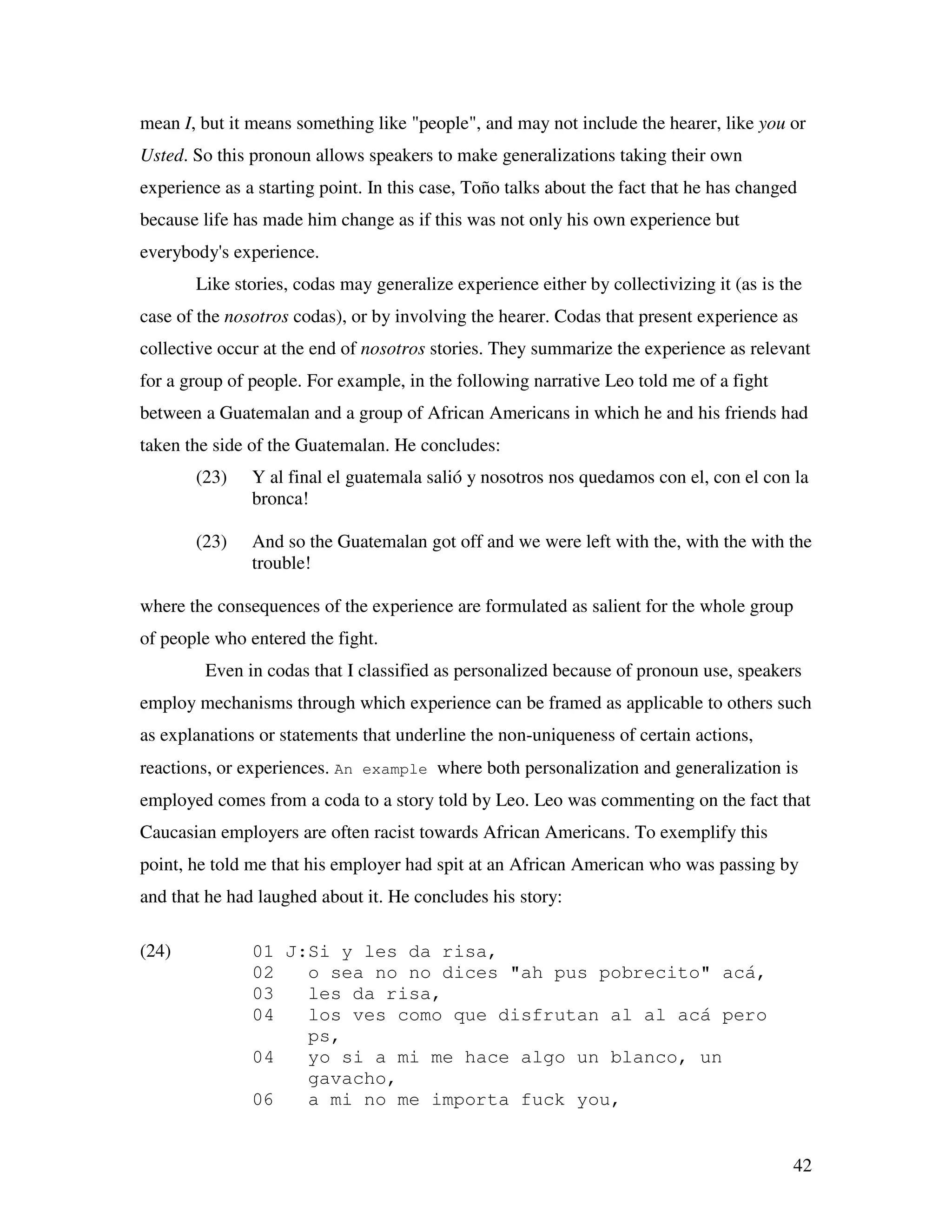
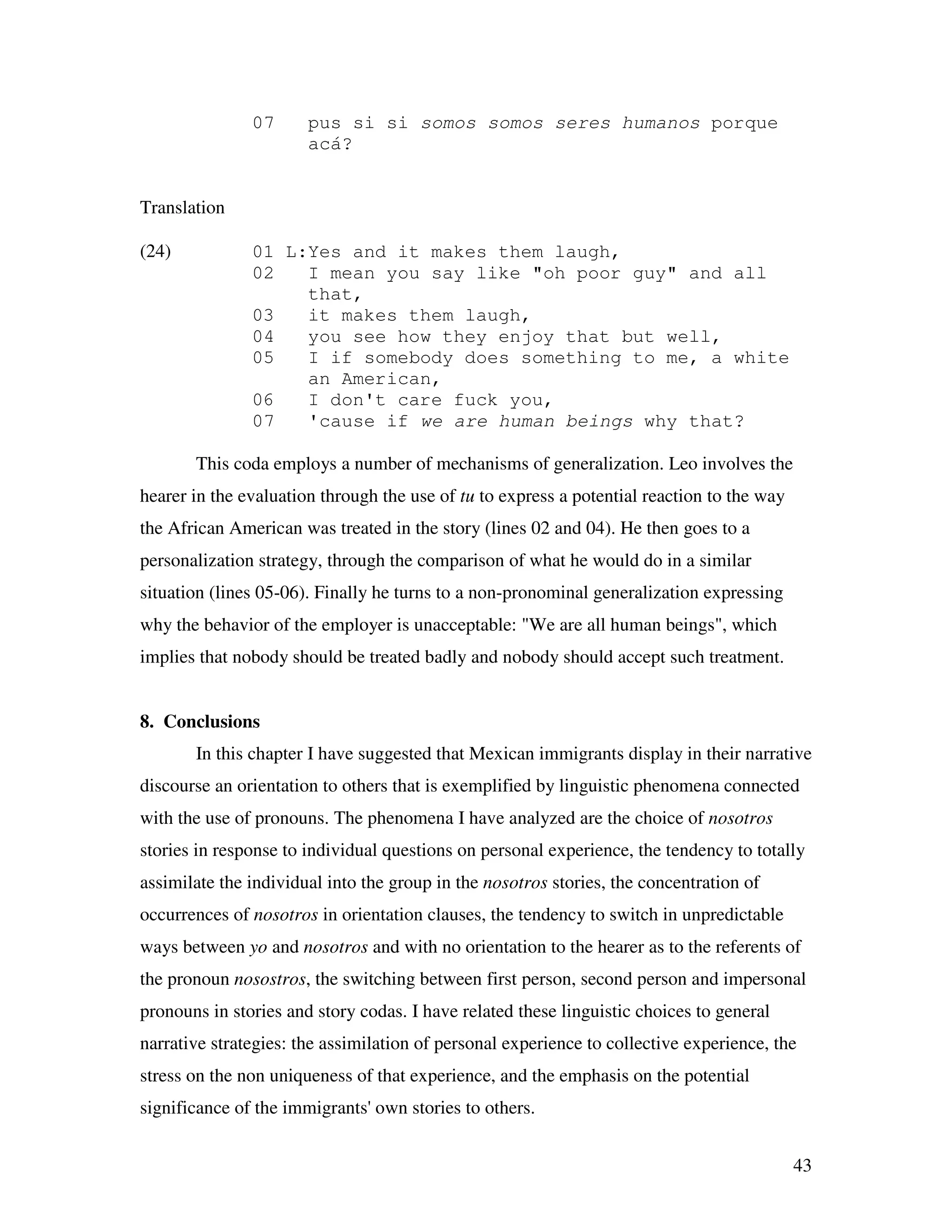
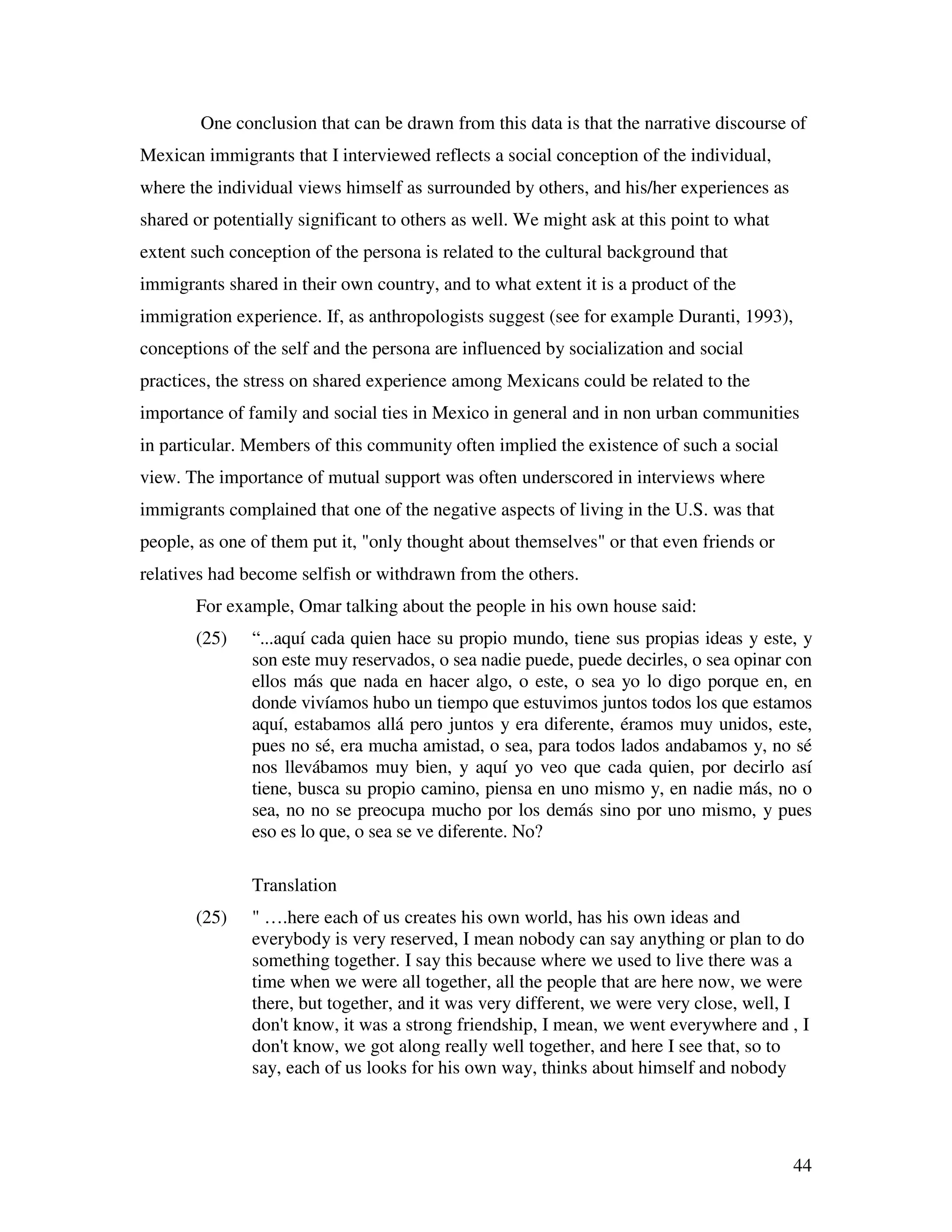
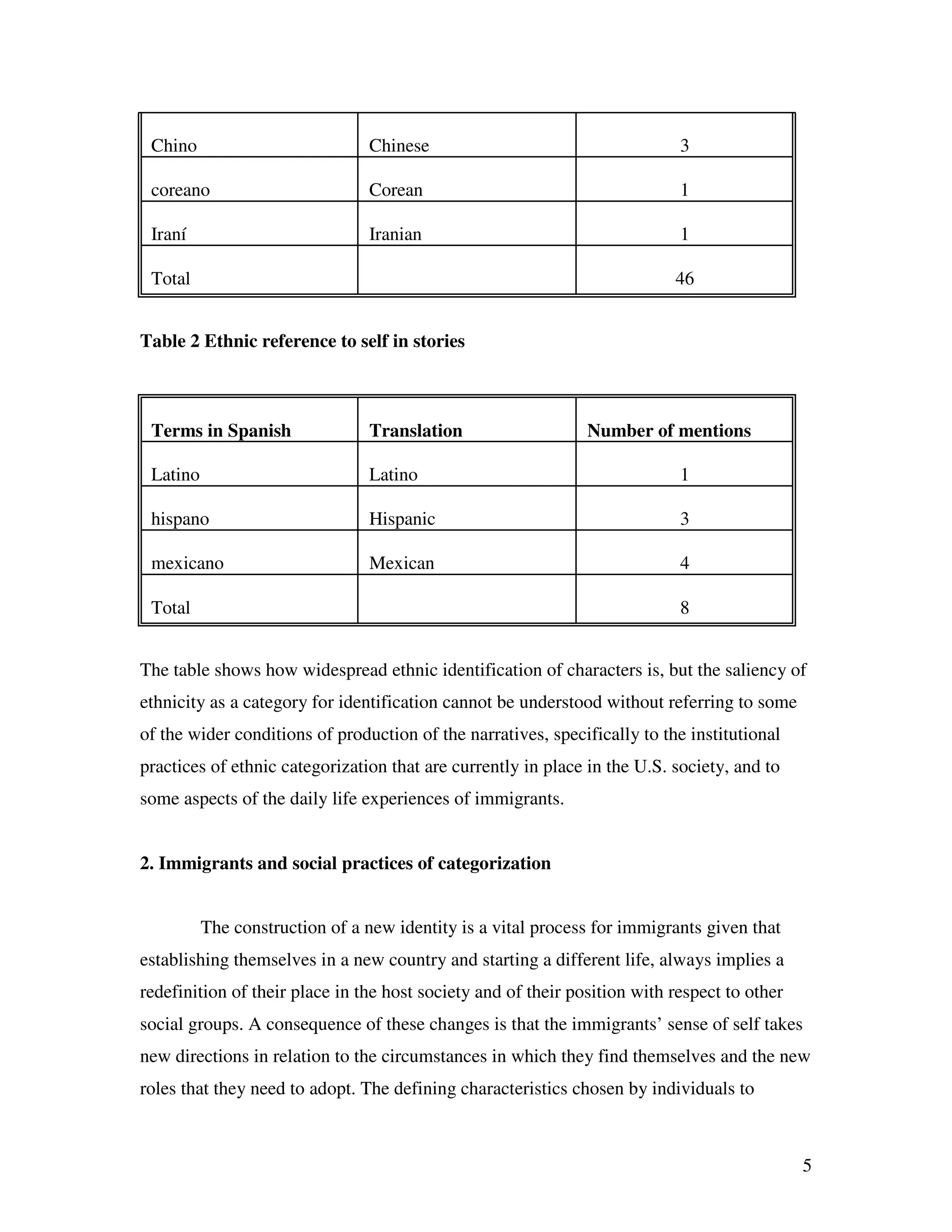
i
Introduction
The writing of this book was motivated by my involvement in three areas of
interest both in academic and personal life. The first one relates to the ways and means
through which language, and in particular narrative, displays its power to voice
experiences, to bring about shared understandings of life events, to shape and transform
individual and collective realities. The second one relates to migration as a social
phenomenon and as a personal experience. I have migrated more than once during my
adult life and, although I am conscious of the profound differences in motivations,
economic backgrounds, origins, adaptation routes, among those who carry out a journey
that takes them away from their countries to settle somewhere else, I am also convinced
that there are many commonalities, many patterns of behavior and experience that are
shared by all of them. Those commonalities constitute a firm basis for understanding and
solidarity, and an occasion for reflection. Finally, the writing of this book was also
spurred by a deep interest in Mexico since the many years I spent in that country
stimulated in me a great admiration for the richness and complexity of the Mexican
people and of Mexican cultural traditions.
The book is based on interviews and ethnographic observation carried out
between September 1996 and June1997 with 14 Mexican economic immigrants living in
Langley Park, Maryland, who were mostly undocumented at the time. The work responds
to two primary objectives: investigating the constitution, representation and negotiation
of identities among Mexican economic migrants to the United States, and showing in
what ways narrative discourse constitutes a privileged locus for the study of identities.
The focus of the analysis is on the connections between the local expression of identities
in narrative discourse and the social processes that surround migration.
There are two preliminary questions that I would like to discuss in the following
pages. The first one is: why study immigrants? The second one is: what are the
advantages of small-scale discourse analytic studies as opposed to quantitatively based
investigations, in order to gain an understanding of migration and the processes of self
definition and redefinition that immigrants live?
ii
Let us start with the first question: the importance of studying immigrants and
immigration hardly needs stressing given the social relevance of the phenomenon. A
great number of new immigrants enter the U.S. every year and of these immigrants, many
are undocumented Mexicans (Dillon, 1997). The presence of Mexican undocumented
workers in the U.S., already estimated between 1.8 and 3.6 millions in the seventiesi
, has
currently reached, according to the national press, a number between 3 and 4 million of
individualsii
. Quantifications of the immigration flux vary, but figures are high enough to
give an idea of the relevance of a phenomenon, largely unknown, but also unmistakably
part of American everyday life. Mexican immigrants, especially undocumented ones,
become more numerous every year and as the divide between the wealth of the U.S. and
the poverty of its neighbors increases, so does the number of those who are pushed across
the border by the dream of a better life.
However, immigration is not only important because of its numerical significance.
It is also important because of its economic, social, and psychological impact. The
constant debate over this topic in the mass media, in the political arena, in academic
circles, and at dinner tables, is a symptom of the centrality of the role of immigration and
immigrants in the political and social landscape of the country. On the other hand, the
continuous attempts, particularly in the South Western states, to limit and regulate the
rights of immigrant workersiii
show how deeply divided politicians and common citizens
are on the extent to which recent immigrants can be considered a true part of society. In
fact, the constant increase in the number of Hispanic immigrants in particular and their
recent attainment of the status of largest and fastest growing minority in the U.S.iv
, has
raised and continues to raise great anxiety among mainstream Americans since often
these immigrants are seen as taking over the country and imposing their own life style,
language, and customs. In many cases being Hispanic is equated with poor performance
at school, drug abuse, poverty and violence. Images and stereotypes abound, but
information on immigrants is scarce and although a wealth of literature on social and
political aspects of immigration exist, very little is known about who immigrants are,
what they think and what they feel, why they come to the U.S., how they see themselves.
This is particularly true of undocumented Mexican immigrants who are active and
present in innumerable work sites across the country and who lend their workforce for
iii
low skilled jobs in areas such as construction and painting, landscaping, catering and
food serving, agriculture and house cleaning in a large number of American cities and
rural areas. Their language, food, music are gaining increasing popularity, but their voice
is rarely heard. Although visible in the work place, they lead their life in anonymity and
isolation. Thus another reason to study immigrant realities, particularly immigrant
identities, is the need to provide insights into aspects of a phenomenon that is amply
debated but largely under-analyzed.
A focus on immigrants and their identity can also help defeat overgeneralization
and stereotyping and show the complexity of immigrant realities and experiences.
Stereotypes are in fact often the result of a lack of knowledge about immigrants.
Anthropologist Rosaldo (1993) stresses the relationship between stereotyping and
ignorance and argues for the importance of listening to what people say about
themselves. Proposing an analysis of Chicano narratives, he underlines that this kind of
research is a response to our ignorance of members’ self-perceptions and our inability to
answer questions about them. The same can be said about undocumented immigrants and
many other minority groups that are often ignored or largely misunderstood.
The second question proposed at the beginning of this introduction was: why
should we rely on small scale qualitative studies such as the one proposed here in order to
gain a deeper understanding of immigration and of the processes of self definition and
redefinition that accompany it? I argue that a qualitative perspective, particularly one
based on discourse and narrative, is much more insightful than quantitative
methodologies because it helps bring to the surface and understand aspects of the
representation of the self that are not apparent through statistics, questionnaires or sample
interviews.
Qualitative studies on Mexican immigrants are scarce not only in the field of
discourse studies, but also in other research areas. Although sociological and economic
aspects of Mexican immigration have constituted and continue to constitute the focus of
many sociological, economic, social psychological, anthropological studies (see
Cornelius and Marcelli, 2001; Durand, 1991; Gaxiola, 1991; Heer, 1990; Wayne,
Chavez, & Castro, 1982; Bustamante, 1979; Wayne, 1978 a and 1978 b; Gamio, 1969a
and 1969b) questions related to self and other-perception, and self and other-
iv
representation, are relatively neglectedv
. But immigration as a process crucially involves
a continuous definition and redefinition of one’s identity and of one’s membership into
larger communities. Life stories analysts and social psychologists see it as one of the
landmark events in the life of individuals and groups. Thus, it is hardly possible to come
to terms with immigrant realities without understanding these “subjective” processes. In
an investigation of socio-psychological responses to migration among Mexican
immigrants, de la Mora (1983), argued that although many studies on the topic suggest
that the factors influencing the outcome of the process are both subjective and objective,
most mainstream analyses have exclusively focused on objective conditions such as
unemployment, inequality in income distribution, patterns of population growth,
educational levels, work-force qualifications, and so on. This emphasis has resulted in a
lack of understanding of the impact of subjective factors related to migration on the life
of individuals and groups.
The importance of developing knowledge on the self-perception and identity
formation among immigrants has been recognized by anthropologists studying new
immigrant populations (see for example Chavez, 1992 and 1994; Rosaldo, 1993). They
argue that such knowledge may for example, lead to a better understanding of the factors
that help immigrants integrate or that, alternatively, prompt their isolation within the host
society. A comprehensive study on Mexican immigrants in Southern California (Wayne,
Chavez, & Castro, 1982) suggested, for example, that the integration of first generation
Mexican immigrants into American society is minimal, as they tend to see themselves as
outsiders to that society even after many years of residence in the U.S. More recent
qualitatively based analyses challenge this kind of accepted wisdom and suggest in
contrast that generalizations on the way new immigrants adjust to life in the U.S. are ill
founded, since too little is known about their lives and the repertoire of identities that
they might be developing. Lamphere (1992), for example, in the introduction to a
collection of papers about the interrelationships between newcomers (including
Mexicans) and established residents in U.S. cities, argues that stereotypical images about
the way immigrants relate to other ethnic groups are inadequate to describe new urban
realities. Similarly, in a study based on interviews about community membership among
undocumented Mexican immigrants in the San Diego area, Chavez (1992) challenges the
v
assumption that the strong links with their country of origin hinders Mexican immigrants'
development of a new sense of community in the U.S. since:
... while many Mexicans retain ties with their home families and communities,
this does not necessarily undermine their experience in their new communities,
experiences that may isolate them from the larger society or lead to change,
sometimes well thought of and other times unconscious, in their orientation from
sojourners to settlers. (p. 56)
In this process, immigrants may be developing “multiple senses of community
membership.”
In sum, qualitative studies of immigrant communities are important both to assess
and evaluate the ways immigrants fit into the host society, and to provide knowledge
about communities that are often the object of stereotyping and misjudgment. In this
book I argue for the importance of the analysis of identity among Mexican immigrants,
but I also show how such analysis inevitably leads to its expression in discourse. I also
argue that narrative discourse is particularly illuminating of the ways in which
immigrants represent the migration process and themselves in it. Thus, my objective is
not only to describe aspects of the identity of Mexican immigrants, but also to advocate
for a discourse-based approach to identity. Language is central to the expression of
identity because it is not a reflection of our apprehension of reality; it is not a "conduit"
(Reddy, 1979) for thought, but rather a constitutive aspect of our experience of the world.
We cannot understand and share experience if we do not express it linguistically. The
way we express our experiences is as part of those experiences as the material and
psychological processes that prompted our telling of them. Story telling, as other
discourse activities, is seen here as situated discursive practice (Fairclough, 1989) in the
sense that it both obeys and creates social rules, understandings, and roles. It obeys
social rules that dictate how narratives should be constructed, by whom and to whom
they should be toldvi
, what is tellable, and howvii
. Furthermore, storytelling, like other
discursive practices, rests on socially shared meanings, conceptions and ideologies (van
Dijk, 1998), establishing a constant dialogue (Bakhtin, 1981) with them, but also
generates new meanings and new behaviors. Among the central functions of storytelling
is, as I will argue, that of presenting and representing identity. In this framework
vi
narrating is a way of talking about the self, but also a way of practicing certain types of
identity in specific interactional contexts.
The recognition of the structuring power of discourse and of discourse organization
is, therefore, at the heart of the enterprise of studying identity through discourse analysis.
The choice of narratives as the focus of analysis and the centrality of narrative in the
expression and negotiation of identity will be thoroughly discussed in Chapter 1. Here I
only want to note that the focus on the micro-analysis of naturally occurring talk and the
emphasis on the local mechanisms through which identity is expressed and negotiated in
narrative, derive from the conviction, shared by many interactional sociolinguists, that it
is mainly through the analysis of data in painstaking detail and the consideration of the
contextualization cues that speakers use to convey specific meanings (Gumperz, 1982,
1992) that it is possible to generate hypotheses on how members of a community
represent and negotiate their belonging to social categoriesviii
. According to interactional
sociolinguists and other interactionally oriented scholars, in order to understand how
language contextualizes social realities, it is important to combine a close focus on the
details of texts “with a broader conception of meaning” (Basso1992, p. 268). Detailed
discourse analysis is like a magnifying glass in that it illuminates the way linguistic items
and strategies employed by individuals are part of a repertory of resources shared by
communities. It is through the study of situated discourse instances that cultural and
social meanings become apparent to the analystix
.
But why study narratives in particular? Narrative is one of the privileged forms
used by humans to elaborate experience. This is why narratives have been widely studied
as windows into the analysis of human communities and individuals in fields as diverse
as anthropology (Levi Strauss, 1963), ethnography and folklore (Hymes, 1981; Bauman,
1986; Rosaldo, 1986), social history (Griffin, 1993), psychology (Rosenwald & Ochberg,
1992; Bruner, 1990; Polkinghorne, 1988; Mishler, 1986); sociology (Somers & Gibson,
1994). One reason for this popularity is their methodological richness. Narratives have
been used as data in many fields of the social sciences and narrative analysis has
constituted the methodological tool of a revolution in qualitative research that has
become generally identified as the ‘narrative turn’. This generalized interest greatly owes
to the characteristics of narratives as texts. Narratives are highly spontaneous and at the
vii
same time highly organized texts both in the way they are structured, and in the way they
are inserted in conversation (Labov & Waletzky, 1967/1997; Labov, 1972; Jefferson,
1978); for this reason they can be recognized and analyzed as a specific and highly
constrained discourse genre. Furthermore, they are a discourse genre that invites and
promotes involvement and participation. Labov's appreciation of the highly spontaneous
character of narratives led him to use them as a central tool for his study of the vernacular
language, since he thought that when people narrate their experience, they get involved
and become less self conscious of the way they speak. After him, researchers have begun
to use narratives as an alternative to more traditional methods of elicitation such as
questionnaires and formal interviews. In the present study the spontaneity and
involvement that the telling of narratives created within the interview context were an
invaluable aid. I was interested in how immigrants make sense of their immigration
experience and I asked them questions on how they felt, what they thought about it, how
migration had changed them. But a direct reconstruction and reflection on the personal
experience of immigration is difficult to elicit. I anticipated that immigrants would have
difficulties of various kinds in talking about, or reflecting on their experiences explicitly,
while I thought that they would more easily tell stories, whether asked to do so or not.
This turned out to be true, since stories and other kinds of narratives emerged throughout
the interviews as spontaneous answers to questions, as illustrations of argumentative
points, and as recollections of past experience. Narratives were then a central tool for me
as a researcher in that they allowed me to study important aspects of the identity
construction in this group, and for the immigrants as interviewees because they allowed
them to talk more freely about their experiences.
Another important aspect of narratives as resources for studying groups and
communities is their ability to serve as locuses for the keying of experience. Goffman
uses this term to refer to “all strips of depicted personal experience made available for
participation to an audience” (1974, p. 53). In storytelling many linguistic devices, such
as tense, reported speech or pronoun switching, allow narrators to replay their
experiences for an audience as if these were taking place before their eyes. In that sense,
although narratives might occur as a response to a question by the interviewer or they
might be directly elicited, they still largely respond to the expressive needs of the narrator
viii
and therefore are more likely to reveal her/his point of view on events and experiences
than other kinds of talk. Furthermore, narratives are in many cases negotiated, thus their
significance is established interactively by the participants in a speech event. Therefore,
they allow for different participants in an interaction to express their evaluation of events
(Goodwin, 1986). This aspect of storytelling was important to my study since the telling
of narratives constituted an occasion for the discussion of the meaning of personal
experience to members of the community. Participants in interviews expressed collective
values and beliefs either through evaluation of narratives told by others, or through co-
construction of narratives with others. Thus, while answers to questions were most of the
time individual, narratives invited more participation and negotiation of meaning from
participants.
As I have argued, discourse, and narrative in particular, represent the point of
intersection between the expression of individual feelings and representations and the
reflection upon and construction of societal processes, ideologies and roles. The latter
become alive in the arena of talk in a unique way. By analyzing narratives we analyze
not only individual stories and experiences, but also collective social representations and
ideologies.
Overview of the volume
The internal organization of the book mirrors my ideas, detailed in chapter one,
about the relationships between narrative discourse and identity. Except for chapter two,
in which I give background information on Mexican undocumented immigrants and on
the group of immigrant workers interviewed for this study and I discuss some
methodological choices, the rest of the book is centered on the analysis and discussion of
different aspects of the presentation and negotiation of identity in narrative discourse. I
argue that identity is not necessarily expressed at one and the same level since it can be
displayed or given off, but it can also be openly negotiated. The degree of openness may
vary, in the sense that choices as to self-presentation can be more or less explicit
depending on the general interactional function of the narrative itself and the storytelling
context. Identities emerge in my analysis through the establishment of connections
ix
between linguistic choices, interactional worlds and story worlds. My proposal is that in
order to study identity, we need to look at these different aspects and at its different ways
of emergence in discourse.
I focus on the analysis of two basic aspects of the construction and expression of
identity: the projection of the self into specific social roles, and the expression of
membership into groups and communities. The first aspect, the projection of social roles,
is analyzed through the consideration of ways of presenting the self in relation to others,
and of ways of presenting the self in relation to social experiences. I look at the role of
the self with respect to others as expressed in social orientation, while I analyze the role
of the self with respect to social experiences as agency. The linguistic phenomena and
strategies on which I focus are pronominal choices and voicing. Both pronominal choices
and voicing operate at a level where identity is displayed more than openly discussed.
Chapters three and four are devoted to this level of contextualization/expression of
identity. In chapter three I analyze pronominal choice and other linguistic strategies that
are seen as an index of social and cultural meanings related to broad conceptions of the
persona. In chapter four I focus on voicing. The analysis is centered on the use of
constructed dialogue to report events and actions in the particular story worlds connected
with the border crossing. The focus is on the narrators’ presentation of his/her role as
figure in the story world in that the narrators’ choices in terms of reporting forms, types
of acts reported, and attribution of those acts to story characters, is seen as signaling
different degrees of agency and participation in the narrated action.
The second level of analysis of identity deals more, even though not exclusively,
with the explicit construction of self in relation to the member’s community or to external
groups. Basic to membership construction is self and other categorization, which is
studied through identification strategies. When self and other categorization is at stake,
identity is more often negotiated than displayed and in order to analyze it we need to
resort to implicit and explicit references to belief systems and ideologies. This level of
analysis is taken up in chapters five and six. Chapter five discusses the categorization of
self and others. Crucial to such categorization are narrative strategies used to introduce
characters in stories. I argue that the analysis of story orientations reveals that immigrants
use ethnicity as a central identification category for self and others in their stories and
x
that ethnic identification reflects and constitutes different levels of context, from the local
negotiation of positions about self and others and the creation of participation
frameworks in particular interactions, to the articulation of values and beliefs shared in
the community and the contextualization of cultural and social norms. Chapter six
focuses more closely on the narrators’ articulation of social representations and beliefs
through story telling, by looking at the application of the ethnic category “Hispanic” to
self and others in different story-worlds. This chapter focuses on the comparison of the
construction and definition of identity in different story worlds, showing how self and
other representations are based on schematic relationships between actions and identities
that are often encoded in stories. However, I also discuss how even the same categories
for self and other description may acquire different senses depending on the story-world
depicted and/or on the interactional worldx
, and how narrators may display conflicting
stances towards apparently uncontroversial definitions of the self.
Both dimensions of identity are studied interactionally in the sense that the
analysis does not look at story-world organization as such, but at the connections that
speakers establish between their narratives and the discourse in which they are inserted.
However, interactional construction and negotiation is not taken as exhausting the
contextual nature of narrative. The dialogue established by narrators cannot be
exclusively reduced to the exchange with audiences, since participants are also engaged
in dialogue with mainstream discourses about immigrants and immigration. In that sense
again, the analysis of narratives needs to take into account how local contexts interact
with wider contexts such as ideologies, belief systems, and the intertextual dimension.
To conclude, this book proposes an analysis of the narrative construction of
identity by undocumented Mexican immigrants, but also an approach to the study of
identity through narrative. The focus of the analysis is not on the projection of individual
selves, but on the dimension of group identity and therefore particular attention is
devoted to the processes and strategies of identity construction that seem to be common
among members of the group interviewed and on the nexus between the local expression
of identity by particular narrators and the more global processes of collective
representation that frame and interact with such local expressions.
xi
i
See "Legal and Illegal Immigration to the U.S.", Report by the Selected Committee on Population. U.S.
House of Representatives, 96 Congress, Second Session, Serial C, Washington D.C., 1978, p.2.
ii
See Allen, M. (2001). Mexico still focused on illegal workers. The Washington Post, September 5, A2.
iii
See the debates over Propositions 185 and 227 in California.
iv
Data released by the U.S. Census Bureau in 2000, show that the Hispanic population has reached 35.3
million in the U.S. thus becoming the largest minority in the country. More than half of these 35 million
individuals declare to be Mexican.
v
Few studies on this topic exist. See Buriel & Cardoza (1993) on ethnic labeling; Chavez (1994) on
perceptions about the place of individuals in communities; De la Mora (1983) on psychosocial factors in
the definition of self among Mexican immigrants.
vi
See Goffman (1981) and his notions of participation frameworks and production formats that explain how
discourse activities are differently organized in terms of production and reception.
vii
See Bauman (1986) on the concept of narrative as ‘performance’, i.e. as a discourse genre governed by
rules dictating how it should be best constructed and presented to an audience.
viii
See Rampton (2001) on Interactional Sociolinguistics as a tool to seek answers to wide social problems.
ix
Sherzel’s observations about anthropological linguistics are illuminating of the way the relationship
between discourse and culture is viewed here. He says: “Increasingly, contemporary research in linguistic
anthropology takes discourse as its starting point, theoretically and methodologically, for linguistic and
cultural analysis. As distinct from viewing texts as metaphors (in the sense of Geertz, 1973), an increasing
number of researchers, each in quite different ways, analyzes discourse, large and small, written and oral,
permanent and fleeting, as not only worthy of investigating in its own right, but as embodiment of the
essence of culture and as constitutive of what the language-culture-society relationship is about” (1987, p.
297).
x
I use the term interactional world to refer to the domain of the interaction in which narratives are told.
The difference in my use of the terms interactional world and storytelling world is that the latter refers to
the immediate context of the telling of a story, while the former refers more in general to the speech
activity of which the telling of a narrative is a particular moment.
1
CHAPTER 1
Identity in narrative: a discourse approach
Introduction
In this chapter I discuss narrative, identity and their relationships. I attempt to
show why narrative is central to the study of identity and which properties of narrative as
a genre make it particularly apt to become the locus of expression, construction and
enactment of identity, but also a privileged genre for its analysis. In the first section, I
present my definition of narrative and review some theoretical models that are basic to
understand both narrative structure and function. In the following section, I examine
some theoretical approaches to identity and to its analysis in narrative discourse. I then
present my own approach to the analysis of identity in narrative. I discuss different levels
and modes of expression of identity in narrative, review linguistic and textual phenomena
that relate to these different levels, and discuss the methodological tools and analytical
levels that I used to analyze identity as a collective phenomenon. In the last section, I go
back to the theoretical question of the relationship between identity, discourse and
context and explain how my approach to narrative identity is informed by a view of
discourse as social practice.
1. Narrative genre and types of narratives
The first question that I want to address is that of the definition of narrative as a
genre and of the kinds of narratives that form the object of my analysis. Among the
criteria proposed to distinguish narrative from non-narrative texts, one dimension is, in
my view, essential to the characterization of a text as narrative. Such dimension is
temporal ordering, or sequentiality. Essentially, narratives are texts that recount events in
a sequential order. Even when sequentiality is conceived in terms of casual connections,
there is a temporal aspect to it since events that generate other events are presented as
preceding them temporally. The idea of temporal ordering as a defining property of
narrative is one of the tenets of literary narratology (Bal, 1985; Genette, 1980), a
2
discipline that has had great influence on linguistic studies of narrative. Prince (1982, p.
4), for example describes narrative as: “the representation of at least two real or fictive
events or situations in a time sequence, neither of which presupposes or entails the other.”
The temporal dimension is viewed by many scholars as inextricably tied with narrative,
both in the sense that time itself cannot be conceived outside its expression through
narrative (Ricoeur, 1984), and in the sense that it is through the weaving of events in time
that narratives realize their meaning making and interpretive functions (Brockmeyer,
2000). Linguists who have studied narrative also give prominence to time as a principle
governing the organization of narrative. In his groundbreaking work, Labov (1972, p.
359) incorporated time in his definition of narrative as the recapitulation of past
experience, and Ochs & Capps (2001, p. 2) recently characterized personal narrative as “a
way of using language or another symbolic system to imbue life events with a temporal
and logic order.”
Aside from temporal ordering, which is usually accepted as basic to narrative,
other criteria have been proposed as distinctive features for narrative, but these are not as
universal, or as applicable to all kinds of narrative texts. In fact, most definitions of
narrative either apply to specific narrative genres, but not to others, or describe
prototypical cases only. The prototype of a narrative, both in literary and conversational
domains, is the story. Stories can be described not only as narratives that have a
sequential and temporal ordering, but also as texts that include some kind of rupture or
disturbance in the normal course of events, some kind of unexpected action that provokes
a reaction and/or an adjustment. Thus linguistic, literary and psychological models of
stories recognize the existence of textual components representing a basic action structure
and progression in these types of texts. Labov (1972) and Labov& Waletzki (1967/1997)
conceived of typical stories as composed of a number of sections:
1) An abstract that summarizes what the story is about
2) An orientation that gives indications about the setting of the story and its protagonists
3) A complicating action that presents the main action of the story
4) An evaluation through which the narrator gives the point of the story
3
5) A result that represents the resolution to the complicating action
6) A coda that signals the closing of the story and bridges the gap with the present
Ochs & Capps (2001, p.173) argue that storylines are articulated in ways that present
explanations of events and propose the following story components:
1) Setting
2) Unexpected event
3) Psychological/physiological responses
4) Object/state change
5) Unplanned action
6) Attempt
In their model, while settings lay the background for understanding unexpected events,
the latter may set in motion a response, a change of state, a random action, or an attempt
to deal with them.
In both these linguistic models the axis around which stories revolve is a
complicating event. Research on psychological responses to stories confirms the
prototypical character of stories that have the kind of structure outlined above. Brewer
(1985. p. 170), who attempted to devise universal properties of stories, hypothesized that
readers enjoy narratives if they produce “surprise and resolution, suspense and resolution,
or curiosity and resolution.” To support his hypothesis, he reports results of a study
conducted with Lichtenstein (Brewer & Lichtenstein, 1980) in which readers who were
asked to rate narratives on the degree to which they were stories or non-stories, did not
consider texts without an “initiating event” or an “outcome” to be stories. Thus the way
we conceive of stories usually reflects a general expectation about their structure: stories
may be told for many reasons including to enjoy, inform, argue, and express feelings, but
they are expected to convey a sense of suspense or surprise and a closure of some kind.
This expectation is related to a further criterion used to distinguish stories from non-
stories: tellability. According to Polanyi (1985), for example, stories are usually
conceived as texts that evolve around events that are ‘tellable’, i.e. interesting, surprising,
4
or unexpected in some way. Thus the idea of tellability is tied to the presence of a
complicating action in the story and so examples of highly tellable stories both in
everyday talk and in literature are those that present dramatic events, out of the ordinary
occurrences, unexpected developments or resolutions. Finally, both Labov (1972) and
Polanyi (1979 and 1985) mentioned the importance for prototypical stories to have a
point, i.e. to convey the narrator’s interpretation and point of view on characters, events,
or state of affairs. Labov talked about evaluation as a main component of stories and a
section destined to carry out the function of responding to a possible “so what?” coming
from a listener. Polanyi expressed a similar view when she argued that conversational
stories need to have a point in order to be successful. To summarize: Prototypical
narratives, or stories, are narratives that tell past events, revolve around unexpected
episodes, ruptures or disturbances of normal states of affairs or social rules, and convey a
specific message and interpretation about those events and/or the characters involved in
them.
However, research in recent years has increasingly pointed to the variability of the
texts that belong to the narrative genre and to the existence of many types of narratives
that do not fit the description given above. Narratives dramatically vary according to
structure, content type, social function, and interactional organization. Thus, while stories
are usually conversational events whose topics are not pre-established, many other types
of narratives develop around topics that have been previously stipulated, such as court
narratives or elicited accounts of personal or social events. While stories have a specific
point, other kinds of narratives, such as autobiographies or historical chronicles, do not
have one single point. While stories depict discrete events, habitual narratives tell events
that used to take place over and over again. While many stories are told to amuse and
entertain, others are told to inform, to accuse, to argue, only to mention some of their
possible functions.
Besides differing in topics, functions, internal structure, narratives greatly differ in
terms of the interactional structures that they create and or reflect. Shuman (1986), Blum-
Kulka (1993), M.H. Goodwin (1990a and b), C. Goodwin (1984), Ervin-Tripp& Küntai
(1997), Schegloff (1997), Ochs & Capps (2001), among others, have shown that
storytelling as an activity may involve a variety of participation formats reflecting the
5
power and social relationships among interactants. From monologic narratives, to
polyphonic ones, from spontaneous narratives to elicited ones, from finished to
unfinished tellings, from tellings that take place once to retellings, from disputed to
undisputed tales, the interactional formats that narratives create and in which they are
inserted are innumerable. For all these reasons, although we may look at stories as
prototypes and as a basic genre from which the others are derived, characterizing
narratives in terms of stories is reductive and may lead to neglect storytelling as a process
and to focus exclusively on stories as products.
In this book, I use as data two types of narratives: Stories of personal experience and
accounts of the border crossing that I call chronicles. While stories of personal
experience exhibit the characteristics of prototypical narratives as described above,
border crossing chronicles are usually longer narratives told by the informants in
response to a question on how they managed to get to the United States and are centered
around the telling of the journey between Mexico and the United States, or simply around
the crossing. I describe the characteristics of these narratives in more detail in chapter 4
where I compare them to stories of personal experience.
2. Identity and narrative
Identity is an extremely complex construct and simple definitions of what the
term refers to are difficult to find as there is no neutral way to characterize it. Definitions
of identity, especially within social psychology, often refer to a sense of belonging to
social categories. According to Tajfel (1981, p. 255), for example, identity is ‘that part of
an individual’s self-concept which derives from his knowledge of his membership in a
social group (or groups) together with the value and emotional significance attached to
that membership.” Linguists and linguistic anthropologists focus on the role of language
in the process. Thus Kroskrity (2000) talks about identity as “the linguistic construction
of membership in one or more social groups or categories” (p.111), and stresses the fact
that although identity is not necessarily expressed through linguistic means, language
plays a central role in its construction. These definitions reflect some of the terms of the
current debate on identity since while Tajfel describes identity as ‘self-concept’,
6
Kroskrity talks about it as a ‘construction’. Thus, on the one hand we have a description
that implies something stable and definite like a concept, but on the other hand we have
the characterization of a process. Furthermore, while Tajfel ascribes identity to an
individual, Kroskrity does not attribute the process to any specific agent. Another point of
contention that is apparent in these two definitions and that elicits opposing views in
contemporary debate over identity, is the contrast between a process firmly situated in the
individual and a process grounded within social interactions and institutions in which and
with which individuals and groups are engaged.
Post-structuralist and social constructivist positions developed in the 60’s and
70’s have profoundly influenced recent reflections on identity in linguistics. Francophone
post-structuralist thinkers have contributed to modern conceptions of identity through
their reflections on ‘the subject’ in language, pointing to the irreducible link between the
constitution of subjectivity itself and language. Benveniste’s equation between the
subject and the subject of speech (Benveniste, 2000 [orig.1958]) and Derrida’s claim that
the subject is ‘inscribed in language, is a function of language’ (Derrida, 2000, p. 91
[orig.1972]) both point in this direction. Another tenet of post-structuralist thinking has
been the idea that subjectivity only exists as an effect of social practices and cultural
templates. Such is the sense of Althusser’s claim that the subject is an ideological effect
since individuals become subjects only by virtue of their ‘interpellation’ through ideology
(Althusser, 1971). This is also the direction of Foucault’s theory that social practices are
responsible for creating specific social subjects (Foucault, 1984).
Social constructivist theorists in the social sciences, on the other hand, have
contributed to a notion of identity based on the premise that social realities are
constructed and not given (Berger & Luckman, 1967, p.84) and therefore need to be
regarded as accomplishments to which human beings arrive through social work
(Zimmermann & Wieder, 1970). These ideas have been instrumental to the recent turn in
identity studies away from a notion of identity as the prerogative of a subject and a
function of her/his beliefs and feelings and a conception of subjectivity itself as a stable
and coherent ensemble of characteristics defining groups or persons. Postmodern ideas
about identity reject the notion of the ‘subject’ as a Cartesian unit encompassing
rationality and freedom of choices. They have led to the substitution of the single term,
7
‘identity’ with alternative formulations, such as its plural ‘identities’ - reflecting the
notion that individuals and groups have access to a repertoire of choices socially
available to them- or the term ‘identification’ - referring to a construction and a process
never completed that requires discursive work (Hall, 2000, p.16). This turn has had
important consequences for discourse studies since researchers have turned to the
investigation of ways in which fragmented and ‘polyphonous’ (Barrett, 1999) identities
coexist within the same individual, ways in which identities change and evolve according
to situations, interlocutors and contexts, ways in which identities are created, imposed,
enjoined, or repressed through social institutions and interactions.
With respect to narrative studies, this new focus on identity as a social
construction has taken a number of different routes. Among them we can distinguish two
dominant paradigms: On the one hand the tradition centered on autobiography and based
on psychological theories of identity, and on the other hand, the conversation analytic and
ethnomethodological tradition. In the first approach, the relationship between narrative
and the expression of identity has been widely conceived in terms of the relationship
between the self and the act of narrating, positing the act of narrating as an act of
constitution of identity. A great deal of work on autobiography has followed this route
and many scholars in psychology have been interested in the connection between ‘the
self’ and narrative. Bruner (1990) noticed that between the 70's and the 80's psychologists
increasingly started to see the self as a storyteller. As a result, narrative studies have
grown exponentially adopting as their methodological tool the investigation of the
narrative construction of the self by individuals and groups. Bruner was among the first
scholars to embrace a view of the self not as a static and fixed entity, but a social
construction that emerges mainly in narrative form. Another psychologist, Polkinghorne
(1991), suggested that narrativization is a process basic to the constitution of the self in
that it allows humans to make sense of experience and to grasp the self as a whole. He
argued that narrative helps build a sense of self by providing temporal organization,
which in turn produces coherent self-understanding. In his view, narrative configuration
is a process that takes place through emplotment, "a procedure configuring temporal
elements into a whole by grasping them together and directing them towards a conclusion
8
or sequence of disconnected events into a unified story with a point or theme" (1991,
p.141). In a similar vein, the philosopher Kerby has argued that:
Narratives are a primary embodiment of our understanding of the world, of
experience, and ultimately of ourselves. Narrative emplotment appears to yield a
form of understanding of human experience, both individual and collective, that is
not amenable to other forms of exposition or analysis. (1991, p.3).
For these authors then, narrative is central in the encoding of human experience because
it is based on temporal sequence and because experience itself becomes intelligible to
humans only when they narrate it. Studies of autobiographical narrative (see for example;
Rosenwald and Ochberg, 1992; Gergen and Gergen, 1988; Bruner, 1991and 1993;
McAdams, 1993; Lieblich, Lieblich,Tuval-Mashiach & Zilber 1998; Mishler, 1999;
Brockmeier & Cardbaugh, 2001) have stressed the postmodernist conception of the self
as “a reflexive construction” (Brockmeier, 2000, p. 53) and as a process in flux.
According to this approach stories reflect an inner reality, but also shape it and therefore
identity cannot be seen as a product or a given, but needs to be seen as an ever changing
process. Recent developments in this field have stressed the role of interaction in
autobiographical self-construction through the concept of ‘positioning’: a process of
identity construction involving both the storyteller and the audience (see Wortham, 2001;
Bamberg, 1997; Davies & Harré, 1990; Harré & Van Langenhove, 1999). However,
many scholars working within this tradition have focused on the concept of ‘self’ as the
expression of individual, mainly monologic, processes of construction and reconstruction
of personal experience.
At the opposite end, the tradition of narrative studies inspired by Ethno-
methodology and Conversation Analysis looks at identity mainly as emerging in
interactional circumstances, thus a process in itself, constituted in ‘performance’,
negotiated and enacted, not internalized in any way, and with no substantial existence
outside the local interactional context. Bauman’s (2000, p. 1) description of identity
applies to this approach:
9
In this perspective identity is an emergent construction, the situated outcome of a
rhetorical and interpretive process in which interactants make situationally
motivated selections from socially constituted repertoires of identificational and
affiliational resources and craft these semiotic resources into identity claims for
presentation to others.
Within this paradigm, identity is defined in terms of members’ orientation to the context
at hand, and as a process activated in relation to different contexts of interaction. A basic
construct to analyze processes of identification in such approach has been the study of
categorization processes, since people are not seen as having an identity, but rather as
being “cast into a category with associated characteristics or features.” (Antaki &
Widdicombe, 1998, p.3). Categories defining people’s identity are seen as locally
occasioned and made relevant through specific orientations displayed by interactants in
interactional contexts and negotiated with their interlocutors. This approach to identity
has spurred some interesting developments in narrative studies as well. Following
remarks by conversation analysts on the importance of incorporating interactional
contexts and members’ orientations within the study of narrative, (see for example
Schegloff 1997; Goodwin, 1997) scholars in this tradition have criticized the prevalence
of narrative studies centered on monologic stories produced within interviews. They have
focused instead on the co-construction and negotiation of identities as accomplishments
within talk- in- interaction. These accounts underscore the role of interviewers (Lucius-
Hoene and Deppermann, 2000; McKenzie, 1999) or other interactants (Kyratzkis, 1999)
in the co-contruction of the identity displayed by narrators and emphasize that identity is
a strategic construct sensitive to local occasioning and circumstances.
This brief summary of positions on identity is useful to point to some conflicts in
the theoretical-methodological choices of scholars who study the intersection between
identity and narrative language. The first one opposes a focus on the individual as the
receptor and articulator of social meanings or of conflicting personal images, to the focus
on context as the shaping force determining individual identities. The second one opposes
the study and analysis of ‘naturally occurring’ narratives to the study of elicited or
‘solicited’ narratives.
10
The emphasis of this book is on group identity and on the expression of identity
as a process that is shaped and at the same time shapes collective social and discursive
practices. In this sense, identity is not primarily conceived as the expression of an
individual’s definition of self, since the ‘self’ is “never more than a part in a social
relation, and the subject is, as they say, social even in his or her solitude." (Hanks, 1990,
p.7). The approach taken here stresses the fact that narrators construct and articulate a
variety of meanings that go beyond the manifestation of their individual selves to
encompass their multiple ties to social groups and practices. Narrating is seen as a
discursive practice, i.e. a form of social practice centered on discourse (Fairclough, 1989)
that both reflects social beliefs and relationships and contributes to negotiate and modify
them. Through narratives people create and negotiate understandings of social realities,
but they also continuously modify the social relationships that exist among them and also,
potentially, with others who are not present in the interaction.
The relationship between narrative and identity is here seen as operating at
different levels:
a) At one level, identity can be related to narrators’ adherence to cultural ways of
telling through the articulation of linguistic and rhetorical resources. Narrators
draw on, and creatively build upon, shared narrative resources such as story
schemata, rhetorical and performance devices, styles, that identify them as
members of specific communities
b) At another level, identity can be related to the negotiation of social roles (both
local and global) that conform or oppose the ones attributed to narrators by
communities and individuals. Narrators use stories as stages for the enactment,
reflection or negation of social relationships and concretely contribute to
perpetrate or modify them
c) Yet at another level, identity can be related to the expression, discussion and
negotiation of membership into communities. Central to such process is the
categorization of self and others and the negotiation of beliefs and stances that
help narrators identify themselves as members of groups or distinguish
themselves from members of other groups
11
The first aspect of narrative identity has to do with specific ways of telling related to
the use of shared linguistic, rhetorical and interactional narrative resources. Groups
defined in terms of nationality, gender, or ethnicity have been shown to use narrative
resources in specific ways that set them aside from other groups. Scholars that have
carried out systematic comparisons between groups of speakers belonging to different
nationalities for example have been able to demonstrate that differences between national
groups exist in terms of story topics and of storytelling strategies. Tannen (1980 and
1989) showed differences in the choice of evaluation devices and use of detail between
Greeks and Americans; Blum-Kulka (1993) reported differences between Americans and
Israelis in the type of narratives that were told, in their topics, and in the participation
frameworks enacted when the narratives were told. Still other scholars attempted to show
how ethnically defined groups exhibit specific patterns in telling strategies, topics, or
narrative organization. For example, Michaels (1981) investigated differences in topic
organization between Caucasians and African Americans children and reported that black
children use a topic-associating style that is different from the hierarchical organization
of narratives told by white children. Similarly, Heath (1983) found important
dissimilarities in the way narratives were organized among the population of two towns
in the U.S. and related them to specific socialization processes. Johnstone (1990), who
studied the cultural content of narratives told by Midwestern Americans, found
differences between men and women in the type of worlds evoked and the way
protagonists were depicted in narratives. More recent studies have proposed other aspects
that may differentiate groups (defined by gender or ethnicity) in the way they tell
narratives, such as the degree of discourse integration of stories (Sawin, 1999), and the
choice of language or language varieties (Bukholtz, 1999; Holmes, 1997; Barrett, 1999).
Adherence to cultural ways of telling has also been interpreted as the adoption of
particular telling styles. Bauman (1986 and 2000) and Hymes (1981) studied narratives as
cultural speech acts with specific performance rules respectively in South Western
communities and among Native Americans. Other scholars (Maryns & Blommaert, 2001)
have analyzed how shifts in narrative style connect the same speaker to polyphonous
identities related to different ethnic or national groups. Anthropologists and linguists have
also argued that linguistic devices used in narratives can only be understood against the
12
background of wider cultural frameworks for the organization of experience in specific
speech communities. Scollon & Scollon (1981), for example, described Athabaskan
narratives as having both a rhythmic organization that is different from Western
narratives, and a content that reflects values and beliefs related to Athabaskan
philosophy. All these studies show the many ways in which speakers use the narrative
resources available to them in ways that are in some sense ‘typical’ of their communities.
The second level of identity construction that I have identified is the negotiation
of personal and social roles that takes place through stories. Researchers investigating the
representation of self in story worlds have pointed to different kinds of positions that
narrators attribute to themselves as figures in the story-world by looking at linguistic
choices indexing social or personal roles in both story and in interactional worlds.
Schiffrin (1996, 2000), for example, discusses how stories told by Jewish women about
relatives reflect and shape their stances with respect to their identities as women and
family members. O' Connor (1994) shows how narratives allow prisoners to position
themselves in non agentive terms towards their past actions, and to propose a new sense
of self. Hamilton suggests (1998) that personal narratives told by patients contribute to
their collective construction of an identity as "survivors" and fighters. Studies
investigating gendered identities have also greatly contributed to the analysis of agency
and role representation in stories and in storytelling. Ochs and Taylor (1995) demonstrate
how narratives become occasions for the reproduction and replay of family roles, Capps
(1999) illustrates how women are constructed as agoraphobic through narratives, Holmes
(forthcoming) shows how both men and women manage anecdotes to project and build
individual and collective work-related roles. Finally, research in anthropological
linguistics shows how narrators emplot important social events in ways that help
strengthen or underscore the roles that they impersonate within their communities
(Briggs, 1997).
The third level at which narratives can become a locus for the enactment and
reflection of identities is the expression and negotiation of membership into communities.
Such sense of belonging is expressed through processes of categorization and labeling
and is often defined by the adherence to values, beliefs and behaviors. Stories provide a
powerful occasion for narrators to classify and evaluate characters and their actions
13
against implicit or explicit norms and values. Since stories typically deal with violations
of expected courses of actions, narrators are able to present moral stances that confirm or
refute generally held positions and values and therefore to evaluate themselves and/or
others as members of groups holding or rejecting moral values and social norms. Polanyi
(1985) underscores this aspect of storytelling arguing that the analysis of the evaluation
of unexpected events in stories provides important insights into the values and beliefs of
specific groups or cultures. She proposed a "cultural reading" of the stories that she
collected, and was able to show how their topics and the evaluations of events and
characters in them, reflected values widespread at all levels of American society. Ochs &
Capps also (2001) discuss the fact that experiences are framed within the limits of
stereotypes and socially accepted conventions through cultural templates or conventional
images of people and events. Life-story analysts also illustrated the connection between
stories and beliefs. Linde, (1993), for example argued that individual life stories are
constructed according to coherence principles which, in turn, reflect systems of beliefs
held by members of certain social groups. Luborsky (1990) showed how personal life
stories, far from constituting raw data, were highly processed according to situational,
professional and cultural norms such as narrative sequencing, metaphors used to
represent experience, and cultural "templates" representing overarching personal
meanings. These devices in turn reflect ways of thinking about the individual and human
life that are shared by a given community. Values and beliefs are related to characters in
stories and characters are evaluated according to categories such as the morality or
immorality, normality or abnormality, adequacy or inadequacy of their actions. Thus
narratives allow narrators to relate identities with acceptable and unacceptable behaviors.
However, when we look at narratives as a kind of discourse practice it becomes
clear that narratives do not merely “evaluate” actions and identities, they also contribute
to change or maintain them. It has been stressed how narratives are important in the
diffusion and strengthening of social prejudice (see van Dijk, 1987). Narrators create,
circulate and contest images about in-groups and out-groups by stressing similarities and
differences, by building interpretations on common contexts of experience. Many studies
underline the role of narratives in negotiating attitudes towards social categories such as
race (Bukholtz, 1999), gender (Kiesling, forthcoming) ethnicity (De Fina, 2000) and their
14
centrality in the creation of expectations and or myths about social experiences and stress
how it is often through them that individuals and groups construct their group
memberships.
To summarize the arguments developed in this section: story telling is a type of
discourse practice that involves the reflection, negotiation and constitution of identities at
three levels:
a. through styles of telling that derive from common uses of narrative resources;
b. through the projection, representation, and re-elaboration of social roles and
relationships;
c. through the negotiation of membership into communities that are seen as holding
common beliefs and values and behaving in specific ways.
In this book I focus on the latter two levels: the representation and elaboration of
social roles, and the presentation and negotiation of membership into communities.
However, I also explore the extent to which common uses of linguistic resources may
allow us to speak of a style of telling about the self that is either culturally specific or
typical of this particular group of speakers. I study identity in relation to social roles
through the investigation of linguistic choices and strategies that reflect ways of
presenting the self in relation to others, and ways of presenting the self in relation to
social experiences. For the analysis of the presentation of the self in relation to others I
look at social orientation. For the analysis of the projection/construction of roles with
respect to social experience, I look at agency as the represented degree of activity and
initiative that narrators attribute to themselves as characters in particular story worlds.
The focus of the analysis is on the linguistic mechanisms and strategies that help speakers
construct these of roles. Specifically, I focus on pronominal choice and voicing devices.
Through pronominal choices narrators express personalized or depersonalized views of
experience and construct themselves in stories as socially or personally oriented
individuals. Through use of voicing devices (reported dialogue and reported actions
within it) narrators convey degrees of initiative that they attribute to themselves and
others within crucial experiences such as the border crossing. At the same time, I explore
the extent to which common uses of narrative resources among members of this group of
15
speakers points to the existence of shared ways of telling and of constructing personal
experience.
I analyze the second level of identity construction: the negotiation of membership into
particular social groups through the study of categorization and identification strategies
used by narrators to introduce themselves and others in narratives. The questions asked
are: what are the salient categories for self and other description for this particular
community? What relationships do narrators establish between identities, actions and
reactions? Stories where categorization is prominent are typically argumentative in that
they re-present and evaluate adherence to or violation of social norms and the analysis of
identity at this level leads more directly than in other types of narratives, to implicit
mental representations and ideologies.
Thus, the expression of particular identities is tied in my analysis to the use of
linguistic elements and communicative and rhetorical strategies both in the representation
of characters within worlds of experience and in its negotiation with interlocutors. Such
linguistic phenomena and strategies belong to different (although interdependent) levels
of analysis: lexical, textual/pragmatic, and interactional. The lexical level refers to the use
of specific words or expressions. The textual pragmatic level refers to textual logical and
argumentative relationships both explicit and implicit. The interactional level refers to the
devices and strategies used by narrators to index their stances and attitudes both towards
their own texts and other interlocutors. Among other discursive mechanisms and
strategies and the linguistic elements that I have focused on in the analysis are the
following:
Lexical level
a. Pronouns, verbs and syntactic constructions indicating different degrees of
responsibility, engagement and activity both in relation to the story-world and
the story- telling world
b. definite descriptions, referential terms, pronouns used to identify self and others
Textual/Pragmatic level
a. different types of implicatures, implicit propositions, and presuppositions
b. relationships of consequence, cause or effect
16
c. oppositions between terms, actions or descriptions
d. relations between identifying descriptions and actions
e. cohesive devices and coherence relationships between textual segments and
between the text and the discourse surrounding it
f. argumentative relations between parts of the text
Interactional level
a. Devices and strategies encoding shifts between the story world and the
interactional world
b. Performance devices such as reported speech, tone, tempo, rhythm, repetition
conveying implicit stances towards characters or events
c. Devices and strategies indicating involvement or distancing with respect to
interlocutors and-or narrated events
Focus on linguistic phenomena does not imply that identities are directly related to
linguistic choices. Rather, identities emerge through the interplay between linguistic
choices, rhetorical and performance strategies in the representation of particular story
worlds, and the negotiation of such representations in the interactional world.
Negotiations involving not only narrators and interviewers but also other participants in
the interaction often show how the construction of particular identities is subject to
conflicts and reformulations. Identities are “achieved” not given, and therefore their
discursive construction should be seen as a process in which narrators and listeners are
constantly engaged. The analysis of identity as discursive work requires therefore
consideration of the discursive mechanisms through which narrators convey, negotiate,
contest, discuss, certain identities, of the ways in which such identities are negotiated
with other interactants, and of the relationships between identities and particular contexts
of experience, represented in and through story worlds. Thus, in the present study, for
example, I show how depersonalization in the representation of experience does not
merely result from the choice of individual or collective pronouns in the representation of
story characters, but also from differences between the pronominal choices suggested by
the interviewer in her questions (singular you) and the pronominal choices adopted by the
17
narrators in the telling (plural us). Similarly, the analysis considers for example how
particular descriptions for the identification of self or others as characters in the story
world are negotiated with the interviewer or with other interactants, but also
problematized through the use of performance devices that allow narrators to convey
implicit stances towards their characters. Thus, for example, narrators may identify
themselves as Hispanic in story worlds, but may at the same time convey conflicting
attitudes towards such categorization through the use of performance devices such as
voice, tempo, laughter, etc. They may also convey conflicting and contradictory identities
as they shift from one self-description to another in connection with different worlds of
experience. These shifts are apparent when we relate changes in pronominal choices or
identification devices to differences in the story worlds evoked. As story worlds represent
different life domains, narrators ascribe, contest and negotiate varying inventories of
identities.
Besides recognizing the existence of different levels of expression and
construction of identity in narrative, we need to also acknowledge the existence of a
variety of modes of emergence of identities within discourse. Identity can be given off,
conveyed, enacted, performed, discussed, contested by narrators. For example, when
narrators use particular linguistic devices such as first person singular or plural pronouns
to refer to themselves, employ or switch between linguistic codes, choose certain styles
such as topic association or “franqueza” (Farr, 2000), they may convey, or give off, their
identities simply by adhering to telling norms and styles that are shared by other members
of their communities. On the other hand, when narrators use particular accents,
impersonate, ventriloquate (Bakhtin, 1986), imitate, different voices, or employ other
kinds of devices that allow them to express footings (Goffman, 1981), they may be
“performing” identities. Finally, when narrators adopt identificational strategies for
themselves and others as characters in the story-world and/or as participants in the
interactional world, or when they critically present characters as breaking social rules,
they may be openly accepting, contesting and discussing identities. These ways of
impersonating, presenting, re-presenting identity are not necessarily exclusive of each
other, but appear to different degrees according to the objectives, topics and moments of
the interactional contexts and call for different tools of analysis. For example, identities
18
that are conveyed or given off can be related to representational choices such as the
choice of pronouns or type of verbs to depict the action in the story world. On the other
hand, identities that are negotiated and discussed can be related to the argumentative
attribution of certain actions to characters and to the use of explicit external evaluation
devices in stories.
Contexts are crucial not only for the kinds of identities presented, but also for the
ways these are presented. In the case of storytelling taking place within interviews, the
level of explicit negotiation of identities is important because tellers are often invited to
reflect on who they are and how they are defined by society and therefore they use stories
to accomplish socially acceptable self-presentations. Interview contexts encourage for
example both long monologic tellings in which little negotiation takes place and most of
the identity work is done by the narrator, and the telling of argumentative stories told to
support images of the in group or the out-group. For undocumented immigrants
storytelling within interviews represents an important occasion for the negotiation of their
presentation of self, since their opportunities to be heard by social actors who don’t
belong to their group are limited. Interviews also represent interactional events where
interviewers and interviewees often try to make sense of social reality through explicit
analysis of social circumstances and roles. This does not imply that identities are always
openly discussed since narratives told in interviews are also often performed or arise
spontaneously in connection with points that are being discussed, but simply that
narrators rely more heavily than in in-group conversation on explicit discussions about
their identity. In conclusion, the choice of an interview context as a site for the
investigation of identity makes relevant the analysis of explicit, argumentative modes in
the presentation of self, and of their negotiation with an interviewer who, although
sympathetic, is not a member of the group. The question of the interviewer’s role in the
kinds of identities that emerge in this context is also, therefore, highly salient.
3. Local and global contexts
The arguments discussed in the previous sections converge on the idea that
identities are situated in historical, social, and interactional contexts. Looking at identity
19
in social constructionist terms, I have argued that identities are the result of ‘discursive
work’ (Hall, 2000), and that there can be no single identity, but a constellation of
identities often conflicting with each other, a repertoire that is available to individuals and
from which they draw when presenting and representing who they are. I have also
discussed the fact that selection within the repertoire of possible identities within and
outside story worlds crucially depends on the context. But which context is pertinent for
the construction and analysis of specific identities? Social constructionist approaches
stress the plurality of identities that may be displayed and their context sensitivity, but
often leave open the question of how local and global identities interact with each other
and what kinds of contexts are pertinent for their analysis. Identities constructed through
narratives may be related to a multiplicity of contexts.
The local context situates narratives within the interaction at hand. Conversation
analysts have pointed to the fact that narratives are told by speakers to audiences and that
narrators introduce or close their stories following the constraints imposed by other
interactants (Jefferson, 1978 ; Polanyi, 1985) through clear displays of relevance and
adequacy of their content to the rest of the interaction. They have shown how these texts
develop according to the presence or absence of audience reactions (Goodwin, 1986;
Duranti, 1986; Polanyi, 1985) and are built based on evaluation of audience expectations
(Sacks, 1992 a, b). By the same token, identities are locally produced since narrators
position themselves and enact specific identities that are at least partly the product of
ongoing negotiation processes and therefore create or refute particular alignments and
participation frameworks with other speakers and listeners (Goodwin, 1986; Goodwin,
M., 1993). At the local level of interactional positioning (Bamberg, 1997) narrators may
engage for example in discursive work aimed at projecting their moral identity as
collaborative, or mature or knowledgeable individuals. At another local level, they may
stress their dependence on the sympathy of the listener, or conversely, their independence
and individuality. Participants, including interviewers (Wortham, 2001), may in turn be
oriented towards the construction or contestation of such identities. Furthermore, as we
have seen, narrative structure and development, story content and therefore also the
identities enacted in specific interactions display clear links with the interactional
practices in which they are inserted and with the roles of the participants in them. The
20
identity work done through stories told in interviews may differ dramatically from that of
stories told in conversation because of the distance in the relationship between
interactants. Similarly, stories told within other discursive practices such as sermons
(Ochs & Capps, 20001) or educational discussions (Moita Lopes, forthcoming) may
differ as the identities that speakers and audiences produce and reproduce crucially relate
to the circumstances of production. In other words, identities are bound to interactional
contexts through their connections with participant frameworks and speech events.
At another level, the context of narrative identities is given by much wider social
circumstances which constitute the broad framework for the attribution to self and others
of membership into ethnic, social, economic categories. Yet at another level, the story
world in which both interactional frameworks and worlds of experience are re-presented
provides a further, represented, context.
Although it is true that the expression and negotiation of identities may connect
these different contexts, it is also true that the analysis of the way contexts interact with
identities is necessarily selective and interpretive. Focus on local identity displays may
take the analyst deeper and deeper into the dynamics of a specific interaction and of the
participation framework of an event while focus on the narrators’ management of
represented identities may take her further and further away from the local context and
deeper into the relationship between self representation and experience of the world. As a
result, the analysis of identities may rely more or less heavily on the local or global
context as explanatory constructs. Reliance on the local context to explain and frame
identities is typical of ethnomethodologically and C.A. oriented social constructionist
approaches (see Antaki & Widdicombe, 1998). These methodologies posit that the
pertinent level of analysis is the local construction of identities as signaled by the
orientation of interactants. In the analyses inspired by those approaches, global identities
only become pertinent as they are signaled, enacted, or negotiated in the interactional
context and identities are constructed and accomplished in the process by speakers and
other interactants.
However, a reduction of the context to sequentially and locally accomplished
actions does not allow a full appreciation of the links between locally expressed identities
and global phenomena of identity formation since their complex relationships are
21
mediated through wider discursive and social practices that may not necessarily be
apparent in individual interactions, or signaled by speakers’ orientation towards them.
Thus, for example, the frequent switches between yo (I) and nosotros (we) exhibited by
Mexican immigrants when describing themselves as actors in story worlds, may go
unnoticed within the local interaction, but acquire significance when analyzed at a more
general level as a strategy of positioning vis a vis life experiences that constitute a threat
to their integrity and sense of self. Similarly, the recourse to specific ethnic
identifications to refer to oneself or others in story orientations, may evoke no specific
reaction among participants and no orientation signaling their significance. However, an
analysis of a number of stories and background information on the role of ethnicity in
American society and in immigrant life, may shed light on the significance of those story
identifications for Mexican immigrants. Thus, it is argued in this book that the analysis of
group identity in stories cannot rely exclusively on the local context, but needs to take
into account its complex relationships with the wider context of social and discursive
practices and their dynamic connections with the discourse of specific actors.
Story telling is a discursive practice marked by its insertion within certain
conditions of production and reception. The sociologist Bourdieu (1982) explains context
dependence in terms of markedness. Using as an example the words in a language, he
says : "The dictionary word has no social existence: in practice it only exists as immersed
in certain situations," (p. 16). In the same way as words become socially charged as soon
as they are uttered, so do utterances and longer stretches of talk since they are inserted
within social and interactional practices, and therefore within other contexts. One way in
which we may connect specific discourse instances to macro social circumstances is
through analysis of the "conditions of production and reception" of discourses (see
Pecheux, 1969 and Pecheux & Fuchs, 1975). These are not something external to
discourses, but something that shapes them. Conditions of production include the
institutional framework, the ideological apparatus within which certain discourses are
produced, mental representations, the political situation and force relationships among
social groups, intended effects and strategies. The former are not simply 'circumstances'
that exert constraints on discourse, rather, they constitute it and characterize it (Gardin,
1976). These wider social factors are contextualized in storytelling through the use of
22
linguistic elements and strategies that connect for example specific instances of discourse
to wider ideologies and mental representations, social behaviors and social relations.
Again, an understanding of the role that narratives have in conversation and of the
meanings that are transmitted and negotiated through them would not be possible without
reference for example to implicit and explicit beliefs and values held by most members in
the community, even if they have not been brought to bear in the particular interaction, or
participants do not orient to them. The analysis of stories, and particularly the analysis of
identities in stories, cannot avoid incorporating an analysis of ideologies (van Dijk, 1998)
and beliefs. Thus, in this book, the ways in which identities are related to actions in
stories is connected to schematic representations about self and others that appear to be
shared by group members, and implicit evaluations of actions are studied against
common moral stances. These representations and stances are often discussed in the
interviews and constitute a frame of reference for the evaluation of characters.
Another way in which local contexts connect local identity displays with wider
group relations and mental representations is through intertextuality (see Kristeva, 1980).
Beyond the interaction at hand narrators establish intertextual connections not only with
other stories such as other narratives about migration, but also with other “discourses”,
such as dominant images about immigrants circulated through institutions and media.
While responding to interlocutors, narrators also respond to discourses that are not
necessarily uttered in their presence, but that are being socially circulated. In brief, texts
produced in specific circumstances are also part of a discursive chain that links together
texts produced at different moments and by different people. Thus, when immigrants
present certain images of themselves or apply definitions to others, they are often reacting
to what the media, or other social actors say about them. Their stories are often designed
to counter negative images or to incorporate commonly held prejudice about competing
groups. Therefore, interactional negotiations about identity cannot be explained without
reference to these external voices.
Because the focus of my work is on the connection between local expression of
identities and group representations about identities, the local context is taken as an
explanatory and constitutive frame for the expression of identities in so far as it connects
to wider social contexts. For this reason, not much attention is paid to the personal
23
dynamics between interviewer and interviewees, or between interviewees, which
certainly belong to the level of interactional positioning. Furthermore, phenomena are
seen as significant if they show patterns that occur in different stories precisely because
the emphasis is on shared processes of construction and representation.
In chapters three, four, five, and six, I explore the connections between local and
global identities in detail. However, I devote the next chapter to the description of some
aspects of the migration of Mexican workers (particularly of undocumented ones) to the
United States and to a presentation of the subjects, data and methodology of this study.
1
Chapter 2
The social phenomenon: Mexican migration to the U.S.
Introduction
In this chapter, I discuss some aspects of what I have called “the conditions of
production” of the narrative discourse of the Mexican immigrants who were interviewed
for this study. I present an overview of the social phenomenon of Mexican undocumented
migration to the United States looking at its size, origins, and motives in order to explain
the position of undocumented immigrants within U.S. society. I introduce my informants
and their specific social economic background, and give some information on the nature
of the discourses on migration circulated by the media and in the political arena since, as
I argue, these discourses constitute an intertextual domain with which immigrants (and
the interviewer) establish connections in their narratives and arguments. Finally, I
explain some of my choices in terms of fieldwork, data collection procedures and
analysis.
1. Mexican undocumented immigrants to the United States
The migration of millions of workers from Mexico to the United States has been a
recurrent phenomenon in the history of the two countries and a focus of concern, debate,
and conflict on both sides of the border. Mexican workers started migrating to the United
States to work in the agricultural sector in the 19th century, shortly after the signing of
the Guadalupe Hidalgo Peace Treaty (1848), which sanctioned for Mexico the loss of a
great part of its Northern territories. The flux of workers has never stopped since then.
Scholars of Mexican migration (Chavez, 1992; Rouse, 1991; Gaxiola, 1991)
suggest that because of the geographical proximity of the two countries and because of
this long history of migration, Mexican workers have a different attitude to moving into
the U.S. than migrants from other countries. First, they see the possibility of crossing the
border as an opportunity that has been exploited again and again by generations of people
in their own family or village, as something that has a precise historical tradition, and as a
resource that is always present in moments of economic difficulty. Secondly, and as a
2
consequence of this, they see themselves as forming part of a transnational labor market,
not as a labor force whose place of employment is restricted to their own national
boundaries.
Another interesting aspect, also related to the historical and traditional character
of Mexican migration, is the fact that migration is largely a social process, much more so
than an individual one. Mexicans hear about life in the United States from returning
migrants, they usually discuss their decision to leave with members of their family or
friends, and they often leave for their journey in groups.
The geographical proximity of the two countries also facilitates migration, since
Mexicans, unlike other Latin Americans, only need to cross one border in order to get to
their destinations, and many of them cross it more than once in their lifetime. Migration
to the United States is, in sum, a widespread process in the history of Mexico as a country
and part of the shared experiences of people from particular villages, cities, and states
within it.
1.1 Number and origin of Mexican undocumented workers in the U.S.
It is difficult to estimate what proportion of the Mexican immigrants who work in
the United States are undocumented. Estimates vary greatly and often are based on
conjecture. Gaxiola (1991) reviewed a number of studies conducted both in the United
States and in Mexico on the volume of the undocumented population between 1970 and
1980, and reported that estimates varied between 3 and 13 millions of undocumented
workers in general, with varying proportions of Mexicans. Her review points to the fact
that data on the presence of undocumented workers are in many cases unreliable since
they often respond to the political aims of those who provide them.
A study conducted by Lesko and Associates in 1975 that had been requested by
Chapman, then INS commissioner, estimated for example that the number of illegal
Mexican workers in the United States was 5,204,000. This estimate was widely criticized
because of the unreliability of the methods used to calculate it (Heer, 1990). Research
conducted between 1977 and 1979 by the Mexican Centro Nacional de Información y
Estadística del Trabajo (CENIET) (published in 1982) provided more reliable data. The
3
research was conducted among Mexicans who were being expelled from the United
States, and Mexicans who were back in Mexico but had recently been living in the United
States. The study concluded that the number of undocumented Mexican workers in the
United States could be estimated at 990,719. Heer (1990, p. 51), who surveyed 10 studies
on the presence of Mexican undocumented workers between 1973 and 1980, proposed a
figure of 1,781,000 for 1980.
The figures are probably higher today, since immigration seems to have increased
in the eighties at both global (Papail & Arroyo, 1996, p.16-17) and local levels. If we
look at reports of immigration in individual states like California, the immigration from
Mexico to the United States has constantly increased in the last thirty years (Wayne,
Chavez, & Castro, 1982, p.13). According to Chavez (1994, p.52) in the eighties it was
calculated that between 200,000 and 300,000 undocumented workers from all countries
stay in the U.S. each year. The number of immigrants crossing the border is also directly
related to the economic situation in both countries and the variations in the real salaries
(Hanson & Spilimbergo, 1997, p.7). Thus, given the dramatic fall in the real salaries of
Mexican workers in the nineties, it is also reasonable to suppose that the flux of
immigrants from Mexico has increased in the same period.
Studies of Mexican migration (Gamio, 1969 a and b; Bustamante, 1979; Morales,
1981; Gaxiola, 1991) also agree on the fact that most of the Mexican undocumented
workers traditionally have come, and still come, from a limited number of states of the
Mexican Republic, namely: Guanajuato, Jalisco, Chihuaua, Zacatecas, Michoacan. Other
states where migration is a significant phenomenon are Durango, San Luis Potosí, Baja
California. This means that the existence of a tradition of migration is a strong factor in
the diffusion and establishment of the process.
Most of these states are not Border States but occupy the central region of the
country. It is also interesting to stress that they are not the poorest states in Mexico. This
shows how the decision to migrate is not only determined by economic factors, but also
by the presence of relatives and friends on the other side of the border, and the existence
of a local tradition. On the other hand, surveys of Mexican undocumented population in
the United States agree on the fact that most of the undocumented workers choose as
their destination the South-Western United States. Heer (1990, p.53-54) reports data from
4
the 1980 Census, according to which it was calculated that 67% of all undocumented
Mexican workers were in California, while another 13% were in Texas. Thus, these two
states constituted together the destination of 80% of all undocumented workers in the
U.S. He also quotes the CENIET (1982) study as confirming these data for documented
and undocumented workers, since it reported that the states where most of the Mexicans
residing in the U.S. were found were respectively: California (49.2%), Texas (22%),
Illinois (8.6%), New Mexico (2.0%), Colorado (1.9%) and Arizona (1.8%).
1.2 Reasons for migrating and sociocultural characteristics of Mexican immigrants
According to the CENIET study (1982), about 78% of the undocumented workers
interviewed had a job in Mexico before emigrating. This seems to corroborate the
hypothesis proposed by different authors that one of the main reasons for migrating is not
unemployment, but the desire to improve one's economic situation and the need to get a
better salary. Many undocumented workers report, in fact, that their salaries in Mexico
are insufficient to provide for their basic needs, while in the United States their income is
more substantial. Even though they sometimes earn less than the minimum wage, they
can still send money to their family back home. Wayne (1978 a) reported a difference of
up to 13 to 1 in the salary earned by an immigrant in the United States and in Mexico.
Chavez (1992, p.29-33) also quotes other reasons for migrating reported by the
undocumented workers he interviewed in California. Among them are the desire to
follow "the immigrant dream" of getting a better life socially and economically,
overcoming family conflicts, or wanting to satisfy a need for adventure. On the whole,
nonetheless, most authors agree that the main motive for migrating is, in the case of
Mexican undocumented workers, economic need (Gamio, 1969a; North & Houston,
1976; Morales, 1981; Gaxiola, 1991; Chavez, 1992).
What is the social profile of Mexican undocumented migrants? In a study
conducted by the Consejo Nacional de Población (CONAPO) (1987, p. 73-77), which
surveyed 9,631 Mexicans who were sent back to Mexico from border cities because of
lack of proper documentation, it was found that the larger groups of immigrants were
composed of people between 15 and 29 years of age, steadily decreasing after that age.
5
According to the same study, more men migrate than women, hardly surprising
information if we think that women whose age is between 15 and 29 are in their
childbearing years, and therefore have less mobility than men.
According to Morales (1981), who bases her conclusion on a survey of several
studies of Mexican undocumented migration, another characteristic of migrant workers is
that their level of education is low. The majority of the workers interviewed in the
CONAPO (1987) study had completed only elementary school. Chavez (1992) also found
that most of the workers he interviewed at different campsites around San Diego had little
education. Gaxiola (1991) reports that 45% of the 200 hundred undocumented workers
detained at the border that she interviewed in Laredo, Texas, had completed elementary
school, while another 20% had completed between 3 and 4 years of primary education.
Data on the occupation of migrant workers in the United States are more difficult
to compare, since most studies have been conducted in the South of the United States and
their results do not necessarily represent the situation in other areas. Different studies
found that the majority of the Mexican undocumented workers are employed in the
agricultural sector (Bustamante, 1979; North & Houston, 1976; CONAPO, 1987). The
CONAPO study also found that the most common occupation after agriculture was
industry. According to Wayne, Chavez, & Castro (1982, p.29), in Southern California
Mexican immigrants can be found holding unskilled and semi-skilled jobs in virtually
every sector of the region’s economy. These authors also suggest that although
agriculture was still an important area of employment for Mexican workers, there was a
trend towards moving from agriculture to different types of jobs and that most workers
were employed in small firms.
These studies confirm that Mexican undocumented workers are employed as
unskilled workers in most sectors, and that their earnings are low and their work
conditions often worse than the ones that American workers would accept. It is
nonetheless likely that the sectors of employment will vary with the areas to which these
workers migrate.
To summarize, most studies agree on the fact that undocumented workers are
mostly young, between 20 and 29 years old, that their educational level is low, and that
they are mostly occupied as unskilled workers.
6
1.3 The migration process
We have already seen that migration is usually a social process, in the sense that it
often involves contact with people who are (or were) in the United States, and it is also
often based on an established local tradition. Another aspect of the migration process that
has been underscored by many authors is its temporal nature.
According to Morales (1981, p.182-183), the majority of the Mexican workers
interviewed in those studies stayed in the United States for less than one year. This is due,
according to the author, to the cyclic nature of agricultural work. These conclusions are
again largely based on the situation of Mexican immigrants in the South of the U.S. The
case of those who manage to reach the northern areas of the country and get a job in the
industrial sector is different. The trip back to Mexico is more expensive and difficult, and
therefore they probably stay longer there and some of them even bring their families.
Not much is known on the percentage of Mexican undocumented workers who
stay in the United States, but it is generally accepted that their proportion is smaller than
the proportion of those who come and go. This has led to a vision of Mexican
undocumented workers as homing pigeons who do not develop any ties with the host
country. Chavez (1994) strongly argues against this vision saying that many Mexicans
stay in the United States and that the migration process has an inevitable effect on the
people who undertake it, whether they go back to their country or not, since they
ultimately develop multiple senses of community membership.
2. The subjects of the study
The data for this study come from sociolinguistic interviews with 14 Mexican
immigrants living in Langley Park, Maryland. Most of them came from the same village
in Mexico, lived in houses that were not too far apart, and often visited each other on
weekends. Twelve of the fourteen people that I interviewed were born in El Oro, Estado
de México, while two of them (César and Sixtoi
), were born respectively in Mexico City
7
and San Luis Potosi. Their age varied, but most of them were young since 9 were in their
twenties, 3 were in their thirties, and 2 were in their fifties.
The immigrants belonged to 4 different households, or ‘domestic groups’
(Chavez, 1992, p.129). Chavez describes domestic groups as houses where people live
together but do not necessarily constitute a family. This arrangement is common among
immigrants for two reasons: first, because newly arrived immigrants often are housed by
friends or relatives who are already living in the country, and secondly, because it allows
them to share expenses related to rent and utilities.
Domestic groups have different types of compositions; in the case of the
immigrants I interviewed, there were 4 domestic groups which were all formed either by
members of the same extended family, or by relatives and friends. Leo, for example,
lived with his wife and brother. Silvia lived in an apartment with 7 other guests: Omar,
her brother, Raquel and Lourdes, her cousins, who in turn were sisters, and 4 other young
people who were unrelated to them. So the domestic groups that I visited were
combinations of family members living together, and family members and friends.
Among these immigrants, the general level of education was higher than the one
reported in other studies since more than half the people I interviewed had studied
beyond elementary school; in fact 2 had started university before coming to the United
States, 2 had completed high school and 4 had studied a technical career after high
school, while another 2 had started, but not completed, high school.
This higher level of education reflected the fact that most of my informants did
not belong to the poorest layers of society. Most of them could be classified as middle
class or lower middle class. Among the women: Silvia had worked as a computer
specialist in a firm in Mexico, Laura as a receptionist, Raquel as an employee of the court
house, María had been owner of a restaurant, while Virginia had not worked outside the
house. Willi had worked at the Nissan plant in Mexico City, Cesar had worked as a
waiter, Oscar had been employed as a shop assistant. Not all these informants had been
employed before coming to the United States; in fact Leo had never worked because he
had left Mexico when he was very young, and Juan attended school before he came to the
U.S. with his mother. Ciro told me that he and his wife were not well off in Mexico and
that they did not own a house, but that they were not poor. He said that he had worked for
8
the Secretary of Agriculture in his village, but did not specify the nature of his job. His
wife had never worked outside the house, while his brother, Antonio, was a baker. Sixto
did not mention his previous occupation.
The jobs that they obtained in the United States were much less varied: 2 of the
girls worked part time in a dry cleaners', and part time for house cleaning agencies at the
time when I interviewed them. Another one also had a cleaning job. María was
unemployed when I met her, but told me that she had had all kinds of jobs, from cleaning
to painting. Virginia was a housewife. All the men worked either in landscaping or
painting. Some of the men (Sixto, Ciro, Leo and Sergio) had previously been employed
in the agricultural sector.
The time that these immigrants had spent in the United States varied from a
minimum of seven months, which was Omar’s case, to a maximum of 8 years, which was
Ciro’s case. However, the migration patterns varied between men and women. For
example, coming and going was an established pattern for men, but not for women. Of
the women that I interviewed only María told me that she had come twice, the second
time to bring her own children with her. For the other women there had only been one
trip from Mexico and they did not plan to go and come back. They planned to spend a
period of time in the United States and then to go back definitively to their country.
In the case of the men that I interviewed, 5 had crossed the border more than
once; 4 of these, were also the oldest ones: Ciro, Antonio, Sixto, and Willi. Leo, who also
had followed a pattern of multiple migration, was younger than the rest, but he had left
Mexico when he was only 15 years old and he had crossed the border more than once. He
was also the only one who had formed a family with a non-Mexican. He was married to a
Porto Rican. The rest of the men who were married, were married to Mexicans. Sixto had
met and married Maria in the U.S., while Ciro was the only one who had brought his
wife, Virginia and his children to the U.S. with him, but for many years he had been
divided between his work in the U.S. and his family in Mexico. Willi and Antonio had
wives and children in Mexico, but did not plan to bring them. The other men were not
married. Of the women, María had brought her children with her, but left her older ones
in Mexico. Virginia had joined Ciro and brought along her two children. Raquel had a
child in Mexico who lived with her mother. The other two girls were not married.
9
The reasons that the immigrants mentioned for coming to the United States were
mainly economic. Those who did have a job in Mexico declared that they could not get
enough money to provide for their basic needs. The most recent migrants mentioned the
economic crisis that hit Mexico at the end of President Salinas' term in 1994 as a major
reason for migrating. Some of them had experienced unemployment: Willi, for example,
had been laid off by the company where he worked. Others had faced economic hardship:
María, for instance, had been compelled to close the restaurant she owned.
It was also clear from what the immigrants said, that migration from El Oro was
not a new phenomenon. Many of my informants told me that people from El Oro had
always migrated, if not abroad, at least within Mexico because the village offers very
little. El Oro is a town in the Northwest of the Estado de México. It was a mining village
until the beginning of the century, but nowadays it has no industries or alternative sources
of work so that most people either work in services, in the agricultural sector, or in
craftsmanship (Mondragón Martínez, 1989). However, unemployment is quite high and
many young people look for work elsewhere.
Another reason that was often mentioned together with the economic motive was
a need for change, a desire of adventure, a dream of getting a fresh start in life. Both Ciro
and Leo, for example, told me that when they were young they often talked with their
friends about trying their luck in the U.S., which they had seen as a kind of Promised
Land. Juan said that he felt that he was a problem child and that he needed to change
environment and do something different. Maria told me that she had originally left
Mexico because she wanted to visit Canada. But, such motives were never mentioned as
the primary ones for migration. All the people I interviewed stressed the fact that they
had come to work and that they needed more money than they could get in Mexico.
When Silvia told me about her previous job as a computer specialist in Mexico she
added: “Well, it is a badly paid job and I worked 10 hours a day. And what made me
leave it was that my mother was sick and she needed money. So the economic problem,
more than anything else, is what makes one come to this country.”
Most of the immigrants I interviewed were undocumented. I did not discuss this
topic openly with them because I felt that they would resent being asked whether they
were legal or not. Nonetheless, some of them implied that they had no papers when they
10
discussed the fear that their irregular situation produced in them, and for others I could
reach this conclusion because of details that had come out in the interviews. The only
person who told me that he had legal papers was Ciro, who said he had obtained them
when he was working in California.
Migration was seen by most of the people I interviewed as a temporary situation.
The immigrants, except for one, declared that they planned to go back to Mexico at some
point. But some of them also mentioned the fact that they would stay in the United States
if they could become legal. Those who had children were flexible on their future choices.
For example Ciro and his wife mentioned that their plans would depend on their children.
For those who said that they wanted to go back to Mexico, the reasons were many.
Among them there were the belief that U.S. society has no firm family values and cannot
assure happiness, and a feeling of rejection and isolation with respect to North American
society. There was also a fear of seeing the children becoming prone on violence or
addicted to drugs.
It is nonetheless important to say that many of the people that I interviewed were
relatively recent immigrants with a strong attachment to their families and country, and
strong ties in Mexico. The idea of going back to Mexico was for some of them related to
specific projects that they had in mind. For example, Laura wanted to make some money
to help her mother build her own house. Also Silvia wanted to earn money for an
operation that her mother needed to undergo. Raquel was planning to start a business in
Mexico and ensure a better future for her child. Sergio was trying to earn enough money
to finance his studies in Mexico.
These plans and ideas for returning to Mexico evolve in the course of the
immigration process, so that many of the immigrants who initially planned to go back,
may actually end up staying in the U.S. In the case of the group of people I interviewed,
three of them have now gone back to Mexico: Omar, Virginia and Raquel. The rest of the
immigrants are still in the United States. Although some of them told me that they were
planning to go back within the year, many years have passed since I started my data
collection and they have not done so. Thus, many immigrants who do not plan to stay in
the United States end up settling there.
11
Looking at the group as a whole, it seems that the immigrants that I interviewed
are in some ways similar to other groups that have been studied, but in other ways
different. They are similar in terms of age (since most of them are young), motivations
for coming, and origin. The city of El Oro, is in Estado de México, a state in the Center
of Mexico that is very close to Michoacan, a traditional migration area.
In other respects, these immigrants are different from other groups previously
studied. For example, they mostly come from a lower middle class background, thus they
were less poor in their country than most undocumented workers surveyed in California.
The fact that they tend to be more educated could be related to the more recent economic
events in the history of Mexico that have led to a steady impoverishment of the middle
class, and to a widening of the gap between rich and poor. Such social phenomena must
have affected the immigration process so that more immigrants with the same
characteristics must have come to the U.S. in recent years.
2.1 Life in the United States
During my interviews and visits to the area where the immigrants lived, I gathered
notes on their way of life and their social environment. The area where they live has a
mixed population composed mostly of Latin Americans and African Americans. All my
informants lived in buildings inhabited by other Latin Americans, but they did not seem
to have much contact with their neighbors. These apartments were usually crowded since
many people shared a limited space. I was usually taken to a living room with a T.V.
where the interview took place. During most of the interviews the TV was kept on even if
nobody was watching it. The T.V. seemed to have such a central role in the physical
space where immigrants lived because watching T.V. was among the few diversions in a
life mainly devoted to working. T.V. rooms were also the rooms where the people who
lived in the same apartment spent time together. The programs that they watched were
always in Spanish since the Mexicans I met spoke very little or no English.
The language question was always present in our discussions since not being able
to speak English increased the feelings of isolation that these immigrants had. Some of
them told me that they managed to communicate although they did not consider
12
themselves fluent in English. Ciro, for example, had learned some English since he had
been in the country longer than the others, but the anxiety related to the lack of
competence in English was one of the topics that came out more often in our
conversations. When I asked why they did not learn English, most people told me that
they had neither time nor money to study. Occasions to practice the language at work
were limited for them since they usually worked with other Spanish speakers or with
other foreigners. Moreover, their contacts with English speaking people were reduced.
Nonetheless, they were conscious and worried about the fact that their lack of
competence in English was an obstacle in the search for better working conditions.
When asked about the area where they lived, immigrants often complained about
drug selling and insecurity in the streets: that is why they often preferred to spend their
free time home or away from their area. When I asked them how they spent their week-
ends, many told me that they watched T.V., or got together with friends or relatives to
have lunch or a drink. Men also played soccer and some of the younger informants told
me that they often went to the National Mall to see the museums.
There was a general feeling that ability to relate to each other and willingness to
spend time with other people had in many ways suffered. Many complained about the
fact that life in the U.S. made people more isolated, that even persons who had been
friends in Mexico had become somewhat estranged in the United States. Loneliness and
lack of freedom were two topics that were also often brought out in conversation.
All the immigrants that I interviewed worked for long hours during the week and
often during the weekend as well. They all stressed that they had come to the United
States in order to work and make money. Silvia, Raquel and Susana for example, had two
part time jobs, so they came home to have lunch at about three o'clock, and then they
went out to work until night again. They were all engaged in jobs that they had never had
in Mexico, but few complained about it. They stressed the fact that these jobs were often
physically exhausting, but for some of the immigrants this was not a problem. Some of
them liked to work outside in painting or landscaping, but they felt that it was difficult for
them to progress without obtaining legal papers. They felt in many ways as second-class
citizens, as people who were exploited but whose rights were not acknowledged. They
told me that they all had to pay taxes but could receive no benefits. They said that they
13
contributed with their work to the wealth of the host country and that they all had jobs
that Americans do not want to do; nonetheless they felt that they were treated as
unwanted guests.
The moral issue of being undocumented emerged in open and implicit ways at
many points during the interviews. As we will see in the next section, Mexican workers
know that they are seen as parasites both by Americans and by other, more stable,
immigrant groups. They are acutely conscious of the fact that their status as
undocumented workers puts them materially in a position to be thrown out, and morally
in a position to be blamed for unemployment of national workers and use of the host
country's resources. They often are directly accused of criminal behavior and of lowering
education standards in the U.S. The need to counter this kind of discourse underlies many
of the linguistic and argumentative choices that immigrants made during the interviews
with me, in that immigrants constantly defended themselves against possible accusations
of the kind sketched above.
The problem of the lack of personal freedom was also deeply felt. Immigrants
were always afraid of the police, although they also mentioned that there had been no
attempt on the part of the authorities to prosecute them. María told me, for example, that
she felt constrained and oppressed in the U.S. and that when she had gone back to
Mexico she had felt as if finally free to breathe. To describe the way she felt about her
personal freedom María used a very interesting metaphor: She said that when she entered
her own country she felt as if she was “coming out of a ball of dough.” In this metaphor
her life in the States is represented as seclusion within an oppressive and constricted
space. Many complained about the fact that life was monotonous in the United States,
and that there was not much more than work and that this kind of life was only good
materially, not spiritually.
Nonetheless, immigrants also were critical of their own county’s corruption and
lack of opportunities and praised both the fact that they could get a chance of working in
the United States, and the fact that they perceived people and authorities to be more
honest there. Ciro, for example, told me that he marveled at the respect for individual life
that he had seen in the States and that respect was totally absent in Mexico.
14
3. The Intertextual domain: Public discourse on immigration.
As I have argued before, the narrative discourse that emerged in the interviews
needs to be seen as connected in complex ways to a wider intertext mainly composed of
the discourses on immigration of public institutions such as the media, government
agencies, and political parties. I use the terms ‘intertext’ to refer to the range of
discourses that connect in more or less direct ways to a present instance of discourse and
‘intertextuality’ to the property that texts have of referring to each other. Such notions
derive from Bakhtin’s (1986) insights on the dialogic character of discourse and are
related to Fairclough’s (1992) and Wodak and Reisigl (1999) notions of
interdiscursivityii
.
Besides public discourse on immigration there are of course the discourses
produced and circulated in other domains such as the job place and the area where the
immigrants lived. The influence of public discourse on the construction and negotiation
of the immigrants’ identity is however much stronger than the influence exerted by other
discourse domains because of the power relationships involved in the institutional
practices that support and generate discourse. Immigrants are attentive and receptive to
public discourse about them because they know that the opinions and evaluations that
public discourse may convey about them may lead to concrete and tangible action for or
against them and conversely, that public opinion may swing as new measures on
immigration are implemented. Thus, for example, immigrants mention how the border’s
permeability changes according to political circumstances and how crossing may become
easier or harder at different moments in time. The movement around the border reflects
the unpredictable ups and downs of economic tides and changes in policy are supported
and justified through public discourse. Thus, when economic growth benefits from cheap
labor and authorities allow a greater influx of undocumented workers, a greater stress is
placed in public discourse on the contribution of immigrants to the welfare of the
country. However, when economic crises or unemployment call for restrictions on
immigration, public discourse on the ills of immigration becomes more active and
vociferous.
15
Although immigration finds advocates and foes at all levels of public
administration and opinion making in the U.S., it is not inaccurate to say that discourse
about undocumented migration is generally negative. This opinion is supported by studies
of political debates and of the press on the theme of immigration. In a study of the
metaphors used by leading Californian newspapers to describe undocumented immigrants
and immigration during the debate over Proposition 187iii
in the nineties, Santa Ana
(1999) concluded that independently of the positive, negative, or neutral position of the
authors with regards to immigration itself, the prevailing metaphors used to represent the
phenomenon had negative connotations. Immigrants were described as animals, as an
illness on the body of the nation, as a destructive flux of water. According to this author
“ the absence of positive dominant metaphors for immigrants supports the thesis that the
public discourse on immigrants is racist“ (1999, p. 218).
While pro-immigrant positions in newspapers and political discourse find ground
in the historical composition of the U.S. and in popular constructs that are consistent with
prevailing ideologies about group relations such as the idea of the ‘melting pot’, the idea
of the need to offer equal opportunities to all citizens, the image of the hard working
outsider that makes it to the top of the social pyramid, the defense of undocumented
immigration rests on ideological constructs that are highly unpopular in the US. Among
them the principle of the defense of the poor and the weak, the principle of social
solidarity and the image of a State that has among its functions the protection of its
weaker citizens. Illegal immigrants are invariably classified as ‘parasites’, people who
exploit services that are financed through ‘tax dollars’ paid by the legitimate citizens, and
as individuals who break the law. All these characteristics are antagonistic to a Protestant
ethics centered on individual effort and earning what is deservediv
. As a consequence,
undocumented immigrants are constantly put in the position where they have to defend
and justify themselves. This is particularly true of Mexican undocumented immigrants. In
a recent analysis of press coverage about immigration, Chavez (2001) underscores the
generalized nature of negative attitudes towards Mexicans. According to this author:
Discourse on Mexican immigration does not follow the overall pattern found for
immigration generally. Since 1965, the ten national magazines examined here
have used both affirmative and alarmist imagery in their discourse on
16
immigration. In contrast, the striking pattern that emerges from an examination of
the magazine covers that reference Mexican immigration is that the imagery has
been overwhelming alarmist (p. 215).
Mexicans are described as ‘invaders’, ‘aliens’, and ‘criminals’ whose behavior is ‘out of
control.’ Their growing number is also a focus of concern since mainstream discourse
raises fears of internal ‘colonization’ by a foreign culture. These themes and metaphors,
reflect the worst anti-immigrant rhetoric found in the press over the last twenty years
(Mehan, 1987), and in recent times have formed the hardcore of ideological campaigns
leading to measures such as the approval of Proposition 187, or to campaigns such as the
English-only movement seeking to reduce the use of Spanish in schools. This negative
public discourse constitute the implicit point of reference of much of the argumentative
discourse produced by the Mexican immigrants interviewed for this study, but also of
their narratives about self and others.
4. Notes on methodology and data
4.1. The interviews
The data for this dissertation come from 16 interviews with the 14 Mexican
immigrants. As discussed in section 2, the group of people that participated in the
interviews was relatively homogeneous and closely connected. Members of the group
were either friends, or relatives, or at least knew each other. The interviews were
conducted between September 1996 and June of 1997 in Langley Park, Maryland. They
varied in length from a minimum of 45 minutes to a maximum of approximately two
hours. Some of the interviews were individual ones, while others involved more than one
participant. Some people were interviewed more than once, for example, when they had
participated in a collective interview and it was felt that they had not had sufficient
chance to tell their own story.
As mentioned before, among the immigrants, only one had obtained his papers
when he was working in California, many years before the interview. This fact is very
important to explain the methodological choices that were made for the data collection.
Immigrants agreed to be interviewed because a member of the community who was well
17
known and trusted by the people interviewed introduced me. Before starting the
interviews, I had made contact, through a common friend, with a young Mexican man,
called Ismaelv
, who was himself an immigrant and who had become very interested in the
topic of this research, and had offered to introduce me to people from his village, all of
whom lived in Maryland. Thus, I had the opportunity to visit these immigrants' homes
several times in some cases, to observe and discuss their life style, and the conditions in
which they lived and worked. I was introduced to them as a friend and was treated as a
friend. I told the immigrants that I was conducting research on the life of Mexican
immigrants, but did not explain that my focus was on narrative.
The questions that were asked followed a protocol that elicited socioeconomic
data such as place of origin, age, schooling, work experience, and then went on to more
personal questions about the motives for migration, how the immigrants had reached the
United States, and their impressions about differences and similarities with their own
country, life style in the U.S., and life in the neighborhood (see Appendix 1). But the log
was not rigidly followed and the interviews largely developed according to the
interviewees' reactions to my questions.
I always tried to elicit personal stories about the immigration experience through a
question that was based on Labov’s danger of death question (Labov, 1981). I asked: "Is
there an experience that you had here in the United States that has particularly struck
you?" That question elicited narratives in many cases, but not always.
Ismael took part in all the interviews and became involved in the research in a
very active way. His presence and his collaboration were precious to me for many
reasons. First, his participation as an insider in the community helped relax the
atmosphere and gave the interview a less formal tone. Second, the interviews often
became more spontaneous interactions because the immigrants were talking not only to
me but also often addressed him. Ismael did not take a very active role asking questions
since he seemed to prefer leaving that role to me, but he intervened in the interviews in
many other ways. He provided comments or clarifications, and the interviewees, who
often elicited agreements or disagreements, addressed him, asked him questions, and
enjoyed having him as an audience when they told stories. Third, Ismael was a constant
18
source of information on different aspects of the life of immigrants and discussed many
aspects of the interviews with me.
The Mexicans I interviewed also showed a warm and spontaneous interest in my
project. As I mentioned, they were not told in detail that the focus of the study was
narrative, but they were told that I was working on an academic project on immigrant
life. Many of them expressed an interest in being heard and in telling their story.
Sometimes talking about their experience seemed to be a relief to them, since most
immigrants feel lonely and cherish a chance to discuss their experiences with somebody.
Another important factor in the relationship that I developed with the people I
interviewed was my familiarity with Mexico and Mexican culture. This created a bond
between us, and contributed to the disappearance of any diffidence that they might have
had towards me at the beginning. They also asked me a lot of questions about myself, my
family, what I thought of Mexico, the way I felt about living in the United States, and so
in many ways the interviews were interactional exchanges and not formal events.
The informality of the interview does not , however, erase the social distance between
interviewer and interviewee, and the fact that immigrants were interrogated on their
perception of the immigration experience and their role within it, was also an element of
the context that permeated the interviews. Immigrants were discussing about themselves
with a stranger that in many respects represented and voiced generalized concerns and
opinions about them. The impact of these circumstances on the interview cannot be
underestimated since the construction of identity that takes place within this interactional
frame is often related to the perception of the interviewer as an observer and a judge and
therefore a potential holder of generalized opinions about who immigrants are and how
they live. This context needs to be used as a frame to understand the strategies that
immigrants use to present themselves and negotiate their identity, but also their silences
or avoidance on particular topics.
In general it can be said that the methodology followed in the data collection and
analysis was largely inspired by ethnographic principles, to the extent that it was possible
given the fact I was not a member of the immigrants' community, and there was no public
common place where the Mexicans would meet and I would be able to spend time with
them. I could visit people, talk to them and gather information from different sources, I
19
could discuss my insights with one member of the community, but I was a foreigner and
a person from a different social class. Nonetheless, I drew on ethnography in many ways.
First, I based the study on interviews with ordinary people. Ethnography
emphasizes the role of ordinary people as resource through which to understand a
particular group's experience. As Spradley (1979) points out " An ethnographer seeks out
ordinary people with ordinary knowledge and builds on their common experience" (p.
25).
Second, I drew on the ethnographic view of the observer not as a 'bias', but as a
source of understanding; an approach that rejects of the idea that the researcher needs to
try to look at the object of research as something that can be separated from his own
subjective understanding of it. The information that I gathered about the situation and
ways of thinking of immigrants was obtained through a process in which we all
participated and exchanged ideas and points of views. I was not merely observing the
immigrants, but was bringing my own experience as an immigrant and my own
perception of life in the United States to the interviews. Such perceptions and
understandings were often elicited by the immigrants themselves and certainly had an
influence on the questions I asked, the topics I pursued, my reactions to the stories I
heard. My being Italian, and my having lived in Mexico, contributed to a certain level of
understanding with the interviewees. On the other hand, my being from a different social
class separated me from them. The interviews were not merely occasions in which I was
trying to elicit opinions and stories, they were also themselves part of a process which
involved (for me and the people interviewed) making sense of the immigration
experience. However, trying to eliminate the influence of the observer on the data would
imply believing that data can be observed independently from the observer. Such an
opinion is, in my view, naïve.
My experience as an immigrant, and my experience living in Mexico were part of
my analysis since they oriented me in the interpretation of the data. For example, they
contributed to drawing my attention to the question of social orientation in narratives; a
point that I felt sharply separated Americans and Mexicans.
A further influence of the ethnographic approach to data analysis was the
adoption of a methodology in which the formation of hypotheses was largely data driven.
20
Although I approached the research with questions and ideas on how Mexican
immigrants would talk about themselves, and with a theoretical framework that allowed
me to analyze narrative data, most of my work was guided by a close analysis of the
verbal exchanges that occurred in the interactions with the immigrants. Those analyses
helped me formulate hypotheses on the function of specific linguistic elements and on the
meaning of linguistic choices. Those hypotheses in turn made me go back to my initial
theoretical stance about the relationship between narrative as discourse and identity with
a new understanding.
4. 2. Data selection and transcription
After the interviews were completed I transcribed them in their entirety because
although the focus of this analysis is on narrative, narratives are seen as texts that emerge
within the context of the interview and they cannot be isolated from it.
The narrative data on which I worked are of two kinds: chronicles of the border
crossing and stories. While I define stories in Labovian termsvi
as narratives that present
temporal juncture, a specific evaluation point and a structure including at least one
complicating action, I define chronicles as narratives that relate chronologically a series
of events, have as their objective the description of how those events took place and
do not have a single evaluative point. I will return to this point in detail in chapter four
where I also discuss the reasons for the inclusion of chronicles in the study.
I used Labov & Waletzky's (1967/97) model as a point of reference for the
description of both types of narratives, chronicles and stories. Although widely criticized
because of its failure to incorporate the interactional context and to explain its role in
storytelling (Schegloff, 1997), and because of its emphasis on external world and
narrative clauses (see Polanyi, 1985), this model has many advantages for the analysis of
narratives. First, it offers a characterization of narrative and of its constituents that helps
us describe a text as an example of narrative (although beginnings and ends of narratives
are not always easily recognizable and can be fuzzy). Second, the model constitutes a
guide to separate functions of utterances within narratives. Thus, Labov & Waletzky's
model is a basic tool for the analysis of personal narratives, particularly to locate the
21
narrator's beliefs and attitudes in a story. Furthermore, the structure delineated by these
authors, has been found to work for stories told by Spanish speakers too (Lavandera,
1981; Silva Corvalán, 1983) and was therefore applicable to my corpus as well.
The adoption of Labov & Waletzky’s model required the division of stories into
clauses, a choice that has many advantages, but also many disadvantages. The main
advantage is that each clause can be assigned at least one of the functions that Labov
proposed. The disadvantage is that clauses often violate other types of units (such as
intonation units) that cut across the traditional syntactic boundary of the clause.
The data I used include 41 narratives of personal experience and 13 chronicles
told by the 14 Mexican immigrants that I interviewed. However, some analyses focus on
chronicles, others on narratives of personal experience. Table 1 summarizes the data used
for the different kinds of analyses.
Table 1 Data used in analyses
Chapter 3 Pronominal reference 35 narratives of personal experience with
narrator as story world protagonist
Chapter 3 Codas All 41 narratives of personal experience
Chapter 4 Reported speech 13 Chronicles of the border crossing
Chapter 5 Self and other categorization All 41 narratives
Chapter 6 Ethnic Identity All 41 narratives and 15 chronicles
When I analyzed pronominal reference to self I used 35 narratives, that is only the ones
that involved the narrator as protagonist in the story world, since I was interested in
looking at ways in which speakers referred to themselves when they were the main
characters in the story. In the analysis of codas I used all narratives, since I was interested
in finding out to what extent experiences lived by the narrators or by others are evaluated
as having personal or general significance. In the analysis of reported speech I only used
chronicles since I was interested in analyzing the border crossing experience. Within the
group of chronicles, I used the ones that presented instances of reported speech. In the
analysis of self and other categorization, I used all 41 narratives of personal experience
since I found that the phenomenon of ethnic identification becomes more salient after the
immigrants are established in the new country. Nonetheless, when I wanted to compare
22
how the immigrants' sense of ethnic identity changed or stayed the same across story
worlds (chapter 6) I used both sets of data (chronicles and stories).
For transcription conventions I relied on the model reproduced in appendix 2.
Each line of transcript generally corresponds to one independent clause with its
dependent clauses. However, I do not follow Labov & Waltezky's original model in the
transcription of reported speech since I number each independent clause of reported
speech as well, while they included all reported speech in the same numbered line. I
usually transcribe the translation of a story after the original in Spanish, but occasionally,
when I discuss a specific part of a story that has been already analyzed, I just reproduce
the translation.
i
All the names used to refer to the immigrants in this study are pseudonyms.
ii
Bakhtin (1986) repeatedly talked about the fundamentally dialogic nature of discourse as the ability that
utterances have to echo, respond or anticipate other utterances. Both Fairclough (1992) and Wodak and
Reisigl (1999) conceive of intertextuality (or, interdiscursivity) as the property of texts and discourses to
combine with each other in various ways. Although they refer more to the combination of different genres
and their relations with orders of discourse, the fundamental idea of the relatedness of texts is present also
in their conceptualizations.
iii
Proposition 187, voted in California in 1994, required public officials to check the legal status of students
before they were enrolled in schools or allowed to receive medical attention.
iv
See Mehan (1997, p. 261) on this point:” Us vs. them arguments connect to the principle of
individualism, which a diverse body of historical, philosophical and anthropological scholarship (Lukes,
1973; Sennett, 1977; Bellah et al., 1985) has substantiated is a dominant social value in the U.S., whereas
we’re all in this together arguments connect to the principle of the public good, which has not enjoyed the
same privilege in U.S. society.”
v
This is not a pseudonym since Ismael accepted to be mentioned by his real name.
vi
See Labov & Waletsky, 1967 and Labov, 1972 on this point.
1
Chapter 3.
Identity as social orientation: pronominal choice
Introduction
In this chapter I look at identity as representation and negotiation of social roles. I
focus on the analysis of ways in which narrators present themselves in relation to others
in stories of personal experience. The particular aspect studied in their narratives is social
orientation. I use the term to refer to the position of the speaker with respect to the
dimensions of interdependence versus autonomy from others and of personalization
versus depersonalization of experience. Both aspects of identity are seen as related to
common linguistic choices and strategies in the representation of the self within the
recounting of life experiences in the U.S. The narratives used as data are stories of
personal experience told during the interviews. In this case, identity is therefore analyzed
as implicitly conveyed, not as openly discussed and negotiated. The questions that I ask
in this chapter are: to what extent do narrators emphasize their role as individual
protagonists within story worlds? Do they stress the personal or the social meaning of
story world actions in which they are involved? An analysis of these levels of
representation of the self can throw light on implicit views on the role of individual
versus the collectivity that can in turn be explained resorting to general cultural
expectations and/or to the specific social circumstances that the immigrants live. The
linguistic phenomena and strategies that I take as pertinent to this level of analysis are the
choice and negotiation of pronouns and of referential expressions in the self-
representation of narrators as characters in story worlds, within more general textual
constructions through which narrators emphasize personalization or depersonalization of
the experiences told. I start the chapter with a general reflection on the role of pronouns
in the construction of agency. I then introduce the Spanish pronominal system. In the
following section, I look at pronominal choice in representational terms in that I discuss
some data on the choice of collective or individual pronouns in the stories and on the
occurrence of pronouns in different types of clauses. I then analyze how collective or
‘depersonalized’ roles are constructed in the interactional negotiation of stories through
2
pronoun switches and self-repairs. In the last section, I analyze what kinds of story-codas
the narrators use to close their stories in order to assess the degree to which they focus on
personal versus general significance of the events narrated. Finally, I draw some
conclusions on the social or cultural origin of the conception of the role of individuals in
society implicitly conveyed by narrators.
1. Pronominal choice and speaker-orientation
The investigation of the use of pronouns as a window into the analysis of identity
has a long- standing tradition in linguistics. Pronouns have always interested linguists,
particularly discourse analysts, because they are indexical elements par excellence in that
by pointing to concrete individuals, they establish a relationship between the linguistic
and the extra-linguistic world. Benveniste (1971), one of the pioneers in the analysis of
the pragmatic function of pronouns, described them as empty signs whose role is "to
provide the instrument of a conversion that one could call the conversion of language into
discourse "(p. 219-220). Since reference to the self or to the interlocutor is a reflexive act
that can only be interpreted in relation to the immediate and social context of the
interaction, pronouns can be seen as central to the establishment of connections between
language and contexts. According to Benveniste, the act of saying you or I anchors
language to the situation of utterance by making reference to concrete speakers
unavoidable. But the referential function carried out by pronouns represents only one of
their linguistic functions, since by manipulating pronouns speakers can also convey
subtle social meanings that relate to their social identities or to their positions with
respect to other interlocutors, both present and absent, and to the experiences and topics
that are being discussed. Early studies of pronouns (see, among others, Brown &
Gilman, 1972; Silverstein, 1976; Friedrich, 1979; Urban, 1989; Mülhausler & Harré,
1990) have shown that these systematically encode ‘the social identities of participants or
the social relationships between them, or between one of them and persons and entities
referred to’ (Levinson, 1983, p. 89). More recent, pragmatic approaches have focused on
how pronominal alternations are used by speakers to express and negotiate specific
identities in a diversity of interactional contexts and genres. Speakers exploit the multi-
3
functionality of pronominal choices to express stances with respect to interlocutors and
topics and to shift alignments and positions.
Many scholars in the area of political discourse have emphasized the multi-functionality
and the ambiguity of pronominal choices. Maitland & Wilson (1987) and Wilson (1990),
for example, described how pronouns were used by politicians to index attitudes of
involvement or distance towards the topics under discussion or the discourse participants.
Pronoun switching (particularly the alternation between I and we) and the ambiguities in
the referents that are created and fostered through such shifts, have been shown to
constitute powerful tools for the expression of alignments and disalignments not only in
political discourse (Zupnik, 1994; De Fina 1995), but also in public debates (Connor-
Lynton, 1995), or in work interactions among individuals in position of power and
subordinates (Stewart, 2001). Uses of pronouns with ambiguous reference such as we
have proved instrumental in creating ambiguity as to the kinds of identities projected by
speakers, but have also been related to positive self affirmation by new social agents.
Martin-Rojo (1997), for example, studied ways in which alternating forms of pronominal
and non pronominal reference, contribute to the formation of a new identity among Spanish
women. Proposing an analysis of identity which takes into account both "identification"
with others and type of agency attributed to self, she argued that "nosotras" ("we", feminine)
is both used to encode solidarity and to strengthen shared authority thus deemphasizing
individual responsibility.
These discursive functions of pronoun alternation: expressing distancing,
involvement, or solidarity with topics and participants, and conveying responsibility or
lack of it, also play a crucial role in storytelling. One of the central characteristics of
narrative as a discursive activity is the conjuring of a double world: the story world and
4
the storytelling world. Pronominal choice indexes meanings at both these levels. At one
level, the narrator’s selection of specific pronouns indicates the type of roles that he
assigns to herself or himself as a character in the story world. Through selection of
specific pronouns, the narrator may present herself or himself as an individual or as a
member of a group, may stress responsibility in the performance of actions or indicate
lack of participation in them. At another level, pronoun switching indexes relationships
between the narrator and other participants in the storytelling world since pronouns may
also be used to involve the hearer in the evaluation of the action, or to take the listener
into the story-world. The significance of pronominal alternation in the encoding of
narrators’ stances towards aspects of the story or storytelling world, has been shown by
O'Connor' (1994) who analyzed how on many occasions uses of the pronoun you in
prisoner’s autobiographical narratives encoded, at the same time, distancing from the self
acting as a character in the story world, and involvement of the hearer in the evaluation of
the action, thus conveying a lower degree of responsibility than they would have by using
the pronoun I.
2. Pronominal choice and cultural conceptions of the self
It has been argued that pronominal choice and alternation convey particular kinds
of speaker involvement, but may also index particular views about the self and its role in
the social world. Studies in psychological anthropology have often suggested a
relationship between specific cultures and different kinds of personality traits (see
Bourguignon, 1979, p. 75-116). Many scholars point to the fact that theories about the
persona and the self are culturally variable, going from very individualistic concepts of
personhood which are said to be typical of Western developed societies, to more social
and impersonal conceptions in which the individual is seen as determined and constrained
5
by a variety of forces and relationships that are culturally variable. According to cultural
psychologist Matsumoto, (1994) for example, one dimension of cultural difference is the
opposition between individualism and collectivism which refers to the degree to which a
culture encourages individual needs, wishes, desires, and values over group and
collective ones. Such a dimension has been identified as basic in the differentiation of
cultures.
The connection between different conceptions of the self and specific language
practices has received much attention in anthropology as well. Duranti (1993), for
example, argues that many non-Western cultures, including the Samoan, share an
"impersonal" concept of the self, which is apparent in their treatment of responsibility in
public discourse. Before him another anthropologist, Geertz (1983), had brought to the
attention of scholars the existence of cultural variations in the concept of personhood. He
wrote:
The Western conception of the person as a bounded, unique, more or less
integrated motivational and cognitive universe, a dynamic center of awareness,
emotion, judgment, and action organized into a distinctive whole and set
contrastively both against such wholes and against its social and natural
background, is, however incorrigible it may seem to us, a rather peculiar idea
within the context of the world’s cultures (p.59).
It has also been proposed that the construction of reference in discourse, including
pronominal reference, can be regarded as a type of social practice that indexes and makes
relevant implicit rules and frames having to do with the conception of the persona. Hanks
(1990) discussed for example how choice of possessives and of personal pronominal
forms in Mayan reflects not only socially determined spatio-temporal frames, but also
social rules about the roles of individuals in the different domains of society. He argues
that uses of deictics in interaction index social roles. Thus, in his analysis when a Mayan
man answers the interviewer’s question on how many rooms there are in his house
replying "three rooms of mine and three of my older brothers", he "links the rooms both
to” their “ current 'here' and to himself as owner " (p.169). According to Hanks, the
pronominal choice of pointing to himself and his brother, not the respective families, as
6
owners, is consistent with rules of property ownership in Mayan homes. Similarly, he
argues that when Mayans choose to say, "we went with Manuel" as an equivalent of "I
went with Manuel," they display a perspective on the event and the relationship between
referents that differ from that of speakers of English.
Mülhausler & Harré (1990, p. 106) also reflect on how the Wintu’s conception of
the self as unbound and not sharply separated from others finds expression in the
grammar of self-reference in their language, specifically in the use of pronominal
suffixes.
Hill (1989) brought a similar perspective to her studies of storytelling by
Mexicano speakers in Mexico. She also explored the idea that certain cultures display a
less differentiated concept of the self than developed Western cultures. In this
perspective, she looked as storytelling strategies on a continuum between individualistic
and sociocentric views of the self. At one end of the continuum there is a conception of
the self in which the individual is seen primarily as a member of a community; at the
opposite end there is a view that regards the person as independent and highly
differentiated from others. Hill characterizes Mexicano speakers as "sociocentric" as
opposed to "egocentric" middle-class Americans. In her work on involvement strategies
used in narratives by these two groups, she found that Mexicano speakers tended to
locate evaluation and self-reference within story-world clauses in constructed dialogue
and to use the pronoun you to refer to themselves, while Americans tended to locate
evaluation and self reference in interactional world clauses and to use the pronoun I for
self-reference. The notion of a socio-centric conception of the self, proposed by Hill in
connection with pronominal choice, has also been used by social psychologists who have
looked at the degree of social orientation in the discourse of different social groups such
as ethnic communities or children (see Veroff, Chadiha, Leber, & Sutherland, 1993; and
Dreyer, Dreyer & Davis, 1987).
In the following analysis I consider the uses of, and alternations between, the
pronouns yo (I), nosotros (we), tu/Usted (informal and formal you), uno (one) and se
(impersonal/indefinite) in narratives of personal experience, to discuss social orientation.
However, I do not only look at the distribution of pronouns in stories, but also at the
strategies used by narrators with the interviewer to point at their role as characters in
7
stories and to convey authorship or responsibility. I problematize the notion that
orientation can be exclusively or mainly explained in cultural terms and discuss the
importance of the local and social context, in this case the migration context, to put into
perspective the narrators’ choices.
3. Personal and collective protagonists in narratives of personal experience
The data that I take as a basis for this chapter are 41 narratives told by the
immigrants who participated in the sociolinguistic interviews. I will also refer to other
parts of the interviews within which the narratives were told. In the first part of the
chapter I discuss 35 of the 41 stories, that is, those in which the speakers were also main
agents or main experiencers of the action. In the second part, I add to the analysis 6
narratives, in which the protagonists are not the narrators, but only figure in the story
world as witnesses. These stories will be taken into account in the analysis of story codas.
The 35 narratives discussed in this section are all narratives of personal experience, but
some of them were elicited through direct questions to the interviewees, while others
were told spontaneously in connection with a variety of conversational topics that
emerged during the interviews. The questions that elicited narratives were of two kinds.
The first set of questions elicited 9 narratives and referred to how or when the immigrants
got a job and to their experiences in connection with that process. The second set of
questions elicited 15 narratives and referred to experiences that the immigrants had in the
U.S. (both at their arrival and after) that had been memorable to them either in a positive
or in a negative sense. The third set of narratives (11) emerged during the discussion of a
variety of topics such as the immigrants' ability to speak English, safety in their
neighborhood, difficulties in getting visas, etc. They can be broadly regrouped into
stories that relate bad, good, surprising experiences at work, stories that recount
frightening or uncomfortable experiences like being lost in the city, or in airports, car
accidents, being stopped by the police, getting mugged, and finally stories that relate
encounters or experiences with members of other ethnic groups. When I mention the
notion of topic in this section, I refer to a brief description obtained through a summary
8
of the complicating action, with no reference to evaluation. I am not therefore including
here speaker or interactional topicsi
.
The classification of the texts as stories of personal experience was based on
Labov's minimal requirement of temporal juncture, according to which the text presents
at least a sequence of two clauses that are temporally ordered such that a "change in their
order will result in a change in the temporal sequence of the original semantic
interpretation " (Labov 1972, p. 361), on the presence of a story structure including at
least a complicating action, and on the narrators’ treatment of the action in the text as
constituting a specific ‘evaluable’ event.
Since the analysis focuses on the use of first and second person pronouns, and on
their alternation with impersonal pronouns, I present the pronominal system used in
Mexican Spanish below and compare it to the American English system.
TABLE 1
Personal pronouns in Spanish
First Person Second Person Third Person
Singular Yo Tu
Usted
El
Ella
Uno (indefinite)
Se (impersonal)
Plural Nosotros Ustedes Ellos
TABLE 2
Personal pronouns in English
First Person Second Person Third Person
Singular I You He
She
One (indefinite)
You (indefinite)
Plural We You They
9
Like English, Spanish has a singular first person pronoun yo (I) and a plural first person
pronoun nosotros (we). For the second person, Mexican Spanish speakers can choose
between an informal tu (you) and a formal Usted (YOU), but the only plural pronoun
available is ustedes (plural you or YOU). The third person singular is usually expressed
by el (he), or ella (she) for the singular, and ellos (they) for the plural. However, there are
two third person pronouns that express respectively indefinite and impersonal reference,
uno (one), and se. The latter pronoun has no equivalent in English but it corresponds to
the use of passive or impersonal constructions with it.
In my first, general analysis, I separated narratives that were told in the yo (I)
form, narratives that were told in the nosotros form (we), and narratives which presented
frequent switches between yo and nosotros, and between yo and second person pronouns
like tu or Usted (informal and formal you), or the impersonal pronouns uno (one) and se.
In the analysis I took into account not only explicit pronominal reference, but also verb
agreement and possessive pronouns, since Spanish is a null subject language where direct
pronouns can be omitted and reference can be derived based on morphology. Henceforth
I will use the Spanish equivalent for each pronoun. My general interest was finding out
whether the stories told were more often told as collective stories or as stories based on
individual experiences.
Narratives were classified as yo or nosotros when they were told either
exclusively or mainly in one pronominal form and when the story’s focus was on
individual or on collective protagonists. I considered the use of both pronouns in all types
of story clauses: orientation, narratives and evaluation clauses. In some of the stories that
were classified as having a basic pronominal form, switches to other pronouns did occur
but did not alter the agentive focus of the story.
An example of a story which was classified as mainly a “ yo story” is the
following. In this story Ciro, a 33 years old house painter, narrated a fight with an
employer who had asked him to perform a job and had reacted very aggressively to his
not understanding the instructions. The whole story is told in the yo form, but at the end
in the evaluation section there are a few switches to nosotros. This fragment is
reproduced below :
10
(1) 01 C:Ok ya me subi y todo ya,
02 "vamos a hacer esto"
03 y bien enojado, ya,
04 I:@@@@@
05 después cuando salimos
06 me dice “Ciro I'm sorry,
07 que mira que compréndeme,
08 que yo soy este americano
09 y no puedo hablar contigo",
10 luego "discúlpame" [..] todo y ya.
11 después a la otra semana me salí de trabajar,
12 porque ya ya habíamos discutido
13 ya habíamos perdido un poquito de confianza,
14 yo ya le había gritado también,
15 entonces ya no iba a estar bien con él,
16 y así me iba a ser muy fácil gritarle y no!
17 yo siempre soy respetuoso no? con los patrones.
18 hasta en México soy respetuoso,
19 pero como todo humano también tengo límite.
Translation
(1) 01 C:Ok so I got in [the car] and everything,
02 "let's do this"
03 and really angry, already,
04I: @@@@@
05 then when we went out,
06 he tells me “Ciro I'm sorry,
07 look understand me,
08 I am American
09 and I can't talk with you"
10 then "excuse me" [..] and all and that's it.
11 after that the following week I left the job,
12 because we had already had a fight
13 we already had lost confidence a little,
14 and I had also shouted at him,
15 so I would not be all right with him,
16 and then it would be easy for me to
shout at him and no!
17 I always respect my employers, right?
18 even in Mexico I am respectful,
19 but like all human beings I have a limit.
11
In this narrative, Ciro switched to the nosotros form in line 02 because he was reporting
what the employer said to him; in line 05 to describe an action that was performed with
the employer, and in 12-13 to comment on the fact that he and his employer had had a
fight. Such switches do not alter the fact that the main focus of the story is always on him
versus his employer. This is why the narrative was classified as a “yo narrative.”
The following fragment represents the opposite case, of a narrative classified as a
“nosotros narrative". The story is told by Juan, a young painter, and also recounts a labor
conflict between the protagonist and the other people who work with him, and the
employer.
(2) 01 J:Luego nos fuimos a:, a trabajar con mi
hermano, a la casa de Potomac,
………….
02 I:Cortando pasto?
03 J:No, pintando, éramos (.) ya éramos pintores de
brocha gorda allá
04 y este, nos tocó trabajar en unas casas, pus:
muy, pues sí no? que si tenían dinero,
05 pus casas- los acabados bien padres bien bonitos
06 entonces el, nuestro jefe,(.) pues era medio
avaricioso no?,
07 yo pienso que era medio así,
08 porque todo los que trabajaban eran hispanos,
09 entonces esos trabajos, yo pienso no?,
10 luego platicaba con mi hermano
11 y decía que tenía una casa (.) que nada más el
puro, cómo se diría? la pintura? iba a costar un
millón de dólares!
12 pus yo creo que eso es mucho dinero.
13 (.) yo creo que, a todos nos pagaba un precio muy
bajo no?
14 más grande, yo creo que era diez, doce la hora,
(.)
15 lo que él, no metía las manos en el trabajo
16 y ya ganaba mucho, (.)
17 entonces yo creo que el dinero lo cegó,
18 porque llegó un tiempo que no nos pagó.
19 I: Uh!
20 J:A mi llegó a deber cuatro semanas, a mi hermano
menos,
12
21 a mi primo, le quedó a deber también como cuatro
semanas, pero más aparte unos sábados y domingos,
22 era:n como mil doscientos,
23 entonces, llegamos nosotros
24 y, lo demandamos!
25 A:Lo demandaron!?
26 J:Si lo demandamos a este señor (.)
27 lo llevamos a la corte,
28 y quedamos en un acuerdo no?
29 que nos iba a dar la mitad,
30 y la mitad nos dió de nuestro sueldo,
31 porque nos decía, con el jefe que estamos
trabajando ahorita,
32 nos decía que mejor aceptáramos eso,
33 porque si no lo íbamos a llevar a la corte,
34 él se iba a declarar en quiebra
35 y no le iban a sacar nada,
36 bueno! Por lo mientras aprendimos en ese trabajo,
37 pero sí nos dió la mitad de nuestro sueldo,
38 pero no se salió con la suya@@@
Translation
(2) 01 J:Then we went to:, to work with my brother, to the
Potomac house,
…………………………………..
02 I:Mowing lawns?
03 J:No, painting, we were (.) we already were thick
brush painters there,
04 and well, we got to work in some houses, well:
very, well yes that really had money,
05 well houses- the [?] were really cool really nice
06 so the, our boss, (.) well he was somewhat stingy
right?
07 I think that he was like that,
08 because all the workers were Hispanics,
09 so these jobs, I think right?
10 then he talked to my brother,
11 and he said that he had a house (.) that only
the, how would you say? the paint? was going to
cost a million dollars!
12 well I think that it's a lot of money,
13 think tha:t, he paid all of us a very low
salary right?
14 I think that the highest was ten, twelve an
hour,(.)
13
15 and he, did not lay a hand in the job
16 and already he earned a lot, (.)
17 so I think that money made him blind,
18 because a time came when he didn't pay us.
19 I:Uh!
20 J:He got to owing me four weeks, my brother less
21 and my cousin, he also owed him around four
weeks, but also some Saturdays and Sundays,
22 it wa:s like one thousand two hundred,
23 so, we went
24 and, we sued him!
25 I:You sued him?
26 J:Yes we sued him with this person (.)
27 we took him to court right?
28 and we reached an agreement right?
29 that he was going to give us half,
30 and he gave us half of our salary,
31 because he told us, the boss with whom we are
working now,
32 told us that it was better that we accepted that,
33 because otherwise if we were not going to take
him to court,
34 he was going to declare bankruptcy,
35 and they were not going to get any money from
him,
36 fine! But during that time we learned the job,
37 but he did give us half of our salary,
38 but he didn't win@@@@.
This narrative was classified as nosotros because the agent presented as the main
protagonist is a collective entity. Juan encompasses with the pronoun nosotros himself,
his cousin, and his brother (lines 01, 03, 04, 18, 23, 24, 27-32, 36-37). The focus of this
narrative is not on Juan himself in any way. He switches to yo in evaluation clauses (12,
13, 14, 17), but mainly in expressions like "I think", "I guess", where he is making
suppositions on the motives for his boss' actions, or commenting on how he feels about
his boss earning a lot of money. He also uses the pronoun mi (me and my) on line 20, but
does so again in the context of the group as a point of concern, since he his comparing his
personal situation with the boss and the situation that his close relatives were facing.
Then he goes back to the nosotros form also in the evaluation section (line 31-37), thus
confirming that the experience is presented as a group experience.
14
Stories that were classified as "mixed pronoun" narratives presented significant
switches between the different pronouns, thus indicating that the focus was not constantly
set on the same agent in the story world or that it was switched away from the story world
protagonist to other story world or interactional world participants. Examples of this last
type will be discussed below (see example 14).
The pronominal analysis of the narratives led to the following classification.
TABLE 3
Classification of narratives according to use of pronouns
‘Yo’ narratives 14
‘Nosotros’ Narratives 12
Mixed pronouns Narratives 9
In classifying the narratives according to the focus on an individual or collective
story world protagonist I was interested in discovering to what extent individual
experiences predominated in the narration over collective ones, and to what extent the
story worlds evoked in the narratives of the two kinds were different. I did not find any
single factor that could be related to the choice of the main pronoun used. There were
some differences between the yo stories and the nosotros stories in the story topic. Most
of the stories that used mainly the yo form were stories of conflicts or fights at work (8
out of 14), but there were also stories in the nosotros form which involved conflicts and
fights. On the other hand, 4 of the nosotros stories emerged in conversation to support
arguments about inter ethnic relations. Yet, there were also individual stories that were
presented to support judgments or positions about other groups. Thus, the interactional
function of the stories or their topic did not seem to have influenced the choice of point of
view.
It can be argued that pronominal choice is influenced by objective circumstances,
such as the number of characters involved in the story world and whether the protagonist
was alone or not. Nonetheless, these circumstances are not enough to explain pronominal
choices since stories are not objective representations of reality, but personal accounts of
events that are constructed in subjective ways. Thus, while it is undeniable that certain
kinds of "objective circumstances" play a role, they certainly do not determine the way
15
stories are told, or which stories the speaker decides to present as individual or collective
ones. Speakers choose (consciously or unconsciously) to emphasize roles, actions or
circumstances according to a variety of personal and cultural reasons. An explanation of
pronominal choices that focuses on a correspondence between external circumstances and
narratives cannot adequately account, for example, for the fact that narrators sometimes
decide to refer to themselves as I, while on other occasions they choose more impersonal
forms as one or you, or that they choose personal or collective reference in situations
where more than one actor was involved.
As we see in table 3, there are 12 narratives (roughly one third of the total and
almost the same number as first person stories) in which the main experiencer or actor is
a group of people that includes the narrator. This is an interesting phenomenon in itself
given that the context in which these collective stories emerge is that of personal
interviews and of autobiographical reflection. It has been shown in studies of other
groups ii
that in similar contexts it is common to find narratives that predominantly index
the narrator. Second, these stories not only predominantly present a collective agent, but
also often seem to contain little or no reference to the role of the narrator in the story
world. The actions and thoughts of the individual are not focused upon and, although they
may be mentioned, they do not receive prominence with respect to the actions and
experiences of the group.
This mechanism can be illustrated with the following story told in response to my
question eliciting good and bad experiences in the United States by Raquel, a young girl
who migrated with her sister and two cousins.
(3) 01 A:Hay alguna experiencia que recuerdas, mucho de
esos primeros, momentos que llegaste?
02 R:Buena o mala?
03 A:Como tu quieras,
04 puede ser buena o mala,
05 cuéntame la mala
06 y luego me cuentas la buena, o al revés.
07 R:Uh (.) bueno la b- (.) mala, o sea es
08 porque llegamos las tres llegamos a un
departamento prácticamente vacío,
09 sólo había ese sillón viejo que está allí en
donde está Ismael,
10 no había televisión,
16
11 no había nada,
12 eso fue,
13 o sea llega uno
14 y se encuentra con todo todo vacío,
15 uh nosotras no teníamos trabajo,
16 teníamos muy poca r-
17 teníamos un sólo par de zapatos cada una,
18 no teníamos ropa,
19 no teníamos para ir a lavar la ropa,
20 teníamos que lava@rla y colgarla,
21 uh y sobre todo o sea lo que uno tiene es que
extraña su familia,
22 o sea más que nada soledad y acostumbrarse.
Translation
(3) 01 A:Is there an experience that you remember very
much about these first, moments when you came?
02 R:Good or bad?
03 A:As you like,
04 it can be good or bad,
05 tell me the bad one
07 and then you tell me the good one, or the other
way around.
07 R:Uh (.) well the g- (.) bad one, I mean is
08 because we came the three of us to a practically
empty apartment,
09 there was only this old sofa which is there where
Ismael is,
10 there was no television,
11 there was nothing,
12 that was it,
13 I mean one comes
14 and one finds everything empty,
15 uh we didn't have a job,
16 we had very few cl-,
17 we only had a pair of shoes each,
18 we had no clothes,
19 we didn't have a place to wash our clothes,
20 we had to wa@sh them and hang them,
21 and more than everything else I mean what happens
to one is that one misses the family,
22 I mean more than anything else loneliness and
getting used to it.
The story is unusual in that it does not have an explicit complicating action. Nonetheless,
it can be treated as a minimal narrative because the order of at least two events may be
17
inferred: the girls first arrived at the apartment, and next realized that it was empty. The
latter situation constitutes a complicating action with consequences: it brings about not
only the aggravation of poverty, but also the psychological consequences of sadness and
feelings of loneliness. The description of what the girls didn’t have (no jobs, no clothes,
no shoes) is highly evaluative and leads to a consideration of what life is like for
immigrants (lines 21 and 22). Thus, although just two events are narrated, the presence of
an elaborate evaluation on them shows their importance. This text illustrates an
annulment of the self that is present in many of the “nosotros narratives”. Raquel never
refers to her own feelings or reactions in seeing the empty apartment. She does not
separate her material condition from the one of the others either. She rather represents
herself as part of a unit to which she belongs. We saw the same style in Juan's story about
the suit against the employer, since Juan only refers to himself either to compare his
situation to the situation of his relatives, or in expressions like "I think" and "I guess".
But the whole narrative presents the group as a unit, starting the suit, seeking advice and
then settling the suit. Juan makes no reference to the way he personally felt or acted. The
presentation of individual experience as not particularly salient with respect to group
experience is common in the stories told by the immigrants.
However, my argument that this group of Mexican immigrants projects a self that
is essentially oriented to others is not based exclusively on the significant presence of
nosotros narratives. Other discursive phenomena seem to contribute to the
communication of a sense of other orientation in many of these narratives. In the
following sections I analyze some of them, specifically: pronominal choice and
distribution, interactional negotiation of pronouns and switching, and the use of
generalizing or personalizing constructions in story codas.
4. Pronominal distribution in story clauses
An analysis of the distribution of pronouns in different types of story clauses
shows another aspect of the orientation to others in the discourse of this group of
immigrants. Other orientation appears to be achieved through narrators’ representation of
themselves as characters surrounded by a collectivity. Tables 4 and 5 present an analysis
18
of the distribution of the two pronouns in the 3 main types of clauses present in stories:
orientation clauses, narrative clauses and evaluation clauses.
TABLE 4
Distribution of the pronoun yo in narrative clauses
Pronoun type Clause type Clause type Clause type
Orientation Evaluation Complicating Act.
Yo explicit subject 43 44 22
Yo implicit subject 35 42 34
Yo object (me) 23 16 61
TOT 101 102 117
% 31.5% 31.8% 36.5%
TABLE 5
Distribution of the pronoun nosotros
Pronoun type Clause type Clause type Clause type
Orientation Evaluation Complicating Act.
Nosotros explicit
subject
7 3 3
Nosotros implicit
subject
75 19 23
Nosotros object 26 10 25
TOT 108 32 51
% 56.5% 16.7% 26.7%
Pronouns were counted both in their function as subject (implicit and explicit) and as
object. Tables 4 and 5 show the distribution of pronouns as implicit or explicit subjects
and as objects in different types of clauses. Higher occurrence of nosotros as implicit
subject with respect to yo (75 instances against 35) is very likely due to the fact that first
19
person singular agreement is indistinguishable from third person singular agreement in
the imperfect in Spanish, thus making it necessary to disambiguate reference through the
use of the explicit pronoun yo in those cases. Thus, this particular difference does not
appear to be significant in this data. However, other differences in pronoun distribution
seem important. A comparison of tables 4 and 5 shows in fact that while yo is almost
evenly distributed among the three types of clauses (with a slight prevalence in
complicating action clauses), nosotros has a definite tendency to appear in orientation
clauses (56.5% of occurrences) with respect to other types of clauses. This difference in
distribution confirms the hypothesis that Mexican immigrants present an identity defined
with reference to a collectivity of people who shares their experiences. Such collectivity
may be represented by members of the immediate family, other immigrants who came
with them, or friends. The distribution of pronouns in tables 4 and 5 reflects the fact that
even in stories where the protagonist is the yo but there is alternation with nosotros, the
actions or feelings of the protagonists are often situated within the more general frame of
the group. This is achieved through the placement of nosotros references in orientation
clauses. I illustrate this alternation between the yo and the nosotros in the following story
told by Willi, also about one of his first work experiences. The story was told during an
interview in which another couple of immigrants living in the same house were also
present.
(4) 01 A:Entonces bueno te viniste la primera vez[y te
02 W: [Si
quedaste y=
03 A:=y llegaste así sin trabajo a buscar trabajo? Así
como la señora?
04 W:Pus mira la- pues si así!
05 Y el primer día que fui a trabajar f[ue el=
06 M: [todos
llegamos así.
07 W:=primer día que-
08 M:Todos llegamos sin trabajo.
09 A:Es igual eh?
10 W:Que fui a buscar trabajo,
11 conseguí afortunadamente,
12 conseguí trabajo afo-
13 I:Adónde fuiste?
20
14 W:Con unos chinos a hacer una mudanza,
15 estaban tirando todo,
16 o sea llegamos,
17 nos instalamos en un departamento y todo,
18 pero no teníamos ni platos ni cubiertos ni nada,
19 entonces este el primer día que trabajé fue con
unos japoneses,
20 fue con un- si unos japoneses y este, a una
mudanza,
21 Y todo lo estaban tirando a la basura, televisión
y todo!
22 le digo “Y esta televisión?”
23 "La quieres?"
24 "Llévatela!"
25 “Y este microondas?”
26 “También”.
27 me traje platos, cubiertos y un montón de cosas,
28 pues es que no teníamos nada.
29 llegamos como cinco seis[ que este,
30 A: [Uhu
31 W:que aunque no estaban acostumbrados a usar
cubiertos@[@
32 I: [@@@@
33 W:Porque también sale igual eh! verdad?
34 pero yo llegué con cosas, la tele y todo!
35 orale!
36 y todo servía!
37 y no me traje más cosas porque ya no cabía
38 osea pero para más o menos llévarsela bien ahí
no?
39 lavamos todo y eso y ya.
Translation
(4) 01 A:Well so you came the first time[and you stayed
02 W: [Yes
03 A: =and and you came like that without a job to
look for a job? Like this lady here? ((referring
to María))
04 W:Well look the- well yes like that!
05 and the first day that I went to work it w[as
06 M: [we
all came like that
07 W:= the first day that-
08 M:We all arrived without a job.
09 A:It’s the same,right?
21
10 W:that I went to look for a job,
11 I found it luckily,
12 I found a job luck-
13 I:Where did you go?
14 W:with some Chinese people for a moving,
15 they were throwing everything,
16 I mean we came,
17 we settled in an apartment and all,
18 but we didn’t have plates or silverware or
anything,
19 so the first day that I worked it was with some
Japaneseiii
,
20 it was with a- yes some Japanese and uh, a move,
20 and they were throwing everything to the trash,
television and all!
22 I tell him “and this television?”
23 "Do you want it?”
24 "Take it!"
25 “And this microwave?”
26 “Also.”
27 I brought plates, silverware, a lot of things,
28 well because we had nothing,
29 we arrived in five or six[that uh,
30 A: [Uhu
31 W:that even if they were not used to using the
silverware!@[@@
32 I: [@@@@
33 W:Because anyway it’s the same, uh! right?
34 but I arrived with things! The T.V. and all!
35 really!
36 and all worked!
37 and I didn’t bring more stuff because there was
no space,
38 I mean but so that it would be possible to get by
well there, right?
39 we washed everything and that’s it.
This story is basically presented as a "yo narrative”, that is a story in which the
narrator presents himself as the main character. Willi recounts how he salvaged a lot of
objects that were being thrown out, in order to furnish the apartment where he lived.
Nonetheless, his actions are also framed within a general preoccupation with the group of
immigrants that shared his apartment. Most of the nosotros forms are in fact located in
orientation clauses (16, 17, 18, 28, 29) that give the background for Willi's actions. It is
22
interesting to notice that the first switch to nosotros in line 16 comes suddenly and
without introduction. Willi had started his story in line 05, but it seems that in line 16 he
decided to give some background to the action in terms of its antecedents. He did not
seem to notice the need to introduce the referents of the nosotros until line 29, where he
explained that he lived with other people who had come with him, and who must have
been poor immigrants (as can be deduced from his comments about them in line 31).
Willi' s switch in line 16 demonstrates the salience of the group to his story, since in the
story he is presented as acting in favor of his small community. The motivation for his
own actions in the story-world was the fact that he and his companions had nothing in the
apartment (16-18). The movement from himself as the protagonist to the companions as
the beneficiaries but also in some sense the origin of his actions is achieved through
pronoun shifts. The narrator places himself at the center of the action by referring to
himself as yo in the complicating action (lines 22-27), then reintroduces his companions
as the motive for his action (lines 28-29), stressing that they had nothing to furnish the
rooms. He then goes back to commenting on how he was able to bring home things that
would allow him and his companions to live a little better (lines 34, 38). However the
resolution of the story is narrated again in the nosotros form: "We washed all that and
that was it" (line 39).
This narrative exemplifies a movement from self to others that is common in
these stories and illustrates a conception of the individual self as part of a collectivity for
which it acts and finds solutions. It also shows how the concentration of nosotros forms
in orientation clauses that we found in Table 4 and 5 can contribute to a sense of other
orientation of narrators in stories.
5. Pronominal switches and repair
Up to this point we have looked at the structure of stories pointing to the impact
of the choice and distribution of referential expressions in the construction of a
collectively oriented identity. In the following sections I shift the attention to the
interactional mechanisms through which narrators negotiate their identity, in particular
shifts in pronominal choice with respect to the interviewer, and self-repairs. Stories about
23
the group are often told in the interviews as responses to questions addressed to the
individual who is being interviewed. The mismatch between the pronominal form used
by the interviewer and the pronouns used in the answers shows a change in focus
between what the interviewer is eliciting (individual, autobiographical experiences) and
what the interviewee is conveying. The interesting fact about the pronoun switches is that
they go from the singular (tu) to the plural (nosotros) often without introductions about
the new referents. To illustrate this mechanism let us look again at the beginning of
Rachel’s story (reproduced in 5).
(5) 01 A:Is there an experience that you remember very
much about these first, moments when you came?
02 R:Good or bad?
03 A:As you like,
04 It can be good or bad,
05 tell me the bad one
06 and then you tell me the good one, or the other
way around.
07 R:Uh (.) well the g- (.) bad one, I mean is
08 because we came the three of us to a practically
empty apartment,
09 there was only this old sofa which is there where
Ismael is,
The story that I had framed as a personal experience is negotiated by Raquel as a
collective one. By switching from my tu, to her nosotros, Raquel changes the focus from
the meaning of the experience to her, to the meaning of the experience to her and her
relatives. In the continuation of the interview I switch back to the tu form again (line 23),
personalizing a feeling that Raquel had expressed with the impersonal uno (one, line 21)
and the impersonal se (getting used to it, line 22).
(6) 21 R:este,y sobre todo o sea lo que uno tiene es que
extraña su familia,
22 o sea la más que nada soledad y acostumbrarse.
23 A:Recuerdas algún momento en que cambió esta
sensación o nunca cambió?
24 R:No ha cambiado para mi.
25 Bueno, ya ya me he acostumbrado un poco, pero no
ha cambiado nada.
26 R:Y has tenido alguna experiencia que en cambio te
24
recuerdas como muy buena o no?
25 R:(.) Oh buena porque o sea cuando uno encuentra un
trabajo
28 y empieza a ganar dinero este,
29 eso para nosotros nos parece bueno,
30 porque si uno aquí llega y está y se encuentra uno
que no tiene dónde trabajar->
31 que uno tiene que pagar renta cada mes, teléfono,
eso es algo malo para uno,
32 O sea encontrar un trabajo y estar trabajando
continuamente, eso es bueno.
Translation
(6) 21 R:Well, and most of all I mean what happens to one
is that one misses the family,
22 that is more than anything else loneliness and
getting used to it.
23 A:Do you remember a moment where this feeling
changed or it didn’t ever change?
24 R: No, it has not changed for me.
25 Well, and now I have got used to it a little, but
it has not changed.
26 A:And have you had any experience on the other hand
that you remember as very good or not?
27 R:(.) Oh good because I mean when one finds a job,
28 and starts to make money uh,
29 this for us it seems good to us,
30 because if one gets here,and is and finds oneself
with no place to work->
31 that one has to pay rent every month, telephone,
that is bad for one,
32 I mean to find a job and working continuously,
that is good.
In the line following my question (line 24), Raquel adjusts to my pronominal choice (it
has not changed for me) and goes back to herself as an agent. But the following question
which again I personalize as tu (line 26), is followed by a new movement toward the
nosotros and the uno that alternate in the following lines, indicating again that Raquel is
not stressing her agentive role in the experience, but rather her identification with the
group. The use of the pronoun uno as an element of depersonalization is also very
significant. I will come back to this point in the following section.
25
The excerpt from Raquel’s interview exemplifies a strategy of focus on collective
agency that appears in other stories. Immigrants often answered questions eliciting their
reaction to experiences with stories that shifted the focus from them to a group to which
they belonged. The following story told by Ciro further illustrates this point:
(7) 01 A:Alguna experiencia que Usted haya tenido aquí
que para Usted haya sido, (.)
02 C:Que haya sido buena o mala?
03 A:O buena o mala o que recuerda mucho de todos
estos años que ha estado.
04 C:Bueno, es que son va:rios,
05 mire por ejemplo una de ellas, la que recuerdo yo
un poquito fea, no?
06 es de cuando íbamos para pa' Florida,
07 de que íbamos en el carro
08 y entonces aquel muchacho ya se iba a dormir,
09 A:Uhu.
10 C:Y vimos unas luces rojas lejos
11 pero el las vio cerquita pues iba durmiendo,
12 siempre no!
13 y allí vueltas cuando estaba lloviznando,
14 no se golpeó
15 sino dió así, así
16 ya ves que los puentes tienen su protección?
17 pegó en el puente
18 y luego se fue para acá y allí [..]
19 pues eso fue una experiencia muy fea
20 porque sentimos feo
21 porque dije yo ahi [...]
22 hasta que llega para el puente así,
23 y pegó,
24 ya ve que en Florida por Pensacola así má:s cerca
antes de llegar a Lousiana, hay puentes y abajo
hay agua?
25 y pues si se siente muy feo no?
26 esta fue una de las experiencias que sentí feo!
Tanslation
(7) 01 A:An experience that You have had here that for
You has been, (.)
02 C:That has been good or bad?
03 A:Good or bad or that you remember a lot of about
26
all these years that you have been here.
04 C:Well there are ma:ny,
05 look for example one of those, the one that I
remember as a little bit bad right?
06 is that when we were going to Florida,
07 that we went in the car
08 and then that boy was falling asleep,
09 Uhu.
10 and we saw some red lights
11 but he saw them close since he was asleep,
12 but no!
13 and there we went round and round when it was
raining,
14 he didn't crash
15 but he hit like that,
16 you see that bridges have a protection?
17 he hit the bridge
18 and then the car went that way and this way [..]
19 that was a very bad experience
20 because we felt bad
21 because I said oh [..]
22 until he got to the bridge
23 and he hit it
24 you see that in Florida around Pansacola, before
getting to Louisiana, there are bridges where
there is water underneath
25 and well yes it does feel bad right?
26 that was one of the experiences that I felt bad.
In this story, like in Raquel’s narrative, there is a shift in pronouns between
interviewer and interviewee that corresponds with a shift in point of view. While I ask my
question to Ciro using the Usted form (line 01), he immediately presents an orientation to
a collective story (line 06) in which he goes back to his coming to the U.S. with a group
of young immigrants, which he had narrated earlier in the interview. He does not re-
orient me to the saliency of the group and he does not distinguish himself from the rest of
them. The protagonists are presented as going to Florida, sitting in the car, then seeing the
lights of the train coming, and getting scared all together, as a single unit. Ciro does
express his own thoughts in line 21, but there is no particular emphasis or insistence on
what he specifically did or felt on that occasion. In fact the groups' reaction of feeling bad
(25) is not personalized but generalized in line 25 in the evaluation, through the pronoun
se (indefinite). The experience is finally personalized in the coda "I felt bad" (line 26).
27
This personalization appears as a strategy to relate the story to my request for an
experience that had particularly affected Ciro. The movement is the same as in Raquel’s
story. From tu, to nosotros, to impersonal.
Shifts between yo and the nosotros also appear in the form of repair in a number
of narratives indexing the same movement in the perspective of the teller from individual
to collective agency. The following story, told by Toño illustrates this point. Toño was
relating to me how he got one of his first jobs. Prior to this story he had told me how he
went to a commercial establishment (the Seven Eleven) that was used as a job center and
stood in a line with other workers until somebody offered to take himiv
. On that
occasion, he had been summoned from within a crowd of workers by somebody who
needed two workers for a job that he had never done before. So I asked him if also this
time the employer had requested two workers (line 05), and here he told me a minimal
story with a similar point: He got hired because, although he had been a baker in his
village, he pretended to know how to work in construction, and was chosen by the
employer. He seemed to imply that he was lucky because, as he says" things are easier in
the U.S." (line 10), probably referring to the fact that the machinery employed is more
sophisticated and that therefore workers do not need to be particularly skilled.
(8) 01 A:y después de eso adónde se fue ?
02 T:Uh (.) con otro, con un iraní.
03 A:Y también en el mismo Seven Eleven?
04 T:Sí también de ahí mismo.
05 A:También le dijo necesito d[os?@@
06 T: [No::, esa vez regres-
esa vez llegó,
07 y dijo que quién sabía, este, echar cemento
08 y yo ese día alcé la mano@@,
09 y sale no- me- nos llevó,
10 pero aquí es más fácil, todo es fácil aquí,
11 y nos fuimos
12 y duré con él, duré año y medio.
Translation
(8) 01 A:and after that where did you go?
02 T:Uh(.) with another Iranian.
03 A:And also at the same Seven Eleven?
04 T:Yes there also.
28
05 A:Did he also tell you I need tw[o?@@
06 T: [No::,this time he
came ba- he came,
07 and he asked who knew how to lay cement
08 and that day I raised my hand@,
09 and ok he took me- took us,
10 but here everything is easier, everything is
easier here,
11 and we went,
12 and I worked there for a year and a half.
In this brief story Toño has two unexpected and rather interesting switches from yo to
nosotros in action clauses. The first one on line 09 is surprising because one would
expect him to say that after he raised his hand he was picked up. On the contrary, he
shows uncertainty on the choice of the pronoun and then settles for the nosostros form,
repairing from "took me" to "took us". As in the cases of switches in other narratives
discussed before, no clear reference is provided for the nosotros, nor is there any
indication at the beginning of the story that Antonio was not alone in raising his hand.
The reference of nosotros can be established taking into account the fact that he had told
me much earlier that he went to look for jobs with friends and with his brother. So
nosotros could refer to him and his friends, or him and his brother, or him and some other
workers. After saying that they were picked up, Antonio switches back to yo to conclude
that he stayed quite a long time with that job. The pronoun switches in this story shift the
focus of attention from Antonio to an unspecified group of people and back, and their
effect is that although Antonio is relating something as happening to him, he was not
alone but sharing the experience with others who also raised their hands and got chosen
for work.
Repair switches between yo and nosotros are present in other stories as well,
confirming that speakers often spontaneously present themselves as part of a collectivity.
Another example of repair is presented in the example below:
(9) 01 C:un poquito de discriminación si la he visto
02 pero eso es más [..]
03 A:En qué sentido?
04 le ha pasado algo?
05 C:Pos la cosa de que si no? Cuando vamos a por
29
decir-
06 fui a arreglar unos papeles en migración de de
[....]
07 llegué yo primero y a fin de cuentas [STORY
continues]
Translation
(9) 01 C:I have seen some discrimination
02 but that is more [...]
03 A:In what sense?
04 has anything happened to you?
05 C:Well the thing that when we go for example-
06 I went to get some papers at the INS of of [....]
07 I arrived first and after all [STORY continues]
In this fragment preceding the telling of a story by Ciro, the speaker mentioned
that he had experienced some discrimination, and when I asked him for an example (line
04), he responded with a story about going to the INS to get his papers and being
attended last even if he had arrived first. The story is told in the yo form, but it is
interesting that Ciro starts it in the we form and then self- repairs just before beginning.
This time the direction of the switch is opposite, from nosotros to yo, and there is no
return to nosotros, since Ciro was alone in the story, but the fact that he started it in the
nosotros form shows that these Mexican immigrants' spontaneously orient towards
collective subjectivity when asked about individual experiences.
It is interesting to notice how both mechanisms, choice of a collective experience
as an answer to a personal question, and assimilation of the individual with the group,
also surface all along the interviews in response to questions about life experiences that
elicit instances of narrative discourse. An example form Juan’s interview is presented
below.
(10) 01 J:Mi mamá está divorciada de mi papa.
02 A:Ah están separados!
03 Ya, ya,
04 y entonces ella estaba acá (.) cuando tu viniste.
05 J:Si!
06 Si ya tiene un buen rato,
07 tiene como cuatro años yo creo ((..))
08 A:Bueno cuéntame cuando llegaste aquí.
30
09 qué pasó después?
10 cómo encontraste trabajo o qué hiciste?
11 J:Bueno, pus cuando llegué yo aquí pus, (.)
12 pus llegamos
13 y al otro día luego luego queríamos trabajar no?
como todos.
14 A:Llegaron aquí a esta casa?
15 J:No, a otra zona por allá por la [name of street].
16 A:Por- a casa de tú mamá o: llegaron?
17 J:Si a un departamento llegamos a casa de mi mamá,
18 y este ya al otro día, ya queríamos trabajar no?
19 (.) y ya duramos una semana sin trabajar,
20 y nos fuimos al [name of place].
Translation
(10) 01 J: My mother is divorced from my father.
02 A:Oh they are separated!
03 I see, I see,
04 and so she was here (.) when you came?
05 J:Yes!
06 yes it's been a while,
07 it's been like four years I think ((..))
08 A:Well tell me when you arrived here.
09 what happened afterwards?
10 how did you find a job or what did you do?
11 J:Well, well when I arrived here well, (.)
12 we arrived
12 and the day after we immediately wanted to work,
right? like everybody.
14 A:Did you ((plural)) arrive in this house?
15 J:No, to another area around the [name of street].
16 A:Around- to your mother's place or did you
((plural)) arrive?
17 J:Yes we arrived to an apartment, my mother's
place,
18 and well the following day, we already wanted to
work right? (.)
19 and we spent one week without working,
20 and we went to [name of place].
In the talk preceding the question about how Juan found a job, he was telling me
about what he did in El Oro and what his family was like, and this is how we got to talk
about his mother, with whom he lived at the time of the interview. When I asked him
about how he found his job, I started my question with tu (line 10) and Juan seemed to
31
respond to that (line 11). Suddenly in line 12, however, he switched to nosotros, leading
me to reformulate the following question in the ustedes (you plural) form and thus
subsequently establishing this as the pronoun of reference, a reference encompassing his
uncle and cousin with whom he arrived in the U.S. Notice that the switch to nosotros in
line 5 is preceded by the word well (line 11), a discourse marker frequently associated
with repairs in conversation (Schiffrin, 1987). In order to recover the referent of the
nosotros form when I was listening to the audio recording of this part of the interview, I
had to go back 3 pages in the transcript, to a point when Juan had been telling me about
how he came to the U.S. with his cousin and uncle. Nonetheless, the switch in reference
is treated by Juan as unmarked, since he does not reintroduce the referents, which
indicates that the referent of the nosotros is pragmatically much more salient to him than
to me.
The switch uncovers two mechanisms in Juan's narration: one is an assimilation
with the group, an assimilation which is similar to the one found in the law suit story, the
other one is the focus away from himself as a protagonist of the narrated events.
Another example of the same discourse style is apparent in Silvia's interview:
(11) 01 A:En que trabajas aquí?
02 S:Actualmente? Limpieza, limpieza de casas.
03 inicialmente llegamos aquí en el mes de Julio, el
año pasado,
04 estuvimos casi tres meses sin trabajo,
05 hasta septiembre que empezamos a trabajar en una
imprenta.
06 en ese entonces entonces se hacían trabajos para
el army, calendarios para el army,
07 trabajamos ocho horas o hasta a veces más, con un
sueldo de seis la hora,
08 y después y fue un trabajo que tuvimos hasta
octubre,
09 bueno hablo en general porque somos tres que
íbamos a los departamentos,
10 y casi hemos pasado por lo mismo las tres.
11 A:Ellas viven aquí tambien?
Translation
(11) 01 A:What kind of job do you do here?
32
02 S:Now? Cleaning, house cleaning.
03 at the beginning we arrived here in the month of
July, last year,
04 we spent almost six months without a job,
05 until September when we started to work in a
printing press.
06 at that time jobs were done for the army,
calendars for the army,
07 we worked eight hours or even more sometimes,
with a salary of six per hour,
08 and then and it was a job that we had until
October,
09 well I speak in general because there is three of
us who went to the apartments,
10 and we have gone through almost the same
experiences the three of us.
11 A:Do they also live here?
Again, Silvia spontaneously answers a tu question (line 01) with a nosotros answer (line
03). Unlike Juan, nonetheless she realizes that the nosotros that is salient to her is not
salient to me, as shown by my question in line 11. In line 09 she makes her reasons for
"speaking in general" explicit: the experiences that she mentioned were shared with the
other two girls, whom I subsequently learned were her two cousins who lived in the same
house. These mismatches in pronoun choices between the interlocutors indicate that the
role of the individual within the experience that is being talked about is not seen as
prominent by the interviewee as it is seen by the interviewer and that immigrants
constantly shift their focus of attention to the persons with whom they are sharing the
immigration experience.
6. Depersonalization in stories : From yo to uno and tu
In the previous section I analyzed narratives that focus on the group, or narratives
that shift the focus from the individual to the group, thus presenting experience as shared.
But we also saw that besides a stress towards collective agency, there is often also a
stress towards the generalizability of experience. The shifts from yo to nosotros, indicate
the merging of the individual into the collectivity, but shifts from yo or nosotros to uno
index a movement from particular to general.
33
We have seen the negotiation of experience as not unique, generalizable and
shared in previous stories and narrative excerpts. At the beginning of Willi’s story
(eample 4) for instance, this kind of framing of the story is negotiated by Maria, who was
participating in the interaction and had just been interviewed:
(12) 01 A:Well so you came the first time[and you stayed=
02 W: [Yes
03 A: =and you came like that without a job to look
for a job? like this lady here? ((referring to
María))
04 well look the- well yes like that! And the first
day that I went to work it w[as the=
06 M: [we all came like
that
07 W:=first day that-
08 M:We all arrived without a job.
09 A:It’s the same,right?
Notice Maria’s contribution on line 06 where she tries to get everybody’s attention on the
fact that Willi’s situation when he arrived in the country is shared, and her repetition (08),
that prompts my recognition: “ It’s the same, right?” (line 09).
The same effect of stressing non uniqueness was apparent in Raquel’s response to my
questions in example 06, that I reproduce below, when she moves from use of nosotros
to use of one, oneself, one (lines 30, 31, 32, 33).
(13) 26 A: And have you had any experience on the other
hand that you remember as very good or not?
27 R:(.) Oh good because I mean when one finds a job,
28 and starts to make money uh,
29 this for us it seems good to us,
30 because if one gets here,
and is and finds oneself with no place to work->
31 that one has to pay rent every month, telephone,
that is bad for one,
32 I mean to find a job and working continuously,
that is good.
34
In this example, Raquel does not present a particular story as a response to my question,
but rather constructs a general description of what happened to her in order to stress that
what is good for her and for her relatives is good for any immigrant.
Experience can be presented as relevant to others by depicting events as "typical"
in some way of a condition shared by others, but also by involving the hearer in the story
world. These ways of presentation surface in stories where pronominal switches involve
the pronouns tu or Usted (you and YOU) besides the pronouns uno or sev
. The stories
where these types of switches occur in my corpus are odd because, as I will show below,
they almost sound like non stories, since the movement from the particularity to the
generality voids them of their character of true stories.
As an illustration of these kinds of stories, I analyze a narrative told by Maria,
who was recounting one of her first experiences at work. Participants in the interview
include (besides Ismael and me), Willi and Sixto, Maria’s husband. In this story Maria
sometimes uses the pronoun Usted, to refer to me:
(14) 01 M:Casi fue, no mi primer trabajo fue en una
tintorería
02 como se le dice [aquí? Una dry clean.
03 S: [Dry clean
04 A:Dry clean tintor[ería.
05 M: [Aha.
06 yo estuve trabajando.
07 ese fue mi primer trabajo, con unos chinos
08 pero son explotadores.
09 W:Si.
10 A:Porque?
11 M:Pus porque la explotan demasiado,
12 lo exprimen a uno,
13 Usted saca su trabajo
14 y aquellos porque eran unos ganchos grandes así
llenos de ropa,
15 yo planchaba faldas blusas,uh (.) pantalones de
mujer,
16 que más? todo lo que se puede planchar, saquitos,
si?
10 entonces aquellos eran uno- eran dos ganchos pero
tubos así larguísimos,
18 no te creas que era una cosita así
19 entonces eso estaba repleto!
35
20 A:Uh.
21 M:entonces si Usted sacaba este trabajo le daban
más y más
22 y nunca veía ese final!
23 A: Uhu.
24 M: Entonces era una explotación
25 y para lo que le pagaban!
26 A:Uhu
27 M:Si?
28 Entonces inclusive como veían que yo le sacaba el
trabajo
29 después ellos pusieron que les daban servicio a
las otras tintorerías en PLANCHADO,
30 se imagina?
31 No es explotador eso?
32 A:Pues si.
33 M:Y luego para lo que le pagaban,
34 y yo trabajaba desde las siete y media hasta la,
35 entraba a las siete y media
36 y salía hasta las cinco y media de la tarde.
37 Y no me pagaban por hora sino por semana.
38 I:Uhmm!
39 M:Pero la necesidad.
40 A Pues si.
41 M:Si?
42 eso es lo que ocasiona a uno que por la necesidad
aguanta uno muchas cosas.
Translation
(14) 01 M:It was almost, no my first job was in a
"tintorería"
02 how do they call it [here? A dry clean.
03 S: [Dry clean.
04 Dry clean tinto[rería.
05 M: [Aha
06 I have been working.
07 that was my first job, with these Chinese people,
08 but they are exploiters.
09 W:Yes.
10 Why?
11 M:Because they exploit YOU too much,
12 they get everything out of one,
13 YOU do YOUR work,
14 and those because they were big hooks full of
clothes,
15 I ironed skirts, blouses, uh (.) women trousers,
36
16 what else? anything that can be ironed, jackets?
right?
17 and so those were some- two hooks but very long
pipes,
18 don't think that it was a small thing like that,
19 so that was stuffed!
20 A:Uhu.
21 M:So if YOU did the job they gave YOU more and
more.
22 and YOU never saw the end of it!
23 A:Uhu.
24 M:so it was exploitation
25 and for what they gave YOU!
26 A:Uhu,
27 M:Yes?
28 so when they saw that I did all that work
29 then they wrote that they offered IRONING service
to other dry cleaners,
30 can YOU imagine?
31 Isn't this exploitation?
32 A:Well yes.
33 M:And then for what they paid YOU,
34 and then I worked from seven thirty until the,
35 I started at seven thirty
36 and I came out at five thirty at night.
37 and I didn't get paid by the hour but weekly.
38 I:Uhmm!
39 M:But need.
40 A:Right.
41 M:Yes?
42 that is what determines that one out of need one
accepts so many things.
This narrative has a very particular structure because of the frequency and of the
location of pronoun switches, all of which shift the focus away from María as an
individual protagonist. The particular episode that María recounts as an instance of
exploitation is between lines 28 and 29, where she tells me that after her employers saw
that she finished all the work that was given to her, they put up a sign offering ironing
service to other dry cleaners. This particular action is told to justify her statement that her
employers exploited her. She also comes back to this point in the evaluation (lines 33-37)
when she mentions the low pay that she received and the long hours that she worked.
37
In this narrative the shift in pronouns is very peculiar because it creates a
continuous movement between a focus on María as the protagonist of the story world and
a focus away from her personally. The first pronominal shift occurs in the talk that
precedes the story, where María presents the job at the dry cleaners as her first job, a job
with people that she defines exploiters. But when asked about why they exploited her, she
answers in generic terms, “because they exploit YOU too much, they take everything out
of one" (lines 11-12). In line 11 she uses the formal YOU ("la" in Spanish refers to
Usted), that implies involving the hearer as a potential experiencer of the situation she is
describing, and in line 12 she uses one, a pronoun that depersonalizes the experience by
ascribing it to no one in particular, and therefore potentially to anybody. In the following
line (13) María says "YOU do YOUR job", where again she both addresses the hearer,
presenting her as a potential actor and generalizes her experience as something that
happens to people when they work in that kind of environment. However, in line 15, she
abruptly enters the story-world and starts a description of the kind of work that she was
doing. This time she uses the pronoun yo. In the orientation clauses in lines 21, 22, and in
the evaluation clause in line 25, she returns to Usted as a hypothetical actor, although the
state of affairs that is described and evaluated in these clauses was clearly experienced
first hand by her. In other words, instead of saying:” so if I finished my work, they gave
me more and more and I never saw the end of it. And for what they paid me! ", she says:
"so if YOU finished YOUR work they gave YOU more and more and YOU never saw
the end of it and for what they paid YOU!" The result of this shift in pronouns is that the
hearer is brought into the story world and into the evaluation of it instead of its real
protagonist. Maria's condition becomes thus less specific to herself as the hearer is
invited to share it with her. This strategy of involvement of the hearer also appears
enacted in line 30 where Maria evaluates how little she was paid and in line 30 when
Maria appeals to me as an evaluator:
“Can YOU imagine?”
Finally, it is used again in line 33, when Maria repeats what she already had said in line
25. The story closes with a "generalizing coda" in which she describes her own
experience as an instance of a more general human condition through the use of the
pronoun "one". We will return to "generalizing codas" in the next section. The general
38
effect of Maria's pronoun shifts in the narrative is that of reducing the uniqueness of her
experience and therefore of diminishing the "story-like" character of the narrative itself.
7. Generalization of experience and story codas
The processes of particularization or generalization of experiences that are
reflected in pronoun use and switching in narratives are also very relevant for the analysis
of codas in these stories. According to Labov (1972, p.365-366) story codas are clauses
found at the end of narratives that have the interactional function of indicating that the
narrative is finished, while at the same time bridging the gap between the story-world
evoked in the narrative and the interactional world in which the story is told. Codas may
be brief summarizing comments, or they may contain general observations that show the
effects of the events on the narrator, or underscore the point of the story. They may
consist of a single clause, or they may include a more extended evaluation section. I
analyzed the codas according to the presence of the first, second person, or impersonal
pronouns that we have been discussing and/or their absence, in order to assess to what
extent narrators evaluated the significance of their stories as general or specific. I divided
codas into personalized, generalized and neutral types of codas. I discuss some examples
below.
Personalized codas frame the story as relevant to the individual. For this reason,
narrators typically use first person pronouns in them, as in the following examples:
(15) Desde que llegué aquí de todos los trabajos, ése es el más desagradable que tuve
(15) Since I arrived here of all the jobs, this is the most unpleasant that I have had
(16) Eso es lo único que me ha pasado
(16) This is the only thing that has happened to me
(17) Al siguiente día yo ya no fui a trabajar con ella
(17) The next day I didn't go to work with her any more
In these codas the story is presented either as an instance of the good or bad things
that happened to the individual, as in (15) and (16), or as having specific consequences
for his/her life, as in (17).
39
Codas that I denominated "neutral" where those in which the experience is not
personalized and there is no specific reference to the speaker or anybody else as in the
following examples:
(18) Hi:jo qué friega no?
(18) Man how tiring right?
(19) Ya fue la única forma de hacerlo.
(19) Well, that was the only way to do it.
In both cases the speaker is obviously present as the author of the words, but does not
refer to himself or herself explicitly.
Generalizing codas are illustrated by the example in María’s story, which I reproduce
below
(20) Pero la necesidad, (......) eso es lo que ocasiona a uno que por la necesidad
aguanta uno muchas cosas
(20) But need,(……) that is what determines that one out of need one accepts so many
things
This coda has two effects: first, it makes Maria's experience relevant to others since it
includes all people in need as potential experiencers of similar situations, second, it
relieves Maria of responsibilities by eliminating the particularity of her choice of
accepting work conditions that could be seen as unacceptable. The latter effect is clearly
increased because of the presence of a passive construction.
In table 6, I summarize the results of my analysis of codas.
TABLE 6
Codas in narratives
Personal General Mixed Neutral Total
Stories with
narrator as
protagonist
10 13 5 3 31
Stories with
narrator as
witness
4 1 1 6
Total 10 17 6 4 37
40
As can be seen, generalizing codas are more frequent than other types of codas both in
personal stories and in narratives where the storyteller is not the protagonist. Narrators
seem to abstract from their particular experiences in order to make it relevant to others.
Generalizing codas with uno are common in this data (there are 8 of them between
personal and non personal stories) because uno is a pronoun that stresses indefiniteness
and being non specific, it can be applied to any person and it allows inclusion of others in
the point of a story. Thus, codas where narrators use uno sometimes allow speakers to
generalize their own experience (as we saw in Maria´s story); in other cases, they allow
speakers to generalize based on somebody else's experience. This is illustrated in the
following coda to a story told by Sixto, Maria's husband. The narrative came up during an
interview with Sixto and María, where I had asked her how she communicated with her
employers since she didn't speak English. Sixto at this point intervened to tell the story of
a Greek fellow worker who had bought a Spanish course book and had learned Spanish in
order to be able to communicate with him.
He concludes his story saying:
(21) 01 S:y aprendió el Español,
02 fíjese nada más!
03 lo que uno no, uno lo que le interesa a
veces es trabajar [trabajar y el inglés-
05 M: [si luego a veces uno se
olvida de, uno-
06 S:no pero el inglés le voy a decir una cosa
sobre la gente que lo agarra la gente que,
que no está preocupada, que no tiene
preocupaciones.
Translation
(21) 01 S:and he learned Spanish,
02 imagine that!
03 what one doesn't, one sometimes what one
wants is to work to [work and English-
05 M: [Yes then sometimes one
forgets, one-
06 S:no but English I will tell you something
about the people that people who learn it
are those who are not worried, who have no
worries.
41
The coda to the story is contained between lines 01 and 04 and it's not completed because
of Maria's intervention, which interestingly is also formulated in terms of one. Sixto
marvels at the Greek's ability to learn Spanish and compares it to one who only thinks
about working. Such observation clearly comes from his own experience of why he didn't
learn English, but the pronoun one makes it possible to present it as a more generalizable
fact. Here, as in the case of Maria's story, one depersonalizes experience while allowing
generalization.
This function of uno becomes clearer when we look at the use of this pronoun in
the other types of autobiographical narrations, where it often appears. We already saw an
example in Raquel’s interview (reported in example 6, above), but her narrative style
was by no means unique since my questions about changes that had occurred as a result
of the migration process were often answered by immigrants with uno, also by other
immigrants as illustrated in the following interview with Toño:
(22) 01 A:Y usted ha cambiado como persona, con toda esta
experiencia de estar aquí y vivir aquí?
02 T:Si, cambia uno mucho.
03 A:Por qué?
04 T:Pues porque este, bu- eh, uno aprende, bueno,
aprende, como dijera,
05 la vida la hace cambiar mucho, verda', la verda'.
06 ahora si no cambia uno nunca, nunca va uno a
hacer lo que quiere, verda',
Translation
(22) 01 R:And have you changed as a person, with all this
experience of being here and living here?
02 T:Yes, one changes a lot.
03 A:Why?
04 T:Well because well, we- eh, one learns, well,
learns,how can I say that,
05 life makes YOU one change a lot, right, that's
the truth.
06 now if one doesn't ever change, one will never
do what one wants, isn't it?
This fragment shows that uno is treated in a way as an equivalent of yo, but at the
same time it is not completely equivalent to yo because it is not personalized. Uno doesn't
42
mean I, but it means something like "people", and may not include the hearer, like you or
Usted. So this pronoun allows speakers to make generalizations taking their own
experience as a starting point. In this case, Toño talks about the fact that he has changed
because life has made him change as if this was not only his own experience but
everybody's experience.
Like stories, codas may generalize experience either by collectivizing it (as is the
case of the nosotros codas), or by involving the hearer. Codas that present experience as
collective occur at the end of nosotros stories. They summarize the experience as relevant
for a group of people. For example, in the following narrative Leo told me of a fight
between a Guatemalan and a group of African Americans in which he and his friends had
taken the side of the Guatemalan. He concludes:
(23) Y al final el guatemala salió y nosotros nos quedamos con el, con el con la
bronca!
(23) And so the Guatemalan got off and we were left with the, with the with the
trouble!
where the consequences of the experience are formulated as salient for the whole group
of people who entered the fight.
Even in codas that I classified as personalized because of pronoun use, speakers
employ mechanisms through which experience can be framed as applicable to others such
as explanations or statements that underline the non-uniqueness of certain actions,
reactions, or experiences. An example where both personalization and generalization is
employed comes from a coda to a story told by Leo. Leo was commenting on the fact that
Caucasian employers are often racist towards African Americans. To exemplify this
point, he told me that his employer had spit at an African American who was passing by
and that he had laughed about it. He concludes his story:
(24) 01 J:Si y les da risa,
02 o sea no no dices "ah pus pobrecito" acá,
03 les da risa,
04 los ves como que disfrutan al al acá pero
ps,
04 yo si a mi me hace algo un blanco, un
gavacho,
06 a mi no me importa fuck you,
43
07 pus si si somos somos seres humanos porque
acá?
Translation
(24) 01 L:Yes and it makes them laugh,
02 I mean you say like "oh poor guy" and all
that,
03 it makes them laugh,
04 you see how they enjoy that but well,
05 I if somebody does something to me, a white
an American,
06 I don't care fuck you,
07 'cause if we are human beings why that?
This coda employs a number of mechanisms of generalization. Leo involves the
hearer in the evaluation through the use of tu to express a potential reaction to the way
the African American was treated in the story (lines 02 and 04). He then goes to a
personalization strategy, through the comparison of what he would do in a similar
situation (lines 05-06). Finally he turns to a non-pronominal generalization expressing
why the behavior of the employer is unacceptable: "We are all human beings", which
implies that nobody should be treated badly and nobody should accept such treatment.
8. Conclusions
In this chapter I have suggested that Mexican immigrants display in their narrative
discourse an orientation to others that is exemplified by linguistic phenomena connected
with the use of pronouns. The phenomena I have analyzed are the choice of nosotros
stories in response to individual questions on personal experience, the tendency to totally
assimilate the individual into the group in the nosotros stories, the concentration of
occurrences of nosotros in orientation clauses, the tendency to switch in unpredictable
ways between yo and nosotros and with no orientation to the hearer as to the referents of
the pronoun nosostros, the switching between first person, second person and impersonal
pronouns in stories and story codas. I have related these linguistic choices to general
narrative strategies: the assimilation of personal experience to collective experience, the
stress on the non uniqueness of that experience, and the emphasis on the potential
significance of the immigrants' own stories to others.
44
One conclusion that can be drawn from this data is that the narrative discourse of
Mexican immigrants that I interviewed reflects a social conception of the individual,
where the individual views himself as surrounded by others, and his/her experiences as
shared or potentially significant to others as well. We might ask at this point to what
extent such conception of the persona is related to the cultural background that
immigrants shared in their own country, and to what extent it is a product of the
immigration experience. If, as anthropologists suggest (see for example Duranti, 1993),
conceptions of the self and the persona are influenced by socialization and social
practices, the stress on shared experience among Mexicans could be related to the
importance of family and social ties in Mexico in general and in non urban communities
in particular. Members of this community often implied the existence of such a social
view. The importance of mutual support was often underscored in interviews where
immigrants complained that one of the negative aspects of living in the U.S. was that
people, as one of them put it, "only thought about themselves" or that even friends or
relatives had become selfish or withdrawn from the others.
For example, Omar talking about the people in his own house said:
(25) “...aquí cada quien hace su propio mundo, tiene sus propias ideas y este, y
son este muy reservados, o sea nadie puede, puede decirles, o sea opinar con
ellos más que nada en hacer algo, o este, o sea yo lo digo porque en, en
donde vivíamos hubo un tiempo que estuvimos juntos todos los que estamos
aquí, estabamos allá pero juntos y era diferente, éramos muy unidos, este,
pues no sé, era mucha amistad, o sea, para todos lados andabamos y, no sé
nos llevábamos muy bien, y aquí yo veo que cada quien, por decirlo así
tiene, busca su propio camino, piensa en uno mismo y, en nadie más, no o
sea, no no se preocupa mucho por los demás sino por uno mismo, y pues
eso es lo que, o sea se ve diferente. No?
Translation
(25) " ….here each of us creates his own world, has his own ideas and
everybody is very reserved, I mean nobody can say anything or plan to do
something together. I say this because where we used to live there was a
time when we were all together, all the people that are here now, we were
there, but together, and it was very different, we were very close, well, I
don't know, it was a strong friendship, I mean, we went everywhere and , I
don't know, we got along really well together, and here I see that, so to
say, each of us looks for his own way, thinks about himself and nobody
45
else, does not worry too much about the others, but only about oneself,
and this is what, I mean looks different. Right?"
Here Omar describes the attitude of his friends as having profoundly changed after
migrating, from a great deal of caring about the others to total selfishness. The loss of
interest in others is thus depicted as a product of the immigration experiences and of the
estrangement from one’s culture and background.
Nonetheless, cultural influences are not the only possible explanation for the kind
of presentation of self found in this data. It is important to look at the possible interplay
between those factors, the material characteristics of the immigrant experience, and other
elements of the social and local context as well. At the level of the material conditions of
immigration, immigrants crucially depend on the help and support of family members,
friends, or acquaintances that represent their contact when they come to the U.S. These
relatives and friends often provide them with a place to stay and the perspective of a job.
On the other hand, immigrants also seem to stress their relationship with the people with
whom they came, both because sharing such an important experience creates a bond
between them, and because these companions are often the only people that they see and
to whom they talk, particularly in the beginning of the immigrant experience. Thus, the
experience of migrating accentuates, especially in its early phases, the immigrant sense of
identification with others. When immigrants respond to questions on their experience
with stories that have collective protagonists, they underline the saliency of their group to
them. The discursive immersion in the group has a material correlation in a situation
where immigrants feel that they share very difficult experiences with relatives or people
they come in contact with, but also a situation where they physically live in-group homes.
On the other hand, the tendency to present individual experience as non-unique,
and potentially generalizable, can also been interpreted in the light of strategies of
deresponsabilization. Immigrants in interviews are questioned about their own life
choices, but the discourse that develops within the interview among the participants, in
not just a private conversation; it also responds to and echoes other voices and other
discourse circulating in society. We have mentioned in chapter 2 how mainstream
discourse presents being undocumented as intentionally breaking the law, cheating,
taking advantage of services and goods that should only be available to legal residents.
46
Immigrants seem to respond to these charges through a discourse of deresponsabilization.
By presenting immigration as a collective phenomenon and underlining that their choice
to migrate is not an individual one, but was in some ways forced upon them as a
community by the conditions of need that they experienced in Mexico, immigrants are
able to shift responsibility away from them as individuals. These strategies alleviate the
burden of a responsibility for breaking the law that society places on them and allow
them to present migration as a social not an individual choice. Such differences in focus
are evident in the mismatch between the interviewer’s emphasis, and interest, on
individual experiences, and the immigrants’ responses that concentrate on the general
significance of those experiences.
In all these ways, pronominal choice in narrative discourse represents not just the
expression of the narrators' point of view on events and action, but also the encoding of a
collective experience that is particular to this group of workers. The social orientation in
the stories told is therefore not the exclusive result of socialization processes stressing the
role of social ties, but also (and may be mainly) related to the concrete and specific
circumstances of migration.
i
See Schiffrin (1988), who distinguishes between at least four kinds of topics: Speaker topic,
interactional topic, text topic, and entity topic. What I am talking about here is close to her notion of text
topic.
ii
See for example the data cited by O'Connor (1994, p. 111) in her study of autobiographical narratives told
by prisoners, where she found a great predominance of narratives in the first person.
iii
Willi talks about Chinese employers, and then about Japanese employers. Likely the confusion is due to
the fact that Mexicans tend not to differentiate between the two nationalities in everyday discourse as if
Chinese and Japanese were the same. The alternate use of the two terms is found in popular anti Chinese
rhymes for example.
iv
It is common experience for Mexican immigrants to go to commercial establishments that become job
centers, and wait in line for potential employers who come and choose the workers that they want for that
day.
v
See Mülhausler & Harré, (1990, p. 168-206) on how switching from I to you to one allows speakers to
shift away from self-involvement and responsibility.
1
Chapter 4
Identity as agency: Dialogue and action in narrative
Introduction
In this chapter, I look at another aspect of the construction of identity in discourse: the
presentation of self in relation to social experiences. As in the previous chapter, I focus
on the implicit identity construction that emerges from common uses of linguistic
resources in the representation of self and others in the story world. In this case, I relate
self-presentation to the action structure of a narrative, which can be schematically
represented as the ‘who does what’ of a particular story world. Particular kinds of
identities can be seen as stemming from ways of talking about the self in action. In this
case, the represented world of experience on which I focus is the crossing of the border
and the aspect of the action structure that I analyze is the degree of initiative that
narrators attribute to themselves and others within it. I center the analysis on reported
speech as this narrative resource is used to underscore important aspects of the story
world. I argue that narrators construct a narrated speaking space in which certain
characters and actions are highlighted, thus projecting particular interpretations of what
happened. Besides looking at the kinds of acts reported and their illocutionary force, I
also attempt to highlight those features of “reporting style” that are most revealing of the
way the border crossing is perceived and constructed in discourse. Reported speech is
considered here as an important locus to study agency in these immigrants’ discourse not
only because of its functional richness and centrality in storytelling, but also because of
its particular saliency in the narratives told by members of this group.
1. Reported speech in narrative
Reported speech has been, until relatively recent times, a topic of interest mainly
to literary critics. It is therefore not surprising that modern linguistic reflections on this
discursive strategy have been greatly influenced by the work of Bakhtin/Voloshinov, who
2
applied linguistic analysis to literary works. Bakhtin introduced the very central concept
that reporting speech is not a passive enterprise, but an active process of transformation.
Any act of reporting is, according to this author, at the same time an act of appropriation
of somebody else’s words, and a reformulation of the original act. Because the forms of
this appropriation are always in one way or another inscribed within the new utterance, in
reported speech we also have "an objective document of its reception" (Voloshinov,
1973, p. 63). The Russian critic shows how reported speech can be presented on a scale
of “objectivity”, from a clear separation of the narrator’s voice with respect to that of the
speaking character, to a subtle mixing of different voices within the same text that may
make it at time almost impossible to distinguish reporting from commentary. The voice
of the narrator and the voice of the character that spoke the original words can be blended
to different degrees, reaching an extreme when they become inextricably intertwined with
each other. Different degrees of embedding often correspond to different quoting styles
(see Urban, 1989 on this point). Borrowing Goffman’s (1981) distinction between author
(the person who produces an utterance) and animator (the person who is merely
reproducing the utterance), we can look at quotative styles as producing different
relations between the voices of a text and the voices that are external to it. While direct
quotation introduces a precise separation between author and animator marked through
the use of verba dicendi (‘she said’, ‘he said’), and gives the hearer the illusion that the
quoted speech was actually uttered as reported, indirect quotation presents the words of
the author through the voice of the animator. In other quotative styles, such as indirect
free speech, the borders between the author’s and the animator’s voice are less clear-cut
and utterances cannot be clearly attributed to author or animator. But Bakhtin’s most
important lesson is that even a report that seems completely objective is in a way a
construction. He says:
The following must be kept in mind: that the speech of another, once enclosed in
a context, is - no matter how accurately transmitted - always subject to certain
semantic changes. The context embracing another’s word is responsible for its
dialogizing background, whose influence can be very great. Given the appropriate
3
methods of framing, one may bring about fundamental changes even in another's
utterance accurately quoted. (Bakhtin, 1981, p. 340)
Bakhtin shows ways in which literary texts can be polyphonic, that is ways in which they
can incorporate different voices in apparently monologic utterances. However, polyphony
is not only a literary phenomenon. Although literary discourse is built on the complex
relationship between the author's, the narrator's, and the characters' voices (see Banfield,
1982), similar complexities are found in everyday discourse, particularly in storytelling.
Polanyi (1982) showed how in conversational stories narrators consciously or
unconsciously manipulate the different points of view from which the events can be
apprehended: that of the omniscient narrator, that of the witnessing narrator, and that of
the character. Such manipulations are often realized through different types of reported
speech.
The presence of dialogue in stories reminds us that different frames are activated
in storytelling (Young, 1987). Two such frames are, according to Tannen (1989) the
“reporting context”, the context in which the telling takes place, and “the reported
context”, the world in which the original words were uttered. This duplicity is one of the
reasons why she proposes the term "constructed dialogue" instead of reported speech, to
describe this phenomenon. Her perspective is in sharp contrast with a view of language as
a simple "conduit" (Reddy, 1979) of content that decontextualizes utterances. In the case
of reported speech, the conduit metaphor leads people to look at whatever is reported as
speech that was uttered, not as a construction whose author is the present speaker or some
other agent.
Reported speech, and particularly reported dialogue (i.e. the reporting of entire
speech exchanges), like many other linguistic devices used by storytellers, is a way of
telling, a feature of performance, as Wolfson, (1978) Hymes, (1996) Bauman (1986), and
others have convincingly argued. Words that are reported in the storytelling world may
have never been uttered, or may have been uttered in a completely different manner in the
storyworld. As Johnstone (1990, p.100) remarks:
...all tellings, by their nature, are fictions, in the sense that all tellers make choices
about what to present and how to give it meaning as they present it. The line
4
between fact and fiction in recountings is culturally drawn, and a teller's
responsibility to be 'factual', and how this responsibility is carried out, depends on
how the social cohort defines factualness, on the culturally defined genre of his
telling, and on the immediate social and rhetorical context.
According to this view, reported speech represents particular perspectives of the
narrator on events, not an objective rendering of language exchanges. Within narrative
discourse reported speech has the specific function of conveying evaluation since
narrators use their own voices or the voices of others to implicitly highlight elements of
the story. Thus reported speech constitutes a strategy of interpretation of features of the
story-world within the storytelling world. When speech is reported, particularly if
dialogue is reported, the different interactive meaning making contexts related to
narrative are activated. Narrators are situated in a storytelling world within which they
evoke a story-world. However, they also animate another interactional world (the one in
which characters speak) within the story-world itself. Ronkin (2001) calls these worlds
respectively the narrated world and the narrated interaction. Narrators (and listeners) shift
from one world to the other creating multiple relations between them and conveying
complex positionings towards other interactants, local or global circumstances, narrated
events and figures in the story world. Reported speech is a central evaluative strategy in
that it is used to emphasize different aspects of the narrative. Narrators highlight facets of
the personality of characters by giving them voice (Carranza, 1996), present themselves
as moral selves by activating scenarios in which different characters speak (Ronkin,
2001), evaluate events by representing characters' reactions to them (Labov, 1981), and
make actions prominent by representing them through dialogue instead of simply
recounting them (Schiffrin, 1996). Reported speech is thus both a powerful positioning
device (Wortham, 2001) and a device to deflect responsibility (Georgakopoulou, 1995),
since it allows narrators to assume different points of view and express stances and
interpretations often through theatrical manipulation of the voices of others.
However, reporting speech is not merely a strategic resource available to
individual narrators for positioning, it is also a societal resource, used in different ways
5
by speech communities. In fact, both the quantity and the manner in which reported
speech and dialogue are used in oral discourse seem to vary in different speech
communities and within different speech activities (Wolfson, 1978). According to
Tannen, for example, stories told by Greek speakers present more constructed dialogue
than stories told by American speakers (1989, p. 124). Hill (1989) shows that Mexicano
storytellers also use more constructed dialogue than American storytellers. It has also
been argued that the forms that reported speech takes in a community are strongly
connected with the way authority and speech rights are seen in general in that
community. Analyzing Nukulaelae storytelling, for example, Besnier (1993) argues that
reported speech has a central role in that kind of speech event because speech reporting
activities are extremely salient in that culture. Islanders are, in fact, suspicious of
interpretations and try to avoid inferences about behavior.
From the perspective of the study of group identities, the analysis of reported
speech is a powerful tool for understanding how collective experiences are constructed
because by weaving the voices of the characters in their tellings, narrators replay (in
Goffmanian terms) real and concrete interactions in which they have taken part,
highlighting certain roles and actions. Characters’ voices are used to move the action
along and to comment on various aspects of it. At the same time, language exchanges
become theatrical performances of moments that are presented by narrators as important
within particular episodes. The story worlds in which those interactions occur are the
fabric for the construction of the narratives and the way interactions are constructed is the
key to particular representations of experience.
Reported speech in narratives presents a very strong link with action in that
characters that speak are also characters that stand out and actively take particular roles.
When Labov (1981) analyzed the narration of violent events in danger of death stories, he
was looking for clues in the telling that would explain the dramatic developments in the
story worlds. Although his paper did not focus specifically on reported speech, this
linguistic strategy played a central role in the stories that he analyzed since it was used to
give voice to challenges, the very speech acts that explain the violent reaction of the
characters to whom the words were addressed in the narrated interaction. An analysis of
6
dialogue in that case reveals the centrality of those speech acts in the narrator’s
construction of the development of story events, but also the central role of the speaking
characters in the development of the story action itself.
Discourse analysts who have explored reported speech as a feature of the
discourse of social groups, have underlined its nexus with agency. Johnstone (1987) show
how tense alternations within confrontational situations between citizens and authorities
patterned with the reporting of speech acts realized by authorities or non-authorities in
the story world. Hamilton (1998) describes how patients’ reports on speech acts initiated
by them or by doctors and medical personnel in on line conflict narratives underscored
their role as active survivors. Relaño Pastor and De Fina (forthcoming) illustrate through
associations created by narrators between complicating actions, constructed dialogues
and the use of emotional devices, how Mexican women re-locate themselves as moral
agents by contesting and often rejecting the social roles in which they are placed by
others both in the story world and in the social world around. These studies proposed
ways in which represented speech and represented agency relate to each other. I argue
that an analysis of the relationships between character voices and speech acts reported
highlights the immigrants’ sense of agency within a dramatic and central experience such
as the border crossing. By answering questions such as: Who speaks and who responds?
What kinds of actions are represented through speech? How is speech itself reported? It is
possible to assess which acts are given salience in the border crossing, what kinds of roles
protagonists have within them, what implicit views about human relations are held by
immigrants.
2. Chronicles as a type of narrative.
I have taken as a basis for the present analysis 13 chronicles of the crossing of the
border told by 10 narrators. In this section I describe the characteristics of chronicles and
discuss how they differ from stories. As discussed in chapter 1, among the defining
properties of a story there are temporal juncture, complicating action, and evaluation.
With respect to temporal juncture, chronicles are different from stories in that they
7
usually involve a series of temporally (and in our case also spatially) ordered events. So,
while it is possible for a minimal narrative to be based on just two temporally ordered
events, this is not possible for a chronicle. The chronicles that appear in my data have
some additional characteristics. They are not only chronologically, but also spatially
organized since all of them start in Mexico and end in the United States, so that they have
a spatially different beginning and ending point. The degree to which they meet this
criteria varies in that some chronicles are very complete and organized and relate the
whole trip from the planning to the arrival, others are less thorough and only start at the
very moment when the crossing took place.
Another difference between stories and chronicles is that while stories must have
a point (Polanyi,1985) chronicles do not need to have one specific point. While stories
have as their main objective that of presenting the narrator's evaluation of the meaning of
certain actions and events, chronicles are descriptive in nature since their objective is to
give an account of how a certain state of affairs was brought about. In the case of the
chronicles that I analyzed, the particular objective that narrators pursued was that of
describing how they arrived to the United States. This of course does not imply that
chronicles have no evaluation, but their main function is not that of evaluating events, but
rather that of telling them. Linde (1993) captures these characteristics by saying that
chronicles are sequences of events that do not have a single evaluative point. In fact,
chronicles have a multiplicity of evaluative points related to the different episodes that
are narrated within them. Most chronicles can be subdivided into episodes whose limits
are defined by changes in time, setting, and/or characters involved. This means that they
are often composed of a series of stories. Linde (1993) states that chronicles have no
abstract, no orientation, and no coda. These criteria do not seem to be clearly applicable
to the data discussed here. In fact, I have found chronicles ending with sections that are
recognizable as codas, that is statements that bridge the gap between past and present and
indicate that the narrative is over. The following example illustrates a chronicle that ends
with a coda:
(1) 01 C:Ya después nos empezamos a apartar,
02 otros recibieron sus papeles,
8
03 empezamos a agarrar la onda
04 y ya de aquí ya no nos movimos.
Translation
(1) 01 C:And then later we started to separate from
each other,
02 others got their papers,
03 we started to adapt
04 and we haven't moved from here.
Here, the final comment of the speaker builds a bridge between the chronicle and the
present reality of all the protagonists of the chronicle. After he and other immigrants
arrived, they settled in and did not go back to Mexico. The relationship between the
events narrated in the chronicles and the present is established in line 04 through use of
the past perfect (we haven't moved) and of the deictic here, while at the same time the
whole sequence (lines 01-04) functions as an indication that the narration is over.
I have also found abstracts in chronicles, although these are less common. In the
following fragment Ciro introduces his chronicle with a summary that characterizes the
whole narrative as an example of how people suffer when they leave their country.
(2) 01 O sea de todas las veces que salí de El Oro,
02 ya ve que es duro no?
03 casi siempre saliendo de su tierra de uno,
parece que es como una no sé qué como una
mala suerte,
04 una vez saliendo de El Oro empieza el
sufrimiento,
05 salimos!
Translation
(2) 01 I mean of all the times that I left El Oro,
02 you see that it's hard right?
03 almost always when one leaves one's country,
it's like some kind of bad luck,
04 once you leave El Oro, the suffering starts,
05 we left!
9
Here Ciro produced an abstract as a framework in which I could place the chronicle as a
narration of unfortunate events. Thus, although abstracts are not common in chronicles,
they do occur.
To summarize, chronicles can be defined as narratives that:
a) relate a series of events chronologically and/or spatially ordered
b) give an account of how a certain state of affairs was brought about
c) do not have a single evaluative point.
The chronicles collected here were subdivided into two sets, the first set is
composed of 11 chronicles told by 8 speakers. Some of the speakers crossed the border
more than once on different occasions and therefore told two chronicles. The second set
is composed of 2 long chronicles told by another two speakers, Ciro and Leo. The
rationale for dividing the two sets of chronicles is that the two chronicles told by Leo and
Ciro are in many ways similar to each other, but different from the rest. First, the events
that they recount as occurring between the crossing of the border and their arrival to the
Washington area cover a period of many months instead of days. This is due to the fact
that these immigrants crossed the border illegally and then went on traveling across the
United States and working in different states and cities; thus their narratives cover these
different episodes and not merely the crossing. In Leo's case, the trip began in El Oro
with some friends, continued until they reached the border, included thirteen days of
walking along the interior to avoid being caught by the police, and then continued with
travel within the U.S. in search of a permanent home. Also in Ciro’s case, the trip started
and continued as a collective experience and went on for months, until the immigrants
reached the D.C. area. The second similarity is that these two chronicles are almost
entirely told in the nosotros (we) form and relate the experience of a group of immigrants
(which included the narrator as character) that went through the crossing and the
subsequent events together, while the other 11 chronicles are mostly tellings of individual
experiences. Another important reason for separating the two sets of chronicles is the
difference in length, since Ciro’s and Leo’s chronicles are exceptionally long with respect
to the others. The total lines of transcript are 1,900 for the set of 11 chronicles, while the
10
total lines of transcript for the set of 2 longer chronicles are 2,484. These differences in
length also make a numerical comparison of occurrences of reported speech awkward.
3. Crossing the border
I have argued that chronicles are an important genre to study the construction of
Mexican immigrants’ identity because of the significance to these immigrants of the
border crossing experience. The migration process itself depends, in their case, on the
successful crossing of the border. On the other hand, crossing the border represents the
first immigration experience, the moment in which Mexican immigrants become
immigrants, and for this reason it acquires a great symbolic valuei
. It is probably for this
reason that most of the immigrants that I interviewed gave detailed descriptions of
crossing episodes, even when my questions did not explicitly elicit them. They often
interpreted a question on how they had come to the United States as a request for a
description of the border crossing. Such focus showed how migration in collective
representation was very closely linked to being able to cross the border. The following
exchanges illustrate how tellers oriented to the border crossing as a main narrative point:
(3)
A: Bueno cuéntame un poco como llegaste.
Cómo fue que ocurrió esto?
R: Cómo fue?
O sea uh o sea decidimos venirnos para acá porque
como estaba en crisis el país, eh o sea
teníamos un sueldo pero ya no era lo mismo, no nos
alcanzaba más que para para comer, para vestir más
que bien vestir, ya no era lo mismo.
Entonces un día decidimos venir para acá.
-> Y quieres que te cuente cómo fue que pasamos la
frontera?
A: Lo que tu quieras.
Translation
(3) A: Well tell me a little bit about how you came.
How did that happen?
R: How was it?
I mean I mean we decided to come here because since
the country was in a crisis, uh I mean we had a
11
salary but it was not the same any more, it was
barely enough to to eat, to buy clothes, more or
less buy clothes, it was not the same.
So one day we decided to come here.
-> And do you want me to tell you how it is that we
crossed the border?
A: Whatever you like.
(4) A: Bueno. Cómo se dió la, la cosa de venir acá?
T: Ah, por un hermano que ya tenía aquí(.)verdad, pero
yo nunca, nunca tenía la idea de venirme pa'ca,
sino que dije un día,”Voy a probar”, verdad, y,
verdad, probé y (.) me vine.
I: Por Ciro?
-> T: Aha, sí, y este (.) ahora que? le cuento cómo me
vine la primera vez?
A: Sí, si quiere cuénteme eso.
Translation
(4) A: Ok. How this this thing of coming here happen?
T: Oh, because of a brother that I had here(.)right,
but I never had the idea to come here, rather one
day I said, “I am going to try”, right, and, right,
I tried and(.)I came.
I: Because of Ciro?
-> T: Uhu, yes, and(.) now what? shall I tell you how I
came the first time?
A: Yes, if you like tell me that.
These exchanges reveal how tellers share a representation in which migrating is
connected discursively to being able to cross the border. Crossing the border is a highly
tellable experience intertextually constructed through repeated and shared tellings that
circulate among the immigrants, and through institutional and public narratives produced
by the mediaii
. In the following text, Silvia reflects on how her own crossing was
unexpectedly simple. Through her words we learn about the kinds of expectations related
to the crossing:
(5) S: o sea no fue problema- yo no puedo decir que
pasamos por el monte corriendo, o que la persona
que se encargó de eso se quiso pasar de listo con
12
nosotras, o sea fue de lo más tranquilo. No hubo
ningún problema, salvo porque a mi me regresaron
entonces si nos pusimos un poco nerviosas. Pero
todo fue tranquilo. No hubo nada.
Translation
(5) S: I mean there was no problem- I cannot say that we
passed through the mountains running, or that the
person who was in charge of this tried to take
advantage of us, I mean it was very easy. There was
no problem, except for the fact that I was sent
back, then we did get a little nervous. But
everything was ok. There was nothing.
Silvia’s comment illustrates that shared expectations about crossing the border include
danger, anxiety, robbing and cheating by the smugglers and that therefore border crossing
is seen as a highly tellable experience.
Naturally, immigrants’ expectations are related to the circumstances that normally
surround the crossing of the border. Like many other undocumented immigrants, most of
those who narrated their chronicles, crossed the border by paying what they call a
"coyote", a smuggler who, in a way or another, takes them across the border. Coyotes are
contacted sometimes directly from Mexico, sometimes at the border, and they exact huge
sums of money to complete their trade. The crossing takes place in different ways.
Sometimes the coyotes help immigrants pass the border illegally through crossing points
that they indicate. Sometimes they provide immigrants with illegal papers to go through
border controls. There are cases of immigrants who try to cross without the help of a
coyote, just swimming or walking along the border until they find a spot where it is safe
to go to the other side. Immigrants may be stopped not only by the border police in the
United States, but also by Mexican police on the Mexican side. Among the immigrants
that I interviewed, some started the trip alone, some with children or relatives, some in
groups of friends. Some chronicles relate relatively painless experiences, other relate
frightful experiences where the narrators suffered hunger or thirst, or were arrested and
kept in border prisons, robbed either by common thieves or by police officers and left
13
without money, or cheated by the coyotes. Most of the immigrants reported that after
being taken across, they went straight to the locations where relatives or contact people
were expecting them. Others had no specific plan, other than going through the border
and then looking for a job and a place to live, so they ended up traveling for months
before finding a more permanent accommodation.
Most of the men and one of the women whom I interviewed had been back and
forth more than once. When crossing for the first time, most of the immigrants do not
really know what awaits them on the other side since a lot of the information they have is
from hearsay. They often refer to this kind of information through expressions like
“people said”, “they told me” or “I heard”. Some hear that crossing is easy, but most of
them are told of immigrants who drown, get beaten, or become victims of assaults. Thus,
crossing the border is an experience to which immigrants arrive quite unprepared, but
filled with anxiety and fear, or with expectations of possible disasters. Once in the United
States, immigrants share their experiences, thus adding to the construction of a collective
narrative about crossing the border that is also built around newspaper stories focusing on
those cases where crossing has resulted in death or injury.
4. Reported speech in the chronicles
Reported speech is a widely used linguistic device in the border crossing
chronicles. As mentioned before, among the chronicles that I collected, only 2 had no
instances of reported speech. Lines of reported speech were 29% of the total of
transcribed lines in the first set of chronicles, and 25% in the second set. This means that
an average of 27% of all the transcribed lines in the texts of the chronicles were reported
speech. Although the amount of reported speech varied among speakers (from a
minimum of 2% of lines of reported speech in one chronicle to a maximum of 35% in
another one) the average captures the fact that reporting speech is a salient activity in the
narratives produced by these narrators.
Another aspect worth mentioning is that a majority of these lines are in direct
reported speech. Out of a total of 1,166 lines of reported speech, only 92 are indirect
14
reported speech, i.e. 7.8% of the total. Furthermore, there are no chronicles where only
indirect reported speech occurs, while there are two chronicles where only direct reported
speech is used. Thus, uses of indirect reported speech seem to be much more limited than
uses of direct reported speech, both quantitatively and qualitatively, as the former is often
used in alternation, or as a complement, to direct reported speech. For example, in (6) we
see an alternation between indirect speech (line 01) and direct speech (line 02) in that the
words of the first story character are reported indirectly while the words of the second
character are animated.
(6) 01S: le dijo al gringo que si me podía llevar a
Houston para que yo me viniera para acá,
02 y le dice," No! no pus no!"
03 porque como? Mucho problema llevar a un mojarraiii
no?
Translation
(6) 01 S:he told the gringo if he could take me to Houston
so that I could come here,
02 and he tells him, "No! no well, no!"
03 because how? Too much problem to take a wetback
right?
Indirect speech often alternates with direct speech either to present the words of different
characters as in the previous example, or as an expansion or clarifications of something
quoted in direct form. An example of this alternation is presented in (7), where Toño uses
indirect speech (line 03) to expand on his companion's words, reported in direct speech in
lines 01-02.
(7) 01 T:y me dice, "Bueno vamos" dice,
02 "pero mañana me das el dinero",
03 ella si me decía que la mitad no?
Translation
(7) 01 T:and she tells me, "Ok let's go" she says,
02 "but tomorrow you give me the money",
15
03 she did tell me that[she would pay] half of it
right?
In both examples indirect reported speech alternates with direct reported speech, but
direct reported speech widely prevails in the data. This predominance can be understood
as reflecting a preference in the use of reported speech as a narrative evaluation strategy.
The animation of different voices in the story-world contributes to a style of telling where
a great deal of the evaluation of events is conveyed, not directly commented upon, and
the speaking characters have the task to transmit the fear, anxiety, or dangers of the
border crossing or to convey the saliency of certain actions, without open evaluative
comments. As I will show below, the main evaluative functions of direct reported speech
in this data are underlying certain actions and conveying characters’ reactions to events.
With respect to actions, an example of this kind of use of reported speech is in (6)
where Sergio animated the words of a “gringo” who responded negatively to a request for
help on his behalf. Sergio had managed to cross the border, but had been stuck for more
than a month in a Texan ranch where he had lived in isolation. At this point of the story,
he had managed to convince another immigrant who spoke English to go and find
somebody who would take him to Houston, from where he could go further North. The
gringo’s rejection was therefore a turning point in his plan since he could not leave as he
had wanted to do for a long time. By reporting the gringo’s words directly, Sergio avoids
a direct comment on how this rejection fueled his anxiety about being isolated and stuck,
but underlines its significance to him. In other cases (as we will see below) reported
speech voices questions or exclamations that convey the protagonist’s, or other
characters’ emotional response to a situation. See the following example in which Sergio,
the narrator, is presented as wondering how he could repay with his salary a debt with the
coyote that was becoming larger and larger. He is not speaking to anybody since he was
alone, but just thinking aloud.
(8) 01 S:Yo tenía que pagar ochocientos dólares,
02 y me pagaban cientociencuenta dólares a la
semana,
03-> entonces este, dije, "Cuando se los pago!" no?
16
04 en un mes sacaba seicientos dólares!
Translation
(8) 01 S:I had to pay eight hundred dollars,
02 and I got paid one hundred and fifty dollars a
week,
03-> so, I said, "When will I pay them back!" right?
04 in a month I made six hundred dollars!
The words reported do not comment on the anxiety that the situation gave rise to, rather,
they show the protagonist wondering, asking himself how he could ever pay the debt. The
reported speech conveys that anxiety indirectly, by letting the listener feel what the
character was feeling. These two main functions of reported speech in the data:
underlying actions and conveying evaluations, constitute the basis for my analysis of
agency in the chronicles.
5. Coding of reported speech acts
The objective of my analysis of reported speech in the data was to reconstruct the
distribution of the speaking space among the story characters and the relevance of their
reported actions. Thus, the questions that I asked in relation to reported speech were the
following:
1) Who initiates speech in the storyworld?
2) What speech acts are characters reported as initiating?
3) How do features of reported speech (i.e. the reporting style) relate to narrators’
construction of selves?
These questions reflect my primary interest in agency. Since I wanted to see what
kind and degree of agency immigrants attribute to themselves in the crossing of the
border, I focused on initiating speech acts. These generally influence the way the
interaction goes and the kind of response that will follow. For example, initiating
information requests uttered by the police will be followed by responses by the
immigrants; requests for help will be followed by acceptances or refusals, etc. Some
types of initiations often determine the occurrence of very long instances of reported
17
dialogue. For instance, police interrogations are sometimes reported in lengthy exchanges
where both parties are described as speaking for many consecutive turns. Nonetheless,
the types of acts occurring within those turns are fairly uniform: inquiries are followed by
answers. This kind of analysis leads to a map of how “speaking space” was distributed in
the story world among the characters as a way of getting to represented agency.
The focus on initiation determined my coding choices. I coded only initiating
instances of reported speech or dialogue. As a consequence, I did not attempt to code
every single utterance by every character, but rather every utterance that was reported
either as isolated, i.e. with no answer following, or as initiating an exchange. I am using
the term "exchange" non -technically here, to refer to an instance of spoken interaction
between characters in the story world.
I coded every act as an initiating act every time that there was a change in the
setting (time and or space), or in the composition of the participant group in the dialogue.
Such coding corresponds to a notion of "scene", as in a play, where the characters
involved in a dialogue may change partly or completely, the background stage may be
occupied with new items or freed of the ones belonging to a previous scene, and the time
frame may switch.
Let us consider the following example where I illustrate the presence of two
initiating acts in order to explain how they were coded:
(9) 01 J:Bueno, al otro día, como a las tres de la
tarde, llegó un:, llegó un señor, (.) que le
decían, (.)
02 no me acuerdo como le decían, (.)
03-> este, nos dijo no que, "Ya están listos?"
04 "No, que sí".
05 "Ahorita regreso por ustedes,
06 necesito las fotografías que les pedimos".
07 se las dimos y se fue.
08 como a la media hora, llega un chavo preguntando
por nosotros,
09-> y nos dice "Saben qué? vamos".
Translation
(9) 01 B:well, the following day, at about three in
18
the afternoon, a man came, uhm, came a man, (.)
that people called, (.)
02 I can't remember how people called him, (.)
03-> well, and he told us, "Are you ready?"
04 "Yes, we are"
05 "I'm coming back to get you,
06 I need the photographs that I asked for."
07 we gave them to him and he went away.
08 about half an hour later, a guy comes asking
for us,
09-> and he tells us, "You know what? Let's go."
In this passage two initiating acts were coded, the first one, reported in 03 (request
for information), and the second one, reported in line 09 (instructions/ orders). In fact the
speech in 09 is presented as uttered after a lapse of time has passed (half an hour), and
also the participants are different, since the speaker in 09 is not the same as the speaker in
03.
This example is also worth commenting for another reason. It illustrates an
opening act (“sabes qué?”, “you know what?”) whose function is prefatory in that it is
used by characters to make addressees pay attention to their words. Prefatory acts are
realized through other expressions as well. For example the expression "Qué onda?"
("What do you think?" or "What's going on?") is used as a premise for proposals,
consultations, inquiries, and functions as a prelude to the speech act that is realized
through the utterance following it, while imperative forms like "venga", "vengan",
(come), "oiga", "oigan" (listen) are used as summons. See for instance the use of acts
prefacing a proposal (10) and an offer (11) in examples below.
(10) 01 L:nos salimos en la noche,
02-> "Qué onda, vamos a darle otro rato?
Translation
(10) 01 L:we went out in the night,
02->"What do you say, shall we work a little more?"
(11) 01 L:en eso salió la otra viejilla de enfrente,
02-> dice,"Vengan!"
03 Ya nos @llamó no?
19
04 y ya dice, "Qué quieren comer?"
Translation
(11) 01 L:meanwhile the other old lady who lived in front,
02-> says, "Come!"
03 she @called us right?
04 and she says, "What do you want to eat?"
Prefatory acts of this kind have not been coded per se. Single and multiple initiating
utterances attributed to characters have been coded according to the function of the
following act. So for example with expressions used as preliminaries to speech acts, the
coding has been applied directly to the utterances expressing the speech act.
In (10) "qué onda?" is a preliminary to the proposal, while in (11) the expression
"vengan" ("come"), is merely a summons, not an order, a preliminary to the offer.
With respect to coding, acts were coded taking as a point of reference the acts
mentioned by Searle (1979, p. 1-29) as belonging to the categories of assertives,
commissives, directives, and expressives. Some acts that were not included in Searle’s
taxonomy were also introduced and will be illustrated below.
A list of the reported acts found in the corpus followsiv
:
I. Assertives : acts that commit the speaker to the truth of a proposition.
Statements
Boasts
II. Directives : attempts by the speaker to get the hearer to do something
*consultations
proposals
advice
warnings
orders/ instructions
requests ( for action)
*inquiries (requests for information)
20
*interrogations
permits
challenges
threats
*encouragements
III. Commissives: acts that commit the speaker to a course of action
*expressions of intention or of decisions
offers
IV. Expressives : express psychological state
evaluations
Among the speech acts that I have added to Searle’s taxonomy are evaluations,
which were briefly presented above (see example 8). They represent dialogues with
oneself, reactions to circumstances. In this data, when they are attributed to individuals,
they are not really uttered but rather, thought; when they are attributed to groups they
might have been uttered, but more likely they represent interpretative summaries of
collective frames of mind. I consider them initiating acts because when speakers utter
them, they open an interaction even when the interaction is often with themselves, an
internal dialogue. Some examples of these kinds of acts are given below. In (12) the
narrator is presented as talking to himself after meeting with a stranger whom he didn't
trust.
(12) 01 T:si:, me llevé mis cosas acá otra vez,
02 ya nos fuimos,
03 dije, "Siquiera en el hotel estoy seguro" verdad?
Translation
(12) 01 T:ye:s, I took my things with me again,
02 and we went,
03 I said, "At least in the hotel I am safe" isn't
it?
21
In the example above Toño is trying to reassure himself about going to a hotel with a
stranger who had offered him to share the expense of the room and whom he suspected to
be a burglar. He is clearly not communicating these thoughts to the stranger since he does
not trust her.
In the following example, Omar used constructed dialogue to depict the anxiety
that he and other immigrants felt in a situation where they not know what would happen
to them. After hearing that Omar and others were transferred to a detention center, I
asked if all the people at the detention center were just waiting there, and Omar
responded with some lines of dialogue (03) that may have been actually uttered, or may
simply summarize the collective wondering about what would come next.
(13) 01 A:Y ustedes nada más allí esperando?
02 O: Pues si, nada más a la expectativa,
03 "Qué va a pasar o qué nos van a hacer?" más que
nada.
Translation
(13) 01 A:And all of you waiting there?
02 O:Well yes, just waiting,
03 "What is going to happen or what are they going
to do to us?" basically.
Another kind of act that I added to Searle taxonomy are interrogations. These are
macro-acts, not single ones, since they consist of questions used by authorities in order to
decide on a course of action towards immigrants. Such questions are usually uttered in a
series. I felt that it was important to distinguish them from simple requests for
information.
Among the speech acts that were added to Searle taxonomy, are communications
of intentions or decisions. These acts are embodied in utterances through which a
character communicates to another person something that she/he wants to do, or has
resolved to do. I illustrate them below since they are not among the most frequent speech
22
acts and therefore are not discussed in the analysis. In the following example, taken from
Leo's chronicles, Ciro reports to his mother his decision to leave for the United States.
(14) 01 L:en si yo me fui a avisar a mi mama
02 cuando le avisé a mi mama, nadie me creyó
que me venía pa' ca.
03 le dije a mi jefa, "Qué onda jefa? ya me voy
al gabachov
."
04 dice, "Ah tu eres bien loco!"
05 dice quién sabe que....
Translation
(14) 01 L:So I went to tell my mother
02 and when I told my mother, nobody believed
me that I was coming here.
03 I told my mother, "What's up mom? I'm going
to the States."
04 she says, "Oh you are so crazy!"
05 she says whatever....
Here Leo reports initiating a speech act which is more than assertive: he declares an
intention that shows his commitment to go. The reported utterance, “I’m going to the
United States,” does not simply depict an event, it also brings it about.
Encouragements were also added to Searle's taxonomy of directives. They are
speech acts whose objective is to help somebody in the performance of an action or in the
experience of a circumstance. See the following example where Ciro and his friends have
to leave their jobs and start for a new journey after being left with no money. One of the
friends tries to encourage the rest with the argument that although they have no money,
they have enough food.
(15) 01 C:pos sin dinero no?
02 porque habíamos llegado a trabajar allí,
03 el cheque no nos había salido todavía,
bueno!
04 ice [..]," No se aguiten, no se aflijan"
05 dice este, "Allí traemos hartos frijoles!"
Translation
(15) 01 C:well without money right?
23
02 because we had come to work there,
03 the check had not come out yet, fine!
04 [he] says [...], "Do not get depressed, do
not get upset"
05 [he] says, "Here we have a lot of beans!"
I identified the speech acts in this list taking into account the context of the represented
interaction, but also information on previous events in the chronicle, and their insertion
within discourse sequences that contain evaluation by the narrator or other characters.
Summarizing, I have added to Searle's taxonomy the following speech acts:
consultations, inquiries, interrogations, encouragement, expressions of intentions or of
decisions, evaluations.
6. Analysis : individual chronicles
In this section I present an analysis of the initiating speech acts that were found in
the first set of 11 chronicles. The agents that appeared as story-world figures in the
chronicles and to whom the speech acts were ascribed, were the following:
1) Immigrants:
a) individual narrators as characters
b) group including narrators as characters
c) accompanying immigrants other than the narrators as characters
2) Authorities:
a) coyotes
b) police and other authorities
3) People met during the journey
strangers
4) People who are not present during the journey
non accompanying friends and relatives
Table 1 summarizes number of acts reported and initiators.
24
Table 1 Number and initiation of reported speech acts in the chronicles
Initiator Number of acts % of total
Individual narrators as
characters
32 37%
Group including narrators as
characters
2 2%
Accompanying immigrants
other than narrators as
characters
9 10%
Coyotes 21 24%
Police or authorities 13 15%
Strangers 5 6%
Non accompanying friends or
relatives
5 6%
Total 87 100%
Table 1 represents the distribution of the "speaking space" among characters. We find
that narrators as characters are reported as initiators in 37% of the acts. We also find that
the second most important group of initiators is that of the 'coyotes' (24%) and then the
police and other authorities (15%). If we group agents together, we find that authorities'
and coyotes' acts are reported as much (in fact slightly more) than immigrants' acts. In
this set of chronicles, acts reported as initiated by a group including immigrants are few.
Of course, if we include all agents, acts initiated by others outnumber the acts attributed
to narrators (62% vs 38%). This is consistent with the fact that there are many characters
in chronicles and therefore there are also many occasions for reporting the words of
others. As this table shows, immigrants do not tend to focus too much on their own
initiating acts, but tend to report what other people say. It also shows the importance
attributed to the words of coyotes and police in the story world.
More interesting observations come from the analysis of the type of acts that are
attributed to each agent, since these can give a much more concrete idea of the kind of
agentive roles that immigrants assume in the narratives referring to the crossing of the
25
border. Table 2 presents a summary of the types of acts that predominate in the reported
speech attributed by narrators to each agent:
Table 2 Most frequently reported acts
Number of acts initiated Most frequently initiated
acts
Individual narrators as
characters
32 (37%) Evaluations: 19 (59%)
Requests: 8 (25%)
Group including narrators
as characters
2 (2%) Evaluations: 2 (100%)
Accompanying
immigrants other than
narrators as characters
9 (10%) Proposals: 3 (33%)
Coyotes 21 (24%) Orders or
Instructions: 12 (57%)
Police or other authorities 13 (15%) Interrogations: 6 (46%)
Strangers 5 (6%) NA (vary)
Non accompanying
relatives or friends
5 (6%) Advice: 4 (80%)
Analysis of the most frequently reported types of acts that immigrants and other
agents are portrayed as initiating, shows that in the case of individual immigrants those
acts are in fact mostly what we have called evaluations (59% of the total), followed by
requests (25%). As we mentioned, actions ascribed to narrators/characters as members of
a group are very few, but even so, the only acts initiated by them are again evaluative
acts, choral expressions of internal states of wonder or fear.
Thus, most of the acts that immigrants are portrayed as initiating are in fact,
reactions to circumstances. As we have seen with the examples discussed in section 5,
they constitute internal thoughts or exclamations, emotions that have no effect or
outcome. They are emblematic of situations where the narrator has no choice since he/she
is in the hands of somebody else and cannot act but only react.
26
The second most frequently reported acts are requests (8 out of 32, that is 25%).
Immigrants are often represented as asking for food, help, money, etc. Below are two
examples, in which immigrants are reported as issuing a request for money, in order to be
able to continue their trip.
(16) 01 A:y este, y entonces agarré y empecé a pedir coras,
02-> le digo a un chavo ,"Préstame unas coras no? para
hablar",
03 "Sale!"
04 me regaló un peso.
Translation
(16) 01 A:and then, and so I started to ask for coins,
02-> I say to a guy, "Lend me a few coins will you? to
call",
03 "Ok!"
04 he gave me one peso.
(17) 01 S:Luego también yo debía dinero en México para,
que me prestaron también para yo venirme a
Houston.
02-> entonces yo le dije a él que me prestara dinero
para para terminarle de pagar al chavo que le
debía allí,y poderme venir para acá,
03 luego entonces él me mandó el dinero.
Translation
(17) 01 S:Then I also owed money in Mexico for,
that they lent me also to come here to Houston.
02-> so I told him to give me money to
to finish paying the guy I owed money there,
and to be able to come here,
03 and so he sent me the money.
In (16) Toño asks a stranger for money to make a phone call since he has been robbed.
The stranger accepts and gives him a coin. In (17) Sergio calls his brother and asks him to
lend him money to continue his trip since he has given everything to the coyote, and his
brother helps him.
27
Summarizing, the acts ascribed by immigrants to themselves as characters in the
story world are predominantly evaluative ones. The second set of acts that are frequently
reported are requests. The only other acts that are reported more than once, are inquiries,
which are, in some senses also requests, only they are requests for information rather than
for goods. Although requests are more "agentive" than evaluations in that they require
initiative on the part of immigrants, both types of acts constitute responses to difficult
situations in which immigrants find themselves.
Turning to acts initiated by agents that do not include the immigrants as
characters, we find that acts ascribed to other immigrants are only 9 in total. Three of
these acts are proposals; the rest include among others advice and offers. It is worthwhile
mentioning that the only request ascribed to an accompanying person is uttered on behalf
of the narrator as character. See the following example in which a friend issues on behalf
of Sergio a request for a ride:
(18) S: Otro chavo que estaba, con el que yo me
vine, su hermano, el mayor, le dijo al
gringo que que si me podía llevar a Houston
para que yo me viniera para acá
Translation
(18) S: Another guy that was there, with whom I
came, his older brother told the gringo if
he could take me to Houston so that I could
come here.
It is also interesting to notice that while 3 of the 9 actions attributed to
accompanying people are proposals, the immigrants themselves are never reported as
proposing anything to the people accompanying them. If a proposal for action is made,
another person, not the narrator as character, makes it. As an exemplification, let us look
at the following example where Toño and another young man are getting ready to cross
the border, and it is the latter that proposes to him to pretend not to know each other at
the checkpoint:
(19) 01 entonces cuando estábamos en Houston,
02 llegamos a Houston,
28
03 llegamos como a la una de la mañana, el jueves,
el jueves a la una,
04 de allí me dice el muchacho este, "Sabes qué? No
nos vamos a hablar",
05 él tenía miedo,
06 que "No nos conocemos" dice,
07 porque el también venía con otros papeles de otro
muchacho,
08 "No nos conocemos",
09 le digo, "Orale como quieres, sale".
Translation
(19) 01 so when we were in Houston
02 we arrived in Houston
03 we arrived like at one in the morning, Thursday,
Thursday at one,
-> 04 there that boy tells me, "You know what? Let's
not talk to each other",
05 he was afraid,
06 "We don't know each other", he says,
07 because he also came with another boy's papers,
08 "We don't know each other",
09 I tell him, "Ok, as you like, fine".
Here the young man accompanying Toño takes the role of initiator, while the
latter accepts the proposal and complies. As for the roles attributed to non-accompanying
friends and relatives, these are portrayed here mainly as giving advice, warnings etc.
These actions are hardly surprising, given the importance of the support of family
members and friends for the success of the immigrants' enterprise.
6.1. Reported speech and power
An analysis of the speech attributed to authorities or to coyotes reveals that their
speech tends to be reported slightly more frequently than that of immigrants. There is
also a tendency to report the speech of the coyotes more than the speech of the police.
Coyotes are portrayed as mostly giving orders and instructions (12 times out of the total
21) and police as mostly interrogating (6 times out of 13).
29
In both cases the immigrants display a tendency to report these interactions in a
manner that appears to be very "literal” that is with a lot of detail on the exact words that
the coyotes or the policemen who interrogated them are supposed to have used. Of
course, it is not possible to establish whether those words were actually uttered the way
they are reported, but dialogues with coyotes and policemen give the impression that the
immigrants remember exactly what was said because of the detailed nature of the
instructions that they record. Tannen (1991, p. 141) notices that detail gives as impression
of verisimilitude to the hearer, and thus makes situations appear very real, while Chafe
(1990) stresses how details give a text the quality of immediate experience rather than
that of something remembered.
In these interactions the immigrants as characters have varying roles: sometimes
they are portrayed as responding, while sometimes it is the coyotes who speak, while the
immigrants' reactions are not voiced. In all cases, the dialogues are vividly reproduced.
Let us look at the following example taken from Virginia´s chronicle, where she reports
the instructions that the coyote gave her the day before she was supposed to cross the
border. She reports how the coyote described in detail the way she should be dressed in
order to look like a person from the San Antonio asking for a short stay visa.
(20) 01 V:y dice, "Ahora si sabe qué? necesito una
bolsa de mano,
02 fíjese como va aquella señora de la calle,
pelo suelto, un chongo acá",
03 ah que pelo suelto no quería
04 dice, "Usted ha visto todas las señoras de
San Antonio?
05 NO traen pelo suelto y si todas- cortito o
chongo acá o si ni trenza traen!"
06 dice, "Bueno entonces vístase como, este
trae bilé?
07 píntese, arréglese, bolsa de mano, y no va a
llevar nada más que eso,
08 los niños póngalos bien, arreglados,"
00 dice, “bueno mire ahorita vengo",
10 se fue y regresó.
Translation
30
(20) 01 V:and he says, "Now you know what? I need a
handbag,
02 look at the way that lady on the street is
dressed, loose hair, a bun here",
03 oh he didn't want the hair loose,
04 he says, "Have you seen the ladies in San
Antonio?
05 they DON'T wear their hair loose- short or
with a bun and they don't even have a
plait!"
06 he says," Well then get dressed like uh, do
you have make up powder?
07 put make up, make yourself pretty, handbag,
and that's all you are going to take,
08 dress the children really well,"
09 he says, "Fine,look I'm coming back,"
10 he went and came back.
In the following example, María also reports in detail a dialogue with a coyote that gives
her instructions before crossing the border.
(21) 01 M:le digo que entonces ya estaba listo,
02 y me dice el coyote," Sabe qué señora sí se
van a pasar,
03 y se van a pasar en carro"
((a few lines follow to describe another
lady who was also at the border))
04 Y me dice: "Pus señora yo no sé cómo le va a
hacer, pero usted me va a echar la mano con
ella,
05 dice, " Tiene que pasar!"
06 dice, "Al fin que van sus dos niños",
07 mi niña y mi hijo,
08 dice ,"A ver cómo le hacen muchachos pero
ustedes tienen que echarme la mano, si, no
esta señora ya debe de estar allá,"
09 y así fue.
Translation
(21) 01 M:I tell you that it was ready,
02 and the coyote tells me, "You know madam
31
that you are going to cross
03 and you are going to cross in a car",
((a few lines follow to describe another
lady who was also at the border))
04 and he tells me, "Well lady I don't know how
you are going to do it, but you are going to
help me with her",
05 he says, "She has to pass!"
06 he says, "After all your children are going
with you",
07 my girl and my boy,
08 he says, "Let's see how you do it guys but
you have to help me, yes, this lady has to
get there,"
09 and that's how it was.
The detail of these interactions, particularly the detail with which the words of the
coyotes are reported is noticeable. In example (20) Virginia reports how the coyote told
her to dress, how she was supposed to comb her hair, what kind of make up she needed to
wear and how she should dress her children. But she also seems to reproduce the way he
gave those instructions, that is drawing her attention to the kinds of hairdo and clothing
that women wear in San Antonio. She also reproduces the coyote's words when he says
good bye :"Fine I'm coming back" (line 09).
Also in Maria's chronicle (example 21) the coyote's words are reported in detail
not only when he explains to her how she is going to cross and tells her to take another
lady across with her (02-05), but also when he repeats the same explanation and
instruction to her son and daughter (08). The repetition does not bring any new
information about the coyote's instruction, but it does give a flavor of the way he was
addressing everybody to try to convince them.
The same phenomenon happens with reports of dialogues with the police since
most of the time the content of their interrogations is also reported in detail. Immigrants
report dialogues with American police or with Mexican police at the border. They report
dialogues that ended successfully, with them crossing the border, but also dialogues that
ended unsuccessfully. See the following examples where Toño reports his discussion
with the police on the Mexican side.
32
(22) 01 T:De suerte a mí no me encontraron la cartera,
02 porque la llevaba bien escondida,
03 al otro muchacho sí,
03 y le encontraron una carta donde le decían
cómo iba a pasar, a quién iba a ver, a quíen
le iba a hablar,
05 y de ahí se agarraron ellos, de ahí,
06 enton's a mí no me encontraron nada,
07 y dice no, dice, "De dónde son ustedes?"
08 le digo "De México",
09 "De qué parte?"
10 "Del Estado de México,"
11 y nos dicen "Bueno, quíen es el gobernador
del Estado de México?"
12 era creo (.) este, Zorrilla, no, no, no,
13 al ese que no duró mucho, que corrieron,
14 a este, que entró en lugar del Alfredo del
Mazo.
15 I:Pichardo Pagaza?
16 A:Pichardo Pagaza,
17 ya le dije yo, era Pichardo Pagaza
18 y dice "No" dice, este, "a ver, ustedes son
de Centroamérica",
19 "No que somos de México!"
20 y luego ya este, no que- "Nos van a
acompañar a la procuraduría", no?
21 y ya yo les dije no "Saben qué?
pu's la mera verdad vamos a brincar para el
otro lado",
22 le digo "Pero no traemos dinero,
23 el dinero nos lo van a dar del otro lado",
24 "Y quíen?"
25 "Pu's unos familiares",
26 "Quíen son sus familiares?"
27 Yo ya les dije,
28 "Pu's mi familiar está hasta tal parte" le
digo
29 "Y no, no tiene ni teléfono, no tiene nada,
dinero no traemos",
30 como yo, la verdad pu's yo sabía cómo la
policía cómo se mueve y eso,
31 porque es puro dinero la policía en México,
32 se mueve con puro dinero,
33 este, y luego, agarramos y le digo yo al
muchacho ese,
34 a él le quitaron 120 dólares, verdad?
33
((narrative continues))
Translation
(22) 01 T: Luckily they did not find my wallet,
02 because I had hidden it very well,
03 the other guy's they found,
04 and they found a letter where they told him
how to cross, who he was going to see, whom
he was going to talk to,
05 and that was their excuse, that,
06 so they didn't find anything on me,
07 and he says, he says "Where are you from?"
08 I tell him "From Mexico"
09 "Which part?"
10 "From Estado de México",
11 and they tell us "Fine, who is the governor
of the Estado de México?"
12 it was I think (.) well, Zorrilla, no, no,
no,
13 that one didn't last long, that was thrown
out,
14 the one, who came in instead of Alfredo del
Mazo,
15 I:Pichardo Pagaza?
16 A:Pichardo Pagaza,
17 so I told him, it was Pichardo Pagaza
18 and he says "No" he says, "let's see you are
from Central America",
19 "No we are from Mexico!"
20 and then well, that- "You are going to come
with us to the attorney's office", right?
21 and so I told them "You know what? the
truth is that we are going to cross to the
other side",
22 I tell him "But we have no money,
23 they are going to give us money on the other
side"
24 "And who?"
25 "Well, some relatives",
26 "Who are your relatives?"
27 so I told them,
28 "My relative lives there" I tell him
29 "And, he doesn't, he doesn't have a phone,
doesn't have anything, we have no money ",
30 and since I, the truth is that I knew how
34
the police how the police works and all
that,
31 because it's just money with the police in
Mexico,
32 they just want money,
33 and then, and then I told that boy,
34 they took 129 dollars from him, right?
((narrative continues))
As in the case of the coyotes, where details were given on the exact instructions or
orders that the coyotes gave, dialogues with police officers are often reported with the
details of the questions that were asked, and sometimes also with a detail on the
responses that the narrators gave. As we see in example (22), Toño reports a lengthy
exchange with the Mexican police who, according to him, often stop people who look
suspicious to try to get money from them. This exchange portrays the repeated attempts
by the police to find some problem with Toño and his friend's papers in order to extort
some money. Again, questions and answers seem precise, vivid. Speakers in both cases
do not only report the content of questions and answers but also markers and colloquial
expressions (bueno, (fine), in line 11, a ver, (let's see) in line 18).
The example also illustrate the meaning of the predominance of initiating acts by
authorities or coyotes in the chronicles as a whole: by highlighting these interactions
through constructed dialogue and by performing them, immigrants as a group convey,
without open comments, the central role that negotiations with the coyotes and the police
play in the crossing of the border and their dependence on coyotes instructions and on
police acceptance to pass the border. These dialogue illustrate how the chance of actually
ending up in the United States for those who choose not to cross the river or the
mountains, but to go through the immigration police check points, is crucially tied to
those brief encounters with the police officers on both sides. Their destiny at those
moments depends on what the officer who is checking their papers will say. Such
dependence is mirrored in the almost obsessive precision with which these dialogues are
reported in the chronicles.
To summarize, the picture that emerges from the analysis of reported dialogue in
the 11 immigrant chronicles examined until now is that of a state of diminished agency
35
and dependence. Immigrants portray themselves as accomplishing mostly internal acts
(evaluations) or as issuing requests to other people that may help them survive in a
situation where they have lost control of their actions. They present themselves as
basically "responding" to situations in that they need to follow detailed instructions from
coyotes, or abide to the decisions made by immigration authorities. Lack of initiative and
agency is indicated by the small percentage of initiating acts that they report and by the
fact that initiatives are often attributed to people accompanying them, a surprising fact, if
we think that they are the protagonists of the stories narrated, but not if we consider how
the process is presented and lived. However, if we look at the interactional positioning
that immigrants manage in storytelling worlds, the picture appears somewhat more
complex in that individual immigrants may use reported dialogue to stress specific kinds
of agentive selves that are not necessarily the same for all.
6.2. Interactive positioning
Detailed report of interactions that as a whole conveys the salience of authorities
and “gatekeepers” in the chronicles, may help individual narrators stress somewhat
agentive positions, or at least positive self presentations, even within the constraints of
responsive behavior. By reporting dialogues vividly, some immigrants build in
interaction with hearers, positive presentations of selves as capable of handling difficult
situations. In some cases immigrants use dialogues as a strategy to stress powerlessness,
but in others they construct themselves as characters with certain moral attributes. In the
dialogue reported below, (23) for example, Maria presented herself as bold and capable
of reacting to a difficult situation:
(23) 01 M: Ah ya pasé.
02 y me [dijeron],
03 "No que voy a San Isidro",
04 "Y a qué vas?"
05 "Ah pus voy a comprar zapatos, a hacer unas
compras",
06 ya me revisaron mis papeles,
07 "Pus cuánto dinero trae?"
08 "Yo traigo mil quinientos dólares",
36
09 "Me los puede enseñar?"
10 "Si como no".
11 ya le saqué allí.
12 "Ah si" dice "no hay problema, pase."
13 y este, ya me pasé.
Translation
(23) 01 M:ah my turn came,
02 And they [told me]
03 "I'm going to San Isidro",
04 "What for?"
05 "Oh well I am going to buy shoes, to do some
shopping",
06 so they checked my papers,
07 "Well, how much money do you carry?"
08 "I have one thousand five hundred dollars",
09 "Can you show them to me?"
10 "Yes, sure ".
11 so I took it out",
12 "Oh yes" he says "there is no problem, go
ahead."
13 and well, I went across.
We see that María presents herself as able to answer all the questions that the border
officer asks with confidence (lines 03, 05, 08). She makes no evaluative
comments on fear or anxiety on her part, but models herself as somebody who can
respond without wavering even if she is not telling the truth. The image that emerges in
the dialogue is that of a person who knows how to manage herself. Similarly, in
example (22), discussed in the previous section (which I reproduce below), Toño had
presented himself as alert and conscious of what the police were trying to do, although
unable to react. In the introduction to the encounter (lines 01-04) he portrays himself as
particularly experienced in handling these kinds of circumstances. He comments on the
fact that he knows what to do, unlike other immigrants who are caught with money,
names and addresses of people. He also stresses his ability in hiding his wallet so that the
police had not been able to find proof that he was going to cross illegally (lines 02-06).
The reported dialogue with the police is functional in building up this image of a person
who has the ability to handle complicated situation (lines 07-32):
37
(24) 01 T: Luckily they did not find my wallet,
02 because I had hidden it very well,
03 the other guy's they found,
04 and they found a letter where they told him
how to cross, who he was going to see, whom
he was going to talk to,
05 and that was their excuse, that,
06 so they didn't find anything on me,
07 and he says, he says "Where are you from?"
08 I tell him "From Mexico"
09 "Which part?"
10 "From Estado de México",
11 and they tell us "Fine, who is the governor
of the Estado de México?"
12 it was I think (.) well, Zorrilla, no, no,
no,
13 that one didn't last long, that was thrown
out,
14 the one, who came in instead of Alfredo del
Mazo,
15 I:Pichardo Pagaza?
16 A:Pichardo Pagaza,
17 so I told him, it was Pichardo Pagaza
18 and he says "No" he says, "let's see you are
from Central America",
19 "No we are from Mexico!"
20 and then well, that- "You are going to come
with us to the attorney's office", right?
21 and so I told them "You know what? the
truth is that we are going to cross to the
other side",
22 I tell him "But we have no money,
23 they are going to give us money on the other
side"
24 "And who?"
25 "Well, some relatives",
26 "Who are your relatives?"
27 so I told them,
28 "My relative lives there" I tell him
29 "And, he doesn't, he doesn't have a phone,
doesn't have anything, we have no money ",
30 and since I, the truth is that I knew how
the police how the police works and all
that,
31 because it's just money with the police in
Mexico,
38
32 they just want money,
33 and then, and then I told that boy,
34 they took 129 dollars from him, right?
Like María, Toño does not give any evaluation about fear or anxiety. He just reports his
answers to the interrogation (08, 10, 17, 19) as if he had given them with no hesitation. In
the dialogue he is pictured as reacting very intelligently to the police attempt to corner
him by declaring that his intention is to cross the border illegally (lines 21-23) in order to
avoid giving them money. Thus, dialogue implicitly highlights certain qualities that are
also commented upon in the evaluation. In lines 30-32, Toño comments on his behavior
attributing it to his knowledge of the usual behavior and objectives of Mexican police
officers (line 31).
In conclusion, while as a general phenomenon, the detailed reporting of dialogues
with authorities, underscores the dependence of immigrants on police and coyotes, it may
also become a tool for interactional positioning such that individual immigrants may use
it to stress certain qualities that they possess such as the ability to remain cool and control
fear. Nonetheless, in both cases immigrants show their capability to manage situations
within the constraints of events that they clearly present as escaping their control.
7. Analysis: Collective chronicles
In this section I compare the data discussed above with the data from the two
longer chronicles, in order to evaluate to what extent the representation of the experience
changes when the immigration process is told as experienced collectively. The two longer
chronicles relate the journey of two people who left Mexico in a group from the
beginning, and who stayed together until they reached the D.C. area. In table 3 below, I
summarize the number of acts initiated by each agent.
39
Table 3 Number and initiation of reported speech acts
Initiator Number of acts % of total
Individual narrators as
characters
15 11%
Group including narrators
as characters
61 45%
Accompanying
immigrants other than
narrators as characters
15 11%
Coyotes 8 6%
Police or authorities 8 6%
Strangers 26 19%
Non accompanying
friends or relatives
2 2%
Total 135 100%
The data presented in this table reveal one important difference with the data
presented in table 1: police and coyotes are not given the same amount of speaking space
here as in the previous chronicles, since altogether the acts that they initiate are about
12% of the total initiating acts. This is likely due not only to the fact that here we have
long narratives but only two narrators, but also to the fact that in these longer chronicles
the moment of the passing of the border is just one episode within the odyssey of crossing
the country in search of a job and a permanent place to live. In these chronicles the stress
is placed on surviving a long period of instability. Nonetheless, it is worthwhile
mentioning that dialogues with coyotes and police are reported in the same detail as they
were reported in the 11 chronicles that we already examined and they often occupy many
lines of transcript. In the following example Ciro relates his (and his friends') encounter
with the police in Louisiana during one of the many trips across the United States that the
40
immigrants undertook in search of a job. We can see that he uses as much detail as
speakers in examples (22) and (23).
(25) 01 C:y ya estábamos allí.
02 que llegan dos policías y que nos [.]dice,
"Hey amigo!
03 dice, "Tu hablas inglés?"
04 "No",
05 dice,"Tienes papeles?"
06 "No",
07 "Licencia"?
08 "No",
09 "De quién es la camioneta?"
10 "De todos"
11 "Quién maneja"?
12 "Todos"!
13 "No traen pistola?"
14 "No",
15 "Marijuana?"
16 "No",
17 "Papeles de la camioneta?"
18 "No",
19 ya se fueron retirados,
20 y se les queda::ban viendo al Neto, a
Galleto
21 y les daba risa,
22 se fueron
23 dice, "Ok para donde van?"
24 "Para Florida",
25 "Y de dónde vienen?"
26 "De New York City",
27 "Ahh! Bueno",
28 pues se fueron
29 ya regresaron
30 y dice, este "se van para para donde van"
dice,
31 "No se vayan a quedar aquí porque ustedes
andan muy mal aquí" dice,
32 "no traen papeles->
33 no traen licencia->
34 no traen título de camioneta",
35 dice, "sus papeles de la camioneta, no traen
nada!"
36 dice, "Si los agarran otros los van a
encerrar en la policia ,
41
37 se la van a quitar",
38 "No si señor si nos vamos",
39 le dijimos, "Nada más vamos a entrar a comer
allí y ya nos vamos,"
40 y si entró Felipe
((narrative continues))
Translation
(25) 01 C:And we were there,
02 two policemen come and tell us,"Hey friend!"
03 he says, "Do you speak English?"
04 "No",
05 He says "Do you have papers?"
06 "No",
07 "Driving license?"
08 "No",
09 "Whose van is this?"
10 "It belongs to all of us,"
11 "Who drives?"
12 "All of us,"
13 "Do you carry a gun?"
14 "No",
15 "Marijuana?"
16 "No",
17 "Car papers?"
18 "No",
19 so they went aside,
20 and they loo::ked at Neto, at Galleto,
21 and it made them laugh,
22 they went,
23 he says, "Ok where are you going?"
24 "To Florida",
25 "And where do you come from?"
26 "From New York City,"
27 "Ooh! Fine, "
28 so they went,
29 and came back,
30 and he says, "Go where you are headed," he
says,
31 “Do not stay here because you are in trouble
here" he says,
32 "You have no papers->
33 you have no license->
34 you have no car registration,"
35 he says "Your papers from the van, you have
nothing!"
42
36 he says, "If others get hold of you they are
going to put you in jail,
37 they are going to take it away"
38 "Yes sir, we are going,"
39 we told him, "We are only going to eat in
there and then we’ll leave,"
40 and Felipe did go in,
((narrative continues))
This dialogue shows the same patterns that we saw in the previous sections in dialogues
with coyotes and authorities. Questions and answers are reported vividly and characters
speak using interjections (“hey" line 02, "ooh", line 27) giving the impression that
narrators remember exactly what was said on the occasion. Ciro´s interactional
positioning however is very different from the ones built by María and Toño in examples
(22) and (23), since he presents himself and his companions throughout the narrative as
young and naive. Thus, at the level of specific interactions detailed dialogues serve a
variety of functions that depend on the narrator’s specific communicative objectives.
Dialogues with coyotes, on the other hand are less prominent because the
protagonists crossed the border without them, although they had contact with coyotes
offering them their services at different times. Thus, differences in the initiation and type
of acts reported seem to be related to differences in the prominence that narrators give to
the role of different agents in the story world. Leo's and Ciro's chronicles take place over
a much longer period of time, in a greater variety of environments and, consequently, of
characters. Thus coyotes and police occupy a smaller "speaking space", while strangers
speak much more than in the previous chronicles (19% of initiations).
Interestingly, the agent to which more initiating acts are attributed is here the
group as a whole (45%), which mainly speaks as a chorus, while narrators individually
are still attributed a small number of initiating acts (11%), in fact the same amounts of
initiations as other immigrants who are not narrators. Together, they occupy a greater
speaking space than in the individual chronicles. This distribution of initiating acts
reflects the construction of a more active role in situations where immigrants were faced
with the need to look for jobs in different places and at different times, and to organize
43
their life over a long time span. However, these facts do not explain the prominence of
the collective subject over the individual one. The latter seems to reflect the importance
placed by narrators on the protection and comfort of the group in a situation where
immigrants were basically lost and wondering in a country that they did not know at all.
We now turn to the kinds of speech acts reported for each agent :
Table 4. Most frequently initiated acts
N. Acts initiated Most frequently initiated
acts
Individual narrators as
characters
15 Evaluations: 7 (47%)
Immigrants as characters
in a group
61 Requests: 19 (31%)
Evaluations: 11 (18%)
Consultations: 11 (18%)
Immigrants other than
narrators
15 Proposals: 7 (47%)
Coyotes 8 Warnings: 2 (25%)
Requests: 2 (25%)
Police 5 Interrogations: 3 (60%)
Other authorities 3 NA
Strangers 26 Offers: 14 (54%)
People in Mexico 2 Advice: 2 (100%)
We find that the most salient acts of the group are requests, followed by evaluations and
consultations. For the narrators as individuals, the analysis is the same as in the case of
the shorter chronicles: the most frequent actions are evaluative responses. Both Ciro and
Leo when they attribute speech acts to themselves alone, predominantly report internal
evaluations. On the other hand, the most frequent actions attributed to strangers are
offers.
There is, in other words, a coincidence in the speech acts that are more frequently
attributed to immigrants in both sets of data: requests and evaluations. Their
44
predominance is reversed when we consider individuals and groups, since in the longer
chronicles immigrants as groups are seen as issuing requests more often than
accomplishing evaluations, while in the case of the 11 chronicles examined in the
previous sections, the opposite is true. Evaluations predominate when individuals report
their own speech, but they also have an important place in group reports. In these cases
evaluation acts are choral, they are not attributed to anybody in particular, but are simply
reported as if all actors uttered them. Sometimes they are not necessarily reported as
being pronounced by all, but are not attributed to anyone in particular, therefore are seen
in a way as collective.
The phenomenon of chorality is extremely salient in these chronicles since choral
acts cover almost half of the acts reported and the phenomenon is equally salient in both
chronicles. As we have seen in the analysis of the first set of chronicles, choral acts
include acts that are presented as spoken simultaneously by all the group members, even
where it seems obvious that there must have been a particular speaker. Choral speech is
particularly interesting when it voices requests or proposals, since it is clearly a narrative
strategy. In fact these kinds of speech acts could not have been uttered at the same time
by more than one person. The following example illustrates a choral proposal:
(26) 01 L:No pus como éramos- no veíamos que avanzábamos,
02 nos quedábamos en la noche también a darle,
03 nos salíamos en la noche,
-> 04 "Qué onda? vamos a darle otro rato?"
05 "No pus órale".
Translation
(26) 01 L:And since we were- we didn't see any progress,
02 we worked in the night as well,
03 we went out in the night,
-> 04 "What do you say? shall we work a little longer?"
05 "All right".
In this example Leo was relating how, after many hours of working in a construction site
without much result, the immigrants decided to go back there in the night in order to
finish what they had started. There is a proposal to continue working (line 04) which is
45
presented as choral, but it seems unlikely that all immigrants could have spoken at the
same time.
Choral evaluations also strongly contribute to the sense that the voyage into the
new land is presented by these speakers as an essentially collective enterprise. See for
example the following evaluations where positive reactions are represented:
(27) 01C: Ya nos dio gusto,
-> 02 "Bueno traemos suerte no?"
Translation
(27) 01C: So we felt happy,
-> 02 "Well we are lucky isn't it?"
(28) 01 L:y pum que se parquea!
02 dijimos, "Ya la hicimos!"
Translation
(28) 01 L:and pum there he parks!
-> 02 we said, "We made it!"
In (27) immigrants express happiness at not having been caught by the border patrol,
while in (28) they rejoice over the fact that a car stopped to give them a ride.
To go back to our discussion of initiating acts in collective chronicles, we find
that the situation that characterizes the crossing of the border and the first experiences of
the immigrants is again represented as one of a great dependence on the intervention and
initiative of others. However, while in the individual chronicles agency is diminished and
narrators represent themselves as mainly reacting internally to external circumstances, in
collective chronicles, the dependence is mostly represented by the presence of many acts
of requests on the part of the immigrants (31% of their total reported acts). Immigrants
portray themselves as constantly lost in the new land and in need of help, help that they
do not hesitate in seeking, especially from other Spanish-speaking individuals, but also as
often sustained by the help or the initiative of strangers. In the following examples
immigrants in difficult circumstances are portrayed as requesting help from strangers:
46
(29) 01 C:pos se nos quedó sin leche la niña
02 y, "Pues qué hacemos?"
03 nuestra idea era este, "Sabes qué si ya no
tenemos dinero nos metemos al supermercado, y le
pedimos regalada la leche a alguien",
04 "Pos si!"
05 "Bueno!"
06 salió un señor
-> 07 y le dijimos al señor,"Oiga no nos regala este un
dinerito, leche para la niña?"
Translation
(29) 01 C:Well we had no milk left for the baby
02 and, "What shall we do?"
03 our idea was, "You know what? If we do not have
money we go to the supermarket, and we ask
somebody to give us some milk",
04 "Well yes!"
05 "Fine!"
06 a man came out
-> 07 and we said to the man, "Listen won't you give us
some money, or milk for the baby?"
(30) 01 L: ya mi compa se levanta,
02 "Señora señora! deme un @pedazo de pan!"
03 ((en voz baja)) "No no traemos" dice, "lo traemos
en la van",
04 dice, "Pus nos lo avienta cuando se suban a la
van!"
05 @"No" dice, "si nos agarra@@ migración por andar
haciendo esos, esos ((..)) no?"
06 ya nada más dice, "No pus está bien entonces,"
07 y allí nos quedamos hasta que amaneció,
Translation
(30) 01 L:So my friend gets up,
-> 02 "Madam madam! Give me a @piece of bread!"
03 ((whispering)) "No we don't have have it we have
it in the van",
04 says, "Well you throw it when you get in the
van!"
05 "@No no” she says, if the migration police
catches us because we are doing these, these
((...)) no?"
47
06 and then says, "It's ok then,"
07 and we stayed there until dawn.
In these examples requests are prompted by difficulties in the course of the
journey. In (29) the immigrants need milk for the baby of a woman traveling with them.
Their request for it (line 07) is accepted by the stranger, who proposes to give them
money if they clean his house. In (30), one of the immigrants accompanying Leo asks
other people hiding from the border patrol to give them some bread, after a whole day
without food (line 02). However, this time help is refused (line 03), and he responds with
another attempt to convince the strangers, but with no luck.
Immigrants present lack of money and therefore of food, as the basic problems
that they face in the story-world when leaving for a journey which is like a plunge into
the unknown. They present themselves as reacting to these circumstances by asking for
help from whomever they meet. In this sense, although the immigrants' agency is
diminished by the fact that they cannot provide for themselves, they do initiate actions
much more than in individual chronicles, where they mainly react to external
circumstances. Requests are, in fact, more agentive speech acts than evaluations, since
when issuing a request immigrants need to get other people to give them something and
at times, like in example (30), they have to insist in order to get what they want.
Evaluations, on the other hand, imply no action and no possible follow up. It is
interesting to notice that a great deal of these acts of request are attributed to the chorus.
In fact, the chorus issues 19 requests, while individual narrators only issue 3. This
indicates that agency increases when narrators are presented as members of a group.
In parallel fashion, Mexican immigrants also stress through reported speech the
role of other people who step forward to make offers that provide help or opportunities
for them. This explains the presence of offers as the main act ascribed to strangers (53%
of their total speech acts). Offers, of course, include job offers that are also reported as
they were "spoken" by the people involved. In the following example an offer for help
comes from a stranger: an old lady who sees the immigrants asking for food at her
neighbor's door, spontaneously offers to feed them.
(31) 01L: ya nos venimos,
02 y en eso salió la otra viejilla de enfrente,
48
03 dice, "Vengan!"
-> 04 y ya dice, "Qué? Quieren comer?"
05 "No: pues que si" dice,
06 y dice, "Ahorita les traigo,pásenle!"
07 Y nos pasó.
Translation
(31) 01 L:we left,
02 and at that moment the other old lady who lived
in front came out,
03 and she says, "Come!"
-> 04 and she says " What? Do you want to eat?"
05 "Well yes" says,
06 and she says, "I'll bring you food in a minute,
come in!"
07 and she let us in.
Requests and corresponding offers appear then as salient in these situations where
immigrants act together as a group. On the other hand, when immigrants are ascribed
actions as individuals, they are still portrayed as mainly "evaluating" situations.
In this data, as in the previous set of chronicles, proposals are never presented as
verbally actualized by the narrators . They are either voiced chorally as in example (29),
where it is not clear that anybody specifically is speaking, or they are attributed to
individual immigrants other than the narrator.
On the whole, if we group all proposals in the two sets of data, we see the same
phenomenon: no proposals come from the narrators individually, but proposals are
ascribed to other members of the group or to the group as a chorus. Although there are
cases where an immigrant takes some kind of initiative (for example there are cases
where the narrator as character announces a decision or an intention to the other members
of the group) such cases are sporadic.
To summarize, like the other immigrants in individual chronicles, Leo and Ciro
presented themselves as mainly realizing evaluative acts, while they ascribed initiating
acts such as requests and proposals to the group with which they were traveling or to
specific individuals in that group. Their chronicles stress requests as important actions
realized by immigrants collectively, and offers as parallel actions realized by strangers,
thus underscoring at the same time the situation of dependence in which they found
49
themselves and the value placed on assistance from others. The main difference between
their chronicles and the chronicles told by other immigrants is the centrality of the
collectivity in the system of agency presented, since we saw that immigrants in groups
are presented as taking the initiative much more than immigrants individually, even
though the initiative is related to actions like requests.
8. Discussion
We are now in a position to answer some of the questions that were posed at the
beginning of this chapter, regarding who speaks and what kinds of speech acts are
ascribed to different speakers. We saw that the immigrants do report their speech in
chronicles quite often, but that when they speak as individuals their speech is mainly
internal, and that it becomes externalized and more concrete only when they appear in
their narratives as members of a group.
We also saw that a lot of "speaking space", particularly in the individual
chronicles, is taken up by the words of authorities and coyotes, whose verbalizations
assume an extremely important role as the speech of the "gatekeepers"vi
of the
immigration process. Police and members of the border patrol have the institutional
power to make decisions on the immigrants' right to cross the border and to allow or
prevent such process. In the case of coyotes, although their power is not institutionally
guaranteed, they are still seen by immigrants as authorities who can make the right or
wrong decisions for them. The way immigrants see the role of these agents in the
crossing process can thus explain their prominence in the speaking space of the story-
world.
It was found that the kind of speech actions attributed to immigrants does not vary
in the substance, although it varies in the distribution according to their situation as
individuals or as members of a group. Immigrants are either responding or pleading, their
actions depending crucially on the actions of others. Conversely, other agents express
speech acts which empower themselves: either they interrogate or order, as in the case of
authorities, or they offer, as in the case of strangers. Offers are, of course, different from
orders, but both speech acts imply that the agents who pronounce them have some power
50
over the immigrants, either power to make them act in certain ways, or power to give
them something that they need.
In this frame of dependence, which is the frame in which immigrants enter as
soon as they leave their homes to go to the United States, their own ability or willingness
to act appears greatly diminished in their narrative discourse, although it tends to increase
in collective chronicles. Immigrants are rarely initiators, as confirmed by the fact that
they either never make proposals to others, but rather receive them, or when initiate acts
that perpetrate their role of dependents such as requests. However, analysis of the specific
function of detailed reported dialogues also shows that immigrants construct positive self
-presentations in interaction even within the constraints of this dependence.
At the beginning of the chapter I also asked how features of reported speech, i.e.
the reporting style, relates to choices in the way agency is presented. One feature of the
reporting style is the use of detail that appears to have both the function of underlying the
centrality of interactions with authorities for the success of the immigration enterprise,
and of constructing certain kinds of interactional positionings, such as the presentation of
self as resourceful.
A second important feature of the reporting style is chorality, which is the
introduction of dialogue as expressed collectively. Chorality strongly contributes to
emphasize the role of the group as the main agentive unit in the story world. A similar
feature is "anonymous speech", that is speech that cannot be attributed to anybody in
particular. An example of this kind of speech is the presence of verbs of saying with
unidentified subjects as in (32), (which I report again below), where the verb of saying
"dice" (line 05) has no explicit individual subject.
(32) 01 L:ya nos venimos,
02 y en eso salió la otra viejilla de enfrente,
03 dice "vengan!"
-> 04 y ya dice "qué? Quieren comer?"
05 "no: pues que si" dice,
06 y dice "ahorita les traigo,
pásenle!"
07 Y nos pasó.
51
Translation
(32) 01L: we left,
02 and at that moment the other old lady who lived
in front came out,
03 and she says, "Come!"
04 and she says " What? Do you want to eat?"
-> 05 "Well yes" says,
06 and she says "I'll bring you [food] in a minute,
come in!"
07 and she let us in.
One last feature of reported speech that reveals specific conceptions of
experiences and of the roles of people in them is the ways in which decisions are
reported. Decisions are often represented as a process, not as a product. This explains the
presence among the speech act coded as "consultations", particularly in the two group
chronicles, where debates on what to do after a problem arises have a prominent role.
Consultations also appear in individual chronicles when decision making involve dyads.
In all these cases decisions are represented as debates initiated by somebody in the form
of a consultation and then concluded after discussion. The following examples represent
consultations on what to do after difficulties of some kind arise. In (33) the two
immigrants have been prevented from entering the U.S. from Canada and so they discuss
what to do.
(33) 01 M:Entonces pus como la señora tenía parientes
aquí en Santana California,
02 dice, "Bueno pus entonces qué vamos a hacer?
03 Nos vamos a ir hasta México?"
04 Dije, "No, pus si ya estamos aquí a ver qué
hacemos no?"
05 "Entonces pus ya!"
06 ya nos nos- llegamos a Chicago
Translation
(33) 01 So, given that that lady had relatives here in
Santana California
02 she says, "Well then what shall we do?
03 Shall we go to Mexico?"
03 I said, "No, since we are here let's see what we
52
can do isn't it?"
05 "All right then!"
06 so we arrived in Chicago
In the following example (34) the immigrants decide what to do after they have been
cheated and threatened by a coyote.
(34) 01C: Nos espantamos
02 "No pues qué hacemos ahora?"
03 "No pues vámonos, vámonos!"
04 "Yo tengo cuanto",
05 "Yo tengo tanto y tu tanto,
06 "Vamos a comprar un carrito, orale?"
07 Nos vendieron un station wagon amarillo.
Translation
(34) 01C: We got frightened
02 "Well what shall we do now?"
03 "Well let's go, let's go!"
04 "I've got that much",
05 "I've got that much and you that much,
06 Let's buy a car, ok?"
07 They sold us a yellow station wagon.
In all these examples the decision-making is represented as a process in which
each speaker expresses an opinion and sometimes a feeling. In the case of the dyad (33),
it is possible to distinguish each speaker's contribution to the debate. In the case of group
debates, represented in example (34), the different opinions and reactions that lead to a
decision are presented, but they are not attributed to any member of the group in
particular. We can infer that certain lines represent the lines of the dialogue, but there is
no indication as to who said what (as it happens with all cases of choral dialogue
analyzed here). In all cases a decision is represented through the process of decision-
making.
Two considerations stem from this analysis: first in cases where difficult
situations arise, these immigrants seem to place emphasis on the fact that solutions to the
problems were found through a discussion process which involves their peers. Secondly,
by reporting dialogues that lead to decisions, they emphasize the role of verbal interaction
53
with other immigrants as a source of support and strength. Such considerations are in line
with the findings of chapter three about the way individuals conceive of themselves as
immersed in collectivity.
9. Conclusions
In this chapter I have analyzed ways in which reported speech, particularly
constructed dialogue, illuminates how immigrants construct their agency within the
border crossing experience. The analysis has shown that immigrants represent themselves
in passive roles, especially when they are alone, that they stress their dependence on the
actions of authorities and on the help of strangers, but also their sense of community and
collectivity as a resource for strength and a sense of agency as resourceful people.
Crossing the border emerges through the interactions that immigrants replay in their
chronicles as an enterprise that implies a loss of freedom and the need to put oneself in
the hands of others. It also implies fighting against feelings of fear and anxiety that stem
from the lack of knowledge about and control over events. Besides constructing a non
agentive self, immigrants also convey certain elements of their conception of social roles,
specifically the stress on collectivity and the correspondent downplaying of individual
differentiation within the group. These conceptualizations are embodied in aspects of
their reporting style such as choral and anonymous speech and the replaying of decision-
making dialogues.
i
Historically, the border has had a great symbolic significance in the life of Mexican immigrants for almost
a century and a half. For a discussion, see García (1996).
ii
See Chavez (2001, chapter 8) on the treatment of the border as a “war zone” by American mainstream
newspapers.
iii
The word "mojarra" is a pun. It means "illegal immigrant". The joke derives from the association between
the word "mojado" ("wet", also used to designate illegal immigrants who cross the border swimming) and
"mojarra" (a type of fish).
iv
Acts marked with an asterisk are not mentioned by Searle, but were added in order to describe the
illocutionary force of acts found in the data. Examples of acts with an asterisk that are frequently reported
such as consultations and interrogations, are discussed in the analysis.
v
Colloquial expression used to refer to the United States.
54
vi
According to Erickson and Schultz (1984, p. xi) in "gate keeping encounters" typically "two persons
meet, usually as strangers, with one of them having the authority to make decisions that affect the other’s
future."
1
CHAPTER 5i
Identity as categorization: identification strategies
Introduction
In this chapter I analyze identity as the expression, discussion and negotiation of
membership into particular communities. At this level, self or other identity is often
(although not always) openly discussed, not implicit as is the case with identity conveyed
through common use of storytelling resources or through the representation of social and
agentive roles in story worlds.
As we will see, in the stories told by Mexican immigrants’ values, ideas, behaviors
are often attributed to characters not as individuals, but as representatives of social
identities whose actions and attitudes are judged according to categories such as morality
or immorality, normality or abnormality, adequacy or inadequacy. Self-identities are
therefore also often built on the basis of opposition or contrast with others. Self and other
reference and the processes of character identification that narrators put in place and
negotiate with their interlocutors have a prominent position in the analysis of identities at
this level because they reveal:
1. What kinds of categories are used for self and other description and which ones
are the most salient?
2. What kinds of actions and reactions (and implicitly what kinds of values and
norms) are associated with those categories
Categorization processes underlining the ascription of group membership are central
to the formation of social identities because these are often defined on the basis of the
individual’s sense of belonging to groups. According to Tajfel (1981), for example, social
identity is ‘that part of an individual’s self concept which derives from his knowledge of
his membership in a social group (or groups) together with the value and emotional
significance attached to that membership” (p. 255). The identification and classification
of groups is therefore at the heart of the construction of specific identities. In this sense,
categorization reflects the symbolic systems and processes that are created to apprehend
social relations and realities (Woodward, 1997, p. 29-30). Sociologists and
anthropologists such as Durkheim (1954) and Lévi Strauss (1963) have underlined the
2
role of classification systems in identification processes. Such systems are the moulds
provided by culture within which individuals and groups construct oppositions and
affiliations, similarities and differences, therefore they are basic to the construction of
social meanings in general and of identity in particular. The role of language in these
processes of categorization is crucial in that it is through language that membership
categories are constructed and negotiatedii
.
The analysis of identification as a discourse strategy relates storytelling as a practice
on the one hand to identity construction as an interactional process sensitive to local
constraints, and on the other hand to wider social practices and constructs. In the case of
categorical identifications such as national, ethnic or racial mentions, which constitute the
focus of the present chapter and of chapter 6, the study of narrators’ introductions or
qualification of characters through these categories illustrates the multiple
contextualizations that relate narrative activity to its conditions of production (Pecheux &
Fuchs, 1975) such as institutional practices, ideologies and power relations among social
groups. In fact, the analysis of story identifications links storytelling practice and
specifically the narrators’ management of their identity as members of particular groups
at the level of the interaction within the interview, to wider constructs such as mainstream
ideologies about race and ethnicity circulated through public discourses, shared
conceptualizations about self and others in local communities, and practices of inclusion,
exclusion, resistance put into place by immigrants and others as social agents.
The analysis of the relevance relations built in discourse between identities and
actions and of the latter with evaluations also leads to schematic representations about
self and others. By introducing characters in certain ways, attributing them moral
characteristics, right and wrong behaviors, and acceptable or unacceptable attitudes,
narrators build on self and other representations that are a basic part of group ideologies.
Such ideologies partly define, although they cannot be equated to, group identities (van
Dijk, 1998). Representations about self and others mobilized and built in storytelling are,
however, not static conceptualizations, but dynamic constructs creatively related to
interactional contexts and to narratively represented social words.
Thus, story identifications connect narrative practices to wider social practices,
discourses and representations, via the strategies through which narrators reflect on,
3
discuss, oppose mainstream social characterizations and negotiate their own ways of
looking at themselves and others. In this chapter, I focus on the types of identities that
narrators attribute to others through the introduction of characters in their narratives, on
the strategies that they employ to attribute explicit and implicit meanings to those
identities, and on the general social meaning of common identification devices.
To summarize, I argue that categorization devices and the way they are used in
discourse are a crucial area for the analysis of identities because the type of
identifications, the connections that narrators establish between those identifications and
actions in storyworlds, and the negotiation of their position with respect to actions and
identities are both reflective and constitutive of social processes of ascription, perception
and struggle over categorization itself.
The data for this chapter come from the 41 stories of personal experience
discussed in Chapter 3. The questions that I attempt to answer through analysis of the
data and that in my view are basic to an understanding of group identity in narrative are
the following:
1. What kinds of identifications do narrators routinely use to introduce characters?
2. How do narrators make those identifications relevant to the story world and to the
interactional world?
3. What kinds of (narrated and interactional) contexts bring about these
identifications?
1. Categories of identification: ethnicity
A preliminary general answer to the first question in the analysis of my corpus of
narratives was that the most common identifications found in these narratives were
ethniciii
characterizations including descriptions based on labels such as hispano
(Hispanic), moreno, (dark), etc., national labels such as salvadoreño (Salvadoran), chino
(Chinese) or supranational labels such as centroamericano (Central American). Such
identifications occurred in orientation clauses in 26 of the 41 stories, i.e. in more than half
of the narratives told by this group of narrators. No other kind of identification category
4
such as sex, or age, is as generalized in this corpus. Table 1 and 2 summarize all the
ethnic references found in the stories.
Table 1 Ethnic references to others in storiesiv
Terms in Spanish Translation Number of mentions
americano American 5
americano blanco white American 1
gabacho American (pejorative) 2
moreno dark skinned 3
Negro Black 4
hispano Hispanic 8
Latino Latin 1
chilango from Mexico City 1
salvadoreño Salvadoran 3
del salvador from El salvador 2
salvatruco Salvadoran (pejorative) 1
centroamericano Central American 2
nicaragüense Nicaraguan 1
de Nicaragua from Nicaragua 1
de Guatemala Guatemalan 1
guatemala Guatemalan 1
colombiano Colombian 1
Griego Greek 2
japonés Japanese 1
5
Chino Chinese 3
coreano Corean 1
Iraní Iranian 1
Total 46
Table 2 Ethnic reference to self in stories
Terms in Spanish Translation Number of mentions
Latino Latino 1
hispano Hispanic 3
mexicano Mexican 4
Total 8
The table shows how widespread ethnic identification of characters is, but the saliency of
ethnicity as a category for identification cannot be understood without referring to some
of the wider conditions of production of the narratives, specifically to the institutional
practices of ethnic categorization that are currently in place in the U.S. society, and to
some aspects of the daily life experiences of immigrants.
2. Immigrants and social practices of categorization
The construction of a new identity is a vital process for immigrants given that
establishing themselves in a new country and starting a different life, always implies a
redefinition of their place in the host society and of their position with respect to other
social groups. A consequence of these changes is that the immigrants’ sense of self takes
new directions in relation to the circumstances in which they find themselves and the new
roles that they need to adopt. The defining characteristics chosen by individuals to
6
distinguish themselves from others and to ascribe membership into groups vary a great
deal according to social and personal circumstances (Horowitz, 1975, p. 113), but are
also crucially limited by the repertoire of identities (Kroskrity, 2000, p. 112) available in
the society in which they live. Central to a definition of membership for oneself and
others for an immigrant in the United States (but also in other countriesv
) is ethnic/racial
affiliation within the specific categories that are used and enforced for social
classification in that society.
Ethnic identity is, as we will discuss in chapter 6, a very slippery category for
identification. Although anthropologists and psychologists have tried to define it,
ethnicity appears to be a dynamic social construct that may be defined based on a host of
different criteria. However, institutional definitions of ethnicity should be clearly
distinguished from group members’ ascriptions and perceptions, since they are based on
criteria that are in most cases, determined by political convenience. When building
identities immigrants come to terms with these institutional definitions and develop
elements of acceptance and/or resistance towards them.
For Latin Americans in particular, developing a new identity based on ethnic
categories involves many dilemmas. First, immigrants need to accept the idea of using
and applying ethnic categorizations, although other traits of their definition as human
beings such as social class or occupation, for example, might be more salient to them.
Second, they need to build specific connections between what they feel they are as
individuals, and the categories socially available to them. Thus they must both accept
being categorized and categorizing others in terms of ethnic identity, and develop their
own understanding of these categories.
Immigrants who arrive to the United States and find themselves classified in
ethnic terms and labeled as Hispanics or Latinos, often feel that other kinds of
descriptions may be more suitable to identify them (Oboler,1995). However, as Gimenez
(1992) notices, ethnic categorizations are central in the social and political landscape of
the United States since in this country the existence of social classes and class struggles
are neither recognized, nor discussed, while race and ethnicity are obsessively placed in
the center of political life. Such emphasis is, according to her, the result of the interaction
7
of many factors, among which one of the most important is the heterogeneous origin of
the population.
The “ethnic” categories commonly used to describe minorities have historically
resulted from a mix of criteria that are social and political more than scientific. If we take
ancestral or racial origin as a starting point, for example, it appears obvious that people
classified as Hispanics would have little in common. People born in Latin America might
have Indian, European, or African ancestry and therefore they are racially extremely
diversevi
These differences are not acknowledged in institutional categorization practices
since the latter are based on conscious political choices (Mehan, 1997, p. 257). Forbes
(1992) describes how the terms that are nowadays used to label different ethnic groups in
the U.S. were institutionalized in the 1970's as a result of official recommendations on
the collection of racial/ethnic data. These categories thus reflected the preference for
certain aspects of the description of an individual rather than others. So, for example,
under the new regulations the categorization of Latin Americans under the grouping of
people "of Spanish descent" overrode the Native American ancestry of many Indians
born in Central and South America. Even recently revised categories used in the Census
reflect changes in the political alignment and perception of the different social groups
(Omi, 1999vii
).
The simplistic nature of these classifications in the case of Latin American
immigrants becomes clear if we think, for example, of the great variability in the motives
that cause immigration for groups such as Mexicans and Salvadorans. Even further
differences emerge among immigrant groups from different Latin American countries or
regions, when we consider the relationships that were established between these home
countries and the United States throughout history. Such differences tend to be
overlooked in favor of a forced homogenization under an abstract "Hispanic" or "Latino"
identity. Nonetheless, ethnic labels have become primary categories for understanding the
actions and characteristics of individuals in U.S. society (Carter, Green, & Halpern 1986;
Baker, 1998). Their use as a basis for legal and social action of different kinds intertwines
with their constant presence in the discourse of the media. Statements about ethnic
differences or similarities pervade public discourse in fields as diverse as education,
8
economy, and medicine. Even scientific discourse is based on racial classification.viii
People are continuously screened, categorized, and classified according to their ethnic
origin. This widespread use of ethnic categories favors the formation of a stereotyped
vision in which the identity of individuals is strongly determined by their ethnic
affiliation and the social meanings associated with that affiliation.
As I have mentioned, generic ethnic identifications are not the only kind of group
categorizations found in stories, since specific national identification categories are also
common. The relationships established by narrators between identities, character actions
and evaluations vary in different stories, but the salience of both ethnic and national
labels in general terms also needs to be understood against the background of everyday
experiences of Mexican immigrants in the Washington area. These come into contact
with people from other countries or cultures both in the suburbs where they live, and at
work. Fellow workers and bosses may come from countries whose language is different
not only from Spanish, but also from English, or from other parts of Latin America such
as Guatemala, Chile, El Salvador, etc. Among other Latin Americans, Salvadorans are
the most established and the most numerous group, since for years they have been
allowed to enter the U.S. as political refugees. As a consequence, they often occupy
higher posts in the workplace with respect to recent Mexican immigrants and they more
often speak English than the latter. Given the isolation that immigrants suffer in their
everyday life and the centrality of work in it, their contacts with other immigrants are
therefore perceived mainly through the lenses of work related experiences, such as
competition for similar jobs, and power relations and hierarchies. So both institutional
practices of ethnic labeling and social experiences with other foreign immigrants, give
ethnicity (in the wide sense of racial, or national origin) a relevance that makes it one of
the most important categories provided by society for individual membership ascription.
These are some aspects of the wider social context that contribute to explaining
the frequency with which ethnic identifications are used in stories. These general
conditions are also echoed and reinforced in the interactional context at hand, since the
interview often explicitly focuses on the relationship between immigrants and other
groups defined in ethnic terms. In these cases, it is the discourse between interviewers
and participants that makes the ethnic identification of characters salient and immigrants
9
become engaged in discursive work aimed at underlining the relevance of those
introductions and ascriptions to story and interactional worlds. Such discursive work is
based on the development of relevance relationships between the ways in which
characters are introduced in story orientations, the actions depicted in the story, and the
arguments managed at the level of the local discourse. In fact, characters are generally
introduced through ethnic labels in orientation clauses and in abstracts. These are also
essentially orientation units since they help hearers place the story within a frame that
gives its main point and often also its main situational coordinates. As a result, the
orientation section and clauses of stories have an important function in the construction
of identification strategies by narrators and in the interpretation of implicit meanings by
audiences. In order to describe the specific function of ethnic orientations in the stories
analyzed we need therefore to take a closer look at the function of orientation elements in
narratives.
3. Functions of orientation and detail in stories
According to Labov (1972, p. 364), orientation clauses in narratives "identify in
some way the time, place, persons, and their activity or the situation." Polanyi (1985) lists
orientation clauses within the category of durative-descriptive clauses, in that they
present background events, states, and conditions that do not belong to the main line of
action. Chafe (1994, p.128) defines orientation in more cognitive terms as fulfilling the
need that consciousness has to place itself in space and time. Tannen (1989, p. 138)
describes many kinds of background information on characters, time, or place, as "detail"
having the function of getting the hearer involved in the story-telling. She argues that
details on characters and places do not merely contribute to the story, but basically make
the story since they help create a vivid picture of characters, places or actions in the story
world. However, details of orientation can have different functions depending on the
relationships that they establish with the point of the story. In a study of Midwestern
stories Johnstone (1990) proposed a distinction between "thematic" and "extrathematic"
detail. The latter is detail which is not relevant to the story's plot and which does not
reappear in the plot line of the story (1990, p. 91). In the narratives collected by this
author, examples of "extrathematic" detail included very exact and specific indications
10
about locations and times of the action that were not directly functional to the point of the
story but gave an air of factuality to the stories themselves.
In discussing detail both Tannen and Johnstone imply that storytellers and
audiences expect that information introduced in a story will have some bearing on the
story itself. This is not only true of detail, but of all information presented in the
orientation. Judgments on whether this information is seen as "having to do" with the
story constitute the basis for hearers' ongoing analyses/interpretations of what
information is relevant or irrelevant for the point that is being made, but also of
interpretations on what function orientation elements may have in a story. We can say
that judgments about ways in which information on characters (or other entities and
actions in the story world) relates to what is being talked about, are based on the same
principles that govern communication in general, principles that have been proposed by
Grice (1975) as the Cooperative Principle and related Conversational Maxims.
Grice conceives of verbal communication as an activity based on the presumption of
rational behavior. Speakers are able to communicate with each other because they assume
a reciprocal intention to cooperate and a desire to make each other's communicative
intention intelligible. Such presumption of rationality is embodied in the Cooperative
Principle. The presumption of respect of the Cooperative Principle gives rise to
implicatures in conversation. Conversational contributions that violate one or more of the
Maxims also give rise to implicatures, since speakers presume that their conversational
partners are willing to cooperate with them and to make their contributions
understandable. Such implicatures are also based on conventional meanings, the
linguistic and extra linguistic context, and background knowledge.
Although Grice's CP and Maxims have mainly been applied to utterances within
conversations, some linguists have shown their workings within other types of speech
activities. Schiffrin (1994, p. 203-227), for example, has discussed how the Maxims of
Quantity and Relation can provide guidance for the interpretation of referring terms
within stories. In the case discussed here, I argue that a presumption of respect of the
Cooperative Principle explains the general fact that we expect stories to have a point, that
is, that by telling stories speakers are trying to communicate some specific meaning. On
the other hand, the operation of the Maxims explains the fact that we are able to derive
11
inferences on the meanings of utterances or discourse units within the story. Such
inferences include hypotheses on ways in which background information on characters,
places or actions relate to the point of the story.
In the case of orientations to a story, audiences expect the information provided in
these sections or clauses of a story to give them clues that explain the actions represented
in the main story line or some other aspect of it. More specifically, they expect story
orientations to respond to the maxims of Quantity and Relation, in the sense that they are
supposed to provide information that is both sufficient to understand specific aspects of
stories and relevant to them. It is on the basis of the expectations described above, that
information contained in orientation clauses may be judged to be important, relevant,
irrelevant, too detailed, insufficient, etc. On the other hand, the presumption of
cooperation will lead hearers to always look for ways in which orientation clauses may be
seen as pertinent by the narrator. Similar judgments of relevance may be applied to
orientation elements such as ethnic descriptions. I will illustrate how these can be
considered more or less relevant through a story discussed by Lavandera (1981, p.54). In
the story, named "At the Alamo", the narrator (Pepe) explains how he met a friend who
had worked in a movie that was set during that famous battle between Mexico and the
United States. This friend told the narrator about an accident that occurred to him on the
set. He was going up a ladder while playing the part of a Mexican soldier who attacked
the fort. He was supposed to be pushed down and to fall on a mattress, but when he fell
there was no mattress, and he ended up on the floor. In the orientation the narrator says:
01 "Fíjate, Tom, hablando de ese Alamo te vua platicar una
02 historia (T...storias) Okay? Ese Alamo ahí hicieron el
03 el ser ahí en en un lado del del río en un pueblito que
04 se llama Bracketville este y luego estaban eh fueron
05 ahí andaban los esos carrotes y y y y este y luego las
06 station wagons y cuanto, con la Columbia o Paramount
07 Pictures en las puertas (T. Sí) en el Alamo (T. Sí) Y
08 luego este andaban queriendo agarrar gente,
09 especialmente muchos mexicanos porque los mejicanos,
10 los mexicanos iban a hacer los soldados mexicanos, ves?
11 (T. Hm, hm) que iban a estar peleando contra los
12 tejanos (T. Sí) en el Alamo (T. Sí) y luego después de
13 casados a los cinco años que fuimos pa allá me encontré
14 a este muchacho que era muy amigo mío y era grandote y
15 prietote y luego tenía unas narizotas como indio...
12
16 puro chicano... este y luego empezamos a hablar de esto
17 y lotro y luego ya me empezó a platicar de la vista del
18 Alamo....."
Translation (from Lavandera)
01 "Listen, Tom, speaking about the Alamo I'm gonna tell
02 you a story (T.... stories) Okay? That Alamo there they
03 made the the be there by the side of the river in a
04 small town called Bracketville and then they were,
05 went the ones who have those big wagons and then the
06 station wagons and all that, with Columbia and
07 Paramount Pictures at the door, and then they went
08 around wanting to grab people, especially a lot of
09 Mexicans, because they were going to make the Mexican
10 soldiers, you see? (T. Hm, hm) who were going to be
11 fighting against the Texans (T. Yes) at the Alamo (T.
12 Yes) and then after getting married, five years after we
13 went there, I met this guy who was a great friend of
14 mine and was very large and very dark and then he had
15 a great nose like an Indian.... pure Chicano... and
16 then we started to talk about this and that and then he
17 began to tell me about the movie of the Alamo....
(my italics).
The story of the accident follows from this point.
According to Lavandera, Pepe mentions that the Americans and Mexicans are
going to make a movie which involves both Mexicans and Texans (lines 9 and 11) in
order to make the story relevant to the ethnic concerns of his audience and to get the
attention of his listeners. She argues that the nationality of the people involved has no
relation to the point of the story. She adds that the reference to the ethnic characteristics
of Pepe's friend (lines 14-15) are also inserted to suggest that the story may be relevant to
ethnic issues since they play no role in the comic incident related.
Lavandera's observations are important for our discussion of the relevance of
ethnic mentions. First, she notices how ethnic descriptions like the ones that appear in the
story may be apparently unrelated to the point of the story. Secondly, she recognizes the
socially grounded nature of such descriptions in that they may be evaluative comments
that respond to social concerns of the speaker, the audience, or both. In brief, she points
to the fact that the way orientations are built, besides providing temporal, spatial and
personal coordinates for the story, also reflects social expectations on what is relevant to
a particular group of speakers. By calculating such expectations, the speaker can create
13
specific pragmatic effects. Orientations in stories, then, reflect ways of analyzing reality,
which may reveal not only an individual's preferences and style, but also groups'
expectations about how protagonists’ characterizations affect the action.
Taking this story as a starting point, we can see how ethnic descriptions may
relate to the point of a story. In this case, I would argue, it seems that the ethnic
identifications present in the first orientation (lines 9-11), are more related to the point of
the story than the ones referring to Pepe's friend (lines 14-16). The identification of the
people that Paramount or Columbia were looking for as Mexicans, relates to the story-
world, in that the film set in which the story action takes place is that of the Alamo, a
battle where crucially Mexicans and Texans were fighting against each other. Therefore,
this information is relevant to understanding the fact that Pepe's friend could get a job
playing a Mexican soldier, and was expected to climb up a ladder while attacking the
fort. On the other hand, the description of Pepe's friend as Chicano, dark, with a nose
looking like an Indian is not directly related to the accident and it also seems to violate
Grice's Maxim of Quantity in that it presents more information than is necessary to
understand the character's actions. This is why Lavandera qualifies it as a description
aimed at getting the audience's attention. The two sets of ethnic identifications in the
story, then, are not equally relevant to the story action. We can say that the information
about the nationality of the actors is more relevant than the information about Pepe's
friend’s ethnic characteristics, based on its relatedness to what is later told in the story.
Lavandera's example helps illustrate how information presented in the orientation
of a story can appear to violate Grice's Maxims of Relation and Quantity. Sometimes the
violation of the Maxim of Quantity derives from the violation of the Maxim of Relation.
In fact, the amount of detail necessary to convey a certain type of information may
depend on its relevance to the story. If the story had been centered on Pepe's friend's
Indian descent, for example, a description of his Indian traits would not have been
considered detail. Violations of Grice's Maxims lead audiences to look for possible
implicatures. In this case, for example, Lavandera suggests that Pepe’s mentions of the
ethnic origin of his friend help him retain his audience's attention by giving the
impression that the story has ethnic implications. So this kind of identification is used
strategically to involve the audience.
14
In sum, as illustrated by Tannen, Johnstone, and Lavandera, descriptions of time,
locations and characters may be intentionally detailed (thus violating the Maxim of
Quantity) in order to reach specific effects, but it is precisely a sense of the operation of
the Maxims of Relation and Quantity that allows us to understand those effects.
4. Interactional world relevance of ethnic descriptions.
In the previous section I have presented some of the elements that audiences may
take into account for judgments about the sufficiency and relevance of information
contained in orientation clauses of a story. I will now turn to how these considerations
allow us to analyze the functions of ethnic identifications within stories told by Mexican
immigrants. Such descriptions are in fact found mostly in orientation clauses occurring at
the beginning of narratives, or in narrative abstracts, although in some cases they are used
to describe actors in complicating action clauses.
The Gricean framework is useful to explain how character identifications in
stories are constrained, among other things, by considerations of relevance and how
implicit meanings related to ethnic identifications may be understood. Within that
framework, we may look for the relevance of such identifications either in the discourse
developed in the interactional world in which these stories are produced, or in the story-
world narrated. But it is also important to stress that the meaning and relevance of story
identifications and other orientation details, cannot be understood exclusively on the basis
of their local relevance, since, as seen with Lavandera’s example, apparently irrelevant
mentions at the local level, if analyzed as a global phenomenon acquire relevance against
the background of social experiences and expectations.
Among the 41 narratives of personal experience that I collected, 26 contained
ethnic identifications either in orientation clauses, or in abstracts. In these 26 stories 46
ethnic identifications were applied to characters different from the narrator as story-world
figure, and 8 ethnic were applied to the narrator as story-world figure. Of these 54
identifications, 26 had interactional world relevance, that is they were related to
arguments openly sustained by narrators, 18 had story world relevance, that is they were
related to the action in the story, and 10 appeared not relevant to the interactional or story
15
world. I will first discuss the narratives in which ethnic mentions had interactional world
relevance.
Narratives where ethnic identifications had interactional world relevance were
argumentative in that they were told by narrators to support open generalizations about
qualities and/or behaviors mostly attributed to others as members of groups. Van Dijk
describes argumentative stories as narratives having "a persuasive point, rather than an
entertaining function" (1993, p. 126). Thus, they are not told to produce pleasure, but to
put forward an argument about something or somebody. Narratives about ethnic, racial or
national groups are typically argumentative since they usually orient the hearer towards a
conclusion about a specific group and therefore they are presented as support for a claim
or claims about that groupix
. Schiffrin (1996), Carranza (1994), Günthner (1995), among
others, have shown how argumentative stories are told to back up positions, or claims
which are proffered by a speaker and which the speaker proposes as controversial, or
disputable. Disputable positions, are often represented by opinions, beliefs, judgments
and feelings (Schiffrin, 1994, p. 40). Some beliefs or judgments become inherently
disputable in certain historical periods and societies because of socially dominant
ideologies about what is good, bad, acceptable or unacceptable. Generalizations about
groups of people are particularly disputable because they can be classified as prejudice,
which in turn is considered irrational and unwarranted in many Western societies (Billig,
1988).
What aspects of the local and interactional contexts influenced the emergence of
these types of narratives? Argumentative narratives in my corpus were triggered by
interview questions or discussions about the role and perceptions of immigrant workers in
the host society, the insertion and adaptation of immigrants in the work place, and their
relationships with fellow workers and other people. In these contexts, immigrants
proposed narratives of personal experience as illustrations of particular points about
themselves or others. The theses openly put forward by immigrants regarding other
groups and illustrated by stories centered on attributions of racism, discrimination, or lack
of solidarity to various out-group members towards the immigrants as individuals or as
members of wider communities. Below I present a list of arguments that were backed up
with narratives of personal experience. The list was obtained summarizing the positions
16
that were explicitly verbalized in the talk preceding stories and in the evaluation sections,
but does not reflect in detail all the related arguments put forward and negotiated through
the telling.
1. Hispanics work harder than Americans (Black and white)
2. Americans think that Hispanics are ignorant and treat them badly
3. Blacks (like Hispanics) are discriminated against by white Americans
4. Blacks are aggressive/discriminating towards Hispanics
5. There is no sense of community among Hispanics
6. Hispanics who come to the United States lose their moral values
7. American bosses/people are racist
8. Central Americans are racist/lack solidarity towards Mexicans and other Latinos
As can be seen from the kinds of arguments sustained, identities were discussed and
presented in most of the cases as social ones, i.e. in terms of group affiliations, crucially
defined in ethnic terms. Although often centered on others, these narratives did not only
evaluate the behavior, beliefs and position of others, but also communicated implicit or
explicit evaluations about the self or the community to which it was presented as
belonging. The placement of ethnic identifications in orientations and the development of
relevance relationships between these and the positions sustained in discourse were
crucial strategies within the construction of certain kinds of self and other identities in
these narratives.
I will illustrate these kinds of strategies with a narrative told by Raquel in an
interview with Silvia, Ismael and myself. The narrative occurred at the end of Silvia's
interview. Raquel had come in and joined the group formed by Silvia, Ismael and me.
Ismael was telling us that many qualified young Mexicans come to the U.S. to look for a
job and find it difficult to get one. I had asked him if there were other Mexicans at his
job. The transcript starts with his answer:
17
(1)
01 I: No la mayoría son centroamericanos,
02 uno es guatemalteco,
03 uno es salvadoreño,
04 acaba de salir otro salvadoreño.
05 A: Y qué tal se llevan?
06 I: Pus yo no he tenido problemas con nadie la
verdad,@@@ con nadie con nadie con nadie.
07 A: ((responding to Silvia who is shaking her head and
smiling))Silvia porque tu si?
08 S: Pues por lo general siempre con person- nosotras con
las mujeres, ((...)) nos cuesta un poquito más de
trabajo, ((...)) con mujeres de centroamérica,
09 porque o sea nosotras ((...))tenemos unas compañeras
de trabajo,
10 y a veces chocamos.
11 R: Es muy dificil entablar una conversacion con ellas,
12 pero pues, o sea ellas mira ellas, las mujeres mira
nada más están,=
13 I: =Entre ellas.
14 R: O sea para mi es dificil, para mi es dificil,
15 con las personas, con, con las tres centroamericanas
que he conocido, o sea así siempre ha habido=
16 A: Mhm,
R: =problemas, por una cosa o por otra.
17 las- primero no les gusta como como ha[blamos,
18 S: [como
hablamos,
19 I: @@@@@@@@@@@@@
20 S: el tono de voz,
21 nos identifican luego luego por el acento.
22 I: @@@@
23 R: luego que, o sea si uno les dice que tiene una
pequeña carrera, que sabe hacer algo, a ellas casi
((...)) envidia ((...))
24 I: Sienten envidia.
25 R: N yo no me llevo bien definitivamente.
((...))
26 A: O sea de el Salvador? de dónde son?
27 S: La mayoría.
28 R: Hace poco tuvimos un problema mi hermana y yo, en un
autobus con unas salvadoreñas,
29 porque o sea nosotras veníamos de trabajar
30 ellas [se sentaron atrás],
31 y empezaron a hablar cosas de de de los mexicanos,
32 o sea (.) dijeron que los mexicanos, eran ratas, eran
18
[jalapeños], eran,(.) ratas? cucara- alimañas
cucarachas o alguna cosa así,
33 entonces eso a mi hermana y yo nos molestó mucho
34 porque claro nos estaban ofendiendo!
35 y tuvimos un problema,
36 porque claro [uno no se pone en el bus a contestarle
a la gente],
37 pero les dijimos que, o sea que respetaran,
38 o sea que nosotras eramos mexicanas
39 que por favor no hablaran mal de nuestro país,
40 y allí ibamos en el bus@@ no? con mi hermanita!
41 I: @@@@
42 R: No si, eh luego o sea uno se pone a pensar como es
posible que los otros ((..)) los centroamericanos a
veces se pongan,
43 como es posible que gente que habla nuestro idioma
(.) se pongan a insultarnos o a ((..))
44 ahi, no sé como explicarte!
45 A: Si si te entiendo
46 R: o sea que ellos se porten racistas con nosotros (.) y
con los otros latinos, como es posible!
47 I: Que uno esperaría que si no ayudaran por lo menos
encontrar algo en común!
48 R: Oye un americano por lo menos está en su país (.)
49 pero de una gente que habla nuestro idioma!
((...))
50 I: @@
51 S: Cuesta trabajo.
52 I: Y si generalmente como dijo Silvia la agresión es
porque ellos pasan muchas dificultades.
Translation
(1)
01 I: No most of them are Central Americans,
02 one is Guatemalan,
03 one is Salvadoran,
04 another Salvadoran just left.
05 A: And how do you get along with each other?
06 I: Well I really had no problems with anybody,
@@@ with nobody, nobody, nobody.
07 A: ((responding to Silvia who is shaking her head and
smiling))Silvia why did you?
08 S: Well in general always with people- we with women,
((...)) we have a little more trouble , ((…))
19
with women from Central America,
09 because I mean we((..))have some fellow workers,
10 and at times we fight.
11 R: It is very difficult to start a conversation with
them,
12 but, well, I mean look they, the women only stick=
13 I: =With each other
14 R: I mean for me it is hard, for me it is hard,
15 with the people, with, with the three Central
American women that I have know, I mean=
16 A: Mhm,
R: =there have always been problems for one thing or the
other.
17 they- first they don’t like how we sp[eak,
18 S: [how
we speak,
19 I: @@@@@@@@@@@@@
20 S: the tone of voice,
21 they identify immediately because of the accent.
22 I: @@@@
23 R: then, I mean if one tells them that one has a little
bit of college education, that one knows how to do
something they almost ((...)) envy ((...))
24 I: They feel envious.
25 R: No I don’t get along, definitely.
((...))
26 A: But from Salvador? Or where are they from?
27 S: Most of them.
28 R: Recently we had a problem, my sister and I, in a bus
with some Salvadoran women,
29 because I mean we came from work
30 they [sat in the back],
31 and they started to speak about Mexicans,
32 I mean (.) they started saying that Mexicans were
rats, [jalapeños], they were, (.) rats? cocroa-
insects, roaches or something like that,
33 so that bothered my sister and me very much
34 of course because they were offending us!
35 and we had a problem,
36 because of course [you cannot start quarreling with
people on the bus],
37 but we told them, I mean, that they should be
respectful,
38 I mean that we were Mexicans,
39 that please they shouldn't speak badly about our
country,
40 and there we were in the bus@@ right? with my little
20
sister!
41 I: @@@@
42 R: Yes, uh then I mean you start thinking how is it
possible that others ((..))that Central Americans
sometimes start,
43 how is it possible that people who speak our language
(.) start insulting us or ((...))
44 oh I don't know how to explain it!
45 A: No I understand.
46 R: I mean that they behave in a racist way with us (.)
and with other Latinos, how is it possible!
47 I: Because one would expect that if they didn't help, at
least they would find something in common!
48 R: Listen an American at least is in his own country,
(.)
49 but someone who speaks our language!
50 I: @@
51 S: It's hard to understand.
52 I: And generally like Silvia said the aggression is
because they have a difficult time in our country.
The story, told by Rachel, was occasioned by talk on relationships with fellow
workers. I had addressed a question to Ismael, about relations with other groups and he
had said that he had no trouble with anybody in the work place (line 06). I had noticed,
however, that Silvia was indicating that she didn't have the same experience and I
questioned her about it. Her answer was that she and her friends had difficulty with
women from Central America (line 08). Silvia's statement could be seen as controversial
because it contains a generalization about an ethnic group, and for this reason it is
presented by her as a position that needs back up. Silvia also needs to show that the
difficulties do not stem from prejudice on her part.
Silvia’s first argumentative move is to back up the claim that Central American
women are difficult to get along with, with an explanation based on personal experience
of conflict at work (lines 09-10). Silvia’s argument is then taken up by Raquel, who
elaborates it with further arguments, specifically: 'It is difficult to talk to these women',
and a new support, which is again explanatory, 'because they want to be by themselves'
(lines 11-13). Notice that this explanation is not given by Raquel but anticipated by
Ismael, who seems to be able to interpret what she is trying to convey (line 13). Raquel,
21
reelaborates the position: it is difficult to get along with Central American women, and
again backs it up with personal experience with the "three Central Americans" that she
has known, with which there have always been problems (line 15). A list of problems is
presented as a specification of the support: They don't like the Mexican accent and the
way they Mexicans speak (lines 17-21), and they become envious if other women are
educated (lines 23-24). Again, the support is constructed with Silvia’s (line 20) and
Ismael’s alignment (lines 22 and 24).
To summarize, the position jointly presented in this part of the interaction is: ‘We
have difficult relationships with Central American women’. Since such position could be
attacked as prejudice, the support needs to show that there are reasons for not liking
Central American women. Support is given by negative experiences at work caused by
those women's behavior. Thus, the dislike for them is presented as a reaction, not as a
prejudice. Nonetheless, there has been a referential ambiguity in the discourse since
negative behavior has been attributed to Central American women (line 08) at the
beginning, but later to some "fellow workers" (09) and then to "the three Central
American women I have known" (line 15). My question in line 26 shows the existence of
this ambiguity, since I interpreted Raquel’s statement as referring to the women that
worked with her and I ask if they are Salvadorans or where they are from. Silvia's answer
implicitly restates that she is talking about Central American women in general, in that it
would make no sense to refer to three women at work as:"most of them" (line 27).
It is at this point that Raquel tells her story. As we can see, the story is opened
with an abstract orienting the listener to the main conflict, the place where it occurred
(the bus), and the identity of the co-participants, which are described in ethnic terms as
"some Salvadoran women" (line 28).
The main complicating action in the story is an episode in which the two
Salvadorans insult Mexicans for no reason (lines 31-32) and Raquel and her sister react
verbally to the insult (37-39). The complicating action is not very elaborate and there is
no resolution to the conflict, since, as Raquel explains in line 36, the two sisters felt that
they could not quarrel in the bus. The structure of this narrative mirrors those already
noticed by van Dijk (1987 and 1993) in argumentative stories about ethnic groups, where
it is not the action itself that is the focus of the narrative, but rather the evaluation that
22
acquires prominence. This story presents, in fact, an elaborate evaluation section (lines
42-51) in which the main points made by Raquel and supported by Ismael and Silvia, are
that people who speak the same language should not fight each other, but should instead
find things in common (lines 43 and 47) and that Central Americans violate this implicit
norm by showing no solidarity to other “Latinos”. This evaluation allows the speaker to
convey a negative stance about Central American women (and Central Americans in
general since in line 42 Raquel uses the plural masculine which is inclusive of men and
women), who are presented as a group with whom there is no identification, and an
alignment to common in-group beliefs: people who speak the same language should help
each other.
The story told by Raquel is typical in many ways of the argumentative narratives
told in this corpus to back up claims about others. In these narratives speakers create links
between the actions carried out by characters identified ethnically and the predications
attributed in the preceding discourse to those ethnicities. These links make ethnic
mentions in the orientations of stories relevant In this case, Central American women are
presented in the argumentation as “difficult to get along with” and “envious”, and in
parallel fashion the Central American characters in the story act aggressively and
scornfully. The actions of the protagonists in the story-world confirm the judgment
attributed to people having that identity in the discourse preceding the story. Thus the
story contributes to attributing a negative identity to Central Americans. However,
Raquel is not only conveying an image of others, she is also constructing, by opposition,
a moral character for herself. The evaluation of the story defines this morality as
characterized by rules of non aggression and solidarity towards other “latinos”. Notice
that the status of these moral rules as part of a group ideology is confirmed by the
interactional positionig of the other immigrants, who show total agreement with Raquel’s
point throughout the storytelling, but particularly in the evaluation section of the story.
The action structure of the story parallels the moral rules in that Raquel and her sister are
represented as the victims of a verbal aggression. Their reaction is just to talk back, but in
a reasonable way, explaining their antagonists what they should and should not do and
why (lines 37 and 39).
The table below presents a schematic analysis of the main aspects of the narrative:
23
Story thesis: Central American women are racist/lack solidarity
towards Mexicans and other Hispanics
Action Structure: Antagonists insult protagonists
Protagonists react verbally
Resolution None
Values/beliefs defended Latinos, as people who speak the same language should
help each other.
In other stories, narrators use personal experience as witnesses to back up
positions about others. In the following example, Leo presents a story to support a
negative stance about North Americans. This story was told by Leo during his interview,
which took place in the presence and with the collaboration of his brother and wife. The
talk preceding the story had been occasioned by a question to Leo whom I had asked
whether he worked with Mexicans or other foreigners and how he got along with
Americans. Leo had told me that he didn’t get along with the Americans in his work
place because they seemed to think that all Hispanics are ignorant and therefore they
treated them badly His position was that Americans treat all the people who are not
white badly. He said to me that when he used to go to shelters in Chicago, white poor
people were always served food before the others, and he concluded that this is why they
were hated. This is the point where the transcript starts:
(2)
01 L: Tu crees que no vas a odiar así a los gabachosx
?
02 dime.
03 A: No no claro que si.
04 L: Y como dicen te vuelvo a repetir, por uno pagan
todos,
05 no todos los gabachos son así, [pero por eso=
06 E: No,[muy pocos,
L: =también los vas a odiar así.
07 A: Uhu.
08 L: Yo me he peleado con morenos
y todo y también y, también pus no- (.)
09 los morenos son más compas que los gabachos.
10 A: si?
24
11 L: Yo he tenido más compas [o sea-
12 E: [porque también pasan no? lo
mismo, ellos pasan también[los mismos sufrimientos=
13 L: [ellos pasan lo mismo que
nosotros también,
E: =que nosotros.
14 L: entiendes?
15 Un este, un gabacho que trabajaba con con Rig, mi
patrón,
16 A: uh,
17 L: mi patrón platicó que el este que no quería a los
hispanis,
18 A: Uh=
19 L: =y luego iban en el trock así y eso
20 y veían un his-
21 una vez vio a un negro, que estaba así esperando el
bus,
22 y ellos iban en el trock,
23 y le escupió, pam,
24 le escupió así,
25 dice y no,:"Cálmate" dice, "si hubieras venido a
trabajar aquí cuando tenías a Frank,"
26 se llamaba Frank ves?
este no: no hubieras aguantado ni un día,”
27 “El que no hubiera aguantado es él le dije["yo creo!”
28 E: [@@
29 L: =Ehi.
30 Si y les da risa
31 o sea no no dices ah pus pobrecito acá
32 les da risa,
33 los ves como que disfrutan al al acá pero ps,
34 yo si a mi me hace algo un blanco, un gabacho, a mi
no me importa, fuck you,
35 pus si si somos somos seres humanos porque acá?
Translation
(2)
01 L: You think that you are not going to hate Americans
for that?
02 tell me.
03 A: Yes of course.
04 L: And as they say I repeat, all pay for one.
05 Not all Americans are like that, [but also for=
06 E: No,[very few,
L: =that you are going to hate them like that.
07 A: Uhu.
25
08 L: I have had fights with dark skinned people and
everything and also and, also no- (.)
09 dark skinned people are more friendly than Americans.
10 A: Yes?
11 L: I have had more friends [I mean-
12 E: [because they also go through
right? the same, they go through [the same suffering=
13 L: [they also suffer=
E: =as we do.
14 L: =as we do. You understand?
15 an, American who worked with with Rig, my boss,
16 A: Uh,
17 L: My boss told me that he didn't like Hispanics,
18 A: Uh =
19 L: =and then they were in the truck and all that
20 and they saw a Hisp-
21 once he saw a black guy , who was like that waiting
for the bus,
22 and they were in the truck,
23 and he spit at him, pam,
24 he spit at him like that!
25 and he says, "Take it easy" he says, "If you had come
when Frank was here,"
26 that guy was called Frank,
"Well you would have not resisted even for one day,"
27 “The one who would not have resisted is he!" I
said[" I think!”
28 E: [@@
29 L: Right.
30 Yes and it makes them laugh,
31 I mean you say "Oh poor guy!" and all that,
32 but it makes them laugh,
33 you see how they like that and all but,
34 I if somebody does something to me, some white guy,
some American, I don't care, fuck you,
35 'cause if we are all human beings why all that?
Leo was making the point that white Americans are racist to non whites. He had
used the expression "all pay for one" (line 04), to mean that because some Hispanics are
uneducated or do drugs, Americans extend negative judgments to all of them. Although
accepting that not all Americans are racist (line 05), he had stated that there were reasons
for hating them. His further point was that although he had had fights with dark skinned
people, the latter are friendlier with Hispanics than (white) Americans (line 09). This was
his argumentative position at this point. His wife intervened to offer support to such a
26
position by explaining that blacks are closer to Hispanics because they also suffer
harassment by whites (line 12). Leo aligns himself with his wife by repeating her
statement (line 13). Thus the explanation for the solidarity displayed by blacks towards
Hispanics- the fact that they suffer as much discrimination as Hispanics- becomes now a
position that needs to be supported, and this is where the story is told.
The story starting in line 15 is intended as an example of how whites make blacks
and Hispanics suffer. The main character is introduced in the orientation clause through
an ethnic characterization: An American (gabacho) who worked with Rig, Leo’s boss.
His prominence in the story is stressed by the fact that the narrator topicalizes the Noun
Phrase (line 15) by placing it in subject position, although it should be in object position
in the utterance since it is Rig who talks about him (line 17). The relevance of ethnic
categories is signaled through the double characterization of the man as an American and
as somebody who (according to Leo's boss) did not like Hispanics (lines 15 and 17).
In the following orientation clause the circumstances of the story are described:
Rig and his friend were driving a truck when they saw a black man at the bus stop (lines
21-22). Then comes the complicating action: Frank spits at the black man (line 23). Thus
a parallel is implicitly driven in the story between Frank not liking Hispanics and his not
liking blacks, so that the conclusion might be drawn that if he treated blacks with hatred,
he would have done the same with Hispanics.
This parallel is not explicit, but it is sustained through a number of linguistic
devices. First, the mention of the fact that Rig's co-worker was American (line 15) and
did not like Hispanics in the story orientation (line 17) creates an expectation of relevance
of ethnic information to the interpretation of the action. Second, the statement that Frank
didn't like Hispanics (line 17) is joined to the following complicating action through the
markers and and then (lines 19 and 20), which suggest temporal and discourse continuity
between the meanings expressed in the two utterances: first he didn't like Hispanics, and
then he spit on a black man. Moreover, the repair in line 20, where Leo was going to use
the term Hispanic instead of the term black, to describe the person that suffered Frank's
aggression also suggests identification between the two groups.
But another, more subtle parallel is created in the story between being American
and disliking blacks and Hispanics. In fact, both the negative feelings against Hispanics
27
and the aggression against a black man have been attributed to Frank. In the reported
dialogue between Rig and Leo in lines 25 and 26, Rig uses the incident to distance
himself from his former fellow worker by telling Leo that he is lucky to have arrived after
the former fellow worker had left. Through this statement, he suggests that he does not
align himself with Frank in his dislike for Hispanics.
But Leo rejects any distinction between the two men in the following evaluation
clause (line 30) where he uses the pronoun "them" to accuse Rig and Frank (and possibly
every American since the pronoun "them" could have a more general reference) of
cruelty, of laughing about their abuses. In the evaluation, Leo also stresses the parallel
between Hispanics and blacks by mentioning what he would do if he was harassed by
somebody, some white (line 34), thus contrasting his reactivity to apathy of the black
man in the story. The narrator uses reported dialogue and the evaluation section to
position himself both in the story and interactional world. In the story-world he is
presented as rejecting any alignment with his boss and implying that he would have
fought against any attempt at discrimination. In the interactional world, Leo strengthens
his image as a person who does not accept discrimination by openly commenting on what
he would do if somebody treated him like the black man in the story. The final evaluative
comment: “we are all humans” (line 35) reaffirms the parallel between treating a black
man badly and treating anybody else that was in a subordinate position badly. The
evaluation presents him as a moral character while at the same time offering elements of
an ideology of solidarity, which is, similar to the one expressed by Rachel in her story.
This narrative serves as an example to support the position that blacks suffer as
much as Hispanics because white Americans despise them. The identification of the guy
who worked with Rig as "gabacho" in the orientation again acquires relevance through its
connection with the ethnic judgment affirmed in the position sustained by the narrator.
As in Raquel’s story, the action presented reaffirms the predications attributed to specific
ethnicities in the discourse preceding the story since the white American character carries
out a physical aggression towards a black man who had done nothing to provoke his
anger. Like Raquel, Leo presents himself as subscribing to an ideology of solidarity: all
men are equal. He positions himself as an active defender of human rights both through
internal evaluation (the reported dialogue with his boss in lines 25-27) and external
28
evaluation (his comments on how he would not accept discrimination from anybody in
line 34).
The schematic analysis of the narrative is as follow:
Story thesis: Blacks (like Hispanics) suffer discrimination from white
Americans
Action Structure: Antagonist attacks protagonist
Protagonist does not react
Resolution None
Values/beliefs defended It’s wrong to discriminate others because all men are equal
The ethnic identification of Frank as gabacho (American) constrains the interpretation of
the story precisely through the implicit assumption of relevance, since if whites treat
blacks badly and the story is meant to support that point, being a white American in the
story is simply an exemplification of being a white American in general. As we have
seen, such a generalization is supported in the evaluation where Leo rejects any
differentiation between Rig and Frank.
In the stories discussed up to this point, ethnic identifications occurred in
orientation sections and within abstracts. I showed that these identifications acquired
relevance by establishing topical ties with the argumentative points made by speakers,
while at the same time providing a frame of interpretation for the events in the stories
themselves as examples of behavior presented as typical of groups. Such behaviors
violate beliefs and values held by the narrators. Sachs (1992 c) describes the operation of
generic reference categories in discourse in a way that applies to our case. He says that
categories such as "women", "blacks", "Jews" are used in discourse in a special way in
that they are not seen as a collection of individuals but as generalized entities, so that
judgments and attributions made in relation to them cannot be falsified. The author sees
such categories as intrinsically bound to social activities:
We have our category-bound activities, where, some activity occurring, we have a
rule of relevance, which says 'look first to see whether the person who did it is a
member of the category to which the activity is bound.' So that if somebody does
29
being a fickle, or is observably being rich, you might then have a rule that permits
you to select a preferred category to see who they are. And of course, using that
procedure for finding the category, you may never come across occasions for
seeing that it's 'incorrect' in the sense that the first procedure I suggest would end
up showing.
Now, one consequence of that procedure's use is, if it turns out that
someone is a member of some category, then what you have is an explanation, X
is fickle. Why? Use the relevance rule. It turns out that the one who did it is a
woman, and women are fickle. One importance of these statements, then, is that
they make some large class of activities immediately understandable, needing no
further explanation (1992c, p. 337).
Argumentative stories about members of out-groups establish these connections
through the crucial placement of ethnic identifications in the orientation section or in the
abstract. Through this strategy, the activities of a specific Salvadoran girl or of some
specific Salvadoran women in the story-world are understood in the light of the fact that
such people are members of the ethnic category Central Americans, thus they become
“category –bound’ activities. Similarly, the fact that a couple of "gabachos" are cruel is
understood in the light of their belonging to the larger class of white North Americans.
Ethnic identifications work in this kind of stories to foster the idea that whatever an
individual does is in some ways attributable to his being a member of an ethnic group.
Stories about members of other groups are powerful discourse occasions for the
expression of stances and beliefs about those groups and ethic positions embraced by the
narrators.
5. Story world relevance of ethnic identifications
We have seen that narrators convey stances and beliefs about other social groups,
and implicitly about themselves, through the use of discourse related story identifications.
At this level, identity itself is often at stake in discourse as narrators follow up on
questions by the interviewer or on their own statements about relationships with others.
However, discourse about aspects of self and other identity can take a more indirect form
when values and judgments about other groups are embedded in stories, but not tied to
explicit discourse arguments. In the narratives where identifications are story-world
related, the relevance of ethnic mentions is not so apparent, and establishing those ties
30
requires a sustained inferential work since narrators do not openly manage the behavior
of characters as “category-bound” behavior, but rather convey their stances and opinions
through the use of a variety of discourse strategies. As with argumentative narratives, the
placement of ethnic identifications in orientation clauses is central, but while in the
former narrators often express stances and beliefs in external evaluation clauses, in the
latter they rely more heavily on a variety of storytelling strategies among which the
following stand out:
a. Internal evaluationxi
(particularly voicing)
b. Expression of contrast and opposition between characters, events, circumstances,
etc.
c. Creation of sequential or causal ties between events
d. Conveying of presuppositions and implicatures
As in the case of argumentative narratives, stories of personal experience where
ethnicity is used to identify characters, are stories told to convey ideas about self and
other identity that are tied to shared ideologies and constructs. The first example that I
present illustrates how speakers use narratives where ethnic mentions are related to the
story world to build negative images of others as members of groups. The following
story, told by Toño in an individual interview, was embedded in talk about safety in the
neighborhood and reported an episode of robbery, but the narrator exploited the ethnic
identification of characters as blacks to convey ideas about relationships between
Hispanics and blacks and about certain characteristics of the black community.
(3)
O1 A: Qué pensó cuando llegó aquí, qué era muy distinto qué
no era muy distinto?
02 T: No, en todo es muy distinto, en todo,
03 sí porque por ejemplo en el pueblo de uno puede andar
uno a las dos tres de la mañana en la calle y nunca le
pasa nada,
04 y aquí no puede usted andar a las tres de la mañana,
dos de la mañana, solo, solo, verdad? porque pasan
muchas cosas
05 y allá en el pueblo de uno, no, allá puede uno andar a
la hora que quiera.
06 A: A usted le ha pasado algo aquí?
07 T: Nada más una vez (.)
08 nos asaltaron trabajando en un apartamento, ah,
31
09 remodelando un apartamento,
10 entraron
11 y nos asaltaron ahí mismo, a mí y a un patrón,
12 y con pistola
13 y se imagina qué hacíamos,
14 a mí me quitaron veinte dólares que traía nada más,
15 a mi patrón su reloj y su dinero,
16 y toda la herramienta se la llevaron,
17 y fueron morenos verdad, morenos,
18 todavía cuando fuimos a poner la demanda,
19 nos dice el policía, "Y cuántos hispanos eran?" @@@
20 A: @@@Directamente.
21 T: Y, y, y se enojó porque el policía era moreno,
22 “No” le digo, “Eran puros morenos,”
23 le digo, “Eran puros morenos, puros negros,” verdad (.)
24 ahora por ejemplo aquí pu's ya no se puede salir ya ni
en paz,
25 ya no se vive en paz aquí, por tanta droga que hay,
tanta, tanta drogadición, tanta cosa.
26 A: Entonces, esa fue una diferencia,
27 y qué otras cosas notó que le parecen diferentes a su
país?
Translation
(3)
O1 A: What did you think when you arrived here, that it was
very different, that it wasn’t very different?
02 T: No, in everything it was different, in everything,
03 yes because for example in one’s own town one can walk
on the street at two three in the morning and nothing
happens to one,
04 and here you cannot go at three in the morning, two
in the morning, alone, alone, right? because many
things happen,
05 and there in one’s town, no, there one can go around
at any time.
06 A: Did anything happen to you here?
07 T: Only once(.)
08 we were attacked while working in an apartment,uh
09 remodeling an apartament,
10 they came in
11 and attacked us right there, an employer and me,
12 and with guns,
13 and do you imagine what could we do?
14 they took from me twenty dollars that I had, nothing
32
else,
15 from my employer his watch and his money,
16 and they took all the tools,
17 and they were dark skinnedxii
, right, dark skinned,
18 and on top of it when we went to notify the police,
19 the policeman says to us, “How many Hispanics were
they?“ @@@
20 A: @@@Directly.
21 T: And, and, and the policeman got mad because he was dark
skinned,
22 “no” I tell him, “They were all dark skinned,”
23 I tell him, “They were all dark skinned, all blacks,”
right,
24 now for example here one cannot go out in peace any
more,
25 you don’t live in peace any more, because of so much
drug that there is, so much drug addiction, so many
things.
26 A: Then, that was one difference,
27 and what else did you notice that looks different from
your country?
In the talk preceding the narrative (lines 01-06) we had been discussing differences
between life in Mexico and life in the U.S. Toño stated that one of the main differences
was lack of security in his neighborhood as compared to his native town (lines 02-05).
This statement prompted me to ask whether he had had any bad experiences (line 07) and
this was the point where the story started. The complicating action is very simple: people
with guns robbed Toño and his boss and as a result they lost a watch, money, and tools.
Interestingly, Toño introduces the first ethnic identification of characters in the
orientation after the complicating action, and in the form of an addendum. In line 17 he
says “and they were dark skinned right, dark skinned”. Since the identification seems to
violate the Maxim of Relation in that it shows no connection to the action of the story, it
rises an expectation about the relevance of the assailants’ ethnicity in the story world. In
fact, in the following three lines Toño relates that the policeman asked him “how many
Hispanics” had done the robbery, that the policeman got angry because he was black, and
that Toño told him that the assailants were black. Although Toño talks about the
policeman being angry before he reports his answer to him, (lines 22-23), it can be
inferred that the policeman got angry because of Toño’s answer. In the evaluation lines
33
following the narrative, Toño comments that it is hard to live decently in a place with so
much drug and violence.
The relevance of the identification of the assailants as black is thus
established within the story-world through internal evaluation since the characters
themselves voice their own interpretation of how being black or Hispanic affects the
interpretation of events. In particular, the policeman is presented as presupposing that the
actions have been carried out by Hispanics (line 19), while Toño is presented as
contesting that interpretation (line 23). The relationship between being black or Hispanic
and the action in the story world is also emphasized in the evaluation clauses since Toño
explains the policeman’s anger with the fact that he was black (notice the use of the
connective because in lines 21: ‘the policeman got mad because he was dark skinned’).
Through this management of internal evaluation, Toño portrays the policeman as
prejudiced. Both my utterance following Toño‘s reporting of the policeman’s words, and
my laughter show an awareness of such interpretation and an alignment with Toño’s
implicit rejection of it. The management of other storytelling strategies allows Toño to
convey his stance towards the particular events and characters, but also towards
interracial relationships more in general. The narrator stresses the ethnicity of the
assailants through repetition at different points (lines 17, 22 and 23) thus emphasizing the
opposition between the facts and the interpretation of the policeman. However, the
repetition also has the effect of emphasizing the importance of ethnicity as a construct to
interpret deeper possible implications of the story. In fact, in the evaluation Toño speaks
of the difficulty of living in peace in his neighborhood, creating a contrast between life in
the U.S. and life his village (lines 03-04). After the story ends, he restates the same
argument (lines 24-25). Thus the story is recast as an illustration of the kinds of things
that happen in the neighborhood based on the experience of the narrator as a victim of
robbery. Since, in this case, the narrator underlines the ethnicity of the robbers, the
discourse function of the story changes: it is not just a robbery, but a robbery carried out
by blacks. This information creates a relevance space not only with respect to the action
in the story world, but also with respect to the more general evaluation of the story: since
the story deals with black people acting in a criminal way, drug consumption and
violence in the neighborhood can also be more easily attributed to them.
34
Like in previous examples, Toño uses identification strategies to talk about
identity. The narrative is built around two oppositions: one (explicit) between Mexicans
who are able to lead a peaceful life, and Americans who live in crime-ridden
neighborhoods, and the other one (implicit) between Hispanics and blacks. While
Hispanics are presented as victims of aggression and prejudice, blacks are presented as
aggressors and as prejudiced in the story world, and as potentially responsible for the
spreading of drug and violence in the neighborhood. These characterizations
intertextually echo mainstream discourse about blacks being criminals and respond to
similar mainstream conceptions about Hispanics voiced in the story through the figure of
the policeman.
As in openly argumentative stories, the narrative works as an exemplum (Martin
& Plum, 1997; Müller & Di Luzio, 1995) precisely because the actions are attributed to
characters not as individuals, but as members of a group. However, in this narrative, the
relevance relationships between ethnic categories and story actions are not explicitly
proposed in discourse, but are built exclusively through connections between identities
and actions in the story-world.
6. Irrelevant mentions?
A third type of narratives where narrators identify characters through ethnic
mentions are stories where these identifications do not appear to be part of a strategy to
convey (implicit or explicit) generalizations about self and others. However also in these
cases, the analysis of the possible relevance of the mentions to the story world, often
leads to implicit assumptions and beliefs about intergroup relations and the way ethnicity
affects everyday life. In the example below, taken from Laura’s interview, the narrator
conveys through the story an image of how being Hispanic, white American or black
affects the way people are perceived and treated at work. The narrative was told in
connection with talk about difficult work experiences:
(4)
01 L: Eso fue uno.
02 pero una experiencia desagradable que sí tengo de
esas la puedo aguantar,
35
03 pero de una que no fue en la universidad de [name],
04 despues de allí:, (.)
05 pero eso fue- ese trabajo lo tuve mucho antes que con
la señora de Peru.
06 o sea con esa señora tenía trabajo tres veces a la
semana, todas las semanas,
07 pero eso fue mucho antes, cuando llegamos,
08 un señor de allí del del mismo trabajo donde piden
gente fue
09 y dijo que necesitaba aplicaciones para que
trabajaran allí,
10 pues entonces a las tres nos dieron trabajo allí,
11 nos pidieron así uniforme y todo,
12 nosotras teníamos como dos meses,
13 pero no hablábamos nada de inglés, nada nada,
14 y entonces fuimos a trabajar allí,
15 y desde el primer día se nos-
16 porque solamente eran americanos blancos,
17 y se nos quedaban viendo así como bichos raros, así
muy feo,
18 desde que íbamos caminando todos los estudiantes, uh,
19 y después llegamos,
20 entramos allí a trabajar y lo mismo,
21 nadie nos quería enseñar,
22 y le decíamos que nos ayudaran así,
23 nadie nos quería enseñar,
24 había otras señoras también que eran latinas que
eran-
25 es como una especie de ayudante de mesera,
26 o sea ellos tienen sus como festines
27 y nosotros teníamos que pasarles así como charolas
con comida y limpiar todo,lavar y trastes y todo eso,
28 y entonces esa vez estuve yendo como dos días,
29 pero el ambiente era muy pesado,
30 los americanos, eran estudiantes los que estaban a
cargo de eso,
31 a veces yo sent- como que hablaban de nosotras,
32 bueno yo no sé que decían
33 porque yo no les entendía,
34 pero yo sé que hablaban de nosotras
35 porque volteaban a vernos,
36 se reían,
37 y luego una vez, cuando si ya dejé de ir, fue que una
morena nos gritó,
38 nos dijo groserías,
39 porque ellas, ella no nos decía lo que teníamos que
hacer,
36
40-> y entonces esa vez, yo fui con una charola de comida
41 y se la pasé a toda la gente,
42 pero todas nos ponían a trabajar, unas charolas tan
pesadas!
43 Y esa vez estuve trabajando así mucho mucho,
44 fueron más de ocho horas,
45 y no nos habían dado de comer,
46 entonces ya estábamos bien cansadas,
47 y mi hermana, este se sentó,
48 me acuerdo que se sentó así en la cocina en un rincón
49 y yo me senté con ella,
50 y le dije que que tenía,
51 dice, "Me siento muy cansada",
52 y le digo, "Bueno vamos a descansar tantito, mientras
ellos comen," mientras estaban comiendo,
53 pues en eso una morena nos vio
54 y nos dijo que nos levantáramos,
55 nos dijo, nos dijo que éramos unas flojas,
56 bueno eso nos lo dijo otra señora que sí sabía hablar
inglés,
57 y nos gritó,
58 pero tenía unos gritos horribles, así,
59 y y yo me enojé mucho,
60 y yo le dije a mi hermana, "Vámonos, hay que dejarle
botado todo y nos vamos,"
61 pero mi hermana no quiso,
62 y allí nos quedamos,
63 y yo le dije a mi hermana que yo al día siguiente ya
no iba a ir a trabajar con ella.
64 A: Uhu.
65 Y la esa morena le dijo al este señor que con las que
hicimos las aplicaciones que ya no nos quería a
nosotras tres, que porque éramos unas flo:jas,
66 ni siquiera- y ese día nos dejaron salir como a las
diez de la noche,
67 así nos tuvimos que venir caminando por toda la
carretera,
68 A: Uhu.
69 R: Y ya casi veníamos casi @@llorando por todo el
camino!
70 pero de eso es lo que más me acuerdo,
71 desde que llegué aquí de todos los trabajos, ése es
el más desagradable que tuve.
37
Translation
(4)
01 L: That was one.
02 but I had an unpleasant experience that I can stand,
03 but another one that I can't stand was in [name]
university,
04 then from there,
05 but that was- that job I got much before the one with
the lady from Peru,
06 I mean that lady I worked with three times a week,
every week,
07 but that was much before, when we arrived,
08 a man from the same job center came,
09 and said that he needed applications to work there,
10 so the three of us got a job there,
11 they asked us to wear a uniform and all,
12 we had been there for two months,
13 but we spoke no English, nothing at all,
14 and so we went to work there
15 and since the first day they kept on-
16 because there were only white Americans
17 and they stared at us like strange animals, like
that,
18 since we started walking around, all the students, uh
19 and then we got there to the work place,
20 and the same thing happened,
21 nobody wanted to teach us,
22 and we told them to help us like that,
23 no one wanted to teach us,
24 there were other ladies also who were Latinas that
were-
25 it was a kind of job like assistant waitress,
26 they have their like parties,
27 and we had to pass around trays with food and clean
everything, wash the dishes and all that,
28 and so this time I went for like two days,
29 but the atmosphere was very heavy,
30 the Americans, they were students those who were in
charge of that,
31 sometimes I felt- as if they were talking about us,
32 well I don’t know what they were saying,
33 because I couldn’t understand them,
34 but I know that they were talking about us
35 because they looked at us,
38
36 and laughed,
37 and then once when I did stop going
it was because a dark skinned lady shouted at us,
38 she insulted us,
39 because they, she didn’t tell us what we had to do
40-> and so that time I went with a tray of food
41 and passed it around
42 but all of them put us to work with such heavy trays!
43 and that time I worked like a lot a lot,
44 it was more than eight hours,
45 and they had not given us anything to eat,
46 and so we were very tired,
47 and my sister, well she sat down,
48 I remember that she sat down like that in the kitchen
in a corner,
49 and I sat with her,
50 and I asked her what was wrong,
51 she says, “I feel very tired”
52 and I tell her, "Fine let’s get some rest, while they
eat," while they were eating,
53 well a dark skinned lady saw us
54 and she told us to get up,
55 she told us that we were lazy,
56 well another lady who did speak English told us that,
57 and she screamed at us,
58 but her screams were horrible, like that
59 and I got really mad,
60 and I told my sister, "Let's go, we should leave
everything and go,"
61 but my sister didn't want to,
62 and we stayed there
63 and I told my sister that the following day I would
not go to work with her,
64 A: Uhu.
65 and that dark skinned lady told the man we did the
applications with that she didn't want the three
of us any more, because we were lazy,
66 and that day they didn't let us go out before around
ten at night,
67 and so we had to come walking all the way,
68 A: Uhu.
69 and we almost came @@@crying all the way!
70 but this is what I remember the most,
71 since I've come here of all the jobs, this has been
the most unpleasant that I have had.
39
In this narrative Laura describes an unpleasant incident that occurred when she, and her
sister and her cousin, got one of their first job as waitresses in a large American
university. The first part of this narrative is mainly orientation since all the clauses give
background information on the girls' situation at the point when they got the job. Laura
describes how they got a catering job at a local university (lines 8-11), the length of their
stay in the country (line 12) and their situation with respect to language ability (line 13),
what relations with other people on campus (lineas 17-18) and at work (line 24) were
like, the lack of collaboration and assistance on the job (lines 21-24), and the nature of
their job (25-27). In line 28, Laura seems to be starting the story, but again she produces
more orientation regarding the atmosphere at work, which is described as heavy and
hostile (30-37). Lines 37-39 form the abstract of the story, a brief summary of what
happened, while the story proper starts in line 40 where Laura describes how one day she
had been working particularly hard passing around heavy trays of food and was very
tired. Her sister was tired too and they sat down together to rest. The main conflict arises
between the girls and a ‘dark skinned’ lady, when the latter orders them to get up and
accuses them of being lazy (lines 53-57). There is no actual resolution to the conflict
since Laura states that she and her sister stayed at work (line 62) even if she got angry
and wanted to leave. Lines 63 and 65 use internal evaluation to convey Laura’s stance
towards the events and character. In 63 she reports her own words to convey her anger
over the incident. On the other hand, the report of the antagonist’s words to the employer
(line 65) is meant to convey a portrayal of this character as unjust and untrustworthy,
since she had falsely accused the girls of being lazy. In fact the events presented
between lines 40-52, and 66-69 contradict what the black lady said, since the three girls
are presented as working until ten at night and as being exhausted and desperate. Finally,
the coda (lines 70-71) evaluates the whole story as the worst experience at work. The
incident takes place within a work environment that has already been presented in the
orientation by Laura as hostile. It is within this general frame of the story that the ethnic
identifications in lines 16, 24, 30, 37, 53 and 65 must be understood.
The first identification of the students as "white American", in line 16, is
presented as having story-world relevance. In fact, it seems that this line constitutes an
explanation for the actions described in lines17 and 18. Students stared at the three girls
40
from the moment when they arrived on campus. The status of 16 as an explanation is
suggested by its placement and by the use of the discourse markers because and and
(Schiffrin, 1987). In line 15 Laura had started the utterance that is actually completed in
17 ("se nos quedaban viendo", "they kept on staring at us"), but then self repaired and
continued with the following 'because they were all white Americans and they kept on
staring at us". The use of the marker because indicates that the utterance that it prefaces is
an explanation for something that was said before. In this case, we suppose that Laura
was going to complete her utterance as in 17, and that she didn't because she proposed an
explanation for the action that she was describing. Being white American would thus be
presented as an explanation for staring. In addition, the two utterances (‘there were only
white Americans’, and ‘they stared at us like strange animals’) are conjoined by the
marker and, which also establishes a relationship between the two predicates. Thus Laura
is proposing a causal relationship between being white American and staring at three
[non-white] girls. As a consequence, this mention is presented as relevant to the story
world in that it implicitly explains some of the actions described within it. This kind of
relevance could also explain the identification of the students as Americans in line 30-36,
since their mockery of the girls would be a further demonstration of hostility.
The other ethnic identifications in line 24, 53 and 65 appear nonetheless irrelevant
both in the story world and in the interactional world. The fact that the ladies who worked
with Laura are identified as "Latinas" does not seem to have any bearing on the actions
described in the story-world, and does not support an argument that is being proposed,
although the utterance is not completed and therefore no definite conclusions can be
drawn on it. Also the identification of the lady as dark skinned (lines 37, 53 and 65) does
not seem to have direct story-world relevance. The fact that the lady shouts at the girls
and complains about them with the employer has no relation with her being black. This
identification appears therefore to be more informative than is required and not relevant
to the point being made.
Nonetheless, based on the CP, we assume that the narrator is in fact conveying
some point through the use of these particular identifications and that therefore she
constructs the actions that occur in the story world as in some way related to the ethnic
identity of speakers. However, such relation is not explicit. One way of looking for the
41
possible relevance of this mention is to derive it from common assumptions and beliefs
about ethnicity as reflected in the theses put forward in the argumentative stories or in
their evaluation sections. For example, the argument "blacks are hostile/aggressive to
Hispanics" would make the mentions in line 37, 53, and 65 relevant to explain her
behavior in the story-world. The relevance of the description of the coworkers as Latinas
(line 24) is not clear given that the utterance containing it was interrupted, but it could be
tied to the previous evaluative clauses (21-23) describing how no one on the job wanted
to help the girls. In this case the mention would frame the action of the fellow workers as
a violation of the belief that "Hispanics should help each other.” The ethnicity of
characters would be tied to their action through violation or confirmation of assumptions
about them.
As these example illustrate, speakers may make ethnic mentions more or less
relevant to the story-world, the interactional world, or both. The degree of relevance of
ethnic identifications can thus vary from higher (interactional world) to lower (story
world). There are also narratives in which ethnic identifications truly appear as
"extrathematic detail.” This is the case with many narratives about work that are opened
through orientation clauses containing apparently irrelevant details on the nationality of
employers or fellow workers. Let us look for examples at Willi’s narrative, discussed in
chapter three, of an episode that happened during his first work experience with a moving
company, when he picked up many of the items that were being thrown away and
brought them home to furnish his apartment:
(5)
W:01 Y el primer día que fui a trabajar f[ue el primer=
M:02 [todos llegamos
así,
W: =día que-
M:03 Todos llegamos sin trabajo.
A:04 Es igual eh?
W:05 Que fui a buscar trabajo,
06 conseguí afortunadamente.
07 conseguí trabajo afo-
I:08 Adónde fuiste?
W:09 Con unos chinos a hacer una mudanza,
10 estaban tirando todo.
42
11 o sea llegamos,
12 nos instalamos en un departamento y todo,
13 pero no teníamos ni platos ni cubiertos ni nada.
14 entonces este el primer día que trabajé fue con unos
japoneses,
15 fue con un- si unos japoneses y este, a una mudanza.
16 y todo lo estaban tirando a la basura, televisión y
todo!
Translation
(5)
W:01 And the first day that I went to work it w[as the=
M:02 [We all=
M: =came like that.
W: =first day that-
M:03 We all came without a job.
A:04 It's the same right?
W:05 That I went to look for a job,
06 I found it luckily.
07 I found a job lucky-
I:08 Where did you go?
W:09 With these Chinese to help with a move,
10 they were throwing everything.
11 I mean we arrived,
12 we settled in the apartment and all,
13 but we had no plates or silver ware or anything.
14 so well the first day that I worked it was with
these Japanesexiii
,
15 it was with a- yes these Japanese and well, in a move.
16 and they were throwing everything in the trashcan,
television and all!
In this story the nationality of the employers mentioned in orientation clauses
(lines 09 and 14-15) is an extra-thematic detail that has no apparent bearing on the story,
and does not seem to convey any particular meaning related to identity.
Yet, the analysis of the different narratives and of the different ways in which ethnicity
may be mentioned, shows that ethnicity has a general relevance for these speakers as a
category for identification, independently of particular story worlds. Speakers and
listeners do not orient to it to the same degree in all contexts, but the presence of ethnic
mentions at all these levels shows that there is a potential saliency of this category, at
43
least in connection with stories about work. This social saliency derives from some of the
conditions of production of the narratives: i.e. from the categorization practices to which
immigrants are exposed and in which they participate and from their daily interaction
with people from foreign countries.
7. Ethnic identities in interactional and story-world contexts
In the previous sections I have argued that ethnicity is a pervasive identification
category, and that it is used by narrators in different stories to negotiate or to convey
stances and beliefs about other social groups and about themselves. These stances, values
and beliefs vary according to the narrator, the topics discussed in the interactional
context, and the narrated world evoked. Narrators have been shown to sustain conflicting
and contradictory evaluations about characteristics and behaviors related to the identity of
other ethnic groups, and a variety of beliefs and moral stances. The case of stories about
blacks is exemplary since we have seen the development of positive and negative stances,
of solidarity and rejection and of varying combinations of oppositions and alignments
with other ethnic groups in different narratives. Equal variability has been found in the
positioning of narrators towards themselves and others as characters in the story world.
We have seen that some narrators position themselves as passive in the story-world and
in the interactional world. For example, Toño portrays himself as not reacting physically
or verbally towards his antagonists (both the robbers and the policeman), and does not
engage in external evaluation to explain his views about others with the interviewer in the
interactional world. On the other hand, we have seen narrators who present themselves as
both verbally reactive in the story-world (Raquel and Leo) and as engaged in constructing
a specific image of others and/or of themselves in the interactional world with the
interviewer. Both Leo and Raquel constructed a morally defined self who explicitly
discusses beliefs about what is good and what is bad, acceptable or unacceptable. Thus,
although it is common for narrators to use ethnic categories to build images of themselves
and others and to explain behaviors and attitudes, these images and explanations have a
great variability as identities get constructed in different circumstances. Narratives
44
centered on ethnicity thus confirm the flexibility and context sensitivity of identification
processes in interaction.
However, there are also some interesting commonalities among the interactional
and narrated contexts that give rise to these types of stories. With respect to interactional
contexts, we have seen that ethnicity is used as a categorization device not only in open
discussions about group identity such as talk focusing on relationships with others at
work or in other social domains, but it is also typically invoked in narratives about bad
experiences where group identity is not at stake. Ethnic identity is therefore used as a
basic construct in the explanation of conflict.
In parallel fashion, looking at the action structure of the stories where characters
(mostly antagonists, but sometimes both antagonists and protagonists) are identified
ethnically we find some similarities across speakers and contexts in that most of the
narratives are built around an aggressive action (verbal or physical) carried out by an
antagonist or antagonists against the narrator as protagonist (or sometimes another
character) who is not presented as being in a position to respond. This action structure
including roles, actions and reactions seems to be repeated across stories with ethnic
mentions, and can be seen therefore as a sort of shared schema or script xiv
that is being
built for representing and understanding relations with other groups in conflict situations.
Out of the 26 narratives that presented ethnic mentions, 10 recounted episodes of
exploitation, racism and even violence at work, 5 recounted episodes of physical
aggression in public spaces, 3 recounted episodes of verbal aggression in public spaces,
and 2 recounted episodes of discrimination in public spaces. Only six of the narratives
did not have an action structure centered on a conflict provoked by an aggressive action,
and ethnic identifications in them appeared to be functional to comparisons between self
and others in terms of behaviors or customs.
8. Conclusions
Let us go back to the questions that I asked at the beginning of this chapter:
1. What kinds of identifications do narrators routinely use to introduce characters?
45
2. How do narrators make those identifications relevant to the story world and to the
interactional world?
3. What kinds of (narrated and interactional) contexts bring about these
identifications?
I have shown that the most salient identifications in narratives are ethnic identifications,
that they are made relevant by narrators in connection with explicit arguments and
positions concerning attributes and behaviors typical of other groups, or in connection
with implicit interpretations on how others are or behave. The latter are conveyed through
management of narrated episodes as exempla of how membership into groups affects
everyday experiences and interactions. I have also argued that ethnicity appears as
prominent in the telling of conflict situations evoked in discussions about relationships
with others or in the telling of bad experiences. Finally, I have shown that while the
interactional positioning of narrators, their arguments and descriptions of self and other
identity changes, the story worlds in which the narrated events take place are to a certain
extent similar, in that they are characterized by a schematic action structure in which the
narrators as characters (and other protagonists with whom they align themselves) are
victims of many types of aggressions and are not in a position to react. Finally, I have
argued that the general saliency of ethnicity appears to be connected to the wider context
of practices of ethnic labeling in North American society on the one hand, and of the
experience of dealing with work environments in which people of different nationalities,
cultures and often also different languages, come into contact on the other. The latter
explains the potential importance of nationality (and therefore the presence of ‘irrelevant
mentions’ in the narratives) since coming from different nationalities may affect not only
linguistic communication between fellow workers or between workers and bosses, but
also communication in the wider sense of the word. But the way ethnicity is managed as
an identification category in the narratives of this corpus is also related in complex
fashion to the local context of the interview. Personal interviews require that immigrants
engage, as a group, in the exercise of reflecting on their experiences at work, their
relationships with other bosses and fellow workers, their perception of the environment.
The identity that they present at this level should be seen as directly tied to this exercise
of open reflection. In this context, immigrants tell narratives in whose schematic structure
46
and evaluation they emphasize (openly or implicitly) to the interviewer their identity as
an underprivileged community, constantly threatened by economic and linguistic
disadvantage, therefore often unable to communicate and to defend their rights and to
choose alternative paths that may lead them to achieve greater economic and social
freedom.
i
Parts of this chapter were published in my article (2000) Orientation in immigrant narratives: the role of
ethnicity in the identification of characters. Discourse Studies Vol.2,(2) 131-157.
ii
See Gudykunst and Smith (1988, p.1) on this point: “Language is one of the major factors used to
categorise others”. Language use also plays a major role in the development of social identity in general
and ethnic identity in particular.
iii
I use the term “ethnic” broadly to refer to categorizations based on race, nationality and color. Although
I am conscious of the possible differences between these categories and of the lack of an objective
description of their referents, I adopt them in order to reflect the labeling practices that are widespread in
the U.S.
iv
For the sake of simplicity, ethnic descriptions are reproduced in the table in the masculine singular
without specification of gender and number.
v
Rampton (1995, p. 8) states for example that in Great Britain people in subordinate positions are invited to think
of their political situation in terms of nation and ethnicity. In his words:" Cultures are seen as discrete, ethnic
essences, and these ethnic essences are regarded as the central influences in shaping a person's character. Gilroy
calls this perspective "ethnic absolutism". It obscures the fact that individuals form complicated and often
contradictory patterns of solidarity and opposition across a range of category memberships."
vi
See Klor de Alva (1988, p.114): “Latinos differ ‘racially’ (that is, in physical characteristics) according
to national group, within their own national groups, and even among members of the same family,
particularly among Caribbean. There are many Dominicans and Puerto Ricans who are considered black by
Americans. The first two waves of wealthy and middle class Cubans were composed primarily of light
skinned refugees. ........Poor, dark skinned Mexicans and Central Americans contrast with the white
immigrants from inland Colombia, Argentina, Uruguay, and other Latin American countries. Therefore, a
meeting of Mexicans looks racially different form a gathering of Puerto Ricans or Dominicans, or a group
of Cubans.”
vii
According to Omi (1999, p. 27) “racial and ethnic categories in the U.S. have historically been shaped by
the political and social agendas of particular times.” This author shows how categories used in the Census
at different times reflect changes in economic or political priorities set by the State or by powerful social
groups.
viii
See again Omi (1999, p.2) and his comments on the dilemma that U.S. scientists face: “On the one hand,
they routinely utilize racial categories in their research and regularly make comparisons between the races
with respect to health, behavior, and (as the Bell Curve controversy reminds us) intelligence. On the other
hand, most scientists feel that racial classifications are meaningless and unscientific.”
47
ix
See also G nthner (1995) on stories as illustrations of general rules that often involve other ethnic
groups.
x
The word gabacho is, like gringo, a mostly pejorative term for (white) American.
xi
Labov (1972) called internal evaluation the evaluation that is done by the narrator without stopping the
story-action. Internal evaluation can be more and more embedded within the story world and includes: the
reporting by the narrator of her own voice, the reporting of another character’s comments, evaluated action,
i.e. action which is described in evaluative terms.
xii
Immigrants told me that they use the word moreno (which can be translated as dark skinned), as the
politically correct term for black.
xiii
See note iii in chapter 3 about Willi’s confusion between Chinese and Japanese nationality.
xiv
Van Dijk (1988) describes both schemata and scripts as models for organizing knowledge. The concept
of schema has been applied to explain how people understand events, people and objects. The notion of
scripts has been used to describe, “The knowledge people have about the stereotypical events of their
culture.” (p. 58). However here I am talking about a schema in the sense of a representation of roles and
actions that is being built in discourse and that because of its occurrence in different narratives acquires the
potential for becoming a shared model.
1
CHAPTER 6
Identity as social representation: negotiating affiliations
Introduction
In chapter 5 I have discussed categorization both in terms of the identification
categories that appear to be salient in the narratives told by immigrants in this corpus, and
of how these categories are used by narrators. In this chapter I further examine the
relationship between categorization and identity construction through the analysis of the
links between identification strategies and representations about self and others. I
investigate these relations through a deeper analysis of how immigrants apply the
description Hispanic to themselves and others in connection with different story and
interactional worlds. I show that narratives told by speakers who belong to a group may
present recurrent schemas at the level of self and other representation. These schemas
present recurrent patterns in terms for example of roles and actions, and of narrators’
evaluations of them. The presence of schemas points to the existence of shared
representations about self and other identity that, in turn, may be seen as basic to the
construction of a collective identity. However, categories for self and other identification
are subject to continuous negotiation according to situation, speaker and topic being
discussed.
I argue that in order to investigate group identity we need to attend to both shared,
schematic representations and local negotiations about specific aspects of identity in that
they represent different, at time conflicting, constructions about the self. While schematic
representations that speakers build about circumstances, roles and relationships constitute
the basis for expectations about what identities imply in terms of characteristics and
behavior, interactional negotiations over identity show rejections, reformulations and
renegotiation of expectations and definitions of new patterns. In other words, in my view
we need to capture elements of stability and elements of variability in the representation
and negotiation of identity in order to understand how particular groups articulate their
identity in particular moments in time. In the next section I review the notion of ethnicity
and its application to Mexican immigrants’ perceptions of themselves and others as
Hispanic. I then illustrate how the construction of self in narrative can be linked to van
2
Dijk’s (1998) notion of identity as the product of shared representations. Finally, I
analyze ways in which schematic representations explain some traits attributed to
characters described as Hispanic in particular story worlds, but also ways in which
speakers negotiate that ascription according to strategic concerns that arise in the
interactional world.
1. Ethnicity: some definitions.
We have seen in chapter 5 that as a result of social processes of categorization,
ethnicity becomes a very salient category for self and other identification for immigrants
who arrive in the United States. Such importance is mirrored in the frequency with which
the ethnicity of characters is mentioned in narratives. We have also started to see how
ethnicity is locally constructed in narrative discourse in response to specific topics, but
also how it is related in complex ways to different worlds of experience. Although
ethnicity is such a prominent category both in public discourse and in the narratives that
we have been examining, there is nothing essential or objective about it. Social scientists
have struggled for years and still fundamentally disagree not only over the criteria that
may be invoked in the definition of the concept, but also over the possibility of an
objective definition. Scholars who have attempted definitions of what ethnicity is have
invoked psychological, cultural, economic, biologic criteria, or a mix of them. In Barth’s
view (1969) for example, ethnicity is an individual's membership in a group that shares a
common ancestral heritage involving the biological, cultural, social and psychological
domains of life. He emphasizes the relationship between ethnicity and the creation of
boundaries. Edwards (1985) stresses the centrality of the psychological dimensions since
he regards ethnicity as defined by loyalty to a group that has an observable common past.
Farley (1988) gives preeminence to social and cultural factors such as nationality,
language, and religion as defining properties of ethnicity. Buriel & Cardoza, (1993)
equate ethnicity with psychological affiliation since they argue that, regardless of
variations in the biological, cultural, and social domains, if a person identifies with a
particular ethnic group, then she/he will be willing to be perceived and treated as a
member of that group.
3
These definitions also reflect a fundamental divide between “primordialists” and
"circumstancialists" (Glazer & Moynihan, 1975; Scott, 1990). The former conceive of
ethnicity as created around primordial and affective symbols and stemming from
objective biological attributes (van den Berghe, 1987). In contrast, the latter stress the
influence of different types of circumstances in the emergence of specific ethnicities.
Among the factors that have been mentioned as important to determine the permanence
or change of ethnic affiliations, are the relative economic and social power of ethnic
groups within society (Hagendoorn, 1993), their participation in political changes and
social movements (Bell, 1975; Horowitz, 1975), and psychosocial factors such as
isolation and loss of values in modern communities (Anderson, 1983). According to
circumstancialist theorists, individuals respond to all these factors when defining their
ethnicity. They believe that ethnicity itself is not necessarily a salient category in all
circumstances. Furthermore, groups and individuals evolve in the way they define the
characteristics of their ethnic group and in the way they draw the line between themselves
and others. In a recent survey on the concept of ethnic identity in communication
research, Leetts, Giles and Clément (1996) underline not only that there is no
comprehensive and unified theory of ethnicity in the social sciences, but also that
different ways of operationalizing the concept produce very divergent empirical results in
applied research.
In many of the definitions that I have reviewed there is a sense of ethnicity as a
property of individuals, an objective quality. However, discourse centered studies
(Bukholtz, 1999; De Fina; 2000; Bailey, 2001; Maryns & Blommaert, 2001) have
attempted to ground the notion of ethnicity (like the notion of identity in general) in
interactional work, so that ethnicity is seen “not as a representational term that indexes a
more abstract quality of the individual; rather it is the basis for inferences about the
individual within a specific social circumstance “ (Banks, 1988, p. 17-18).
Many recent studies have analyzed the connections between ethnic identities and
the use of ethnic labels for self-definition (Imbens-Bailey, 1996; Low-Potgieter & Giles,
1987; Hecht & Ribeau, 1988) pointing to the fact that labels are associated with attitudes
that groups hold toward each other (Buriel & Cardoza, 1993). Although there are no
analyses centered on Mexican immigrants, the use of labels has been examined in the
4
case of Mexican Americans. The choice between terms such as 'Chicano' or 'Latino' for
self-identification, for example, has been linked to different social factors such as age,
social class and generation (Hurtado & Arce, 1986; Gómez, 1992; Buriel & Cardoza,
1993; Estrada, 1993; Berry, 1993). Most of the investigations quoted have used
questionnaires as methods of investigation. In one of the few qualitative studies on this
topic, Oboler (1995) looked at the different perceptions of the term Hispanic as expressed
in interviews by 21 Latin Americans of different origin and social class. She found that
acceptance of the label varied among her informants based on the social class to which
they belonged, with middle class immigrants willing to accept to be identified as
Hispanics more readily than lower class immigrants
2. Identity as representation
Definitions of identity and group affiliations are, however, not stable but sensitive
to the social constraints posed by the situations in which they become relevant and the
perceived roles of subjects and interlocutors (see Rampton, 1995). In addition, open
reflections on self and other labeling do not reveal anything about how labels are actually
used in discourse. Thus, the categories used to define self and others cannot be taken as
having inherent meanings, since they are applied and understood in different ways
according to the context in which they appear. The narratives centered on ethnicity that
were examined in chapter 5 clearly show that immigrants attribute different implications
to ethnic identity depending on the discourse activity and the story world evoked, and
that these implications are open to interactional negotiation. As in the case of personal
and group identity in general, specific discourse occasions provide an arena for the
construction and reflection of images about oneself and others. The study of
identification in narrative discourse affords the possibility to analyze the way categories
are used by specific groups in discourse and also to discern elements of these
representations that may have greater stability than others, together with points of conflict
and negotiation. In fact we have seen that in narratives where others were ethnically
characterized, certain patterns relating to roles, actions and identities were emerging. For
example, stories of intergroup conflict presented a stable pattern in terms of action and
5
character roles: an aggression of some kind constituted the complicating action and the
protagonist(s) figured as victim(s) who did not respond (or only responded verbally) to
the aggressor(s). The perpetrators of the aggression varied, although some groups
(Central Americans and blacks) were more likely to be presented as aggressors. The
emergence of this pattern in story structure is an indication of the existence, or at least the
building up, of schemas about group relations.
The schemas on which narratives are built can be seen as contributing to the
creation and fostering of shared representations about self and others. Shared
representations are described by van Dijk (1998, p. 69-70) as basic schemas that allow
individuals to answer questions about themselves and others in relation to who they are,
who belongs to their group, what they do or are expected to do in specific social
circumstances, what basic values characterize their world ethics, etc. According to van
Dijk there is a strong connection between group identity and shared representations in
that the identity of a group is based on those common representations about self and
others and these, in turn, are the basis for group ideologies. The patterns that emerge in
narratives represent typical associations between actions and identities and between these
and related evaluations. These patterns can be seen as corresponding with aspects of
shared representations in that stories constitute models of particular worlds in which
certain identities are normally related to certain actions and therefore also to judgments
about self or others.
This is not to say that group identity can be exclusively reduced to or equated with
shared representations since identity is a process constructed within social practices and
subject to continuous evolutions and modifications. Identities are not merely mental
concepts, but the processes of construction and negotiation of identities certainly draw
from and contribute to mental representations. On the other hand, identities are not just
discursive constructions emerging in local interactions. They reflect and constitute in
complex ways ideologies and representations of roles and relationships that go beyond
the immediate context of interaction, and that often only become apparent when we
transcend the boundaries of local discourse and look at other contexts and speakers.
Partners in interaction develop creative understandings of categories that are already
charged with social meanings, that are used in other practices outside the local discourse
6
and whose implications are in many ways tacitly presupposed by interactants. For
example, interactants build on intertextual relations, creating subtle links with discourses
that are circulated in the larger social world, and building new meanings over the old
ones, or reaffirming certainties and stereotypes.
3. Being Hispanic in different story worlds: The chronicles
Story-worlds and the roles and actions that characters play in them constitute
interesting starting points to understand important aspects of the discourse management
and of the constitution of categories of identity, since narrators construct their identities
as characters in opposition/affiliation with other characters and in relation to social
circumstances. Story-worlds frame and set boundaries to identities. They are
reconstructions of lived experiences and therefore illustrate how certain aspects of one’s
own or others’ identity become central or peripheral and what are the “working
definitions” of specific identifications. One way of looking at these aspects is comparing
the appearance of the same identifying terms when applied to self and to others in
different story-worlds, and analyzing their interplay with different expressions identifying
both self and others. Below, I illustrate the insights that this kind of approach can afford
on the identities displayed by speakers through the analysis of the application of the term
Hispanic to others and to self in different story worlds: the worlds related to the border
crossing and the worlds related to the experiences after the crossing. A first step in the
analysis is to compare all ethnic references to self and others in the two sets of narratives.
When we contrast the ethnic identifications applied to others in stories that refer to life in
the U.S. to those that appear in chronicles that relay the passage through the border and
the first contacts with the host land, we find in fact important differences between the
way characters are identified in the two sets of narratives. In tables 1-4 below, I present a
summary of ethnic identifications used in chronicles and narratives of personal
experience indicating the number of times that they are used in both contexts.
7
Table 1 Ethnic references to others in chronicles
Terms in Spanish Translation Number of mentions
hispano Hispanic 8
Gringo American 7
Gabacho American 2
Moreno dark skinned 2
Morenito dark skinned 1
de+name of city From+name of city 2
Mexicano Mexican 2
Puertorriqueño Puerto Rican 1
Cholo Latin American of mixed
ancestry
1
Total 26
Table 2 Ethnic references to self in chronicles
Terms in Spanish Translation Number of mentions
hispanotes Hispanics 1
8
Table 3 Ethnic references to others in stories
Terms in Spanish Translation Number of mentions
americano American 5
americano blanco white American 1
gabacho American 2
moreno dark skinned 3
negro Black 4
hispano Hispanic 8
latino Latin 1
chilango from Mexico City 1
salvadoreño Salvadoran 3
del salvador from El salvador 2
salvatruco Salvadoran (pej.) 1
centroamericano Central American 2
nicaragüense Nicaraguan 1
de Nicaragua from Nicaragua 1
de Guatemala Guatemalan 1
guatemala Guatemalan 1
colombiano Colombian 1
griego Greek 2
japonés Japanese 1
chino Chinese 3
9
coreano Corean 1
iraní Iranian 1
Total 46
Table 4 Ethnic reference to self in stories
Terms in Spanish Translation Number of mentions
latino Latino 1
hispano Hispanic 3
mexicano Mexican 4
Total 8
For the sake of simplicity, the terms are presented in the tables in the masculine
singular, although in the stories they are usually inflected for gender and number.
Terms used to refer to North Americans include americano blanco (white American),
americano (American), gabacho and gringo (which also mean American but are both
somewhat pejorative), negro (black), and moreno/morenito (dark skinned). As we saw in
chapter 5, the latter is the "politically correct" version of negro. Morenito is formed
adding the suffix ---ito to the word moreno. This suffix is a modifier usually indicating
affection. It seems that the term americano is basically used for white Americans, since
there are no contexts in which there is an alternation between americano and negro or
moreno for African American characters, while alternation between americano and
americano blanco is found in the case of white Americans. The term cholo refers to Latin
American people of mixed ancestry: half Indian and half European. The word hispanote
in table 2 is a modification of hispano. The addition of the suffix -ote to a root has
emotional meanings; it can indicate affection, irony, or both. In table 3, we find the term
chilango, commonly used to denominate people who come from Mexico City.
salvatruco, is a pejorative term for Salvadoran, literally meaning “save tricks”.
10
As we can see, comparing table 1 and 3, the most important difference in
reference between the two types of story worlds evoked is that in chronicles the majority
of other mentions refer to Hispanics and white Americans (17 out of 26, taking into
account that the terms "gringo" and "gabacho" are used for white Americans), while in
the stories the biggest single group of other mentions (21 out 46 including the term
Central American) is composed of individual nationalities, although references to
Hispanics, (8), white Americans (9), and African Americans (7) are still numerous. A
parallel difference is apparent in table 2 and 4, which show that the only ethnic reference
to self in the chronicles characterizes the protagonists as Hispanics, while in stories
immigrants also refer to themselves as Mexicans. This difference in the choice of terms
for identifying both others and themselves points to differences in focus in the
construction of experience, with the border crossing chronicles constituting identities
within worlds that represent the first contacts with the new land, and the narratives of
personal experience constituting identities within the domains of work and public life as
settled immigrants.
In the chronicles, others are mostly categorized either as gringos or as hispanos,
while self-reference is limited to the expression hispanos. This generality in the reference
reflects some fundamental aspects of the construction of the experience of crossing the
border, and the expectations that underlie it. The story world of the chronicles is a world
divided in two halves: on one side, the United States and on the other side, the rest of the
continent. The border physically and symbolically separates the gringos from the people
who live everywhere else South of it. Most importantly, for immigrants who are pushed
into crossing illegally, the border constitutes a potential barrier to the realization of their
plans and dreams. Thus, narrators who tell the border crossing seem to stress that the
most salient trait of characters who appear in them is their identity as gatekeepers and/or
legitimate inhabitants of the new land, as opposed to their identity as strangers, who
either have come to the U.S. from the other side of the border, or originally belonged to
other side.
A second factor that may have some influence on this polarization of identities are
the immigrants’ expectations about ethnic composition in the United States before the
crossing. The immigrants commented in their interviews that before arriving in the
11
United States, they did not expect to find the ethnic variety that actually characterizes this
country and that they imagined the host country as exclusively inhabited by gringos,
white Americans. Therefore the presentation of gringos or Americans on the one side,
and Hispanics on the other as the basic ethnic categories of the story-world described in
the chronicles, could also reflect the narrators’ representation of themselves as characters
lacking experience with the subtler distinctions that operate in the various social domains
in which immigrants find themselves once they start their new life in the United States.
One important question that these narratives pose is that of the implications of
being Hispanic in the story worlds depicted. In the chronicles such implications are
directly linked to the implications of being gringo, gabacho, and americano in that
definitions of self are always formulated in contrast or opposition to definitions of others.
An interesting fact about the characterization of white Americans in the chronicles is that
these are never called americanos (Americans) as they are sometimes called in stories
that refer to experiences after the crossing. Rather, they are always referred to either as
gringos or as gabachos , both terms with usually negative connotations in Mexican
Spanish, as opposed to americano that is more neutral. In contrast, in the narratives of
personal experience the term americano is used both in conflict and in non-conflict
stories. This absence of neutral terms in the chronicles seems consistent with the
polarization in the story worlds of the border crossing between insiders and outsiders in
the host country and therefore with the opposition between Hispanics and white
Americans on a positive/negative polarity.
In fact, in the chronicles characters that are identified as Hispanic are usually
figures that provide help or guidance in situations where immigrants are at a loss or in
difficulty, while (usually) the opposite is true for American characters. The fact that
Hispanic characters are expected to behave in ways that show solidarity with immigrants
as figures in the story world is not only related to their frequent appearance as “saving
figures” often in opposition with Americans as “opposing figures”, but also to
evaluations expressed by narrators in episodes of the chronicles dealing with these issues.
I illustrate this kind of evaluations and expectations with two episodes taken from
Virginia's chronicle. Virginia crossed the border through a checkpoint with the help of a
coyote who provided her with false papers. She was rejected the first time, but was able
12
to go through the second time. The participants in the interview were, Ismael and myself,
Virginia and her husband, Ciro. Virginia told me the story of her crossing from Tijuana in
response to my question on how she had managed to arrive to Washington D.C. The
transcript starts with her description of the first attempt to cross the border and of the
rejection by the local authority. The episode in (1) reports the encounter with the first
border officer, while the episode in (2) describes the second attempt at crossing:
(1)
01 V: pero si siempre yo sentía así que,
02 si no o sea yo decía, "Pus qué me va a hacer o
qué?"
03 porque luego yo veía que pasaban a unos
04 y chin ya les daban unas patadas aquí en el
trasero,
05 decía, "Hijo!"
06 o sea que más me espantaba yo no?
07 y luego entraba una señora
08 y allí sentada!
09 y llore y llore la señora,
10 y diciéndole quien sabe qué tanto en inglés a la
señora,
11 a mi me tocó una hispana, de allí, pero bien
grosera,
12 me trató bien mal.
13 y yo decía, “Pero cómo es posible!
14 si somos del mismo país!
15 me trata así” y e[so,
16 C: [Uhu.
17 o sea que sentía yo, me sentía yo muy mal
18 y decía este, “Pus qué me irán a hacer?” no?
(2)
01 V: y ya esa vez no:, me tocó un gringo
02 y ya este, y de los mismos nervios que yo tenía
pero no me temblaban las manos,
03 sino que yo sentía que por dentro osea todo me
temblaba no?
04 y le di los papeles
05 y se me cayó u:no!
06 dije yo osea luego luego pensé, "Ya ya me
agarraron!"
07 no: me da mis papeles
08 y dice, "Ok".
13
Translation
(1)
01 V: but I always felt that,
02 yes I mean I said, "What are they going to do to
me or what?"
03 because then I saw that some went across
04 and man they kicked them in the butt,
05 I said, "God!"
06 I mean I was more and more afraid right?
07 and then a lady came
08 and she was sitting there!
09 crying and crying,
10 and {{they)) told that lady who knows what in
English,
11 I got (to deal with) a hispanic woman, from there
but really rude,
12 she treated me very badly,
13 and I said, “But how is it possible,
14 if we come from the same country!
15 she treats me like that” and [all,
16 C: [Uhu.
17 I mean I felt, I felt very bad,
18 and I thought, "Well what are they going to do to
me right?"
(2)
01 and this time I got (to deal with) a gringo
02 and so, and because of my own anxiety,
03 but my hands did not tremble,
04 but I felt inside that I was all trembling right?
05 and I gave him the papers,
06 and one fell on the floor!
07 I said I mean then then I thought,”They got
me now!"
08 No: he gives me my papers,
09 and says, "Ok".
In these two episodes Virginia relates her encounters with border officials. Both
episodes, (as well as the chronicle itself), focus on the fear that the protagonist felt not
only of being rejected, but also of going through a process about which she knew
nothing, but could only fantasize. In the first part of episode 1, Virginia presents herself
14
wondering what the immigration officers would do to her in case she was discovered,
as she observed how other immigrants were kicked out (lines 01-05). She describes
how her anxiety increased at the sight of other people’s troubles (lines 06-10) and then
depicts her encounter with the immigration officer. The latter is introduced as a
"Hispanic woman from there ((Tijuana))” (line 11) who treated her really badly (line
12). This treatment is presented discursively as contrary to expectations mainly due to
the use of the marker pero, (but) in the utterance "pero bien grosera" ("but really rude")
(line 11). In fact, the Spanish marker pero (like English but) signals that the proposition
expressed in the utterance prefaced by it has an argumentative direction that is opposite
to the argumentative direction of another, implied, proposition (see Puig, 1983). In this
case, pero connects two utterances :
a. "I got (to deal with) a Hispanic woman"
b. "(she was) very rude"
The presence of pero establishes an opposition between utterances a and b through an
implicit proposition (r) that could have been derived from a. In this case, the proposition
expressed in the utterance " she [the Hispanic woman] was rude" goes in the opposite
argumentative direction with respect to a possible implicit proposition:
“she [the Hispanic woman] was very kind” (not r).
Since the latter is treated as an implicit derivation from utterance a, Virginia is actually
conveying the idea that she expected a Hispanic officer to be kind to her. The reasons for
such expectation are explained later through her internal evaluation in lines 13-15 :
and I said,” But how is it possible
if we come from the same country!
she treats me like that and all."
Virginia shows that she believes that coming from” the same country” should be a basis
for solidarity and that such unfriendly behavior is surprising. This evaluative point has
some similarity with the one expressed by Raquel’s in her story about the fight with the
women from El Salvador in the bus (chapter five), where she stressed that people “who
speak the same language” should help each other.
This explicit comment on the expectations about how being Hispanic can affect
relationships in this story world provides some background for the mention of the officer
15
being a gringo in line 01 of the second episode that comes later in the chronicle. In the
opening of this part of the narrative, Virginia introduces the officer exactly with the same
words that she had used to introduce the ‘Hispanic woman’: and this time I got (to deal
with) a gringo (01), but she also uses the expression this time, thus creating a contrast
between the two situations. There is no expectation of clemency with the gringo, in fact
given what has been discussed before, we can assume that Virginia's expectations about
this person's attitude to her were negative, since an American officer would have even
less in common with her than a Hispanic one. This expectation explains why she was
sure that she would be caught just because she had dropped one of her papers (lines 05-
06). But here again there is a violation of expectations when the gringo says: "Ok", and
lets her pass.
To summarize, the mention of the ethnic origin of the border officers seems to
respond to implicit assumptions about how being gringo or Hispanic will affect the
relationship with the protagonists in those circumstances. But it is also interesting to
notice how the opposition between Hispanic and gringo as categories of identification
that can have certain consequences on the story world, is discursively created through the
privileging of a certain aspects of the officers’ identity. It is in fact clear that the Hispanic
woman was a Mexican or a Chicana, since Virginia describes her as a Hispanic woman
from there (Tijuana)(line 11) and then as a person who comes from the same country (line
14). In this circumstance, the choice of the description Hispana strongly confirms the
role played by story worlds in the presentation of salient ethnicities in the introduction of
characters, and therefore also my analysis of how the border chronicles stress the general
opposition between Hispanics and Americans rather than more specific distinctions. As
mentioned, the expectations of solidarity and kindness towards in-group members
attached to being Hispanic by Virginia, are also derived from the role that characters
labeled as Hispanic usually have in the chronicles since they appear as “helping figures”.
The expectation that gringos will be unhelpful is less directly implicated in Virginia’s
chronicle, but it can be derived also from the frequent association between American
characters and negative behaviors (such as refusals to help) in other chronicles.
I illustrate both situations with examples from different chronicles. In the example
below, Leo is narrating an episode in which he arrived in a village that was close to the
16
point where he and his friends were planning to cross to the other side. Leo and his
friends had been traveling for some time before getting to that village and were hungry
and tired. In that situation, a character described as Hispanic intervenes to help them
(3)
01 L:Llegamos a ese pueblillo
02 y luego pus íbamos a entrar al pueblillo,
03 en eso nos vio un hispano,
04 dice, "Ustedes son mojarrasi
verdad?"
05 "No pus si" que acá,
06 @dice, "Escóndanse allá" dice "porque ahí viene
migración@,"
07 ya nos escondimos no? entre las hierbas,
08 dice, "Qué quieren o qué hacen aquí o qué?"
09 "No ps vamos p’ allá,"
10 "Y con quien vienen o que?"
11 "No pus, con nadie,"
12 y como traíamos los cinco dolar,
13 ya traíamos mucha hambre,
14 dijimos, "Qué onda no seas gacho no?
15 venos a comprar algo para comer,"
16 "No pus si" dice, "No hay problema,
17 pero ustedes quédense aquí porque si no se los va a
llevar la,=
18 A: =migración.
19 L:la migración,"
20 "No pues si,"
21 nos trajo dos bolsas de ese de pan este, del pan
blanco,
22 nos trajo dos bolsas y un paquete así de jamón,
23 y él fue a su casa y nos sacó unas sodotas y papas y
todo,
24 y ahí nos llevó y ahí escondidos abajo come y come no?
25 pus ahí estuvimos,
26 dormimos ahí, y todo,
Translation
(3)
01 L:We arrived in this village
02 and then we were going to enter the village,
17
03 and then a Hispanic guy saw us,
04 he says, "You are wetbacks right?"
05 "Yes indeed" and so on,
06 @he says, "Hide there " he says "because here comes
the border patrol,"
07 so we hid right? in the grass,
08 he says, "What do you want or what are you doing here
or what?
09 "Well we are going to the other side."
10 "And who are you with or what?"
11 "Well, with nobody,"
12 and since we had the five dollars,
13 we were very hungry,
14 we said "Listen, don't be bad,
15 go and buy us something to eat,"
16 "Yes ok" he says "no problem,"
17 "But you stay here because otherwise the,=
18 A:= border patrol,
19 L:the border patrol is going to get you,
20 "All right,"
21 he brought us two bags of bread, of white bread,
22 he brought us two bags and a packet of ham this big,
23 and he went to his house and he got some big sodas and
chips,
24 and he brought it there and we [were] hidden there
eating a lot,
25 so there we stayed,
26 we slept there and everything,
In this episode the implications of being Hispanic are not discussed, but the
character so described acts according to expectations. In the circumstances depicted
the arrival of an unknown person immediately raises the question of identity because a
stranger could either be associated with the police, or willing to call the police. The
stranger, presented as a Hispanic guy (line 03), asks the young Mexicans if they are
wet-backs (line 04), a question that could be dangerous if issued by an authority or by
somebody who felt hostile towards illegal immigrants. But the question turns out to be
a pre-sequence to a suggestion to hide from the border patrol (line 06). Leo reports
how the stranger continues the interaction with questions on the identity of the
immigrants and their situation (lines 08-11) and how the young men become confident
enough to ask for his help in buying food (line 14-15). The stranger not only agrees to
help them, but also volunteers further advice on how to avoid the border patrol (lines
18
16-19). and then comes back with the food (lines 21-24). Thus his behavior
corresponds with Virginia’s expectation about Hispanics being helpful. Another
example shows a similar pattern where somebody described as Hispanic has an
important role in helping an immigrant in the border crossing .The following episode is
taken from Toño’s chronicle. At the moment when the recount starts, Toño had already
crossed the border, but he had been robbed of all his money during the crossing, so he
had called someone in Mexico asking for money to continue the trip.
(4)
01 T: entonces, se vino el camión,
02 me dejó,
03 yo estaba sentado en la terminal
04 y estaba otro señor,
05 y no traía ni un quinto ni pa' comer,
06 me dice un muchacho, “No quieres?”
07 me dío unas papitas de esas que venden en la
terminal,
08 sí, va el security y me dice,
09 empiezan los securities en la terminal, “Boletos!”
10 el que no tiene boleto lo sacan,
11 le digo, “Tu boleto” me dice el security pero en
inglés,
12 le digo “No traigo”,
13 le digo este, “Estoy esperando un dinero que me van
a mandar”, verdad?
14 le dije en inglés,
15 pero a mí no me gusta hablar en inglés así cuando
se platica,
16 le dije en inglés
17 y luego dice, “No, te vas a sacar”,
18 fuí
19 y hablé,
20 le pregunté que quién era el gerente ahí, el
manager, el manager de la terminal
21 y fue una muchacha, una hispana,
22 le digo, ”Sabes que?”, le digo, “tú sabes que ya
pedí el dinero , pero no me llegó completo verdad?”
23 este, “Porque no, no” dice este, “Pues vamos,”
24 ya me llevó con, a la seguridad
25 y le dice, ” Saben que, este muchacho se va a
quedar aquí hasta las seis de la mañana” dice.
19
Translation
(4)
01 T: then the bus came,
02 it left me,
03 I was sitting at the bus terminal,
04 and there was another guy,
05 I didn’t have a cent even to eat,
06 the young guy tells me, ”Do you want some?”
07 he gave me some potato chips, the kind that they
ll sell at the bus terminal,
08 right, the security guard comes and tells me,
09 security guards at the terminal they start,
”Tickets!”
10 they throw out those who have no tickets,
11 I tell him, “Your ticket” the security guard tells
me, but in English,
12 I tell him, “I don’t have it,”
13 well I tell him, “I am waiting for some money that
they are going to send to me, right?
14 I told him in English,
15 but I don’t like to speak in English like that when
having a chat,
16 I told him in English,
17 and then he says, “No, you are getting out,”
18 I went
19 and I said,
20 I asked him who was the manager there, the
manager, the bus terminal manager
21 and a girl came, a Hispanic,
22 I tell her, ”You know what?”, I tell her, “You know
I have already asked for the money, but I haven’t
got it all, right?”
23 well, “ Why don’t we,” she says well, “Let’s go,”
24 so she took me, to the security guards
25 and she tells them, ” You know what? This guy is
going to stay here until six in the morning” she
says.
The circumstances in which the girl described as Hispanic acts are typical in these
narratives: The main character is in difficulty and needs help. In this case, he has lost his
money and is therefore unable to pay for a hotel, for food, or for a new bus ticket. In line
08-17 Toño introduces the security guard and reports his dialogue with him, underlining
20
that the dialogue occurs in English and that he doesn’t like to speak in English in
informal conversations. The guard is presented as an antagonist, since he does not want to
let him stay in the bus terminal without a ticket. At this point, Antonio asks for the
manager and he introduces the manager as a Hispanic girl (line 21). The girl acts in the
usual friendly manner. She listens to Toño and then walks up to the security guards and
tells them to let him stay in the bus terminal. Notice that Toño’s mention of the language
spoken and his attitude about it lines 14-16 indicates that the problem with the guard
could have been a problem of understanding, therefore the exchange with the manager
could have been smoother because of the possibility of communicating with each other.
But, whatever the possible interpretations of these comments about Toño’s ability or
willingness to speak in English, the fact is that the Hispanic lady is presented as a
”friendly” character and a helpful hand in a difficult predicament exactly like the man in
Leo’s chronicle.
The role of Hispanic characters as helpers is also clear in the following episode in
Ciro’s chronicle where the protagonists are in a difficult moment because they got lost
during their journey across the country, ended up in the New York area, but were unable
to secure a job:
(5)
01 C:no pues pos nos desanimamos y esto
02 y vimos la ciudad muy fea
03 pus si da miedo ((..))
04 ya agarramos,
05 "Pus vámonos muchachos"
06 "Y qué hacemos?"
07 "Dicen que, que puedes ((..)) encontrar una persona
hispana”,
08 "Oiga que nos dice donde hay trabajo?"
09 "No pus que aquí en esta ciudad,"
10 ((To Ismael)) "Cómo se llama esta ciudad que hay pura
fábrica, como se llama?
11 I:New Jersey
12 C:"En New Jersey hay trabajo."
13 "Bueno vamos mañana órale!"
Translation
(5)
21
01 C:no well we got discouraged and all that
02 and the city seemed very ugly
03 well it does scare you ((..))
04 so we started,
05 "Well let’s go boys"
06 "And what shall we do?”
07 "They say, that you can ((…)) find a Hispanic person”,
08 "Listen, can you tell us where there is work”?
09 "Well here in this city,"
10 ((To Ismael)) "How do you call that city full of
factories, how do you call it?
11 I: New Jersey
12 C:"In New Jersey there is work.”
13 "Ok let’s go come on!"
In this part of the episode Ciro describes the discouragement that he and his companions
felt when they got to New York and found themselves without a job, but also lost in a
city that scared them (lines 01-03). The following action is described through the reported
dialogue among the boys. When one of them asks the others what they should do, another
one is reported as responding with the idea of looking for a “Hispanic person.” (line 07)
The person is presented in 09 as providing the immigrants with the information they need
in order to continue with their journey. The difference with the previous episodes is that
in this case the search for a Hispanic as someone who can help is explicit. We see that
the pattern PROTAGONIST NEEDS HELP-HELP IS PROVIDED is repeated in this
episode in connection with the presentation of a character as Hispanic. There appear to
be, in other words, a schema that relates Hispanic identity with positive actions towards
the protagonist and therefore presumably also supports positive evaluations of that
specific identity.
The opposite pattern is generally found for characters that are described as
American, and notice that Americans mentioned in the chronicles are always white
Americans. See for example the following text from Sergio’s chronicle:
(6)
01 S: y, y luego ahí había unos gringos que iban a
trabajar,
02 A: Uhu,
03 S: A hacer de electricidad, soldadura y todo eso,
04 A: Uhu.
22
05 S: Otro chavo que estaba con el que yo me vine, su
hermano, el mayor,
06 A: Uhu.
07 S: le dijo al gringo que que si me podía llevar a
Houston,
08 A: Uh,
09 S: para que yo me viniera par acá.
10 Y le dice, "No! no pus no!”
11 porque cómo? mucho problema llevar a un mojarra"
no?@@
Translation
(6)
01 S: and, and then there were some gringos who went to
work,
02 A: Uhu,
03 S: who worked as electricians, solderers and all
that,
04 A: Uhu.
05 S: another guy who was with the person I came with,
his elder brother,
06 A: Uhu.
07 S: told the gringo if if he could take me to
Houston,
08 A: Uh,
09 S: so that I could come here,
10 and he answers, "No! definitely not!”
11 because how? too much problem to take a wetback"
right?@@
In this extract Sergio was talking about his first job in Texas where he was working in a
construction site. He wanted to leave Texas to go to Washington and join his brother, but
he had no money. That is why his friend asked one of the gringos introduced in this story
in line 07 to take him to Houston. The gringo refuses because he does not want to take
the risk of helping a wetback (line 11).
The pattern is repeated in the following episode from Leo’s chronicle where he reports
another attempt to ask for food to strangers in a town after crossing the border:
(7)
01 L: y si ya seguimos así (.)
02 luego: pasando Rivera cual es? (.)
23
03 o sea en Rivera ya casi saliendo de Rivera (.)ya
casi saliendo de Rivera nos este al otro día, al
otro día andamos pidiendo comida,
04 en eso nos metimos por una calle ya en Rivera pero
del pueblito no?
05 A: Uhu.
06 L: nos metimos a una calle
07 y le fuimos a tocar a un señor, pu:m,
08 que sale un gavacho!
acá en Inglés y acá: “What do you want” quien sabe
qué
09 y @@@ nos sacó de allí todos no?
10 A: @@@
11 L: No pus salimos corriendo!
Translation
(7)
01 L: and so we went on like that (.)
02 the:n after Rivera which one is it? (.)
I mean in Rivera almost coming out from Rivera (.)
almost coming out from Rivera we well the day
after, the day after we were asking for food,
and in that we went on a street in Rivera but in
the village right?
05 A: Uhu.
06 L: we went on a street
07 and we went to knock at a man’s door, pu:m,
08 and a gavacho comes out!
in English here, “What do you want” who knows
what
09 and @@@ he threw us all out of there right?
10 A: @@@
11 L: Well we got out running!
As we can see from all these episodes there is often a link between the presentation of
Hispanics as “helping figures’ and of Americans as the opposite, and the utterance of
comments about language, so that the possibility of linguistic communication is clearly
one of the strong elements for the presentation of the category Hispanic as having a
positive connection to the self and one indicating affinity in these kinds of circumstances.
At the same time, these connections with the language also point to the fact that
Mexicans understand the category Hispanic as characterized by common language.
24
However, the schemata about group relationships that have been presented as
emerging in chronicles are not to be taken as iron rules, but merely as patterns that are
found consistently. As such, they do not exclude the presence of counterexamples where
characters violate expectations. For example in the passage below an American woman
offers help to Ciro and his friends :
(8)
01 C: caemos a Nueva York a la una de la mañana
02 I: A Manhattan?
03 C: Si ((...)) cantinas y mujeres! así, híjole!
04 y nosotros, "Híjoles! Y ahora?"
05 "No muchachos hay que salir de aquí porque no
aquí si no:::",
06 "Yo he visto en películas que-"
07 "Como la llevamos?"
08 nos fuimos al supermercado
09 y una gringa, gordita ella bien simpática, se
preocupó harto,
10 "Vénganse yo les doy trabajo y que mi-
pero díganle a mi suegra que son amigos,
((...)) que son amigos de mi esposo porque mi
suegra me regaña".
11 ((...)) y ya por fin que, "No pus que si hay
trabajo pero que para tres,"
12 bueno!
Translation
(8)
01 C: we find ourselves in New York at one o clock in
the morning.
02 I: In Manhattan?
03 C: Yes((...)) bars and women! Like that, Jesus!
04 and we, "Jesús! and now?"
05 "No guys we need to come out of here because
here it’s not good”,
06 "I have seen in films that-"
07 "How shall we do it?”
08 we went to a supermarket
09 and a gringa, chubby and really nice, got very
worried,
25
10 "Come I’ll give you a job and my- but tell my
mother in law that you are friends, ((...)) that
you are friends of my husband otherwise my
mother in law will scold me.”
11 ((…)) and so in the end, "There is work but only
for three people.”
12 fine!
In this episode, from Ciro's chronicle, the narrator describes one of the many occasions in
which he and his friends got lost while traveling within the U.S. It often happened in the
chronicle that the protagonists were told that there were jobs available in a certain place
and they drove in that direction, but they often lost their way, turning up somewhere else.
In this episode Ciro explains how he and his friends got lost and arrived in New York by
chance. Ciro describes the exchange of negative impressions evoked by the city among
the protagonists (01-06) and their uncertainty about what to do (line 07). No solution was
found, but when the protagonists went to the supermarket, help was unexpectedly
provided by a "chubby and nice gringa" (line 09) who offered the boys a job (lines 10).
Ciro later relates how the decision was made not to take the job because only three of the
friends would have been given employment. But here, contrary to what typically
happens, the “helping character” is an American.
4. Being Hispanic in different story worlds: experiences after settlement
How related is the type of presentation of Hispanic characters in the chronicles to
the story worlds of the border crossing? In other words, are there ‘historical’ changes in
the roles of Hispanic characters in the narratives that refer to life after settlement with
respect to the chronicles? The narratives discussed in examples (1) through (8) illustrate
that narrators relating their crossing from Mexico to the Unites States jointly construct a
story schema in which somebody who is Hispanic acts as a friend in difficult situations
and therefore is portrayed (and sometimes openly evaluated) as collaborative and, in
general, generous. A Hispanic character is seen as someone who is closely related to a
character belonging to the in-group because he/she speaks the same language and
sometimes comes from the same country. Evaluations of this character (and implicitly of
his “category of membership”) are therefore usually positive. Conversely, a white
26
American character is seen as a possible obstacle to the development of the action and
gets associated with negative behavior. The category of membership “American” is
therefore also implicitly presented as not connected to the in-group. These properties of
story characters lead to the existence of possible shared representations about
belongingness to the category Hispanic and about typical behaviors and traits of people
from other groups that are classified as belonging to the category. These shared
representations would be part of the definitions of one’s and others’ identity for Mexican
immigrants.
Does the discourse management of the identification category Hispanic change in
the narratives that deal with experiences after settlement? To a certain extent, there is a
permanence of the schematic representations that we saw in chronicles. Hispanic
characters appear as sympathetic and helpful also in these kinds of narratives. As an
example, we can look at the closing section of a narrative told by Ciro in which he finds
himself in difficulty and is saved by a Hispanic man. The narrative is about a fight that
Ciro had with an employer who accused him of not doing his work well. The fight
escalated when the employer, after getting in his car with Ciro, asked him to close the
door and Ciro accidentally slammed it. At this point the employer ordered him to get off
the car in the middle of the street. This part of the narrative starts when Ciro is left alone:
(9)
01 C: y era lejos era allá por Bethesda desde aquí en
el 'Seven Eleven'!
02 no conoces!
03 A: Pues si
04 C: Híjole, yo ya que vi un señor hispano dije, "Oiga
señor disculpe, no sabe por donde puedo llegar a
Silver Spring, al Seven Eleven?"
05 dice, "Y qué anda haciendo aquí?"
06 ya le conté mi aventura.
07 "Uh" dice, "Hay gente muy mala!"
08 “Pero de verdad hombre yo no sabía que su
camioneta,
09 “Yo entendí que que más duro y el me dijo que no
tan duro!”
10 ya me llevó a su casa,
11 me dió de almorzar el señor ese de de comer,
12 y ya me vino a dejar,
27
13 dice no, "Es que no te voy a dejar tarde porque
tengo que hacer cosas."
14 si! me vino a dejar.
15 pero le digo que que son experiencias que no se
me olvidan
Translation
(9)
01 C: and it was far away around Bethesda from here
from the 'Seven Eleven'!
02 and you don't know the way!
03 I: Yes!
04 C: God! When I saw a Hispanic man I said "Listen
Sir, excuse me, do you know which way I could
take to Silver Spring, to the Seven Eleven?"
05 he says, "And what are you doing here?"
06 so I told him my adventure,
07 "Uh" he says, "There are very bad people"
08 "But really man I didn't know that his van,
08 I understood that he said harder and he told me
not so hard!"
10 then he took me to his house,
11 that man gave me lunch something to eat,
12 and he came to take me home,
13 he says, " I am not going to take you home late
because I have things to do."
14 yes! he took me home.
15 but I tell you that these are experiences that one
does not forget
Its is apparent that in this narrative there is a recurrence of the schema that we have seen
at work in the chronicles in that the Hispanic character represents the “helping figure”
when the protagonist needs that help. However, there are developments in this respect in
the narratives of personal experience after the crossing in that Hispanic characters can
become direct antagonists and be associated with aggressive behavior and negative
evaluations. This change is related to a reorganization of the “ethnic space” in which the
category Hispanic does not embrace all those who are not “gringos” and unite them under
the similarity of language and origins, but can be selectively applied to others and to self
as a category for division, inclusion and exclusion. We saw in fact that in stories about
28
settlement narrators start using individual or transnational categorizations for characters
together with general ethnic labels such as Hispanic, Latino, White, Black, etc., and also
that they oppose specific individual labels to the “common label” Hispanic/Latino, to
indicate distance from specific national groups (see Raquel’s story about Salvadoran girls
in chapter 5).
These changes in character identification related to the story worlds depicted, are
also linked to the differences in the interactional worlds in which the two types of
narratives emerge. While chronicles are elicited as explanations of past events and invoke
the narrators’ identity as travelers, narratives of personal experience are often inserted in
open discussions about identity in the present, they are used to support positions about
the role and place of immigrants as social agents at work and in society, they respond to
the need to explain, justify, defend those roles or positions. Thus the construction of
sameness and difference and the definition of the boundaries between in-group and out-
group varies according to topics and the position of interlocutors. In addition, since
narratives of personal experience are not as monologic as the chronicles, ascriptions of
identity are negotiable and do get negotiated with the interlocutors. An important change
that occurs with narratives that refer to life after settlement is the more frequent
appearance of characters identified as Hispanic in conflict stories. I give an example of a
narrative of this kind below from the interview with Leo, his wife Evelina and his brother
Sergio:
(10)
01 S:y como venía sucio y todo dijo, “Uh,”
02 con su cara dijo todo no?
03 como se me quedó viendo dije “m:”!
04 L:mejor te cambiaste de asiento@.
05 S:No, me quedé allí no? pero ps me sentí mal porque
se me quedó viendo así como ahi viéndome con mala
cara.
06 L:La otra vez una señora también verdad?
Con la que iba[ a cachetear a la señora que iba=
07 E: [uhm.
L:=a cachetear,
08 na más que pus cómo le voy a pegar a una señora,
09 pero yo ya enojado
29
10 me vale gorro si es señora o no es señora, la neta
11 A:@
12 L:Porque no voy a dejar que me peguen tampoco!
13 A:Pero qué te hizo?
14 L:Porque iba subiendo al bus no?
y en eso yo estaba yo estaba echando este
estaba echando para el transfer no?
15 la señora venía pasando con unas bolsas,
16 y era hispanis,
17 no más que era morena así como [..],
18 venía pasando
19 y me dice ((with despise)) “get out of my way!”
20 y volteó así, y[- [y me empujó no?
21 E: [Hasta lo empu[jó y todo=
22 =y yo cuando vi que ella le empujaba[yo me iba también=
23 L: [y cuando volteé,
yo volteé así me dijo que me quitara no?
24 E:=para encima de la señora
25 L:Y luego yo como estaba morena y eso yo dije “a lo mejor
no habla no habla español” no?
26 pero esta me dice “qué pasó qué”?
27 ella ya estaba hasta atrás en el bus,
28 yo, “No esta ruca de quien sabe qué!”
29 I:@@@@
30 L:((imitating the angry lady)) “A mi no me diga ruca
pinche quien @sabe que!”
31 me empezó a decir pero en[ español!
32 E: [Oh [..] ilegal que esto,
33 L: Me dijo ilegal!
34 y que el otro que vienen aquí a,
35 y le dije [....]
36 pero le agarré y le, acá no?
37 yo no, o sea unas groserias yo le dije ah, le dije,
38 y me hizo así con su bolsa,
39 A:Uhu.
40 L:Yo creo pensó que yo me iba a dejar como los los inditos
no? que les empiezan a hablar en inglés o acá y ya
((...))
41 yo le dije, “Tu no me pones a mi para que ((...))”
42 me quería pegar con su bolsa
43 y le dije, “Pégame y te golpeo”, acá,
44 y cuando vio que le iba a dar el el ((...)) mejor se
hizo para atrás,
45 ya no dijo nada.
46 A:Pero ella de dónde era?
47 L:Era como mexicana verdad?
48 A:Ah hispana también.
30
49 L:Una hispana era hispana
50 pero me estaba hablando no más en puro[ inglés.
51 E: [Si::
Translation
(10)
01 S:and since I was dirty and all she said,“Uh,”
02 with her face she said all right?
03 And since she kept on staring at me I said “m:!”
04 L:you decided to change seats@.
05 S:No, I stayed there right? But I felt bad because she
kept on staring at me like that like looking at me with
a bad face.
06 L:The other time a lady also right?
With whom I was going [ to slap the lady that I was=
07 E: [uhm.
L:=going to slap,
08 except that how can I hit a lady,
09 but I was very angry,
10 I don’t care if she is a lady or not, the truth,
11 A:@
12 L:because I am not going to let somebody hit me either!
13 A:But what did she do to you?
14 L:Because I was getting on the bus, right?
And I was putting coins in for the transfer right?
15 the lady was passing by with the bags,
16 and she was Hispanicii
,
17 just that she was dark skinned like[..],
18 she was passing,
19 and she tells me,((with despise)) “Get out of my wayiii
!”
20 and she turned like this[ [and she pushed=
21 E: [she even pu[shed him and all=
L: =me, right?
22 E: =and when I saw that she was pushing him[I was=
23 L: [and when
I turned around like that she told me to get out,
24 E:=going to throw myself on the lady,
25 L:and then since she was dark skinned I thought “May be
she doesn’t speak Spanish well, right?
26 but she tells me “What is going on”?
27 she was already at the back of the bus,
28 and I “No this old hag whatever whatever”
29 I:@@@@
30 L:((imitating the angry lady)) “Don’t call me old hag
whatever whatever!”
31
31 she started telling me but[in Spanish!
32 E: [Oh ((...)) illegal and this,
33 L:She called me illegal!
34 and all and that you come here to,
35 and I told her ((...))
36 but I got hold of her, like that right?
37 I don’t,I mean I told her insults, uh, I told her,
38 and she did like that to me with her bag,
39 A:uhu.
40 L:I think that she thought that I was going to let her do
like the Indiosiv
right? When they are spoken to in
English and that’s it((...))
41 I told her, “Do not do that to me so that ((...))”
42 she wanted to hit me with a bag,
43 and I told her, “ Hit me and I hit you” and all that,
44 and when she saw that I was going to give her the ((…))
she better backed up,
45 didn’t say anything else.
46 A:But where was she from?
47 L:She was like Mexican right?
48 A:Oh Hispanic, Hispanic too.
49 L:A Hispanic she was Hispanic
50 but she was talking to me [only in English
51 E: [Yes
Leo produced this narrative as a second story (Ryave, 1978), after his brother
Sergio had told a first story to back up a claim that there was discrimination by blacks
against Hispanics. Sergio’s narrative was centered on a conflict with two black ladies
who had looked at him with despise on a bus. The end of the story is reproduced in lines
01 –03 where Sergio describes how the ladies looked at him with disgust and Leo asks
him if he changed his seat. Leo links his evaluation of a similar experience that he had on
the bus with this narrative (lines 06-12), but does not tell the story until I explicitly ask
him to (line 13). I do so because of his emotionally charged evaluations of the
antagonist’s behavior and of his reactions to her (lines 09-12). The story follows the
pattern described for stories of inter group conflict in that the complicating action starts
and develops following an aggression on the part of the antagonist: a push and an order to
get out of the way (lines 18-20). In this case, the reaction of the protagonists is very
strong in that both Leo and his wife, Evelina, report that they fought back. Evelina
describes how she was going to hit the lady (lines 22 and 24), while Leo depicts himself
32
as engaged in an exchange of insults (line 28, 30, 31, 32, 33, 34, 37) and in the physical
act of grabbing her (line 36). The antagonist is plainly described as a Hispanic woman
(line 16) who does not want to speak Spanish although she knows it. In fact Sergio
underlines in the evaluation that he thought that she was not Hispanic because she looked
dark skinned to him (line 25) and that when he spoke in Spanish she understood him and
reacted (line 29-33). In Evelina and Leo’s joint reconstruction of the dialogue that took
place between the two antagonists (lines 31-34) the lady did answer back to Leo in
Spanish but she called him ‘illegal’. This line in the dialogue is very significant because
by accusing Leo of being an illegal worker, the lady underlines her distance from him and
their difference in the light of a possible community given by their speaking the same
language. It is also interesting that unlike other stories of inter group conflict; in this
narrative there is a resolution in which the narrator presents the protagonist as prevailing
over the antagonist. It is also interesting to notice how emotionally charged this narrative
is. A very strong negative affective orientation (Ochs and Schieffelin, 1989) is encoded
through many linguistic devices. External evaluation is one of them, since Leo explicitly
condemns the antagonist’s attitude, establishes his right to react, and differentiates
himself from what he calls the “Indians”, i.e. the native Latin American Indians, who,
besides being the most exploited minority in Latin American countries, are also well
known for their tolerance and submission (line 40). However, there are also a number of
“affect keys” interspersed throughout the narrative Notice for example, the performance
devices that Sergio uses to mimic the voice of the antagonist as a ‘negative’ voice (lines
19 and 30), the use of affectively charged words in his own responses (the insulting
pinche ruca (old hag)), the emphasis given to actions by the repetition of crucial lines
uttered by Evelina (lines 21 and 32), the use of pronouns to mark opposition (line 40 She
thought that I was going to let her do), the increase in pitch (line 30). All these devices
convey anger and a strong sense of rejection. Here we also see that the identity of the
woman as Hispanic, which Leo presents as salient, is subject to negotiation (see my
question in line 46) and eventually accepted as relevant to the action by all participants
(line 48).
This narrative illustrates how, although the category Hispanic is used both for self
and for other categorization in chronicles and narratives of settlement, in the latter, it is
33
used in more subtle and polemic ways to unite and divide, to express identification, but
also distance. In fact it is true that being Hispanic (or Latino, since no clear distinction is
marked in discourse between the two terms) carries throughout the chronicles and the
narratives of personal experience a positive valence associated with “group
belongingness” (defined by community in language and/or in country). Yet, it also carries
all the weight of an “imposed” identity, an identity that overrides other, important,
distinctions. Therefore, the construction of one’s own identity within this category in
narratives of settlement (and at the same time within talk over present identity) clearly
shows ambiguities and conflicts between defensive identifications, positive
identifications, self-ascribed or other-ascribed characteristics and therefore a great
variation in the implications of being Hispanic in different story worlds and in connection
with different topics. As Louw-Potgieter & Giles notice, the idea that people have
relative freedom of choice regarding identification with a group “ignores the fact that
some groups, or some group members, possess more power than others and, by virtue of
this power, can impose their notion of identity upon the less powerful” (1998, p. 106-
107).
These conflicts and ambiguities emerge clearly in narratives where immigrants
describe themselves as Hispanics since this identity can be managed as a positive choice,
or as an imposition by others, as an affirmation of belongingness, or as a negation of
sameness, depending on the topic of discourse and the story world evoked. The following
openly argumentative narrative provides an example of the management of being
Hispanic as a choice. Ciro told the story in response to a question on being an illegal
immigrant.
(11)
01 A: Pero es que ven que aquí hay mucha gente que está
en contra de los ilegales no?
02 Mucha gente que dice que que no tienen que venir
aquí y que no se qué,
03 este, qué piensan de eso ustedes.
04 C: Uhu
05 V: Si.
06 C: Bueno yo pienso por ejemplo de que de eso, pues
en mi caso mío personal y en el de todos no?
07 venimos a trabajar,
34
08 no venimos a, pus a qu[itarle nada a nadie.
09 V: [a robarles.
10 A: Uhu.
11 C: El simple hecho de que nos paramos en una zona de
empleo tres mexicanos, tres negros y tres
gringos, de que primero se van a trabajar dos
hispanos y un gringo y un moreno si es cierto.
12 casi por lo regular la gente hispana trabaja muy
duro, no?
13 A: Uhu.
14 C: Sera que en nuestros países estamos acostumbrados
a lo duro,
15 trabajamos muy grueso
16 y no sé si ese sea el motivo de que muchos nos
tienen coraje por eso.
17 A: Eso digo yo.
18 C: Porque, en las centrales de trabajos a mi en
Immokalee en Flórida me pasó,
19 entramos a trabajar dos hispan[os-
20 A: [Cómo se llama?
Immokalee?
21 C: Immokalee, es cerca de Miami.
22 A: Ya.
23 C: Entramos a trabajar dos hispanos allí
24 y ya para media semana ya habíamos entrado los
ocho mexicanos que venían,
25 porque nos vieron como trabajamos,
26 y los morenos no!
27 echaban dos cajas,
28 se sentaban un rato
29 y uhm se fumaban @un cigarro.
30 Y no los hispanos no.
31 V: Pe[ro es este-
32 C: [Una porque vemos que venimos a trabajar
33 y dos porque venimos, necesitamos el trabajo,
34 si nosotros tuviéramos un poquito de trabajo no
mucho,
35 y que nos pagaran muy bien en México,
36 no tendríamos nada que venirnos,
37 en los años de los sesentas no había mucho ilegal
mucho, por lo mismo que todavía uno podía
sobrevivir,
38 ahora, que si ellos (.) el gobierno sabe bien, si
ellos pusieran un hasta aquí como cuando la ley
Simpson Rodin, no estaríamos aquí.
35
Translation
(11)
01 A: But you see that here there are many people that
are against illegal workers right?
02 many people that say that you should not come
here, and other things,
03 well what do you think about that.
04 C: Uhu=
05 V: =Yes.
06 C: Well I think for example that in my personal case
and in everybody's case right?
07 We come to work
08 we do not come to, well to ta[ke anybody's job=
09 V: [to steal.
C: =away,
10 A: Uhu.
11 C: The simple fact that we stand in a working area
three Mexicans, three blacks and three gringos,
and that first two Hispanics get the job and then
one gringo and one dark skinned is true,
12 generally Hispanics work very hard right?
13 A: Uhu.
14 C: May be because in our countries we are used to
hardship,
15 we work very hard,
16 and I don't know if this is the reason why many
are angry at us because of that,
17 A: That's what I say.
18 C: Because, at job centers it has happened to
me in Immoktalee in Florida that happened to
me,
19 we started working two Hispani[cs-
20 A [What is it called?
Immoktalee?
21 C: Immoktalee, it's near Miami.
22 A: I see.
23 C: We were two Hispanics who got the job there
24 and by the middle of the week the eight of us
Mexicans that came had got a job,
because they saw the way we worked,
36
26 and the dark skinned didn't!
27 they moved two boxes,
28 and they sat for a while,
29 and uhm they smoked @a cigarette,
30 and the Hispanics didn't.
31 V: Bu[t its's well-
32 [First because we see that we come to work
33 and second because we come, we need the work,
34 if we had some work even a little not much,
35 and we got paid well in Mexico,
36 we would have no reason to come here,
37 in the sixties there were not many illegal workers,
precisely because one could still survive,
38 now, if they(.) the government knows well, if they
put a stop to it like with the Simpson Rodino Law,
we would not be here.
The narrative produced by Ciro represents an attempt to build and negotiate a
positive identity in the context of a discussion on the role of undocumented immigrants.
The question that elicited the story was in fact directed at soliciting Ciro and Virginia's
opinions about negative attitudes towards "illegal workers" (01). I posed the question
openly referring to an intertext , the voice of ‘many people’, which can be identified as
the voice of the mainstream, echoed through the mass media, the political apparatus, and
circulated in every day conversations. This open recourse to the intertext allows me as an
interviewer to distance myself from negative positions on immigration (since these are
presented as the voices of others, not my own) while managing to elicit a response. But
the wording of the question frames Ciro and Virginia’s possible responses as a defense
and as involving their identity not as individuals, but as undocumented workers. Ciro, in
his response, accepts to take up a collective identity through the pronoun we (which
could refer to undocumented workers or to Mexican undocumented workers). He then
articulates the defense arguing that he and all undocumented workers come to the U.S. to
work, not to take people’s jobs (lines 07-08) or, as Virginia adds, to steal (line 09). This
defense clearly responds to an implied, shared voice in the intertext that describes
undocumented Mexicans as either taking away jobs who legitimately belong to members
of local communities, or as delinquents. The equation between undocumented
immigration and crime is, in fact, one of the well-established arguments of the anti-
immigrant rhetoricv
. Between lines 11 and 12 Ciro also starts developing his claim that
37
Hispanics work harder than local groups, a claim related to the statement that
undocumented immigrants come primarily to work. He illustrates the claim by saying
that if the same number of Mexicans, of blacks and gringos stand in line for a job, the
Mexicans will be chosen in a higher proportion than the others. Notice that in the claim,
Ciro uses first the self-including reference we Mexicans and then the reference Hispanics
basically as equivalent terms, since he uses them to designate the same referents. This
equivalence is maintained throughout his narrative. In line 12 he elaborates on his claim
saying that Hispanics work very hard, and then alternates this referring term with the
pronouns we and us in lines 14, 15, 16. In particular in (14) he uses the expression in our
countries, in the plural to indicate that Mexico is one of the countries from which
Hispanics come, and therefore that Mexicans are a subset of the group Hispanics.
The narrative starting in line 19 illustrates the claim through presentation of
personal experience, a typical function of argumentative stories (see chapter 5), since the
lived character of the experience gives more substance to the claim and makes it
rhetorically more convincingvi
. The narrative centers on the following events: when Ciro
and his companions were in Florida, all of them eventually got hired because the
employer saw how hard they worked in comparison with blacks who did not work so
hard. Notice that Ciro refers to himself and to his companions as Hispanics in line 19
and 23, and then switches to the eight of us Mexicans in line 24. Again he opposes the in-
group (Hispanics/Mexicans) to the out-group: the blacks, who do not want to work as
hard. The opposition between blacks and Hispanics is again repeated in line 30. Then,
Ciro switches back to the pronoun we in the evaluation of the story where he reiterates
that the reason why Mexican (or Hispanic) illegal immigrants arrive in the U.S. is the
need to work (lines 32-36) From this point he goes on to argue that if the government had
no interest in maintaining an illegal Mexican work force, there would be less illegal
immigration (line 38).
Thus in Ciro's argument there has been a shift from my focus on undocumented
workers to a focus on Mexicans, and then on Mexicans as Hispanics. In fact we have seen
that he uses the referring terms Hispanics and Mexicans as equivalent in his story. His
argument and the shifts in reference, show that he considers being Hispanic part of the
identity of being Mexican. To be hardworking is a trait that characterizes Hispanics (and
38
therefore also Mexicans) and it opposes them (as immigrants) to local groups. The
assumption of a positive Hispanic identity in this story is strategic in that it allows Ciro to
reject a characterization of Mexican undocumented workers as parasitic but also to share
the responsibility of entering the country illegally with a wider group of people. This
narrative shows that self-identification as Hispanic, and with specific traits characterizing
the group, can be an argumentative move to sustain a positive image of the self.
However, we have seen that disaffiliation is also present in discourse about
Hispanics in narratives about everyday experiences. Self-characterization as Hispanic in
those narratives does not necessarily imply a positive choice, but can also be presented as
the result of identification by others. This is the case with stories of conflict where
immigrants report different kinds of troubles. A very clear illustration of this conflicting
use of the self-reference Hispanic, comes in a story where Juan described the first time
the police stopped him when he was driving and how this produced in him an irrational
fear. After he told me the story, I inquired about its outcome:
(12)
01 A: Y no the hizo nada el policía?
02 J: No. Ni un ticket ni nada.
03 A: Pero por?- Ah! the paró en la calle,
04 estabas manejando.
05 J: No, iba, iba manejando entonces,
06 traemos ahorita una camioneta,
07 la fuimos a comprar a Pennsylvania,
08 trae unas placas de cartón no?
09 yo creo que por eso, no, nos pararon no?
10 bueno, primero me alcanzó (.) mmmh,
11 vió que todos éramos hispanos,
12 y luego nos detuvo.
13 (.) y ahí nos dijo, que los pape:les ya, todo
esto ya,
14 pero, no nos dijo nada.
15 A: Uhu.
Translation
(12)
01 A: And the policeman didn't do anything to you?
02 J: No. Not a ticket nothing.
03 A: But- Why?- Oh! He stopped you on the street,
39
04 you were driving.
05 J: No, I, was driving and so,
06 we have a new van now,
07 we went to buy it in Pennsylvania,
08 it has provisional tags right?
09 I think that this is why they did, they stopped
us right?
10 well, first he caught up with me (.) mmmh,
11 he saw that we were all Hispanics,
12 and then he stopped us.
13 (.) and so he asked us, for our papers, all that,
14 but, he didn't say anything.
15 A: Uhu.
In the story world evoked in this narrative, Juan was with Mexican relatives, nonetheless
in line 11 he identifies himself and the others as Hispanics. This identification is
functional to his proposed interpretation of the reasons why he was stopped by the
policeman. His first answer is that he was stopped because he had provisional tags (line
09), but later he reformulates his explanation (as indicated by the use of well, a marker
that according to Schiffrin , 1987 often accompanies repairs) and presents a sequence in
which the policeman first reaches the car, then sees that all the occupants are Hispanics,
and finally stops them. The temporal ordering of the action is constructed as to present
being stopped as a consequence of being identified as Hispanics. In this case Juan, like
Ciro, has merged his identity as Mexican with his identity as Hispanic, but the merging is
a polemic more than a positive choice, since it is the result of the look of the policeman, a
look that in a way recasts an attitude of people in position of authority in the United
States.
5. Conclusions
In this chapter I have shown that in order to capture the development of aspects
of the identity of a group, it is necessary to attend to patterns involving actions, roles and
evaluations, but also that since these patterns tend to crystallize something which is both
evolving and profoundly context dependent, exclusive reliance on schematic
representations to analyze identity should be avoided. I have looked at the evolution of a
sense of self in relation to the category Hispanic, as an unavoidable point of reference for
40
Mexicans who come to the United States. I have shown that both in the identification of
others and of oneself as Hispanic it is possible to find elements that define belongingness.
In fact, certain traits and certain behaviors are consistently assigned to Hispanic
characters and these elements lead to positive evaluations of the way Hispanics are and of
the things that they have in common with Mexicans. I have also shown that there are
aspects of stability in these patterns in that they recur in narratives that refer to different
moments in the experience of migration and different sets of story worlds. In that sense
these patterns may constitute the basic material for building self-representations that are
in turn, basic to identities. Within these patterns being Hispanic implies being to a
certain extent in the same community.
However, communities are built in different ways according to different worlds so
that for example, the in-group is opposed to a rather undifferentiated out-group in the
chronicles, while the boundaries of in-group and out-group become more permeable in
the narratives relaying experience after settlement. The definitions of what being
Hispanic means and who is Hispanic also have been shown to be sensitive topics of
interaction that make negotiation and conflict more salient. Thus, in open discussions
about their role in society, Mexicans may stress their identity as Hispanics with certain
characteristics, but they may also underline distance and division, the lack of a
community with shared values when faced with other kinds of questions. In addition,
narrators have also been shown to manage identification as Hispanics as an other-
assigned identity, the product of oppression and discrimination by society’s others. These
insights in the use of a particular category of identification show the centrality of close
analysis of text and talk in the study of what identifying categories mean, but also the
multiple determinations that operate on discursive constructions themselves.
i
Mojarra is a pun. Mojarra in Mexican Spanish is a kind of fish, but here there is an intentional association
with “mojado” (wet back).
41
ii
Leo pronounces the word “Hispanis”, but he means “Hispanic.”
iii
In English in the original
iv
Native American Indians are the poorest, mostly exploited population in Mexico and other Latin
American countries. They are also considered particularly tolerant and not aggressive. Here Sergio actually
uses the suffix –ito (inditos) that has the effect of literally ‘diminishing’ these characters even further.
v
The literature on this topic is too extensive to be adequately represented. However, see for example
Martin Rojo & van Dijk (1997), and Mehan (1997).
vi
Günthner (1995, p. 149) explains the function of stories as exempla. According to her, the exemplum
“does not consider that which is evoked as unique; on the contrary, it seeks to reveal a general law or
structure by providing a particular case.” Stories of personal experience are particularly strong exempla
since they present the speaker as a witness and therefore provide first hand experience. This kind of proof is
highly valued in everyday argument (see Müller & Di Luzio, 1995 for a discussion).
1
CHAPTER 7
Conclusions
Introduction
At the beginning of this book I argued for the need to study "subjective"
factors in migration in order to generate a deeper understanding of the processes of
adjustment and adaptation that immigrants go through when moving to a new
country, and therefore also to be able to fight stereotyped visions, prejudices and
ignorance about them. I attempted to contribute to this enterprise from the particular
perspective offered by discourse analysis, since I consider discourse not simply a
tool for the expression of meanings that pre-exist in people's minds, but a practice
constitutive of reality and therefore central to our understanding of how meanings
are generated. In particular, I attempted to show that narrative is an ideal locus for
the study of identity since narratives are always subjectively and culturally
determined versions of personal experience, and narrators consistently use linguistic
mechanisms and strategies that can be related to conceptions of the self, its role, and
its relationships to others.
In the following sections I summarize the findings presented in the book in
relation to the questions posed in the introduction. I describe what we learn from the
analysis about the identity of the Mexican immigrants interviewed in terms of the
projection, representation, and re-elaboration of social roles and relationships, and of
their expression of membership into communities. I then discuss how my work relates
to current developments in the study of storytelling and identity. I conclude with an
analysis of perspectives for future research and open questions.
1. Social roles, agency and membership into communities
In chapter three I analyzed the encoding of social roles, particularly the implicit
conception of the relationship between individual and community in the narratives of
personal experience told by the immigrants. I looked at pronominal choices as I argued
that by using pronouns in certain ways speakers may emphasize individual or collective
2
orientation both in terms of presenting themselves as individual or collective
protagonists in the story world, and in terms of stressing the personal or general
significance of their experiences. I characterized the narrative discourse of these
immigrants as other-oriented. Other orientation was related to the frequent use of the
pronoun nosotros in personal stories, to its distribution in different clause types, to
instability in the choice between the pronouns yo and nosotros in the narratives, and to
the use of pronouns (like tu, Usted, and se) that represent various levels of detachment
from the self as a specific individual. I also found that the Mexican immigrants
interviewed told many stories that were mainly in the nosotros form, and that they
often did so in response to questions about individual experiences. This tendency to tell
collective stories in response to individual questions was found also in the interviews
when immigrants responded to tu questions with nosotros answers. While stressing
other orientation, immigrants also appeared to present their experience as not unique,
but potentially shareable with other immigrants who might find themselves in the same
situation. They underlined the non-uniqueness of their stories and their generalizability
in codas and often shifted the focus from themselves as the center of the story to other
characters, or to the interviewer.
In chapter five I looked at another aspect of the expression of identity in
narrative discourse: the construction of agency in relation to social experience. This
time I analyzed a different set of story worlds, those related to the crossing of the
border, and a different type of narrative, the chronicle. Agency was studied in reported
speech in relation to linguistic strategies used to represent actions performed by
characters in the story. The analysis centered on the initiation of speech acts, looking at
the role of different agents initiating the speech acts, and at the types of speech acts that
they initiated.
I concluded that the narrators did not stress an agentive role for themselves in
3
the story worlds depicted, since although their words as protagonists were often
reported, the speech acts that they reported were mainly internal reactions. I also found
that in chronicles agency increased with the group both in the sense that actions that
were never reported as realized by narrators in individual chronicles (such as
proposals), were realized by the chorus in collective chronicles, and in the sense that in
collective chronicles more agentive acts (such as requests) were more frequent than
less agentive acts (such as internal evaluations), when narrators spoke as groups.
These findings need to be put in perspective since the chronicles narrate the
border crossing experience, and the way that experience is presented by immigrants
cannot be readily generalized to other story worlds. Nonetheless, comparing the
findings of these two chapters and keeping in mind that they deal with different story
worlds, possible commonalities in the implicit roles that narrators are assigned in
stories become apparent. In both cases there is a stress on the connection between the
individual and the people who surround him/her. In personal narratives, the individual
is often presented as a member of a collectivity formed by her/his relatives or friends.
In the chronicles the individual is presented as more agentive when he is a member of a
group. This tendency to stress the importance of group agency also underlies the
detailed representation of group negotiations in reported speech in the chronicles. The
interdependency between self and others is also underscored through reporting of the
positive intervention of strangers in the chronicles, who are often depicted in the role of
helping characters with respect to the immigrants
Thus, in both data sets I have found that Mexican immigrants use different
linguistic mechanisms and strategies that underscore the importance of the role of the
collectivity over the role of the individual in their life. At the same time, they implicitly
underplay their agency and personal involvement/initiative as characters in particular
worlds of experience and tend to narrate stories in which they do not stand out as
4
protagonists, but rather impersonate roles that are not central in the unfolding of the
action. We have seen that these aspects of the conception of identity are not openly
discussed by the immigrants, but emerge implicitly through the manipulation of
specific linguistic resources
In chapters five and six I analyzed identification categories and strategies in
orientation clauses and in abstracts of both narratives and chronicles, and found that in
narratives referring to both sets of story worlds, ethnicity stands out as the main
category for the description of characters. I showed that ethnicity was contextualized in
different ways in stories. Sometimes it was explicitly incorporated in argumentative
narratives that were told to back up a variety of positions about the differences and
similarities between immigrants and members of other groups. In other narratives, it
was contextualized as a category invoked by characters in the story world. Still in
other cases, the ethnicity of characters was simply mentioned, but not explicitly related
to specific story world or interactional world meanings. I concluded that besides its
contextual meanings in particular stories, ethnicity has also a social meaning to
immigrants that goes beyond what is told in specific stories and said in specific
interactional worlds.
In chapter six I analyzed meanings associated with self and other
characterization as Hispanic. I showed that narratives center on relatively stable
relationships between identities and actions and that these recurrent patterns can be
seen as reflecting schematic representations about self and others. In the case of the
description Hispanic for example, I showed that there is a general tendency to treat
Hispanic characters as helping characters (and a corresponding tendency to treat
American characters as unhelpful) and that being Hispanic is usually presented as
having positive connotations and as constituting a category of shared membership.
However, I also discussed how membership ascriptions and schematic representations
5
are subject to interactional negotiations, changes and contextual determinations of all
kinds. Immigrants discuss and contradict expectations derived from the characteristics
that they usually connect with being Hispanic, and charge that identity with
continuously evolving meanings since associations of self with certain ethnicities and
distancing from them often appear to be strategic moves related to the domain of
discourse and the world of experience evoked.
2. Storytelling, discourse, identity
The analyses and results presented in this book allow us to answer some
questions about the relationship between narrative and identity, but also leave others
open to discussion. I believe that I have shown how for example a discourse analytic
approach to narrative can afford an understanding of explicit and implicit aspects of the
construction of identity by members of a particular community. Identities emerge
through the narrators’ manipulation of linguistic choices that construct specific
relationships with aspects of the story-worlds depicted, of the interactional world in
which the stories are told, and of the social context that frames the more local context.
Although these relationships are always simultaneously created, the analysis can focus
on one or the other in order to highlight a particular aspect of the construction of
identity. When we focus on the relationship between linguistic choices (such as choice
of pronouns, of voicing devices or identifying expressions) and specific story-worlds,
we can gain insight on the roles that speakers assign to themselves and others in those
story-worlds, and therefore examine ways of representing the self in those
circumstances. In this type of analysis, we address a level of identity that is more
projected than openly discussed. Comparison of the positioning of narrators with
respect to different story-worlds can lead us to discover commonalities or differences
6
in the representation of the self from one world of experience to another. For example,
when I compared the use of pronouns in the stories and the attribution of speech acts in
the chronicles, I concluded that both choices had in common a greater stress on
collective than on individual agency. When I compared identification categories in the
chronicles and in the narratives of personal experience, I found that there were
important differences in the saliency and use of ethnic categories.
Other interesting aspects of identity construction emerge when we focus on the
relationship between the narrators’ linguistic choices and aspects of the interactional
world. I have explored this question when I analyzed ways in which ethnic
identifications are contextualized by speakers in relation to arguments that they make
about themselves and others in ongoing discussions with the interviewer. In these cases
the analysis of identity in storytelling leads to a more explicit level of construction, that
of the conversational negotiation about who we and others are. Such facets of identity
are also highly sensitive to the relationships between interviewers and interviewees.
However, the contexts pertinent to the expression of identity in story telling are
not only the narrated story worlds and the local interactions in which the stories are
produced. I argued that the telling of particular stories and the way identities are
constructed, should also be understood in relation to aspects of the wider social context
in which they are produced. Among these aspects, the dominant discourses about
immigrants stand as one of the most important. This intertextual dimension is crucial to
the analysis of identity in stories since the identities that are built in discourse are also
shaped in response to the need to fight or confirm socially constructed narratives about
the self. Thus, when Mexican immigrants produce argumentative stories supporting the
point that Hispanics are hard working, for example, (see chapter 6), they are responding
to, and establishing a dialogue not only with questions posed by me as an interviewer,
but also with invisible interlocutors who produce discourses about undocumented
7
immigrants circulating in society.
Finally, the representation/construction of the self in different worlds of
experience and in different interactional contexts cannot be understood without
reference to wider social processes and cultural expectations that frame and surround
the migration of Mexican workers. A concrete example of ways in which social
processes impact on narrative identity is the generalization of specific classification
practices as tools for the interpretation of reality; in this case, the centrality of the
construct of ethnicity, which is commonly used as an interpretive device in the United
States, has been related to ethnic mentions as a generalized practice in story telling by
immigrants.
Tracing these multiple connections between particular identity claims or self
representations and the contexts that interact with them is extremely complex, but is
also a necessary task if one is to avoid both essentialist claims and anecdotal analyses.
If on the one hand it is true that the identities that people build in discourse are never
the same, are partly co-produced with the interlocutors, and are highly sensitive to the
constraints of the interactional context, on the other hand it is also true that local
contexts are framed by social and historical circumstances and that narrators rely on
implicit and shared understandings about themselves and others, on dominant
ideologies and on established social relationships. The current debate over identity
opposes representational views against interactional or performative views1
. The
former are often associated with the assumption that identity is based on cognitive
categories that are reproduced in discourse, while the latter are associated with the
assumption that identities are constructed in discourse through members’ orientations
(Edwards, 1998). Although such theoretical approaches have generated very different
models of narrative analyses, they need not be seen as incompatible. While the claim
that identities cannot be treated as properties of individuals and that they need to be
8
seen as emergent in context is valid, it is also true that a host of cultural and cognitive
factors intervene in the process. Thus for example, in the particular case that I analyzed
in this book, the strategies of other orientation and depersonalization and the
diminished agency that emerge in the narrative discourse produced by Mexican
immigrants can partly be related to the local context of interaction, partly to the context
of the socio-economic reality in which they live, and partly to the cultural background
of the narrators. The focus away from the individual as the protagonist of narratives
related to migration and settlement, appears in part as a response to a perception of the
interviewer as a possible judge of the situation of illegality in which immigrants live
and as a member (although a sympathetic one) of the dominant culture. However, there
is also a clear dependence on collective support and social interconnection in the
everyday life of immigrants and in their fight for survival. Finally, there is a cultural
background that stresses the role of family and social ties over the role of individual as
an arbiter of his/her own destiny. All these contexts interplay with the specific
discourse on identity that the immigrants interviewed produced. These interconnections
point to the need to look at both representational and performative aspects in the
process of identity construction and to attend to its locally constructed character, but
also to its ties with existing discourses, cognitive representations, ideologies and social
relations.
Summarizing, I have stressed the interplay of linguistic choices and strategies in
story telling with different contexts: the narrated story worlds, the interactional worlds
(both local and global), and the wider worlds of social experience. I have argued that
the analysis of the way language choices relate to these different contexts allows us to
look at different aspects of the expression of identity, all of which constitute the pieces
of a mosaic that is always in the making.
Story telling reflects the interplay of all these levels of meaning, but also
9
constitutes a type of discourse practice. When immigrants tell stories they create new
meanings, they circulate and constitute images of themselves and others, interpretations
of the migration process and of their roles in it. Other immigrants often act according to
what they hear from stories and form opinions based on stories. In all these senses,
story telling like other discourse genres, is an unfolding social activity in that it both
reflects and makes the world as it is.
3. Concluding remarks and perspectives for future research
The limitations of a study of this kind are evident: I have been dealing
with stories told by fourteen immigrants, a very small universe that has nonetheless
presented me with an immense challenge in terms of transcription and analysis. A
methodology like the one employed in this work does not allow the handling of much
larger corpora and therefore the generalizability of its findings is necessarily limited.
Yet, a discourse analytic approach does not seek general truths, but rather a deeper
understanding of the problems it seeks to illuminate.
There are some questions that I have answered, but many other questions have
surfaced along the way, and are open to further investigation. For example, in order to
look for commonalities in the presentation of self, I have overlooked possible
differences even within the small group of informants that I have investigated.
Although I have not discussed gender, there are important differences between men and
women in the way they talk about themselves. I have not been able to address this
question because of the limited number of informants that I had. This is certainly a very
important topic to pursue in the future.
Another topic to pursue in the future would be for example the variability of
storytelling practices among different groups of Mexican immigrants, such as
documented and undocumented workers or recently arrived and more established
10
individuals. Further research could explore for example ways in which story telling
practices change if we compare different groups of immigrants and answer questions
like the following: Do story topics change? Do ways of representing the crossing
change? Is the focus on individual achievement stronger among more established
immigrants? Do they still stress their ties with friends, family and other workers?
Also, although I have theoretically recognized the impact of the interviewing
context in the telling of the narratives, my analysis of the influence of this context on
the way immigrants talk about themselves has been limited by the fact that I had no
data from other contexts. The analysis of narratives told spontaneously by immigrants
in other contexts would be another important direction of research in order to compare
ways in which identities are built in different interactional encounters and with
different interlocutors.
Recognizing the limitations that I have discussed, I think that the value of this
study lies in having attempted to exemplify in what ways a discourse centered approach
to the question of the interplay between migration and the expression of identity can
enhance our understanding of those processes. A discourse-centered approach
recognizes the complexity of the relationship between the way groups and individuals
represent themselves and the different facets of those experiences. It also recognizes
the processual nature of the formation of identity and its different contextual
determinants, it does not imply that immigrants display certain identities because of a
cultural essence, or because they belong to a certain class, or because they have a
certain place in the production world. It stresses the fact that immigrants say certain
things about how they and others are, portray themselves in certain roles, build
similarities and oppositions with others in ways that are not fixed, but can change
according to what they are talking about and who they are talking to. Furthermore, my
approach recognizes that immigrants use their linguistic resources in original ways, but
11
also within the limits imposed by the surrounding social discourses and social
practices.
To characterize the picture that emerges from this kind of analysis, I have used
the metaphor of the mosaic. A discourse-based study of identity produces an image that
is made of many small pieces, all of which contribute to build the whole.
1
See Wortham, 2001, p. 5-12 for a discussion of the differences between representational and
performative approaches.
1
BIBLIOGRAPHY
Allen M. (2001, September 5). Mexico still focused on illegal workers. The Washington
Post, p. A2.
Althusser, L. (1971). Ideology and ideological state apparatuses. In L. Althusser (Ed.),
Lenin and philosophy and other essays (pp. 170-186). London: New Left Books.
Anderson, B. (1983). Imagined communities. London: Verso.
Antaki, C. & Widdicombe, S. (1998). Identities in talk. London: Sage.
Bailey, B. (2001). The language of multiple identities among Dominican Americans.
Journal of Linguistic Anthropology, 10(2), 190-216.
Baker, L. (1998). From savage to Negro. Anthropology and the construction of race.
Berkeley: University of California Press.
Bakhtin, M. (1986). (V.W. McGee, Trans.) The problem of speech genres. In C. Emerson
& M. Holquist (Eds.), Speech genres and other late essays (pp. 103-131). Austin:
University of Texas Press.
Bakhtin, M. (1981). The Dialogic Imagination. (M. Holquist & C. Emerson,Trans.).
Austin: University of Texas Press.
Bal, M. (1985). Narratology: introduction to the theory of narrative. Toronto: University
of Toronto Press.
Bamberg, M. (1997). Positioning between structure and performance. In M. Bamberg,
(Ed.), Oral versions of personal experience: three decades of narrative analysis (pp.335-
342). Journal of Narrative and Life History, 7, 1-4.
Banfield, A. (1982). Unspeakable sentences: narration and representation in the
language of fiction. Boston: Routledge and Kegan Paul.
Banks, S. (1988). Achieving ‘unmarkedness’ in organizational discourse: a praxis
perspective on ethnolinguistic identity. In W. B. Gudynkust (Ed.), Language and ethnic
identity (pp.15-34). Clevedon: Multilingual Matters.
2
Barrett, R. (1999). Indexing polyphonous identity in the speech of African American drag
queens. In M. Bucholtz, A. Liang, & L. Sutton, (Eds.), Reiventing identitities (pp.313-
332). Oxford: Oxford University Press.
Barth, F. (1969). Ethnic groups and boundaries. Boston: Little, Brown and Company.
Basso, E. (1992). Contextualization in Kapalo narratives. In A. Duranti & C. Goodwin,
Rethinking Context (pp. 253- 270).Cambridge: Cambridge University Press.
Bauman, R. (2000). Language, identity, performance. Pragmatics, 10 (1), 1-5.
Bauman, R. (1986). Story, performance, and event. Cambridge: Cambridge University
Press.
Bell, D. (1975). Ethnicity and social change. In N. Glazer & D. Moynihan (Eds.),
Ethnicity: Theory and experience (pp. 141-176). Cambridge Mass.: Harvard University
Press.
Bellah, R., Madsen, R., Sullivan, W.M., Swindler, A., & Tipton, S. M. (1985). Habits of
the heart: Individualism and commitment in American life. Berkeley: University of
California Press.
Benveniste, E. (1971). L'appareil formel de l'énonciation. In E. Benveniste (Ed.),
Problèmes de Linguistique Generale (pp. 79-90). Paris: Gallimard. (Original work
published 1966).
Berger, P. & Luckmann, T. (1967). The social construction of reality. Harmondsworth:
Penguin.
Berry, J. (1993). Ethnic identities in plural societies. In M. Bernal & G. P. Knight (Eds.),
Ethnic identity. Formation and transmission among Hispanics and other minorities (pp.
272-296). Albany: State University of New York Press.
Besnier, N. (1993). Reported speech and affect on Nukulaelae Atoll. In J. Hill & J. Irvine
(Eds.), Responsibility and evidence in oral discourse (pp. 161-181). Cambridge:
Cambridge University Press.
Billig, M. (1988). The notion of ‘prejudice’: Some rhetorical and ideological aspects.
Text, 8 (1-2), 91-110.
3
Blum-Kulka, S. (1993). "You gotta Know how to tell a story": telling, tales and tellers in
American and Israeli narrative events at dinner. Language in Society, 22, 361-402.
Bourdieu, P. (1982). Ce que parler veut dire. Paris: Fayard.
Bourguignon, E. (1979). Psychological anthropology. New York: Holt, Rinehart &
Winston.
Brewer, W. F. (1985). The story schema: universal and culture-specific properties. In D.
R. Olson, N. Torrance, & A. Hildyard (Eds.), Literacy, language and learning (pp.166-
194). Cambridge: Cambridge University Press.
Brewer, W. F.& Lichtenstein, E. H. (1980). Event schemas, story schemas; and story
grammars. In J. Long & A. Baddeley (Eds.), Attention and performance, 9 (pp. 363-379).
Hillsdale, N.J.: Erlbaum.
Briggs, C. (1997). Sequentiality and temporality in the narrative construction of a South
American cholera epidemic. In, M. Bamberg (Ed.), Oral versions of personal experience:
three decades of narrative analysis (pp.177-184). Journal of Narrative and Life History,
7, 177-184.
Brockmeier, J., & Carbaugh, D. (Eds.). (2001). Narrative and identity. Amsterdam: John
Benjamins.
Brockmeier, J. (2000). Autobiographical time. Narrative Inquiry, 10 (1), 51-74.
Brown, R. & Gilman, A. (1972). The pronouns of power and solidarity. In P. Giglioli
(Ed.), Language and social context. (pp.252-282). Harmondsworth, Middlesex: Penguin.
(Original work published 1960).
Bruner, J. (1993). The autobiographical process. In R. Folkenflik (Ed.), The culture of
autobiography (pp. 38-56). Stanford: Stanford University Press.
Bruner, J. (1991). The narrative construction of reality. Critical Inquiry, 18, 1-21.
Bruner, J. (1990). Acts of meaning. Cambridge Mass.: Harvard University Press.
Bucholtz, M. (1999). You Da man: Narrating the racial other in the production of white
masculinity. Journal of Sociolinguistics, 3 (4), 461-479.
4
Bukholtz, M., Liang, A., & Sutton, L. (Eds.), (1999). Reinventing identitities. Oxford:
Oxford University Press.
Buriel, R. & Cardoza, D. (1993). Mexican American ethnic labeling: an intrafamiliar and
intergenerational analysis. In M. Bernal & G. P. Knight (Eds.), Ethnic identity. formation
and transmission among Hispanics and other minorities (pp. 197-210). Albany: State
University of New York Press.
Bustamante, J. (1979). Emigración indocumentada a los Estados Unidos. In Centro de
Estudios Internacionales, Colegio de México (Ed.), Indocumentados: mitos y realidades
(pp.23-60). México: El Colegio de México.
Capps, L (1999). Constructing the irrational woman: narrative interaction and
agoraphobic identity. In M. Bukholtz, A. Liang, & L. Sutton, (Eds.), Reiventing
identitities (pp. 83-100). Oxford: Oxford University Press.
Carranza, I. (1996). Argumentation and ideological outlook in storytelling. Dissertation
Abstracts International ( Doctoral dissertation, Georgetown University, 1996), 57, 267.
Carter, B., Green, M., & Halpern, R. (1986). Immigration policy and the racialization of
migrant labour: the construction of national identities in the U.S.A. and Britain. Ethnic
and Racial Studies, 19(1), 135-157.
Centro Nacional de Información y Estadísticas del Trabajo (CENIET). (1982). Los
Trabajadores Mexicanos en Estados Unidos: Resultados de una Encuesta Nacional de
emigración a la Frontera Norte del País. México D. F.: CENIET.
Chafe, W. (1994). Discourse, consciousness and time. Chicago: University of Chicago
Press.
Chafe, W. (1990). Some things that narratives tell us about the mind. In B. Britton & A.
Pellegrini (Eds.), Narrative thought and narrative language (pp. 79-98). Hillsdale N.J.:
Erlbaum.
Chavez, L. (2001). Covering immigration. Popular images and the politics of the nation.
Berkeley: University of California Press.
Chavez, L. (1994). The power of the imagined community: the settlement of
undocumented Mexicans and Central Americans in the United States. American
Anthropologist, 96(1), 52-73.
5
Chavez, L. (1992). Shadowed lives. Undocumented immigrants in American society.
Orlando: Harcourt Brace Jovanovich Publishers.
Connor-Lynton, J. (1995). The role of lexical variation in Cross-talk: pronominal
reference choices in Soviet American Spacebridge. Journal of Pragmatics, 23(3), 301-
334.
Consejo Nacional de Población. (1987). Encuesta en la frontera norte a trabajadores
indocumentados devueltos por las autoridades de los Estados Unidos de América.
Diciembre de 1984.(ETIDEU). Resultados estadísticos. México D.F.: Consejo Nacional
de Población.
Cornelius, W. & Marcelli, E.A. (2001). The changing profile of Mexican migrants to the
United States: new evidence from California and Mexico. Latin American Research
Review, 36 (3), 1-34.
Davies, B. & Harré, R. (1990). Positioning: The discursive production of selves. Journal
for the Theory of Social Behavior, 20, 43-46.
De Fina, A. (2000).Orientation in immigrant narratives: the role of ethnicity in the
identification of characters. Discourse Studies, 2(2), 131-157.
De Fina, A. (1995). Pronominal choice, identity and solidarity in political discourse. Text,
15 (3), 379-410.
De la Mora Y. (1983). Proceso sociopsicológico de la emigración legal a los Estados
Unidos. In Secretaria del Trabajo y Previsión Social Unidad Coordinadora de Políticas,
Estudios y Estadísticas del Trabajo. Cuadernos laborales (pp. 1-180). México D.F.
Derrida, J. (2000). Différance. In P. Du Gay, J. Evans, & P. Redman (Eds.), Identity: A
reader (pp.87-93). London: Sage and The Open University.
Dillon, S. (1997, August 31) U.S. Mexico study sees exaggeration of migration data. The
New York Times, p.A1.
Dreyer, A.,Dreyer, C., & Davis, J. (1987). Individuality and mutuality in the language of
families of field-dependent and field-independent children. Journal of Genetic
Psychology, 148, 105-117.
6
Durand, J. (Ed.), (1991). Migración México- Estados Unidos. Años Veinte. México D.F.:
Publicaciones del Consejo Nacional para la Cultura y las Artes.
Duranti, A.(1986). The audience as co-author: an introduction. Text, 6 (3), 239-247.
Duranti, A. (1993). Intentions, self, responsibility: an essay in Samohan ethnopragmatics.
In J.Hill & J.Irvine (Eds.), Responsibility and evidence in oral discourse (pp. 24-47).
Cambridge: Cambridge University Press.
Durkheim, E. (1954). The elementary forms of the religious life. London: Allen & Unwin.
Edwards, D. (1998). The relevant thing about her: social identity categories in use. In C.
Antaki & S. Widdicombe (Eds.), Identities in talk (pp. 13-33). London: Sage.
Edwards, J. (1985). Language, society and identity. Oxford: Basil Blackwell.
Erickson, F. & Schultz, J. (1984). The counselor as gatekeeper. New York: Academic
Press.
Ervin-Tripp, S. & Küntai, A. (1997). The occasioning and structure of conversational
stories. In T. Givon (Ed.), Conversation: Cognitive, communicative, and social
perspectives (pp.133-166). Amsterdam and Philadelphia: John Benjamins.
Estrada, L. (1993). Family influences on demographic trends in Hispanic ethnic
identification and labeling. In M. Bernal & G. P. Knight (Eds.), Ethnic Identity.
Formation and transmission among Hispanics and other minorities (pp. 162-179).
Albany: State University of New York Press.
Fairclough, N. (1989). Language and power. London : Longman.
Fairclough, N. (1992). Discourse and text: linguistic and intertextual analysis within
discourse analysis. Discourse & Society, 3 (2), 193-217.
Farley, J. E. (1988). Majority-minority relations. Englewood Cliffs, N.J.: Prentice Hall
Farr, M. (2000). ¡A mi no me manda nadie! Individualism and identity in Mexican
ranchero speech, Pragmatics, 10(1), 61-85.
Forbes, J. (1992).The Hispanic Spin. Party politics and governmental manipulation of
ethnic identity. Latin American Perspectives , 75 (19), 59-78.
7
Foucault, M. (1984). The history of sexuality. Harmondsworth: Penguin.
Friedrich, P. (1979). Language, context and the imagination. Stanford: Stanford
University Press.
Gamio, M. (1969a). El inmigrante mexicano. La historia de su vida. Mexico City:
Universidad Nacional Autónoma de México.
Gamio, M. (1969b). Mexican immigration to the United States. New York: Arno Press
and The New York Times.
García, M. (1996). La frontera: the border as symbol and reality in Mexican-American
thought. In D. Gutiérrez, (Ed.), Between two worlds. Mexican immigrants in the United
States (pp. 89-118). Wilmington: Scholarly Resources, Inc.
Gardin, B. (1976). Discours patronal et discours syndical. Langages, 41, 47-78.
Gaxiola, M. (1991). Migración de trabajadores Mexicanos indocumentados a los
Estados Unidos. Mexico City: Universidad Nacional Autónoma de México.
Geertz, C. (1983). Local knowledge: further essays in interpretive anthropology. New
York: Basic Books, Inc. Publishers.
Geertz, C. (1973). The interpretation of cultures. New York: Basic Books.
Genette, G. (1980). Narrative discourse. New York: Cornell University Press.
Georgakopoulou, A. (1995). Women, men and conversational narrative performances:
aspects of gender in Greek storytelling. Anthropological Linguistics, 37(4): 460-487.
Gergen, K. J. & Gergen, M. (1988). Narrative and the self as relationship. Advances in
Experimental Social Psychology, 21, 17-56.
Giménez, M. (1992). U.S. ethnic politics. Implications for Latin Americans. Latin
American Perspectives, 75(19), 7-17.
Glazer, N. & Moynihan, D. (Eds.), (1975). Ethnicity: Theory and experience. Cambridge
Mass.: Harvard University Press.
8
Goffman, E. (1981). Forms of Talk. Philadelphia: University of Pennsylvania Press.
Goffman, E. (1974). Frame Analysis. New York: Harper and Row.
Gómez, L. (1992). The birth of the "Hispanic generation". Attitudes of Mexican-
American political elites toward the Hispanic label. Latin American Perspectives, 75 (19),
45-38.
Goodwin, C. (1986). Audience diversity, participation, and interpretation. Text 6(3), 283-
316.
Goodwin, M.H. (1997). Towards families of stories in context. In M. Bamberg (Ed.),
Oral versions of personal experience: three decades of narrative analysis (pp. 107-112).
Journal of Narrative and Life History, 7(1-4).
Goodwin, M. H. (1993). Tactical uses of stories. In D. Tannen (Ed.), Gender and
conversational interaction (pp.110-143). Oxford: Oxford University Press.
Goodwin, M. H. (1990a). Retellings, pre-tellings and hypothetical stories. Research on
Language and Social Interaction, 24, 263-276.
Goodwin, M.H. (1990b). He-said-she-said: Talk as social organization among black
children. Bloomington : Indiana
Grice, P. (1975). Logic and conversation. In P. Cole & J. L. Morgan (Vol. Eds.), Syntax
and Semantics, Vol. 3: Speech Acts (pp. 41-58). New York: Academic Press.
Griffin, L. (1993) Narrative, event structure analysis, and casual interpretation in
historical sociology. American Journal of Sociology, 98, 1094-1133.
Gudykunst, W. & Schmidt, K. (1988). Language and ethnic identity: An overview and
prologue. In W. Gudykunst (Ed.), Language and Ethnic Identity (pp.1-14). Clevedon:
Multilingual Matters.
Gumperz, J. (1992). Contextualization revisited. In P. Auer & A. Di Luzio (Eds.), The
Contextualization of language (pp. 39-53). Amsterdam/ Philadelphia: John Benjamins.
Gumperz, J. (1982) Discourse strategies. Cambridge: Cambridge University Press.
Günthner, S. (1995). Exemplary stories: the cooperative construction of moral
9
indignation. Versus, 70-75, 148-175.
Hagendoorn, L. (1993). Ethnic categorization and outgroup exclusion: cultural values and
social stereotypes in the construction of ethnic hierarchies’ models. Ethnic and Racial
Studies, 16 (1), 26-51
Hall, S. (2000). Who needs identity? In P. Du Gay, J. Evans, & P. Redman (Eds.),
Identity: a reader (pp.15-30). London: Sage Publications and the Open University.
Hamilton, H. (1998). Reported speech and survivor identity in on-line bone marrow
transplantation narratives. Journal of Sociolinguistics, 2(1), 53-67.
Hanks, W. (1990). Referential practice. Language and lived space among the Maya.
Chicago: University of Chicago Press.
Hanson, G. & Spilimbergo, A. (1997). La economía mexicana y la emigración ilegal a los
Estados Unidos. Políticas de Desarrollo, 7-8. Washington D.C.: Inter American
Development Bank.
Harré, R., & van Langenhove, L. (1999). Introducing positioning theory. In R. Harré & L.
van Langenhove (Eds.), Positioning theory: Moral contexts of intentional action (pp. 14-
31). Oxford, UK: Blackwell.
Heath, S. (1983). Ways with Words. Cambridge: Cambridge University Press.
Hecht, M. & Ribeau, S. (1998). Afro-American identity labels and communication
effectiveness. In In W. B. Gudynkust (Ed.), Language and ethnic identity (pp.163-170).
Clevedon: Multilingual Matters.
Heer, D. (1990). Undocumented Mexicans in the United States. Cambridge: Cambridge
University Press.
Hill, J. (1989). The cultural (?) context of narrative involvement. In R. Graczyk & C.
Wiltshire (Eds.), Papers from the Twenty Fifth Annual Regional Meeting of the Chicago
Linguistic Society (pp. 138-156). Chicago: Chicago Linguistics Society.
Holmes, J. (forthcoming) Workplace narratives, professional identity and relational
practice. In D. Schiffrin, A. De Fina & M. Bamberg (eds.) Discourse Identities.
Cambridge: Cambridge University Press.
10
Holmes, J. (1997). Women, language and identity. Journal of Sociolinguistics,1 (2),195-
224.
Horowitz, D. (1975). Ethnic identity. In N. Glazer & D. Moynihan (Eds.), Ethnicity:
Theory and experience (pp.111-140). Cambridge Mass.: Harvard University Press.
Hurtado, A. & Arce, C. (1986). Mexicanos, chicanos, Mexican Americans, or pochos....?
Qué somos? The impact of nativity on ethnic labeling. Aztláan, 17(1), 103-130.
Hymes, D. (1996). Ethnography, linguistics, narrative inequality. London: Taylor &
Francis.
Hymes, D. (1981) "In vain I tried to tell you." Essays in Native American ethnopoetics.
Philadelphia: University of Pennsylvania Press.
Imbens-Bailey, A. (1996). Ancestral language acquisition, implications for aspects of
ethnic identity among Armenian American children and adolescents. Journal of
Language and Social Psychology, 15(4), 422-443.
Jefferson, J. (1978). Sequential aspects of storytelling in conversation. In J. Schenkein
(Ed.), Studies in the organization of conversation (pp.79-112). New York: Academic
Press.
Johnstone, B. (1990). Stories, community, and place. Bloomington & Indianapolis:
Indiana University Press.
Johnstone, B. (1987). 'He says... so I said': verb tense alternation and narrative depictions
of authority in American English. Linguistics, 25(1), 33-52.
Kerby, A. (1991). Narrative and the Self. Bloomington/ Indianapolis: Indiana University
Press.
Kiesling, S. (2001). Hegemonic identity-making in narrative. In D. Schiffrin, A. De Fina
& M. Bamberg (Eds.) Discourse Identities. Cambridge: Cambridge University Press.
Klor de Alva, J. (1988). Telling Hispanics apart: Latino sociocultural diversity. In E.
Acosta-Belén & B. Sjostrom (Eds.), The Hispanic Experience in the United Sates (pp.
107-136). New York: Praeger
Kristeva, J. (1980): Desire in Language: A Semiotic Approach to Literature and Art. New
11
York: Columbia University Press
Kroskrity, P. (2000). Identity. Journal of Linguistic Anthropology, 9 (1-2), 111-114.
Kyratzis, A. (1999). Narrative identity: Preschoolers’ self-construction through narrative
in same-sex friendship group play. Narrative Inquiry, 9(2), 1-28.
Labov, W. (1997) Some further steps in narrative analysis. In M. Bamberg (Ed.), Oral
versions of personal experience: three decades of narrative analysis (pp. 395-415).
Journal of Narrative and Life History, Vol.7, numbers 1-4.
Labov, W. (1981). Speech actions and reactions in personal narrative. In D. Tannen (Ed.),
Analyzing discourse: text and talk (217-247). Washington D.C.: Georgetown University
Press.
Labov, W. (1972). The transformation of experience in narrative syntax. In W. Labov,
(Ed.), Language in the Inner City: Studies in the Black English Vernacular (pp. 354-396).
Philadelphia: University of Pennsylvania Press.
Labov, W. and Waletzky, J. (1967/1997). Narrative analysis: oral versions of personal
experience. In J. Helm (Ed.), Essays on the Verbal and Visual Arts (pp. 12-44).
Seattle/London: University of Washington Press. (Reprinted in Journal of Narrative and
Life History, 7/97, 3-38).
Lacan, J. (2000). The mirror stage. In P. Du Gay, J. Evans, & P. Redman (Eds.), Identity:
a reader (pp.44-50). London: Sage and The Open University.
Lamphere, L. (Ed.), (1992). Structuring Diversity: Ethnographic Perspectives on the New
Immigration. Chicago: University of Chicago Press.
Lavandera, B. (1981). Lo quebramos, but only in performance. In P.R.Duran (Ed.),
Latino language and communicative behavior (pp. 49-68). Norwood, N.J.: Ablex
Publishing Company.
Leets, L., Giles, H., & Clément, R. (1996). Explicating ethnicity in theory and
communication research. Multilingua, 15-2, 115-147.
Lesko & Associates (1975). Final report: basic data and guidance required to implement
a major illegal alien study during fiscal year 1976, Contract N. CO-16-75, Office of
Planning and Evaluation, U.S.: Immigration and Naturalization Service.
12
Levinson, S.(1983). Pragmatics. Cambridge: Cambridge University Press
Levi-Strauss, C. (1963). The structural study of myth. In C. Levi-Strauss (Ed.), Structural
Anthropology (pp. 206-231). New York: Basic Books.
Lieblich, A., Tuval-Mashiach, R., & Zilber, T. (1998). Narrative research reading,
analysis and interpretation. Thousand Oaks, CA: Sage.
Linde, C. (1993). Life stories: The creation of coherence. Oxford: Oxford University
Press.
Louw-Potgieter, J. & Giles, H. (1987). Afrikaner identity: diversity amongst the right.
Journal of multilingual and multicultural development, 8, 283-292.
Louw-Potgieter, J. & Giles, H.(1988). Imposed identity and linguistic strategies. In In W.
B. Gudynkust (Ed.), Language and ethnic identity (pp.105-130) .Clevedon: Multilingual
Matters.
Luborsky, M. (1990). Alchemists' visions: Conceptual templates and sequence formats as
representations of subjectivities in life narratives. Journal of Aging Studies, 4 (1), 17-29.
Lucius-Hoene, G. & Deppermann, A. (2000). Narrative identity empiricized: A dialogical
and positioning approach to autobiographical research interviews. Narrative Inquiry, 10
(1), 199-222.
Lukes, S. (1973). Individualism. New York: Harper & Row.
Maitland, K.& Wilson, J. (1987). Ideological conflict and pronominal resolution. Journal
of Pragmatics, 11 (4), 495-512.
Martin, J.R. & Plum, G. (1997). Construing experience: some story genres. In M.
Bamberg (Ed.), Oral versions of personal experience: three decades of narrative analysis.
Journal of Narrative and Life History, 7 (1-4), 299-308.
Martín Rojo, L. (1997). The politics of gender: Agency and self-reference in women's
discourse. In J. Blommaert and C. Bulcaen (Eds.), Political Linguistics (pp. 231-254).
Amsterdam: John Benjamins.
Martin Rojo, L. & van Dijk, T.A. (1997). “There was a problem and it was solved!”
13
Legitimating the explusion of “illegal immigrants” in Spanish parliamentary discourse.
Discourse and Society, 8 (4), 523-67.
Maryns, K. & Blommaert, J. (2001). Stylistic and thematic shifting as a narrative
resource: assessing asylum seekers’ repertoires. Multilingua, 20(1), 61-84.
Matsumoto, D. (1994). Culture and emotion. In L. Loeb Adler & U. Gielen (Eds.), Cross
cultural topics in psychology (pp.115-124). Westport: Praeger.
McAdams, D.P. (1993). The Stories we live by: Personal myths and the making of the
self. New York: William Morrow.
McKenzie, K. (1999). The psychology of time travel: ambivalent identity in stories of
cross cultural contact. Narrative Inquiry, 9(2), 391-426.
Mehan, H. (1997). The discourse of the illegal immigration debate: a case study in the
politics of representation. Discourse and Society, 8 (2), 249-270.
Michaels, S. (1981). "Sharing time": children's narrative styles and differential access to
literacy. Language and Society, 10, 423-442.
Mishler, E. (1999). Storylines: Craftartists’ narratives of identity. Cambridge: Harvard
University Press.
Mishler, E. (1986). Research interviewing: Context and narrative Boston: Harvard
University Press
Moita Lopes, L.P. (forthcoming). On being white, heterosexual and male at school:
multiple positionings in oral narratives. In D. Schiffrin, A. De Fina & M. Bamberg (eds.)
Discourse Identities. Cambridge: Cambridge University Press.
Mondragón Martínez, J.(1989). El municipio de El Oro. Toluca: Gobierno del Estado de
México, Coordinación General de Comunicación Social.
Morales P. (1981). Indocumentados Mexicanos. Barcelona-Buenos Aires: Grijalbo.
Morrison, T. (1994). On the backs of the blacks. In N. Mills (Ed.), Arguing Immigration
(pp.97-100). New York: Touchstone.
Mühlhausler, P. & Harré, P. (1990). Pronouns and People: the linguistic construction of
14
social and personal identity. Oxford: Basil Blackwell.
Müller, E. & Di Luzio, A. (1995). Stories as examples in everyday argument. Versus, 70-
75, 114-145.
North, D.& Houston, M. F. (1976). The characteristics and role of illegal aliens in the
U.S. labor market: An exploratory study. Washington D.C.: Linton & Co.
Oboler, S. (1995). Ethnic labels, latino lives. Minneapolis: University of Minnesota
Press.
Ochs, E.& Capps, L. (2001). Living Narrative. Cambridge Mass.: Harvard University
Press.
Ochs, E. & Taylor, C. (1995). The "father knows best " dynamic in dinnertime narrative.
In K. Hall & M. Bucholtz (Eds.), Gender articulated. Language and the socially
constructed self ( pp.97-120). New York and London: Routledge.
Ochs, E.& Schieffelin, B. (1989). Language has a heart. Text, 9 (1), 4-25.
O' Connor, P. (1994). You could feel it through the skin: Agency and positioning in
prisoners' stabbing stories. Text, 14, (1), 45-75.
Omi, M. (1999). Racial identity and the State: Contesting the Federal standards for
classification. In P. Wong (Ed.), Race, ethnicity, and nationality in the United States
(pp.15-24). Colorado: Westview Press.
Papail, J. & Arroyo, A. (1996). Migración mexicana a Estados Unidos y desarrollo
regional en Jalisco. Guadalajara: Universidad de Guadalajara.
Pecheux, M.& Fuchs, C. (1975). Mise au point des perspectives a propos de l’analyse
automatique des discours. Langages, 37, 7-80.
Pecheux , M. (1969). Analyse automatique du discours. Paris: Dunod.
Polanyi, L. (1985). Telling the American story: A structural and cultural analysis of
conversational storytelling. Norwood, N.J.: Ablex.
Polanyi, L. (1982). Literary complexity in everyday storytelling. In D. Tannen, (Ed.),
Spoken and written language: exploring orality and literacy, 155-170. Norwood, NJ:
15
Ablex
Polanyi, L. (1979). So what's the point? Semiotica, 25(3), 207-241.
Polkinghorne, D., E. (1988). Narrative knowing and the human sciences. Albany: State
University of New York Press.
Prince, G. (1982). Narratology. Berlin: Mouton.
Puig, L. (1983). En torno a la conjunción pero. Nueva Antropología, 6 (22), 107-118.
Rampton, B.(2001). Critique in interaction. Critique of Anthropology, 21 (1), 83-107
Rampton, B. (1995). Crossing: Language and ethnicity among adolescents. London:
Longman.
Reddy, M. (1979). The conduit metaphor: a case of frame conflict in our language about
language. In A. Ortony (Ed.), Metaphor and thought ( pp. 284-324). Cambridge:
Cambridge University Press.
Relaño Pastor, A.M. & De Fina, A. (forthcoming) Contesting social place: narratives of
language conflict. In M. Baynham & A. De Fina (eds.) Dislocations/relocations:
narratives of displacement. Manchester: St. Jerome Publishing.
Relaño Pastor, A. M. (2002). La comunicación intercultural en la frontera de México y
Estados Unidos. Un estudio de caso a través de la narrativa de mujeres inmigrantes
mexicanas. Unpublished Doctoral Dissertation, Granada University.
Ricoeur, P. (1984). Narrative and time. Chicago: University of Chicago Press.
Riessman, C. (1993). Narrative Analysis. Newbury Park: Sage
Ronkin, M. (2001). Represented Speech, Positioning, and identity in a Pakistani family-
centered narrative. Unpublished paper, Annual Meeting of the American Anthropological
Association, Washington, D.C.: December.
Rosaldo, R. (1993). Meaning and truth. The remaking of social analysis. Boston: Beacon
Press
Rosaldo, R. (1986). Hongot hunting as story and experience. In V.W. Turner & E.M.
16
Bruner (Eds.), The anthropology of experience (pp. 97-138). Chicago: University of
Illinois Press.
Rosenwald, G. & Ochberg, R. (1992). Storied Lives. New Haven: Yale University Press.
Rouse, R. (1991). Mexican migration and the social space of postmodernism. Diaspora,
1, 8-23.
Ryave, A. (1978). On the achievement of a series of stories. In J. Schenkein (Ed.), Studies
in the organization of conversation (pp. 113-132). New York: Academic Press.
Sacks, H. (1992a/1970) Stories take more than one utterance; story prefaces. In G.
Jefferson (Ed.), Harold Sacks. Lectures on conversation, Volume 2 (pp.222-228).
Oxford/Cambridge, Mass.: Blackwell.
Sacks, H. (1992b/1968). Features of a recognizable 'story'; story prefaces; sequential
locator terms; lawful interruption. In G. Jefferson (Ed.), Harold Sacks. Lectures on
conversation, Volume 2 (pp. 17-31). Oxford/ Cambridge Mass.: Blackwell
Sacks, H. (1992c/1966) 'We'; Category-bound activities. In G. Jefferson (Ed.), Harold
Sacks. Lectures on conversation, Volume 1 (pp.333-340). Oxford / Cambridge Mass.:
Blackwell.
Santa Ana, O. (1999). Like an animal I was treated: Anti-immigrant metaphor in U.S.
public discourse. Discourse and Society, (10) 2, 192-224.
Sawin, P. (1999). Gender, context, and the narrative construction of identity: rethinking
models of women’s narratives. In M. Bucholtz, A.C. Liang, & L.A. Sutton (Eds.),
Reinventing identities. The gendered self in discourse (pp. 241-258). New York: Oxford
University Press.
Schegloff, E. (1997). Narrative analysis 30 years later. In M. Bamberg (Ed.), Oral
versions of personal experience: three decades of narrative analysis (pp. 97-106). Journal
of Narrative and Life History, 7, (1-4).
Schiffrin, D. (2000). Mother/daughter discourse in a Holocaust oral history: “Because
then you admit that you’re guilty.” Narrative Inquiry, 10 (1), 1-44.
Schiffrin, D. (1996) Narrative as self-portrait. Language in Society, 25, 167-203.
17
Schiffrin, D. (1994) Approaches to discourse. Cambridge, Mass.: Blackwell.
Schiffrin, D. (1988). Sociolinguistic approaches to discourse: topic and reference in
narrative. In K. Ferrara, B. Brown, K. Walters, & J. Baugh (Eds.), Linguistic change and
contact (pp. 1-16). Austin: Texas Univ. Press.
Schiffrin, D. (1987). Discourse Markers. Cambridge: Cambridge University Press.
Scollon, R. & Scollon, S. (1981) Narrative, literacy and face in interethnic
communication. Norwood, N.J.: Ablex.
Scott, G. (1990). A resynthesis of the primordial and circumstancial approaches to ethnic
group solidarity: towards an explanatory model. Ethnic and Racial Studies, 13 (2), 147-
171
Searle, J. (1979). Expression and meaning. Studies in the theory of speech acts.
Cambridge: Cambridge University Press.
Sherzel, J. (1987). A discourse-centered approach to language and culture. American
Anthropologist, 89, 295-309.
Shuman, A. (1986). Storytelling rights. Cambridge: Cambridge University Press.
Silva Corvalán, C.(1983). Tense and aspect in oral Spanish narrative: context and
meaning. Language, 59 (4), 760-780.
Silverstein, M. (1976). Shifters, linguistic categories and cultural descriptions. In K.
Basso & H. Selby (Eds.), Meaning in anthropology (pp. 11-55). Albuquerque: University
of New Mexico Press.
Somers, M. & Gibson, G. (1994). Reclaiming the epistemological "other": narrative and
the social construction of identity. In C. Calhoun (Ed.), Social Theory and the politics of
identity (pp.37-99). Oxford: Blackwell.
Spradley, J. (1979). The Ethnographic interview. Forth Worth: Holt, Rinehart and
Winston, Inc.
Stewart, M. (2001). Pronouns of power and solidarity: the case of Spanish first person
nosotros. Multilingua, 20, 155-169.
18
Tajfel, H. (1981). Human groups and social categories: studies in social psychology.
Cambridge: Cambridge University Press.
Tannen, D. (1991). Conversational style: analyzing talk among friends. Norwood N.J.:
Ablex Publishing Corporation.
Tannen, D. (1989). Talking voices. Cambridge: Cambridge University Press.
Tannen, D. (1980). A comparative analysis of oral narrative strategies: Athenian Greek
and American English. In W. Chafe (Ed.), The pear stories (pp.51-86). Norwood: Ablex.
Urban, G. (1989). The “I” of discourse. In B. Lee & G. Urban (Eds.), Semiotics, self, and
society (pp. 27-51). Berlin: Mouton de Gruyter.
U.S. House of Representatives (1978). Legal and illegal immigration to the U.S., report
by the Selected Committee on Population. 96 Congress, Second Session, Serial C.
Washington D.C.
van den Berghe, P. (1987). Race and ethnicity: a sociobiological perspective. Ethnic and
Racial Studies, 1(4), 401-411.
van Dijk, T. (1998). Ideology. A multidisciplinary approach. London: Sage.
van Dijk, T. (1993). Stories and racism. In D. Mumby, (Ed.), Narrative and social
control: critical perspectives (pp. 121-142). London/ New Delhi: Sage
van Dijk, T. (1987). Communicating Racism. Newbury Park: Sage.
Veroff, J., Chadiha,L., Leber, D., & Sutherland, L. (1993). Affect and interactions in
newlyweds' narratives: black and white couples compared. Journal of Narrative and Life
History, 3 (4), 361-390.
Voloshinov, V.(1973). Marxism and the philosophy of language ( L. Matejka & I.R.
Titunik trans.). Cambridge Mass.: Harvard University Press. (Original work published
1929).
Wayne, A. (1978a). Mexican migration to the United States: causes, consequences, and
U.S. responses. Migration and Development Monograph C/78-79. Cambridge, Mass.:
M.I.T. Center for International Studies.
19
Wayne, A. (1978b). La migración ilegal Mexicana a los Estados Unidos; conclusiones de
investigaciones recientes, implicaciones políticas y prioridades de investigación México.
Foro Internacional 71, Vol. XVII (3) (p.399-429). Mexico D.F.: Colegio de México.
Wayne, A., Chavez, L., & Castro, J. (1982). Mexican immigrants and Southern
California: a summary of current knowledge. Center for U.S.-Mexican Studies. San
Diego: University of California.
Wilson, J. (1990). Politically Speaking. Oxford: Basil Blackwell.
Wodak, R. & Reisigl, M. (1999). Discourse and discrimination. The rhetoric of racism
and anti-Semitism. London: Routledge.
Wolfson, N. (1978). A feature of performed narrative: the conversational historical
present. Language in Society 7, 215-237.
Woodward, K. (Ed.). (1997). Identity and difference. London/Thousand Oaks: Sage.
Wortham, S. (2001). Narratives in action. New York: Teachers College Press.
Young, Galloway, K. (1987). Taleworlds and storyrealms. Dodrecht: Martinus Nijhoff
Publishers.
Zimmerman, D.H. & Weider, D.L. (1970). Ethnomethodology and the problem of order:
Comment on Denzin. In J.D. Douglas (Ed.), Understanding everyday life: Toward the
reconstruction of sociological knowledge (pp. 285-298). Chicago: Aldine Publishing
Co.
Zupnik, Y.J. (1994). A pragmatic analysis of the use of person deixis in political
discourse. Journal of Pragmatics, 21 (4), 339-383.

Identity In Narrative A Study Of Immigrant Discourse

  • 1.
    i Introduction The writing ofthis book was motivated by my involvement in three areas of interest both in academic and personal life. The first one relates to the ways and means through which language, and in particular narrative, displays its power to voice experiences, to bring about shared understandings of life events, to shape and transform individual and collective realities. The second one relates to migration as a social phenomenon and as a personal experience. I have migrated more than once during my adult life and, although I am conscious of the profound differences in motivations, economic backgrounds, origins, adaptation routes, among those who carry out a journey that takes them away from their countries to settle somewhere else, I am also convinced that there are many commonalities, many patterns of behavior and experience that are shared by all of them. Those commonalities constitute a firm basis for understanding and solidarity, and an occasion for reflection. Finally, the writing of this book was also spurred by a deep interest in Mexico since the many years I spent in that country stimulated in me a great admiration for the richness and complexity of the Mexican people and of Mexican cultural traditions. The book is based on interviews and ethnographic observation carried out between September 1996 and June1997 with 14 Mexican economic immigrants living in Langley Park, Maryland, who were mostly undocumented at the time. The work responds to two primary objectives: investigating the constitution, representation and negotiation of identities among Mexican economic migrants to the United States, and showing in what ways narrative discourse constitutes a privileged locus for the study of identities. The focus of the analysis is on the connections between the local expression of identities in narrative discourse and the social processes that surround migration. There are two preliminary questions that I would like to discuss in the following pages. The first one is: why study immigrants? The second one is: what are the advantages of small-scale discourse analytic studies as opposed to quantitatively based investigations, in order to gain an understanding of migration and the processes of self definition and redefinition that immigrants live?
  • 2.
    ii Let us startwith the first question: the importance of studying immigrants and immigration hardly needs stressing given the social relevance of the phenomenon. A great number of new immigrants enter the U.S. every year and of these immigrants, many are undocumented Mexicans (Dillon, 1997). The presence of Mexican undocumented workers in the U.S., already estimated between 1.8 and 3.6 millions in the seventiesi , has currently reached, according to the national press, a number between 3 and 4 million of individualsii . Quantifications of the immigration flux vary, but figures are high enough to give an idea of the relevance of a phenomenon, largely unknown, but also unmistakably part of American everyday life. Mexican immigrants, especially undocumented ones, become more numerous every year and as the divide between the wealth of the U.S. and the poverty of its neighbors increases, so does the number of those who are pushed across the border by the dream of a better life. However, immigration is not only important because of its numerical significance. It is also important because of its economic, social, and psychological impact. The constant debate over this topic in the mass media, in the political arena, in academic circles, and at dinner tables, is a symptom of the centrality of the role of immigration and immigrants in the political and social landscape of the country. On the other hand, the continuous attempts, particularly in the South Western states, to limit and regulate the rights of immigrant workersiii show how deeply divided politicians and common citizens are on the extent to which recent immigrants can be considered a true part of society. In fact, the constant increase in the number of Hispanic immigrants in particular and their recent attainment of the status of largest and fastest growing minority in the U.S.iv , has raised and continues to raise great anxiety among mainstream Americans since often these immigrants are seen as taking over the country and imposing their own life style, language, and customs. In many cases being Hispanic is equated with poor performance at school, drug abuse, poverty and violence. Images and stereotypes abound, but information on immigrants is scarce and although a wealth of literature on social and political aspects of immigration exist, very little is known about who immigrants are, what they think and what they feel, why they come to the U.S., how they see themselves. This is particularly true of undocumented Mexican immigrants who are active and present in innumerable work sites across the country and who lend their workforce for
  • 3.
    iii low skilled jobsin areas such as construction and painting, landscaping, catering and food serving, agriculture and house cleaning in a large number of American cities and rural areas. Their language, food, music are gaining increasing popularity, but their voice is rarely heard. Although visible in the work place, they lead their life in anonymity and isolation. Thus another reason to study immigrant realities, particularly immigrant identities, is the need to provide insights into aspects of a phenomenon that is amply debated but largely under-analyzed. A focus on immigrants and their identity can also help defeat overgeneralization and stereotyping and show the complexity of immigrant realities and experiences. Stereotypes are in fact often the result of a lack of knowledge about immigrants. Anthropologist Rosaldo (1993) stresses the relationship between stereotyping and ignorance and argues for the importance of listening to what people say about themselves. Proposing an analysis of Chicano narratives, he underlines that this kind of research is a response to our ignorance of members’ self-perceptions and our inability to answer questions about them. The same can be said about undocumented immigrants and many other minority groups that are often ignored or largely misunderstood. The second question proposed at the beginning of this introduction was: why should we rely on small scale qualitative studies such as the one proposed here in order to gain a deeper understanding of immigration and of the processes of self definition and redefinition that accompany it? I argue that a qualitative perspective, particularly one based on discourse and narrative, is much more insightful than quantitative methodologies because it helps bring to the surface and understand aspects of the representation of the self that are not apparent through statistics, questionnaires or sample interviews. Qualitative studies on Mexican immigrants are scarce not only in the field of discourse studies, but also in other research areas. Although sociological and economic aspects of Mexican immigration have constituted and continue to constitute the focus of many sociological, economic, social psychological, anthropological studies (see Cornelius and Marcelli, 2001; Durand, 1991; Gaxiola, 1991; Heer, 1990; Wayne, Chavez, & Castro, 1982; Bustamante, 1979; Wayne, 1978 a and 1978 b; Gamio, 1969a and 1969b) questions related to self and other-perception, and self and other-
  • 4.
    iv representation, are relativelyneglectedv . But immigration as a process crucially involves a continuous definition and redefinition of one’s identity and of one’s membership into larger communities. Life stories analysts and social psychologists see it as one of the landmark events in the life of individuals and groups. Thus, it is hardly possible to come to terms with immigrant realities without understanding these “subjective” processes. In an investigation of socio-psychological responses to migration among Mexican immigrants, de la Mora (1983), argued that although many studies on the topic suggest that the factors influencing the outcome of the process are both subjective and objective, most mainstream analyses have exclusively focused on objective conditions such as unemployment, inequality in income distribution, patterns of population growth, educational levels, work-force qualifications, and so on. This emphasis has resulted in a lack of understanding of the impact of subjective factors related to migration on the life of individuals and groups. The importance of developing knowledge on the self-perception and identity formation among immigrants has been recognized by anthropologists studying new immigrant populations (see for example Chavez, 1992 and 1994; Rosaldo, 1993). They argue that such knowledge may for example, lead to a better understanding of the factors that help immigrants integrate or that, alternatively, prompt their isolation within the host society. A comprehensive study on Mexican immigrants in Southern California (Wayne, Chavez, & Castro, 1982) suggested, for example, that the integration of first generation Mexican immigrants into American society is minimal, as they tend to see themselves as outsiders to that society even after many years of residence in the U.S. More recent qualitatively based analyses challenge this kind of accepted wisdom and suggest in contrast that generalizations on the way new immigrants adjust to life in the U.S. are ill founded, since too little is known about their lives and the repertoire of identities that they might be developing. Lamphere (1992), for example, in the introduction to a collection of papers about the interrelationships between newcomers (including Mexicans) and established residents in U.S. cities, argues that stereotypical images about the way immigrants relate to other ethnic groups are inadequate to describe new urban realities. Similarly, in a study based on interviews about community membership among undocumented Mexican immigrants in the San Diego area, Chavez (1992) challenges the
  • 5.
    v assumption that thestrong links with their country of origin hinders Mexican immigrants' development of a new sense of community in the U.S. since: ... while many Mexicans retain ties with their home families and communities, this does not necessarily undermine their experience in their new communities, experiences that may isolate them from the larger society or lead to change, sometimes well thought of and other times unconscious, in their orientation from sojourners to settlers. (p. 56) In this process, immigrants may be developing “multiple senses of community membership.” In sum, qualitative studies of immigrant communities are important both to assess and evaluate the ways immigrants fit into the host society, and to provide knowledge about communities that are often the object of stereotyping and misjudgment. In this book I argue for the importance of the analysis of identity among Mexican immigrants, but I also show how such analysis inevitably leads to its expression in discourse. I also argue that narrative discourse is particularly illuminating of the ways in which immigrants represent the migration process and themselves in it. Thus, my objective is not only to describe aspects of the identity of Mexican immigrants, but also to advocate for a discourse-based approach to identity. Language is central to the expression of identity because it is not a reflection of our apprehension of reality; it is not a "conduit" (Reddy, 1979) for thought, but rather a constitutive aspect of our experience of the world. We cannot understand and share experience if we do not express it linguistically. The way we express our experiences is as part of those experiences as the material and psychological processes that prompted our telling of them. Story telling, as other discourse activities, is seen here as situated discursive practice (Fairclough, 1989) in the sense that it both obeys and creates social rules, understandings, and roles. It obeys social rules that dictate how narratives should be constructed, by whom and to whom they should be toldvi , what is tellable, and howvii . Furthermore, storytelling, like other discursive practices, rests on socially shared meanings, conceptions and ideologies (van Dijk, 1998), establishing a constant dialogue (Bakhtin, 1981) with them, but also generates new meanings and new behaviors. Among the central functions of storytelling is, as I will argue, that of presenting and representing identity. In this framework
  • 6.
    vi narrating is away of talking about the self, but also a way of practicing certain types of identity in specific interactional contexts. The recognition of the structuring power of discourse and of discourse organization is, therefore, at the heart of the enterprise of studying identity through discourse analysis. The choice of narratives as the focus of analysis and the centrality of narrative in the expression and negotiation of identity will be thoroughly discussed in Chapter 1. Here I only want to note that the focus on the micro-analysis of naturally occurring talk and the emphasis on the local mechanisms through which identity is expressed and negotiated in narrative, derive from the conviction, shared by many interactional sociolinguists, that it is mainly through the analysis of data in painstaking detail and the consideration of the contextualization cues that speakers use to convey specific meanings (Gumperz, 1982, 1992) that it is possible to generate hypotheses on how members of a community represent and negotiate their belonging to social categoriesviii . According to interactional sociolinguists and other interactionally oriented scholars, in order to understand how language contextualizes social realities, it is important to combine a close focus on the details of texts “with a broader conception of meaning” (Basso1992, p. 268). Detailed discourse analysis is like a magnifying glass in that it illuminates the way linguistic items and strategies employed by individuals are part of a repertory of resources shared by communities. It is through the study of situated discourse instances that cultural and social meanings become apparent to the analystix . But why study narratives in particular? Narrative is one of the privileged forms used by humans to elaborate experience. This is why narratives have been widely studied as windows into the analysis of human communities and individuals in fields as diverse as anthropology (Levi Strauss, 1963), ethnography and folklore (Hymes, 1981; Bauman, 1986; Rosaldo, 1986), social history (Griffin, 1993), psychology (Rosenwald & Ochberg, 1992; Bruner, 1990; Polkinghorne, 1988; Mishler, 1986); sociology (Somers & Gibson, 1994). One reason for this popularity is their methodological richness. Narratives have been used as data in many fields of the social sciences and narrative analysis has constituted the methodological tool of a revolution in qualitative research that has become generally identified as the ‘narrative turn’. This generalized interest greatly owes to the characteristics of narratives as texts. Narratives are highly spontaneous and at the
  • 7.
    vii same time highlyorganized texts both in the way they are structured, and in the way they are inserted in conversation (Labov & Waletzky, 1967/1997; Labov, 1972; Jefferson, 1978); for this reason they can be recognized and analyzed as a specific and highly constrained discourse genre. Furthermore, they are a discourse genre that invites and promotes involvement and participation. Labov's appreciation of the highly spontaneous character of narratives led him to use them as a central tool for his study of the vernacular language, since he thought that when people narrate their experience, they get involved and become less self conscious of the way they speak. After him, researchers have begun to use narratives as an alternative to more traditional methods of elicitation such as questionnaires and formal interviews. In the present study the spontaneity and involvement that the telling of narratives created within the interview context were an invaluable aid. I was interested in how immigrants make sense of their immigration experience and I asked them questions on how they felt, what they thought about it, how migration had changed them. But a direct reconstruction and reflection on the personal experience of immigration is difficult to elicit. I anticipated that immigrants would have difficulties of various kinds in talking about, or reflecting on their experiences explicitly, while I thought that they would more easily tell stories, whether asked to do so or not. This turned out to be true, since stories and other kinds of narratives emerged throughout the interviews as spontaneous answers to questions, as illustrations of argumentative points, and as recollections of past experience. Narratives were then a central tool for me as a researcher in that they allowed me to study important aspects of the identity construction in this group, and for the immigrants as interviewees because they allowed them to talk more freely about their experiences. Another important aspect of narratives as resources for studying groups and communities is their ability to serve as locuses for the keying of experience. Goffman uses this term to refer to “all strips of depicted personal experience made available for participation to an audience” (1974, p. 53). In storytelling many linguistic devices, such as tense, reported speech or pronoun switching, allow narrators to replay their experiences for an audience as if these were taking place before their eyes. In that sense, although narratives might occur as a response to a question by the interviewer or they might be directly elicited, they still largely respond to the expressive needs of the narrator
  • 8.
    viii and therefore aremore likely to reveal her/his point of view on events and experiences than other kinds of talk. Furthermore, narratives are in many cases negotiated, thus their significance is established interactively by the participants in a speech event. Therefore, they allow for different participants in an interaction to express their evaluation of events (Goodwin, 1986). This aspect of storytelling was important to my study since the telling of narratives constituted an occasion for the discussion of the meaning of personal experience to members of the community. Participants in interviews expressed collective values and beliefs either through evaluation of narratives told by others, or through co- construction of narratives with others. Thus, while answers to questions were most of the time individual, narratives invited more participation and negotiation of meaning from participants. As I have argued, discourse, and narrative in particular, represent the point of intersection between the expression of individual feelings and representations and the reflection upon and construction of societal processes, ideologies and roles. The latter become alive in the arena of talk in a unique way. By analyzing narratives we analyze not only individual stories and experiences, but also collective social representations and ideologies. Overview of the volume The internal organization of the book mirrors my ideas, detailed in chapter one, about the relationships between narrative discourse and identity. Except for chapter two, in which I give background information on Mexican undocumented immigrants and on the group of immigrant workers interviewed for this study and I discuss some methodological choices, the rest of the book is centered on the analysis and discussion of different aspects of the presentation and negotiation of identity in narrative discourse. I argue that identity is not necessarily expressed at one and the same level since it can be displayed or given off, but it can also be openly negotiated. The degree of openness may vary, in the sense that choices as to self-presentation can be more or less explicit depending on the general interactional function of the narrative itself and the storytelling context. Identities emerge in my analysis through the establishment of connections
  • 9.
    ix between linguistic choices,interactional worlds and story worlds. My proposal is that in order to study identity, we need to look at these different aspects and at its different ways of emergence in discourse. I focus on the analysis of two basic aspects of the construction and expression of identity: the projection of the self into specific social roles, and the expression of membership into groups and communities. The first aspect, the projection of social roles, is analyzed through the consideration of ways of presenting the self in relation to others, and of ways of presenting the self in relation to social experiences. I look at the role of the self with respect to others as expressed in social orientation, while I analyze the role of the self with respect to social experiences as agency. The linguistic phenomena and strategies on which I focus are pronominal choices and voicing. Both pronominal choices and voicing operate at a level where identity is displayed more than openly discussed. Chapters three and four are devoted to this level of contextualization/expression of identity. In chapter three I analyze pronominal choice and other linguistic strategies that are seen as an index of social and cultural meanings related to broad conceptions of the persona. In chapter four I focus on voicing. The analysis is centered on the use of constructed dialogue to report events and actions in the particular story worlds connected with the border crossing. The focus is on the narrators’ presentation of his/her role as figure in the story world in that the narrators’ choices in terms of reporting forms, types of acts reported, and attribution of those acts to story characters, is seen as signaling different degrees of agency and participation in the narrated action. The second level of analysis of identity deals more, even though not exclusively, with the explicit construction of self in relation to the member’s community or to external groups. Basic to membership construction is self and other categorization, which is studied through identification strategies. When self and other categorization is at stake, identity is more often negotiated than displayed and in order to analyze it we need to resort to implicit and explicit references to belief systems and ideologies. This level of analysis is taken up in chapters five and six. Chapter five discusses the categorization of self and others. Crucial to such categorization are narrative strategies used to introduce characters in stories. I argue that the analysis of story orientations reveals that immigrants use ethnicity as a central identification category for self and others in their stories and
  • 10.
    x that ethnic identificationreflects and constitutes different levels of context, from the local negotiation of positions about self and others and the creation of participation frameworks in particular interactions, to the articulation of values and beliefs shared in the community and the contextualization of cultural and social norms. Chapter six focuses more closely on the narrators’ articulation of social representations and beliefs through story telling, by looking at the application of the ethnic category “Hispanic” to self and others in different story-worlds. This chapter focuses on the comparison of the construction and definition of identity in different story worlds, showing how self and other representations are based on schematic relationships between actions and identities that are often encoded in stories. However, I also discuss how even the same categories for self and other description may acquire different senses depending on the story-world depicted and/or on the interactional worldx , and how narrators may display conflicting stances towards apparently uncontroversial definitions of the self. Both dimensions of identity are studied interactionally in the sense that the analysis does not look at story-world organization as such, but at the connections that speakers establish between their narratives and the discourse in which they are inserted. However, interactional construction and negotiation is not taken as exhausting the contextual nature of narrative. The dialogue established by narrators cannot be exclusively reduced to the exchange with audiences, since participants are also engaged in dialogue with mainstream discourses about immigrants and immigration. In that sense again, the analysis of narratives needs to take into account how local contexts interact with wider contexts such as ideologies, belief systems, and the intertextual dimension. To conclude, this book proposes an analysis of the narrative construction of identity by undocumented Mexican immigrants, but also an approach to the study of identity through narrative. The focus of the analysis is not on the projection of individual selves, but on the dimension of group identity and therefore particular attention is devoted to the processes and strategies of identity construction that seem to be common among members of the group interviewed and on the nexus between the local expression of identity by particular narrators and the more global processes of collective representation that frame and interact with such local expressions.
  • 11.
    xi i See "Legal andIllegal Immigration to the U.S.", Report by the Selected Committee on Population. U.S. House of Representatives, 96 Congress, Second Session, Serial C, Washington D.C., 1978, p.2. ii See Allen, M. (2001). Mexico still focused on illegal workers. The Washington Post, September 5, A2. iii See the debates over Propositions 185 and 227 in California. iv Data released by the U.S. Census Bureau in 2000, show that the Hispanic population has reached 35.3 million in the U.S. thus becoming the largest minority in the country. More than half of these 35 million individuals declare to be Mexican. v Few studies on this topic exist. See Buriel & Cardoza (1993) on ethnic labeling; Chavez (1994) on perceptions about the place of individuals in communities; De la Mora (1983) on psychosocial factors in the definition of self among Mexican immigrants. vi See Goffman (1981) and his notions of participation frameworks and production formats that explain how discourse activities are differently organized in terms of production and reception. vii See Bauman (1986) on the concept of narrative as ‘performance’, i.e. as a discourse genre governed by rules dictating how it should be best constructed and presented to an audience. viii See Rampton (2001) on Interactional Sociolinguistics as a tool to seek answers to wide social problems. ix Sherzel’s observations about anthropological linguistics are illuminating of the way the relationship between discourse and culture is viewed here. He says: “Increasingly, contemporary research in linguistic anthropology takes discourse as its starting point, theoretically and methodologically, for linguistic and cultural analysis. As distinct from viewing texts as metaphors (in the sense of Geertz, 1973), an increasing number of researchers, each in quite different ways, analyzes discourse, large and small, written and oral, permanent and fleeting, as not only worthy of investigating in its own right, but as embodiment of the essence of culture and as constitutive of what the language-culture-society relationship is about” (1987, p. 297). x I use the term interactional world to refer to the domain of the interaction in which narratives are told. The difference in my use of the terms interactional world and storytelling world is that the latter refers to the immediate context of the telling of a story, while the former refers more in general to the speech activity of which the telling of a narrative is a particular moment.
  • 12.
    1 CHAPTER 1 Identity innarrative: a discourse approach Introduction In this chapter I discuss narrative, identity and their relationships. I attempt to show why narrative is central to the study of identity and which properties of narrative as a genre make it particularly apt to become the locus of expression, construction and enactment of identity, but also a privileged genre for its analysis. In the first section, I present my definition of narrative and review some theoretical models that are basic to understand both narrative structure and function. In the following section, I examine some theoretical approaches to identity and to its analysis in narrative discourse. I then present my own approach to the analysis of identity in narrative. I discuss different levels and modes of expression of identity in narrative, review linguistic and textual phenomena that relate to these different levels, and discuss the methodological tools and analytical levels that I used to analyze identity as a collective phenomenon. In the last section, I go back to the theoretical question of the relationship between identity, discourse and context and explain how my approach to narrative identity is informed by a view of discourse as social practice. 1. Narrative genre and types of narratives The first question that I want to address is that of the definition of narrative as a genre and of the kinds of narratives that form the object of my analysis. Among the criteria proposed to distinguish narrative from non-narrative texts, one dimension is, in my view, essential to the characterization of a text as narrative. Such dimension is temporal ordering, or sequentiality. Essentially, narratives are texts that recount events in a sequential order. Even when sequentiality is conceived in terms of casual connections, there is a temporal aspect to it since events that generate other events are presented as preceding them temporally. The idea of temporal ordering as a defining property of narrative is one of the tenets of literary narratology (Bal, 1985; Genette, 1980), a
  • 13.
    2 discipline that hashad great influence on linguistic studies of narrative. Prince (1982, p. 4), for example describes narrative as: “the representation of at least two real or fictive events or situations in a time sequence, neither of which presupposes or entails the other.” The temporal dimension is viewed by many scholars as inextricably tied with narrative, both in the sense that time itself cannot be conceived outside its expression through narrative (Ricoeur, 1984), and in the sense that it is through the weaving of events in time that narratives realize their meaning making and interpretive functions (Brockmeyer, 2000). Linguists who have studied narrative also give prominence to time as a principle governing the organization of narrative. In his groundbreaking work, Labov (1972, p. 359) incorporated time in his definition of narrative as the recapitulation of past experience, and Ochs & Capps (2001, p. 2) recently characterized personal narrative as “a way of using language or another symbolic system to imbue life events with a temporal and logic order.” Aside from temporal ordering, which is usually accepted as basic to narrative, other criteria have been proposed as distinctive features for narrative, but these are not as universal, or as applicable to all kinds of narrative texts. In fact, most definitions of narrative either apply to specific narrative genres, but not to others, or describe prototypical cases only. The prototype of a narrative, both in literary and conversational domains, is the story. Stories can be described not only as narratives that have a sequential and temporal ordering, but also as texts that include some kind of rupture or disturbance in the normal course of events, some kind of unexpected action that provokes a reaction and/or an adjustment. Thus linguistic, literary and psychological models of stories recognize the existence of textual components representing a basic action structure and progression in these types of texts. Labov (1972) and Labov& Waletzki (1967/1997) conceived of typical stories as composed of a number of sections: 1) An abstract that summarizes what the story is about 2) An orientation that gives indications about the setting of the story and its protagonists 3) A complicating action that presents the main action of the story 4) An evaluation through which the narrator gives the point of the story
  • 14.
    3 5) A resultthat represents the resolution to the complicating action 6) A coda that signals the closing of the story and bridges the gap with the present Ochs & Capps (2001, p.173) argue that storylines are articulated in ways that present explanations of events and propose the following story components: 1) Setting 2) Unexpected event 3) Psychological/physiological responses 4) Object/state change 5) Unplanned action 6) Attempt In their model, while settings lay the background for understanding unexpected events, the latter may set in motion a response, a change of state, a random action, or an attempt to deal with them. In both these linguistic models the axis around which stories revolve is a complicating event. Research on psychological responses to stories confirms the prototypical character of stories that have the kind of structure outlined above. Brewer (1985. p. 170), who attempted to devise universal properties of stories, hypothesized that readers enjoy narratives if they produce “surprise and resolution, suspense and resolution, or curiosity and resolution.” To support his hypothesis, he reports results of a study conducted with Lichtenstein (Brewer & Lichtenstein, 1980) in which readers who were asked to rate narratives on the degree to which they were stories or non-stories, did not consider texts without an “initiating event” or an “outcome” to be stories. Thus the way we conceive of stories usually reflects a general expectation about their structure: stories may be told for many reasons including to enjoy, inform, argue, and express feelings, but they are expected to convey a sense of suspense or surprise and a closure of some kind. This expectation is related to a further criterion used to distinguish stories from non- stories: tellability. According to Polanyi (1985), for example, stories are usually conceived as texts that evolve around events that are ‘tellable’, i.e. interesting, surprising,
  • 15.
    4 or unexpected insome way. Thus the idea of tellability is tied to the presence of a complicating action in the story and so examples of highly tellable stories both in everyday talk and in literature are those that present dramatic events, out of the ordinary occurrences, unexpected developments or resolutions. Finally, both Labov (1972) and Polanyi (1979 and 1985) mentioned the importance for prototypical stories to have a point, i.e. to convey the narrator’s interpretation and point of view on characters, events, or state of affairs. Labov talked about evaluation as a main component of stories and a section destined to carry out the function of responding to a possible “so what?” coming from a listener. Polanyi expressed a similar view when she argued that conversational stories need to have a point in order to be successful. To summarize: Prototypical narratives, or stories, are narratives that tell past events, revolve around unexpected episodes, ruptures or disturbances of normal states of affairs or social rules, and convey a specific message and interpretation about those events and/or the characters involved in them. However, research in recent years has increasingly pointed to the variability of the texts that belong to the narrative genre and to the existence of many types of narratives that do not fit the description given above. Narratives dramatically vary according to structure, content type, social function, and interactional organization. Thus, while stories are usually conversational events whose topics are not pre-established, many other types of narratives develop around topics that have been previously stipulated, such as court narratives or elicited accounts of personal or social events. While stories have a specific point, other kinds of narratives, such as autobiographies or historical chronicles, do not have one single point. While stories depict discrete events, habitual narratives tell events that used to take place over and over again. While many stories are told to amuse and entertain, others are told to inform, to accuse, to argue, only to mention some of their possible functions. Besides differing in topics, functions, internal structure, narratives greatly differ in terms of the interactional structures that they create and or reflect. Shuman (1986), Blum- Kulka (1993), M.H. Goodwin (1990a and b), C. Goodwin (1984), Ervin-Tripp& Küntai (1997), Schegloff (1997), Ochs & Capps (2001), among others, have shown that storytelling as an activity may involve a variety of participation formats reflecting the
  • 16.
    5 power and socialrelationships among interactants. From monologic narratives, to polyphonic ones, from spontaneous narratives to elicited ones, from finished to unfinished tellings, from tellings that take place once to retellings, from disputed to undisputed tales, the interactional formats that narratives create and in which they are inserted are innumerable. For all these reasons, although we may look at stories as prototypes and as a basic genre from which the others are derived, characterizing narratives in terms of stories is reductive and may lead to neglect storytelling as a process and to focus exclusively on stories as products. In this book, I use as data two types of narratives: Stories of personal experience and accounts of the border crossing that I call chronicles. While stories of personal experience exhibit the characteristics of prototypical narratives as described above, border crossing chronicles are usually longer narratives told by the informants in response to a question on how they managed to get to the United States and are centered around the telling of the journey between Mexico and the United States, or simply around the crossing. I describe the characteristics of these narratives in more detail in chapter 4 where I compare them to stories of personal experience. 2. Identity and narrative Identity is an extremely complex construct and simple definitions of what the term refers to are difficult to find as there is no neutral way to characterize it. Definitions of identity, especially within social psychology, often refer to a sense of belonging to social categories. According to Tajfel (1981, p. 255), for example, identity is ‘that part of an individual’s self-concept which derives from his knowledge of his membership in a social group (or groups) together with the value and emotional significance attached to that membership.” Linguists and linguistic anthropologists focus on the role of language in the process. Thus Kroskrity (2000) talks about identity as “the linguistic construction of membership in one or more social groups or categories” (p.111), and stresses the fact that although identity is not necessarily expressed through linguistic means, language plays a central role in its construction. These definitions reflect some of the terms of the current debate on identity since while Tajfel describes identity as ‘self-concept’,
  • 17.
    6 Kroskrity talks aboutit as a ‘construction’. Thus, on the one hand we have a description that implies something stable and definite like a concept, but on the other hand we have the characterization of a process. Furthermore, while Tajfel ascribes identity to an individual, Kroskrity does not attribute the process to any specific agent. Another point of contention that is apparent in these two definitions and that elicits opposing views in contemporary debate over identity, is the contrast between a process firmly situated in the individual and a process grounded within social interactions and institutions in which and with which individuals and groups are engaged. Post-structuralist and social constructivist positions developed in the 60’s and 70’s have profoundly influenced recent reflections on identity in linguistics. Francophone post-structuralist thinkers have contributed to modern conceptions of identity through their reflections on ‘the subject’ in language, pointing to the irreducible link between the constitution of subjectivity itself and language. Benveniste’s equation between the subject and the subject of speech (Benveniste, 2000 [orig.1958]) and Derrida’s claim that the subject is ‘inscribed in language, is a function of language’ (Derrida, 2000, p. 91 [orig.1972]) both point in this direction. Another tenet of post-structuralist thinking has been the idea that subjectivity only exists as an effect of social practices and cultural templates. Such is the sense of Althusser’s claim that the subject is an ideological effect since individuals become subjects only by virtue of their ‘interpellation’ through ideology (Althusser, 1971). This is also the direction of Foucault’s theory that social practices are responsible for creating specific social subjects (Foucault, 1984). Social constructivist theorists in the social sciences, on the other hand, have contributed to a notion of identity based on the premise that social realities are constructed and not given (Berger & Luckman, 1967, p.84) and therefore need to be regarded as accomplishments to which human beings arrive through social work (Zimmermann & Wieder, 1970). These ideas have been instrumental to the recent turn in identity studies away from a notion of identity as the prerogative of a subject and a function of her/his beliefs and feelings and a conception of subjectivity itself as a stable and coherent ensemble of characteristics defining groups or persons. Postmodern ideas about identity reject the notion of the ‘subject’ as a Cartesian unit encompassing rationality and freedom of choices. They have led to the substitution of the single term,
  • 18.
    7 ‘identity’ with alternativeformulations, such as its plural ‘identities’ - reflecting the notion that individuals and groups have access to a repertoire of choices socially available to them- or the term ‘identification’ - referring to a construction and a process never completed that requires discursive work (Hall, 2000, p.16). This turn has had important consequences for discourse studies since researchers have turned to the investigation of ways in which fragmented and ‘polyphonous’ (Barrett, 1999) identities coexist within the same individual, ways in which identities change and evolve according to situations, interlocutors and contexts, ways in which identities are created, imposed, enjoined, or repressed through social institutions and interactions. With respect to narrative studies, this new focus on identity as a social construction has taken a number of different routes. Among them we can distinguish two dominant paradigms: On the one hand the tradition centered on autobiography and based on psychological theories of identity, and on the other hand, the conversation analytic and ethnomethodological tradition. In the first approach, the relationship between narrative and the expression of identity has been widely conceived in terms of the relationship between the self and the act of narrating, positing the act of narrating as an act of constitution of identity. A great deal of work on autobiography has followed this route and many scholars in psychology have been interested in the connection between ‘the self’ and narrative. Bruner (1990) noticed that between the 70's and the 80's psychologists increasingly started to see the self as a storyteller. As a result, narrative studies have grown exponentially adopting as their methodological tool the investigation of the narrative construction of the self by individuals and groups. Bruner was among the first scholars to embrace a view of the self not as a static and fixed entity, but a social construction that emerges mainly in narrative form. Another psychologist, Polkinghorne (1991), suggested that narrativization is a process basic to the constitution of the self in that it allows humans to make sense of experience and to grasp the self as a whole. He argued that narrative helps build a sense of self by providing temporal organization, which in turn produces coherent self-understanding. In his view, narrative configuration is a process that takes place through emplotment, "a procedure configuring temporal elements into a whole by grasping them together and directing them towards a conclusion
  • 19.
    8 or sequence ofdisconnected events into a unified story with a point or theme" (1991, p.141). In a similar vein, the philosopher Kerby has argued that: Narratives are a primary embodiment of our understanding of the world, of experience, and ultimately of ourselves. Narrative emplotment appears to yield a form of understanding of human experience, both individual and collective, that is not amenable to other forms of exposition or analysis. (1991, p.3). For these authors then, narrative is central in the encoding of human experience because it is based on temporal sequence and because experience itself becomes intelligible to humans only when they narrate it. Studies of autobiographical narrative (see for example; Rosenwald and Ochberg, 1992; Gergen and Gergen, 1988; Bruner, 1991and 1993; McAdams, 1993; Lieblich, Lieblich,Tuval-Mashiach & Zilber 1998; Mishler, 1999; Brockmeier & Cardbaugh, 2001) have stressed the postmodernist conception of the self as “a reflexive construction” (Brockmeier, 2000, p. 53) and as a process in flux. According to this approach stories reflect an inner reality, but also shape it and therefore identity cannot be seen as a product or a given, but needs to be seen as an ever changing process. Recent developments in this field have stressed the role of interaction in autobiographical self-construction through the concept of ‘positioning’: a process of identity construction involving both the storyteller and the audience (see Wortham, 2001; Bamberg, 1997; Davies & Harré, 1990; Harré & Van Langenhove, 1999). However, many scholars working within this tradition have focused on the concept of ‘self’ as the expression of individual, mainly monologic, processes of construction and reconstruction of personal experience. At the opposite end, the tradition of narrative studies inspired by Ethno- methodology and Conversation Analysis looks at identity mainly as emerging in interactional circumstances, thus a process in itself, constituted in ‘performance’, negotiated and enacted, not internalized in any way, and with no substantial existence outside the local interactional context. Bauman’s (2000, p. 1) description of identity applies to this approach:
  • 20.
    9 In this perspectiveidentity is an emergent construction, the situated outcome of a rhetorical and interpretive process in which interactants make situationally motivated selections from socially constituted repertoires of identificational and affiliational resources and craft these semiotic resources into identity claims for presentation to others. Within this paradigm, identity is defined in terms of members’ orientation to the context at hand, and as a process activated in relation to different contexts of interaction. A basic construct to analyze processes of identification in such approach has been the study of categorization processes, since people are not seen as having an identity, but rather as being “cast into a category with associated characteristics or features.” (Antaki & Widdicombe, 1998, p.3). Categories defining people’s identity are seen as locally occasioned and made relevant through specific orientations displayed by interactants in interactional contexts and negotiated with their interlocutors. This approach to identity has spurred some interesting developments in narrative studies as well. Following remarks by conversation analysts on the importance of incorporating interactional contexts and members’ orientations within the study of narrative, (see for example Schegloff 1997; Goodwin, 1997) scholars in this tradition have criticized the prevalence of narrative studies centered on monologic stories produced within interviews. They have focused instead on the co-construction and negotiation of identities as accomplishments within talk- in- interaction. These accounts underscore the role of interviewers (Lucius- Hoene and Deppermann, 2000; McKenzie, 1999) or other interactants (Kyratzkis, 1999) in the co-contruction of the identity displayed by narrators and emphasize that identity is a strategic construct sensitive to local occasioning and circumstances. This brief summary of positions on identity is useful to point to some conflicts in the theoretical-methodological choices of scholars who study the intersection between identity and narrative language. The first one opposes a focus on the individual as the receptor and articulator of social meanings or of conflicting personal images, to the focus on context as the shaping force determining individual identities. The second one opposes the study and analysis of ‘naturally occurring’ narratives to the study of elicited or ‘solicited’ narratives.
  • 21.
    10 The emphasis ofthis book is on group identity and on the expression of identity as a process that is shaped and at the same time shapes collective social and discursive practices. In this sense, identity is not primarily conceived as the expression of an individual’s definition of self, since the ‘self’ is “never more than a part in a social relation, and the subject is, as they say, social even in his or her solitude." (Hanks, 1990, p.7). The approach taken here stresses the fact that narrators construct and articulate a variety of meanings that go beyond the manifestation of their individual selves to encompass their multiple ties to social groups and practices. Narrating is seen as a discursive practice, i.e. a form of social practice centered on discourse (Fairclough, 1989) that both reflects social beliefs and relationships and contributes to negotiate and modify them. Through narratives people create and negotiate understandings of social realities, but they also continuously modify the social relationships that exist among them and also, potentially, with others who are not present in the interaction. The relationship between narrative and identity is here seen as operating at different levels: a) At one level, identity can be related to narrators’ adherence to cultural ways of telling through the articulation of linguistic and rhetorical resources. Narrators draw on, and creatively build upon, shared narrative resources such as story schemata, rhetorical and performance devices, styles, that identify them as members of specific communities b) At another level, identity can be related to the negotiation of social roles (both local and global) that conform or oppose the ones attributed to narrators by communities and individuals. Narrators use stories as stages for the enactment, reflection or negation of social relationships and concretely contribute to perpetrate or modify them c) Yet at another level, identity can be related to the expression, discussion and negotiation of membership into communities. Central to such process is the categorization of self and others and the negotiation of beliefs and stances that help narrators identify themselves as members of groups or distinguish themselves from members of other groups
  • 22.
    11 The first aspectof narrative identity has to do with specific ways of telling related to the use of shared linguistic, rhetorical and interactional narrative resources. Groups defined in terms of nationality, gender, or ethnicity have been shown to use narrative resources in specific ways that set them aside from other groups. Scholars that have carried out systematic comparisons between groups of speakers belonging to different nationalities for example have been able to demonstrate that differences between national groups exist in terms of story topics and of storytelling strategies. Tannen (1980 and 1989) showed differences in the choice of evaluation devices and use of detail between Greeks and Americans; Blum-Kulka (1993) reported differences between Americans and Israelis in the type of narratives that were told, in their topics, and in the participation frameworks enacted when the narratives were told. Still other scholars attempted to show how ethnically defined groups exhibit specific patterns in telling strategies, topics, or narrative organization. For example, Michaels (1981) investigated differences in topic organization between Caucasians and African Americans children and reported that black children use a topic-associating style that is different from the hierarchical organization of narratives told by white children. Similarly, Heath (1983) found important dissimilarities in the way narratives were organized among the population of two towns in the U.S. and related them to specific socialization processes. Johnstone (1990), who studied the cultural content of narratives told by Midwestern Americans, found differences between men and women in the type of worlds evoked and the way protagonists were depicted in narratives. More recent studies have proposed other aspects that may differentiate groups (defined by gender or ethnicity) in the way they tell narratives, such as the degree of discourse integration of stories (Sawin, 1999), and the choice of language or language varieties (Bukholtz, 1999; Holmes, 1997; Barrett, 1999). Adherence to cultural ways of telling has also been interpreted as the adoption of particular telling styles. Bauman (1986 and 2000) and Hymes (1981) studied narratives as cultural speech acts with specific performance rules respectively in South Western communities and among Native Americans. Other scholars (Maryns & Blommaert, 2001) have analyzed how shifts in narrative style connect the same speaker to polyphonous identities related to different ethnic or national groups. Anthropologists and linguists have also argued that linguistic devices used in narratives can only be understood against the
  • 23.
    12 background of widercultural frameworks for the organization of experience in specific speech communities. Scollon & Scollon (1981), for example, described Athabaskan narratives as having both a rhythmic organization that is different from Western narratives, and a content that reflects values and beliefs related to Athabaskan philosophy. All these studies show the many ways in which speakers use the narrative resources available to them in ways that are in some sense ‘typical’ of their communities. The second level of identity construction that I have identified is the negotiation of personal and social roles that takes place through stories. Researchers investigating the representation of self in story worlds have pointed to different kinds of positions that narrators attribute to themselves as figures in the story-world by looking at linguistic choices indexing social or personal roles in both story and in interactional worlds. Schiffrin (1996, 2000), for example, discusses how stories told by Jewish women about relatives reflect and shape their stances with respect to their identities as women and family members. O' Connor (1994) shows how narratives allow prisoners to position themselves in non agentive terms towards their past actions, and to propose a new sense of self. Hamilton suggests (1998) that personal narratives told by patients contribute to their collective construction of an identity as "survivors" and fighters. Studies investigating gendered identities have also greatly contributed to the analysis of agency and role representation in stories and in storytelling. Ochs and Taylor (1995) demonstrate how narratives become occasions for the reproduction and replay of family roles, Capps (1999) illustrates how women are constructed as agoraphobic through narratives, Holmes (forthcoming) shows how both men and women manage anecdotes to project and build individual and collective work-related roles. Finally, research in anthropological linguistics shows how narrators emplot important social events in ways that help strengthen or underscore the roles that they impersonate within their communities (Briggs, 1997). The third level at which narratives can become a locus for the enactment and reflection of identities is the expression and negotiation of membership into communities. Such sense of belonging is expressed through processes of categorization and labeling and is often defined by the adherence to values, beliefs and behaviors. Stories provide a powerful occasion for narrators to classify and evaluate characters and their actions
  • 24.
    13 against implicit orexplicit norms and values. Since stories typically deal with violations of expected courses of actions, narrators are able to present moral stances that confirm or refute generally held positions and values and therefore to evaluate themselves and/or others as members of groups holding or rejecting moral values and social norms. Polanyi (1985) underscores this aspect of storytelling arguing that the analysis of the evaluation of unexpected events in stories provides important insights into the values and beliefs of specific groups or cultures. She proposed a "cultural reading" of the stories that she collected, and was able to show how their topics and the evaluations of events and characters in them, reflected values widespread at all levels of American society. Ochs & Capps also (2001) discuss the fact that experiences are framed within the limits of stereotypes and socially accepted conventions through cultural templates or conventional images of people and events. Life-story analysts also illustrated the connection between stories and beliefs. Linde, (1993), for example argued that individual life stories are constructed according to coherence principles which, in turn, reflect systems of beliefs held by members of certain social groups. Luborsky (1990) showed how personal life stories, far from constituting raw data, were highly processed according to situational, professional and cultural norms such as narrative sequencing, metaphors used to represent experience, and cultural "templates" representing overarching personal meanings. These devices in turn reflect ways of thinking about the individual and human life that are shared by a given community. Values and beliefs are related to characters in stories and characters are evaluated according to categories such as the morality or immorality, normality or abnormality, adequacy or inadequacy of their actions. Thus narratives allow narrators to relate identities with acceptable and unacceptable behaviors. However, when we look at narratives as a kind of discourse practice it becomes clear that narratives do not merely “evaluate” actions and identities, they also contribute to change or maintain them. It has been stressed how narratives are important in the diffusion and strengthening of social prejudice (see van Dijk, 1987). Narrators create, circulate and contest images about in-groups and out-groups by stressing similarities and differences, by building interpretations on common contexts of experience. Many studies underline the role of narratives in negotiating attitudes towards social categories such as race (Bukholtz, 1999), gender (Kiesling, forthcoming) ethnicity (De Fina, 2000) and their
  • 25.
    14 centrality in thecreation of expectations and or myths about social experiences and stress how it is often through them that individuals and groups construct their group memberships. To summarize the arguments developed in this section: story telling is a type of discourse practice that involves the reflection, negotiation and constitution of identities at three levels: a. through styles of telling that derive from common uses of narrative resources; b. through the projection, representation, and re-elaboration of social roles and relationships; c. through the negotiation of membership into communities that are seen as holding common beliefs and values and behaving in specific ways. In this book I focus on the latter two levels: the representation and elaboration of social roles, and the presentation and negotiation of membership into communities. However, I also explore the extent to which common uses of linguistic resources may allow us to speak of a style of telling about the self that is either culturally specific or typical of this particular group of speakers. I study identity in relation to social roles through the investigation of linguistic choices and strategies that reflect ways of presenting the self in relation to others, and ways of presenting the self in relation to social experiences. For the analysis of the presentation of the self in relation to others I look at social orientation. For the analysis of the projection/construction of roles with respect to social experience, I look at agency as the represented degree of activity and initiative that narrators attribute to themselves as characters in particular story worlds. The focus of the analysis is on the linguistic mechanisms and strategies that help speakers construct these of roles. Specifically, I focus on pronominal choice and voicing devices. Through pronominal choices narrators express personalized or depersonalized views of experience and construct themselves in stories as socially or personally oriented individuals. Through use of voicing devices (reported dialogue and reported actions within it) narrators convey degrees of initiative that they attribute to themselves and others within crucial experiences such as the border crossing. At the same time, I explore the extent to which common uses of narrative resources among members of this group of
  • 26.
    15 speakers points tothe existence of shared ways of telling and of constructing personal experience. I analyze the second level of identity construction: the negotiation of membership into particular social groups through the study of categorization and identification strategies used by narrators to introduce themselves and others in narratives. The questions asked are: what are the salient categories for self and other description for this particular community? What relationships do narrators establish between identities, actions and reactions? Stories where categorization is prominent are typically argumentative in that they re-present and evaluate adherence to or violation of social norms and the analysis of identity at this level leads more directly than in other types of narratives, to implicit mental representations and ideologies. Thus, the expression of particular identities is tied in my analysis to the use of linguistic elements and communicative and rhetorical strategies both in the representation of characters within worlds of experience and in its negotiation with interlocutors. Such linguistic phenomena and strategies belong to different (although interdependent) levels of analysis: lexical, textual/pragmatic, and interactional. The lexical level refers to the use of specific words or expressions. The textual pragmatic level refers to textual logical and argumentative relationships both explicit and implicit. The interactional level refers to the devices and strategies used by narrators to index their stances and attitudes both towards their own texts and other interlocutors. Among other discursive mechanisms and strategies and the linguistic elements that I have focused on in the analysis are the following: Lexical level a. Pronouns, verbs and syntactic constructions indicating different degrees of responsibility, engagement and activity both in relation to the story-world and the story- telling world b. definite descriptions, referential terms, pronouns used to identify self and others Textual/Pragmatic level a. different types of implicatures, implicit propositions, and presuppositions b. relationships of consequence, cause or effect
  • 27.
    16 c. oppositions betweenterms, actions or descriptions d. relations between identifying descriptions and actions e. cohesive devices and coherence relationships between textual segments and between the text and the discourse surrounding it f. argumentative relations between parts of the text Interactional level a. Devices and strategies encoding shifts between the story world and the interactional world b. Performance devices such as reported speech, tone, tempo, rhythm, repetition conveying implicit stances towards characters or events c. Devices and strategies indicating involvement or distancing with respect to interlocutors and-or narrated events Focus on linguistic phenomena does not imply that identities are directly related to linguistic choices. Rather, identities emerge through the interplay between linguistic choices, rhetorical and performance strategies in the representation of particular story worlds, and the negotiation of such representations in the interactional world. Negotiations involving not only narrators and interviewers but also other participants in the interaction often show how the construction of particular identities is subject to conflicts and reformulations. Identities are “achieved” not given, and therefore their discursive construction should be seen as a process in which narrators and listeners are constantly engaged. The analysis of identity as discursive work requires therefore consideration of the discursive mechanisms through which narrators convey, negotiate, contest, discuss, certain identities, of the ways in which such identities are negotiated with other interactants, and of the relationships between identities and particular contexts of experience, represented in and through story worlds. Thus, in the present study, for example, I show how depersonalization in the representation of experience does not merely result from the choice of individual or collective pronouns in the representation of story characters, but also from differences between the pronominal choices suggested by the interviewer in her questions (singular you) and the pronominal choices adopted by the
  • 28.
    17 narrators in thetelling (plural us). Similarly, the analysis considers for example how particular descriptions for the identification of self or others as characters in the story world are negotiated with the interviewer or with other interactants, but also problematized through the use of performance devices that allow narrators to convey implicit stances towards their characters. Thus, for example, narrators may identify themselves as Hispanic in story worlds, but may at the same time convey conflicting attitudes towards such categorization through the use of performance devices such as voice, tempo, laughter, etc. They may also convey conflicting and contradictory identities as they shift from one self-description to another in connection with different worlds of experience. These shifts are apparent when we relate changes in pronominal choices or identification devices to differences in the story worlds evoked. As story worlds represent different life domains, narrators ascribe, contest and negotiate varying inventories of identities. Besides recognizing the existence of different levels of expression and construction of identity in narrative, we need to also acknowledge the existence of a variety of modes of emergence of identities within discourse. Identity can be given off, conveyed, enacted, performed, discussed, contested by narrators. For example, when narrators use particular linguistic devices such as first person singular or plural pronouns to refer to themselves, employ or switch between linguistic codes, choose certain styles such as topic association or “franqueza” (Farr, 2000), they may convey, or give off, their identities simply by adhering to telling norms and styles that are shared by other members of their communities. On the other hand, when narrators use particular accents, impersonate, ventriloquate (Bakhtin, 1986), imitate, different voices, or employ other kinds of devices that allow them to express footings (Goffman, 1981), they may be “performing” identities. Finally, when narrators adopt identificational strategies for themselves and others as characters in the story-world and/or as participants in the interactional world, or when they critically present characters as breaking social rules, they may be openly accepting, contesting and discussing identities. These ways of impersonating, presenting, re-presenting identity are not necessarily exclusive of each other, but appear to different degrees according to the objectives, topics and moments of the interactional contexts and call for different tools of analysis. For example, identities
  • 29.
    18 that are conveyedor given off can be related to representational choices such as the choice of pronouns or type of verbs to depict the action in the story world. On the other hand, identities that are negotiated and discussed can be related to the argumentative attribution of certain actions to characters and to the use of explicit external evaluation devices in stories. Contexts are crucial not only for the kinds of identities presented, but also for the ways these are presented. In the case of storytelling taking place within interviews, the level of explicit negotiation of identities is important because tellers are often invited to reflect on who they are and how they are defined by society and therefore they use stories to accomplish socially acceptable self-presentations. Interview contexts encourage for example both long monologic tellings in which little negotiation takes place and most of the identity work is done by the narrator, and the telling of argumentative stories told to support images of the in group or the out-group. For undocumented immigrants storytelling within interviews represents an important occasion for the negotiation of their presentation of self, since their opportunities to be heard by social actors who don’t belong to their group are limited. Interviews also represent interactional events where interviewers and interviewees often try to make sense of social reality through explicit analysis of social circumstances and roles. This does not imply that identities are always openly discussed since narratives told in interviews are also often performed or arise spontaneously in connection with points that are being discussed, but simply that narrators rely more heavily than in in-group conversation on explicit discussions about their identity. In conclusion, the choice of an interview context as a site for the investigation of identity makes relevant the analysis of explicit, argumentative modes in the presentation of self, and of their negotiation with an interviewer who, although sympathetic, is not a member of the group. The question of the interviewer’s role in the kinds of identities that emerge in this context is also, therefore, highly salient. 3. Local and global contexts The arguments discussed in the previous sections converge on the idea that identities are situated in historical, social, and interactional contexts. Looking at identity
  • 30.
    19 in social constructionistterms, I have argued that identities are the result of ‘discursive work’ (Hall, 2000), and that there can be no single identity, but a constellation of identities often conflicting with each other, a repertoire that is available to individuals and from which they draw when presenting and representing who they are. I have also discussed the fact that selection within the repertoire of possible identities within and outside story worlds crucially depends on the context. But which context is pertinent for the construction and analysis of specific identities? Social constructionist approaches stress the plurality of identities that may be displayed and their context sensitivity, but often leave open the question of how local and global identities interact with each other and what kinds of contexts are pertinent for their analysis. Identities constructed through narratives may be related to a multiplicity of contexts. The local context situates narratives within the interaction at hand. Conversation analysts have pointed to the fact that narratives are told by speakers to audiences and that narrators introduce or close their stories following the constraints imposed by other interactants (Jefferson, 1978 ; Polanyi, 1985) through clear displays of relevance and adequacy of their content to the rest of the interaction. They have shown how these texts develop according to the presence or absence of audience reactions (Goodwin, 1986; Duranti, 1986; Polanyi, 1985) and are built based on evaluation of audience expectations (Sacks, 1992 a, b). By the same token, identities are locally produced since narrators position themselves and enact specific identities that are at least partly the product of ongoing negotiation processes and therefore create or refute particular alignments and participation frameworks with other speakers and listeners (Goodwin, 1986; Goodwin, M., 1993). At the local level of interactional positioning (Bamberg, 1997) narrators may engage for example in discursive work aimed at projecting their moral identity as collaborative, or mature or knowledgeable individuals. At another local level, they may stress their dependence on the sympathy of the listener, or conversely, their independence and individuality. Participants, including interviewers (Wortham, 2001), may in turn be oriented towards the construction or contestation of such identities. Furthermore, as we have seen, narrative structure and development, story content and therefore also the identities enacted in specific interactions display clear links with the interactional practices in which they are inserted and with the roles of the participants in them. The
  • 31.
    20 identity work donethrough stories told in interviews may differ dramatically from that of stories told in conversation because of the distance in the relationship between interactants. Similarly, stories told within other discursive practices such as sermons (Ochs & Capps, 20001) or educational discussions (Moita Lopes, forthcoming) may differ as the identities that speakers and audiences produce and reproduce crucially relate to the circumstances of production. In other words, identities are bound to interactional contexts through their connections with participant frameworks and speech events. At another level, the context of narrative identities is given by much wider social circumstances which constitute the broad framework for the attribution to self and others of membership into ethnic, social, economic categories. Yet at another level, the story world in which both interactional frameworks and worlds of experience are re-presented provides a further, represented, context. Although it is true that the expression and negotiation of identities may connect these different contexts, it is also true that the analysis of the way contexts interact with identities is necessarily selective and interpretive. Focus on local identity displays may take the analyst deeper and deeper into the dynamics of a specific interaction and of the participation framework of an event while focus on the narrators’ management of represented identities may take her further and further away from the local context and deeper into the relationship between self representation and experience of the world. As a result, the analysis of identities may rely more or less heavily on the local or global context as explanatory constructs. Reliance on the local context to explain and frame identities is typical of ethnomethodologically and C.A. oriented social constructionist approaches (see Antaki & Widdicombe, 1998). These methodologies posit that the pertinent level of analysis is the local construction of identities as signaled by the orientation of interactants. In the analyses inspired by those approaches, global identities only become pertinent as they are signaled, enacted, or negotiated in the interactional context and identities are constructed and accomplished in the process by speakers and other interactants. However, a reduction of the context to sequentially and locally accomplished actions does not allow a full appreciation of the links between locally expressed identities and global phenomena of identity formation since their complex relationships are
  • 32.
    21 mediated through widerdiscursive and social practices that may not necessarily be apparent in individual interactions, or signaled by speakers’ orientation towards them. Thus, for example, the frequent switches between yo (I) and nosotros (we) exhibited by Mexican immigrants when describing themselves as actors in story worlds, may go unnoticed within the local interaction, but acquire significance when analyzed at a more general level as a strategy of positioning vis a vis life experiences that constitute a threat to their integrity and sense of self. Similarly, the recourse to specific ethnic identifications to refer to oneself or others in story orientations, may evoke no specific reaction among participants and no orientation signaling their significance. However, an analysis of a number of stories and background information on the role of ethnicity in American society and in immigrant life, may shed light on the significance of those story identifications for Mexican immigrants. Thus, it is argued in this book that the analysis of group identity in stories cannot rely exclusively on the local context, but needs to take into account its complex relationships with the wider context of social and discursive practices and their dynamic connections with the discourse of specific actors. Story telling is a discursive practice marked by its insertion within certain conditions of production and reception. The sociologist Bourdieu (1982) explains context dependence in terms of markedness. Using as an example the words in a language, he says : "The dictionary word has no social existence: in practice it only exists as immersed in certain situations," (p. 16). In the same way as words become socially charged as soon as they are uttered, so do utterances and longer stretches of talk since they are inserted within social and interactional practices, and therefore within other contexts. One way in which we may connect specific discourse instances to macro social circumstances is through analysis of the "conditions of production and reception" of discourses (see Pecheux, 1969 and Pecheux & Fuchs, 1975). These are not something external to discourses, but something that shapes them. Conditions of production include the institutional framework, the ideological apparatus within which certain discourses are produced, mental representations, the political situation and force relationships among social groups, intended effects and strategies. The former are not simply 'circumstances' that exert constraints on discourse, rather, they constitute it and characterize it (Gardin, 1976). These wider social factors are contextualized in storytelling through the use of
  • 33.
    22 linguistic elements andstrategies that connect for example specific instances of discourse to wider ideologies and mental representations, social behaviors and social relations. Again, an understanding of the role that narratives have in conversation and of the meanings that are transmitted and negotiated through them would not be possible without reference for example to implicit and explicit beliefs and values held by most members in the community, even if they have not been brought to bear in the particular interaction, or participants do not orient to them. The analysis of stories, and particularly the analysis of identities in stories, cannot avoid incorporating an analysis of ideologies (van Dijk, 1998) and beliefs. Thus, in this book, the ways in which identities are related to actions in stories is connected to schematic representations about self and others that appear to be shared by group members, and implicit evaluations of actions are studied against common moral stances. These representations and stances are often discussed in the interviews and constitute a frame of reference for the evaluation of characters. Another way in which local contexts connect local identity displays with wider group relations and mental representations is through intertextuality (see Kristeva, 1980). Beyond the interaction at hand narrators establish intertextual connections not only with other stories such as other narratives about migration, but also with other “discourses”, such as dominant images about immigrants circulated through institutions and media. While responding to interlocutors, narrators also respond to discourses that are not necessarily uttered in their presence, but that are being socially circulated. In brief, texts produced in specific circumstances are also part of a discursive chain that links together texts produced at different moments and by different people. Thus, when immigrants present certain images of themselves or apply definitions to others, they are often reacting to what the media, or other social actors say about them. Their stories are often designed to counter negative images or to incorporate commonly held prejudice about competing groups. Therefore, interactional negotiations about identity cannot be explained without reference to these external voices. Because the focus of my work is on the connection between local expression of identities and group representations about identities, the local context is taken as an explanatory and constitutive frame for the expression of identities in so far as it connects to wider social contexts. For this reason, not much attention is paid to the personal
  • 34.
    23 dynamics between interviewerand interviewees, or between interviewees, which certainly belong to the level of interactional positioning. Furthermore, phenomena are seen as significant if they show patterns that occur in different stories precisely because the emphasis is on shared processes of construction and representation. In chapters three, four, five, and six, I explore the connections between local and global identities in detail. However, I devote the next chapter to the description of some aspects of the migration of Mexican workers (particularly of undocumented ones) to the United States and to a presentation of the subjects, data and methodology of this study.
  • 35.
    1 Chapter 2 The socialphenomenon: Mexican migration to the U.S. Introduction In this chapter, I discuss some aspects of what I have called “the conditions of production” of the narrative discourse of the Mexican immigrants who were interviewed for this study. I present an overview of the social phenomenon of Mexican undocumented migration to the United States looking at its size, origins, and motives in order to explain the position of undocumented immigrants within U.S. society. I introduce my informants and their specific social economic background, and give some information on the nature of the discourses on migration circulated by the media and in the political arena since, as I argue, these discourses constitute an intertextual domain with which immigrants (and the interviewer) establish connections in their narratives and arguments. Finally, I explain some of my choices in terms of fieldwork, data collection procedures and analysis. 1. Mexican undocumented immigrants to the United States The migration of millions of workers from Mexico to the United States has been a recurrent phenomenon in the history of the two countries and a focus of concern, debate, and conflict on both sides of the border. Mexican workers started migrating to the United States to work in the agricultural sector in the 19th century, shortly after the signing of the Guadalupe Hidalgo Peace Treaty (1848), which sanctioned for Mexico the loss of a great part of its Northern territories. The flux of workers has never stopped since then. Scholars of Mexican migration (Chavez, 1992; Rouse, 1991; Gaxiola, 1991) suggest that because of the geographical proximity of the two countries and because of this long history of migration, Mexican workers have a different attitude to moving into the U.S. than migrants from other countries. First, they see the possibility of crossing the border as an opportunity that has been exploited again and again by generations of people in their own family or village, as something that has a precise historical tradition, and as a resource that is always present in moments of economic difficulty. Secondly, and as a
  • 36.
    2 consequence of this,they see themselves as forming part of a transnational labor market, not as a labor force whose place of employment is restricted to their own national boundaries. Another interesting aspect, also related to the historical and traditional character of Mexican migration, is the fact that migration is largely a social process, much more so than an individual one. Mexicans hear about life in the United States from returning migrants, they usually discuss their decision to leave with members of their family or friends, and they often leave for their journey in groups. The geographical proximity of the two countries also facilitates migration, since Mexicans, unlike other Latin Americans, only need to cross one border in order to get to their destinations, and many of them cross it more than once in their lifetime. Migration to the United States is, in sum, a widespread process in the history of Mexico as a country and part of the shared experiences of people from particular villages, cities, and states within it. 1.1 Number and origin of Mexican undocumented workers in the U.S. It is difficult to estimate what proportion of the Mexican immigrants who work in the United States are undocumented. Estimates vary greatly and often are based on conjecture. Gaxiola (1991) reviewed a number of studies conducted both in the United States and in Mexico on the volume of the undocumented population between 1970 and 1980, and reported that estimates varied between 3 and 13 millions of undocumented workers in general, with varying proportions of Mexicans. Her review points to the fact that data on the presence of undocumented workers are in many cases unreliable since they often respond to the political aims of those who provide them. A study conducted by Lesko and Associates in 1975 that had been requested by Chapman, then INS commissioner, estimated for example that the number of illegal Mexican workers in the United States was 5,204,000. This estimate was widely criticized because of the unreliability of the methods used to calculate it (Heer, 1990). Research conducted between 1977 and 1979 by the Mexican Centro Nacional de Información y Estadística del Trabajo (CENIET) (published in 1982) provided more reliable data. The
  • 37.
    3 research was conductedamong Mexicans who were being expelled from the United States, and Mexicans who were back in Mexico but had recently been living in the United States. The study concluded that the number of undocumented Mexican workers in the United States could be estimated at 990,719. Heer (1990, p. 51), who surveyed 10 studies on the presence of Mexican undocumented workers between 1973 and 1980, proposed a figure of 1,781,000 for 1980. The figures are probably higher today, since immigration seems to have increased in the eighties at both global (Papail & Arroyo, 1996, p.16-17) and local levels. If we look at reports of immigration in individual states like California, the immigration from Mexico to the United States has constantly increased in the last thirty years (Wayne, Chavez, & Castro, 1982, p.13). According to Chavez (1994, p.52) in the eighties it was calculated that between 200,000 and 300,000 undocumented workers from all countries stay in the U.S. each year. The number of immigrants crossing the border is also directly related to the economic situation in both countries and the variations in the real salaries (Hanson & Spilimbergo, 1997, p.7). Thus, given the dramatic fall in the real salaries of Mexican workers in the nineties, it is also reasonable to suppose that the flux of immigrants from Mexico has increased in the same period. Studies of Mexican migration (Gamio, 1969 a and b; Bustamante, 1979; Morales, 1981; Gaxiola, 1991) also agree on the fact that most of the Mexican undocumented workers traditionally have come, and still come, from a limited number of states of the Mexican Republic, namely: Guanajuato, Jalisco, Chihuaua, Zacatecas, Michoacan. Other states where migration is a significant phenomenon are Durango, San Luis Potosí, Baja California. This means that the existence of a tradition of migration is a strong factor in the diffusion and establishment of the process. Most of these states are not Border States but occupy the central region of the country. It is also interesting to stress that they are not the poorest states in Mexico. This shows how the decision to migrate is not only determined by economic factors, but also by the presence of relatives and friends on the other side of the border, and the existence of a local tradition. On the other hand, surveys of Mexican undocumented population in the United States agree on the fact that most of the undocumented workers choose as their destination the South-Western United States. Heer (1990, p.53-54) reports data from
  • 38.
    4 the 1980 Census,according to which it was calculated that 67% of all undocumented Mexican workers were in California, while another 13% were in Texas. Thus, these two states constituted together the destination of 80% of all undocumented workers in the U.S. He also quotes the CENIET (1982) study as confirming these data for documented and undocumented workers, since it reported that the states where most of the Mexicans residing in the U.S. were found were respectively: California (49.2%), Texas (22%), Illinois (8.6%), New Mexico (2.0%), Colorado (1.9%) and Arizona (1.8%). 1.2 Reasons for migrating and sociocultural characteristics of Mexican immigrants According to the CENIET study (1982), about 78% of the undocumented workers interviewed had a job in Mexico before emigrating. This seems to corroborate the hypothesis proposed by different authors that one of the main reasons for migrating is not unemployment, but the desire to improve one's economic situation and the need to get a better salary. Many undocumented workers report, in fact, that their salaries in Mexico are insufficient to provide for their basic needs, while in the United States their income is more substantial. Even though they sometimes earn less than the minimum wage, they can still send money to their family back home. Wayne (1978 a) reported a difference of up to 13 to 1 in the salary earned by an immigrant in the United States and in Mexico. Chavez (1992, p.29-33) also quotes other reasons for migrating reported by the undocumented workers he interviewed in California. Among them are the desire to follow "the immigrant dream" of getting a better life socially and economically, overcoming family conflicts, or wanting to satisfy a need for adventure. On the whole, nonetheless, most authors agree that the main motive for migrating is, in the case of Mexican undocumented workers, economic need (Gamio, 1969a; North & Houston, 1976; Morales, 1981; Gaxiola, 1991; Chavez, 1992). What is the social profile of Mexican undocumented migrants? In a study conducted by the Consejo Nacional de Población (CONAPO) (1987, p. 73-77), which surveyed 9,631 Mexicans who were sent back to Mexico from border cities because of lack of proper documentation, it was found that the larger groups of immigrants were composed of people between 15 and 29 years of age, steadily decreasing after that age.
  • 39.
    5 According to thesame study, more men migrate than women, hardly surprising information if we think that women whose age is between 15 and 29 are in their childbearing years, and therefore have less mobility than men. According to Morales (1981), who bases her conclusion on a survey of several studies of Mexican undocumented migration, another characteristic of migrant workers is that their level of education is low. The majority of the workers interviewed in the CONAPO (1987) study had completed only elementary school. Chavez (1992) also found that most of the workers he interviewed at different campsites around San Diego had little education. Gaxiola (1991) reports that 45% of the 200 hundred undocumented workers detained at the border that she interviewed in Laredo, Texas, had completed elementary school, while another 20% had completed between 3 and 4 years of primary education. Data on the occupation of migrant workers in the United States are more difficult to compare, since most studies have been conducted in the South of the United States and their results do not necessarily represent the situation in other areas. Different studies found that the majority of the Mexican undocumented workers are employed in the agricultural sector (Bustamante, 1979; North & Houston, 1976; CONAPO, 1987). The CONAPO study also found that the most common occupation after agriculture was industry. According to Wayne, Chavez, & Castro (1982, p.29), in Southern California Mexican immigrants can be found holding unskilled and semi-skilled jobs in virtually every sector of the region’s economy. These authors also suggest that although agriculture was still an important area of employment for Mexican workers, there was a trend towards moving from agriculture to different types of jobs and that most workers were employed in small firms. These studies confirm that Mexican undocumented workers are employed as unskilled workers in most sectors, and that their earnings are low and their work conditions often worse than the ones that American workers would accept. It is nonetheless likely that the sectors of employment will vary with the areas to which these workers migrate. To summarize, most studies agree on the fact that undocumented workers are mostly young, between 20 and 29 years old, that their educational level is low, and that they are mostly occupied as unskilled workers.
  • 40.
    6 1.3 The migrationprocess We have already seen that migration is usually a social process, in the sense that it often involves contact with people who are (or were) in the United States, and it is also often based on an established local tradition. Another aspect of the migration process that has been underscored by many authors is its temporal nature. According to Morales (1981, p.182-183), the majority of the Mexican workers interviewed in those studies stayed in the United States for less than one year. This is due, according to the author, to the cyclic nature of agricultural work. These conclusions are again largely based on the situation of Mexican immigrants in the South of the U.S. The case of those who manage to reach the northern areas of the country and get a job in the industrial sector is different. The trip back to Mexico is more expensive and difficult, and therefore they probably stay longer there and some of them even bring their families. Not much is known on the percentage of Mexican undocumented workers who stay in the United States, but it is generally accepted that their proportion is smaller than the proportion of those who come and go. This has led to a vision of Mexican undocumented workers as homing pigeons who do not develop any ties with the host country. Chavez (1994) strongly argues against this vision saying that many Mexicans stay in the United States and that the migration process has an inevitable effect on the people who undertake it, whether they go back to their country or not, since they ultimately develop multiple senses of community membership. 2. The subjects of the study The data for this study come from sociolinguistic interviews with 14 Mexican immigrants living in Langley Park, Maryland. Most of them came from the same village in Mexico, lived in houses that were not too far apart, and often visited each other on weekends. Twelve of the fourteen people that I interviewed were born in El Oro, Estado de México, while two of them (César and Sixtoi ), were born respectively in Mexico City
  • 41.
    7 and San LuisPotosi. Their age varied, but most of them were young since 9 were in their twenties, 3 were in their thirties, and 2 were in their fifties. The immigrants belonged to 4 different households, or ‘domestic groups’ (Chavez, 1992, p.129). Chavez describes domestic groups as houses where people live together but do not necessarily constitute a family. This arrangement is common among immigrants for two reasons: first, because newly arrived immigrants often are housed by friends or relatives who are already living in the country, and secondly, because it allows them to share expenses related to rent and utilities. Domestic groups have different types of compositions; in the case of the immigrants I interviewed, there were 4 domestic groups which were all formed either by members of the same extended family, or by relatives and friends. Leo, for example, lived with his wife and brother. Silvia lived in an apartment with 7 other guests: Omar, her brother, Raquel and Lourdes, her cousins, who in turn were sisters, and 4 other young people who were unrelated to them. So the domestic groups that I visited were combinations of family members living together, and family members and friends. Among these immigrants, the general level of education was higher than the one reported in other studies since more than half the people I interviewed had studied beyond elementary school; in fact 2 had started university before coming to the United States, 2 had completed high school and 4 had studied a technical career after high school, while another 2 had started, but not completed, high school. This higher level of education reflected the fact that most of my informants did not belong to the poorest layers of society. Most of them could be classified as middle class or lower middle class. Among the women: Silvia had worked as a computer specialist in a firm in Mexico, Laura as a receptionist, Raquel as an employee of the court house, María had been owner of a restaurant, while Virginia had not worked outside the house. Willi had worked at the Nissan plant in Mexico City, Cesar had worked as a waiter, Oscar had been employed as a shop assistant. Not all these informants had been employed before coming to the United States; in fact Leo had never worked because he had left Mexico when he was very young, and Juan attended school before he came to the U.S. with his mother. Ciro told me that he and his wife were not well off in Mexico and that they did not own a house, but that they were not poor. He said that he had worked for
  • 42.
    8 the Secretary ofAgriculture in his village, but did not specify the nature of his job. His wife had never worked outside the house, while his brother, Antonio, was a baker. Sixto did not mention his previous occupation. The jobs that they obtained in the United States were much less varied: 2 of the girls worked part time in a dry cleaners', and part time for house cleaning agencies at the time when I interviewed them. Another one also had a cleaning job. María was unemployed when I met her, but told me that she had had all kinds of jobs, from cleaning to painting. Virginia was a housewife. All the men worked either in landscaping or painting. Some of the men (Sixto, Ciro, Leo and Sergio) had previously been employed in the agricultural sector. The time that these immigrants had spent in the United States varied from a minimum of seven months, which was Omar’s case, to a maximum of 8 years, which was Ciro’s case. However, the migration patterns varied between men and women. For example, coming and going was an established pattern for men, but not for women. Of the women that I interviewed only María told me that she had come twice, the second time to bring her own children with her. For the other women there had only been one trip from Mexico and they did not plan to go and come back. They planned to spend a period of time in the United States and then to go back definitively to their country. In the case of the men that I interviewed, 5 had crossed the border more than once; 4 of these, were also the oldest ones: Ciro, Antonio, Sixto, and Willi. Leo, who also had followed a pattern of multiple migration, was younger than the rest, but he had left Mexico when he was only 15 years old and he had crossed the border more than once. He was also the only one who had formed a family with a non-Mexican. He was married to a Porto Rican. The rest of the men who were married, were married to Mexicans. Sixto had met and married Maria in the U.S., while Ciro was the only one who had brought his wife, Virginia and his children to the U.S. with him, but for many years he had been divided between his work in the U.S. and his family in Mexico. Willi and Antonio had wives and children in Mexico, but did not plan to bring them. The other men were not married. Of the women, María had brought her children with her, but left her older ones in Mexico. Virginia had joined Ciro and brought along her two children. Raquel had a child in Mexico who lived with her mother. The other two girls were not married.
  • 43.
    9 The reasons thatthe immigrants mentioned for coming to the United States were mainly economic. Those who did have a job in Mexico declared that they could not get enough money to provide for their basic needs. The most recent migrants mentioned the economic crisis that hit Mexico at the end of President Salinas' term in 1994 as a major reason for migrating. Some of them had experienced unemployment: Willi, for example, had been laid off by the company where he worked. Others had faced economic hardship: María, for instance, had been compelled to close the restaurant she owned. It was also clear from what the immigrants said, that migration from El Oro was not a new phenomenon. Many of my informants told me that people from El Oro had always migrated, if not abroad, at least within Mexico because the village offers very little. El Oro is a town in the Northwest of the Estado de México. It was a mining village until the beginning of the century, but nowadays it has no industries or alternative sources of work so that most people either work in services, in the agricultural sector, or in craftsmanship (Mondragón Martínez, 1989). However, unemployment is quite high and many young people look for work elsewhere. Another reason that was often mentioned together with the economic motive was a need for change, a desire of adventure, a dream of getting a fresh start in life. Both Ciro and Leo, for example, told me that when they were young they often talked with their friends about trying their luck in the U.S., which they had seen as a kind of Promised Land. Juan said that he felt that he was a problem child and that he needed to change environment and do something different. Maria told me that she had originally left Mexico because she wanted to visit Canada. But, such motives were never mentioned as the primary ones for migration. All the people I interviewed stressed the fact that they had come to work and that they needed more money than they could get in Mexico. When Silvia told me about her previous job as a computer specialist in Mexico she added: “Well, it is a badly paid job and I worked 10 hours a day. And what made me leave it was that my mother was sick and she needed money. So the economic problem, more than anything else, is what makes one come to this country.” Most of the immigrants I interviewed were undocumented. I did not discuss this topic openly with them because I felt that they would resent being asked whether they were legal or not. Nonetheless, some of them implied that they had no papers when they
  • 44.
    10 discussed the fearthat their irregular situation produced in them, and for others I could reach this conclusion because of details that had come out in the interviews. The only person who told me that he had legal papers was Ciro, who said he had obtained them when he was working in California. Migration was seen by most of the people I interviewed as a temporary situation. The immigrants, except for one, declared that they planned to go back to Mexico at some point. But some of them also mentioned the fact that they would stay in the United States if they could become legal. Those who had children were flexible on their future choices. For example Ciro and his wife mentioned that their plans would depend on their children. For those who said that they wanted to go back to Mexico, the reasons were many. Among them there were the belief that U.S. society has no firm family values and cannot assure happiness, and a feeling of rejection and isolation with respect to North American society. There was also a fear of seeing the children becoming prone on violence or addicted to drugs. It is nonetheless important to say that many of the people that I interviewed were relatively recent immigrants with a strong attachment to their families and country, and strong ties in Mexico. The idea of going back to Mexico was for some of them related to specific projects that they had in mind. For example, Laura wanted to make some money to help her mother build her own house. Also Silvia wanted to earn money for an operation that her mother needed to undergo. Raquel was planning to start a business in Mexico and ensure a better future for her child. Sergio was trying to earn enough money to finance his studies in Mexico. These plans and ideas for returning to Mexico evolve in the course of the immigration process, so that many of the immigrants who initially planned to go back, may actually end up staying in the U.S. In the case of the group of people I interviewed, three of them have now gone back to Mexico: Omar, Virginia and Raquel. The rest of the immigrants are still in the United States. Although some of them told me that they were planning to go back within the year, many years have passed since I started my data collection and they have not done so. Thus, many immigrants who do not plan to stay in the United States end up settling there.
  • 45.
    11 Looking at thegroup as a whole, it seems that the immigrants that I interviewed are in some ways similar to other groups that have been studied, but in other ways different. They are similar in terms of age (since most of them are young), motivations for coming, and origin. The city of El Oro, is in Estado de México, a state in the Center of Mexico that is very close to Michoacan, a traditional migration area. In other respects, these immigrants are different from other groups previously studied. For example, they mostly come from a lower middle class background, thus they were less poor in their country than most undocumented workers surveyed in California. The fact that they tend to be more educated could be related to the more recent economic events in the history of Mexico that have led to a steady impoverishment of the middle class, and to a widening of the gap between rich and poor. Such social phenomena must have affected the immigration process so that more immigrants with the same characteristics must have come to the U.S. in recent years. 2.1 Life in the United States During my interviews and visits to the area where the immigrants lived, I gathered notes on their way of life and their social environment. The area where they live has a mixed population composed mostly of Latin Americans and African Americans. All my informants lived in buildings inhabited by other Latin Americans, but they did not seem to have much contact with their neighbors. These apartments were usually crowded since many people shared a limited space. I was usually taken to a living room with a T.V. where the interview took place. During most of the interviews the TV was kept on even if nobody was watching it. The T.V. seemed to have such a central role in the physical space where immigrants lived because watching T.V. was among the few diversions in a life mainly devoted to working. T.V. rooms were also the rooms where the people who lived in the same apartment spent time together. The programs that they watched were always in Spanish since the Mexicans I met spoke very little or no English. The language question was always present in our discussions since not being able to speak English increased the feelings of isolation that these immigrants had. Some of them told me that they managed to communicate although they did not consider
  • 46.
    12 themselves fluent inEnglish. Ciro, for example, had learned some English since he had been in the country longer than the others, but the anxiety related to the lack of competence in English was one of the topics that came out more often in our conversations. When I asked why they did not learn English, most people told me that they had neither time nor money to study. Occasions to practice the language at work were limited for them since they usually worked with other Spanish speakers or with other foreigners. Moreover, their contacts with English speaking people were reduced. Nonetheless, they were conscious and worried about the fact that their lack of competence in English was an obstacle in the search for better working conditions. When asked about the area where they lived, immigrants often complained about drug selling and insecurity in the streets: that is why they often preferred to spend their free time home or away from their area. When I asked them how they spent their week- ends, many told me that they watched T.V., or got together with friends or relatives to have lunch or a drink. Men also played soccer and some of the younger informants told me that they often went to the National Mall to see the museums. There was a general feeling that ability to relate to each other and willingness to spend time with other people had in many ways suffered. Many complained about the fact that life in the U.S. made people more isolated, that even persons who had been friends in Mexico had become somewhat estranged in the United States. Loneliness and lack of freedom were two topics that were also often brought out in conversation. All the immigrants that I interviewed worked for long hours during the week and often during the weekend as well. They all stressed that they had come to the United States in order to work and make money. Silvia, Raquel and Susana for example, had two part time jobs, so they came home to have lunch at about three o'clock, and then they went out to work until night again. They were all engaged in jobs that they had never had in Mexico, but few complained about it. They stressed the fact that these jobs were often physically exhausting, but for some of the immigrants this was not a problem. Some of them liked to work outside in painting or landscaping, but they felt that it was difficult for them to progress without obtaining legal papers. They felt in many ways as second-class citizens, as people who were exploited but whose rights were not acknowledged. They told me that they all had to pay taxes but could receive no benefits. They said that they
  • 47.
    13 contributed with theirwork to the wealth of the host country and that they all had jobs that Americans do not want to do; nonetheless they felt that they were treated as unwanted guests. The moral issue of being undocumented emerged in open and implicit ways at many points during the interviews. As we will see in the next section, Mexican workers know that they are seen as parasites both by Americans and by other, more stable, immigrant groups. They are acutely conscious of the fact that their status as undocumented workers puts them materially in a position to be thrown out, and morally in a position to be blamed for unemployment of national workers and use of the host country's resources. They often are directly accused of criminal behavior and of lowering education standards in the U.S. The need to counter this kind of discourse underlies many of the linguistic and argumentative choices that immigrants made during the interviews with me, in that immigrants constantly defended themselves against possible accusations of the kind sketched above. The problem of the lack of personal freedom was also deeply felt. Immigrants were always afraid of the police, although they also mentioned that there had been no attempt on the part of the authorities to prosecute them. María told me, for example, that she felt constrained and oppressed in the U.S. and that when she had gone back to Mexico she had felt as if finally free to breathe. To describe the way she felt about her personal freedom María used a very interesting metaphor: She said that when she entered her own country she felt as if she was “coming out of a ball of dough.” In this metaphor her life in the States is represented as seclusion within an oppressive and constricted space. Many complained about the fact that life was monotonous in the United States, and that there was not much more than work and that this kind of life was only good materially, not spiritually. Nonetheless, immigrants also were critical of their own county’s corruption and lack of opportunities and praised both the fact that they could get a chance of working in the United States, and the fact that they perceived people and authorities to be more honest there. Ciro, for example, told me that he marveled at the respect for individual life that he had seen in the States and that respect was totally absent in Mexico.
  • 48.
    14 3. The Intertextualdomain: Public discourse on immigration. As I have argued before, the narrative discourse that emerged in the interviews needs to be seen as connected in complex ways to a wider intertext mainly composed of the discourses on immigration of public institutions such as the media, government agencies, and political parties. I use the terms ‘intertext’ to refer to the range of discourses that connect in more or less direct ways to a present instance of discourse and ‘intertextuality’ to the property that texts have of referring to each other. Such notions derive from Bakhtin’s (1986) insights on the dialogic character of discourse and are related to Fairclough’s (1992) and Wodak and Reisigl (1999) notions of interdiscursivityii . Besides public discourse on immigration there are of course the discourses produced and circulated in other domains such as the job place and the area where the immigrants lived. The influence of public discourse on the construction and negotiation of the immigrants’ identity is however much stronger than the influence exerted by other discourse domains because of the power relationships involved in the institutional practices that support and generate discourse. Immigrants are attentive and receptive to public discourse about them because they know that the opinions and evaluations that public discourse may convey about them may lead to concrete and tangible action for or against them and conversely, that public opinion may swing as new measures on immigration are implemented. Thus, for example, immigrants mention how the border’s permeability changes according to political circumstances and how crossing may become easier or harder at different moments in time. The movement around the border reflects the unpredictable ups and downs of economic tides and changes in policy are supported and justified through public discourse. Thus, when economic growth benefits from cheap labor and authorities allow a greater influx of undocumented workers, a greater stress is placed in public discourse on the contribution of immigrants to the welfare of the country. However, when economic crises or unemployment call for restrictions on immigration, public discourse on the ills of immigration becomes more active and vociferous.
  • 49.
    15 Although immigration findsadvocates and foes at all levels of public administration and opinion making in the U.S., it is not inaccurate to say that discourse about undocumented migration is generally negative. This opinion is supported by studies of political debates and of the press on the theme of immigration. In a study of the metaphors used by leading Californian newspapers to describe undocumented immigrants and immigration during the debate over Proposition 187iii in the nineties, Santa Ana (1999) concluded that independently of the positive, negative, or neutral position of the authors with regards to immigration itself, the prevailing metaphors used to represent the phenomenon had negative connotations. Immigrants were described as animals, as an illness on the body of the nation, as a destructive flux of water. According to this author “ the absence of positive dominant metaphors for immigrants supports the thesis that the public discourse on immigrants is racist“ (1999, p. 218). While pro-immigrant positions in newspapers and political discourse find ground in the historical composition of the U.S. and in popular constructs that are consistent with prevailing ideologies about group relations such as the idea of the ‘melting pot’, the idea of the need to offer equal opportunities to all citizens, the image of the hard working outsider that makes it to the top of the social pyramid, the defense of undocumented immigration rests on ideological constructs that are highly unpopular in the US. Among them the principle of the defense of the poor and the weak, the principle of social solidarity and the image of a State that has among its functions the protection of its weaker citizens. Illegal immigrants are invariably classified as ‘parasites’, people who exploit services that are financed through ‘tax dollars’ paid by the legitimate citizens, and as individuals who break the law. All these characteristics are antagonistic to a Protestant ethics centered on individual effort and earning what is deservediv . As a consequence, undocumented immigrants are constantly put in the position where they have to defend and justify themselves. This is particularly true of Mexican undocumented immigrants. In a recent analysis of press coverage about immigration, Chavez (2001) underscores the generalized nature of negative attitudes towards Mexicans. According to this author: Discourse on Mexican immigration does not follow the overall pattern found for immigration generally. Since 1965, the ten national magazines examined here have used both affirmative and alarmist imagery in their discourse on
  • 50.
    16 immigration. In contrast,the striking pattern that emerges from an examination of the magazine covers that reference Mexican immigration is that the imagery has been overwhelming alarmist (p. 215). Mexicans are described as ‘invaders’, ‘aliens’, and ‘criminals’ whose behavior is ‘out of control.’ Their growing number is also a focus of concern since mainstream discourse raises fears of internal ‘colonization’ by a foreign culture. These themes and metaphors, reflect the worst anti-immigrant rhetoric found in the press over the last twenty years (Mehan, 1987), and in recent times have formed the hardcore of ideological campaigns leading to measures such as the approval of Proposition 187, or to campaigns such as the English-only movement seeking to reduce the use of Spanish in schools. This negative public discourse constitute the implicit point of reference of much of the argumentative discourse produced by the Mexican immigrants interviewed for this study, but also of their narratives about self and others. 4. Notes on methodology and data 4.1. The interviews The data for this dissertation come from 16 interviews with the 14 Mexican immigrants. As discussed in section 2, the group of people that participated in the interviews was relatively homogeneous and closely connected. Members of the group were either friends, or relatives, or at least knew each other. The interviews were conducted between September 1996 and June of 1997 in Langley Park, Maryland. They varied in length from a minimum of 45 minutes to a maximum of approximately two hours. Some of the interviews were individual ones, while others involved more than one participant. Some people were interviewed more than once, for example, when they had participated in a collective interview and it was felt that they had not had sufficient chance to tell their own story. As mentioned before, among the immigrants, only one had obtained his papers when he was working in California, many years before the interview. This fact is very important to explain the methodological choices that were made for the data collection. Immigrants agreed to be interviewed because a member of the community who was well
  • 51.
    17 known and trustedby the people interviewed introduced me. Before starting the interviews, I had made contact, through a common friend, with a young Mexican man, called Ismaelv , who was himself an immigrant and who had become very interested in the topic of this research, and had offered to introduce me to people from his village, all of whom lived in Maryland. Thus, I had the opportunity to visit these immigrants' homes several times in some cases, to observe and discuss their life style, and the conditions in which they lived and worked. I was introduced to them as a friend and was treated as a friend. I told the immigrants that I was conducting research on the life of Mexican immigrants, but did not explain that my focus was on narrative. The questions that were asked followed a protocol that elicited socioeconomic data such as place of origin, age, schooling, work experience, and then went on to more personal questions about the motives for migration, how the immigrants had reached the United States, and their impressions about differences and similarities with their own country, life style in the U.S., and life in the neighborhood (see Appendix 1). But the log was not rigidly followed and the interviews largely developed according to the interviewees' reactions to my questions. I always tried to elicit personal stories about the immigration experience through a question that was based on Labov’s danger of death question (Labov, 1981). I asked: "Is there an experience that you had here in the United States that has particularly struck you?" That question elicited narratives in many cases, but not always. Ismael took part in all the interviews and became involved in the research in a very active way. His presence and his collaboration were precious to me for many reasons. First, his participation as an insider in the community helped relax the atmosphere and gave the interview a less formal tone. Second, the interviews often became more spontaneous interactions because the immigrants were talking not only to me but also often addressed him. Ismael did not take a very active role asking questions since he seemed to prefer leaving that role to me, but he intervened in the interviews in many other ways. He provided comments or clarifications, and the interviewees, who often elicited agreements or disagreements, addressed him, asked him questions, and enjoyed having him as an audience when they told stories. Third, Ismael was a constant
  • 52.
    18 source of informationon different aspects of the life of immigrants and discussed many aspects of the interviews with me. The Mexicans I interviewed also showed a warm and spontaneous interest in my project. As I mentioned, they were not told in detail that the focus of the study was narrative, but they were told that I was working on an academic project on immigrant life. Many of them expressed an interest in being heard and in telling their story. Sometimes talking about their experience seemed to be a relief to them, since most immigrants feel lonely and cherish a chance to discuss their experiences with somebody. Another important factor in the relationship that I developed with the people I interviewed was my familiarity with Mexico and Mexican culture. This created a bond between us, and contributed to the disappearance of any diffidence that they might have had towards me at the beginning. They also asked me a lot of questions about myself, my family, what I thought of Mexico, the way I felt about living in the United States, and so in many ways the interviews were interactional exchanges and not formal events. The informality of the interview does not , however, erase the social distance between interviewer and interviewee, and the fact that immigrants were interrogated on their perception of the immigration experience and their role within it, was also an element of the context that permeated the interviews. Immigrants were discussing about themselves with a stranger that in many respects represented and voiced generalized concerns and opinions about them. The impact of these circumstances on the interview cannot be underestimated since the construction of identity that takes place within this interactional frame is often related to the perception of the interviewer as an observer and a judge and therefore a potential holder of generalized opinions about who immigrants are and how they live. This context needs to be used as a frame to understand the strategies that immigrants use to present themselves and negotiate their identity, but also their silences or avoidance on particular topics. In general it can be said that the methodology followed in the data collection and analysis was largely inspired by ethnographic principles, to the extent that it was possible given the fact I was not a member of the immigrants' community, and there was no public common place where the Mexicans would meet and I would be able to spend time with them. I could visit people, talk to them and gather information from different sources, I
  • 53.
    19 could discuss myinsights with one member of the community, but I was a foreigner and a person from a different social class. Nonetheless, I drew on ethnography in many ways. First, I based the study on interviews with ordinary people. Ethnography emphasizes the role of ordinary people as resource through which to understand a particular group's experience. As Spradley (1979) points out " An ethnographer seeks out ordinary people with ordinary knowledge and builds on their common experience" (p. 25). Second, I drew on the ethnographic view of the observer not as a 'bias', but as a source of understanding; an approach that rejects of the idea that the researcher needs to try to look at the object of research as something that can be separated from his own subjective understanding of it. The information that I gathered about the situation and ways of thinking of immigrants was obtained through a process in which we all participated and exchanged ideas and points of views. I was not merely observing the immigrants, but was bringing my own experience as an immigrant and my own perception of life in the United States to the interviews. Such perceptions and understandings were often elicited by the immigrants themselves and certainly had an influence on the questions I asked, the topics I pursued, my reactions to the stories I heard. My being Italian, and my having lived in Mexico, contributed to a certain level of understanding with the interviewees. On the other hand, my being from a different social class separated me from them. The interviews were not merely occasions in which I was trying to elicit opinions and stories, they were also themselves part of a process which involved (for me and the people interviewed) making sense of the immigration experience. However, trying to eliminate the influence of the observer on the data would imply believing that data can be observed independently from the observer. Such an opinion is, in my view, naïve. My experience as an immigrant, and my experience living in Mexico were part of my analysis since they oriented me in the interpretation of the data. For example, they contributed to drawing my attention to the question of social orientation in narratives; a point that I felt sharply separated Americans and Mexicans. A further influence of the ethnographic approach to data analysis was the adoption of a methodology in which the formation of hypotheses was largely data driven.
  • 54.
    20 Although I approachedthe research with questions and ideas on how Mexican immigrants would talk about themselves, and with a theoretical framework that allowed me to analyze narrative data, most of my work was guided by a close analysis of the verbal exchanges that occurred in the interactions with the immigrants. Those analyses helped me formulate hypotheses on the function of specific linguistic elements and on the meaning of linguistic choices. Those hypotheses in turn made me go back to my initial theoretical stance about the relationship between narrative as discourse and identity with a new understanding. 4. 2. Data selection and transcription After the interviews were completed I transcribed them in their entirety because although the focus of this analysis is on narrative, narratives are seen as texts that emerge within the context of the interview and they cannot be isolated from it. The narrative data on which I worked are of two kinds: chronicles of the border crossing and stories. While I define stories in Labovian termsvi as narratives that present temporal juncture, a specific evaluation point and a structure including at least one complicating action, I define chronicles as narratives that relate chronologically a series of events, have as their objective the description of how those events took place and do not have a single evaluative point. I will return to this point in detail in chapter four where I also discuss the reasons for the inclusion of chronicles in the study. I used Labov & Waletzky's (1967/97) model as a point of reference for the description of both types of narratives, chronicles and stories. Although widely criticized because of its failure to incorporate the interactional context and to explain its role in storytelling (Schegloff, 1997), and because of its emphasis on external world and narrative clauses (see Polanyi, 1985), this model has many advantages for the analysis of narratives. First, it offers a characterization of narrative and of its constituents that helps us describe a text as an example of narrative (although beginnings and ends of narratives are not always easily recognizable and can be fuzzy). Second, the model constitutes a guide to separate functions of utterances within narratives. Thus, Labov & Waletzky's model is a basic tool for the analysis of personal narratives, particularly to locate the
  • 55.
    21 narrator's beliefs andattitudes in a story. Furthermore, the structure delineated by these authors, has been found to work for stories told by Spanish speakers too (Lavandera, 1981; Silva Corvalán, 1983) and was therefore applicable to my corpus as well. The adoption of Labov & Waletzky’s model required the division of stories into clauses, a choice that has many advantages, but also many disadvantages. The main advantage is that each clause can be assigned at least one of the functions that Labov proposed. The disadvantage is that clauses often violate other types of units (such as intonation units) that cut across the traditional syntactic boundary of the clause. The data I used include 41 narratives of personal experience and 13 chronicles told by the 14 Mexican immigrants that I interviewed. However, some analyses focus on chronicles, others on narratives of personal experience. Table 1 summarizes the data used for the different kinds of analyses. Table 1 Data used in analyses Chapter 3 Pronominal reference 35 narratives of personal experience with narrator as story world protagonist Chapter 3 Codas All 41 narratives of personal experience Chapter 4 Reported speech 13 Chronicles of the border crossing Chapter 5 Self and other categorization All 41 narratives Chapter 6 Ethnic Identity All 41 narratives and 15 chronicles When I analyzed pronominal reference to self I used 35 narratives, that is only the ones that involved the narrator as protagonist in the story world, since I was interested in looking at ways in which speakers referred to themselves when they were the main characters in the story. In the analysis of codas I used all narratives, since I was interested in finding out to what extent experiences lived by the narrators or by others are evaluated as having personal or general significance. In the analysis of reported speech I only used chronicles since I was interested in analyzing the border crossing experience. Within the group of chronicles, I used the ones that presented instances of reported speech. In the analysis of self and other categorization, I used all 41 narratives of personal experience since I found that the phenomenon of ethnic identification becomes more salient after the immigrants are established in the new country. Nonetheless, when I wanted to compare
  • 56.
    22 how the immigrants'sense of ethnic identity changed or stayed the same across story worlds (chapter 6) I used both sets of data (chronicles and stories). For transcription conventions I relied on the model reproduced in appendix 2. Each line of transcript generally corresponds to one independent clause with its dependent clauses. However, I do not follow Labov & Waltezky's original model in the transcription of reported speech since I number each independent clause of reported speech as well, while they included all reported speech in the same numbered line. I usually transcribe the translation of a story after the original in Spanish, but occasionally, when I discuss a specific part of a story that has been already analyzed, I just reproduce the translation. i All the names used to refer to the immigrants in this study are pseudonyms. ii Bakhtin (1986) repeatedly talked about the fundamentally dialogic nature of discourse as the ability that utterances have to echo, respond or anticipate other utterances. Both Fairclough (1992) and Wodak and Reisigl (1999) conceive of intertextuality (or, interdiscursivity) as the property of texts and discourses to combine with each other in various ways. Although they refer more to the combination of different genres and their relations with orders of discourse, the fundamental idea of the relatedness of texts is present also in their conceptualizations. iii Proposition 187, voted in California in 1994, required public officials to check the legal status of students before they were enrolled in schools or allowed to receive medical attention. iv See Mehan (1997, p. 261) on this point:” Us vs. them arguments connect to the principle of individualism, which a diverse body of historical, philosophical and anthropological scholarship (Lukes, 1973; Sennett, 1977; Bellah et al., 1985) has substantiated is a dominant social value in the U.S., whereas we’re all in this together arguments connect to the principle of the public good, which has not enjoyed the same privilege in U.S. society.” v This is not a pseudonym since Ismael accepted to be mentioned by his real name. vi See Labov & Waletsky, 1967 and Labov, 1972 on this point.
  • 57.
    1 Chapter 3. Identity associal orientation: pronominal choice Introduction In this chapter I look at identity as representation and negotiation of social roles. I focus on the analysis of ways in which narrators present themselves in relation to others in stories of personal experience. The particular aspect studied in their narratives is social orientation. I use the term to refer to the position of the speaker with respect to the dimensions of interdependence versus autonomy from others and of personalization versus depersonalization of experience. Both aspects of identity are seen as related to common linguistic choices and strategies in the representation of the self within the recounting of life experiences in the U.S. The narratives used as data are stories of personal experience told during the interviews. In this case, identity is therefore analyzed as implicitly conveyed, not as openly discussed and negotiated. The questions that I ask in this chapter are: to what extent do narrators emphasize their role as individual protagonists within story worlds? Do they stress the personal or the social meaning of story world actions in which they are involved? An analysis of these levels of representation of the self can throw light on implicit views on the role of individual versus the collectivity that can in turn be explained resorting to general cultural expectations and/or to the specific social circumstances that the immigrants live. The linguistic phenomena and strategies that I take as pertinent to this level of analysis are the choice and negotiation of pronouns and of referential expressions in the self- representation of narrators as characters in story worlds, within more general textual constructions through which narrators emphasize personalization or depersonalization of the experiences told. I start the chapter with a general reflection on the role of pronouns in the construction of agency. I then introduce the Spanish pronominal system. In the following section, I look at pronominal choice in representational terms in that I discuss some data on the choice of collective or individual pronouns in the stories and on the occurrence of pronouns in different types of clauses. I then analyze how collective or ‘depersonalized’ roles are constructed in the interactional negotiation of stories through
  • 58.
    2 pronoun switches andself-repairs. In the last section, I analyze what kinds of story-codas the narrators use to close their stories in order to assess the degree to which they focus on personal versus general significance of the events narrated. Finally, I draw some conclusions on the social or cultural origin of the conception of the role of individuals in society implicitly conveyed by narrators. 1. Pronominal choice and speaker-orientation The investigation of the use of pronouns as a window into the analysis of identity has a long- standing tradition in linguistics. Pronouns have always interested linguists, particularly discourse analysts, because they are indexical elements par excellence in that by pointing to concrete individuals, they establish a relationship between the linguistic and the extra-linguistic world. Benveniste (1971), one of the pioneers in the analysis of the pragmatic function of pronouns, described them as empty signs whose role is "to provide the instrument of a conversion that one could call the conversion of language into discourse "(p. 219-220). Since reference to the self or to the interlocutor is a reflexive act that can only be interpreted in relation to the immediate and social context of the interaction, pronouns can be seen as central to the establishment of connections between language and contexts. According to Benveniste, the act of saying you or I anchors language to the situation of utterance by making reference to concrete speakers unavoidable. But the referential function carried out by pronouns represents only one of their linguistic functions, since by manipulating pronouns speakers can also convey subtle social meanings that relate to their social identities or to their positions with respect to other interlocutors, both present and absent, and to the experiences and topics that are being discussed. Early studies of pronouns (see, among others, Brown & Gilman, 1972; Silverstein, 1976; Friedrich, 1979; Urban, 1989; Mülhausler & Harré, 1990) have shown that these systematically encode ‘the social identities of participants or the social relationships between them, or between one of them and persons and entities referred to’ (Levinson, 1983, p. 89). More recent, pragmatic approaches have focused on how pronominal alternations are used by speakers to express and negotiate specific identities in a diversity of interactional contexts and genres. Speakers exploit the multi-
  • 59.
    3 functionality of pronominalchoices to express stances with respect to interlocutors and topics and to shift alignments and positions. Many scholars in the area of political discourse have emphasized the multi-functionality and the ambiguity of pronominal choices. Maitland & Wilson (1987) and Wilson (1990), for example, described how pronouns were used by politicians to index attitudes of involvement or distance towards the topics under discussion or the discourse participants. Pronoun switching (particularly the alternation between I and we) and the ambiguities in the referents that are created and fostered through such shifts, have been shown to constitute powerful tools for the expression of alignments and disalignments not only in political discourse (Zupnik, 1994; De Fina 1995), but also in public debates (Connor- Lynton, 1995), or in work interactions among individuals in position of power and subordinates (Stewart, 2001). Uses of pronouns with ambiguous reference such as we have proved instrumental in creating ambiguity as to the kinds of identities projected by speakers, but have also been related to positive self affirmation by new social agents. Martin-Rojo (1997), for example, studied ways in which alternating forms of pronominal and non pronominal reference, contribute to the formation of a new identity among Spanish women. Proposing an analysis of identity which takes into account both "identification" with others and type of agency attributed to self, she argued that "nosotras" ("we", feminine) is both used to encode solidarity and to strengthen shared authority thus deemphasizing individual responsibility. These discursive functions of pronoun alternation: expressing distancing, involvement, or solidarity with topics and participants, and conveying responsibility or lack of it, also play a crucial role in storytelling. One of the central characteristics of narrative as a discursive activity is the conjuring of a double world: the story world and
  • 60.
    4 the storytelling world.Pronominal choice indexes meanings at both these levels. At one level, the narrator’s selection of specific pronouns indicates the type of roles that he assigns to herself or himself as a character in the story world. Through selection of specific pronouns, the narrator may present herself or himself as an individual or as a member of a group, may stress responsibility in the performance of actions or indicate lack of participation in them. At another level, pronoun switching indexes relationships between the narrator and other participants in the storytelling world since pronouns may also be used to involve the hearer in the evaluation of the action, or to take the listener into the story-world. The significance of pronominal alternation in the encoding of narrators’ stances towards aspects of the story or storytelling world, has been shown by O'Connor' (1994) who analyzed how on many occasions uses of the pronoun you in prisoner’s autobiographical narratives encoded, at the same time, distancing from the self acting as a character in the story world, and involvement of the hearer in the evaluation of the action, thus conveying a lower degree of responsibility than they would have by using the pronoun I. 2. Pronominal choice and cultural conceptions of the self It has been argued that pronominal choice and alternation convey particular kinds of speaker involvement, but may also index particular views about the self and its role in the social world. Studies in psychological anthropology have often suggested a relationship between specific cultures and different kinds of personality traits (see Bourguignon, 1979, p. 75-116). Many scholars point to the fact that theories about the persona and the self are culturally variable, going from very individualistic concepts of personhood which are said to be typical of Western developed societies, to more social and impersonal conceptions in which the individual is seen as determined and constrained
  • 61.
    5 by a varietyof forces and relationships that are culturally variable. According to cultural psychologist Matsumoto, (1994) for example, one dimension of cultural difference is the opposition between individualism and collectivism which refers to the degree to which a culture encourages individual needs, wishes, desires, and values over group and collective ones. Such a dimension has been identified as basic in the differentiation of cultures. The connection between different conceptions of the self and specific language practices has received much attention in anthropology as well. Duranti (1993), for example, argues that many non-Western cultures, including the Samoan, share an "impersonal" concept of the self, which is apparent in their treatment of responsibility in public discourse. Before him another anthropologist, Geertz (1983), had brought to the attention of scholars the existence of cultural variations in the concept of personhood. He wrote: The Western conception of the person as a bounded, unique, more or less integrated motivational and cognitive universe, a dynamic center of awareness, emotion, judgment, and action organized into a distinctive whole and set contrastively both against such wholes and against its social and natural background, is, however incorrigible it may seem to us, a rather peculiar idea within the context of the world’s cultures (p.59). It has also been proposed that the construction of reference in discourse, including pronominal reference, can be regarded as a type of social practice that indexes and makes relevant implicit rules and frames having to do with the conception of the persona. Hanks (1990) discussed for example how choice of possessives and of personal pronominal forms in Mayan reflects not only socially determined spatio-temporal frames, but also social rules about the roles of individuals in the different domains of society. He argues that uses of deictics in interaction index social roles. Thus, in his analysis when a Mayan man answers the interviewer’s question on how many rooms there are in his house replying "three rooms of mine and three of my older brothers", he "links the rooms both to” their “ current 'here' and to himself as owner " (p.169). According to Hanks, the pronominal choice of pointing to himself and his brother, not the respective families, as
  • 62.
    6 owners, is consistentwith rules of property ownership in Mayan homes. Similarly, he argues that when Mayans choose to say, "we went with Manuel" as an equivalent of "I went with Manuel," they display a perspective on the event and the relationship between referents that differ from that of speakers of English. Mülhausler & Harré (1990, p. 106) also reflect on how the Wintu’s conception of the self as unbound and not sharply separated from others finds expression in the grammar of self-reference in their language, specifically in the use of pronominal suffixes. Hill (1989) brought a similar perspective to her studies of storytelling by Mexicano speakers in Mexico. She also explored the idea that certain cultures display a less differentiated concept of the self than developed Western cultures. In this perspective, she looked as storytelling strategies on a continuum between individualistic and sociocentric views of the self. At one end of the continuum there is a conception of the self in which the individual is seen primarily as a member of a community; at the opposite end there is a view that regards the person as independent and highly differentiated from others. Hill characterizes Mexicano speakers as "sociocentric" as opposed to "egocentric" middle-class Americans. In her work on involvement strategies used in narratives by these two groups, she found that Mexicano speakers tended to locate evaluation and self-reference within story-world clauses in constructed dialogue and to use the pronoun you to refer to themselves, while Americans tended to locate evaluation and self reference in interactional world clauses and to use the pronoun I for self-reference. The notion of a socio-centric conception of the self, proposed by Hill in connection with pronominal choice, has also been used by social psychologists who have looked at the degree of social orientation in the discourse of different social groups such as ethnic communities or children (see Veroff, Chadiha, Leber, & Sutherland, 1993; and Dreyer, Dreyer & Davis, 1987). In the following analysis I consider the uses of, and alternations between, the pronouns yo (I), nosotros (we), tu/Usted (informal and formal you), uno (one) and se (impersonal/indefinite) in narratives of personal experience, to discuss social orientation. However, I do not only look at the distribution of pronouns in stories, but also at the strategies used by narrators with the interviewer to point at their role as characters in
  • 63.
    7 stories and toconvey authorship or responsibility. I problematize the notion that orientation can be exclusively or mainly explained in cultural terms and discuss the importance of the local and social context, in this case the migration context, to put into perspective the narrators’ choices. 3. Personal and collective protagonists in narratives of personal experience The data that I take as a basis for this chapter are 41 narratives told by the immigrants who participated in the sociolinguistic interviews. I will also refer to other parts of the interviews within which the narratives were told. In the first part of the chapter I discuss 35 of the 41 stories, that is, those in which the speakers were also main agents or main experiencers of the action. In the second part, I add to the analysis 6 narratives, in which the protagonists are not the narrators, but only figure in the story world as witnesses. These stories will be taken into account in the analysis of story codas. The 35 narratives discussed in this section are all narratives of personal experience, but some of them were elicited through direct questions to the interviewees, while others were told spontaneously in connection with a variety of conversational topics that emerged during the interviews. The questions that elicited narratives were of two kinds. The first set of questions elicited 9 narratives and referred to how or when the immigrants got a job and to their experiences in connection with that process. The second set of questions elicited 15 narratives and referred to experiences that the immigrants had in the U.S. (both at their arrival and after) that had been memorable to them either in a positive or in a negative sense. The third set of narratives (11) emerged during the discussion of a variety of topics such as the immigrants' ability to speak English, safety in their neighborhood, difficulties in getting visas, etc. They can be broadly regrouped into stories that relate bad, good, surprising experiences at work, stories that recount frightening or uncomfortable experiences like being lost in the city, or in airports, car accidents, being stopped by the police, getting mugged, and finally stories that relate encounters or experiences with members of other ethnic groups. When I mention the notion of topic in this section, I refer to a brief description obtained through a summary
  • 64.
    8 of the complicatingaction, with no reference to evaluation. I am not therefore including here speaker or interactional topicsi . The classification of the texts as stories of personal experience was based on Labov's minimal requirement of temporal juncture, according to which the text presents at least a sequence of two clauses that are temporally ordered such that a "change in their order will result in a change in the temporal sequence of the original semantic interpretation " (Labov 1972, p. 361), on the presence of a story structure including at least a complicating action, and on the narrators’ treatment of the action in the text as constituting a specific ‘evaluable’ event. Since the analysis focuses on the use of first and second person pronouns, and on their alternation with impersonal pronouns, I present the pronominal system used in Mexican Spanish below and compare it to the American English system. TABLE 1 Personal pronouns in Spanish First Person Second Person Third Person Singular Yo Tu Usted El Ella Uno (indefinite) Se (impersonal) Plural Nosotros Ustedes Ellos TABLE 2 Personal pronouns in English First Person Second Person Third Person Singular I You He She One (indefinite) You (indefinite) Plural We You They
  • 65.
    9 Like English, Spanishhas a singular first person pronoun yo (I) and a plural first person pronoun nosotros (we). For the second person, Mexican Spanish speakers can choose between an informal tu (you) and a formal Usted (YOU), but the only plural pronoun available is ustedes (plural you or YOU). The third person singular is usually expressed by el (he), or ella (she) for the singular, and ellos (they) for the plural. However, there are two third person pronouns that express respectively indefinite and impersonal reference, uno (one), and se. The latter pronoun has no equivalent in English but it corresponds to the use of passive or impersonal constructions with it. In my first, general analysis, I separated narratives that were told in the yo (I) form, narratives that were told in the nosotros form (we), and narratives which presented frequent switches between yo and nosotros, and between yo and second person pronouns like tu or Usted (informal and formal you), or the impersonal pronouns uno (one) and se. In the analysis I took into account not only explicit pronominal reference, but also verb agreement and possessive pronouns, since Spanish is a null subject language where direct pronouns can be omitted and reference can be derived based on morphology. Henceforth I will use the Spanish equivalent for each pronoun. My general interest was finding out whether the stories told were more often told as collective stories or as stories based on individual experiences. Narratives were classified as yo or nosotros when they were told either exclusively or mainly in one pronominal form and when the story’s focus was on individual or on collective protagonists. I considered the use of both pronouns in all types of story clauses: orientation, narratives and evaluation clauses. In some of the stories that were classified as having a basic pronominal form, switches to other pronouns did occur but did not alter the agentive focus of the story. An example of a story which was classified as mainly a “ yo story” is the following. In this story Ciro, a 33 years old house painter, narrated a fight with an employer who had asked him to perform a job and had reacted very aggressively to his not understanding the instructions. The whole story is told in the yo form, but at the end in the evaluation section there are a few switches to nosotros. This fragment is reproduced below :
  • 66.
    10 (1) 01 C:Okya me subi y todo ya, 02 "vamos a hacer esto" 03 y bien enojado, ya, 04 I:@@@@@ 05 después cuando salimos 06 me dice “Ciro I'm sorry, 07 que mira que compréndeme, 08 que yo soy este americano 09 y no puedo hablar contigo", 10 luego "discúlpame" [..] todo y ya. 11 después a la otra semana me salí de trabajar, 12 porque ya ya habíamos discutido 13 ya habíamos perdido un poquito de confianza, 14 yo ya le había gritado también, 15 entonces ya no iba a estar bien con él, 16 y así me iba a ser muy fácil gritarle y no! 17 yo siempre soy respetuoso no? con los patrones. 18 hasta en México soy respetuoso, 19 pero como todo humano también tengo límite. Translation (1) 01 C:Ok so I got in [the car] and everything, 02 "let's do this" 03 and really angry, already, 04I: @@@@@ 05 then when we went out, 06 he tells me “Ciro I'm sorry, 07 look understand me, 08 I am American 09 and I can't talk with you" 10 then "excuse me" [..] and all and that's it. 11 after that the following week I left the job, 12 because we had already had a fight 13 we already had lost confidence a little, 14 and I had also shouted at him, 15 so I would not be all right with him, 16 and then it would be easy for me to shout at him and no! 17 I always respect my employers, right? 18 even in Mexico I am respectful, 19 but like all human beings I have a limit.
  • 67.
    11 In this narrative,Ciro switched to the nosotros form in line 02 because he was reporting what the employer said to him; in line 05 to describe an action that was performed with the employer, and in 12-13 to comment on the fact that he and his employer had had a fight. Such switches do not alter the fact that the main focus of the story is always on him versus his employer. This is why the narrative was classified as a “yo narrative.” The following fragment represents the opposite case, of a narrative classified as a “nosotros narrative". The story is told by Juan, a young painter, and also recounts a labor conflict between the protagonist and the other people who work with him, and the employer. (2) 01 J:Luego nos fuimos a:, a trabajar con mi hermano, a la casa de Potomac, …………. 02 I:Cortando pasto? 03 J:No, pintando, éramos (.) ya éramos pintores de brocha gorda allá 04 y este, nos tocó trabajar en unas casas, pus: muy, pues sí no? que si tenían dinero, 05 pus casas- los acabados bien padres bien bonitos 06 entonces el, nuestro jefe,(.) pues era medio avaricioso no?, 07 yo pienso que era medio así, 08 porque todo los que trabajaban eran hispanos, 09 entonces esos trabajos, yo pienso no?, 10 luego platicaba con mi hermano 11 y decía que tenía una casa (.) que nada más el puro, cómo se diría? la pintura? iba a costar un millón de dólares! 12 pus yo creo que eso es mucho dinero. 13 (.) yo creo que, a todos nos pagaba un precio muy bajo no? 14 más grande, yo creo que era diez, doce la hora, (.) 15 lo que él, no metía las manos en el trabajo 16 y ya ganaba mucho, (.) 17 entonces yo creo que el dinero lo cegó, 18 porque llegó un tiempo que no nos pagó. 19 I: Uh! 20 J:A mi llegó a deber cuatro semanas, a mi hermano menos,
  • 68.
    12 21 a miprimo, le quedó a deber también como cuatro semanas, pero más aparte unos sábados y domingos, 22 era:n como mil doscientos, 23 entonces, llegamos nosotros 24 y, lo demandamos! 25 A:Lo demandaron!? 26 J:Si lo demandamos a este señor (.) 27 lo llevamos a la corte, 28 y quedamos en un acuerdo no? 29 que nos iba a dar la mitad, 30 y la mitad nos dió de nuestro sueldo, 31 porque nos decía, con el jefe que estamos trabajando ahorita, 32 nos decía que mejor aceptáramos eso, 33 porque si no lo íbamos a llevar a la corte, 34 él se iba a declarar en quiebra 35 y no le iban a sacar nada, 36 bueno! Por lo mientras aprendimos en ese trabajo, 37 pero sí nos dió la mitad de nuestro sueldo, 38 pero no se salió con la suya@@@ Translation (2) 01 J:Then we went to:, to work with my brother, to the Potomac house, ………………………………….. 02 I:Mowing lawns? 03 J:No, painting, we were (.) we already were thick brush painters there, 04 and well, we got to work in some houses, well: very, well yes that really had money, 05 well houses- the [?] were really cool really nice 06 so the, our boss, (.) well he was somewhat stingy right? 07 I think that he was like that, 08 because all the workers were Hispanics, 09 so these jobs, I think right? 10 then he talked to my brother, 11 and he said that he had a house (.) that only the, how would you say? the paint? was going to cost a million dollars! 12 well I think that it's a lot of money, 13 think tha:t, he paid all of us a very low salary right? 14 I think that the highest was ten, twelve an hour,(.)
  • 69.
    13 15 and he,did not lay a hand in the job 16 and already he earned a lot, (.) 17 so I think that money made him blind, 18 because a time came when he didn't pay us. 19 I:Uh! 20 J:He got to owing me four weeks, my brother less 21 and my cousin, he also owed him around four weeks, but also some Saturdays and Sundays, 22 it wa:s like one thousand two hundred, 23 so, we went 24 and, we sued him! 25 I:You sued him? 26 J:Yes we sued him with this person (.) 27 we took him to court right? 28 and we reached an agreement right? 29 that he was going to give us half, 30 and he gave us half of our salary, 31 because he told us, the boss with whom we are working now, 32 told us that it was better that we accepted that, 33 because otherwise if we were not going to take him to court, 34 he was going to declare bankruptcy, 35 and they were not going to get any money from him, 36 fine! But during that time we learned the job, 37 but he did give us half of our salary, 38 but he didn't win@@@@. This narrative was classified as nosotros because the agent presented as the main protagonist is a collective entity. Juan encompasses with the pronoun nosotros himself, his cousin, and his brother (lines 01, 03, 04, 18, 23, 24, 27-32, 36-37). The focus of this narrative is not on Juan himself in any way. He switches to yo in evaluation clauses (12, 13, 14, 17), but mainly in expressions like "I think", "I guess", where he is making suppositions on the motives for his boss' actions, or commenting on how he feels about his boss earning a lot of money. He also uses the pronoun mi (me and my) on line 20, but does so again in the context of the group as a point of concern, since he his comparing his personal situation with the boss and the situation that his close relatives were facing. Then he goes back to the nosotros form also in the evaluation section (line 31-37), thus confirming that the experience is presented as a group experience.
  • 70.
    14 Stories that wereclassified as "mixed pronoun" narratives presented significant switches between the different pronouns, thus indicating that the focus was not constantly set on the same agent in the story world or that it was switched away from the story world protagonist to other story world or interactional world participants. Examples of this last type will be discussed below (see example 14). The pronominal analysis of the narratives led to the following classification. TABLE 3 Classification of narratives according to use of pronouns ‘Yo’ narratives 14 ‘Nosotros’ Narratives 12 Mixed pronouns Narratives 9 In classifying the narratives according to the focus on an individual or collective story world protagonist I was interested in discovering to what extent individual experiences predominated in the narration over collective ones, and to what extent the story worlds evoked in the narratives of the two kinds were different. I did not find any single factor that could be related to the choice of the main pronoun used. There were some differences between the yo stories and the nosotros stories in the story topic. Most of the stories that used mainly the yo form were stories of conflicts or fights at work (8 out of 14), but there were also stories in the nosotros form which involved conflicts and fights. On the other hand, 4 of the nosotros stories emerged in conversation to support arguments about inter ethnic relations. Yet, there were also individual stories that were presented to support judgments or positions about other groups. Thus, the interactional function of the stories or their topic did not seem to have influenced the choice of point of view. It can be argued that pronominal choice is influenced by objective circumstances, such as the number of characters involved in the story world and whether the protagonist was alone or not. Nonetheless, these circumstances are not enough to explain pronominal choices since stories are not objective representations of reality, but personal accounts of events that are constructed in subjective ways. Thus, while it is undeniable that certain kinds of "objective circumstances" play a role, they certainly do not determine the way
  • 71.
    15 stories are told,or which stories the speaker decides to present as individual or collective ones. Speakers choose (consciously or unconsciously) to emphasize roles, actions or circumstances according to a variety of personal and cultural reasons. An explanation of pronominal choices that focuses on a correspondence between external circumstances and narratives cannot adequately account, for example, for the fact that narrators sometimes decide to refer to themselves as I, while on other occasions they choose more impersonal forms as one or you, or that they choose personal or collective reference in situations where more than one actor was involved. As we see in table 3, there are 12 narratives (roughly one third of the total and almost the same number as first person stories) in which the main experiencer or actor is a group of people that includes the narrator. This is an interesting phenomenon in itself given that the context in which these collective stories emerge is that of personal interviews and of autobiographical reflection. It has been shown in studies of other groups ii that in similar contexts it is common to find narratives that predominantly index the narrator. Second, these stories not only predominantly present a collective agent, but also often seem to contain little or no reference to the role of the narrator in the story world. The actions and thoughts of the individual are not focused upon and, although they may be mentioned, they do not receive prominence with respect to the actions and experiences of the group. This mechanism can be illustrated with the following story told in response to my question eliciting good and bad experiences in the United States by Raquel, a young girl who migrated with her sister and two cousins. (3) 01 A:Hay alguna experiencia que recuerdas, mucho de esos primeros, momentos que llegaste? 02 R:Buena o mala? 03 A:Como tu quieras, 04 puede ser buena o mala, 05 cuéntame la mala 06 y luego me cuentas la buena, o al revés. 07 R:Uh (.) bueno la b- (.) mala, o sea es 08 porque llegamos las tres llegamos a un departamento prácticamente vacío, 09 sólo había ese sillón viejo que está allí en donde está Ismael, 10 no había televisión,
  • 72.
    16 11 no habíanada, 12 eso fue, 13 o sea llega uno 14 y se encuentra con todo todo vacío, 15 uh nosotras no teníamos trabajo, 16 teníamos muy poca r- 17 teníamos un sólo par de zapatos cada una, 18 no teníamos ropa, 19 no teníamos para ir a lavar la ropa, 20 teníamos que lava@rla y colgarla, 21 uh y sobre todo o sea lo que uno tiene es que extraña su familia, 22 o sea más que nada soledad y acostumbrarse. Translation (3) 01 A:Is there an experience that you remember very much about these first, moments when you came? 02 R:Good or bad? 03 A:As you like, 04 it can be good or bad, 05 tell me the bad one 07 and then you tell me the good one, or the other way around. 07 R:Uh (.) well the g- (.) bad one, I mean is 08 because we came the three of us to a practically empty apartment, 09 there was only this old sofa which is there where Ismael is, 10 there was no television, 11 there was nothing, 12 that was it, 13 I mean one comes 14 and one finds everything empty, 15 uh we didn't have a job, 16 we had very few cl-, 17 we only had a pair of shoes each, 18 we had no clothes, 19 we didn't have a place to wash our clothes, 20 we had to wa@sh them and hang them, 21 and more than everything else I mean what happens to one is that one misses the family, 22 I mean more than anything else loneliness and getting used to it. The story is unusual in that it does not have an explicit complicating action. Nonetheless, it can be treated as a minimal narrative because the order of at least two events may be
  • 73.
    17 inferred: the girlsfirst arrived at the apartment, and next realized that it was empty. The latter situation constitutes a complicating action with consequences: it brings about not only the aggravation of poverty, but also the psychological consequences of sadness and feelings of loneliness. The description of what the girls didn’t have (no jobs, no clothes, no shoes) is highly evaluative and leads to a consideration of what life is like for immigrants (lines 21 and 22). Thus, although just two events are narrated, the presence of an elaborate evaluation on them shows their importance. This text illustrates an annulment of the self that is present in many of the “nosotros narratives”. Raquel never refers to her own feelings or reactions in seeing the empty apartment. She does not separate her material condition from the one of the others either. She rather represents herself as part of a unit to which she belongs. We saw the same style in Juan's story about the suit against the employer, since Juan only refers to himself either to compare his situation to the situation of his relatives, or in expressions like "I think" and "I guess". But the whole narrative presents the group as a unit, starting the suit, seeking advice and then settling the suit. Juan makes no reference to the way he personally felt or acted. The presentation of individual experience as not particularly salient with respect to group experience is common in the stories told by the immigrants. However, my argument that this group of Mexican immigrants projects a self that is essentially oriented to others is not based exclusively on the significant presence of nosotros narratives. Other discursive phenomena seem to contribute to the communication of a sense of other orientation in many of these narratives. In the following sections I analyze some of them, specifically: pronominal choice and distribution, interactional negotiation of pronouns and switching, and the use of generalizing or personalizing constructions in story codas. 4. Pronominal distribution in story clauses An analysis of the distribution of pronouns in different types of story clauses shows another aspect of the orientation to others in the discourse of this group of immigrants. Other orientation appears to be achieved through narrators’ representation of themselves as characters surrounded by a collectivity. Tables 4 and 5 present an analysis
  • 74.
    18 of the distributionof the two pronouns in the 3 main types of clauses present in stories: orientation clauses, narrative clauses and evaluation clauses. TABLE 4 Distribution of the pronoun yo in narrative clauses Pronoun type Clause type Clause type Clause type Orientation Evaluation Complicating Act. Yo explicit subject 43 44 22 Yo implicit subject 35 42 34 Yo object (me) 23 16 61 TOT 101 102 117 % 31.5% 31.8% 36.5% TABLE 5 Distribution of the pronoun nosotros Pronoun type Clause type Clause type Clause type Orientation Evaluation Complicating Act. Nosotros explicit subject 7 3 3 Nosotros implicit subject 75 19 23 Nosotros object 26 10 25 TOT 108 32 51 % 56.5% 16.7% 26.7% Pronouns were counted both in their function as subject (implicit and explicit) and as object. Tables 4 and 5 show the distribution of pronouns as implicit or explicit subjects and as objects in different types of clauses. Higher occurrence of nosotros as implicit subject with respect to yo (75 instances against 35) is very likely due to the fact that first
  • 75.
    19 person singular agreementis indistinguishable from third person singular agreement in the imperfect in Spanish, thus making it necessary to disambiguate reference through the use of the explicit pronoun yo in those cases. Thus, this particular difference does not appear to be significant in this data. However, other differences in pronoun distribution seem important. A comparison of tables 4 and 5 shows in fact that while yo is almost evenly distributed among the three types of clauses (with a slight prevalence in complicating action clauses), nosotros has a definite tendency to appear in orientation clauses (56.5% of occurrences) with respect to other types of clauses. This difference in distribution confirms the hypothesis that Mexican immigrants present an identity defined with reference to a collectivity of people who shares their experiences. Such collectivity may be represented by members of the immediate family, other immigrants who came with them, or friends. The distribution of pronouns in tables 4 and 5 reflects the fact that even in stories where the protagonist is the yo but there is alternation with nosotros, the actions or feelings of the protagonists are often situated within the more general frame of the group. This is achieved through the placement of nosotros references in orientation clauses. I illustrate this alternation between the yo and the nosotros in the following story told by Willi, also about one of his first work experiences. The story was told during an interview in which another couple of immigrants living in the same house were also present. (4) 01 A:Entonces bueno te viniste la primera vez[y te 02 W: [Si quedaste y= 03 A:=y llegaste así sin trabajo a buscar trabajo? Así como la señora? 04 W:Pus mira la- pues si así! 05 Y el primer día que fui a trabajar f[ue el= 06 M: [todos llegamos así. 07 W:=primer día que- 08 M:Todos llegamos sin trabajo. 09 A:Es igual eh? 10 W:Que fui a buscar trabajo, 11 conseguí afortunadamente, 12 conseguí trabajo afo- 13 I:Adónde fuiste?
  • 76.
    20 14 W:Con unoschinos a hacer una mudanza, 15 estaban tirando todo, 16 o sea llegamos, 17 nos instalamos en un departamento y todo, 18 pero no teníamos ni platos ni cubiertos ni nada, 19 entonces este el primer día que trabajé fue con unos japoneses, 20 fue con un- si unos japoneses y este, a una mudanza, 21 Y todo lo estaban tirando a la basura, televisión y todo! 22 le digo “Y esta televisión?” 23 "La quieres?" 24 "Llévatela!" 25 “Y este microondas?” 26 “También”. 27 me traje platos, cubiertos y un montón de cosas, 28 pues es que no teníamos nada. 29 llegamos como cinco seis[ que este, 30 A: [Uhu 31 W:que aunque no estaban acostumbrados a usar cubiertos@[@ 32 I: [@@@@ 33 W:Porque también sale igual eh! verdad? 34 pero yo llegué con cosas, la tele y todo! 35 orale! 36 y todo servía! 37 y no me traje más cosas porque ya no cabía 38 osea pero para más o menos llévarsela bien ahí no? 39 lavamos todo y eso y ya. Translation (4) 01 A:Well so you came the first time[and you stayed 02 W: [Yes 03 A: =and and you came like that without a job to look for a job? Like this lady here? ((referring to María)) 04 W:Well look the- well yes like that! 05 and the first day that I went to work it w[as 06 M: [we all came like that 07 W:= the first day that- 08 M:We all arrived without a job. 09 A:It’s the same,right?
  • 77.
    21 10 W:that Iwent to look for a job, 11 I found it luckily, 12 I found a job luck- 13 I:Where did you go? 14 W:with some Chinese people for a moving, 15 they were throwing everything, 16 I mean we came, 17 we settled in an apartment and all, 18 but we didn’t have plates or silverware or anything, 19 so the first day that I worked it was with some Japaneseiii , 20 it was with a- yes some Japanese and uh, a move, 20 and they were throwing everything to the trash, television and all! 22 I tell him “and this television?” 23 "Do you want it?” 24 "Take it!" 25 “And this microwave?” 26 “Also.” 27 I brought plates, silverware, a lot of things, 28 well because we had nothing, 29 we arrived in five or six[that uh, 30 A: [Uhu 31 W:that even if they were not used to using the silverware!@[@@ 32 I: [@@@@ 33 W:Because anyway it’s the same, uh! right? 34 but I arrived with things! The T.V. and all! 35 really! 36 and all worked! 37 and I didn’t bring more stuff because there was no space, 38 I mean but so that it would be possible to get by well there, right? 39 we washed everything and that’s it. This story is basically presented as a "yo narrative”, that is a story in which the narrator presents himself as the main character. Willi recounts how he salvaged a lot of objects that were being thrown out, in order to furnish the apartment where he lived. Nonetheless, his actions are also framed within a general preoccupation with the group of immigrants that shared his apartment. Most of the nosotros forms are in fact located in orientation clauses (16, 17, 18, 28, 29) that give the background for Willi's actions. It is
  • 78.
    22 interesting to noticethat the first switch to nosotros in line 16 comes suddenly and without introduction. Willi had started his story in line 05, but it seems that in line 16 he decided to give some background to the action in terms of its antecedents. He did not seem to notice the need to introduce the referents of the nosotros until line 29, where he explained that he lived with other people who had come with him, and who must have been poor immigrants (as can be deduced from his comments about them in line 31). Willi' s switch in line 16 demonstrates the salience of the group to his story, since in the story he is presented as acting in favor of his small community. The motivation for his own actions in the story-world was the fact that he and his companions had nothing in the apartment (16-18). The movement from himself as the protagonist to the companions as the beneficiaries but also in some sense the origin of his actions is achieved through pronoun shifts. The narrator places himself at the center of the action by referring to himself as yo in the complicating action (lines 22-27), then reintroduces his companions as the motive for his action (lines 28-29), stressing that they had nothing to furnish the rooms. He then goes back to commenting on how he was able to bring home things that would allow him and his companions to live a little better (lines 34, 38). However the resolution of the story is narrated again in the nosotros form: "We washed all that and that was it" (line 39). This narrative exemplifies a movement from self to others that is common in these stories and illustrates a conception of the individual self as part of a collectivity for which it acts and finds solutions. It also shows how the concentration of nosotros forms in orientation clauses that we found in Table 4 and 5 can contribute to a sense of other orientation of narrators in stories. 5. Pronominal switches and repair Up to this point we have looked at the structure of stories pointing to the impact of the choice and distribution of referential expressions in the construction of a collectively oriented identity. In the following sections I shift the attention to the interactional mechanisms through which narrators negotiate their identity, in particular shifts in pronominal choice with respect to the interviewer, and self-repairs. Stories about
  • 79.
    23 the group areoften told in the interviews as responses to questions addressed to the individual who is being interviewed. The mismatch between the pronominal form used by the interviewer and the pronouns used in the answers shows a change in focus between what the interviewer is eliciting (individual, autobiographical experiences) and what the interviewee is conveying. The interesting fact about the pronoun switches is that they go from the singular (tu) to the plural (nosotros) often without introductions about the new referents. To illustrate this mechanism let us look again at the beginning of Rachel’s story (reproduced in 5). (5) 01 A:Is there an experience that you remember very much about these first, moments when you came? 02 R:Good or bad? 03 A:As you like, 04 It can be good or bad, 05 tell me the bad one 06 and then you tell me the good one, or the other way around. 07 R:Uh (.) well the g- (.) bad one, I mean is 08 because we came the three of us to a practically empty apartment, 09 there was only this old sofa which is there where Ismael is, The story that I had framed as a personal experience is negotiated by Raquel as a collective one. By switching from my tu, to her nosotros, Raquel changes the focus from the meaning of the experience to her, to the meaning of the experience to her and her relatives. In the continuation of the interview I switch back to the tu form again (line 23), personalizing a feeling that Raquel had expressed with the impersonal uno (one, line 21) and the impersonal se (getting used to it, line 22). (6) 21 R:este,y sobre todo o sea lo que uno tiene es que extraña su familia, 22 o sea la más que nada soledad y acostumbrarse. 23 A:Recuerdas algún momento en que cambió esta sensación o nunca cambió? 24 R:No ha cambiado para mi. 25 Bueno, ya ya me he acostumbrado un poco, pero no ha cambiado nada. 26 R:Y has tenido alguna experiencia que en cambio te
  • 80.
    24 recuerdas como muybuena o no? 25 R:(.) Oh buena porque o sea cuando uno encuentra un trabajo 28 y empieza a ganar dinero este, 29 eso para nosotros nos parece bueno, 30 porque si uno aquí llega y está y se encuentra uno que no tiene dónde trabajar-> 31 que uno tiene que pagar renta cada mes, teléfono, eso es algo malo para uno, 32 O sea encontrar un trabajo y estar trabajando continuamente, eso es bueno. Translation (6) 21 R:Well, and most of all I mean what happens to one is that one misses the family, 22 that is more than anything else loneliness and getting used to it. 23 A:Do you remember a moment where this feeling changed or it didn’t ever change? 24 R: No, it has not changed for me. 25 Well, and now I have got used to it a little, but it has not changed. 26 A:And have you had any experience on the other hand that you remember as very good or not? 27 R:(.) Oh good because I mean when one finds a job, 28 and starts to make money uh, 29 this for us it seems good to us, 30 because if one gets here,and is and finds oneself with no place to work-> 31 that one has to pay rent every month, telephone, that is bad for one, 32 I mean to find a job and working continuously, that is good. In the line following my question (line 24), Raquel adjusts to my pronominal choice (it has not changed for me) and goes back to herself as an agent. But the following question which again I personalize as tu (line 26), is followed by a new movement toward the nosotros and the uno that alternate in the following lines, indicating again that Raquel is not stressing her agentive role in the experience, but rather her identification with the group. The use of the pronoun uno as an element of depersonalization is also very significant. I will come back to this point in the following section.
  • 81.
    25 The excerpt fromRaquel’s interview exemplifies a strategy of focus on collective agency that appears in other stories. Immigrants often answered questions eliciting their reaction to experiences with stories that shifted the focus from them to a group to which they belonged. The following story told by Ciro further illustrates this point: (7) 01 A:Alguna experiencia que Usted haya tenido aquí que para Usted haya sido, (.) 02 C:Que haya sido buena o mala? 03 A:O buena o mala o que recuerda mucho de todos estos años que ha estado. 04 C:Bueno, es que son va:rios, 05 mire por ejemplo una de ellas, la que recuerdo yo un poquito fea, no? 06 es de cuando íbamos para pa' Florida, 07 de que íbamos en el carro 08 y entonces aquel muchacho ya se iba a dormir, 09 A:Uhu. 10 C:Y vimos unas luces rojas lejos 11 pero el las vio cerquita pues iba durmiendo, 12 siempre no! 13 y allí vueltas cuando estaba lloviznando, 14 no se golpeó 15 sino dió así, así 16 ya ves que los puentes tienen su protección? 17 pegó en el puente 18 y luego se fue para acá y allí [..] 19 pues eso fue una experiencia muy fea 20 porque sentimos feo 21 porque dije yo ahi [...] 22 hasta que llega para el puente así, 23 y pegó, 24 ya ve que en Florida por Pensacola así má:s cerca antes de llegar a Lousiana, hay puentes y abajo hay agua? 25 y pues si se siente muy feo no? 26 esta fue una de las experiencias que sentí feo! Tanslation (7) 01 A:An experience that You have had here that for You has been, (.) 02 C:That has been good or bad? 03 A:Good or bad or that you remember a lot of about
  • 82.
    26 all these yearsthat you have been here. 04 C:Well there are ma:ny, 05 look for example one of those, the one that I remember as a little bit bad right? 06 is that when we were going to Florida, 07 that we went in the car 08 and then that boy was falling asleep, 09 Uhu. 10 and we saw some red lights 11 but he saw them close since he was asleep, 12 but no! 13 and there we went round and round when it was raining, 14 he didn't crash 15 but he hit like that, 16 you see that bridges have a protection? 17 he hit the bridge 18 and then the car went that way and this way [..] 19 that was a very bad experience 20 because we felt bad 21 because I said oh [..] 22 until he got to the bridge 23 and he hit it 24 you see that in Florida around Pansacola, before getting to Louisiana, there are bridges where there is water underneath 25 and well yes it does feel bad right? 26 that was one of the experiences that I felt bad. In this story, like in Raquel’s narrative, there is a shift in pronouns between interviewer and interviewee that corresponds with a shift in point of view. While I ask my question to Ciro using the Usted form (line 01), he immediately presents an orientation to a collective story (line 06) in which he goes back to his coming to the U.S. with a group of young immigrants, which he had narrated earlier in the interview. He does not re- orient me to the saliency of the group and he does not distinguish himself from the rest of them. The protagonists are presented as going to Florida, sitting in the car, then seeing the lights of the train coming, and getting scared all together, as a single unit. Ciro does express his own thoughts in line 21, but there is no particular emphasis or insistence on what he specifically did or felt on that occasion. In fact the groups' reaction of feeling bad (25) is not personalized but generalized in line 25 in the evaluation, through the pronoun se (indefinite). The experience is finally personalized in the coda "I felt bad" (line 26).
  • 83.
    27 This personalization appearsas a strategy to relate the story to my request for an experience that had particularly affected Ciro. The movement is the same as in Raquel’s story. From tu, to nosotros, to impersonal. Shifts between yo and the nosotros also appear in the form of repair in a number of narratives indexing the same movement in the perspective of the teller from individual to collective agency. The following story, told by Toño illustrates this point. Toño was relating to me how he got one of his first jobs. Prior to this story he had told me how he went to a commercial establishment (the Seven Eleven) that was used as a job center and stood in a line with other workers until somebody offered to take himiv . On that occasion, he had been summoned from within a crowd of workers by somebody who needed two workers for a job that he had never done before. So I asked him if also this time the employer had requested two workers (line 05), and here he told me a minimal story with a similar point: He got hired because, although he had been a baker in his village, he pretended to know how to work in construction, and was chosen by the employer. He seemed to imply that he was lucky because, as he says" things are easier in the U.S." (line 10), probably referring to the fact that the machinery employed is more sophisticated and that therefore workers do not need to be particularly skilled. (8) 01 A:y después de eso adónde se fue ? 02 T:Uh (.) con otro, con un iraní. 03 A:Y también en el mismo Seven Eleven? 04 T:Sí también de ahí mismo. 05 A:También le dijo necesito d[os?@@ 06 T: [No::, esa vez regres- esa vez llegó, 07 y dijo que quién sabía, este, echar cemento 08 y yo ese día alcé la mano@@, 09 y sale no- me- nos llevó, 10 pero aquí es más fácil, todo es fácil aquí, 11 y nos fuimos 12 y duré con él, duré año y medio. Translation (8) 01 A:and after that where did you go? 02 T:Uh(.) with another Iranian. 03 A:And also at the same Seven Eleven? 04 T:Yes there also.
  • 84.
    28 05 A:Did healso tell you I need tw[o?@@ 06 T: [No::,this time he came ba- he came, 07 and he asked who knew how to lay cement 08 and that day I raised my hand@, 09 and ok he took me- took us, 10 but here everything is easier, everything is easier here, 11 and we went, 12 and I worked there for a year and a half. In this brief story Toño has two unexpected and rather interesting switches from yo to nosotros in action clauses. The first one on line 09 is surprising because one would expect him to say that after he raised his hand he was picked up. On the contrary, he shows uncertainty on the choice of the pronoun and then settles for the nosostros form, repairing from "took me" to "took us". As in the cases of switches in other narratives discussed before, no clear reference is provided for the nosotros, nor is there any indication at the beginning of the story that Antonio was not alone in raising his hand. The reference of nosotros can be established taking into account the fact that he had told me much earlier that he went to look for jobs with friends and with his brother. So nosotros could refer to him and his friends, or him and his brother, or him and some other workers. After saying that they were picked up, Antonio switches back to yo to conclude that he stayed quite a long time with that job. The pronoun switches in this story shift the focus of attention from Antonio to an unspecified group of people and back, and their effect is that although Antonio is relating something as happening to him, he was not alone but sharing the experience with others who also raised their hands and got chosen for work. Repair switches between yo and nosotros are present in other stories as well, confirming that speakers often spontaneously present themselves as part of a collectivity. Another example of repair is presented in the example below: (9) 01 C:un poquito de discriminación si la he visto 02 pero eso es más [..] 03 A:En qué sentido? 04 le ha pasado algo? 05 C:Pos la cosa de que si no? Cuando vamos a por
  • 85.
    29 decir- 06 fui aarreglar unos papeles en migración de de [....] 07 llegué yo primero y a fin de cuentas [STORY continues] Translation (9) 01 C:I have seen some discrimination 02 but that is more [...] 03 A:In what sense? 04 has anything happened to you? 05 C:Well the thing that when we go for example- 06 I went to get some papers at the INS of of [....] 07 I arrived first and after all [STORY continues] In this fragment preceding the telling of a story by Ciro, the speaker mentioned that he had experienced some discrimination, and when I asked him for an example (line 04), he responded with a story about going to the INS to get his papers and being attended last even if he had arrived first. The story is told in the yo form, but it is interesting that Ciro starts it in the we form and then self- repairs just before beginning. This time the direction of the switch is opposite, from nosotros to yo, and there is no return to nosotros, since Ciro was alone in the story, but the fact that he started it in the nosotros form shows that these Mexican immigrants' spontaneously orient towards collective subjectivity when asked about individual experiences. It is interesting to notice how both mechanisms, choice of a collective experience as an answer to a personal question, and assimilation of the individual with the group, also surface all along the interviews in response to questions about life experiences that elicit instances of narrative discourse. An example form Juan’s interview is presented below. (10) 01 J:Mi mamá está divorciada de mi papa. 02 A:Ah están separados! 03 Ya, ya, 04 y entonces ella estaba acá (.) cuando tu viniste. 05 J:Si! 06 Si ya tiene un buen rato, 07 tiene como cuatro años yo creo ((..)) 08 A:Bueno cuéntame cuando llegaste aquí.
  • 86.
    30 09 qué pasódespués? 10 cómo encontraste trabajo o qué hiciste? 11 J:Bueno, pus cuando llegué yo aquí pus, (.) 12 pus llegamos 13 y al otro día luego luego queríamos trabajar no? como todos. 14 A:Llegaron aquí a esta casa? 15 J:No, a otra zona por allá por la [name of street]. 16 A:Por- a casa de tú mamá o: llegaron? 17 J:Si a un departamento llegamos a casa de mi mamá, 18 y este ya al otro día, ya queríamos trabajar no? 19 (.) y ya duramos una semana sin trabajar, 20 y nos fuimos al [name of place]. Translation (10) 01 J: My mother is divorced from my father. 02 A:Oh they are separated! 03 I see, I see, 04 and so she was here (.) when you came? 05 J:Yes! 06 yes it's been a while, 07 it's been like four years I think ((..)) 08 A:Well tell me when you arrived here. 09 what happened afterwards? 10 how did you find a job or what did you do? 11 J:Well, well when I arrived here well, (.) 12 we arrived 12 and the day after we immediately wanted to work, right? like everybody. 14 A:Did you ((plural)) arrive in this house? 15 J:No, to another area around the [name of street]. 16 A:Around- to your mother's place or did you ((plural)) arrive? 17 J:Yes we arrived to an apartment, my mother's place, 18 and well the following day, we already wanted to work right? (.) 19 and we spent one week without working, 20 and we went to [name of place]. In the talk preceding the question about how Juan found a job, he was telling me about what he did in El Oro and what his family was like, and this is how we got to talk about his mother, with whom he lived at the time of the interview. When I asked him about how he found his job, I started my question with tu (line 10) and Juan seemed to
  • 87.
    31 respond to that(line 11). Suddenly in line 12, however, he switched to nosotros, leading me to reformulate the following question in the ustedes (you plural) form and thus subsequently establishing this as the pronoun of reference, a reference encompassing his uncle and cousin with whom he arrived in the U.S. Notice that the switch to nosotros in line 5 is preceded by the word well (line 11), a discourse marker frequently associated with repairs in conversation (Schiffrin, 1987). In order to recover the referent of the nosotros form when I was listening to the audio recording of this part of the interview, I had to go back 3 pages in the transcript, to a point when Juan had been telling me about how he came to the U.S. with his cousin and uncle. Nonetheless, the switch in reference is treated by Juan as unmarked, since he does not reintroduce the referents, which indicates that the referent of the nosotros is pragmatically much more salient to him than to me. The switch uncovers two mechanisms in Juan's narration: one is an assimilation with the group, an assimilation which is similar to the one found in the law suit story, the other one is the focus away from himself as a protagonist of the narrated events. Another example of the same discourse style is apparent in Silvia's interview: (11) 01 A:En que trabajas aquí? 02 S:Actualmente? Limpieza, limpieza de casas. 03 inicialmente llegamos aquí en el mes de Julio, el año pasado, 04 estuvimos casi tres meses sin trabajo, 05 hasta septiembre que empezamos a trabajar en una imprenta. 06 en ese entonces entonces se hacían trabajos para el army, calendarios para el army, 07 trabajamos ocho horas o hasta a veces más, con un sueldo de seis la hora, 08 y después y fue un trabajo que tuvimos hasta octubre, 09 bueno hablo en general porque somos tres que íbamos a los departamentos, 10 y casi hemos pasado por lo mismo las tres. 11 A:Ellas viven aquí tambien? Translation (11) 01 A:What kind of job do you do here?
  • 88.
    32 02 S:Now? Cleaning,house cleaning. 03 at the beginning we arrived here in the month of July, last year, 04 we spent almost six months without a job, 05 until September when we started to work in a printing press. 06 at that time jobs were done for the army, calendars for the army, 07 we worked eight hours or even more sometimes, with a salary of six per hour, 08 and then and it was a job that we had until October, 09 well I speak in general because there is three of us who went to the apartments, 10 and we have gone through almost the same experiences the three of us. 11 A:Do they also live here? Again, Silvia spontaneously answers a tu question (line 01) with a nosotros answer (line 03). Unlike Juan, nonetheless she realizes that the nosotros that is salient to her is not salient to me, as shown by my question in line 11. In line 09 she makes her reasons for "speaking in general" explicit: the experiences that she mentioned were shared with the other two girls, whom I subsequently learned were her two cousins who lived in the same house. These mismatches in pronoun choices between the interlocutors indicate that the role of the individual within the experience that is being talked about is not seen as prominent by the interviewee as it is seen by the interviewer and that immigrants constantly shift their focus of attention to the persons with whom they are sharing the immigration experience. 6. Depersonalization in stories : From yo to uno and tu In the previous section I analyzed narratives that focus on the group, or narratives that shift the focus from the individual to the group, thus presenting experience as shared. But we also saw that besides a stress towards collective agency, there is often also a stress towards the generalizability of experience. The shifts from yo to nosotros, indicate the merging of the individual into the collectivity, but shifts from yo or nosotros to uno index a movement from particular to general.
  • 89.
    33 We have seenthe negotiation of experience as not unique, generalizable and shared in previous stories and narrative excerpts. At the beginning of Willi’s story (eample 4) for instance, this kind of framing of the story is negotiated by Maria, who was participating in the interaction and had just been interviewed: (12) 01 A:Well so you came the first time[and you stayed= 02 W: [Yes 03 A: =and you came like that without a job to look for a job? like this lady here? ((referring to María)) 04 well look the- well yes like that! And the first day that I went to work it w[as the= 06 M: [we all came like that 07 W:=first day that- 08 M:We all arrived without a job. 09 A:It’s the same,right? Notice Maria’s contribution on line 06 where she tries to get everybody’s attention on the fact that Willi’s situation when he arrived in the country is shared, and her repetition (08), that prompts my recognition: “ It’s the same, right?” (line 09). The same effect of stressing non uniqueness was apparent in Raquel’s response to my questions in example 06, that I reproduce below, when she moves from use of nosotros to use of one, oneself, one (lines 30, 31, 32, 33). (13) 26 A: And have you had any experience on the other hand that you remember as very good or not? 27 R:(.) Oh good because I mean when one finds a job, 28 and starts to make money uh, 29 this for us it seems good to us, 30 because if one gets here, and is and finds oneself with no place to work-> 31 that one has to pay rent every month, telephone, that is bad for one, 32 I mean to find a job and working continuously, that is good.
  • 90.
    34 In this example,Raquel does not present a particular story as a response to my question, but rather constructs a general description of what happened to her in order to stress that what is good for her and for her relatives is good for any immigrant. Experience can be presented as relevant to others by depicting events as "typical" in some way of a condition shared by others, but also by involving the hearer in the story world. These ways of presentation surface in stories where pronominal switches involve the pronouns tu or Usted (you and YOU) besides the pronouns uno or sev . The stories where these types of switches occur in my corpus are odd because, as I will show below, they almost sound like non stories, since the movement from the particularity to the generality voids them of their character of true stories. As an illustration of these kinds of stories, I analyze a narrative told by Maria, who was recounting one of her first experiences at work. Participants in the interview include (besides Ismael and me), Willi and Sixto, Maria’s husband. In this story Maria sometimes uses the pronoun Usted, to refer to me: (14) 01 M:Casi fue, no mi primer trabajo fue en una tintorería 02 como se le dice [aquí? Una dry clean. 03 S: [Dry clean 04 A:Dry clean tintor[ería. 05 M: [Aha. 06 yo estuve trabajando. 07 ese fue mi primer trabajo, con unos chinos 08 pero son explotadores. 09 W:Si. 10 A:Porque? 11 M:Pus porque la explotan demasiado, 12 lo exprimen a uno, 13 Usted saca su trabajo 14 y aquellos porque eran unos ganchos grandes así llenos de ropa, 15 yo planchaba faldas blusas,uh (.) pantalones de mujer, 16 que más? todo lo que se puede planchar, saquitos, si? 10 entonces aquellos eran uno- eran dos ganchos pero tubos así larguísimos, 18 no te creas que era una cosita así 19 entonces eso estaba repleto!
  • 91.
    35 20 A:Uh. 21 M:entoncessi Usted sacaba este trabajo le daban más y más 22 y nunca veía ese final! 23 A: Uhu. 24 M: Entonces era una explotación 25 y para lo que le pagaban! 26 A:Uhu 27 M:Si? 28 Entonces inclusive como veían que yo le sacaba el trabajo 29 después ellos pusieron que les daban servicio a las otras tintorerías en PLANCHADO, 30 se imagina? 31 No es explotador eso? 32 A:Pues si. 33 M:Y luego para lo que le pagaban, 34 y yo trabajaba desde las siete y media hasta la, 35 entraba a las siete y media 36 y salía hasta las cinco y media de la tarde. 37 Y no me pagaban por hora sino por semana. 38 I:Uhmm! 39 M:Pero la necesidad. 40 A Pues si. 41 M:Si? 42 eso es lo que ocasiona a uno que por la necesidad aguanta uno muchas cosas. Translation (14) 01 M:It was almost, no my first job was in a "tintorería" 02 how do they call it [here? A dry clean. 03 S: [Dry clean. 04 Dry clean tinto[rería. 05 M: [Aha 06 I have been working. 07 that was my first job, with these Chinese people, 08 but they are exploiters. 09 W:Yes. 10 Why? 11 M:Because they exploit YOU too much, 12 they get everything out of one, 13 YOU do YOUR work, 14 and those because they were big hooks full of clothes, 15 I ironed skirts, blouses, uh (.) women trousers,
  • 92.
    36 16 what else?anything that can be ironed, jackets? right? 17 and so those were some- two hooks but very long pipes, 18 don't think that it was a small thing like that, 19 so that was stuffed! 20 A:Uhu. 21 M:So if YOU did the job they gave YOU more and more. 22 and YOU never saw the end of it! 23 A:Uhu. 24 M:so it was exploitation 25 and for what they gave YOU! 26 A:Uhu, 27 M:Yes? 28 so when they saw that I did all that work 29 then they wrote that they offered IRONING service to other dry cleaners, 30 can YOU imagine? 31 Isn't this exploitation? 32 A:Well yes. 33 M:And then for what they paid YOU, 34 and then I worked from seven thirty until the, 35 I started at seven thirty 36 and I came out at five thirty at night. 37 and I didn't get paid by the hour but weekly. 38 I:Uhmm! 39 M:But need. 40 A:Right. 41 M:Yes? 42 that is what determines that one out of need one accepts so many things. This narrative has a very particular structure because of the frequency and of the location of pronoun switches, all of which shift the focus away from María as an individual protagonist. The particular episode that María recounts as an instance of exploitation is between lines 28 and 29, where she tells me that after her employers saw that she finished all the work that was given to her, they put up a sign offering ironing service to other dry cleaners. This particular action is told to justify her statement that her employers exploited her. She also comes back to this point in the evaluation (lines 33-37) when she mentions the low pay that she received and the long hours that she worked.
  • 93.
    37 In this narrativethe shift in pronouns is very peculiar because it creates a continuous movement between a focus on María as the protagonist of the story world and a focus away from her personally. The first pronominal shift occurs in the talk that precedes the story, where María presents the job at the dry cleaners as her first job, a job with people that she defines exploiters. But when asked about why they exploited her, she answers in generic terms, “because they exploit YOU too much, they take everything out of one" (lines 11-12). In line 11 she uses the formal YOU ("la" in Spanish refers to Usted), that implies involving the hearer as a potential experiencer of the situation she is describing, and in line 12 she uses one, a pronoun that depersonalizes the experience by ascribing it to no one in particular, and therefore potentially to anybody. In the following line (13) María says "YOU do YOUR job", where again she both addresses the hearer, presenting her as a potential actor and generalizes her experience as something that happens to people when they work in that kind of environment. However, in line 15, she abruptly enters the story-world and starts a description of the kind of work that she was doing. This time she uses the pronoun yo. In the orientation clauses in lines 21, 22, and in the evaluation clause in line 25, she returns to Usted as a hypothetical actor, although the state of affairs that is described and evaluated in these clauses was clearly experienced first hand by her. In other words, instead of saying:” so if I finished my work, they gave me more and more and I never saw the end of it. And for what they paid me! ", she says: "so if YOU finished YOUR work they gave YOU more and more and YOU never saw the end of it and for what they paid YOU!" The result of this shift in pronouns is that the hearer is brought into the story world and into the evaluation of it instead of its real protagonist. Maria's condition becomes thus less specific to herself as the hearer is invited to share it with her. This strategy of involvement of the hearer also appears enacted in line 30 where Maria evaluates how little she was paid and in line 30 when Maria appeals to me as an evaluator: “Can YOU imagine?” Finally, it is used again in line 33, when Maria repeats what she already had said in line 25. The story closes with a "generalizing coda" in which she describes her own experience as an instance of a more general human condition through the use of the pronoun "one". We will return to "generalizing codas" in the next section. The general
  • 94.
    38 effect of Maria'spronoun shifts in the narrative is that of reducing the uniqueness of her experience and therefore of diminishing the "story-like" character of the narrative itself. 7. Generalization of experience and story codas The processes of particularization or generalization of experiences that are reflected in pronoun use and switching in narratives are also very relevant for the analysis of codas in these stories. According to Labov (1972, p.365-366) story codas are clauses found at the end of narratives that have the interactional function of indicating that the narrative is finished, while at the same time bridging the gap between the story-world evoked in the narrative and the interactional world in which the story is told. Codas may be brief summarizing comments, or they may contain general observations that show the effects of the events on the narrator, or underscore the point of the story. They may consist of a single clause, or they may include a more extended evaluation section. I analyzed the codas according to the presence of the first, second person, or impersonal pronouns that we have been discussing and/or their absence, in order to assess to what extent narrators evaluated the significance of their stories as general or specific. I divided codas into personalized, generalized and neutral types of codas. I discuss some examples below. Personalized codas frame the story as relevant to the individual. For this reason, narrators typically use first person pronouns in them, as in the following examples: (15) Desde que llegué aquí de todos los trabajos, ése es el más desagradable que tuve (15) Since I arrived here of all the jobs, this is the most unpleasant that I have had (16) Eso es lo único que me ha pasado (16) This is the only thing that has happened to me (17) Al siguiente día yo ya no fui a trabajar con ella (17) The next day I didn't go to work with her any more In these codas the story is presented either as an instance of the good or bad things that happened to the individual, as in (15) and (16), or as having specific consequences for his/her life, as in (17).
  • 95.
    39 Codas that Idenominated "neutral" where those in which the experience is not personalized and there is no specific reference to the speaker or anybody else as in the following examples: (18) Hi:jo qué friega no? (18) Man how tiring right? (19) Ya fue la única forma de hacerlo. (19) Well, that was the only way to do it. In both cases the speaker is obviously present as the author of the words, but does not refer to himself or herself explicitly. Generalizing codas are illustrated by the example in María’s story, which I reproduce below (20) Pero la necesidad, (......) eso es lo que ocasiona a uno que por la necesidad aguanta uno muchas cosas (20) But need,(……) that is what determines that one out of need one accepts so many things This coda has two effects: first, it makes Maria's experience relevant to others since it includes all people in need as potential experiencers of similar situations, second, it relieves Maria of responsibilities by eliminating the particularity of her choice of accepting work conditions that could be seen as unacceptable. The latter effect is clearly increased because of the presence of a passive construction. In table 6, I summarize the results of my analysis of codas. TABLE 6 Codas in narratives Personal General Mixed Neutral Total Stories with narrator as protagonist 10 13 5 3 31 Stories with narrator as witness 4 1 1 6 Total 10 17 6 4 37
  • 96.
    40 As can beseen, generalizing codas are more frequent than other types of codas both in personal stories and in narratives where the storyteller is not the protagonist. Narrators seem to abstract from their particular experiences in order to make it relevant to others. Generalizing codas with uno are common in this data (there are 8 of them between personal and non personal stories) because uno is a pronoun that stresses indefiniteness and being non specific, it can be applied to any person and it allows inclusion of others in the point of a story. Thus, codas where narrators use uno sometimes allow speakers to generalize their own experience (as we saw in Maria´s story); in other cases, they allow speakers to generalize based on somebody else's experience. This is illustrated in the following coda to a story told by Sixto, Maria's husband. The narrative came up during an interview with Sixto and María, where I had asked her how she communicated with her employers since she didn't speak English. Sixto at this point intervened to tell the story of a Greek fellow worker who had bought a Spanish course book and had learned Spanish in order to be able to communicate with him. He concludes his story saying: (21) 01 S:y aprendió el Español, 02 fíjese nada más! 03 lo que uno no, uno lo que le interesa a veces es trabajar [trabajar y el inglés- 05 M: [si luego a veces uno se olvida de, uno- 06 S:no pero el inglés le voy a decir una cosa sobre la gente que lo agarra la gente que, que no está preocupada, que no tiene preocupaciones. Translation (21) 01 S:and he learned Spanish, 02 imagine that! 03 what one doesn't, one sometimes what one wants is to work to [work and English- 05 M: [Yes then sometimes one forgets, one- 06 S:no but English I will tell you something about the people that people who learn it are those who are not worried, who have no worries.
  • 97.
    41 The coda tothe story is contained between lines 01 and 04 and it's not completed because of Maria's intervention, which interestingly is also formulated in terms of one. Sixto marvels at the Greek's ability to learn Spanish and compares it to one who only thinks about working. Such observation clearly comes from his own experience of why he didn't learn English, but the pronoun one makes it possible to present it as a more generalizable fact. Here, as in the case of Maria's story, one depersonalizes experience while allowing generalization. This function of uno becomes clearer when we look at the use of this pronoun in the other types of autobiographical narrations, where it often appears. We already saw an example in Raquel’s interview (reported in example 6, above), but her narrative style was by no means unique since my questions about changes that had occurred as a result of the migration process were often answered by immigrants with uno, also by other immigrants as illustrated in the following interview with Toño: (22) 01 A:Y usted ha cambiado como persona, con toda esta experiencia de estar aquí y vivir aquí? 02 T:Si, cambia uno mucho. 03 A:Por qué? 04 T:Pues porque este, bu- eh, uno aprende, bueno, aprende, como dijera, 05 la vida la hace cambiar mucho, verda', la verda'. 06 ahora si no cambia uno nunca, nunca va uno a hacer lo que quiere, verda', Translation (22) 01 R:And have you changed as a person, with all this experience of being here and living here? 02 T:Yes, one changes a lot. 03 A:Why? 04 T:Well because well, we- eh, one learns, well, learns,how can I say that, 05 life makes YOU one change a lot, right, that's the truth. 06 now if one doesn't ever change, one will never do what one wants, isn't it? This fragment shows that uno is treated in a way as an equivalent of yo, but at the same time it is not completely equivalent to yo because it is not personalized. Uno doesn't
  • 98.
    42 mean I, butit means something like "people", and may not include the hearer, like you or Usted. So this pronoun allows speakers to make generalizations taking their own experience as a starting point. In this case, Toño talks about the fact that he has changed because life has made him change as if this was not only his own experience but everybody's experience. Like stories, codas may generalize experience either by collectivizing it (as is the case of the nosotros codas), or by involving the hearer. Codas that present experience as collective occur at the end of nosotros stories. They summarize the experience as relevant for a group of people. For example, in the following narrative Leo told me of a fight between a Guatemalan and a group of African Americans in which he and his friends had taken the side of the Guatemalan. He concludes: (23) Y al final el guatemala salió y nosotros nos quedamos con el, con el con la bronca! (23) And so the Guatemalan got off and we were left with the, with the with the trouble! where the consequences of the experience are formulated as salient for the whole group of people who entered the fight. Even in codas that I classified as personalized because of pronoun use, speakers employ mechanisms through which experience can be framed as applicable to others such as explanations or statements that underline the non-uniqueness of certain actions, reactions, or experiences. An example where both personalization and generalization is employed comes from a coda to a story told by Leo. Leo was commenting on the fact that Caucasian employers are often racist towards African Americans. To exemplify this point, he told me that his employer had spit at an African American who was passing by and that he had laughed about it. He concludes his story: (24) 01 J:Si y les da risa, 02 o sea no no dices "ah pus pobrecito" acá, 03 les da risa, 04 los ves como que disfrutan al al acá pero ps, 04 yo si a mi me hace algo un blanco, un gavacho, 06 a mi no me importa fuck you,
  • 99.
    43 07 pus sisi somos somos seres humanos porque acá? Translation (24) 01 L:Yes and it makes them laugh, 02 I mean you say like "oh poor guy" and all that, 03 it makes them laugh, 04 you see how they enjoy that but well, 05 I if somebody does something to me, a white an American, 06 I don't care fuck you, 07 'cause if we are human beings why that? This coda employs a number of mechanisms of generalization. Leo involves the hearer in the evaluation through the use of tu to express a potential reaction to the way the African American was treated in the story (lines 02 and 04). He then goes to a personalization strategy, through the comparison of what he would do in a similar situation (lines 05-06). Finally he turns to a non-pronominal generalization expressing why the behavior of the employer is unacceptable: "We are all human beings", which implies that nobody should be treated badly and nobody should accept such treatment. 8. Conclusions In this chapter I have suggested that Mexican immigrants display in their narrative discourse an orientation to others that is exemplified by linguistic phenomena connected with the use of pronouns. The phenomena I have analyzed are the choice of nosotros stories in response to individual questions on personal experience, the tendency to totally assimilate the individual into the group in the nosotros stories, the concentration of occurrences of nosotros in orientation clauses, the tendency to switch in unpredictable ways between yo and nosotros and with no orientation to the hearer as to the referents of the pronoun nosostros, the switching between first person, second person and impersonal pronouns in stories and story codas. I have related these linguistic choices to general narrative strategies: the assimilation of personal experience to collective experience, the stress on the non uniqueness of that experience, and the emphasis on the potential significance of the immigrants' own stories to others.
  • 100.
    44 One conclusion thatcan be drawn from this data is that the narrative discourse of Mexican immigrants that I interviewed reflects a social conception of the individual, where the individual views himself as surrounded by others, and his/her experiences as shared or potentially significant to others as well. We might ask at this point to what extent such conception of the persona is related to the cultural background that immigrants shared in their own country, and to what extent it is a product of the immigration experience. If, as anthropologists suggest (see for example Duranti, 1993), conceptions of the self and the persona are influenced by socialization and social practices, the stress on shared experience among Mexicans could be related to the importance of family and social ties in Mexico in general and in non urban communities in particular. Members of this community often implied the existence of such a social view. The importance of mutual support was often underscored in interviews where immigrants complained that one of the negative aspects of living in the U.S. was that people, as one of them put it, "only thought about themselves" or that even friends or relatives had become selfish or withdrawn from the others. For example, Omar talking about the people in his own house said: (25) “...aquí cada quien hace su propio mundo, tiene sus propias ideas y este, y son este muy reservados, o sea nadie puede, puede decirles, o sea opinar con ellos más que nada en hacer algo, o este, o sea yo lo digo porque en, en donde vivíamos hubo un tiempo que estuvimos juntos todos los que estamos aquí, estabamos allá pero juntos y era diferente, éramos muy unidos, este, pues no sé, era mucha amistad, o sea, para todos lados andabamos y, no sé nos llevábamos muy bien, y aquí yo veo que cada quien, por decirlo así tiene, busca su propio camino, piensa en uno mismo y, en nadie más, no o sea, no no se preocupa mucho por los demás sino por uno mismo, y pues eso es lo que, o sea se ve diferente. No? Translation (25) " ….here each of us creates his own world, has his own ideas and everybody is very reserved, I mean nobody can say anything or plan to do something together. I say this because where we used to live there was a time when we were all together, all the people that are here now, we were there, but together, and it was very different, we were very close, well, I don't know, it was a strong friendship, I mean, we went everywhere and , I don't know, we got along really well together, and here I see that, so to say, each of us looks for his own way, thinks about himself and nobody
  • 101.
    45 else, does notworry too much about the others, but only about oneself, and this is what, I mean looks different. Right?" Here Omar describes the attitude of his friends as having profoundly changed after migrating, from a great deal of caring about the others to total selfishness. The loss of interest in others is thus depicted as a product of the immigration experiences and of the estrangement from one’s culture and background. Nonetheless, cultural influences are not the only possible explanation for the kind of presentation of self found in this data. It is important to look at the possible interplay between those factors, the material characteristics of the immigrant experience, and other elements of the social and local context as well. At the level of the material conditions of immigration, immigrants crucially depend on the help and support of family members, friends, or acquaintances that represent their contact when they come to the U.S. These relatives and friends often provide them with a place to stay and the perspective of a job. On the other hand, immigrants also seem to stress their relationship with the people with whom they came, both because sharing such an important experience creates a bond between them, and because these companions are often the only people that they see and to whom they talk, particularly in the beginning of the immigrant experience. Thus, the experience of migrating accentuates, especially in its early phases, the immigrant sense of identification with others. When immigrants respond to questions on their experience with stories that have collective protagonists, they underline the saliency of their group to them. The discursive immersion in the group has a material correlation in a situation where immigrants feel that they share very difficult experiences with relatives or people they come in contact with, but also a situation where they physically live in-group homes. On the other hand, the tendency to present individual experience as non-unique, and potentially generalizable, can also been interpreted in the light of strategies of deresponsabilization. Immigrants in interviews are questioned about their own life choices, but the discourse that develops within the interview among the participants, in not just a private conversation; it also responds to and echoes other voices and other discourse circulating in society. We have mentioned in chapter 2 how mainstream discourse presents being undocumented as intentionally breaking the law, cheating, taking advantage of services and goods that should only be available to legal residents.
  • 102.
    46 Immigrants seem torespond to these charges through a discourse of deresponsabilization. By presenting immigration as a collective phenomenon and underlining that their choice to migrate is not an individual one, but was in some ways forced upon them as a community by the conditions of need that they experienced in Mexico, immigrants are able to shift responsibility away from them as individuals. These strategies alleviate the burden of a responsibility for breaking the law that society places on them and allow them to present migration as a social not an individual choice. Such differences in focus are evident in the mismatch between the interviewer’s emphasis, and interest, on individual experiences, and the immigrants’ responses that concentrate on the general significance of those experiences. In all these ways, pronominal choice in narrative discourse represents not just the expression of the narrators' point of view on events and action, but also the encoding of a collective experience that is particular to this group of workers. The social orientation in the stories told is therefore not the exclusive result of socialization processes stressing the role of social ties, but also (and may be mainly) related to the concrete and specific circumstances of migration. i See Schiffrin (1988), who distinguishes between at least four kinds of topics: Speaker topic, interactional topic, text topic, and entity topic. What I am talking about here is close to her notion of text topic. ii See for example the data cited by O'Connor (1994, p. 111) in her study of autobiographical narratives told by prisoners, where she found a great predominance of narratives in the first person. iii Willi talks about Chinese employers, and then about Japanese employers. Likely the confusion is due to the fact that Mexicans tend not to differentiate between the two nationalities in everyday discourse as if Chinese and Japanese were the same. The alternate use of the two terms is found in popular anti Chinese rhymes for example. iv It is common experience for Mexican immigrants to go to commercial establishments that become job centers, and wait in line for potential employers who come and choose the workers that they want for that day. v See Mülhausler & Harré, (1990, p. 168-206) on how switching from I to you to one allows speakers to shift away from self-involvement and responsibility.
  • 103.
    1 Chapter 4 Identity asagency: Dialogue and action in narrative Introduction In this chapter, I look at another aspect of the construction of identity in discourse: the presentation of self in relation to social experiences. As in the previous chapter, I focus on the implicit identity construction that emerges from common uses of linguistic resources in the representation of self and others in the story world. In this case, I relate self-presentation to the action structure of a narrative, which can be schematically represented as the ‘who does what’ of a particular story world. Particular kinds of identities can be seen as stemming from ways of talking about the self in action. In this case, the represented world of experience on which I focus is the crossing of the border and the aspect of the action structure that I analyze is the degree of initiative that narrators attribute to themselves and others within it. I center the analysis on reported speech as this narrative resource is used to underscore important aspects of the story world. I argue that narrators construct a narrated speaking space in which certain characters and actions are highlighted, thus projecting particular interpretations of what happened. Besides looking at the kinds of acts reported and their illocutionary force, I also attempt to highlight those features of “reporting style” that are most revealing of the way the border crossing is perceived and constructed in discourse. Reported speech is considered here as an important locus to study agency in these immigrants’ discourse not only because of its functional richness and centrality in storytelling, but also because of its particular saliency in the narratives told by members of this group. 1. Reported speech in narrative Reported speech has been, until relatively recent times, a topic of interest mainly to literary critics. It is therefore not surprising that modern linguistic reflections on this discursive strategy have been greatly influenced by the work of Bakhtin/Voloshinov, who
  • 104.
    2 applied linguistic analysisto literary works. Bakhtin introduced the very central concept that reporting speech is not a passive enterprise, but an active process of transformation. Any act of reporting is, according to this author, at the same time an act of appropriation of somebody else’s words, and a reformulation of the original act. Because the forms of this appropriation are always in one way or another inscribed within the new utterance, in reported speech we also have "an objective document of its reception" (Voloshinov, 1973, p. 63). The Russian critic shows how reported speech can be presented on a scale of “objectivity”, from a clear separation of the narrator’s voice with respect to that of the speaking character, to a subtle mixing of different voices within the same text that may make it at time almost impossible to distinguish reporting from commentary. The voice of the narrator and the voice of the character that spoke the original words can be blended to different degrees, reaching an extreme when they become inextricably intertwined with each other. Different degrees of embedding often correspond to different quoting styles (see Urban, 1989 on this point). Borrowing Goffman’s (1981) distinction between author (the person who produces an utterance) and animator (the person who is merely reproducing the utterance), we can look at quotative styles as producing different relations between the voices of a text and the voices that are external to it. While direct quotation introduces a precise separation between author and animator marked through the use of verba dicendi (‘she said’, ‘he said’), and gives the hearer the illusion that the quoted speech was actually uttered as reported, indirect quotation presents the words of the author through the voice of the animator. In other quotative styles, such as indirect free speech, the borders between the author’s and the animator’s voice are less clear-cut and utterances cannot be clearly attributed to author or animator. But Bakhtin’s most important lesson is that even a report that seems completely objective is in a way a construction. He says: The following must be kept in mind: that the speech of another, once enclosed in a context, is - no matter how accurately transmitted - always subject to certain semantic changes. The context embracing another’s word is responsible for its dialogizing background, whose influence can be very great. Given the appropriate
  • 105.
    3 methods of framing,one may bring about fundamental changes even in another's utterance accurately quoted. (Bakhtin, 1981, p. 340) Bakhtin shows ways in which literary texts can be polyphonic, that is ways in which they can incorporate different voices in apparently monologic utterances. However, polyphony is not only a literary phenomenon. Although literary discourse is built on the complex relationship between the author's, the narrator's, and the characters' voices (see Banfield, 1982), similar complexities are found in everyday discourse, particularly in storytelling. Polanyi (1982) showed how in conversational stories narrators consciously or unconsciously manipulate the different points of view from which the events can be apprehended: that of the omniscient narrator, that of the witnessing narrator, and that of the character. Such manipulations are often realized through different types of reported speech. The presence of dialogue in stories reminds us that different frames are activated in storytelling (Young, 1987). Two such frames are, according to Tannen (1989) the “reporting context”, the context in which the telling takes place, and “the reported context”, the world in which the original words were uttered. This duplicity is one of the reasons why she proposes the term "constructed dialogue" instead of reported speech, to describe this phenomenon. Her perspective is in sharp contrast with a view of language as a simple "conduit" (Reddy, 1979) of content that decontextualizes utterances. In the case of reported speech, the conduit metaphor leads people to look at whatever is reported as speech that was uttered, not as a construction whose author is the present speaker or some other agent. Reported speech, and particularly reported dialogue (i.e. the reporting of entire speech exchanges), like many other linguistic devices used by storytellers, is a way of telling, a feature of performance, as Wolfson, (1978) Hymes, (1996) Bauman (1986), and others have convincingly argued. Words that are reported in the storytelling world may have never been uttered, or may have been uttered in a completely different manner in the storyworld. As Johnstone (1990, p.100) remarks: ...all tellings, by their nature, are fictions, in the sense that all tellers make choices about what to present and how to give it meaning as they present it. The line
  • 106.
    4 between fact andfiction in recountings is culturally drawn, and a teller's responsibility to be 'factual', and how this responsibility is carried out, depends on how the social cohort defines factualness, on the culturally defined genre of his telling, and on the immediate social and rhetorical context. According to this view, reported speech represents particular perspectives of the narrator on events, not an objective rendering of language exchanges. Within narrative discourse reported speech has the specific function of conveying evaluation since narrators use their own voices or the voices of others to implicitly highlight elements of the story. Thus reported speech constitutes a strategy of interpretation of features of the story-world within the storytelling world. When speech is reported, particularly if dialogue is reported, the different interactive meaning making contexts related to narrative are activated. Narrators are situated in a storytelling world within which they evoke a story-world. However, they also animate another interactional world (the one in which characters speak) within the story-world itself. Ronkin (2001) calls these worlds respectively the narrated world and the narrated interaction. Narrators (and listeners) shift from one world to the other creating multiple relations between them and conveying complex positionings towards other interactants, local or global circumstances, narrated events and figures in the story world. Reported speech is a central evaluative strategy in that it is used to emphasize different aspects of the narrative. Narrators highlight facets of the personality of characters by giving them voice (Carranza, 1996), present themselves as moral selves by activating scenarios in which different characters speak (Ronkin, 2001), evaluate events by representing characters' reactions to them (Labov, 1981), and make actions prominent by representing them through dialogue instead of simply recounting them (Schiffrin, 1996). Reported speech is thus both a powerful positioning device (Wortham, 2001) and a device to deflect responsibility (Georgakopoulou, 1995), since it allows narrators to assume different points of view and express stances and interpretations often through theatrical manipulation of the voices of others. However, reporting speech is not merely a strategic resource available to individual narrators for positioning, it is also a societal resource, used in different ways
  • 107.
    5 by speech communities.In fact, both the quantity and the manner in which reported speech and dialogue are used in oral discourse seem to vary in different speech communities and within different speech activities (Wolfson, 1978). According to Tannen, for example, stories told by Greek speakers present more constructed dialogue than stories told by American speakers (1989, p. 124). Hill (1989) shows that Mexicano storytellers also use more constructed dialogue than American storytellers. It has also been argued that the forms that reported speech takes in a community are strongly connected with the way authority and speech rights are seen in general in that community. Analyzing Nukulaelae storytelling, for example, Besnier (1993) argues that reported speech has a central role in that kind of speech event because speech reporting activities are extremely salient in that culture. Islanders are, in fact, suspicious of interpretations and try to avoid inferences about behavior. From the perspective of the study of group identities, the analysis of reported speech is a powerful tool for understanding how collective experiences are constructed because by weaving the voices of the characters in their tellings, narrators replay (in Goffmanian terms) real and concrete interactions in which they have taken part, highlighting certain roles and actions. Characters’ voices are used to move the action along and to comment on various aspects of it. At the same time, language exchanges become theatrical performances of moments that are presented by narrators as important within particular episodes. The story worlds in which those interactions occur are the fabric for the construction of the narratives and the way interactions are constructed is the key to particular representations of experience. Reported speech in narratives presents a very strong link with action in that characters that speak are also characters that stand out and actively take particular roles. When Labov (1981) analyzed the narration of violent events in danger of death stories, he was looking for clues in the telling that would explain the dramatic developments in the story worlds. Although his paper did not focus specifically on reported speech, this linguistic strategy played a central role in the stories that he analyzed since it was used to give voice to challenges, the very speech acts that explain the violent reaction of the characters to whom the words were addressed in the narrated interaction. An analysis of
  • 108.
    6 dialogue in thatcase reveals the centrality of those speech acts in the narrator’s construction of the development of story events, but also the central role of the speaking characters in the development of the story action itself. Discourse analysts who have explored reported speech as a feature of the discourse of social groups, have underlined its nexus with agency. Johnstone (1987) show how tense alternations within confrontational situations between citizens and authorities patterned with the reporting of speech acts realized by authorities or non-authorities in the story world. Hamilton (1998) describes how patients’ reports on speech acts initiated by them or by doctors and medical personnel in on line conflict narratives underscored their role as active survivors. Relaño Pastor and De Fina (forthcoming) illustrate through associations created by narrators between complicating actions, constructed dialogues and the use of emotional devices, how Mexican women re-locate themselves as moral agents by contesting and often rejecting the social roles in which they are placed by others both in the story world and in the social world around. These studies proposed ways in which represented speech and represented agency relate to each other. I argue that an analysis of the relationships between character voices and speech acts reported highlights the immigrants’ sense of agency within a dramatic and central experience such as the border crossing. By answering questions such as: Who speaks and who responds? What kinds of actions are represented through speech? How is speech itself reported? It is possible to assess which acts are given salience in the border crossing, what kinds of roles protagonists have within them, what implicit views about human relations are held by immigrants. 2. Chronicles as a type of narrative. I have taken as a basis for the present analysis 13 chronicles of the crossing of the border told by 10 narrators. In this section I describe the characteristics of chronicles and discuss how they differ from stories. As discussed in chapter 1, among the defining properties of a story there are temporal juncture, complicating action, and evaluation. With respect to temporal juncture, chronicles are different from stories in that they
  • 109.
    7 usually involve aseries of temporally (and in our case also spatially) ordered events. So, while it is possible for a minimal narrative to be based on just two temporally ordered events, this is not possible for a chronicle. The chronicles that appear in my data have some additional characteristics. They are not only chronologically, but also spatially organized since all of them start in Mexico and end in the United States, so that they have a spatially different beginning and ending point. The degree to which they meet this criteria varies in that some chronicles are very complete and organized and relate the whole trip from the planning to the arrival, others are less thorough and only start at the very moment when the crossing took place. Another difference between stories and chronicles is that while stories must have a point (Polanyi,1985) chronicles do not need to have one specific point. While stories have as their main objective that of presenting the narrator's evaluation of the meaning of certain actions and events, chronicles are descriptive in nature since their objective is to give an account of how a certain state of affairs was brought about. In the case of the chronicles that I analyzed, the particular objective that narrators pursued was that of describing how they arrived to the United States. This of course does not imply that chronicles have no evaluation, but their main function is not that of evaluating events, but rather that of telling them. Linde (1993) captures these characteristics by saying that chronicles are sequences of events that do not have a single evaluative point. In fact, chronicles have a multiplicity of evaluative points related to the different episodes that are narrated within them. Most chronicles can be subdivided into episodes whose limits are defined by changes in time, setting, and/or characters involved. This means that they are often composed of a series of stories. Linde (1993) states that chronicles have no abstract, no orientation, and no coda. These criteria do not seem to be clearly applicable to the data discussed here. In fact, I have found chronicles ending with sections that are recognizable as codas, that is statements that bridge the gap between past and present and indicate that the narrative is over. The following example illustrates a chronicle that ends with a coda: (1) 01 C:Ya después nos empezamos a apartar, 02 otros recibieron sus papeles,
  • 110.
    8 03 empezamos aagarrar la onda 04 y ya de aquí ya no nos movimos. Translation (1) 01 C:And then later we started to separate from each other, 02 others got their papers, 03 we started to adapt 04 and we haven't moved from here. Here, the final comment of the speaker builds a bridge between the chronicle and the present reality of all the protagonists of the chronicle. After he and other immigrants arrived, they settled in and did not go back to Mexico. The relationship between the events narrated in the chronicles and the present is established in line 04 through use of the past perfect (we haven't moved) and of the deictic here, while at the same time the whole sequence (lines 01-04) functions as an indication that the narration is over. I have also found abstracts in chronicles, although these are less common. In the following fragment Ciro introduces his chronicle with a summary that characterizes the whole narrative as an example of how people suffer when they leave their country. (2) 01 O sea de todas las veces que salí de El Oro, 02 ya ve que es duro no? 03 casi siempre saliendo de su tierra de uno, parece que es como una no sé qué como una mala suerte, 04 una vez saliendo de El Oro empieza el sufrimiento, 05 salimos! Translation (2) 01 I mean of all the times that I left El Oro, 02 you see that it's hard right? 03 almost always when one leaves one's country, it's like some kind of bad luck, 04 once you leave El Oro, the suffering starts, 05 we left!
  • 111.
    9 Here Ciro producedan abstract as a framework in which I could place the chronicle as a narration of unfortunate events. Thus, although abstracts are not common in chronicles, they do occur. To summarize, chronicles can be defined as narratives that: a) relate a series of events chronologically and/or spatially ordered b) give an account of how a certain state of affairs was brought about c) do not have a single evaluative point. The chronicles collected here were subdivided into two sets, the first set is composed of 11 chronicles told by 8 speakers. Some of the speakers crossed the border more than once on different occasions and therefore told two chronicles. The second set is composed of 2 long chronicles told by another two speakers, Ciro and Leo. The rationale for dividing the two sets of chronicles is that the two chronicles told by Leo and Ciro are in many ways similar to each other, but different from the rest. First, the events that they recount as occurring between the crossing of the border and their arrival to the Washington area cover a period of many months instead of days. This is due to the fact that these immigrants crossed the border illegally and then went on traveling across the United States and working in different states and cities; thus their narratives cover these different episodes and not merely the crossing. In Leo's case, the trip began in El Oro with some friends, continued until they reached the border, included thirteen days of walking along the interior to avoid being caught by the police, and then continued with travel within the U.S. in search of a permanent home. Also in Ciro’s case, the trip started and continued as a collective experience and went on for months, until the immigrants reached the D.C. area. The second similarity is that these two chronicles are almost entirely told in the nosotros (we) form and relate the experience of a group of immigrants (which included the narrator as character) that went through the crossing and the subsequent events together, while the other 11 chronicles are mostly tellings of individual experiences. Another important reason for separating the two sets of chronicles is the difference in length, since Ciro’s and Leo’s chronicles are exceptionally long with respect to the others. The total lines of transcript are 1,900 for the set of 11 chronicles, while the
  • 112.
    10 total lines oftranscript for the set of 2 longer chronicles are 2,484. These differences in length also make a numerical comparison of occurrences of reported speech awkward. 3. Crossing the border I have argued that chronicles are an important genre to study the construction of Mexican immigrants’ identity because of the significance to these immigrants of the border crossing experience. The migration process itself depends, in their case, on the successful crossing of the border. On the other hand, crossing the border represents the first immigration experience, the moment in which Mexican immigrants become immigrants, and for this reason it acquires a great symbolic valuei . It is probably for this reason that most of the immigrants that I interviewed gave detailed descriptions of crossing episodes, even when my questions did not explicitly elicit them. They often interpreted a question on how they had come to the United States as a request for a description of the border crossing. Such focus showed how migration in collective representation was very closely linked to being able to cross the border. The following exchanges illustrate how tellers oriented to the border crossing as a main narrative point: (3) A: Bueno cuéntame un poco como llegaste. Cómo fue que ocurrió esto? R: Cómo fue? O sea uh o sea decidimos venirnos para acá porque como estaba en crisis el país, eh o sea teníamos un sueldo pero ya no era lo mismo, no nos alcanzaba más que para para comer, para vestir más que bien vestir, ya no era lo mismo. Entonces un día decidimos venir para acá. -> Y quieres que te cuente cómo fue que pasamos la frontera? A: Lo que tu quieras. Translation (3) A: Well tell me a little bit about how you came. How did that happen? R: How was it? I mean I mean we decided to come here because since the country was in a crisis, uh I mean we had a
  • 113.
    11 salary but itwas not the same any more, it was barely enough to to eat, to buy clothes, more or less buy clothes, it was not the same. So one day we decided to come here. -> And do you want me to tell you how it is that we crossed the border? A: Whatever you like. (4) A: Bueno. Cómo se dió la, la cosa de venir acá? T: Ah, por un hermano que ya tenía aquí(.)verdad, pero yo nunca, nunca tenía la idea de venirme pa'ca, sino que dije un día,”Voy a probar”, verdad, y, verdad, probé y (.) me vine. I: Por Ciro? -> T: Aha, sí, y este (.) ahora que? le cuento cómo me vine la primera vez? A: Sí, si quiere cuénteme eso. Translation (4) A: Ok. How this this thing of coming here happen? T: Oh, because of a brother that I had here(.)right, but I never had the idea to come here, rather one day I said, “I am going to try”, right, and, right, I tried and(.)I came. I: Because of Ciro? -> T: Uhu, yes, and(.) now what? shall I tell you how I came the first time? A: Yes, if you like tell me that. These exchanges reveal how tellers share a representation in which migrating is connected discursively to being able to cross the border. Crossing the border is a highly tellable experience intertextually constructed through repeated and shared tellings that circulate among the immigrants, and through institutional and public narratives produced by the mediaii . In the following text, Silvia reflects on how her own crossing was unexpectedly simple. Through her words we learn about the kinds of expectations related to the crossing: (5) S: o sea no fue problema- yo no puedo decir que pasamos por el monte corriendo, o que la persona que se encargó de eso se quiso pasar de listo con
  • 114.
    12 nosotras, o seafue de lo más tranquilo. No hubo ningún problema, salvo porque a mi me regresaron entonces si nos pusimos un poco nerviosas. Pero todo fue tranquilo. No hubo nada. Translation (5) S: I mean there was no problem- I cannot say that we passed through the mountains running, or that the person who was in charge of this tried to take advantage of us, I mean it was very easy. There was no problem, except for the fact that I was sent back, then we did get a little nervous. But everything was ok. There was nothing. Silvia’s comment illustrates that shared expectations about crossing the border include danger, anxiety, robbing and cheating by the smugglers and that therefore border crossing is seen as a highly tellable experience. Naturally, immigrants’ expectations are related to the circumstances that normally surround the crossing of the border. Like many other undocumented immigrants, most of those who narrated their chronicles, crossed the border by paying what they call a "coyote", a smuggler who, in a way or another, takes them across the border. Coyotes are contacted sometimes directly from Mexico, sometimes at the border, and they exact huge sums of money to complete their trade. The crossing takes place in different ways. Sometimes the coyotes help immigrants pass the border illegally through crossing points that they indicate. Sometimes they provide immigrants with illegal papers to go through border controls. There are cases of immigrants who try to cross without the help of a coyote, just swimming or walking along the border until they find a spot where it is safe to go to the other side. Immigrants may be stopped not only by the border police in the United States, but also by Mexican police on the Mexican side. Among the immigrants that I interviewed, some started the trip alone, some with children or relatives, some in groups of friends. Some chronicles relate relatively painless experiences, other relate frightful experiences where the narrators suffered hunger or thirst, or were arrested and kept in border prisons, robbed either by common thieves or by police officers and left
  • 115.
    13 without money, orcheated by the coyotes. Most of the immigrants reported that after being taken across, they went straight to the locations where relatives or contact people were expecting them. Others had no specific plan, other than going through the border and then looking for a job and a place to live, so they ended up traveling for months before finding a more permanent accommodation. Most of the men and one of the women whom I interviewed had been back and forth more than once. When crossing for the first time, most of the immigrants do not really know what awaits them on the other side since a lot of the information they have is from hearsay. They often refer to this kind of information through expressions like “people said”, “they told me” or “I heard”. Some hear that crossing is easy, but most of them are told of immigrants who drown, get beaten, or become victims of assaults. Thus, crossing the border is an experience to which immigrants arrive quite unprepared, but filled with anxiety and fear, or with expectations of possible disasters. Once in the United States, immigrants share their experiences, thus adding to the construction of a collective narrative about crossing the border that is also built around newspaper stories focusing on those cases where crossing has resulted in death or injury. 4. Reported speech in the chronicles Reported speech is a widely used linguistic device in the border crossing chronicles. As mentioned before, among the chronicles that I collected, only 2 had no instances of reported speech. Lines of reported speech were 29% of the total of transcribed lines in the first set of chronicles, and 25% in the second set. This means that an average of 27% of all the transcribed lines in the texts of the chronicles were reported speech. Although the amount of reported speech varied among speakers (from a minimum of 2% of lines of reported speech in one chronicle to a maximum of 35% in another one) the average captures the fact that reporting speech is a salient activity in the narratives produced by these narrators. Another aspect worth mentioning is that a majority of these lines are in direct reported speech. Out of a total of 1,166 lines of reported speech, only 92 are indirect
  • 116.
    14 reported speech, i.e.7.8% of the total. Furthermore, there are no chronicles where only indirect reported speech occurs, while there are two chronicles where only direct reported speech is used. Thus, uses of indirect reported speech seem to be much more limited than uses of direct reported speech, both quantitatively and qualitatively, as the former is often used in alternation, or as a complement, to direct reported speech. For example, in (6) we see an alternation between indirect speech (line 01) and direct speech (line 02) in that the words of the first story character are reported indirectly while the words of the second character are animated. (6) 01S: le dijo al gringo que si me podía llevar a Houston para que yo me viniera para acá, 02 y le dice," No! no pus no!" 03 porque como? Mucho problema llevar a un mojarraiii no? Translation (6) 01 S:he told the gringo if he could take me to Houston so that I could come here, 02 and he tells him, "No! no well, no!" 03 because how? Too much problem to take a wetback right? Indirect speech often alternates with direct speech either to present the words of different characters as in the previous example, or as an expansion or clarifications of something quoted in direct form. An example of this alternation is presented in (7), where Toño uses indirect speech (line 03) to expand on his companion's words, reported in direct speech in lines 01-02. (7) 01 T:y me dice, "Bueno vamos" dice, 02 "pero mañana me das el dinero", 03 ella si me decía que la mitad no? Translation (7) 01 T:and she tells me, "Ok let's go" she says, 02 "but tomorrow you give me the money",
  • 117.
    15 03 she didtell me that[she would pay] half of it right? In both examples indirect reported speech alternates with direct reported speech, but direct reported speech widely prevails in the data. This predominance can be understood as reflecting a preference in the use of reported speech as a narrative evaluation strategy. The animation of different voices in the story-world contributes to a style of telling where a great deal of the evaluation of events is conveyed, not directly commented upon, and the speaking characters have the task to transmit the fear, anxiety, or dangers of the border crossing or to convey the saliency of certain actions, without open evaluative comments. As I will show below, the main evaluative functions of direct reported speech in this data are underlying certain actions and conveying characters’ reactions to events. With respect to actions, an example of this kind of use of reported speech is in (6) where Sergio animated the words of a “gringo” who responded negatively to a request for help on his behalf. Sergio had managed to cross the border, but had been stuck for more than a month in a Texan ranch where he had lived in isolation. At this point of the story, he had managed to convince another immigrant who spoke English to go and find somebody who would take him to Houston, from where he could go further North. The gringo’s rejection was therefore a turning point in his plan since he could not leave as he had wanted to do for a long time. By reporting the gringo’s words directly, Sergio avoids a direct comment on how this rejection fueled his anxiety about being isolated and stuck, but underlines its significance to him. In other cases (as we will see below) reported speech voices questions or exclamations that convey the protagonist’s, or other characters’ emotional response to a situation. See the following example in which Sergio, the narrator, is presented as wondering how he could repay with his salary a debt with the coyote that was becoming larger and larger. He is not speaking to anybody since he was alone, but just thinking aloud. (8) 01 S:Yo tenía que pagar ochocientos dólares, 02 y me pagaban cientociencuenta dólares a la semana, 03-> entonces este, dije, "Cuando se los pago!" no?
  • 118.
    16 04 en unmes sacaba seicientos dólares! Translation (8) 01 S:I had to pay eight hundred dollars, 02 and I got paid one hundred and fifty dollars a week, 03-> so, I said, "When will I pay them back!" right? 04 in a month I made six hundred dollars! The words reported do not comment on the anxiety that the situation gave rise to, rather, they show the protagonist wondering, asking himself how he could ever pay the debt. The reported speech conveys that anxiety indirectly, by letting the listener feel what the character was feeling. These two main functions of reported speech in the data: underlying actions and conveying evaluations, constitute the basis for my analysis of agency in the chronicles. 5. Coding of reported speech acts The objective of my analysis of reported speech in the data was to reconstruct the distribution of the speaking space among the story characters and the relevance of their reported actions. Thus, the questions that I asked in relation to reported speech were the following: 1) Who initiates speech in the storyworld? 2) What speech acts are characters reported as initiating? 3) How do features of reported speech (i.e. the reporting style) relate to narrators’ construction of selves? These questions reflect my primary interest in agency. Since I wanted to see what kind and degree of agency immigrants attribute to themselves in the crossing of the border, I focused on initiating speech acts. These generally influence the way the interaction goes and the kind of response that will follow. For example, initiating information requests uttered by the police will be followed by responses by the immigrants; requests for help will be followed by acceptances or refusals, etc. Some types of initiations often determine the occurrence of very long instances of reported
  • 119.
    17 dialogue. For instance,police interrogations are sometimes reported in lengthy exchanges where both parties are described as speaking for many consecutive turns. Nonetheless, the types of acts occurring within those turns are fairly uniform: inquiries are followed by answers. This kind of analysis leads to a map of how “speaking space” was distributed in the story world among the characters as a way of getting to represented agency. The focus on initiation determined my coding choices. I coded only initiating instances of reported speech or dialogue. As a consequence, I did not attempt to code every single utterance by every character, but rather every utterance that was reported either as isolated, i.e. with no answer following, or as initiating an exchange. I am using the term "exchange" non -technically here, to refer to an instance of spoken interaction between characters in the story world. I coded every act as an initiating act every time that there was a change in the setting (time and or space), or in the composition of the participant group in the dialogue. Such coding corresponds to a notion of "scene", as in a play, where the characters involved in a dialogue may change partly or completely, the background stage may be occupied with new items or freed of the ones belonging to a previous scene, and the time frame may switch. Let us consider the following example where I illustrate the presence of two initiating acts in order to explain how they were coded: (9) 01 J:Bueno, al otro día, como a las tres de la tarde, llegó un:, llegó un señor, (.) que le decían, (.) 02 no me acuerdo como le decían, (.) 03-> este, nos dijo no que, "Ya están listos?" 04 "No, que sí". 05 "Ahorita regreso por ustedes, 06 necesito las fotografías que les pedimos". 07 se las dimos y se fue. 08 como a la media hora, llega un chavo preguntando por nosotros, 09-> y nos dice "Saben qué? vamos". Translation (9) 01 B:well, the following day, at about three in
  • 120.
    18 the afternoon, aman came, uhm, came a man, (.) that people called, (.) 02 I can't remember how people called him, (.) 03-> well, and he told us, "Are you ready?" 04 "Yes, we are" 05 "I'm coming back to get you, 06 I need the photographs that I asked for." 07 we gave them to him and he went away. 08 about half an hour later, a guy comes asking for us, 09-> and he tells us, "You know what? Let's go." In this passage two initiating acts were coded, the first one, reported in 03 (request for information), and the second one, reported in line 09 (instructions/ orders). In fact the speech in 09 is presented as uttered after a lapse of time has passed (half an hour), and also the participants are different, since the speaker in 09 is not the same as the speaker in 03. This example is also worth commenting for another reason. It illustrates an opening act (“sabes qué?”, “you know what?”) whose function is prefatory in that it is used by characters to make addressees pay attention to their words. Prefatory acts are realized through other expressions as well. For example the expression "Qué onda?" ("What do you think?" or "What's going on?") is used as a premise for proposals, consultations, inquiries, and functions as a prelude to the speech act that is realized through the utterance following it, while imperative forms like "venga", "vengan", (come), "oiga", "oigan" (listen) are used as summons. See for instance the use of acts prefacing a proposal (10) and an offer (11) in examples below. (10) 01 L:nos salimos en la noche, 02-> "Qué onda, vamos a darle otro rato? Translation (10) 01 L:we went out in the night, 02->"What do you say, shall we work a little more?" (11) 01 L:en eso salió la otra viejilla de enfrente, 02-> dice,"Vengan!" 03 Ya nos @llamó no?
  • 121.
    19 04 y yadice, "Qué quieren comer?" Translation (11) 01 L:meanwhile the other old lady who lived in front, 02-> says, "Come!" 03 she @called us right? 04 and she says, "What do you want to eat?" Prefatory acts of this kind have not been coded per se. Single and multiple initiating utterances attributed to characters have been coded according to the function of the following act. So for example with expressions used as preliminaries to speech acts, the coding has been applied directly to the utterances expressing the speech act. In (10) "qué onda?" is a preliminary to the proposal, while in (11) the expression "vengan" ("come"), is merely a summons, not an order, a preliminary to the offer. With respect to coding, acts were coded taking as a point of reference the acts mentioned by Searle (1979, p. 1-29) as belonging to the categories of assertives, commissives, directives, and expressives. Some acts that were not included in Searle’s taxonomy were also introduced and will be illustrated below. A list of the reported acts found in the corpus followsiv : I. Assertives : acts that commit the speaker to the truth of a proposition. Statements Boasts II. Directives : attempts by the speaker to get the hearer to do something *consultations proposals advice warnings orders/ instructions requests ( for action) *inquiries (requests for information)
  • 122.
    20 *interrogations permits challenges threats *encouragements III. Commissives: actsthat commit the speaker to a course of action *expressions of intention or of decisions offers IV. Expressives : express psychological state evaluations Among the speech acts that I have added to Searle’s taxonomy are evaluations, which were briefly presented above (see example 8). They represent dialogues with oneself, reactions to circumstances. In this data, when they are attributed to individuals, they are not really uttered but rather, thought; when they are attributed to groups they might have been uttered, but more likely they represent interpretative summaries of collective frames of mind. I consider them initiating acts because when speakers utter them, they open an interaction even when the interaction is often with themselves, an internal dialogue. Some examples of these kinds of acts are given below. In (12) the narrator is presented as talking to himself after meeting with a stranger whom he didn't trust. (12) 01 T:si:, me llevé mis cosas acá otra vez, 02 ya nos fuimos, 03 dije, "Siquiera en el hotel estoy seguro" verdad? Translation (12) 01 T:ye:s, I took my things with me again, 02 and we went, 03 I said, "At least in the hotel I am safe" isn't it?
  • 123.
    21 In the exampleabove Toño is trying to reassure himself about going to a hotel with a stranger who had offered him to share the expense of the room and whom he suspected to be a burglar. He is clearly not communicating these thoughts to the stranger since he does not trust her. In the following example, Omar used constructed dialogue to depict the anxiety that he and other immigrants felt in a situation where they not know what would happen to them. After hearing that Omar and others were transferred to a detention center, I asked if all the people at the detention center were just waiting there, and Omar responded with some lines of dialogue (03) that may have been actually uttered, or may simply summarize the collective wondering about what would come next. (13) 01 A:Y ustedes nada más allí esperando? 02 O: Pues si, nada más a la expectativa, 03 "Qué va a pasar o qué nos van a hacer?" más que nada. Translation (13) 01 A:And all of you waiting there? 02 O:Well yes, just waiting, 03 "What is going to happen or what are they going to do to us?" basically. Another kind of act that I added to Searle taxonomy are interrogations. These are macro-acts, not single ones, since they consist of questions used by authorities in order to decide on a course of action towards immigrants. Such questions are usually uttered in a series. I felt that it was important to distinguish them from simple requests for information. Among the speech acts that were added to Searle taxonomy, are communications of intentions or decisions. These acts are embodied in utterances through which a character communicates to another person something that she/he wants to do, or has resolved to do. I illustrate them below since they are not among the most frequent speech
  • 124.
    22 acts and thereforeare not discussed in the analysis. In the following example, taken from Leo's chronicles, Ciro reports to his mother his decision to leave for the United States. (14) 01 L:en si yo me fui a avisar a mi mama 02 cuando le avisé a mi mama, nadie me creyó que me venía pa' ca. 03 le dije a mi jefa, "Qué onda jefa? ya me voy al gabachov ." 04 dice, "Ah tu eres bien loco!" 05 dice quién sabe que.... Translation (14) 01 L:So I went to tell my mother 02 and when I told my mother, nobody believed me that I was coming here. 03 I told my mother, "What's up mom? I'm going to the States." 04 she says, "Oh you are so crazy!" 05 she says whatever.... Here Leo reports initiating a speech act which is more than assertive: he declares an intention that shows his commitment to go. The reported utterance, “I’m going to the United States,” does not simply depict an event, it also brings it about. Encouragements were also added to Searle's taxonomy of directives. They are speech acts whose objective is to help somebody in the performance of an action or in the experience of a circumstance. See the following example where Ciro and his friends have to leave their jobs and start for a new journey after being left with no money. One of the friends tries to encourage the rest with the argument that although they have no money, they have enough food. (15) 01 C:pos sin dinero no? 02 porque habíamos llegado a trabajar allí, 03 el cheque no nos había salido todavía, bueno! 04 ice [..]," No se aguiten, no se aflijan" 05 dice este, "Allí traemos hartos frijoles!" Translation (15) 01 C:well without money right?
  • 125.
    23 02 because wehad come to work there, 03 the check had not come out yet, fine! 04 [he] says [...], "Do not get depressed, do not get upset" 05 [he] says, "Here we have a lot of beans!" I identified the speech acts in this list taking into account the context of the represented interaction, but also information on previous events in the chronicle, and their insertion within discourse sequences that contain evaluation by the narrator or other characters. Summarizing, I have added to Searle's taxonomy the following speech acts: consultations, inquiries, interrogations, encouragement, expressions of intentions or of decisions, evaluations. 6. Analysis : individual chronicles In this section I present an analysis of the initiating speech acts that were found in the first set of 11 chronicles. The agents that appeared as story-world figures in the chronicles and to whom the speech acts were ascribed, were the following: 1) Immigrants: a) individual narrators as characters b) group including narrators as characters c) accompanying immigrants other than the narrators as characters 2) Authorities: a) coyotes b) police and other authorities 3) People met during the journey strangers 4) People who are not present during the journey non accompanying friends and relatives Table 1 summarizes number of acts reported and initiators.
  • 126.
    24 Table 1 Numberand initiation of reported speech acts in the chronicles Initiator Number of acts % of total Individual narrators as characters 32 37% Group including narrators as characters 2 2% Accompanying immigrants other than narrators as characters 9 10% Coyotes 21 24% Police or authorities 13 15% Strangers 5 6% Non accompanying friends or relatives 5 6% Total 87 100% Table 1 represents the distribution of the "speaking space" among characters. We find that narrators as characters are reported as initiators in 37% of the acts. We also find that the second most important group of initiators is that of the 'coyotes' (24%) and then the police and other authorities (15%). If we group agents together, we find that authorities' and coyotes' acts are reported as much (in fact slightly more) than immigrants' acts. In this set of chronicles, acts reported as initiated by a group including immigrants are few. Of course, if we include all agents, acts initiated by others outnumber the acts attributed to narrators (62% vs 38%). This is consistent with the fact that there are many characters in chronicles and therefore there are also many occasions for reporting the words of others. As this table shows, immigrants do not tend to focus too much on their own initiating acts, but tend to report what other people say. It also shows the importance attributed to the words of coyotes and police in the story world. More interesting observations come from the analysis of the type of acts that are attributed to each agent, since these can give a much more concrete idea of the kind of agentive roles that immigrants assume in the narratives referring to the crossing of the
  • 127.
    25 border. Table 2presents a summary of the types of acts that predominate in the reported speech attributed by narrators to each agent: Table 2 Most frequently reported acts Number of acts initiated Most frequently initiated acts Individual narrators as characters 32 (37%) Evaluations: 19 (59%) Requests: 8 (25%) Group including narrators as characters 2 (2%) Evaluations: 2 (100%) Accompanying immigrants other than narrators as characters 9 (10%) Proposals: 3 (33%) Coyotes 21 (24%) Orders or Instructions: 12 (57%) Police or other authorities 13 (15%) Interrogations: 6 (46%) Strangers 5 (6%) NA (vary) Non accompanying relatives or friends 5 (6%) Advice: 4 (80%) Analysis of the most frequently reported types of acts that immigrants and other agents are portrayed as initiating, shows that in the case of individual immigrants those acts are in fact mostly what we have called evaluations (59% of the total), followed by requests (25%). As we mentioned, actions ascribed to narrators/characters as members of a group are very few, but even so, the only acts initiated by them are again evaluative acts, choral expressions of internal states of wonder or fear. Thus, most of the acts that immigrants are portrayed as initiating are in fact, reactions to circumstances. As we have seen with the examples discussed in section 5, they constitute internal thoughts or exclamations, emotions that have no effect or outcome. They are emblematic of situations where the narrator has no choice since he/she is in the hands of somebody else and cannot act but only react.
  • 128.
    26 The second mostfrequently reported acts are requests (8 out of 32, that is 25%). Immigrants are often represented as asking for food, help, money, etc. Below are two examples, in which immigrants are reported as issuing a request for money, in order to be able to continue their trip. (16) 01 A:y este, y entonces agarré y empecé a pedir coras, 02-> le digo a un chavo ,"Préstame unas coras no? para hablar", 03 "Sale!" 04 me regaló un peso. Translation (16) 01 A:and then, and so I started to ask for coins, 02-> I say to a guy, "Lend me a few coins will you? to call", 03 "Ok!" 04 he gave me one peso. (17) 01 S:Luego también yo debía dinero en México para, que me prestaron también para yo venirme a Houston. 02-> entonces yo le dije a él que me prestara dinero para para terminarle de pagar al chavo que le debía allí,y poderme venir para acá, 03 luego entonces él me mandó el dinero. Translation (17) 01 S:Then I also owed money in Mexico for, that they lent me also to come here to Houston. 02-> so I told him to give me money to to finish paying the guy I owed money there, and to be able to come here, 03 and so he sent me the money. In (16) Toño asks a stranger for money to make a phone call since he has been robbed. The stranger accepts and gives him a coin. In (17) Sergio calls his brother and asks him to lend him money to continue his trip since he has given everything to the coyote, and his brother helps him.
  • 129.
    27 Summarizing, the actsascribed by immigrants to themselves as characters in the story world are predominantly evaluative ones. The second set of acts that are frequently reported are requests. The only other acts that are reported more than once, are inquiries, which are, in some senses also requests, only they are requests for information rather than for goods. Although requests are more "agentive" than evaluations in that they require initiative on the part of immigrants, both types of acts constitute responses to difficult situations in which immigrants find themselves. Turning to acts initiated by agents that do not include the immigrants as characters, we find that acts ascribed to other immigrants are only 9 in total. Three of these acts are proposals; the rest include among others advice and offers. It is worthwhile mentioning that the only request ascribed to an accompanying person is uttered on behalf of the narrator as character. See the following example in which a friend issues on behalf of Sergio a request for a ride: (18) S: Otro chavo que estaba, con el que yo me vine, su hermano, el mayor, le dijo al gringo que que si me podía llevar a Houston para que yo me viniera para acá Translation (18) S: Another guy that was there, with whom I came, his older brother told the gringo if he could take me to Houston so that I could come here. It is also interesting to notice that while 3 of the 9 actions attributed to accompanying people are proposals, the immigrants themselves are never reported as proposing anything to the people accompanying them. If a proposal for action is made, another person, not the narrator as character, makes it. As an exemplification, let us look at the following example where Toño and another young man are getting ready to cross the border, and it is the latter that proposes to him to pretend not to know each other at the checkpoint: (19) 01 entonces cuando estábamos en Houston, 02 llegamos a Houston,
  • 130.
    28 03 llegamos comoa la una de la mañana, el jueves, el jueves a la una, 04 de allí me dice el muchacho este, "Sabes qué? No nos vamos a hablar", 05 él tenía miedo, 06 que "No nos conocemos" dice, 07 porque el también venía con otros papeles de otro muchacho, 08 "No nos conocemos", 09 le digo, "Orale como quieres, sale". Translation (19) 01 so when we were in Houston 02 we arrived in Houston 03 we arrived like at one in the morning, Thursday, Thursday at one, -> 04 there that boy tells me, "You know what? Let's not talk to each other", 05 he was afraid, 06 "We don't know each other", he says, 07 because he also came with another boy's papers, 08 "We don't know each other", 09 I tell him, "Ok, as you like, fine". Here the young man accompanying Toño takes the role of initiator, while the latter accepts the proposal and complies. As for the roles attributed to non-accompanying friends and relatives, these are portrayed here mainly as giving advice, warnings etc. These actions are hardly surprising, given the importance of the support of family members and friends for the success of the immigrants' enterprise. 6.1. Reported speech and power An analysis of the speech attributed to authorities or to coyotes reveals that their speech tends to be reported slightly more frequently than that of immigrants. There is also a tendency to report the speech of the coyotes more than the speech of the police. Coyotes are portrayed as mostly giving orders and instructions (12 times out of the total 21) and police as mostly interrogating (6 times out of 13).
  • 131.
    29 In both casesthe immigrants display a tendency to report these interactions in a manner that appears to be very "literal” that is with a lot of detail on the exact words that the coyotes or the policemen who interrogated them are supposed to have used. Of course, it is not possible to establish whether those words were actually uttered the way they are reported, but dialogues with coyotes and policemen give the impression that the immigrants remember exactly what was said because of the detailed nature of the instructions that they record. Tannen (1991, p. 141) notices that detail gives as impression of verisimilitude to the hearer, and thus makes situations appear very real, while Chafe (1990) stresses how details give a text the quality of immediate experience rather than that of something remembered. In these interactions the immigrants as characters have varying roles: sometimes they are portrayed as responding, while sometimes it is the coyotes who speak, while the immigrants' reactions are not voiced. In all cases, the dialogues are vividly reproduced. Let us look at the following example taken from Virginia´s chronicle, where she reports the instructions that the coyote gave her the day before she was supposed to cross the border. She reports how the coyote described in detail the way she should be dressed in order to look like a person from the San Antonio asking for a short stay visa. (20) 01 V:y dice, "Ahora si sabe qué? necesito una bolsa de mano, 02 fíjese como va aquella señora de la calle, pelo suelto, un chongo acá", 03 ah que pelo suelto no quería 04 dice, "Usted ha visto todas las señoras de San Antonio? 05 NO traen pelo suelto y si todas- cortito o chongo acá o si ni trenza traen!" 06 dice, "Bueno entonces vístase como, este trae bilé? 07 píntese, arréglese, bolsa de mano, y no va a llevar nada más que eso, 08 los niños póngalos bien, arreglados," 00 dice, “bueno mire ahorita vengo", 10 se fue y regresó. Translation
  • 132.
    30 (20) 01 V:andhe says, "Now you know what? I need a handbag, 02 look at the way that lady on the street is dressed, loose hair, a bun here", 03 oh he didn't want the hair loose, 04 he says, "Have you seen the ladies in San Antonio? 05 they DON'T wear their hair loose- short or with a bun and they don't even have a plait!" 06 he says," Well then get dressed like uh, do you have make up powder? 07 put make up, make yourself pretty, handbag, and that's all you are going to take, 08 dress the children really well," 09 he says, "Fine,look I'm coming back," 10 he went and came back. In the following example, María also reports in detail a dialogue with a coyote that gives her instructions before crossing the border. (21) 01 M:le digo que entonces ya estaba listo, 02 y me dice el coyote," Sabe qué señora sí se van a pasar, 03 y se van a pasar en carro" ((a few lines follow to describe another lady who was also at the border)) 04 Y me dice: "Pus señora yo no sé cómo le va a hacer, pero usted me va a echar la mano con ella, 05 dice, " Tiene que pasar!" 06 dice, "Al fin que van sus dos niños", 07 mi niña y mi hijo, 08 dice ,"A ver cómo le hacen muchachos pero ustedes tienen que echarme la mano, si, no esta señora ya debe de estar allá," 09 y así fue. Translation (21) 01 M:I tell you that it was ready, 02 and the coyote tells me, "You know madam
  • 133.
    31 that you aregoing to cross 03 and you are going to cross in a car", ((a few lines follow to describe another lady who was also at the border)) 04 and he tells me, "Well lady I don't know how you are going to do it, but you are going to help me with her", 05 he says, "She has to pass!" 06 he says, "After all your children are going with you", 07 my girl and my boy, 08 he says, "Let's see how you do it guys but you have to help me, yes, this lady has to get there," 09 and that's how it was. The detail of these interactions, particularly the detail with which the words of the coyotes are reported is noticeable. In example (20) Virginia reports how the coyote told her to dress, how she was supposed to comb her hair, what kind of make up she needed to wear and how she should dress her children. But she also seems to reproduce the way he gave those instructions, that is drawing her attention to the kinds of hairdo and clothing that women wear in San Antonio. She also reproduces the coyote's words when he says good bye :"Fine I'm coming back" (line 09). Also in Maria's chronicle (example 21) the coyote's words are reported in detail not only when he explains to her how she is going to cross and tells her to take another lady across with her (02-05), but also when he repeats the same explanation and instruction to her son and daughter (08). The repetition does not bring any new information about the coyote's instruction, but it does give a flavor of the way he was addressing everybody to try to convince them. The same phenomenon happens with reports of dialogues with the police since most of the time the content of their interrogations is also reported in detail. Immigrants report dialogues with American police or with Mexican police at the border. They report dialogues that ended successfully, with them crossing the border, but also dialogues that ended unsuccessfully. See the following examples where Toño reports his discussion with the police on the Mexican side.
  • 134.
    32 (22) 01 T:Desuerte a mí no me encontraron la cartera, 02 porque la llevaba bien escondida, 03 al otro muchacho sí, 03 y le encontraron una carta donde le decían cómo iba a pasar, a quién iba a ver, a quíen le iba a hablar, 05 y de ahí se agarraron ellos, de ahí, 06 enton's a mí no me encontraron nada, 07 y dice no, dice, "De dónde son ustedes?" 08 le digo "De México", 09 "De qué parte?" 10 "Del Estado de México," 11 y nos dicen "Bueno, quíen es el gobernador del Estado de México?" 12 era creo (.) este, Zorrilla, no, no, no, 13 al ese que no duró mucho, que corrieron, 14 a este, que entró en lugar del Alfredo del Mazo. 15 I:Pichardo Pagaza? 16 A:Pichardo Pagaza, 17 ya le dije yo, era Pichardo Pagaza 18 y dice "No" dice, este, "a ver, ustedes son de Centroamérica", 19 "No que somos de México!" 20 y luego ya este, no que- "Nos van a acompañar a la procuraduría", no? 21 y ya yo les dije no "Saben qué? pu's la mera verdad vamos a brincar para el otro lado", 22 le digo "Pero no traemos dinero, 23 el dinero nos lo van a dar del otro lado", 24 "Y quíen?" 25 "Pu's unos familiares", 26 "Quíen son sus familiares?" 27 Yo ya les dije, 28 "Pu's mi familiar está hasta tal parte" le digo 29 "Y no, no tiene ni teléfono, no tiene nada, dinero no traemos", 30 como yo, la verdad pu's yo sabía cómo la policía cómo se mueve y eso, 31 porque es puro dinero la policía en México, 32 se mueve con puro dinero, 33 este, y luego, agarramos y le digo yo al muchacho ese, 34 a él le quitaron 120 dólares, verdad?
  • 135.
    33 ((narrative continues)) Translation (22) 01T: Luckily they did not find my wallet, 02 because I had hidden it very well, 03 the other guy's they found, 04 and they found a letter where they told him how to cross, who he was going to see, whom he was going to talk to, 05 and that was their excuse, that, 06 so they didn't find anything on me, 07 and he says, he says "Where are you from?" 08 I tell him "From Mexico" 09 "Which part?" 10 "From Estado de México", 11 and they tell us "Fine, who is the governor of the Estado de México?" 12 it was I think (.) well, Zorrilla, no, no, no, 13 that one didn't last long, that was thrown out, 14 the one, who came in instead of Alfredo del Mazo, 15 I:Pichardo Pagaza? 16 A:Pichardo Pagaza, 17 so I told him, it was Pichardo Pagaza 18 and he says "No" he says, "let's see you are from Central America", 19 "No we are from Mexico!" 20 and then well, that- "You are going to come with us to the attorney's office", right? 21 and so I told them "You know what? the truth is that we are going to cross to the other side", 22 I tell him "But we have no money, 23 they are going to give us money on the other side" 24 "And who?" 25 "Well, some relatives", 26 "Who are your relatives?" 27 so I told them, 28 "My relative lives there" I tell him 29 "And, he doesn't, he doesn't have a phone, doesn't have anything, we have no money ", 30 and since I, the truth is that I knew how
  • 136.
    34 the police howthe police works and all that, 31 because it's just money with the police in Mexico, 32 they just want money, 33 and then, and then I told that boy, 34 they took 129 dollars from him, right? ((narrative continues)) As in the case of the coyotes, where details were given on the exact instructions or orders that the coyotes gave, dialogues with police officers are often reported with the details of the questions that were asked, and sometimes also with a detail on the responses that the narrators gave. As we see in example (22), Toño reports a lengthy exchange with the Mexican police who, according to him, often stop people who look suspicious to try to get money from them. This exchange portrays the repeated attempts by the police to find some problem with Toño and his friend's papers in order to extort some money. Again, questions and answers seem precise, vivid. Speakers in both cases do not only report the content of questions and answers but also markers and colloquial expressions (bueno, (fine), in line 11, a ver, (let's see) in line 18). The example also illustrate the meaning of the predominance of initiating acts by authorities or coyotes in the chronicles as a whole: by highlighting these interactions through constructed dialogue and by performing them, immigrants as a group convey, without open comments, the central role that negotiations with the coyotes and the police play in the crossing of the border and their dependence on coyotes instructions and on police acceptance to pass the border. These dialogue illustrate how the chance of actually ending up in the United States for those who choose not to cross the river or the mountains, but to go through the immigration police check points, is crucially tied to those brief encounters with the police officers on both sides. Their destiny at those moments depends on what the officer who is checking their papers will say. Such dependence is mirrored in the almost obsessive precision with which these dialogues are reported in the chronicles. To summarize, the picture that emerges from the analysis of reported dialogue in the 11 immigrant chronicles examined until now is that of a state of diminished agency
  • 137.
    35 and dependence. Immigrantsportray themselves as accomplishing mostly internal acts (evaluations) or as issuing requests to other people that may help them survive in a situation where they have lost control of their actions. They present themselves as basically "responding" to situations in that they need to follow detailed instructions from coyotes, or abide to the decisions made by immigration authorities. Lack of initiative and agency is indicated by the small percentage of initiating acts that they report and by the fact that initiatives are often attributed to people accompanying them, a surprising fact, if we think that they are the protagonists of the stories narrated, but not if we consider how the process is presented and lived. However, if we look at the interactional positioning that immigrants manage in storytelling worlds, the picture appears somewhat more complex in that individual immigrants may use reported dialogue to stress specific kinds of agentive selves that are not necessarily the same for all. 6.2. Interactive positioning Detailed report of interactions that as a whole conveys the salience of authorities and “gatekeepers” in the chronicles, may help individual narrators stress somewhat agentive positions, or at least positive self presentations, even within the constraints of responsive behavior. By reporting dialogues vividly, some immigrants build in interaction with hearers, positive presentations of selves as capable of handling difficult situations. In some cases immigrants use dialogues as a strategy to stress powerlessness, but in others they construct themselves as characters with certain moral attributes. In the dialogue reported below, (23) for example, Maria presented herself as bold and capable of reacting to a difficult situation: (23) 01 M: Ah ya pasé. 02 y me [dijeron], 03 "No que voy a San Isidro", 04 "Y a qué vas?" 05 "Ah pus voy a comprar zapatos, a hacer unas compras", 06 ya me revisaron mis papeles, 07 "Pus cuánto dinero trae?" 08 "Yo traigo mil quinientos dólares",
  • 138.
    36 09 "Me lospuede enseñar?" 10 "Si como no". 11 ya le saqué allí. 12 "Ah si" dice "no hay problema, pase." 13 y este, ya me pasé. Translation (23) 01 M:ah my turn came, 02 And they [told me] 03 "I'm going to San Isidro", 04 "What for?" 05 "Oh well I am going to buy shoes, to do some shopping", 06 so they checked my papers, 07 "Well, how much money do you carry?" 08 "I have one thousand five hundred dollars", 09 "Can you show them to me?" 10 "Yes, sure ". 11 so I took it out", 12 "Oh yes" he says "there is no problem, go ahead." 13 and well, I went across. We see that María presents herself as able to answer all the questions that the border officer asks with confidence (lines 03, 05, 08). She makes no evaluative comments on fear or anxiety on her part, but models herself as somebody who can respond without wavering even if she is not telling the truth. The image that emerges in the dialogue is that of a person who knows how to manage herself. Similarly, in example (22), discussed in the previous section (which I reproduce below), Toño had presented himself as alert and conscious of what the police were trying to do, although unable to react. In the introduction to the encounter (lines 01-04) he portrays himself as particularly experienced in handling these kinds of circumstances. He comments on the fact that he knows what to do, unlike other immigrants who are caught with money, names and addresses of people. He also stresses his ability in hiding his wallet so that the police had not been able to find proof that he was going to cross illegally (lines 02-06). The reported dialogue with the police is functional in building up this image of a person who has the ability to handle complicated situation (lines 07-32):
  • 139.
    37 (24) 01 T:Luckily they did not find my wallet, 02 because I had hidden it very well, 03 the other guy's they found, 04 and they found a letter where they told him how to cross, who he was going to see, whom he was going to talk to, 05 and that was their excuse, that, 06 so they didn't find anything on me, 07 and he says, he says "Where are you from?" 08 I tell him "From Mexico" 09 "Which part?" 10 "From Estado de México", 11 and they tell us "Fine, who is the governor of the Estado de México?" 12 it was I think (.) well, Zorrilla, no, no, no, 13 that one didn't last long, that was thrown out, 14 the one, who came in instead of Alfredo del Mazo, 15 I:Pichardo Pagaza? 16 A:Pichardo Pagaza, 17 so I told him, it was Pichardo Pagaza 18 and he says "No" he says, "let's see you are from Central America", 19 "No we are from Mexico!" 20 and then well, that- "You are going to come with us to the attorney's office", right? 21 and so I told them "You know what? the truth is that we are going to cross to the other side", 22 I tell him "But we have no money, 23 they are going to give us money on the other side" 24 "And who?" 25 "Well, some relatives", 26 "Who are your relatives?" 27 so I told them, 28 "My relative lives there" I tell him 29 "And, he doesn't, he doesn't have a phone, doesn't have anything, we have no money ", 30 and since I, the truth is that I knew how the police how the police works and all that, 31 because it's just money with the police in Mexico,
  • 140.
    38 32 they justwant money, 33 and then, and then I told that boy, 34 they took 129 dollars from him, right? Like María, Toño does not give any evaluation about fear or anxiety. He just reports his answers to the interrogation (08, 10, 17, 19) as if he had given them with no hesitation. In the dialogue he is pictured as reacting very intelligently to the police attempt to corner him by declaring that his intention is to cross the border illegally (lines 21-23) in order to avoid giving them money. Thus, dialogue implicitly highlights certain qualities that are also commented upon in the evaluation. In lines 30-32, Toño comments on his behavior attributing it to his knowledge of the usual behavior and objectives of Mexican police officers (line 31). In conclusion, while as a general phenomenon, the detailed reporting of dialogues with authorities, underscores the dependence of immigrants on police and coyotes, it may also become a tool for interactional positioning such that individual immigrants may use it to stress certain qualities that they possess such as the ability to remain cool and control fear. Nonetheless, in both cases immigrants show their capability to manage situations within the constraints of events that they clearly present as escaping their control. 7. Analysis: Collective chronicles In this section I compare the data discussed above with the data from the two longer chronicles, in order to evaluate to what extent the representation of the experience changes when the immigration process is told as experienced collectively. The two longer chronicles relate the journey of two people who left Mexico in a group from the beginning, and who stayed together until they reached the D.C. area. In table 3 below, I summarize the number of acts initiated by each agent.
  • 141.
    39 Table 3 Numberand initiation of reported speech acts Initiator Number of acts % of total Individual narrators as characters 15 11% Group including narrators as characters 61 45% Accompanying immigrants other than narrators as characters 15 11% Coyotes 8 6% Police or authorities 8 6% Strangers 26 19% Non accompanying friends or relatives 2 2% Total 135 100% The data presented in this table reveal one important difference with the data presented in table 1: police and coyotes are not given the same amount of speaking space here as in the previous chronicles, since altogether the acts that they initiate are about 12% of the total initiating acts. This is likely due not only to the fact that here we have long narratives but only two narrators, but also to the fact that in these longer chronicles the moment of the passing of the border is just one episode within the odyssey of crossing the country in search of a job and a permanent place to live. In these chronicles the stress is placed on surviving a long period of instability. Nonetheless, it is worthwhile mentioning that dialogues with coyotes and police are reported in the same detail as they were reported in the 11 chronicles that we already examined and they often occupy many lines of transcript. In the following example Ciro relates his (and his friends') encounter with the police in Louisiana during one of the many trips across the United States that the
  • 142.
    40 immigrants undertook insearch of a job. We can see that he uses as much detail as speakers in examples (22) and (23). (25) 01 C:y ya estábamos allí. 02 que llegan dos policías y que nos [.]dice, "Hey amigo! 03 dice, "Tu hablas inglés?" 04 "No", 05 dice,"Tienes papeles?" 06 "No", 07 "Licencia"? 08 "No", 09 "De quién es la camioneta?" 10 "De todos" 11 "Quién maneja"? 12 "Todos"! 13 "No traen pistola?" 14 "No", 15 "Marijuana?" 16 "No", 17 "Papeles de la camioneta?" 18 "No", 19 ya se fueron retirados, 20 y se les queda::ban viendo al Neto, a Galleto 21 y les daba risa, 22 se fueron 23 dice, "Ok para donde van?" 24 "Para Florida", 25 "Y de dónde vienen?" 26 "De New York City", 27 "Ahh! Bueno", 28 pues se fueron 29 ya regresaron 30 y dice, este "se van para para donde van" dice, 31 "No se vayan a quedar aquí porque ustedes andan muy mal aquí" dice, 32 "no traen papeles-> 33 no traen licencia-> 34 no traen título de camioneta", 35 dice, "sus papeles de la camioneta, no traen nada!" 36 dice, "Si los agarran otros los van a encerrar en la policia ,
  • 143.
    41 37 se lavan a quitar", 38 "No si señor si nos vamos", 39 le dijimos, "Nada más vamos a entrar a comer allí y ya nos vamos," 40 y si entró Felipe ((narrative continues)) Translation (25) 01 C:And we were there, 02 two policemen come and tell us,"Hey friend!" 03 he says, "Do you speak English?" 04 "No", 05 He says "Do you have papers?" 06 "No", 07 "Driving license?" 08 "No", 09 "Whose van is this?" 10 "It belongs to all of us," 11 "Who drives?" 12 "All of us," 13 "Do you carry a gun?" 14 "No", 15 "Marijuana?" 16 "No", 17 "Car papers?" 18 "No", 19 so they went aside, 20 and they loo::ked at Neto, at Galleto, 21 and it made them laugh, 22 they went, 23 he says, "Ok where are you going?" 24 "To Florida", 25 "And where do you come from?" 26 "From New York City," 27 "Ooh! Fine, " 28 so they went, 29 and came back, 30 and he says, "Go where you are headed," he says, 31 “Do not stay here because you are in trouble here" he says, 32 "You have no papers-> 33 you have no license-> 34 you have no car registration," 35 he says "Your papers from the van, you have nothing!"
  • 144.
    42 36 he says,"If others get hold of you they are going to put you in jail, 37 they are going to take it away" 38 "Yes sir, we are going," 39 we told him, "We are only going to eat in there and then we’ll leave," 40 and Felipe did go in, ((narrative continues)) This dialogue shows the same patterns that we saw in the previous sections in dialogues with coyotes and authorities. Questions and answers are reported vividly and characters speak using interjections (“hey" line 02, "ooh", line 27) giving the impression that narrators remember exactly what was said on the occasion. Ciro´s interactional positioning however is very different from the ones built by María and Toño in examples (22) and (23), since he presents himself and his companions throughout the narrative as young and naive. Thus, at the level of specific interactions detailed dialogues serve a variety of functions that depend on the narrator’s specific communicative objectives. Dialogues with coyotes, on the other hand are less prominent because the protagonists crossed the border without them, although they had contact with coyotes offering them their services at different times. Thus, differences in the initiation and type of acts reported seem to be related to differences in the prominence that narrators give to the role of different agents in the story world. Leo's and Ciro's chronicles take place over a much longer period of time, in a greater variety of environments and, consequently, of characters. Thus coyotes and police occupy a smaller "speaking space", while strangers speak much more than in the previous chronicles (19% of initiations). Interestingly, the agent to which more initiating acts are attributed is here the group as a whole (45%), which mainly speaks as a chorus, while narrators individually are still attributed a small number of initiating acts (11%), in fact the same amounts of initiations as other immigrants who are not narrators. Together, they occupy a greater speaking space than in the individual chronicles. This distribution of initiating acts reflects the construction of a more active role in situations where immigrants were faced with the need to look for jobs in different places and at different times, and to organize
  • 145.
    43 their life overa long time span. However, these facts do not explain the prominence of the collective subject over the individual one. The latter seems to reflect the importance placed by narrators on the protection and comfort of the group in a situation where immigrants were basically lost and wondering in a country that they did not know at all. We now turn to the kinds of speech acts reported for each agent : Table 4. Most frequently initiated acts N. Acts initiated Most frequently initiated acts Individual narrators as characters 15 Evaluations: 7 (47%) Immigrants as characters in a group 61 Requests: 19 (31%) Evaluations: 11 (18%) Consultations: 11 (18%) Immigrants other than narrators 15 Proposals: 7 (47%) Coyotes 8 Warnings: 2 (25%) Requests: 2 (25%) Police 5 Interrogations: 3 (60%) Other authorities 3 NA Strangers 26 Offers: 14 (54%) People in Mexico 2 Advice: 2 (100%) We find that the most salient acts of the group are requests, followed by evaluations and consultations. For the narrators as individuals, the analysis is the same as in the case of the shorter chronicles: the most frequent actions are evaluative responses. Both Ciro and Leo when they attribute speech acts to themselves alone, predominantly report internal evaluations. On the other hand, the most frequent actions attributed to strangers are offers. There is, in other words, a coincidence in the speech acts that are more frequently attributed to immigrants in both sets of data: requests and evaluations. Their
  • 146.
    44 predominance is reversedwhen we consider individuals and groups, since in the longer chronicles immigrants as groups are seen as issuing requests more often than accomplishing evaluations, while in the case of the 11 chronicles examined in the previous sections, the opposite is true. Evaluations predominate when individuals report their own speech, but they also have an important place in group reports. In these cases evaluation acts are choral, they are not attributed to anybody in particular, but are simply reported as if all actors uttered them. Sometimes they are not necessarily reported as being pronounced by all, but are not attributed to anyone in particular, therefore are seen in a way as collective. The phenomenon of chorality is extremely salient in these chronicles since choral acts cover almost half of the acts reported and the phenomenon is equally salient in both chronicles. As we have seen in the analysis of the first set of chronicles, choral acts include acts that are presented as spoken simultaneously by all the group members, even where it seems obvious that there must have been a particular speaker. Choral speech is particularly interesting when it voices requests or proposals, since it is clearly a narrative strategy. In fact these kinds of speech acts could not have been uttered at the same time by more than one person. The following example illustrates a choral proposal: (26) 01 L:No pus como éramos- no veíamos que avanzábamos, 02 nos quedábamos en la noche también a darle, 03 nos salíamos en la noche, -> 04 "Qué onda? vamos a darle otro rato?" 05 "No pus órale". Translation (26) 01 L:And since we were- we didn't see any progress, 02 we worked in the night as well, 03 we went out in the night, -> 04 "What do you say? shall we work a little longer?" 05 "All right". In this example Leo was relating how, after many hours of working in a construction site without much result, the immigrants decided to go back there in the night in order to finish what they had started. There is a proposal to continue working (line 04) which is
  • 147.
    45 presented as choral,but it seems unlikely that all immigrants could have spoken at the same time. Choral evaluations also strongly contribute to the sense that the voyage into the new land is presented by these speakers as an essentially collective enterprise. See for example the following evaluations where positive reactions are represented: (27) 01C: Ya nos dio gusto, -> 02 "Bueno traemos suerte no?" Translation (27) 01C: So we felt happy, -> 02 "Well we are lucky isn't it?" (28) 01 L:y pum que se parquea! 02 dijimos, "Ya la hicimos!" Translation (28) 01 L:and pum there he parks! -> 02 we said, "We made it!" In (27) immigrants express happiness at not having been caught by the border patrol, while in (28) they rejoice over the fact that a car stopped to give them a ride. To go back to our discussion of initiating acts in collective chronicles, we find that the situation that characterizes the crossing of the border and the first experiences of the immigrants is again represented as one of a great dependence on the intervention and initiative of others. However, while in the individual chronicles agency is diminished and narrators represent themselves as mainly reacting internally to external circumstances, in collective chronicles, the dependence is mostly represented by the presence of many acts of requests on the part of the immigrants (31% of their total reported acts). Immigrants portray themselves as constantly lost in the new land and in need of help, help that they do not hesitate in seeking, especially from other Spanish-speaking individuals, but also as often sustained by the help or the initiative of strangers. In the following examples immigrants in difficult circumstances are portrayed as requesting help from strangers:
  • 148.
    46 (29) 01 C:posse nos quedó sin leche la niña 02 y, "Pues qué hacemos?" 03 nuestra idea era este, "Sabes qué si ya no tenemos dinero nos metemos al supermercado, y le pedimos regalada la leche a alguien", 04 "Pos si!" 05 "Bueno!" 06 salió un señor -> 07 y le dijimos al señor,"Oiga no nos regala este un dinerito, leche para la niña?" Translation (29) 01 C:Well we had no milk left for the baby 02 and, "What shall we do?" 03 our idea was, "You know what? If we do not have money we go to the supermarket, and we ask somebody to give us some milk", 04 "Well yes!" 05 "Fine!" 06 a man came out -> 07 and we said to the man, "Listen won't you give us some money, or milk for the baby?" (30) 01 L: ya mi compa se levanta, 02 "Señora señora! deme un @pedazo de pan!" 03 ((en voz baja)) "No no traemos" dice, "lo traemos en la van", 04 dice, "Pus nos lo avienta cuando se suban a la van!" 05 @"No" dice, "si nos agarra@@ migración por andar haciendo esos, esos ((..)) no?" 06 ya nada más dice, "No pus está bien entonces," 07 y allí nos quedamos hasta que amaneció, Translation (30) 01 L:So my friend gets up, -> 02 "Madam madam! Give me a @piece of bread!" 03 ((whispering)) "No we don't have have it we have it in the van", 04 says, "Well you throw it when you get in the van!" 05 "@No no” she says, if the migration police catches us because we are doing these, these ((...)) no?"
  • 149.
    47 06 and thensays, "It's ok then," 07 and we stayed there until dawn. In these examples requests are prompted by difficulties in the course of the journey. In (29) the immigrants need milk for the baby of a woman traveling with them. Their request for it (line 07) is accepted by the stranger, who proposes to give them money if they clean his house. In (30), one of the immigrants accompanying Leo asks other people hiding from the border patrol to give them some bread, after a whole day without food (line 02). However, this time help is refused (line 03), and he responds with another attempt to convince the strangers, but with no luck. Immigrants present lack of money and therefore of food, as the basic problems that they face in the story-world when leaving for a journey which is like a plunge into the unknown. They present themselves as reacting to these circumstances by asking for help from whomever they meet. In this sense, although the immigrants' agency is diminished by the fact that they cannot provide for themselves, they do initiate actions much more than in individual chronicles, where they mainly react to external circumstances. Requests are, in fact, more agentive speech acts than evaluations, since when issuing a request immigrants need to get other people to give them something and at times, like in example (30), they have to insist in order to get what they want. Evaluations, on the other hand, imply no action and no possible follow up. It is interesting to notice that a great deal of these acts of request are attributed to the chorus. In fact, the chorus issues 19 requests, while individual narrators only issue 3. This indicates that agency increases when narrators are presented as members of a group. In parallel fashion, Mexican immigrants also stress through reported speech the role of other people who step forward to make offers that provide help or opportunities for them. This explains the presence of offers as the main act ascribed to strangers (53% of their total speech acts). Offers, of course, include job offers that are also reported as they were "spoken" by the people involved. In the following example an offer for help comes from a stranger: an old lady who sees the immigrants asking for food at her neighbor's door, spontaneously offers to feed them. (31) 01L: ya nos venimos, 02 y en eso salió la otra viejilla de enfrente,
  • 150.
    48 03 dice, "Vengan!" ->04 y ya dice, "Qué? Quieren comer?" 05 "No: pues que si" dice, 06 y dice, "Ahorita les traigo,pásenle!" 07 Y nos pasó. Translation (31) 01 L:we left, 02 and at that moment the other old lady who lived in front came out, 03 and she says, "Come!" -> 04 and she says " What? Do you want to eat?" 05 "Well yes" says, 06 and she says, "I'll bring you food in a minute, come in!" 07 and she let us in. Requests and corresponding offers appear then as salient in these situations where immigrants act together as a group. On the other hand, when immigrants are ascribed actions as individuals, they are still portrayed as mainly "evaluating" situations. In this data, as in the previous set of chronicles, proposals are never presented as verbally actualized by the narrators . They are either voiced chorally as in example (29), where it is not clear that anybody specifically is speaking, or they are attributed to individual immigrants other than the narrator. On the whole, if we group all proposals in the two sets of data, we see the same phenomenon: no proposals come from the narrators individually, but proposals are ascribed to other members of the group or to the group as a chorus. Although there are cases where an immigrant takes some kind of initiative (for example there are cases where the narrator as character announces a decision or an intention to the other members of the group) such cases are sporadic. To summarize, like the other immigrants in individual chronicles, Leo and Ciro presented themselves as mainly realizing evaluative acts, while they ascribed initiating acts such as requests and proposals to the group with which they were traveling or to specific individuals in that group. Their chronicles stress requests as important actions realized by immigrants collectively, and offers as parallel actions realized by strangers, thus underscoring at the same time the situation of dependence in which they found
  • 151.
    49 themselves and thevalue placed on assistance from others. The main difference between their chronicles and the chronicles told by other immigrants is the centrality of the collectivity in the system of agency presented, since we saw that immigrants in groups are presented as taking the initiative much more than immigrants individually, even though the initiative is related to actions like requests. 8. Discussion We are now in a position to answer some of the questions that were posed at the beginning of this chapter, regarding who speaks and what kinds of speech acts are ascribed to different speakers. We saw that the immigrants do report their speech in chronicles quite often, but that when they speak as individuals their speech is mainly internal, and that it becomes externalized and more concrete only when they appear in their narratives as members of a group. We also saw that a lot of "speaking space", particularly in the individual chronicles, is taken up by the words of authorities and coyotes, whose verbalizations assume an extremely important role as the speech of the "gatekeepers"vi of the immigration process. Police and members of the border patrol have the institutional power to make decisions on the immigrants' right to cross the border and to allow or prevent such process. In the case of coyotes, although their power is not institutionally guaranteed, they are still seen by immigrants as authorities who can make the right or wrong decisions for them. The way immigrants see the role of these agents in the crossing process can thus explain their prominence in the speaking space of the story- world. It was found that the kind of speech actions attributed to immigrants does not vary in the substance, although it varies in the distribution according to their situation as individuals or as members of a group. Immigrants are either responding or pleading, their actions depending crucially on the actions of others. Conversely, other agents express speech acts which empower themselves: either they interrogate or order, as in the case of authorities, or they offer, as in the case of strangers. Offers are, of course, different from orders, but both speech acts imply that the agents who pronounce them have some power
  • 152.
    50 over the immigrants,either power to make them act in certain ways, or power to give them something that they need. In this frame of dependence, which is the frame in which immigrants enter as soon as they leave their homes to go to the United States, their own ability or willingness to act appears greatly diminished in their narrative discourse, although it tends to increase in collective chronicles. Immigrants are rarely initiators, as confirmed by the fact that they either never make proposals to others, but rather receive them, or when initiate acts that perpetrate their role of dependents such as requests. However, analysis of the specific function of detailed reported dialogues also shows that immigrants construct positive self -presentations in interaction even within the constraints of this dependence. At the beginning of the chapter I also asked how features of reported speech, i.e. the reporting style, relates to choices in the way agency is presented. One feature of the reporting style is the use of detail that appears to have both the function of underlying the centrality of interactions with authorities for the success of the immigration enterprise, and of constructing certain kinds of interactional positionings, such as the presentation of self as resourceful. A second important feature of the reporting style is chorality, which is the introduction of dialogue as expressed collectively. Chorality strongly contributes to emphasize the role of the group as the main agentive unit in the story world. A similar feature is "anonymous speech", that is speech that cannot be attributed to anybody in particular. An example of this kind of speech is the presence of verbs of saying with unidentified subjects as in (32), (which I report again below), where the verb of saying "dice" (line 05) has no explicit individual subject. (32) 01 L:ya nos venimos, 02 y en eso salió la otra viejilla de enfrente, 03 dice "vengan!" -> 04 y ya dice "qué? Quieren comer?" 05 "no: pues que si" dice, 06 y dice "ahorita les traigo, pásenle!" 07 Y nos pasó.
  • 153.
    51 Translation (32) 01L: weleft, 02 and at that moment the other old lady who lived in front came out, 03 and she says, "Come!" 04 and she says " What? Do you want to eat?" -> 05 "Well yes" says, 06 and she says "I'll bring you [food] in a minute, come in!" 07 and she let us in. One last feature of reported speech that reveals specific conceptions of experiences and of the roles of people in them is the ways in which decisions are reported. Decisions are often represented as a process, not as a product. This explains the presence among the speech act coded as "consultations", particularly in the two group chronicles, where debates on what to do after a problem arises have a prominent role. Consultations also appear in individual chronicles when decision making involve dyads. In all these cases decisions are represented as debates initiated by somebody in the form of a consultation and then concluded after discussion. The following examples represent consultations on what to do after difficulties of some kind arise. In (33) the two immigrants have been prevented from entering the U.S. from Canada and so they discuss what to do. (33) 01 M:Entonces pus como la señora tenía parientes aquí en Santana California, 02 dice, "Bueno pus entonces qué vamos a hacer? 03 Nos vamos a ir hasta México?" 04 Dije, "No, pus si ya estamos aquí a ver qué hacemos no?" 05 "Entonces pus ya!" 06 ya nos nos- llegamos a Chicago Translation (33) 01 So, given that that lady had relatives here in Santana California 02 she says, "Well then what shall we do? 03 Shall we go to Mexico?" 03 I said, "No, since we are here let's see what we
  • 154.
    52 can do isn'tit?" 05 "All right then!" 06 so we arrived in Chicago In the following example (34) the immigrants decide what to do after they have been cheated and threatened by a coyote. (34) 01C: Nos espantamos 02 "No pues qué hacemos ahora?" 03 "No pues vámonos, vámonos!" 04 "Yo tengo cuanto", 05 "Yo tengo tanto y tu tanto, 06 "Vamos a comprar un carrito, orale?" 07 Nos vendieron un station wagon amarillo. Translation (34) 01C: We got frightened 02 "Well what shall we do now?" 03 "Well let's go, let's go!" 04 "I've got that much", 05 "I've got that much and you that much, 06 Let's buy a car, ok?" 07 They sold us a yellow station wagon. In all these examples the decision-making is represented as a process in which each speaker expresses an opinion and sometimes a feeling. In the case of the dyad (33), it is possible to distinguish each speaker's contribution to the debate. In the case of group debates, represented in example (34), the different opinions and reactions that lead to a decision are presented, but they are not attributed to any member of the group in particular. We can infer that certain lines represent the lines of the dialogue, but there is no indication as to who said what (as it happens with all cases of choral dialogue analyzed here). In all cases a decision is represented through the process of decision- making. Two considerations stem from this analysis: first in cases where difficult situations arise, these immigrants seem to place emphasis on the fact that solutions to the problems were found through a discussion process which involves their peers. Secondly, by reporting dialogues that lead to decisions, they emphasize the role of verbal interaction
  • 155.
    53 with other immigrantsas a source of support and strength. Such considerations are in line with the findings of chapter three about the way individuals conceive of themselves as immersed in collectivity. 9. Conclusions In this chapter I have analyzed ways in which reported speech, particularly constructed dialogue, illuminates how immigrants construct their agency within the border crossing experience. The analysis has shown that immigrants represent themselves in passive roles, especially when they are alone, that they stress their dependence on the actions of authorities and on the help of strangers, but also their sense of community and collectivity as a resource for strength and a sense of agency as resourceful people. Crossing the border emerges through the interactions that immigrants replay in their chronicles as an enterprise that implies a loss of freedom and the need to put oneself in the hands of others. It also implies fighting against feelings of fear and anxiety that stem from the lack of knowledge about and control over events. Besides constructing a non agentive self, immigrants also convey certain elements of their conception of social roles, specifically the stress on collectivity and the correspondent downplaying of individual differentiation within the group. These conceptualizations are embodied in aspects of their reporting style such as choral and anonymous speech and the replaying of decision- making dialogues. i Historically, the border has had a great symbolic significance in the life of Mexican immigrants for almost a century and a half. For a discussion, see García (1996). ii See Chavez (2001, chapter 8) on the treatment of the border as a “war zone” by American mainstream newspapers. iii The word "mojarra" is a pun. It means "illegal immigrant". The joke derives from the association between the word "mojado" ("wet", also used to designate illegal immigrants who cross the border swimming) and "mojarra" (a type of fish). iv Acts marked with an asterisk are not mentioned by Searle, but were added in order to describe the illocutionary force of acts found in the data. Examples of acts with an asterisk that are frequently reported such as consultations and interrogations, are discussed in the analysis. v Colloquial expression used to refer to the United States.
  • 156.
    54 vi According to Ericksonand Schultz (1984, p. xi) in "gate keeping encounters" typically "two persons meet, usually as strangers, with one of them having the authority to make decisions that affect the other’s future."
  • 157.
    1 CHAPTER 5i Identity ascategorization: identification strategies Introduction In this chapter I analyze identity as the expression, discussion and negotiation of membership into particular communities. At this level, self or other identity is often (although not always) openly discussed, not implicit as is the case with identity conveyed through common use of storytelling resources or through the representation of social and agentive roles in story worlds. As we will see, in the stories told by Mexican immigrants’ values, ideas, behaviors are often attributed to characters not as individuals, but as representatives of social identities whose actions and attitudes are judged according to categories such as morality or immorality, normality or abnormality, adequacy or inadequacy. Self-identities are therefore also often built on the basis of opposition or contrast with others. Self and other reference and the processes of character identification that narrators put in place and negotiate with their interlocutors have a prominent position in the analysis of identities at this level because they reveal: 1. What kinds of categories are used for self and other description and which ones are the most salient? 2. What kinds of actions and reactions (and implicitly what kinds of values and norms) are associated with those categories Categorization processes underlining the ascription of group membership are central to the formation of social identities because these are often defined on the basis of the individual’s sense of belonging to groups. According to Tajfel (1981), for example, social identity is ‘that part of an individual’s self concept which derives from his knowledge of his membership in a social group (or groups) together with the value and emotional significance attached to that membership” (p. 255). The identification and classification of groups is therefore at the heart of the construction of specific identities. In this sense, categorization reflects the symbolic systems and processes that are created to apprehend social relations and realities (Woodward, 1997, p. 29-30). Sociologists and anthropologists such as Durkheim (1954) and Lévi Strauss (1963) have underlined the
  • 158.
    2 role of classificationsystems in identification processes. Such systems are the moulds provided by culture within which individuals and groups construct oppositions and affiliations, similarities and differences, therefore they are basic to the construction of social meanings in general and of identity in particular. The role of language in these processes of categorization is crucial in that it is through language that membership categories are constructed and negotiatedii . The analysis of identification as a discourse strategy relates storytelling as a practice on the one hand to identity construction as an interactional process sensitive to local constraints, and on the other hand to wider social practices and constructs. In the case of categorical identifications such as national, ethnic or racial mentions, which constitute the focus of the present chapter and of chapter 6, the study of narrators’ introductions or qualification of characters through these categories illustrates the multiple contextualizations that relate narrative activity to its conditions of production (Pecheux & Fuchs, 1975) such as institutional practices, ideologies and power relations among social groups. In fact, the analysis of story identifications links storytelling practice and specifically the narrators’ management of their identity as members of particular groups at the level of the interaction within the interview, to wider constructs such as mainstream ideologies about race and ethnicity circulated through public discourses, shared conceptualizations about self and others in local communities, and practices of inclusion, exclusion, resistance put into place by immigrants and others as social agents. The analysis of the relevance relations built in discourse between identities and actions and of the latter with evaluations also leads to schematic representations about self and others. By introducing characters in certain ways, attributing them moral characteristics, right and wrong behaviors, and acceptable or unacceptable attitudes, narrators build on self and other representations that are a basic part of group ideologies. Such ideologies partly define, although they cannot be equated to, group identities (van Dijk, 1998). Representations about self and others mobilized and built in storytelling are, however, not static conceptualizations, but dynamic constructs creatively related to interactional contexts and to narratively represented social words. Thus, story identifications connect narrative practices to wider social practices, discourses and representations, via the strategies through which narrators reflect on,
  • 159.
    3 discuss, oppose mainstreamsocial characterizations and negotiate their own ways of looking at themselves and others. In this chapter, I focus on the types of identities that narrators attribute to others through the introduction of characters in their narratives, on the strategies that they employ to attribute explicit and implicit meanings to those identities, and on the general social meaning of common identification devices. To summarize, I argue that categorization devices and the way they are used in discourse are a crucial area for the analysis of identities because the type of identifications, the connections that narrators establish between those identifications and actions in storyworlds, and the negotiation of their position with respect to actions and identities are both reflective and constitutive of social processes of ascription, perception and struggle over categorization itself. The data for this chapter come from the 41 stories of personal experience discussed in Chapter 3. The questions that I attempt to answer through analysis of the data and that in my view are basic to an understanding of group identity in narrative are the following: 1. What kinds of identifications do narrators routinely use to introduce characters? 2. How do narrators make those identifications relevant to the story world and to the interactional world? 3. What kinds of (narrated and interactional) contexts bring about these identifications? 1. Categories of identification: ethnicity A preliminary general answer to the first question in the analysis of my corpus of narratives was that the most common identifications found in these narratives were ethniciii characterizations including descriptions based on labels such as hispano (Hispanic), moreno, (dark), etc., national labels such as salvadoreño (Salvadoran), chino (Chinese) or supranational labels such as centroamericano (Central American). Such identifications occurred in orientation clauses in 26 of the 41 stories, i.e. in more than half of the narratives told by this group of narrators. No other kind of identification category
  • 160.
    4 such as sex,or age, is as generalized in this corpus. Table 1 and 2 summarize all the ethnic references found in the stories. Table 1 Ethnic references to others in storiesiv Terms in Spanish Translation Number of mentions americano American 5 americano blanco white American 1 gabacho American (pejorative) 2 moreno dark skinned 3 Negro Black 4 hispano Hispanic 8 Latino Latin 1 chilango from Mexico City 1 salvadoreño Salvadoran 3 del salvador from El salvador 2 salvatruco Salvadoran (pejorative) 1 centroamericano Central American 2 nicaragüense Nicaraguan 1 de Nicaragua from Nicaragua 1 de Guatemala Guatemalan 1 guatemala Guatemalan 1 colombiano Colombian 1 Griego Greek 2 japonés Japanese 1
  • 161.
    5 Chino Chinese 3 coreanoCorean 1 Iraní Iranian 1 Total 46 Table 2 Ethnic reference to self in stories Terms in Spanish Translation Number of mentions Latino Latino 1 hispano Hispanic 3 mexicano Mexican 4 Total 8 The table shows how widespread ethnic identification of characters is, but the saliency of ethnicity as a category for identification cannot be understood without referring to some of the wider conditions of production of the narratives, specifically to the institutional practices of ethnic categorization that are currently in place in the U.S. society, and to some aspects of the daily life experiences of immigrants. 2. Immigrants and social practices of categorization The construction of a new identity is a vital process for immigrants given that establishing themselves in a new country and starting a different life, always implies a redefinition of their place in the host society and of their position with respect to other social groups. A consequence of these changes is that the immigrants’ sense of self takes new directions in relation to the circumstances in which they find themselves and the new roles that they need to adopt. The defining characteristics chosen by individuals to
  • 162.
    6 distinguish themselves fromothers and to ascribe membership into groups vary a great deal according to social and personal circumstances (Horowitz, 1975, p. 113), but are also crucially limited by the repertoire of identities (Kroskrity, 2000, p. 112) available in the society in which they live. Central to a definition of membership for oneself and others for an immigrant in the United States (but also in other countriesv ) is ethnic/racial affiliation within the specific categories that are used and enforced for social classification in that society. Ethnic identity is, as we will discuss in chapter 6, a very slippery category for identification. Although anthropologists and psychologists have tried to define it, ethnicity appears to be a dynamic social construct that may be defined based on a host of different criteria. However, institutional definitions of ethnicity should be clearly distinguished from group members’ ascriptions and perceptions, since they are based on criteria that are in most cases, determined by political convenience. When building identities immigrants come to terms with these institutional definitions and develop elements of acceptance and/or resistance towards them. For Latin Americans in particular, developing a new identity based on ethnic categories involves many dilemmas. First, immigrants need to accept the idea of using and applying ethnic categorizations, although other traits of their definition as human beings such as social class or occupation, for example, might be more salient to them. Second, they need to build specific connections between what they feel they are as individuals, and the categories socially available to them. Thus they must both accept being categorized and categorizing others in terms of ethnic identity, and develop their own understanding of these categories. Immigrants who arrive to the United States and find themselves classified in ethnic terms and labeled as Hispanics or Latinos, often feel that other kinds of descriptions may be more suitable to identify them (Oboler,1995). However, as Gimenez (1992) notices, ethnic categorizations are central in the social and political landscape of the United States since in this country the existence of social classes and class struggles are neither recognized, nor discussed, while race and ethnicity are obsessively placed in the center of political life. Such emphasis is, according to her, the result of the interaction
  • 163.
    7 of many factors,among which one of the most important is the heterogeneous origin of the population. The “ethnic” categories commonly used to describe minorities have historically resulted from a mix of criteria that are social and political more than scientific. If we take ancestral or racial origin as a starting point, for example, it appears obvious that people classified as Hispanics would have little in common. People born in Latin America might have Indian, European, or African ancestry and therefore they are racially extremely diversevi These differences are not acknowledged in institutional categorization practices since the latter are based on conscious political choices (Mehan, 1997, p. 257). Forbes (1992) describes how the terms that are nowadays used to label different ethnic groups in the U.S. were institutionalized in the 1970's as a result of official recommendations on the collection of racial/ethnic data. These categories thus reflected the preference for certain aspects of the description of an individual rather than others. So, for example, under the new regulations the categorization of Latin Americans under the grouping of people "of Spanish descent" overrode the Native American ancestry of many Indians born in Central and South America. Even recently revised categories used in the Census reflect changes in the political alignment and perception of the different social groups (Omi, 1999vii ). The simplistic nature of these classifications in the case of Latin American immigrants becomes clear if we think, for example, of the great variability in the motives that cause immigration for groups such as Mexicans and Salvadorans. Even further differences emerge among immigrant groups from different Latin American countries or regions, when we consider the relationships that were established between these home countries and the United States throughout history. Such differences tend to be overlooked in favor of a forced homogenization under an abstract "Hispanic" or "Latino" identity. Nonetheless, ethnic labels have become primary categories for understanding the actions and characteristics of individuals in U.S. society (Carter, Green, & Halpern 1986; Baker, 1998). Their use as a basis for legal and social action of different kinds intertwines with their constant presence in the discourse of the media. Statements about ethnic differences or similarities pervade public discourse in fields as diverse as education,
  • 164.
    8 economy, and medicine.Even scientific discourse is based on racial classification.viii People are continuously screened, categorized, and classified according to their ethnic origin. This widespread use of ethnic categories favors the formation of a stereotyped vision in which the identity of individuals is strongly determined by their ethnic affiliation and the social meanings associated with that affiliation. As I have mentioned, generic ethnic identifications are not the only kind of group categorizations found in stories, since specific national identification categories are also common. The relationships established by narrators between identities, character actions and evaluations vary in different stories, but the salience of both ethnic and national labels in general terms also needs to be understood against the background of everyday experiences of Mexican immigrants in the Washington area. These come into contact with people from other countries or cultures both in the suburbs where they live, and at work. Fellow workers and bosses may come from countries whose language is different not only from Spanish, but also from English, or from other parts of Latin America such as Guatemala, Chile, El Salvador, etc. Among other Latin Americans, Salvadorans are the most established and the most numerous group, since for years they have been allowed to enter the U.S. as political refugees. As a consequence, they often occupy higher posts in the workplace with respect to recent Mexican immigrants and they more often speak English than the latter. Given the isolation that immigrants suffer in their everyday life and the centrality of work in it, their contacts with other immigrants are therefore perceived mainly through the lenses of work related experiences, such as competition for similar jobs, and power relations and hierarchies. So both institutional practices of ethnic labeling and social experiences with other foreign immigrants, give ethnicity (in the wide sense of racial, or national origin) a relevance that makes it one of the most important categories provided by society for individual membership ascription. These are some aspects of the wider social context that contribute to explaining the frequency with which ethnic identifications are used in stories. These general conditions are also echoed and reinforced in the interactional context at hand, since the interview often explicitly focuses on the relationship between immigrants and other groups defined in ethnic terms. In these cases, it is the discourse between interviewers and participants that makes the ethnic identification of characters salient and immigrants
  • 165.
    9 become engaged indiscursive work aimed at underlining the relevance of those introductions and ascriptions to story and interactional worlds. Such discursive work is based on the development of relevance relationships between the ways in which characters are introduced in story orientations, the actions depicted in the story, and the arguments managed at the level of the local discourse. In fact, characters are generally introduced through ethnic labels in orientation clauses and in abstracts. These are also essentially orientation units since they help hearers place the story within a frame that gives its main point and often also its main situational coordinates. As a result, the orientation section and clauses of stories have an important function in the construction of identification strategies by narrators and in the interpretation of implicit meanings by audiences. In order to describe the specific function of ethnic orientations in the stories analyzed we need therefore to take a closer look at the function of orientation elements in narratives. 3. Functions of orientation and detail in stories According to Labov (1972, p. 364), orientation clauses in narratives "identify in some way the time, place, persons, and their activity or the situation." Polanyi (1985) lists orientation clauses within the category of durative-descriptive clauses, in that they present background events, states, and conditions that do not belong to the main line of action. Chafe (1994, p.128) defines orientation in more cognitive terms as fulfilling the need that consciousness has to place itself in space and time. Tannen (1989, p. 138) describes many kinds of background information on characters, time, or place, as "detail" having the function of getting the hearer involved in the story-telling. She argues that details on characters and places do not merely contribute to the story, but basically make the story since they help create a vivid picture of characters, places or actions in the story world. However, details of orientation can have different functions depending on the relationships that they establish with the point of the story. In a study of Midwestern stories Johnstone (1990) proposed a distinction between "thematic" and "extrathematic" detail. The latter is detail which is not relevant to the story's plot and which does not reappear in the plot line of the story (1990, p. 91). In the narratives collected by this author, examples of "extrathematic" detail included very exact and specific indications
  • 166.
    10 about locations andtimes of the action that were not directly functional to the point of the story but gave an air of factuality to the stories themselves. In discussing detail both Tannen and Johnstone imply that storytellers and audiences expect that information introduced in a story will have some bearing on the story itself. This is not only true of detail, but of all information presented in the orientation. Judgments on whether this information is seen as "having to do" with the story constitute the basis for hearers' ongoing analyses/interpretations of what information is relevant or irrelevant for the point that is being made, but also of interpretations on what function orientation elements may have in a story. We can say that judgments about ways in which information on characters (or other entities and actions in the story world) relates to what is being talked about, are based on the same principles that govern communication in general, principles that have been proposed by Grice (1975) as the Cooperative Principle and related Conversational Maxims. Grice conceives of verbal communication as an activity based on the presumption of rational behavior. Speakers are able to communicate with each other because they assume a reciprocal intention to cooperate and a desire to make each other's communicative intention intelligible. Such presumption of rationality is embodied in the Cooperative Principle. The presumption of respect of the Cooperative Principle gives rise to implicatures in conversation. Conversational contributions that violate one or more of the Maxims also give rise to implicatures, since speakers presume that their conversational partners are willing to cooperate with them and to make their contributions understandable. Such implicatures are also based on conventional meanings, the linguistic and extra linguistic context, and background knowledge. Although Grice's CP and Maxims have mainly been applied to utterances within conversations, some linguists have shown their workings within other types of speech activities. Schiffrin (1994, p. 203-227), for example, has discussed how the Maxims of Quantity and Relation can provide guidance for the interpretation of referring terms within stories. In the case discussed here, I argue that a presumption of respect of the Cooperative Principle explains the general fact that we expect stories to have a point, that is, that by telling stories speakers are trying to communicate some specific meaning. On the other hand, the operation of the Maxims explains the fact that we are able to derive
  • 167.
    11 inferences on themeanings of utterances or discourse units within the story. Such inferences include hypotheses on ways in which background information on characters, places or actions relate to the point of the story. In the case of orientations to a story, audiences expect the information provided in these sections or clauses of a story to give them clues that explain the actions represented in the main story line or some other aspect of it. More specifically, they expect story orientations to respond to the maxims of Quantity and Relation, in the sense that they are supposed to provide information that is both sufficient to understand specific aspects of stories and relevant to them. It is on the basis of the expectations described above, that information contained in orientation clauses may be judged to be important, relevant, irrelevant, too detailed, insufficient, etc. On the other hand, the presumption of cooperation will lead hearers to always look for ways in which orientation clauses may be seen as pertinent by the narrator. Similar judgments of relevance may be applied to orientation elements such as ethnic descriptions. I will illustrate how these can be considered more or less relevant through a story discussed by Lavandera (1981, p.54). In the story, named "At the Alamo", the narrator (Pepe) explains how he met a friend who had worked in a movie that was set during that famous battle between Mexico and the United States. This friend told the narrator about an accident that occurred to him on the set. He was going up a ladder while playing the part of a Mexican soldier who attacked the fort. He was supposed to be pushed down and to fall on a mattress, but when he fell there was no mattress, and he ended up on the floor. In the orientation the narrator says: 01 "Fíjate, Tom, hablando de ese Alamo te vua platicar una 02 historia (T...storias) Okay? Ese Alamo ahí hicieron el 03 el ser ahí en en un lado del del río en un pueblito que 04 se llama Bracketville este y luego estaban eh fueron 05 ahí andaban los esos carrotes y y y y este y luego las 06 station wagons y cuanto, con la Columbia o Paramount 07 Pictures en las puertas (T. Sí) en el Alamo (T. Sí) Y 08 luego este andaban queriendo agarrar gente, 09 especialmente muchos mexicanos porque los mejicanos, 10 los mexicanos iban a hacer los soldados mexicanos, ves? 11 (T. Hm, hm) que iban a estar peleando contra los 12 tejanos (T. Sí) en el Alamo (T. Sí) y luego después de 13 casados a los cinco años que fuimos pa allá me encontré 14 a este muchacho que era muy amigo mío y era grandote y 15 prietote y luego tenía unas narizotas como indio...
  • 168.
    12 16 puro chicano...este y luego empezamos a hablar de esto 17 y lotro y luego ya me empezó a platicar de la vista del 18 Alamo....." Translation (from Lavandera) 01 "Listen, Tom, speaking about the Alamo I'm gonna tell 02 you a story (T.... stories) Okay? That Alamo there they 03 made the the be there by the side of the river in a 04 small town called Bracketville and then they were, 05 went the ones who have those big wagons and then the 06 station wagons and all that, with Columbia and 07 Paramount Pictures at the door, and then they went 08 around wanting to grab people, especially a lot of 09 Mexicans, because they were going to make the Mexican 10 soldiers, you see? (T. Hm, hm) who were going to be 11 fighting against the Texans (T. Yes) at the Alamo (T. 12 Yes) and then after getting married, five years after we 13 went there, I met this guy who was a great friend of 14 mine and was very large and very dark and then he had 15 a great nose like an Indian.... pure Chicano... and 16 then we started to talk about this and that and then he 17 began to tell me about the movie of the Alamo.... (my italics). The story of the accident follows from this point. According to Lavandera, Pepe mentions that the Americans and Mexicans are going to make a movie which involves both Mexicans and Texans (lines 9 and 11) in order to make the story relevant to the ethnic concerns of his audience and to get the attention of his listeners. She argues that the nationality of the people involved has no relation to the point of the story. She adds that the reference to the ethnic characteristics of Pepe's friend (lines 14-15) are also inserted to suggest that the story may be relevant to ethnic issues since they play no role in the comic incident related. Lavandera's observations are important for our discussion of the relevance of ethnic mentions. First, she notices how ethnic descriptions like the ones that appear in the story may be apparently unrelated to the point of the story. Secondly, she recognizes the socially grounded nature of such descriptions in that they may be evaluative comments that respond to social concerns of the speaker, the audience, or both. In brief, she points to the fact that the way orientations are built, besides providing temporal, spatial and personal coordinates for the story, also reflects social expectations on what is relevant to a particular group of speakers. By calculating such expectations, the speaker can create
  • 169.
    13 specific pragmatic effects.Orientations in stories, then, reflect ways of analyzing reality, which may reveal not only an individual's preferences and style, but also groups' expectations about how protagonists’ characterizations affect the action. Taking this story as a starting point, we can see how ethnic descriptions may relate to the point of a story. In this case, I would argue, it seems that the ethnic identifications present in the first orientation (lines 9-11), are more related to the point of the story than the ones referring to Pepe's friend (lines 14-16). The identification of the people that Paramount or Columbia were looking for as Mexicans, relates to the story- world, in that the film set in which the story action takes place is that of the Alamo, a battle where crucially Mexicans and Texans were fighting against each other. Therefore, this information is relevant to understanding the fact that Pepe's friend could get a job playing a Mexican soldier, and was expected to climb up a ladder while attacking the fort. On the other hand, the description of Pepe's friend as Chicano, dark, with a nose looking like an Indian is not directly related to the accident and it also seems to violate Grice's Maxim of Quantity in that it presents more information than is necessary to understand the character's actions. This is why Lavandera qualifies it as a description aimed at getting the audience's attention. The two sets of ethnic identifications in the story, then, are not equally relevant to the story action. We can say that the information about the nationality of the actors is more relevant than the information about Pepe's friend’s ethnic characteristics, based on its relatedness to what is later told in the story. Lavandera's example helps illustrate how information presented in the orientation of a story can appear to violate Grice's Maxims of Relation and Quantity. Sometimes the violation of the Maxim of Quantity derives from the violation of the Maxim of Relation. In fact, the amount of detail necessary to convey a certain type of information may depend on its relevance to the story. If the story had been centered on Pepe's friend's Indian descent, for example, a description of his Indian traits would not have been considered detail. Violations of Grice's Maxims lead audiences to look for possible implicatures. In this case, for example, Lavandera suggests that Pepe’s mentions of the ethnic origin of his friend help him retain his audience's attention by giving the impression that the story has ethnic implications. So this kind of identification is used strategically to involve the audience.
  • 170.
    14 In sum, asillustrated by Tannen, Johnstone, and Lavandera, descriptions of time, locations and characters may be intentionally detailed (thus violating the Maxim of Quantity) in order to reach specific effects, but it is precisely a sense of the operation of the Maxims of Relation and Quantity that allows us to understand those effects. 4. Interactional world relevance of ethnic descriptions. In the previous section I have presented some of the elements that audiences may take into account for judgments about the sufficiency and relevance of information contained in orientation clauses of a story. I will now turn to how these considerations allow us to analyze the functions of ethnic identifications within stories told by Mexican immigrants. Such descriptions are in fact found mostly in orientation clauses occurring at the beginning of narratives, or in narrative abstracts, although in some cases they are used to describe actors in complicating action clauses. The Gricean framework is useful to explain how character identifications in stories are constrained, among other things, by considerations of relevance and how implicit meanings related to ethnic identifications may be understood. Within that framework, we may look for the relevance of such identifications either in the discourse developed in the interactional world in which these stories are produced, or in the story- world narrated. But it is also important to stress that the meaning and relevance of story identifications and other orientation details, cannot be understood exclusively on the basis of their local relevance, since, as seen with Lavandera’s example, apparently irrelevant mentions at the local level, if analyzed as a global phenomenon acquire relevance against the background of social experiences and expectations. Among the 41 narratives of personal experience that I collected, 26 contained ethnic identifications either in orientation clauses, or in abstracts. In these 26 stories 46 ethnic identifications were applied to characters different from the narrator as story-world figure, and 8 ethnic were applied to the narrator as story-world figure. Of these 54 identifications, 26 had interactional world relevance, that is they were related to arguments openly sustained by narrators, 18 had story world relevance, that is they were related to the action in the story, and 10 appeared not relevant to the interactional or story
  • 171.
    15 world. I willfirst discuss the narratives in which ethnic mentions had interactional world relevance. Narratives where ethnic identifications had interactional world relevance were argumentative in that they were told by narrators to support open generalizations about qualities and/or behaviors mostly attributed to others as members of groups. Van Dijk describes argumentative stories as narratives having "a persuasive point, rather than an entertaining function" (1993, p. 126). Thus, they are not told to produce pleasure, but to put forward an argument about something or somebody. Narratives about ethnic, racial or national groups are typically argumentative since they usually orient the hearer towards a conclusion about a specific group and therefore they are presented as support for a claim or claims about that groupix . Schiffrin (1996), Carranza (1994), Günthner (1995), among others, have shown how argumentative stories are told to back up positions, or claims which are proffered by a speaker and which the speaker proposes as controversial, or disputable. Disputable positions, are often represented by opinions, beliefs, judgments and feelings (Schiffrin, 1994, p. 40). Some beliefs or judgments become inherently disputable in certain historical periods and societies because of socially dominant ideologies about what is good, bad, acceptable or unacceptable. Generalizations about groups of people are particularly disputable because they can be classified as prejudice, which in turn is considered irrational and unwarranted in many Western societies (Billig, 1988). What aspects of the local and interactional contexts influenced the emergence of these types of narratives? Argumentative narratives in my corpus were triggered by interview questions or discussions about the role and perceptions of immigrant workers in the host society, the insertion and adaptation of immigrants in the work place, and their relationships with fellow workers and other people. In these contexts, immigrants proposed narratives of personal experience as illustrations of particular points about themselves or others. The theses openly put forward by immigrants regarding other groups and illustrated by stories centered on attributions of racism, discrimination, or lack of solidarity to various out-group members towards the immigrants as individuals or as members of wider communities. Below I present a list of arguments that were backed up with narratives of personal experience. The list was obtained summarizing the positions
  • 172.
    16 that were explicitlyverbalized in the talk preceding stories and in the evaluation sections, but does not reflect in detail all the related arguments put forward and negotiated through the telling. 1. Hispanics work harder than Americans (Black and white) 2. Americans think that Hispanics are ignorant and treat them badly 3. Blacks (like Hispanics) are discriminated against by white Americans 4. Blacks are aggressive/discriminating towards Hispanics 5. There is no sense of community among Hispanics 6. Hispanics who come to the United States lose their moral values 7. American bosses/people are racist 8. Central Americans are racist/lack solidarity towards Mexicans and other Latinos As can be seen from the kinds of arguments sustained, identities were discussed and presented in most of the cases as social ones, i.e. in terms of group affiliations, crucially defined in ethnic terms. Although often centered on others, these narratives did not only evaluate the behavior, beliefs and position of others, but also communicated implicit or explicit evaluations about the self or the community to which it was presented as belonging. The placement of ethnic identifications in orientations and the development of relevance relationships between these and the positions sustained in discourse were crucial strategies within the construction of certain kinds of self and other identities in these narratives. I will illustrate these kinds of strategies with a narrative told by Raquel in an interview with Silvia, Ismael and myself. The narrative occurred at the end of Silvia's interview. Raquel had come in and joined the group formed by Silvia, Ismael and me. Ismael was telling us that many qualified young Mexicans come to the U.S. to look for a job and find it difficult to get one. I had asked him if there were other Mexicans at his job. The transcript starts with his answer:
  • 173.
    17 (1) 01 I: Nola mayoría son centroamericanos, 02 uno es guatemalteco, 03 uno es salvadoreño, 04 acaba de salir otro salvadoreño. 05 A: Y qué tal se llevan? 06 I: Pus yo no he tenido problemas con nadie la verdad,@@@ con nadie con nadie con nadie. 07 A: ((responding to Silvia who is shaking her head and smiling))Silvia porque tu si? 08 S: Pues por lo general siempre con person- nosotras con las mujeres, ((...)) nos cuesta un poquito más de trabajo, ((...)) con mujeres de centroamérica, 09 porque o sea nosotras ((...))tenemos unas compañeras de trabajo, 10 y a veces chocamos. 11 R: Es muy dificil entablar una conversacion con ellas, 12 pero pues, o sea ellas mira ellas, las mujeres mira nada más están,= 13 I: =Entre ellas. 14 R: O sea para mi es dificil, para mi es dificil, 15 con las personas, con, con las tres centroamericanas que he conocido, o sea así siempre ha habido= 16 A: Mhm, R: =problemas, por una cosa o por otra. 17 las- primero no les gusta como como ha[blamos, 18 S: [como hablamos, 19 I: @@@@@@@@@@@@@ 20 S: el tono de voz, 21 nos identifican luego luego por el acento. 22 I: @@@@ 23 R: luego que, o sea si uno les dice que tiene una pequeña carrera, que sabe hacer algo, a ellas casi ((...)) envidia ((...)) 24 I: Sienten envidia. 25 R: N yo no me llevo bien definitivamente. ((...)) 26 A: O sea de el Salvador? de dónde son? 27 S: La mayoría. 28 R: Hace poco tuvimos un problema mi hermana y yo, en un autobus con unas salvadoreñas, 29 porque o sea nosotras veníamos de trabajar 30 ellas [se sentaron atrás], 31 y empezaron a hablar cosas de de de los mexicanos, 32 o sea (.) dijeron que los mexicanos, eran ratas, eran
  • 174.
    18 [jalapeños], eran,(.) ratas?cucara- alimañas cucarachas o alguna cosa así, 33 entonces eso a mi hermana y yo nos molestó mucho 34 porque claro nos estaban ofendiendo! 35 y tuvimos un problema, 36 porque claro [uno no se pone en el bus a contestarle a la gente], 37 pero les dijimos que, o sea que respetaran, 38 o sea que nosotras eramos mexicanas 39 que por favor no hablaran mal de nuestro país, 40 y allí ibamos en el bus@@ no? con mi hermanita! 41 I: @@@@ 42 R: No si, eh luego o sea uno se pone a pensar como es posible que los otros ((..)) los centroamericanos a veces se pongan, 43 como es posible que gente que habla nuestro idioma (.) se pongan a insultarnos o a ((..)) 44 ahi, no sé como explicarte! 45 A: Si si te entiendo 46 R: o sea que ellos se porten racistas con nosotros (.) y con los otros latinos, como es posible! 47 I: Que uno esperaría que si no ayudaran por lo menos encontrar algo en común! 48 R: Oye un americano por lo menos está en su país (.) 49 pero de una gente que habla nuestro idioma! ((...)) 50 I: @@ 51 S: Cuesta trabajo. 52 I: Y si generalmente como dijo Silvia la agresión es porque ellos pasan muchas dificultades. Translation (1) 01 I: No most of them are Central Americans, 02 one is Guatemalan, 03 one is Salvadoran, 04 another Salvadoran just left. 05 A: And how do you get along with each other? 06 I: Well I really had no problems with anybody, @@@ with nobody, nobody, nobody. 07 A: ((responding to Silvia who is shaking her head and smiling))Silvia why did you? 08 S: Well in general always with people- we with women, ((...)) we have a little more trouble , ((…))
  • 175.
    19 with women fromCentral America, 09 because I mean we((..))have some fellow workers, 10 and at times we fight. 11 R: It is very difficult to start a conversation with them, 12 but, well, I mean look they, the women only stick= 13 I: =With each other 14 R: I mean for me it is hard, for me it is hard, 15 with the people, with, with the three Central American women that I have know, I mean= 16 A: Mhm, R: =there have always been problems for one thing or the other. 17 they- first they don’t like how we sp[eak, 18 S: [how we speak, 19 I: @@@@@@@@@@@@@ 20 S: the tone of voice, 21 they identify immediately because of the accent. 22 I: @@@@ 23 R: then, I mean if one tells them that one has a little bit of college education, that one knows how to do something they almost ((...)) envy ((...)) 24 I: They feel envious. 25 R: No I don’t get along, definitely. ((...)) 26 A: But from Salvador? Or where are they from? 27 S: Most of them. 28 R: Recently we had a problem, my sister and I, in a bus with some Salvadoran women, 29 because I mean we came from work 30 they [sat in the back], 31 and they started to speak about Mexicans, 32 I mean (.) they started saying that Mexicans were rats, [jalapeños], they were, (.) rats? cocroa- insects, roaches or something like that, 33 so that bothered my sister and me very much 34 of course because they were offending us! 35 and we had a problem, 36 because of course [you cannot start quarreling with people on the bus], 37 but we told them, I mean, that they should be respectful, 38 I mean that we were Mexicans, 39 that please they shouldn't speak badly about our country, 40 and there we were in the bus@@ right? with my little
  • 176.
    20 sister! 41 I: @@@@ 42R: Yes, uh then I mean you start thinking how is it possible that others ((..))that Central Americans sometimes start, 43 how is it possible that people who speak our language (.) start insulting us or ((...)) 44 oh I don't know how to explain it! 45 A: No I understand. 46 R: I mean that they behave in a racist way with us (.) and with other Latinos, how is it possible! 47 I: Because one would expect that if they didn't help, at least they would find something in common! 48 R: Listen an American at least is in his own country, (.) 49 but someone who speaks our language! 50 I: @@ 51 S: It's hard to understand. 52 I: And generally like Silvia said the aggression is because they have a difficult time in our country. The story, told by Rachel, was occasioned by talk on relationships with fellow workers. I had addressed a question to Ismael, about relations with other groups and he had said that he had no trouble with anybody in the work place (line 06). I had noticed, however, that Silvia was indicating that she didn't have the same experience and I questioned her about it. Her answer was that she and her friends had difficulty with women from Central America (line 08). Silvia's statement could be seen as controversial because it contains a generalization about an ethnic group, and for this reason it is presented by her as a position that needs back up. Silvia also needs to show that the difficulties do not stem from prejudice on her part. Silvia’s first argumentative move is to back up the claim that Central American women are difficult to get along with, with an explanation based on personal experience of conflict at work (lines 09-10). Silvia’s argument is then taken up by Raquel, who elaborates it with further arguments, specifically: 'It is difficult to talk to these women', and a new support, which is again explanatory, 'because they want to be by themselves' (lines 11-13). Notice that this explanation is not given by Raquel but anticipated by Ismael, who seems to be able to interpret what she is trying to convey (line 13). Raquel,
  • 177.
    21 reelaborates the position:it is difficult to get along with Central American women, and again backs it up with personal experience with the "three Central Americans" that she has known, with which there have always been problems (line 15). A list of problems is presented as a specification of the support: They don't like the Mexican accent and the way they Mexicans speak (lines 17-21), and they become envious if other women are educated (lines 23-24). Again, the support is constructed with Silvia’s (line 20) and Ismael’s alignment (lines 22 and 24). To summarize, the position jointly presented in this part of the interaction is: ‘We have difficult relationships with Central American women’. Since such position could be attacked as prejudice, the support needs to show that there are reasons for not liking Central American women. Support is given by negative experiences at work caused by those women's behavior. Thus, the dislike for them is presented as a reaction, not as a prejudice. Nonetheless, there has been a referential ambiguity in the discourse since negative behavior has been attributed to Central American women (line 08) at the beginning, but later to some "fellow workers" (09) and then to "the three Central American women I have known" (line 15). My question in line 26 shows the existence of this ambiguity, since I interpreted Raquel’s statement as referring to the women that worked with her and I ask if they are Salvadorans or where they are from. Silvia's answer implicitly restates that she is talking about Central American women in general, in that it would make no sense to refer to three women at work as:"most of them" (line 27). It is at this point that Raquel tells her story. As we can see, the story is opened with an abstract orienting the listener to the main conflict, the place where it occurred (the bus), and the identity of the co-participants, which are described in ethnic terms as "some Salvadoran women" (line 28). The main complicating action in the story is an episode in which the two Salvadorans insult Mexicans for no reason (lines 31-32) and Raquel and her sister react verbally to the insult (37-39). The complicating action is not very elaborate and there is no resolution to the conflict, since, as Raquel explains in line 36, the two sisters felt that they could not quarrel in the bus. The structure of this narrative mirrors those already noticed by van Dijk (1987 and 1993) in argumentative stories about ethnic groups, where it is not the action itself that is the focus of the narrative, but rather the evaluation that
  • 178.
    22 acquires prominence. Thisstory presents, in fact, an elaborate evaluation section (lines 42-51) in which the main points made by Raquel and supported by Ismael and Silvia, are that people who speak the same language should not fight each other, but should instead find things in common (lines 43 and 47) and that Central Americans violate this implicit norm by showing no solidarity to other “Latinos”. This evaluation allows the speaker to convey a negative stance about Central American women (and Central Americans in general since in line 42 Raquel uses the plural masculine which is inclusive of men and women), who are presented as a group with whom there is no identification, and an alignment to common in-group beliefs: people who speak the same language should help each other. The story told by Raquel is typical in many ways of the argumentative narratives told in this corpus to back up claims about others. In these narratives speakers create links between the actions carried out by characters identified ethnically and the predications attributed in the preceding discourse to those ethnicities. These links make ethnic mentions in the orientations of stories relevant In this case, Central American women are presented in the argumentation as “difficult to get along with” and “envious”, and in parallel fashion the Central American characters in the story act aggressively and scornfully. The actions of the protagonists in the story-world confirm the judgment attributed to people having that identity in the discourse preceding the story. Thus the story contributes to attributing a negative identity to Central Americans. However, Raquel is not only conveying an image of others, she is also constructing, by opposition, a moral character for herself. The evaluation of the story defines this morality as characterized by rules of non aggression and solidarity towards other “latinos”. Notice that the status of these moral rules as part of a group ideology is confirmed by the interactional positionig of the other immigrants, who show total agreement with Raquel’s point throughout the storytelling, but particularly in the evaluation section of the story. The action structure of the story parallels the moral rules in that Raquel and her sister are represented as the victims of a verbal aggression. Their reaction is just to talk back, but in a reasonable way, explaining their antagonists what they should and should not do and why (lines 37 and 39). The table below presents a schematic analysis of the main aspects of the narrative:
  • 179.
    23 Story thesis: CentralAmerican women are racist/lack solidarity towards Mexicans and other Hispanics Action Structure: Antagonists insult protagonists Protagonists react verbally Resolution None Values/beliefs defended Latinos, as people who speak the same language should help each other. In other stories, narrators use personal experience as witnesses to back up positions about others. In the following example, Leo presents a story to support a negative stance about North Americans. This story was told by Leo during his interview, which took place in the presence and with the collaboration of his brother and wife. The talk preceding the story had been occasioned by a question to Leo whom I had asked whether he worked with Mexicans or other foreigners and how he got along with Americans. Leo had told me that he didn’t get along with the Americans in his work place because they seemed to think that all Hispanics are ignorant and therefore they treated them badly His position was that Americans treat all the people who are not white badly. He said to me that when he used to go to shelters in Chicago, white poor people were always served food before the others, and he concluded that this is why they were hated. This is the point where the transcript starts: (2) 01 L: Tu crees que no vas a odiar así a los gabachosx ? 02 dime. 03 A: No no claro que si. 04 L: Y como dicen te vuelvo a repetir, por uno pagan todos, 05 no todos los gabachos son así, [pero por eso= 06 E: No,[muy pocos, L: =también los vas a odiar así. 07 A: Uhu. 08 L: Yo me he peleado con morenos y todo y también y, también pus no- (.) 09 los morenos son más compas que los gabachos. 10 A: si?
  • 180.
    24 11 L: Yohe tenido más compas [o sea- 12 E: [porque también pasan no? lo mismo, ellos pasan también[los mismos sufrimientos= 13 L: [ellos pasan lo mismo que nosotros también, E: =que nosotros. 14 L: entiendes? 15 Un este, un gabacho que trabajaba con con Rig, mi patrón, 16 A: uh, 17 L: mi patrón platicó que el este que no quería a los hispanis, 18 A: Uh= 19 L: =y luego iban en el trock así y eso 20 y veían un his- 21 una vez vio a un negro, que estaba así esperando el bus, 22 y ellos iban en el trock, 23 y le escupió, pam, 24 le escupió así, 25 dice y no,:"Cálmate" dice, "si hubieras venido a trabajar aquí cuando tenías a Frank," 26 se llamaba Frank ves? este no: no hubieras aguantado ni un día,” 27 “El que no hubiera aguantado es él le dije["yo creo!” 28 E: [@@ 29 L: =Ehi. 30 Si y les da risa 31 o sea no no dices ah pus pobrecito acá 32 les da risa, 33 los ves como que disfrutan al al acá pero ps, 34 yo si a mi me hace algo un blanco, un gabacho, a mi no me importa, fuck you, 35 pus si si somos somos seres humanos porque acá? Translation (2) 01 L: You think that you are not going to hate Americans for that? 02 tell me. 03 A: Yes of course. 04 L: And as they say I repeat, all pay for one. 05 Not all Americans are like that, [but also for= 06 E: No,[very few, L: =that you are going to hate them like that. 07 A: Uhu.
  • 181.
    25 08 L: Ihave had fights with dark skinned people and everything and also and, also no- (.) 09 dark skinned people are more friendly than Americans. 10 A: Yes? 11 L: I have had more friends [I mean- 12 E: [because they also go through right? the same, they go through [the same suffering= 13 L: [they also suffer= E: =as we do. 14 L: =as we do. You understand? 15 an, American who worked with with Rig, my boss, 16 A: Uh, 17 L: My boss told me that he didn't like Hispanics, 18 A: Uh = 19 L: =and then they were in the truck and all that 20 and they saw a Hisp- 21 once he saw a black guy , who was like that waiting for the bus, 22 and they were in the truck, 23 and he spit at him, pam, 24 he spit at him like that! 25 and he says, "Take it easy" he says, "If you had come when Frank was here," 26 that guy was called Frank, "Well you would have not resisted even for one day," 27 “The one who would not have resisted is he!" I said[" I think!” 28 E: [@@ 29 L: Right. 30 Yes and it makes them laugh, 31 I mean you say "Oh poor guy!" and all that, 32 but it makes them laugh, 33 you see how they like that and all but, 34 I if somebody does something to me, some white guy, some American, I don't care, fuck you, 35 'cause if we are all human beings why all that? Leo was making the point that white Americans are racist to non whites. He had used the expression "all pay for one" (line 04), to mean that because some Hispanics are uneducated or do drugs, Americans extend negative judgments to all of them. Although accepting that not all Americans are racist (line 05), he had stated that there were reasons for hating them. His further point was that although he had had fights with dark skinned people, the latter are friendlier with Hispanics than (white) Americans (line 09). This was his argumentative position at this point. His wife intervened to offer support to such a
  • 182.
    26 position by explainingthat blacks are closer to Hispanics because they also suffer harassment by whites (line 12). Leo aligns himself with his wife by repeating her statement (line 13). Thus the explanation for the solidarity displayed by blacks towards Hispanics- the fact that they suffer as much discrimination as Hispanics- becomes now a position that needs to be supported, and this is where the story is told. The story starting in line 15 is intended as an example of how whites make blacks and Hispanics suffer. The main character is introduced in the orientation clause through an ethnic characterization: An American (gabacho) who worked with Rig, Leo’s boss. His prominence in the story is stressed by the fact that the narrator topicalizes the Noun Phrase (line 15) by placing it in subject position, although it should be in object position in the utterance since it is Rig who talks about him (line 17). The relevance of ethnic categories is signaled through the double characterization of the man as an American and as somebody who (according to Leo's boss) did not like Hispanics (lines 15 and 17). In the following orientation clause the circumstances of the story are described: Rig and his friend were driving a truck when they saw a black man at the bus stop (lines 21-22). Then comes the complicating action: Frank spits at the black man (line 23). Thus a parallel is implicitly driven in the story between Frank not liking Hispanics and his not liking blacks, so that the conclusion might be drawn that if he treated blacks with hatred, he would have done the same with Hispanics. This parallel is not explicit, but it is sustained through a number of linguistic devices. First, the mention of the fact that Rig's co-worker was American (line 15) and did not like Hispanics in the story orientation (line 17) creates an expectation of relevance of ethnic information to the interpretation of the action. Second, the statement that Frank didn't like Hispanics (line 17) is joined to the following complicating action through the markers and and then (lines 19 and 20), which suggest temporal and discourse continuity between the meanings expressed in the two utterances: first he didn't like Hispanics, and then he spit on a black man. Moreover, the repair in line 20, where Leo was going to use the term Hispanic instead of the term black, to describe the person that suffered Frank's aggression also suggests identification between the two groups. But another, more subtle parallel is created in the story between being American and disliking blacks and Hispanics. In fact, both the negative feelings against Hispanics
  • 183.
    27 and the aggressionagainst a black man have been attributed to Frank. In the reported dialogue between Rig and Leo in lines 25 and 26, Rig uses the incident to distance himself from his former fellow worker by telling Leo that he is lucky to have arrived after the former fellow worker had left. Through this statement, he suggests that he does not align himself with Frank in his dislike for Hispanics. But Leo rejects any distinction between the two men in the following evaluation clause (line 30) where he uses the pronoun "them" to accuse Rig and Frank (and possibly every American since the pronoun "them" could have a more general reference) of cruelty, of laughing about their abuses. In the evaluation, Leo also stresses the parallel between Hispanics and blacks by mentioning what he would do if he was harassed by somebody, some white (line 34), thus contrasting his reactivity to apathy of the black man in the story. The narrator uses reported dialogue and the evaluation section to position himself both in the story and interactional world. In the story-world he is presented as rejecting any alignment with his boss and implying that he would have fought against any attempt at discrimination. In the interactional world, Leo strengthens his image as a person who does not accept discrimination by openly commenting on what he would do if somebody treated him like the black man in the story. The final evaluative comment: “we are all humans” (line 35) reaffirms the parallel between treating a black man badly and treating anybody else that was in a subordinate position badly. The evaluation presents him as a moral character while at the same time offering elements of an ideology of solidarity, which is, similar to the one expressed by Rachel in her story. This narrative serves as an example to support the position that blacks suffer as much as Hispanics because white Americans despise them. The identification of the guy who worked with Rig as "gabacho" in the orientation again acquires relevance through its connection with the ethnic judgment affirmed in the position sustained by the narrator. As in Raquel’s story, the action presented reaffirms the predications attributed to specific ethnicities in the discourse preceding the story since the white American character carries out a physical aggression towards a black man who had done nothing to provoke his anger. Like Raquel, Leo presents himself as subscribing to an ideology of solidarity: all men are equal. He positions himself as an active defender of human rights both through internal evaluation (the reported dialogue with his boss in lines 25-27) and external
  • 184.
    28 evaluation (his commentson how he would not accept discrimination from anybody in line 34). The schematic analysis of the narrative is as follow: Story thesis: Blacks (like Hispanics) suffer discrimination from white Americans Action Structure: Antagonist attacks protagonist Protagonist does not react Resolution None Values/beliefs defended It’s wrong to discriminate others because all men are equal The ethnic identification of Frank as gabacho (American) constrains the interpretation of the story precisely through the implicit assumption of relevance, since if whites treat blacks badly and the story is meant to support that point, being a white American in the story is simply an exemplification of being a white American in general. As we have seen, such a generalization is supported in the evaluation where Leo rejects any differentiation between Rig and Frank. In the stories discussed up to this point, ethnic identifications occurred in orientation sections and within abstracts. I showed that these identifications acquired relevance by establishing topical ties with the argumentative points made by speakers, while at the same time providing a frame of interpretation for the events in the stories themselves as examples of behavior presented as typical of groups. Such behaviors violate beliefs and values held by the narrators. Sachs (1992 c) describes the operation of generic reference categories in discourse in a way that applies to our case. He says that categories such as "women", "blacks", "Jews" are used in discourse in a special way in that they are not seen as a collection of individuals but as generalized entities, so that judgments and attributions made in relation to them cannot be falsified. The author sees such categories as intrinsically bound to social activities: We have our category-bound activities, where, some activity occurring, we have a rule of relevance, which says 'look first to see whether the person who did it is a member of the category to which the activity is bound.' So that if somebody does
  • 185.
    29 being a fickle,or is observably being rich, you might then have a rule that permits you to select a preferred category to see who they are. And of course, using that procedure for finding the category, you may never come across occasions for seeing that it's 'incorrect' in the sense that the first procedure I suggest would end up showing. Now, one consequence of that procedure's use is, if it turns out that someone is a member of some category, then what you have is an explanation, X is fickle. Why? Use the relevance rule. It turns out that the one who did it is a woman, and women are fickle. One importance of these statements, then, is that they make some large class of activities immediately understandable, needing no further explanation (1992c, p. 337). Argumentative stories about members of out-groups establish these connections through the crucial placement of ethnic identifications in the orientation section or in the abstract. Through this strategy, the activities of a specific Salvadoran girl or of some specific Salvadoran women in the story-world are understood in the light of the fact that such people are members of the ethnic category Central Americans, thus they become “category –bound’ activities. Similarly, the fact that a couple of "gabachos" are cruel is understood in the light of their belonging to the larger class of white North Americans. Ethnic identifications work in this kind of stories to foster the idea that whatever an individual does is in some ways attributable to his being a member of an ethnic group. Stories about members of other groups are powerful discourse occasions for the expression of stances and beliefs about those groups and ethic positions embraced by the narrators. 5. Story world relevance of ethnic identifications We have seen that narrators convey stances and beliefs about other social groups, and implicitly about themselves, through the use of discourse related story identifications. At this level, identity itself is often at stake in discourse as narrators follow up on questions by the interviewer or on their own statements about relationships with others. However, discourse about aspects of self and other identity can take a more indirect form when values and judgments about other groups are embedded in stories, but not tied to explicit discourse arguments. In the narratives where identifications are story-world related, the relevance of ethnic mentions is not so apparent, and establishing those ties
  • 186.
    30 requires a sustainedinferential work since narrators do not openly manage the behavior of characters as “category-bound” behavior, but rather convey their stances and opinions through the use of a variety of discourse strategies. As with argumentative narratives, the placement of ethnic identifications in orientation clauses is central, but while in the former narrators often express stances and beliefs in external evaluation clauses, in the latter they rely more heavily on a variety of storytelling strategies among which the following stand out: a. Internal evaluationxi (particularly voicing) b. Expression of contrast and opposition between characters, events, circumstances, etc. c. Creation of sequential or causal ties between events d. Conveying of presuppositions and implicatures As in the case of argumentative narratives, stories of personal experience where ethnicity is used to identify characters, are stories told to convey ideas about self and other identity that are tied to shared ideologies and constructs. The first example that I present illustrates how speakers use narratives where ethnic mentions are related to the story world to build negative images of others as members of groups. The following story, told by Toño in an individual interview, was embedded in talk about safety in the neighborhood and reported an episode of robbery, but the narrator exploited the ethnic identification of characters as blacks to convey ideas about relationships between Hispanics and blacks and about certain characteristics of the black community. (3) O1 A: Qué pensó cuando llegó aquí, qué era muy distinto qué no era muy distinto? 02 T: No, en todo es muy distinto, en todo, 03 sí porque por ejemplo en el pueblo de uno puede andar uno a las dos tres de la mañana en la calle y nunca le pasa nada, 04 y aquí no puede usted andar a las tres de la mañana, dos de la mañana, solo, solo, verdad? porque pasan muchas cosas 05 y allá en el pueblo de uno, no, allá puede uno andar a la hora que quiera. 06 A: A usted le ha pasado algo aquí? 07 T: Nada más una vez (.) 08 nos asaltaron trabajando en un apartamento, ah,
  • 187.
    31 09 remodelando unapartamento, 10 entraron 11 y nos asaltaron ahí mismo, a mí y a un patrón, 12 y con pistola 13 y se imagina qué hacíamos, 14 a mí me quitaron veinte dólares que traía nada más, 15 a mi patrón su reloj y su dinero, 16 y toda la herramienta se la llevaron, 17 y fueron morenos verdad, morenos, 18 todavía cuando fuimos a poner la demanda, 19 nos dice el policía, "Y cuántos hispanos eran?" @@@ 20 A: @@@Directamente. 21 T: Y, y, y se enojó porque el policía era moreno, 22 “No” le digo, “Eran puros morenos,” 23 le digo, “Eran puros morenos, puros negros,” verdad (.) 24 ahora por ejemplo aquí pu's ya no se puede salir ya ni en paz, 25 ya no se vive en paz aquí, por tanta droga que hay, tanta, tanta drogadición, tanta cosa. 26 A: Entonces, esa fue una diferencia, 27 y qué otras cosas notó que le parecen diferentes a su país? Translation (3) O1 A: What did you think when you arrived here, that it was very different, that it wasn’t very different? 02 T: No, in everything it was different, in everything, 03 yes because for example in one’s own town one can walk on the street at two three in the morning and nothing happens to one, 04 and here you cannot go at three in the morning, two in the morning, alone, alone, right? because many things happen, 05 and there in one’s town, no, there one can go around at any time. 06 A: Did anything happen to you here? 07 T: Only once(.) 08 we were attacked while working in an apartment,uh 09 remodeling an apartament, 10 they came in 11 and attacked us right there, an employer and me, 12 and with guns, 13 and do you imagine what could we do? 14 they took from me twenty dollars that I had, nothing
  • 188.
    32 else, 15 from myemployer his watch and his money, 16 and they took all the tools, 17 and they were dark skinnedxii , right, dark skinned, 18 and on top of it when we went to notify the police, 19 the policeman says to us, “How many Hispanics were they?“ @@@ 20 A: @@@Directly. 21 T: And, and, and the policeman got mad because he was dark skinned, 22 “no” I tell him, “They were all dark skinned,” 23 I tell him, “They were all dark skinned, all blacks,” right, 24 now for example here one cannot go out in peace any more, 25 you don’t live in peace any more, because of so much drug that there is, so much drug addiction, so many things. 26 A: Then, that was one difference, 27 and what else did you notice that looks different from your country? In the talk preceding the narrative (lines 01-06) we had been discussing differences between life in Mexico and life in the U.S. Toño stated that one of the main differences was lack of security in his neighborhood as compared to his native town (lines 02-05). This statement prompted me to ask whether he had had any bad experiences (line 07) and this was the point where the story started. The complicating action is very simple: people with guns robbed Toño and his boss and as a result they lost a watch, money, and tools. Interestingly, Toño introduces the first ethnic identification of characters in the orientation after the complicating action, and in the form of an addendum. In line 17 he says “and they were dark skinned right, dark skinned”. Since the identification seems to violate the Maxim of Relation in that it shows no connection to the action of the story, it rises an expectation about the relevance of the assailants’ ethnicity in the story world. In fact, in the following three lines Toño relates that the policeman asked him “how many Hispanics” had done the robbery, that the policeman got angry because he was black, and that Toño told him that the assailants were black. Although Toño talks about the policeman being angry before he reports his answer to him, (lines 22-23), it can be inferred that the policeman got angry because of Toño’s answer. In the evaluation lines
  • 189.
    33 following the narrative,Toño comments that it is hard to live decently in a place with so much drug and violence. The relevance of the identification of the assailants as black is thus established within the story-world through internal evaluation since the characters themselves voice their own interpretation of how being black or Hispanic affects the interpretation of events. In particular, the policeman is presented as presupposing that the actions have been carried out by Hispanics (line 19), while Toño is presented as contesting that interpretation (line 23). The relationship between being black or Hispanic and the action in the story world is also emphasized in the evaluation clauses since Toño explains the policeman’s anger with the fact that he was black (notice the use of the connective because in lines 21: ‘the policeman got mad because he was dark skinned’). Through this management of internal evaluation, Toño portrays the policeman as prejudiced. Both my utterance following Toño‘s reporting of the policeman’s words, and my laughter show an awareness of such interpretation and an alignment with Toño’s implicit rejection of it. The management of other storytelling strategies allows Toño to convey his stance towards the particular events and characters, but also towards interracial relationships more in general. The narrator stresses the ethnicity of the assailants through repetition at different points (lines 17, 22 and 23) thus emphasizing the opposition between the facts and the interpretation of the policeman. However, the repetition also has the effect of emphasizing the importance of ethnicity as a construct to interpret deeper possible implications of the story. In fact, in the evaluation Toño speaks of the difficulty of living in peace in his neighborhood, creating a contrast between life in the U.S. and life his village (lines 03-04). After the story ends, he restates the same argument (lines 24-25). Thus the story is recast as an illustration of the kinds of things that happen in the neighborhood based on the experience of the narrator as a victim of robbery. Since, in this case, the narrator underlines the ethnicity of the robbers, the discourse function of the story changes: it is not just a robbery, but a robbery carried out by blacks. This information creates a relevance space not only with respect to the action in the story world, but also with respect to the more general evaluation of the story: since the story deals with black people acting in a criminal way, drug consumption and violence in the neighborhood can also be more easily attributed to them.
  • 190.
    34 Like in previousexamples, Toño uses identification strategies to talk about identity. The narrative is built around two oppositions: one (explicit) between Mexicans who are able to lead a peaceful life, and Americans who live in crime-ridden neighborhoods, and the other one (implicit) between Hispanics and blacks. While Hispanics are presented as victims of aggression and prejudice, blacks are presented as aggressors and as prejudiced in the story world, and as potentially responsible for the spreading of drug and violence in the neighborhood. These characterizations intertextually echo mainstream discourse about blacks being criminals and respond to similar mainstream conceptions about Hispanics voiced in the story through the figure of the policeman. As in openly argumentative stories, the narrative works as an exemplum (Martin & Plum, 1997; Müller & Di Luzio, 1995) precisely because the actions are attributed to characters not as individuals, but as members of a group. However, in this narrative, the relevance relationships between ethnic categories and story actions are not explicitly proposed in discourse, but are built exclusively through connections between identities and actions in the story-world. 6. Irrelevant mentions? A third type of narratives where narrators identify characters through ethnic mentions are stories where these identifications do not appear to be part of a strategy to convey (implicit or explicit) generalizations about self and others. However also in these cases, the analysis of the possible relevance of the mentions to the story world, often leads to implicit assumptions and beliefs about intergroup relations and the way ethnicity affects everyday life. In the example below, taken from Laura’s interview, the narrator conveys through the story an image of how being Hispanic, white American or black affects the way people are perceived and treated at work. The narrative was told in connection with talk about difficult work experiences: (4) 01 L: Eso fue uno. 02 pero una experiencia desagradable que sí tengo de esas la puedo aguantar,
  • 191.
    35 03 pero deuna que no fue en la universidad de [name], 04 despues de allí:, (.) 05 pero eso fue- ese trabajo lo tuve mucho antes que con la señora de Peru. 06 o sea con esa señora tenía trabajo tres veces a la semana, todas las semanas, 07 pero eso fue mucho antes, cuando llegamos, 08 un señor de allí del del mismo trabajo donde piden gente fue 09 y dijo que necesitaba aplicaciones para que trabajaran allí, 10 pues entonces a las tres nos dieron trabajo allí, 11 nos pidieron así uniforme y todo, 12 nosotras teníamos como dos meses, 13 pero no hablábamos nada de inglés, nada nada, 14 y entonces fuimos a trabajar allí, 15 y desde el primer día se nos- 16 porque solamente eran americanos blancos, 17 y se nos quedaban viendo así como bichos raros, así muy feo, 18 desde que íbamos caminando todos los estudiantes, uh, 19 y después llegamos, 20 entramos allí a trabajar y lo mismo, 21 nadie nos quería enseñar, 22 y le decíamos que nos ayudaran así, 23 nadie nos quería enseñar, 24 había otras señoras también que eran latinas que eran- 25 es como una especie de ayudante de mesera, 26 o sea ellos tienen sus como festines 27 y nosotros teníamos que pasarles así como charolas con comida y limpiar todo,lavar y trastes y todo eso, 28 y entonces esa vez estuve yendo como dos días, 29 pero el ambiente era muy pesado, 30 los americanos, eran estudiantes los que estaban a cargo de eso, 31 a veces yo sent- como que hablaban de nosotras, 32 bueno yo no sé que decían 33 porque yo no les entendía, 34 pero yo sé que hablaban de nosotras 35 porque volteaban a vernos, 36 se reían, 37 y luego una vez, cuando si ya dejé de ir, fue que una morena nos gritó, 38 nos dijo groserías, 39 porque ellas, ella no nos decía lo que teníamos que hacer,
  • 192.
    36 40-> y entoncesesa vez, yo fui con una charola de comida 41 y se la pasé a toda la gente, 42 pero todas nos ponían a trabajar, unas charolas tan pesadas! 43 Y esa vez estuve trabajando así mucho mucho, 44 fueron más de ocho horas, 45 y no nos habían dado de comer, 46 entonces ya estábamos bien cansadas, 47 y mi hermana, este se sentó, 48 me acuerdo que se sentó así en la cocina en un rincón 49 y yo me senté con ella, 50 y le dije que que tenía, 51 dice, "Me siento muy cansada", 52 y le digo, "Bueno vamos a descansar tantito, mientras ellos comen," mientras estaban comiendo, 53 pues en eso una morena nos vio 54 y nos dijo que nos levantáramos, 55 nos dijo, nos dijo que éramos unas flojas, 56 bueno eso nos lo dijo otra señora que sí sabía hablar inglés, 57 y nos gritó, 58 pero tenía unos gritos horribles, así, 59 y y yo me enojé mucho, 60 y yo le dije a mi hermana, "Vámonos, hay que dejarle botado todo y nos vamos," 61 pero mi hermana no quiso, 62 y allí nos quedamos, 63 y yo le dije a mi hermana que yo al día siguiente ya no iba a ir a trabajar con ella. 64 A: Uhu. 65 Y la esa morena le dijo al este señor que con las que hicimos las aplicaciones que ya no nos quería a nosotras tres, que porque éramos unas flo:jas, 66 ni siquiera- y ese día nos dejaron salir como a las diez de la noche, 67 así nos tuvimos que venir caminando por toda la carretera, 68 A: Uhu. 69 R: Y ya casi veníamos casi @@llorando por todo el camino! 70 pero de eso es lo que más me acuerdo, 71 desde que llegué aquí de todos los trabajos, ése es el más desagradable que tuve.
  • 193.
    37 Translation (4) 01 L: Thatwas one. 02 but I had an unpleasant experience that I can stand, 03 but another one that I can't stand was in [name] university, 04 then from there, 05 but that was- that job I got much before the one with the lady from Peru, 06 I mean that lady I worked with three times a week, every week, 07 but that was much before, when we arrived, 08 a man from the same job center came, 09 and said that he needed applications to work there, 10 so the three of us got a job there, 11 they asked us to wear a uniform and all, 12 we had been there for two months, 13 but we spoke no English, nothing at all, 14 and so we went to work there 15 and since the first day they kept on- 16 because there were only white Americans 17 and they stared at us like strange animals, like that, 18 since we started walking around, all the students, uh 19 and then we got there to the work place, 20 and the same thing happened, 21 nobody wanted to teach us, 22 and we told them to help us like that, 23 no one wanted to teach us, 24 there were other ladies also who were Latinas that were- 25 it was a kind of job like assistant waitress, 26 they have their like parties, 27 and we had to pass around trays with food and clean everything, wash the dishes and all that, 28 and so this time I went for like two days, 29 but the atmosphere was very heavy, 30 the Americans, they were students those who were in charge of that, 31 sometimes I felt- as if they were talking about us, 32 well I don’t know what they were saying, 33 because I couldn’t understand them, 34 but I know that they were talking about us 35 because they looked at us,
  • 194.
    38 36 and laughed, 37and then once when I did stop going it was because a dark skinned lady shouted at us, 38 she insulted us, 39 because they, she didn’t tell us what we had to do 40-> and so that time I went with a tray of food 41 and passed it around 42 but all of them put us to work with such heavy trays! 43 and that time I worked like a lot a lot, 44 it was more than eight hours, 45 and they had not given us anything to eat, 46 and so we were very tired, 47 and my sister, well she sat down, 48 I remember that she sat down like that in the kitchen in a corner, 49 and I sat with her, 50 and I asked her what was wrong, 51 she says, “I feel very tired” 52 and I tell her, "Fine let’s get some rest, while they eat," while they were eating, 53 well a dark skinned lady saw us 54 and she told us to get up, 55 she told us that we were lazy, 56 well another lady who did speak English told us that, 57 and she screamed at us, 58 but her screams were horrible, like that 59 and I got really mad, 60 and I told my sister, "Let's go, we should leave everything and go," 61 but my sister didn't want to, 62 and we stayed there 63 and I told my sister that the following day I would not go to work with her, 64 A: Uhu. 65 and that dark skinned lady told the man we did the applications with that she didn't want the three of us any more, because we were lazy, 66 and that day they didn't let us go out before around ten at night, 67 and so we had to come walking all the way, 68 A: Uhu. 69 and we almost came @@@crying all the way! 70 but this is what I remember the most, 71 since I've come here of all the jobs, this has been the most unpleasant that I have had.
  • 195.
    39 In this narrativeLaura describes an unpleasant incident that occurred when she, and her sister and her cousin, got one of their first job as waitresses in a large American university. The first part of this narrative is mainly orientation since all the clauses give background information on the girls' situation at the point when they got the job. Laura describes how they got a catering job at a local university (lines 8-11), the length of their stay in the country (line 12) and their situation with respect to language ability (line 13), what relations with other people on campus (lineas 17-18) and at work (line 24) were like, the lack of collaboration and assistance on the job (lines 21-24), and the nature of their job (25-27). In line 28, Laura seems to be starting the story, but again she produces more orientation regarding the atmosphere at work, which is described as heavy and hostile (30-37). Lines 37-39 form the abstract of the story, a brief summary of what happened, while the story proper starts in line 40 where Laura describes how one day she had been working particularly hard passing around heavy trays of food and was very tired. Her sister was tired too and they sat down together to rest. The main conflict arises between the girls and a ‘dark skinned’ lady, when the latter orders them to get up and accuses them of being lazy (lines 53-57). There is no actual resolution to the conflict since Laura states that she and her sister stayed at work (line 62) even if she got angry and wanted to leave. Lines 63 and 65 use internal evaluation to convey Laura’s stance towards the events and character. In 63 she reports her own words to convey her anger over the incident. On the other hand, the report of the antagonist’s words to the employer (line 65) is meant to convey a portrayal of this character as unjust and untrustworthy, since she had falsely accused the girls of being lazy. In fact the events presented between lines 40-52, and 66-69 contradict what the black lady said, since the three girls are presented as working until ten at night and as being exhausted and desperate. Finally, the coda (lines 70-71) evaluates the whole story as the worst experience at work. The incident takes place within a work environment that has already been presented in the orientation by Laura as hostile. It is within this general frame of the story that the ethnic identifications in lines 16, 24, 30, 37, 53 and 65 must be understood. The first identification of the students as "white American", in line 16, is presented as having story-world relevance. In fact, it seems that this line constitutes an explanation for the actions described in lines17 and 18. Students stared at the three girls
  • 196.
    40 from the momentwhen they arrived on campus. The status of 16 as an explanation is suggested by its placement and by the use of the discourse markers because and and (Schiffrin, 1987). In line 15 Laura had started the utterance that is actually completed in 17 ("se nos quedaban viendo", "they kept on staring at us"), but then self repaired and continued with the following 'because they were all white Americans and they kept on staring at us". The use of the marker because indicates that the utterance that it prefaces is an explanation for something that was said before. In this case, we suppose that Laura was going to complete her utterance as in 17, and that she didn't because she proposed an explanation for the action that she was describing. Being white American would thus be presented as an explanation for staring. In addition, the two utterances (‘there were only white Americans’, and ‘they stared at us like strange animals’) are conjoined by the marker and, which also establishes a relationship between the two predicates. Thus Laura is proposing a causal relationship between being white American and staring at three [non-white] girls. As a consequence, this mention is presented as relevant to the story world in that it implicitly explains some of the actions described within it. This kind of relevance could also explain the identification of the students as Americans in line 30-36, since their mockery of the girls would be a further demonstration of hostility. The other ethnic identifications in line 24, 53 and 65 appear nonetheless irrelevant both in the story world and in the interactional world. The fact that the ladies who worked with Laura are identified as "Latinas" does not seem to have any bearing on the actions described in the story-world, and does not support an argument that is being proposed, although the utterance is not completed and therefore no definite conclusions can be drawn on it. Also the identification of the lady as dark skinned (lines 37, 53 and 65) does not seem to have direct story-world relevance. The fact that the lady shouts at the girls and complains about them with the employer has no relation with her being black. This identification appears therefore to be more informative than is required and not relevant to the point being made. Nonetheless, based on the CP, we assume that the narrator is in fact conveying some point through the use of these particular identifications and that therefore she constructs the actions that occur in the story world as in some way related to the ethnic identity of speakers. However, such relation is not explicit. One way of looking for the
  • 197.
    41 possible relevance ofthis mention is to derive it from common assumptions and beliefs about ethnicity as reflected in the theses put forward in the argumentative stories or in their evaluation sections. For example, the argument "blacks are hostile/aggressive to Hispanics" would make the mentions in line 37, 53, and 65 relevant to explain her behavior in the story-world. The relevance of the description of the coworkers as Latinas (line 24) is not clear given that the utterance containing it was interrupted, but it could be tied to the previous evaluative clauses (21-23) describing how no one on the job wanted to help the girls. In this case the mention would frame the action of the fellow workers as a violation of the belief that "Hispanics should help each other.” The ethnicity of characters would be tied to their action through violation or confirmation of assumptions about them. As these example illustrate, speakers may make ethnic mentions more or less relevant to the story-world, the interactional world, or both. The degree of relevance of ethnic identifications can thus vary from higher (interactional world) to lower (story world). There are also narratives in which ethnic identifications truly appear as "extrathematic detail.” This is the case with many narratives about work that are opened through orientation clauses containing apparently irrelevant details on the nationality of employers or fellow workers. Let us look for examples at Willi’s narrative, discussed in chapter three, of an episode that happened during his first work experience with a moving company, when he picked up many of the items that were being thrown away and brought them home to furnish his apartment: (5) W:01 Y el primer día que fui a trabajar f[ue el primer= M:02 [todos llegamos así, W: =día que- M:03 Todos llegamos sin trabajo. A:04 Es igual eh? W:05 Que fui a buscar trabajo, 06 conseguí afortunadamente. 07 conseguí trabajo afo- I:08 Adónde fuiste? W:09 Con unos chinos a hacer una mudanza, 10 estaban tirando todo.
  • 198.
    42 11 o seallegamos, 12 nos instalamos en un departamento y todo, 13 pero no teníamos ni platos ni cubiertos ni nada. 14 entonces este el primer día que trabajé fue con unos japoneses, 15 fue con un- si unos japoneses y este, a una mudanza. 16 y todo lo estaban tirando a la basura, televisión y todo! Translation (5) W:01 And the first day that I went to work it w[as the= M:02 [We all= M: =came like that. W: =first day that- M:03 We all came without a job. A:04 It's the same right? W:05 That I went to look for a job, 06 I found it luckily. 07 I found a job lucky- I:08 Where did you go? W:09 With these Chinese to help with a move, 10 they were throwing everything. 11 I mean we arrived, 12 we settled in the apartment and all, 13 but we had no plates or silver ware or anything. 14 so well the first day that I worked it was with these Japanesexiii , 15 it was with a- yes these Japanese and well, in a move. 16 and they were throwing everything in the trashcan, television and all! In this story the nationality of the employers mentioned in orientation clauses (lines 09 and 14-15) is an extra-thematic detail that has no apparent bearing on the story, and does not seem to convey any particular meaning related to identity. Yet, the analysis of the different narratives and of the different ways in which ethnicity may be mentioned, shows that ethnicity has a general relevance for these speakers as a category for identification, independently of particular story worlds. Speakers and listeners do not orient to it to the same degree in all contexts, but the presence of ethnic mentions at all these levels shows that there is a potential saliency of this category, at
  • 199.
    43 least in connectionwith stories about work. This social saliency derives from some of the conditions of production of the narratives: i.e. from the categorization practices to which immigrants are exposed and in which they participate and from their daily interaction with people from foreign countries. 7. Ethnic identities in interactional and story-world contexts In the previous sections I have argued that ethnicity is a pervasive identification category, and that it is used by narrators in different stories to negotiate or to convey stances and beliefs about other social groups and about themselves. These stances, values and beliefs vary according to the narrator, the topics discussed in the interactional context, and the narrated world evoked. Narrators have been shown to sustain conflicting and contradictory evaluations about characteristics and behaviors related to the identity of other ethnic groups, and a variety of beliefs and moral stances. The case of stories about blacks is exemplary since we have seen the development of positive and negative stances, of solidarity and rejection and of varying combinations of oppositions and alignments with other ethnic groups in different narratives. Equal variability has been found in the positioning of narrators towards themselves and others as characters in the story world. We have seen that some narrators position themselves as passive in the story-world and in the interactional world. For example, Toño portrays himself as not reacting physically or verbally towards his antagonists (both the robbers and the policeman), and does not engage in external evaluation to explain his views about others with the interviewer in the interactional world. On the other hand, we have seen narrators who present themselves as both verbally reactive in the story-world (Raquel and Leo) and as engaged in constructing a specific image of others and/or of themselves in the interactional world with the interviewer. Both Leo and Raquel constructed a morally defined self who explicitly discusses beliefs about what is good and what is bad, acceptable or unacceptable. Thus, although it is common for narrators to use ethnic categories to build images of themselves and others and to explain behaviors and attitudes, these images and explanations have a great variability as identities get constructed in different circumstances. Narratives
  • 200.
    44 centered on ethnicitythus confirm the flexibility and context sensitivity of identification processes in interaction. However, there are also some interesting commonalities among the interactional and narrated contexts that give rise to these types of stories. With respect to interactional contexts, we have seen that ethnicity is used as a categorization device not only in open discussions about group identity such as talk focusing on relationships with others at work or in other social domains, but it is also typically invoked in narratives about bad experiences where group identity is not at stake. Ethnic identity is therefore used as a basic construct in the explanation of conflict. In parallel fashion, looking at the action structure of the stories where characters (mostly antagonists, but sometimes both antagonists and protagonists) are identified ethnically we find some similarities across speakers and contexts in that most of the narratives are built around an aggressive action (verbal or physical) carried out by an antagonist or antagonists against the narrator as protagonist (or sometimes another character) who is not presented as being in a position to respond. This action structure including roles, actions and reactions seems to be repeated across stories with ethnic mentions, and can be seen therefore as a sort of shared schema or script xiv that is being built for representing and understanding relations with other groups in conflict situations. Out of the 26 narratives that presented ethnic mentions, 10 recounted episodes of exploitation, racism and even violence at work, 5 recounted episodes of physical aggression in public spaces, 3 recounted episodes of verbal aggression in public spaces, and 2 recounted episodes of discrimination in public spaces. Only six of the narratives did not have an action structure centered on a conflict provoked by an aggressive action, and ethnic identifications in them appeared to be functional to comparisons between self and others in terms of behaviors or customs. 8. Conclusions Let us go back to the questions that I asked at the beginning of this chapter: 1. What kinds of identifications do narrators routinely use to introduce characters?
  • 201.
    45 2. How donarrators make those identifications relevant to the story world and to the interactional world? 3. What kinds of (narrated and interactional) contexts bring about these identifications? I have shown that the most salient identifications in narratives are ethnic identifications, that they are made relevant by narrators in connection with explicit arguments and positions concerning attributes and behaviors typical of other groups, or in connection with implicit interpretations on how others are or behave. The latter are conveyed through management of narrated episodes as exempla of how membership into groups affects everyday experiences and interactions. I have also argued that ethnicity appears as prominent in the telling of conflict situations evoked in discussions about relationships with others or in the telling of bad experiences. Finally, I have shown that while the interactional positioning of narrators, their arguments and descriptions of self and other identity changes, the story worlds in which the narrated events take place are to a certain extent similar, in that they are characterized by a schematic action structure in which the narrators as characters (and other protagonists with whom they align themselves) are victims of many types of aggressions and are not in a position to react. Finally, I have argued that the general saliency of ethnicity appears to be connected to the wider context of practices of ethnic labeling in North American society on the one hand, and of the experience of dealing with work environments in which people of different nationalities, cultures and often also different languages, come into contact on the other. The latter explains the potential importance of nationality (and therefore the presence of ‘irrelevant mentions’ in the narratives) since coming from different nationalities may affect not only linguistic communication between fellow workers or between workers and bosses, but also communication in the wider sense of the word. But the way ethnicity is managed as an identification category in the narratives of this corpus is also related in complex fashion to the local context of the interview. Personal interviews require that immigrants engage, as a group, in the exercise of reflecting on their experiences at work, their relationships with other bosses and fellow workers, their perception of the environment. The identity that they present at this level should be seen as directly tied to this exercise of open reflection. In this context, immigrants tell narratives in whose schematic structure
  • 202.
    46 and evaluation theyemphasize (openly or implicitly) to the interviewer their identity as an underprivileged community, constantly threatened by economic and linguistic disadvantage, therefore often unable to communicate and to defend their rights and to choose alternative paths that may lead them to achieve greater economic and social freedom. i Parts of this chapter were published in my article (2000) Orientation in immigrant narratives: the role of ethnicity in the identification of characters. Discourse Studies Vol.2,(2) 131-157. ii See Gudykunst and Smith (1988, p.1) on this point: “Language is one of the major factors used to categorise others”. Language use also plays a major role in the development of social identity in general and ethnic identity in particular. iii I use the term “ethnic” broadly to refer to categorizations based on race, nationality and color. Although I am conscious of the possible differences between these categories and of the lack of an objective description of their referents, I adopt them in order to reflect the labeling practices that are widespread in the U.S. iv For the sake of simplicity, ethnic descriptions are reproduced in the table in the masculine singular without specification of gender and number. v Rampton (1995, p. 8) states for example that in Great Britain people in subordinate positions are invited to think of their political situation in terms of nation and ethnicity. In his words:" Cultures are seen as discrete, ethnic essences, and these ethnic essences are regarded as the central influences in shaping a person's character. Gilroy calls this perspective "ethnic absolutism". It obscures the fact that individuals form complicated and often contradictory patterns of solidarity and opposition across a range of category memberships." vi See Klor de Alva (1988, p.114): “Latinos differ ‘racially’ (that is, in physical characteristics) according to national group, within their own national groups, and even among members of the same family, particularly among Caribbean. There are many Dominicans and Puerto Ricans who are considered black by Americans. The first two waves of wealthy and middle class Cubans were composed primarily of light skinned refugees. ........Poor, dark skinned Mexicans and Central Americans contrast with the white immigrants from inland Colombia, Argentina, Uruguay, and other Latin American countries. Therefore, a meeting of Mexicans looks racially different form a gathering of Puerto Ricans or Dominicans, or a group of Cubans.” vii According to Omi (1999, p. 27) “racial and ethnic categories in the U.S. have historically been shaped by the political and social agendas of particular times.” This author shows how categories used in the Census at different times reflect changes in economic or political priorities set by the State or by powerful social groups. viii See again Omi (1999, p.2) and his comments on the dilemma that U.S. scientists face: “On the one hand, they routinely utilize racial categories in their research and regularly make comparisons between the races with respect to health, behavior, and (as the Bell Curve controversy reminds us) intelligence. On the other hand, most scientists feel that racial classifications are meaningless and unscientific.”
  • 203.
    47 ix See also Gnthner (1995) on stories as illustrations of general rules that often involve other ethnic groups. x The word gabacho is, like gringo, a mostly pejorative term for (white) American. xi Labov (1972) called internal evaluation the evaluation that is done by the narrator without stopping the story-action. Internal evaluation can be more and more embedded within the story world and includes: the reporting by the narrator of her own voice, the reporting of another character’s comments, evaluated action, i.e. action which is described in evaluative terms. xii Immigrants told me that they use the word moreno (which can be translated as dark skinned), as the politically correct term for black. xiii See note iii in chapter 3 about Willi’s confusion between Chinese and Japanese nationality. xiv Van Dijk (1988) describes both schemata and scripts as models for organizing knowledge. The concept of schema has been applied to explain how people understand events, people and objects. The notion of scripts has been used to describe, “The knowledge people have about the stereotypical events of their culture.” (p. 58). However here I am talking about a schema in the sense of a representation of roles and actions that is being built in discourse and that because of its occurrence in different narratives acquires the potential for becoming a shared model.
  • 204.
    1 CHAPTER 6 Identity associal representation: negotiating affiliations Introduction In chapter 5 I have discussed categorization both in terms of the identification categories that appear to be salient in the narratives told by immigrants in this corpus, and of how these categories are used by narrators. In this chapter I further examine the relationship between categorization and identity construction through the analysis of the links between identification strategies and representations about self and others. I investigate these relations through a deeper analysis of how immigrants apply the description Hispanic to themselves and others in connection with different story and interactional worlds. I show that narratives told by speakers who belong to a group may present recurrent schemas at the level of self and other representation. These schemas present recurrent patterns in terms for example of roles and actions, and of narrators’ evaluations of them. The presence of schemas points to the existence of shared representations about self and other identity that, in turn, may be seen as basic to the construction of a collective identity. However, categories for self and other identification are subject to continuous negotiation according to situation, speaker and topic being discussed. I argue that in order to investigate group identity we need to attend to both shared, schematic representations and local negotiations about specific aspects of identity in that they represent different, at time conflicting, constructions about the self. While schematic representations that speakers build about circumstances, roles and relationships constitute the basis for expectations about what identities imply in terms of characteristics and behavior, interactional negotiations over identity show rejections, reformulations and renegotiation of expectations and definitions of new patterns. In other words, in my view we need to capture elements of stability and elements of variability in the representation and negotiation of identity in order to understand how particular groups articulate their identity in particular moments in time. In the next section I review the notion of ethnicity and its application to Mexican immigrants’ perceptions of themselves and others as Hispanic. I then illustrate how the construction of self in narrative can be linked to van
  • 205.
    2 Dijk’s (1998) notionof identity as the product of shared representations. Finally, I analyze ways in which schematic representations explain some traits attributed to characters described as Hispanic in particular story worlds, but also ways in which speakers negotiate that ascription according to strategic concerns that arise in the interactional world. 1. Ethnicity: some definitions. We have seen in chapter 5 that as a result of social processes of categorization, ethnicity becomes a very salient category for self and other identification for immigrants who arrive in the United States. Such importance is mirrored in the frequency with which the ethnicity of characters is mentioned in narratives. We have also started to see how ethnicity is locally constructed in narrative discourse in response to specific topics, but also how it is related in complex ways to different worlds of experience. Although ethnicity is such a prominent category both in public discourse and in the narratives that we have been examining, there is nothing essential or objective about it. Social scientists have struggled for years and still fundamentally disagree not only over the criteria that may be invoked in the definition of the concept, but also over the possibility of an objective definition. Scholars who have attempted definitions of what ethnicity is have invoked psychological, cultural, economic, biologic criteria, or a mix of them. In Barth’s view (1969) for example, ethnicity is an individual's membership in a group that shares a common ancestral heritage involving the biological, cultural, social and psychological domains of life. He emphasizes the relationship between ethnicity and the creation of boundaries. Edwards (1985) stresses the centrality of the psychological dimensions since he regards ethnicity as defined by loyalty to a group that has an observable common past. Farley (1988) gives preeminence to social and cultural factors such as nationality, language, and religion as defining properties of ethnicity. Buriel & Cardoza, (1993) equate ethnicity with psychological affiliation since they argue that, regardless of variations in the biological, cultural, and social domains, if a person identifies with a particular ethnic group, then she/he will be willing to be perceived and treated as a member of that group.
  • 206.
    3 These definitions alsoreflect a fundamental divide between “primordialists” and "circumstancialists" (Glazer & Moynihan, 1975; Scott, 1990). The former conceive of ethnicity as created around primordial and affective symbols and stemming from objective biological attributes (van den Berghe, 1987). In contrast, the latter stress the influence of different types of circumstances in the emergence of specific ethnicities. Among the factors that have been mentioned as important to determine the permanence or change of ethnic affiliations, are the relative economic and social power of ethnic groups within society (Hagendoorn, 1993), their participation in political changes and social movements (Bell, 1975; Horowitz, 1975), and psychosocial factors such as isolation and loss of values in modern communities (Anderson, 1983). According to circumstancialist theorists, individuals respond to all these factors when defining their ethnicity. They believe that ethnicity itself is not necessarily a salient category in all circumstances. Furthermore, groups and individuals evolve in the way they define the characteristics of their ethnic group and in the way they draw the line between themselves and others. In a recent survey on the concept of ethnic identity in communication research, Leetts, Giles and Clément (1996) underline not only that there is no comprehensive and unified theory of ethnicity in the social sciences, but also that different ways of operationalizing the concept produce very divergent empirical results in applied research. In many of the definitions that I have reviewed there is a sense of ethnicity as a property of individuals, an objective quality. However, discourse centered studies (Bukholtz, 1999; De Fina; 2000; Bailey, 2001; Maryns & Blommaert, 2001) have attempted to ground the notion of ethnicity (like the notion of identity in general) in interactional work, so that ethnicity is seen “not as a representational term that indexes a more abstract quality of the individual; rather it is the basis for inferences about the individual within a specific social circumstance “ (Banks, 1988, p. 17-18). Many recent studies have analyzed the connections between ethnic identities and the use of ethnic labels for self-definition (Imbens-Bailey, 1996; Low-Potgieter & Giles, 1987; Hecht & Ribeau, 1988) pointing to the fact that labels are associated with attitudes that groups hold toward each other (Buriel & Cardoza, 1993). Although there are no analyses centered on Mexican immigrants, the use of labels has been examined in the
  • 207.
    4 case of MexicanAmericans. The choice between terms such as 'Chicano' or 'Latino' for self-identification, for example, has been linked to different social factors such as age, social class and generation (Hurtado & Arce, 1986; Gómez, 1992; Buriel & Cardoza, 1993; Estrada, 1993; Berry, 1993). Most of the investigations quoted have used questionnaires as methods of investigation. In one of the few qualitative studies on this topic, Oboler (1995) looked at the different perceptions of the term Hispanic as expressed in interviews by 21 Latin Americans of different origin and social class. She found that acceptance of the label varied among her informants based on the social class to which they belonged, with middle class immigrants willing to accept to be identified as Hispanics more readily than lower class immigrants 2. Identity as representation Definitions of identity and group affiliations are, however, not stable but sensitive to the social constraints posed by the situations in which they become relevant and the perceived roles of subjects and interlocutors (see Rampton, 1995). In addition, open reflections on self and other labeling do not reveal anything about how labels are actually used in discourse. Thus, the categories used to define self and others cannot be taken as having inherent meanings, since they are applied and understood in different ways according to the context in which they appear. The narratives centered on ethnicity that were examined in chapter 5 clearly show that immigrants attribute different implications to ethnic identity depending on the discourse activity and the story world evoked, and that these implications are open to interactional negotiation. As in the case of personal and group identity in general, specific discourse occasions provide an arena for the construction and reflection of images about oneself and others. The study of identification in narrative discourse affords the possibility to analyze the way categories are used by specific groups in discourse and also to discern elements of these representations that may have greater stability than others, together with points of conflict and negotiation. In fact we have seen that in narratives where others were ethnically characterized, certain patterns relating to roles, actions and identities were emerging. For example, stories of intergroup conflict presented a stable pattern in terms of action and
  • 208.
    5 character roles: anaggression of some kind constituted the complicating action and the protagonist(s) figured as victim(s) who did not respond (or only responded verbally) to the aggressor(s). The perpetrators of the aggression varied, although some groups (Central Americans and blacks) were more likely to be presented as aggressors. The emergence of this pattern in story structure is an indication of the existence, or at least the building up, of schemas about group relations. The schemas on which narratives are built can be seen as contributing to the creation and fostering of shared representations about self and others. Shared representations are described by van Dijk (1998, p. 69-70) as basic schemas that allow individuals to answer questions about themselves and others in relation to who they are, who belongs to their group, what they do or are expected to do in specific social circumstances, what basic values characterize their world ethics, etc. According to van Dijk there is a strong connection between group identity and shared representations in that the identity of a group is based on those common representations about self and others and these, in turn, are the basis for group ideologies. The patterns that emerge in narratives represent typical associations between actions and identities and between these and related evaluations. These patterns can be seen as corresponding with aspects of shared representations in that stories constitute models of particular worlds in which certain identities are normally related to certain actions and therefore also to judgments about self or others. This is not to say that group identity can be exclusively reduced to or equated with shared representations since identity is a process constructed within social practices and subject to continuous evolutions and modifications. Identities are not merely mental concepts, but the processes of construction and negotiation of identities certainly draw from and contribute to mental representations. On the other hand, identities are not just discursive constructions emerging in local interactions. They reflect and constitute in complex ways ideologies and representations of roles and relationships that go beyond the immediate context of interaction, and that often only become apparent when we transcend the boundaries of local discourse and look at other contexts and speakers. Partners in interaction develop creative understandings of categories that are already charged with social meanings, that are used in other practices outside the local discourse
  • 209.
    6 and whose implicationsare in many ways tacitly presupposed by interactants. For example, interactants build on intertextual relations, creating subtle links with discourses that are circulated in the larger social world, and building new meanings over the old ones, or reaffirming certainties and stereotypes. 3. Being Hispanic in different story worlds: The chronicles Story-worlds and the roles and actions that characters play in them constitute interesting starting points to understand important aspects of the discourse management and of the constitution of categories of identity, since narrators construct their identities as characters in opposition/affiliation with other characters and in relation to social circumstances. Story-worlds frame and set boundaries to identities. They are reconstructions of lived experiences and therefore illustrate how certain aspects of one’s own or others’ identity become central or peripheral and what are the “working definitions” of specific identifications. One way of looking at these aspects is comparing the appearance of the same identifying terms when applied to self and to others in different story-worlds, and analyzing their interplay with different expressions identifying both self and others. Below, I illustrate the insights that this kind of approach can afford on the identities displayed by speakers through the analysis of the application of the term Hispanic to others and to self in different story worlds: the worlds related to the border crossing and the worlds related to the experiences after the crossing. A first step in the analysis is to compare all ethnic references to self and others in the two sets of narratives. When we contrast the ethnic identifications applied to others in stories that refer to life in the U.S. to those that appear in chronicles that relay the passage through the border and the first contacts with the host land, we find in fact important differences between the way characters are identified in the two sets of narratives. In tables 1-4 below, I present a summary of ethnic identifications used in chronicles and narratives of personal experience indicating the number of times that they are used in both contexts.
  • 210.
    7 Table 1 Ethnicreferences to others in chronicles Terms in Spanish Translation Number of mentions hispano Hispanic 8 Gringo American 7 Gabacho American 2 Moreno dark skinned 2 Morenito dark skinned 1 de+name of city From+name of city 2 Mexicano Mexican 2 Puertorriqueño Puerto Rican 1 Cholo Latin American of mixed ancestry 1 Total 26 Table 2 Ethnic references to self in chronicles Terms in Spanish Translation Number of mentions hispanotes Hispanics 1
  • 211.
    8 Table 3 Ethnicreferences to others in stories Terms in Spanish Translation Number of mentions americano American 5 americano blanco white American 1 gabacho American 2 moreno dark skinned 3 negro Black 4 hispano Hispanic 8 latino Latin 1 chilango from Mexico City 1 salvadoreño Salvadoran 3 del salvador from El salvador 2 salvatruco Salvadoran (pej.) 1 centroamericano Central American 2 nicaragüense Nicaraguan 1 de Nicaragua from Nicaragua 1 de Guatemala Guatemalan 1 guatemala Guatemalan 1 colombiano Colombian 1 griego Greek 2 japonés Japanese 1 chino Chinese 3
  • 212.
    9 coreano Corean 1 iraníIranian 1 Total 46 Table 4 Ethnic reference to self in stories Terms in Spanish Translation Number of mentions latino Latino 1 hispano Hispanic 3 mexicano Mexican 4 Total 8 For the sake of simplicity, the terms are presented in the tables in the masculine singular, although in the stories they are usually inflected for gender and number. Terms used to refer to North Americans include americano blanco (white American), americano (American), gabacho and gringo (which also mean American but are both somewhat pejorative), negro (black), and moreno/morenito (dark skinned). As we saw in chapter 5, the latter is the "politically correct" version of negro. Morenito is formed adding the suffix ---ito to the word moreno. This suffix is a modifier usually indicating affection. It seems that the term americano is basically used for white Americans, since there are no contexts in which there is an alternation between americano and negro or moreno for African American characters, while alternation between americano and americano blanco is found in the case of white Americans. The term cholo refers to Latin American people of mixed ancestry: half Indian and half European. The word hispanote in table 2 is a modification of hispano. The addition of the suffix -ote to a root has emotional meanings; it can indicate affection, irony, or both. In table 3, we find the term chilango, commonly used to denominate people who come from Mexico City. salvatruco, is a pejorative term for Salvadoran, literally meaning “save tricks”.
  • 213.
    10 As we cansee, comparing table 1 and 3, the most important difference in reference between the two types of story worlds evoked is that in chronicles the majority of other mentions refer to Hispanics and white Americans (17 out of 26, taking into account that the terms "gringo" and "gabacho" are used for white Americans), while in the stories the biggest single group of other mentions (21 out 46 including the term Central American) is composed of individual nationalities, although references to Hispanics, (8), white Americans (9), and African Americans (7) are still numerous. A parallel difference is apparent in table 2 and 4, which show that the only ethnic reference to self in the chronicles characterizes the protagonists as Hispanics, while in stories immigrants also refer to themselves as Mexicans. This difference in the choice of terms for identifying both others and themselves points to differences in focus in the construction of experience, with the border crossing chronicles constituting identities within worlds that represent the first contacts with the new land, and the narratives of personal experience constituting identities within the domains of work and public life as settled immigrants. In the chronicles, others are mostly categorized either as gringos or as hispanos, while self-reference is limited to the expression hispanos. This generality in the reference reflects some fundamental aspects of the construction of the experience of crossing the border, and the expectations that underlie it. The story world of the chronicles is a world divided in two halves: on one side, the United States and on the other side, the rest of the continent. The border physically and symbolically separates the gringos from the people who live everywhere else South of it. Most importantly, for immigrants who are pushed into crossing illegally, the border constitutes a potential barrier to the realization of their plans and dreams. Thus, narrators who tell the border crossing seem to stress that the most salient trait of characters who appear in them is their identity as gatekeepers and/or legitimate inhabitants of the new land, as opposed to their identity as strangers, who either have come to the U.S. from the other side of the border, or originally belonged to other side. A second factor that may have some influence on this polarization of identities are the immigrants’ expectations about ethnic composition in the United States before the crossing. The immigrants commented in their interviews that before arriving in the
  • 214.
    11 United States, theydid not expect to find the ethnic variety that actually characterizes this country and that they imagined the host country as exclusively inhabited by gringos, white Americans. Therefore the presentation of gringos or Americans on the one side, and Hispanics on the other as the basic ethnic categories of the story-world described in the chronicles, could also reflect the narrators’ representation of themselves as characters lacking experience with the subtler distinctions that operate in the various social domains in which immigrants find themselves once they start their new life in the United States. One important question that these narratives pose is that of the implications of being Hispanic in the story worlds depicted. In the chronicles such implications are directly linked to the implications of being gringo, gabacho, and americano in that definitions of self are always formulated in contrast or opposition to definitions of others. An interesting fact about the characterization of white Americans in the chronicles is that these are never called americanos (Americans) as they are sometimes called in stories that refer to experiences after the crossing. Rather, they are always referred to either as gringos or as gabachos , both terms with usually negative connotations in Mexican Spanish, as opposed to americano that is more neutral. In contrast, in the narratives of personal experience the term americano is used both in conflict and in non-conflict stories. This absence of neutral terms in the chronicles seems consistent with the polarization in the story worlds of the border crossing between insiders and outsiders in the host country and therefore with the opposition between Hispanics and white Americans on a positive/negative polarity. In fact, in the chronicles characters that are identified as Hispanic are usually figures that provide help or guidance in situations where immigrants are at a loss or in difficulty, while (usually) the opposite is true for American characters. The fact that Hispanic characters are expected to behave in ways that show solidarity with immigrants as figures in the story world is not only related to their frequent appearance as “saving figures” often in opposition with Americans as “opposing figures”, but also to evaluations expressed by narrators in episodes of the chronicles dealing with these issues. I illustrate this kind of evaluations and expectations with two episodes taken from Virginia's chronicle. Virginia crossed the border through a checkpoint with the help of a coyote who provided her with false papers. She was rejected the first time, but was able
  • 215.
    12 to go throughthe second time. The participants in the interview were, Ismael and myself, Virginia and her husband, Ciro. Virginia told me the story of her crossing from Tijuana in response to my question on how she had managed to arrive to Washington D.C. The transcript starts with her description of the first attempt to cross the border and of the rejection by the local authority. The episode in (1) reports the encounter with the first border officer, while the episode in (2) describes the second attempt at crossing: (1) 01 V: pero si siempre yo sentía así que, 02 si no o sea yo decía, "Pus qué me va a hacer o qué?" 03 porque luego yo veía que pasaban a unos 04 y chin ya les daban unas patadas aquí en el trasero, 05 decía, "Hijo!" 06 o sea que más me espantaba yo no? 07 y luego entraba una señora 08 y allí sentada! 09 y llore y llore la señora, 10 y diciéndole quien sabe qué tanto en inglés a la señora, 11 a mi me tocó una hispana, de allí, pero bien grosera, 12 me trató bien mal. 13 y yo decía, “Pero cómo es posible! 14 si somos del mismo país! 15 me trata así” y e[so, 16 C: [Uhu. 17 o sea que sentía yo, me sentía yo muy mal 18 y decía este, “Pus qué me irán a hacer?” no? (2) 01 V: y ya esa vez no:, me tocó un gringo 02 y ya este, y de los mismos nervios que yo tenía pero no me temblaban las manos, 03 sino que yo sentía que por dentro osea todo me temblaba no? 04 y le di los papeles 05 y se me cayó u:no! 06 dije yo osea luego luego pensé, "Ya ya me agarraron!" 07 no: me da mis papeles 08 y dice, "Ok".
  • 216.
    13 Translation (1) 01 V: butI always felt that, 02 yes I mean I said, "What are they going to do to me or what?" 03 because then I saw that some went across 04 and man they kicked them in the butt, 05 I said, "God!" 06 I mean I was more and more afraid right? 07 and then a lady came 08 and she was sitting there! 09 crying and crying, 10 and {{they)) told that lady who knows what in English, 11 I got (to deal with) a hispanic woman, from there but really rude, 12 she treated me very badly, 13 and I said, “But how is it possible, 14 if we come from the same country! 15 she treats me like that” and [all, 16 C: [Uhu. 17 I mean I felt, I felt very bad, 18 and I thought, "Well what are they going to do to me right?" (2) 01 and this time I got (to deal with) a gringo 02 and so, and because of my own anxiety, 03 but my hands did not tremble, 04 but I felt inside that I was all trembling right? 05 and I gave him the papers, 06 and one fell on the floor! 07 I said I mean then then I thought,”They got me now!" 08 No: he gives me my papers, 09 and says, "Ok". In these two episodes Virginia relates her encounters with border officials. Both episodes, (as well as the chronicle itself), focus on the fear that the protagonist felt not only of being rejected, but also of going through a process about which she knew nothing, but could only fantasize. In the first part of episode 1, Virginia presents herself
  • 217.
    14 wondering what theimmigration officers would do to her in case she was discovered, as she observed how other immigrants were kicked out (lines 01-05). She describes how her anxiety increased at the sight of other people’s troubles (lines 06-10) and then depicts her encounter with the immigration officer. The latter is introduced as a "Hispanic woman from there ((Tijuana))” (line 11) who treated her really badly (line 12). This treatment is presented discursively as contrary to expectations mainly due to the use of the marker pero, (but) in the utterance "pero bien grosera" ("but really rude") (line 11). In fact, the Spanish marker pero (like English but) signals that the proposition expressed in the utterance prefaced by it has an argumentative direction that is opposite to the argumentative direction of another, implied, proposition (see Puig, 1983). In this case, pero connects two utterances : a. "I got (to deal with) a Hispanic woman" b. "(she was) very rude" The presence of pero establishes an opposition between utterances a and b through an implicit proposition (r) that could have been derived from a. In this case, the proposition expressed in the utterance " she [the Hispanic woman] was rude" goes in the opposite argumentative direction with respect to a possible implicit proposition: “she [the Hispanic woman] was very kind” (not r). Since the latter is treated as an implicit derivation from utterance a, Virginia is actually conveying the idea that she expected a Hispanic officer to be kind to her. The reasons for such expectation are explained later through her internal evaluation in lines 13-15 : and I said,” But how is it possible if we come from the same country! she treats me like that and all." Virginia shows that she believes that coming from” the same country” should be a basis for solidarity and that such unfriendly behavior is surprising. This evaluative point has some similarity with the one expressed by Raquel’s in her story about the fight with the women from El Salvador in the bus (chapter five), where she stressed that people “who speak the same language” should help each other. This explicit comment on the expectations about how being Hispanic can affect relationships in this story world provides some background for the mention of the officer
  • 218.
    15 being a gringoin line 01 of the second episode that comes later in the chronicle. In the opening of this part of the narrative, Virginia introduces the officer exactly with the same words that she had used to introduce the ‘Hispanic woman’: and this time I got (to deal with) a gringo (01), but she also uses the expression this time, thus creating a contrast between the two situations. There is no expectation of clemency with the gringo, in fact given what has been discussed before, we can assume that Virginia's expectations about this person's attitude to her were negative, since an American officer would have even less in common with her than a Hispanic one. This expectation explains why she was sure that she would be caught just because she had dropped one of her papers (lines 05- 06). But here again there is a violation of expectations when the gringo says: "Ok", and lets her pass. To summarize, the mention of the ethnic origin of the border officers seems to respond to implicit assumptions about how being gringo or Hispanic will affect the relationship with the protagonists in those circumstances. But it is also interesting to notice how the opposition between Hispanic and gringo as categories of identification that can have certain consequences on the story world, is discursively created through the privileging of a certain aspects of the officers’ identity. It is in fact clear that the Hispanic woman was a Mexican or a Chicana, since Virginia describes her as a Hispanic woman from there (Tijuana)(line 11) and then as a person who comes from the same country (line 14). In this circumstance, the choice of the description Hispana strongly confirms the role played by story worlds in the presentation of salient ethnicities in the introduction of characters, and therefore also my analysis of how the border chronicles stress the general opposition between Hispanics and Americans rather than more specific distinctions. As mentioned, the expectations of solidarity and kindness towards in-group members attached to being Hispanic by Virginia, are also derived from the role that characters labeled as Hispanic usually have in the chronicles since they appear as “helping figures”. The expectation that gringos will be unhelpful is less directly implicated in Virginia’s chronicle, but it can be derived also from the frequent association between American characters and negative behaviors (such as refusals to help) in other chronicles. I illustrate both situations with examples from different chronicles. In the example below, Leo is narrating an episode in which he arrived in a village that was close to the
  • 219.
    16 point where heand his friends were planning to cross to the other side. Leo and his friends had been traveling for some time before getting to that village and were hungry and tired. In that situation, a character described as Hispanic intervenes to help them (3) 01 L:Llegamos a ese pueblillo 02 y luego pus íbamos a entrar al pueblillo, 03 en eso nos vio un hispano, 04 dice, "Ustedes son mojarrasi verdad?" 05 "No pus si" que acá, 06 @dice, "Escóndanse allá" dice "porque ahí viene migración@," 07 ya nos escondimos no? entre las hierbas, 08 dice, "Qué quieren o qué hacen aquí o qué?" 09 "No ps vamos p’ allá," 10 "Y con quien vienen o que?" 11 "No pus, con nadie," 12 y como traíamos los cinco dolar, 13 ya traíamos mucha hambre, 14 dijimos, "Qué onda no seas gacho no? 15 venos a comprar algo para comer," 16 "No pus si" dice, "No hay problema, 17 pero ustedes quédense aquí porque si no se los va a llevar la,= 18 A: =migración. 19 L:la migración," 20 "No pues si," 21 nos trajo dos bolsas de ese de pan este, del pan blanco, 22 nos trajo dos bolsas y un paquete así de jamón, 23 y él fue a su casa y nos sacó unas sodotas y papas y todo, 24 y ahí nos llevó y ahí escondidos abajo come y come no? 25 pus ahí estuvimos, 26 dormimos ahí, y todo, Translation (3) 01 L:We arrived in this village 02 and then we were going to enter the village,
  • 220.
    17 03 and thena Hispanic guy saw us, 04 he says, "You are wetbacks right?" 05 "Yes indeed" and so on, 06 @he says, "Hide there " he says "because here comes the border patrol," 07 so we hid right? in the grass, 08 he says, "What do you want or what are you doing here or what? 09 "Well we are going to the other side." 10 "And who are you with or what?" 11 "Well, with nobody," 12 and since we had the five dollars, 13 we were very hungry, 14 we said "Listen, don't be bad, 15 go and buy us something to eat," 16 "Yes ok" he says "no problem," 17 "But you stay here because otherwise the,= 18 A:= border patrol, 19 L:the border patrol is going to get you, 20 "All right," 21 he brought us two bags of bread, of white bread, 22 he brought us two bags and a packet of ham this big, 23 and he went to his house and he got some big sodas and chips, 24 and he brought it there and we [were] hidden there eating a lot, 25 so there we stayed, 26 we slept there and everything, In this episode the implications of being Hispanic are not discussed, but the character so described acts according to expectations. In the circumstances depicted the arrival of an unknown person immediately raises the question of identity because a stranger could either be associated with the police, or willing to call the police. The stranger, presented as a Hispanic guy (line 03), asks the young Mexicans if they are wet-backs (line 04), a question that could be dangerous if issued by an authority or by somebody who felt hostile towards illegal immigrants. But the question turns out to be a pre-sequence to a suggestion to hide from the border patrol (line 06). Leo reports how the stranger continues the interaction with questions on the identity of the immigrants and their situation (lines 08-11) and how the young men become confident enough to ask for his help in buying food (line 14-15). The stranger not only agrees to help them, but also volunteers further advice on how to avoid the border patrol (lines
  • 221.
    18 16-19). and thencomes back with the food (lines 21-24). Thus his behavior corresponds with Virginia’s expectation about Hispanics being helpful. Another example shows a similar pattern where somebody described as Hispanic has an important role in helping an immigrant in the border crossing .The following episode is taken from Toño’s chronicle. At the moment when the recount starts, Toño had already crossed the border, but he had been robbed of all his money during the crossing, so he had called someone in Mexico asking for money to continue the trip. (4) 01 T: entonces, se vino el camión, 02 me dejó, 03 yo estaba sentado en la terminal 04 y estaba otro señor, 05 y no traía ni un quinto ni pa' comer, 06 me dice un muchacho, “No quieres?” 07 me dío unas papitas de esas que venden en la terminal, 08 sí, va el security y me dice, 09 empiezan los securities en la terminal, “Boletos!” 10 el que no tiene boleto lo sacan, 11 le digo, “Tu boleto” me dice el security pero en inglés, 12 le digo “No traigo”, 13 le digo este, “Estoy esperando un dinero que me van a mandar”, verdad? 14 le dije en inglés, 15 pero a mí no me gusta hablar en inglés así cuando se platica, 16 le dije en inglés 17 y luego dice, “No, te vas a sacar”, 18 fuí 19 y hablé, 20 le pregunté que quién era el gerente ahí, el manager, el manager de la terminal 21 y fue una muchacha, una hispana, 22 le digo, ”Sabes que?”, le digo, “tú sabes que ya pedí el dinero , pero no me llegó completo verdad?” 23 este, “Porque no, no” dice este, “Pues vamos,” 24 ya me llevó con, a la seguridad 25 y le dice, ” Saben que, este muchacho se va a quedar aquí hasta las seis de la mañana” dice.
  • 222.
    19 Translation (4) 01 T: thenthe bus came, 02 it left me, 03 I was sitting at the bus terminal, 04 and there was another guy, 05 I didn’t have a cent even to eat, 06 the young guy tells me, ”Do you want some?” 07 he gave me some potato chips, the kind that they ll sell at the bus terminal, 08 right, the security guard comes and tells me, 09 security guards at the terminal they start, ”Tickets!” 10 they throw out those who have no tickets, 11 I tell him, “Your ticket” the security guard tells me, but in English, 12 I tell him, “I don’t have it,” 13 well I tell him, “I am waiting for some money that they are going to send to me, right? 14 I told him in English, 15 but I don’t like to speak in English like that when having a chat, 16 I told him in English, 17 and then he says, “No, you are getting out,” 18 I went 19 and I said, 20 I asked him who was the manager there, the manager, the bus terminal manager 21 and a girl came, a Hispanic, 22 I tell her, ”You know what?”, I tell her, “You know I have already asked for the money, but I haven’t got it all, right?” 23 well, “ Why don’t we,” she says well, “Let’s go,” 24 so she took me, to the security guards 25 and she tells them, ” You know what? This guy is going to stay here until six in the morning” she says. The circumstances in which the girl described as Hispanic acts are typical in these narratives: The main character is in difficulty and needs help. In this case, he has lost his money and is therefore unable to pay for a hotel, for food, or for a new bus ticket. In line 08-17 Toño introduces the security guard and reports his dialogue with him, underlining
  • 223.
    20 that the dialogueoccurs in English and that he doesn’t like to speak in English in informal conversations. The guard is presented as an antagonist, since he does not want to let him stay in the bus terminal without a ticket. At this point, Antonio asks for the manager and he introduces the manager as a Hispanic girl (line 21). The girl acts in the usual friendly manner. She listens to Toño and then walks up to the security guards and tells them to let him stay in the bus terminal. Notice that Toño’s mention of the language spoken and his attitude about it lines 14-16 indicates that the problem with the guard could have been a problem of understanding, therefore the exchange with the manager could have been smoother because of the possibility of communicating with each other. But, whatever the possible interpretations of these comments about Toño’s ability or willingness to speak in English, the fact is that the Hispanic lady is presented as a ”friendly” character and a helpful hand in a difficult predicament exactly like the man in Leo’s chronicle. The role of Hispanic characters as helpers is also clear in the following episode in Ciro’s chronicle where the protagonists are in a difficult moment because they got lost during their journey across the country, ended up in the New York area, but were unable to secure a job: (5) 01 C:no pues pos nos desanimamos y esto 02 y vimos la ciudad muy fea 03 pus si da miedo ((..)) 04 ya agarramos, 05 "Pus vámonos muchachos" 06 "Y qué hacemos?" 07 "Dicen que, que puedes ((..)) encontrar una persona hispana”, 08 "Oiga que nos dice donde hay trabajo?" 09 "No pus que aquí en esta ciudad," 10 ((To Ismael)) "Cómo se llama esta ciudad que hay pura fábrica, como se llama? 11 I:New Jersey 12 C:"En New Jersey hay trabajo." 13 "Bueno vamos mañana órale!" Translation (5)
  • 224.
    21 01 C:no wellwe got discouraged and all that 02 and the city seemed very ugly 03 well it does scare you ((..)) 04 so we started, 05 "Well let’s go boys" 06 "And what shall we do?” 07 "They say, that you can ((…)) find a Hispanic person”, 08 "Listen, can you tell us where there is work”? 09 "Well here in this city," 10 ((To Ismael)) "How do you call that city full of factories, how do you call it? 11 I: New Jersey 12 C:"In New Jersey there is work.” 13 "Ok let’s go come on!" In this part of the episode Ciro describes the discouragement that he and his companions felt when they got to New York and found themselves without a job, but also lost in a city that scared them (lines 01-03). The following action is described through the reported dialogue among the boys. When one of them asks the others what they should do, another one is reported as responding with the idea of looking for a “Hispanic person.” (line 07) The person is presented in 09 as providing the immigrants with the information they need in order to continue with their journey. The difference with the previous episodes is that in this case the search for a Hispanic as someone who can help is explicit. We see that the pattern PROTAGONIST NEEDS HELP-HELP IS PROVIDED is repeated in this episode in connection with the presentation of a character as Hispanic. There appear to be, in other words, a schema that relates Hispanic identity with positive actions towards the protagonist and therefore presumably also supports positive evaluations of that specific identity. The opposite pattern is generally found for characters that are described as American, and notice that Americans mentioned in the chronicles are always white Americans. See for example the following text from Sergio’s chronicle: (6) 01 S: y, y luego ahí había unos gringos que iban a trabajar, 02 A: Uhu, 03 S: A hacer de electricidad, soldadura y todo eso, 04 A: Uhu.
  • 225.
    22 05 S: Otrochavo que estaba con el que yo me vine, su hermano, el mayor, 06 A: Uhu. 07 S: le dijo al gringo que que si me podía llevar a Houston, 08 A: Uh, 09 S: para que yo me viniera par acá. 10 Y le dice, "No! no pus no!” 11 porque cómo? mucho problema llevar a un mojarra" no?@@ Translation (6) 01 S: and, and then there were some gringos who went to work, 02 A: Uhu, 03 S: who worked as electricians, solderers and all that, 04 A: Uhu. 05 S: another guy who was with the person I came with, his elder brother, 06 A: Uhu. 07 S: told the gringo if if he could take me to Houston, 08 A: Uh, 09 S: so that I could come here, 10 and he answers, "No! definitely not!” 11 because how? too much problem to take a wetback" right?@@ In this extract Sergio was talking about his first job in Texas where he was working in a construction site. He wanted to leave Texas to go to Washington and join his brother, but he had no money. That is why his friend asked one of the gringos introduced in this story in line 07 to take him to Houston. The gringo refuses because he does not want to take the risk of helping a wetback (line 11). The pattern is repeated in the following episode from Leo’s chronicle where he reports another attempt to ask for food to strangers in a town after crossing the border: (7) 01 L: y si ya seguimos así (.) 02 luego: pasando Rivera cual es? (.)
  • 226.
    23 03 o seaen Rivera ya casi saliendo de Rivera (.)ya casi saliendo de Rivera nos este al otro día, al otro día andamos pidiendo comida, 04 en eso nos metimos por una calle ya en Rivera pero del pueblito no? 05 A: Uhu. 06 L: nos metimos a una calle 07 y le fuimos a tocar a un señor, pu:m, 08 que sale un gavacho! acá en Inglés y acá: “What do you want” quien sabe qué 09 y @@@ nos sacó de allí todos no? 10 A: @@@ 11 L: No pus salimos corriendo! Translation (7) 01 L: and so we went on like that (.) 02 the:n after Rivera which one is it? (.) I mean in Rivera almost coming out from Rivera (.) almost coming out from Rivera we well the day after, the day after we were asking for food, and in that we went on a street in Rivera but in the village right? 05 A: Uhu. 06 L: we went on a street 07 and we went to knock at a man’s door, pu:m, 08 and a gavacho comes out! in English here, “What do you want” who knows what 09 and @@@ he threw us all out of there right? 10 A: @@@ 11 L: Well we got out running! As we can see from all these episodes there is often a link between the presentation of Hispanics as “helping figures’ and of Americans as the opposite, and the utterance of comments about language, so that the possibility of linguistic communication is clearly one of the strong elements for the presentation of the category Hispanic as having a positive connection to the self and one indicating affinity in these kinds of circumstances. At the same time, these connections with the language also point to the fact that Mexicans understand the category Hispanic as characterized by common language.
  • 227.
    24 However, the schemataabout group relationships that have been presented as emerging in chronicles are not to be taken as iron rules, but merely as patterns that are found consistently. As such, they do not exclude the presence of counterexamples where characters violate expectations. For example in the passage below an American woman offers help to Ciro and his friends : (8) 01 C: caemos a Nueva York a la una de la mañana 02 I: A Manhattan? 03 C: Si ((...)) cantinas y mujeres! así, híjole! 04 y nosotros, "Híjoles! Y ahora?" 05 "No muchachos hay que salir de aquí porque no aquí si no:::", 06 "Yo he visto en películas que-" 07 "Como la llevamos?" 08 nos fuimos al supermercado 09 y una gringa, gordita ella bien simpática, se preocupó harto, 10 "Vénganse yo les doy trabajo y que mi- pero díganle a mi suegra que son amigos, ((...)) que son amigos de mi esposo porque mi suegra me regaña". 11 ((...)) y ya por fin que, "No pus que si hay trabajo pero que para tres," 12 bueno! Translation (8) 01 C: we find ourselves in New York at one o clock in the morning. 02 I: In Manhattan? 03 C: Yes((...)) bars and women! Like that, Jesus! 04 and we, "Jesús! and now?" 05 "No guys we need to come out of here because here it’s not good”, 06 "I have seen in films that-" 07 "How shall we do it?” 08 we went to a supermarket 09 and a gringa, chubby and really nice, got very worried,
  • 228.
    25 10 "Come I’llgive you a job and my- but tell my mother in law that you are friends, ((...)) that you are friends of my husband otherwise my mother in law will scold me.” 11 ((…)) and so in the end, "There is work but only for three people.” 12 fine! In this episode, from Ciro's chronicle, the narrator describes one of the many occasions in which he and his friends got lost while traveling within the U.S. It often happened in the chronicle that the protagonists were told that there were jobs available in a certain place and they drove in that direction, but they often lost their way, turning up somewhere else. In this episode Ciro explains how he and his friends got lost and arrived in New York by chance. Ciro describes the exchange of negative impressions evoked by the city among the protagonists (01-06) and their uncertainty about what to do (line 07). No solution was found, but when the protagonists went to the supermarket, help was unexpectedly provided by a "chubby and nice gringa" (line 09) who offered the boys a job (lines 10). Ciro later relates how the decision was made not to take the job because only three of the friends would have been given employment. But here, contrary to what typically happens, the “helping character” is an American. 4. Being Hispanic in different story worlds: experiences after settlement How related is the type of presentation of Hispanic characters in the chronicles to the story worlds of the border crossing? In other words, are there ‘historical’ changes in the roles of Hispanic characters in the narratives that refer to life after settlement with respect to the chronicles? The narratives discussed in examples (1) through (8) illustrate that narrators relating their crossing from Mexico to the Unites States jointly construct a story schema in which somebody who is Hispanic acts as a friend in difficult situations and therefore is portrayed (and sometimes openly evaluated) as collaborative and, in general, generous. A Hispanic character is seen as someone who is closely related to a character belonging to the in-group because he/she speaks the same language and sometimes comes from the same country. Evaluations of this character (and implicitly of his “category of membership”) are therefore usually positive. Conversely, a white
  • 229.
    26 American character isseen as a possible obstacle to the development of the action and gets associated with negative behavior. The category of membership “American” is therefore also implicitly presented as not connected to the in-group. These properties of story characters lead to the existence of possible shared representations about belongingness to the category Hispanic and about typical behaviors and traits of people from other groups that are classified as belonging to the category. These shared representations would be part of the definitions of one’s and others’ identity for Mexican immigrants. Does the discourse management of the identification category Hispanic change in the narratives that deal with experiences after settlement? To a certain extent, there is a permanence of the schematic representations that we saw in chronicles. Hispanic characters appear as sympathetic and helpful also in these kinds of narratives. As an example, we can look at the closing section of a narrative told by Ciro in which he finds himself in difficulty and is saved by a Hispanic man. The narrative is about a fight that Ciro had with an employer who accused him of not doing his work well. The fight escalated when the employer, after getting in his car with Ciro, asked him to close the door and Ciro accidentally slammed it. At this point the employer ordered him to get off the car in the middle of the street. This part of the narrative starts when Ciro is left alone: (9) 01 C: y era lejos era allá por Bethesda desde aquí en el 'Seven Eleven'! 02 no conoces! 03 A: Pues si 04 C: Híjole, yo ya que vi un señor hispano dije, "Oiga señor disculpe, no sabe por donde puedo llegar a Silver Spring, al Seven Eleven?" 05 dice, "Y qué anda haciendo aquí?" 06 ya le conté mi aventura. 07 "Uh" dice, "Hay gente muy mala!" 08 “Pero de verdad hombre yo no sabía que su camioneta, 09 “Yo entendí que que más duro y el me dijo que no tan duro!” 10 ya me llevó a su casa, 11 me dió de almorzar el señor ese de de comer, 12 y ya me vino a dejar,
  • 230.
    27 13 dice no,"Es que no te voy a dejar tarde porque tengo que hacer cosas." 14 si! me vino a dejar. 15 pero le digo que que son experiencias que no se me olvidan Translation (9) 01 C: and it was far away around Bethesda from here from the 'Seven Eleven'! 02 and you don't know the way! 03 I: Yes! 04 C: God! When I saw a Hispanic man I said "Listen Sir, excuse me, do you know which way I could take to Silver Spring, to the Seven Eleven?" 05 he says, "And what are you doing here?" 06 so I told him my adventure, 07 "Uh" he says, "There are very bad people" 08 "But really man I didn't know that his van, 08 I understood that he said harder and he told me not so hard!" 10 then he took me to his house, 11 that man gave me lunch something to eat, 12 and he came to take me home, 13 he says, " I am not going to take you home late because I have things to do." 14 yes! he took me home. 15 but I tell you that these are experiences that one does not forget Its is apparent that in this narrative there is a recurrence of the schema that we have seen at work in the chronicles in that the Hispanic character represents the “helping figure” when the protagonist needs that help. However, there are developments in this respect in the narratives of personal experience after the crossing in that Hispanic characters can become direct antagonists and be associated with aggressive behavior and negative evaluations. This change is related to a reorganization of the “ethnic space” in which the category Hispanic does not embrace all those who are not “gringos” and unite them under the similarity of language and origins, but can be selectively applied to others and to self as a category for division, inclusion and exclusion. We saw in fact that in stories about
  • 231.
    28 settlement narrators startusing individual or transnational categorizations for characters together with general ethnic labels such as Hispanic, Latino, White, Black, etc., and also that they oppose specific individual labels to the “common label” Hispanic/Latino, to indicate distance from specific national groups (see Raquel’s story about Salvadoran girls in chapter 5). These changes in character identification related to the story worlds depicted, are also linked to the differences in the interactional worlds in which the two types of narratives emerge. While chronicles are elicited as explanations of past events and invoke the narrators’ identity as travelers, narratives of personal experience are often inserted in open discussions about identity in the present, they are used to support positions about the role and place of immigrants as social agents at work and in society, they respond to the need to explain, justify, defend those roles or positions. Thus the construction of sameness and difference and the definition of the boundaries between in-group and out- group varies according to topics and the position of interlocutors. In addition, since narratives of personal experience are not as monologic as the chronicles, ascriptions of identity are negotiable and do get negotiated with the interlocutors. An important change that occurs with narratives that refer to life after settlement is the more frequent appearance of characters identified as Hispanic in conflict stories. I give an example of a narrative of this kind below from the interview with Leo, his wife Evelina and his brother Sergio: (10) 01 S:y como venía sucio y todo dijo, “Uh,” 02 con su cara dijo todo no? 03 como se me quedó viendo dije “m:”! 04 L:mejor te cambiaste de asiento@. 05 S:No, me quedé allí no? pero ps me sentí mal porque se me quedó viendo así como ahi viéndome con mala cara. 06 L:La otra vez una señora también verdad? Con la que iba[ a cachetear a la señora que iba= 07 E: [uhm. L:=a cachetear, 08 na más que pus cómo le voy a pegar a una señora, 09 pero yo ya enojado
  • 232.
    29 10 me valegorro si es señora o no es señora, la neta 11 A:@ 12 L:Porque no voy a dejar que me peguen tampoco! 13 A:Pero qué te hizo? 14 L:Porque iba subiendo al bus no? y en eso yo estaba yo estaba echando este estaba echando para el transfer no? 15 la señora venía pasando con unas bolsas, 16 y era hispanis, 17 no más que era morena así como [..], 18 venía pasando 19 y me dice ((with despise)) “get out of my way!” 20 y volteó así, y[- [y me empujó no? 21 E: [Hasta lo empu[jó y todo= 22 =y yo cuando vi que ella le empujaba[yo me iba también= 23 L: [y cuando volteé, yo volteé así me dijo que me quitara no? 24 E:=para encima de la señora 25 L:Y luego yo como estaba morena y eso yo dije “a lo mejor no habla no habla español” no? 26 pero esta me dice “qué pasó qué”? 27 ella ya estaba hasta atrás en el bus, 28 yo, “No esta ruca de quien sabe qué!” 29 I:@@@@ 30 L:((imitating the angry lady)) “A mi no me diga ruca pinche quien @sabe que!” 31 me empezó a decir pero en[ español! 32 E: [Oh [..] ilegal que esto, 33 L: Me dijo ilegal! 34 y que el otro que vienen aquí a, 35 y le dije [....] 36 pero le agarré y le, acá no? 37 yo no, o sea unas groserias yo le dije ah, le dije, 38 y me hizo así con su bolsa, 39 A:Uhu. 40 L:Yo creo pensó que yo me iba a dejar como los los inditos no? que les empiezan a hablar en inglés o acá y ya ((...)) 41 yo le dije, “Tu no me pones a mi para que ((...))” 42 me quería pegar con su bolsa 43 y le dije, “Pégame y te golpeo”, acá, 44 y cuando vio que le iba a dar el el ((...)) mejor se hizo para atrás, 45 ya no dijo nada. 46 A:Pero ella de dónde era? 47 L:Era como mexicana verdad? 48 A:Ah hispana también.
  • 233.
    30 49 L:Una hispanaera hispana 50 pero me estaba hablando no más en puro[ inglés. 51 E: [Si:: Translation (10) 01 S:and since I was dirty and all she said,“Uh,” 02 with her face she said all right? 03 And since she kept on staring at me I said “m:!” 04 L:you decided to change seats@. 05 S:No, I stayed there right? But I felt bad because she kept on staring at me like that like looking at me with a bad face. 06 L:The other time a lady also right? With whom I was going [ to slap the lady that I was= 07 E: [uhm. L:=going to slap, 08 except that how can I hit a lady, 09 but I was very angry, 10 I don’t care if she is a lady or not, the truth, 11 A:@ 12 L:because I am not going to let somebody hit me either! 13 A:But what did she do to you? 14 L:Because I was getting on the bus, right? And I was putting coins in for the transfer right? 15 the lady was passing by with the bags, 16 and she was Hispanicii , 17 just that she was dark skinned like[..], 18 she was passing, 19 and she tells me,((with despise)) “Get out of my wayiii !” 20 and she turned like this[ [and she pushed= 21 E: [she even pu[shed him and all= L: =me, right? 22 E: =and when I saw that she was pushing him[I was= 23 L: [and when I turned around like that she told me to get out, 24 E:=going to throw myself on the lady, 25 L:and then since she was dark skinned I thought “May be she doesn’t speak Spanish well, right? 26 but she tells me “What is going on”? 27 she was already at the back of the bus, 28 and I “No this old hag whatever whatever” 29 I:@@@@ 30 L:((imitating the angry lady)) “Don’t call me old hag whatever whatever!”
  • 234.
    31 31 she startedtelling me but[in Spanish! 32 E: [Oh ((...)) illegal and this, 33 L:She called me illegal! 34 and all and that you come here to, 35 and I told her ((...)) 36 but I got hold of her, like that right? 37 I don’t,I mean I told her insults, uh, I told her, 38 and she did like that to me with her bag, 39 A:uhu. 40 L:I think that she thought that I was going to let her do like the Indiosiv right? When they are spoken to in English and that’s it((...)) 41 I told her, “Do not do that to me so that ((...))” 42 she wanted to hit me with a bag, 43 and I told her, “ Hit me and I hit you” and all that, 44 and when she saw that I was going to give her the ((…)) she better backed up, 45 didn’t say anything else. 46 A:But where was she from? 47 L:She was like Mexican right? 48 A:Oh Hispanic, Hispanic too. 49 L:A Hispanic she was Hispanic 50 but she was talking to me [only in English 51 E: [Yes Leo produced this narrative as a second story (Ryave, 1978), after his brother Sergio had told a first story to back up a claim that there was discrimination by blacks against Hispanics. Sergio’s narrative was centered on a conflict with two black ladies who had looked at him with despise on a bus. The end of the story is reproduced in lines 01 –03 where Sergio describes how the ladies looked at him with disgust and Leo asks him if he changed his seat. Leo links his evaluation of a similar experience that he had on the bus with this narrative (lines 06-12), but does not tell the story until I explicitly ask him to (line 13). I do so because of his emotionally charged evaluations of the antagonist’s behavior and of his reactions to her (lines 09-12). The story follows the pattern described for stories of inter group conflict in that the complicating action starts and develops following an aggression on the part of the antagonist: a push and an order to get out of the way (lines 18-20). In this case, the reaction of the protagonists is very strong in that both Leo and his wife, Evelina, report that they fought back. Evelina describes how she was going to hit the lady (lines 22 and 24), while Leo depicts himself
  • 235.
    32 as engaged inan exchange of insults (line 28, 30, 31, 32, 33, 34, 37) and in the physical act of grabbing her (line 36). The antagonist is plainly described as a Hispanic woman (line 16) who does not want to speak Spanish although she knows it. In fact Sergio underlines in the evaluation that he thought that she was not Hispanic because she looked dark skinned to him (line 25) and that when he spoke in Spanish she understood him and reacted (line 29-33). In Evelina and Leo’s joint reconstruction of the dialogue that took place between the two antagonists (lines 31-34) the lady did answer back to Leo in Spanish but she called him ‘illegal’. This line in the dialogue is very significant because by accusing Leo of being an illegal worker, the lady underlines her distance from him and their difference in the light of a possible community given by their speaking the same language. It is also interesting that unlike other stories of inter group conflict; in this narrative there is a resolution in which the narrator presents the protagonist as prevailing over the antagonist. It is also interesting to notice how emotionally charged this narrative is. A very strong negative affective orientation (Ochs and Schieffelin, 1989) is encoded through many linguistic devices. External evaluation is one of them, since Leo explicitly condemns the antagonist’s attitude, establishes his right to react, and differentiates himself from what he calls the “Indians”, i.e. the native Latin American Indians, who, besides being the most exploited minority in Latin American countries, are also well known for their tolerance and submission (line 40). However, there are also a number of “affect keys” interspersed throughout the narrative Notice for example, the performance devices that Sergio uses to mimic the voice of the antagonist as a ‘negative’ voice (lines 19 and 30), the use of affectively charged words in his own responses (the insulting pinche ruca (old hag)), the emphasis given to actions by the repetition of crucial lines uttered by Evelina (lines 21 and 32), the use of pronouns to mark opposition (line 40 She thought that I was going to let her do), the increase in pitch (line 30). All these devices convey anger and a strong sense of rejection. Here we also see that the identity of the woman as Hispanic, which Leo presents as salient, is subject to negotiation (see my question in line 46) and eventually accepted as relevant to the action by all participants (line 48). This narrative illustrates how, although the category Hispanic is used both for self and for other categorization in chronicles and narratives of settlement, in the latter, it is
  • 236.
    33 used in moresubtle and polemic ways to unite and divide, to express identification, but also distance. In fact it is true that being Hispanic (or Latino, since no clear distinction is marked in discourse between the two terms) carries throughout the chronicles and the narratives of personal experience a positive valence associated with “group belongingness” (defined by community in language and/or in country). Yet, it also carries all the weight of an “imposed” identity, an identity that overrides other, important, distinctions. Therefore, the construction of one’s own identity within this category in narratives of settlement (and at the same time within talk over present identity) clearly shows ambiguities and conflicts between defensive identifications, positive identifications, self-ascribed or other-ascribed characteristics and therefore a great variation in the implications of being Hispanic in different story worlds and in connection with different topics. As Louw-Potgieter & Giles notice, the idea that people have relative freedom of choice regarding identification with a group “ignores the fact that some groups, or some group members, possess more power than others and, by virtue of this power, can impose their notion of identity upon the less powerful” (1998, p. 106- 107). These conflicts and ambiguities emerge clearly in narratives where immigrants describe themselves as Hispanics since this identity can be managed as a positive choice, or as an imposition by others, as an affirmation of belongingness, or as a negation of sameness, depending on the topic of discourse and the story world evoked. The following openly argumentative narrative provides an example of the management of being Hispanic as a choice. Ciro told the story in response to a question on being an illegal immigrant. (11) 01 A: Pero es que ven que aquí hay mucha gente que está en contra de los ilegales no? 02 Mucha gente que dice que que no tienen que venir aquí y que no se qué, 03 este, qué piensan de eso ustedes. 04 C: Uhu 05 V: Si. 06 C: Bueno yo pienso por ejemplo de que de eso, pues en mi caso mío personal y en el de todos no? 07 venimos a trabajar,
  • 237.
    34 08 no venimosa, pus a qu[itarle nada a nadie. 09 V: [a robarles. 10 A: Uhu. 11 C: El simple hecho de que nos paramos en una zona de empleo tres mexicanos, tres negros y tres gringos, de que primero se van a trabajar dos hispanos y un gringo y un moreno si es cierto. 12 casi por lo regular la gente hispana trabaja muy duro, no? 13 A: Uhu. 14 C: Sera que en nuestros países estamos acostumbrados a lo duro, 15 trabajamos muy grueso 16 y no sé si ese sea el motivo de que muchos nos tienen coraje por eso. 17 A: Eso digo yo. 18 C: Porque, en las centrales de trabajos a mi en Immokalee en Flórida me pasó, 19 entramos a trabajar dos hispan[os- 20 A: [Cómo se llama? Immokalee? 21 C: Immokalee, es cerca de Miami. 22 A: Ya. 23 C: Entramos a trabajar dos hispanos allí 24 y ya para media semana ya habíamos entrado los ocho mexicanos que venían, 25 porque nos vieron como trabajamos, 26 y los morenos no! 27 echaban dos cajas, 28 se sentaban un rato 29 y uhm se fumaban @un cigarro. 30 Y no los hispanos no. 31 V: Pe[ro es este- 32 C: [Una porque vemos que venimos a trabajar 33 y dos porque venimos, necesitamos el trabajo, 34 si nosotros tuviéramos un poquito de trabajo no mucho, 35 y que nos pagaran muy bien en México, 36 no tendríamos nada que venirnos, 37 en los años de los sesentas no había mucho ilegal mucho, por lo mismo que todavía uno podía sobrevivir, 38 ahora, que si ellos (.) el gobierno sabe bien, si ellos pusieran un hasta aquí como cuando la ley Simpson Rodin, no estaríamos aquí.
  • 238.
    35 Translation (11) 01 A: Butyou see that here there are many people that are against illegal workers right? 02 many people that say that you should not come here, and other things, 03 well what do you think about that. 04 C: Uhu= 05 V: =Yes. 06 C: Well I think for example that in my personal case and in everybody's case right? 07 We come to work 08 we do not come to, well to ta[ke anybody's job= 09 V: [to steal. C: =away, 10 A: Uhu. 11 C: The simple fact that we stand in a working area three Mexicans, three blacks and three gringos, and that first two Hispanics get the job and then one gringo and one dark skinned is true, 12 generally Hispanics work very hard right? 13 A: Uhu. 14 C: May be because in our countries we are used to hardship, 15 we work very hard, 16 and I don't know if this is the reason why many are angry at us because of that, 17 A: That's what I say. 18 C: Because, at job centers it has happened to me in Immoktalee in Florida that happened to me, 19 we started working two Hispani[cs- 20 A [What is it called? Immoktalee? 21 C: Immoktalee, it's near Miami. 22 A: I see. 23 C: We were two Hispanics who got the job there 24 and by the middle of the week the eight of us Mexicans that came had got a job, because they saw the way we worked,
  • 239.
    36 26 and thedark skinned didn't! 27 they moved two boxes, 28 and they sat for a while, 29 and uhm they smoked @a cigarette, 30 and the Hispanics didn't. 31 V: Bu[t its's well- 32 [First because we see that we come to work 33 and second because we come, we need the work, 34 if we had some work even a little not much, 35 and we got paid well in Mexico, 36 we would have no reason to come here, 37 in the sixties there were not many illegal workers, precisely because one could still survive, 38 now, if they(.) the government knows well, if they put a stop to it like with the Simpson Rodino Law, we would not be here. The narrative produced by Ciro represents an attempt to build and negotiate a positive identity in the context of a discussion on the role of undocumented immigrants. The question that elicited the story was in fact directed at soliciting Ciro and Virginia's opinions about negative attitudes towards "illegal workers" (01). I posed the question openly referring to an intertext , the voice of ‘many people’, which can be identified as the voice of the mainstream, echoed through the mass media, the political apparatus, and circulated in every day conversations. This open recourse to the intertext allows me as an interviewer to distance myself from negative positions on immigration (since these are presented as the voices of others, not my own) while managing to elicit a response. But the wording of the question frames Ciro and Virginia’s possible responses as a defense and as involving their identity not as individuals, but as undocumented workers. Ciro, in his response, accepts to take up a collective identity through the pronoun we (which could refer to undocumented workers or to Mexican undocumented workers). He then articulates the defense arguing that he and all undocumented workers come to the U.S. to work, not to take people’s jobs (lines 07-08) or, as Virginia adds, to steal (line 09). This defense clearly responds to an implied, shared voice in the intertext that describes undocumented Mexicans as either taking away jobs who legitimately belong to members of local communities, or as delinquents. The equation between undocumented immigration and crime is, in fact, one of the well-established arguments of the anti- immigrant rhetoricv . Between lines 11 and 12 Ciro also starts developing his claim that
  • 240.
    37 Hispanics work harderthan local groups, a claim related to the statement that undocumented immigrants come primarily to work. He illustrates the claim by saying that if the same number of Mexicans, of blacks and gringos stand in line for a job, the Mexicans will be chosen in a higher proportion than the others. Notice that in the claim, Ciro uses first the self-including reference we Mexicans and then the reference Hispanics basically as equivalent terms, since he uses them to designate the same referents. This equivalence is maintained throughout his narrative. In line 12 he elaborates on his claim saying that Hispanics work very hard, and then alternates this referring term with the pronouns we and us in lines 14, 15, 16. In particular in (14) he uses the expression in our countries, in the plural to indicate that Mexico is one of the countries from which Hispanics come, and therefore that Mexicans are a subset of the group Hispanics. The narrative starting in line 19 illustrates the claim through presentation of personal experience, a typical function of argumentative stories (see chapter 5), since the lived character of the experience gives more substance to the claim and makes it rhetorically more convincingvi . The narrative centers on the following events: when Ciro and his companions were in Florida, all of them eventually got hired because the employer saw how hard they worked in comparison with blacks who did not work so hard. Notice that Ciro refers to himself and to his companions as Hispanics in line 19 and 23, and then switches to the eight of us Mexicans in line 24. Again he opposes the in- group (Hispanics/Mexicans) to the out-group: the blacks, who do not want to work as hard. The opposition between blacks and Hispanics is again repeated in line 30. Then, Ciro switches back to the pronoun we in the evaluation of the story where he reiterates that the reason why Mexican (or Hispanic) illegal immigrants arrive in the U.S. is the need to work (lines 32-36) From this point he goes on to argue that if the government had no interest in maintaining an illegal Mexican work force, there would be less illegal immigration (line 38). Thus in Ciro's argument there has been a shift from my focus on undocumented workers to a focus on Mexicans, and then on Mexicans as Hispanics. In fact we have seen that he uses the referring terms Hispanics and Mexicans as equivalent in his story. His argument and the shifts in reference, show that he considers being Hispanic part of the identity of being Mexican. To be hardworking is a trait that characterizes Hispanics (and
  • 241.
    38 therefore also Mexicans)and it opposes them (as immigrants) to local groups. The assumption of a positive Hispanic identity in this story is strategic in that it allows Ciro to reject a characterization of Mexican undocumented workers as parasitic but also to share the responsibility of entering the country illegally with a wider group of people. This narrative shows that self-identification as Hispanic, and with specific traits characterizing the group, can be an argumentative move to sustain a positive image of the self. However, we have seen that disaffiliation is also present in discourse about Hispanics in narratives about everyday experiences. Self-characterization as Hispanic in those narratives does not necessarily imply a positive choice, but can also be presented as the result of identification by others. This is the case with stories of conflict where immigrants report different kinds of troubles. A very clear illustration of this conflicting use of the self-reference Hispanic, comes in a story where Juan described the first time the police stopped him when he was driving and how this produced in him an irrational fear. After he told me the story, I inquired about its outcome: (12) 01 A: Y no the hizo nada el policía? 02 J: No. Ni un ticket ni nada. 03 A: Pero por?- Ah! the paró en la calle, 04 estabas manejando. 05 J: No, iba, iba manejando entonces, 06 traemos ahorita una camioneta, 07 la fuimos a comprar a Pennsylvania, 08 trae unas placas de cartón no? 09 yo creo que por eso, no, nos pararon no? 10 bueno, primero me alcanzó (.) mmmh, 11 vió que todos éramos hispanos, 12 y luego nos detuvo. 13 (.) y ahí nos dijo, que los pape:les ya, todo esto ya, 14 pero, no nos dijo nada. 15 A: Uhu. Translation (12) 01 A: And the policeman didn't do anything to you? 02 J: No. Not a ticket nothing. 03 A: But- Why?- Oh! He stopped you on the street,
  • 242.
    39 04 you weredriving. 05 J: No, I, was driving and so, 06 we have a new van now, 07 we went to buy it in Pennsylvania, 08 it has provisional tags right? 09 I think that this is why they did, they stopped us right? 10 well, first he caught up with me (.) mmmh, 11 he saw that we were all Hispanics, 12 and then he stopped us. 13 (.) and so he asked us, for our papers, all that, 14 but, he didn't say anything. 15 A: Uhu. In the story world evoked in this narrative, Juan was with Mexican relatives, nonetheless in line 11 he identifies himself and the others as Hispanics. This identification is functional to his proposed interpretation of the reasons why he was stopped by the policeman. His first answer is that he was stopped because he had provisional tags (line 09), but later he reformulates his explanation (as indicated by the use of well, a marker that according to Schiffrin , 1987 often accompanies repairs) and presents a sequence in which the policeman first reaches the car, then sees that all the occupants are Hispanics, and finally stops them. The temporal ordering of the action is constructed as to present being stopped as a consequence of being identified as Hispanics. In this case Juan, like Ciro, has merged his identity as Mexican with his identity as Hispanic, but the merging is a polemic more than a positive choice, since it is the result of the look of the policeman, a look that in a way recasts an attitude of people in position of authority in the United States. 5. Conclusions In this chapter I have shown that in order to capture the development of aspects of the identity of a group, it is necessary to attend to patterns involving actions, roles and evaluations, but also that since these patterns tend to crystallize something which is both evolving and profoundly context dependent, exclusive reliance on schematic representations to analyze identity should be avoided. I have looked at the evolution of a sense of self in relation to the category Hispanic, as an unavoidable point of reference for
  • 243.
    40 Mexicans who cometo the United States. I have shown that both in the identification of others and of oneself as Hispanic it is possible to find elements that define belongingness. In fact, certain traits and certain behaviors are consistently assigned to Hispanic characters and these elements lead to positive evaluations of the way Hispanics are and of the things that they have in common with Mexicans. I have also shown that there are aspects of stability in these patterns in that they recur in narratives that refer to different moments in the experience of migration and different sets of story worlds. In that sense these patterns may constitute the basic material for building self-representations that are in turn, basic to identities. Within these patterns being Hispanic implies being to a certain extent in the same community. However, communities are built in different ways according to different worlds so that for example, the in-group is opposed to a rather undifferentiated out-group in the chronicles, while the boundaries of in-group and out-group become more permeable in the narratives relaying experience after settlement. The definitions of what being Hispanic means and who is Hispanic also have been shown to be sensitive topics of interaction that make negotiation and conflict more salient. Thus, in open discussions about their role in society, Mexicans may stress their identity as Hispanics with certain characteristics, but they may also underline distance and division, the lack of a community with shared values when faced with other kinds of questions. In addition, narrators have also been shown to manage identification as Hispanics as an other- assigned identity, the product of oppression and discrimination by society’s others. These insights in the use of a particular category of identification show the centrality of close analysis of text and talk in the study of what identifying categories mean, but also the multiple determinations that operate on discursive constructions themselves. i Mojarra is a pun. Mojarra in Mexican Spanish is a kind of fish, but here there is an intentional association with “mojado” (wet back).
  • 244.
    41 ii Leo pronounces theword “Hispanis”, but he means “Hispanic.” iii In English in the original iv Native American Indians are the poorest, mostly exploited population in Mexico and other Latin American countries. They are also considered particularly tolerant and not aggressive. Here Sergio actually uses the suffix –ito (inditos) that has the effect of literally ‘diminishing’ these characters even further. v The literature on this topic is too extensive to be adequately represented. However, see for example Martin Rojo & van Dijk (1997), and Mehan (1997). vi Günthner (1995, p. 149) explains the function of stories as exempla. According to her, the exemplum “does not consider that which is evoked as unique; on the contrary, it seeks to reveal a general law or structure by providing a particular case.” Stories of personal experience are particularly strong exempla since they present the speaker as a witness and therefore provide first hand experience. This kind of proof is highly valued in everyday argument (see Müller & Di Luzio, 1995 for a discussion).
  • 245.
    1 CHAPTER 7 Conclusions Introduction At thebeginning of this book I argued for the need to study "subjective" factors in migration in order to generate a deeper understanding of the processes of adjustment and adaptation that immigrants go through when moving to a new country, and therefore also to be able to fight stereotyped visions, prejudices and ignorance about them. I attempted to contribute to this enterprise from the particular perspective offered by discourse analysis, since I consider discourse not simply a tool for the expression of meanings that pre-exist in people's minds, but a practice constitutive of reality and therefore central to our understanding of how meanings are generated. In particular, I attempted to show that narrative is an ideal locus for the study of identity since narratives are always subjectively and culturally determined versions of personal experience, and narrators consistently use linguistic mechanisms and strategies that can be related to conceptions of the self, its role, and its relationships to others. In the following sections I summarize the findings presented in the book in relation to the questions posed in the introduction. I describe what we learn from the analysis about the identity of the Mexican immigrants interviewed in terms of the projection, representation, and re-elaboration of social roles and relationships, and of their expression of membership into communities. I then discuss how my work relates to current developments in the study of storytelling and identity. I conclude with an analysis of perspectives for future research and open questions. 1. Social roles, agency and membership into communities In chapter three I analyzed the encoding of social roles, particularly the implicit conception of the relationship between individual and community in the narratives of personal experience told by the immigrants. I looked at pronominal choices as I argued that by using pronouns in certain ways speakers may emphasize individual or collective
  • 246.
    2 orientation both interms of presenting themselves as individual or collective protagonists in the story world, and in terms of stressing the personal or general significance of their experiences. I characterized the narrative discourse of these immigrants as other-oriented. Other orientation was related to the frequent use of the pronoun nosotros in personal stories, to its distribution in different clause types, to instability in the choice between the pronouns yo and nosotros in the narratives, and to the use of pronouns (like tu, Usted, and se) that represent various levels of detachment from the self as a specific individual. I also found that the Mexican immigrants interviewed told many stories that were mainly in the nosotros form, and that they often did so in response to questions about individual experiences. This tendency to tell collective stories in response to individual questions was found also in the interviews when immigrants responded to tu questions with nosotros answers. While stressing other orientation, immigrants also appeared to present their experience as not unique, but potentially shareable with other immigrants who might find themselves in the same situation. They underlined the non-uniqueness of their stories and their generalizability in codas and often shifted the focus from themselves as the center of the story to other characters, or to the interviewer. In chapter five I looked at another aspect of the expression of identity in narrative discourse: the construction of agency in relation to social experience. This time I analyzed a different set of story worlds, those related to the crossing of the border, and a different type of narrative, the chronicle. Agency was studied in reported speech in relation to linguistic strategies used to represent actions performed by characters in the story. The analysis centered on the initiation of speech acts, looking at the role of different agents initiating the speech acts, and at the types of speech acts that they initiated. I concluded that the narrators did not stress an agentive role for themselves in
  • 247.
    3 the story worldsdepicted, since although their words as protagonists were often reported, the speech acts that they reported were mainly internal reactions. I also found that in chronicles agency increased with the group both in the sense that actions that were never reported as realized by narrators in individual chronicles (such as proposals), were realized by the chorus in collective chronicles, and in the sense that in collective chronicles more agentive acts (such as requests) were more frequent than less agentive acts (such as internal evaluations), when narrators spoke as groups. These findings need to be put in perspective since the chronicles narrate the border crossing experience, and the way that experience is presented by immigrants cannot be readily generalized to other story worlds. Nonetheless, comparing the findings of these two chapters and keeping in mind that they deal with different story worlds, possible commonalities in the implicit roles that narrators are assigned in stories become apparent. In both cases there is a stress on the connection between the individual and the people who surround him/her. In personal narratives, the individual is often presented as a member of a collectivity formed by her/his relatives or friends. In the chronicles the individual is presented as more agentive when he is a member of a group. This tendency to stress the importance of group agency also underlies the detailed representation of group negotiations in reported speech in the chronicles. The interdependency between self and others is also underscored through reporting of the positive intervention of strangers in the chronicles, who are often depicted in the role of helping characters with respect to the immigrants Thus, in both data sets I have found that Mexican immigrants use different linguistic mechanisms and strategies that underscore the importance of the role of the collectivity over the role of the individual in their life. At the same time, they implicitly underplay their agency and personal involvement/initiative as characters in particular worlds of experience and tend to narrate stories in which they do not stand out as
  • 248.
    4 protagonists, but ratherimpersonate roles that are not central in the unfolding of the action. We have seen that these aspects of the conception of identity are not openly discussed by the immigrants, but emerge implicitly through the manipulation of specific linguistic resources In chapters five and six I analyzed identification categories and strategies in orientation clauses and in abstracts of both narratives and chronicles, and found that in narratives referring to both sets of story worlds, ethnicity stands out as the main category for the description of characters. I showed that ethnicity was contextualized in different ways in stories. Sometimes it was explicitly incorporated in argumentative narratives that were told to back up a variety of positions about the differences and similarities between immigrants and members of other groups. In other narratives, it was contextualized as a category invoked by characters in the story world. Still in other cases, the ethnicity of characters was simply mentioned, but not explicitly related to specific story world or interactional world meanings. I concluded that besides its contextual meanings in particular stories, ethnicity has also a social meaning to immigrants that goes beyond what is told in specific stories and said in specific interactional worlds. In chapter six I analyzed meanings associated with self and other characterization as Hispanic. I showed that narratives center on relatively stable relationships between identities and actions and that these recurrent patterns can be seen as reflecting schematic representations about self and others. In the case of the description Hispanic for example, I showed that there is a general tendency to treat Hispanic characters as helping characters (and a corresponding tendency to treat American characters as unhelpful) and that being Hispanic is usually presented as having positive connotations and as constituting a category of shared membership. However, I also discussed how membership ascriptions and schematic representations
  • 249.
    5 are subject tointeractional negotiations, changes and contextual determinations of all kinds. Immigrants discuss and contradict expectations derived from the characteristics that they usually connect with being Hispanic, and charge that identity with continuously evolving meanings since associations of self with certain ethnicities and distancing from them often appear to be strategic moves related to the domain of discourse and the world of experience evoked. 2. Storytelling, discourse, identity The analyses and results presented in this book allow us to answer some questions about the relationship between narrative and identity, but also leave others open to discussion. I believe that I have shown how for example a discourse analytic approach to narrative can afford an understanding of explicit and implicit aspects of the construction of identity by members of a particular community. Identities emerge through the narrators’ manipulation of linguistic choices that construct specific relationships with aspects of the story-worlds depicted, of the interactional world in which the stories are told, and of the social context that frames the more local context. Although these relationships are always simultaneously created, the analysis can focus on one or the other in order to highlight a particular aspect of the construction of identity. When we focus on the relationship between linguistic choices (such as choice of pronouns, of voicing devices or identifying expressions) and specific story-worlds, we can gain insight on the roles that speakers assign to themselves and others in those story-worlds, and therefore examine ways of representing the self in those circumstances. In this type of analysis, we address a level of identity that is more projected than openly discussed. Comparison of the positioning of narrators with respect to different story-worlds can lead us to discover commonalities or differences
  • 250.
    6 in the representationof the self from one world of experience to another. For example, when I compared the use of pronouns in the stories and the attribution of speech acts in the chronicles, I concluded that both choices had in common a greater stress on collective than on individual agency. When I compared identification categories in the chronicles and in the narratives of personal experience, I found that there were important differences in the saliency and use of ethnic categories. Other interesting aspects of identity construction emerge when we focus on the relationship between the narrators’ linguistic choices and aspects of the interactional world. I have explored this question when I analyzed ways in which ethnic identifications are contextualized by speakers in relation to arguments that they make about themselves and others in ongoing discussions with the interviewer. In these cases the analysis of identity in storytelling leads to a more explicit level of construction, that of the conversational negotiation about who we and others are. Such facets of identity are also highly sensitive to the relationships between interviewers and interviewees. However, the contexts pertinent to the expression of identity in story telling are not only the narrated story worlds and the local interactions in which the stories are produced. I argued that the telling of particular stories and the way identities are constructed, should also be understood in relation to aspects of the wider social context in which they are produced. Among these aspects, the dominant discourses about immigrants stand as one of the most important. This intertextual dimension is crucial to the analysis of identity in stories since the identities that are built in discourse are also shaped in response to the need to fight or confirm socially constructed narratives about the self. Thus, when Mexican immigrants produce argumentative stories supporting the point that Hispanics are hard working, for example, (see chapter 6), they are responding to, and establishing a dialogue not only with questions posed by me as an interviewer, but also with invisible interlocutors who produce discourses about undocumented
  • 251.
    7 immigrants circulating insociety. Finally, the representation/construction of the self in different worlds of experience and in different interactional contexts cannot be understood without reference to wider social processes and cultural expectations that frame and surround the migration of Mexican workers. A concrete example of ways in which social processes impact on narrative identity is the generalization of specific classification practices as tools for the interpretation of reality; in this case, the centrality of the construct of ethnicity, which is commonly used as an interpretive device in the United States, has been related to ethnic mentions as a generalized practice in story telling by immigrants. Tracing these multiple connections between particular identity claims or self representations and the contexts that interact with them is extremely complex, but is also a necessary task if one is to avoid both essentialist claims and anecdotal analyses. If on the one hand it is true that the identities that people build in discourse are never the same, are partly co-produced with the interlocutors, and are highly sensitive to the constraints of the interactional context, on the other hand it is also true that local contexts are framed by social and historical circumstances and that narrators rely on implicit and shared understandings about themselves and others, on dominant ideologies and on established social relationships. The current debate over identity opposes representational views against interactional or performative views1 . The former are often associated with the assumption that identity is based on cognitive categories that are reproduced in discourse, while the latter are associated with the assumption that identities are constructed in discourse through members’ orientations (Edwards, 1998). Although such theoretical approaches have generated very different models of narrative analyses, they need not be seen as incompatible. While the claim that identities cannot be treated as properties of individuals and that they need to be
  • 252.
    8 seen as emergentin context is valid, it is also true that a host of cultural and cognitive factors intervene in the process. Thus for example, in the particular case that I analyzed in this book, the strategies of other orientation and depersonalization and the diminished agency that emerge in the narrative discourse produced by Mexican immigrants can partly be related to the local context of interaction, partly to the context of the socio-economic reality in which they live, and partly to the cultural background of the narrators. The focus away from the individual as the protagonist of narratives related to migration and settlement, appears in part as a response to a perception of the interviewer as a possible judge of the situation of illegality in which immigrants live and as a member (although a sympathetic one) of the dominant culture. However, there is also a clear dependence on collective support and social interconnection in the everyday life of immigrants and in their fight for survival. Finally, there is a cultural background that stresses the role of family and social ties over the role of individual as an arbiter of his/her own destiny. All these contexts interplay with the specific discourse on identity that the immigrants interviewed produced. These interconnections point to the need to look at both representational and performative aspects in the process of identity construction and to attend to its locally constructed character, but also to its ties with existing discourses, cognitive representations, ideologies and social relations. Summarizing, I have stressed the interplay of linguistic choices and strategies in story telling with different contexts: the narrated story worlds, the interactional worlds (both local and global), and the wider worlds of social experience. I have argued that the analysis of the way language choices relate to these different contexts allows us to look at different aspects of the expression of identity, all of which constitute the pieces of a mosaic that is always in the making. Story telling reflects the interplay of all these levels of meaning, but also
  • 253.
    9 constitutes a typeof discourse practice. When immigrants tell stories they create new meanings, they circulate and constitute images of themselves and others, interpretations of the migration process and of their roles in it. Other immigrants often act according to what they hear from stories and form opinions based on stories. In all these senses, story telling like other discourse genres, is an unfolding social activity in that it both reflects and makes the world as it is. 3. Concluding remarks and perspectives for future research The limitations of a study of this kind are evident: I have been dealing with stories told by fourteen immigrants, a very small universe that has nonetheless presented me with an immense challenge in terms of transcription and analysis. A methodology like the one employed in this work does not allow the handling of much larger corpora and therefore the generalizability of its findings is necessarily limited. Yet, a discourse analytic approach does not seek general truths, but rather a deeper understanding of the problems it seeks to illuminate. There are some questions that I have answered, but many other questions have surfaced along the way, and are open to further investigation. For example, in order to look for commonalities in the presentation of self, I have overlooked possible differences even within the small group of informants that I have investigated. Although I have not discussed gender, there are important differences between men and women in the way they talk about themselves. I have not been able to address this question because of the limited number of informants that I had. This is certainly a very important topic to pursue in the future. Another topic to pursue in the future would be for example the variability of storytelling practices among different groups of Mexican immigrants, such as documented and undocumented workers or recently arrived and more established
  • 254.
    10 individuals. Further researchcould explore for example ways in which story telling practices change if we compare different groups of immigrants and answer questions like the following: Do story topics change? Do ways of representing the crossing change? Is the focus on individual achievement stronger among more established immigrants? Do they still stress their ties with friends, family and other workers? Also, although I have theoretically recognized the impact of the interviewing context in the telling of the narratives, my analysis of the influence of this context on the way immigrants talk about themselves has been limited by the fact that I had no data from other contexts. The analysis of narratives told spontaneously by immigrants in other contexts would be another important direction of research in order to compare ways in which identities are built in different interactional encounters and with different interlocutors. Recognizing the limitations that I have discussed, I think that the value of this study lies in having attempted to exemplify in what ways a discourse centered approach to the question of the interplay between migration and the expression of identity can enhance our understanding of those processes. A discourse-centered approach recognizes the complexity of the relationship between the way groups and individuals represent themselves and the different facets of those experiences. It also recognizes the processual nature of the formation of identity and its different contextual determinants, it does not imply that immigrants display certain identities because of a cultural essence, or because they belong to a certain class, or because they have a certain place in the production world. It stresses the fact that immigrants say certain things about how they and others are, portray themselves in certain roles, build similarities and oppositions with others in ways that are not fixed, but can change according to what they are talking about and who they are talking to. Furthermore, my approach recognizes that immigrants use their linguistic resources in original ways, but
  • 255.
    11 also within thelimits imposed by the surrounding social discourses and social practices. To characterize the picture that emerges from this kind of analysis, I have used the metaphor of the mosaic. A discourse-based study of identity produces an image that is made of many small pieces, all of which contribute to build the whole. 1 See Wortham, 2001, p. 5-12 for a discussion of the differences between representational and performative approaches.
  • 256.
    1 BIBLIOGRAPHY Allen M. (2001,September 5). Mexico still focused on illegal workers. The Washington Post, p. A2. Althusser, L. (1971). Ideology and ideological state apparatuses. In L. Althusser (Ed.), Lenin and philosophy and other essays (pp. 170-186). London: New Left Books. Anderson, B. (1983). Imagined communities. London: Verso. Antaki, C. & Widdicombe, S. (1998). Identities in talk. London: Sage. Bailey, B. (2001). The language of multiple identities among Dominican Americans. Journal of Linguistic Anthropology, 10(2), 190-216. Baker, L. (1998). From savage to Negro. Anthropology and the construction of race. Berkeley: University of California Press. Bakhtin, M. (1986). (V.W. McGee, Trans.) The problem of speech genres. In C. Emerson & M. Holquist (Eds.), Speech genres and other late essays (pp. 103-131). Austin: University of Texas Press. Bakhtin, M. (1981). The Dialogic Imagination. (M. Holquist & C. Emerson,Trans.). Austin: University of Texas Press. Bal, M. (1985). Narratology: introduction to the theory of narrative. Toronto: University of Toronto Press. Bamberg, M. (1997). Positioning between structure and performance. In M. Bamberg, (Ed.), Oral versions of personal experience: three decades of narrative analysis (pp.335- 342). Journal of Narrative and Life History, 7, 1-4. Banfield, A. (1982). Unspeakable sentences: narration and representation in the language of fiction. Boston: Routledge and Kegan Paul. Banks, S. (1988). Achieving ‘unmarkedness’ in organizational discourse: a praxis perspective on ethnolinguistic identity. In W. B. Gudynkust (Ed.), Language and ethnic identity (pp.15-34). Clevedon: Multilingual Matters.
  • 257.
    2 Barrett, R. (1999).Indexing polyphonous identity in the speech of African American drag queens. In M. Bucholtz, A. Liang, & L. Sutton, (Eds.), Reiventing identitities (pp.313- 332). Oxford: Oxford University Press. Barth, F. (1969). Ethnic groups and boundaries. Boston: Little, Brown and Company. Basso, E. (1992). Contextualization in Kapalo narratives. In A. Duranti & C. Goodwin, Rethinking Context (pp. 253- 270).Cambridge: Cambridge University Press. Bauman, R. (2000). Language, identity, performance. Pragmatics, 10 (1), 1-5. Bauman, R. (1986). Story, performance, and event. Cambridge: Cambridge University Press. Bell, D. (1975). Ethnicity and social change. In N. Glazer & D. Moynihan (Eds.), Ethnicity: Theory and experience (pp. 141-176). Cambridge Mass.: Harvard University Press. Bellah, R., Madsen, R., Sullivan, W.M., Swindler, A., & Tipton, S. M. (1985). Habits of the heart: Individualism and commitment in American life. Berkeley: University of California Press. Benveniste, E. (1971). L'appareil formel de l'énonciation. In E. Benveniste (Ed.), Problèmes de Linguistique Generale (pp. 79-90). Paris: Gallimard. (Original work published 1966). Berger, P. & Luckmann, T. (1967). The social construction of reality. Harmondsworth: Penguin. Berry, J. (1993). Ethnic identities in plural societies. In M. Bernal & G. P. Knight (Eds.), Ethnic identity. Formation and transmission among Hispanics and other minorities (pp. 272-296). Albany: State University of New York Press. Besnier, N. (1993). Reported speech and affect on Nukulaelae Atoll. In J. Hill & J. Irvine (Eds.), Responsibility and evidence in oral discourse (pp. 161-181). Cambridge: Cambridge University Press. Billig, M. (1988). The notion of ‘prejudice’: Some rhetorical and ideological aspects. Text, 8 (1-2), 91-110.
  • 258.
    3 Blum-Kulka, S. (1993)."You gotta Know how to tell a story": telling, tales and tellers in American and Israeli narrative events at dinner. Language in Society, 22, 361-402. Bourdieu, P. (1982). Ce que parler veut dire. Paris: Fayard. Bourguignon, E. (1979). Psychological anthropology. New York: Holt, Rinehart & Winston. Brewer, W. F. (1985). The story schema: universal and culture-specific properties. In D. R. Olson, N. Torrance, & A. Hildyard (Eds.), Literacy, language and learning (pp.166- 194). Cambridge: Cambridge University Press. Brewer, W. F.& Lichtenstein, E. H. (1980). Event schemas, story schemas; and story grammars. In J. Long & A. Baddeley (Eds.), Attention and performance, 9 (pp. 363-379). Hillsdale, N.J.: Erlbaum. Briggs, C. (1997). Sequentiality and temporality in the narrative construction of a South American cholera epidemic. In, M. Bamberg (Ed.), Oral versions of personal experience: three decades of narrative analysis (pp.177-184). Journal of Narrative and Life History, 7, 177-184. Brockmeier, J., & Carbaugh, D. (Eds.). (2001). Narrative and identity. Amsterdam: John Benjamins. Brockmeier, J. (2000). Autobiographical time. Narrative Inquiry, 10 (1), 51-74. Brown, R. & Gilman, A. (1972). The pronouns of power and solidarity. In P. Giglioli (Ed.), Language and social context. (pp.252-282). Harmondsworth, Middlesex: Penguin. (Original work published 1960). Bruner, J. (1993). The autobiographical process. In R. Folkenflik (Ed.), The culture of autobiography (pp. 38-56). Stanford: Stanford University Press. Bruner, J. (1991). The narrative construction of reality. Critical Inquiry, 18, 1-21. Bruner, J. (1990). Acts of meaning. Cambridge Mass.: Harvard University Press. Bucholtz, M. (1999). You Da man: Narrating the racial other in the production of white masculinity. Journal of Sociolinguistics, 3 (4), 461-479.
  • 259.
    4 Bukholtz, M., Liang,A., & Sutton, L. (Eds.), (1999). Reinventing identitities. Oxford: Oxford University Press. Buriel, R. & Cardoza, D. (1993). Mexican American ethnic labeling: an intrafamiliar and intergenerational analysis. In M. Bernal & G. P. Knight (Eds.), Ethnic identity. formation and transmission among Hispanics and other minorities (pp. 197-210). Albany: State University of New York Press. Bustamante, J. (1979). Emigración indocumentada a los Estados Unidos. In Centro de Estudios Internacionales, Colegio de México (Ed.), Indocumentados: mitos y realidades (pp.23-60). México: El Colegio de México. Capps, L (1999). Constructing the irrational woman: narrative interaction and agoraphobic identity. In M. Bukholtz, A. Liang, & L. Sutton, (Eds.), Reiventing identitities (pp. 83-100). Oxford: Oxford University Press. Carranza, I. (1996). Argumentation and ideological outlook in storytelling. Dissertation Abstracts International ( Doctoral dissertation, Georgetown University, 1996), 57, 267. Carter, B., Green, M., & Halpern, R. (1986). Immigration policy and the racialization of migrant labour: the construction of national identities in the U.S.A. and Britain. Ethnic and Racial Studies, 19(1), 135-157. Centro Nacional de Información y Estadísticas del Trabajo (CENIET). (1982). Los Trabajadores Mexicanos en Estados Unidos: Resultados de una Encuesta Nacional de emigración a la Frontera Norte del País. México D. F.: CENIET. Chafe, W. (1994). Discourse, consciousness and time. Chicago: University of Chicago Press. Chafe, W. (1990). Some things that narratives tell us about the mind. In B. Britton & A. Pellegrini (Eds.), Narrative thought and narrative language (pp. 79-98). Hillsdale N.J.: Erlbaum. Chavez, L. (2001). Covering immigration. Popular images and the politics of the nation. Berkeley: University of California Press. Chavez, L. (1994). The power of the imagined community: the settlement of undocumented Mexicans and Central Americans in the United States. American Anthropologist, 96(1), 52-73.
  • 260.
    5 Chavez, L. (1992).Shadowed lives. Undocumented immigrants in American society. Orlando: Harcourt Brace Jovanovich Publishers. Connor-Lynton, J. (1995). The role of lexical variation in Cross-talk: pronominal reference choices in Soviet American Spacebridge. Journal of Pragmatics, 23(3), 301- 334. Consejo Nacional de Población. (1987). Encuesta en la frontera norte a trabajadores indocumentados devueltos por las autoridades de los Estados Unidos de América. Diciembre de 1984.(ETIDEU). Resultados estadísticos. México D.F.: Consejo Nacional de Población. Cornelius, W. & Marcelli, E.A. (2001). The changing profile of Mexican migrants to the United States: new evidence from California and Mexico. Latin American Research Review, 36 (3), 1-34. Davies, B. & Harré, R. (1990). Positioning: The discursive production of selves. Journal for the Theory of Social Behavior, 20, 43-46. De Fina, A. (2000).Orientation in immigrant narratives: the role of ethnicity in the identification of characters. Discourse Studies, 2(2), 131-157. De Fina, A. (1995). Pronominal choice, identity and solidarity in political discourse. Text, 15 (3), 379-410. De la Mora Y. (1983). Proceso sociopsicológico de la emigración legal a los Estados Unidos. In Secretaria del Trabajo y Previsión Social Unidad Coordinadora de Políticas, Estudios y Estadísticas del Trabajo. Cuadernos laborales (pp. 1-180). México D.F. Derrida, J. (2000). Différance. In P. Du Gay, J. Evans, & P. Redman (Eds.), Identity: A reader (pp.87-93). London: Sage and The Open University. Dillon, S. (1997, August 31) U.S. Mexico study sees exaggeration of migration data. The New York Times, p.A1. Dreyer, A.,Dreyer, C., & Davis, J. (1987). Individuality and mutuality in the language of families of field-dependent and field-independent children. Journal of Genetic Psychology, 148, 105-117.
  • 261.
    6 Durand, J. (Ed.),(1991). Migración México- Estados Unidos. Años Veinte. México D.F.: Publicaciones del Consejo Nacional para la Cultura y las Artes. Duranti, A.(1986). The audience as co-author: an introduction. Text, 6 (3), 239-247. Duranti, A. (1993). Intentions, self, responsibility: an essay in Samohan ethnopragmatics. In J.Hill & J.Irvine (Eds.), Responsibility and evidence in oral discourse (pp. 24-47). Cambridge: Cambridge University Press. Durkheim, E. (1954). The elementary forms of the religious life. London: Allen & Unwin. Edwards, D. (1998). The relevant thing about her: social identity categories in use. In C. Antaki & S. Widdicombe (Eds.), Identities in talk (pp. 13-33). London: Sage. Edwards, J. (1985). Language, society and identity. Oxford: Basil Blackwell. Erickson, F. & Schultz, J. (1984). The counselor as gatekeeper. New York: Academic Press. Ervin-Tripp, S. & Küntai, A. (1997). The occasioning and structure of conversational stories. In T. Givon (Ed.), Conversation: Cognitive, communicative, and social perspectives (pp.133-166). Amsterdam and Philadelphia: John Benjamins. Estrada, L. (1993). Family influences on demographic trends in Hispanic ethnic identification and labeling. In M. Bernal & G. P. Knight (Eds.), Ethnic Identity. Formation and transmission among Hispanics and other minorities (pp. 162-179). Albany: State University of New York Press. Fairclough, N. (1989). Language and power. London : Longman. Fairclough, N. (1992). Discourse and text: linguistic and intertextual analysis within discourse analysis. Discourse & Society, 3 (2), 193-217. Farley, J. E. (1988). Majority-minority relations. Englewood Cliffs, N.J.: Prentice Hall Farr, M. (2000). ¡A mi no me manda nadie! Individualism and identity in Mexican ranchero speech, Pragmatics, 10(1), 61-85. Forbes, J. (1992).The Hispanic Spin. Party politics and governmental manipulation of ethnic identity. Latin American Perspectives , 75 (19), 59-78.
  • 262.
    7 Foucault, M. (1984).The history of sexuality. Harmondsworth: Penguin. Friedrich, P. (1979). Language, context and the imagination. Stanford: Stanford University Press. Gamio, M. (1969a). El inmigrante mexicano. La historia de su vida. Mexico City: Universidad Nacional Autónoma de México. Gamio, M. (1969b). Mexican immigration to the United States. New York: Arno Press and The New York Times. García, M. (1996). La frontera: the border as symbol and reality in Mexican-American thought. In D. Gutiérrez, (Ed.), Between two worlds. Mexican immigrants in the United States (pp. 89-118). Wilmington: Scholarly Resources, Inc. Gardin, B. (1976). Discours patronal et discours syndical. Langages, 41, 47-78. Gaxiola, M. (1991). Migración de trabajadores Mexicanos indocumentados a los Estados Unidos. Mexico City: Universidad Nacional Autónoma de México. Geertz, C. (1983). Local knowledge: further essays in interpretive anthropology. New York: Basic Books, Inc. Publishers. Geertz, C. (1973). The interpretation of cultures. New York: Basic Books. Genette, G. (1980). Narrative discourse. New York: Cornell University Press. Georgakopoulou, A. (1995). Women, men and conversational narrative performances: aspects of gender in Greek storytelling. Anthropological Linguistics, 37(4): 460-487. Gergen, K. J. & Gergen, M. (1988). Narrative and the self as relationship. Advances in Experimental Social Psychology, 21, 17-56. Giménez, M. (1992). U.S. ethnic politics. Implications for Latin Americans. Latin American Perspectives, 75(19), 7-17. Glazer, N. & Moynihan, D. (Eds.), (1975). Ethnicity: Theory and experience. Cambridge Mass.: Harvard University Press.
  • 263.
    8 Goffman, E. (1981).Forms of Talk. Philadelphia: University of Pennsylvania Press. Goffman, E. (1974). Frame Analysis. New York: Harper and Row. Gómez, L. (1992). The birth of the "Hispanic generation". Attitudes of Mexican- American political elites toward the Hispanic label. Latin American Perspectives, 75 (19), 45-38. Goodwin, C. (1986). Audience diversity, participation, and interpretation. Text 6(3), 283- 316. Goodwin, M.H. (1997). Towards families of stories in context. In M. Bamberg (Ed.), Oral versions of personal experience: three decades of narrative analysis (pp. 107-112). Journal of Narrative and Life History, 7(1-4). Goodwin, M. H. (1993). Tactical uses of stories. In D. Tannen (Ed.), Gender and conversational interaction (pp.110-143). Oxford: Oxford University Press. Goodwin, M. H. (1990a). Retellings, pre-tellings and hypothetical stories. Research on Language and Social Interaction, 24, 263-276. Goodwin, M.H. (1990b). He-said-she-said: Talk as social organization among black children. Bloomington : Indiana Grice, P. (1975). Logic and conversation. In P. Cole & J. L. Morgan (Vol. Eds.), Syntax and Semantics, Vol. 3: Speech Acts (pp. 41-58). New York: Academic Press. Griffin, L. (1993) Narrative, event structure analysis, and casual interpretation in historical sociology. American Journal of Sociology, 98, 1094-1133. Gudykunst, W. & Schmidt, K. (1988). Language and ethnic identity: An overview and prologue. In W. Gudykunst (Ed.), Language and Ethnic Identity (pp.1-14). Clevedon: Multilingual Matters. Gumperz, J. (1992). Contextualization revisited. In P. Auer & A. Di Luzio (Eds.), The Contextualization of language (pp. 39-53). Amsterdam/ Philadelphia: John Benjamins. Gumperz, J. (1982) Discourse strategies. Cambridge: Cambridge University Press. Günthner, S. (1995). Exemplary stories: the cooperative construction of moral
  • 264.
    9 indignation. Versus, 70-75,148-175. Hagendoorn, L. (1993). Ethnic categorization and outgroup exclusion: cultural values and social stereotypes in the construction of ethnic hierarchies’ models. Ethnic and Racial Studies, 16 (1), 26-51 Hall, S. (2000). Who needs identity? In P. Du Gay, J. Evans, & P. Redman (Eds.), Identity: a reader (pp.15-30). London: Sage Publications and the Open University. Hamilton, H. (1998). Reported speech and survivor identity in on-line bone marrow transplantation narratives. Journal of Sociolinguistics, 2(1), 53-67. Hanks, W. (1990). Referential practice. Language and lived space among the Maya. Chicago: University of Chicago Press. Hanson, G. & Spilimbergo, A. (1997). La economía mexicana y la emigración ilegal a los Estados Unidos. Políticas de Desarrollo, 7-8. Washington D.C.: Inter American Development Bank. Harré, R., & van Langenhove, L. (1999). Introducing positioning theory. In R. Harré & L. van Langenhove (Eds.), Positioning theory: Moral contexts of intentional action (pp. 14- 31). Oxford, UK: Blackwell. Heath, S. (1983). Ways with Words. Cambridge: Cambridge University Press. Hecht, M. & Ribeau, S. (1998). Afro-American identity labels and communication effectiveness. In In W. B. Gudynkust (Ed.), Language and ethnic identity (pp.163-170). Clevedon: Multilingual Matters. Heer, D. (1990). Undocumented Mexicans in the United States. Cambridge: Cambridge University Press. Hill, J. (1989). The cultural (?) context of narrative involvement. In R. Graczyk & C. Wiltshire (Eds.), Papers from the Twenty Fifth Annual Regional Meeting of the Chicago Linguistic Society (pp. 138-156). Chicago: Chicago Linguistics Society. Holmes, J. (forthcoming) Workplace narratives, professional identity and relational practice. In D. Schiffrin, A. De Fina & M. Bamberg (eds.) Discourse Identities. Cambridge: Cambridge University Press.
  • 265.
    10 Holmes, J. (1997).Women, language and identity. Journal of Sociolinguistics,1 (2),195- 224. Horowitz, D. (1975). Ethnic identity. In N. Glazer & D. Moynihan (Eds.), Ethnicity: Theory and experience (pp.111-140). Cambridge Mass.: Harvard University Press. Hurtado, A. & Arce, C. (1986). Mexicanos, chicanos, Mexican Americans, or pochos....? Qué somos? The impact of nativity on ethnic labeling. Aztláan, 17(1), 103-130. Hymes, D. (1996). Ethnography, linguistics, narrative inequality. London: Taylor & Francis. Hymes, D. (1981) "In vain I tried to tell you." Essays in Native American ethnopoetics. Philadelphia: University of Pennsylvania Press. Imbens-Bailey, A. (1996). Ancestral language acquisition, implications for aspects of ethnic identity among Armenian American children and adolescents. Journal of Language and Social Psychology, 15(4), 422-443. Jefferson, J. (1978). Sequential aspects of storytelling in conversation. In J. Schenkein (Ed.), Studies in the organization of conversation (pp.79-112). New York: Academic Press. Johnstone, B. (1990). Stories, community, and place. Bloomington & Indianapolis: Indiana University Press. Johnstone, B. (1987). 'He says... so I said': verb tense alternation and narrative depictions of authority in American English. Linguistics, 25(1), 33-52. Kerby, A. (1991). Narrative and the Self. Bloomington/ Indianapolis: Indiana University Press. Kiesling, S. (2001). Hegemonic identity-making in narrative. In D. Schiffrin, A. De Fina & M. Bamberg (Eds.) Discourse Identities. Cambridge: Cambridge University Press. Klor de Alva, J. (1988). Telling Hispanics apart: Latino sociocultural diversity. In E. Acosta-Belén & B. Sjostrom (Eds.), The Hispanic Experience in the United Sates (pp. 107-136). New York: Praeger Kristeva, J. (1980): Desire in Language: A Semiotic Approach to Literature and Art. New
  • 266.
    11 York: Columbia UniversityPress Kroskrity, P. (2000). Identity. Journal of Linguistic Anthropology, 9 (1-2), 111-114. Kyratzis, A. (1999). Narrative identity: Preschoolers’ self-construction through narrative in same-sex friendship group play. Narrative Inquiry, 9(2), 1-28. Labov, W. (1997) Some further steps in narrative analysis. In M. Bamberg (Ed.), Oral versions of personal experience: three decades of narrative analysis (pp. 395-415). Journal of Narrative and Life History, Vol.7, numbers 1-4. Labov, W. (1981). Speech actions and reactions in personal narrative. In D. Tannen (Ed.), Analyzing discourse: text and talk (217-247). Washington D.C.: Georgetown University Press. Labov, W. (1972). The transformation of experience in narrative syntax. In W. Labov, (Ed.), Language in the Inner City: Studies in the Black English Vernacular (pp. 354-396). Philadelphia: University of Pennsylvania Press. Labov, W. and Waletzky, J. (1967/1997). Narrative analysis: oral versions of personal experience. In J. Helm (Ed.), Essays on the Verbal and Visual Arts (pp. 12-44). Seattle/London: University of Washington Press. (Reprinted in Journal of Narrative and Life History, 7/97, 3-38). Lacan, J. (2000). The mirror stage. In P. Du Gay, J. Evans, & P. Redman (Eds.), Identity: a reader (pp.44-50). London: Sage and The Open University. Lamphere, L. (Ed.), (1992). Structuring Diversity: Ethnographic Perspectives on the New Immigration. Chicago: University of Chicago Press. Lavandera, B. (1981). Lo quebramos, but only in performance. In P.R.Duran (Ed.), Latino language and communicative behavior (pp. 49-68). Norwood, N.J.: Ablex Publishing Company. Leets, L., Giles, H., & Clément, R. (1996). Explicating ethnicity in theory and communication research. Multilingua, 15-2, 115-147. Lesko & Associates (1975). Final report: basic data and guidance required to implement a major illegal alien study during fiscal year 1976, Contract N. CO-16-75, Office of Planning and Evaluation, U.S.: Immigration and Naturalization Service.
  • 267.
    12 Levinson, S.(1983). Pragmatics.Cambridge: Cambridge University Press Levi-Strauss, C. (1963). The structural study of myth. In C. Levi-Strauss (Ed.), Structural Anthropology (pp. 206-231). New York: Basic Books. Lieblich, A., Tuval-Mashiach, R., & Zilber, T. (1998). Narrative research reading, analysis and interpretation. Thousand Oaks, CA: Sage. Linde, C. (1993). Life stories: The creation of coherence. Oxford: Oxford University Press. Louw-Potgieter, J. & Giles, H. (1987). Afrikaner identity: diversity amongst the right. Journal of multilingual and multicultural development, 8, 283-292. Louw-Potgieter, J. & Giles, H.(1988). Imposed identity and linguistic strategies. In In W. B. Gudynkust (Ed.), Language and ethnic identity (pp.105-130) .Clevedon: Multilingual Matters. Luborsky, M. (1990). Alchemists' visions: Conceptual templates and sequence formats as representations of subjectivities in life narratives. Journal of Aging Studies, 4 (1), 17-29. Lucius-Hoene, G. & Deppermann, A. (2000). Narrative identity empiricized: A dialogical and positioning approach to autobiographical research interviews. Narrative Inquiry, 10 (1), 199-222. Lukes, S. (1973). Individualism. New York: Harper & Row. Maitland, K.& Wilson, J. (1987). Ideological conflict and pronominal resolution. Journal of Pragmatics, 11 (4), 495-512. Martin, J.R. & Plum, G. (1997). Construing experience: some story genres. In M. Bamberg (Ed.), Oral versions of personal experience: three decades of narrative analysis. Journal of Narrative and Life History, 7 (1-4), 299-308. Martín Rojo, L. (1997). The politics of gender: Agency and self-reference in women's discourse. In J. Blommaert and C. Bulcaen (Eds.), Political Linguistics (pp. 231-254). Amsterdam: John Benjamins. Martin Rojo, L. & van Dijk, T.A. (1997). “There was a problem and it was solved!”
  • 268.
    13 Legitimating the explusionof “illegal immigrants” in Spanish parliamentary discourse. Discourse and Society, 8 (4), 523-67. Maryns, K. & Blommaert, J. (2001). Stylistic and thematic shifting as a narrative resource: assessing asylum seekers’ repertoires. Multilingua, 20(1), 61-84. Matsumoto, D. (1994). Culture and emotion. In L. Loeb Adler & U. Gielen (Eds.), Cross cultural topics in psychology (pp.115-124). Westport: Praeger. McAdams, D.P. (1993). The Stories we live by: Personal myths and the making of the self. New York: William Morrow. McKenzie, K. (1999). The psychology of time travel: ambivalent identity in stories of cross cultural contact. Narrative Inquiry, 9(2), 391-426. Mehan, H. (1997). The discourse of the illegal immigration debate: a case study in the politics of representation. Discourse and Society, 8 (2), 249-270. Michaels, S. (1981). "Sharing time": children's narrative styles and differential access to literacy. Language and Society, 10, 423-442. Mishler, E. (1999). Storylines: Craftartists’ narratives of identity. Cambridge: Harvard University Press. Mishler, E. (1986). Research interviewing: Context and narrative Boston: Harvard University Press Moita Lopes, L.P. (forthcoming). On being white, heterosexual and male at school: multiple positionings in oral narratives. In D. Schiffrin, A. De Fina & M. Bamberg (eds.) Discourse Identities. Cambridge: Cambridge University Press. Mondragón Martínez, J.(1989). El municipio de El Oro. Toluca: Gobierno del Estado de México, Coordinación General de Comunicación Social. Morales P. (1981). Indocumentados Mexicanos. Barcelona-Buenos Aires: Grijalbo. Morrison, T. (1994). On the backs of the blacks. In N. Mills (Ed.), Arguing Immigration (pp.97-100). New York: Touchstone. Mühlhausler, P. & Harré, P. (1990). Pronouns and People: the linguistic construction of
  • 269.
    14 social and personalidentity. Oxford: Basil Blackwell. Müller, E. & Di Luzio, A. (1995). Stories as examples in everyday argument. Versus, 70- 75, 114-145. North, D.& Houston, M. F. (1976). The characteristics and role of illegal aliens in the U.S. labor market: An exploratory study. Washington D.C.: Linton & Co. Oboler, S. (1995). Ethnic labels, latino lives. Minneapolis: University of Minnesota Press. Ochs, E.& Capps, L. (2001). Living Narrative. Cambridge Mass.: Harvard University Press. Ochs, E. & Taylor, C. (1995). The "father knows best " dynamic in dinnertime narrative. In K. Hall & M. Bucholtz (Eds.), Gender articulated. Language and the socially constructed self ( pp.97-120). New York and London: Routledge. Ochs, E.& Schieffelin, B. (1989). Language has a heart. Text, 9 (1), 4-25. O' Connor, P. (1994). You could feel it through the skin: Agency and positioning in prisoners' stabbing stories. Text, 14, (1), 45-75. Omi, M. (1999). Racial identity and the State: Contesting the Federal standards for classification. In P. Wong (Ed.), Race, ethnicity, and nationality in the United States (pp.15-24). Colorado: Westview Press. Papail, J. & Arroyo, A. (1996). Migración mexicana a Estados Unidos y desarrollo regional en Jalisco. Guadalajara: Universidad de Guadalajara. Pecheux, M.& Fuchs, C. (1975). Mise au point des perspectives a propos de l’analyse automatique des discours. Langages, 37, 7-80. Pecheux , M. (1969). Analyse automatique du discours. Paris: Dunod. Polanyi, L. (1985). Telling the American story: A structural and cultural analysis of conversational storytelling. Norwood, N.J.: Ablex. Polanyi, L. (1982). Literary complexity in everyday storytelling. In D. Tannen, (Ed.), Spoken and written language: exploring orality and literacy, 155-170. Norwood, NJ:
  • 270.
    15 Ablex Polanyi, L. (1979).So what's the point? Semiotica, 25(3), 207-241. Polkinghorne, D., E. (1988). Narrative knowing and the human sciences. Albany: State University of New York Press. Prince, G. (1982). Narratology. Berlin: Mouton. Puig, L. (1983). En torno a la conjunción pero. Nueva Antropología, 6 (22), 107-118. Rampton, B.(2001). Critique in interaction. Critique of Anthropology, 21 (1), 83-107 Rampton, B. (1995). Crossing: Language and ethnicity among adolescents. London: Longman. Reddy, M. (1979). The conduit metaphor: a case of frame conflict in our language about language. In A. Ortony (Ed.), Metaphor and thought ( pp. 284-324). Cambridge: Cambridge University Press. Relaño Pastor, A.M. & De Fina, A. (forthcoming) Contesting social place: narratives of language conflict. In M. Baynham & A. De Fina (eds.) Dislocations/relocations: narratives of displacement. Manchester: St. Jerome Publishing. Relaño Pastor, A. M. (2002). La comunicación intercultural en la frontera de México y Estados Unidos. Un estudio de caso a través de la narrativa de mujeres inmigrantes mexicanas. Unpublished Doctoral Dissertation, Granada University. Ricoeur, P. (1984). Narrative and time. Chicago: University of Chicago Press. Riessman, C. (1993). Narrative Analysis. Newbury Park: Sage Ronkin, M. (2001). Represented Speech, Positioning, and identity in a Pakistani family- centered narrative. Unpublished paper, Annual Meeting of the American Anthropological Association, Washington, D.C.: December. Rosaldo, R. (1993). Meaning and truth. The remaking of social analysis. Boston: Beacon Press Rosaldo, R. (1986). Hongot hunting as story and experience. In V.W. Turner & E.M.
  • 271.
    16 Bruner (Eds.), Theanthropology of experience (pp. 97-138). Chicago: University of Illinois Press. Rosenwald, G. & Ochberg, R. (1992). Storied Lives. New Haven: Yale University Press. Rouse, R. (1991). Mexican migration and the social space of postmodernism. Diaspora, 1, 8-23. Ryave, A. (1978). On the achievement of a series of stories. In J. Schenkein (Ed.), Studies in the organization of conversation (pp. 113-132). New York: Academic Press. Sacks, H. (1992a/1970) Stories take more than one utterance; story prefaces. In G. Jefferson (Ed.), Harold Sacks. Lectures on conversation, Volume 2 (pp.222-228). Oxford/Cambridge, Mass.: Blackwell. Sacks, H. (1992b/1968). Features of a recognizable 'story'; story prefaces; sequential locator terms; lawful interruption. In G. Jefferson (Ed.), Harold Sacks. Lectures on conversation, Volume 2 (pp. 17-31). Oxford/ Cambridge Mass.: Blackwell Sacks, H. (1992c/1966) 'We'; Category-bound activities. In G. Jefferson (Ed.), Harold Sacks. Lectures on conversation, Volume 1 (pp.333-340). Oxford / Cambridge Mass.: Blackwell. Santa Ana, O. (1999). Like an animal I was treated: Anti-immigrant metaphor in U.S. public discourse. Discourse and Society, (10) 2, 192-224. Sawin, P. (1999). Gender, context, and the narrative construction of identity: rethinking models of women’s narratives. In M. Bucholtz, A.C. Liang, & L.A. Sutton (Eds.), Reinventing identities. The gendered self in discourse (pp. 241-258). New York: Oxford University Press. Schegloff, E. (1997). Narrative analysis 30 years later. In M. Bamberg (Ed.), Oral versions of personal experience: three decades of narrative analysis (pp. 97-106). Journal of Narrative and Life History, 7, (1-4). Schiffrin, D. (2000). Mother/daughter discourse in a Holocaust oral history: “Because then you admit that you’re guilty.” Narrative Inquiry, 10 (1), 1-44. Schiffrin, D. (1996) Narrative as self-portrait. Language in Society, 25, 167-203.
  • 272.
    17 Schiffrin, D. (1994)Approaches to discourse. Cambridge, Mass.: Blackwell. Schiffrin, D. (1988). Sociolinguistic approaches to discourse: topic and reference in narrative. In K. Ferrara, B. Brown, K. Walters, & J. Baugh (Eds.), Linguistic change and contact (pp. 1-16). Austin: Texas Univ. Press. Schiffrin, D. (1987). Discourse Markers. Cambridge: Cambridge University Press. Scollon, R. & Scollon, S. (1981) Narrative, literacy and face in interethnic communication. Norwood, N.J.: Ablex. Scott, G. (1990). A resynthesis of the primordial and circumstancial approaches to ethnic group solidarity: towards an explanatory model. Ethnic and Racial Studies, 13 (2), 147- 171 Searle, J. (1979). Expression and meaning. Studies in the theory of speech acts. Cambridge: Cambridge University Press. Sherzel, J. (1987). A discourse-centered approach to language and culture. American Anthropologist, 89, 295-309. Shuman, A. (1986). Storytelling rights. Cambridge: Cambridge University Press. Silva Corvalán, C.(1983). Tense and aspect in oral Spanish narrative: context and meaning. Language, 59 (4), 760-780. Silverstein, M. (1976). Shifters, linguistic categories and cultural descriptions. In K. Basso & H. Selby (Eds.), Meaning in anthropology (pp. 11-55). Albuquerque: University of New Mexico Press. Somers, M. & Gibson, G. (1994). Reclaiming the epistemological "other": narrative and the social construction of identity. In C. Calhoun (Ed.), Social Theory and the politics of identity (pp.37-99). Oxford: Blackwell. Spradley, J. (1979). The Ethnographic interview. Forth Worth: Holt, Rinehart and Winston, Inc. Stewart, M. (2001). Pronouns of power and solidarity: the case of Spanish first person nosotros. Multilingua, 20, 155-169.
  • 273.
    18 Tajfel, H. (1981).Human groups and social categories: studies in social psychology. Cambridge: Cambridge University Press. Tannen, D. (1991). Conversational style: analyzing talk among friends. Norwood N.J.: Ablex Publishing Corporation. Tannen, D. (1989). Talking voices. Cambridge: Cambridge University Press. Tannen, D. (1980). A comparative analysis of oral narrative strategies: Athenian Greek and American English. In W. Chafe (Ed.), The pear stories (pp.51-86). Norwood: Ablex. Urban, G. (1989). The “I” of discourse. In B. Lee & G. Urban (Eds.), Semiotics, self, and society (pp. 27-51). Berlin: Mouton de Gruyter. U.S. House of Representatives (1978). Legal and illegal immigration to the U.S., report by the Selected Committee on Population. 96 Congress, Second Session, Serial C. Washington D.C. van den Berghe, P. (1987). Race and ethnicity: a sociobiological perspective. Ethnic and Racial Studies, 1(4), 401-411. van Dijk, T. (1998). Ideology. A multidisciplinary approach. London: Sage. van Dijk, T. (1993). Stories and racism. In D. Mumby, (Ed.), Narrative and social control: critical perspectives (pp. 121-142). London/ New Delhi: Sage van Dijk, T. (1987). Communicating Racism. Newbury Park: Sage. Veroff, J., Chadiha,L., Leber, D., & Sutherland, L. (1993). Affect and interactions in newlyweds' narratives: black and white couples compared. Journal of Narrative and Life History, 3 (4), 361-390. Voloshinov, V.(1973). Marxism and the philosophy of language ( L. Matejka & I.R. Titunik trans.). Cambridge Mass.: Harvard University Press. (Original work published 1929). Wayne, A. (1978a). Mexican migration to the United States: causes, consequences, and U.S. responses. Migration and Development Monograph C/78-79. Cambridge, Mass.: M.I.T. Center for International Studies.
  • 274.
    19 Wayne, A. (1978b).La migración ilegal Mexicana a los Estados Unidos; conclusiones de investigaciones recientes, implicaciones políticas y prioridades de investigación México. Foro Internacional 71, Vol. XVII (3) (p.399-429). Mexico D.F.: Colegio de México. Wayne, A., Chavez, L., & Castro, J. (1982). Mexican immigrants and Southern California: a summary of current knowledge. Center for U.S.-Mexican Studies. San Diego: University of California. Wilson, J. (1990). Politically Speaking. Oxford: Basil Blackwell. Wodak, R. & Reisigl, M. (1999). Discourse and discrimination. The rhetoric of racism and anti-Semitism. London: Routledge. Wolfson, N. (1978). A feature of performed narrative: the conversational historical present. Language in Society 7, 215-237. Woodward, K. (Ed.). (1997). Identity and difference. London/Thousand Oaks: Sage. Wortham, S. (2001). Narratives in action. New York: Teachers College Press. Young, Galloway, K. (1987). Taleworlds and storyrealms. Dodrecht: Martinus Nijhoff Publishers. Zimmerman, D.H. & Weider, D.L. (1970). Ethnomethodology and the problem of order: Comment on Denzin. In J.D. Douglas (Ed.), Understanding everyday life: Toward the reconstruction of sociological knowledge (pp. 285-298). Chicago: Aldine Publishing Co. Zupnik, Y.J. (1994). A pragmatic analysis of the use of person deixis in political discourse. Journal of Pragmatics, 21 (4), 339-383.