Thyroid EmbryologyThyroid Embryology
Stephanie JohnsonStephanie Johnson
PGY 2PGY 2
Initial embryologyInitial embryology
Thyroid:Thyroid:
 11stst
endocrine glandendocrine gland
 Day ~24th gestationDay ~24th gestation
 Proliferation ofProliferation of endodermalendodermal cells oncells on
midline pharyngeal floormidline pharyngeal floor
 Between 2 key structures:Between 2 key structures:
– tuberculum impartuberculum impar
– CopulaCopula
……called “called “foramen cecumforamen cecum””
Initial embryologyInitial embryology
Thyroid:Thyroid:
 Initially develops caudal to theInitially develops caudal to the
“tuberculum impar”“tuberculum impar” (median tongue bud)(median tongue bud)
 From the 1From the 1stst
pharyngeal archpharyngeal arch
 Midline on floor of developing pharynxMidline on floor of developing pharynx
 Eventually helps form the tongue as the 2Eventually helps form the tongue as the 2
lateral lingual swellings overgrow itlateral lingual swellings overgrow it
Initial embryologyInitial embryology
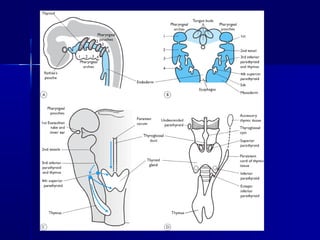
 Foramen cecum begins ant to the copula,Foramen cecum begins ant to the copula,
aka ‘aka ‘hypobranchial eminencehypobranchial eminence ’’
 Median embryologic swelling = mesodermMedian embryologic swelling = mesoderm
that arises from thethat arises from the secondsecond pharyngealpharyngeal
pouch (although the third and fourthpouch (although the third and fourth
pouches are also involved)pouches are also involved)
 SummarySummary - thyroid gland originates from- thyroid gland originates from
b/wb/w 11stst
and 2and 2ndnd
pharyngeal pouchespharyngeal pouches
Initial embryologyInitial embryology
““thyroid primordium”thyroid primordium”
 initial thyroid precursorinitial thyroid precursor
 starts as a simple midline thickeningstarts as a simple midline thickening
 forms thyroid diverticulumforms thyroid diverticulum
 initially hollowinitially hollow
 later solidifies and becomes bilobedlater solidifies and becomes bilobed
Descent of thyroid glandDescent of thyroid gland
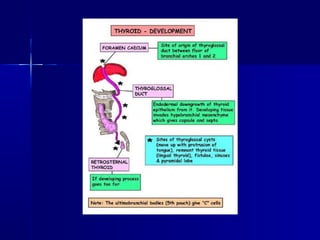
 Initial descent starts ant to pharyngeal gutInitial descent starts ant to pharyngeal gut
 Thyroid still connected to the tongue via theThyroid still connected to the tongue via the
thyroglossal ductthyroglossal duct
 Later - tubular duct solidifies then obliteratesLater - tubular duct solidifies then obliterates
entirely (during gestational weeksentirely (during gestational weeks 7-107-10))
 Foramen cecumForamen cecum = opening of the= opening of the
thyroglossal duct into the tonguethyroglossal duct into the tongue
Descent of thyroid glandDescent of thyroid gland
Pyramidal lobe:Pyramidal lobe:
 in up to 50% peoplein up to 50% people
 persistence of the inferior end of thepersistence of the inferior end of the
thyroglossal duct (fx to obliterate)thyroglossal duct (fx to obliterate)
 may be attached to the hyoid bonemay be attached to the hyoid bone
(~thryoglossal duct cyst) OR may be(~thryoglossal duct cyst) OR may be
incorporatedincorporated intointo a thyroglossal ducta thyroglossal duct
cystcyst
Descent of thyroid glandDescent of thyroid gland
 Further descent – ant (ventral) to theFurther descent – ant (ventral) to the
hyoid bone and laryngeal cartilagehyoid bone and laryngeal cartilage
 DuringDuring descent – thyroid forms itsdescent – thyroid forms its
mature shape: median isthmusmature shape: median isthmus
connecting 2 lateral lobesconnecting 2 lateral lobes
 Descent COMPLETE at 7Descent COMPLETE at 7thth
gestationalgestational
weekweek
Parafollicular cellsParafollicular cells
 AkaAka C cellsC cells
 Secrete calcitonin (Ca regulation)Secrete calcitonin (Ca regulation)
 FromFrom ultimobranchial bodyultimobranchial body (last(last
structure derived from the branchialstructure derived from the branchial
pouches)pouches)
 Ultimobranchial body – fromUltimobranchial body – from 55thth
pharyngeal pouchpharyngeal pouch
Parafollicular cellsParafollicular cells
 Migrating cells from the neural crest regionMigrating cells from the neural crest region
infiltrateinfiltrate  ultimobranchial body (UBB)ultimobranchial body (UBB)
 This struct (neural crest + UBB) =This struct (neural crest + UBB) =
incorporatedincorporated  thyroid glandthyroid gland
 UBBUBB fusesfuses with the thyroid gland andwith the thyroid gland and
disseminatesdisseminates its cells into itits cells into it
 SummarySummary: the C cells of the thyroid are of: the C cells of the thyroid are of
neural crestneural crest origin.origin.
Clinical correlationsClinical correlations
1)1) Thyroglossal duct cystThyroglossal duct cyst
 duct fx to atrophyduct fx to atrophy
 can form a sinuscan form a sinus
 Rx – “Sistrunk” procedure (includes resection part ofRx – “Sistrunk” procedure (includes resection part of
hyoid bone)hyoid bone)
2) Ectopic thyroid2) Ectopic thyroid
 can occur anywhere along the path of descentcan occur anywhere along the path of descent
 most common at the base of the tongue ‘most common at the base of the tongue ‘linguallingual
thyroidthyroid’’
Clinical correlationsClinical correlations
3)3) Accessory thyroidAccessory thyroid
 from remnants of thyroglossal ductfrom remnants of thyroglossal duct
 may be functional but insufficient formay be functional but insufficient for
normal function of thyroidnormal function of thyroid

Thyroid embryology

  • 1.
    Thyroid EmbryologyThyroid Embryology StephanieJohnsonStephanie Johnson PGY 2PGY 2
  • 2.
    Initial embryologyInitial embryology Thyroid:Thyroid: 11stst endocrine glandendocrine gland  Day ~24th gestationDay ~24th gestation  Proliferation ofProliferation of endodermalendodermal cells oncells on midline pharyngeal floormidline pharyngeal floor  Between 2 key structures:Between 2 key structures: – tuberculum impartuberculum impar – CopulaCopula ……called “called “foramen cecumforamen cecum””
  • 4.
    Initial embryologyInitial embryology Thyroid:Thyroid: Initially develops caudal to theInitially develops caudal to the “tuberculum impar”“tuberculum impar” (median tongue bud)(median tongue bud)  From the 1From the 1stst pharyngeal archpharyngeal arch  Midline on floor of developing pharynxMidline on floor of developing pharynx  Eventually helps form the tongue as the 2Eventually helps form the tongue as the 2 lateral lingual swellings overgrow itlateral lingual swellings overgrow it
  • 5.
    Initial embryologyInitial embryology Foramen cecum begins ant to the copula,Foramen cecum begins ant to the copula, aka ‘aka ‘hypobranchial eminencehypobranchial eminence ’’  Median embryologic swelling = mesodermMedian embryologic swelling = mesoderm that arises from thethat arises from the secondsecond pharyngealpharyngeal pouch (although the third and fourthpouch (although the third and fourth pouches are also involved)pouches are also involved)  SummarySummary - thyroid gland originates from- thyroid gland originates from b/wb/w 11stst and 2and 2ndnd pharyngeal pouchespharyngeal pouches
  • 6.
    Initial embryologyInitial embryology ““thyroidprimordium”thyroid primordium”  initial thyroid precursorinitial thyroid precursor  starts as a simple midline thickeningstarts as a simple midline thickening  forms thyroid diverticulumforms thyroid diverticulum  initially hollowinitially hollow  later solidifies and becomes bilobedlater solidifies and becomes bilobed
  • 8.
    Descent of thyroidglandDescent of thyroid gland  Initial descent starts ant to pharyngeal gutInitial descent starts ant to pharyngeal gut  Thyroid still connected to the tongue via theThyroid still connected to the tongue via the thyroglossal ductthyroglossal duct  Later - tubular duct solidifies then obliteratesLater - tubular duct solidifies then obliterates entirely (during gestational weeksentirely (during gestational weeks 7-107-10))  Foramen cecumForamen cecum = opening of the= opening of the thyroglossal duct into the tonguethyroglossal duct into the tongue
  • 9.
    Descent of thyroidglandDescent of thyroid gland Pyramidal lobe:Pyramidal lobe:  in up to 50% peoplein up to 50% people  persistence of the inferior end of thepersistence of the inferior end of the thyroglossal duct (fx to obliterate)thyroglossal duct (fx to obliterate)  may be attached to the hyoid bonemay be attached to the hyoid bone (~thryoglossal duct cyst) OR may be(~thryoglossal duct cyst) OR may be incorporatedincorporated intointo a thyroglossal ducta thyroglossal duct cystcyst
  • 10.
    Descent of thyroidglandDescent of thyroid gland  Further descent – ant (ventral) to theFurther descent – ant (ventral) to the hyoid bone and laryngeal cartilagehyoid bone and laryngeal cartilage  DuringDuring descent – thyroid forms itsdescent – thyroid forms its mature shape: median isthmusmature shape: median isthmus connecting 2 lateral lobesconnecting 2 lateral lobes  Descent COMPLETE at 7Descent COMPLETE at 7thth gestationalgestational weekweek
  • 11.
    Parafollicular cellsParafollicular cells AkaAka C cellsC cells  Secrete calcitonin (Ca regulation)Secrete calcitonin (Ca regulation)  FromFrom ultimobranchial bodyultimobranchial body (last(last structure derived from the branchialstructure derived from the branchial pouches)pouches)  Ultimobranchial body – fromUltimobranchial body – from 55thth pharyngeal pouchpharyngeal pouch
  • 12.
    Parafollicular cellsParafollicular cells Migrating cells from the neural crest regionMigrating cells from the neural crest region infiltrateinfiltrate  ultimobranchial body (UBB)ultimobranchial body (UBB)  This struct (neural crest + UBB) =This struct (neural crest + UBB) = incorporatedincorporated  thyroid glandthyroid gland  UBBUBB fusesfuses with the thyroid gland andwith the thyroid gland and disseminatesdisseminates its cells into itits cells into it  SummarySummary: the C cells of the thyroid are of: the C cells of the thyroid are of neural crestneural crest origin.origin.
  • 13.
    Clinical correlationsClinical correlations 1)1)Thyroglossal duct cystThyroglossal duct cyst  duct fx to atrophyduct fx to atrophy  can form a sinuscan form a sinus  Rx – “Sistrunk” procedure (includes resection part ofRx – “Sistrunk” procedure (includes resection part of hyoid bone)hyoid bone) 2) Ectopic thyroid2) Ectopic thyroid  can occur anywhere along the path of descentcan occur anywhere along the path of descent  most common at the base of the tongue ‘most common at the base of the tongue ‘linguallingual thyroidthyroid’’
  • 15.
    Clinical correlationsClinical correlations 3)3)Accessory thyroidAccessory thyroid  from remnants of thyroglossal ductfrom remnants of thyroglossal duct  may be functional but insufficient formay be functional but insufficient for normal function of thyroidnormal function of thyroid