Identification of
important lobsters
By – Joselin Karunya Mary .J
Lobsters are invertebrates with a hard protective exoskeleton. Like
most arthropods, lobsters must moult to grow, which leaves them
vulnerable. During the moulting process, several species change
color. Lobsters have eight walking legs; the front three pairs bear
claws, the first of which are larger than the others. The front pincers
are also biologically considered legs, so they belong in the order
Decapods ("ten-footed").
Lobster general appearance
• Carapace (shape, surface sculpturation, spination)
• Eyes (absent, reduced or well developed, position of the orbits),
• Antennulae (length of flagella)
• Antennae (size, shape, dentition and shape, length and structure
of the flagellum)
• Antennular plate (number and arrangement of spines, presence or
absence of a stridulating organ)
• Pereopods (whether or not chelate, size and structure of chelae)
• Thoracic sternum (general shape, shape of anterior margin,
presence or absence of tubercles or spines)
• Abdomen (dorsal sculpturation, shape of the pleura, shape of the
tail, number of pleopods)
• Colour and the colour pattern of the species are also helpful in
field identification
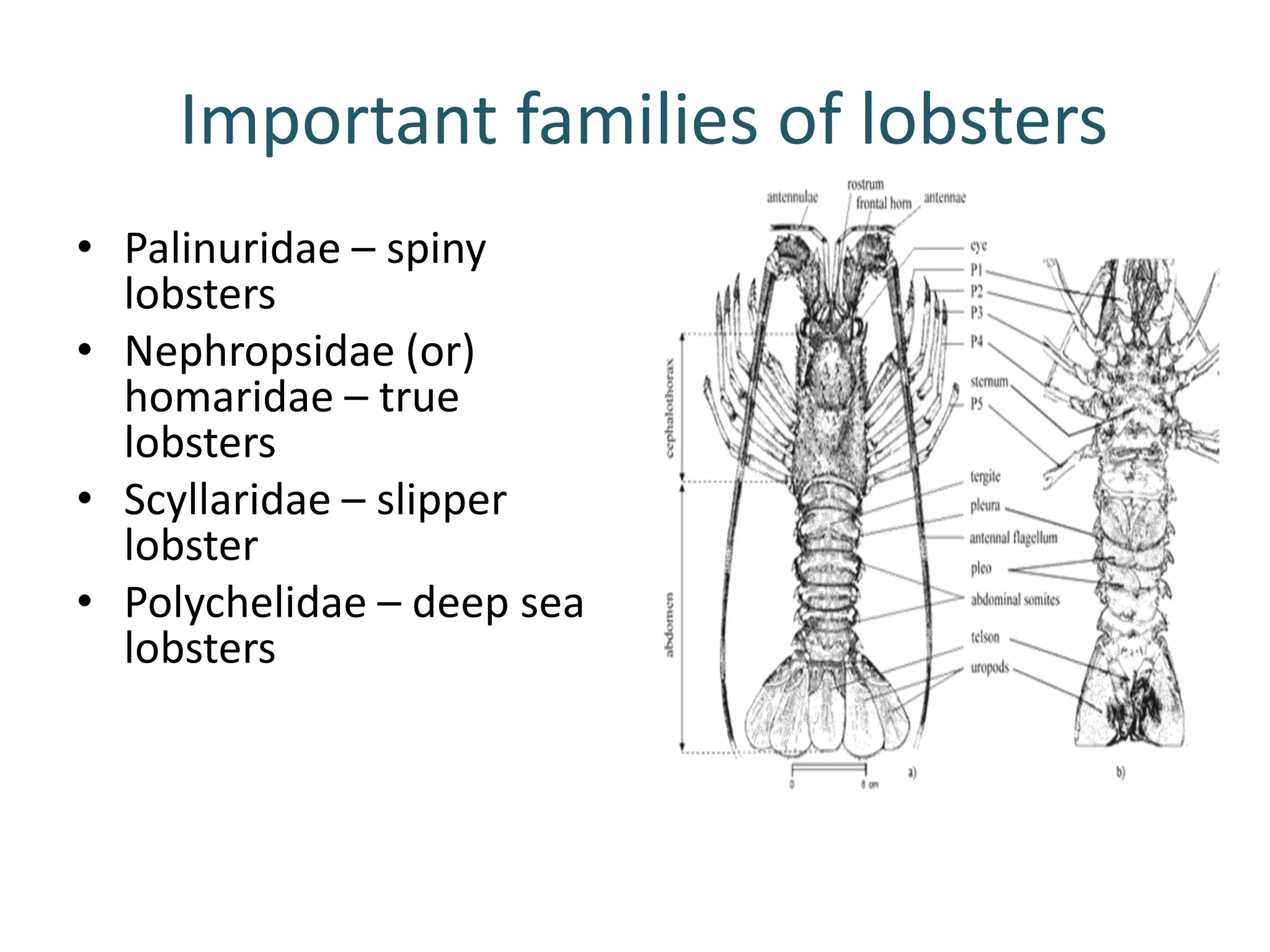
Important families of lobsters
• Palinuridae – spiny
lobsters
• Nephropsidae (or)
homaridae – true
lobsters
• Scyllaridae – slipper
lobster
• Polychelidae – deep sea
lobsters
• Classification ;
kingdom – animalia
phylum – arthropoda
class - crustacea
sub class- malacostraca
order – decapoda
Family characters- palinuridae
• Body tubular carapace without rostrum
• Legs with true pincers
• First pair of legs not enlarged
• Antenna longer than body
Commercially important genera is panulirus
,puerulus
Panulirus homarus(scalloped spiny
lobster)
• Scalloped anterior margin of transverse groove
• Base of antennae separated by a broad
antennular plate bearing 2 equal well separated
pairs of principal spines and scattering small
spines
• Dark greenish to blackish color
• Antennal flagella distinctly ringed
• Bright coloured species
P. longipes (long legged spiny lobster)
• Antennal and antennular flagella cross banded
• Legs with white spotes and line of yellow in
between
• 1 pair of spines followed by small spines
• Antennal flagellum very long
• Abdomen with numerous round spots
• Transverse grooves complete
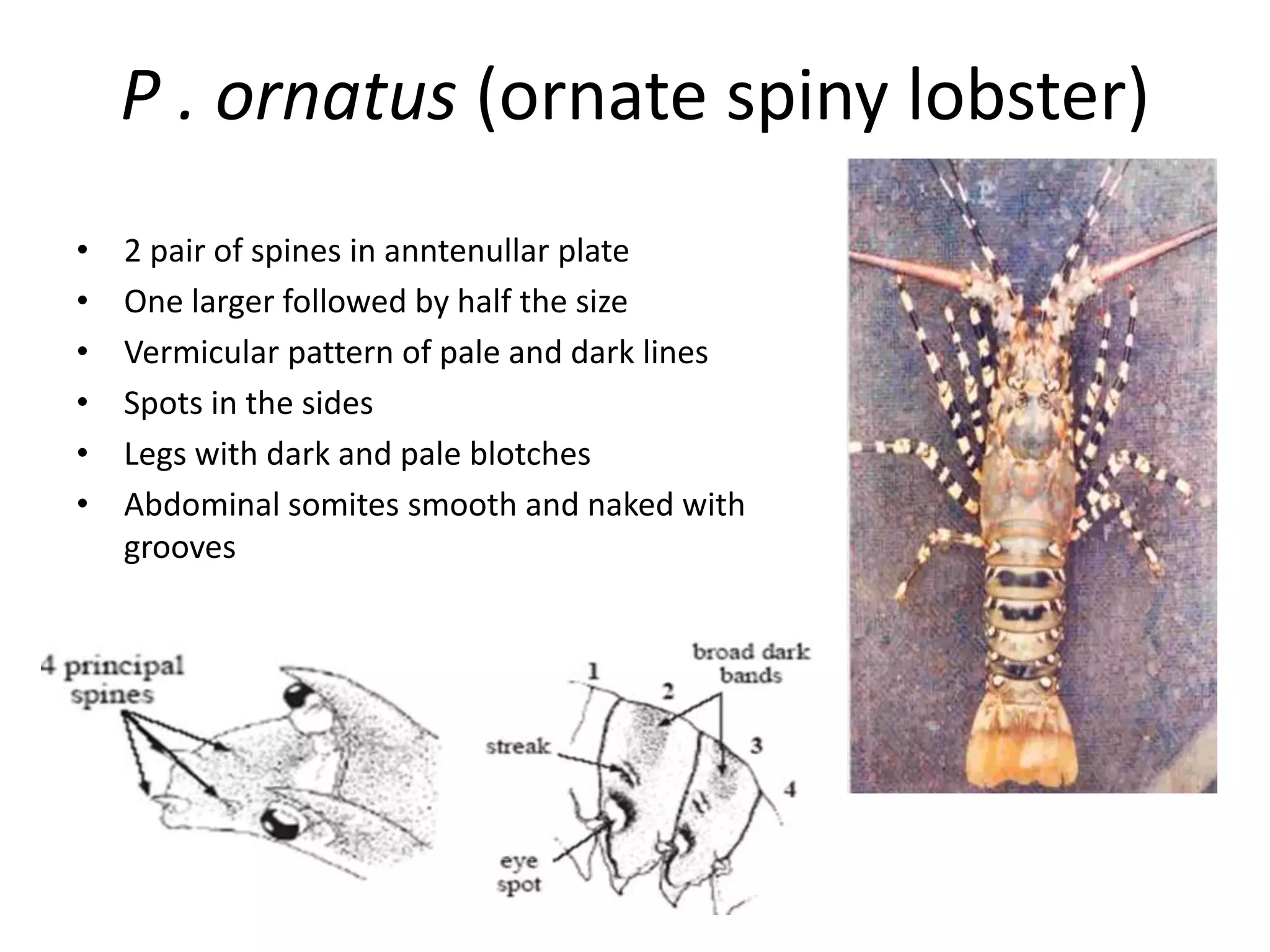
P . ornatus (ornate spiny lobster)
• 2 pair of spines in anntenullar plate
• One larger followed by half the size
• Vermicular pattern of pale and dark lines
• Spots in the sides
• Legs with dark and pale blotches
• Abdominal somites smooth and naked with
grooves
P . Penicillatus (pronghorn spiny
lobster)
• 2 pair of equal sized spines joined at their base in
antennular plate
• Antennular flagellae green or brown
• Legs with fine longitudinal white or yellow stripes
• Colur – body greenish or reddish, ranges from brown
green to blue black or dark reddish brown
• 1st abdominal somite has white spots
• Legs with yellow streaks
P. Polyphagus ( mud spiny lobster)
• Single pair of large spines in antennular plate
• Antennal flagellum very longer ie 1.5 times of
the body
• Abdomenal segments with a distict band of
white
• Legs irregularly blotched creamy white
• No tranverse groves, yellowish white bands
present.
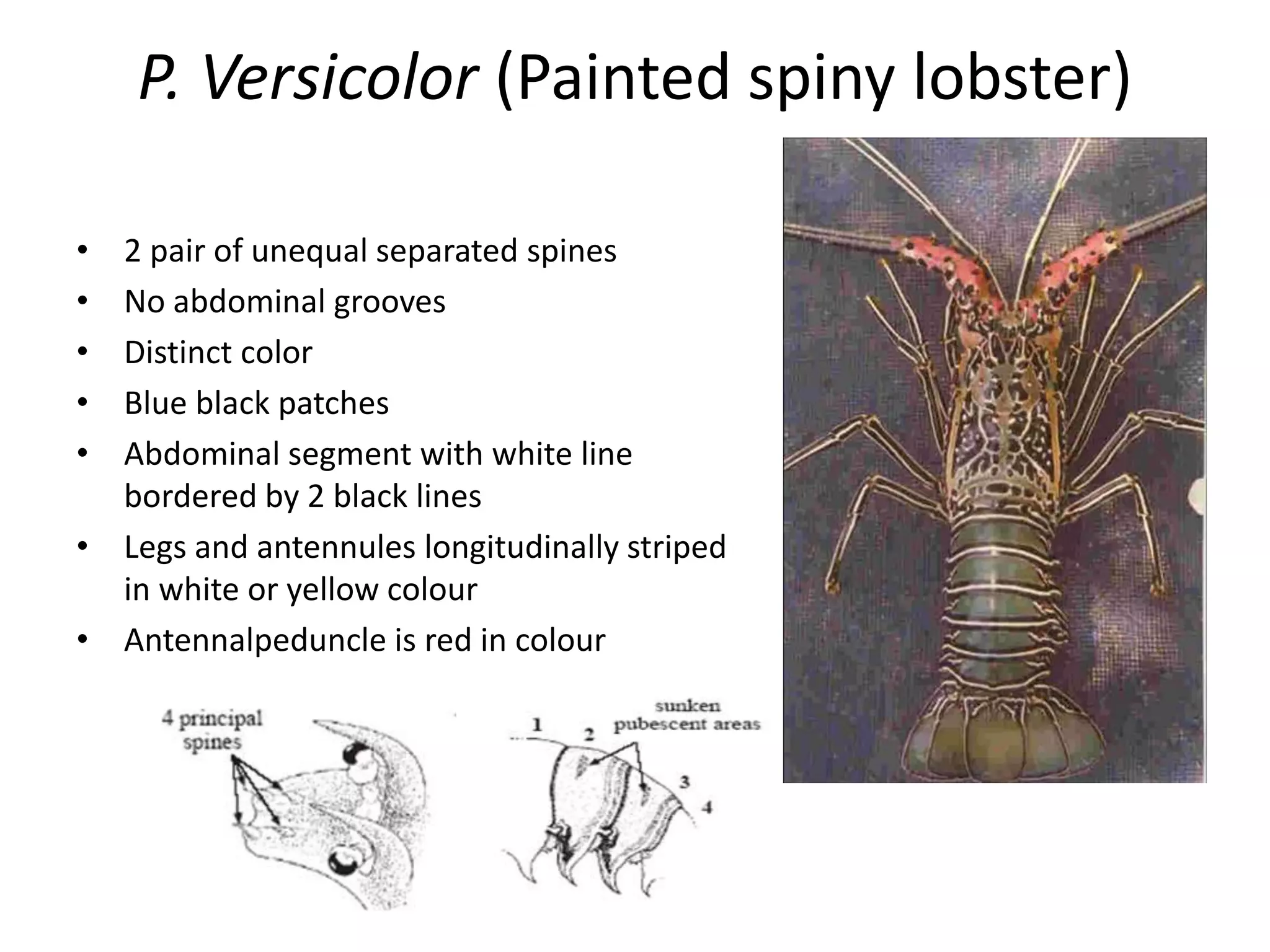
P. Versicolor (Painted spiny lobster)
• 2 pair of unequal separated spines
• No abdominal grooves
• Distinct color
• Blue black patches
• Abdominal segment with white line
bordered by 2 black lines
• Legs and antennules longitudinally striped
in white or yellow colour
• Antennalpeduncle is red in colour
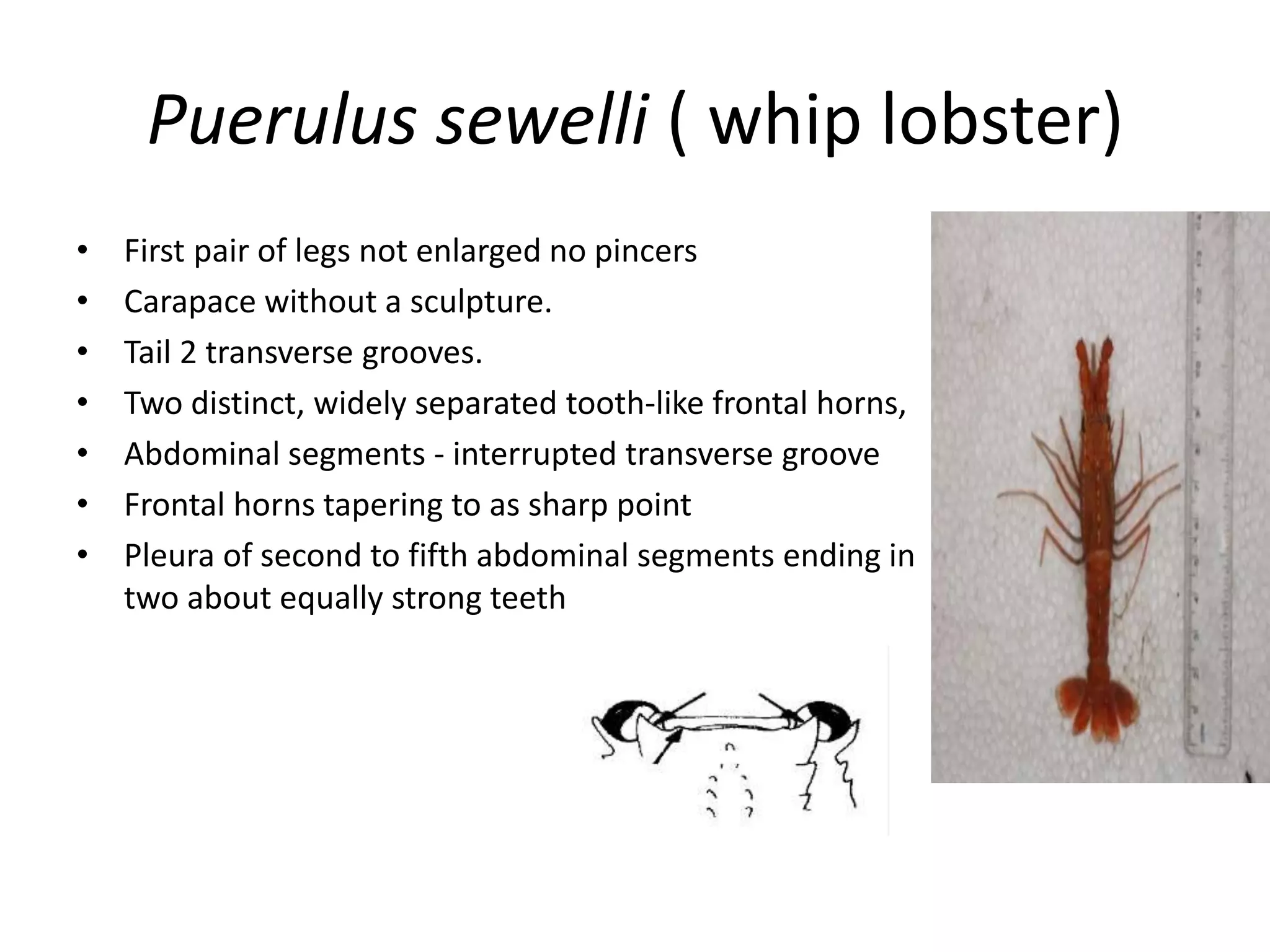
Puerulus sewelli ( whip lobster)
• First pair of legs not enlarged no pincers
• Carapace without a sculpture.
• Tail 2 transverse grooves.
• Two distinct, widely separated tooth-like frontal horns,
• Abdominal segments - interrupted transverse groove
• Frontal horns tapering to as sharp point
• Pleura of second to fifth abdominal segments ending in
two about equally strong teeth
Nephropidae family characters
• They are called as true lobsters
• Family also known as homaridae
• Carapace with rostrum
• 1st three pairs with pincers
• First larger than rest
Homarus americanus (american
lobster)
• It is the largest lobster
species
• Rostrum with one or
more ventral teeth
• Palm of 1st chelipeds
are naked without hair
cover
• 1st chelipeds left and
right are strongly
different in shape
Scyllaridae family characters
• Flattened dorsoventrally
• Rostrum not present
• Antennae scale like
• Legs without pincers
• All small
• Also clled as slipper lobster
Genus thenus is important .
Thenus characters
• Orbits on the anterolateral angle of the carapace.
• No teeth on the lateral margin of the carapace, apart from the
anterolateral and postcervical.
• Carapace flat, triangular, narrowing posteriorly.
• Exposed third and first maxilliped without a flagellum.
• The flagellum of the second maxilliped gets transformed as the single
laminate segment.
• Body strongly depressed.
• Fifth leg of bundle with a chela.
• Abdomen granular with transverse groove over middle of each segment.
• Fifth segment with a sharp spiniform tooth in the middle of posterior
margin.
• 2nd pair of Antennae are most conspicuous as they are flat plates
projecting outwards the head .
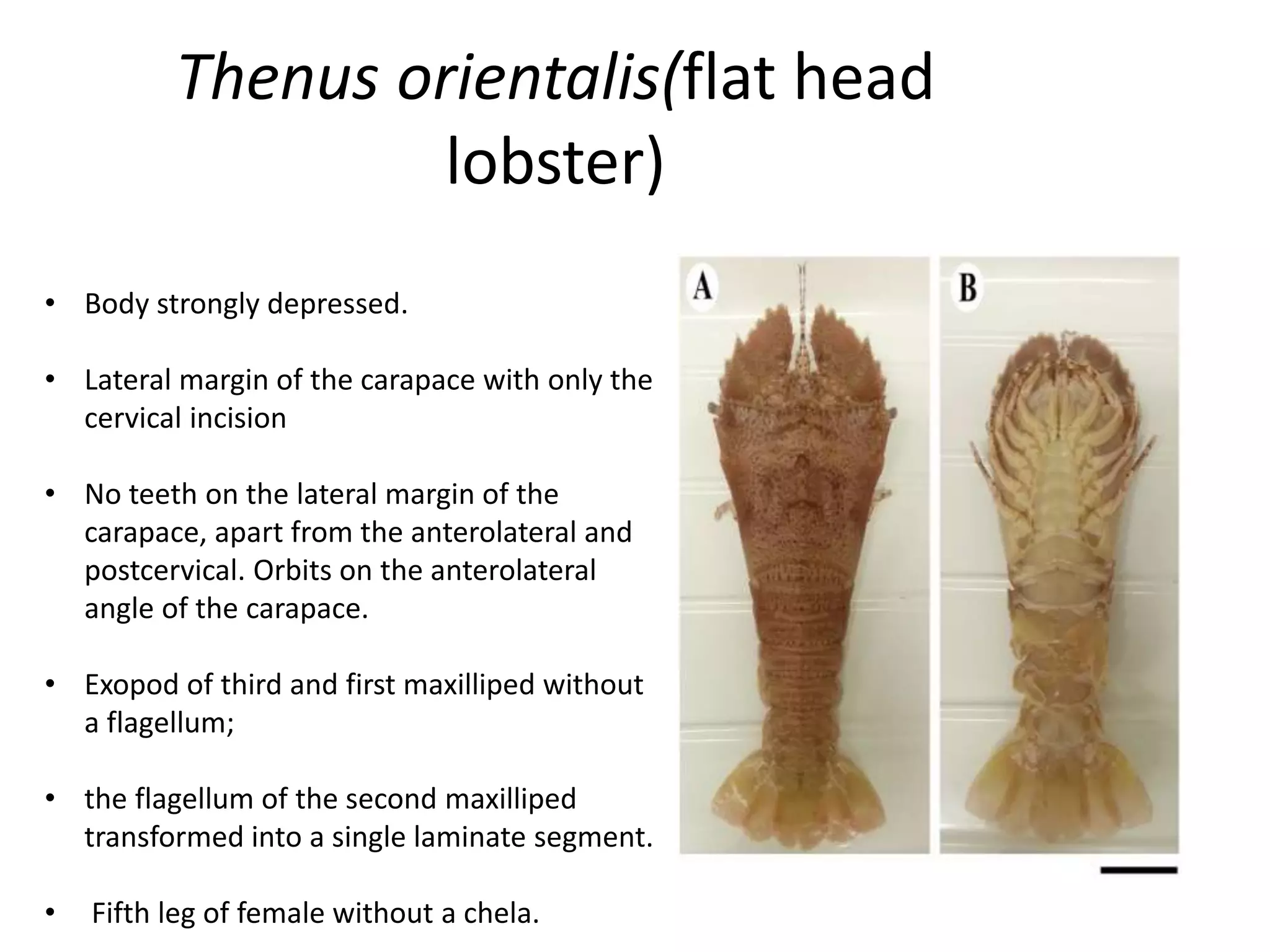
Thenus orientalis(flat head
lobster)
• Body strongly depressed.
• Lateral margin of the carapace with only the
cervical incision
• No teeth on the lateral margin of the
carapace, apart from the anterolateral and
postcervical. Orbits on the anterolateral
angle of the carapace.
• Exopod of third and first maxilliped without
a flagellum;
• the flagellum of the second maxilliped
transformed into a single laminate segment.
• Fifth leg of female without a chela.
Polychelidae family characters
The family Polychelidae is notable for the number of chelate
(clawed) limbs, with either four or all five pairs of pereiopods
bearing claws. This gives rise to the scientific names
Polycheles (many-clawed) The first pair of periopods are
greatly elongated, but often become broken off while
specimens are being brought to the surface. The rostrum is
very short or absent, and, although eyestalks are present, the
eyes are absent. This family can be seen as evidence of the
transition from shrimp-like animals to lobster-like animals,
since they possess a number of primitive characters , such as
the pointed telson, in contrast to the rounded telson in
lobsters.
Polychelus sculptus
Polycheles sculptus is a species of
"strange, blind crustacean"
resembling a prawn or a squat
lobster.
Thank you.

Identification of important lobsters

  • 1.
    Identification of important lobsters By– Joselin Karunya Mary .J
  • 2.
    Lobsters are invertebrateswith a hard protective exoskeleton. Like most arthropods, lobsters must moult to grow, which leaves them vulnerable. During the moulting process, several species change color. Lobsters have eight walking legs; the front three pairs bear claws, the first of which are larger than the others. The front pincers are also biologically considered legs, so they belong in the order Decapods ("ten-footed").
  • 3.
    Lobster general appearance •Carapace (shape, surface sculpturation, spination) • Eyes (absent, reduced or well developed, position of the orbits), • Antennulae (length of flagella) • Antennae (size, shape, dentition and shape, length and structure of the flagellum) • Antennular plate (number and arrangement of spines, presence or absence of a stridulating organ) • Pereopods (whether or not chelate, size and structure of chelae) • Thoracic sternum (general shape, shape of anterior margin, presence or absence of tubercles or spines) • Abdomen (dorsal sculpturation, shape of the pleura, shape of the tail, number of pleopods) • Colour and the colour pattern of the species are also helpful in field identification
  • 4.
    Important families oflobsters • Palinuridae – spiny lobsters • Nephropsidae (or) homaridae – true lobsters • Scyllaridae – slipper lobster • Polychelidae – deep sea lobsters
  • 5.
    • Classification ; kingdom– animalia phylum – arthropoda class - crustacea sub class- malacostraca order – decapoda
  • 6.
    Family characters- palinuridae •Body tubular carapace without rostrum • Legs with true pincers • First pair of legs not enlarged • Antenna longer than body Commercially important genera is panulirus ,puerulus
  • 7.
    Panulirus homarus(scalloped spiny lobster) •Scalloped anterior margin of transverse groove • Base of antennae separated by a broad antennular plate bearing 2 equal well separated pairs of principal spines and scattering small spines • Dark greenish to blackish color • Antennal flagella distinctly ringed • Bright coloured species
  • 8.
    P. longipes (longlegged spiny lobster) • Antennal and antennular flagella cross banded • Legs with white spotes and line of yellow in between • 1 pair of spines followed by small spines • Antennal flagellum very long • Abdomen with numerous round spots • Transverse grooves complete
  • 9.
    P . ornatus(ornate spiny lobster) • 2 pair of spines in anntenullar plate • One larger followed by half the size • Vermicular pattern of pale and dark lines • Spots in the sides • Legs with dark and pale blotches • Abdominal somites smooth and naked with grooves
  • 10.
    P . Penicillatus(pronghorn spiny lobster) • 2 pair of equal sized spines joined at their base in antennular plate • Antennular flagellae green or brown • Legs with fine longitudinal white or yellow stripes • Colur – body greenish or reddish, ranges from brown green to blue black or dark reddish brown • 1st abdominal somite has white spots • Legs with yellow streaks
  • 11.
    P. Polyphagus (mud spiny lobster) • Single pair of large spines in antennular plate • Antennal flagellum very longer ie 1.5 times of the body • Abdomenal segments with a distict band of white • Legs irregularly blotched creamy white • No tranverse groves, yellowish white bands present.
  • 12.
    P. Versicolor (Paintedspiny lobster) • 2 pair of unequal separated spines • No abdominal grooves • Distinct color • Blue black patches • Abdominal segment with white line bordered by 2 black lines • Legs and antennules longitudinally striped in white or yellow colour • Antennalpeduncle is red in colour
  • 13.
    Puerulus sewelli (whip lobster) • First pair of legs not enlarged no pincers • Carapace without a sculpture. • Tail 2 transverse grooves. • Two distinct, widely separated tooth-like frontal horns, • Abdominal segments - interrupted transverse groove • Frontal horns tapering to as sharp point • Pleura of second to fifth abdominal segments ending in two about equally strong teeth
  • 14.
    Nephropidae family characters •They are called as true lobsters • Family also known as homaridae • Carapace with rostrum • 1st three pairs with pincers • First larger than rest
  • 15.
    Homarus americanus (american lobster) •It is the largest lobster species • Rostrum with one or more ventral teeth • Palm of 1st chelipeds are naked without hair cover • 1st chelipeds left and right are strongly different in shape
  • 16.
    Scyllaridae family characters •Flattened dorsoventrally • Rostrum not present • Antennae scale like • Legs without pincers • All small • Also clled as slipper lobster Genus thenus is important .
  • 17.
    Thenus characters • Orbitson the anterolateral angle of the carapace. • No teeth on the lateral margin of the carapace, apart from the anterolateral and postcervical. • Carapace flat, triangular, narrowing posteriorly. • Exposed third and first maxilliped without a flagellum. • The flagellum of the second maxilliped gets transformed as the single laminate segment. • Body strongly depressed. • Fifth leg of bundle with a chela. • Abdomen granular with transverse groove over middle of each segment. • Fifth segment with a sharp spiniform tooth in the middle of posterior margin. • 2nd pair of Antennae are most conspicuous as they are flat plates projecting outwards the head .
  • 18.
    Thenus orientalis(flat head lobster) •Body strongly depressed. • Lateral margin of the carapace with only the cervical incision • No teeth on the lateral margin of the carapace, apart from the anterolateral and postcervical. Orbits on the anterolateral angle of the carapace. • Exopod of third and first maxilliped without a flagellum; • the flagellum of the second maxilliped transformed into a single laminate segment. • Fifth leg of female without a chela.
  • 19.
    Polychelidae family characters Thefamily Polychelidae is notable for the number of chelate (clawed) limbs, with either four or all five pairs of pereiopods bearing claws. This gives rise to the scientific names Polycheles (many-clawed) The first pair of periopods are greatly elongated, but often become broken off while specimens are being brought to the surface. The rostrum is very short or absent, and, although eyestalks are present, the eyes are absent. This family can be seen as evidence of the transition from shrimp-like animals to lobster-like animals, since they possess a number of primitive characters , such as the pointed telson, in contrast to the rounded telson in lobsters.
  • 20.
    Polychelus sculptus Polycheles sculptusis a species of "strange, blind crustacean" resembling a prawn or a squat lobster.
  • 21.