Project Group PUSHPIN
Idea description
16.02.2012


Wolfgang Reinhardt & Tobias Varlemann
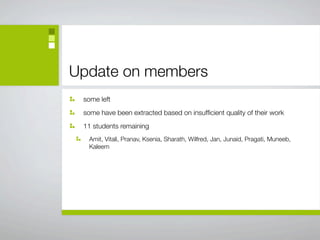
Update on members
 some left
 some have been extracted based on insufficient quality of their work
 11 students remaining
  Amit, Vitali, Pranav, Ksenia, Sharath, Wilfred, Jan, Junaid, Pragati, Muneeb,
  Kaleem
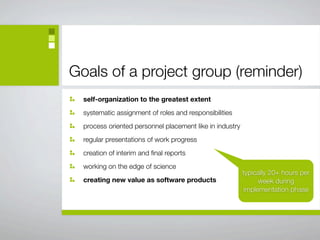
Goals of a project group (reminder)
  self-organization to the greatest extent
  systematic assignment of roles and responsibilities
  process oriented personnel placement like in industry
  regular presentations of work progress
  creation of interim and final reports
  working on the edge of science
                                                          typically 20+ hours per
  creating new value as software products                      week during
                                                          implementation phase
Purpose of this meeting
  Description of the general idea that we (as customers) have
  shifting work from us to you


   now

   it’s

   your

   turn
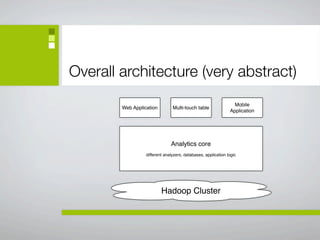
Overall architecture (very abstract)
                                                                 Mobile
        Web Application         Multi-touch table
                                                               Application


                               Analytics core
                  different analyzers, databases, application logic


                          Hadoop Cluster
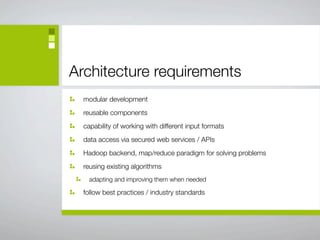
Architecture requirements
  modular development
  reusable components
  capability of working with different input formats
  data access via secured web services / APIs
  Hadoop backend, map/reduce paradigm for solving problems
  reusing existing algorithms
    adapting and improving them when needed

  follow best practices / industry standards
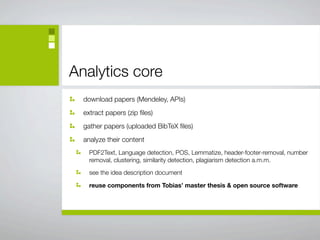
Analytics core
  download papers (Mendeley, APIs)
  extract papers (zip files)
  gather papers (uploaded BibTeX files)
  analyze their content
    PDF2Text, Language detection, POS, Lemmatize, header-footer-removal, number
    removal, clustering, similarity detection, plagiarism detection a.m.m.

    see the idea description document

    reuse components from Tobias’ master thesis & open source software
Web application
 will be the most used interface to PUSHPIN
 sign-up & sign-in
 edit user profiles
 connect social media accounts
 follow other people
 activity streams (user, affiliation, research domain, topic, tag)
 upload papers
 tagging, bookmarking, liking of objects
Web application II
  visualizations
    networks

    metrics

    graphs

    side-by-side comparison of objects

    plagiarism visualization

    visual recommendation rationale

  faceted full-text search
    annotated search results, “find similar”
Mobile application
  access to the PUSHPIN data
  share user profile (digital business card)
  find researchers nearby
  access your publications
    share them

  authentication at multi-touch table
Multi-touch table application
  different authentication methods
  large scale-visualizations
  find yourself in the network
  compare documents / researchers
  explore similarity between objects
  see maps of affiliations, cooperation networks
  send files from mobile to table and vice versa
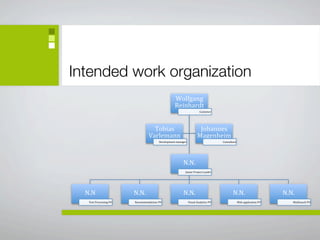
Intended work organization
                                                    Wolfgang(
                                                    Reinhardt(
                                                                         Customer(


                                    Tobias(                             Johannes(
                                  Varlemann(                           Magenheim(
                                         Development(manager(                          Consultant(


                                                          N.N.(
                                                           Junior(Project(Leader(


  N.N(                   N.N.(                            N.N.(                                N.N.(                       N.N.(
   Text(Processing(PO(   Recommendations(PO(                    Visual(Analytics(PO(                 Web(application(PO(      Multitouch(PO(
User stories
  Ben is a researcher at the University of Maryland. He has heard of the
  PUSHPIN system and wants to explore its functionalities. Ben navigates to
  the PUSHPIN web application and signs up for an account using an OAuth
  with his Mendeley account. Ben fills in some basic questions about his
  research interests, his social media handles and his affiliation while the
  PUSHPIN system grabs Ben’s publications from Mendeley in the
  background. Ben surfs the PUSHPIN application and finds the profile of Tom
  who is working at the Hong Kong University. As Tom is researcher in a very
  similar research domain and they have met before, Ben starts following Tom
  on PUSHPIN. Tom receives a notification mail telling him that Ben is now
  following him and he decides to follow him back. After Ben’s publications
  have been analyzed by the PUSHPIN infrastructure, Ben receives first
User stories
  Ben is a researcher at the University of Maryland. He has heard of the
  PUSHPIN system and wants to explore its functionalities. Ben navigates to
  the PUSHPIN web application and signs up for an account using an OAuth
  with his Mendeley account. Ben fills in some basic questions about his
  research interests, his social media handles and his affiliation while the
  PUSHPIN system grabs Ben’s publications from Mendeley in the
  background. Ben surfs the PUSHPIN application and finds the profile of Tom
  who is working at the Hong Kong University. As Tom is researcher in a very
  similar research domain and they have met before, Ben starts following
  Tom on PUSHPIN. Tom receives a notification mail telling him that Ben is
  now following him and he decides to follow him back. After Ben’s
  publications have been analyzed by the PUSHPIN infrastructure, Ben
Feature descriptions
  Connextra format
   In order to < business value >
   As a < role >
   I want to < feature >


   forces you to think of WHY you want that feature

   in FDD you implement certain features in an iteration (only what is necessary for
   that feature)
Mockups
 create Mockups for your applications
  core UI elements

  user flow (when the user clicks here, then ...)

  link to user stories and feature descriptions (at least one mockup for each feature)


  use whatever tool you want to use

    Balsamiq Mockups / Microsoft Visio / amm

    http://speckyboy.com/2011/02/23/10-completely-free-wireframing-and-
    mockup-tools/
Next steps
 read the written idea description
   https://trac.cs.upb.de/pgpushpin/wiki/IdeaDescription

 sit down together and discuss the idea
   if you have questions mail us
                                                             use the trac
   prepare discussion items for the next meeting
                                                           system for doing
 derive requirements on the architecture                         that
 derive feature descriptions
 develop more user stories
 derive modules of the architecture and apps that you’ll have to implement
Next steps II
  Wed, 22.02.
   ask the customer

   present user stories and requirements

   further develop features, user stories and requirements

  Thu, 23.02.
   ask the customer

  Wed, 29.02.
   ask the customer, present results
Next steps III
  Thu, 01.03.
   show first prototypes

   sequence diagrams

   preliminary architecture

   how and where to store information

   finalize responsibilities


   starting shoot for the real implementation phase
wolfgang reinhardt  university of paderborn


                                                social media               sna
twitter        recommendations
                                                 awareness
research networks
                                                  bibliometrics
  artefact-actor-networks
                                                                     ginkgo
                            research 2.0
                 www.isitjustme.de        www.ginkgosem.com
  @wollepb                           @wollepb                  @wolfgang.reinhardt
  @wollepb                           @wollepb                  @wolfgang.reinhardt
  @wollepb                           @wollepb                  @wollepb

Idea presentation for the project group PUSHPIN

  • 1.
    Project Group PUSHPIN Ideadescription 16.02.2012 Wolfgang Reinhardt & Tobias Varlemann
  • 2.
    Update on members some left some have been extracted based on insufficient quality of their work 11 students remaining Amit, Vitali, Pranav, Ksenia, Sharath, Wilfred, Jan, Junaid, Pragati, Muneeb, Kaleem
  • 3.
    Goals of aproject group (reminder) self-organization to the greatest extent systematic assignment of roles and responsibilities process oriented personnel placement like in industry regular presentations of work progress creation of interim and final reports working on the edge of science typically 20+ hours per creating new value as software products week during implementation phase
  • 4.
    Purpose of thismeeting Description of the general idea that we (as customers) have shifting work from us to you now it’s your turn
  • 5.
    Overall architecture (veryabstract) Mobile Web Application Multi-touch table Application Analytics core different analyzers, databases, application logic Hadoop Cluster
  • 6.
    Architecture requirements modular development reusable components capability of working with different input formats data access via secured web services / APIs Hadoop backend, map/reduce paradigm for solving problems reusing existing algorithms adapting and improving them when needed follow best practices / industry standards
  • 7.
    Analytics core download papers (Mendeley, APIs) extract papers (zip files) gather papers (uploaded BibTeX files) analyze their content PDF2Text, Language detection, POS, Lemmatize, header-footer-removal, number removal, clustering, similarity detection, plagiarism detection a.m.m. see the idea description document reuse components from Tobias’ master thesis & open source software
  • 8.
    Web application willbe the most used interface to PUSHPIN sign-up & sign-in edit user profiles connect social media accounts follow other people activity streams (user, affiliation, research domain, topic, tag) upload papers tagging, bookmarking, liking of objects
  • 9.
    Web application II visualizations networks metrics graphs side-by-side comparison of objects plagiarism visualization visual recommendation rationale faceted full-text search annotated search results, “find similar”
  • 10.
    Mobile application access to the PUSHPIN data share user profile (digital business card) find researchers nearby access your publications share them authentication at multi-touch table
  • 11.
    Multi-touch table application different authentication methods large scale-visualizations find yourself in the network compare documents / researchers explore similarity between objects see maps of affiliations, cooperation networks send files from mobile to table and vice versa
  • 12.
    Intended work organization Wolfgang( Reinhardt( Customer( Tobias( Johannes( Varlemann( Magenheim( Development(manager( Consultant( N.N.( Junior(Project(Leader( N.N( N.N.( N.N.( N.N.( N.N.( Text(Processing(PO( Recommendations(PO( Visual(Analytics(PO( Web(application(PO( Multitouch(PO(
  • 13.
    User stories Ben is a researcher at the University of Maryland. He has heard of the PUSHPIN system and wants to explore its functionalities. Ben navigates to the PUSHPIN web application and signs up for an account using an OAuth with his Mendeley account. Ben fills in some basic questions about his research interests, his social media handles and his affiliation while the PUSHPIN system grabs Ben’s publications from Mendeley in the background. Ben surfs the PUSHPIN application and finds the profile of Tom who is working at the Hong Kong University. As Tom is researcher in a very similar research domain and they have met before, Ben starts following Tom on PUSHPIN. Tom receives a notification mail telling him that Ben is now following him and he decides to follow him back. After Ben’s publications have been analyzed by the PUSHPIN infrastructure, Ben receives first
  • 14.
    User stories Ben is a researcher at the University of Maryland. He has heard of the PUSHPIN system and wants to explore its functionalities. Ben navigates to the PUSHPIN web application and signs up for an account using an OAuth with his Mendeley account. Ben fills in some basic questions about his research interests, his social media handles and his affiliation while the PUSHPIN system grabs Ben’s publications from Mendeley in the background. Ben surfs the PUSHPIN application and finds the profile of Tom who is working at the Hong Kong University. As Tom is researcher in a very similar research domain and they have met before, Ben starts following Tom on PUSHPIN. Tom receives a notification mail telling him that Ben is now following him and he decides to follow him back. After Ben’s publications have been analyzed by the PUSHPIN infrastructure, Ben
  • 15.
    Feature descriptions Connextra format In order to < business value > As a < role > I want to < feature > forces you to think of WHY you want that feature in FDD you implement certain features in an iteration (only what is necessary for that feature)
  • 16.
    Mockups create Mockupsfor your applications core UI elements user flow (when the user clicks here, then ...) link to user stories and feature descriptions (at least one mockup for each feature) use whatever tool you want to use Balsamiq Mockups / Microsoft Visio / amm http://speckyboy.com/2011/02/23/10-completely-free-wireframing-and- mockup-tools/
  • 17.
    Next steps readthe written idea description https://trac.cs.upb.de/pgpushpin/wiki/IdeaDescription sit down together and discuss the idea if you have questions mail us use the trac prepare discussion items for the next meeting system for doing derive requirements on the architecture that derive feature descriptions develop more user stories derive modules of the architecture and apps that you’ll have to implement
  • 18.
    Next steps II Wed, 22.02. ask the customer present user stories and requirements further develop features, user stories and requirements Thu, 23.02. ask the customer Wed, 29.02. ask the customer, present results
  • 19.
    Next steps III Thu, 01.03. show first prototypes sequence diagrams preliminary architecture how and where to store information finalize responsibilities starting shoot for the real implementation phase
  • 20.
    wolfgang reinhardt university of paderborn social media sna twitter recommendations awareness research networks bibliometrics artefact-actor-networks ginkgo research 2.0 www.isitjustme.de www.ginkgosem.com @wollepb @wollepb @wolfgang.reinhardt @wollepb @wollepb @wolfgang.reinhardt @wollepb @wollepb @wollepb