Awareness Support in
 Scientific Events with
        SETapp
Wolfgang Reinhardt, Tim Messerschmidt, Tobias Nelkner
                 University of Paderborn, Germany

1st Workshop on Awareness and Reflection in Learning Networks at the
    2011 European Conference on Technology Enhanced Learning
Awareness ...
•“is [an] ambiguous and unsatisfactory” term and
  “hardly a concise concept by any standard” (Schmidt
  2002)

•CSCW research largely focused on groupware in order
  to

•broader meaning in networked communities (Reinhardt
  and Mletzko 2011)

 •trends, experts, network properties, knowledge
       awareness, history of connections, longitudinal
       evolvement
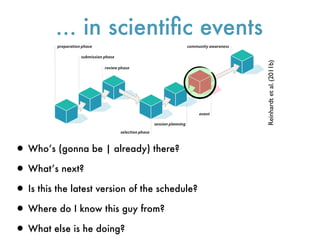
... in scientific events


                                                Reinhardt et al. (2011b)
• Who’s (gonna be | already) there?
• What’s next?
• Is this the latest version of the schedule?
• Where do I know this guy from?
• What else is he doing?
Goal of this research

•explore the usability of NFC in the context of scientific
  events

•develop a prototypical Android application
•compare performance of NFC with QR codes
•user evaluation (acceptance, satisfaction)
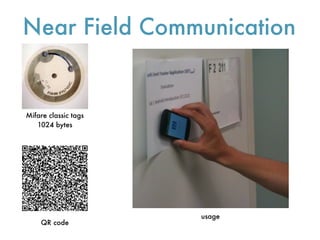
NFC?
Near Field Communication

•wireless data exchange
•fast linking of devices (< 0.02s)
•short transmission distance ( < 2cm)
•very high fault tolerance
•NFC tags with up to 1MB storage
•active and passive standard
Near Field Communication


Mifare classic tags
   1024 bytes


                      usage
    QR code
Selected Use Cases
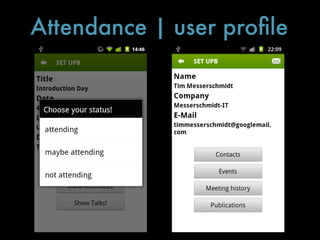
•follow / plan to attend events
•check in to events and talks
•get additional data about posters
•exchange researcher profiles
•send / receive messages
•browse contacts and their publications (Mendeley)
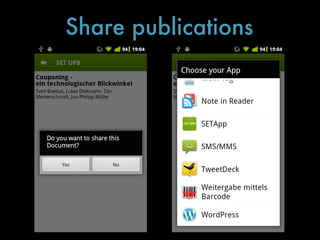
•share publications
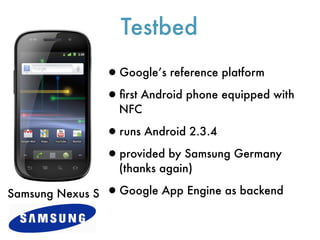
Testbed
                  •Google’s reference platform
                  •first Android phone equipped with
                    NFC

                  •runs Android 2.3.4
                  •provided by Samsung Germany
                    (thanks again)

Samsung Nexus S   •Google App Engine as backend
Dependency on
reliable Internet
   connection a go od
              not
                         cte l1 1
                    at #e
            i dea
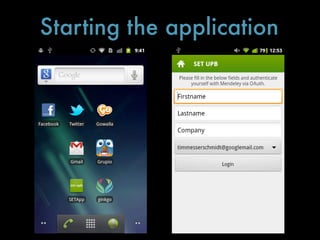
Starting the application
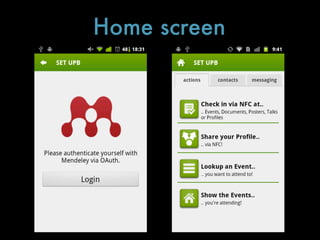
Home screen
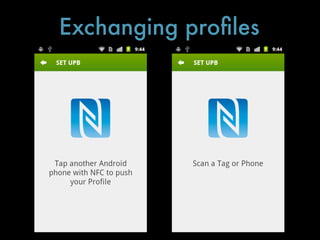
Exchanging profiles
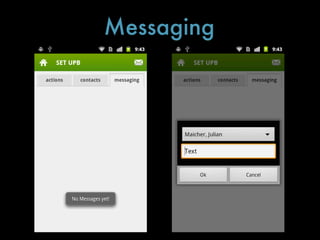
Messaging
Attendance | user profile
Share publications
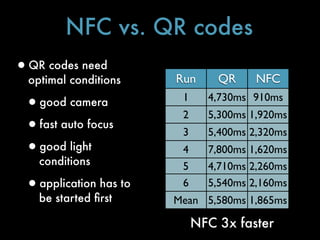
NFC vs. QR codes
•QR codes need
  optimal conditions   Run      QR     NFC

 •good camera           1
                        2
                              4,730ms 910ms
                              5,300ms 1,920ms
 •fast auto focus       3     5,400ms 2,320ms
 •good light            4     7,800ms 1,620ms
    conditions          5     4,710ms 2,260ms
 •application has to    6     5,540ms 2,160ms
    be started first    Mean 5,580ms 1,865ms

                            NFC 3x faster
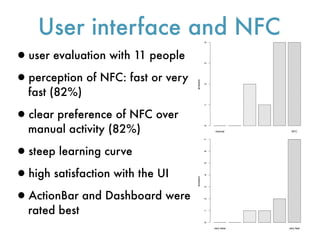
User interface and NFC


                                             4
•user evaluation with 11 people


                                             3
•perception of NFC: fast or very


                                   answers

                                             2
  fast (82%)

•clear preference of NFC over


                                             1
  manual activity (82%)


                                             0
                                                 manual        NFC


•steep learning curve

                                             7
                                             6
•high satisfaction with the UI
                                             5
                                             4
                                   answers
•ActionBar and Dashboard were                3
                                             2

  rated best
                                             1
                                             0


                                                 very slow   very fast
Future research
•connection to the ginkgo event management system
•wait for NFC introduction in iOS
•research towards NFC application in workplace
  learning and higher education

 •scan books and receive recommendations
 •personal identifier on mobile, get suiting job offers
    from personal advisor
wolfgang reinhardt  university of paderborn


                                                social media               sna
twitter        recommendations
                                                 awareness
research networks
                                                  bibliometrics
  artefact-actor-networks
                                                                     ginkgo
                            research 2.0
                 www.isitjustme.de        www.ginkgosem.com
  @wollepb                           @wollepb                  @wolfgang.reinhardt
  @wollepb                           @wollepb                  @wolfgang.reinhardt
  @wollepb                           @wollepb                  @wollepb
Food for discussion

•Would you use such a tool?
•Reviewers said: is there really an information
  overload in the context of scientific events? What do
  you think?

•Meeting history is trigger for reflection?
Literature

•   Reinhardt et al. (2011a): Reinhardt, W., Mletzko, C., Drachsler, H. & Sloep, P.B.:
    Awareness Issues in Research Networks. Manuscript in preparation.

•   Reinhardt et al. (2011b): Reinhardt, W., Maicher, J., Drachsler, H. & Sloep, P.B.:
    Awareness Support in Scientific Event Management with ginkgo. In: Proceedings of the
    11th Intl. Conference on Knowledge Management and Knowledge Technologies (i-Know
    2011), pp. 40:1-40:8, 2011. http://doi.acm.org/10.1145/2024288.2024336

•   Reinhardt and Mletzko (2011): Awareness in Learning Networks. In W. Reinhardt and
    T. D. Ullmann, editors, Proceedings of the 1st Workshop on Awareness and Reflection in
    Personal Learning Networks, Southampton, UK, July 2011.

•   Schmidt (2002): Schmidt, K.: The problem with awareness. Computer Supported
    Cooperative Work, 11:285-298, 2002.

Awareness Support in Scientific Events with SETapp

  • 1.
    Awareness Support in Scientific Events with SETapp Wolfgang Reinhardt, Tim Messerschmidt, Tobias Nelkner University of Paderborn, Germany 1st Workshop on Awareness and Reflection in Learning Networks at the 2011 European Conference on Technology Enhanced Learning
  • 2.
    Awareness ... •“is [an]ambiguous and unsatisfactory” term and “hardly a concise concept by any standard” (Schmidt 2002) •CSCW research largely focused on groupware in order to •broader meaning in networked communities (Reinhardt and Mletzko 2011) •trends, experts, network properties, knowledge awareness, history of connections, longitudinal evolvement
  • 3.
    ... in scientificevents Reinhardt et al. (2011b) • Who’s (gonna be | already) there? • What’s next? • Is this the latest version of the schedule? • Where do I know this guy from? • What else is he doing?
  • 4.
    Goal of thisresearch •explore the usability of NFC in the context of scientific events •develop a prototypical Android application •compare performance of NFC with QR codes •user evaluation (acceptance, satisfaction)
  • 5.
  • 6.
    Near Field Communication •wirelessdata exchange •fast linking of devices (< 0.02s) •short transmission distance ( < 2cm) •very high fault tolerance •NFC tags with up to 1MB storage •active and passive standard
  • 7.
    Near Field Communication Mifareclassic tags 1024 bytes usage QR code
  • 8.
    Selected Use Cases •follow/ plan to attend events •check in to events and talks •get additional data about posters •exchange researcher profiles •send / receive messages •browse contacts and their publications (Mendeley) •share publications
  • 9.
    Testbed •Google’s reference platform •first Android phone equipped with NFC •runs Android 2.3.4 •provided by Samsung Germany (thanks again) Samsung Nexus S •Google App Engine as backend
  • 10.
    Dependency on reliable Internet connection a go od not cte l1 1 at #e i dea
  • 11.
  • 12.
  • 13.
  • 14.
  • 15.
  • 16.
  • 17.
    NFC vs. QRcodes •QR codes need optimal conditions Run QR NFC •good camera 1 2 4,730ms 910ms 5,300ms 1,920ms •fast auto focus 3 5,400ms 2,320ms •good light 4 7,800ms 1,620ms conditions 5 4,710ms 2,260ms •application has to 6 5,540ms 2,160ms be started first Mean 5,580ms 1,865ms NFC 3x faster
  • 18.
    User interface andNFC 4 •user evaluation with 11 people 3 •perception of NFC: fast or very answers 2 fast (82%) •clear preference of NFC over 1 manual activity (82%) 0 manual NFC •steep learning curve 7 6 •high satisfaction with the UI 5 4 answers •ActionBar and Dashboard were 3 2 rated best 1 0 very slow very fast
  • 19.
    Future research •connection tothe ginkgo event management system •wait for NFC introduction in iOS •research towards NFC application in workplace learning and higher education •scan books and receive recommendations •personal identifier on mobile, get suiting job offers from personal advisor
  • 20.
    wolfgang reinhardt university of paderborn social media sna twitter recommendations awareness research networks bibliometrics artefact-actor-networks ginkgo research 2.0 www.isitjustme.de www.ginkgosem.com @wollepb @wollepb @wolfgang.reinhardt @wollepb @wollepb @wolfgang.reinhardt @wollepb @wollepb @wollepb
  • 21.
    Food for discussion •Wouldyou use such a tool? •Reviewers said: is there really an information overload in the context of scientific events? What do you think? •Meeting history is trigger for reflection?
  • 22.
    Literature • Reinhardt et al. (2011a): Reinhardt, W., Mletzko, C., Drachsler, H. & Sloep, P.B.: Awareness Issues in Research Networks. Manuscript in preparation. • Reinhardt et al. (2011b): Reinhardt, W., Maicher, J., Drachsler, H. & Sloep, P.B.: Awareness Support in Scientific Event Management with ginkgo. In: Proceedings of the 11th Intl. Conference on Knowledge Management and Knowledge Technologies (i-Know 2011), pp. 40:1-40:8, 2011. http://doi.acm.org/10.1145/2024288.2024336 • Reinhardt and Mletzko (2011): Awareness in Learning Networks. In W. Reinhardt and T. D. Ullmann, editors, Proceedings of the 1st Workshop on Awareness and Reflection in Personal Learning Networks, Southampton, UK, July 2011. • Schmidt (2002): Schmidt, K.: The problem with awareness. Computer Supported Cooperative Work, 11:285-298, 2002.