PEOPLE: International Journal of Social Sciences
ISSN 2454-5899
9th International Conference on Psychology, Language and Teaching (ICPLT), 28-29 December
2016, Bangkok, Thailand
Asian Institute of Technology (AIT), Conference Center, Bangkok, Thailand 1
CONFERENCE PROCEEDINGS
9th International Conference on Psychology, Language and Teaching
(ICPLT), 28-29 December 2016, Bangkok, Thailand
28-29 December 2016
Conference Venue
Asian Institute of Technology (AIT), Conference Center, Bangkok, Thailand
Email: info@gplra.org
http://gplra.org/
PEOPLE: International Journal of Social Sciences
ISSN 2454-5899
9th International Conference on Psychology, Language and Teaching (ICPLT), 28-29 December
2016, Bangkok, Thailand
Asian Institute of Technology (AIT), Conference Center, Bangkok, Thailand 2
KEYNOTE SPEAKERS
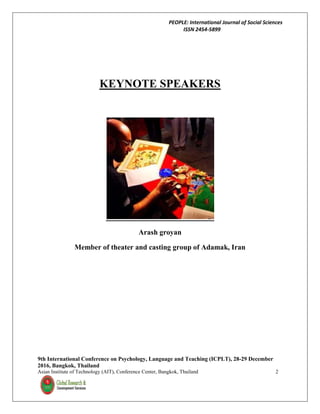
Arash groyan
Member of theater and casting group of Adamak, Iran
PEOPLE: International Journal of Social Sciences
ISSN 2454-5899
9th International Conference on Psychology, Language and Teaching (ICPLT), 28-29 December
2016, Bangkok, Thailand
Asian Institute of Technology (AIT), Conference Center, Bangkok, Thailand 3
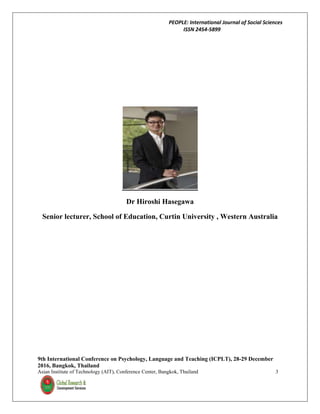
Dr Hiroshi Hasegawa
Senior lecturer, School of Education, Curtin University , Western Australia
PEOPLE: International Journal of Social Sciences
ISSN 2454-5899
9th International Conference on Psychology, Language and Teaching (ICPLT), 28-29 December
2016, Bangkok, Thailand
Asian Institute of Technology (AIT), Conference Center, Bangkok, Thailand 4
Dr. Misal Nivrutti Vinayak
GICICPLT1610051
How should be the Primary Education?
Dr. Misal Nivrutti Vinayak
Arts, Commerce & Science College, Sonai, Tal- Newasa, Dist- Ahmednagar
(Maharashtra), India
nivruttimisal2010@gmail.com
ABSTRACT
Ancient Indian sages had emphatically said, “Nothing is more scared than
knowledge.” Even southern scholars were saying “Knowledge is power.”
Naturally, modern Indian social thinkers called knowledge as power. All
people including Raja Rammohan Roy, Lokhitwadi, Mahatma Jyotiba Fule,
Vishnushastri Chiplunkar, Lokmanya Tilak, Gopal Ganesh Agarkar,
Maharashi Vitthal Ramji Shinde, Rajarshi Shahu Maharaj, Mahatma
Gandhi, Karmveer Bhaurao Patil and Dr. Babasaheb Ambedkar accepted the
way of knowledge. They tried their best to bring all into the way of knowledge
like Brahmins and untouchables, men and women, old and young, rich and
poor.
Modern education system is in trouble from all side. Common people are
deprived of education. On the other side, education has been kept away from
life by putting differences between ‘knowledge and labour’. Lord Macaulay
had become the president of ‘The Committee of Public Instruction’ in 1934.
He brought ‘Theory of Percolation’ in the field of education. According to this
theory, Lord Macaulay said, “The higher education should be given to the
upper classes of society and then it would percolate to the lower classes.”
Mahatma Fule did not agree with Lord Macaulay’s theory of giving education
to special class. He thought that education was the only way for the well being
of Indian people. He presented the statement before Hunter Commission on
19th October, 1982. He put his revolutionary thoughts before the commission.
Mahatma Fule was the first person who presented his radical thoughts of
primary education. His demand was that primary education should be
compulsory and free. His dream was to spread education to all the common
people.
The deprived class in the village is in utter poverty. They are not ready to send
their children to school. There should be scholarship and prizes in order to
encourage them to send children to school and create interest in getting
education.
The primary education is ineffective for future life. We need to reconstruct
both the present education system and syllabus. We should give knowledge of
moral, machinery, health, agriculture and art. We should firm the base of
primary education. Late Ramkrushna More was right. He was of the opinion
that there should the competitive examination in primary education till 4th
class. It was in interest of the deprived people but his dream did not complete.
We should complete his dream.
The education officer should inspect primary school once in a month. He
should visit schools without information and present clear report. This would
create discipline and firm the base of primary education.
PEOPLE: International Journal of Social Sciences
ISSN 2454-5899
9th International Conference on Psychology, Language and Teaching (ICPLT), 28-29 December
2016, Bangkok, Thailand
Asian Institute of Technology (AIT), Conference Center, Bangkok, Thailand 5
The government should notice the unfortunate event happened at
Kumbhkonam in Tamilnadu. Many children died in the fire caused while
cooking rice. It would be better to give rice to the children at home.
We can see the worst condition of education in the countryside today.
Teachers do not go to work in tribal hilly areas. If they go, they do not have
mentality to teach children. The government should provide proper facilities
to such teachers. The primary education should be capable of building stable
future. Therefore, we need to bring about radical changes in primary
education.
Farmers are committing suicide from decades. The government does not take
care of the future of their children. Therefore, education should be given to
children of farmers and untouchables. We need to implement some preventive
plans to change this condition.
Drawbacks of Primary Education:
1.It is written in article, 45 of Indian constitution that the compulsory and free
education would be provided to all the children till 14 years since 1960. But it
was not completely implemented till 2004.
2.Thousands of child workers are not getting education. They earn their
livelihood by working at mess, market, hospital etc. the government formed
law in 1986 to protect such children. This law has not much effect till 2004.
3. The poor education is given without thinking of the syllabus of
primary schools.
4. Chhatrapati Shahu Maharaj implemented compulsory and free
primary education in 1918. But we find indifference towards it today.
5. It was decided to spend at least 6% amount of national income on the
education but it is not completely implemented.
6. Children of upper class, government officers, doctors, merchants,
businessmen, thinkers, professors do not learn in primary schools. They think
it is degrading to learn their attitude towards primary schools is quite
different.
These drawbacks have made the worst condition of primary education.
Remedies on Primary Education:
1. Clever and crap citizen committees should be formed in villages. They
should have control on schools.
2. The basic agriculture education should be given in primary schools.
3. Health knowledge should be given in primary schools by providing
primary health education through small stories.
4. There should good sitting facility, clean drinking water, sports
material and trained sports teachers in primary schools.
5. The insurance should be drawn on each student of primary school by
government.
6. Public opinions in the countryside should be considered while
forming policies of primary education
7. 25% amount of primary education should be reserved for hilly, tribal
areas.
8. The government should adopt deprived children and provide
education to them.
9. There should be an independent law to education child labors.
10. A teacher is appointed from 1st to 4th class in primary school today.
PEOPLE: International Journal of Social Sciences
ISSN 2454-5899
9th International Conference on Psychology, Language and Teaching (ICPLT), 28-29 December
2016, Bangkok, Thailand
Asian Institute of Technology (AIT), Conference Center, Bangkok, Thailand 6
There should be separate teacher for separate class.
11. It is good that English is compulsory from primary school. But it
should be beneficial in the future.
Today, very few people have power and knowledge. The nation would not
develop till it was equally distributed. Several children are dying due to
malnutrition today. The government should bring concrete solution to provide
food and knowledge to such malnourished. Huts are still waiting to have oil
for burning lamps. Besides, they need amp of knowledge. The government
should care for them.
There are less Ashram Schools in tribal area. Their number should be
increased. Only then primary education would reach to the countryside. Until
the base of primary education should be firmed, the lower classes would not
be enlightened. About the effects of ignorance, Mahatma Fule writes,
‘ ivaVoivanaa mait gaolaI¸ maitivanaa naItI gaolaI
naItIivanaa gatI gaolaI¸ gaitivanaa iva%t gaolao
iva%taivanaa Saud` Kcalao¸ [tko Anaqa- eka AivaVonao kolao’
This educational speculative thought of Mahatma Fule is very valuable. The
survey of many things like need of radical changes in primary education,
compulsory and free primary education insurance of children is done in the
above explanation.
Education should include all the people. A man develops through education.
He develops by getting primary education and will achieve godlike qualities.
Atan Tulin
GICICPLT1610053
Comparison of Aggression Scores of Sports Sciences and Education Faculty
Students
Atan Tulin
University of Ondokuz Mayıs, Faculty of Yasar Dogu Sports Sciences, Turkiye
takman@omu.edu.tr
ABSTRACT
The aim of this study was to compare the aggression scores of Sports Sciences
Faculty and Education Faculty students. Also effects of some demographic
variables on aggression were examined. 200 Sports Faculty students (which do
sports at least four days a week for two hours) and 200 Education Faculty
students (which do not sports) were participated the study. The inventory
developed by Kiper (1984) was used for determining the aggression scores.
Inventory consisting of 30 questions has three sub dimensions such as
disruptive aggression (DA), assertiveness (AS) and passive aggression (PA).
Also General Aggression Scores (GAS) was examined. Items focused on
demographic details including faculty, age, gender, educational class, smoking
status and using alcohol or not.
DA, PA and GAS scores were not found to be significantly different between
Sports and Educational Faculty students (p>0.05). AS scores of Physical
Education students were higher than the Education Faculty students (p<0.05).
DA, AS, PA and GAS scores were not found to be significantly different
between female and male students (p>0.05). DA, PA and GAS scores were not
found to be significantly different between educational classes (p>0.05). AS
scores, of 3rd class students were higher than the 1st class students (p<0.0167).
DA and GA scores were higher in students which use cigarette and alcohol
(p<0.05). AS and PAS scores were found similar between students who use
PEOPLE: International Journal of Social Sciences
ISSN 2454-5899
9th International Conference on Psychology, Language and Teaching (ICPLT), 28-29 December
2016, Bangkok, Thailand
Asian Institute of Technology (AIT), Conference Center, Bangkok, Thailand 7
cigarette and alcohol (p>0.05).
As a conclusion, it can be said that participation in sports increased
assertiveness, did not influence the aggression level of gender. Assertiveness
levels increased as the educational class study increased. Smoking and
drinking increased the levels of DA and GA.
Keywords: Sports, Aggression, Assertiveness
Low Suet Fin
GICICPLT1610054
Educational Beliefs and Passion Among Preservice Teachers: A Comparative
Study Between Malaysia and China
Zahari Ishak & Low Suet Fin
Department of Educational Psychology and Counseling, Faculty of Education
University Malaya 50603 Kuala Lumpur
mlowsf@gmail.com
ABSTRACT
Educational beliefs and passion are two important factors contributing to
teachers’ quality in a successful education system. The objective of this study
was to identify the correlation between the sub-constructs of educational
beliefs and sub-constructs of passion among preservice teachers. The sample
consisted of 409 preservice teachers from Malaysia and China. Results
demonstrated that Malaysian preservice teachers scored the highest mean for
traditionalism whereas the Chinese preservice teachers obtained the highest
mean for romanticism. As for passion, the Malaysian and Chinese preservice
teachers reported the highest mean in harmonious passion. The findings also
revealed significant positive correlations between the sub-constructs of
educational beliefs and passion except between progressivism and obsessive
passion. Among the Chinese preservice teachers, significant correlations were
found between the sub-constructs of educational beliefs and passion except
romanticism with passion criteria, romanticism with harmonious passion,
progressivism with obsessive passion and lastly traditionalism with obsessive
passion. Besides that, the findings also highlighted the correlation between
traditionalism and harmonious passion as the strongest for Malaysian
preservice teachers and the Chinese preservice teachers.
Keywords: Educational Beliefs, Passion, Pre-Service Teachers,
Traditionalism, Progressivism, Romanticism, Harmonious Passion and
Obsessive Passion
Callista Hapsari Almira
Inez Ersya
GICICPLT1610055
Generation Y on Work Life: The Relationship Between SelfEfficacy
and Organizational
Commitment
Callista Hapsari Almira Inez Ersya
Faculty of Psychology Universitas Indonesia, Indonesia
Fasya Khalida Suffah
Faculty of Psychology Universitas Indonesia, Indonesia
PEOPLE: International Journal of Social Sciences
ISSN 2454-5899
9th International Conference on Psychology, Language and Teaching (ICPLT), 28-29 December
2016, Bangkok, Thailand
Asian Institute of Technology (AIT), Conference Center, Bangkok, Thailand 8
Faradiella Damaputri
Faculty of Psychology Universitas Indonesia, Indonesia
Muthmainah Mufidah
Faculty of Psychology Universitas Indonesia, Indonesia
Abstract
Generation Y are now beginning to dominate the organization world, crucial
and plays important roles. Nowadays, people tend to cross from one
organization to other organization in short time (less than a year), especially
the generation Y. They do not need to climb a long way career by jumping
from one company to another. This phenomenon describes a person’s
commitment in organization. Important to note for companies, it gives impact
on turnover and organization goals. According Meyer and Allen (1991),
organizational commitment is under the influence of the person’s selfefficacy
working in the company. From above issues, we conducted a study on
generation Y organizational commitment, seeking the relationship with
Self efficacy. Using pearson correlation, we generate the result from 62
generation Y employees in Jakarta, Bogor, Depok, Tangerang, and Bekasi
through self administered online form. The result showed that there is no
relationship between self efficacy and organizational commitment, r (0,090),
(p> 0.05), two tailed. Even there’s no relation between these two variables, we
found that people with high self efficacy also have high organizational
commitment. We also found interesting result from this study, most of them
started working on 2015, and admitted that the longest time in company were
in average of 23 years. During this time, they’ve changed companies 2 times.
There is a negative relationship between time spent in career and
organizational commitment, r (0,24), (p>0.05), two tailed. It means that the
more time people spent in work life, the less their organizational commitment.
Keyword: Generation Y, Organizational Commitment, Self Efficacy
Fasya Khalida Suffah
GICICPLT1610056
Generation Y on Work Life: The Relationship Between Self-Efficacy and
Organizational Commitment
Callista Hapsari Almira Inez Ersya
Faculty of Psychology Universitas Indonesia, Indonesia
Fasya Khalida Suffah
Faculty of Psychology Universitas Indonesia, Indonesia
Faradiella Damaputri
Faculty of Psychology Universitas Indonesia, Indonesia
Muthmainah Mufidah
Faculty of Psychology Universitas Indonesia, Indonesia
ABSTRACT
Generation Y are now beginning to dominate the organization world, crucial
and plays important roles. Nowadays, people tend to cross from one
PEOPLE: International Journal of Social Sciences
ISSN 2454-5899
9th International Conference on Psychology, Language and Teaching (ICPLT), 28-29 December
2016, Bangkok, Thailand
Asian Institute of Technology (AIT), Conference Center, Bangkok, Thailand 9
organization to other organization in short time (less than a year), especially
the generation Y. They do not need to climb a long way career by jumping
from one company to another. This phenomenon describes a person’s
commitment in organization. Important to note for companies, it gives impact
on turnover and organization goals. According Meyer and Allen (1991),
organizational commitment is under the influence of the person’s self-efficacy
working in the company. From above issues, we conducted a study on
generation Y organizational commitment, seeking the relationship with self-
efficacy. Using pearson correlation, we generate the result from 62 generation
Y employees in Jakarta, Bogor, Depok, Tangerang, and Bekasi through self-
administered online form. The result showed that there is no relationship
between self-efficacy and organizational commitment, r (0,090), (p> 0.05),
two-tailed. Even there’s no relation between these two variables, we found
that people with high self-efficacy also have high organizational commitment.
We also found interesting result from this study, most of them started working
on 2015, and admitted that the longest time in company were in average of 2-3
years. During this time, they’ve changed companies 2 times. There is a
negative relationship between time spent in career and organizational
commitment, r (-0,24), (p>0.05), two-tailed. It means that the more time
people spent in work-life, the less their organizational commitment.
Keyword: Generation Y, Organizational Commitment, Self-Efficacy
Muthmainah Mufidah
GICICPLT1610057
Generation Y on Work Life: The Relationship Between Self Efficacy and
Organizational Commitment
Callista Hapsari Almira Inez Ersya
Faculty of Psychology Universitas Indonesia, Indonesia
Fasya Khalida Suffah
Faculty of Psychology Universitas Indonesia, Indonesia
Faradiella Damaputri
Faculty of Psychology Universitas Indonesia, Indonesia
Muthmainah Mufidah
Faculty of Psychology Universitas Indonesia, Indonesia
ABSTRACT
Generation Y are now beginning to dominate the organization world, crucial
and plays important roles. Nowadays, people tend to cross from one
organization to other organization in short time (less than a year), especially
the generation Y. They do not need to climb a long way career by jumping
from one company to another. This phenomenon describes a person’s
commitment in organization. Important to note for companies, it gives impact
on turnover and organization goals. According Meyer and Allen (1991),
organizational commitment is under the influence of the person’s self efficacy
working in the company. From above issues, we conducted a study on
generation Y organizational commitment, seeking the relationship with self
efficacy. Using pearson correlation, we generate the result from 62 generation
Y employees in Jakarta, Bogor, Depok, Tangerang, and Bekasi through self
administered online form. The result showed that there is no relationship
PEOPLE: International Journal of Social Sciences
ISSN 2454-5899
9th International Conference on Psychology, Language and Teaching (ICPLT), 28-29 December
2016, Bangkok, Thailand
Asian Institute of Technology (AIT), Conference Center, Bangkok, Thailand 10
between self efficacy and organizational commitment, r (0,090), (p> 0.05),
twotailed. Even there’s no relation between these two variables, we found that
people with high self efficacy also have high organizational commitment. We
also found interesting result from this study, most of them started working on
2015, and admitted that the longest time in company were in average of 23
years. During this time, they’ve changed companies 2 times. There is a
negative relationship between time spent in career and organizational
commitment, r (0,24), (p>0.05), twotailed. It means that the more time people
spent in worklife, the less their organizational commitment.
Keyword: Generation Y, Organizational Commitment, SelfEfficacy
Nalini Persram
GICICPLT1610058
Knowledge Through Motion: Concept Formation Through the
Phenomenological-Neurological-Kinesthetic
Nalini Persram
York University, Toronto
persramn@yorku.ca
ABSTRACT
The project is a multidisciplinary, transdisciplinary one that draws on: a wide
range of academic subjects and disciplines; certain forms of aesthetic
expression, concentration and movement, such as dance and yoga; and the
practical, theoretical and scientific work of neuroscience and kinesthetic
experimentation. The geographical locations for the project are India and the
USA, the rationale being that each represents a very different culture;
traditionally, each has had very different forms and practices of well-being;
and today both are interested in each other’s investigations of the relation
between mind and body, a development that moves beyond the West’s historic
dismissal of Indian science to the opposite place where it is now extremely
interested in Eastern (to include China and other Asian societies) methods of
healing the mind and the body. The research investigates how
movement and affect create pre-cognitive conditions facilitating the
understanding
of complex concepts when ultimately directed at the cognitive, verbally. The
problematic is how we can more efficiently acquire and comprehend difficult
philosophical ideas, theoretical approaches and complex concepts; how the
phenomenology of movement – the experiencing of unfamiliar and familiar
physical gestures or actions at the level of affect (feeling) – informs the way the
intellect handles complex concepts. The research question is: How can
knowledge acquisition, first, and aesthetic/kinesthetic physicality and affect,
second, rather than being arranged into contradictory and mutually exclusive
relations, be viewed as a dynamic relation; how can the latter two elements
allow for the opening of
mental/neural pathways that readily prepare the mind for intellectual
creativity and understanding?
PEOPLE: International Journal of Social Sciences
ISSN 2454-5899
9th International Conference on Psychology, Language and Teaching (ICPLT), 28-29 December
2016, Bangkok, Thailand
Asian Institute of Technology (AIT), Conference Center, Bangkok, Thailand 11
Azhar Pervaiz
GICICPLT1610059
The Role of Working Memory in Exploring the Causes of Slow Language
Learning by the Dyslexic Children
Azhar Pervaiz
Assistant Professor, Deptt. of English, University of Sargodha
Samrina Sana
BS English, UoS
Abstract
This paper aims to highlight the relation between dyslexia and working
memory of the language learners. Further, it explores certain ways by which
dyslexia can be measured at a very early stage of the learners. It reveals the
differences in the academic performance of Dyslexic (DC) and Non-Dyslexic
Children (NDC). The framework is inquired through the use of working
memory of the learners. Any impairment or brain damage in the left
hemisphere of the children’s brain causes them to be called as Dyslexic
children (DC). This agitates their capabilities to decode the provided
information accurately and it results in malfunctioning of cerebral cortex
failing to perceive the appropriate codes. To investigate these aspects a
sample of 40 learners of English language was taken. The sample was divided
into experimental and controlled groups respectively. They were tested
through Automated Working Memory Assessment (AWMA) and the results
were matched to draw a comparison between both the groups. This study was
based on formulation of two hypotheses. The first one stated that DC will
show a clear cut difference in their verbal short term memory and working
memory when compared with that of the controlled group whereas the second
hypothesis focuses on the troubles and dissimilarities of visuospatial short
term memory and working memory of both the groups. The responses of the
respondents were analyzed through the statistical software i.e. SPSS and the
results show that DC as incapable of perceiving the actual data and fail to
answer appropriately. They perform poorer leading to score lower than the
NDC. The findings of the paper have great implication in the present day
researches to diagnose the impairments in the brain at early stages of learning
and this further helps us devise new learning strategies for the DC.
Machhindra Govind Varpe
GICICPLT1608060
English Language-behaviour, Language Systems and Speech
Machhindra Govind Varpe
Associate Professor & Head , Dept. of English
Mula Education Society’s Arts, Commerce & Science College Sonai, Tal-
Newasa , Dist- Ahmednagar 414105(India)
m.g.varpe@gmail.com
ABSTRACT
This research paper addresses the issues such as language and its various
definitions and as a means of communication competence, and language-
acquisition.Language-: This research behaviour and language-systems also
discussed. It also differs between language and speech, written and spoken
language. Spoken language is used for a wider purposes than the written
language. As the communicative needs of society change, so then language will
PEOPLE: International Journal of Social Sciences
ISSN 2454-5899
9th International Conference on Psychology, Language and Teaching (ICPLT), 28-29 December
2016, Bangkok, Thailand
Asian Institute of Technology (AIT), Conference Center, Bangkok, Thailand 12
change to meet these needs.
Key words: Language, human, language-systems, language-behaviour,
cognitive psychology, language community, linguistic competence.
Kaewmart Pongakkasira
GICICPLT1608062
Effect of Mood and Creativity on Product Creativity: Using LEGO as a
Hands-On Activity
Kaewmart Pongakkasira
KMUTT, Thailand
kaewmart17@gmail.com
ABSTRACT
This paper aimed at finding out the effectiveness of Engage, Study and
Activate (ESA) Sequence toward mastering vocabularies for Indonesian
teenagers. The problem statements of the research were; (1) to what extent
was the effectiveness of Engage, Study and Activate (ESA) Sequence toward
mastering vocabularies for Indonesian teenagers? (2) What was the students’
attitude toward the application of Engage, Study and Activate (ESA)
Sequence toward mastering vocabularies for Indonesian teenagers?
The design of this research was quasi experimental design. It
employed speaking test and questionnaire as the instruments. The population
of this research took 67 students. The writer used systematic sampling to
choose the sample of the research and took 20 students as experimental class
and 20 students as controlled class. The speaking test was given twice; at pre-
test and post-test. They were given in both experimental class and controlled
class. The tests were used to find out the data of the students’ vocabulary
mastering. The questionnaire was used to find out the students’ attitude
toward the application of Engage, Study and Activate (ESA) Sequence toward
mastering vocabularies for Indonesian teenagers.
The descriptive analysis showed that the students’ vocabulary mastering
improved after receiving the treatment by using Engage, Study and Activate
(ESA) sequence. It was supported by the inferential analysis with the t-test of
the vocabulary mastering which has greater value than the t-table (2.021).
Based on the questionnaire analysis, the students also gave good feedback that
they were very interested, motivated, and challenged to learn English speaking
in order to master vocabulary through Engage, Study and Activate (ESA)
sequence. This was evidence that Engage, Study and Activate (ESA) sequence
was effective toward mastering vocabularies for Indonesian teenagers.
Key words: Vocabulary Mastering, ESA Technique, Speaking
Patrick Rates
GICICPLT1608063
Pre and Post Activities To Support a Study Abroad Program
Patrick Rates
psrates@yahoo.com
aknttmmo@kwansei.ac.jp
Abstract
This presentation discusses the fifteen week pre-departure classroom
components and arrival components that can make study abroad programs
more effective so that students successfully improve their language and
culture competency of the host culture. First, the presentation will offer pre-
departure classroom activities and ideas to learn about the host country and to
PEOPLE: International Journal of Social Sciences
ISSN 2454-5899
9th International Conference on Psychology, Language and Teaching (ICPLT), 28-29 December
2016, Bangkok, Thailand
Asian Institute of Technology (AIT), Conference Center, Bangkok, Thailand 13
introduce their own culture during their stay in the host country. Second, the
presentation provides criteria for evaluating the students during their study
abroad programs. Third, the presentation present ways to assist students in
processing their experiences upon their return.
Keywords: Study abroad, authentic learning, curriculum
Helen Yeh
GICICPLT1608064
A study of the relationship between the use of Grammar Learning Strategies
and Student Achievement
Helen Yeh
Language & Communication, The Hong Kong Polytechnic University
(CPCE), Hong Kong
atan@teknokrat.ac.id
Abstract
It is widely known that some students learn a second language better or faster
while the others do not even though they study in the same environment.
Chastain (1988) states that all students have their learning strategies but only
some are successful. Therefore, many language teachers have been searching
for effective teaching methodologies in order to help students become
proficient and competent learners. Wenden and Rubin (1987) define learning
strategies as ‘any set of operations, steps, plans routines used by the learner to
facilitate the obtaining, storage, retrieved, and usage of information’ (p.19).
Among all learning strategies, grammar learning is a central concern in
English language teaching because an effective learner has to master the
structure of the language. Hence, the objective of this research is to investigate
whether the use of Grammar Learning Strategies has an impact on student
achievement at English courses. The data collection includes the academic
results of the students in the module of English for Academic studies
(Business) I and a Grammar Learning Strategies questionnaire. The 35-item
questionnaire was modified from the Strategy Inventory for Language
Learning (SILL) developed by Oxford (1990). This instrument has been used
extensively to collect data on large numbers of mostly foreign language
learners (Nyikos & Oxford, 1993; Olivares-Cuhat, 2002; Oxford, 1990;
Oxford & BurryStock, 1995; Wharton, 2000). The result obtained can help
teachers plan and develop appropriate teaching methodologies and activities
to suit the learners’ learning styles/needs and help students learn and master
effective grammar learning strategies through teaching methodologies.
Figen Tezdiker
GICICPLT1608067
Teachers’ Perceptions of Teaming to Teach
Figen Tezdiker
Instructor, Anadolu University, Eskisehir, Turkey
figentezdiker@gmail.com
ABSTRACT
Collaborative teaching, which meets the need to strengthen teacher education
(Cochran-Smith and Fries, 2005), is defined as two teachers working together
with groups of students; sharing the planning, organization, delivery, and
assessment of instruction, as well as the physical space (Bacharach, Heck &
Dank, 2004). As a model of collaborative teaching, team teaching usually
refers to two teachers combining their classes and sharing responsibility for
PEOPLE: International Journal of Social Sciences
ISSN 2454-5899
9th International Conference on Psychology, Language and Teaching (ICPLT), 28-29 December
2016, Bangkok, Thailand
Asian Institute of Technology (AIT), Conference Center, Bangkok, Thailand 14
instruction. It is basically a form of teacher training model and has been
regarded as an alternative way of teacher development. Having two minds
facilitating a group of students allows teachers to connect with different
teaching styles and personal attitudes. This study examines teachers’
subjective experience associated with team teaching. In this study, a
perception questionnaire is adapted and used to reveal the teachers’
perceptions towards team teaching implementations carried out during the
term. The presentation will start with the description of the essence of team
teaching and its benefits in language teaching. After the introduction part,
methodology of the study, setting, participants, instrument and data analysis
will be explained in detail. As for the results of the study, perceptions of the
teachers regarding effects of team teaching on their teaching will be presented.
The presentation will end with the implications, which will give new insights to
the teachers about why team teaching is an alternative model to use in
language teaching.
Cochran-Smith, M., & Fries, K. (2005). The AERA panel on research and
teacher education. In M. Cochran-Smith & K. M. Zeicher (Eds.), Studying
teacher education (pp. 37–68). Mahwah, NJ: Lawrence Erlabum.
Washut Heck, T. & Bacharach, N. (2010). Mentoring Teacher Candidates
Through Co-Teaching. Teacher Quality Enhancement Center. St. Cloud,
Minnesota.
Sevil Keser
GICICPLT1608068
EFL University Students’ Perceptions of the Difficulties in Speaking
Sevil Keser
Department of English, School of Foreign Languages,Anadolu University,
Eskisehir, Turkey
skeser@anadolu.edu.tr
ABSTRACT
Speaking comes to the fore among four skills in language teaching in terms of
the level of importance. The reason is that the main purpose to learn a
language is to communicate, and the first step to communicate is generally to
speak. Whereas, speaking is usually considered the most difficult skill to
aquire for most language learners. Therefore, identifying the difficulties
encountered in developing speaking skills is one of the significant reseach
areas. By determining what those difficulties are, it will be possible to suggest
some possible solutions. Thus, in this study, it is aimed to describe difficulties
that might be faced by a group of EFL students in a Turkish state university.
The learners’ perceptions on difficulties will be explored by conducting a
survey questionnaire and the findings will be analysed in order to suggest
possible solutions to those percieved difficulties.
The Use Of Creative Dramatics To Improve Social Skills In Kindergarten
SALCEDO
Department Of Education Deped – Philippines, Department Of Education
Deped – Philippines, Iloilo-Philippines
Abstract
The objective of this study was to observe the use of creative dramatics that
can improve the level of social skills in kindergarten pupil who showed the
PEOPLE: International Journal of Social Sciences
ISSN 2454-5899
9th International Conference on Psychology, Language and Teaching (ICPLT), 28-29 December
2016, Bangkok, Thailand
Asian Institute of Technology (AIT), Conference Center, Bangkok, Thailand 15
SALCEDO
GICICPLT1608069
least abilities to say courteous greetings which are integrated into the
curriculum as a part of the daily plan make a meaningful difference on the
acquisition of social skills of children aged five to six. Data were gathered
through observation, journal, and rating-scale checklist. During the pre-
intervention, the children had difficulty in his social skills. During the
intervention period children gradually showed development in his social skills.
During the post-intervention period, the child showed the improvement in
most of his social skills. There are some implications showed to researcher in
findings the present studied. The use of creative dramatics needs a lot of time
and preparation, specifically role playing proves to be an effective
intervention in developing the social skills of a child with least abilities to say
courteous greetings. The researcher of creative dramatics as an intervention
in a child’s social skills should also try to find out if the activities are
appropriate to the child. Many things should be considered first before
implementing this approach.
Asli Kimav
GICICPLT1610070
The Relationship between the Culture of Learning and Academic
Achievement
Asli Kimav
Anadolu University, Turkey
akarabiyik@anadolu.edu.tr
ABSTRACT
Many language programs at universities in Turkey have been increasingly
leaning towards curricula which demand greater autonomy from learners.
However, students have been shown to exhibit either resistance or reluctance
while engaging in activities which require learner autonomy. In this respect,
research in this area shows that the role of culture of learning is found to have
a role on students’ autonomous behaviors as a variable affecting the
promotion of learner autonomy .This variable, in turn, might affect their
academic achievement as well. Considering the relatively fewer studies at
university level in Turkey, this study investigates the relationship between the
culture of learning that students were exposed to before coming to university
and their academic achievement. The study gathered data from university
students studying at different proficiency levels in an intensive language
program at Anadolu University. The data were collected through a learning
culture questionnaire and a demographic information questionnaire. To
measure students’ academic achievement, the scores of the students’ mid-term
exam were considered. Finally, correlation tests were run to analyze the
relationship between students’ culture of learning and their academic
achievement.
Keywords: culture, learning, learner autonomy
PEOPLE: International Journal of Social Sciences
ISSN 2454-5899
9th International Conference on Psychology, Language and Teaching (ICPLT), 28-29 December
2016, Bangkok, Thailand
Asian Institute of Technology (AIT), Conference Center, Bangkok, Thailand 16
Qiu Hong
GICICPLT1610072
Asymmetry between Affirmative and Negative Structures of the Japanese
Aspect Form “tesimau”
Qiu Hong
Beijing Foreign Studies University
qiuhongkyu@163.com
Abstract: In aspect and tense forms, there’s usually affirmative-negative
neutralization. The neutralization is also reflected in the Japanese aspect form
“tesimau”, which causes asymmetry between affirmation and negation. The
form of “tesimau” is used not only as the expression of aspect, but also with
the meaning of modality. The use of “tesimau” is classified into three types,
namely expression of aspect, meaning of modality, the use between the two.
The function of modality in “tesimau” influences the formation of negative
structure. The stronger the meaning of modality is, the more difficult it is to
establish the negative form. Conversely, the stronger the expression of aspect
is, the more likely it is to be denied. The characteristic of “tesimau”also
reflects the continuity between aspect and modality.
Keywords: “tesimau”; asymmetry; modality; aspect
Yasemin ACIKGOZ
GICICPLT1610074
The Effects Of Drama On Students' Motivation In Language Learning
Process
Yasemin ACIKGOZ
Anadolu University School of Foreign Languages
yasemingoren9@gmail.com
ABSTRACT
In modern education system, the most effective ways of teaching English have
been researched. Motivation, self-reliance and the methods that are used in
language classroom are closely related to each other.
Drama can be an alternative way to integrate into the language learning
process to make language learning more effective. In this respect this study
aims to find out if drama effects the motivation of students in learning
English. To achieve this, an 8-week lesson plan was designed. The study was
carried out with 100 elementary level students at the Preparatory school of
Hasan KALYONCU University, a private university in South Eastern
Anatolian region of Turkey. The aim was to find the answers for the following
research questions which are
(1) Is using drama activities effective for developing students'
motivation?
(2) What are the students' perceptions towards using drama activities?
Regarding these questions, three different data collection tools were used; the
teacher kept weekly diaries after the drama classes for 8 weeks. Also students
answered questionnaires. Lastly, at the end of the term, an interview was
conducted with 10 students.
The results from the interviews were analysed by content analysis and the
questionnaire data was calculated based on a five-point Likert scale. The
findings showed that using drama in language learning was quite effective.
Also students reflected positively about the drama lessons in terms of
PEOPLE: International Journal of Social Sciences
ISSN 2454-5899
9th International Conference on Psychology, Language and Teaching (ICPLT), 28-29 December
2016, Bangkok, Thailand
Asian Institute of Technology (AIT), Conference Center, Bangkok, Thailand 17
improving their motivation.
Mete Özçelik
GICICPLT1610075
Using Facebook as a peer review tool to enhance writing
Mete Özçelik
The School of Foreign Languages Anadolu University Eskişehir, Turkey
mozcelik@anadolu.edu.tr
Abstract
Using Facebook as a peer review tool to enhance writing The emergence of the
Internet has created platforms where people from all ages meet, communicate,
socialize, and become friends. Therefore, the role of Web 2.0 tools on learning
a foreign language has been widely researched. One of the most frequently
researched online tool is Facebook, which is used by about 1 billion people
from all over the world. The researcher of the current study created two
different groups on Facebook for his students in two different classrooms,
interacted with them through Fall Term of 2014-2015 education year. The
main purpose of the researcher was to investigate if Facebook can be used in
helping learners improve their writing skill in an EFL context by using peer
feedback practice. The experimental group consisted of 20 students. The
group size for the control group is the same, as well. The participants in the
experimental group were required to post 7 writing tasks on the Facebook
group which are all parallel to the coursebook and comment on each other’s
writing. On the other hand, the participants in the control group received only
teacher feedback for the same tasks on Facebook. For each writing
assignment, the researcher posted sample texts and informed learners about
what the focus on while writing and for each writing task, learners in the
experimental group were also informed about what to focus on while
commenting on peers’ papers. In the first week, all participants were required
to create a text about their best friends in 40 minutes with a word limit of
minimum 80 words. The same procedure was implemented in the last week.
The tasks were graded by using the criteria of the school by two ELT
instructors, none of them was the researcher himself. Paired-samples t-test
(SPSS) was applied and the difference between the scores of two groups was
calculated. The researcher posted a 5-point-Likert scale questionnaire -
prepared by himself- for the experimental group to see what the participants
thought about the procedure via Google Docs. The findings showed that the
participants in the experimental group who received peer feedback on
Facebook improved their writing skill more than the participants in the
control group who received only teacher feedback on Facebook (4, 6 %). Also,
the answers of the participants revealed that the majority of students also
believe in the benefits of peer comments via Facebook on improving their
writing skill (about 80 %).To conclude, it can be inferred from the current
study that all instructors can build anxiety-free learning environments where
writing skills of learners develop in a more fun learning environment.
PEOPLE: International Journal of Social Sciences
ISSN 2454-5899
9th International Conference on Psychology, Language and Teaching (ICPLT), 28-29 December
2016, Bangkok, Thailand
Asian Institute of Technology (AIT), Conference Center, Bangkok, Thailand 18
Thillainathan
Sathaananthan
GICICPLT1610076
Harden’s SPICES model for Biochemistry in Medical curriculum
T.Sathaananthan
Faculty of Health-Care Sciences, Eastern University, Sri Lanka.
sathaananthan@yahoo.co.uk
Introduction
The process of acquisition of knowledge has changed since the Stone Age
when it was through the use of human senses. It is undertaken by informal,
formal and non-formal modes. The formal and non-formal modes used for the
acquisition of knowledge in the past have given birth to the present education
system. Education is undoubtedly provided in a formal and systematic
manner in teaching institutions. But it does not end there. Education is a
continuous process and goes on from cradle to grave.
The discipline based traditional medical curriculum was designed on the
recommendations of Flexner’s in 1910. In the traditional curriculum, the basic
sciences are taught in the initial phase, followed by the clinically oriented
subjects. This has three stages for the MBBS course. Those are Pre-clinical
studies, Para clinical studies and Clinical studies. Preclinical studies are
conducted in the first two years. Unlike the traditional discipline based
curriculum, the new curriculum, integrates every discipline in a unified
manner with the expectation to develop the students with high level of
efficacy. In traditional system, pre clinical subjects are taught in the first two
years and clinical subjects are taught at last years. In such a situation,
scholars and educationists argue that, student could face difficulties in finding
the correlation between pre-clinical and clinical subjects. The newer system is
commonly referred as SPICES model (Harden et al., 1984) and the following
comparison illustrates the main differences.
Biochemistry was taught as a main subject in the first two years of study along
with other subjects, Anatomy and Physiology. However, currently it has been
integrated with other disciplines in the curriculum. The present study plans to
analyse the Harden’s SPICES model of Educational strategies with the
Biochemistry in medical curricula.
Importance of Mathematics Education in Medicine
S.Sathaananthan
Department Mathematics, Faculty of Science, Eastern University, Sri Lanka.
shiventhira@yahoo.com
T.Sathaananthan
Faculty of Health-Care Sciences, Eastern University, Sri Lanka.
sathaananthan@yahoo.co.uk
Abstract
Mathematics-related tasks are common in healthcare and include
understanding nutrition information, interpreting blood sugar readings and
other clinical data, adjusting medications, and understanding probability in
risk communication. While literacy and mathematics are strongly correlated,
we have identified many patients with adequate reading ability but poor
PEOPLE: International Journal of Social Sciences
ISSN 2454-5899
9th International Conference on Psychology, Language and Teaching (ICPLT), 28-29 December
2016, Bangkok, Thailand
Asian Institute of Technology (AIT), Conference Center, Bangkok, Thailand 19
mathematics skills. Better tools to measure mathematics and more studies to
assess the unique contribution of mathematics are needed. This research can
contribute to developing interventions to improve outcomes for patients with
poor mathematics skills.
Kennedy, J.
GICICPLT1610077
Students vs. Language: Challenges Faced by the Students Offering English
Medium Instruction With special reference to the second year students at the
Eastern University, Sri Lanka
Kennedy, J.
Senior Lecturer in English, Eastern University, Sri Lanka
kennedyjeevaretnam@gmail.com
Abstract
This study verifies the challenges faced by the undergraduate students who
offer English Medium Instruction (EMI) whose mother tongue is other than
English where the English language is taught as second language. Sri Lanka
was under the British for a long period and English became one of the media
of instruction since the occupation of the British. After the independence, Sri
Lanka had adopted the same system to its educational sector until the late
1950’s in the school level. But in the tertiary level, the natural science based
subjects continued to confine to the English Medium Instruction. This trend
has been expanded to other field of studies in the tertiary level such as social
sciences and humanities.
Currently, as in the case of other countries – especially the Asian countries,
Sri Lanka also switched to EMI not only in the tertiary level but also in the
secondary level of education as well. Theoretically the introduction of EMI
has many expected outcomes, but in practice it has many challenges in the
tertiary level than in the secondary level. Concerning the tertiary level of
education, a higher level of language proficiency is expected for a successful
academic study in the EMI where this would be a platform for the language
development.
This study was conducted among a group of weaker students in English
language skills those who failed in the General English courses in the first year
of study in their undergraduation who are at present in their second year of
study. This study reveals that more than 70% of the students would like to
switch on again to have their course of study though they realize the
importance of the English language.
Key words: English Medium Instruction, proficiency, language learning,
tertiary level, language development.
Mst. Maleka Pervin
Teachers’ attitudes toward inclusion of students with Autism Spectrum
Disorders: A critical review of the articles
Mst. Maleka Pervin
Assistant Professor Department of Psychology, University of Dhaka, Dhaka-
1000
mpervinpsy@gmail.com
Abstract
This article reviews the research on the teachers' attitudes toward inclusion of
students with autism in the regular classroom and thereby finds out the
PEOPLE: International Journal of Social Sciences
ISSN 2454-5899
9th International Conference on Psychology, Language and Teaching (ICPLT), 28-29 December
2016, Bangkok, Thailand
Asian Institute of Technology (AIT), Conference Center, Bangkok, Thailand 20
GICICPLT1610078 teacher-related factors that might impact teacher attitudes toward inclusion of
students with autism. Teachers play the vital role as a decision maker in
implementing inclusive education for students with autism. Given that
research has suggested that the successful implementation of any inclusive
policy is largely dependent on teachers being positive about it, a great deal of
research has sought to examine teachers' attitudes toward the inclusion and,
more recently, the inclusion of students with autism in the regular classroom.
A review of four studies revealed that most of the teachers showed positive
attitudes toward inclusion of students with autism. However, there was no
evidence of acceptance of a total inclusion or 'zero reject' approach to special
educational provision. Teachers' attitudes were found to be influenced by
teacher-related variables. The methodologies used in the research findings are
discussed and recommendations for future research based on alternative
methodologies are provided.
Key words: Teachers’ Attitudes, Inclusion, Autism Spectrum Disorders
Melasurej C. Francisco
GICICPLT1610079
Self-Efficacy and Self-Worth of Elderly in Geriatric Institutions
Melasurej C. Francisco
Psychology student at De La Salle University- Dasmariñas, 4114, Philippines
rthreadline@gmail.com
Sophia D. Rusit
Psychology student at De La Salle University- Dasmariñas, 4114, Philippines
Abstract
Old age is a record of one’s own life, this is the crucial phase for most.
However, there are individuals who believe that old people retain self-efficacy
and self-worth throughout their existence. Geriatric institutions focus on
health of elderly, in which they have been supported with medicines and
therapies by clinician thus, indicating that these may suffice physical,
emotional, and mental health of the elderly. This study focuses on (1)
Describing the level or degree of self-efficacy; (2) Recognizing the extent of
self-worth; (3) Determining the significant relationship between self-efficacy
and self-worth. It is a mixed method design. A combination of correlational
research and in depth interview. Purposive sampling technique was used to
select participants, considering that this assay focused on elderly in geriatric
institutions, it follows that respondents and participants are at least sixty
years of age and must be living inside the institution. 121 senior citizens took
part in this study. Scores from both General Self-Efficacy Scale (GSE) and
Rosenberg Self-Esteem Scale (RSES) showed varying levels of self-efficacy
and self-worth. SE had μ=28.099, σ=6.6262, σ²=43.9067 while, SW had
μ=14.9669, σ=5.3789, σ²28.9322 which denotes that robt (121)=0.3164 is higher
than rcrit which is 0.150. Although this exhibits positive moderate correlation
between SE and SW, relationship between variables is weak. Likewise, the
pvalue (pvalue=0.000406) is lower than the significance level alpha=0.01, thus,
rejecting the null hypothesis, and accepting the alternative hypothesis.
Keywords— Elderly, Geriatric, Self-Efficacy, Self-Worth
Zahra Ali
GICICPLT1610080
Stigma around mental illness among the white collar professionals
Zahra Ali
PEOPLE: International Journal of Social Sciences
ISSN 2454-5899
9th International Conference on Psychology, Language and Teaching (ICPLT), 28-29 December
2016, Bangkok, Thailand
Asian Institute of Technology (AIT), Conference Center, Bangkok, Thailand 21
MPhil Scholar at the Institute of Clinical Psychology, University of Karachi
zahraalyy@gmail.com
ABSTRACT
Objective: This study aims to describe and explore attitudes toward mental
illness in different white collar professionals of Karachi.
Background and Rationale: There are only 2 to 3 psychiatrists per a million of
population in Pakistan (Achakza, 1998). According to WHO, about 10% of
people in developing countries suffer from some kind of mild mental illness
and numbers are rising every day. However, many more cases go unidentified
(WHO, 2007). Previous researches highlight the stigma in medical
practitioners and a reluctance of students to pursue mental health profession
adding to an overall alarming state (Imran, 2007; Aslam, 2009). In order to
address the prevalence of mental illness and scarcity of resources, stigma
around mental illness should be dispelled. Also, the current literature seems to
contain varying evidences about the relation between differences in attitudes
toward mental illness and social status, with some findings supporting the
existence of an association between the two (e.g. Dohrenwend & Chin-Shong,
1967) while others negating this view (e.g. Nieradzik & Cochrane, 1985).
Although it is commonly believed that taboos are only prevalent among the
laymen, this research aims to find the differences in attitudes of various white
collar professionals and to highlight specific groups for future intervention.
Hypothesis: There will be differences in the attitudes of people toward mental
illness and mentally ill with respect to their professions.
Sample: Professionals working in different fields of work will be included in
the sample via convenience sampling technique.
Instrument: Community Attitudes toward the Mentally Ill (CAMI) scale will
be used. This questionnaire was developed by S. Martin Taylor and Michael J.
Dear (1981).
Statistics: Descriptive statistics (mean, standard deviations and standard error
of mean) will be applied to analyze the demographics of the sample. One-way
ANOVA will be applied to find the mean differences in the scores of attitudes
towards mental illness and the mentally ill.
Proposed findings: Taking into account the current evidences available in the
literature, it is expected that the results of this study will reveal differences in
attitudes towards mental illness and the mentally ill with respect to the
different social classes that the white collar professionals belong to. These
differences are expected to appear with regard to their household income as
well as the fields of work that the professionals belong to.
In addition, results are also expected to indicate the nature of differences in
attitudes within and between specific groups
Diana Putri Arini
Trapped in Violence: Traumatic Bonding Phenomenon among Teenage Girls
with Suffering from Dating
Diana Putri Arini
faculty of Psychology gadjah Mada University
Dianaputriarini@gmail.com
Mutingatu Sholichah
Faculty of Psychology Ahmad Dahlan University
PEOPLE: International Journal of Social Sciences
ISSN 2454-5899
9th International Conference on Psychology, Language and Teaching (ICPLT), 28-29 December
2016, Bangkok, Thailand
Asian Institute of Technology (AIT), Conference Center, Bangkok, Thailand 22
GICICPLT1610081
Abstract
This study aimed to analyze the forms of dating violence which was
experienced by teenage girls, coping strategies applied when facing violences
in dating and the formation process of traumatic bonding.
This research was conducted using a qualitative method with a
phenomenological approach. The data collected using interview ,observation
techniques and secondary data collected from mobile phone message, letter of
agreement. The subjects were three teenage girls of 19-21 years old, which
experienced at least two of the five forms of violence and back to their partner
after decided a broken relationship.
The forms of violence suffered by the three subjects included social,
psychological, sexual, physical and economic violences. Coping strategy
mostly applied by the subjects was emotion-focused coping one such as denial
and self-criticism. Traumatic Bonding was formed due to emotional
attachment after a broken relationship, while the partner applied a flattery
strategy and a threat to suicide. Premarital sexual relations with the partner
made the subjects trapped in a more destruction relationship because virginity
loss made them worrying that she would be unaccepted except the partner.
Traumatic bonding was characterized by both power imbalance and
intermittent abuse during the dating.
Keywords: Dating Violence, Coping Strategies, Traumatic Bonding
Luthfi Noor Aini
GICICPLT1610082
Health-Related Quality Of Life In Breast Cancer Patients : An Overview
Luthfi Noor Aini
Faculty of Psychology Diponegoro University
luthfinaini@gmail.com
Farida Hidayati
Faculty of Psychology Diponegoro University
farida_hid@yahoo.co.id
ABSTRACT
The existence of cancer in the body and a series of treatments, endured
physical and psychological because subject had to adjust to the new conditions
in her life so that the effect on the aspects that determine the quality of life,
especially health-related quality of life. The purpose of this study was to
discover how the representation of health-related quality of life and the
factors that influence in breast cancer patients. Research using qualitative
methods with case study research design. Subjects in this study amounted to
two women with breast cancer aged 53 and 74 years, two supporting
informants family members (husband and daughter) and three expert
informant that two specialist doctors and psychologists. Data was collected by
interview, observation and documents. Researchers used the data analysis
model explication. The results showed that both subjects had positive
HRQOL. The main aspects that determine health-related quality of life in
both subjects are health and psychological functions. Indicators of health and
psychological functioning aspects are: spirituality, and high spirits in both
subject. In addition to high spirits, the indicator is very influential on the
subject SH is spirituality. Subjects experienced an increase in spiritual
PEOPLE: International Journal of Social Sciences
ISSN 2454-5899
9th International Conference on Psychology, Language and Teaching (ICPLT), 28-29 December
2016, Bangkok, Thailand
Asian Institute of Technology (AIT), Conference Center, Bangkok, Thailand 23
matters than before breast cancer. In the subject MY emphasis on indicators
of high spirits. The support of family that given to subject MY is instrumental
support such as a willingness to take during treatment. The factors that affect
the quality of life related to positive health is knowledge and understanding of
the disease, economic factors, age and social support.
Keywords : Health Related Quality of Life, Breast Cancer.
Ima Fitri Sholichah
GICICPLT1610083
SOCIAL IDENTITY ON STUDENT MADURESE ETHNIC
Ima Fitri Sholichah
Faculty of Psychology, Gadjah Mada University, Yogyakarta, Indonesia
ima.fitri.s@mail.ugm.ac.id
ABSTRACT
Madurese ethnic student living in Yogyakarta has a dilemma with their social
identity. This is due to the negative stigma from society to Madurese ethnic
which makes them generally more exclusive group with fellow students
Madura. This research uses a qualitative approach with interviews and
observations data collection technique. The results showed that in the
identification, individuals are encouraged to achieve a positive identity of the
group, this is in line with Michael A Hogg (2004) that social identity is formed
through social comparisons when a group feels better than any other group, it
will cause social identity positive. In addition, students Madura emphasized
the difference in-group and out-group in the process of establishing their
social identity in the colony, Yogyakarta. When students Madura joining the
various ethnic (out-group), their self-esteem tends to decline but their
cohesiveness is very high in Madura ethnical group (in-group). This is because
the individual who is a member of the group with negative images tend to feel
threatened, so they are trying to improve in-group cohesiveness. Because of it,
joining the in-group does not mean because it has advantages but they feel
threatened by the stigma.
Keyword: social identity, student, madurese ethnic.
Eprika Adhityani
GICICPLT1610084
Effect of Optimism, Religiosity, and Social Support on Subjective Well-being
Parents with Autism Spectrum Disorder (ASD) Children
Eprika Adhityani
Faculty of Psychology State Islamic University Syarif Hidayatullah Jakarta,
Faculty of Psychology Universitas Gadjah Mada, Indonesia
eprika.adhityani@mail.ugm.ac.id
Abstract
Caring for ASD children is not easy for any parent. Some of the obstacles that
must be faced by parents are finding the right treatment, financial burden to
finance the treatment, as well as the social stigma associated with disability.
Therefore, parents with ASD children susceptible to high levels of stress and
depression, as well as decrease of the well-being. This study aims to determine
the effect of optimism, religiosity, and social support on the subjective well-
being of parents who have children with ASD with control variables are
gender and income. Total subjects in this study are 102 people (N = 102) and
the sampling technique used is non-probability sampling. Data were analyzed
using multiple regression. The results showed that there was a significant
PEOPLE: International Journal of Social Sciences
ISSN 2454-5899
9th International Conference on Psychology, Language and Teaching (ICPLT), 28-29 December
2016, Bangkok, Thailand
Asian Institute of Technology (AIT), Conference Center, Bangkok, Thailand 24
effect of optimism, religiosity, and social support on subjective well-being of
parents who have children with ASD. The proportion of the variance of
subjective well-being described by all the independent variable is equal to
51.9%, while 48.1% is influenced by other variables outside this study. Minor
hypothesis test results show that optimism, the dimensions of an emotional
support, esteem support dimension, the dimension of social networking
support and income has a significant effect on subjective well-being of parents
with ASD children.
Keywords: subjective well-being, optimism, religiosity, social support
Dr Hiroshi Hasegawa
GICICPLT1610085
The critical role of universities in impacting upon English education in Japan
Dr Hiroshi Hasegawa
Curtin University
h.hasegawa@curtin.edu.au
ABSTRACT
Foreign language education in Japan is a compulsory subject in the primary
and secondary school curricula, with most schools selecting English as their
foreign language. Japan’s MEXT (Ministry of Education, Culture, Sports,
Science and Technology) clearly identifies one of the main aims of teaching
foreign languages as being to improve students’ communicative abilities in the
target language. However, many students in Japan continue to think of
themselves as having only very limited oral English communication skills, and
are not confident when interacting orally. The majority of Japanese students
are primarily externally-motivated English learners; they study it simply to
pass examinations. Thus one may say that that the students’ motivation for
studying English is inconsistent with the Ministry’s aim. Even so, the current
lack of opportunities for students to practise their English communication
skills could be overcome by implementing systematic plans and achievable
strategies. To enable them to provide these opportunities, the role of Japan’s
higher education institutions, such as universities, must be reassessed.
This paper sets out reasons why universities can play a critical role in
promoting practical strategies in schools to impact upon and influence
students’ practical English skills positively. The paper discusses three key
approaches for improving the use of English as an oral communication tool:
(1) the inclusion of oral performance in English in the university entrance
examination, (2) the development of coherent learning processes for achieving
certain outcomes at the university level, and (3) the introduction of training
opportunities for current university lecturers of English.
Hülya SEZER
GICICPLT1610086
The effects of using songs on learners’ motivation and vocabulary competence
Hülya SEZER
Anadolu University School of Foreign Languages
hlyasezer@gmail.com
ABSTRACT
As the world is turning into a global village, English is becoming the medium
language for the villagers. Researchers studying Second Language teaching
have come up with countless approaches, methods and techniques so far to
reach the best result in this regard. Yet, recently, student motivation has been
PEOPLE: International Journal of Social Sciences
ISSN 2454-5899
9th International Conference on Psychology, Language and Teaching (ICPLT), 28-29 December
2016, Bangkok, Thailand
Asian Institute of Technology (AIT), Conference Center, Bangkok, Thailand 25
the main focus of the language syllabi all over the world.
The use of songs can raise the intrinsic motivation levels of students leading
them to learn English language and culture more effectively via boosting their
vocabulary knowledge. In this respect, this study seeks to find out the effects
of using songs on English learners’ vocabulary competence. To accomplish
this, a 6-week lesson plan was designed. The study was carried out with 40
elementary level students at the Preparatory School of Anadolu University, a
state university in the central Anatolian region of Turkey. The study aimed to
find answers to these questions:
(1) Does the use of songs raise student motivation?
(2) Does the use of songs boost vocabulary competence?
Concerning these questions, three different data collecting tools were utilized.
Firstly, a pre-test and a follow-up test on target vocabulary were used in every
lesson. Also, an extensive test was taken by students at the end of the six
weeks. Finally, a questionnaire was given to students to ask their opinions on
the process.
Test results were interpreted with the help of both qualitative and quantitative
analysis. The questionnaire data was calculated based on a five-point Likert
scale. The findings showed that using songs in vocabulary learning process
was quite effective. Furthermore, students expressed positive opinions on the
use of songs in terms of improving their motivation and vocabulary
competence.
Meraj Ahmad
GICICPLT1610087
Mustafa Mahmud and His Thoughts: A Critical Study
Meraj Ahmad
Centre for Arabic and African Studies, School of Languages, Literature and
Cultural Studies, Jawaharlal Nehru University, New Delhi, India
ahmadmerajjnu@gmail.com
ABSTRACT
This paper aims to study the life and works of the great Arabic literary
scholar and an established medical practitioner, Dr. Mustafa Mahmud. Being
a man of science, Dr. Mahmud had always been inquisitive in nature and had
addressed his queries in a scientific manner. He had written over 150 books in
his lifetime and this paper traces his transformation from the secular
materialistic stage to the mystic (sufi) stage (1954-2009). The approach of the
study has been essentially analytical and critical using both primary
(Shahidun Ala Asrehi, Dar al-Ma’rif, Cairo, 1989, etc) and secondary sources.
The method of study has been inductive, descriptive and scientific in nature.
Dr. Mahmud’s life had been devoted to questioning standard beliefs and
finally establishing his own understanding of the much debated religion and
faith. The long standing issue of faith meeting science was of utmost
importance to the doctor. My synopsis presents a proposed chapterisation of
the complete works dividing the analysis broadly into four parts – his life in
the socio-political scenario of Egypt; his works and achievements; an
analytical study of the development of his thought, considering both pre- and
post-Islamic faith; and an analytical assessment of his literary work. This
paper examines Dr. Mahmud’s quest for knowledge under the light of
Marxism, Naturalism, Bhaktism, and life after death and his later on bend
towards faith and Sufism. My work presents an overview of a man’s life in
PEOPLE: International Journal of Social Sciences
ISSN 2454-5899
9th International Conference on Psychology, Language and Teaching (ICPLT), 28-29 December
2016, Bangkok, Thailand
Asian Institute of Technology (AIT), Conference Center, Bangkok, Thailand 26
search of truth and learning from his thoughts put into words.
Muhammad Afsar Kayum
GICICPLT1610088
Developing Oral Communication Skill in Bangladesh: A Further study
Muhammad Afsar Kayum
Assistant Professor of English, Manarat International University, Dhaka,
Bangladesh
Abstract
Competency in Oral Communication has become the most spoken issue of the
present Bangladesh. English Language /is no more the communication
medium for the English only; it has achieved the status of the official or the
dominant language for above two billion in more than 60 countries. In a short
period of time, English received a wide Geographical coverage and become
one of the leading means of communication. In line with the present
competitive world, Bangladesh is not an exception. In here, also, English
continues its domination and expansion as the highly demandable and an
inevitable language. People who have a very sound communication skill in
English, especially of spoken English, are in the triumphant march. However,
the way of increasing this oral communicative competences for the students of
Bangladesh, is indeed a very crucial and burning issue. Despite acknowledging
the great importance of this language, our students cannot reach to that
required level. Only ‘mutual intelligibility’ or ‘ mere communication through
English’ cannot be considered as competency in speaking. Even the students
entering the University level have a very poor knowledge in English Language.
This paper, therefore, tends to go through the present scenario of
communicative skill especially speaking skill of today’s students and the
existing methods of developing this oral communication skill in Bangladesh. It
also endeavors to diagnose the reasons behind the students’ incompetency ,
and to propose some new strategies to overcome this language barrier.
Keywords: Communicative skill, speaking, existing practices, correction,
development, methods.
Sujardin SYARIFUDDIN
GICICPLT1610089
Lexical Cohesion in The New York Times Representation of Mother Teresa of
Calcutta During Her Pre and Post-Canonization Period (1970s-present)
Sujardin SYARIFUDDIN
University of New South Wales, Sydney, Australia
sujardin.syarifuddin060190@gmail.com
Rizki ANANDA
University of New South Wales, Sydney, Australia
Abstract
Using one of the major American-based newspapers, The New York Times,
this study aims to describe how Mother Teresa of Calcutta is portrayed before
and after her canonization as a Catholic Saint. This study used critical
discourse analysis approach, while the analytical method was drawn from
Halliday’s Systemic Functional Grammar, which is textual function focusing
on lexical choices. The data were drawn from 20 articles published between
1970 and 2016 taken from the New York Times archieves. By analyzing aspect
PEOPLE: International Journal of Social Sciences
ISSN 2454-5899
9th International Conference on Psychology, Language and Teaching (ICPLT), 28-29 December
2016, Bangkok, Thailand
Asian Institute of Technology (AIT), Conference Center, Bangkok, Thailand 27
of textual function through lexical choices, the articles show that Mother
Teresa’s portrayal has been represented and constructed with specific lexical
choices in the text organization of The New York Times in the past four
decades.
Keywords: critical discourse analysis, news media portrayal, lexical choices
Samson H. L. Yuen
GICICPLT1608061
A teacher-initiated innovation versus government-led schemes: a case study
on school-based curriculum development in Hong Kong
Samson H. L. Yuen
Nottingham Trent University
tpsyenglish@gmail.com
ABSTRACT
Former studies on the school-based curriculum development (SBCD) schemes
initiated by the government in Hong Kong indicated that what was supposed
to be a bottom-up innovation that aimed to cater for pupils’ diversity had
turned into a highly centralized initiative that targeted to satisfy bureaucratic
requirements. At issue is the bureaucratization of school-based innovations
that threatens to usurp teachers’ autonomy and judgment. To provide a
different perspective, this qualitative case study takes an insider approach to
examine the implementation of a teacher-initiated school-based curriculum in
a Hong Kong secondary school. Reflective interviews were conducted with the
four teachers who implemented the school-based curriculum at the classroom
level. The findings showed that all teachers felt positive about the bottom-up
initiative, citing favourable reasons such as catering to students’ diversity,
saving costs on textbooks and reducing teachers’ preparation time. Teachers
delivered the school-based curriculum in accordance with their beliefs and at
times practiced artistry in their teaching by exercising discretion in response
to contextual constraints so that learners’ needs were catered for. The findings
of this case study thus contrast sharply with the former top-down SBCD
schemes initiated by the government which addressed official concerns rather
than pupils’ needs.
DENG CHAOQUN
GICICPLT1610071
Semantic and Syntactic Features of “Aru” Construction on Event Usage
–from Perspective of Qualia Structure
DENG CHAOQUN
Beijing Center For Japanese Studies, Beijing Foreign Studies University
Beijing, China
koeru101@hotmail.com
Abstract
This article discusses the semantic and syntactic features of "aru"
construction on event usage, as well as the relevance between the semantic and
syntactic structure. This paper pointes out: a. Semantically, the semantic type
and qualia structure of the noun with “ga” case determines the meaning of
"aru" construction, and its telic role is an important means to achieve the
event interpretation; b. As for syntactic structure, event sentences can be
divided into two types--process type and activity type, each of which has a
different case system, so it is ungrammatical to blend them in usage; c.
Features of the semantic and syntactic structure of the “aru” construction
PEOPLE: International Journal of Social Sciences
ISSN 2454-5899
9th International Conference on Psychology, Language and Teaching (ICPLT), 28-29 December
2016, Bangkok, Thailand
Asian Institute of Technology (AIT), Conference Center, Bangkok, Thailand 28
influence and are closely related with each other.
Faradiella Damaputri
GICICPLT1610091
Generation Y on Work Life: The Relationship Between SelfEfficacy and
Organizational Commitment
Callista Hapsari Almira Inez Ersya
Faculty of Psychology Universitas Indonesia, Indonesia
Fasya Khalida Suffah
Faculty of Psychology Universitas Indonesia, Indonesia
Faradiella Damaputri
Faculty of Psychology Universitas Indonesia, Indonesia
Muthmainah Mufidah
Faculty of Psychology Universitas Indonesia, Indonesia
Abstract
Generation Y are now beginning to dominate the organization world, crucial
and plays important roles. Nowadays, people tend to cross from one
organization to other organization in short time (less than a year), especially
the generation Y. They do not need to climb a long way career by jumping
from one company to another. This phenomenon describes a person’s
commitment in organization. Important to note for companies, it gives impact
on turnover and organization goals. According Meyer and Allen (1991),
organizational commitment is under the influence of the person’s selfefficacy
working in the company. From above issues, we conducted a study on
generation Y organizational commitment, seeking the relationship with
Self efficacy. Using pearson correlation, we generate the result from 62
generation Y employees in Jakarta, Bogor, Depok, Tangerang, and Bekasi
through self administered online form. The result showed that there is no
relationship between self efficacy and organizational commitment, r (0,090),
(p> 0.05), two tailed. Even there’s no relation between these two variables, we
found that people with high self efficacy also have high organizational
commitment. We also found interesting result from this study, most of them
started working on 2015, and admitted that the longest time in company were
in average of 23 years. During this time, they’ve changed companies 2 times.
There is a negative relationship between time spent in career and
organizational commitment, r (0,24), (p>0.05), two tailed. It means that the
more time people spent in work life, the less their organizational commitment.
Keyword: Generation Y, Organizational Commitment, Self Efficacy
Margita Mesárošová
GICICPLT1610090
Care for self-development in relation to the self-regulation in the students of
helping professions
Margita Mesárošová
Pavol Jozef Šafárik University in Košice, Slovakia,
margita.mesarosova@upjs.sk
PEOPLE: International Journal of Social Sciences
ISSN 2454-5899
9th International Conference on Psychology, Language and Teaching (ICPLT), 28-29 December
2016, Bangkok, Thailand
Asian Institute of Technology (AIT), Conference Center, Bangkok, Thailand 29
ABSTRACT
Self-development of young people is an important task as was emphasized by
Erikson (1968). The objective of this study is to explore the nature and
components of the care for self-development in college students of helping
professions, as well as its predictors. Methods: The Care for Self-Development
Scale (CSD, Mesárošová, 2014), Learning Questionnaire (SRQ-L; Williams,
Deci, 1996) were completed by a group of 213 college students (50.7 % were
medical students, 49.3 % social work students, 81.7 % were female). Results:
Factor analysis of CSD produced three factors (the care for development in
personal, educational, and general areas), which showed significant positive
correlations with the components of the self-regulation in learning (the
autonomous and controlled regulation). The only autonomous regulation was
proved as a predictor of the care for self-development in both groups of
students. Conclusion: Our research showed the utility of the self-regulation in
predicting the care for self-development in college students. We consider our
findings the useful contribution to the educational and counseling process in
students of helping professions.
Key words: care for self-development, self-regulation, learning, helping
professions
Jeevaretnam Kennedy
GICICPLT1610077
Students vs. Language: Challenges Faced by the Students Offering English
Medium Instruction
With special reference to the second year students at the Eastern University,
Sri Lanka
Jeevaretnam Kennedy
Department of Languages, Faculty of Arts & Culture, Eastern University,
Chenkalady, Sri Lanka
ABSTRACT
This study verifies the challenges faced by the undergraduate students who
offer English Medium Instruction (EMI) whose mother tongue is other than
English where the English language is taught as second language. Sri Lanka
was under the British for a long period and English became one of the media
of instruction since the occupation of the British. After the independence, Sri
Lanka had adopted the same system to its educational sector until the late
1950’s in the school level. But in the tertiary level, the natural science based
subjects continued to confine to the English Medium Instruction. This trend
has been expanded to other field of studies in the tertiary level such as social
sciences and humanities.
Currently, as in the case of other countries – especially the Asian countries,
Sri Lanka also switched to EMI not only in the tertiary level but also in the
secondary level of education as well. Theoretically the introduction of EMI
has many expected outcomes, but in practice it has many challenges in the
tertiary level than in the secondary level. Concerning the tertiary level of
education, a higher level of language proficiency is expected for a successful
academic study in the EMI where this would be a platform for the language
development.
This study was conducted among a group of weaker students in English
language skills those who failed in the General English courses in the first year
PEOPLE: International Journal of Social Sciences
ISSN 2454-5899
9th International Conference on Psychology, Language and Teaching (ICPLT), 28-29 December
2016, Bangkok, Thailand
Asian Institute of Technology (AIT), Conference Center, Bangkok, Thailand 30
of study in their undergraduation who are at present in their second year of
study. This study reveals that more than 70% of the students would like to
switch on again to have their course of study though they realize the
importance of the English language.
Key words: English Medium Instruction, proficiency, language learning,
tertiary level, language development.
Hulya Sezer
GICICPLT1610086
The effects of using songs on learners’ motivation
And vocabulary competence
Hülya SEZER
Anadolu University School of Foreign Languages
ABSTRACT
As the world is turning into a global village, English is becoming the medium
language for the villagers. Researchers studying Second Language teaching
have come up with countless approaches, methods and techniques so far to
reach the best result in this regard. Yet, recently, student motivation has been
the main focus of the language syllabi all over the world.
The use of songs can raise the intrinsic motivation levels of students leading
them to learn English language and culture more effectively via boosting their
vocabulary knowledge. In this respect, this study seeks to find out the effects
of using songs on English learners’ vocabulary competence. To accomplish
this, a 6-week lesson plan was designed. The study was carried out with 40
elementary level students at the Preparatory School of Anadolu University, a
state university in the central Anatolian region of Turkey. The study aimed to
find answers to these questions:
(1) Does the use of songs raise student motivation?
(2) Does the use of songs boost vocabulary competence?
Concerning these questions, three different data collecting tools were utilized.
Firstly, a pre-test and a follow-up test on target vocabulary were used in every
lesson. Also, an extensive test was taken by students at the end of the six
weeks. Finally, a questionnaire was given to students to ask their opinions on
the process.
Test results were interpreted with the help of both qualitative and quantitative
analysis. The questionnaire data was calculated based on a five-point Likert
scale. The findings showed that using songs in vocabulary learning process
was quite effective. Furthermore, students expressed positive opinions on the
use of songs in terms of improving their motivation and vocabulary
competence.
Fereshte Rahimi
GICICPLT1610089
Effect of Reflectivity/Impulsivity on EFL Learners’ Task-Based Interaction
Fereshte Rahimi
Department of English Language and Literature, University of Mazandaran,
Babolsar, Iran
rahimi1420@gmail.com
ABSTRACT
A frequently raised stylistic issue is whether students should be grouped
according to their learning style, with all the students who prefer analysis
grouped together and all of the globals in another group (Oxford, 1990).
PEOPLE: International Journal of Social Sciences
ISSN 2454-5899
9th International Conference on Psychology, Language and Teaching (ICPLT), 28-29 December
2016, Bangkok, Thailand
Asian Institute of Technology (AIT), Conference Center, Bangkok, Thailand 31
Accordingly, this study aimed to investigate the probable impact of
reflectivity/impulsivity, as two learning styles in the cognitive domain, on pre-
intermediate Iranian EFL learners’ interaction by examining the level of
engagement with linguistic choices produced in language related episodes.
According to Storch (2008), elaborate engagement was operationalized as
instances of LREs where learners deliberated and discussed language items,
and limited engagement where one learner made a suggestion and the other
repeated, acknowledged or did not respond to the suggestion. Twenty-eight
female language learners were selected as the subjects of the study. Eysenck
Personality Questionnaire (1975) was used to determine the cognitive styles of
the learners. Then, they were assigned to one of the two dyadic groups: a dyad
containing two reflective learners, and a dyad containing two impulsive
learners. Learners completed two dictogloss tasks in two sessions. Their pair
talk during performing the tasks was tape-recorded and transcribed. Analysis
of the pair talk data showed that LREs were not affected by learners’
cognitive styles: the nature of learners’ engagement with linguistic choices in
both types of dyads ranged from elaborate to limited and there were not any
significant differences between the two groups regarding elaborate or limited
engagements.
Key words: reflectivity, impulsivity, level of engagement, LREs
Mostafa Mostakmeli
GICICPLT1610092
Investigation of the educational and administrative productivity level of
Iranian educational complexes and its associated challenges; Focusing on
studying educational complexes of South Khorasan Province
Mostafa Mostakmeli
PhD student of Higher Education Management. Shahid Beheshti University.
Tehran. Iran
ABSTRACT
Since knowledge is an important key to achieve the productivity,
competitiveness, wealth and prosperity in today’s society, most countries have
focused on strategies to develop human capital in order to gain access to better
quality of education. Improvements of the educational system have
traditionally been a challenging topic for scholars of management training and
executive manager of the education and training system. Approving a plan to
establish educational complexes in 1389 is one of the Iranian educational
policy to fulfill school-centered standards in order to reduce the educational
problems and to strengthen school units. This study aimed to examine
productivity of these educational complexes from the educational and
administrative aspects and associated challenges; therefore, it could be
considered a descriptive research. The population consisted of 154 rural
centers and 25 urban centers. According to Morgan table, 85 managers and
243 teachers were selected by stratified sampling according to each region.
Also, making interviews, resorting to the library and using two researcher
made questionnaires were used to collect data from administrators and
teachers. Content and face validity was examined through the theoretical
fundamentals and expert professors. Teachers’ questionnaire reliability was
calculated using Cronbach's alpha which was equal to 98.2. Administrators’
questionnaire reliability was calculated using Cronbach's alpha which was
equal to 95.8. To analyze the gathered data (percentage, frequency, charts and
PEOPLE: International Journal of Social Sciences
ISSN 2454-5899
9th International Conference on Psychology, Language and Teaching (ICPLT), 28-29 December
2016, Bangkok, Thailand
Asian Institute of Technology (AIT), Conference Center, Bangkok, Thailand 32
mean the descriptive statistics was used ;furthermore, inferential statistics was
used using SPSS software in order to check the significance in data. The
results have showed that complexes achieved their goals both in educational
and administrative aspects. The most challenging issue in educational aspect
was creating conditions for students to gain first-hand experiences and in
administrative aspect were organizing labor, developing good relations with
employees and delegating sufficient authority to managers.
Key Words: educational complex, productivity, administrative and
educational aspects.
Min Kumar Tamang
YRSICPLT161052
Low Female Participation In Higher Education In The Rural
Min Kumar Tamang
Kathmanu University, Nepal
ABSTRACT
This research paper tries to explore issue of the female participation in higher
education in the context of the rural parts of Nepal by examining the
traditional social cultural and economic view in relation to the female
education. However, there have been equal opportunities to receive the
education in the world. This research paper argues that there is still
discrimination in getting the higher education between the male and female in
our country even the world has developed a lot in the education sector. More
importantly, this paper also argues that the backgrounds and beliefs systems
of Nepalese society were reported as significant constraints to female pursuing
their higher education for their careers. In this globalized world, it is
important to value and empower the female participant in achieving the
higher education in order to change the society into the developed country.
This moreover paper encourage the female to achieve the education in spite of
being the social cultural and economic challenges in our society.
Key words: Female education, social cultural, discrimination, empower,
traditional beliefs etc.
Andre Ginting
YRSICPLT161053
Investigating The Potential Sources Of Foreign Language Speaking Anxiety:
Chinese As A Foreign Language In Indonesia
Andre Ginting
Department of Chinese Studies, University of Indonesia
Andrepginting@gmail.com
ABSTRACT
Based on previous research on foreign language teaching, the phenomenon of
foreign language anxiety has been a tremendous problem in foreign language
teaching. This study aims to investigate the sources of foreign language
anxiety on Indonesian students’ speaking performance in classsroom.
Participants were 30 Chinese major students from a public university in
Indonesia. This study mixed both quantitative and qualitative method. Data
were collected through questionnaire consisting of 18-items questions adapted
from Foreign Language Anxiety Classroom Anxiety Scale (FLACAS) by
Horwitz, Horwitz, and Cope. This instrument itself is well-known as a tool to
measure and analyse the intensity of Foreign Language Anxiety in classroom.
Investigating the anxious tertiray students’ experience in learning Chinese is
PEOPLE: International Journal of Social Sciences
ISSN 2454-5899
9th International Conference on Psychology, Language and Teaching (ICPLT), 28-29 December
2016, Bangkok, Thailand
Asian Institute of Technology (AIT), Conference Center, Bangkok, Thailand 33
very important because Foreign Language Anxiety can affect negatively
students’ interest to learn foreign language. The findings showed that 28
students were found at moderate level. Only two students are classified as
higher-anxious (HA) students than others. To determine the potential sources,
HA students are asked to participate an interview session. The result revealed
that there are two main potential sources of foreign language speaking
anxiety: 1) Chinese as a required course, 2) low-esteem to pronounce spoken
Chinese. This study suggests that the teacher has a crucial role, not only in
teaching but providing counseling to students who have problems in affective
aspects.
Keywords : Chinese as a foreign language; Foreign languange anxiety;
Potential resources
Listeners
Ibrahim Roke Sesay
English Department, Help The Helpless Sierra Leone, Bangkok
GICICPLT1608065
Mariama Bah
English Department, Help The Helpless Sierra Leone, Bangkok
GICICPLT1608066
Shayne Torikawa
Department of Engineering, Nihon University ,Shinjuku-ku
GICICPLT1610073
Hiromi Otaka
Graduate School of Language, Communication and Culture, Kwansei Gakuin University, Japan
GICICPLT1608063
Upcoming Conferences
http://gahssr.org/conference.php
» 10th International Conference on Social Science and Humanities (ICSSH), 18-19
Feb 2017, Dubai
» 13th International Conference on Social Science and Humanities (ICSSH), 22-23
May 2017, Lisbon
» 10th International Conference on Business Management and Legal Studies
(ICBMLS), 22-23 May 2017, Lisbon
PEOPLE: International Journal of Social Sciences
ISSN 2454-5899
9th International Conference on Psychology, Language and Teaching (ICPLT), 28-29 December
2016, Bangkok, Thailand
Asian Institute of Technology (AIT), Conference Center, Bangkok, Thailand 34
» 14th International Conference on Social Science and Humanities (ICSSH), 13-14
June 2017, Singapore
» 11th International Conference on Business Management and Legal Studies
(ICBMLS), 13-14 June 2017, Singapore
» 15th International Conference on Social Science & Humanities (ICSSH), 20-21
June 2017, Kuala Lumpur
» 12th International Conference on Business Management & Legal Studies
(ICBMLS), 20-21 June 2017, Kuala Lumpur
» 16th International Conference on Social Science & Humanities (ICSSH), 11-12
July 2017, Bali, Indonesia
» 13th International Conference on Business Management & Legal Studies
(ICBMLS), 11-12 July 2017, Bali, Indonesia
» 17th International Conference on Social Science & Humanities (ICSSH), 18-19
July 2017, Bangkok, Thailand
» 14th International Conference on Business Management & Legal Studies
(ICBMLS), 18-19 July 2017, Bangkok, Thailand
» 18th International Conference on Social Science & Humanities (ICSSH), 06-07
June 2017, Rome, Italy
» 15th International Conference on Business Management & Legal Studies
(ICBMLS), 06-07 June 2017, Rome, Italy

Icplt proceedings

  • 1.
    PEOPLE: International Journalof Social Sciences ISSN 2454-5899 9th International Conference on Psychology, Language and Teaching (ICPLT), 28-29 December 2016, Bangkok, Thailand Asian Institute of Technology (AIT), Conference Center, Bangkok, Thailand 1 CONFERENCE PROCEEDINGS 9th International Conference on Psychology, Language and Teaching (ICPLT), 28-29 December 2016, Bangkok, Thailand 28-29 December 2016 Conference Venue Asian Institute of Technology (AIT), Conference Center, Bangkok, Thailand Email: info@gplra.org http://gplra.org/
  • 2.
    PEOPLE: International Journalof Social Sciences ISSN 2454-5899 9th International Conference on Psychology, Language and Teaching (ICPLT), 28-29 December 2016, Bangkok, Thailand Asian Institute of Technology (AIT), Conference Center, Bangkok, Thailand 2 KEYNOTE SPEAKERS Arash groyan Member of theater and casting group of Adamak, Iran
  • 3.
    PEOPLE: International Journalof Social Sciences ISSN 2454-5899 9th International Conference on Psychology, Language and Teaching (ICPLT), 28-29 December 2016, Bangkok, Thailand Asian Institute of Technology (AIT), Conference Center, Bangkok, Thailand 3 Dr Hiroshi Hasegawa Senior lecturer, School of Education, Curtin University , Western Australia
  • 4.
    PEOPLE: International Journalof Social Sciences ISSN 2454-5899 9th International Conference on Psychology, Language and Teaching (ICPLT), 28-29 December 2016, Bangkok, Thailand Asian Institute of Technology (AIT), Conference Center, Bangkok, Thailand 4 Dr. Misal Nivrutti Vinayak GICICPLT1610051 How should be the Primary Education? Dr. Misal Nivrutti Vinayak Arts, Commerce & Science College, Sonai, Tal- Newasa, Dist- Ahmednagar (Maharashtra), India nivruttimisal2010@gmail.com ABSTRACT Ancient Indian sages had emphatically said, “Nothing is more scared than knowledge.” Even southern scholars were saying “Knowledge is power.” Naturally, modern Indian social thinkers called knowledge as power. All people including Raja Rammohan Roy, Lokhitwadi, Mahatma Jyotiba Fule, Vishnushastri Chiplunkar, Lokmanya Tilak, Gopal Ganesh Agarkar, Maharashi Vitthal Ramji Shinde, Rajarshi Shahu Maharaj, Mahatma Gandhi, Karmveer Bhaurao Patil and Dr. Babasaheb Ambedkar accepted the way of knowledge. They tried their best to bring all into the way of knowledge like Brahmins and untouchables, men and women, old and young, rich and poor. Modern education system is in trouble from all side. Common people are deprived of education. On the other side, education has been kept away from life by putting differences between ‘knowledge and labour’. Lord Macaulay had become the president of ‘The Committee of Public Instruction’ in 1934. He brought ‘Theory of Percolation’ in the field of education. According to this theory, Lord Macaulay said, “The higher education should be given to the upper classes of society and then it would percolate to the lower classes.” Mahatma Fule did not agree with Lord Macaulay’s theory of giving education to special class. He thought that education was the only way for the well being of Indian people. He presented the statement before Hunter Commission on 19th October, 1982. He put his revolutionary thoughts before the commission. Mahatma Fule was the first person who presented his radical thoughts of primary education. His demand was that primary education should be compulsory and free. His dream was to spread education to all the common people. The deprived class in the village is in utter poverty. They are not ready to send their children to school. There should be scholarship and prizes in order to encourage them to send children to school and create interest in getting education. The primary education is ineffective for future life. We need to reconstruct both the present education system and syllabus. We should give knowledge of moral, machinery, health, agriculture and art. We should firm the base of primary education. Late Ramkrushna More was right. He was of the opinion that there should the competitive examination in primary education till 4th class. It was in interest of the deprived people but his dream did not complete. We should complete his dream. The education officer should inspect primary school once in a month. He should visit schools without information and present clear report. This would create discipline and firm the base of primary education.
  • 5.
    PEOPLE: International Journalof Social Sciences ISSN 2454-5899 9th International Conference on Psychology, Language and Teaching (ICPLT), 28-29 December 2016, Bangkok, Thailand Asian Institute of Technology (AIT), Conference Center, Bangkok, Thailand 5 The government should notice the unfortunate event happened at Kumbhkonam in Tamilnadu. Many children died in the fire caused while cooking rice. It would be better to give rice to the children at home. We can see the worst condition of education in the countryside today. Teachers do not go to work in tribal hilly areas. If they go, they do not have mentality to teach children. The government should provide proper facilities to such teachers. The primary education should be capable of building stable future. Therefore, we need to bring about radical changes in primary education. Farmers are committing suicide from decades. The government does not take care of the future of their children. Therefore, education should be given to children of farmers and untouchables. We need to implement some preventive plans to change this condition. Drawbacks of Primary Education: 1.It is written in article, 45 of Indian constitution that the compulsory and free education would be provided to all the children till 14 years since 1960. But it was not completely implemented till 2004. 2.Thousands of child workers are not getting education. They earn their livelihood by working at mess, market, hospital etc. the government formed law in 1986 to protect such children. This law has not much effect till 2004. 3. The poor education is given without thinking of the syllabus of primary schools. 4. Chhatrapati Shahu Maharaj implemented compulsory and free primary education in 1918. But we find indifference towards it today. 5. It was decided to spend at least 6% amount of national income on the education but it is not completely implemented. 6. Children of upper class, government officers, doctors, merchants, businessmen, thinkers, professors do not learn in primary schools. They think it is degrading to learn their attitude towards primary schools is quite different. These drawbacks have made the worst condition of primary education. Remedies on Primary Education: 1. Clever and crap citizen committees should be formed in villages. They should have control on schools. 2. The basic agriculture education should be given in primary schools. 3. Health knowledge should be given in primary schools by providing primary health education through small stories. 4. There should good sitting facility, clean drinking water, sports material and trained sports teachers in primary schools. 5. The insurance should be drawn on each student of primary school by government. 6. Public opinions in the countryside should be considered while forming policies of primary education 7. 25% amount of primary education should be reserved for hilly, tribal areas. 8. The government should adopt deprived children and provide education to them. 9. There should be an independent law to education child labors. 10. A teacher is appointed from 1st to 4th class in primary school today.
  • 6.
    PEOPLE: International Journalof Social Sciences ISSN 2454-5899 9th International Conference on Psychology, Language and Teaching (ICPLT), 28-29 December 2016, Bangkok, Thailand Asian Institute of Technology (AIT), Conference Center, Bangkok, Thailand 6 There should be separate teacher for separate class. 11. It is good that English is compulsory from primary school. But it should be beneficial in the future. Today, very few people have power and knowledge. The nation would not develop till it was equally distributed. Several children are dying due to malnutrition today. The government should bring concrete solution to provide food and knowledge to such malnourished. Huts are still waiting to have oil for burning lamps. Besides, they need amp of knowledge. The government should care for them. There are less Ashram Schools in tribal area. Their number should be increased. Only then primary education would reach to the countryside. Until the base of primary education should be firmed, the lower classes would not be enlightened. About the effects of ignorance, Mahatma Fule writes, ‘ ivaVoivanaa mait gaolaI¸ maitivanaa naItI gaolaI naItIivanaa gatI gaolaI¸ gaitivanaa iva%t gaolao iva%taivanaa Saud` Kcalao¸ [tko Anaqa- eka AivaVonao kolao’ This educational speculative thought of Mahatma Fule is very valuable. The survey of many things like need of radical changes in primary education, compulsory and free primary education insurance of children is done in the above explanation. Education should include all the people. A man develops through education. He develops by getting primary education and will achieve godlike qualities. Atan Tulin GICICPLT1610053 Comparison of Aggression Scores of Sports Sciences and Education Faculty Students Atan Tulin University of Ondokuz Mayıs, Faculty of Yasar Dogu Sports Sciences, Turkiye takman@omu.edu.tr ABSTRACT The aim of this study was to compare the aggression scores of Sports Sciences Faculty and Education Faculty students. Also effects of some demographic variables on aggression were examined. 200 Sports Faculty students (which do sports at least four days a week for two hours) and 200 Education Faculty students (which do not sports) were participated the study. The inventory developed by Kiper (1984) was used for determining the aggression scores. Inventory consisting of 30 questions has three sub dimensions such as disruptive aggression (DA), assertiveness (AS) and passive aggression (PA). Also General Aggression Scores (GAS) was examined. Items focused on demographic details including faculty, age, gender, educational class, smoking status and using alcohol or not. DA, PA and GAS scores were not found to be significantly different between Sports and Educational Faculty students (p>0.05). AS scores of Physical Education students were higher than the Education Faculty students (p<0.05). DA, AS, PA and GAS scores were not found to be significantly different between female and male students (p>0.05). DA, PA and GAS scores were not found to be significantly different between educational classes (p>0.05). AS scores, of 3rd class students were higher than the 1st class students (p<0.0167). DA and GA scores were higher in students which use cigarette and alcohol (p<0.05). AS and PAS scores were found similar between students who use
  • 7.
    PEOPLE: International Journalof Social Sciences ISSN 2454-5899 9th International Conference on Psychology, Language and Teaching (ICPLT), 28-29 December 2016, Bangkok, Thailand Asian Institute of Technology (AIT), Conference Center, Bangkok, Thailand 7 cigarette and alcohol (p>0.05). As a conclusion, it can be said that participation in sports increased assertiveness, did not influence the aggression level of gender. Assertiveness levels increased as the educational class study increased. Smoking and drinking increased the levels of DA and GA. Keywords: Sports, Aggression, Assertiveness Low Suet Fin GICICPLT1610054 Educational Beliefs and Passion Among Preservice Teachers: A Comparative Study Between Malaysia and China Zahari Ishak & Low Suet Fin Department of Educational Psychology and Counseling, Faculty of Education University Malaya 50603 Kuala Lumpur mlowsf@gmail.com ABSTRACT Educational beliefs and passion are two important factors contributing to teachers’ quality in a successful education system. The objective of this study was to identify the correlation between the sub-constructs of educational beliefs and sub-constructs of passion among preservice teachers. The sample consisted of 409 preservice teachers from Malaysia and China. Results demonstrated that Malaysian preservice teachers scored the highest mean for traditionalism whereas the Chinese preservice teachers obtained the highest mean for romanticism. As for passion, the Malaysian and Chinese preservice teachers reported the highest mean in harmonious passion. The findings also revealed significant positive correlations between the sub-constructs of educational beliefs and passion except between progressivism and obsessive passion. Among the Chinese preservice teachers, significant correlations were found between the sub-constructs of educational beliefs and passion except romanticism with passion criteria, romanticism with harmonious passion, progressivism with obsessive passion and lastly traditionalism with obsessive passion. Besides that, the findings also highlighted the correlation between traditionalism and harmonious passion as the strongest for Malaysian preservice teachers and the Chinese preservice teachers. Keywords: Educational Beliefs, Passion, Pre-Service Teachers, Traditionalism, Progressivism, Romanticism, Harmonious Passion and Obsessive Passion Callista Hapsari Almira Inez Ersya GICICPLT1610055 Generation Y on Work Life: The Relationship Between SelfEfficacy and Organizational Commitment Callista Hapsari Almira Inez Ersya Faculty of Psychology Universitas Indonesia, Indonesia Fasya Khalida Suffah Faculty of Psychology Universitas Indonesia, Indonesia
  • 8.
    PEOPLE: International Journalof Social Sciences ISSN 2454-5899 9th International Conference on Psychology, Language and Teaching (ICPLT), 28-29 December 2016, Bangkok, Thailand Asian Institute of Technology (AIT), Conference Center, Bangkok, Thailand 8 Faradiella Damaputri Faculty of Psychology Universitas Indonesia, Indonesia Muthmainah Mufidah Faculty of Psychology Universitas Indonesia, Indonesia Abstract Generation Y are now beginning to dominate the organization world, crucial and plays important roles. Nowadays, people tend to cross from one organization to other organization in short time (less than a year), especially the generation Y. They do not need to climb a long way career by jumping from one company to another. This phenomenon describes a person’s commitment in organization. Important to note for companies, it gives impact on turnover and organization goals. According Meyer and Allen (1991), organizational commitment is under the influence of the person’s selfefficacy working in the company. From above issues, we conducted a study on generation Y organizational commitment, seeking the relationship with Self efficacy. Using pearson correlation, we generate the result from 62 generation Y employees in Jakarta, Bogor, Depok, Tangerang, and Bekasi through self administered online form. The result showed that there is no relationship between self efficacy and organizational commitment, r (0,090), (p> 0.05), two tailed. Even there’s no relation between these two variables, we found that people with high self efficacy also have high organizational commitment. We also found interesting result from this study, most of them started working on 2015, and admitted that the longest time in company were in average of 23 years. During this time, they’ve changed companies 2 times. There is a negative relationship between time spent in career and organizational commitment, r (0,24), (p>0.05), two tailed. It means that the more time people spent in work life, the less their organizational commitment. Keyword: Generation Y, Organizational Commitment, Self Efficacy Fasya Khalida Suffah GICICPLT1610056 Generation Y on Work Life: The Relationship Between Self-Efficacy and Organizational Commitment Callista Hapsari Almira Inez Ersya Faculty of Psychology Universitas Indonesia, Indonesia Fasya Khalida Suffah Faculty of Psychology Universitas Indonesia, Indonesia Faradiella Damaputri Faculty of Psychology Universitas Indonesia, Indonesia Muthmainah Mufidah Faculty of Psychology Universitas Indonesia, Indonesia ABSTRACT Generation Y are now beginning to dominate the organization world, crucial and plays important roles. Nowadays, people tend to cross from one
  • 9.
    PEOPLE: International Journalof Social Sciences ISSN 2454-5899 9th International Conference on Psychology, Language and Teaching (ICPLT), 28-29 December 2016, Bangkok, Thailand Asian Institute of Technology (AIT), Conference Center, Bangkok, Thailand 9 organization to other organization in short time (less than a year), especially the generation Y. They do not need to climb a long way career by jumping from one company to another. This phenomenon describes a person’s commitment in organization. Important to note for companies, it gives impact on turnover and organization goals. According Meyer and Allen (1991), organizational commitment is under the influence of the person’s self-efficacy working in the company. From above issues, we conducted a study on generation Y organizational commitment, seeking the relationship with self- efficacy. Using pearson correlation, we generate the result from 62 generation Y employees in Jakarta, Bogor, Depok, Tangerang, and Bekasi through self- administered online form. The result showed that there is no relationship between self-efficacy and organizational commitment, r (0,090), (p> 0.05), two-tailed. Even there’s no relation between these two variables, we found that people with high self-efficacy also have high organizational commitment. We also found interesting result from this study, most of them started working on 2015, and admitted that the longest time in company were in average of 2-3 years. During this time, they’ve changed companies 2 times. There is a negative relationship between time spent in career and organizational commitment, r (-0,24), (p>0.05), two-tailed. It means that the more time people spent in work-life, the less their organizational commitment. Keyword: Generation Y, Organizational Commitment, Self-Efficacy Muthmainah Mufidah GICICPLT1610057 Generation Y on Work Life: The Relationship Between Self Efficacy and Organizational Commitment Callista Hapsari Almira Inez Ersya Faculty of Psychology Universitas Indonesia, Indonesia Fasya Khalida Suffah Faculty of Psychology Universitas Indonesia, Indonesia Faradiella Damaputri Faculty of Psychology Universitas Indonesia, Indonesia Muthmainah Mufidah Faculty of Psychology Universitas Indonesia, Indonesia ABSTRACT Generation Y are now beginning to dominate the organization world, crucial and plays important roles. Nowadays, people tend to cross from one organization to other organization in short time (less than a year), especially the generation Y. They do not need to climb a long way career by jumping from one company to another. This phenomenon describes a person’s commitment in organization. Important to note for companies, it gives impact on turnover and organization goals. According Meyer and Allen (1991), organizational commitment is under the influence of the person’s self efficacy working in the company. From above issues, we conducted a study on generation Y organizational commitment, seeking the relationship with self efficacy. Using pearson correlation, we generate the result from 62 generation Y employees in Jakarta, Bogor, Depok, Tangerang, and Bekasi through self administered online form. The result showed that there is no relationship
  • 10.
    PEOPLE: International Journalof Social Sciences ISSN 2454-5899 9th International Conference on Psychology, Language and Teaching (ICPLT), 28-29 December 2016, Bangkok, Thailand Asian Institute of Technology (AIT), Conference Center, Bangkok, Thailand 10 between self efficacy and organizational commitment, r (0,090), (p> 0.05), twotailed. Even there’s no relation between these two variables, we found that people with high self efficacy also have high organizational commitment. We also found interesting result from this study, most of them started working on 2015, and admitted that the longest time in company were in average of 23 years. During this time, they’ve changed companies 2 times. There is a negative relationship between time spent in career and organizational commitment, r (0,24), (p>0.05), twotailed. It means that the more time people spent in worklife, the less their organizational commitment. Keyword: Generation Y, Organizational Commitment, SelfEfficacy Nalini Persram GICICPLT1610058 Knowledge Through Motion: Concept Formation Through the Phenomenological-Neurological-Kinesthetic Nalini Persram York University, Toronto persramn@yorku.ca ABSTRACT The project is a multidisciplinary, transdisciplinary one that draws on: a wide range of academic subjects and disciplines; certain forms of aesthetic expression, concentration and movement, such as dance and yoga; and the practical, theoretical and scientific work of neuroscience and kinesthetic experimentation. The geographical locations for the project are India and the USA, the rationale being that each represents a very different culture; traditionally, each has had very different forms and practices of well-being; and today both are interested in each other’s investigations of the relation between mind and body, a development that moves beyond the West’s historic dismissal of Indian science to the opposite place where it is now extremely interested in Eastern (to include China and other Asian societies) methods of healing the mind and the body. The research investigates how movement and affect create pre-cognitive conditions facilitating the understanding of complex concepts when ultimately directed at the cognitive, verbally. The problematic is how we can more efficiently acquire and comprehend difficult philosophical ideas, theoretical approaches and complex concepts; how the phenomenology of movement – the experiencing of unfamiliar and familiar physical gestures or actions at the level of affect (feeling) – informs the way the intellect handles complex concepts. The research question is: How can knowledge acquisition, first, and aesthetic/kinesthetic physicality and affect, second, rather than being arranged into contradictory and mutually exclusive relations, be viewed as a dynamic relation; how can the latter two elements allow for the opening of mental/neural pathways that readily prepare the mind for intellectual creativity and understanding?
  • 11.
    PEOPLE: International Journalof Social Sciences ISSN 2454-5899 9th International Conference on Psychology, Language and Teaching (ICPLT), 28-29 December 2016, Bangkok, Thailand Asian Institute of Technology (AIT), Conference Center, Bangkok, Thailand 11 Azhar Pervaiz GICICPLT1610059 The Role of Working Memory in Exploring the Causes of Slow Language Learning by the Dyslexic Children Azhar Pervaiz Assistant Professor, Deptt. of English, University of Sargodha Samrina Sana BS English, UoS Abstract This paper aims to highlight the relation between dyslexia and working memory of the language learners. Further, it explores certain ways by which dyslexia can be measured at a very early stage of the learners. It reveals the differences in the academic performance of Dyslexic (DC) and Non-Dyslexic Children (NDC). The framework is inquired through the use of working memory of the learners. Any impairment or brain damage in the left hemisphere of the children’s brain causes them to be called as Dyslexic children (DC). This agitates their capabilities to decode the provided information accurately and it results in malfunctioning of cerebral cortex failing to perceive the appropriate codes. To investigate these aspects a sample of 40 learners of English language was taken. The sample was divided into experimental and controlled groups respectively. They were tested through Automated Working Memory Assessment (AWMA) and the results were matched to draw a comparison between both the groups. This study was based on formulation of two hypotheses. The first one stated that DC will show a clear cut difference in their verbal short term memory and working memory when compared with that of the controlled group whereas the second hypothesis focuses on the troubles and dissimilarities of visuospatial short term memory and working memory of both the groups. The responses of the respondents were analyzed through the statistical software i.e. SPSS and the results show that DC as incapable of perceiving the actual data and fail to answer appropriately. They perform poorer leading to score lower than the NDC. The findings of the paper have great implication in the present day researches to diagnose the impairments in the brain at early stages of learning and this further helps us devise new learning strategies for the DC. Machhindra Govind Varpe GICICPLT1608060 English Language-behaviour, Language Systems and Speech Machhindra Govind Varpe Associate Professor & Head , Dept. of English Mula Education Society’s Arts, Commerce & Science College Sonai, Tal- Newasa , Dist- Ahmednagar 414105(India) m.g.varpe@gmail.com ABSTRACT This research paper addresses the issues such as language and its various definitions and as a means of communication competence, and language- acquisition.Language-: This research behaviour and language-systems also discussed. It also differs between language and speech, written and spoken language. Spoken language is used for a wider purposes than the written language. As the communicative needs of society change, so then language will
  • 12.
    PEOPLE: International Journalof Social Sciences ISSN 2454-5899 9th International Conference on Psychology, Language and Teaching (ICPLT), 28-29 December 2016, Bangkok, Thailand Asian Institute of Technology (AIT), Conference Center, Bangkok, Thailand 12 change to meet these needs. Key words: Language, human, language-systems, language-behaviour, cognitive psychology, language community, linguistic competence. Kaewmart Pongakkasira GICICPLT1608062 Effect of Mood and Creativity on Product Creativity: Using LEGO as a Hands-On Activity Kaewmart Pongakkasira KMUTT, Thailand kaewmart17@gmail.com ABSTRACT This paper aimed at finding out the effectiveness of Engage, Study and Activate (ESA) Sequence toward mastering vocabularies for Indonesian teenagers. The problem statements of the research were; (1) to what extent was the effectiveness of Engage, Study and Activate (ESA) Sequence toward mastering vocabularies for Indonesian teenagers? (2) What was the students’ attitude toward the application of Engage, Study and Activate (ESA) Sequence toward mastering vocabularies for Indonesian teenagers? The design of this research was quasi experimental design. It employed speaking test and questionnaire as the instruments. The population of this research took 67 students. The writer used systematic sampling to choose the sample of the research and took 20 students as experimental class and 20 students as controlled class. The speaking test was given twice; at pre- test and post-test. They were given in both experimental class and controlled class. The tests were used to find out the data of the students’ vocabulary mastering. The questionnaire was used to find out the students’ attitude toward the application of Engage, Study and Activate (ESA) Sequence toward mastering vocabularies for Indonesian teenagers. The descriptive analysis showed that the students’ vocabulary mastering improved after receiving the treatment by using Engage, Study and Activate (ESA) sequence. It was supported by the inferential analysis with the t-test of the vocabulary mastering which has greater value than the t-table (2.021). Based on the questionnaire analysis, the students also gave good feedback that they were very interested, motivated, and challenged to learn English speaking in order to master vocabulary through Engage, Study and Activate (ESA) sequence. This was evidence that Engage, Study and Activate (ESA) sequence was effective toward mastering vocabularies for Indonesian teenagers. Key words: Vocabulary Mastering, ESA Technique, Speaking Patrick Rates GICICPLT1608063 Pre and Post Activities To Support a Study Abroad Program Patrick Rates psrates@yahoo.com aknttmmo@kwansei.ac.jp Abstract This presentation discusses the fifteen week pre-departure classroom components and arrival components that can make study abroad programs more effective so that students successfully improve their language and culture competency of the host culture. First, the presentation will offer pre- departure classroom activities and ideas to learn about the host country and to
  • 13.
    PEOPLE: International Journalof Social Sciences ISSN 2454-5899 9th International Conference on Psychology, Language and Teaching (ICPLT), 28-29 December 2016, Bangkok, Thailand Asian Institute of Technology (AIT), Conference Center, Bangkok, Thailand 13 introduce their own culture during their stay in the host country. Second, the presentation provides criteria for evaluating the students during their study abroad programs. Third, the presentation present ways to assist students in processing their experiences upon their return. Keywords: Study abroad, authentic learning, curriculum Helen Yeh GICICPLT1608064 A study of the relationship between the use of Grammar Learning Strategies and Student Achievement Helen Yeh Language & Communication, The Hong Kong Polytechnic University (CPCE), Hong Kong atan@teknokrat.ac.id Abstract It is widely known that some students learn a second language better or faster while the others do not even though they study in the same environment. Chastain (1988) states that all students have their learning strategies but only some are successful. Therefore, many language teachers have been searching for effective teaching methodologies in order to help students become proficient and competent learners. Wenden and Rubin (1987) define learning strategies as ‘any set of operations, steps, plans routines used by the learner to facilitate the obtaining, storage, retrieved, and usage of information’ (p.19). Among all learning strategies, grammar learning is a central concern in English language teaching because an effective learner has to master the structure of the language. Hence, the objective of this research is to investigate whether the use of Grammar Learning Strategies has an impact on student achievement at English courses. The data collection includes the academic results of the students in the module of English for Academic studies (Business) I and a Grammar Learning Strategies questionnaire. The 35-item questionnaire was modified from the Strategy Inventory for Language Learning (SILL) developed by Oxford (1990). This instrument has been used extensively to collect data on large numbers of mostly foreign language learners (Nyikos & Oxford, 1993; Olivares-Cuhat, 2002; Oxford, 1990; Oxford & BurryStock, 1995; Wharton, 2000). The result obtained can help teachers plan and develop appropriate teaching methodologies and activities to suit the learners’ learning styles/needs and help students learn and master effective grammar learning strategies through teaching methodologies. Figen Tezdiker GICICPLT1608067 Teachers’ Perceptions of Teaming to Teach Figen Tezdiker Instructor, Anadolu University, Eskisehir, Turkey figentezdiker@gmail.com ABSTRACT Collaborative teaching, which meets the need to strengthen teacher education (Cochran-Smith and Fries, 2005), is defined as two teachers working together with groups of students; sharing the planning, organization, delivery, and assessment of instruction, as well as the physical space (Bacharach, Heck & Dank, 2004). As a model of collaborative teaching, team teaching usually refers to two teachers combining their classes and sharing responsibility for
  • 14.
    PEOPLE: International Journalof Social Sciences ISSN 2454-5899 9th International Conference on Psychology, Language and Teaching (ICPLT), 28-29 December 2016, Bangkok, Thailand Asian Institute of Technology (AIT), Conference Center, Bangkok, Thailand 14 instruction. It is basically a form of teacher training model and has been regarded as an alternative way of teacher development. Having two minds facilitating a group of students allows teachers to connect with different teaching styles and personal attitudes. This study examines teachers’ subjective experience associated with team teaching. In this study, a perception questionnaire is adapted and used to reveal the teachers’ perceptions towards team teaching implementations carried out during the term. The presentation will start with the description of the essence of team teaching and its benefits in language teaching. After the introduction part, methodology of the study, setting, participants, instrument and data analysis will be explained in detail. As for the results of the study, perceptions of the teachers regarding effects of team teaching on their teaching will be presented. The presentation will end with the implications, which will give new insights to the teachers about why team teaching is an alternative model to use in language teaching. Cochran-Smith, M., & Fries, K. (2005). The AERA panel on research and teacher education. In M. Cochran-Smith & K. M. Zeicher (Eds.), Studying teacher education (pp. 37–68). Mahwah, NJ: Lawrence Erlabum. Washut Heck, T. & Bacharach, N. (2010). Mentoring Teacher Candidates Through Co-Teaching. Teacher Quality Enhancement Center. St. Cloud, Minnesota. Sevil Keser GICICPLT1608068 EFL University Students’ Perceptions of the Difficulties in Speaking Sevil Keser Department of English, School of Foreign Languages,Anadolu University, Eskisehir, Turkey skeser@anadolu.edu.tr ABSTRACT Speaking comes to the fore among four skills in language teaching in terms of the level of importance. The reason is that the main purpose to learn a language is to communicate, and the first step to communicate is generally to speak. Whereas, speaking is usually considered the most difficult skill to aquire for most language learners. Therefore, identifying the difficulties encountered in developing speaking skills is one of the significant reseach areas. By determining what those difficulties are, it will be possible to suggest some possible solutions. Thus, in this study, it is aimed to describe difficulties that might be faced by a group of EFL students in a Turkish state university. The learners’ perceptions on difficulties will be explored by conducting a survey questionnaire and the findings will be analysed in order to suggest possible solutions to those percieved difficulties. The Use Of Creative Dramatics To Improve Social Skills In Kindergarten SALCEDO Department Of Education Deped – Philippines, Department Of Education Deped – Philippines, Iloilo-Philippines Abstract The objective of this study was to observe the use of creative dramatics that can improve the level of social skills in kindergarten pupil who showed the
  • 15.
    PEOPLE: International Journalof Social Sciences ISSN 2454-5899 9th International Conference on Psychology, Language and Teaching (ICPLT), 28-29 December 2016, Bangkok, Thailand Asian Institute of Technology (AIT), Conference Center, Bangkok, Thailand 15 SALCEDO GICICPLT1608069 least abilities to say courteous greetings which are integrated into the curriculum as a part of the daily plan make a meaningful difference on the acquisition of social skills of children aged five to six. Data were gathered through observation, journal, and rating-scale checklist. During the pre- intervention, the children had difficulty in his social skills. During the intervention period children gradually showed development in his social skills. During the post-intervention period, the child showed the improvement in most of his social skills. There are some implications showed to researcher in findings the present studied. The use of creative dramatics needs a lot of time and preparation, specifically role playing proves to be an effective intervention in developing the social skills of a child with least abilities to say courteous greetings. The researcher of creative dramatics as an intervention in a child’s social skills should also try to find out if the activities are appropriate to the child. Many things should be considered first before implementing this approach. Asli Kimav GICICPLT1610070 The Relationship between the Culture of Learning and Academic Achievement Asli Kimav Anadolu University, Turkey akarabiyik@anadolu.edu.tr ABSTRACT Many language programs at universities in Turkey have been increasingly leaning towards curricula which demand greater autonomy from learners. However, students have been shown to exhibit either resistance or reluctance while engaging in activities which require learner autonomy. In this respect, research in this area shows that the role of culture of learning is found to have a role on students’ autonomous behaviors as a variable affecting the promotion of learner autonomy .This variable, in turn, might affect their academic achievement as well. Considering the relatively fewer studies at university level in Turkey, this study investigates the relationship between the culture of learning that students were exposed to before coming to university and their academic achievement. The study gathered data from university students studying at different proficiency levels in an intensive language program at Anadolu University. The data were collected through a learning culture questionnaire and a demographic information questionnaire. To measure students’ academic achievement, the scores of the students’ mid-term exam were considered. Finally, correlation tests were run to analyze the relationship between students’ culture of learning and their academic achievement. Keywords: culture, learning, learner autonomy
  • 16.
    PEOPLE: International Journalof Social Sciences ISSN 2454-5899 9th International Conference on Psychology, Language and Teaching (ICPLT), 28-29 December 2016, Bangkok, Thailand Asian Institute of Technology (AIT), Conference Center, Bangkok, Thailand 16 Qiu Hong GICICPLT1610072 Asymmetry between Affirmative and Negative Structures of the Japanese Aspect Form “tesimau” Qiu Hong Beijing Foreign Studies University qiuhongkyu@163.com Abstract: In aspect and tense forms, there’s usually affirmative-negative neutralization. The neutralization is also reflected in the Japanese aspect form “tesimau”, which causes asymmetry between affirmation and negation. The form of “tesimau” is used not only as the expression of aspect, but also with the meaning of modality. The use of “tesimau” is classified into three types, namely expression of aspect, meaning of modality, the use between the two. The function of modality in “tesimau” influences the formation of negative structure. The stronger the meaning of modality is, the more difficult it is to establish the negative form. Conversely, the stronger the expression of aspect is, the more likely it is to be denied. The characteristic of “tesimau”also reflects the continuity between aspect and modality. Keywords: “tesimau”; asymmetry; modality; aspect Yasemin ACIKGOZ GICICPLT1610074 The Effects Of Drama On Students' Motivation In Language Learning Process Yasemin ACIKGOZ Anadolu University School of Foreign Languages yasemingoren9@gmail.com ABSTRACT In modern education system, the most effective ways of teaching English have been researched. Motivation, self-reliance and the methods that are used in language classroom are closely related to each other. Drama can be an alternative way to integrate into the language learning process to make language learning more effective. In this respect this study aims to find out if drama effects the motivation of students in learning English. To achieve this, an 8-week lesson plan was designed. The study was carried out with 100 elementary level students at the Preparatory school of Hasan KALYONCU University, a private university in South Eastern Anatolian region of Turkey. The aim was to find the answers for the following research questions which are (1) Is using drama activities effective for developing students' motivation? (2) What are the students' perceptions towards using drama activities? Regarding these questions, three different data collection tools were used; the teacher kept weekly diaries after the drama classes for 8 weeks. Also students answered questionnaires. Lastly, at the end of the term, an interview was conducted with 10 students. The results from the interviews were analysed by content analysis and the questionnaire data was calculated based on a five-point Likert scale. The findings showed that using drama in language learning was quite effective. Also students reflected positively about the drama lessons in terms of
  • 17.
    PEOPLE: International Journalof Social Sciences ISSN 2454-5899 9th International Conference on Psychology, Language and Teaching (ICPLT), 28-29 December 2016, Bangkok, Thailand Asian Institute of Technology (AIT), Conference Center, Bangkok, Thailand 17 improving their motivation. Mete Özçelik GICICPLT1610075 Using Facebook as a peer review tool to enhance writing Mete Özçelik The School of Foreign Languages Anadolu University Eskişehir, Turkey mozcelik@anadolu.edu.tr Abstract Using Facebook as a peer review tool to enhance writing The emergence of the Internet has created platforms where people from all ages meet, communicate, socialize, and become friends. Therefore, the role of Web 2.0 tools on learning a foreign language has been widely researched. One of the most frequently researched online tool is Facebook, which is used by about 1 billion people from all over the world. The researcher of the current study created two different groups on Facebook for his students in two different classrooms, interacted with them through Fall Term of 2014-2015 education year. The main purpose of the researcher was to investigate if Facebook can be used in helping learners improve their writing skill in an EFL context by using peer feedback practice. The experimental group consisted of 20 students. The group size for the control group is the same, as well. The participants in the experimental group were required to post 7 writing tasks on the Facebook group which are all parallel to the coursebook and comment on each other’s writing. On the other hand, the participants in the control group received only teacher feedback for the same tasks on Facebook. For each writing assignment, the researcher posted sample texts and informed learners about what the focus on while writing and for each writing task, learners in the experimental group were also informed about what to focus on while commenting on peers’ papers. In the first week, all participants were required to create a text about their best friends in 40 minutes with a word limit of minimum 80 words. The same procedure was implemented in the last week. The tasks were graded by using the criteria of the school by two ELT instructors, none of them was the researcher himself. Paired-samples t-test (SPSS) was applied and the difference between the scores of two groups was calculated. The researcher posted a 5-point-Likert scale questionnaire - prepared by himself- for the experimental group to see what the participants thought about the procedure via Google Docs. The findings showed that the participants in the experimental group who received peer feedback on Facebook improved their writing skill more than the participants in the control group who received only teacher feedback on Facebook (4, 6 %). Also, the answers of the participants revealed that the majority of students also believe in the benefits of peer comments via Facebook on improving their writing skill (about 80 %).To conclude, it can be inferred from the current study that all instructors can build anxiety-free learning environments where writing skills of learners develop in a more fun learning environment.
  • 18.
    PEOPLE: International Journalof Social Sciences ISSN 2454-5899 9th International Conference on Psychology, Language and Teaching (ICPLT), 28-29 December 2016, Bangkok, Thailand Asian Institute of Technology (AIT), Conference Center, Bangkok, Thailand 18 Thillainathan Sathaananthan GICICPLT1610076 Harden’s SPICES model for Biochemistry in Medical curriculum T.Sathaananthan Faculty of Health-Care Sciences, Eastern University, Sri Lanka. sathaananthan@yahoo.co.uk Introduction The process of acquisition of knowledge has changed since the Stone Age when it was through the use of human senses. It is undertaken by informal, formal and non-formal modes. The formal and non-formal modes used for the acquisition of knowledge in the past have given birth to the present education system. Education is undoubtedly provided in a formal and systematic manner in teaching institutions. But it does not end there. Education is a continuous process and goes on from cradle to grave. The discipline based traditional medical curriculum was designed on the recommendations of Flexner’s in 1910. In the traditional curriculum, the basic sciences are taught in the initial phase, followed by the clinically oriented subjects. This has three stages for the MBBS course. Those are Pre-clinical studies, Para clinical studies and Clinical studies. Preclinical studies are conducted in the first two years. Unlike the traditional discipline based curriculum, the new curriculum, integrates every discipline in a unified manner with the expectation to develop the students with high level of efficacy. In traditional system, pre clinical subjects are taught in the first two years and clinical subjects are taught at last years. In such a situation, scholars and educationists argue that, student could face difficulties in finding the correlation between pre-clinical and clinical subjects. The newer system is commonly referred as SPICES model (Harden et al., 1984) and the following comparison illustrates the main differences. Biochemistry was taught as a main subject in the first two years of study along with other subjects, Anatomy and Physiology. However, currently it has been integrated with other disciplines in the curriculum. The present study plans to analyse the Harden’s SPICES model of Educational strategies with the Biochemistry in medical curricula. Importance of Mathematics Education in Medicine S.Sathaananthan Department Mathematics, Faculty of Science, Eastern University, Sri Lanka. shiventhira@yahoo.com T.Sathaananthan Faculty of Health-Care Sciences, Eastern University, Sri Lanka. sathaananthan@yahoo.co.uk Abstract Mathematics-related tasks are common in healthcare and include understanding nutrition information, interpreting blood sugar readings and other clinical data, adjusting medications, and understanding probability in risk communication. While literacy and mathematics are strongly correlated, we have identified many patients with adequate reading ability but poor
  • 19.
    PEOPLE: International Journalof Social Sciences ISSN 2454-5899 9th International Conference on Psychology, Language and Teaching (ICPLT), 28-29 December 2016, Bangkok, Thailand Asian Institute of Technology (AIT), Conference Center, Bangkok, Thailand 19 mathematics skills. Better tools to measure mathematics and more studies to assess the unique contribution of mathematics are needed. This research can contribute to developing interventions to improve outcomes for patients with poor mathematics skills. Kennedy, J. GICICPLT1610077 Students vs. Language: Challenges Faced by the Students Offering English Medium Instruction With special reference to the second year students at the Eastern University, Sri Lanka Kennedy, J. Senior Lecturer in English, Eastern University, Sri Lanka kennedyjeevaretnam@gmail.com Abstract This study verifies the challenges faced by the undergraduate students who offer English Medium Instruction (EMI) whose mother tongue is other than English where the English language is taught as second language. Sri Lanka was under the British for a long period and English became one of the media of instruction since the occupation of the British. After the independence, Sri Lanka had adopted the same system to its educational sector until the late 1950’s in the school level. But in the tertiary level, the natural science based subjects continued to confine to the English Medium Instruction. This trend has been expanded to other field of studies in the tertiary level such as social sciences and humanities. Currently, as in the case of other countries – especially the Asian countries, Sri Lanka also switched to EMI not only in the tertiary level but also in the secondary level of education as well. Theoretically the introduction of EMI has many expected outcomes, but in practice it has many challenges in the tertiary level than in the secondary level. Concerning the tertiary level of education, a higher level of language proficiency is expected for a successful academic study in the EMI where this would be a platform for the language development. This study was conducted among a group of weaker students in English language skills those who failed in the General English courses in the first year of study in their undergraduation who are at present in their second year of study. This study reveals that more than 70% of the students would like to switch on again to have their course of study though they realize the importance of the English language. Key words: English Medium Instruction, proficiency, language learning, tertiary level, language development. Mst. Maleka Pervin Teachers’ attitudes toward inclusion of students with Autism Spectrum Disorders: A critical review of the articles Mst. Maleka Pervin Assistant Professor Department of Psychology, University of Dhaka, Dhaka- 1000 mpervinpsy@gmail.com Abstract This article reviews the research on the teachers' attitudes toward inclusion of students with autism in the regular classroom and thereby finds out the
  • 20.
    PEOPLE: International Journalof Social Sciences ISSN 2454-5899 9th International Conference on Psychology, Language and Teaching (ICPLT), 28-29 December 2016, Bangkok, Thailand Asian Institute of Technology (AIT), Conference Center, Bangkok, Thailand 20 GICICPLT1610078 teacher-related factors that might impact teacher attitudes toward inclusion of students with autism. Teachers play the vital role as a decision maker in implementing inclusive education for students with autism. Given that research has suggested that the successful implementation of any inclusive policy is largely dependent on teachers being positive about it, a great deal of research has sought to examine teachers' attitudes toward the inclusion and, more recently, the inclusion of students with autism in the regular classroom. A review of four studies revealed that most of the teachers showed positive attitudes toward inclusion of students with autism. However, there was no evidence of acceptance of a total inclusion or 'zero reject' approach to special educational provision. Teachers' attitudes were found to be influenced by teacher-related variables. The methodologies used in the research findings are discussed and recommendations for future research based on alternative methodologies are provided. Key words: Teachers’ Attitudes, Inclusion, Autism Spectrum Disorders Melasurej C. Francisco GICICPLT1610079 Self-Efficacy and Self-Worth of Elderly in Geriatric Institutions Melasurej C. Francisco Psychology student at De La Salle University- Dasmariñas, 4114, Philippines rthreadline@gmail.com Sophia D. Rusit Psychology student at De La Salle University- Dasmariñas, 4114, Philippines Abstract Old age is a record of one’s own life, this is the crucial phase for most. However, there are individuals who believe that old people retain self-efficacy and self-worth throughout their existence. Geriatric institutions focus on health of elderly, in which they have been supported with medicines and therapies by clinician thus, indicating that these may suffice physical, emotional, and mental health of the elderly. This study focuses on (1) Describing the level or degree of self-efficacy; (2) Recognizing the extent of self-worth; (3) Determining the significant relationship between self-efficacy and self-worth. It is a mixed method design. A combination of correlational research and in depth interview. Purposive sampling technique was used to select participants, considering that this assay focused on elderly in geriatric institutions, it follows that respondents and participants are at least sixty years of age and must be living inside the institution. 121 senior citizens took part in this study. Scores from both General Self-Efficacy Scale (GSE) and Rosenberg Self-Esteem Scale (RSES) showed varying levels of self-efficacy and self-worth. SE had μ=28.099, σ=6.6262, σ²=43.9067 while, SW had μ=14.9669, σ=5.3789, σ²28.9322 which denotes that robt (121)=0.3164 is higher than rcrit which is 0.150. Although this exhibits positive moderate correlation between SE and SW, relationship between variables is weak. Likewise, the pvalue (pvalue=0.000406) is lower than the significance level alpha=0.01, thus, rejecting the null hypothesis, and accepting the alternative hypothesis. Keywords— Elderly, Geriatric, Self-Efficacy, Self-Worth Zahra Ali GICICPLT1610080 Stigma around mental illness among the white collar professionals Zahra Ali
  • 21.
    PEOPLE: International Journalof Social Sciences ISSN 2454-5899 9th International Conference on Psychology, Language and Teaching (ICPLT), 28-29 December 2016, Bangkok, Thailand Asian Institute of Technology (AIT), Conference Center, Bangkok, Thailand 21 MPhil Scholar at the Institute of Clinical Psychology, University of Karachi zahraalyy@gmail.com ABSTRACT Objective: This study aims to describe and explore attitudes toward mental illness in different white collar professionals of Karachi. Background and Rationale: There are only 2 to 3 psychiatrists per a million of population in Pakistan (Achakza, 1998). According to WHO, about 10% of people in developing countries suffer from some kind of mild mental illness and numbers are rising every day. However, many more cases go unidentified (WHO, 2007). Previous researches highlight the stigma in medical practitioners and a reluctance of students to pursue mental health profession adding to an overall alarming state (Imran, 2007; Aslam, 2009). In order to address the prevalence of mental illness and scarcity of resources, stigma around mental illness should be dispelled. Also, the current literature seems to contain varying evidences about the relation between differences in attitudes toward mental illness and social status, with some findings supporting the existence of an association between the two (e.g. Dohrenwend & Chin-Shong, 1967) while others negating this view (e.g. Nieradzik & Cochrane, 1985). Although it is commonly believed that taboos are only prevalent among the laymen, this research aims to find the differences in attitudes of various white collar professionals and to highlight specific groups for future intervention. Hypothesis: There will be differences in the attitudes of people toward mental illness and mentally ill with respect to their professions. Sample: Professionals working in different fields of work will be included in the sample via convenience sampling technique. Instrument: Community Attitudes toward the Mentally Ill (CAMI) scale will be used. This questionnaire was developed by S. Martin Taylor and Michael J. Dear (1981). Statistics: Descriptive statistics (mean, standard deviations and standard error of mean) will be applied to analyze the demographics of the sample. One-way ANOVA will be applied to find the mean differences in the scores of attitudes towards mental illness and the mentally ill. Proposed findings: Taking into account the current evidences available in the literature, it is expected that the results of this study will reveal differences in attitudes towards mental illness and the mentally ill with respect to the different social classes that the white collar professionals belong to. These differences are expected to appear with regard to their household income as well as the fields of work that the professionals belong to. In addition, results are also expected to indicate the nature of differences in attitudes within and between specific groups Diana Putri Arini Trapped in Violence: Traumatic Bonding Phenomenon among Teenage Girls with Suffering from Dating Diana Putri Arini faculty of Psychology gadjah Mada University Dianaputriarini@gmail.com Mutingatu Sholichah Faculty of Psychology Ahmad Dahlan University
  • 22.
    PEOPLE: International Journalof Social Sciences ISSN 2454-5899 9th International Conference on Psychology, Language and Teaching (ICPLT), 28-29 December 2016, Bangkok, Thailand Asian Institute of Technology (AIT), Conference Center, Bangkok, Thailand 22 GICICPLT1610081 Abstract This study aimed to analyze the forms of dating violence which was experienced by teenage girls, coping strategies applied when facing violences in dating and the formation process of traumatic bonding. This research was conducted using a qualitative method with a phenomenological approach. The data collected using interview ,observation techniques and secondary data collected from mobile phone message, letter of agreement. The subjects were three teenage girls of 19-21 years old, which experienced at least two of the five forms of violence and back to their partner after decided a broken relationship. The forms of violence suffered by the three subjects included social, psychological, sexual, physical and economic violences. Coping strategy mostly applied by the subjects was emotion-focused coping one such as denial and self-criticism. Traumatic Bonding was formed due to emotional attachment after a broken relationship, while the partner applied a flattery strategy and a threat to suicide. Premarital sexual relations with the partner made the subjects trapped in a more destruction relationship because virginity loss made them worrying that she would be unaccepted except the partner. Traumatic bonding was characterized by both power imbalance and intermittent abuse during the dating. Keywords: Dating Violence, Coping Strategies, Traumatic Bonding Luthfi Noor Aini GICICPLT1610082 Health-Related Quality Of Life In Breast Cancer Patients : An Overview Luthfi Noor Aini Faculty of Psychology Diponegoro University luthfinaini@gmail.com Farida Hidayati Faculty of Psychology Diponegoro University farida_hid@yahoo.co.id ABSTRACT The existence of cancer in the body and a series of treatments, endured physical and psychological because subject had to adjust to the new conditions in her life so that the effect on the aspects that determine the quality of life, especially health-related quality of life. The purpose of this study was to discover how the representation of health-related quality of life and the factors that influence in breast cancer patients. Research using qualitative methods with case study research design. Subjects in this study amounted to two women with breast cancer aged 53 and 74 years, two supporting informants family members (husband and daughter) and three expert informant that two specialist doctors and psychologists. Data was collected by interview, observation and documents. Researchers used the data analysis model explication. The results showed that both subjects had positive HRQOL. The main aspects that determine health-related quality of life in both subjects are health and psychological functions. Indicators of health and psychological functioning aspects are: spirituality, and high spirits in both subject. In addition to high spirits, the indicator is very influential on the subject SH is spirituality. Subjects experienced an increase in spiritual
  • 23.
    PEOPLE: International Journalof Social Sciences ISSN 2454-5899 9th International Conference on Psychology, Language and Teaching (ICPLT), 28-29 December 2016, Bangkok, Thailand Asian Institute of Technology (AIT), Conference Center, Bangkok, Thailand 23 matters than before breast cancer. In the subject MY emphasis on indicators of high spirits. The support of family that given to subject MY is instrumental support such as a willingness to take during treatment. The factors that affect the quality of life related to positive health is knowledge and understanding of the disease, economic factors, age and social support. Keywords : Health Related Quality of Life, Breast Cancer. Ima Fitri Sholichah GICICPLT1610083 SOCIAL IDENTITY ON STUDENT MADURESE ETHNIC Ima Fitri Sholichah Faculty of Psychology, Gadjah Mada University, Yogyakarta, Indonesia ima.fitri.s@mail.ugm.ac.id ABSTRACT Madurese ethnic student living in Yogyakarta has a dilemma with their social identity. This is due to the negative stigma from society to Madurese ethnic which makes them generally more exclusive group with fellow students Madura. This research uses a qualitative approach with interviews and observations data collection technique. The results showed that in the identification, individuals are encouraged to achieve a positive identity of the group, this is in line with Michael A Hogg (2004) that social identity is formed through social comparisons when a group feels better than any other group, it will cause social identity positive. In addition, students Madura emphasized the difference in-group and out-group in the process of establishing their social identity in the colony, Yogyakarta. When students Madura joining the various ethnic (out-group), their self-esteem tends to decline but their cohesiveness is very high in Madura ethnical group (in-group). This is because the individual who is a member of the group with negative images tend to feel threatened, so they are trying to improve in-group cohesiveness. Because of it, joining the in-group does not mean because it has advantages but they feel threatened by the stigma. Keyword: social identity, student, madurese ethnic. Eprika Adhityani GICICPLT1610084 Effect of Optimism, Religiosity, and Social Support on Subjective Well-being Parents with Autism Spectrum Disorder (ASD) Children Eprika Adhityani Faculty of Psychology State Islamic University Syarif Hidayatullah Jakarta, Faculty of Psychology Universitas Gadjah Mada, Indonesia eprika.adhityani@mail.ugm.ac.id Abstract Caring for ASD children is not easy for any parent. Some of the obstacles that must be faced by parents are finding the right treatment, financial burden to finance the treatment, as well as the social stigma associated with disability. Therefore, parents with ASD children susceptible to high levels of stress and depression, as well as decrease of the well-being. This study aims to determine the effect of optimism, religiosity, and social support on the subjective well- being of parents who have children with ASD with control variables are gender and income. Total subjects in this study are 102 people (N = 102) and the sampling technique used is non-probability sampling. Data were analyzed using multiple regression. The results showed that there was a significant
  • 24.
    PEOPLE: International Journalof Social Sciences ISSN 2454-5899 9th International Conference on Psychology, Language and Teaching (ICPLT), 28-29 December 2016, Bangkok, Thailand Asian Institute of Technology (AIT), Conference Center, Bangkok, Thailand 24 effect of optimism, religiosity, and social support on subjective well-being of parents who have children with ASD. The proportion of the variance of subjective well-being described by all the independent variable is equal to 51.9%, while 48.1% is influenced by other variables outside this study. Minor hypothesis test results show that optimism, the dimensions of an emotional support, esteem support dimension, the dimension of social networking support and income has a significant effect on subjective well-being of parents with ASD children. Keywords: subjective well-being, optimism, religiosity, social support Dr Hiroshi Hasegawa GICICPLT1610085 The critical role of universities in impacting upon English education in Japan Dr Hiroshi Hasegawa Curtin University h.hasegawa@curtin.edu.au ABSTRACT Foreign language education in Japan is a compulsory subject in the primary and secondary school curricula, with most schools selecting English as their foreign language. Japan’s MEXT (Ministry of Education, Culture, Sports, Science and Technology) clearly identifies one of the main aims of teaching foreign languages as being to improve students’ communicative abilities in the target language. However, many students in Japan continue to think of themselves as having only very limited oral English communication skills, and are not confident when interacting orally. The majority of Japanese students are primarily externally-motivated English learners; they study it simply to pass examinations. Thus one may say that that the students’ motivation for studying English is inconsistent with the Ministry’s aim. Even so, the current lack of opportunities for students to practise their English communication skills could be overcome by implementing systematic plans and achievable strategies. To enable them to provide these opportunities, the role of Japan’s higher education institutions, such as universities, must be reassessed. This paper sets out reasons why universities can play a critical role in promoting practical strategies in schools to impact upon and influence students’ practical English skills positively. The paper discusses three key approaches for improving the use of English as an oral communication tool: (1) the inclusion of oral performance in English in the university entrance examination, (2) the development of coherent learning processes for achieving certain outcomes at the university level, and (3) the introduction of training opportunities for current university lecturers of English. Hülya SEZER GICICPLT1610086 The effects of using songs on learners’ motivation and vocabulary competence Hülya SEZER Anadolu University School of Foreign Languages hlyasezer@gmail.com ABSTRACT As the world is turning into a global village, English is becoming the medium language for the villagers. Researchers studying Second Language teaching have come up with countless approaches, methods and techniques so far to reach the best result in this regard. Yet, recently, student motivation has been
  • 25.
    PEOPLE: International Journalof Social Sciences ISSN 2454-5899 9th International Conference on Psychology, Language and Teaching (ICPLT), 28-29 December 2016, Bangkok, Thailand Asian Institute of Technology (AIT), Conference Center, Bangkok, Thailand 25 the main focus of the language syllabi all over the world. The use of songs can raise the intrinsic motivation levels of students leading them to learn English language and culture more effectively via boosting their vocabulary knowledge. In this respect, this study seeks to find out the effects of using songs on English learners’ vocabulary competence. To accomplish this, a 6-week lesson plan was designed. The study was carried out with 40 elementary level students at the Preparatory School of Anadolu University, a state university in the central Anatolian region of Turkey. The study aimed to find answers to these questions: (1) Does the use of songs raise student motivation? (2) Does the use of songs boost vocabulary competence? Concerning these questions, three different data collecting tools were utilized. Firstly, a pre-test and a follow-up test on target vocabulary were used in every lesson. Also, an extensive test was taken by students at the end of the six weeks. Finally, a questionnaire was given to students to ask their opinions on the process. Test results were interpreted with the help of both qualitative and quantitative analysis. The questionnaire data was calculated based on a five-point Likert scale. The findings showed that using songs in vocabulary learning process was quite effective. Furthermore, students expressed positive opinions on the use of songs in terms of improving their motivation and vocabulary competence. Meraj Ahmad GICICPLT1610087 Mustafa Mahmud and His Thoughts: A Critical Study Meraj Ahmad Centre for Arabic and African Studies, School of Languages, Literature and Cultural Studies, Jawaharlal Nehru University, New Delhi, India ahmadmerajjnu@gmail.com ABSTRACT This paper aims to study the life and works of the great Arabic literary scholar and an established medical practitioner, Dr. Mustafa Mahmud. Being a man of science, Dr. Mahmud had always been inquisitive in nature and had addressed his queries in a scientific manner. He had written over 150 books in his lifetime and this paper traces his transformation from the secular materialistic stage to the mystic (sufi) stage (1954-2009). The approach of the study has been essentially analytical and critical using both primary (Shahidun Ala Asrehi, Dar al-Ma’rif, Cairo, 1989, etc) and secondary sources. The method of study has been inductive, descriptive and scientific in nature. Dr. Mahmud’s life had been devoted to questioning standard beliefs and finally establishing his own understanding of the much debated religion and faith. The long standing issue of faith meeting science was of utmost importance to the doctor. My synopsis presents a proposed chapterisation of the complete works dividing the analysis broadly into four parts – his life in the socio-political scenario of Egypt; his works and achievements; an analytical study of the development of his thought, considering both pre- and post-Islamic faith; and an analytical assessment of his literary work. This paper examines Dr. Mahmud’s quest for knowledge under the light of Marxism, Naturalism, Bhaktism, and life after death and his later on bend towards faith and Sufism. My work presents an overview of a man’s life in
  • 26.
    PEOPLE: International Journalof Social Sciences ISSN 2454-5899 9th International Conference on Psychology, Language and Teaching (ICPLT), 28-29 December 2016, Bangkok, Thailand Asian Institute of Technology (AIT), Conference Center, Bangkok, Thailand 26 search of truth and learning from his thoughts put into words. Muhammad Afsar Kayum GICICPLT1610088 Developing Oral Communication Skill in Bangladesh: A Further study Muhammad Afsar Kayum Assistant Professor of English, Manarat International University, Dhaka, Bangladesh Abstract Competency in Oral Communication has become the most spoken issue of the present Bangladesh. English Language /is no more the communication medium for the English only; it has achieved the status of the official or the dominant language for above two billion in more than 60 countries. In a short period of time, English received a wide Geographical coverage and become one of the leading means of communication. In line with the present competitive world, Bangladesh is not an exception. In here, also, English continues its domination and expansion as the highly demandable and an inevitable language. People who have a very sound communication skill in English, especially of spoken English, are in the triumphant march. However, the way of increasing this oral communicative competences for the students of Bangladesh, is indeed a very crucial and burning issue. Despite acknowledging the great importance of this language, our students cannot reach to that required level. Only ‘mutual intelligibility’ or ‘ mere communication through English’ cannot be considered as competency in speaking. Even the students entering the University level have a very poor knowledge in English Language. This paper, therefore, tends to go through the present scenario of communicative skill especially speaking skill of today’s students and the existing methods of developing this oral communication skill in Bangladesh. It also endeavors to diagnose the reasons behind the students’ incompetency , and to propose some new strategies to overcome this language barrier. Keywords: Communicative skill, speaking, existing practices, correction, development, methods. Sujardin SYARIFUDDIN GICICPLT1610089 Lexical Cohesion in The New York Times Representation of Mother Teresa of Calcutta During Her Pre and Post-Canonization Period (1970s-present) Sujardin SYARIFUDDIN University of New South Wales, Sydney, Australia sujardin.syarifuddin060190@gmail.com Rizki ANANDA University of New South Wales, Sydney, Australia Abstract Using one of the major American-based newspapers, The New York Times, this study aims to describe how Mother Teresa of Calcutta is portrayed before and after her canonization as a Catholic Saint. This study used critical discourse analysis approach, while the analytical method was drawn from Halliday’s Systemic Functional Grammar, which is textual function focusing on lexical choices. The data were drawn from 20 articles published between 1970 and 2016 taken from the New York Times archieves. By analyzing aspect
  • 27.
    PEOPLE: International Journalof Social Sciences ISSN 2454-5899 9th International Conference on Psychology, Language and Teaching (ICPLT), 28-29 December 2016, Bangkok, Thailand Asian Institute of Technology (AIT), Conference Center, Bangkok, Thailand 27 of textual function through lexical choices, the articles show that Mother Teresa’s portrayal has been represented and constructed with specific lexical choices in the text organization of The New York Times in the past four decades. Keywords: critical discourse analysis, news media portrayal, lexical choices Samson H. L. Yuen GICICPLT1608061 A teacher-initiated innovation versus government-led schemes: a case study on school-based curriculum development in Hong Kong Samson H. L. Yuen Nottingham Trent University tpsyenglish@gmail.com ABSTRACT Former studies on the school-based curriculum development (SBCD) schemes initiated by the government in Hong Kong indicated that what was supposed to be a bottom-up innovation that aimed to cater for pupils’ diversity had turned into a highly centralized initiative that targeted to satisfy bureaucratic requirements. At issue is the bureaucratization of school-based innovations that threatens to usurp teachers’ autonomy and judgment. To provide a different perspective, this qualitative case study takes an insider approach to examine the implementation of a teacher-initiated school-based curriculum in a Hong Kong secondary school. Reflective interviews were conducted with the four teachers who implemented the school-based curriculum at the classroom level. The findings showed that all teachers felt positive about the bottom-up initiative, citing favourable reasons such as catering to students’ diversity, saving costs on textbooks and reducing teachers’ preparation time. Teachers delivered the school-based curriculum in accordance with their beliefs and at times practiced artistry in their teaching by exercising discretion in response to contextual constraints so that learners’ needs were catered for. The findings of this case study thus contrast sharply with the former top-down SBCD schemes initiated by the government which addressed official concerns rather than pupils’ needs. DENG CHAOQUN GICICPLT1610071 Semantic and Syntactic Features of “Aru” Construction on Event Usage –from Perspective of Qualia Structure DENG CHAOQUN Beijing Center For Japanese Studies, Beijing Foreign Studies University Beijing, China koeru101@hotmail.com Abstract This article discusses the semantic and syntactic features of "aru" construction on event usage, as well as the relevance between the semantic and syntactic structure. This paper pointes out: a. Semantically, the semantic type and qualia structure of the noun with “ga” case determines the meaning of "aru" construction, and its telic role is an important means to achieve the event interpretation; b. As for syntactic structure, event sentences can be divided into two types--process type and activity type, each of which has a different case system, so it is ungrammatical to blend them in usage; c. Features of the semantic and syntactic structure of the “aru” construction
  • 28.
    PEOPLE: International Journalof Social Sciences ISSN 2454-5899 9th International Conference on Psychology, Language and Teaching (ICPLT), 28-29 December 2016, Bangkok, Thailand Asian Institute of Technology (AIT), Conference Center, Bangkok, Thailand 28 influence and are closely related with each other. Faradiella Damaputri GICICPLT1610091 Generation Y on Work Life: The Relationship Between SelfEfficacy and Organizational Commitment Callista Hapsari Almira Inez Ersya Faculty of Psychology Universitas Indonesia, Indonesia Fasya Khalida Suffah Faculty of Psychology Universitas Indonesia, Indonesia Faradiella Damaputri Faculty of Psychology Universitas Indonesia, Indonesia Muthmainah Mufidah Faculty of Psychology Universitas Indonesia, Indonesia Abstract Generation Y are now beginning to dominate the organization world, crucial and plays important roles. Nowadays, people tend to cross from one organization to other organization in short time (less than a year), especially the generation Y. They do not need to climb a long way career by jumping from one company to another. This phenomenon describes a person’s commitment in organization. Important to note for companies, it gives impact on turnover and organization goals. According Meyer and Allen (1991), organizational commitment is under the influence of the person’s selfefficacy working in the company. From above issues, we conducted a study on generation Y organizational commitment, seeking the relationship with Self efficacy. Using pearson correlation, we generate the result from 62 generation Y employees in Jakarta, Bogor, Depok, Tangerang, and Bekasi through self administered online form. The result showed that there is no relationship between self efficacy and organizational commitment, r (0,090), (p> 0.05), two tailed. Even there’s no relation between these two variables, we found that people with high self efficacy also have high organizational commitment. We also found interesting result from this study, most of them started working on 2015, and admitted that the longest time in company were in average of 23 years. During this time, they’ve changed companies 2 times. There is a negative relationship between time spent in career and organizational commitment, r (0,24), (p>0.05), two tailed. It means that the more time people spent in work life, the less their organizational commitment. Keyword: Generation Y, Organizational Commitment, Self Efficacy Margita Mesárošová GICICPLT1610090 Care for self-development in relation to the self-regulation in the students of helping professions Margita Mesárošová Pavol Jozef Šafárik University in Košice, Slovakia, margita.mesarosova@upjs.sk
  • 29.
    PEOPLE: International Journalof Social Sciences ISSN 2454-5899 9th International Conference on Psychology, Language and Teaching (ICPLT), 28-29 December 2016, Bangkok, Thailand Asian Institute of Technology (AIT), Conference Center, Bangkok, Thailand 29 ABSTRACT Self-development of young people is an important task as was emphasized by Erikson (1968). The objective of this study is to explore the nature and components of the care for self-development in college students of helping professions, as well as its predictors. Methods: The Care for Self-Development Scale (CSD, Mesárošová, 2014), Learning Questionnaire (SRQ-L; Williams, Deci, 1996) were completed by a group of 213 college students (50.7 % were medical students, 49.3 % social work students, 81.7 % were female). Results: Factor analysis of CSD produced three factors (the care for development in personal, educational, and general areas), which showed significant positive correlations with the components of the self-regulation in learning (the autonomous and controlled regulation). The only autonomous regulation was proved as a predictor of the care for self-development in both groups of students. Conclusion: Our research showed the utility of the self-regulation in predicting the care for self-development in college students. We consider our findings the useful contribution to the educational and counseling process in students of helping professions. Key words: care for self-development, self-regulation, learning, helping professions Jeevaretnam Kennedy GICICPLT1610077 Students vs. Language: Challenges Faced by the Students Offering English Medium Instruction With special reference to the second year students at the Eastern University, Sri Lanka Jeevaretnam Kennedy Department of Languages, Faculty of Arts & Culture, Eastern University, Chenkalady, Sri Lanka ABSTRACT This study verifies the challenges faced by the undergraduate students who offer English Medium Instruction (EMI) whose mother tongue is other than English where the English language is taught as second language. Sri Lanka was under the British for a long period and English became one of the media of instruction since the occupation of the British. After the independence, Sri Lanka had adopted the same system to its educational sector until the late 1950’s in the school level. But in the tertiary level, the natural science based subjects continued to confine to the English Medium Instruction. This trend has been expanded to other field of studies in the tertiary level such as social sciences and humanities. Currently, as in the case of other countries – especially the Asian countries, Sri Lanka also switched to EMI not only in the tertiary level but also in the secondary level of education as well. Theoretically the introduction of EMI has many expected outcomes, but in practice it has many challenges in the tertiary level than in the secondary level. Concerning the tertiary level of education, a higher level of language proficiency is expected for a successful academic study in the EMI where this would be a platform for the language development. This study was conducted among a group of weaker students in English language skills those who failed in the General English courses in the first year
  • 30.
    PEOPLE: International Journalof Social Sciences ISSN 2454-5899 9th International Conference on Psychology, Language and Teaching (ICPLT), 28-29 December 2016, Bangkok, Thailand Asian Institute of Technology (AIT), Conference Center, Bangkok, Thailand 30 of study in their undergraduation who are at present in their second year of study. This study reveals that more than 70% of the students would like to switch on again to have their course of study though they realize the importance of the English language. Key words: English Medium Instruction, proficiency, language learning, tertiary level, language development. Hulya Sezer GICICPLT1610086 The effects of using songs on learners’ motivation And vocabulary competence Hülya SEZER Anadolu University School of Foreign Languages ABSTRACT As the world is turning into a global village, English is becoming the medium language for the villagers. Researchers studying Second Language teaching have come up with countless approaches, methods and techniques so far to reach the best result in this regard. Yet, recently, student motivation has been the main focus of the language syllabi all over the world. The use of songs can raise the intrinsic motivation levels of students leading them to learn English language and culture more effectively via boosting their vocabulary knowledge. In this respect, this study seeks to find out the effects of using songs on English learners’ vocabulary competence. To accomplish this, a 6-week lesson plan was designed. The study was carried out with 40 elementary level students at the Preparatory School of Anadolu University, a state university in the central Anatolian region of Turkey. The study aimed to find answers to these questions: (1) Does the use of songs raise student motivation? (2) Does the use of songs boost vocabulary competence? Concerning these questions, three different data collecting tools were utilized. Firstly, a pre-test and a follow-up test on target vocabulary were used in every lesson. Also, an extensive test was taken by students at the end of the six weeks. Finally, a questionnaire was given to students to ask their opinions on the process. Test results were interpreted with the help of both qualitative and quantitative analysis. The questionnaire data was calculated based on a five-point Likert scale. The findings showed that using songs in vocabulary learning process was quite effective. Furthermore, students expressed positive opinions on the use of songs in terms of improving their motivation and vocabulary competence. Fereshte Rahimi GICICPLT1610089 Effect of Reflectivity/Impulsivity on EFL Learners’ Task-Based Interaction Fereshte Rahimi Department of English Language and Literature, University of Mazandaran, Babolsar, Iran rahimi1420@gmail.com ABSTRACT A frequently raised stylistic issue is whether students should be grouped according to their learning style, with all the students who prefer analysis grouped together and all of the globals in another group (Oxford, 1990).
  • 31.
    PEOPLE: International Journalof Social Sciences ISSN 2454-5899 9th International Conference on Psychology, Language and Teaching (ICPLT), 28-29 December 2016, Bangkok, Thailand Asian Institute of Technology (AIT), Conference Center, Bangkok, Thailand 31 Accordingly, this study aimed to investigate the probable impact of reflectivity/impulsivity, as two learning styles in the cognitive domain, on pre- intermediate Iranian EFL learners’ interaction by examining the level of engagement with linguistic choices produced in language related episodes. According to Storch (2008), elaborate engagement was operationalized as instances of LREs where learners deliberated and discussed language items, and limited engagement where one learner made a suggestion and the other repeated, acknowledged or did not respond to the suggestion. Twenty-eight female language learners were selected as the subjects of the study. Eysenck Personality Questionnaire (1975) was used to determine the cognitive styles of the learners. Then, they were assigned to one of the two dyadic groups: a dyad containing two reflective learners, and a dyad containing two impulsive learners. Learners completed two dictogloss tasks in two sessions. Their pair talk during performing the tasks was tape-recorded and transcribed. Analysis of the pair talk data showed that LREs were not affected by learners’ cognitive styles: the nature of learners’ engagement with linguistic choices in both types of dyads ranged from elaborate to limited and there were not any significant differences between the two groups regarding elaborate or limited engagements. Key words: reflectivity, impulsivity, level of engagement, LREs Mostafa Mostakmeli GICICPLT1610092 Investigation of the educational and administrative productivity level of Iranian educational complexes and its associated challenges; Focusing on studying educational complexes of South Khorasan Province Mostafa Mostakmeli PhD student of Higher Education Management. Shahid Beheshti University. Tehran. Iran ABSTRACT Since knowledge is an important key to achieve the productivity, competitiveness, wealth and prosperity in today’s society, most countries have focused on strategies to develop human capital in order to gain access to better quality of education. Improvements of the educational system have traditionally been a challenging topic for scholars of management training and executive manager of the education and training system. Approving a plan to establish educational complexes in 1389 is one of the Iranian educational policy to fulfill school-centered standards in order to reduce the educational problems and to strengthen school units. This study aimed to examine productivity of these educational complexes from the educational and administrative aspects and associated challenges; therefore, it could be considered a descriptive research. The population consisted of 154 rural centers and 25 urban centers. According to Morgan table, 85 managers and 243 teachers were selected by stratified sampling according to each region. Also, making interviews, resorting to the library and using two researcher made questionnaires were used to collect data from administrators and teachers. Content and face validity was examined through the theoretical fundamentals and expert professors. Teachers’ questionnaire reliability was calculated using Cronbach's alpha which was equal to 98.2. Administrators’ questionnaire reliability was calculated using Cronbach's alpha which was equal to 95.8. To analyze the gathered data (percentage, frequency, charts and
  • 32.
    PEOPLE: International Journalof Social Sciences ISSN 2454-5899 9th International Conference on Psychology, Language and Teaching (ICPLT), 28-29 December 2016, Bangkok, Thailand Asian Institute of Technology (AIT), Conference Center, Bangkok, Thailand 32 mean the descriptive statistics was used ;furthermore, inferential statistics was used using SPSS software in order to check the significance in data. The results have showed that complexes achieved their goals both in educational and administrative aspects. The most challenging issue in educational aspect was creating conditions for students to gain first-hand experiences and in administrative aspect were organizing labor, developing good relations with employees and delegating sufficient authority to managers. Key Words: educational complex, productivity, administrative and educational aspects. Min Kumar Tamang YRSICPLT161052 Low Female Participation In Higher Education In The Rural Min Kumar Tamang Kathmanu University, Nepal ABSTRACT This research paper tries to explore issue of the female participation in higher education in the context of the rural parts of Nepal by examining the traditional social cultural and economic view in relation to the female education. However, there have been equal opportunities to receive the education in the world. This research paper argues that there is still discrimination in getting the higher education between the male and female in our country even the world has developed a lot in the education sector. More importantly, this paper also argues that the backgrounds and beliefs systems of Nepalese society were reported as significant constraints to female pursuing their higher education for their careers. In this globalized world, it is important to value and empower the female participant in achieving the higher education in order to change the society into the developed country. This moreover paper encourage the female to achieve the education in spite of being the social cultural and economic challenges in our society. Key words: Female education, social cultural, discrimination, empower, traditional beliefs etc. Andre Ginting YRSICPLT161053 Investigating The Potential Sources Of Foreign Language Speaking Anxiety: Chinese As A Foreign Language In Indonesia Andre Ginting Department of Chinese Studies, University of Indonesia Andrepginting@gmail.com ABSTRACT Based on previous research on foreign language teaching, the phenomenon of foreign language anxiety has been a tremendous problem in foreign language teaching. This study aims to investigate the sources of foreign language anxiety on Indonesian students’ speaking performance in classsroom. Participants were 30 Chinese major students from a public university in Indonesia. This study mixed both quantitative and qualitative method. Data were collected through questionnaire consisting of 18-items questions adapted from Foreign Language Anxiety Classroom Anxiety Scale (FLACAS) by Horwitz, Horwitz, and Cope. This instrument itself is well-known as a tool to measure and analyse the intensity of Foreign Language Anxiety in classroom. Investigating the anxious tertiray students’ experience in learning Chinese is
  • 33.
    PEOPLE: International Journalof Social Sciences ISSN 2454-5899 9th International Conference on Psychology, Language and Teaching (ICPLT), 28-29 December 2016, Bangkok, Thailand Asian Institute of Technology (AIT), Conference Center, Bangkok, Thailand 33 very important because Foreign Language Anxiety can affect negatively students’ interest to learn foreign language. The findings showed that 28 students were found at moderate level. Only two students are classified as higher-anxious (HA) students than others. To determine the potential sources, HA students are asked to participate an interview session. The result revealed that there are two main potential sources of foreign language speaking anxiety: 1) Chinese as a required course, 2) low-esteem to pronounce spoken Chinese. This study suggests that the teacher has a crucial role, not only in teaching but providing counseling to students who have problems in affective aspects. Keywords : Chinese as a foreign language; Foreign languange anxiety; Potential resources Listeners Ibrahim Roke Sesay English Department, Help The Helpless Sierra Leone, Bangkok GICICPLT1608065 Mariama Bah English Department, Help The Helpless Sierra Leone, Bangkok GICICPLT1608066 Shayne Torikawa Department of Engineering, Nihon University ,Shinjuku-ku GICICPLT1610073 Hiromi Otaka Graduate School of Language, Communication and Culture, Kwansei Gakuin University, Japan GICICPLT1608063 Upcoming Conferences http://gahssr.org/conference.php » 10th International Conference on Social Science and Humanities (ICSSH), 18-19 Feb 2017, Dubai » 13th International Conference on Social Science and Humanities (ICSSH), 22-23 May 2017, Lisbon » 10th International Conference on Business Management and Legal Studies (ICBMLS), 22-23 May 2017, Lisbon
  • 34.
    PEOPLE: International Journalof Social Sciences ISSN 2454-5899 9th International Conference on Psychology, Language and Teaching (ICPLT), 28-29 December 2016, Bangkok, Thailand Asian Institute of Technology (AIT), Conference Center, Bangkok, Thailand 34 » 14th International Conference on Social Science and Humanities (ICSSH), 13-14 June 2017, Singapore » 11th International Conference on Business Management and Legal Studies (ICBMLS), 13-14 June 2017, Singapore » 15th International Conference on Social Science & Humanities (ICSSH), 20-21 June 2017, Kuala Lumpur » 12th International Conference on Business Management & Legal Studies (ICBMLS), 20-21 June 2017, Kuala Lumpur » 16th International Conference on Social Science & Humanities (ICSSH), 11-12 July 2017, Bali, Indonesia » 13th International Conference on Business Management & Legal Studies (ICBMLS), 11-12 July 2017, Bali, Indonesia » 17th International Conference on Social Science & Humanities (ICSSH), 18-19 July 2017, Bangkok, Thailand » 14th International Conference on Business Management & Legal Studies (ICBMLS), 18-19 July 2017, Bangkok, Thailand » 18th International Conference on Social Science & Humanities (ICSSH), 06-07 June 2017, Rome, Italy » 15th International Conference on Business Management & Legal Studies (ICBMLS), 06-07 June 2017, Rome, Italy