PERCEPTUAL LLEEAARRNNIINNGG SSTTYYLLEESS 
OOFF VVOOCCAATTIIOONNAALL EEDDUUCCAATTIIOONN SSTTUUDDEENNTTSS 
AATT TTRRAATT TTEECCHHNNIICCAALL CCOOLLLLEEGGEE 
International Conference on Interdisciplinary 
Research and Development in ASEAN Universities 
8-10 August, 2013 
Imperial Mae Ping Hotel, Chiang Mai, Thailand 
Presented by 
Nattawut Matluang, Graduate Student, eric.nattawut@gmail.com 
Pattaraporn Thampradit, Associate Professor, tpattaraporn@yahoo.com 
Department of Applied Arts, Faculty of Industrial Education, 
King Mongkut’s Institute of Technology Ladkrabang (KMITL)
PERCEPTUAL LLEEAARRNNIINNGG SSTTYYLLEESS 
OOFF VVOOCCAATTIIOONNAALL EEDDUUCCAATTIIOONN SSTTUUDDEENNTTSS 
AATT TTRRAATT TTEECCHHNNIICCAALL CCOOLLLLEEGGEE 
 INTRODUCTION 
 MATERIALS AND METHODS 
 RESULTS AND DISCUSSION 
 CONCLUSION
IINNTTRROODDUUCCTTIIOONN 
One of the significant languages in the world is 
definitely English language (Hou, 2009). 
English is official language in more than 50 countries (CIA, 
2012) 
Educational Improvement in the 2nd Decade of Education 
Reform (2011-2018) on English ability (OEC, 2011) 
Student should be aware of their learning styles which 
teachers need to guarantee this (Pask, 1977)
IINNTTRROODDUUCCTTIIOONN ((CCoonntt..)) 
Teachers need to assess the learning styles of their students 
Knowing students' learning styles is significant in learning. 
Only Nimmanpisood (1992) and Buranarek (2002) 
studied the learning styles in English language on 
certificate vocational students. 
No research emphasized on diploma vocational students' 
perceptual learning styles in Thailand
RReesseeaarrcchh QQuueessttiioonnss 
What are the perceptual learning styles of vocational 
education students in six programs at Trat Technical 
College? 
Are there any differences between the perceptual learning 
styles of vocational education students from different 
programs?
OObbjjeeccttiivveess ooff tthhee SSttuuddyy 
To investigate the perceptual learning styles of the 
vocational education students in six programs at Trat 
Technical College. 
To compare the perceptual learning styles of vocational 
education students from different programs at Trat 
Technical College.
MMAATTEERRIIAALLSS AANNDD MMEETTHHOODDSS 
PPooppuullaattiioonn aanndd ssaammpplleess 
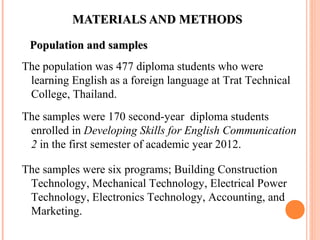
The population was 477 diploma students who were 
learning English as a foreign language at Trat Technical 
College, Thailand. 
The samples were 170 second-year diploma students 
enrolled in Developing Skills for English Communication 
2 in the first semester of academic year 2012. 
The samples were six programs; Building Construction 
Technology, Mechanical Technology, Electrical Power 
Technology, Electronics Technology, Accounting, and 
Marketing.
MMAATTEERRIIAALLSS AANNDD MMEETTHHOODDSS 
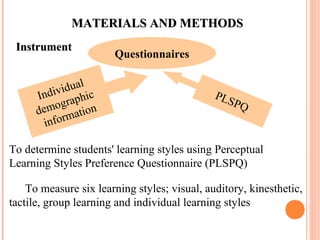
Questionnaires 
PLSPQ 
IInnssttrruummeenntt 
Individual 
demographic 
information 
To determine students' learning styles using Perceptual 
Learning Styles Preference Questionnaire (PLSPQ) 
To measure six learning styles; visual, auditory, kinesthetic, 
tactile, group learning and individual learning styles
Perceptual Learning Styles 
1) Visual Style: Tendency to learn more effectively through 
visual perception. 
2) Auditory Style: Tendency to learn more effectively 
through auditory perception. 
3) Kinesthetic Style: Tendency to learn more effectively 
through whole-body movement.
4) Tactile Style: Tendency to learn more effectively through 
touch and hand-on activity. 
5) Group Style: Tendency to learn more effectively through 
working with others. 
6) Individual Style: Tendency to learn more effectively through 
working alone.
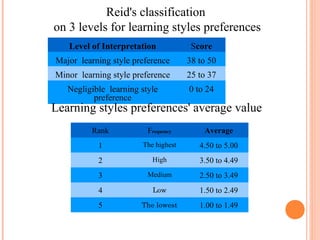
Reid's classification 
on 3 levels for learning styles preferences 
Level of Interpretation Score 
Major learning style preference 38 to 50 
Minor learning style preference 25 to 37 
Negligible learning style 
preference 
0 to 24 
Learning styles preferences' average value 
Rank Frequency Average 
1 The highest 4.50 to 5.00 
2 High 3.50 to 4.49 
3 Medium 2.50 to 3.49 
4 Low 1.50 to 2.49 
5 The lowest 1.00 to 1.49
Data Analysis and Statistical Procedures 
AAnnaallyyssiiss ooff RReesseeaarrcchh ttoooollss 
Validity and reliability of the research tools 
- A pilot questionnaire with 65 diploma students in 
three programs 
- Cronbach Alpha was 0.898. 
AAnnaallyyssiiss ooff rreesseeaarrcchh qquueessttiioonnss 
Descriptive statistics 
- Research question one : statistical procedures, arithmetic 
mean, and standard deviation 
- Research question two : One-Way ANOVA at a 
significance level of p<0.05
RESULTS AND DISCUSSION 
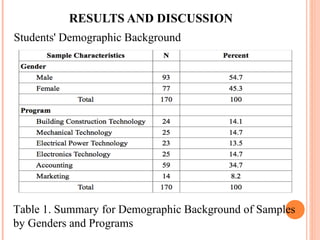
Students' Demographic Background 
Table 1. Summary for Demographic Background of Samples 
by Genders and Programs
Analysis of Research Question One 
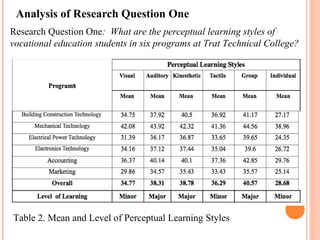
Research Question One: What are the perceptual learning styles of 
vocational education students in six programs at Trat Technical College? 
Table 2. Mean and Level of Perceptual Learning Styles
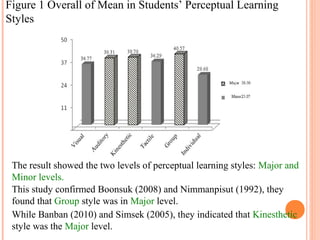
Figure 1 Overall of Mean in Students’ Perceptual Learning 
Styles 
The result showed the two levels of perceptual learning styles: Major and 
Minor levels. 
This study confirmed Boonsuk (2008) and Nimmanpisut (1992), they 
found that Group style was in Major level. 
While Banban (2010) and Simsek (2005), they indicated that Kinesthetic 
style was the Major level.
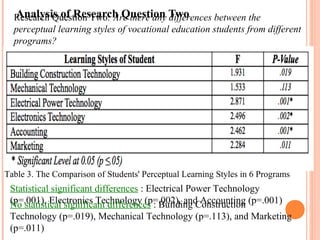
Analysis Research Q uoefs tRioens Tewaroc: hA rQe tuheerset iaonny Tdiwffeorences between the 
perceptual learning styles of vocational education students from different 
programs? 
Table 3. The Comparison of Students' Perceptual Learning Styles in 6 Programs 
Statistical significant differences : Electrical Power Technology 
(Npo= .s0ta0t1is),t iEcalel cstirgonniifcics aTnet cdhinffoelroegnyc e(sp =: .B0u0i2ld),i nagn dC Aonccstoruuncttiionng (p=.001) 
Technology (p=.019), Mechanical Technology (p=.113), and Marketing 
(p=.011)
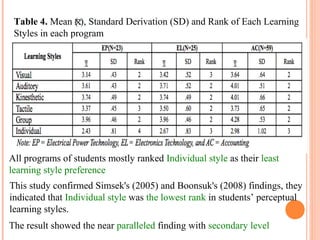
Table 4. Mean ( ), Standard Derivation (SD) and Rank of Each Learning 
Styles in each program 
All programs of students mostly ranked Individual style as their least 
learning style preference 
This study confirmed Simsek's (2005) and Boonsuk's (2008) findings, they 
indicated that Individual style was the lowest rank in students’ perceptual 
learning styles. 
The result showed the near paralleled finding with secondary level
CCOONNCCLLUUSSIIOONN 
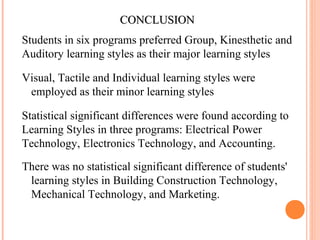
Students in six programs preferred Group, Kinesthetic and 
Auditory learning styles as their major learning styles 
Visual, Tactile and Individual learning styles were 
employed as their minor learning styles 
Statistical significant differences were found according to 
Learning Styles in three programs: Electrical Power 
Technology, Electronics Technology, and Accounting. 
There was no statistical significant difference of students' 
learning styles in Building Construction Technology, 
Mechanical Technology, and Marketing.
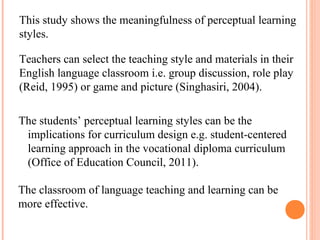
This study shows the meaningfulness of perceptual learning 
styles. 
Teachers can select the teaching style and materials in their 
English language classroom i.e. group discussion, role play 
(Reid, 1995) or game and picture (Singhasiri, 2004). 
The students’ perceptual learning styles can be the 
implications for curriculum design e.g. student-centered 
learning approach in the vocational diploma curriculum 
(Office of Education Council, 2011). 
The classroom of language teaching and learning can be 
more effective.
THANK YOU FOR YOUR ATTENTION

Icird paper 213

  • 1.
    PERCEPTUAL LLEEAARRNNIINNGG SSTTYYLLEESS OOFF VVOOCCAATTIIOONNAALL EEDDUUCCAATTIIOONN SSTTUUDDEENNTTSS AATT TTRRAATT TTEECCHHNNIICCAALL CCOOLLLLEEGGEE International Conference on Interdisciplinary Research and Development in ASEAN Universities 8-10 August, 2013 Imperial Mae Ping Hotel, Chiang Mai, Thailand Presented by Nattawut Matluang, Graduate Student, eric.nattawut@gmail.com Pattaraporn Thampradit, Associate Professor, tpattaraporn@yahoo.com Department of Applied Arts, Faculty of Industrial Education, King Mongkut’s Institute of Technology Ladkrabang (KMITL)
  • 2.
    PERCEPTUAL LLEEAARRNNIINNGG SSTTYYLLEESS OOFF VVOOCCAATTIIOONNAALL EEDDUUCCAATTIIOONN SSTTUUDDEENNTTSS AATT TTRRAATT TTEECCHHNNIICCAALL CCOOLLLLEEGGEE  INTRODUCTION  MATERIALS AND METHODS  RESULTS AND DISCUSSION  CONCLUSION
  • 3.
    IINNTTRROODDUUCCTTIIOONN One ofthe significant languages in the world is definitely English language (Hou, 2009). English is official language in more than 50 countries (CIA, 2012) Educational Improvement in the 2nd Decade of Education Reform (2011-2018) on English ability (OEC, 2011) Student should be aware of their learning styles which teachers need to guarantee this (Pask, 1977)
  • 4.
    IINNTTRROODDUUCCTTIIOONN ((CCoonntt..)) Teachersneed to assess the learning styles of their students Knowing students' learning styles is significant in learning. Only Nimmanpisood (1992) and Buranarek (2002) studied the learning styles in English language on certificate vocational students. No research emphasized on diploma vocational students' perceptual learning styles in Thailand
  • 5.
    RReesseeaarrcchh QQuueessttiioonnss Whatare the perceptual learning styles of vocational education students in six programs at Trat Technical College? Are there any differences between the perceptual learning styles of vocational education students from different programs?
  • 6.
    OObbjjeeccttiivveess ooff tthheeSSttuuddyy To investigate the perceptual learning styles of the vocational education students in six programs at Trat Technical College. To compare the perceptual learning styles of vocational education students from different programs at Trat Technical College.
  • 7.
    MMAATTEERRIIAALLSS AANNDD MMEETTHHOODDSS PPooppuullaattiioonn aanndd ssaammpplleess The population was 477 diploma students who were learning English as a foreign language at Trat Technical College, Thailand. The samples were 170 second-year diploma students enrolled in Developing Skills for English Communication 2 in the first semester of academic year 2012. The samples were six programs; Building Construction Technology, Mechanical Technology, Electrical Power Technology, Electronics Technology, Accounting, and Marketing.
  • 8.
    MMAATTEERRIIAALLSS AANNDD MMEETTHHOODDSS Questionnaires PLSPQ IInnssttrruummeenntt Individual demographic information To determine students' learning styles using Perceptual Learning Styles Preference Questionnaire (PLSPQ) To measure six learning styles; visual, auditory, kinesthetic, tactile, group learning and individual learning styles
  • 9.
    Perceptual Learning Styles 1) Visual Style: Tendency to learn more effectively through visual perception. 2) Auditory Style: Tendency to learn more effectively through auditory perception. 3) Kinesthetic Style: Tendency to learn more effectively through whole-body movement.
  • 10.
    4) Tactile Style:Tendency to learn more effectively through touch and hand-on activity. 5) Group Style: Tendency to learn more effectively through working with others. 6) Individual Style: Tendency to learn more effectively through working alone.
  • 11.
    Reid's classification on3 levels for learning styles preferences Level of Interpretation Score Major learning style preference 38 to 50 Minor learning style preference 25 to 37 Negligible learning style preference 0 to 24 Learning styles preferences' average value Rank Frequency Average 1 The highest 4.50 to 5.00 2 High 3.50 to 4.49 3 Medium 2.50 to 3.49 4 Low 1.50 to 2.49 5 The lowest 1.00 to 1.49
  • 12.
    Data Analysis andStatistical Procedures AAnnaallyyssiiss ooff RReesseeaarrcchh ttoooollss Validity and reliability of the research tools - A pilot questionnaire with 65 diploma students in three programs - Cronbach Alpha was 0.898. AAnnaallyyssiiss ooff rreesseeaarrcchh qquueessttiioonnss Descriptive statistics - Research question one : statistical procedures, arithmetic mean, and standard deviation - Research question two : One-Way ANOVA at a significance level of p<0.05
  • 13.
    RESULTS AND DISCUSSION Students' Demographic Background Table 1. Summary for Demographic Background of Samples by Genders and Programs
  • 14.
    Analysis of ResearchQuestion One Research Question One: What are the perceptual learning styles of vocational education students in six programs at Trat Technical College? Table 2. Mean and Level of Perceptual Learning Styles
  • 15.
    Figure 1 Overallof Mean in Students’ Perceptual Learning Styles The result showed the two levels of perceptual learning styles: Major and Minor levels. This study confirmed Boonsuk (2008) and Nimmanpisut (1992), they found that Group style was in Major level. While Banban (2010) and Simsek (2005), they indicated that Kinesthetic style was the Major level.
  • 16.
    Analysis Research Quoefs tRioens Tewaroc: hA rQe tuheerset iaonny Tdiwffeorences between the perceptual learning styles of vocational education students from different programs? Table 3. The Comparison of Students' Perceptual Learning Styles in 6 Programs Statistical significant differences : Electrical Power Technology (Npo= .s0ta0t1is),t iEcalel cstirgonniifcics aTnet cdhinffoelroegnyc e(sp =: .B0u0i2ld),i nagn dC Aonccstoruuncttiionng (p=.001) Technology (p=.019), Mechanical Technology (p=.113), and Marketing (p=.011)
  • 17.
    Table 4. Mean( ), Standard Derivation (SD) and Rank of Each Learning Styles in each program All programs of students mostly ranked Individual style as their least learning style preference This study confirmed Simsek's (2005) and Boonsuk's (2008) findings, they indicated that Individual style was the lowest rank in students’ perceptual learning styles. The result showed the near paralleled finding with secondary level
  • 18.
    CCOONNCCLLUUSSIIOONN Students insix programs preferred Group, Kinesthetic and Auditory learning styles as their major learning styles Visual, Tactile and Individual learning styles were employed as their minor learning styles Statistical significant differences were found according to Learning Styles in three programs: Electrical Power Technology, Electronics Technology, and Accounting. There was no statistical significant difference of students' learning styles in Building Construction Technology, Mechanical Technology, and Marketing.
  • 19.
    This study showsthe meaningfulness of perceptual learning styles. Teachers can select the teaching style and materials in their English language classroom i.e. group discussion, role play (Reid, 1995) or game and picture (Singhasiri, 2004). The students’ perceptual learning styles can be the implications for curriculum design e.g. student-centered learning approach in the vocational diploma curriculum (Office of Education Council, 2011). The classroom of language teaching and learning can be more effective.
  • 20.
    THANK YOU FORYOUR ATTENTION